






Abstract
This study examined practices and collection development policies that reduce the environmental impacts of the adoption of information and communications technology (ICT) in selected university libraries in Kwara State, Nigeria. The study adopted a multiple-case-study research design. The findings showed that the available ICT facilities in the selected university libraries include computers, printers, scanners, projectors, photocopiers, CD-ROMs, servers and Internet facilities. The results showed that the ICT facilities that consume a high level of energy/power include printers, photocopiers and computer systems. The results showed that the libraries do not have stated collection development policies that consider the environmental impacts of the acquired ICT facilities, and the common practice of the selected university libraries is the adoption of solar energy to power ICT facilities. The findings showed that the challenges associated with the use of ICTs include technological upgrade, inadequate funding, inadequate management support, erratic power supply and difficulty in repairing faulty ICT facilities.
Keywords
Introduction
Generally, the advent of information and communications technologies (ICTs) has changed the paradigm of information service delivery. Many core functions of libraries have been ICT-enabled to ensure efficiency. Onuoha and Obialor (2020) argue that the adoption of ICTs in university libraries has brought about the maximum utilisation of all the technologies that enable the handling of information in various formats within the library. Thus, all activities involving information management, processing and organisation have been designed to be enhanced by ICT. Supporting this assertion, Franque et al. (2021) note that the expectation of users from any information-providing system is to make information readily available. Remote service provision has further entrenched the need to adopt one or more ICT products in various university libraries.
There has not only been regional environmental pollution and ecological destruction in many developing countries, but also large-scale global environmental crises that threaten the survival and development of all humankind (Singh and Singh, 2017). Moreover, while the ICT industry is booming, the rapid development that has been witnessed in all sectors – including university libraries – since the 1990s has brought serious global environmental problems (Zhang and Wei, 2022). The negative impacts of ICTs refer to the effect of information technology on the environment and climate change. These negative impacts of ICTs are related to their energy consumption and carbon dioxide emissions (Haldar and Sethi, 2022). The increase in environmental deterioration has placed the responsibility on libraries to engage in environmentally friendly practices, especially in reducing their greenhouse emissions and carbon footprints, following the advancements in using ICTs for the provision of library services (Adeyemi et al., 2024).
Generally, every library is mirrored through its collections and capacity to address the information needs of its users. This makes collection development a crucial part of libraries. Adeyemi et al. (2025a) note that environmentally friendly library practices are essentially eco-friendly practices. Meanwhile, the proliferation of eco-friendly practices should be integrated into the design and implementation of collection policies (Jones and Wong, 2016). Some studies have focused on the importance of green collections to enhance environmentally friendly practices and ensure sustainable library practices (Adeyemi et al., 2025a; Vaidya, 2018). Douglas (2011) advocates for the need for the continuous revision of collection development policies in the rapidly changing environment. This underscores the need to implement policies that will embed eco-friendly practices and ultimately reduce the carbon footprint of university libraries, especially in the digital age.
Faulkner et al. (2021) note that library policy documents mostly focus on resources in an effort to protect the environment, and they emphasise that those facts that are most often considered are facilities, electricity, water and pollution. They further state that there is a need to understand work-related activities, such as collection development policies and library practices. Fedorowicz-Kruszewska (2019) recommends that libraries should work to fulfil their objectives in respect of sustainable development, which accentuates the need to ensure that libraries are intentional about sustainable library practices. Namagembe (2021) recommends that libraries should intentionally design standard practices that will ensure that only environmentally efficient resources are acquired. Ziemba (2019) concludes that the ICT infrastructure affects sustainable practices in the information society. This suggests that having eco-friendly practices towards ICT adoption and acquisition may be important in reducing its environmental impact in university libraries.
In the context of developing countries such as Nigeria, it has been established that there has been a widespread adoption of ICT in carrying out different library services (Ubogu, 2019). However, it is unknown what the direct implications of this are for the immediate and extended library environment, especially from the perspective of librarians. More crucially, Avom et al. (2020) recognise that ICT adoption has a direct effect on carbon emissions through energy consumption in sub-Saharan Africa. Meanwhile, Adeyemi et al. (2024) demonstrate that the use of ICT in university libraries contributes significantly to energy consumption. This has left a gap in the understanding regarding how library practices and collection development policies are crucial in understanding how these environmental impacts can be reduced. Based on the foregoing, this study seeks to investigate the library practices and collection development policies that have been employed to reduce the environmental impacts of ICT adoption in selected university libraries in Kwara State, Nigeria.
Statement of the problem
University libraries are responsible for the provision of library and information services to their users, which used to be mainly provided in a traditional way. Since the introduction of ICTs, there has been the growing adoption of different ICT tools in library and information centres for effective library service provision. This has enabled services such as online public access catalogues, discovery systems, virtual reference services, virtual library services, electronic reference services and other digital library services (Adeyemi et al., 2025b). The shift to ICT-based library services has positioned university libraries to fulfil their mandate in supporting learning, research and community development in the contemporary age. Meanwhile, the resources that are used to provide ICT-based services are acquired through collection development policies. It has, however, been shown that in the current ICT-driven delivery of information, there is a continuous increase in the environmental impacts of ICT adoption (Avom et al., 2020).
Studies have shown that there has been less attention paid to ensuring green library practices in university libraries in developing countries, especially Nigeria (Adeyemi et al., 2024; David-West and Wali, 2023). This could lead to a devastating effect on the environment. It is therefore anticipated that if these problems are adequately addressed, it will likely enhance sustainable library practices. Adeyemi et al. (2024) have shown evidence of green library practices in university libraries in Kwara State, while Alabi (2020) shows that there is a need for continuous environmental consciousness in public and academic libraries. These two studies, however, do not indicate the library practices and collection development policies employed by librarians in the reduction of the environmental impacts of ICT adoption. It is therefore necessary to investigate practices and strategies that reduce the environmental impacts of ICT adoption in selected university libraries in Kwara State, Nigeria.
Research questions
The findings of this study will provide answers to the following research questions:
What are the types of ICT facilities available in the selected university libraries in Kwara State? What are the energy-consuming ICT facilities in the selected university libraries in Kwara State? What are the collection development policies employed to reduce the environmental impacts of ICT adoption by the selected university libraries in Kwara State? What are the practices adopted by the selected university libraries to reduce the environmental impacts of ICT adoption? What are the challenges faced in the usage of ICT in the selected university libraries in Kwara State?
Scope of the study
The aim of this study is to examine practices and collection development policies that reduce the environmental impacts of ICT adoption in selected university libraries in Kwara State. Thus, the study's subject scope is the library practices and collection development policies that reduce the environmental impacts of ICT adoption in university libraries. The study is limited to the University of Ilorin Library (Ilorin), Kwara State University Library (Malete) and Al-Hikmah University Library (Ilorin). These universities were chosen because they represent federal government-owned, state government-owned and private-owned universities, respectively. Owing to the qualitative nature of this study, the findings are not generalisable. They are specific to the selected university libraries in Kwara State, Nigeria.
Review of related literature
Types of ICT facilities in libraries
Agim et al. (2018) show that ICT facilities include scanners, printers, online public access catalogues, intercoms, CD-ROMs, computers, flash drives, local area networks, wide area networks, modems and an uninterrupted power supply. Their study concludes that scanners, printers, CD-ROMs, computers, flash drives, local area networks, wide area networks, modems and an uninterrupted power supply are available at the Federal Polytechnic Nekede Library, while online public access catalogues, radios, phones, television sets, intercoms and fax machines are not. Ezekwe (2019) reveals that the ICT technology available at universities in Anambra State, Nigeria, includes printers, scanners and photocopiers. Ezekwe’s study concludes that ICT resources were available and used for a favourable library service.
Kumar (2015) shows that the Rayalaseema Region of Andhra Pradesh's Engineering Institute makes ICT facilities and services available for students’ use. The study shows that the majority utilised Pentium IV workstations (72.84%) and Windows XP (87.13%) to access library resources. It was found that most of the libraries (60%) in the studied area were automated, with barcode methods, and a variety of hardware facilities, such as rack, tower, blade and server enclosure, are included in the data. The study demonstrates that Pentium IV, AMD Athlon, dual-core workstations, laptops, portable hard drives, scanners, printers, modems, webcams, closed-circuit cameras, an uninterrupted power supply and liquid-crystal-display projectors are among the equipment in the workstations used as ICT facilities in the library. While all of these studies show the available ICT infrastructure in college libraries, they provide no evidence on their environmental impact or how its negative effect can be reduced.
Okonkwo and Eruwe (2020) examined the ICT-based information resources available in southern Nigeria's colleges of education. Their findings show that the six college of education libraries that were studied had CD-ROMs, Internet facilities, databases, projectors, telephones, local area networks, email, modems, printers, televisions and flash drives. Their study focused only on the southern region of Nigeria and provides evidence on only the observed ICT tools and/or infrastructure in the selected libraries. Ezecheta (2022) shows that the available ICT facilities in Rhema University, Aba, Abia State, Nigeria, include computers, reprographic devices, online databases, e-books, Internet connectivity and an online catalogue. It is further shown in Ezecheta’s study that the library did not have telephones, projectors or cameras.
Hussain et al. (2021) reveal that most of the public libraries in Khyber Pakhtunkhwa, Pakistan, have databases, microfilm readers, barcode readers, external hard drives, digital cameras, televisions and multimedia projectors. Their findings were limited to what was obtainable in public libraries, which are not in the same category as the university libraries that are the focus of the current study. Oriogu et al. (2014) show that the ICT facilities available in Babcock University Library, Ilishan-Remo, Ogun State, Nigeria, comprise computers, the Internet, email, printers, an uninterrupted power supply and photocopiers. In a review by Mishra and Mishra (2014), it was established that the ICT facilities used in university libraries include barcode technology, bulletin board systems, document scanning services, database services, e-journals, email, institutional repositories, library retrieval systems, library websites, networking technology (wide area and local area networks) and online public access catalogues.
Aniekwe et al. (2022) investigated the availability and utilisation of ICT resources in the management of students with special needs in academic libraries in Enugu State, Nigeria. The evidence from their study shows that the ICT resources available in the libraries include Twin Vision books, talking books, induction loops, compact discs (CDs), DVDs and computers with adjustable keyboards. Choudhary and Mukut (2017) evaluated ICT infrastructure and applications in selected academic libraries of the Cachar district in India, using Assam University, Silchar, as a case study. They found that the available ICT facilities are closed-circuit television cameras, barcode readers, barcode printers, workstations, laser printers, scanners, projectors, photocopiers and servers.
Energy-consuming ICT facilities
Adeyoyin et al. (2019) reveal that ICT penetration is hampered by the absence of energy in Nigerian university libraries. Their study reveals that there is a need for alternative energy sources, such as solar electricity, to power some ICT facilities in libraries – for example, computers, servers, the necessary cooling systems to prevent overheating, digital catalogues, databases and online lending systems – and provide continuous access to information. This indicates that university libraries are positioned to consume high energy except solar energy is considered as it has potential to reduce high energy consumption. Chang et al. (2022) show that the ICT facilities that consume energy in libraries are database servers, radio-frequency identification systems, lighting systems, networking equipment and air-conditioning units. Adeyemi et al. (2024) show that the extent to which libraries adopt ICT determines the size of their carbon footprint.
Biswas (2021) indicates that academic libraries use computers, CD or DVD drives (consuming about 20 to 30 watts of electricity) and hard drives (consuming between 15 and 30 watts of electricity). On the other hand, non-renewable and non-biodegradable CD-ROMs and DVD-ROMs also pollute the environment. To reduce the environmental impact, there may be a need to use pen drives or flash drives as an alternative option for data storage and transmission in academic libraries. This is because flash drives store data without moving parts, which makes them less likely to fail as they generate very little heat. In a study that adopted mobile phone subscription and Internet users as proxies for ICT, Charfeddine and Umlai (2023) investigated whether ICT and renewable energy enhance environmental quality, focusing on the Middle East and North Africa. Their results show that ICTs had a first-order effect on carbon emissions. Their findings indicate that the environment is better off when more renewable energy is used.
Bekaroo et al. (2016) demonstrate that there has been a significant increase in the usage of ICT, which has had a severe influence on the environment and a knock-on effect on society. To mitigate this issue, all ICT users should utilise ICT in an environmentally responsible manner. Pesch et al. (2017) reveal that a discrepancy between accessible energy sources. Also, it was shown that the energy needs of portable and mobile ICT systems were improved through energy-harvesting technology and minimised energy dissipation during computing. Their study demonstrates that libraries can enhance their sustainable practices through the use of energy technologies for lighting, reduce server, cloud computing and visualisation. This indicates that the use of energy-consuming devices can reduce paper usage in university libraries. Malmodin et al. (2014) establish that energy is often consumed in the application of ICT in data centres and shared data transport networks.
Bello et al. (2013) demonstrate that the consumption of energy by ICT facilities is significant in providing access to information and supporting innovation, research and learning in Nigerian universities. Their study indicates that energy-consuming ICTs include multimedia projectors, Internet access, photocopiers, laptops, scanners and printers. These ICT tools require a significant amount of power to operate, and service provision may increase energy consumption among librarians. Germani et al. (2016) reveal the goal to establish a new technique that uses life cycle assessment to evaluate the effects of industrial processes within the current ‘plan, do, check, act’ approach. Their study shows that the use of energy-efficient facilities cuts expenses and reduces waste through the implementation of sustainable end-of-life policies and maximising the use of energy and resources.
Collection development policies to reduce the environmental impact of ICT adoption
Over a decade ago, Connell (2010) advocated for the incorporation of environmental considerations into the selection of library resources. Connell highlighted that libraries should consider selecting resources or items whose content discusses green practices, introducing a deselection procedure that emphasises the reuse or recycling of materials, and selecting resources that reduce the carbon footprint of the library. In addition, Aulisio (2012) underscored the importance of collection development librarians understanding sustainability practices, so that they can make decisions that will entrench sustainable practices and support sustainability initiatives. Solemanpharcy and Gaffar (2023) explore the role of the green library in meeting sustainable development goals and environmental education, and found that libraries incorporate sustainable practices in curating library collections with an environmental focus.
In an attempt at an eco-friendly library, Jones and Wong (2016) report that the Chinese University of Hong Kong Library, in its collection development policy, designed and implemented an ‘electronic-preferred policy (e-preferred policy)’, which reduces the need for storage space and enhances eco-friendly practices. Baxter et al. (2016) show that an efficient collection development policy places a high priority on sustainability across the whole lifetime of ICTs in order to lessen the environmental impacts of ICT adoption. Their study reveals that organisations should give preference to suppliers that use environmentally friendly procedures and provide recycling or take-back options for obsolete equipment. Chaputula and Kanyundo (2014) indicate that a policy on the environmental impacts of ICT can be created through the implementation of sustainable procurement, energy management, e-waste management, digital collections, user education, monitoring and evaluation, and policy review.
Aside from libraries and information centres, different organisations have also been adopting acquisition policies that adhere to or align with eco-friendly practices. This is to enhance or support climate change. For instance, Islam et al. (2017) indicate that a strong correlation between financial performance and procurement practices in the ICT industry is intricate, costly and time-consuming. Mansi and Pandey (2016) reveal that Malaysian businesses are using electronic acquisition methods, with an emphasis on environmentally friendly acquisition methods. Their study also reveals that e-acquisition technology and green acquisitions are used to reduce the environmental impact of ICT adoption. Waithaka and Kimani (2021) show that effective acquisition strategies lessen the environmental effect of ICT adoption and comprise the acquisition of low-carbon resources, practices promoting sustainable materials and the implementation of energy-efficient practices.
Odongo and Kazungu (2022) establish that explicit environmental standards for vendors and goods, such as adherence to reputable environmental certifications (such as ENERGY STAR and EPEAT), are essential components of successful acquisition strategies. Their study further reveals that these regulations could mandate that environmental performance be taken into account when evaluating and choosing ICT providers. Parikka-Alhola and Nissinen (2012) reveal that organisations must have procurement strategies that minimise the environmental effects of adopting ICT to meet sustainability targets. Their study shows that these regulations lead to low carbon footprints throughout the course of ICT adoption and energy efficiency. The study shows that environmental standards supporting suppliers (in the library context, vendors), requiring adherence to accredited environmental certifications and including environmental performance in the assessment procedure are all essential components of successful procurement strategies.
Practices used to reduce the environmental impact of ICT adoption
Chugh et al. (2016) reveal that the sustainable practices employed in libraries include cloud computing, virtualisation, energy-efficient hardware, power management tools, eco-friendly manufacturing, recycling initiatives, sustainable design and eco-friendly hardware to ensure proper e-waste disposal and effective energy consumption. Airenhour et al. (2019) found that green computing is useful in the long term as it provides twofold benefits – namely, fit (relative advantage, compatibility, triability and security) and viability (return on investment and asset specificity), information technology infrastructure, and information technology policy and regulations. Mwanzu et al. (2023) demonstrate that the environmental sustainability practices used by Kenyan libraries include evaluating metrics to improve performance and development, as well as upholding green library standards in compliance with the required monitoring. Their study implies that implementing sustainability policies should be considered in ICT adoption.
Radu (2016) reveals that environmental issues regarding the adoption and use of ICTs were at the infancy stage and users were becoming increasingly concerned about green ICT or green computing. Ibrahim et al. (2023) surveyed the impact of organisational, environmental, technological and human factors on the adoption of cloud computing for university libraries. Their findings reveal that cloud computing is revolutionising higher education, particularly in university libraries. Their results show that the practices employed to minimise the environmental impacts of ICT adoption in libraries include green purchasing policies, which can be used to provide eco-friendly services and impact ICT product life cycles. This is because recycling and refurbishment practices reduce waste and ensure e-waste management, facilitating the appropriate disposal and longer life of products through recycling and donation initiatives.
Abubakar (2022) reveals that technologies for smart buildings keep an eye on energy consumption; campaigns for user education inform employees and users about the environmental effects of ICT; green computing workshops provide instruction on energy-saving methods and the proper disposal of e-waste; and sustainability policies incorporate ICT management with environmental factors. The study concludes that continuous improvements are achieved through the regular monitoring and assessment of environmental effects. This means that there is a need to ensure that there is a periodic evaluation of energy use in university libraries. Majeed (2018) shows that greening ICTs help to include lower power consumption of ICT equipment (such as server, router and terminal device); typical abatement levers; ultra-lower power device, optical router and sleep mode; and creation of applicable green energy in the information technology unit.
Challenges faced in the use of ICT in libraries
Jain and Akakandelwa (2016) demonstrate that concerns about budgetary limitations, limited ICT infrastructure, inadequate library and information science courses, the slow adoption of open access materials, opposition to change, and problems importing books and periodicals are some of the major obstacles faced in the use of ICT in libraries. Mahwasane and Mudzielwana (2016) reveal that students utilise libraries through the use of ICT for user education, computer literacy and information retrieval techniques. Their study also reveals that students faced challenges, which include efficient management of ICTs, inadequate training of students, inconsistent adaptation to digital services, inadequate provision for equitable access to resources, inadequate compliance with intricate data protection, and the issue of the digital divide.
Ntui et al. (2017) show that the inefficient use of resources, high maintenance costs and a lack of finance are the biggest obstacles faced in the utilisation of ICT in university libraries in Cross-River State, Nigeria. Shastri and Chudasma (2022) reveal that most of the library professionals (77%) in Gujarat State, India, showed some concerns in using ICT, as resistance to change, infrastructural constraints, difficulties with content management and digital preservation, licensing and legal concerns, and user education and assistance can all impede the adoption of new technology in libraries. Gould and Gomez (2012) demonstrate that ICT in libraries improves the user experience, resource management and information access, but it also has pitfalls, such as the initial set-up, continuing maintenance, technical difficulties and compatibility concerns, which can put a strain on budgets, particularly in libraries with limited funding.
Kimani (2017) found that the challenges associated with the use of ICT include inadequate ICT infrastructure, inadequate staff training capabilities, staff attitudes towards technology adoption, inadequate government regulations and a lack of managerial commitment. Siddiquah and Salim (2017) found that the majority of students had challenges with issues including slow computer speeds, poor computer performance, virus threats, load shedding and limited Internet connection in the public sector universities of Lahore. Muslem et al. (2018) reveal that English as foreign language teachers’ lack of ICT training, inadequate resources, inadequate time and inadequate equipment, combined with unreliable Internet connections were challenges to the use of ICT.
Methodology
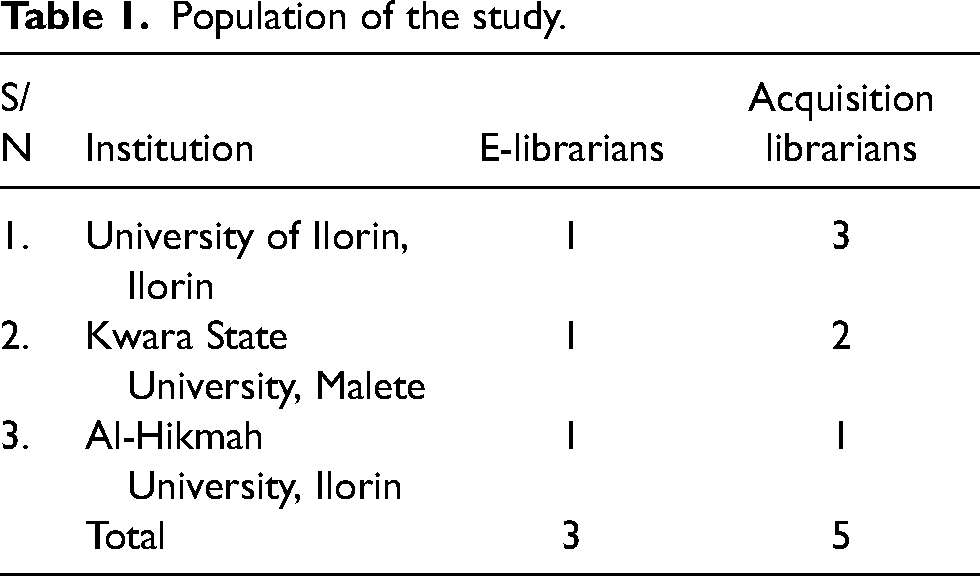
This study adopts a multiple-case-study research design, which is a type of exploratory research. This design uses a variety of methods to gather comprehensive data about real-world multiple bounded systems (cases) over an extended period of time (Creswell, 2013). In this study, the cases are the university libraries selected for the study, which are similar in service provision and user base. The population of the study includes the University of Ilorin (Ilorin), Kwara State University (Malete) and Al-Hikmah University (Ilorin; see Table 1). University libraries in Kwara State, Nigeria, were chosen for this study owing to the observed widespread adoption of ICT in their library services. Owing to the study's aim to assess library practices and collection development policies that reduce the environmental impact of ICT adoption, the population of the study comprises e-librarians and acquisition librarians, as they are considered to be the most appropriate to provide relevant information or data for the study.
Population of the study.
A purposive sampling technique was adopted in this study. The study purposefully selected participants who could answer the interview questions, which concern the practices and collection development policies that reduce the environmental impact of ICT adoption (see Appendix 1). The instrument used for the data collection was interviews. Open-ended questions were used in the interviews as a type of qualitative research approach to elicit detailed information from the participants (Mann, 2016). Interviews offer comprehensive, rich data and facilitate individual viewpoints and experiences. Therefore, the researchers were able to establish a rapport and trust through the interviews, which validates the data and enhances its trustworthiness. The interview sessions were recorded and saved on a CD-ROM to further entrench the trustworthiness of the data collected, and the researchers ensured that data saturation was achieved during the data collection phase.
A letter of introduction was presented to the heads of each division in the libraries where the data was collected in order to obtain permission to collect data for the study. Furthermore, the consent of the participants was sought and obtained before the interviews were conducted. The researchers collected the data physically in the participants’ offices, and the purpose of the study was conveyed to the participants before the data collection. The data collected was analysed using ‘a priori’ thematic analysis. Braun and Clarke's (2006) framework for thematic analysis was adopted for this study. This involves familiarisation with the interview transcript, initial coding, code categorisation, theme identification, refinement, interpretation and reporting to provide a rich understanding of the research topic. While the study is subjective in nature, the researchers ensured that possible researcher bias was reduced to a minimum. Three (Ismail Adeyemi, Gracious Otaru and Olanike Fashola) of the authors were involved in the data analysis process.
Results
From the data collected, a total of 265 codes were extracted, and these codes are presented under the five predetermined themes that align with the study's research questions. All of the participants were anonymised, using code names (Participants 1–8) to ensure confidentiality. All of the eight participants in the study had a minimum qualification of a Bachelor’s degree in Library and Information Science. Table 2 shows the demographic details of the participants.
Participants’ demographic information.
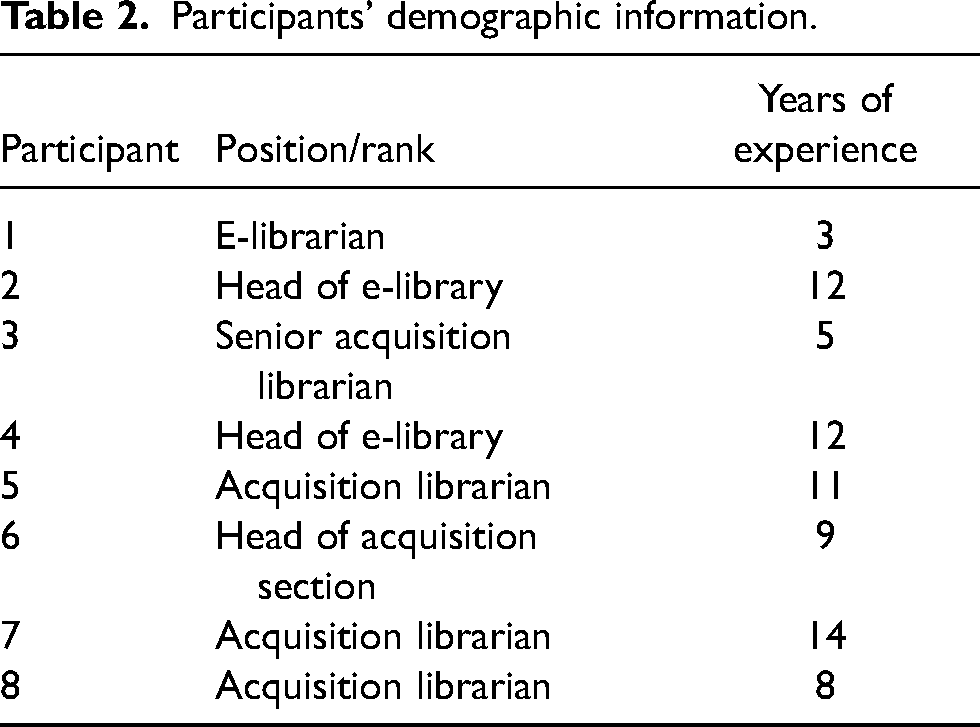
There were five participants (62.5%) working in the acquisition unit/department of their library, while three (37.5%) worked in e-libraries. While the questions were designed to elicit information to answer different research questions, it can be observed that more library personnel participated in this study. Also, the average number of years of experience of the participants was 9.25, which indicates that they had gained considerable experience in their jobs.
Types of ICT facilities available
It can be seen from the collected data that the available ICT facilities in the selected university libraries include computers, printers, scanners, projectors, photocopiers, CD-ROMs, servers and Internet facilities. According to Participant 1: ‘We have different types of ICT facilities, which include the computers, photocopiers, printers, scanners, etc.’. Participant 4 added: ‘The ICT facilities we have in our library include Internet facilities, computer facilities, and a server’. Meanwhile, the available ICT facilities were considered regular facilities by one of the participants. This indicates that academic libraries acquire ICT facilities that are basically for their needs and information services. Participant 5 noted: ‘[we have available] the regular ones – for example, computer and printer’.The data collected shows that the selected university libraries viewed the impact of the available ICT facilities on their library service provision positively. These facilities help them access electronic resources, aid in routine library operations, improve work efficiency and create space. As noted by Participant 2: It [ICT] has a lot of advantages in the library. Like the projector [sic], it helps us to project event and the activities in the library, and the computer helps us to do the library routine. In the e-library, for example, the computer is used to access the electronic resources.
Energy-consuming ICT facilities
Evidence from the data indicates that there are different types of ICT facilities in the selected libraries that consume a high level of energy/power. From the data, it was shown that the ICT facilities that consume a high amount of energy include large photocopiers, large printers and computer systems. This indicates that the larger the ICT facilities are, the higher the chances are of them consuming a lot of energy. In the words of Participant 3: ‘The facilities that consume energy and power is [sic] the computers, big printers and big photocopiers. They consume a lot of energy, especially the big photocopier machine’. Participant 1 remarked: ‘The photocopier machine [consumes a lot of energy]’.
Collection development policies to reduce the environmental impacts of ICT adoption
This question was answered by the acquisition librarians in the selected university libraries. The codes from the collected data showed that the selected libraries do not have a stated policy that considers the environmental impact of the ICT facilities they acquire in their libraries. In fact, emerging evidence from the data showed that the collection development policies in the selected university libraries were focused on paper-based resources. Participant 8 stated: ‘If you mean incorporating the environmental impacts of ICT facilities we want to acquire into our CD [collection development] policy, it is not yet a thing in our library. May be in the future, we may consider that’. Participant 3 commented: ‘Yes, we acquire materials based on people we are meant to serve. Al-Hikmah University policy is paper-based’. And Participant 6 responded: ‘No, they [collection development policies] deal mainly with paper-based [resources]’. Meanwhile, another category of evidence that emerged from the collected data is that the selected university libraries prefer to acquire electronic resources compared to paper-based resources. This implies that, when presented with the opportunity, the participants would choose to acquire electronic resources to be used alongside ICT facilities over paper-based resources. One emerging factor that determined this, based on the collected data, is the timely delivery of these resources compared to paper-based resources. According to Participant 3: ‘Yes [I prefer acquiring electronic resources] because acquisition of electronic resources is the best and its faster compared to the paper-based resources’. Participant 7 replied: ‘Yes, because we are in twenty-first century and the paper-based era is gone. And we are in twenty-first century where almost everything is done electronically. So there's nothing we can do even when you’re acquiring materials’.Furthermore, it can be seen from the collected data that the selected university libraries do not have written collection development policies that address sustainable procurement, energy management and e-waste management. However, it was indicated that some of the university libraries consider eco-friendly e-waste management. Participant 6 remarked: ‘No [sustainable procurement, energy management and e-waste management in the collection development policy] is not welcome; it has never been in place’. And Participant 7 added: ‘We consider that any disposal of electronic items that are no longer useful has to be properly disposed without causing problems to humans’.It can be seen from the collected data that the selected university libraries consider recycling, refurbishing and reusing before acquiring new resources. There was evidence from the data showing that the university libraries consider this because of the economic benefit and efficient budget management. Participant 7 responded: [An] example [is] when you are using a system that's no longer functioning. There must be part that's still functioning, so you can remove the one that is faulty and replaced it with the one that's functioning. That being said, so recycling and reusing before acquiring resources is allowed.
Practices adopted to reduce the environmental impacts of ICT adoption
It can be seen from the collected data that the most common practice adopted by the selected university libraries is the use of solar energy to power their ICT facilities. However, it was observed that the available solar energy is not adequate for the libraries, while some are preparing for its adoption: Yes, we use the solar panel, which is only available for the ground floor, which is not enough, so we are upgrading to the second floor of the library. (Participant 1) We have considered and we have solar energy, which is inverter. (Participant 2) Yes, currently going on but not yet completed [solar and inverter]. (Participant 4) Yes, we are working towards adopting a green library initiative by adopting eco-friendly technologies that will do away with generators, which is the back-up power supply, because of noise pollution. (Participant 5)
It can be inferred from the collected data that no tailored library services have been adopted to help with the reduction of the environmental impacts of ICT adoption in the selected university libraries. According to Participant 5: ‘They have not adopted any yet. Maybe with time they will, depending on the policymaker’. Participant 4’s response was: ‘Nothing, for now’.It can be seen from the data that the selected university libraries adopt virtualisation technology in the provision of library services. For instance, Participant 4 noted that their library uses Google Classroom and this kind of technology is adopted to enhance the accessibility of the library for users: ‘Yes, we use Google Classroom for the provision of library services’. This was also the case for Participant 2: ‘Yes, because it [virtualisation technology] allows the library to be more vital to people. It enables them to see the resources the library provides’.It can be seen from the collected data that the selected university libraries do not fully participate in the use of green ICTs for library service provision, with a limited budget being the reason for their inability to ensure full usage. In the words of Participant 4: ‘[We] partially [use green ICT] because there are limitations due to lack of funds’. Participant 5 noted: ‘30% out of 100% for now because they are still acquiring some of the facilities’.
Challenges faced in the usage of ICT
It can be seen from the collected data that there are different challenges faced in the usage of ICT facilities in the selected university libraries. The evidence shows that technology upgrades, a lack of funds, a lack of management support, an erratic power supply and difficulty in repairing faulty ICT facilities are the main challenges: We face a lot of challenges in the library and one of the challenges is the technology upgrading. Most of the computers we use in the library need to be upgraded and [we need to] buy new ones that can actually perform the task in the library. (Participant 2) The challenges we face are issues of power supply, lack of funds and lack of support from management. (Participant 4) Faults that come up are not faults that can be fixed in-house … an example is the radio frequency identification that developed a fault and can only be fixed in the company [where] they purchased it in China because they don’t have the parts here in Nigeria, and to do that it would cost approximately 20 million naira. (Participant 5)
Discussion
For Research Question 1, the findings of the study show that the available ICT facilities in the selected university libraries include computers, printers, scanners, projectors, photocopiers, CD-ROMs, servers and Internet facilities. This means that the selected university libraries do not have ICT facilities such as intercoms, flash drives, local area networks, wide area networks, modems and an uninterrupted power supply, which were found to be available based on a student-based survey at the Federal Polytechnic Nekede, Owerri, Imo State, Nigeria (Agim et al., 2018). This indicates that academic libraries acquire ICT facilities that are basically for their needs and information services. The findings of the current study are similar to those of Ezekwe (2019), which show that ICT facilities such as printers (for both colour and black-and-white printing), scanners (to digitise pictures and documents) and photocopiers (to create hard copies of documents) were available in universities in Anambra State, Nigeria. Similarly, Okonkwo and Eruwe (2020) show that southern Nigeria's colleges of education had CD-ROMs, Internet facilities, projectors and printers. The results show that the available ICT facilities help in accessing electronic resources, aiding routine library operations, improving work efficiency and creating space.
For Research Question 2, the results show that there are different types of ICT facilities in the selected libraries that consume a large amount of energy/power. It is shown that the ICT facilities that consume a high level of energy include large photocopiers, large printers and computer systems. This indicates that the larger the ICT facilities, the higher the chances of them consuming a lot of energy. In a dissimilar finding, Adeyoyin et al. (2019) show that ICT penetration in Nigerian university libraries is hampered by the absence of energy in the country. However, evidence from the current study suggests that there are high-energy-consuming ICT facilities in Nigerian university libraries. In another contradictory finding, Chang et al. (2022) reveal that the high-energy-consuming ICT facilities in libraries are database servers, radio-frequency identification systems, lighting systems, networking equipment and air-conditioning units. Moreover, Adeyemi et al. (2024) show that the extent to which libraries adopt ICT determines the size of their carbon footprint.
In respect of Research Question 3, the findings show that the selected libraries do not have stated policies that consider the environmental impact of the ICT facilities they acquire. The results show that the collection development policies in the selected university libraries are focused on paper-based resources. The findings also reveal that the selected university libraries prefer to acquire electronic resources rather than paper-based resources. This supports the findings of Jones and Wong (2016), which indicate that an implemented ‘electronic-preferred policy’ in a collection development policy reduces the need for storage space and enhances eco-friendly practices. The results show that the libraries do not have written collection development policies that address sustainable procurement, energy management and e-waste management. However, it was indicated that some of the university libraries are considering eco-friendly e-waste management. Chaputula and Kanyundo (2014) emphasise that libraries need to create policies to address the environmental impacts of ICT through the implementation of sustainable procurement, energy management and e-waste management. It can be seen from the collected data that the selected university libraries are considering recycling, refurbishing and reusing before acquiring new resources.
For Research Question 4, the findings show that the most common practice adopted by the selected university libraries is the use of solar energy to power their ICT facilities. This is similar to Radu's (2016) findings that this area is still in its infancy, and users are becoming increasingly concerned about green ICT or green computing. The results of the study show that the selected university libraries adopt solar energy to power their ICT facilities. However, it was observed that the available solar energy is not adequate for the libraries, while some are preparing for its adoption. Adeyoyin et al. (2019) have shown that the alternative energy provided by solar electricity to power some ICT facilities in libraries helps in the continuous provision of access to information. The findings show that there are no tailored library services to reduce the environmental impact of ICT adoption, and some of the libraries have adopted virtualisation technology in their library service provision. This negates the findings of Solemanpharcy and Gaffar (2023), which show that libraries incorporate sustainable practices in curating library collections with an environmental focus. The results show that the libraries do not fully participate in the use of green ICT for library service provision.
Lastly, for Research Question 5, the findings show that there are different challenges faced in the usage of ICT facilities in the selected university libraries. These challenges include technology upgrades, a lack of funds, a lack of management support, the erratic power supply and difficulty in repairing faulty ICT facilities. This differs from the findings of Jain and Akakandelwa (2016), which suggest that inadequate library and information science courses, the slow adoption of open access materials, opposition to change, and trouble importing books and periodicals are obstacles faced in the use of ICT in African libraries. The findings of the current study are similar to those of Ntui et al. (2017), which indicate that financial obstacles, the inefficient use of resources, high maintenance costs and a lack of finance are the biggest obstacles faced in the utilisation of ICT in university libraries in Cross River State, Nigeria. The results of the current study also differ from those of Shastri and Chudasma (2022), which show that library professionals in Gujarat State, India, faced challenges in using ICT as a result of resistance to change, infrastructural constraints, difficulties with content management and digital preservation, licensing and legal concerns, and user education.
Conclusion
This study has established that the available ICT facilities in the selected university libraries include basic ICT technologies like computers, printers, scanners, projectors, photocopiers, CD-ROMs, servers and Internet facilities. Out of these facilities, large photocopiers, large printers and computer systems are high-energy-consuming facilities. Meanwhile, it was recognised that there are no stated collection development policies regarding the reduction of the environmental impacts of ICT adoption in the selected university libraries. However, the study has established that the libraries consider recycling, refurbishing and reusing before the acquisition of new ICT facilities. This study concludes that the adoption of solar energy is a common practice among the university libraries to reduce the environmental impacts of ICT adoption. However, there are no specified library services tailored towards such. Meanwhile, the challenges faced by the selected university libraries in the use of ICTs include technological upgrades, inadequate funding, inadequate management support, an erratic power supply and difficulty in repairing faulty ICT facilities.
Implications
The findings underscore the need for university libraries to strategically align their ICT acquisitions with the specific needs of their institutions. Libraries should focus on obtaining essential ICT tools that enhance service delivery while being mindful of the environmental impact of these technologies. There is a pressing need for libraries to adopt a more comprehensive approach to sustainability by integrating eco-friendly practices, such as green procurement policies, energy-efficient technologies and e-waste management protocols. Additionally, the reliance on high-energy-consuming devices necessitates an immediate shift towards energy-saving alternatives and renewable energy sources, like solar power, to mitigate the carbon footprint of library operations. By prioritising these sustainable practices, university libraries can improve their operational efficiency while contributing to broader environmental goals.
For policymakers, it is imperative that university libraries develop and implement sustainability-focused collection development policies. These policies should not only address the acquisition of paper-based and electronic resources, but also encompass guidelines for sustainable ICT procurement, energy management and the disposal of e-waste. Libraries should be encouraged to adopt green ICT practices and explore alternative energy solutions to reduce their dependency on traditional power sources. Furthermore, addressing challenges such as inadequate funding, management support and technological upgrades requires comprehensive policy interventions that include government and institutional support for sustained investment in ICT infrastructure. This will ensure that libraries can maintain their role as vital academic resources while adapting to the evolving technological and environmental landscape.
Recommendations
The following are the recommendations of the study based on the findings:
University libraries should consider adding to their ICT facilities by acquiring, among other things, intercoms, local area networks, modems and an uninterrupted power supply. University libraries should ensure that they acquire smaller ICT tools that use less energy to reduce the environmental impacts of ICT adoption. Alternatively, they may consider large eco-efficient photocopiers and printers for their library services. University libraries should incorporate environmentally friendly policies like electronic-preferred policies, sustainable procurement, energy management and e-waste management into their collection development policies. University libraries should fully participate in green ICT to reduce the environmental impact of ICT adoption. University librarians and management should ensure that there are regular technological upgrades, the provision of funds, unalloyed support, an uninterrupted power supply and the effective repair of ICT facilities to enhance the use of these facilities by librarians. Future studies should consider complementing these qualitative insights with quantitative data, which can further enhance understanding by integrating collection development policies and ICT-related library practices to reduce the environmental impacts of ICT adoption in university libraries. Future studies should explore the national and/or regional trends regarding the reduction of the environmental impacts of ICT adoption in university libraries.
Footnotes
Acknowledgements
Thank you to all the heads of the university libraries who served as the focus of this study for their efforts and cooperation.
Data availability
The data sets used and/or analysed in the study are available from the corresponding author upon reasonable request.
Declaration of conflicting interests
The authors declared no potential conflicts of interest with respect to the research, authorship and/or publication of this article.
Funding
The authors received no financial support for the research, authorship and/or publication of this article.
