







Abstract
The role of the public library shifts through generations and how individuals experience it as place shape their relations to it. Through in-depth interviews with 37 individuals of different ethnicities and professions and born between 1961 to 2002, this study examined how individuals experienced Singapore public libraries across historical time. Findings revealed consistencies across intergenerational experiences of the library while highlighting changes in ways of accessing information with technological advancements and different life stage usage. In relation to factors that contributed to sense of place, three key themes emerged: (1) emotional attachments to place and function; (2) the materiality of space; and (3) familiarity through routines. The continued importance of the library as a provider of reading resources and implications for library design for diversity, multiplicity of use, access, wayfinding and thermal comfort are discussed.
Introduction
Between Singapore's independence in 1965 and 2024, Singapore's adult literacy rate rose from 26.1 to 97%. However, with global shifts towards disruptive technologies and artificial intelligence in the Fourth Industrial Revolution, ever higher levels of literacy are required to engage in twenty-first century consumption and work (Schwab, 2017). Within Singapore, where there is continued emphasis on lifelong learning, the National Library and public libraries are seen as core institutions to support Singaporeans’ needs for reading and learning. As institutions continue to design and implement their ambitious plans, how exactly do ordinary individuals perceive and engage with the libraries? In Spencer-Bennett and Grosvenor's (2021) study of children in library spaces, they argue that ‘looking to the past might be a good way of reflecting on the libraries of the future’ (p. 714) (also see Garnar and Tonyan, 2021 on academic libraries).
Through life history interviews with 37 Singaporeans, born between 1961 to 2002, this article seeks to give voice to library users by tracing Singaporean's intergenerational memories of the public library and what constitutes a sense of place for them. Listening to the voices of ordinary users allow us to understand the micro-practices within which official policies and institutional structures are responded to and utilised. The study offers a methodological and analytic lens for identifying and locating elements that constitute a sense of place. Focusing on intergenerational elements allow for identification of consistencies and changes across time, highlighting the institutional and social roles of the library across time.
List of interviewees (by age from oldest to youngest).
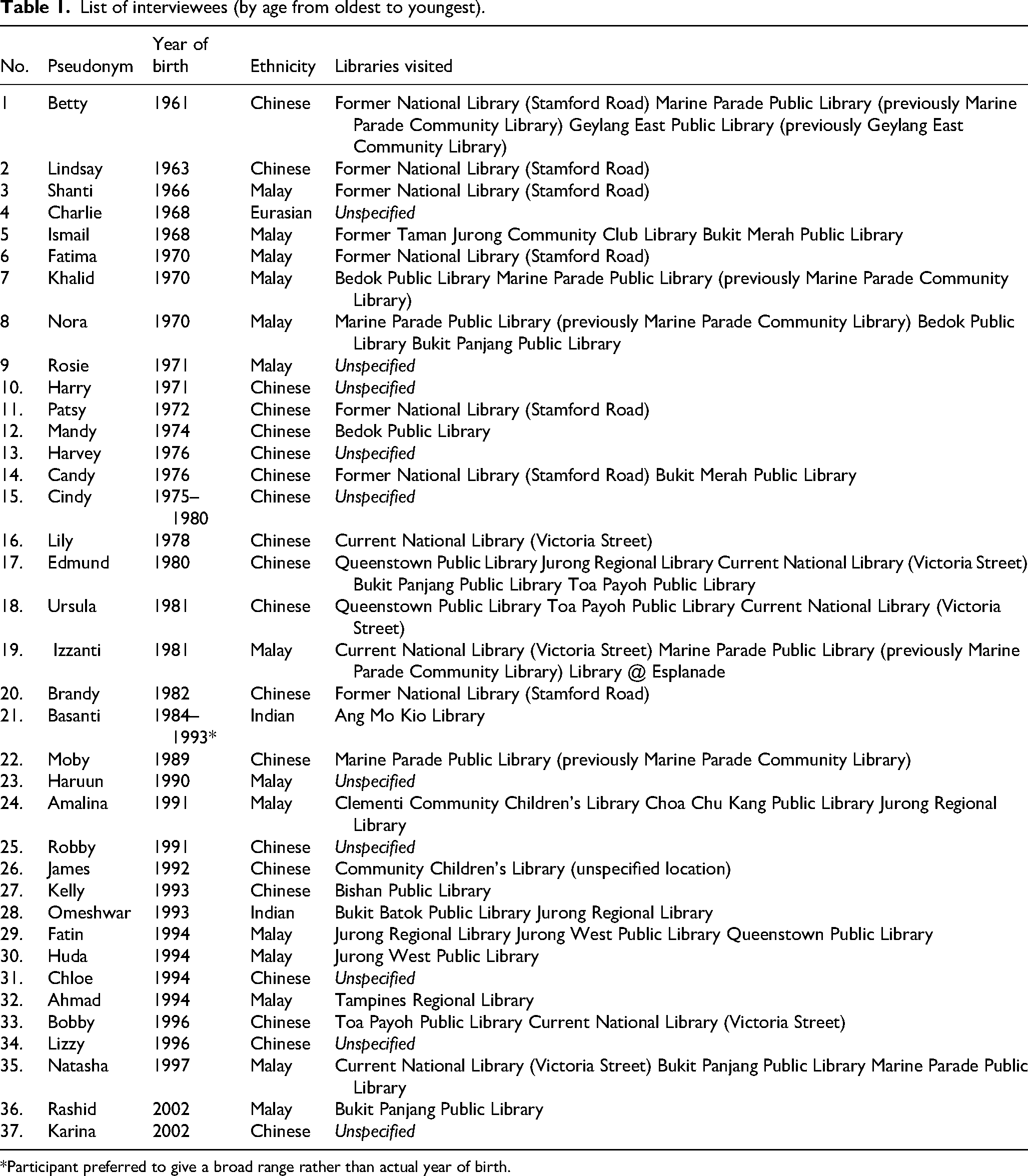
*Participant preferred to give a broad range rather than actual year of birth.
A brief history of the Singapore library system
We offer a brief macro-overview of how the Singapore library system has dramatically transformed and advanced over the decades to set the historical context. As Singapore broke away from the British empire in the 1960s, its first library, the Raffles Library and Museum, was rebranded as the National Library. The National Library democratised resources and became more accessible to the public, evolving from a ‘disseminator of knowledge from an intellectual heaven with the ambience of a mausoleum to a hub of cultural activity’ (Seet, 1983). In the 1970s, Singapore observed continued growth in literacy and student enrolment in English-medium schools (Kuo, 1983). Against the backdrop of an intellectually and socially developing nation, Singapore established its first full-time public library, Queenstown Library. This was followed by expanded services through mobile libraries, part-time branches at community centres and sizeable full-time branches at centrifugal points of new towns (Seet, 1983).
In 1995, the National Library Board (NLB) as a statutory board was established, allowing the government to centrally manage, oversee and coordinate national, public and government libraries in Singapore (Ramachandran, 1999). In 1994, the Library 2000 Investing in a Learning Nation masterplan (Library 2000 Review Committee, 1994) was implemented alongside the national education vision of ‘Learning to Think, Thinking to Learn’ (Ministry of Education, 1997) to foster academic excellence and a life-long passion for learning. To realise this ‘learning nation’ ambition, the NLB brought libraries even closer to families by embedding libraries in neighbourhoods and shopping malls, offering a wider range of collections, services and initiatives such as mobile library services, libraries built at void decks and community centres and a nationwide reading campaign, READ!. By 2004, library visitorship had increased by sixfold to 5.5 million in a decade (Johnston et al., 2007).
In the 2010s, globalisation and technologisation prompted national policy strategies towards developing a ‘Smart Nation’ (Lee, 2014). Physical and virtual library spaces were radically transformed to cater to multi-faceted and technologically savvy users. The NLB offered elevated library experiences through lifestyle libraries located in urban spaces like Orchard and Esplanade (Dresel et al., 2020) and digital services such as NLB Mobile, Overdrive and Libby that users could access from the comfort of their homes. The move to continuously enhance its digital offerings paid off tremendously as the NLB recorded a 150% increase in e-book loans during the Covid-19 pandemic (Bharade, 2020). The NLB's latest undertaking, the LAB25 Libraries and Archives Blueprint 2025 (2024), pivoted to citizen collaboration in enhancing library experiences by inviting partners and the community as stakeholders to participate in engagements and consultations to rethink libraries and archives.
Library as place
To better understand the experiences of library users, we draw from human geography's concept of ‘sense of place’ (Cross, 2001; Tuan, 1977) as a framework to shape our analysis. Place is defined by Agnew (1987) as
locale, of place setting for social interaction; location in geographical space; or sense of place, or attachment between people in place.
In this article, we are particularly concerned with place attachment, or people's specific relations to place and community, which comprise of their experiences in a particular setting and their feelings about that place (Cross, 2001; Lewicka, 2011). Zahnow (2024) highlights two aspects of place attachment: (1) place dependence, which ‘reflects the perceived importance of a place for maintaining a person's activities and lifestyle’, largely through the provision of ‘functional connections and experiences’; and (2) place identity, which comprises ‘the symbolic meanings and importance of a place to individuals’ (p. 448).
The library as a community space can hold multiple levels of meanings for individuals. At a public level, place can serve as public symbols to bind a community and society (Tuan, 1977). At a personal level, place serves as a reminder and symbol of an individual's repository of experiences tied to a specific location (Lewicka, 2011). The public library, as a public space available to all and having nurtured interest in reading and supported study for many Singaporeans (Lin and Luyt, 2014), may engender strong place attachments (Zahnow, 2024). Furthermore, with constant innovation to meet the growing information and technological needs of Singaporeans, the library is also symbolic of Singapore's transformation from a third-world country to a knowledge hub. However, the library is also very much a personal space, with significant memories for individuals.
At a personal level, place can be seen as ‘fields of care, understood as the invisible relationships that people have with the places they inhabit’ and ‘mediated by the different axes of identities that people have’ (Loh et al., 2021). Exploring the role of the public library in the reading lives of individuals through the Singapore Memory Project portal, Loh (2016) notes the generational memories of the library and the varied programmes that encouraged reading. For each person penning a memory in the portal, the memories of the library are personal and contextual, connected to specific libraries that they used to frequent and the people they would frequent the library with. Interviewing elderly visitors at the Toa Payoh library, Luyt and Ho (2011) found that senior citizens’ room in the library was a place of refuge and a ‘place of respite for [those] elderly individuals lacking air conditioning at home’ (p. 208). On the other hand, at Jurong Regional Library, the young people shared that the library was a social place where they could interact with their friends, study and obtain information and entertainment through books and diverse sources provided by the library (Lin et al., 2014). The young people's description of the library and their emotions in relation to it included: ‘quiet’, ‘pleasant’, ‘cool’ and ‘innovative design’, ‘impressive’, ‘playful’, ‘conducive’, ‘popular’, ‘comfortable’ and ‘safe’. For teens who chose to study in the library, they highlight the lack of distraction and safety of the library as conducive to supporting their studying.
The importance of the public library as place is illustrated by responses to the proposed closure and demolition of the former National Library at Stamford Road. Many Singaporeans, who had grown up with the library protested over its demolition to make way for the construction of a tunnel for vehicles. The emotional public outcry from usually reserved Singaporeans demonstrated the place attachment of individuals to the library. This place attachment or ‘sense of place’ highlights that place is not just a physical location but a ‘meaningful location’ (Cresswell, 2015: 12), often the repository of memories and experiences that can be both personal and public. Beyond the functionality of place that engenders place dependence, such place attachments are often tied to the materiality of the library, with regular users remembering the settings, objects and emotions of a well-used space. Writing about childhood memories of the library, Spencer-Bennett and Grosvenor (2021) highlight the library as ‘a relational space, where children have physical interaction with books, and in turn, with the ordering of knowledge’ (p. 711). The library is thus remembered as a physical space, filled with material objects, but also a symbolic space, associated with the development of literate child and of pleasure. Furthermore, Spencer-Bennett (2020) emphasises in her research on women using public library spaces that it is not just space but time that is essential to the understanding of everyday practices of library usage. Drawing on Lefebvre's (2004) concept of rhythm analysis, she demonstrates how repetitive visits of library visits with routinised actions can bring harmony and joy, create pockets of individual time for carers of young children and be ritualised over generations.
This study thus seeks to understand the individual experience of the library as place, and to make connections between the personal and public in place attachments. Through a life history approach, this study examines the following questions:
What are Singaporeans’ memories and sense of place of the public library across time? What are the factors that contribute to their sense of place?
Methods
A life history method focusing on the lived experiences of individuals is utilised for this study (Goodson & Sikes, 2001). Juxtaposing individual stories against the grand narratives of modernisation, globalisation and technologisation that have driven public library development offers insight into the ‘small stories’ (Olson and Craig, 2009) of everyday life, revealing how individuals experience library as place. While such small-scale studies do not offer representativeness, they allow us to connect personal experiences to broader sociocultural structural changes.
Convenience and snowball sampling techniques were used to generate a list of possible participants based on researchers’ networks (Patton, 2002). Purposeful sampling was used to obtain maximum variation and representation of individuals from different age groups, ethnicities and different occupations. The interviews were collected in three batches between 2021 and 2022. The concept of ‘information power’ (Malterud et al., 2016) proposes that researchers examine study aims, sample specificity, use of established theory, quality of dialogue and analysis strategy to determine sample size, together with the practicality of recruitment. In our case, utilising a two-interview protocol ensured the high quality of the data as researchers. Furthermore, the analytic strategy of reviewing and analysing the data reiteratively (described below) allowed the research team to evaluate insights reflexively at each stage of the data collection process.
For the purposes of the broader study, we categorise the interviewees into five generations: Pioneer Generation, Merdeka Generation, Young Seniors, Generation Y and Generation Z. These generational cohorts exist as part of Singapore's concerted effort to address the diverse needs of an ageing population. Recognition of the first two generations in particular, was raised and enacted in 2014 under the Pioneer Generation Fund and the Merdeka Generation Fund by the state. Its purpose was to provide financial and other support to Singapore's seniors born in these generations and for matters connected therewith (Singapore Statutes Online, 2014). While these generational categories typically have policy attachments, this research is inclined to adopt them as a proxy for tracking historical developments in Singapore, namely that of library systems, as these are the very realities individuals in the respective cohorts would have witnessed throughout their life stages. Pioneer Generation (b. on or before 1949) and Merdeka Generation (b. between 1950–1959) had limited accessibility to libraries and are not included in this analysis. While the Pioneer Generation grew up in post-World War II conditions of poverty, the Merdeka Generation grew up in a period of relative stability, yet social issues such as unemployment, unimproved living conditions, racial riots (Chua, 2002) and low literacy levels (Mokhtar, 2018) were still apparent. Below is a brief socio-political and socio-economic contextual description of the generational cohorts this article focuses on.
Young seniors (b. between 1960 and 1979)
These are individuals who have benefitted more from Singapore's years of rapid economic development, are more highly educated and generally in better health as compared with the previous generations. While the young seniors grew up in better conditions, this sandwiched generation is now ‘confronted by a triple dependency’ (Gee, 2023) of having to juggle caring for ageing parents and looking after their young adult children, while worrying about themselves (Bharade, 2023). These young seniors grew up at a time of public library expansion with the first full-time public library, Queenstown library, established in 1970.
Generation Y (b. between 1980 and 1994) and Generation Z (b. between 1995 and 2012)
While generation cutoff points and classifications are still undecided between the two generations, Generation Y or Millennials refers to individuals born between 1980 and 1994, and Generation Z refers to individuals born between 1995 and 2012. Generation Y grew up during a time of extraordinary technological advancements, which saw a rapid evolution in communication and political polarisation. They are also the most educated generation, according to the World Economic Forum (Neufeld, 2021). In Singapore, over half of Generation Y have college degrees and most are bilingual (Bharade, 2023). According to McKinsey and Company (2024), the Generation Z identity has been shaped significantly by the digital age. Other realities that surround the Generation Z identity include climate anxiety, a shifting financial landscape and the Covid-19 pandemic. They grew up in a period of rapid library expansion, with increased access to physical libraries and digital resources.
In total, two Pioneer Generation, one Merdeka Generation, 16 Young Seniors, 16 Gen Ys and five Gen Zs were interviewed for the study. For this article, we include the data from 37 Young Seniors, Gen Ys and Gen Zs.
Data collection and analysis
A one-to one interview conversation or ‘grounded conversation’ (Goodson and Sikes, 2001) shaped the interview, with the researcher focusing on questions to elicit the research participants’ memories of learning to read. Seidman (2006) three-stage interviewing process was adapted into a two-part interview, to build reflexivity into the research process. The first interview focuses on gathering a focused life history whereas the second interview probed for details of the experience. The interviews were audio recorded. The first interview was transcribed and discussed by the research team before the second interview was conducted. The second interview was also transcribed. As part of the reflexive cycle, researchers met at the end of the first interview to discuss emerging themes before proceeding with the second interview. This reiterative process was conducted throughout the data collection process.
Six researchers from the National Institute of Education, Nanyang Technological University (NIE, NTU), interviewed the participants between May 2021 and August 2023 in three stages. Chin Ee was involved in all three data collection stages whereas Tiara was involved in the third data collection stage and data analysis. All researchers were avid readers and NLB members. Except for Chin Ee, who had collaborated with the NLB on other reading research, none of the other researchers had working relationships with the NLB. The study was funded by NIE (RS1/21 Reading Mobilities and Futures: A Life History Study of Learning to Read) and received Institutional Review Board permissions (NTU IRB-2021-03-037). Consent was obtained from all participants who were also informed that they had the option not to share personal information if they preferred at the start of each interview. All interview data were anonymised for storage and transcription and stored in the university's secured OneDrive.
We followed Deterding and Waters’ (2021) recommendation of flexible coding for relatively large datasets (N > 30) by first indexing all references to libraries. Following an independent pre-coding and discussion among the authors, descriptive and in vivo coding was conducted using Dedoose, an online subscription qualitative data analysis tool. Upon discussion, the codes were reduced to themes and focused coding was applied to the data (Saldana, 2021). The authors continued reiterative coding and discussion until theoretical saturation was met. The key categories for focused coding were: (1) generational usage (childhood, adolescence and adulthood); (2) memories (emotions, functions, growing accessibility, regularity, others); and (3) sociomaterial (collections, environment, objects, people and tools, technologies and services).
In the presentation of the findings, we have chosen to give their birth year and occupation for contextual understandings.
Findings
The analysis of the interviews led us to realise the significance of time in understanding library utilisation and emotions towards the library as place. While some libraries were unspecified, contextual information from the participants, read together with development of Singapore libraries, allowed us a good sense of the kinds of libraries referred to.
To answer the first research question about Singaporeans’ memories and sense of place, two key themes emerge: (1) generational memories of the public library; and (2) life stages shaping library experiences. To answer the second question about factors that contribute to sense of place, three key themes emerged: (1) emotional attachments to place and function; (2) the materiality of space; and (3) familiarity through routines.
Generational memories of the public library
Reflecting the growing reach of the public library which had set up branches in town centres, more young seniors born between the mid-1970s and early-1990s were likely to recollect visits to public libraries, often on their own. A key theme was the lack of funds to buy books in newly developing Singapore and the role of the library in supporting young people's reading needs. James (businessman, b. 1992) was of the sentiment that ‘the libraries were considered a game changer’ because ‘books were considered a low priority in terms of spending’ was echoed by other participants. Nora (former journalist and teacher, b. 1970), a homemaker at the time of the interview, often visited the Marine Parade library, which opened in 1978 (Wong, 1999), with her cousin because ‘it was easy to get to from school’, with one direct bus route. Community libraries that were set up in the void decks of public housing also made the library more accessible for the younger generation. Amalina (copywriter, b. 1991), shared her fond memories of the Clementi community library and its resident librarian. It was really catered for kids, for parents to just leave their kids there if they have errands to do or if they’re busy at work. I remember being in the kids section a lot and flipping through picture books, and so on. I remember the librarian. She was an Indian lady who was very friendly. She looked out for me. She knew that I was there alone so she would come and talk to me once in a while.
For Gen Y or younger participants (born after 1980), accounts of library visits integrated into family routines even were more common, probably because of the increase of libraries in neighbourhood centres. Basanti (teacher, b. 1984–1993) recollected her library outings as embedded within other weekend activities. Just over the weekend, just go to the library, borrow books there, read some books, and then figure out which one we want to borrow and then go out and just have a normal family day, family meal after that. We would go and eat in the East before we visited our grandma and the library happened to be there, so we went to the library.
Simultaneously, there was also a sense of changing resources and experiences of the library, with accounts of utilisation of e-books and other technologies for reading. Harvey (software engineer, b. 1976), extolled the convenience of the technological and physical provisions of the library. It's so convenient. I don’t have to register my library card. I’ve never, I’ve never had to use my library card. I never have to borrow anything from the library since I have Libby. I even occasionally borrow magazines … it's a nice place to chill out. Like the Esplanade library. I’ve been inside the, VivoCity one as well ‘cause I thought the interior was really nice … the other day, I literally had a meeting with my colleagues in the library. There was an open area for people who just want to park there and do their work and stuff like that.
In these accounts of generational access to library services, we see the expanding and changing reach of the library both in physical and virtual spaces. Such shifts are iterative, with the core function of serving reading and community needs remaining constant. Transitions of collections to digital platforms and online spaces do not replace the need for print collections and physical spaces; rather, they co-exist as hybrid infrastructures to serve an increasingly literate population in an information-saturated world.
Life stages shaping library experiences
Libraries function as social and meeting spaces, serving diverse ‘high and low-intensive activities’ (Aabø and Audunson, 2012: 140). While participants gave varying responses about their frequency of visits to the library, we observed specific patterns of usage at various life stages. Particularly striking was how the library served as a reading space for younger children who may then transition into using the library as a study or research space in their adolescence and young adulthood. The analysis in this section also highlights the differential needs for library services and usage patterns at different life stages, affirming earlier research by Luyt and Ho (2011) and Lin et al. (2014) about usage patterns of seniors and young people.
Parents were particularly cognizant of their roles as reading models and brought their children to the library to feed their growing appetite for reading material. Edmund (asset management, b. 1980) reports library excursions as part of his family routine. While his family was well able to afford books at home, they made use of public resources to extend their children's reading resources. His account of using the library app on his mobile phone to secure book loans is reflective of the technological improvements that facilitated book access. Queensway, Jurong, National, Bukit Panjang, we have our regular haunts. I will have the app with all their three profiles on it and you can go around and zap all the books, and they are considered borrowed. Amazing. It was a very regular family affair … the one [library] at Toa Payoh … there's this really old traditional Dim Sum place next to the library where we would go for lunch.
Bringing children to the library was not a role limited to parents although they were the most likely role models. Sometimes, caregivers such as Rosie's (teacher, b. 1971) babysitter, Ursula's (librarian, b. 1981) neighbour and Mandy's (academic librarian, b. 1974) tutor brought children to the library.
These narratives emphasise the educational function of the public library in growing the literacy levels of Singapore, certainly a factor in the exponential improvement of Singapore's literacy rate over three generations. Such everyday ‘micro-practices’ (Giddens, 1991) give life to official and institutional dictates. Reading research has consistently demonstrated the value of leisure reading as a form of cultural capital correlated to reading proficiency and academic achievement (Notten and Becker, 2017; Sullivan and Brown, 2015), and the ability to utilise public resources for reading is a skill for independent and lifelong learning (Cunningham and Stanovich, 1998). The public library seemed to be recognised by many adults as a legitimate space for leisure, supporting literacy and educational functions, so much so that Haruun (healthcare engineer, b. 1990) would tell his parents he was visiting the library to obtain permission to go out with his friends. In reality, he visited the library but spend most of the time at the arcade in the same shopping mall where the library was situated. Such concepts of the library (Garnar and Tonyan, 2021), together with enacted everyday practices, contribute to a communal sense of place at national level.
The library also functioned as a study space for teenagers, and at this life stage, it was peers rather than family members who played significant roles in participants’ library encounters. Thus, Omeshwar (creative line, b. 1993), who used to visit the library to read and borrow books as a child found himself using the library space for group studying. My friends and I used to go to the Jurong East library where it was mainly for homework and revision, so we get to help each other out. Very minimum time spent on looking for new books or anything like that … it was more of a common quiet space where we needed to do our homework.
Other than studying, being able to look for research resources became important as participants moved into secondary school and post-secondary education. Candy (social enterprise founder, b. 1976) recounts the need to visit the library to conduct research for her school projects. Our school had a lot of projects for us. So, I do remember going down to the library a lot with my classmates and friends to do our projects, because we had to do research. The National library at Stamford Road, as well as the one at Bukit Merah. It was a little disappointing, in a sense, whereby the books there are not updated. That was in 2010 to 2013 … New technology was coming up and new ways of filmmaking were coming up but the books available, they were more content, or methods based on the 1990s or early 2000s. So, we didn’t have much printed materials when it comes to 2010 onwards. We had to rely heavily on Google and other search engines to give us more accurate information. I’m not sure if that was the same for other genres or sections but for the film section, it was a little outdated. I was doing a few things when I was given the task. I went to hit the shelves at the National library … I knew I was not going to get much from the public libraries. I need to get more research materials and thicker books. I went to the PWD persons with disabilities section, to the zeros zeros decimal place where there's just section on libraries. I went to pull out the books to read through them … Another one was to search the internet, find all the research materials I could get my hands on … I went to hit the archives of the IFLA articles, things that were presented a few years ago … then I also went to see what's locally available in terms of conferences.
Elements contributing to sense of place
In our analysis of the data for factors contributing to sense of place, three key themes emerged: (1) emotional attachments to place and function; (2) the materiality of space; and (3) familiarity through routines. Crucially, it is the interconnections between emotion, materiality and routines that strengthen place attachment.
Emotional attachments to place and function
For regular visitors to the library, there was a sense of nostalgia with the library attached to childhood memories of growing up, for example, with Nora (former journalist and teacher, b. 1970) stating that ‘[we] grew up going to the library’. Amalina (copywriter, b. 1991) called the library her ‘sanctuary’, a place where she ‘felt most comfortable’, associating the library as a place of discovery and unlimited access to reading material and entertainment possibilities (in the form of books and games). I loved it. It was my sanctuary. It was where I felt most comfortable. I really looked forward to after school when I know that I would have time to go there. I loved just wandering around the library alone and then discovering new books, new reads … there were some computers with some kids’ games. So, I looked forward to using the computer as well. Yeah, I was like a kid in a candy shop.
Lizzy (speech therapist, b. 1996) shared that she associated the library as ‘quiet and peaceful’ and found ‘happiness … walking into a place filled with books’ and where she could ‘discover new books to read’ and ‘read undisturbed’. Although she visits the library less as an adult, she ‘still like the libraries a lot’ and would visit occasionally when she has time. Ismail (supply chain manager, b. 1968), a latchkey child, went to the library ‘to hang out’ as his mother had to work shifts. He would just ‘read to make up time … then put it back’. Worried about fines should he forget to return the book, he decided that ‘the best thing to do is just read as much as you can, come back next day and read again … Until you finish.’ Library experiences differed at different ages. Thus, while Omeshwar (creative line, b. 1993) was ‘pretty excited’ about his library visits as a child, he did not enjoy going as much as a teenager as ‘it was so crowded at times’ and he was not always able to get the books he wanted. For the library, sense of place includes having a sense of fulfilment from having one's reading or learning needs met.
The library as a space for discovery of books was a recurrent theme. Having utilised the library as a teenager, Nora (former journalist and teacher, b. 1970) found herself bringing her own children to the library ‘seeking out children's books’ for them. In recent years, the NLB gamified borrowing for children by developing a Book Bugs concept (similar to Pokémon cards), where children could obtain tokens for books borrowed and exchange them for cards. Nora appreciates the ‘rewards system’ which is ‘good for children because it encourages them to read’. Programmes such as these also contribute to the sense of discovery and excitement for child users.
As the public library improved its digital systems and e-offerings, technological affordances and e-resources contributed to users’ sense of place, even when they were not able to visit the physical library premises. In earlier quotes, parents such as Nora (former journalist and teacher, b. 1970) and Edmund (asset management, b. 1980) spoke about the ease of borrowing in the physical library with the NLB app download on their phone. On the other hand, other participants, especially working adults, spoke about the ease of usage and easy availability to reading materials as part of their experiences of the library outside of the library space, highlighting the convergence of the physical and virtual in contributing to the development of positive emotions towards the library as a reading source. If you use Libby [library e-book app], you’d see the interface is so easy to navigate. From the loaning process to putting a hold on a book … It's very seamless, and very simple. (Huda, occupational therapist, b. 1994) I’m literally fully digital now. I actually have Libby on my iPad as well. But half the time, I actually spend reading on my phone. (Harvey, software engineer, b. 1976)
The materiality of space
The library as a space was associated with books and reading for younger children, with many participants remembering the number of books and the quality of the collection as significant to them. Lizzy (speech therapist, b. 1996) shared that the library was ‘a place filled with books’ and Omeshwar (creative line, b. 1993) remembered the ‘kid friendly stuff’. Ursula (librarian, b. 1981) describes the slow, almost indolent climbing of stairs at Toa Payoh library to the fiction section, where she would borrow books to bring home to read. I always remember that I hated the lift, even back then in secondary school (laughter) It was so slow. And I would take the stairs. I love the stairs, because it's so gentle, and so easy to climb. So I will always take the stairs up to level two. And that's where the Fiction section is. Oh, I love the Bedok library, because I always go there in my secondary school days. I love there because I will go after school. The moment you step in, you will see the bag check-in counter where you're supposed to leave your bags … Then after that, you have to pass through this narrow security gate, to go into the ground floor of the library. And the ground floor was the children’s section…Then you have to go up this wide staircase in the middle to level 2. And that's when it’s really quiet. And then, you see lots of, rows of tall shelves … because in the children's section are low shelves. On the right-hand side are the non-fiction. And then on the left-hand side are the fiction shelves which are lower. I always zoom in to the fiction shelves. And because they are arranged alphabetically, I will zoom in to my favourite author's section and start to look at the spine of the books to see are there any titles that catch my eye. Yeah, so I will spend like, a lot of time there (short laughter) hunting.
For frequent visitors, familiar shelves and organisational systems hiding potential new reads offered reassurance alongside excitement. Individuals chose to visit some libraries rather than others because ‘the set up was better, the collection was better’ (Nora, former journalist and teacher, b. 1970), ‘for an overall holistic reading experience’ (Izzanti, construction project manager, b.1981), ‘very nice, can just chill there’ (Ahmad, trainer, b. 1994). Thermal comfort added to the pleasant experience. Rosie (teacher, b. 1971) explained that ‘air-conditioning was a luxury’ in her time and reading and revising ‘for the crucial day of PSLE (Primary School Leaving Examinations), a high-stakes examination for 12-year-olds, needed to be ‘comfortable’. The library also provided her with ‘a form of escapism’ as her parents were going through a divorce in her upper primary years. The repeated accounts of bookshelves and thermal comfort emphasise the importance of these elements in creating the library's comfortable atmosphere.
The twin emotions of excitement and escapism seem to dominate childhood and adolescent memories of the library. Spencer-Bennett and Grosvenor (2021) note in their analysis of childhood memories of libraries that the sense of comfort, in the form of corners and nooks, stillness and quiet prevail in their images and accounts. The library as a space for ‘withdrawal and retreat’ is supported by ‘auditory properties’ (p. 707). Such memories of space are ‘sedimented’ (Pahl, 2008) into memories and embodied postures and behaviours within the library. The library as a secure and adult-approved space for the participants offers freedom and choice within limits, and in that way, is associated as a place of agency and discovery (Willis et al., 2019). Such memories remind architects of modern libraries about the core functions and design to support such functions that need to remain in future re-imaginations of the library (Spencer-Bennett and Grosvenor, 2021).
As detailed in the article's introduction, the library spaces and services in Singapore are constantly being revamped to meet the changing needs of a rapidly evolving world with new knowledge requirements. These refreshments, while welcomed by most, were also mourned by a few. For example, Rashid (National Service, b. 2002) remembered that ‘before the library was renovated, you can just grab a book and sit down. But now it's so modernised, I don’t like it.’ Fatima (retired, b. 1970) highlights that it may be the organisation of the newer libraries that is confusing for users like herself. She compares the much larger Tampines regional library to a smaller Geylang East library. I went to the library at Tampines Hub. It was very good, very big, very nice. I like it. But I think maybe because it's so big that I just don’t know where to start … if you go to the older libraries like Geylang East library, still old style, it's so easy to go to this shelf and you get all the fiction. Somehow, the older libraries are not that confusing, like the new ones.
Familiarity through routines
A sense of place is developed through time spent in place. Regularity and frequency of visits was a common theme across participants. Reading as cultural capital is operationalised through home practices, which include library routines to access reading resources (Loh and Sun, 2020; Neuman and Celano, 2012). Such habitualisation comes from regular visits. Rosie (teacher, b. 1971) describes her weekly visits as occasions where the library served as a babysitter, allowing her mother to run errands while she read. There is joy in the mundane routine of a library visit where time is stretched for the consumption and enjoyment of books. We go at about 10 on a Saturday. Sometimes my mom will park me there while she did her own things. I would spend the time reading … initially, it was half an hour, because she was worried for me. Then it stretched to one hour, two hours, two and a half hours. But I take that as an opportunity for me to actually discover books. And I actually can sit down and read in one sitting. I can actually finish one book. But later on, when I went on my own, that's what I did. Because as we went up to upper primary, we discovered the joys of reading, like young adult books which are upstairs and that was where all the magazines and the, the video tapes are. So yeah, I spend like really half a day over there.
Conclusion
The library as a community space is both public and private, serving as symbolic space for Singapore's literacy transformation but also connected to personal memories of place. The findings demonstrate that place attachment is derived from a combination of emotional attachment, material connections and routines developed over time. Time includes intergenerational time, where one cohort's perceptions and utilisation are transferred to the next generation. While existing research on Singapore libraries focus on the physical space of the library, this study extends our understanding of place dependence as including both physical and virtual space.
Singapore's public library system has been serving the needs of the nation and community, with the vision, encapsulated in its vision, ‘Reader for Life, Learning Communities, Knowledgeable Nation’ (Ministry of Digital Development and Information, 2025). However, even as global contexts shift and literacy demands rise in response to technological developments, the most recent and seismic being the enormous capacity and ubiquity of generative artificial intelligence systems, public libraries such as Singapore's will have to constantly reinvent themselves to meet twin needs of nation and patrons. In such contexts, looking to the past can inform future planning (Spencer-Bennett and Grosvenor, 2021). More specifically, listening to the voices of library users with an emphasis on sense of place as we have done through this life history approach brings to awareness the essence of their experiences, including the people, materialities and routines that contribute to their emotions towards and utilisation of the public library and its services. Across international contexts where libraries must balance tight budgets and justify costs (Hochman, 2016; Spencer-Bennett and Grosvenor, 2021), such voices can bring to life the value and necessity of library provisions. Such an approach can complement other innovation methods such as the utilisation of Design Thinking to generate understandings of library function and user needs. Some insights generated from the study findings include the continual importance of access to reading materials and the need to design for diversity, multiplicity of use, access, wayfinding and thermal comfort.
The intergenerational approach taken in this study highlights consistencies across time, while also emphasising differences. The core function of a library to support reading remains central, with physical spaces being particularly vital for children and families for developing a reading routine essential to the independent acquisition of knowledge (Cunningham and Stanovich, 1998; Neuman and Celano, 2012). The narratives also highlight the importance of the library's function as a community and gathering space (Lawson, 2004; Lin and Luyt, 2014) for both the short term and long-term future. The life course perspective also recognises the differentiated use of the library at different life stages, which suggests there may be varied strategies to draw users at different life stages and depending on their early exposure to library usage. An insight for the authors is the importance of smaller and more intimate library spaces for the elderly, a pertinent issue in light of Singapore's aging society.
While this study offers insights into the experiences and needs of library users, it does not serve to capture non-users. It was not our intent to exclude non-users in the broader study about reading, but it may be that those who responded to our invitation to participate were inclined to library usage. Although the participants cannot be said to be representative of all Singaporeans, they come from a wide swathe of professional jobs and across generations. Their accounts may speak to the significance of the public library in developing Singapore's readership and literacy levels. Thus, although situated in the Singapore context, this study offers a case study of the role of public libraries in supporting the reading and learning needs of individuals within a nation, providing an argument for continual investment and growth of public libraries.
Footnotes
Ethics approval
Ethics approval was obtained (NTU IRB-2021-03-037) and written consent for participation and publication was obtained from all participants.
Funding
The authors disclosed receipt of the following financial support for the research, authorship, and/or publication of this article: The study, Reading Futures and Mobilities: A Life History Study of Learning to Read was funded by the National Institute of Education (RS06-20). Any opinions, findings, and conclusions or recommendations expressed in this material are those of the author(s) and do not necessarily reflect the views of NIE NTU, Singapore.
Declaration of conflicting interests
The authors declared no potential conflicts of interest with respect to the research, authorship, and/or publication of this article.
Author biography
 .
.