







Abstract
Over the last decade, significant progress has been made to customize the maintenance policies of low-volume roads (LVRs) to local needs and available resources. Low-cost treatments and surface repairs are extensively employed to reduce annual maintenance costs. Colorado Department of Transportation (CDOT) uses chip seals and thin overlays as the available treatment options applied to LVRs. However, the effectiveness of these treatments differs depending on the existing condition of pavements. Some surface treatments and light rehabilitations provide only short-term effectiveness. Multi-year optimization techniques can support decision makers with a set of optimal maintenance activities to achieve specific pavement performance targets. This study applies large-scale optimization to compare the current CDOT maintenance policy with an alternative strategy recommended for low-volume paved roads in Colorado. Genetic algorithms were applied in the optimization models because they are capable of resolving the computational complexity of optimization problems in a timely fashion. The optimized maintenance alternatives were comprehensively investigated for a LVR network in Colorado over a specific planning horizon. The specific optimization constraints and limitations prevailing in LVRs are addressed and introduced in the problem formulation of the optimization process. The results of both performance and cost analysis emphasize the effectiveness of the proposed maintenance strategy compared with the existing one. The alternative policy provides much more benefit-cost saving while preserving the overall pavement performance of the network. This approach is expected to be efficient to quantify the mid- and long-term financial impact of different treatment policies applied to LVRs within modest resources.
Departments of Transportation (DOTs) face the challenge of maintaining the pavement condition of road networks. Although pavement deterioration rates increase over time, the financial resources for their maintenance are not raised accordingly ( 1 ). This challenge is more critical for low-volume roads (LVRs) which are managed under the supervision of state DOTs and local agencies. Most federal aid supports state highway agencies to improve the condition of national highways. For LVRs, state and local agencies are interested in developing lower-cost pavement maintenance policies. Low-cost treatments are applied to LVRs even if the pavement performance is poor. In the context of pavement preservation strategies, low-cost and surface treatments should be applied to roads while the pavement is still performing well. When applying preventive maintenance on severely distressed LVRs, some of the treatments applied may provide only short-term effectiveness. In today’s global economy, it is realized by pavement engineers and researchers that considerable savings can be obtained by implementing an efficient pavement management system (PMS) on LVRs ( 2 ). Decision makers are trying to get the best value for the allocated resources by considering effective pavement treatments and taking informed maintenance decisions. Such decisions should be optimized within the limited budgets to preserve the LVR network at an acceptable level of service.
In the State of Colorado, low-volume paved roads are currently maintained with only low-cost treatments ( 3 ). In 2016, Colorado State University and the Wyoming Technology Transfer Center/Local Technical Assistance Program (WYT2/LTAP) conducted a comprehensive evaluation to document the effectiveness of some in-practice treatments applied to LVRs in Colorado. By analyzing historical pavement performance data and treatment records, the effectiveness of each treatment type was determined according to the existing pavement condition. An alternative maintenance strategy was proposed for Colorado Department of Transportation (CDOT) ( 4 ). Cost analysis was also conducted and it was found that the proposed maintenance strategy could provide cost-effective maintenance solutions. However, a comprehensive optimization analysis is required to study the long-term effectiveness of the proposed treatments compared with the current CDOT policy.
The primary objective of this study is to assist CDOT and other transportation agencies in determining the optimal allocation of available network budget, and the corresponding maintenance policy. This paper presents an approach of artificial-intelligence optimization analysis to identify the benefit-cost impact of considering maintenance activities other than those currently applied. The optimized maintenance alternatives were comprehensively investigated for a LVR network in Colorado over a specific planning horizon. This approach is expected to be efficient to quantify the mid- and long-term financial impact of different treatment policies applied to LVRs within a context of modest resources.
Background
According to the definition of the Manual on Uniform Traffic Control Devices, roads are considered low volume when the average daily traffic (ADT) is less than 400 vehicles per day ( 5 ). However, most DOTs consider reasonable traffic ranges of high-, medium-, and low-volume roads to keep the road network of each type in manageable sizes ( 6 ). According to CDOT, LVRs are defined as roads carrying ADT of less than 2,000 vehicles per day and average daily truck traffic (ADTT) of less than 100 vehicles per day, due to the high traffic distributions in Colorado ( 3 ). Several states have been making efforts to develop specific policies for maintaining LVRs in order to reach specific pavement performance targets. Many state DOTs recommend constructing and preserving the pavement of LVRs using low-cost thin overlays ( 7 ). In the State of Nevada, life-cycle cost analysis was conducted for LVRs ( 8 ). It was found that cold in-place recycling (CIR) with double chip seals can effectively rehabilitate a LVR at almost half the cost of placing a 2-inch overlay. The application of full-depth replacement (FDR) was also found to be an effective treatment to increase the structural capacity of LVRs. Another management effort was initiated by Minnesota DOT. A survey was conducted for county engineers in Minnesota and neighboring states to investigate any applied practices of recycling techniques on LVRs ( 9 ). The results of the survey revealed that CIR and FDR are extensively applied in Minnesota. A study evaluating four surface treatments was then performed using test sections. These treatments comprised combinations of CIR, FDR, chip seals, and thin overlays. It can be noticed from the literature that several DOTs are trying to find alternative surface treatments applied to LVRs to reduce the cost of maintenance. However, optimizing proposed maintenance strategies is not well investigated.
Many mathematical optimization methods have been used in the pavement maintenance and management area such as optimal control theory, linear and nonlinear programming, dynamic programing, and integer programming ( 10 – 12 ). However, these conventional optimization techniques require complex forms of mathematical formulations when optimizing pavement maintenance activities. The development of artificial intelligence allows road engineers to include applications of fuzzy systems, neural networks, and genetic algorithms to identify the optimal solution of pavement maintenance problems ( 13 ). Since the early 1990s, genetic algorithms (GAs) have been used widely by many researchers in civil engineering. The reason is that GAs are general-purpose stochastic optimization techniques that are able to generate and store multiple solutions of a global optimization problem with a comparable level of accuracy, especially for large size networks ( 14 ). Also, local pavement management officials can process GAs in optimization problems using user-friendly software. The application of GAs in road maintenance planning was introduced by Fwa et al. ( 15 ). Pavement performance modeling is a key element in formulating the optimization problem. Performance models are used to project future pavement conditions so that multi-year maintenance programs can be assigned. Ferriera et al. ( 16 ) optimized road maintenance activities using deterministic pavement performance models. Other optimization efforts were conducted by Odoki and Kerali ( 17 ) in HDM-4 to find the optimal set of maintenance treatments applied at the network level. Probabilistic performance models were included in bridge pavements to optimize the maintenance strategies using Markov-chain models ( 14 ). Most of studies focused on primary roads, and limited applications were implemented for local PMSs. Mathew and Isaac ( 18 ) developed a PMS optimization model based on GAs for rural roads. The strategy of the previously mentioned studies was to demonstrate the use of GAs in determining multi-year maintenance plans. Few road segments were considered in the analysis for simplicity and efficiency of optimization analysis. However, this study establishes large-scale optimization models for a whole LVR network in Colorado.
Methodology
This section provides brief definitions of the pavement performance variables used in this study. The formulation of optimization models for LVRs is also introduced in this section followed by the main steps in the GA process.
Drivability Life
Drivability life (DL) is an indication of how long a road has acceptable driving conditions in terms of years ( 3 ). DL is determined based on a trend analysis of five distresses that are normalized into the following condition indices:
Fatigue Index
Longitudinal Index
Transverse Index
Ride Index
Rut Index
These indices are on a scale from 0 (pavement’s worst state) to 100 (excellent or brand new pavement). According to CDOT, the pavement has a DL of 0 when any of the distress indices is less than 50. Each condition index has a specific performance curve as a function of pavement age and they were modeled in the pavement evaluation study ( 4 ). The overall DL value of a road is the minimum time remaining until any of the condition index reaches a value of 50.
Optimization Problem Formulation
At the network level, most of the optimization models in PMSs are segment-linked ( 14 , 16 , 18 , 19 ). That is, a set of road segments of the network is identified every year where maintenance actions should be taken. Therefore, a decision variable (Xst) should be optimized for each segment (s) and at a time (t). The following subsections describe some of the important objective functions used when optimizing LVRs in Colorado.
Pavement Performance Maximization
The first strategy is to maximize the overall pavement performance within an annual maintenance budget. This strategy is applied when the network-level funding is inadequate to repair the road network. As shown in Equation 1, the objective function is to maximize the overall weighted DL (OWDL t ) of the road network every year t. Pavement performance can be weighted by different variables such as road length, ADT, ADTT, or the associated risk of maintenance ( 20 ). However, the LVR network tends to show low variability of traffic volumes statewide. Also, the risk of applying low-cost treatments is not significant on LVRs which have low economic and service return, compared with the rehabilitation activities of primary roads. In the proposed optimization model, the OWDL t considers the length of road segments (ls) as the weighting factor so that longer segments would have maintenance priorities. The main constraint of formulating this objective function is that the total costs must be less than the available budget, see Equation 2.

subject to


The expected performance of pavement depends mainly on an optimal set of Xst which is an integer variable of 0 for “do nothing” and 1 when a maintenance is applied to the road, see Equation 3. Equation 4 formulates the

where
Maintenance Costs Minimization
In this strategy, the present worth of the total maintenance cost is minimized, as shown in Equation 5. Any future costs are discounted to the base year of the analysis period using a discount rate (r). This strategy is applied when a minimum performance target (OWDLmin) is required to achieve by the end of the analysis period (T) as shown in Equation 6.

subject to

It can be noted that the decision variable in this strategy has a length of (

Multi-Objective Optimization
The objective functions of both strategies, mentioned above, can be combined into a single model shown in Equation 8. Since they are different in the fitness nature, the maximization problem of OWDL t is converted into a minimization one using the transformation (1/OWDL t ). All of the previously mentioned constraints can be included in this model. This strategy includes multi-objective optimization problems with nonlinear constraints which requires complex GA analysis to find a solution. In some cases, the solution remains infeasible to satisfy the constraints after a number of trials defined by stopping criteria. The unsatisfied solution is then subjected to a penalty process defined by the analyst ( 21 ).

Genetic Algorithms Process
GAs are evolutionary selection algorithms that initiate solutions of the constrained maintenance program in PMSs. They then evolve the maintenance decisions toward a set of more optimal solutions. The decision variable is divided into discrete parts that can vary independently. These parts are called “genes” and they are applied with operations of reproduction, crossover, and mutation. Figure 1 depicts the main steps executed in the GA analysis. After importing the data, the encoded optimization parameters create initial population or “generation” of the potential solutions. They are selected as feasible solutions according to their fitness where all constraints are satisfied. All feasible solutions are used to produce offspring generations with more optimal features by a mating process. Each two individual solutions are assigned as parents then they are combined together to form a new set of potential solutions. The genes of parents are manipulated with a crossover process where sections of the genes, called “chromosomes,” are swapped. Then a few of the produced genes are treated with a random mutation to prevent more solutions falling into a local optimum of the feasible solutions space. Developing subsequent generations stops when specific stopping criteria are met, and the best fit offspring population is considered the optimum solution.
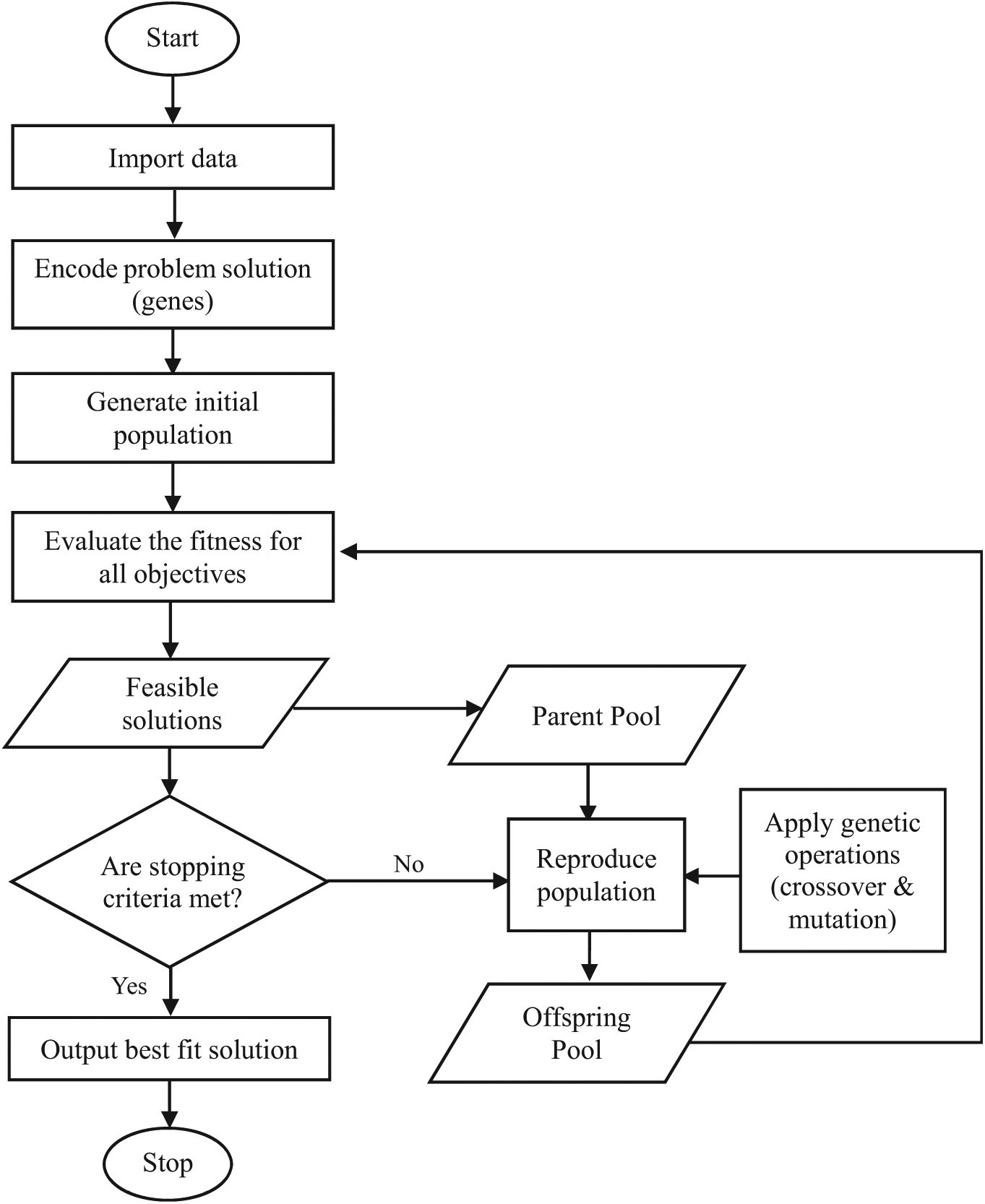
Main steps of problem solving using genetic algorithms.
The crossover probability (Pc) represents the amount of population strings used in the crossover operation. High Pc probabilities allow fast solutions and better performance of the analysis. However, it is recommended the the mutation rate (Pm) should be low to converge the solution. The typical Pc rates are from 0.5 to 1.0 while Pm should be in the range of 0.001 ∼ 0.05 ( 22 ).
Case Study: Low-Volume Paved Roads in Colorado
There are 2,022 miles of low-volume paved roads in Colorado distributed in five engineering regions. In this study, the LVR network of Region 4 was comprehensively analyzed where 85 road segments are distributed along a total of 422 miles. Region 4 has varying traffic volumes with different DL categories, as shown in Figure 2. About half of the LVRs (48% of road miles) have moderate DL values. There are 41% of road miles in the low DL category while only 11% of roads have high drivability lives of more than 10 years. Most of the LVRs have traffic volumes of not more than 800 vehicles per day. The diverse pavement conditions and traffic volumes would support the validity of the optimization models since most treatment options are included in the analysis with different deterioration amounts.
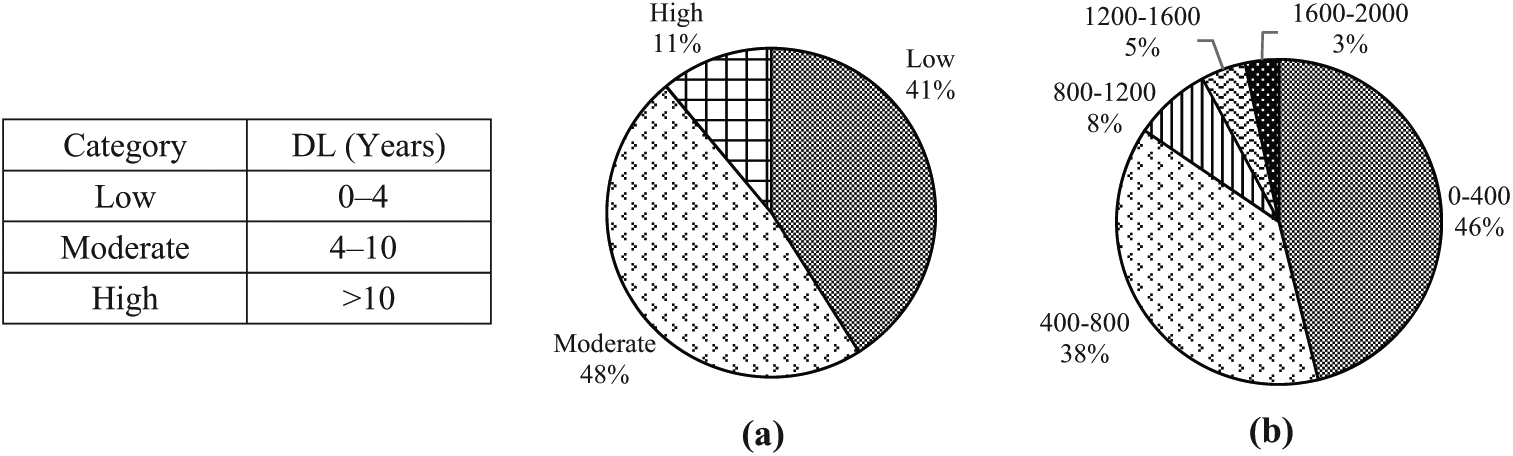
Mileage distribution of Region 4 low-volume paved roads: (a) drivability life; (b) average daily traffic (vehicles per day).
Pavement Treatments
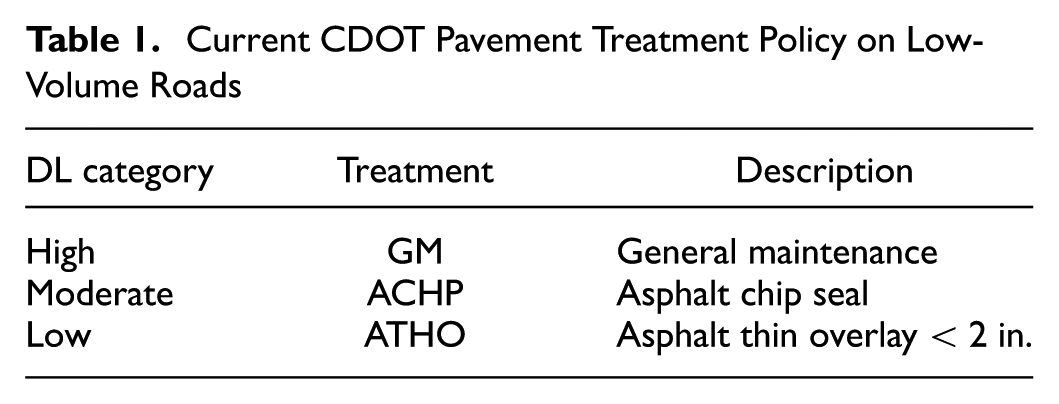
Table 1 shows the current treatment options recommended by CDOT for LVRs. The current maintenance policy of CDOT recommends investigating rehabilitation alternatives to balance between pavement preservation and capacity improvement on LVRs. Four pavement rehabilitation alternatives involving recycling technologies are integrated with the current policy. These treatments are:
Current CDOT Pavement Treatment Policy on Low-Volume Roads
CIR of 4 in, of asphalt surfaced with a fog coat (FC) surface
CIR layer surfaced with an asphalt chip seal
CIR layer with an asphalt thin overlay
Full-depth replacement (FDR)
Unlike the current policy, all treatment options in the proposed strategy were included in a developed decision tree shown in Figure 3. Trigger values of fatigue and transverse cracking were considered for each treatment option. The methodology of selecting triggers was derived from the effectiveness of treatments. This term depends on the initial condition of pavements and it is not fixed. The treatment evaluation study performed a comprehensive analysis on the past performance of the applied treatments and it was able to define the lower limit of each condition index where treatments were found to be effective ( 4 ). Accordingly, the trigger values were assigned in the decision tree in which they do not go below the minimum effective values to ensure effectiveness of treatments.
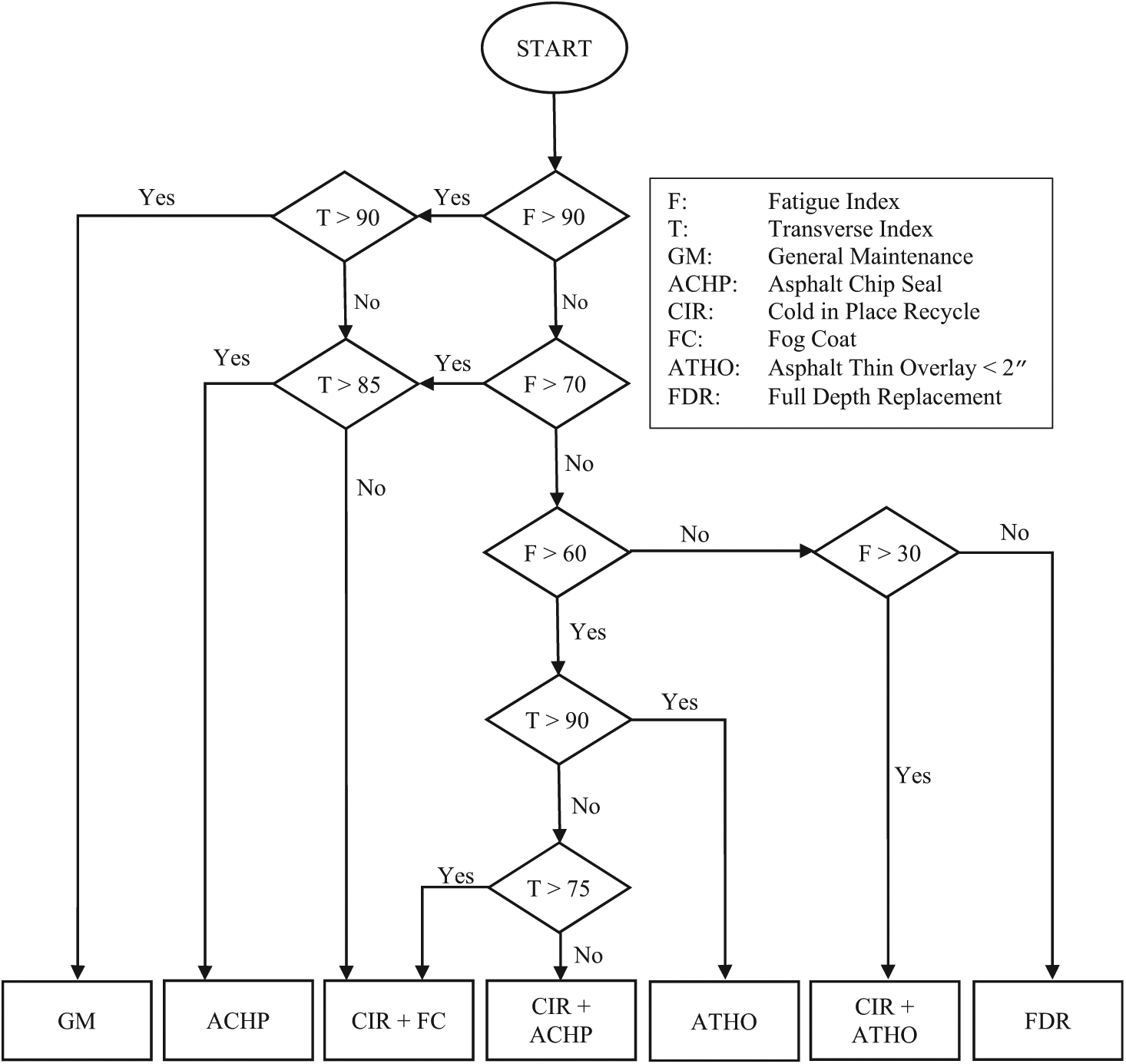
Decision tree of the alternative maintenance strategy.
Multi-Year Optimization Analysis
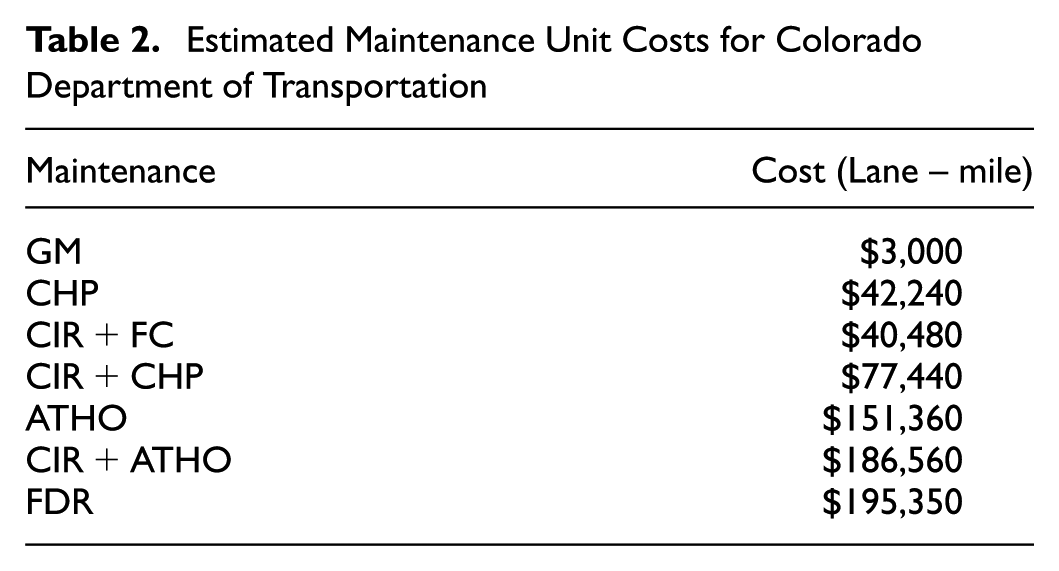
As explained in the methodology, the second strategy of minimizing costs is applied in this study to demonstrate the economic impact of maintenance alternatives so that specific performance targets are achieved at network level. Consequently, cost analysis was conducted to compare each strategy over a study time period of 10 years. The costs were obtained from CDOT and they are listed in Table 2. These costs are based on the dollar value of 2016 which is the base year of the analysis period.
Estimated Maintenance Unit Costs for Colorado Department of Transportation
The multi-year optimization process for selecting treatments is first conducted at the base year where all segments are assigned proper treatments according to each maintenance policy. The decision to maintain segments is then optimized using the developed optimization models. For the subsequent years over the analysis period, the future pavement conditions are projected for both treated and untreated roads. For those roads receiving treatments, the expected improvement of each condition index was identified in the treatment evaluation study as a function of treatment type and the initial value of the condition index (
4
). Accordingly, the term [
For Region 4, the overall weighted DL is 4.87 years. This value was intended to change over the analysis period with different scenarios. Table 3 lists four maintenance scenarios followed in the optimization analysis. The first scenario was to keep the overall DL steady over time by eliminating the overall annual deterioration of the network. The second scenario was to achieve an overall DL target with an improvement of 10% at the end of the analysis period. Scenario III and IV optimized the maintenance activities to achieve improvement amounts of 20% and 30%, respectively. Including different scenarios in the optimization analysis allows decision makers to investigate the impact of allocating different maintenance budgets. At the end of the analysis, a summary was developed showing the costs required for each maintenance policy.
Maintenance Scenarios of Optimization Analysis
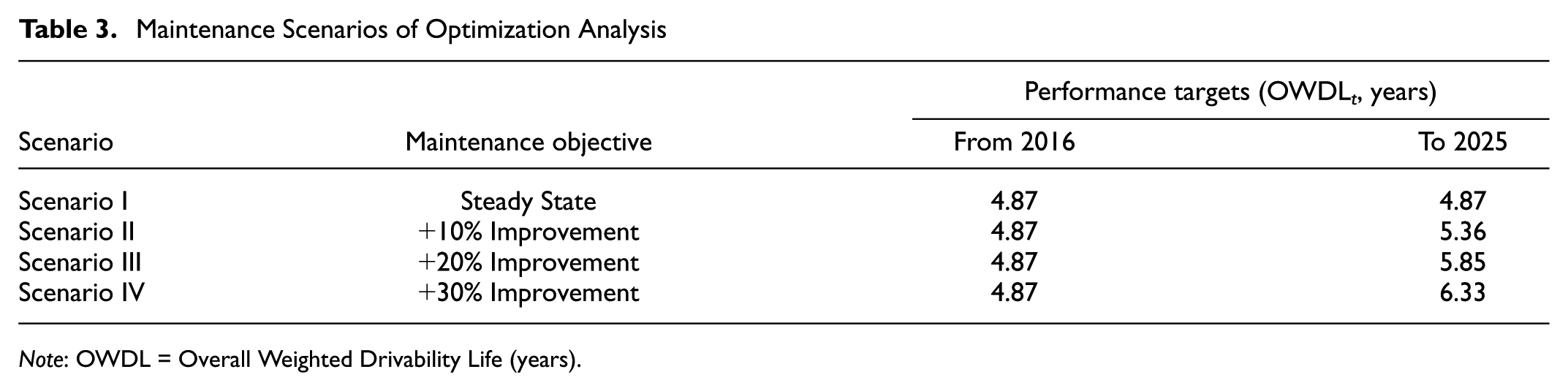
Note: OWDL = Overall Weighted Drivability Life (years).
Optimization Results
Since the optimization model does not have budget constraints, all analysis periods yielded a theoretical optimized solution. The minimum annual performance targets were attained in each maintenance scenario in a reasonable time. The optimized cash flow diagrams of Region 4 are shown in Figure 4 (for Scenario I and II) and Figure 5 (for Scenario III and IV). At the base year of 2016, it can be noticed that all the allocated budgets of the alternative strategy are less than half of the budgets of the current policy. The reason is that about 50% of the LVR network has low DL values. Most of these roads were optimized with lower-cost alternatives such as CIR with fog coats or CIR with chip seals. The costs of the alternative treatments are almost half of the costs of thin overlays applied in the model of current policy.
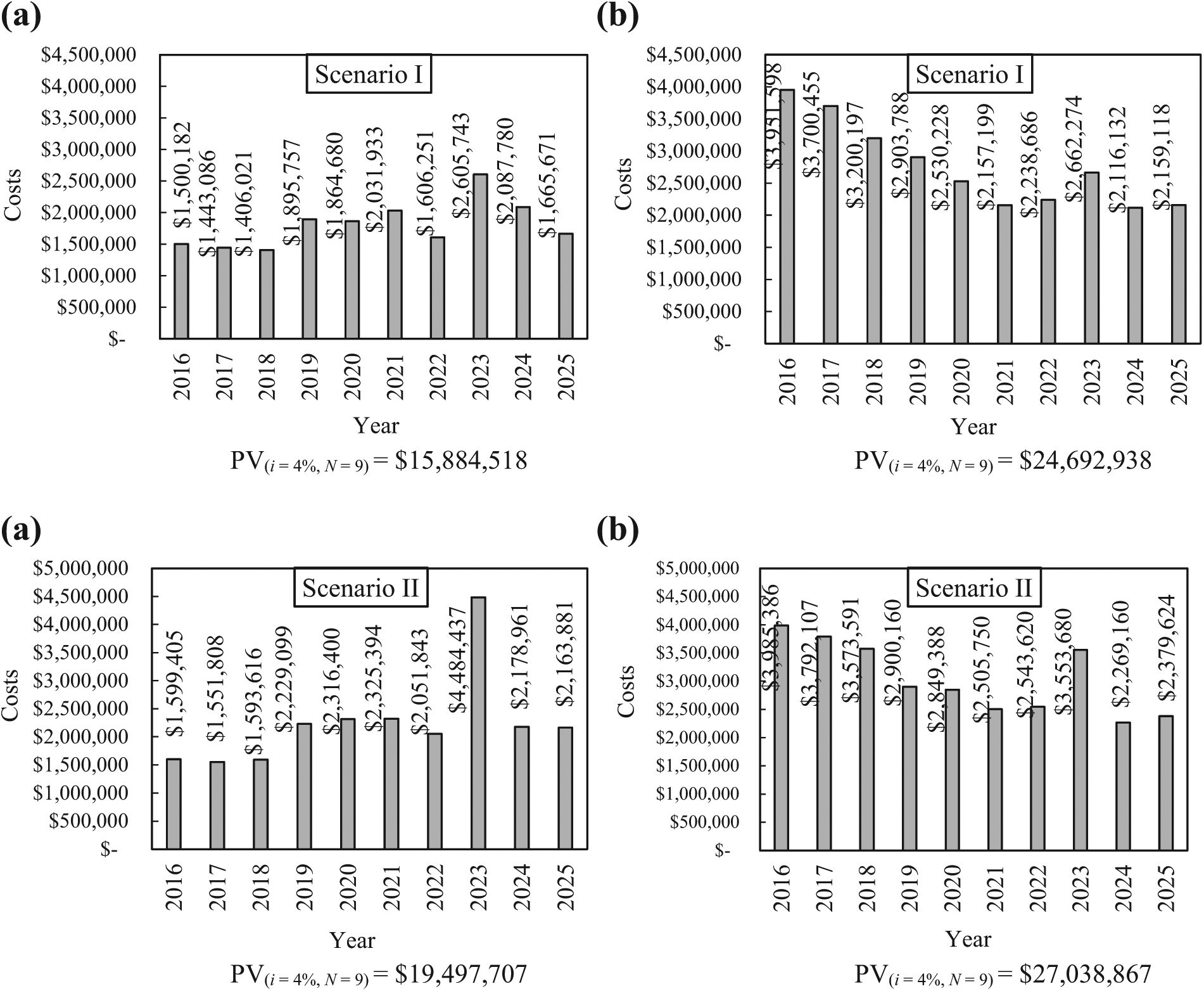
Region 4 cash flow diagram for scenario I and II: (a) alternative maintenance strategy; (b) current maintenance strategy.
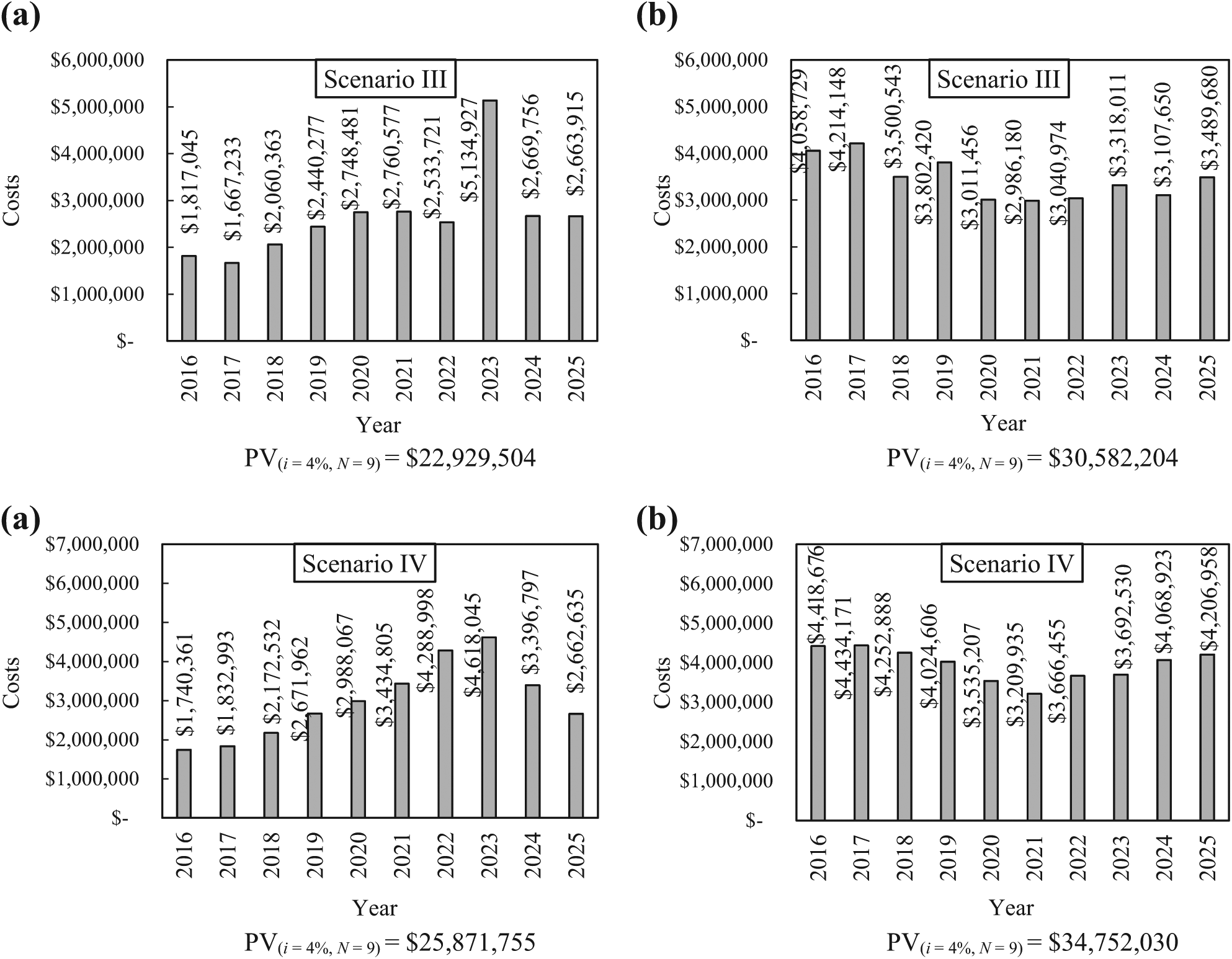
Region 4 cash flow diagram for scenario III and IV: (a) alternative maintenance strategy; (b) current maintenance strategy.
Over the study period, it was found that the alternative maintenance strategy allocates almost uniform annual budget except the costs at 2023. When the targeted improvement increased in each scenario, the annual costs slightly increased, except Scenario IV where a significant improvement target is required to be achieved. On the other hand, the current policy requires much higher budgets at the beginning of the analysis period. The costs then decreased over time which appeared to show a good performance of the maintenance activities. However, the annual costs increased after 2020 for all scenarios, revealing the short-term effectiveness of the applied treatments. Chip seals provide short-term effectiveness if the condition indices are below specific values derived from the evaluation study ( 4 ). However, all roads in the moderate category were optimized with chip seals regardless the value of the condition indices. Also, thin overlays should not be applied directly on severely damaged roads without considering the appropriate pre-overlay treatments. Although the post-treatment performance of thin overlays is expected to be high, some untreated defects may reflect cracks directly to the overlaid pavements. As a result, treated roads show higher deterioration rates.
In order to compare the total costs required for each maintenance strategy, all the allocated funds were discounted to the base year of 2016 using a discount rate of 4%. It can be seen that all present values of the alternative maintenance strategy are less than those of the currently applied policy. Also, the total discounted value increased with increasing the targeted pavement improvement in each maintenance strategy. It was found that a sensitivity analysis is recommended to incorporate a cost-benefit comparison of the two policies on each maintenance scenario.
Sensitivity Analysis
It is highly recommended to identify the maximum benefits of different allowable treatments on LVRs. Benefit-cost analysis is applied in PMSs to evaluate the economic strength of different maintenance alternatives over the lifespan of pavements ( 23 ). The benefit-cost ratio represents the compound benefits of treatment selection. However, the maintenance benefits should be determined in the same currency of costs. This is not practical on LVRs where a low return is expected due to the low social impact of LVRs. For simplicity, the benefit from applying the alternative maintenance strategy is introduced by the percentage of cost saving given the current budget. This amount is weighted by the corresponding condition level target, as shown in Equation 9.

where,
PVcurrent: present value of current maintenance costs;
PValtr: present value of alternative maintenance costs; and
%Improvement: percentage of improvement target of the overall drivability.
Figure 6 displays the percentage of benefits estimated for each maintenance scenario. The results show that the alternative maintenance strategy achieves the maximum benefit when the overall pavement performance is intended to be steady overtime. The second recommended strategy was found to be the fourth scenario, where an improvement of 30% is achieved at the end of the tenth year. It is obvious that there is no significant difference among the scenarios. Also, the optimized budget levels required to achieve the fourth scenario are much more than what can be available to LVRs. Therefore, it is recommended to apply the first maintenance scenario to keep the overall pavement performance of the network steady over the planning period.
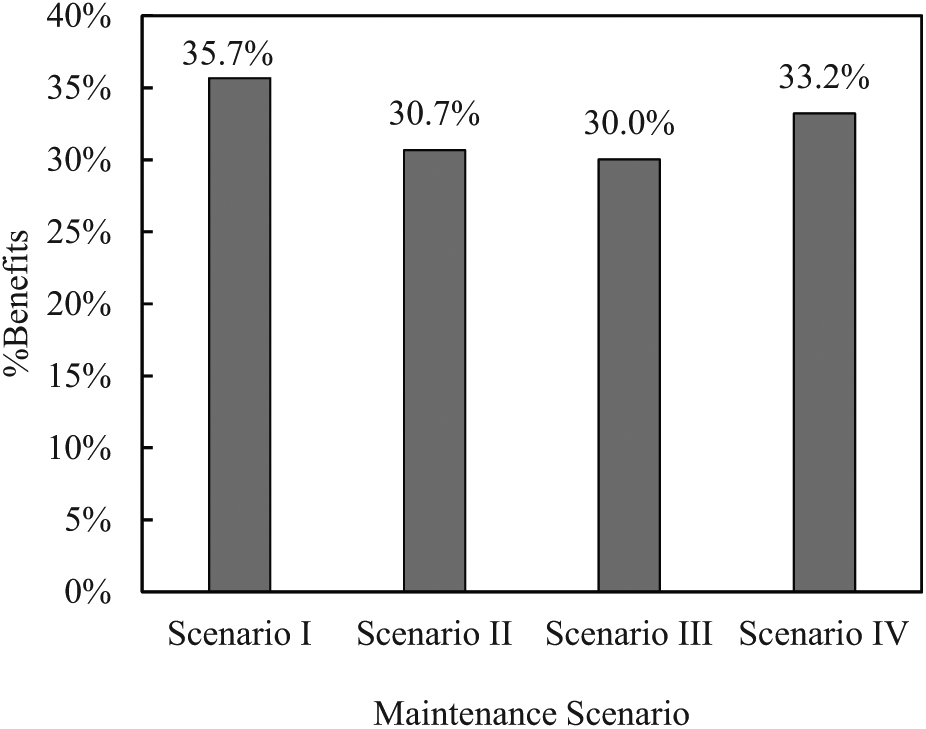
Percentage of benefits of applying alternative maintenance strategy.
Conclusions
A comprehensive optimization analysis was conducted to support pavement management decisions on the maintenance and rehabilitation planning of LVRs. In the State of Colorado, a LVR network of 422 miles was optimized using GAs to minimize the annual maintenance costs restricted by drivability performance targets. Based on the findings of this research study, the following conclusions are drawn:
The optimization tool is functional to seek the long-term effectiveness of different maintenance policies among various treatment options. In this study, the key benefit of optimizing the LVR network is making more effective use of maintenance and rehabilitation strategies.
GAs are able to solve a large-scale optimization problem for LVR networks. The maintenance decision matrix of multi-year planning can be optimized within a reasonable time. However, the decision variable of a large road network can be optimized annually to reduce the number of genes set in the analysis. That enhances the performance and efficiency of the optimization process.
The large-scale optimization of LVRs provides more realistic solutions to quantify the maintenance funding needs. Engineers can identify prudent treatment policies to achieve a desired target state of the network. Moreover, the impact of various condition targets can be evaluated to determine the optimal allocation of maintenance budgets.
The current CDOT policy requires additional funding to sustain the network-level pavement condition given the application of only chip sealing and thin overlaying. Including alternative light rehabilitation strategies for poor roads can save significant amounts of money.
CIR and FDR techniques enhance the overall drivability of LVRs with lower costs compared with the regular rehabilitation of overlays. Also, applying thin overlays over severely deteriorated pavements provides short-term effectiveness. The application of thin overlays should be addressed considering minimum threshold values of pavement distress.
Although raising the performance target levels may add drivability value to LVRs, the benefit-cost impact is not significant. Applying the alternative maintenance policy provides maximum benefit-cost saving when the maintenance decisions are optimized to keep the overall drivability in constant performance.
Recommendations
The large-scale optimization approach is recommended to be applied when investigating alternative maintenance strategies. State DOTs should define all possible constraints that significantly provide benefit-cost effectiveness of proposed treatments. CDOT is recommended to develop statewide implementation plans of pavement maintenance activities on its LVRs to define the appropriate funding levels and capital improvement plans. Also, a comparison between deterministic and probabilistic performance models is recommended to investigate the accuracy of optimization results. The reason is that some transportation agencies do not have enough condition data on LVRs to fit deterministic performance models. Therefore probabilistic performance models could be more practical while optimizing LVRs.
Footnotes
Acknowledgements
The authors gratefully acknowledge CDOT for the financial support provided to this research.
The Standing Committee on Low-Volume Roads (AFB30) peer-reviewed this paper (18-01478).