







Abstract
Sinking accidents are a seafarer’s nightmare. Using 10 years’ of worldwide sinking accident data, this study aims to develop a mortality count model to evaluate the human life loss resulting from sinking accidents using zero-inflated negative binomial regression approaches. The model results show that the increase of the expected human life loss is the largest when a ship suffers a precedent accident of capsizing, followed by fire/explosion or collisions. Lower human life loss is associated with contact and machinery/hull damage accidents. Consistent with our expectation, cruise ships involved in sinking accidents usually suffer more human life loss than non-cruise ships and there is be a bigger mortality count for sinking accidents that occur far away from the coastal area/harbor/port. Fatalities can be less when the ship is moored or docked. The results of this study are beneficial for policy-makers in proposing efficient strategies to reduce sinking accident mortalities.
The shipping industry has witnessed a fast growth in the last three decades because of the significant increase of transportation demands. Shipping movements are operated in a complex and high-risk environment, and many shipping accidents occur at sea, as well as in restricted waters (1, 2). More and more shipping liner companies have an increasing interest in using large-sized ships in the foreseeable future because of their scale advantages. However, a large ship (e.g., a cruise ship) has reduced maneuverability, which ultimately is an increased risk ( 3 ). As a bigger size brings a corresponding increase in cargo and passengers, it may lead to catastrophic consequences with regards to human life loss. Therefore, sinking accidents are a frightening consideration for seafarers and any incidents are likely to be subjected to much public criticism.
It is incumbent for policy-makers to implement efficient navigational safety strategies with the objectives of reducing the likelihood of sinking accidents and rescuing more people from these accidents. Considering the limited available resources and budgets, policy-makers have to determine the prioritization of safety strategies. This can be achieved with the help of a comprehensive understanding of the contributory factors affecting the mortalities that have resulted in sinking accidents.
So far, numerous studies have been carried out for the analysis of shipping accidents. The major focus has been placed on fishing accidents in these studies, such as the investigation of contributory factors, and their effects on the fishing accident probability and consequence (4–8). However, it should be noted that the fishing accident results were only applicable to fishing vessels. Considering all ship types, some other researchers (9, 10) also investigated the relationship between the contributory factors and the risk of shipping accidents. Nevertheless, their results may still be biased because the data sources consider all possible accident types. In general, the contributory factors may present varying effects on the accident mortality for different accident types. In addition, some accident types may be related to each other. For example, a ship may suffer a collision, fire/explosion, contact, grounding and/or capsizing before the occurrence of ship sinking ( 11 ). It was found from the historical data that the majority of shipping accidents may result in no mortality because of efficient emergency rescue plans and other unknown reasons. Zero-inflated models have been considered as a useful approach to model the count data (e.g., the ship mortality) with an excessive number of zero outcomes (12–14). Considering the large numbers of human life loss resulting from sinking accidents, this study aims to model the human life loss caused by shipping sinking accidents using zero-inflated negative binomial regression techniques.
Literature Review
To date, many researchers (4–7) have focused their attention on fishing vessel accidents. For example, Jin et al. examined the determinants of the total losses and number of fatal and non-fatal crew injuries resulting from commercial fishing vessel accidents ( 4 ). It was found that the probability of a total loss of the vessel was the highest for a capsizing, followed by a sinking accident. In addition, fire/explosions and capsizing were expected to incur the greatest number of crew fatalities. In addition, some researchers also examined ship accidents involved tankers ( 15 ), passenger ships ( 16 ) and cellular type containerships ( 17 ).
It should be pointed out that the results from the above studies were only applicable for a specific ship type. In other words, these studies cannot examine the effect of the ship type on the consequence of the shipping accident. On the other hand, many other studies have been conducted to investigate the relationship between the contributory factors and shipping accident risks considering all ship types. For example, some researchers analyzed shipping accidents and proposed many navigation safety enhancement strategies in the Istanbul Strait (18, 19). Debnath and Chin explored the influencing factors of shipping collision risks in the Singapore Port waters ( 20 ). Weng et al. examined the effects of time and traffic directions on shipping accident frequency in the Singapore Strait ( 21 ).
Nevertheless, the results from these studies may still be biased even though all ship types were taken into account. This is because the data sources used for the analysis were subject to specific water areas (e.g., the Istanbul Strait). In addition, the majority of existing studies were concerned with the ship accident occurrence probability and corresponding risk mitigation strategies. However, the general public have great concerns about sinking accidents because of the possible serious accident consequence (i.e., a large amount of human life loss). Unfortunately, there has not been a great deal of literature published on the analysis of mortality resulting from sinking accidents and the corresponding contributory factors.
Data
The worldwide shipping sinking accidents that occurred between the January of 2001 and February of 2011 were obtained from the shipping accident database managed by the Lloyd’s List Intelligence Company. From the shipping accident database, we extracted all sinking accident related information on the: (i) ship type; (ii) precedent accident; (iii) operating conditions; (iv) accident location; and (v) the mortalities (the number of passengers and crew members who died or were declared missing in the accident). The operating conditions include the detailed information on the weather conditions, the operating time and dock condition. In this study, the operating time was divided into two categories: daytime and night-time periods. Hereafter, the daytime period is defined as the period from the local time of sunrise to the time of sunset. It should be pointed out that the times of sunrise and sunset vary with the time of year. The accident location includes “far away from the coastal area/harbor/port” and “near the coastal area/harbor/port”. In this study, ships are categorized into three groups: (i) passenger ships; (ii) ferries/roll on-roll off (ro-ro) ships and (iii) other ship types (e.g., container carrier, cargo ship). The precedent accidents include collision, fire/explosion, machinery/hull damage/failure (e.g., lost rudder, fouled propeller), contact, grounding and capsizing. Hereafter, the collision is defined as a situation that the ship struck or was struck by another ship on the water surface. Contact refers to a situation in which the ship struck any fixed or floating objects other than those included under collision or grounding. A grounding situation refers to a situation in which the ship is in contact with the sea bottom or a bottom obstacle, such as a struck object on the sea floor, or struck or touched the bottom. Capsizing refers to a situation in which a ship is turned on its side or it is upside down.
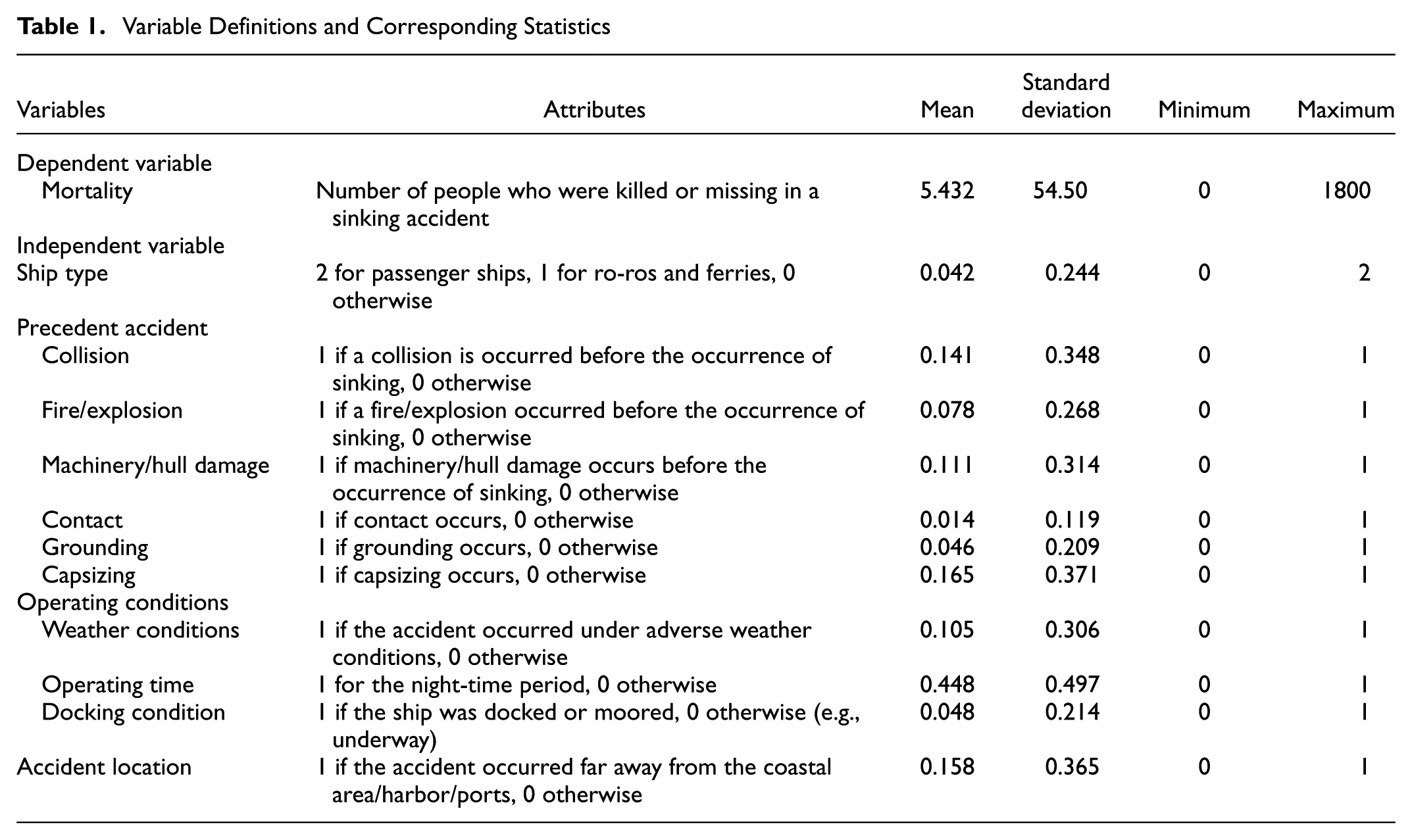
From the shipping accident database, a total of 1871 records of ship accidents which occurred at 33 major worldwide water areas between the January of 2001 and the February of 2011 were collected in this study. Table 1 presents the variables and their descriptive statistics. The mean statistics reveal that 14.1%, 7.8%, 11.1%, 1.4%, 4.6% and 16.5% ships suffer a collision, fire/explosion, machinery/hull damage, contact, grounding and capsizing before the occurrence of ship sinking. Approximately 1.0% of ships involved in sinking accidents are cruise ships. The majority of sinking accidents occurred in good weather conditions (89.5%), and 44.8% of accidents occurred during the night-time period. Furthermore, 4.8% of sinking accidents occurred when the ship was docked or moored. In addition, a relatively small proportion of sinking accidents occurred far away from the coastal area/harbor/ports (15.8%). The loss of human life resulting from the shipping accidents studied ranges from 0 to 1800, with an average value of 5.43 persons and a standard deviation of 54.50 persons. The collected data show that the majority of accidents (69.7%) cause no mortalities (i.e., a zero count).
Variable Definitions and Corresponding Statistics
Model Formulation
In traffic safety analysis, the count data (e.g., the human life loss) often has an excessive number of zero outcomes. To deal with the problem of excess zeros, one of the commonly used methods is zero-inflated distribution. A zero-inflated distribution is actually a mixture of two distributions including a delta distribution on zero (“perfect state”) and a distribution on the non-negative integers (“imperfect state”). In general, a data record is in the perfect state with a probability p and in the imperfect state with probability 1–p. If the data record is in the perfect state, it takes only the value zero. If the record is in the imperfect state, it follows a distribution on non-negative integers (including the value of zero). Lambert proposed a zero-inflated Poisson (ZIP) regression model in which the probability p was related to covariates using a logistic regression model, and a log-linear regression model was developed to relate the Poisson mean to covariates in the imperfect state ( 22 ). As an alternative to ZIP regression, one may consider zero-inflated negative binomial (ZINB) regression if the count data continues to suggest additional over-dispersion ( 23 ). In a ZINB regression model, the negative binomial model is used for the imperfect state. As mentioned above, Table 1 indicates that the standard deviation of mortalities is substantially higher than the mean. Therefore, the ZINB regression approach is more appropriate to model the number of mortalities resulting from sinking accidents in this study.
In a ZINB model, a natural set of stating values for the covariates is provided by the Probit or Logit and independent Poisson or negative binomial estimates. To determine the probability of p for the perfect state, another efficient method is to use the Poisson or negative binomial estimates which are multiplied by a value of




In which
We can determine the estimates of
(1) E-step: Compute

(2) M-step for
(3) M-step for
The details of the EM algorithm can be found in Lambert ( 22 ) and Hall ( 24 ). Minami et al. also explained how to implement the EM algorithm for the ZINB regression model ( 23 ).
Results and Discussions
Model Results
The zero-inflated regression procedure in the Limdep software (Version 9, Econometric Software Inc., NY, USA) was performed to calibrate the proposed ZINB regression model using the collected 1871 sets of sinking accident data. We also developed another three regression models, namely the Poisson regression model, the negative binomial regression model and the ZIP regression model to demonstrate that the ZINB model provides the best fit. When several models are available, one can compare the model performance using the most regularly used measures such as the Akaike information criterion (AIC), the Bayesian information criterion (BIC) and the Deviance information criterion (DIC). The AIC penalizes a model with a larger number of parameters and is defined as
Statistical Comparison among Different Regression Models
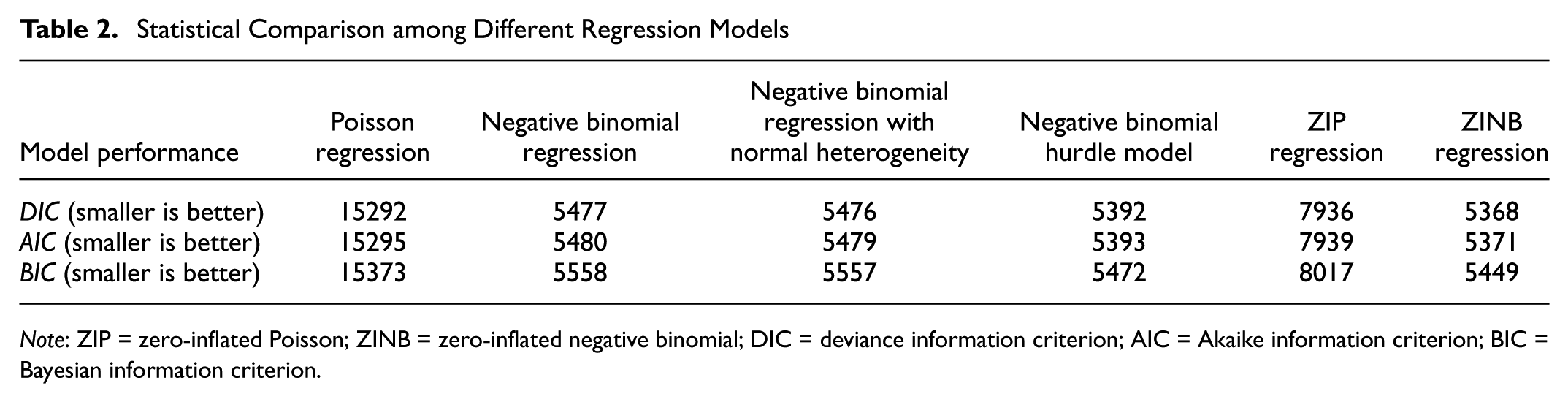
Note: ZIP = zero-inflated Poisson; ZINB = zero-inflated negative binomial; DIC = deviance information criterion; AIC = Akaike information criterion; BIC = Bayesian information criterion.
Table 3 shows the statistical analysis results for the mortality count model. From the table, it can be seen that the coefficient for fire/explosion is positive and statistically significant at a 0.05 level, indicating that there are more deaths and missing people if the ship suffers a fire/explosion before sinking into the water. The over-dispersion parameter
ZINB Regression Model Results for Sinking Accidents
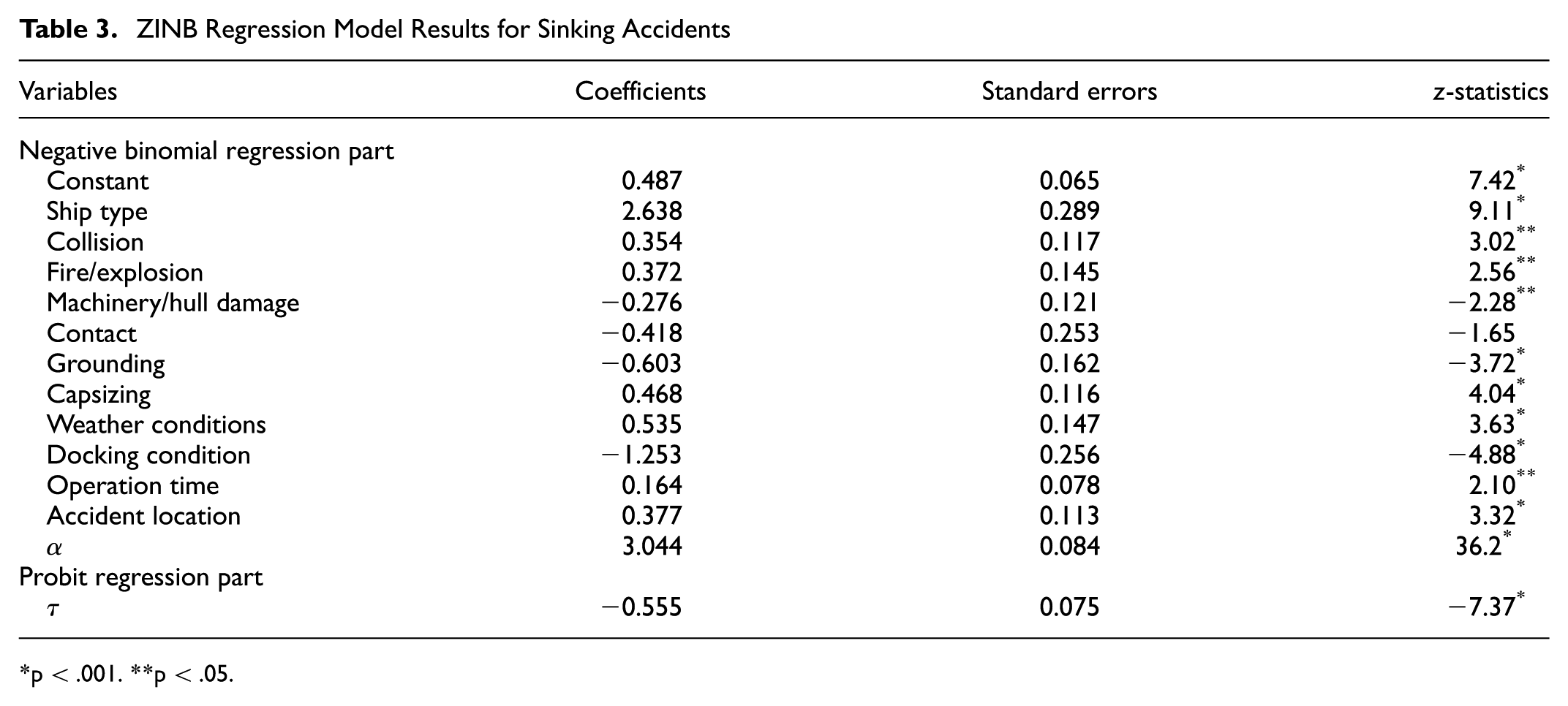
p < .001. **p < .05.
According to Table 3, it can be found that the occurrence of precedent events including collision, fire/explosion and capsizing will increase the number of deaths and missing people, which is expected to be greater when the ship suffers a precedent event including collision, fire/explosion and capsizing. However, a lower mortality count is associated with a precedent event such as machinery/hull damage, contact, grounding, and so on. In addition, human life loss will increase if the sinking accident occurs under adverse weather conditions (e.g., strong winds, waves). The negative sign for the docking conditions indicates that the loss of human life resulting from sinking accidents is less when the ship involved is docking or moored. The positive sign for the ship type shows that cruise ships are associated with a bigger number of mortalities in sinking accidents.
Marginal Effects
Although the signs of the estimated coefficients for the ZINB regression model could provide information on whether changes in given explanatory variables increase or decrease the loss of human life resulting from sinking accidents, they cannot provide further information on the extent to how much the loss of human life is changed. To gain further insight into the effects of the contributory factors on sinking accident mortalities, we can estimate the marginal effect of the explanatory variable

In which
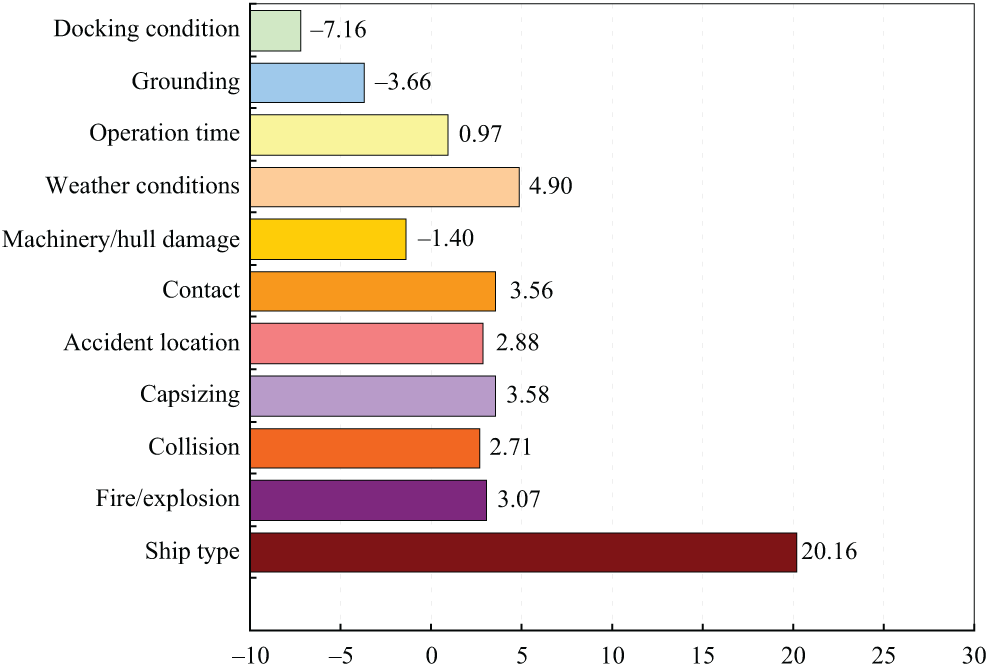
Marginal effects of contributory factors on sinking accident mortalities.
Effects of Ship Type
As expected, the number of mortalities resulting from shipping accidents is significantly affected by the ship type. More specifically, on average, the loss of human life for passenger ships is larger than for ferries/ro-ro ships by 20.16, as shown in Figure 1. This result could possibly be because passenger ships capsize very quickly ( 25 ). Clearly, a quick capsizing event may result in a high number of fatalities. Another possible reason might be that the efficiency of an emergency evacuation could be low on a ship carrying many passengers ( 26 ). In particular, many people finding themselves in the confines of a ship at sea can also expect to experience signs of panic when a fire is present. This result provides evidence to support the argument of House that passenger ships have the potential for incurring high casualty rates in the event of major shipping accidents ( 27 ). To enhance the passenger ship safety level, all passenger ships are required to be fitted with emergency towing arrangements for fore and aft, pre-rigged and capable of easy deployment.
Effects of Precedent Accident
Figure 1 shows that the loss of human life is the highest for the precedent accident of capsizing, followed by fire/explosion and collision. The loss of human life will dramatically increase by 3.77 if a ship suffers a capsizing before eventually sinking into the sea. It is found from Figure 1 that the mortality count for the ship suffering a precedent accident of fire/explosion is on average 2.66 higher than for a ship suffering no fire/explosion before sinking into the sea. This might be explained by the consideration that sudden and overwhelming events provide little evacuation time for the passengers or crew members ( 28 ). Another possible reason is that there is only a small survival chance for people who are caught in fires in the ship. To prevent the occurrence of fires/explosions, ship owners are encouraged to equip their vessels with an efficient flame arrestor, backfire arrester or other similar devices in the carburetors of each inboard engine and efficiently ventilate enclosed spaces so as to remove explosive and flammable gases ( 4 ). In addition, training is extremely important because there are no fire departments at sea. Crew members and passengers would have to extinguish a fire by themselves.
One interesting finding from this study is that a lower mortality count is associated with contact and machinery/hull damage, shown in Figure 1. Although machinery/hull damage has a small effect in increasing the human life loss in this study, it continues to be the cause of the majority of losses in marine insurance. Statistics from the International Union of Marine Insurance ( 29 ) reported that 40% of hull claims by number are for machinery damage, accounting for 20% of costs.
Effects of Accident Location
Consistent with the results of the study by Jin, the distance to the shore is also a significant factor influencing the shipping accident consequence with regards to human life loss in this study ( 8 ). Figure 1 highlights that a sinking accident that occurs far away from the shore can cause 2.14 more fatalities, as compared with a sinking accident close to the shore. This result is consistent with what we expected because there will be a long response time and poor rescuing efficiency for shipping accidents that occur far away from the coastal area/harbor/ports.
Effects of Operation Conditions
Consistent with the results from previous studies, the ship operating time is strongly correlated with human life loss ( 16 ). Figure 1 shows that the mean of human life loss during the night-time period is generally higher than for the daytime period (by 0.98), which is quite close to the findings from the study conducted by Akten ( 1 ). The higher human life loss at night might be attributed to the consideration that people require a longer evacuation time at night compared to during the daytime period, especially as most people would be asleep at this time (30, 31, 32). Another possible reason for the higher casualty number for nighttime accidents would be that it is more challenging to recover people in the darkness once they are in the water.
Consistent with our expectations, adverse weather conditions are associated with an increase in human life loss. It can be seen from Figure 1 that the expected human life loss is 4.84 higher for sinking accidents that occurred under adverse weather conditions. This implies that for every sinking accident that occurs under adverse weather conditions, 4.84 more fatalities and missing people are expected. Figure 1 also shows a marginal effect of −7.08 for docking conditions, suggesting that there are 7.08 fewer fatalities or missing persons for each sinking accident that occurs when ships are moored or docked.
Conclusions
By analyzing 10 years of worldwide sinking accident data, this study developed a mortality count model to evaluate the number of casualties (i.e., human life loss) resulting from sinking accidents using ZINB regression approaches. The marginal effects of the influencing factors on mortalities were also examined in this study. The mortality count model results show that human life loss is higher for precedent accidents including collision, fire/explosion and capsizing, adverse weather conditions and night-time periods. Furthermore, the marginal effect analysis results show that the increase of the expected human life loss in sinking accidents is the largest for a ship that suffers a precedent accident of capsizing, followed by fire/explosion and collisions. Interestingly, a lower human life loss is associated with contact and machinery/hull damage accidents. Consistent with our expectation, cruise ships involved in sinking accidents usually suffer more human life loss and there will be more human life loss for accidents that occur far away from the coastal area/harbor/port. In addition, fatalities could be reduced when the ship is moored or docked.
One implication of this study is that it is essential to prevent the occurrence of ships capsizing so that the resulting loss can be reduced significantly. Government agencies and shipping companies can employ the developed mortality count model to assess various safety enhancing measures and strategies. The developed model in this study could also help insurance companies to evaluate the possible human life loss and damage to ships. It should be pointed out that the ZINB regression technique is only applicable when there are excess zeros and the distribution of the observed counts is over-dispersed. However, if there is no apparent reason to suspect that two states (i.e., perfect and imperfect states) might be present, the use of a ZINB model may be simply capturing model mis-specification that could result from factors such as unobserved effects (heterogeneity) in the data. One limitation of this study is that shipping traffic information was not included in the collected shipping accident database. In future, we will compare our accident results to traffic properties after collecting shipping traffic data. In the future it would also be interesting to investigate whether the dusk/dawn time period exhibits varying effects on human life loss as compared with the nighttime period.
Footnotes
Acknowledgements
The authors thank the five anonymous reviewers for their thorough review of the earlier versions of the paper. This study is sponsored by the Shuguang Program supported by the Shanghai Education Development Foundation and the Shanghai Municipal Education Commission (Grant No. 16SG41).
Author Contributions
The authors confirm contribution to the paper as follows: study conception and design: T. Chai, J. Weng; data collection: J. Weng; analysis and interpretation of results: T. Chai, J. Weng, X. Chai; draft manuscript preparation: J. Weng. All authors reviewed the results and approved the final version of the manuscript.
The Standing Committee on Marine Safety and Human Factors (AW040) peer-reviewed this paper (18-06154).
The views expressed in this paper only reflect the opinion of the author and must not be considered as official opinions from any national or international maritime authorities.