







Abstract
Life course events can lead to a habitual change of mode choice, which can sometimes be from non-car modes to the car, which is not a desirable outcome from a sustainable point of view. This research studied in depth the mode switching behavior from a range of non-car modes to the car, to identify opportunities for policy intervention to hold back such changes in habit toward car usage. Retrospective commute mode choice and various life course event data over four observation periods were collected. A mixed binary logit regression model was developed to study mode switching behavior from car to non-car modes, followed by the development of a set of “mirror models” (also mixed binary logit) that evaluated mode switches from non-car modes to the car. By observing their distinct reactions to life course events, it was found that users of different types of non-car modes display distinct mode switching behavior, especially in relation to getting married, having their first child and in response to different degrees of commute distance change. A thorough discussion on the policy implications of these findings is provided.
Mode choice analysis is a popular topic in travel behavioral research, and most of the existing works have focused their analysis at a tactical level by studying how individual travelers make trade-offs among different attributes. It is indeed a widely used tool for travel demand management; however, there are also findings revealing that choice behavior could be habitual and that mode use decisions may not be affected by the surrounding tactical-level conditions (1–3). With such an understanding, much work has incorporated dynamic elements in their models, that is, taking into account the influence of mode choices observed in earlier periods/states on the current mode choice behavior (4–7), and in most cases such influences were found to be significant.
The revealed importance of mode choice habit could bring substantial challenges to effective travel demand management. For instance, reducing car usage is a common pursuit in today’s world. However, if policy efforts only focus on tactical-level mode choice behavior, the expected modal shift from car to more sustainable modes may not occur owing to a dominant car-use habit. So, what might be the solution? In other words, can choice habit be changed somehow?
Research has proposed and shown that life course events could potentially lead to a change in mode choice habit. There could be a variety of life course events, for example household- or family-related (getting married, child birth, etc.), employment related (income change, employer change, etc.), residential- or contextual-related (home relocation, trip distance change, etc.) ( 8 ). A number of studies have attempted to investigate the connections between those events and long-term mode switching behavior, for instance, switching to and away from the car as a regular commute mode ( 9 , 10 ), to and away from the bicycle ( 11 , 12 ) and a shift toward multimodality ( 13 ). In addition, the impacts of life course events have also been explored on other types of travel behavior such as car ownership (14–18) and commute distance changes ( 19 , 20 ).
Nevertheless, the challenge still remains. As desirable as it would be to see a switch away from car use following certain life events, switching to the car is also a possible outcome, and several studies have found that switching from non-car modes to the car occurred more frequently ( 9 , 10 ). Thus, in such cases that are induced by life course events, it is crucial that efforts are made to hold back any mode switches to the car, as once the car is taken up and over time its use becomes habitual, it will be even more difficult to alter mode choice behavior ( 2 ). This is a subject that has not been properly looked at and the following question remains unanswered: given the presence of life course events that could result in a mode switch from non-car to car, what countermeasures could hold back such a change?
This research aims to offer some direct insights into the above query by delivering a mode switching analysis. The case study is located in a Chinese city, Taiyuan. A retrospective mode choice survey was conducted to collect the citizens’ regular commute mode information in 2006, 2008, 2010, and 2012: a total of four observation periods. A variety of life status data in the corresponding observation periods was also collected. A binary logit regression model was initially developed to study the mode switching behavior from car to non-car modes, followed by a set of “mirror models” that evaluated the mode switches from a range of non-car modes to the car. The objective of the mirror models was to reveal differences in mode switching behavior among users of different non-car modes, and hence more targeted policy implications could be derived.
The remainder of the paper is structured as follows. The next section details the retrospective survey and describes the life course events and observed mode switching patterns. Following that, model formulation is detailed. The model estimation results are then explored and a thorough discussion of policy implications is presented at the end.
Retrospective Survey and Data
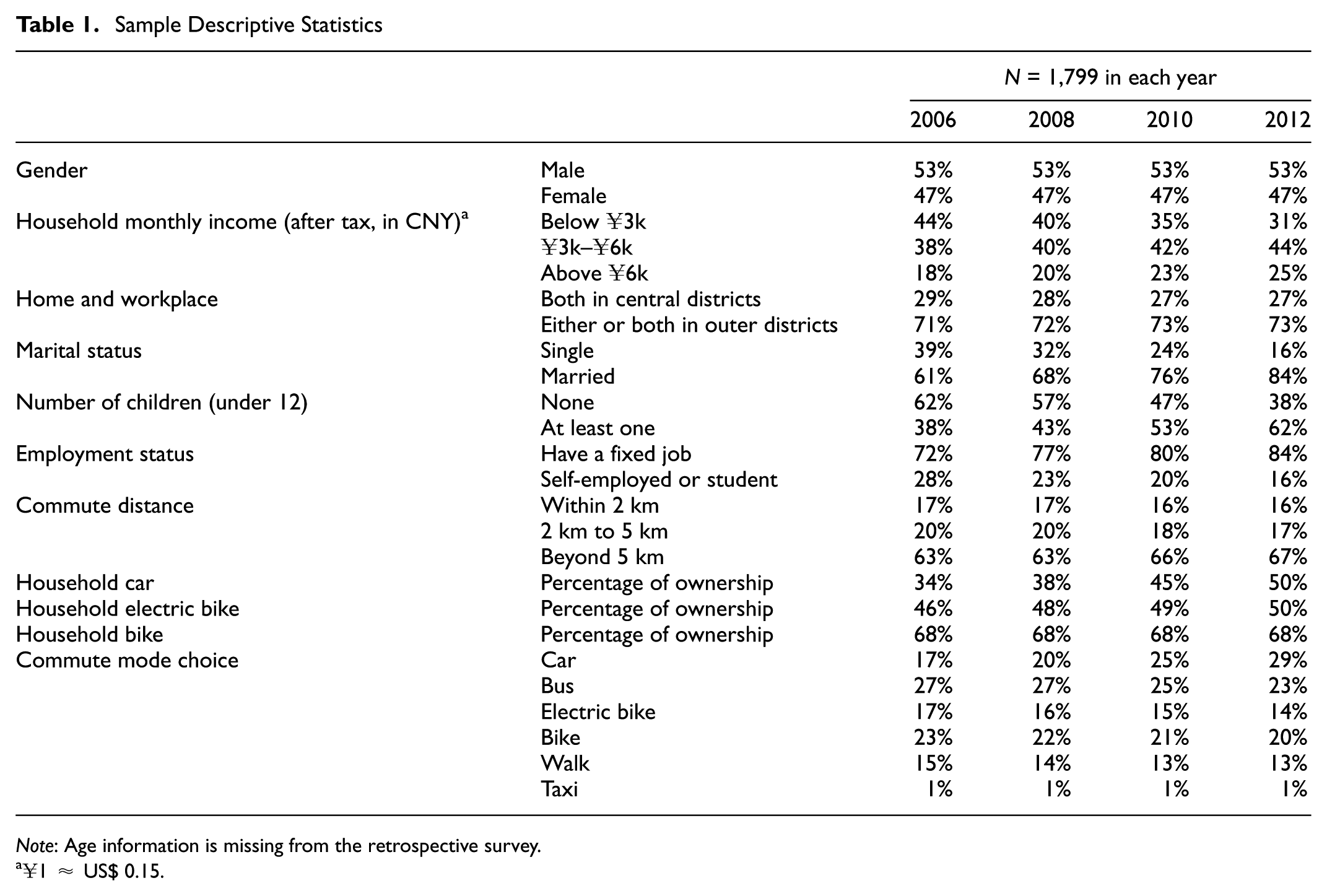
This research uses retrospective survey data to study the effects of life course events on mode switching behavior. The survey is part of the Taiyuan citizens’ travel behavior survey that took place in 2015 in China ( 21 ). Respondents were asked to recall their most frequently used commute mode in the years of 2006, 2008, 2010, and 2012, and also provide a variety of information about their life status for the same years. The survey approached 15,000 Taiyuan citizens; however, for the retrospective part, the number of responses in the final sample was limited. This was owing to 1) the difficulty in recalling past information in a retrospective survey ( 22 , 23 ) leading to a lot of missing values, for which the corresponding observations were removed; and 2) the application of many other criteria to ensure the selected data was credible for analysis. For instance, a respondent in the final sample had to have full observations across all four periods and have been a resident in the city before the first observation period. Information was collated in the survey to ensure those criteria were fulfilled. Ultimately, we had 1,799 respondents with their four-period commute mode choices (7,196 observations in total) for the mode switching analysis. Some key information about this sample is presented in Table 1.
Sample Descriptive Statistics
Note: Age information is missing from the retrospective survey.
¥1 ≈ US$ 0.15.
The sample was almost equally composed of male and female commuters. Age information was not collected in the retrospective survey. Household income had gradually increased over time. The proportion of people who both lived and worked in the central districts of Taiyuan city (there are six districts in Taiyuan and two were perceived as the central districts in the past decade) had remained stable; we identified from the data that this was not a result of approximately the same number of people moving in/out, but simply because most respondents in the sample had stayed within the central/outer district boundary. Many people had married, had children, and secured a permanent job during our study period. The distribution of commute distances was relatively stable over time; however, it was revealed that such stability was caused by the occurrence of both commute distance increases and decreases, not because people’s home and workplace locations were unchanged (though, as mentioned earlier, most of them remained within the boundary of central/outer district). There was an increasing rate of car ownership by household over time, whereas the ownership rates for electric bike and bike remained similar across different periods. In relation to commute mode choice, car usage had seen a continuous increase from 2006 to 2012; by looking at the rest of modes, we can see the increasing demand for the car came from former bus, electric bike, bike users, and journeys made on foot. Meanwhile, the taxi was rarely chosen for regular commute trips and its mode share remained low across all four periods.
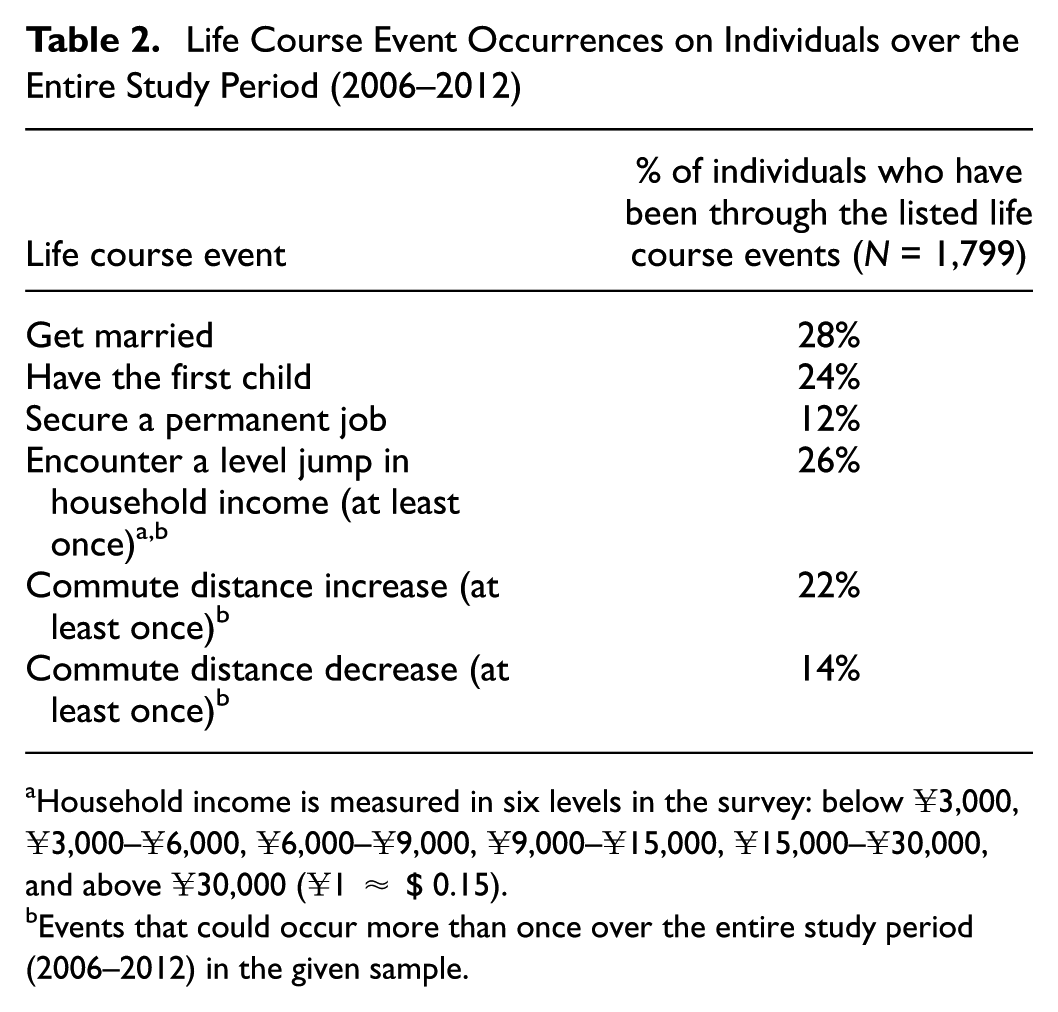
Tables 2 and 3 provide more specific statistics with respect to life course events. In Table 2, we present five critical life course events that could possibly result in mode switching behavior: “Get married,”“Have the first child,”“Secure a permanent job,”“Encounter a level jump in household income,” and “Commute distance change.” Over the entire study period (2006–2012), the percentages of respondents who got married, had their first child, and secured a permanent job were 28%, 24%, and 12% respectively. The latter two figures are consistent with the statistics in Table 1 in which the number of people having at least one child increased from 38% in 2006 to 62% in 2012, and securing a permanent job increased from 72% in 2006 to 84% in 2012. However, 28% of people getting married is 5% higher than the yearly marriage statistics (from 61% in 2006 to 84% in 2012). The difference implies that 5% of people may have got divorced, but such a life course event will not be studied in our models given its low occurrence rate. The survey captures household income in six levels: below ¥3,000, ¥3,000–¥6,000, ¥6,000–¥9,000, ¥9,000–¥15,000, ¥15,000–¥30,000, and above ¥30,000. A jump to a higher household income level is another event that might make people reconsider their mode choice decisions; 26% of the sampled individuals have had at least one such income increase over the entire study period. Finally, commute distance change is broken down into two sub-cases, in which 22% have experienced a distance increase and 14% have experienced a distance decrease.
Life Course Event Occurrences on Individuals over the Entire Study Period (2006–2012)
Household income is measured in six levels in the survey: below ¥3,000, ¥3,000–¥6,000, ¥6,000–¥9,000, ¥9,000–¥15,000, ¥15,000–¥30,000, and above ¥30,000 (¥1 ≈ $ 0.15).
Events that could occur more than once over the entire study period (2006–2012) in the given sample.
Mode Switching Pattern over the Entire Study Period (2006–2012) a
Note: E-bike = electric bike.
We did not analyze the sticking to/switching behavior in relation to taxis in the precedent period owing to the very limited observations of the taxi being used as a regular commute mode (see also “Commute mode choice” in Table 1).
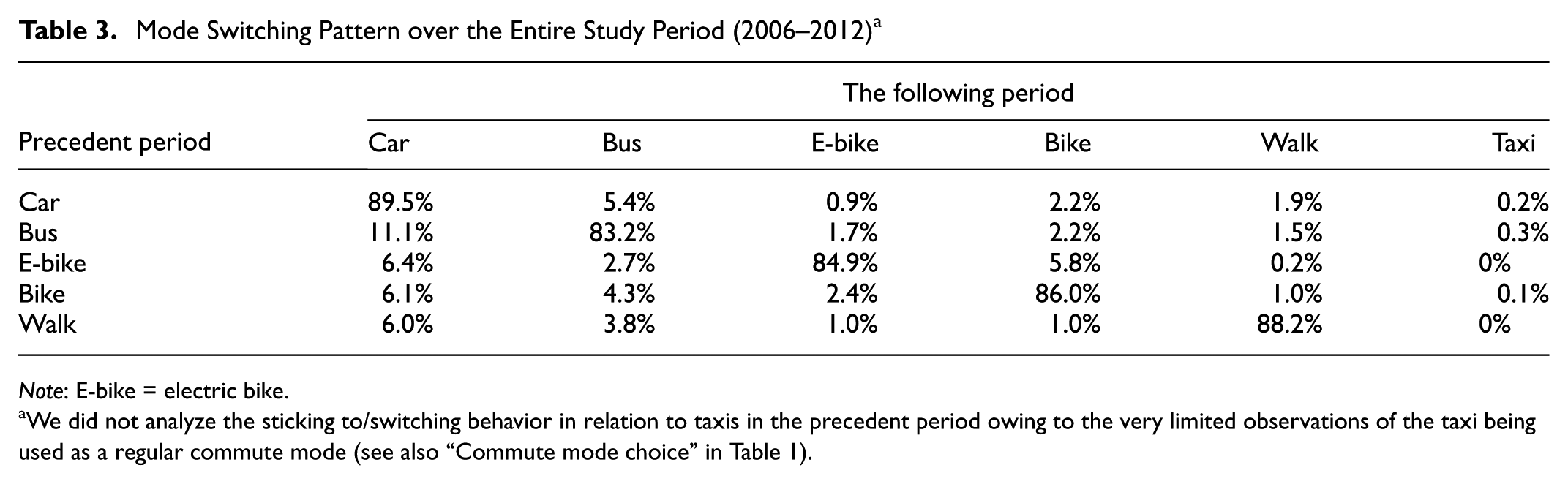
To reveal the mode switching pattern, we converted the original sample data into a different format. Initially, each individual respondent had four mode choice observations from the four periods (2006, 2008, 2010, and 2012). We then formulated paired observations by capturing the mode choices in a precedent period and the following period. As such, each individual respondent now had three paired observations (2006/2008, 2008/2010, and 2010/2012) in which to explicitly display any mode switching behavior. Table 3 offers an overview of the mode switching pattern over the entire study period (2006–2012). About 90% of paired observations that had car as the commute mode in the precedent period still had chosen the car in the period that followed. As a comparison, for bus, electric bike, bike, and walk that were chosen in the precedent period, the percentages of paired observations that had chosen the same modes in the following period were lower, though all were still above 80%. Thus, there was slightly stronger adherence to car usage than to the rest of the modes. Furthermore, it is noteworthy that the car is the preferred alternative when people want to switch away from bus, electric bike, bike, and walk in the following period.
Model Formulation
Based on the data structure displayed in Table 3, we put the paired observations into five sub-datasets in which the commute mode choice in the precedent period includes car, bus, electric bike, bike, and walk. These are the datasets used in our mode switching analysis.
A binary logit regression model was initially developed to investigate the mode switching behavior from car (precedent period) to non-car (the following period). In fact, broader insights could possibly be obtained if the “non-car” alternative could be decomposed into the actual modes that are chosen in the following period (e.g., car–bus, car–electric bike, and so on) rendering a multinomial logit regression possible. However, there are very limited mode switching events in this working dataset (i.e., the first row of Table 3), and as a result, our modeling attempt with multinomial logit regression encountered a convergence issue. Eventually, a binary approach was adopted by following a similar practice outlined in earlier studies ( 9 , 10 ).
Next, a set of mirror models was developed to study the mode switching behavior from bus to car, electric bike to car, bike to car, and walk to car. There are two considerations behind such a practice: 1) it is important to distinguish and verify whether a factor that could possibly induce a mode switch, for instance, car to non-car, is on account of preferring a non-car alternative or simply preferring a switch of mode. This information must be clearly revealed to avoid ineffective or even erroneous policy measures that might be developed from the modeling results (i.e., if a factor that induces a mode switch from car to non-car is a result of “preferring switch,” this factor will have the same impact sign as a non-car to car switch, inferring any policy that aims to encourage a car to non-car switch and targets this factor could possibly also result in a mode switch from non-car to car). Hence, the mirror models will help to verify whether a factor’s impact on the various mode switches to car is opposite to or in the same direction as its impact on the mode switch from the car in the earlier model, and thus will distinguish between “preferring mode” and “preferring switch” to better inform policy making. 2) Another benefit of a set of mirror models is that the differences in mode switching behavior among different mode users can be revealed, that is, a factor may only have a significant impact on some mode users and may be completely irrelevant to others. In other words, more user-specific policy implications could be obtained to dissuade different non-car mode users from switching to the car as their regular commute mode.
Again, either binary or multinomial logit regression can be applied to set up the mirror models. Taking the bus user model as an example, the binary specification will classify the paired choice observations into two categories: bus to car and bus to non-car, whereas the multinomial specification can manage more alternatives by, for example, further splitting the above “bus to non-car” into “bus to bus” (the majority) and “bus to the rest” (a tiny proportion). We tested both specifications and the most important aspect, “bus to car,” shared the same results in relation to the factors’impacts on such a choice. Thus, we adopted the binary specifications for all the mirror models to simplify presentation of the results, without losing any valid information or model explanatory power.
The variables that are used to explain the mode switching behavior include life course events (dynamic) and socio-economic factors (static). The life course events are those presented in Table 2; in addition, for commute distance change (both increase and decrease), we generated three sub-groups, that is, (change by) less than 2 km, 2 km to 5 km, and more than 5 km to explicitly assess how different degrees of distance change in an urban context would possibly affect mode switches. All life course events were studied with their impacts on mode switch observations in the same years. Oakil et al. also explored lead (1 year before) and lag (1 year after) effects of life course events in their mode switching models ( 9 ). However, we do not incorporate such effects in the analysis, given the 2-year observation interval in our data, which means the lead and lag effects are likely to be trivial. Three socio-economic factors were studied: gender, household income, and home and workplace (see Table 1). Mode switch availability conditions were also applied to the models, specifying that car, electric bike, and bike can be chosen as regular commute modes only if an individual’s household owns the corresponding vehicle.
Finally, given how an individual often has more than one paired observation in the datasets, a standard logit mixture approach ( 24 , 25 ) was applied to all models to account for any potential intra-person correlation. Equation 1 presents the mathematical form of our mixed logit model. Model estimations were performed in BisonBiogeme ( 26 ).

where
The intra-person correlation is captured by the error component
Analysis Findings and Implications
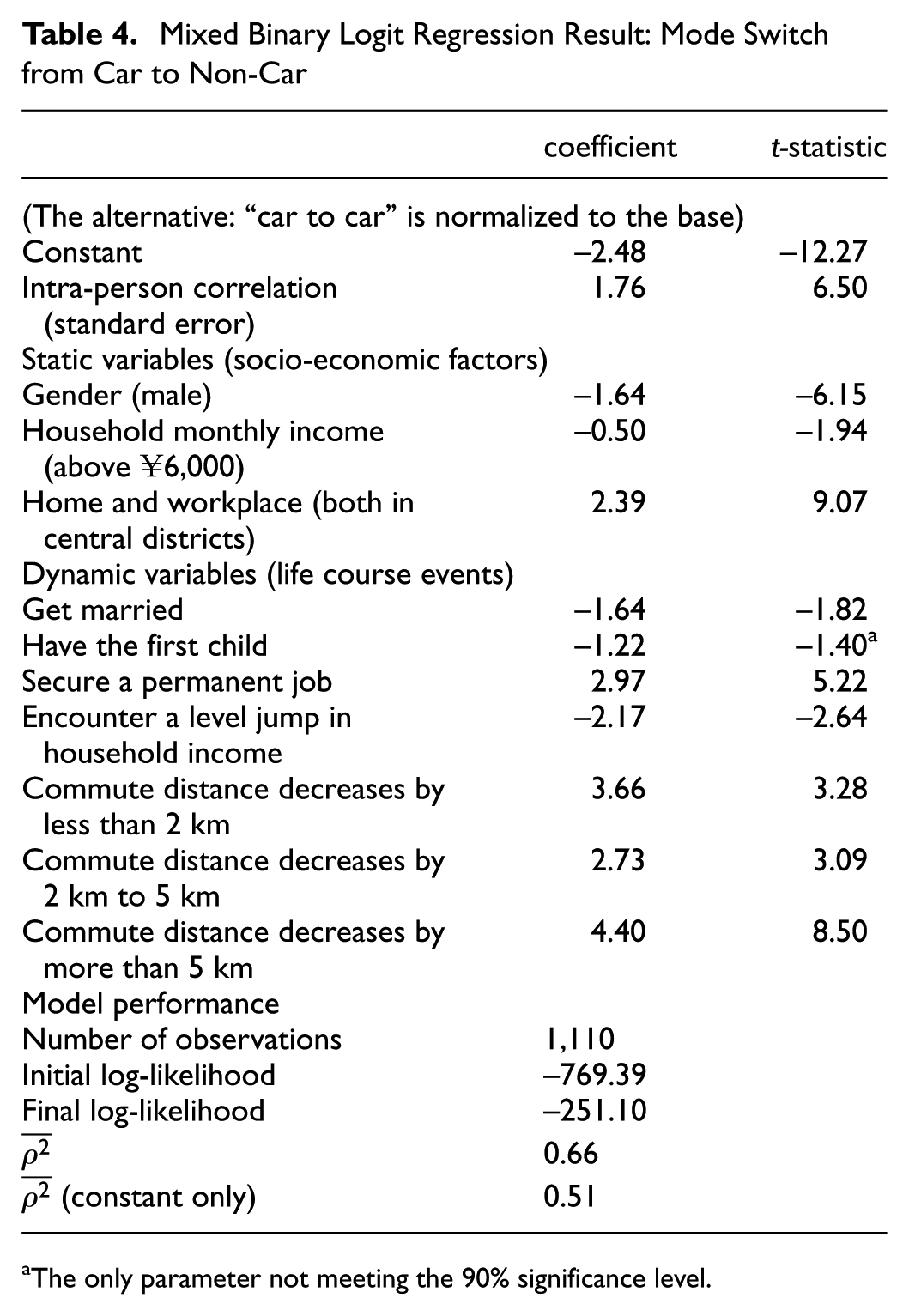
Tables 4 and 5 display the modeling results of mode switching from car and to car respectively. As an overview, the log-likelihood and the adjusted rho-square values indicate a fairly good level of fitness for all the models. The parameter measuring intra-person correlation also has universal significance confirming the presence of an individual-specific attribute that posted an unobserved effect on mode switching behavior.
Mixed Binary Logit Regression Result: Mode Switch from Car to Non-Car
The only parameter not meeting the 90% significance level.
Mixed Binary Logit Regression Results: Mode Switches to Car a
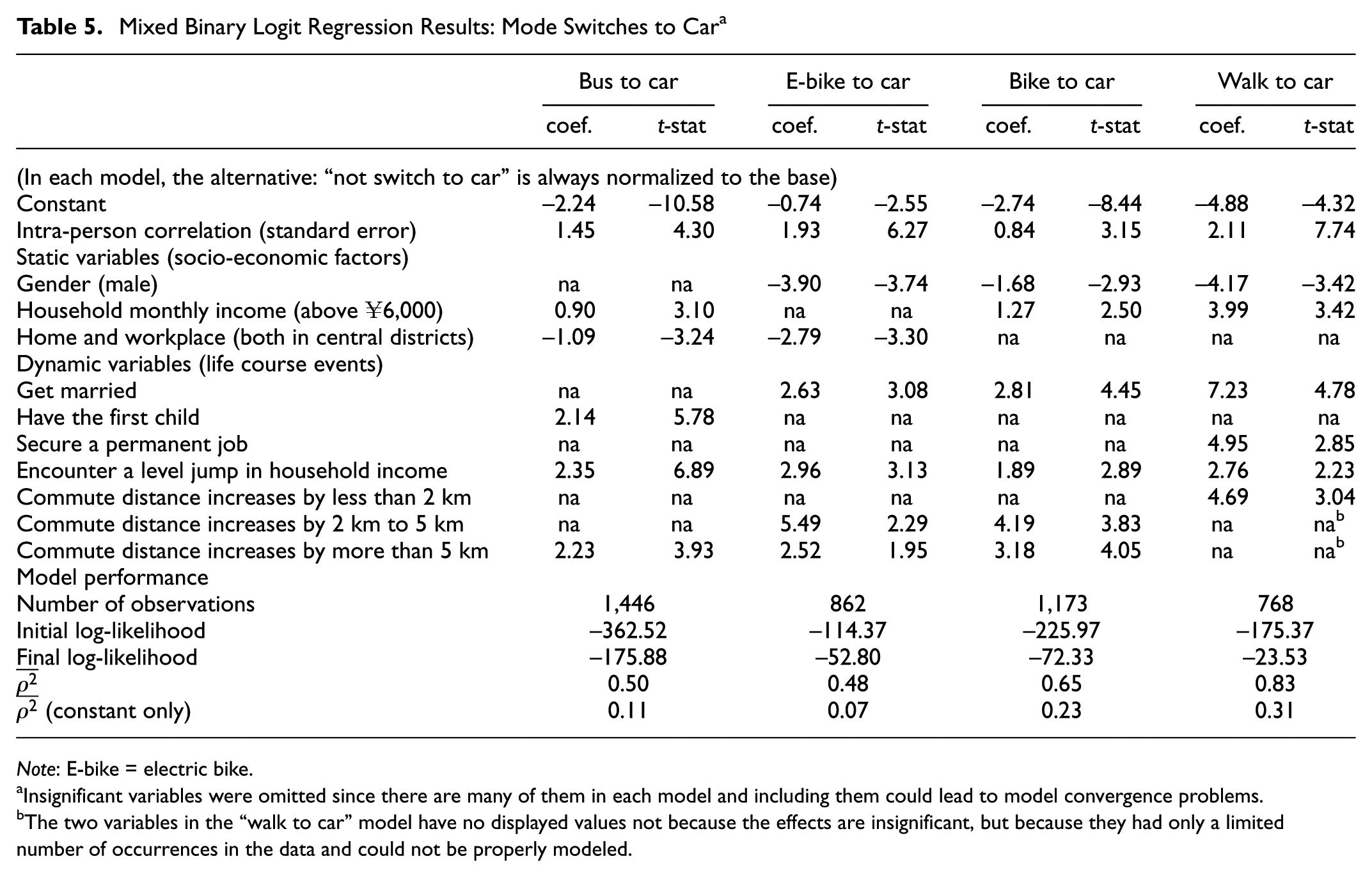
Note: E-bike = electric bike.
Insignificant variables were omitted since there are many of them in each model and including them could lead to model convergence problems.
The two variables in the “walk to car” model have no displayed values not because the effects are insignificant, but because they had only a limited number of occurrences in the data and could not be properly modeled.
Model Estimation Results
In Table 4, with respect to the mode switching behavior from car to non-car, almost all variables exhibited significant effects, except the life course event of having the first child, which was the only variable that did not meet the 90% significance level. For the rest of the life course events, getting married and encountering a level jump in household income also manifested a negative effect, which means both events are less likely to induce a shift to using non-car modes for the regular commute. In comparison, positive effects on a switch from car to non-car were observed with securing a permanent job, and all three cases of commute distance decreased. In relation to socio-economic factors, males and commuters from wealthier households preferred to stick with the car rather than switch to any of the alternatives. However, if both the home and workplace are inside the central districts of the city, people might be more willing to switch their commute modes away from the car.
So far, we have only briefly described some of the modeling results without elaborating. This is because a single model studying only car to non-car mode switching behavior cannot decisively confirm whether the factors’ impacts are a result of “preferring mode” (i.e., different utilities on car and non-car modes) or “preferring switch” (i.e., different utilities on embracing change and living with the status quo). Thus, we now introduce the results of the mirror models to further reveal mode switching behavior.
Table 5 shows the parameter values in the mirror models. Unlike the earlier “car to non-car” model in which most variables exhibited significant effects, there were many more insignificant variables in each of the four mirror models that were thus omitted to avoid model convergence problems. However, despite that, the remaining significant variables displayed a consistency in relation to their impact signs across the different mirror models; the analyses below reveal whether these effects are on account of “preferring mode” or simply “preferring switch.”
Preferring Mode
Several life course events are associated with mode preference. Getting married could significantly affect mode switches from electric bike, bike, and walk to car for which bus to car is the only model in which the impact significance is lost. By comparing these positive impact signs with the negative impact sign in the earlier model, it can be identified that getting married is likely to move people away from non-car modes to using the car for the regular commute; however, if car users get married, they might prefer to remain with the car rather than switch to non-car alternatives. The same could be concluded for having the first child and encountering a level jump in household income, for which both events also have positive effects on the mode switches to car in the mirror models, and the effects are the opposite to the earlier model in which negative signs were observed. However, it should be noted that having the first child was only significant in inducing bus users to switch to car, whereas a surge in household income had a universally significant effect in all four mirror models. Another type of life course event associated with the “preferring mode” rather than “preferring switch” is a change in commute distance. Different degrees of commute distance increases were positively associated with mode switches to car in the mirror models, whereas a mode switch from car to non-car in the earlier model was positively associated with commute distance decreases.
For socio-economic factors in the mirror models and the earlier “car to non-car” model, opposite impact signs were found on household monthly income, and home and workplace location, which means that both of these factors are associated with mode preference. Specifically, car commuters with a higher household income would like to continue using the car and non-car commuters with a higher household income would prefer to switch to the car. Those living in the central districts were found to be more willing to accept a mode switch from car to non-car, whereas a switch from non-car to car was a less appealing option.
Preferring Switch
Only one life course event and one socio-economic factor seemed to be associated with “preferring switch” behavior. In the earlier model, securing a permanent job could possibly lead to a mode switch from car to non-car; in the mirror models, the effect also had a positive impact sign though this was significant only in the walk to car model. The implication is that securing a permanent job (i.e., from being self-employed or a student) may induce a switch of commute mode; however, both switching to and away from the car could potentially occur as a consequence of an individual’s specific travel needs, which could not be identified from the available survey data. Similarly, male commuters were found to have negative impact signs in both the earlier car to non-car model and the subsequent mirror models, which implies their relatively strong “reluctance to switch” compared with female commuters.
Discussions and Policy Implications
Like many travel behavioral studies, the modeling outputs offer a range of insights that could enrich current literature. However, the extent to which these insights could inform policy making is debatable as, in many cases, findings cannot be applied practically owing to various constraints. Thus, we will evaluate each of the key factors in our models with respect to their potential for designing policies with the objective of discouraging commuters from car use. It should be clarified that our aim is not to make any specific policy proposals; this is beyond the scope of this work.
Getting Married
There could be various reasons why getting married could induce a mode switch to car, for example, a car purchase facilitating car access ( 18 ), or the need to reduce the commute journey time having taken on additional family roles. The latter hypothesis could possibly reflect the results of our mirror models in which getting married led to users of the electric bike, bike, and walk switch to the car, whereas its effect on bus users, who may be more satisfied with their mode of choice, was insignificant. Such a result could present an opportunity for a policy intervention. Although we cannot halt mode switches to the car by manipulating the occurrence of life course events, policy making could potentially step in by tactically encouraging, for example, a mode switch to the bus through use of the Voluntary Travel Behavior Change (VTBC) strategy ( 27 , 28 ), which usually consists of informational and marketing efforts to encourage behavioral change ( 10 ). In our example, it might be providing special rewards to new bus customers, to attract the regular electric bike, bike, and walk commuters.
Having the First Child
Recall that having the first child did not have a significant effect on mode switching behavior from car to non-car modes; however, a significant, positive effect was observed in one of the switching to car models. Oakil et al. also made a similar discovery; one explanation they proposed was that having child led to stronger demand for travel flexibility, for example, to travel to baby’s regular check-up or daycare drop-offs and pick-ups, which is something the car definitely offers ( 9 ). Further insight could possibly be revealed by comparing across mirror model results. Having the first child is only significant in inducing bus users, not the rest of the mode users, to switch to the car, which implies that flexibility may not be the only concern, and the eagerness of bus users to choose the car might reflect a dislike of the public transport environment when traveling with a baby on their commute trips (for drop-offs and pick-ups). Hence, encouraging new parents who used to commute by bus to switch to non-car travel options could be a policy pursuit. For instance, subsidies could be offered to new parents for the purchase of cycling equipment (e.g., electric bike or bike).
Securing a Permanent Job
Given the finding that an employment status change could potentially lead to both switching to and from the car, we prefer not to derive any policy implications at this stage until further research reveals the intrinsic factors that might result in such outcomes. Having observed the significant impact of commute distance changes on mode switching behavior in our models (their policy implications will be discussed shortly), distance could be one such factor. However, we did not study the potential interaction between a change in employment status and changes in commute distances as there were insufficient observations in the datasets. Moreover, other intrinsic factors may exist and need investigation.
Encountering a Level Jump in Household Income
Household income was the only factor that had a universally significant effect in all four mirror models. However, from a practical perspective, this also implies that none of the four modes could be a competitive alternative to the car when commuters become wealthier and therefore the potential for policy intervention would be limited.
Changing Commute Distance
An increase in commute distance could make the car more attractive to non-car mode users; however, users of the range of non-car modes were variously affected by different degrees of increase. Bus users tended to switch to the car only if the distance increase was large (by more than 5 km); the two cycling mode users tended to switch to the car under a smaller threshold (2 km to 5 km); finally, commuters on foot switched to the car even when there was a relatively small increase (by less than 2 km). It seems that such trends are in line with the mobility power of each non-car mode. As for the implications for policy making, bus users could potentially remain with the bus if, for example, they were rewarded for making long-distance bus journeys. One solution could be to introduce a flat or even diminishing pricing scheme with respect to journey distance, so that the longer journey time incurred traveling by bus could be compensated for in a cost saving, though the feasibility of such a policy needs to be carefully researched. Persuading cyclists and commuters on foot to stay with their original mode choices could be problematic, as there could be many more “pain points,” for instance, physical fitness, comfort, and safety concerns would come into play, which cannot be easily addressed by policy interventions. Thus, from a practical perspective, it might be more effective to encourage a mode switch to the bus, for example via the aforementioned VTBC reward strategy. Furthermore, for the two bicycle modes in particular, efforts could also be made toward seamless integration with the public transport system (e.g., carrying foldable bikes on buses/providing bikes racks; both measures have already been adopted by many cities across the globe), which might offer another solution to a commute distance increase.
Socio-economic Factors
The three socio-economic factors in this research, gender, household income, and home and workplace, were studied in terms of their linear effects on mode switching behavior. A more sophisticated approach would be to evaluate their interaction effects with life course events to better reveal mode switching patterns; that is, to identify whether a socio-economic group would be affected more/less by a particular life course event and, hence, more realistic policy implications could be obtained ( 29 ). However, owing to our data constraints (limited number of interaction observations), only linear effects could be properly modeled. In fact, the data constraints seem to be a universal issue, given their presence in earlier studies as well ( 9 , 10 , 13 ). Future work to overcome such data challenges could potentially contribute significantly to mode switching research; meanwhile, a broader range of socio-economic factors, such as age, educational level, and household size, could also be explored if relevant data is collected.
Beyond Life Course Events
Finally, we would like to discuss the wider implications in light of the results obtained from this research. Since life course events were found to trigger mode switches to/from the car, it would be worth investigating whether there are other types of events (i.e., not intrinsic as those directly related to individuals) that have similar effects and, importantly, which could generate more policy insights. By hypothesizing broadly, many substantial changes such as those in land use, in transport networks and other built environment conditions, in transport service accessibility, and even persistent changes in an area’s general weather conditions, could all possibly result in changes in mode choice habits. Were mode switching studies to capture some of these extrinsic events, we would anticipate greater potential for policy design, and more opportunities for interventions to influence people’s mode choice habits, especially in countries like China, where the built environment, transport supply, and many other contextual aspects are currently undergoing massive and rapid transition and reform. Moreover, when evaluating extrinsic events, their potential interactions with not only socio-economic factors but intrinsic events (i.e., life course events), should be taken into account. For example, if a public transit station/stop was opened, car users living nearby might switch to this service depending on a range of factors, for example, whether they had recently had children, experienced changes in their employment, income status, an so forth. Overall, more research is needed to shed light on such life event interactions.
Conclusions and Further Research Opportunities
This work offered a mode switching analysis using retrospective survey data. The impacts of a variety of life course events were investigated and the corresponding implications for policy making were discussed. The survey data had a panel structure through capturing a group of Chinese citizens’ main commute mode choices in four observation periods. A mixed binary logit regression model was initially developed to study mode switching behavior from the car to non-car modes between a precedent period and the following period. A set of mirror models was subsequently developed to reveal the mode switches from each of the non-car modes to the car. The mirror models also had a binary structure with a logit mixture to capture intra-person correlation.
It was revealed that getting married, having the first child, and encountering a level jump in household income could induce a mode switch from non-car modes to the car, whereas car users who experienced these life course events continued using the car as their regular commute mode. Similarly, an increase in commute distance rendered people more likely to switch to the car, whereas a decrease made people switch away from the car. The only event that was not associated with a clear mode preference was securing a permanent job, which resulted in both switching to and away from the car. Further research is needed to explore the intrinsic factors that might result in such outcomes.
The mirror models also revealed differences in mode switching behavior among users of different non-car modes, and corresponding policy implications were subsequently derived. To prevent the commuters currently using the electric bike, bike, and walking from switching to the car when they get married, it could be useful to encourage mode switches to the bus, which may also be able to satisfy their travel needs, as bus commuters on marrying were not found to have the same level of desire to switch to the car. Targeted informational and marketing measures could be introduced to facilitate such a mode switch to the bus. However, bus users were more willing to take up the car following their first child, whereas the rest of the non-car mode users seemed indifferent to such a switch in this circumstance. Thus, measures could be taken to encourage an alternative switch (i.e., bus to bike or bus to walk) via for example subsidies to new parents for the purchases of cycling tools. Another event that has policy implications was a change in commute distance. Bus commuters would switch to the car only if the distance increase is large (by more than 5 km); electric bike and bike users would switch to the car under a smaller threshold (by 2 km to 5 km); commuters on foot could switch to the car even when there was a small increase (by less than 2 km). As a result, a rewarding scheme would probably be needed for undertaking long-distance bus journeys to prevent bus users from switching to the car; meanwhile, persuading cyclists and commuters on foot to switch to the bus rather than staying with their current choices would also be recommended since an increase in distance could result in more pain points that cannot be easily addressed by policy intervention (e.g., physical fitness, comfort, and safety concerns). Finally, when discussing these policy implications, attempts were also made to provide possible explanations for the differences in mode switching behavior among different non-car mode users (i.e., why an event could have a significant effect on some mode users and not on the others); however, similar to previous studies ( 9 , 18 ), these explanations are still hypothetical and there could be a need to disclose further significant underlying causes, leading to opportunities for future research.
Several socio-economic factors were captured in this work. However, owing to data constraints, their interaction effects with life course events were not analyzed. This is a subject that should definitely be explored in the future to acquire more in-depth implications for policy making. At the end, opportunities for studying a broader range of events (e.g., changes in land uses, transport supplies) were also identified and discussed.
Footnotes
Acknowledgements
We appreciate the support from Shanxi Transportation Research Institute for the funding and advice provided during the data collection. We are grateful to Mr Li Peiyu of Shanxi Experimental Secondary School, Mr Hou Juntao of Peking University, and Ms Zhao Helan.
Author Contributions
The authors confirm contribution to the paper as follows: study conception and design: WL, MK; data collection: WL; analysis and interpretation of results: WL; draft manuscript preparation: WL, MK. All authors reviewed the results and approved the final version of the manuscript.
The Standing Committee on Traveler Behavior and Values (ADB10) peer-reviewed this paper (19-05629).