







Abstract
The coefficient of thermal expansion (CTE) of concrete is an important parameter that affects the design and performance analysis of concrete pavements. Higher CTE value results in increased curling and related stresses. A 28-day CTE value is used for designing rigid pavements. Though previous studies have revealed that coarse aggregate mineralogy has substantial effects on the CTE value of paving concrete, it is not known yet how CTE value changes with the age of concrete in the long-term. In this study, seven concrete mixes with different coarse aggregate mineralogy are tested in the laboratory and data is analyzed to examine CTE. Results show that limestone has the lowest CTE values compared with other coarse aggregates. Concrete CTE increases from 6.4% to 12.6% as it ages. This increase in CTE may result in increased thermal distresses as concrete pavement ages. Therefore, a single value of 28-day CTE should not be used in the design of concrete pavements. In this study, a prediction model is developed to determine aged CTE incorporating mixture volumetrics and concrete strength properties. The same can be incorporated in Pavement Mechanistic Empirical (ME) Design software to better predict the rigid pavement performance.
The coefficient of thermal expansion (CTE) measures concrete’s expansion and contraction with a change in the concrete’s temperature. Although the CTE values are very small (3.5 με/°F to 7 με/°F) they have a big impact on the design and analysis of rigid pavements. The temperature-related pavement deformations are directly proportional to the CTE value of paving concrete, and an accurately determined CTE value should be used in the design process. The CTE of concrete is dependent on different factors such as coarse aggregate type, type of admixtures, concrete age, and mix proportion. As aggregates are the major constituents of concrete volume, these have the most influence on the CTE of concrete. Several researchers have conducted experimental studies on CTE measurements of concrete prepared with different aggregate types to examine the impact of the mixture properties on the CTE values. They revealed that the CTE value is affected by coarse aggregate mineralogy, sand types, volumetric proportion of the aggregates, and moisture condition. They emphasized that the aggregate mineralogy and volumetric proportion have the most effect on the CTE ( 1 – 4 ).
Alungbe et al. conducted experimental work on the effects of aggregate type and concrete age on the CTE of paving concrete by investigating three types of aggregates including porous limestone, dense limestone, and river gravel ( 5 ). Three combinations of water-to-cement ratio and cement content were studied as well as two curing durations (28 and 90 days). A length comparator was used to measure the length changes of specimens. The specimens were square prisms with dimensions of 3 × 3 × 11.25 in. In this study, the concrete samples with porous limestone as coarse aggregate had a CTE that ranged from 5.42 to 5.80 με/°F, concrete samples produced from dense limestone had a range of 5.82 to 6.14 με/°F, and concrete samples made of gravel coarse aggregate had a CTE range of 6.49 to 7.63 με/°F. A statistical analysis (factorial design) was used to study the effect of different variables on CTE magnitude. Based on statistical analysis, the authors concluded that aggregate type significantly affects the CTE value, but water-to-cement ratio and cement content have no effect on the CTE and, also, there was no significant difference between samples with different curing durations in water-saturated specimens. Tran et al. evaluated the effects of mixture properties on concrete CTE by preparing twelve concrete mixtures using four aggregate types including limestone, sandstone, syenite, and gravel ( 6 ). For each mixture, three replicates were fabricated and the samples were tested at 7 and 28 days. The range of the CTE values was approximately 5 to 7 με/°F. The mixtures made with limestone and syenite had the lowest average CTE of about 5.2 με/°F while mixtures made with gravels had the highest average CTE value of approximately 6.9 με/°F. After conducting a multi-factor analysis of variance (ANOVA) on mixture properties, it was reported that the aggregate type had a pronounced effect on the CTE. The fully saturated concrete specimens showed no significant difference in their respective CTE values at 7 and 28 days. Havel et al. conducted a CTE experimental study on concrete mixes with three Basaltic coarse aggregates ( 7 ). They performed CTE testing at the age of 28 and 56 days and confirmed that CTE values of paving mixes vary with age of specimens. Jeong et al. performed their research on one concrete mix with sandstone as coarse aggregate ( 8 ). They used one cylindrical sample to observe CTE variation with age and implied that there is no CTE variation after the age of 10 H up to the age of 180 days. They did not follow the standard test protocol for their testing. Shin and Chung investigated the effects of concrete age on CTE, by measuring the CTE at 3, 5, 7, 14, 28, 60, and 90 days for concrete prepared with different aggregates ( 9 ). They concluded that the CTE at different ages of the mixtures fluctuated within 0.2 με/°F and verified by the statistical analysis (ANOVA) that there was no significant difference because of concrete age. This statistical analysis cannot be compared with the effects on pavement performance. On the other hand, Kim et al. found with statistical analyses of the experimental data that the CTEs measured at 120 days are significantly lower than those measured at 28 days ( 10 ). They concluded that the magnitude of the measured CTE is significantly (statistically) influenced by the age of the sample at the time of testing. Jahangirnejad et al. performed experimental studies and concluded that the magnitude of the measured CTEs at the early ages (3, 7, 14, 28 days) were significantly (statistically) lower than the magnitudes determined at the end of 90, 180, and 365 days ( 1 ).
Sabih and Tarefder conducted studies on CTE impact on the mechanistic-empirical performance of jointed plain concrete pavement (JPCP) and unbonded overlays and found that CTE has a substantial effect on the performance of concrete pavements and overlays (11–13). They concluded that as CTE increases the pavement performance deteriorates and vice-versa. Hein found that thermal expansion and contraction has a substantial effect on pavement performance ( 14 ).
At the microstructure level, CTE is caused by redistribution of water between capillary pores and gel pores in the cement paste with a change in temperature ( 15 ). The volume of these pores changes with the hydration process in the cement paste and this hydration process continues until the concrete reaches the age of 1 year, thus the CTE of concrete may be assumed to vary with concrete age ( 16 ). Concrete is a composite mixture of cement, coarse aggregate, fine aggregate, and water. The CTE of concrete is dependent on its constituents, as different constituents have different CTEs. Various prediction models for the determination of the CTE of concrete have been proposed in the literature. Emanuel and Hulsey proposed a CTE model based on the volumetric weighted average of the constituents ( 17 ). Another model was proposed by Neekhra et al. (based on the concept of Hirsch’s composite model) for the determination of the CTE of concrete ( 18 ). The CTE of mortar and coarse aggregate are the two main inputs. Pavement Mechanistic Empirical (ME) Design uses a CTE prediction model based on concrete mix volumetrics ( 19 ). It is evident that these models do not consider concrete age in the determination of CTE of concrete (age has a pronounced effect on CTE) thus there is a need to include concrete age factor in the CTE prediction model.
Based on previous research, it can be said that coarse aggregate mineralogy has a considerable impact on the CTE of paving concrete but the effects of concrete age on the CTE have not been predicted well.
Objectives
This study aims to evaluate the effects of concrete age on the CTE of paving mixes and to develop a prediction model for determining long-term CTE values from concrete mixture volumetrics and strength properties.
Experimental Methodology
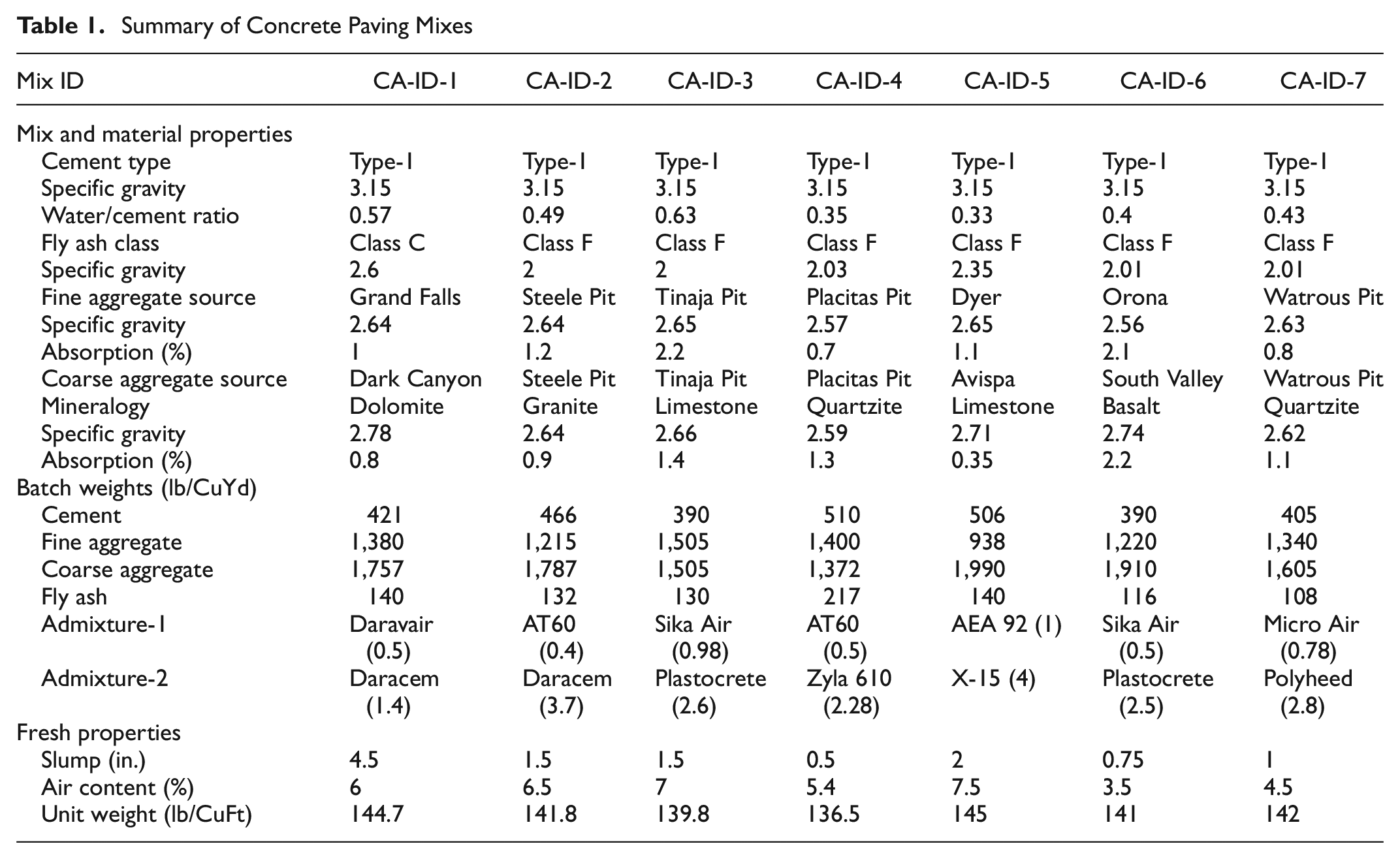
This study comprises testing of seven paving mixes collected from various districts of New Mexico (NM), cast with different coarse aggregates. These paving mixes are designated as CA-ID-1 to CA-ID-7 for data composition and analysis purposes. All of these concrete mixes are approved by the NM Department of Transportation (DOT) for rigid pavement construction in NM. The summary of these paving mixes, including mix properties, batch weights, and fresh mix properties, are given in Table 1. It is evident that all these mixes have different mix proportions with varying water-to-cement ratio, and the coarse aggregates have different geographical and mineralogical properties. The fresh mix properties including slump, air content, and density are also different for all the mixes. The coarse aggregates used in these paving mixes range from granite, basalt, quartzite, dolomite, and limestone. The purpose of using paving mixes with different mix properties is to evaluate the effects of concrete age on the CTE values of different paving mixes, and also the effects of coarse aggregate mineralogy on CTE. As already opined by various researchers that the water-to-cement ratio, slump, and other mix properties have a negligible effect on CTE values.
Summary of Concrete Paving Mixes
CTE Test, Results and Analysis
Cylindrical specimens prepared for each paving mix (CA-ID-1 to CA-ID-6) were tested for CTE, according to the AASHTO T-336 test protocol, at the age of 28, 60, 90, 120, 180, 240, 300, and 360 days to compare the CTE values of concrete at various ages ( 10 ). Six specimens from CA-ID-7 are tested for 28 days CTE to have confidence in the CTE test data.
Pine Instruments’ CTE device is used in this study. The pictorial view of CTE testing is shown in Figure 1. The test procedure consisted of placing the specimens in saturated lime water until the weight equilibrium is achieved, for not less than 48 h. CTE equipment is calibrated with a metallic calibration specimen with known CTE value. The concrete specimen is then tested in the water bath for successive temperature cycles ranging from 50°F to 122°F (10°C to 50°C) and CTE value is obtained from the average of two test cycles.
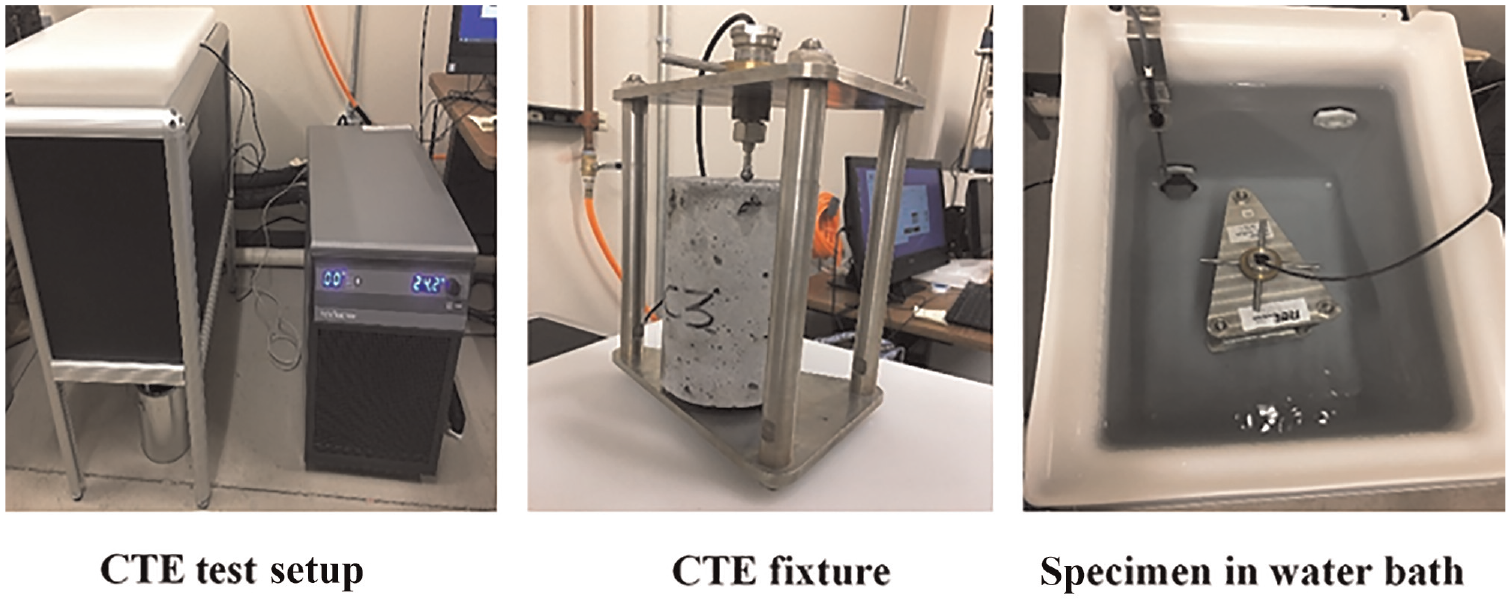
Pictorial view of coefficient of thermal expansion (CTE) testing.
Comparison of CTE Test Data with Pavement ME Default CTE Values
Pavement ME Design is the latest tool for design and performance analysis of rigid pavements which is increasingly being used in the United States. Concrete CTE is a very important input in this design procedure and the structural response models of Pavement ME are quite sensitive to the CTE values. The Pavement ME Design manual recommends the use of average CTE values at 28 days for concrete. It is always recommended to use the accurately tested value of CTE as the variation in CTE value affects the rigid pavement design in a substantial manner.
Figure 2 shows the tested CTE values for all the mixes at the age of 28 days as compared with the ME default CTE values. The tested values differ from the ME default values in a considerable manner. The upper and lower bounds of ME default CTE data are also shown in Figure 2. It can be seen that the tested CTE values of six mixes are within the upper and lower bounds. Only the CTE of CA-ID-7 is slightly higher than the upper bound of default data.
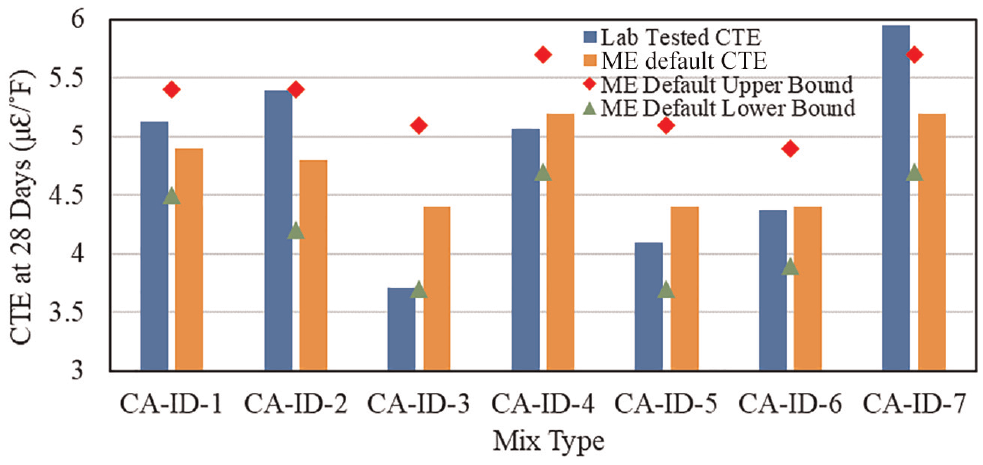
Comparison of CTE test data with ME default data.
The effect of coarse aggregate mineralogy on the CTE of concrete is also evident from these results. The CTE of two concrete mixes comprising limestone aggregate is the lowest, in comparison with the others, ranging between 3.7 με/°F and 4.1 με/°F. The CTE of concrete mix with basalt is slightly higher than that with limestone, whereas concrete with dolomite, granite, and quartzite show the highest CTE in the range of 5.1 με/°F to 5.9 με/°F. These results reveal that coarse aggregate mineralogy affects the CTE of concrete.
Effects of Concrete Age on the CTE of Concrete
The impact of concrete age on CTE is evaluated by analyzing the time series data of six paving mixes which shows an increasing trend of CTE values of all the paving mixes from 28 days to 360 days. It became evident that the CTE of all the paving mixes increases with age. As such, the use of CTE value at the age of 28 days in rigid pavement design may result in erroneous pavement design. The aged CTE value will result in the increased magnitude of curling stresses over the designed service life of the pavement which may result in an increase in pavement distresses and a decrease in design life.
The comparison of long-term CTE values of six paving mixes is presented in Figure 3. Clearly, CTE increases as concrete ages. The difference in CTE between 28 days and 360 days ranges from 0.33 με/°F to 0.55 με/°F with a percent increase from 6.4% to 12.6% for the tested paving mixes as shown in Figure 4. The increase in CTE is different for different paving mixes, which can be attributed to the difference in mix design proportions and different (mineralogy) coarse aggregates being used.
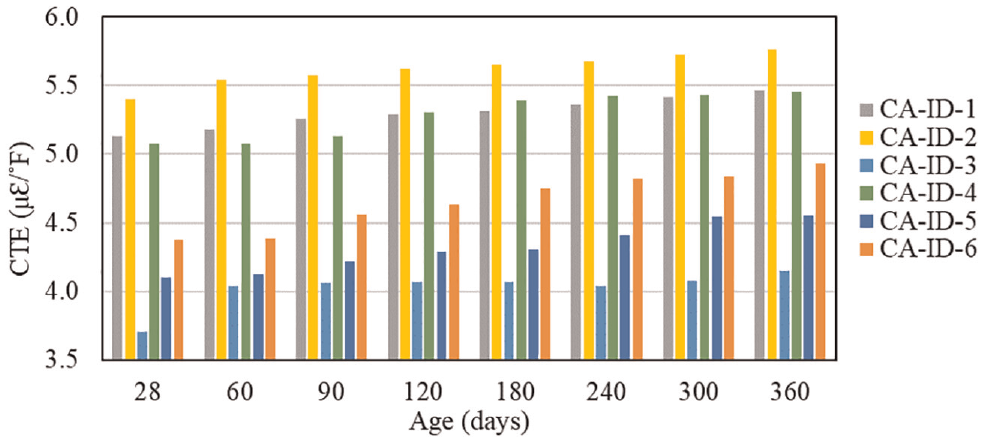
Comparison of coefficient of thermal expansion (CTE) test data (28 days to 360 days).
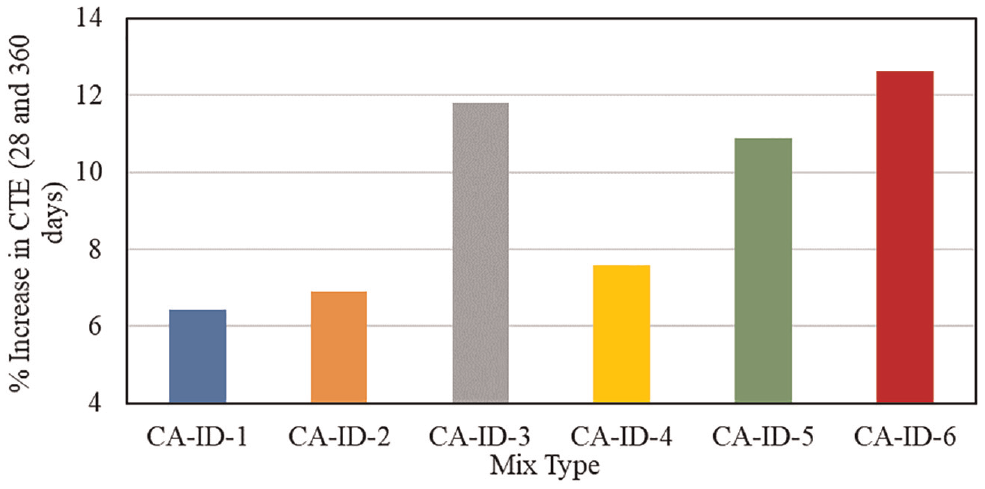
Percent increase in coefficient of thermal expansion (CTE) between 28 days and 360 days.
Replicate Sample Testing for Confidence in Data
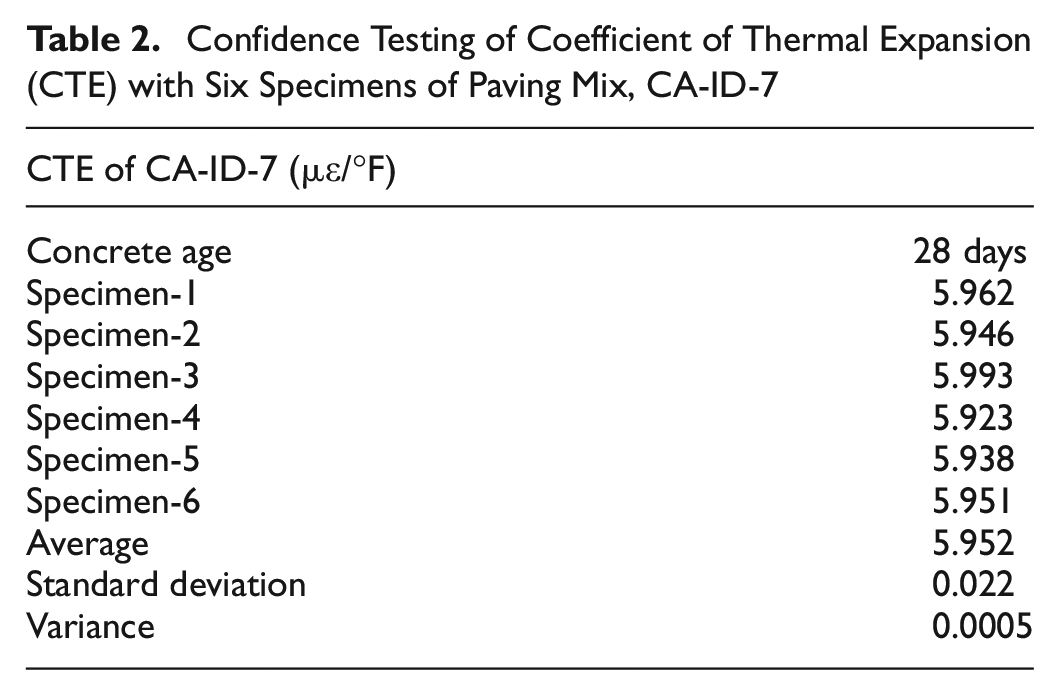
Data presented so far in this study is an average of two samples per mix. To have some confidence in the tested data, six replicate specimens of CA-ID-7 were tested for CTE at the age of 28 days and data analyzed for the confidence interval. The CTE results are given in Table 2 which shows a standard deviation of 0.02 and a variance of 0.0005. With these results, it became evident that the CTE values of CA-ID-7 at the age of 28 days are similar for the six specimens and thus the test procedure is validated.
Confidence Testing of Coefficient of Thermal Expansion (CTE) with Six Specimens of Paving Mix, CA-ID-7
Long-Term CTE Prediction Model For Paving Concrete
Effect of Concrete Age on Compressive Strength and Modulus of Rupture of Hardened Concrete
Replicate cylindrical specimens from each of the paving mixes are tested for compressive strength and modulus of rupture (MOR) at the age of 7, 14, 28, 90, 180, and 360 days. The comparison of compressive strength data with regards to concrete age is shown in Figure 5. It shows a continuously increasing trend in compressive strength with concrete age. The compressive strength values at the intermediate ages of 60, 120, 240, and 300 days are determined with regression models developed for each paving mix. The strength gain trends of all the mixes are the steepest up to the age of 28 days and then they gradually flatten.
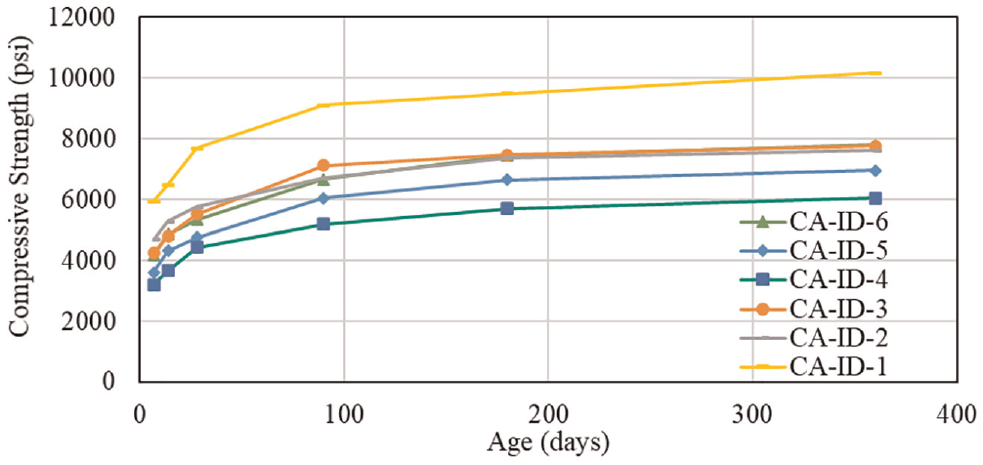
Comparison of long-term compressive strength gain.
Model for Determining Aged CTE Incorporating Mixture Volumetrics and Strength Properties
The long-term CTE prediction model is developed using regression analysis to determine the aged CTE. Test data of five paving mixes were used in the development of the model and six variables of each mix were used including CTE at the age of 28 days, percentage of coarse aggregate volume, percentage of cement paste volume, concrete age (days), modulus of rupture (kips per square inch [ksi]), and compressive strength (ksi). These variables are designated as A, B, C, D, E, and F respectively and the model coefficients for these variables are 0.940163, 0.049563, 2.141642, 0.000912, 0.211117, and 0.006429 respectively. The model is presented in equation 1, where

Analysis and Validation of Aged CTE Model
The aged CTE prediction model developed in this study is based on regression analysis of six variables including 28 days CTE, strength properties, concrete age, and mixture volumetrics. The model has been generated by using the laboratory test data of five concrete mixes including the time series data at the concrete age of 28, 60, 90, 120, 180, 240, 300, and 360 days. This gives a comprehensive data for model generation of 40 data sets.
The CTE prediction model was validated with the test data of seven concrete mixes. The CTE test data of two paving mixes (that were not involved in the model generation) was also incorporated in the validation process. The analysis is shown in Figure 6 where lab tested CTE data (on x-axis) is compared with the predictions of long-term prediction model (on y-axis). It is evident from the analysis that the long-term prediction model works well, and accurately predicts the CTE of paving mixes at different concrete ages. The developed model for long-term prediction of CTE can be further refined/optimized by adding more test data of paving mixes prepared with other coarse aggregates of different mineralogical nature. The prediction model can then be incorporated in Pavement ME Design software for improved design of all types of rigid pavements.
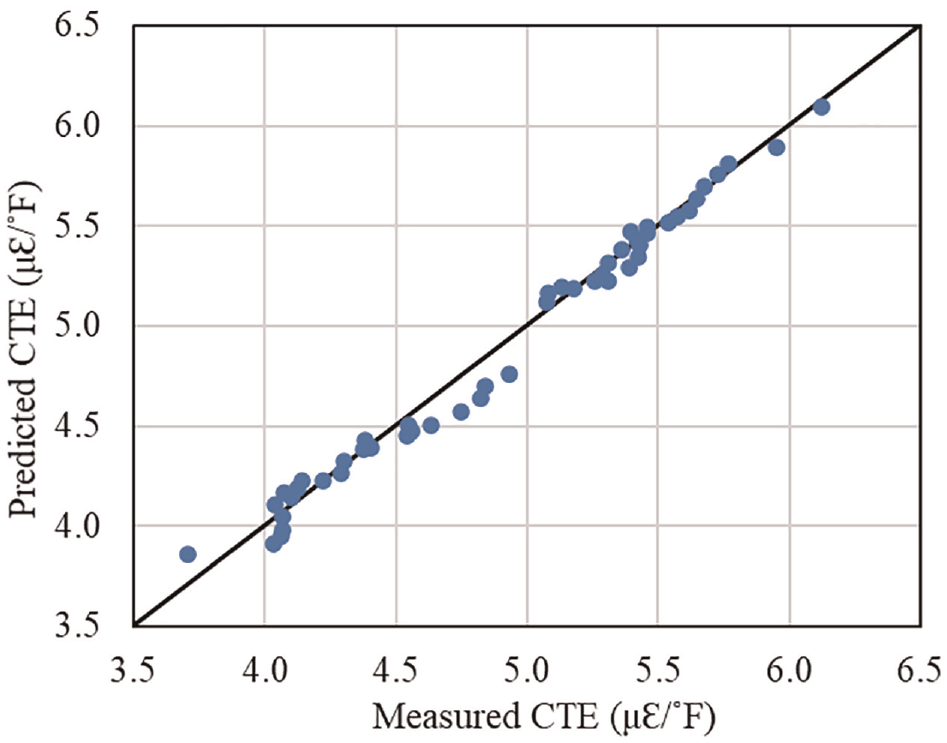
Analysis/validation of aged coefficient of thermal expansion (CTE) model with laboratory test data.
Conclusion
Based on the results of this study, it became evident that coarse aggregate mineralogy affects the CTE of concrete paving mixes. Concrete with limestone as coarse aggregate has the lowest CTE values compared with concrete prepared with other coarse aggregates.
Concrete age affects the CTE in the long-term with an increase from 6.4% to 12.6% between the age of 28 days and 360 days. This increase in CTE with concrete age may affect the concrete pavement design. The use of 28 days CTE value in ME design, which is current practice, will result in erroneous design and the pavement may not perform well for the designed service life. The long-term CTE prediction model developed in this study works well in determining the aged CTE values. This model can be further optimized for incorporation in Pavement ME Design software. This may reduce the inaccuracy in the design of rigid pavements and overlays.
Footnotes
Acknowledgements
The authors would like to express their gratitude to Dr Musharraf Zaman, Director of SPTC, and Jeffrey Mann, David Hadwiger, Parveez Anwar, Sean Brady, and Naomi Gaede of NMDOT for their help and support. The help of the pavement research group at UNM in collecting concrete mixes from the field and preparation of specimens is greatly appreciated.
Author Contributions
The authors confirm contribution to the paper as follows: study conception and design: G. Sabih; data collection: G. Sabih; analysis and interpretation of results: G. Sabih, R. Tarefder; draft manuscript preparation: G. Sabih, R. Tarefder. All authors reviewed the results and approved the final version of the manuscript.
Declaration of Conflicting Interests
The author(s) declared no potential conflicts of interest with respect to the research, authorship, and/or publication of this article.
Funding
The author(s) disclosed receipt of the following financial support for the research, authorship, and/or publication of this article: This study was funded by the New Mexico Department of Transportation (NMDOT) and Southern Plains Transportation Center (SPTC).