







Abstract
This paper examines whether minimum parking requirements affect parking provision in condominiums and what factors determine condominiums’ parking capacities. By calculating actual, required, and excess parking capacities, the paper finds that almost 90% of the sample condominiums in Bangkok and the surrounding municipalities in the Bangkok Metropolitan Region provide more parking spaces than required by law. The parking capacities in condominiums outside Bangkok are almost as high as those in Bangkok, despite their required minimums being half those of Bangkok. Only 11% of the sample condominiums provide the required minimums. The figure has decreased to zero in recent years, likely because of soaring land prices. These results suggest that developers’ decisions to provide parking are not determined by parking requirements but by market demand. Results from regression analyses show that parking capacities are determined by total floor area and number of dwelling units in a project, distance to the nearest transit station, and average unit price. Condominiums located in Bangkok are found to provide significantly more parking spaces than those in the suburban municipalities. This result has important policy implications for transit-oriented development, considering that accessibility to public transit is much better in Bangkok than the suburban areas.
Minimum parking requirements (MPRs) are part of building codes or zoning laws that local authorities use to ensure sufficient parking supply in new developments and to avoid parking spillovers on nearby streets. MPRs have been widely adopted not just in automobile-oriented cities in North America and Australia, but also in many cities in Asia with extensive mass transit networks, such as Seoul and Singapore ( 1 ). But in the past decade, MPRs are being revamped in an increasing number of cities around the world. According to a crowdsourced map initiated by Strong Towns, as of July 2019, at least 105 cities in North America have removed MPRs completely in at least one neighborhood of the city. Another 38 cities have reduced MPRs, and another 10 cities are in the process of removing or reducing them ( 2 ). Several major European cities, such as Amsterdam, Paris, and London, have long eliminated such requirements, while São Paulo, Brazil and Auckland, New Zealand, have removed their MPRs in the past few years.
Following the global trend, the Bangkok Metropolitan Administration, Bangkok’s local government, is currently in the process of relaxing its MPRs in the new Comprehensive Plan, specifically in areas around transit stations in central Bangkok. This regulatory change is in line with the overarching objective of the city’s urban policy to promote transit-oriented development. However, such a move is not uniform across all provinces in the Bangkok Metropolitan Region (BMR). Note that the BMR refers to the conurbation that encompasses the province of Bangkok and five surrounding provinces of Nonthaburi, Pathum Thani, Samut Prakan, Samut Sakhon, and Nakhon Pathom. Local governments in surrounding provinces, which are Bangkok’s de facto residential suburbs, have recently raised the MPRs for condominium development in their local ordinances. In the Thai context, condominiums refer to a building or complex of buildings containing several individually owned dwelling units.
Such contrasting policy shifts signify competing perspectives on off-street parking standards. Bangkok’s move toward deregulation reflects the belief that MPRs are inefficient, given the availability of high-quality transit services, as they lead to the oversupply and underpricing of parking ( 3 , 4 ). Meanwhile, the surrounding municipalities’ decisions to push up the minimum standards follow the conventional rationale that the government has to intervene in the parking market to protect consumer welfare and to prevent negative externalities, especially parking spillover into nearby streets ( 5 ).
The policy contrast also indicates a lack of empirical evidence in Thailand to support either of the two perspectives. Particularly in the case of residential development, it is not certain whether reducing MPR standards would lead to actual reduction in parking supply in residential development, and if so, under what conditions. Residential developers’ decisions to provide parking may not be affected by MPRs, if they think prospective buyers would want access to off-street parking as part of their purchase. This assumption is explicitly stated by a real estate expert who argues that one key factor to consider when purchasing a condominium in Bangkok is parking capacity, and that the best condominium projects should have reserved parking spaces for tenants’ exclusive use ( 6 ). If this is the case, then changes in MPRs would not reduce the actual supply of parking, because developers would still build more parking spaces to accommodate the expected demand. Although it is too soon to assess the effect of Bangkok’s recent policy shifts, we can still use existing data to examine the historical effects of MPRs on parking provision and the factors that explain the provision.
While the overarching goal of this paper is to provide empirical evidence to inform parking policy decisions, the paper specifically aims to answer the following research questions.
Do the minimum parking requirements affect parking provision in condominiums?
What factors explain the parking capacities of condominiums?
The remaining of this paper is organized as follows. The next section summarizes the literature review, followed by an overview of parking regulations in the BMR. The hypotheses, research methodology, and data are outlined; then the results of statistical analyses are presented. The last section concludes with policy implications and suggestions for future research.
Literature Review
MPRs have been long criticized by researchers as the cause of wasteful development, encouraging driving by providing ample parking supply at minimal cost ( 3 , 4 ). That parking requirements mandate more parking than developers would otherwise choose to provide is widely accepted ( 7 , 8 ). The parking measure also has equity implications, as property developers required to build parking pass on the additional costs to property buyers who may not use it ( 9 ). Despite the strong theoretical support for eliminating the minimum standards, there is still limited empirical evidence that can inform policy changes, particularly in relation to residential parking ( 10 ). Even though a growing number of cities have eliminated MPRs, the experiences are still relatively recent. The majority of studies that examine the effects of MPRs on parking supply thus focus on the indirect effects.
Several studies in U.S. cities found that MPRs affect developers’ decisions to provide off-street parking. For instance, Cutter and Franco ( 11 ) showed evidence that MPRs significantly influence developers’ decisions on parking supply in office, commercial, industrial, and retail properties in suburban Los Angeles. Similarly in New York City, McDonnell et al. ( 12 ) examined developers’ responses to parking requirements by comparing the number of spaces that are actually built with those required by zoning law. They found that developers tend to build only the bare minimum of parking required; 47% of them exactly meet the level of MPRs. This suggests that the MPRs are binding for these developers. The same pattern is found in suburban areas. In Mexico City, an analysis of parking data from 251 real estate projects between 2009 and 2013 revealed that, on average, developers provide 10.4% more parking than the requirement, and that in two-thirds of all the projects, developers provide less than 10% above the requirement ( 13 ).
In Chinese cities, where MPRs are also widely applied, a few studies have shown the relationship between parking requirements and off-street parking provision. Analyzing the parking supply mechanism in Shenzhen, Wang and Liu ( 14 ) revealed the relationship between the willingness and concern of developers as a key factor that sets the actual level of car parking spaces. They also found that parking provision in each neighborhood varies significantly according to the attributes of the neighborhood. In another study also in Shenzhen, Liu et al. ( 15 ) compared parking supply with MPRs at each policy period and analyzed the spatial characteristics of parking provision for office use. They found that only 31.17% of office projects in central and transit-rich areas provided parking provision within the range of the MPRs, while this proportion was greater than 60% for projects located in other areas.
Several studies have explored the effects of changes in MPRs. In relation to developers’ responses to changes in parking requirements, Engel-Yan et al. ( 16 ) argued that the proportion of existing sites supplying less parking than existing standards require can be used as an indicator of the likelihood of developers to respond to reductions in parking standards by providing less parking. Meanwhile, Li and Guo ( 17 ) examined the effects of maximum parking standards on the housing market in London. Their analysis results supported the hypothesis that parking maximums might promote more housing investment in inner cities and smart growth.
MPR in the Bangkok Metropolitan Region
As mentioned above, Bangkok and its adjacent municipalities have different MPR levels and policy movements in recent years. Such differences among adjacent jurisdictions in the same metropolitan region lends us a unique opportunity to examine the potential effects of MPRs on parking supply. To examine the issue, it is thus important to understand first how public administration functions in the BMR, as each local government has its own authority to implement different parking policies and institute different legal measures.
Bangkok Metropolitan Region
The six provinces that comprise the BMR have a total land area of 7,762 km2 and a population of 10.89 million as of December 2018 ( 18 ). With 4.26 million personal cars registered in Bangkok in 2018 ( 19 ), the car is the dominant travel mode with 43% share of all trips, followed by motorcycle (25%), public transit (20%) and other modes (12%) ( 20 ). Within the BMR, the Bangkok Metropolitan Administration (BMA) is the local government that has jurisdiction over the whole, albeit only, the province of Bangkok. On the other hand, each surrounding province consists of smaller municipal governments, each of which has legislative authority in local matters, subject to oversight by the Ministry of the Interior. Similarly to the BMA, they can issue municipal ordinances related to building and land use control, as well as implementing infrastructure projects, such as local road construction and sewage management.
The BMA covers a large area with varied patterns of infrastructure, land use, and development density, while the surrounding municipalities usually cover more homogeneous land use and infrastructure development. But the surrounding municipalities have also varied levels of development. For instance, some municipalities in Nonthaburi and Samut Prakan are geographically closer to central Bangkok than other municipalities and even certain parts of Bangkok itself, and are linked to central Bangkok by rail transit lines (see Figures 1 and 2). These factors make them attractive to real estate developers, especially for condominium development in recent years.
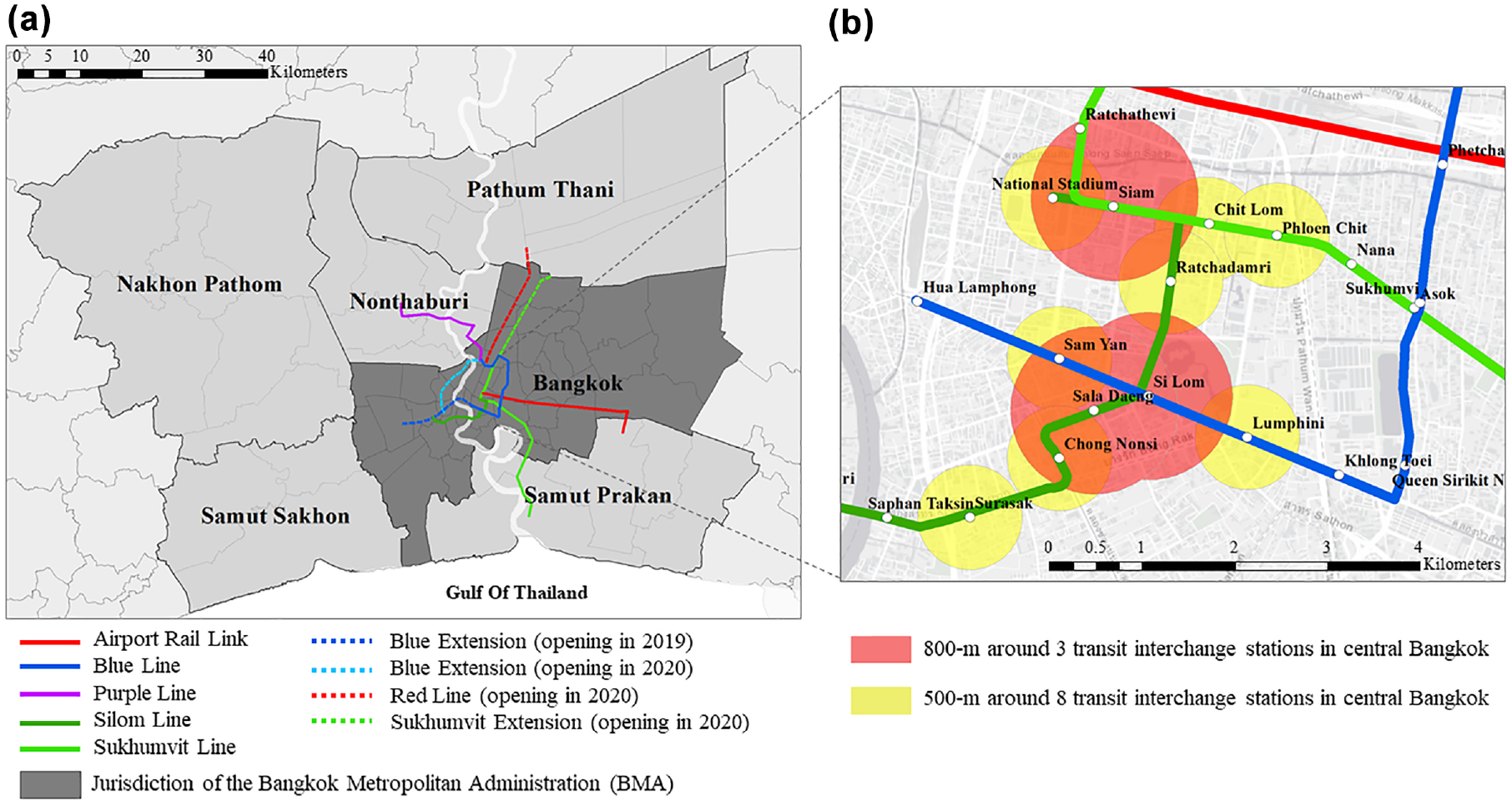
Maps of (a) the Bangkok Metropolitan Region and (b) detail showing areas of proposed 25% reduction in minimum parking requirements in the Bangkok Comprehensive Plan.
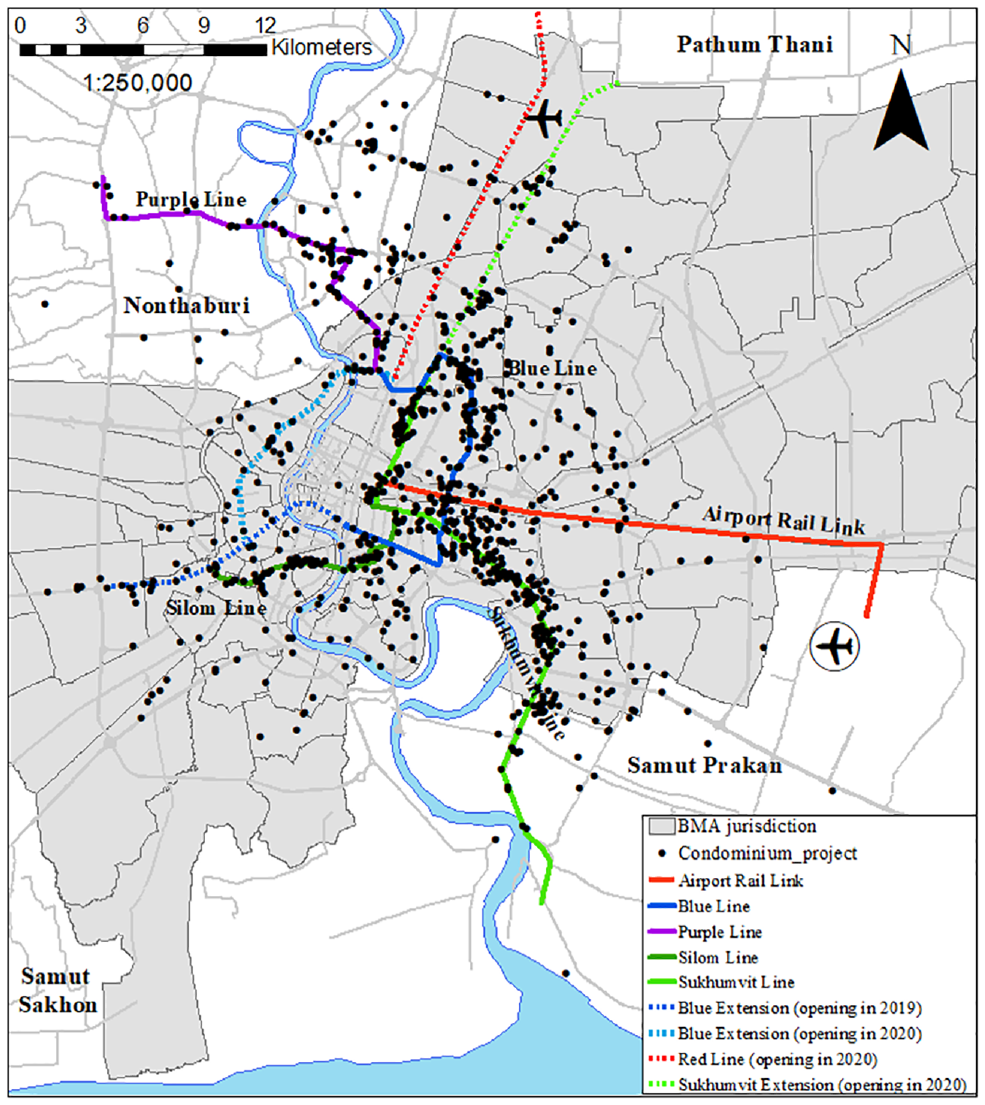
Map of geographical distribution of condominiums and rail transit in the Bangkok Metropolitan Region.
Parking Requirements
Although Bangkok and other municipalities in the BMR have some legal authority in local matters, the legal framework for parking policies in general, and parking requirements in particular, is established at the national level. Parking requirements were first introduced in Thailand in 1974 in the Seventh Ministerial Order B.E. 2517 (1974 C.E.) (called “Seventh Ministerial Order”) pursuant to the Building Construction Control Act B.E. 2479 (1936 C.E.) (called the “Building Act”). The Building Act specified one set of MPRs for eight building types for Bangkok and a different set of standards with lower requirements, for example, fewer parking spaces, for all other municipalities in the country. In 1979, the Building Control Act B.E. 2522 (1979 C.E.) (called the “Building Control Act”) replaced the Building Act, but the Seventh Ministerial Order remains in force.
In 1992 the Building Control Act was revised to empower municipalities to pass local ordinances for specific types of regulations that are not in conflict with the main law. Local governments are now allowed to issue their own variations of parking standards, which may include more building types and impose stricter parking requirements than those mandated by the national standards. For example, in 2001, the BMA passed the Ordinance on Building Control B.E. 2544 (2001 C.E.) that includes a section on minimum parking standards for 18 types of buildings, which are not covered by the national standards ( 21 ). For most building types that have already been regulated by the national standards, the BMA Ordinance requires more parking, usually twice as many spaces as those required by the national standards.
Because the current zoning laws and building codes do not provide variances, developers of condominiums cannot request to deviate from parking requirements. This means no permits are issued to condominiums that provide parking spaces below the levels required by law.
Table 1 shows the summary of residential parking requirements in the BMR. The Seventh Ministerial Order outlines the parking standards for residential complexes with dwelling units larger than 60 m2, which are applicable to municipalities outside Bangkok. On the other hand, the BMA Ordinance on Building Control requires a minimum of one parking space for each dwelling unit larger than 60 m2, and one parking space for the combined living area of 120 m2 for dwelling units smaller than 60 m2. This MPR standard is applied to the whole of the 1,569 km2 area of Bangkok, regardless of land use zones. For example, a condominium located in Bangkok Central Business Districts (CBD) is required to have the same amount of parking as another condominium with a similar size, located in an agricultural zone 50 km east of the city center. The parking requirements in BMA were stricter than those of surrounding municipalities until 2016 when Nonthaburi raised its requirements to match those of Bangkok.
Summary of Residential Parking Requirements in the BMR
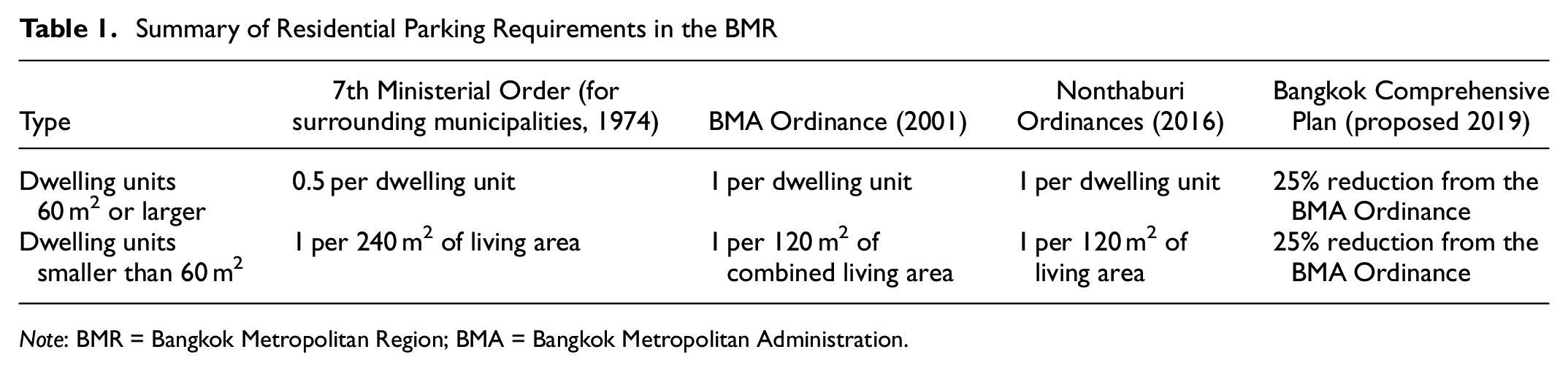
Note: BMR = Bangkok Metropolitan Region; BMA = Bangkok Metropolitan Administration.
Call for Parking Reform
MPRs in Thailand have barely been revised since they were introduced 45 years ago. Only in 2012 were they revised for hotels, and banquet/event halls in restaurants and large buildings. Occasionally, there were calls for parking reform. In 2007, property developers called for the National Legislature to revise the Building Control Act to abolish the MPR, claiming that doing so could reduce condominium prices by 20%–30% because of the reduction in construction costs ( 22 ). The Engineering Institute and the Real Estate Association also echoed such calls for reform, arguing that overreliance on automobiles causes traffic congestion in Bangkok CBD and calling for eliminating the MPRs in these areas ( 23 ).
The push for regulatory change has made significant progress recently. The BMA is currently in the final stage of the process to revise its Comprehensive Plan. One of the objectives is to promote more efficient urban development that is consistent with the on-going infrastructure and transit development plans. Expecting to discourage automobile dependence in the transit-rich CBD of Bangkok, the new Bangkok Comprehensive Plan proposes to reduce the minimum parking standards by 25% for new developments within 500 m of transit stations or within 800 m of interchange stations in central Bangkok. The regulatory change is due to take effect in 2020 (see Figure 1).
Hypotheses and Data
Hypotheses
This study sets up three hypotheses to examine the research questions shown in the introductory section.
The first hypothesis is: H1: MPRs affect parking provision in condominiums in BMR.
This follows the assumption made by several studies in the literature that parking requirements mandate more parking spaces than developers would otherwise choose to provide ( 7 , 8 ). As revealed by empirical evidence from other cities, such as in New York City ( 12 ), it is hypothesized that MPRs affect developers’ decisions on the amount of parking supply in condominiums. The differences in parking standards between Bangkok and the surrounding municipalities are expected to provide an opportunity to test this hypothesis.
If MPRs actually influence parking supply, the amount of parking provision should be at or near the standards in both jurisdictions, and the amount of parking supply in Bangkok should be significantly greater than outside Bangkok where the required standards are only half. Here a question arises as to what the characteristics are of the condominiums that provide parking exactly at the required levels.
The second hypothesis is stated as: H2: Parking capacities are determined by socioeconomic characteristics of buyers, building types, and transit accessibility.
We also keep in mind an alternative hypothesis, that is: parking supply is related to a developer’s expectation of parking demand, which is in turn determined by the socioeconomic characteristics of prospective buyers ( 24 ), building types, and transit accessibility. If this alternative hypothesis is true, then the actual parking supply would not conform to the MPRs in the study area.
The third hypothesis is stated as: H3: Parking capacities of condominiums outside Bangkok are determined by Bangkok’s real estate market, rather than the local MPRs.
It is further hypothesized that condominium developers outside Bangkok provide significantly more parking than the minimum required by the municipality. The reason could be that the amount of parking is actually guided by the parking levels in Bangkok, as these developers consider their projects to be competing in the same market as other condominium projects in Bangkok. Accordingly, they think they must provide similar parking capacities to match their competitors even though they are not required to do so. This means MPRs are less important than the herd behavior of the market, which considers parking as bundled with condominium dwelling units.
It is acknowledged that other factors, especially expected parking demand, could significantly affect developers’ supply decisions. However, since expected demand is not directly observable, this study attempts to control them with proxies that may determine parking demand. These include the price range of condominiums, which generally reflects the income of residents, and the distance from condominiums to the nearest transit station, which may reflect the level of dependence on automobiles, and consequently the demand for parking.
Data
To examine the factors that affect residential parking supply in the BMR, including MPRs, a condominium dataset purchased from Agency for Real Estate Affairs Co., Ltd is used. The dataset includes 1,295 new condominium projects that were open for sale during 2007–2016. The data include key attributes of condominiums, such as location, year of opening, the number of dwelling units, floor area, unit price, amenities, facilities, and the total number of parking spaces. Outliers were identified based on the Z-score of sale prices and parking capacity, and observations with values over three standard deviations above or below mean were dropped from the original dataset, resulting in a dataset of 1,030 observations in total. This dataset was used for empirical analyses. The dataset includes 832 projects in Bangkok and 198 projects outside Bangkok.
Actual parking capacity was computed next, as well as required parking capacity and excess parking capacity. First, the parking capacity ratio is a metric commonly used by developers and consumers in Thailand to indicate the levels of parking provision in condominiums. It is defined as the ratio of parking spaces to the number of dwelling units in a given condominium project.
The condominium dataset was then used to calculate the amount of parking required by either the BMA Ordinance or the national standards, depending on the condominium location. For condominiums located within Bangkok, one parking space is required for every dwelling unit larger than 60 m2. For dwelling units smaller than 60 m2, one parking space is required for the combined living area of 120 m2. For condominiums outside Bangkok, the national standards are applied, because the local ordinances do not specify MPRs beyond the national codes. In this case, one parking space is required for every two dwelling units larger than 60 m2 and one parking space is required for the combined living area of 240 m2 for dwelling units smaller than 60 m2. Because of missing data, it was not possible to determine the minimum amount of parking required for some projects, and therefore the total number of observations was reduced to 999.
Finally, to measure the excess parking capacity relative to the required parking capacity, the excess parking ratio was computed by dividing the excess parking capacity by the required parking. For example, a condominium that provides 120 parking spaces given required parking of 100 has an excess parking capacity ratio of 20%. Even though the figure may not explain developers’ decisions on parking provision, it is indicative of how binding MPRs are to developers when they consider the amount of parking to provide.
Table 2 summarizes the descriptive statistics of the dataset. It shows that the sale price per square meter of condominiums in Bangkok is, on average, more expensive than those outside Bangkok. The condominiums in Bangkok also have fewer dwelling units but are taller, likely because land prices are higher in the city. GIS is also used to determine the various locational characteristics of condominiums, such as distance to the nearest transit station and proximity to the CBD. Figure 2 shows the geographical distribution of condominiums in the dataset.
Descriptive Statistics of Condominium Sales Data in the Bangkok Metropolitan Region, 2007–2016
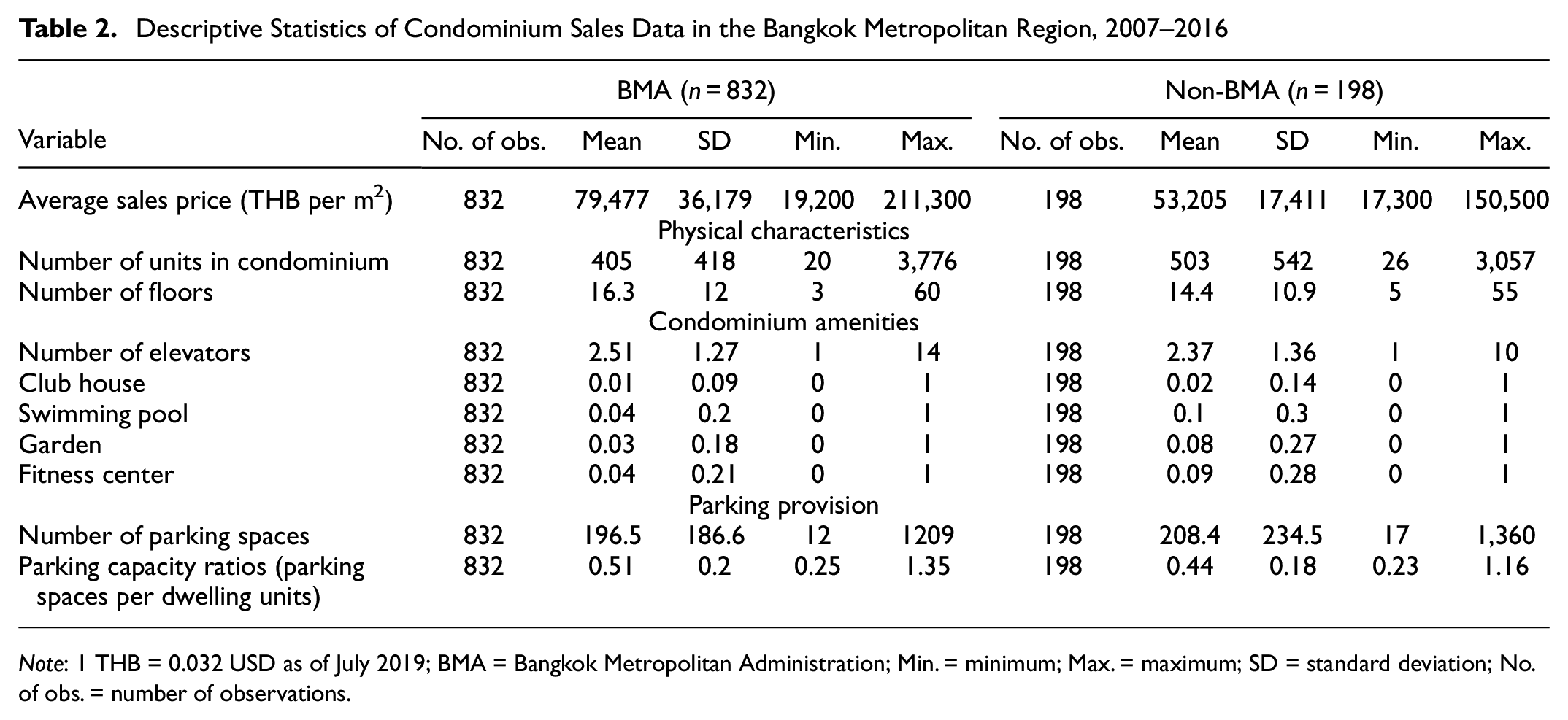
Note: 1 THB = 0.032 USD as of July 2019; BMA = Bangkok Metropolitan Administration; Min. = minimum; Max. = maximum; SD = standard deviation; No. of obs. = number of observations.
Findings on Parking Capacity
Actual Parking Capacity
Table 2 shows the actual parking capacity of condominium projects in the dataset, which ranges from 12 to 1,315, with an average of 196 and standard deviation of 189. The parking capacity ratios in Bangkok were in the range of 0.25–1.35 spaces per dwelling unit, and the ratios for condominiums in the surrounding provinces were in a wider range of 0.23–1.16 spaces per dwelling unit. As shown in Table 2, although the average parking capacity of condominiums in Bangkok is slightly lower than that of condominiums outside Bangkok, the parking capacity ratio is higher for condominiums in Bangkok (0.51) than those outside the city (0.44). Figure 3 shows the distribution of parking capacity ratios. Most condominiums’ parking capacity ratios are in the range of 0.20–0.40 followed by the range of 0.40–0.60. However, there are 29 condominiums, or 2.9% of the total sample, that provide more than 1.00 parking space per dwelling unit.
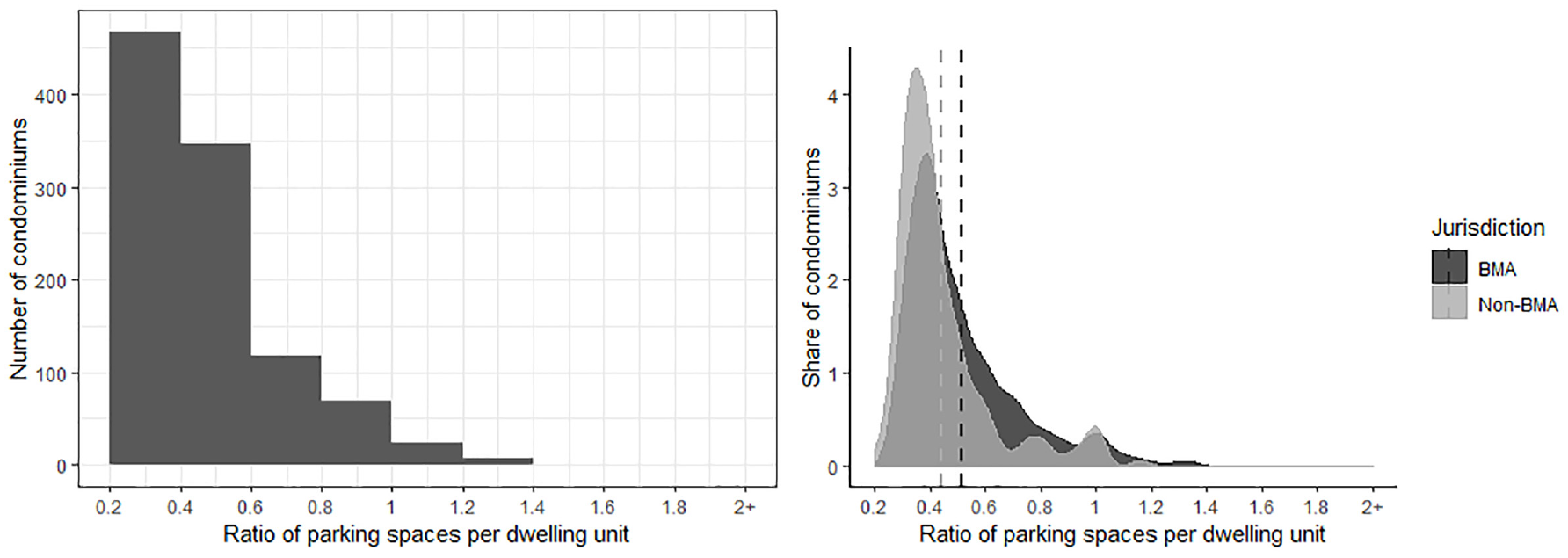
Parking capacity ratios of condominiums in the Bangkok Metropolitan Region (BMR).
Figure 3 illustrates the distributions of parking capacities inside and outside Bangkok. Although the average parking ratio inside Bangkok is higher than outside, the distribution of the parking ratios follows similar pattern. This result might be indicative that developers of condominiums outside Bangkok consider their properties to be in the same market as those inside the city, thinking that they must provide similar amount of parking. This is despite lower MPRs outside Bangkok allowing these developers to build somewhat fewer parking spaces per dwelling unit.
Using the same dataset, the trend of parking provision during 2007–2016 is also captured. As revealed by Figure 4, the average parking capacity ratios in Bangkok were on a downward trend. The parking ratios in the surrounding provinces had also been on a downward trend during 2007–2014, but the ratio spiked up during 2014–2016. Such a wider range could be attributed to more rail transit lines having been extended to the surrounding provinces, and developers’ decisions to provide parking starting to diverge.
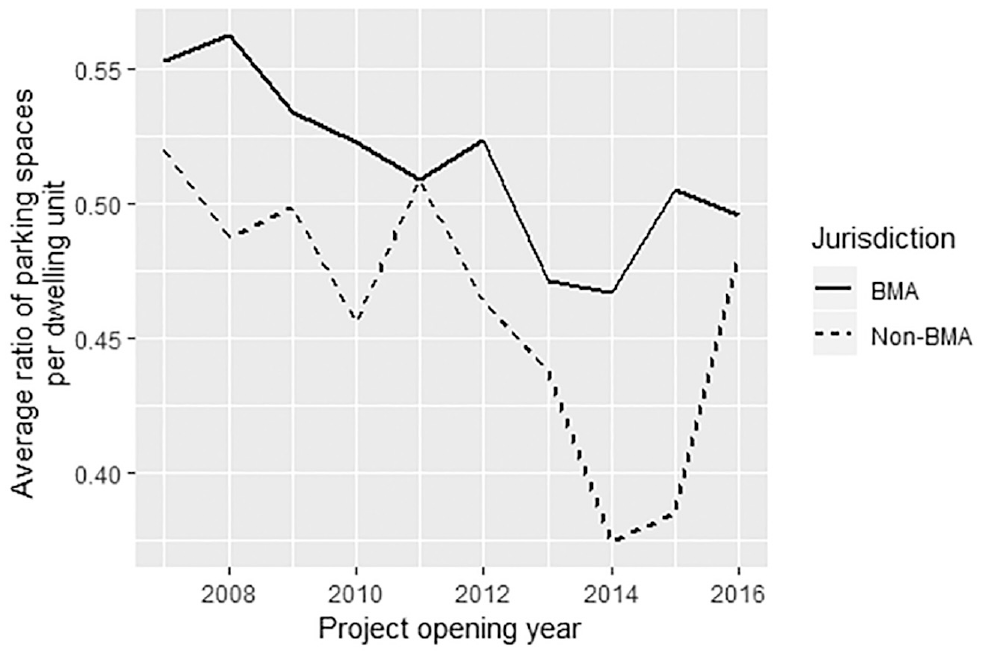
Trend of parking provision in the condominium market in the Bangkok Metropolitan Region (BMR).
Excess Parking Capacity
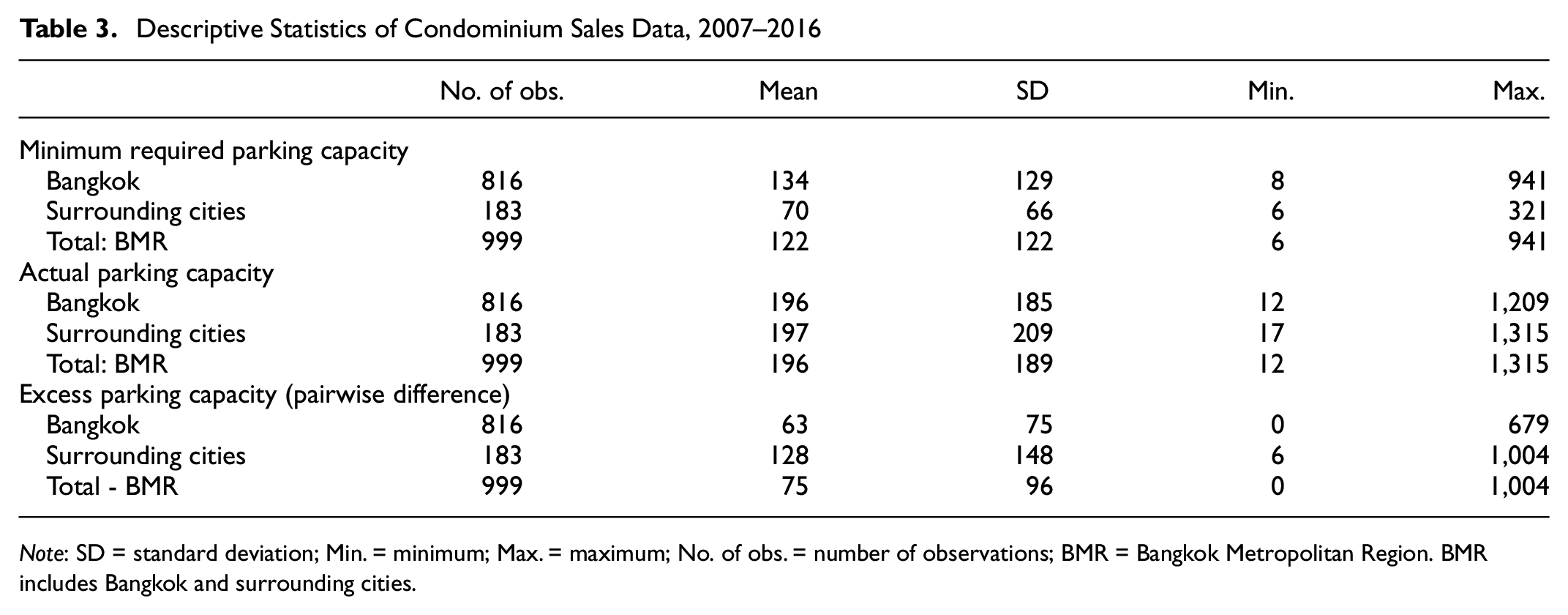
Table 3 shows the summary of descriptive statistics about the calculated minimum required parking, actual parking capacity, and excess parking capacity inside and outside Bangkok.
Descriptive Statistics of Condominium Sales Data, 2007–2016
Note: SD = standard deviation; Min. = minimum; Max. = maximum; No. of obs. = number of observations; BMR = Bangkok Metropolitan Region. BMR includes Bangkok and surrounding cities.
As shown in Table 3, the average parking capacity of 189 is significantly higher than the average number of required parking spaces of 122, indicating that the actual parking capacity is greater than the amount required in most condominium projects. The pairwise difference between the actual and minimum parking capacities shows that, on average, the actual parking capacity exceeds the minimum required amount by 75 parking spaces. The excess parking capacity over the required parking ranges from 0 to 1,004.
The excess parking capacity ratio in the condominium sample in this study ranges from 0% to 336%, averaging 75%. The distribution of excess parking capacity ratio is shown in Figure 5. Note that no observation provides fewer parking spaces than the minimum required parking, only 11.6% of condominiums in the dataset had an excess parking ratio between 0% and 10%, and almost 80% of the condominiums provided more than 25% excess parking.
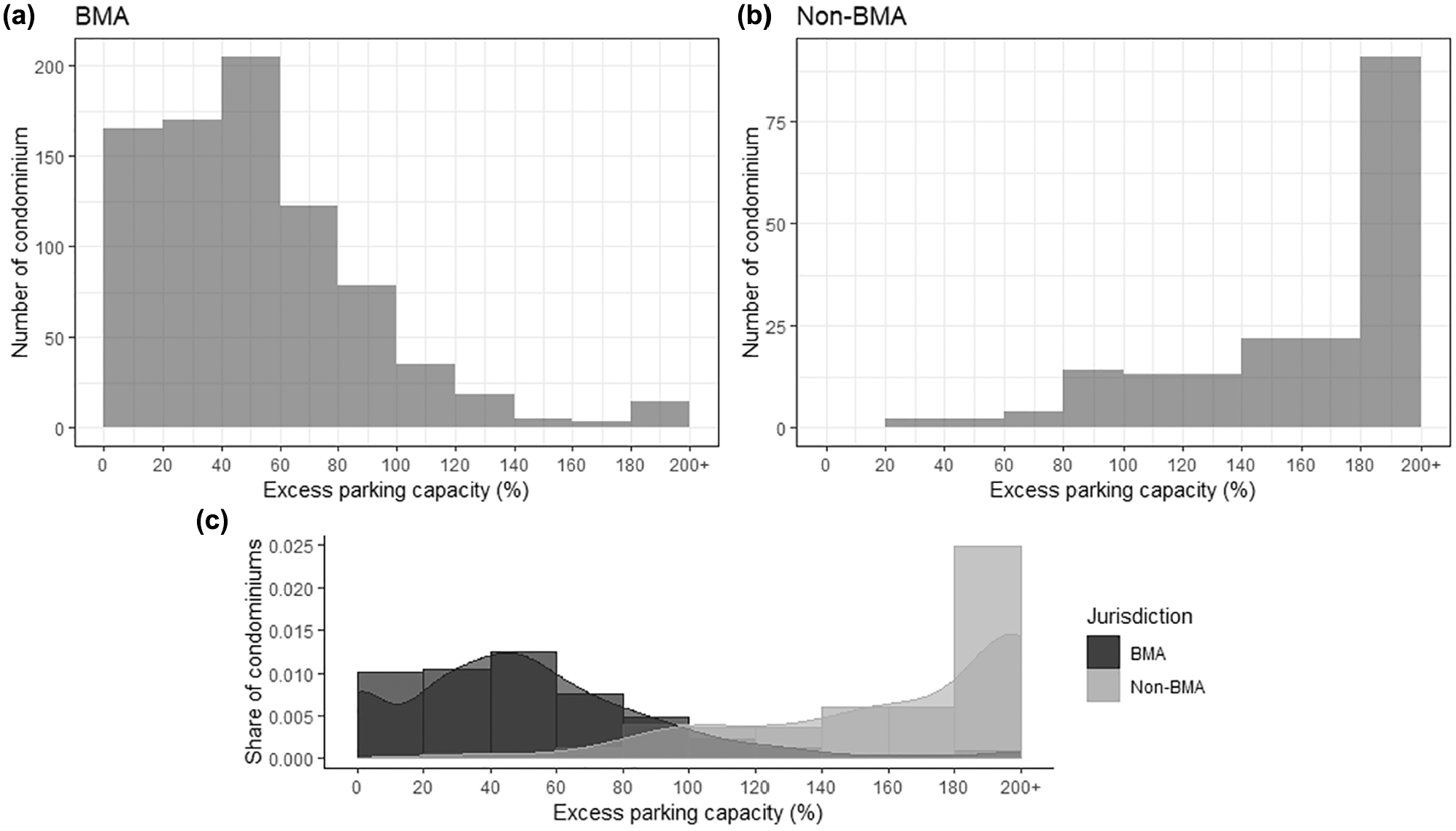
Distribution of excess parking capacities in condominiums (a) within the BMA, (b) in non-BMA cities within the BMR, and (c) by jurisdictions within the BMR.
Figure 5 also reveals a considerable difference between the distribution of excess parking in condominiums inside and outside Bangkok. Condominiums in Bangkok generally have lower excess parking capacity ratios, with the majority providing 100% or less excess parking capacity. On the other hand, the majority of condominiums outside Bangkok provide more than 100% excess parking capacity, with many providing twice as much parking as the minimum required. This could be because the MPRs in Bangkok are twice as high as those outside Bangkok as discussed above. For this reason, it seems that condominiums outside Bangkok provide additional parking to match the minimum required parking for condominiums inside Bangkok since they are within the same real estate market. This result suggests that condominium developers set their parking provision according to the market forces of the Bangkok condominium market, rather than what is specified by the respective local MPRs.
Condominiums without Excess Parking Capacity
We further examine the condominiums that provide parking capacity at the level required by law. Out of 999 condominiums in the sample, 116 of them fall into this category and account for 11.6% of the total sample. Figure 6 shows that, strikingly, all of them are located in Bangkok; all condominiums outside Bangkok provide parking in excess of the required level. Meanwhile, the number and share of condominiums in this category are on a downward trend since 2009. Not a single project opening during 2015–2016 provides parking capacity at the required level.
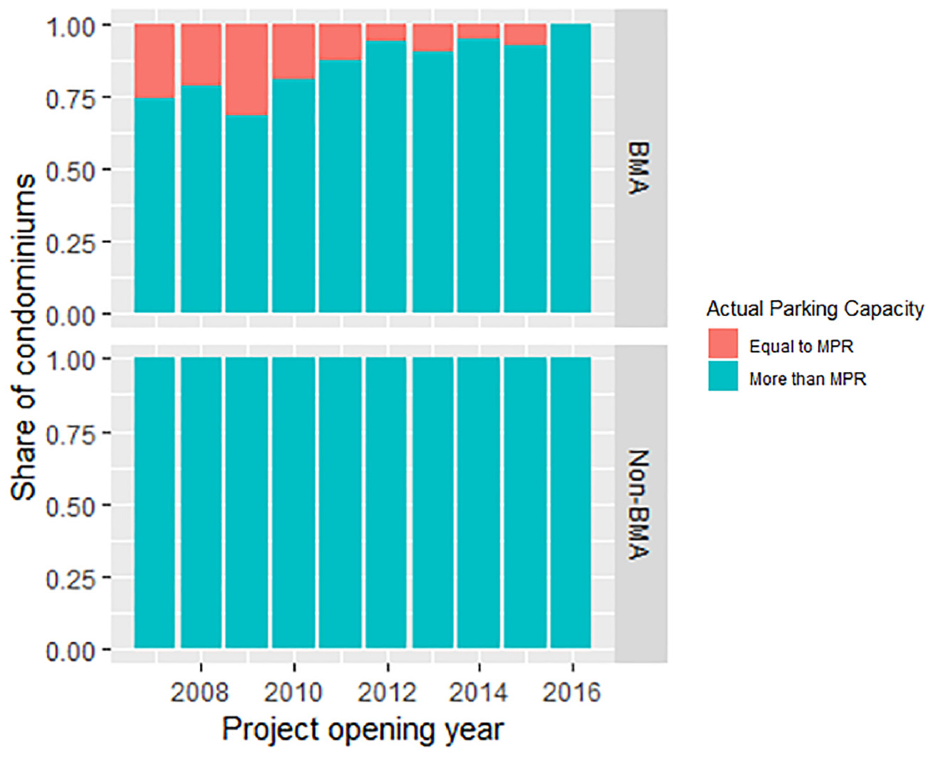
Proportions of condominiums with parking capacities at the required levels.
The characteristics of the 116 condominiums in the BMA without excess parking capacity were further analyzed, supplemented by spatial analysis of the data based on Bangkok’s zoning maps. The findings are as follows:
93% are located in medium-to-high density areas, 51% in high-density residential, 21% in commercial, and 21% in medium-density residential areas.
58% are located within one kilometer from the nearest transit station;
60% have unit prices of lower than 70,000 THB/m2, which is in the low-to-medium price segment;
60% have fewer than 200 dwelling units;
66% are low-rise buildings with up to eight floors; and
58% are developed by small-sized developers, who are not listed in the stock market.
These results suggest that MPRs may have affected relatively low-price, small-scale, and low-rise projects that are located within walking distance from transit stations in high-density areas. However, because of increasing land prices, it has become almost impossible in recent years to develop a condominium that fits such characteristics. Developers have to build condominiums in higher price segments to justify the land costs. Because the potential buyers of these projects tend to own cars, developers have no choice but to provide more parking capacities than required by law.
Parking Capacity Model
The next question is what factors explain parking capacities of condominiums in the BMR, if MPRs are not the determinant as found earlier. Here the relationship between parking capacities in condominiums and various determinants is examined by linear regression models. As discussed above, it is hypothesized that parking capacity is determined by (unobservable) parking demand, which is in turn dependent on building characteristics, socioeconomic characteristics of tenants, and location. Building characteristics include the number of dwelling units and total floor area, and parking capacity is expected to increase with these variables. Note that these are also the determinants of the MPRs. Socioeconomic characteristics of tenants, such as income, may affect parking demand and parking capacity. For example, high-income tenants will be expected to demand more parking. Therefore, in the parking capacity model, the average price per square meter is ued as proxy for income of tenants. Finally, the location of a condominium may also affect parking demand. Residents of condominiums near transit stations may be less automobile-dependent, which may mean less demand for parking. The distance to the nearest transit station and the BMA dummy variable are included in the model to capture the effects of location on parking capacity. A simple linear function is assumed for the parking capacity model, shown as:

where
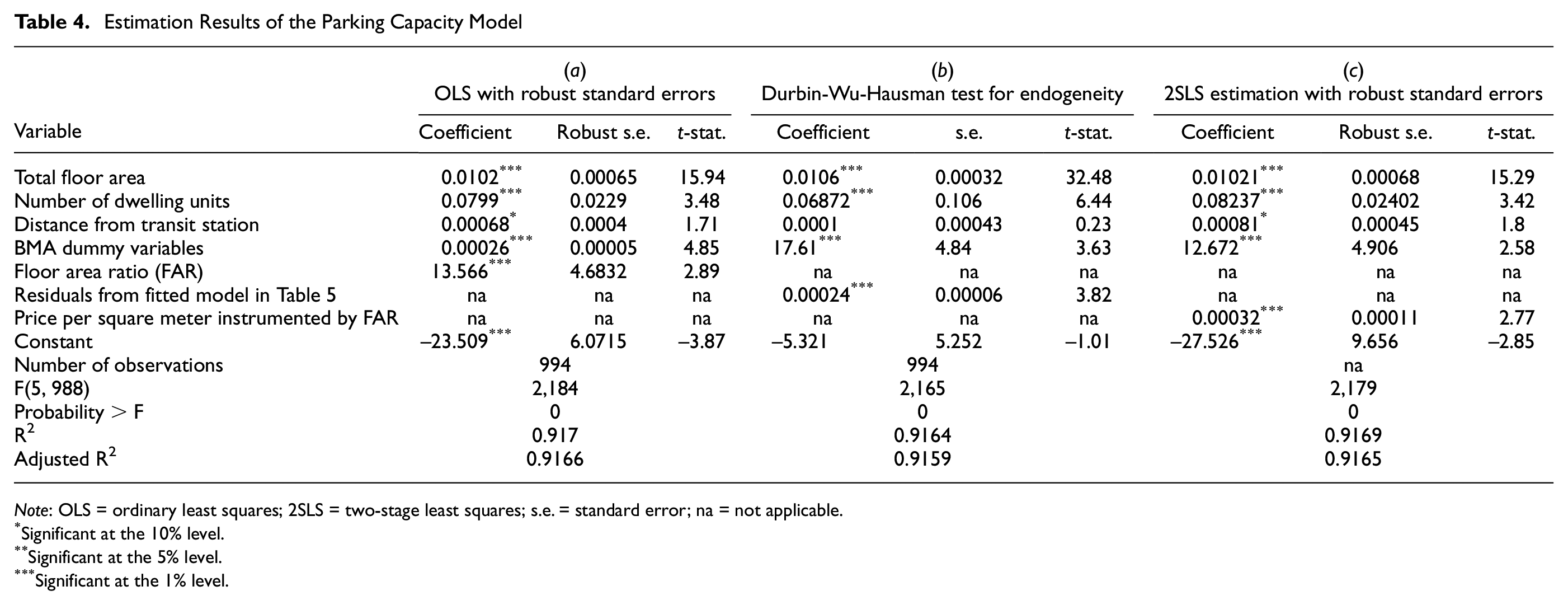
The above model is first estimated by the ordinary least squares (OLS) method and standard tests of the regression assumptions carried out. The results are shown in Table 4a. Based on the Breusch-Pagan test for heteroscedasticity, the null hypothesis of constant variance is rejected. Then White’s robust standard errors are also used for inferences about coefficient estimates of the model.
Estimation Results of the Parking Capacity Model
Note: OLS = ordinary least squares; 2SLS = two-stage least squares; s.e. = standard error; na = not applicable.
Significant at the 10% level.
Significant at the 5% level.
Significant at the 1% level.
In addition to the heteroscedasticity, another concern in estimation is the simultaneous causalities between parking capacity and condominium price. Buyers of high-end condominiums generally demand more parking, while developers of high-price condominiums may also provide more parking capacity in anticipation of such demand. In past studies of hedonic house price, one of the housing features that are found to affect house prices is the availability of parking garages ( 25 ). Some hedonic studies of condominiums in Bangkok also found that parking positively affects the price of condominiums ( 26 ), while the evidence is inconclusive in others ( 27 ). For this reason, the endogeneity in the data is tested by employing the instrumental variable method.
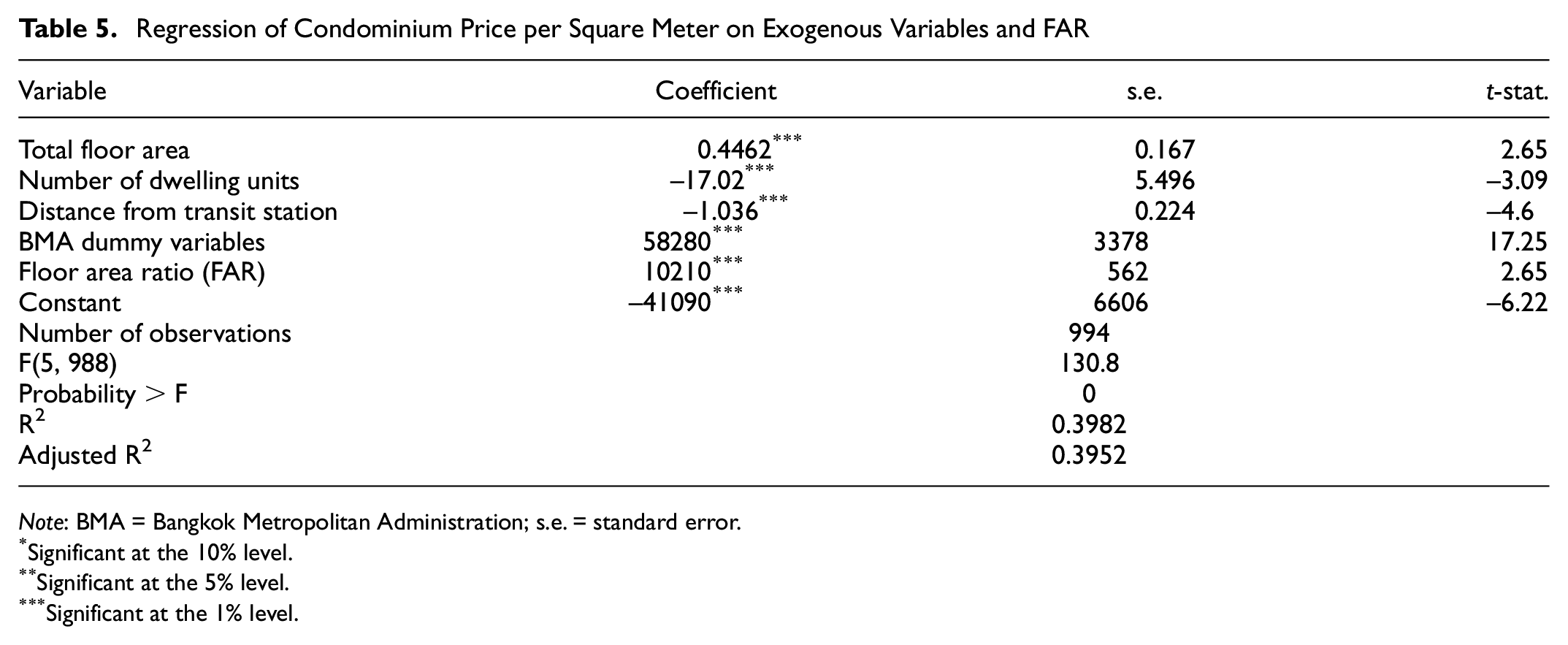
Floor area ratio (FAR) is used here as an instrumental variable for the price of condominiums. FARs are specified either by the building code at the national level or by the zoning ordinance in each city’s Comprehensive Plan. Any new development is subject to a specific maximum FAR permissible in the zone where the building is located. It is assumed that high-density zoning districts tend to attract developers of high-price condominiums, whereas lower-price condominiums tend to be developed in low-density zoning districts. However, because of the current building codes and zoning laws, the authors reckon that zoning has little effect on developers’ decisions on parking provision. Therefore, the endogeneity is tested using the two-stage least squares (2SLS) estimation. FAR is used as an instrument for condominium price. First, the price of condominiums is regressed on FAR in addition to all independent variables in Equation 1. As shown in Table 5, the estimated coefficient of the FAR is highly significant, suggesting that FAR is a possible instrument.
Regression of Condominium Price per Square Meter on Exogenous Variables and FAR
Note: BMA = Bangkok Metropolitan Administration; s.e. = standard error.
Significant at the 10% level.
Significant at the 5% level.
Significant at the 1% level.
Next, the endogeneity is tested with the Durbin-Wu-Hausman test by regressing the condominium parking capacity on the residual from the fitted model in the first step and all other exogenous variables. The estimation results in Table 4b show that the coefficient estimate of the residual is significant, implying the price variable is indeed endogenous.
Finally, FAR is used as an instrumental variable for 2SLS estimation of the parking capacity model. The results are shown in Table 4c. It shows that the coefficients for all variables are estimated to be statistically significant at least at the 0.10 level. The total floor area and the number of dwelling units in a project are, as expected, crucial determinants of parking capacity, as they directly influence parking demand. Condominiums in Bangkok, on average, provide 12.61 more parking spaces than those outside Bangkok. The coefficient estimate for price per square meter suggests that 3.27 additional parking spaces will be provided for every 10,000 THB/m2 increase in price. The coefficient estimate for the distance to transit station reveals that transit access also affects parking, but the marginal effect is quite small. A condominium adjacent to a transit station is expected to provide 0.8 parking space less than a similar condominium 1 km away.
Conclusion
This paper examines the factors that affect residential parking supply by analyzing condominium data in the BMR. The authors do not find evidence in support of the hypothesis (H1) that MPRs affect developers’ decisions on the amount of parking supply in condominiums. Just 11% of the sample condominiums provide only the bare minimum number of parking required by law. This proportion is much lower than in New York City, where almost half of residential projects provide parking exactly equal to the required level ( 12 ). Furthermore, the number of condominiums providing parking spaces at exactly required levels in Bangkok has decreased to none in recent years.
While finding no effect of MPRs on parking supply, the regression analysis lends support to the hypothesis (H2) that parking capacities in condominiums are determined by buyers’ socioeconomic characteristics and transit accessibility. The analysis results also support the hypothesis (H3) that condominium developers outside Bangkok disregard MPRs and provide substantially more parking than the standard requires, presumably to match the parking capacities provided by their competitors in Bangkok.
The finding suggests that MPRs did not generally affect developers’ decisions to provide parking capacity in condominium projects in Bangkok during 2007–2016. Because parking spaces are bundled with other attributes of condominium units, developers set the parking capacities according to what they perceive as the market demand. This case is particularly evident for condominiums in the surrounding municipalities, where the parking capacities far exceed the local MPRs and instead match parking capacity levels in Bangkok.
The small exceptions were condominiums of lower price segments in Bangkok. These projects tend to be small-scale, low-rise projects located within walking distance from transit stations in high-density areas. Developers could have provided even less parking if there were no MPRs. But this issue may not be of much relevance now, because soaring land costs have forced developers to build condominiums in higher price segments and to provide more parking capacities than required by law for potential buyers who can afford them.
The new Bangkok Comprehensive Plan is set to reduce the MPRs for new condominium projects located near transit stations in central Bangkok. The city planners expect that such a measure would help relieve the pressure on condominium developers, who may decide to provide fewer parking spaces and more dwelling units in their future projects. The empirical results from this study cast doubt on the desired impact of such a measure. Most condominiums built during 2007–2016 provided more parking spaces than required by code. And those located in Bangkok provided, on average, more parking capacity than those located outside the city.
The authors conjecture that this is because of the developers’ response to the land market. Because of soaring land prices in the city, developers are pressured to develop housing projects that target higher price segments of the housing market to achieve their expected capitalization rates. In other words, it does not make sense for developers to build condominiums with cheaper units in central Bangkok where land prices are high. Consequently, potential buyers of these relatively more expensive condominiums are limited to those of higher income, who usually own automobiles. This is also why the findings in this paper show that condominiums in Bangkok tend to provide more parking capacity than those in the surrounding provinces. There is a stylized fact that accessibility to public transit is much better inside Bangkok than outside. And this accordingly leads to less necessity to own and drive automobiles, and therefore less need for residential parking. The evidence from this paper shows otherwise.
Although relaxing the MPRs may allow developers to provide fewer parking spaces than before, they may not choose to do so because of the expected demand from prospective buyers. Even though the condominium unit price may become lower, because of lower construction costs for parking spaces and more saleable dwelling units, the reduction may not offset the pressure to provide ample parking. As on-street parking becomes almost impossible for residents in central Bangkok, availability of off-street parking becomes even more critical for condominium buyers. It thus makes sense for developers to provide more parking capacity in their projects than to provide less. Developers who target lower price segments of the housing market may choose to provide fewer parking spaces, if they can assume that prospective buyers will not want them. This is a challenging strategic decision, and one that requires extensive market research.
This study has focused on the supply side of the parking market. To inform parking policy decisions, we need to understand better the demand side of the issue. Several key questions arise: for instance, whether the parking capacity in condominiums is fully occupied by residents, whether condominiums have a considerable amount of excess parking supply, what time of the day that the spaces are occupied, and whether the demand for parking spaces may change if parking is unbundled from dwelling units and priced separately. It is also necessary to explore whether maximum instead of minimum parking requirements could be more effective in reducing parking provision in condominiums.
Footnotes
Author Contributions
The authors confirm contribution to the paper as follows: study conception and design: C. Chullabodhi, S. Chalermpong, A. Ratanawaraha; data collection: C. Chullabodhi; analysis and interpretation of results: C. Chullabodhi, S. Chalermpong, A. Ratanawaraha, H. Kato; draft manuscript preparation: C. Chullabodhi, S. Chalermpong. All authors reviewed the results and approved the final version of the manuscript.
Declaration of Conflicting Interests
The author(s) declared no potential conflicts of interest with respect to the research, authorship, and/or publication of this article.
Funding
The author(s) disclosed receipt of the following financial support for the research, authorship, and/or publication of this article: This research is financially supported by Chulalongkorn University Dussadeepipat Scholarship.