







Abstract
The matching of crowdsourced drivers and delivery tasks is an important decision problem for the crowdsourced delivery platform. Although the existence of uncertainty of transportation duration in logistics delivery has been verified, uncertain transportation duration has not been considered in previous studies on the matching of crowdsourced drivers and delivery tasks. This would lead to the limitation that the results of the existing methods cannot meet the time requirements of senders. In this case, the profit and customer satisfaction of the crowdsourced delivery platform would decrease. In this paper, a model-based rolling matching strategy to match crowdsourced drivers and delivery tasks considering uncertain transportation duration is proposed. In addition, it is assumed that the crowdsourced delivery platform also has some dedicated drivers to implement the delivery tasks that cannot be implemented by crowdsourced drivers. First, a simpler problem is described, which is to match crowdsourced drivers and delivery tasks considering uncertain transportation duration in a static data environment. Then, a model is proposed to solve the above problem. Based on the proposed model, this paper further proposes a rolling procedure to solve the problem in a data refreshing environment. Moreover, a heuristic algorithm is presented for combining multiple delivery tasks to solve the one-to-many matching. Finally, a case study and comparison are given to illustrate the validity and the contribution of the proposed matching strategy. The results show that the proposed matching strategy has a distinct advantage of cost savings.
Crowdsourced delivery is a logistics delivery service that is coordinated by a technology platform and designates the delivery tasks to the public to achieve benefits for all stakeholders (1–6). It is an important part of the sharing economy that provides people with the chance to share and redistribute the excess transportation capacity (7–9). Compared with traditional logistics, crowdsourced delivery can reduce the cost and time of delivery, improve the performance of delivery, and enhance the social resource utilization (10–16). In recent years, crowdsourced delivery has been adopted by some platforms and logistics service companies. For example, in 2015, Amazon launched the Flex service in Seattle and outsourced delivery tasks to private drivers (17, 18); the U.S. crowdsourced logistics platforms, Postmates, Deliv and DoorDash outsource the delivery tasks to part-time couriers to provide customers with fast delivery services (19–23).
When applying for a delivery task, the crowdsourced driver will provide the platform with their relevant information, including their earliest departure time and latest arrival time from the origin to the destination; when announcing the delivery task, the sender will provide the platform with their relevant information, including the earliest and the latest pickup time and delivery time of the package from the origin to the destination. According to the information provided by crowdsourced drivers and senders, the crowdsourced delivery platform needs to determine rational matching between crowdsourced drivers and delivery tasks to implement the delivery tasks and make a profit. It is important to highlight that the determination of rational matching between crowdsourced drivers and delivery tasks is usually complex, since multiple factors need to be considered, including each crowdsourced driver’s origin, destination, earliest departure time and latest arrival time, and each delivery task’s origin, destination, earliest pickup time and latest delivery time, and so forth (2, 24). Therefore, the determination of rational matching between crowdsourced drivers and delivery tasks is an important research problem with a realistic background in the operations of crowdsourced delivery platforms.
In recent years, some researchers have conducted related studies on the determination of matching between crowdsourced drivers and delivery tasks. With regard to the last mile delivery of online orders, Devari et al. proposed a method for crowdsourced delivery matching between social network friends and customers, considering the advantages of social networks ( 25 ). In their study, based on the results of an online survey, a logistic regression model was built to estimate the probabilities that social network friends agree to deliver customers’ online orders. Then, data about the city of Alexandria, Virginia, was used to conduct a simulation study of crowdsourced delivery matching between social network friends and customers according to the probabilities that social network friends would deliver online orders. The performance of the proposed method was evaluated by comparing the scenarios of traditional truck delivery and customers picking up orders at the local store. Results show that the proposed method of crowdsourced last mile delivery using social network friends can effectively improve the efficiency of the last mile delivery, reduce the privacy concerns of consumers and ensure the reliability of the crowdsourced delivery. Soto Setzke et al. proposed an algorithm model for matching crowdsourced drivers and transportation requests considering the transportation routes and time constraints ( 26 ). In the algorithm model, a directed graph is first constructed where the time constraints of departure and pickup are not violated. Then, the matching degrees between the travel routes of the crowdsourced drivers and the delivery routes are measured by computing the additional time of the driver carrying out a transportation request. The maximum matching with minimum cost can be obtained by solving the algorithm model. The effectiveness of the proposed algorithm model was evaluated based on traffic data from a city in Germany. Arslan et al. studied the dynamic pickup and delivery problem ( 7 ). They proposed a rolling horizon framework and developed an exact solution approach to obtain the real-time matching result based on the updated information. In their study, delivery tasks were implemented by either a crowdsourced driver or a dedicated driver. The feasibility and effectiveness of the method was illustrated by computational experiments. The experimental results suggested that the use of crowdsourced drivers can save vehicle-miles by 37% compared with the traditional delivery using only dedicated vehicles. Paskalathis and Azhari solved the multiple pickup and delivery problem in crowdsourced delivery ( 27 ). They proposed an exact algorithm to optimize the transportation path for crowdsourced drivers to implement multiple delivery tasks at one time. In their study, the situations of crowdsourced drivers implementing multiple pickups and deliveries during one trip were considered. Then, the proposed method was evaluated from the number of trips, total distance, total duration and security concerns based on case study data from Yogyakarta, Indonesia. The results show that, compared with direct delivery, the proposed method can effectively save distance and time. Chen et al. focused on the matching problem of multiple crowdsourced drivers and multiple delivery tasks ( 28 ). To solve the matching problem, they proposed a general integer linear programming formulation and developed two heuristic algorithms based on the time compatibility heuristic and the time-expanded graph heuristic, respectively. They synthetically considered the maximum detour, the capacity limits and the selection of transferring delivery tasks between crowdsourced drivers. The numerical study results show that the senders can gain more benefits, and traffic congestion can be alleviated, when the number of crowdsourced drivers increases.
Previous studies have made significant contributions to the determination of rational matching between crowdsourced drivers and delivery tasks considering the different problem characteristics, and have provided valuable decision supports to the practical operation of the crowdsourced delivery platform. It is necessary to point out, however, that the logistics of delivery is generally faced with the uncertainty of transportation duration because of the impact of traffic congestion, weather conditions and other factors (29–31). Uncertain transportation duration (as it is termed in this paper) should be considered in the determination of matching between crowdsourced drivers and delivery tasks. This is because, on the one hand, serious traffic congestion and uncertain transportation duration cause substantial increase of the cost of last mile delivery, which is an important real-life background for the emergence of crowdsourced delivery. On the other hand, senders usually have delivery time requirements (pickup time, delivery time, etc.) ( 32 ). If the time requirements are not satisfied, then the platform would need to pay compensation to senders and the customer satisfaction would decrease. However, uncertain transportation duration has not been considered in previous studies on the determination of matching between crowdsourced drivers and delivery tasks. This would lead to the limitation that the results of the existing methods cannot meet the time requirements of some senders in practice. In this case, the profit and customer satisfaction of the crowdsourced delivery platform would decrease. Therefore, it is necessary to further develop the method for matching crowdsourced drivers and delivery tasks considering uncertain transportation duration.
In this paper, a new model-based rolling matching strategy is proposed to match crowdsourced drivers and delivery tasks considering uncertain transportation duration. To describe the rolling matching strategy easily and clearly, a model for matching crowdsourced drivers and delivery tasks considering uncertain transportation duration in a static data environment is first proposed. On this basis, a procedure is given to solve the problem in the data refreshing environment based on the model for a static data environment. Moreover, a heuristic algorithm is presented to solve the one-to-many matching by combining multiple delivery tasks. Finally, a case study and comparison are demonstrated to illustrate the implementation procedure and validity of the proposed matching strategy.
Problem of Matching Crowdsourced Drivers and Delivery Tasks
The problem of matching crowdsourced drivers and delivery tasks is shown in Figure 1. In Figure 1, an online crowdsourced delivery platform is considered. When applying for the delivery task, each crowdsourced driver will provide the platform with their relevant information, including their earliest departure time from the origin and latest arrival time to the destination; when announcing the delivery task, each sender will provide the platform with their relevant information, including the earliest and the latest pickup time and delivery time of the packages from the origin to the destination. According to the information provided by the crowdsourced drivers and the senders, the crowdsourced delivery platform needs to determine the rational matching between the crowdsourced drivers and delivery tasks to implement delivery tasks and make a profit. It should be noted that the matching between crowdsourced drivers and delivery tasks is determined in a data refreshing environment. In other words, the crowdsourced delivery platform may receive new delivery applications and new delivery tasks from crowdsourced drivers and senders at any time.
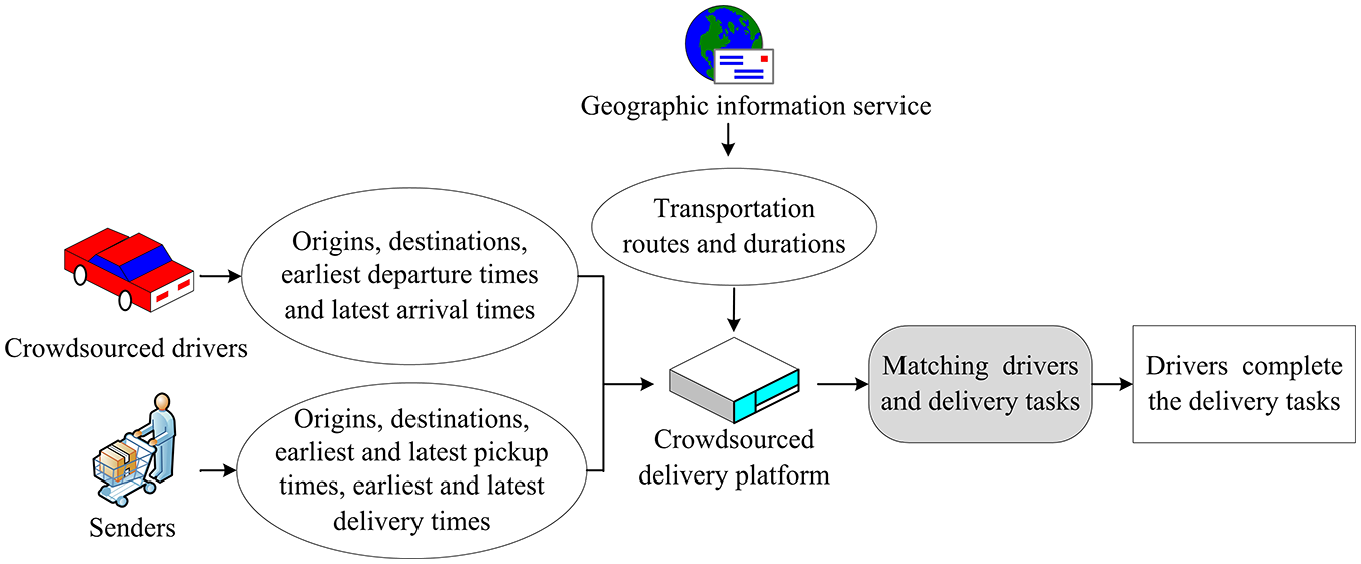
The problem of matching crowdsourced drivers and delivery tasks.
To solve the problem in a data refreshing environment, this paper proposes a model-based rolling matching strategy. To describe the rolling matching strategy easily and clearly, a model is first given to match crowdsourced drivers and delivery tasks considering uncertain transportation duration in a static data environment. On this basis, a procedure is given to solve the problem in a data refreshing environment based on the proposed model. For this, the problem of matching crowdsourced drivers and delivery tasks considering uncertain transportation duration in a static data environment is described in this section.
Considering a time point during the operation of the crowdsourced delivery platform, there are
The above problem is how to determine an optimal matching between drivers and delivery tasks according to the delivery application information
Model for Matching Crowdsourced Drivers and Delivery Tasks Considering Uncertain Transportation Duration in a Static Data Environment
In this section, to solve the above problem shown in the previous section, a model is proposed to match crowdsourced drivers and delivery tasks considering uncertain transportation duration in a static data environment. First, a framework of the proposed model is given, then detailed description of the model is given according to the framework.
Framework of the Proposed Model
It can be seen in the existing studies (7, 24, 33, 34) that the results of one-to-one matching are the basis of one-to-many matching between drivers and delivery tasks. Usually, the model for one-to-many matching can be obtained according to the transformation of the model for one-to-one matching. Since the main contribution of this paper is the consideration of uncertain transportation duration in crowdsourced delivery, first a model is proposed for one-to-one matching between drivers and delivery tasks, that is, each driver implements one delivery task on a trip. Then, a heuristic algorithm is proposed to solve the one-to-many matching problem based on the model for one-to-one matching by combining multiple delivery tasks.
The framework of the proposed model is shown in Figure 2. It can be seen from Figure 2 that the construction of the model includes three parts. A brief description of each part is given below.
Determination of the transportation cost matrix of drivers concerning different delivery tasks. According to the origins and destinations of drivers (including both crowdsourced drivers and dedicated drivers) and delivery tasks, the transportation routes that each driver implements mean that different delivery tasks can be determined. Then, the pickup distance matrix, delivery distance matrix and arriving destination distance matrix of drivers concerning different delivery tasks can be constructed according to the transportation routes. According to the obtained distance matrices and the unit transportation costs of different drivers, the transportation cost matrix of drivers concerning different delivery tasks can be determined.
Determination of the expected penalty cost matrix of drivers concerning different delivery tasks. According to the obtained pickup, delivery and arriving destination distance matrices, the uncertain transportation duration intervals of drivers concerning different delivery tasks can be determined, and the relevant expected times (expected pickup time, expected delivery time and expected arrival at destination time) in the form of interval numbers can be estimated. Then, the penalty probability matrices on pickup, delivery and arrival at destination stages can be estimated based on the time requirements of delivery tasks and the relevant expected times of drivers concerning different delivery tasks. Further, the expected penalty cost matrix of drivers concerning different delivery tasks can be determined according to the penalties of delay concerning different stages.
Constructing and solving the optimization matching model. According to the obtained transportation cost matrix and the expected penalty cost matrix of drivers concerning different delivery tasks, an optimization matching model is constructed to minimize the total cost of the crowdsourced delivery platform. The solution of the optimization matching model can be obtained by the Hungarian method ( 35 ) and the optimal matching between drivers and delivery tasks can be determined.
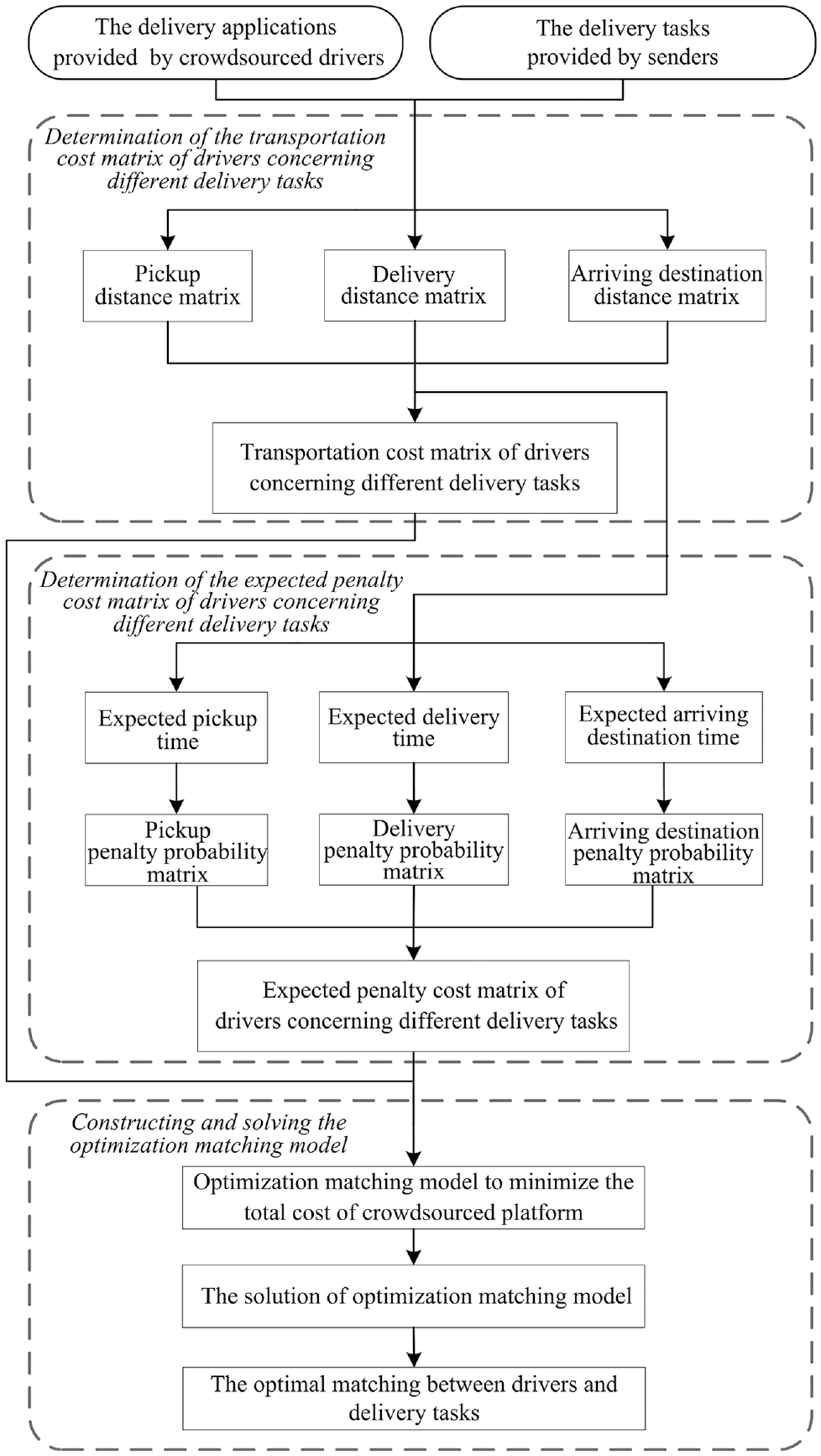
Framework of the proposed model.
Detailed Description of Construction of the Model
Determination of the Transportation Cost Matrix of Drivers Concerning Different Delivery Tasks
Following the study of Arslan et al. ( 7 ), there are four possible position relationships between the origins and destinations of drivers (including crowdsourced drivers and dedicated drivers) and delivery tasks, as shown in Figure 3. In Figure 3a, the driver and the delivery task have the same origin and destination. In this case, the routes of the driver and the delivery task are exactly the same. The idle resources of the drivers are effectively used and there is no waste of additional transportation cost to implement the delivery task. It is the most efficient situation in the crowdsourced delivery. In Figure 3b, the driver and the delivery task have different origins and the same destination. In this case, the driver should arrive at the origin of the delivery task first, then pick up and deliver the package to the destination of the delivery task and their own destination. In Figure 3c, the driver and the delivery task have the same origin and different destinations. In this case, the driver can pick up the package directly and deliver the package to the destination, and then travel to their own destination. In Figure 3d, the driver and the delivery task both have different origins and different destinations. In this case, the driver should first arrive at the origin of the delivery task, and then pick up the package and deliver it to its destination. After completing the delivery task, the driver needs to travel to their own destination.
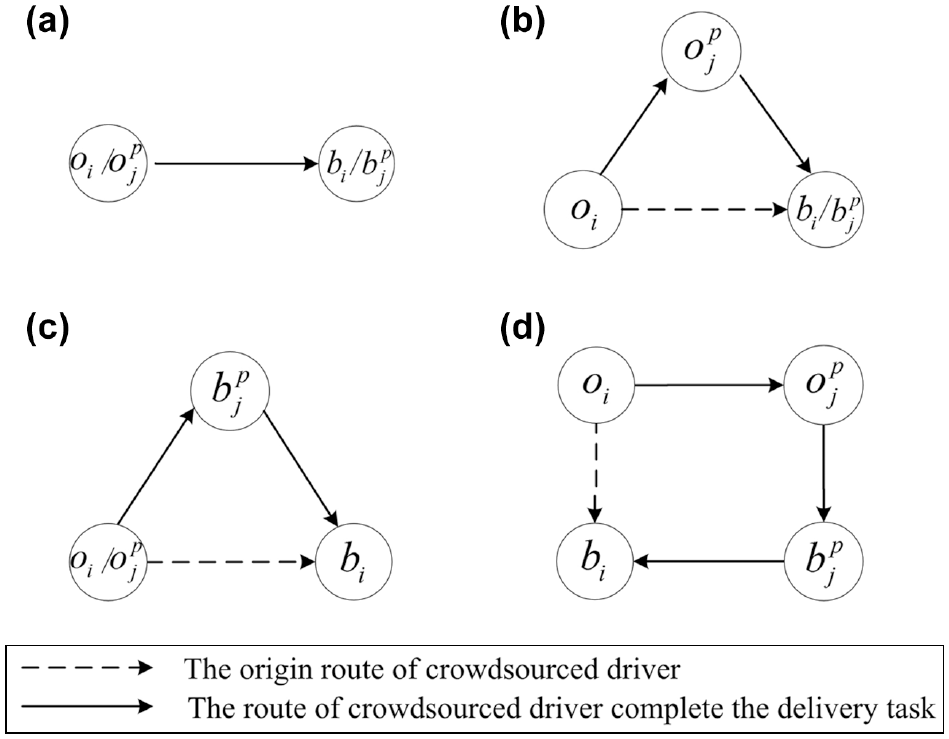
The four possible position relationships between drivers and delivery tasks: (a) same origin and destination, (b) different origins and same destination, (c) same origin and different destinations, and (d) different origins and destinations.
Based on the above analysis, the process by which drivers (including crowdsourcing drivers and dedicated drivers) implement the delivery tasks can be divided into three transportation stages. The first one is the pickup stage, in which the driver travel from their own origin to the origin of the delivery task. If the origin of the driver is the same as the origin of the delivery task (as shown in Figure 3, a and c ), then the transportation distance in the pickup stage is zero. The second is the delivery stage, in which the driver travels from their origin to the destination of the delivery task. The third is the arrival the destination stage, in which the driver moves to their own destination after completing the delivery task. If the destination of the driver is the same as the destination of the delivery task (as shown in Figure 3, a and b ), then the transportation distance in the arrival at destination stage is zero. By using the three transportation stages, the four possible position relationships can be unified into one. Thereafter, the calculation procedure and equations can be given with respect to the unified driver/delivery task relationship.
According to the origin and destination of each driver and each delivery task, the transportation distance of each driver completing each delivery task in each transportation stage can be obtained. Let
In this study, it is assumed that the transportation costs of implementing the delivery tasks are proportional to the transportation distance. Let

where
Similarly, the transportation cost that the platform pays to dedicated driver

According to
Determination of the Expected Penalty Cost Matrix of Drivers Concerning Different Delivery Tasks
In the daily operation of the crowdsourced platform, senders may provide time requirements for the pickup and delivery time of delivery tasks, such as the earliest and latest pickup time, and the earliest and latest delivery time. Meanwhile, crowdsourced drivers may also provide their time requirements, such as the earliest departure time and latest arrival time. Because of the uncertain transportation duration caused by traffic congestion, weather conditions and other factors, a crowdsourced driver may not complete their delivery tasks on time (29–31). If the delivery tasks are not completed meeting the time requirements, then the platform needs to pay compensation to the senders and the senders’ customer satisfaction will also decrease. To analyze the possible loss caused by the delay of delivery tasks under uncertain transportation duration, the penalty probabilities of each driver concerning different delivery tasks are first estimated, and then the expected penalty cost matrix of drivers concerning different delivery tasks can be constructed.
Based on the above analysis, the process by which drivers implement the delivery tasks can be divided into three transportation stages, that is, pickup stage, delivery stage and arrival at destination stage. The uncertain transportation time intervals concerning the three transportation stages by which a driver implements different delivery tasks can be obtained according to the origins and destinations of the driver and the delivery tasks. Let
In the pickup stage, to implement the delivery task

In the delivery stage, if the driver arrives at the origin of the delivery task before the earliest pickup time, then the driver cannot pick up the package and begin to deliver it until the earliest pickup time
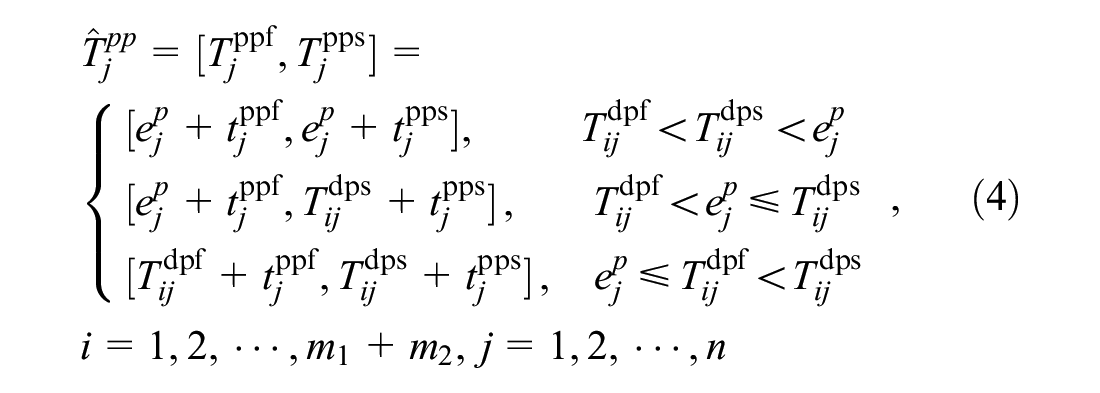
Similar to the analysis of the delivery stage, the analysis of arrival at destination time is given below. If the driver arrives at the destination of the delivery task before earliest delivery time
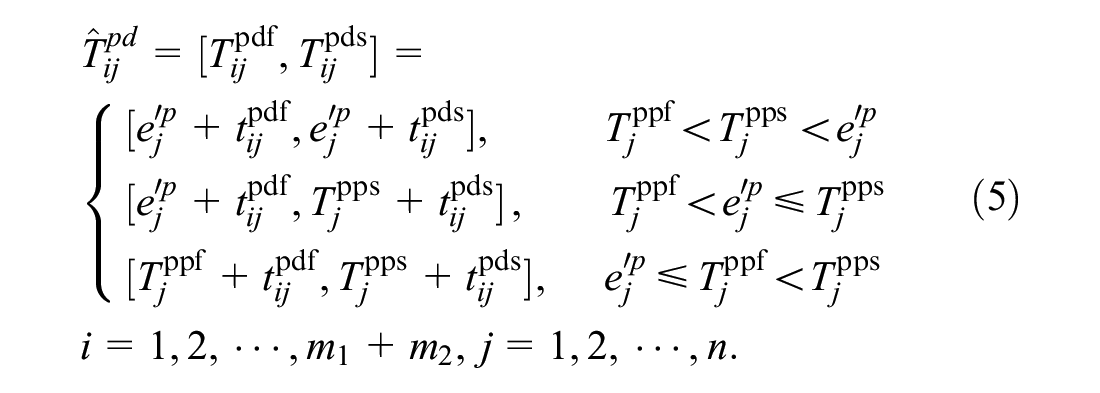
According to the obtained
Let
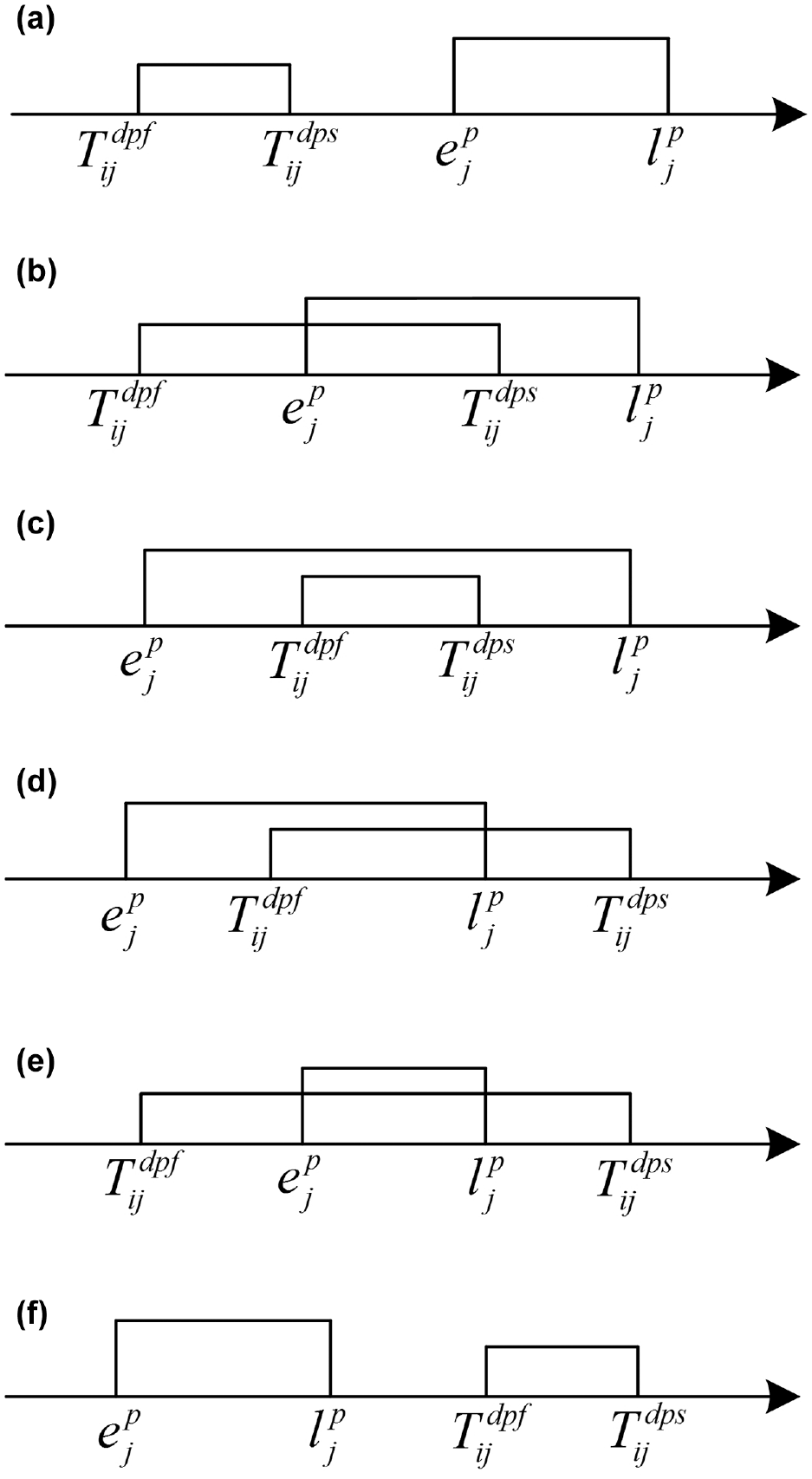
The six possible position relationships between the expected pickup time and the pickup time requirement of delivery task: (a)
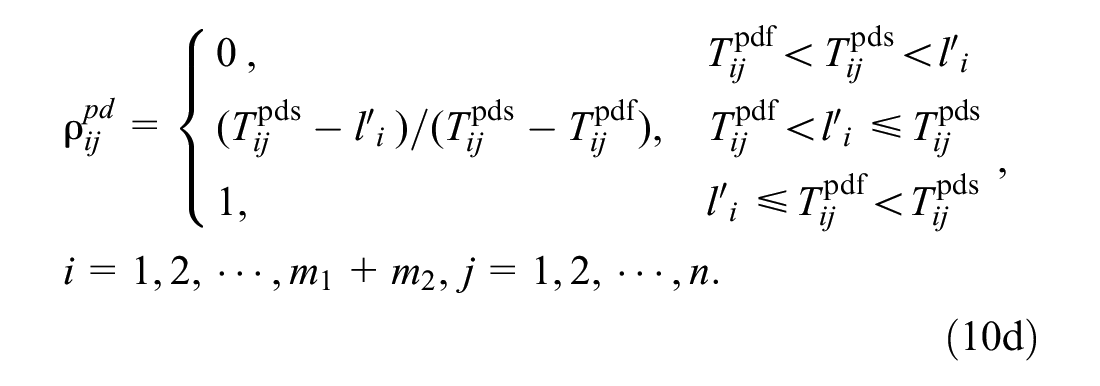
In the cases of Figure 4, a–c, that is,
Thus, the value of
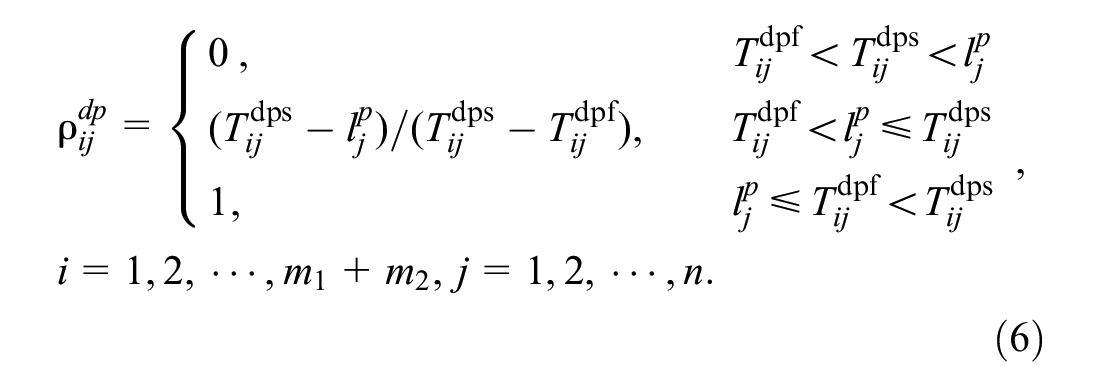
Similar to the analysis of the pickup stage, in the delivery stage and arrival at destination stage, there are also six position relationships between the expected time and time requirement of delivery tasks. The values of
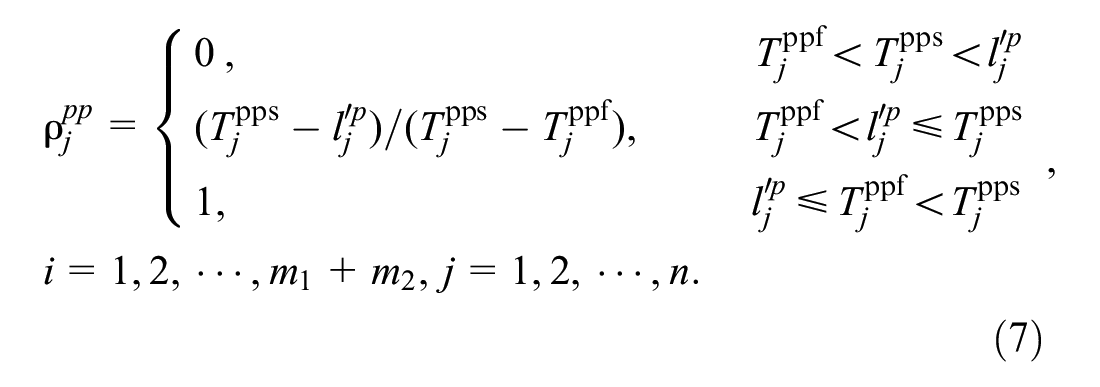
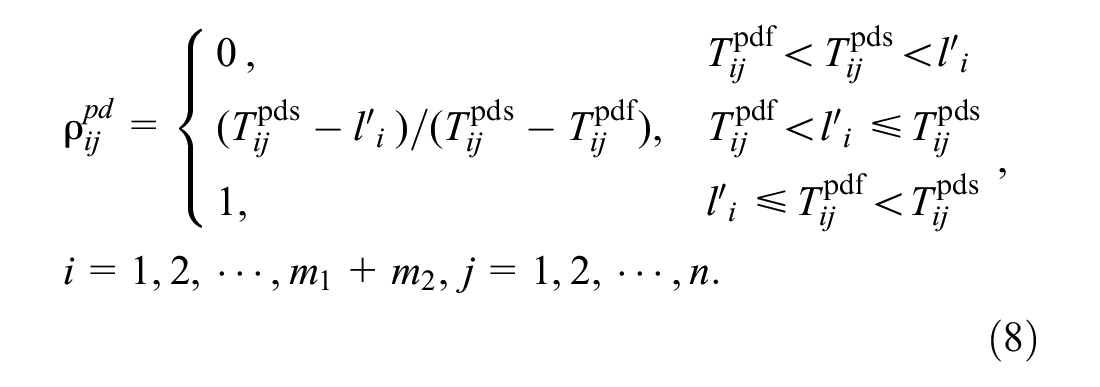
According to the penalty probabilities

where
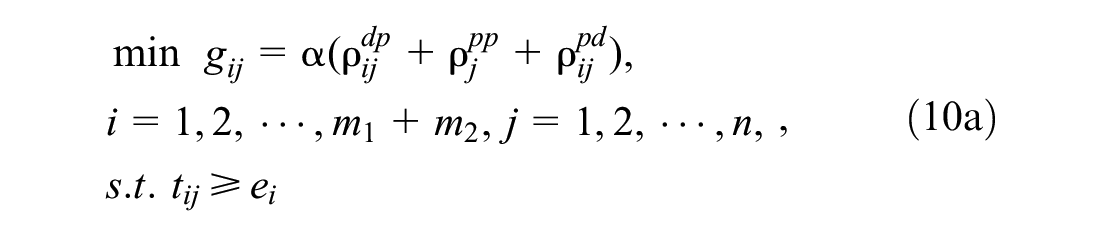
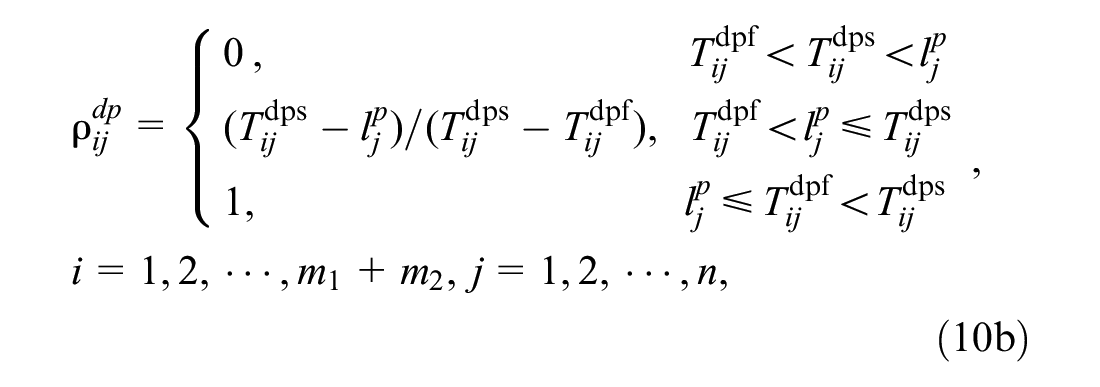
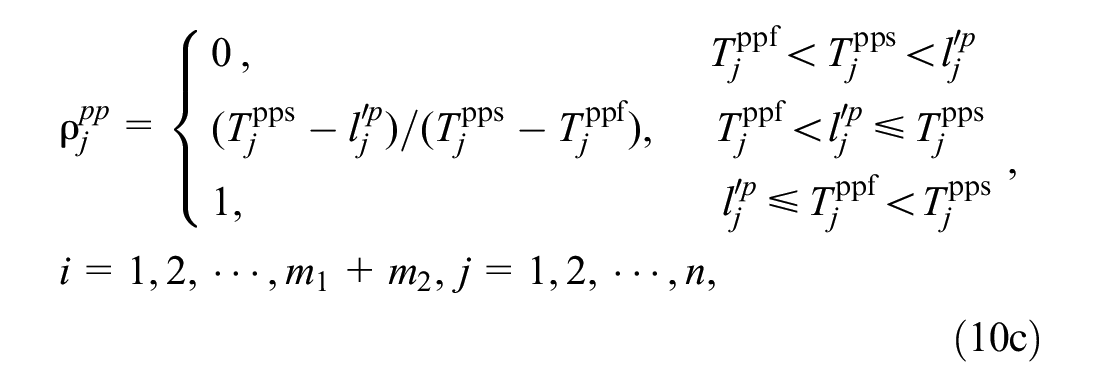
According to the model, the optimal
Constructing and Solving the Optimization Matching Model
According to the transportation cost matrix




In the model, Equation 11a is the objective function to minimize the sum of the transportation costs and expected penalty costs of the matching between drivers and delivery tasks. Constraint 11b is to guarantee that no more than one delivery task is completed by each crowdsourced driver and dedicated driver; constraint 11c is to guarantee that each delivery task is matched with one of the crowdsourced drivers or dedicated drivers. Obviously, the optimization matching model, that is, Equation 11, can be solved by the Hungarian method ( 35 ), and the matching between crowdsourced drivers and dedicated drivers can be determined.
Rolling Procedure for Matching Crowdsourced Drivers and Delivery Tasks in Data Refreshing Environment
It should be noted that the matching between crowdsourced drivers and delivery tasks is carried out in a data refreshing environment. In other words, the crowdsourced delivery platform may receive new delivery applications and new delivery tasks from crowdsourced drivers and senders at any time ( 38 ). To solve the problem in a data refreshing environment, this section proposes a rolling procedure to match crowdsourced drivers and delivery tasks in a data refreshing environment based on the proposed model.
The rolling procedure framework has been widely used and has been estimated as an effective method for decision making in dynamic environments (39–42), such as dynamic pricing (43–45), dynamic inventory management (46, 47) and the dynamic routing problem (40, 48). By optimizing decisions based on the data at the current time and repeating the optimization process when the data is refreshed, the rolling procedure can reduce the complexity of dynamic problems effectively. Thus, the rolling procedure can also be used to solve the matching between crowdsourced drivers and delivery tasks in a data refreshing environment.
The main idea of the rolling procedure is vividly shown in Figure 5. It can be seen from Figure 5 that the rolling procedure can be divided into six stages. A brief description of each stage is given below.
Stage 1: Confirm the information of present delivery applications and delivery tasks, that is, delivery application information
Stage 2: Determine the matching plan between drivers and delivery tasks using the proposed model, that is,
Stage 3: Determine the first departure time which is the departure time of the first driver to implement the delivery task according to the matching plan determined in Stage 2, that is,
Stage 4: If the platform receives a new delivery application or delivery task before the first departure time based on the real-time information, then discard the current matching plan and go to Stage 1; otherwise, go to Stage 5;
Stage 5: Let the driver whose departure time is the first departure time implement the corresponding delivery task;
Stage 6: Delete the driver and delivery task that has been implemented, and go to Stage 1.
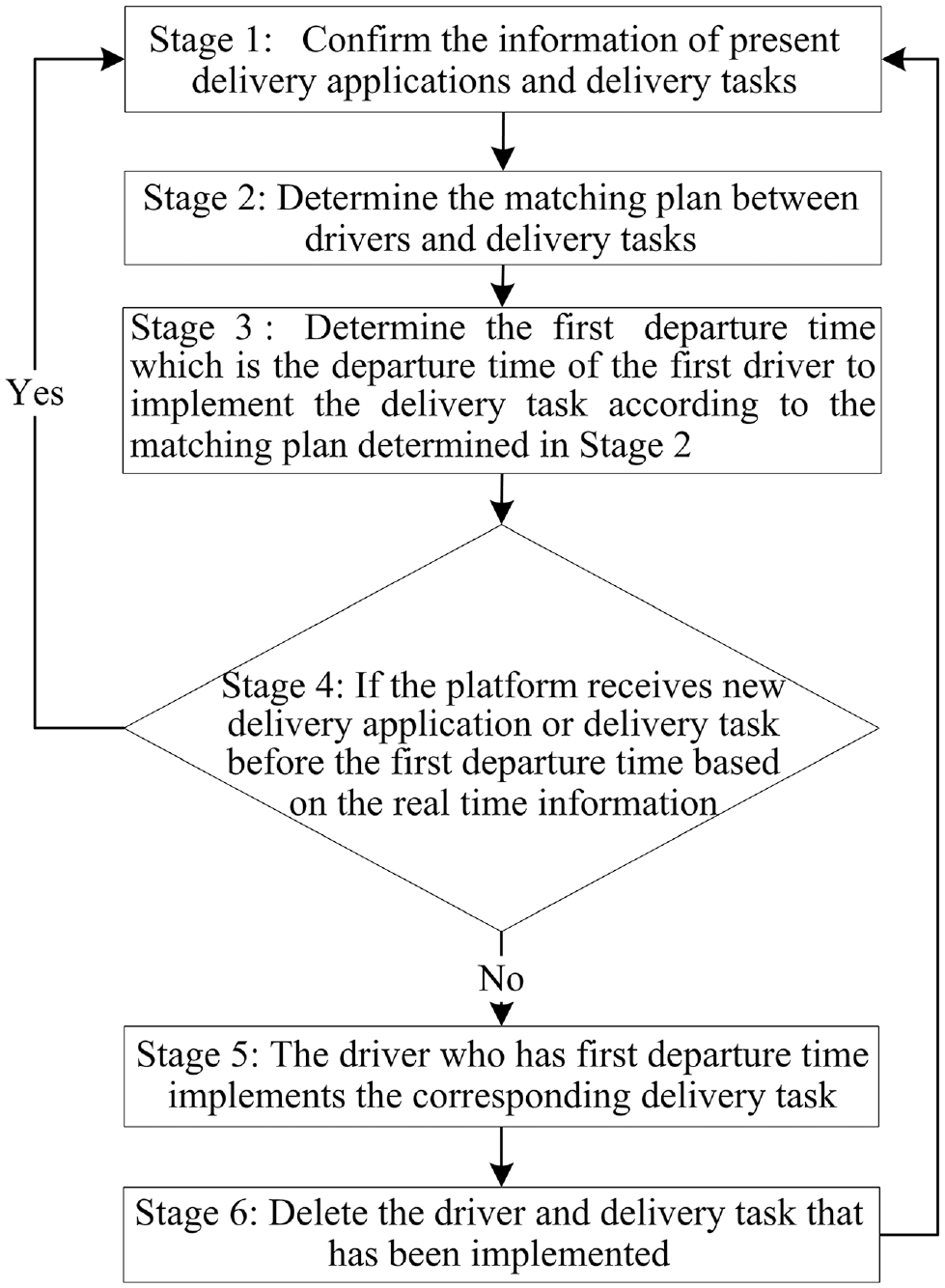
Rolling procedure for matching crowdsourced drivers and delivery tasks in a data refreshing environment.
By the proposed procedure, the problem of matching crowdsourced drivers and delivery tasks in a data refreshing environment can be solved based on the proposed model. The obtained matching results can support the operation of the crowdsourced delivery platform.
It is necessary to point out that the above real-time rolling strategy is proposed based on the assumption that the drivers could receive the information about the assigned tasks from the platform at any time. In some practical situations, however, the assumption may not be satisfied since it will need the drivers to keep sustain attentions to the messages or announcements of the platform. In these situations, the periodic rolling strategy can be adopted as a substitute. Some discussion about the differences between the real-time rolling strategy and the periodic rolling strategy is given below.
The frequency of data refreshing and matching plan recalculating.
In the real-time rolling strategy, when the platform receives new delivery applications or delivery tasks, the data is refreshed and the matching plan is recalculated according to the refreshed data. In the periodic review rolling strategy, the data is refreshed and the matching plan is recalculated at the specific time points with regular intervals. Compared with the real-time rolling strategy, although the periodic rolling strategy usually cannot achieve the optimal assignment results theoretically, it is easier for drivers to receive information and query tasks. The specific time points for data refreshing can be determined according to the characteristics of crowdsourced delivery, such as the number of delivery tasks, the number of crowdsourced drivers and the time requirements of the senders.
2. The cut-off time for the assignment.
In the real-time rolling strategy, the platform determines the matching plan based on the real-time information and backward deduces the first departure time. In this case, the cut-off time for the assignment is the first departure time, which means that the platform can continue to receive the new information and refresh the matching plan before the drivers with the first departure time depart. In the periodic rolling strategy, the platform refreshes the data and determines the matching plan at the preset specific time, and then informs the drivers whose departure times are before the next refreshing time about their delivery tasks. Therefore, in the periodic rolling strategy, the cut-off time for the assignment is the preset specific time of data refreshing.
3. Discarding the matching plan
In the real-time rolling strategy, drivers do not receive the related information about the matching plan before the cut-off time (that is, the first departure time). Thus, if the platform receives new information (new delivery applications or new delivery tasks), then the new matching plan is recalculated according to the new information and the original matching plan can be totally discarded. In the periodic rolling strategy, the platform will send the related information to the drivers whose departure times are before the next refreshing time at the time of data refreshing. Therefore, the matching plan about the drivers who have received the delivery information will not be discarded.
Heuristic Algorithm for Combining Multiple Delivery Tasks to Solve the One-to-Many Matching Problem
According to the proposed model and the rolling procedure, the problem of matching crowdsourced drivers and delivery tasks can be solved by determining one-to-one matching. However, in some practical scenarios, to provide service to more senders or gain more profit, the one-to-many matching problem should be considered. To solve the one-to-many matching problem, in this section, a heuristic algorithm is proposed for combining multiple delivery tasks as a new delivery task. Then, the one-to-many matching problem is transformed into the one-to-one matching problem which can be solved by the above proposed model. The flow chart of the heuristic algorithm is shown in Figure 6. The specific description of each step in the heuristic algorithm is given below.
Step 1: Input initial delivery task information
Input the set of initial delivery task,
Step 2: Calculate the time compatibility for combining any two delivery tasks
Let
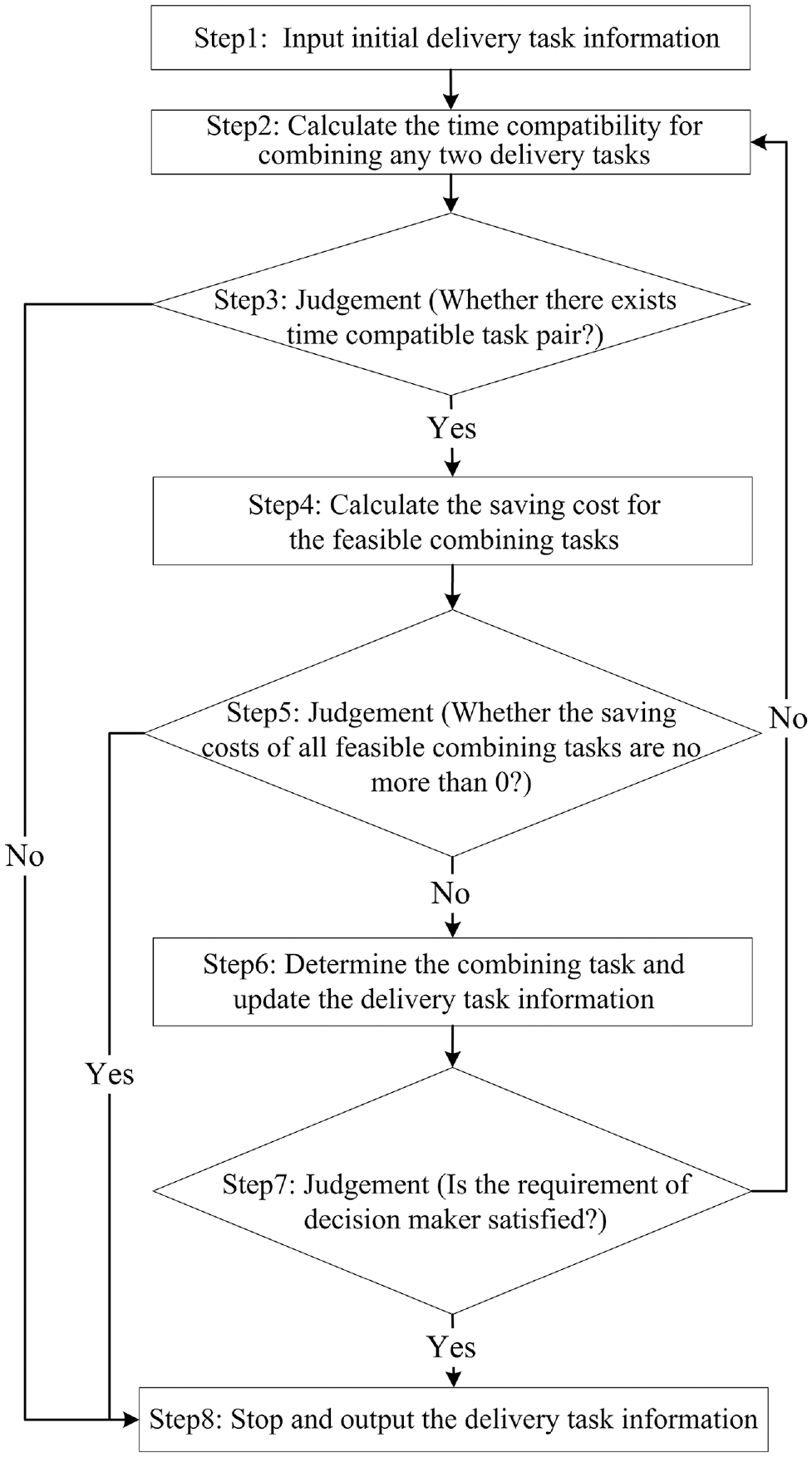
Flow chart of the heuristic algorithm for combining delivery tasks.
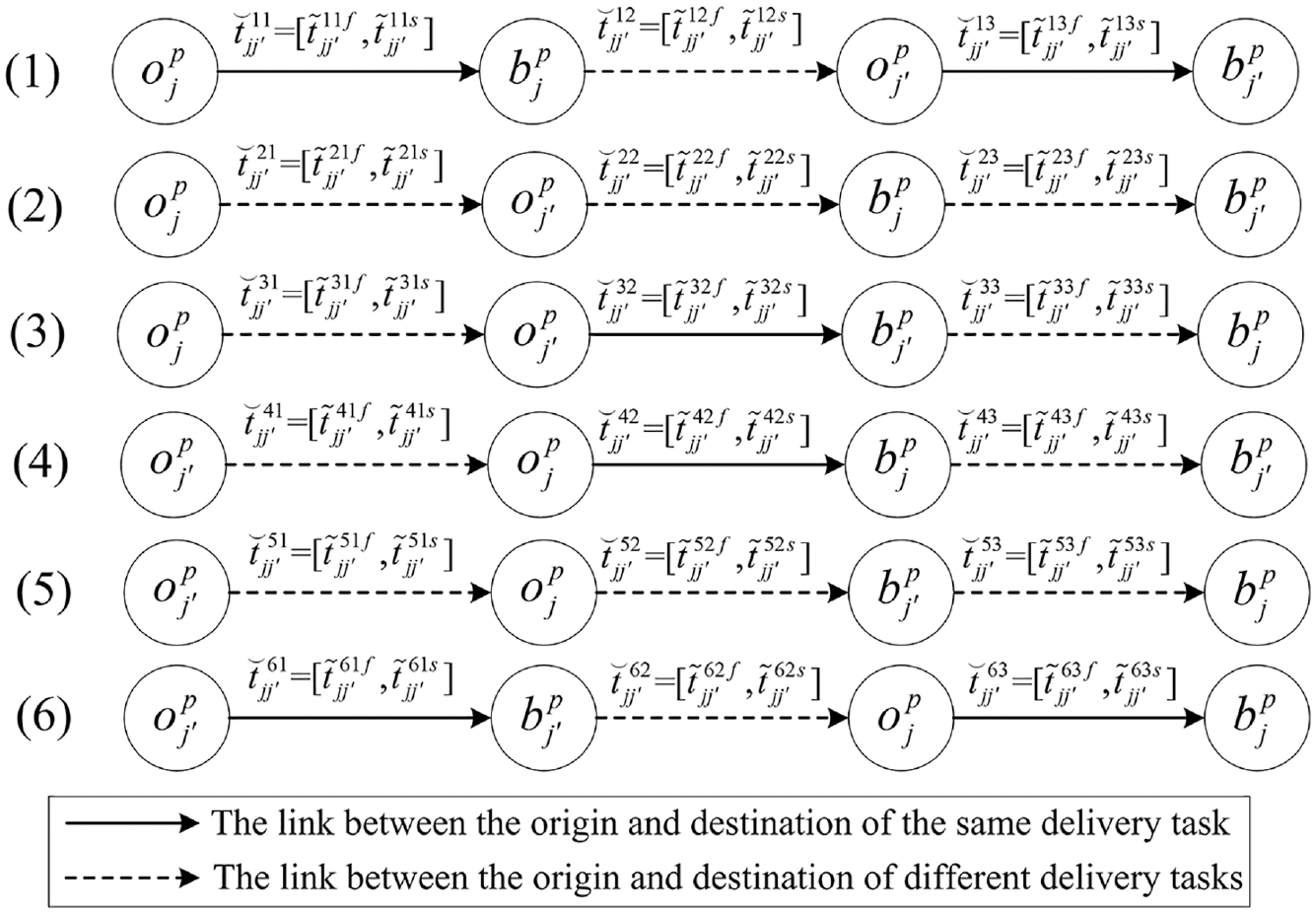
Six possible logical relationships about
In Figure 7, the solid line indicates the link between the origin and destination of the same delivery task and the dashed line indicates the link between the origin and destination of different delivery tasks. It is the default setting that the time requirements between the origin and destination of the same delivery task are compatible. Thus, the sub-time compatibility between the origin and destination of the same delivery task is one. However, the time compatibility between the origin and destination of the different delivery tasks need to be calculated.
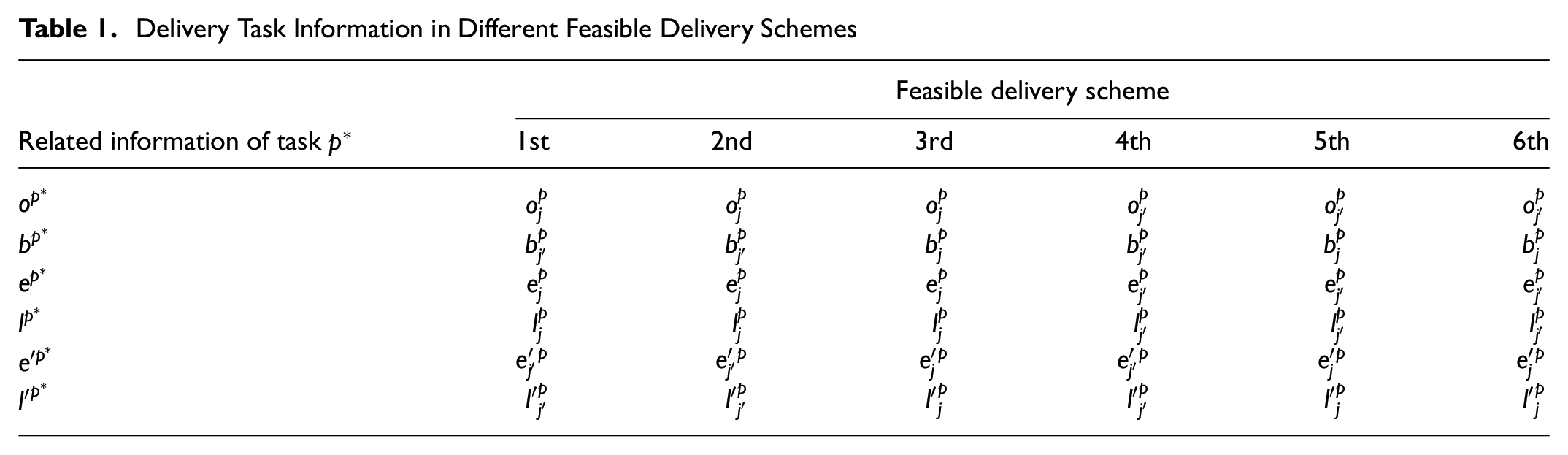
Taking feasible delivery scheme 1 as an example, in feasible delivery scheme 1 there is a sub-time compatibility that needs to be calculated, that is,

Then, let
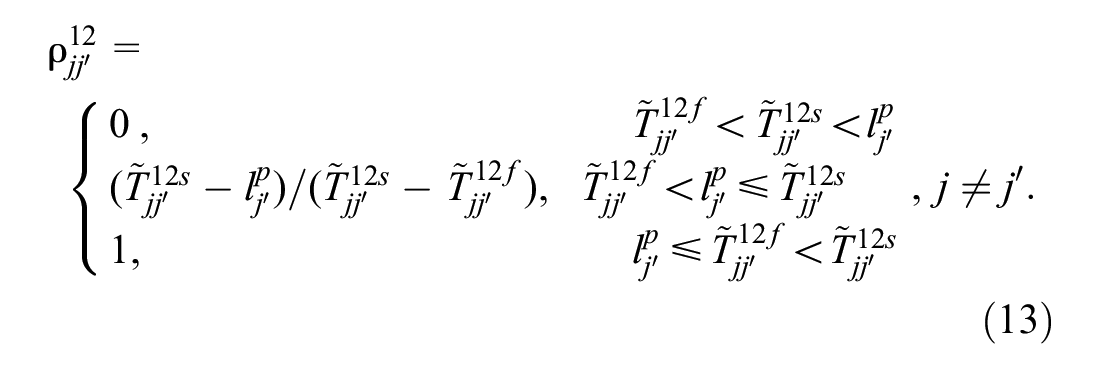
Therefore, let

With a similar approach, the sub-time compatibility in the six feasible delivery schemes can be calculated. Let

Further, since only one feasible delivery scheme should be selected from the six different feasible delivery schemes, we define
Step 3: Judgment (Whether there exists a time compatible task pair?)
If all elements in matrix
Step 4: Calculate the cost saving for the feasible combining tasks
For

where

In Equation 17,

Step 5: Judgment (Whether the cost savings of all feasible combining tasks are no more than zero?)
For
Step 6: Determining the combining task and updating the delivery task information
Let
Delivery Task Information in Different Feasible Delivery Schemes
Step 7: Judgment (Is the requirement of the decision maker satisfied?)
In the operation of the crowdsourcing platform, the decision maker may formulate different operational requirements. For example, to improve the participation positivity of crowdsourcing drivers and ensure the probability of crowdsourcing drivers receiving delivery tasks, decision makers may require combining only when the number of delivery tasks is greater than the number of crowdsourcing drivers. Therefore, a step for judging whether the requirement of the decision maker is satisfied is necessary. If the requirement of the decision maker is satisfied, go to step 8; otherwise, return to step 2.
Step 8: Stop and output the delivery task information
By the proposed heuristic algorithm, the delivery task information which contains combining delivery tasks can be obtained. The matching between delivery tasks and drivers can then be solved based on the proposed model.
It is necessary to point out that the main idea of the heuristic algorithm is to determine the combining tasks by calculating the time compatibility and the cost saving for feasible combining of delivery tasks. It means that the combining of tasks determined by this algorithm must be feasible and the total cost must be decreased. On the other hand, the problem of the one-to-many matching is very complex even if the transportation duration is certain. In this study, uncertain transportation duration is considered, which makes the problem more complicated. Thus, it is difficult to present an exact algorithm that can obtain the optimal solution of combining tasks. Therefore, the proposed heuristic algorithm can be regarded as an acceptable and effective alternative for combining tasks.
Case Study and Comparison
In this section, to illustrate the implementation procedure and validity of the proposed matching strategy, a case study is conducted for a crowdsourced delivery platform that matches crowdsourced drivers and delivery tasks. Then, to further illustrate the importance of the consideration of uncertain transportation durations and the contribution of the proposed matching strategy, a comparison is given. Since the main focus is on the consideration of uncertain transportation duration in crowdsourced delivery, the case study is mainly conducted for matching crowdsourced drivers and delivery tasks considering uncertain transportation duration in a static data environment based on the proposed model.
Case Study
Consider a time point in the operation of the crowdsourced delivery platform in S city. There are 23 drivers (comprised of 20 crowdsourced drivers and three dedicated drivers) and 20 delivery tasks, which are denoted as
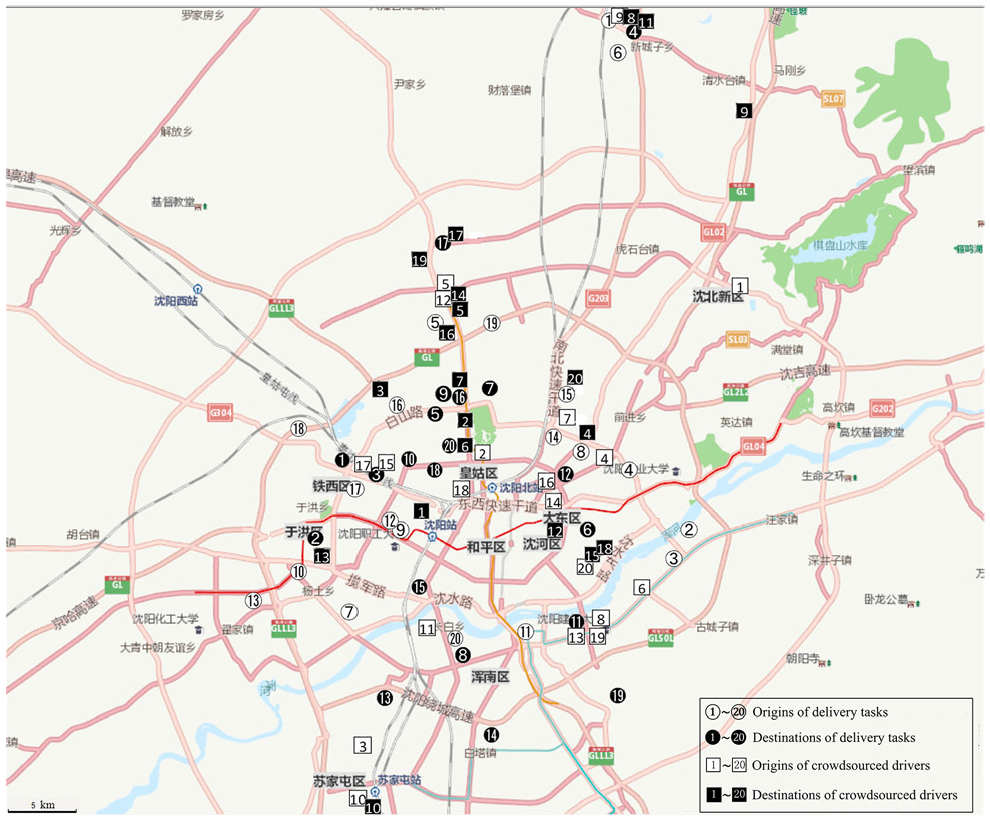
Map of case study city showing origins and destinations of crowdsourced drivers and delivery tasks.
To determine an optimal match between drivers and delivery tasks, the proposed model for matching drivers and delivery tasks considering uncertain transportation duration in a static data environment is used. The process, in detail, has three parts and which are described as follows.
Determination of the transportation cost matrix of drivers concerning different delivery tasks.
According to the origins and destinations of drivers and delivery tasks, from the transportation routes that each driver implements different delivery tasks can be determined. Then, three transportation distance matrices
2. Determination of the expected penalty cost matrix of drivers concerning different delivery tasks.
According to the obtained pickup, delivery and arrival at destination distance matrices, the uncertain transportation duration intervals with respect to the pickup stage, delivery stage and arrival at destination stage, that is,
Let
3. Constructing and solving the optimization matching model.
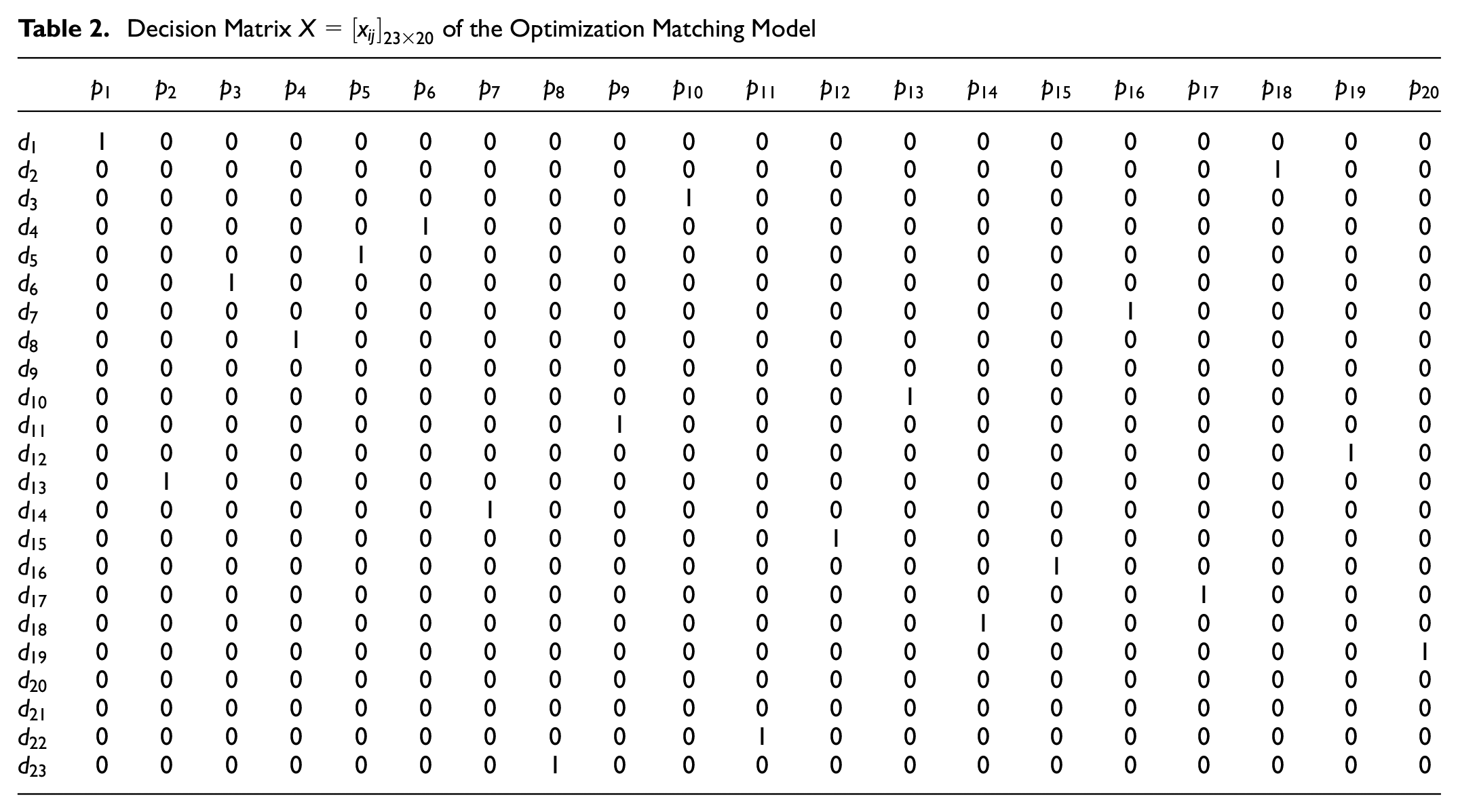
According to the transportation cost matrix of drivers




The optimization matching model can be solved by the Hungarian method (
35
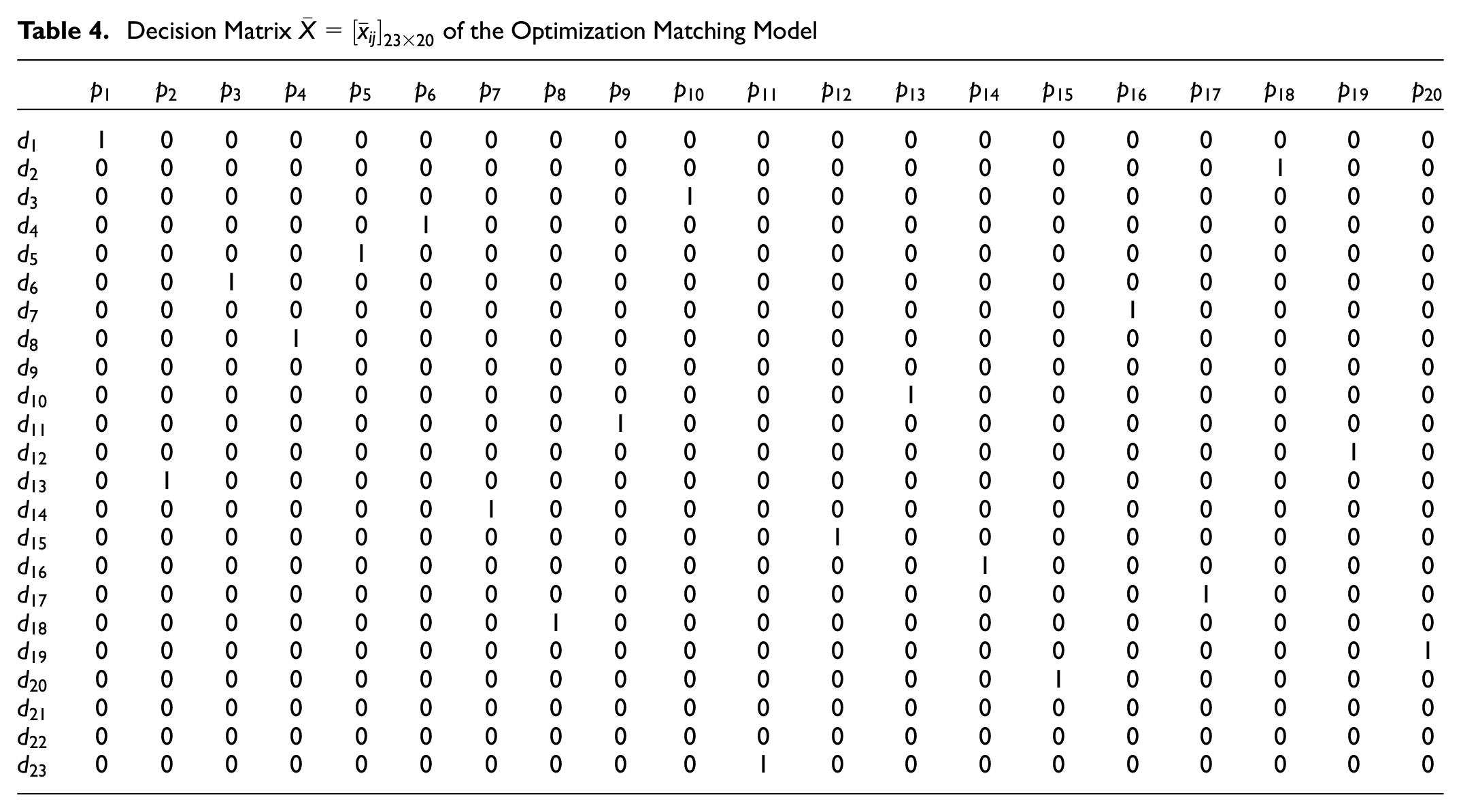
). Table 2 shows the decision matrix
Decision Matrix
Departure Times of Drivers

Note: NA = not available.
According to the departure times of drivers, the first departure time is determined, that is,
By implementing proposed matching strategy, the matching result of the drivers and delivery tasks in a data refreshing environment can be obtained. Then, according to the matching result, the decision maker of the crowdsourced platform can assign the delivery tasks to the drivers. It is necessary to further illustrate that the proposed method is the first attempt to determine the matching result of the drivers and delivery tasks considering uncertain transportation duration. The proposed method has important significance and availability for guiding the decision maker in operating the crowdsourced platform in cities with serious traffic congestion and delay penalties.
Comparison
To further illustrate the importance of the consideration of uncertain transportation duration in the matching between drivers and delivery tasks, the results of the proposed matching strategy are compared with the matching strategy that does not consider uncertain transportation duration. The matching results that consider uncertain transportation duration are determined by the proposed strategy based on the data about the origins, destinations and time requirements of drivers and delivery tasks provided by drivers and senders. The matching strategy that does not consider uncertain transportation duration is also determined by the similar procedure in the proposed model. In the matching strategy that does not consider uncertain transportation duration, it is assumed that the available times of drivers are no longer the ranges of uncertain transportation time intervals, where the available times of drivers are the expected times for drivers to implement delivery tasks. The available times of drivers are represented by exact numbers. We convert the available times of drivers from the uncertain transportation time interval (that is, [earliest time, latest time]) to an exact number according to the transportation distance obtained in the proposed strategy and the average speed in the transportation that considers uncertain transportation duration.
The expected times (in the form of crisp numbers) of drivers implementing delivery tasks that do not consider uncertain transportation duration in the three transportation stages,
According to the transportation cost matrix of drivers,
Decision Matrix
The two strategies were then evaluated by calculating the total costs of the two matching results in which the actual time of the driver implementing the delivery task is randomly selected from the corresponding uncertain transportation time interval. By selecting the actual time of each driver implementing the delivery task 1,000 times repeatedly, 1,000 total costs of the two matching results can be obtained and the moving average total costs of the two results can be obtained. Figure 9 shows the comparison of moving average total costs for the two matching strategies, where
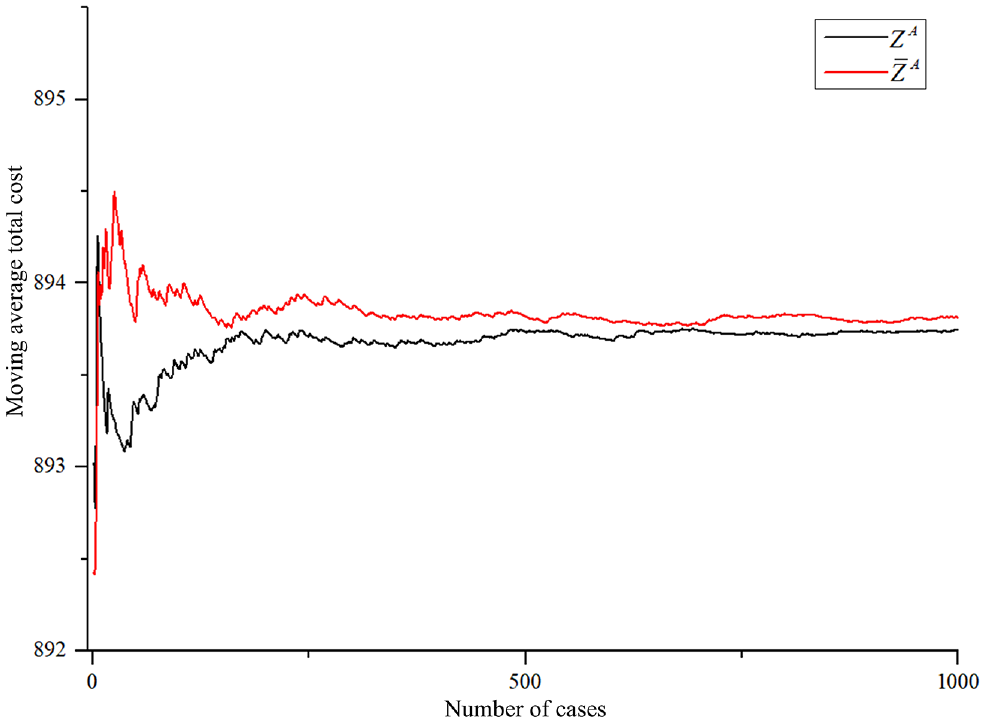
Moving average total costs in 1,000 cases.
In Figure 10, the moving average total costs of the two matching strategies in different unit transportation costs are compared. In Figure 10,
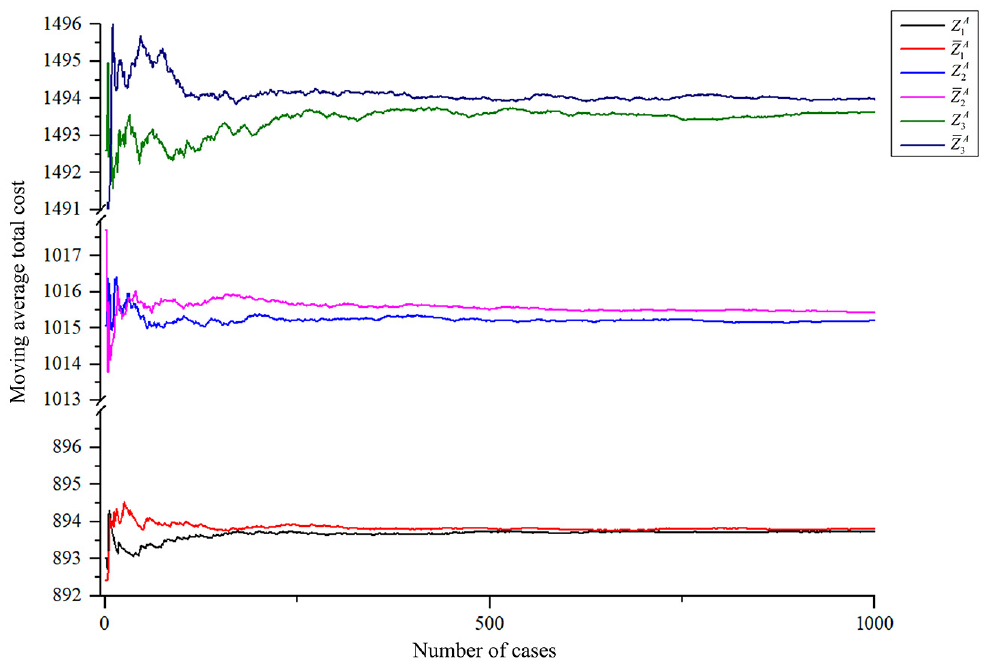
Moving average total costs in different unit distance transportation costs.
Figure 11 shows the moving average total costs of the two matching strategies in different delay penalties. In Figure 11,
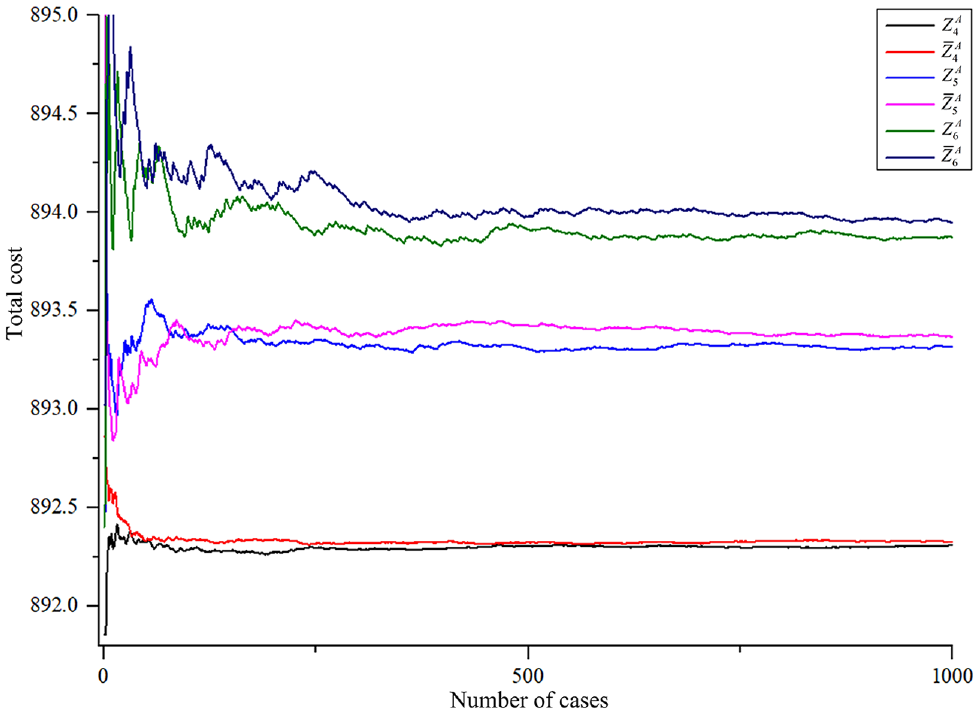
Moving average total costs in different delay penalties.
In summary, the proposed matching strategy can help the decision maker of the crowdsourced platform save cost and make more profit. The proposed matching strategy can save transportation costs, reduce transportation distances and reduce emissions. Therefore, the implementation of the matching strategy considering uncertain transportation duration should be encouraged. Furthermore, the proposed matching strategy can reduce the penalty cost. Especially in cities with serious traffic congestion and delay penalties, where customers have high requirement of delivery on time, the proposed matching strategy can save penalty cost and increase customer satisfaction more effectively.
Conclusions
The matching of crowdsourced drivers and delivery tasks is an important research topic with practical application background in the operation of crowdsourced delivery platforms. Although several studies on matching crowdsourced drivers and delivery tasks have been conducted, uncertain transportation duration in crowdsourced delivery has not been considered. In this paper, a new model-based rolling matching strategy is proposed to match crowdsourced drivers and delivery tasks considering uncertain transportation duration. First, a model for matching crowdsourced drivers and delivery tasks considering uncertain transportation duration in a static data environment is proposed. On this basis, a procedure is given for solving the problem in a data refreshing environment based on the model in a static data environment. Moreover, a heuristic algorithm is presented for combining multiple delivery tasks to solve the one-to-many matching. The major contributions of this paper are summarized as follows.
First, this paper refines a noteworthy research problem, that is, the problem of matching crowdsourced drivers and delivery tasks considering uncertain transportation duration. Although several studies on matching crowdsourced drivers and delivery tasks have been conducted, uncertain transportation duration in crowdsourced delivery has not been considered. The consideration of uncertain transportation duration overcomes the limitations of the results obtained by the existing methods that cannot meet the time requirements of senders, and lays a good foundation for conducting further studies.
Second, to solve the problem, a model-based rolling matching strategy is proposed, which can be described as three parts, that is: (i) a model for matching crowdsourced drivers and delivery tasks considering uncertain transportation duration in a static data environment; (ii) a rolling procedure for matching crowdsourced drivers and delivery tasks in a data refreshing environment based on the proposed model; (iii) a heuristic algorithm that is presented to solve the one-to-many matching by combining multiple delivery tasks. The proposed rolling strategy and heuristic algorithm provide new ideas for dealing with similar problems in a data refreshing environment.
Third, this paper presents formulas for estimating the penalty probability and expected penalty costs of a crowdsourced delivery platform considering uncertain transportation duration. According to the formulas, the expected penalty costs for each driver implementing different delivery tasks can be estimated. The formulas lay a good foundation to construct the optimization matching model considering uncertain transportation duration.
Fourth, to illustrate the validity and the contribution of the proposed matching strategy, this paper conducts a case study and comparison with the matching strategy that does not consider uncertain transportation duration. The results show that the proposed matching strategy has a distinct advantage of cost savings over the matching strategy that does not consider uncertain transportation duration. In addition, considering uncertain transportation duration and implementing the proposed matching strategy are more profitable to the platform in the market of high transportation costs and delay penalties.
This paper also has some limitations, which may serve as avenues for future research. First, crowdsourced drivers can deliver multiple packages in one trip within the limits of transportation capacity. Therefore, extended studies of the proposed method should be conducted considering the transportation capacity of crowdsourced drivers. Second, the crowdsourced driver may reject the delivery task matched by the crowdsourced delivery platform if the matching degree between the travel route of the crowdsourced driver and the delivery route is low. Thus, the detour preference of the crowdsourced driver can be taken as an effect factor for the matching of the crowdsourced delivery platform.
Supplemental Material
sj-docx-1-trr-10.1177_0361198120974364 – Supplemental material for Model-Based Rolling Matching Strategy for Crowdsourced Drivers and Delivery Tasks Considering Uncertain Transportation Duration
Supplemental material, sj-docx-1-trr-10.1177_0361198120974364 for Model-Based Rolling Matching Strategy for Crowdsourced Drivers and Delivery Tasks Considering Uncertain Transportation Duration by Qi Zhang, Yang Liu, Zhi-Ping Fan and Zong-Lin Li in Transportation Research Record
Footnotes
Acknowledgements
The authors thank the anonymous reviewers for their helpful comments and suggestions that greatly improved the presentation of the paper.
Author Contributions
The authors confirm contribution to the paper as follows: study conception and design: Yang Liu, Zhi-Ping Fan, Qi Zhang; data collection: Zong-Lin Li; analysis and interpretation of results: Yang Liu, Qi Zhang, Zhi-Ping Fan; draft manuscript preparation: Qi Zhang, Yang Liu, Zhi-Ping Fan. All authors reviewed the results and approved the final version of the manuscript.
Declaration of Conflicting Interests
The author(s) declared no potential conflicts of interest with respect to the research, authorship, and/or publication of this article.
Funding
The author(s) disclosed receipt of the following financial support for the research, authorship, and/or publication of this article: This work was partly supported by the National Natural Science Foundation of China (Project numbers 72031002 and 71771043), the Liaoning BaiQianWan Talents Program (Project number 2016921027), and the Construction Base for Introducing Talents of Discipline Innovation to Chinese Universities 111 project (B16009).
Data Accessibility Statement
No data are made available.
Supplemental Material
Supplemental material for this article is available online.
References
Supplementary Material
Please find the following supplemental material available below.
For Open Access articles published under a Creative Commons License, all supplemental material carries the same license as the article it is associated with.
For non-Open Access articles published, all supplemental material carries a non-exclusive license, and permission requests for re-use of supplemental material or any part of supplemental material shall be sent directly to the copyright owner as specified in the copyright notice associated with the article.
