







Abstract
In previous studies the risk perception of future accidents was the main variable likely to affect safe driving. However, findings on the relationship between traffic accident history and risk perception of future accidents have been inconsistent. Moreover, in the case of occupational drivers, work attitudes could be the main factor affecting safe driving. However, no research has been conducted on the direct relationship between traffic accident history and work attitudes. Therefore, present study examined the effect of occupational drivers’ traffic accident history on their risk perception, work attitudes, and unstable driving. Data analysis was based on a self-reported survey of Korean occupational drivers (n = 388) and their official traffic accident records. Results show that traffic accident history was associated significantly with professional pride, job satisfaction, and aggressive driving but not with risk perception of future accidents or job stress. Moreover, all variables measuring unstable driving behavior were significantly related to professional pride, job satisfaction, and job stress. Furthermore, professional pride turned out to mediate the relationship between traffic accident history and current unstable driving. The major finding is that there is no significant relationship between traffic accident history and risk perception of future accidents. Furthermore, traffic accident history has a significant effect on positive variables such as professional pride and job satisfaction but not on negative variables such as job stress. In addition, the significant mediator in the relationship between traffic accident history and current unstable driving behavior was only professional pride.
While registered commercial vehicles in South Korea accounted for only 6.8% of all vehicles in 2018, traffic accidents involving occupational drivers accounted for 20.8% ( 1 , 2 ). It is likely that occupational drivers report higher traffic accident rates as their average driving hours are much more than those of non-occupational drivers. Therefore, their high rate of traffic accidents motivated us to examine their evidence-based traffic accidents and driving safety. While previous studies have examined whether safe driving can reduce traffic accidents, the factors that specifically affect safe driving by occupational drivers and traffic accidents have received limited attention.
Occupational drivers, in contrast to non-occupational drivers, drive as an occupation, drive for long hours, and are hired by transportation companies. They naturally expose themselves to danger, given the long hours they are required to drive, and traffic accidents could affect their driving performance. Therefore, it is important to examine how occupational drivers’ traffic accident history can influence their driving attitudes and behaviors. Recent research has mainly focused on post-traumatic stress disorder (PTSD) as an effect of traffic accidents on drivers who have experienced accidents. According to recent meta-analysis research, an average of 22.25% (ranging from 6.3% to 58.3%) of road-traffic accident survivors reported that they suffer from PTSD ( 3 ). However, these statistics also show that many traffic accident survivors do not experience PTSD.
This raises an important question of whether the traffic accident history affects drivers in ways other than PTSD. Previous research shows that the risk perception of future accidents is the most frequently investigated variable in research on the effects of traffic accident history other than PTSD ( 4 – 8 ). For occupational drivers who drive every day, traffic accident history can affect their job attitude and their current unstable driving behavior. Accordingly, based on field data on traffic accidents, we investigated how traffic accident history would affect occupational drivers’ risk perception of future accidents, job satisfaction, stress, professional pride, and current unstable driving behavior. Furthermore, this study would investigate the variables that could mediate the relationship between traffic accident history and unstable driving behavior.
Backgrounds
Traffic Accident History, Risk Perception, and Safety
Risk perception is one of the major factors that can affect safety behavior or risk-taking behavior. The most representative theory is the Protection Motivation Theory (PMT) ( 9 – 11 ). PMT assumes that cognitive mediating processes, such as risk perception, are related to accidents and that cognitive mediating processes would encourage or restrain the reactions to cope with risks. According to a meta-analysis ( 12 ), forms of risk appraisal, such as risk perception, are likely to have a positive relationship with intention or behavior toward safety. Prior traffic research has constantly endorsed that risk perception has a crucial effect on safe driving ( 5 , 7 , 13 – 15 ).
Previous research on the effects of traffic accident history has mainly focused on risk perception and risk-taking ( 16 – 22 ). These studies are based on subjective idealism, which means that the individual’s behavior tends to be influenced more by subjective perception than by the objective event. According to this perspective, traffic accident history could change the driver’s risk perception of future accidents and, in turn, affect their risk-taking behaviors ( 23 ). However, findings on the relationship between traffic accident history and risk perception of future accidents have been inconsistent.
Some studies have found evidence of the effects of traffic accident history on increased risk perception or decreased risk-taking, which are consistent with individuals’ intuitive predictions ( 18 , 20 – 22 ). Other studies have reached the opposite conclusion ( 16 , 19 , 24 , 25 ). This might be because the studies used different survey and data analysis methods. For instance, according to Kouabenan ( 18 ), individuals who had experienced a traffic accident were more likely to perceive higher risk in daily events—including traffic accidents—than those who had not. On the other hand, Ngueutsa and Kouabenan ( 19 ) found that individuals who had experienced more than three traffic accidents perceived less accident risk than those who had experienced fewer than three traffic accidents. Although the two surveys yielded opposite results on the effects of traffic accident history, a simple comparison of the two outcomes was impossible because different standards were used to classify the accident group versus the non-accident group. Furthermore, the relation between traffic accident history and risk perception is unclear as previous research measured traffic accident history based on a self-report survey.
Meanwhile, according to cross-country research on this topic, experience with technological disasters (as opposed to natural disasters), such as a nuclear power plant accident, had a positive association with risk perception. However, there was no relationship between experience with natural disasters and risk perception ( 26 ). This also implies that, contrary to our expectations, experience with some types of accidents might not be associated with risk perception of future accidents. Therefore, additional research will be necessary for a more accurate investigation of the relationship between traffic accident history and risk perception.
Traffic Accident History, Work Attitudes, and Safety
As noted above, in previous studies the risk perception of future accidents was the main variable likely to affect safe driving. However, in the case of occupational drivers, work attitudes could be the main factor. Work attitudes, such as job satisfaction or job stress, including emotional valence toward their jobs ( 27 ), might encourage or discourage their willingness to follow the rules or procedures, for instance, safety guidelines, which organizations provide to drivers ( 28 , 29 ). Gyekye et al. ( 30 ) provided a theoretical model that categorized factors that influence occupational accidents into individual and organizational factors. Their theory includes risk perception at the workplace, such as the perception of safety, as well as work attitudes such as job satisfaction. Their research showed that both perceptions of safety and job satisfaction were related to the frequency of accidents. Furthermore, job satisfaction was associated with workplace safety ( 28 , 31 , 32 ) as well as perceived accident rate and safety inspection frequency ( 33 ). Job stress is one of the work attitudes that was often measured with job satisfaction. Although job stress is the opposite of job satisfaction in emotional valence, they have been examined on two independent dimensions rather than a single dimension. Job stress has also been associated with traffic accidents ( 34 , 35 ) and is known to be a predictor of taxi drivers’ risk driving behavior ( 36 ).
Previous research focused on PTSD caused by the psychological effects of a traffic accident; no research has been conducted on the direct relationship between traffic accident history and work attitudes. However, traffic accident history has an effect on general psychological distress other than PTSD ( 37 ). It is also related to subjective well-being, general anxiety, and depression ( 38 , 39 ). Research on job-related traffic accident experience shows that with more exposure to accidents, participants reported lower mental health and emotional well-being ( 40 ), and longer symptoms of distress after a critical accident experience ( 41 ). From these results, it is inferred that traffic accident history might affect work attitudes with emotional valence. In effect, workers who recognize a higher risk at work are likely to have lower job satisfaction ( 42 , 43 ). Job stress has also been reported to be associated with having experienced accidents at work ( 36 , 44 – 46 ) and traffic accidents ( 34 , 35 ). Based on these studies, we predicted that traffic accident history would have significant associations with job satisfaction and stress.
Finally, the present study began by investigating the role of professional pride that was not included in previous occupational safety research but should be considered to understand the occupational driver’s safety behavior. Professional pride is reported as a major factor related to job satisfaction and self-growth in quantitative research on workers who regard safety as an important work value, such as nurses, doctors, and social workers ( 47 , 48 ). However, research on the role of professional pride in occupational safety is very limited. Although there are a few quantitative studies on professional pride, these studies measured the specific pride of a particular profession, such as nurse ( 49 ), or indirectly measured professional pride using similar variables such as self-esteem ( 50 ). Borst and Lako’s ( 51 ) research on the determinants of professional pride with over 20,000 public servants defined professional pride as “the degree to which someone works honorably, conscientiously, and with dedication for his or her organization.” However, Borst and Lako defined professional pride as being as heuristic as pride in the country and measured professional pride using heuristic pride with a single item. “How proud are you of your job as a public servant?” They found that one of the determinants was a job-related personal experience ( 51 ), which suggests that traffic accident history and job-related personal experience, may influence occupational drivers’ professional pride.
Current Study
The primary goal of this study was to investigate how occupational drivers’ traffic accident history affects their risk perception of future accidents and work attitudes such as job satisfaction, job stress, and professional pride. The second goal was to determine whether risk perception affected by accident experience and work attitudes would influence current unstable driving behaviors. To examine these driving behaviors, we measured Type A driving and driving behaviors.
To summarize, we proposed the following research questions.
Would traffic accident history influence occupational drivers’ risk perception of future accidents?
Would traffic accident history influence occupational drivers’ work attitudes, such as job satisfaction, job stress, and professional pride?
Would the risk perception of future accidents mediate the relationship between traffic accident history and current unstable driving?
Would each worker’s attitude mediate the relationship between traffic accident history and current unstable driving?
Methods
Participants
The participants were 388 occupational drivers who had taken driving aptitude tests to maintain their occupational driver’s licenses in South Korea. Occupational drivers are affiliated with a transportation company or drive their own vehicles after obtaining a commercial driving license. After excluding 45 incomplete responses, 343 valid participants were included in data analysis. The sample consisted of 339 men and four women, and their vehicles were buses (n = 170), taxis (n = 132), and trucks (n = 41). The mean age was 48.87 years (standard deviation [SD] = 9.01), and the mean driving experience was 9.70 years (SD = 7.78). Compared with a population-representative sample of Korean occupational drivers (31.9%, 40.7%, and 27.4% for buses, taxis, and trucks, respectively) according to the Korea Transportation Safety Authority ( 52 ), our study included relatively more bus drivers and fewer truck drivers, but the gender ratio, mean age, and mean driving experience were similar.
Procedure
The study was conducted in Seoul, South Korea. The participants were selected after they completed a driving aptitude test, which occupational drivers of all types of vehicles have to take regularly to maintain their driver’s license. The offline survey was administered to participants who joined voluntarily after being informed that the survey was designed for a study on occupational drivers’ perceptions related to driving. Their examination numbers, instead of their names, were collected to match with their previous traffic accident history. The participants who completed the survey were paid.
Measures
We collected data on traffic accident history, risk perception, occupational pride, job satisfaction, job stress, Type A driving, and driving behaviors of occupational drivers. All items were measured as a single item except for Type A driving and driving behaviors, considering that the time allowed for conducting the offline survey was very limited. The research on the validity of a single item showed that it would be acceptable in field research ( 53 – 57 ). For example, the estimated validity was acceptable in all four studies (.74, .74, .73, and .68, respectively) that investigated the single-item validity of life satisfaction with four-panel data (sample size was over 68,000) ( 57 ). Meanwhile, the existing studies showed that the validity research on a single item was appropriate ( 53 , 54 , 58 , 59 ). A single item that measured stress had content, criterion, and construct validity in research with four-panel data (sample size was over 5,000) ( 54 ).
1. Traffic accident history
Official police records of traffic accidents for the past five years were used to measure traffic accident history.
2. Risk perception of future accidents
We developed a single item to assess risk perception of future accidents: “Assuming that you continue to drive for the next 10 years as an occupational driver, how likely do you think you are to experience traffic accidents over the next 10 years?” This item was measured on a 5-point Likert scale ranging from 1 (not at all) to 5 (very frequently). In the Ganzach and colleague research that compared the measures of risk perception with a single item to multiple items, the validity of a single item was shown to be higher than that of multiple-item to measure risk perception ( 60 ). They explained that the reason was that subjective risk perception is heuristic, rather than systematic. Based on these results, we decided to measure heuristic risk perception with a single item.
3. Job satisfaction and job stress
Both job satisfaction and job stress were measured by a single question: “How satisfied are you with your job?” for overall job satisfaction and “How stressed do you feel by your job?” for overall job stress. Each item was rated on a 5-point Likert scale ranging from 1 (not at all) to 5 (very much). Numerous studies showed that the reliability and validity of measuring job satisfaction and job stress with a single item were acceptable ( 53 , 54 , 61 – 63 ).
4. Professional pride
To investigate the role of professional pride, firstly in the field of safety and risk, the current study measured heuristic occupational pride based on how occupational drivers felt about their jobs, similar to Borst and Lako’s research ( 51 ). The item developed for professional pride was: “How proud are you of your job as an occupational driver?” This was measured on a 5-point Likert scale ranging from 1 (not at all) to 5 (very much).
5. Unstable driving
Unstable driving behavior was measured using two variables: Type A driving and driving behavior. Type A driving refers to how impatiently and aggressively a person drives. It is associated with traffic safety ( 64 – 66 ) and was measured using eight items ( 67 ) on a 5-point Likert scale ranging from 1 (strongly disagree) to 5 (strongly agree). Items included statements such as “I generally feel impatient with the pace of traffic” and “I become furious when the driver in the car in front of mine drives at a pace that I consider too slow.” The Cronbach’s alpha of all items was .60. However, two items were deleted to improve the reliability and, therefore, the final measure was .66.
Driving behavior was measured using a scale consisting of three dimensions: law-violation driving, aggressive driving, and careless driving (unpublished data). Each dimension had 10 items and they were measured on a dichotomous scale: “Yes” or “No.” The sum of scores on unstable driving was the final score. Some examples of the items are: “Honestly, I do not follow the speed limit in a narrow alley” (law-violation driving); “I often overtake a slow-driving car in front of my car” (aggressive driving); and “I am likely to be distracted by something while I am driving” (careless driving). The Cronbach’s alpha was .75, .76, and .78, for law-violation driving, aggressive driving, and careless driving, respectively, in the study that proved the validity for these scales. The Cronbach’s alpha was .70, .74, and .68, for law-violation driving, aggressive driving, and careless driving, respectively, in the current study.
Results
Relationships between Traffic Accident History and Outcome Variables
Descriptive statistics and bivariate correlations for all variables are presented in Table 1. The results of the correlation analysis showed that traffic accident history was related significantly to professional pride (r = −.15, p < .05), job satisfaction (r = −.13, p < .05), and aggressive driving (r = −.13, p < .05), but not to risk perception of future accidents (r = −.01, p > .05) or job stress (r = .06, p > .05). Moreover, all variables measuring unstable driving behavior were significantly related to professional pride (−.18 ≤r≤−.14, p < .05), job satisfaction (−.20 ≤r≤−.15, p < .01), and job stress (.17 ≤r≤ .25, p < .01). Risk perception of future accidents was only related to Type A driving (r = .20, p < .01) and careless driving (r = .16, p < .01).
Means, Standard Deviations, and Intercorrelations of Variables
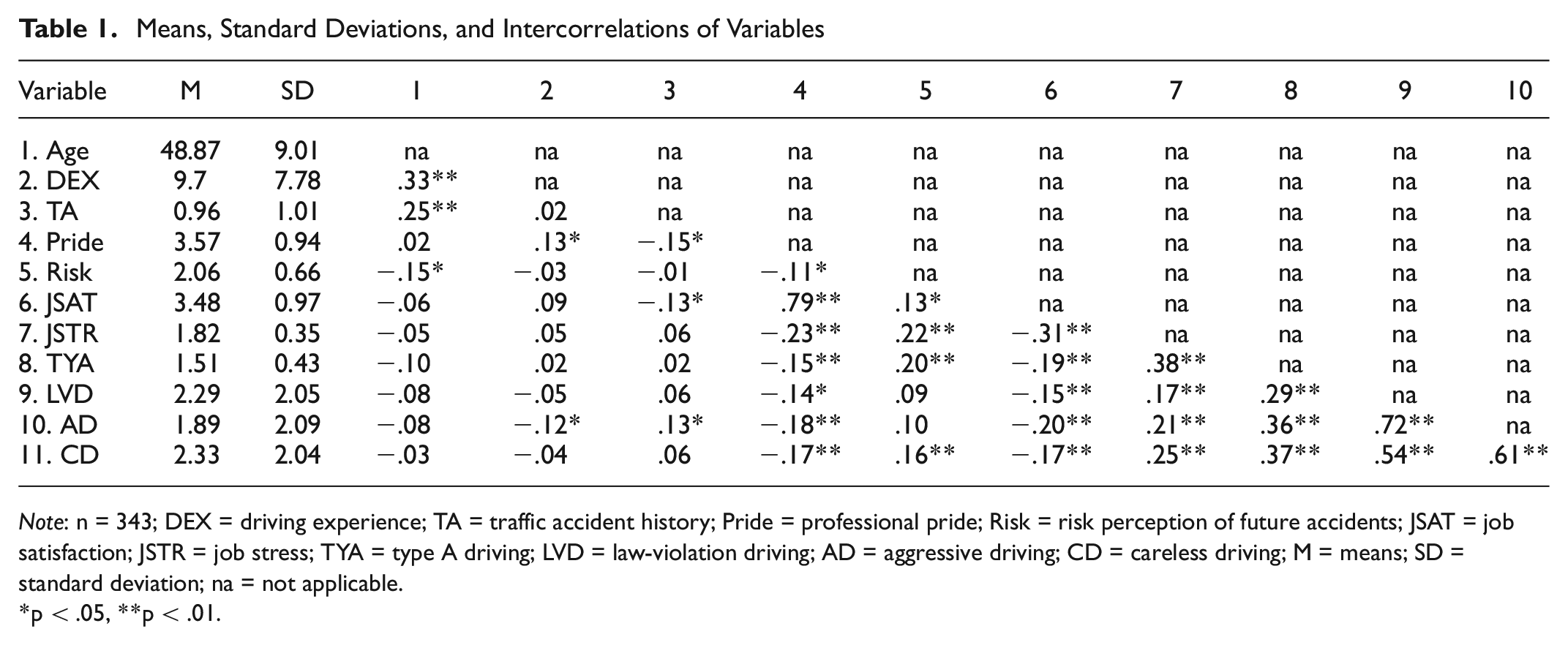
Note: n = 343; DEX = driving experience; TA = traffic accident history; Pride = professional pride; Risk = risk perception of future accidents; JSAT = job satisfaction; JSTR = job stress; TYA = type A driving; LVD = law-violation driving; AD = aggressive driving; CD = careless driving; M = means; SD = standard deviation; na = not applicable.
p < .05, **p < .01.
As shown in Table 1, age was related significantly to traffic accident history. Driving experience was not associated significantly with traffic accident history, but it was related significantly to professional pride (p < .05) and aggressive driving (p < .05). In addition, testing group differences among vehicle types resulted in significant differences for professional pride (p < .001), job satisfaction (p < .001), law-violation driving (p < .01), and aggressive driving (p < .001). Therefore, outcome variables were regressed on the number of accidents after controlling for age, driving experience, and vehicle type. Negative binomial regression was used because the normality and the assumption of equal variances on the frequency of traffic accident history were not met. The results of negative binomial regression analyses were similar to the results of correlations: professional pride (likelihood ratio = 4.25, p < .05), job satisfaction (likelihood ratio = 3.04, p < .10), and aggressive driving (likelihood ratio = 2.98, p < .10). Traffic accident history was not significantly related to other variables.
We conducted further analyses to identify the exact effect of traffic accident history. First, to investigate the differences between groups with and without traffic accident history, a no-accident group (n = 133) and an accident group (n = 210) were created and compared for study variables. ANOVA results controlling for age, driving experience, and vehicle type showed that only professional pride (F = 3.17, p = .07) and aggressive driving (F = 3.24, p = .07) showed a marginally significant difference between the two groups. As expected, the no-accident group had higher professional pride and lower aggressive driving compared with the accident group. There were no group differences in other study variables.
Next, we examined whether there were any differences between groups categorized using Ngueutsa and Kouabenan’s ( 19 ) method to investigate the effects of the number of traffic accidents. In our data, the number of traffic accidents ranged from 0 to 5, but because only one person had five accidents, groups were categorized by including the person who had five traffic accidents in the fourth group, as follows: no accidents (133); one (131); two (48); three (23); and four or five (8). ANOVA results controlling for age, driving experience and vehicle type showed that differences between the four groups were significant in aggressive driving (F = 2.72, p < .05), marginally significant in professional pride (F = 2.01, p < .10), and not significant in other variables.
Mediating Effects
To examine the mediation model, we used the indirect procedure for SPSS ( 68 ), which is well known as a powerful method of testing the significance of indirect effects by using a bootstrapping technique. Age, driving experience, and vehicle type were also controlled in the analysis of mediating effects. We calculated a 95% confidence interval (CI) for parameter estimates and resampled a sample (S = 1,000) from our data to derive estimates of standard errors (n = 343).
Table 2 and Figure 1 present the direct, indirect, and total effects of traffic accident history and professional pride on unstable driving. The results of Type A driving indicate that traffic accident history had a negative effect on professional pride (B = −.122, p < .05), and professional pride had a negative effect on Type A driving (B = −.070, p < .01). The mediating effect of professional pride in the relation to traffic accident history and Type A driving was significant (B = .009, SE = .005, 95% CI = .002 to .021), since the 95% CI does not include zero. Moreover, analyzing the mediation effect of professional pride in the relation between traffic accident history and aggressive driving indicated that professional pride had a negative effect on aggressive driving (B = −.309, p < .05). The mediating effect of professional pride in the relation between traffic accident history and aggressive driving was significant (B = .038, SE = .020, 95% CI = .009 to .096), since the 95% CI does not include zero. In conclusion, professional pride mediated the effect of traffic accident history on unstable driving behavior. The mediation effects of risk perception of future accidents, job satisfaction, and job stress in the relationship between traffic accident history and unstable driving were not significant.
Direct, Indirect, and Total Effects
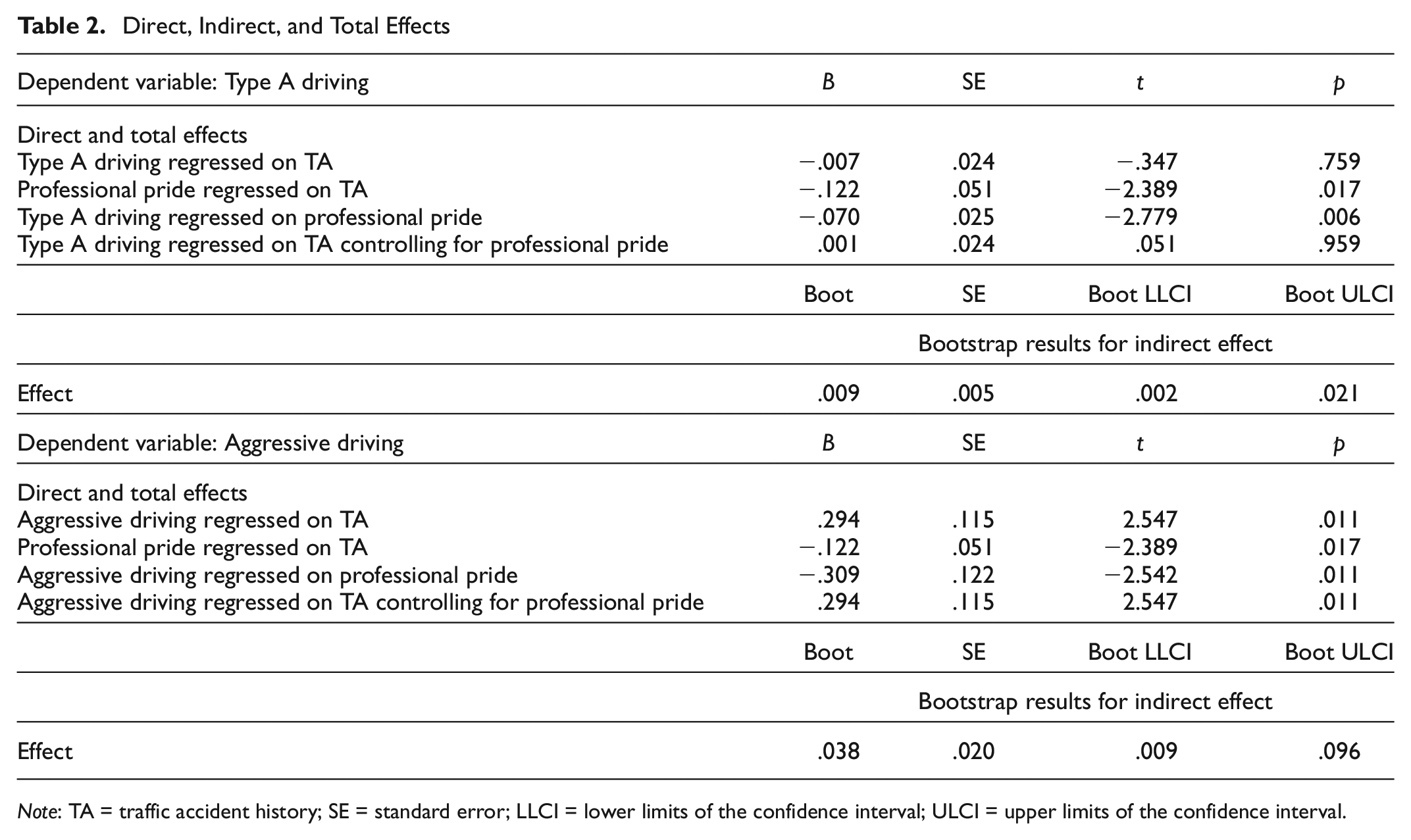
Note: TA = traffic accident history; SE = standard error; LLCI = lower limits of the confidence interval; ULCI = upper limits of the confidence interval.
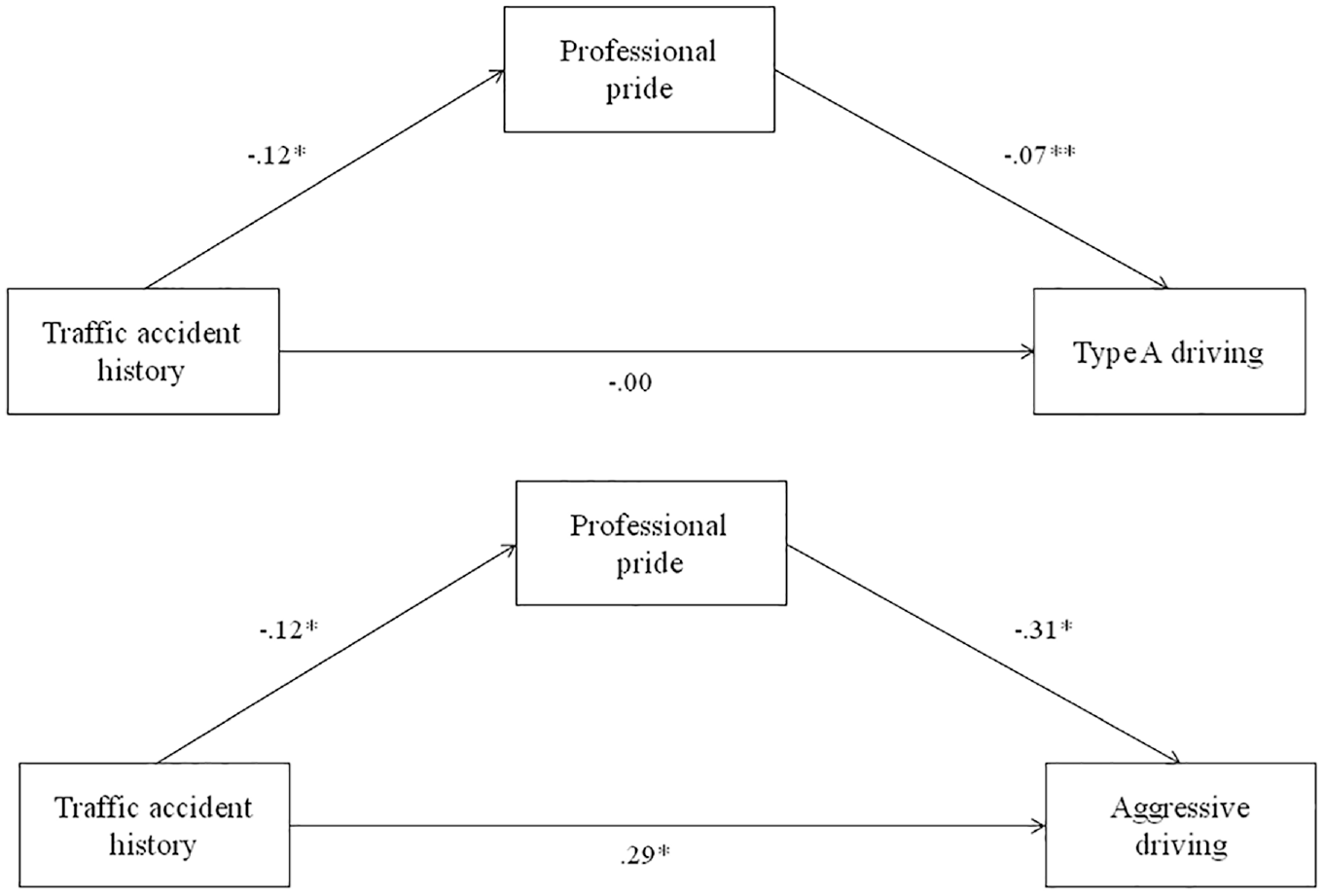
The mediation model of professional pride in the relationship between traffic accident history and unstable driving.
Discussion
This study examined the impact of occupational drivers’ traffic accident histories on their risk perception of future accidents, work attitudes, and unstable driving behaviors. The current study is the first to examine the relationship between traffic accident history and current risk perception of traffic accidents with objective data, not subjective data. Furthermore, it is considered to be the first study to show that traffic accident history could influence occupational drivers’ work attitudes, other than PTSD.
The main finding of this study is that there is no significant relationship between traffic accident history and risk perception of future accidents. This conflicts with the general intuitive prediction, as well as previous findings that traffic accident history has a significant (positive or negative) effect on risk perception of future accidents. We propose two possible reasons for the inconsistency. First, it may have resulted from a measurement method. Prior studies measured traffic accident history through self-reporting, while our measurements were based on official records. In our study, the correlations between traffic accident history and the remaining variables were generally low. This may be because traffic accident records were collected objectively, whereas the other variables were measured using subjective reporting. Although official records render it impossible for participants to lie or claim to be uncertain, they can still be missing or incorrect. Thus, it is hard to judge which method is more accurate. Therefore, in the future, traffic accident history should be measured and studied using both objective data and subjective reporting. Second, the inconsistency could be a result of differences in the samples. Previous studies’ samples consisted of general drivers, while our sample included only occupational drivers. Since occupational drivers have been driving for a long time—even after experiencing traffic accidents—they could have experienced the effect of exposure therapy, which is a form of therapy for anxiety disorders that repeatedly exposes patients to an anxiety context or source to reduce their anxiety ( 69 ). By choosing to continue in their jobs, occupational drivers who have experienced traffic accidents are exposed to the anxiety-inducing stimulus: driving. Therefore, they could have overcome their anxiety naturally and become less sensitive to the risk of traffic accidents. Future research is necessary to determine whether the effect of experiencing traffic accidents on risk perception of future accidents is significant by using the traffic accident history of general drivers.
Another main finding of this study is that traffic accident history has a significant effect on positive variables such as professional pride and job satisfaction but not on negative variables such as job stress. This implies that experience in traffic accidents would not affect job stress, which is in line with previous research that traffic accident history does not influence risk perception. It is significant that positive variables such as job satisfaction and professional pride are affected by traffic accident history. In particular, among the variables in the present study, the significant mediator in the relationship between traffic accident history and current unstable driving behavior was only professional pride. The reason why professional pride could affect current unstable driving behavior can be found in the research that shows that pride is related to self-control. For example, authentic pride can be related to self-control, which is likely to increase the possibility of adaptive achievement ( 70 ), regulate runners’ training process, and facilitate goal-directed behaviors ( 71 , 72 ). These studies suggest that people with high pride would be able to regulate their behaviors to achieve the desired purpose. Since an occupational driver’s job-related goal is the safe transportation of passengers and freight, drivers with high professional pride could regulate their driving behaviors and ensure safety in line with their goal, whereas drivers with low professional pride could fail to regulate their driving behaviors, for example, by disobeying traffic rules and focusing less on safety.
These findings suggest a practical implication: Road safety education programs for occupational drivers would benefit from a paradigm shift. Materials for safe driving programs typically stress that traffic accidents can happen in a flash and describe how destructive the outcomes can be. The main strategy, therefore, was to encourage safe driving by emphasizing the dangers of traffic accidents. However, the findings from this study suggest that professional pride—rather than risk perception—could be a more effective variable in the association between traffic accident history and current safe driving behavior. Furthermore, we found that risk perception of future accidents was not associated with traffic accident history (r = −.01, p >.05) but was significantly related to Type A driving (r = .20, p < .01). This implies that for occupational drivers, risk perception of future accidents could be influenced by drivers’ chronic trait tendency rather than past experiences. These findings also support the notion that safety education programs for occupational drivers should shift their emphasis to motivate a professional mindset that takes pride in their performance and values their job.
Limitations
While this study makes theoretical and practical contributions, it has some limitations. First, all survey respondents were occupational drivers. Therefore, we should be cautious when interpreting the finding that there was no significant association between traffic accident history and risk perception. Moreover, most participants were male, and previous studies report that males typically exhibit different driving behaviors—such as driving more dangerously and aggressively—and therefore would have higher accident rates ( 73 – 75 ). Therefore, to generalize our study results, future research would need to consider the various characteristics of the sample.
Second, the model used in this study assumed that traffic accident history would affect other variables based on time sequences. However, the causality of the study variables could be the opposite. In light of previous research in which authentic pride was shown to be related to self-control and goal-directed behaviors ( 70 – 72 ), drivers with high professional pride would experience fewer traffic accidents because of the regulation of safe driving behaviors. To prove the causal relationship, an experimental design that manipulates professional pride would be necessary.
Third, we suggest that the effect of exposure therapy could occur naturally, and therefore the correlation between traffic accident history and risk perception was not significant. A more complete examination would require the use of a longitudinally repeated measurement design to identify how risk perception changes with time after experiencing traffic accidents. Moreover, this study did not investigate moderators that could affect the relationship between two variables. It would be appropriate for future research to examine the moderating effects of individual, organizational, and environmental variables to gain a better understanding of the effects of experiencing traffic accidents.
Last, there are some limitations related to measurement methods. In this study, because of limited time in executing the survey, the current study chose to use a single item to measure all but two of the study variables by adopting top-down decision-making model. Although it is known that measuring a certain construct with a single item is valid ( 54 , 55 ), it will be necessary to replicate our results using a measurement tool with multiple items. Specifically, professional pride might include the meaningfulness of one’s job, identification with the job, self-efficacy on performance, and so on as sub-dimensions of concept. Therefore, it is necessary to conduct further research that develops a multi-dimensional scale for professional pride and to validate it. Furthermore, traffic accident history in this study included only major accidents to the extent to which it could be recorded as official accidents. However, there could exist the various types of traffic accidents in severity, handling expenses, responsibility, and so on. Further research is necessary to investigate accurate traffic accident history by including minor accidents. Moreover, we measured current unstable driving behavior using self-reporting, but further research to measure actual driving behaviors will be necessary for more accurate results.
Footnotes
Author Contributions
The authors confirm contribution to the paper as follows: study conception and design: E. K. Chung, Y. W. Sohn; data collection: E. K. Chung, Y. W. Sohn; analysis and interpretation of results: E. K. Chung, S. Y. Park; draft manuscript preparation: E. K. Chung, S. Y. Park, Y. W. Sohn. All authors reviewed the results and approvedthe final version of the manuscript.
Declaration of Conflicting Interests
The author(s) declared no potential conflicts of interest with respect to the research, authorship, and/or publication of this article.
Funding
The author(s) disclosed receipt of the following financial support for the research, authorship, and/or publication of this article: This study was supported by the Korea Transportation Safety Authority.