







Abstract
The development of traffic models based on macroscopic fundamental diagrams (MFD) enables many real-time control strategies for urban networks, including cordon-based pricing schemes. However, most existing MFD-based pricing strategies are designed only to optimize the traffic-related performance, without considering the revenue collected by operators. In this study, we investigate cordon-based pricing schemes for mixed networks with urban networks and freeways. In this system, heterogeneous commuters choose their routes based on the user equilibrium principle. There are two types of operational objective for operating urban networks: (1) to optimize the urban network’s performance, that is, to maximize the outflux; and (2) to maximize the revenue for operators. To compare those two objectives, we first apply feedback control to design pricing schemes to optimize the urban network’s performance. Then, we formulate an optimal control problem to obtain the revenue-maximization pricing scheme. With numerical examples, we illustrate the difference between those pricing schemes.
Congestion pricing has been studied extensively both theoretically and practically to reduce traffic congestion in urban networks. In practice, single cordon-based pricing schemes have been designed and implemented in many cities, such as Stockholm and Milan. A hybrid scheme combining facility-based and cordon-based pricing has been implemented in Singapore, whereas a zone-based scheme has been applied in London. A comprehensive overview of nine congestion pricing practices is provided in ( 1 ). By imposing a fee to enter specific areas, congestion pricing can change commuter behavior, including mode choice, route choice, and departure time choice. A comprehensive review of congestion pricing methodologies and technologies is provided in ( 2 , 3 ). Pigou and Knight were the first to advocate congestion pricing by arguing that an optimal charge should be implemented for the congested road to internalize the externality of vehicles and drive the system to an optimal state ( 4 , 5 ). The first-best pricing is proposed to reach optimal flow in a system by setting the toll rate as the difference between marginal social cost and marginal private cost. Some assumptions are made in realizing the first-best pricing, including: (1) individual drivers choose the route based on utility maximization principle; (2) congestion pricing is applied to all relevant road segments in the network; (3) full information on all costs is available for both the operators and the drivers; and (4) congestion pricing is technically feasible and the transaction costs are reasonably low ( 6 ). Therefore, the applications of first-best pricing models have been impractical despite the idealized theoretical basis. As a result, second-best pricing schemes have been proposed, in which tolls are only active in a subset of links. A mathematical program with equilibrium constraints (MPEC) has been formulated to derive the second-best pricing in ( 7 – 12 ). However, the solution to the MPEC for a large-scale dynamic network is computationally complex ( 13 ). In addition, one common assumption in those studies is that the traffic is in steady state, which may not capture traffic dynamics accurately.
To develop an effective congestion pricing scheme for urban networks, it is essential to understand the traffic dynamics at a network level. A macroscopic fundamental diagram (MFD) that relates the average speed and the average per-lane vehicle density in a road network was first proposed and calibrated for Ipswich in ( 14 ). Recently, the existence of MFD has been revealed in many cities ( 15 , 16 ). The development of MFD models has enabled many real-time control strategies to improve network performance. For example, a model predictive control-based perimeter control is proposed in ( 17 – 19 ), and a dynamic routing strategy is developed in ( 20 , 21 ).
Recently, MFD-based pricing schemes have been developed to reduce congestion. Geroliminis and Levinson combined Vickrey’s bottleneck model ( 22 ) with a MFD to derive an optimal fine toll when commuters are homogeneous ( 23 ). Results show that the proposed toll shortens the duration of the peak period, and is Pareto-efficient for every commuter. Zheng et al. applied an integral controller to adjust the flat cordon-based tolls with an agent-based simulation of Zurich’s urban road network ( 24 ). Simoni et al. derived two alternative cordon-based tolls, that is, a step toll and a hybrid toll, by using the marginal cost pricing and an MFD, and applied this to a case study of Zurich ( 25 ). Some other types of MFD-based congestion pricing scheme are proposed when considering the distribution of trip lengths, such as a usage-based toll ( 26 ), a distance-based toll ( 27 ), a joint distance and time toll, and a joint distance and delay toll (JDDT) ( 13 ). In addition, Gu et al. formulated two new high-dimensional toll level problems (TLPs) in a large-scale heterogeneously congested traffic network by integrating a linear JDDT with the MFD ( 28 ). Those two problems were solved by using surrogate-based optimization. Later, four state-of-the-art simulation-based optimization methods were applied and compared to solve the TLPs ( 29 ). Furthermore, recent studies extend the single-mode MFD to be bi-modal with cars and buses. Zheng et al. proposed a proportional-integral controller to determine the area-based pricing for an urban network with cars and buses, and tested the performance with an agent-based simulation of the Sioux Fall network ( 30 ). Dantsuji et al. proposed a simulation-based joint optimization framework to develop congestion pricing schemes and road space allocation plans based on the congestion costs represented by a multimodal MFD ( 31 ). In addition, Zheng and Geroliminis designed an optimal VOT-based toll for a two-region bi-modal city when commuters differ in their income levels and value of time (VOT) ( 32 ).
Laval et al. investigated the dynamic user equilibrium in a mixed network with two routes, an urban network modeled with an MFD and a freeway ( 33 ). However, to our knowledge, no study has investigated a mixed network that considers joint pricing and traffic dynamics in the combined system. In addition, in most MFD-based pricing schemes, commuters are assumed to have the same VOT or their VOTs have a limited set of values. In this study, we aim to propose different pricing schemes for the urban networks when commuters differ in VOTs. Two popular operation objectives are explored: performance-optimization and revenue-maximization. The performance-optimization is realized by a feedback control approach, which is similar to ( 34 , 35 ). The controllers do not directly determine the price, but estimate coefficients in the price model. The revenue-maximization pricing scheme is obtained by solving an optimal control problem. Note that the proposed framework is different from ( 17 , 18 ) for several reasons: (1) the study site is different; and (2) the utility function is different, since tolls are included in our paper. Also, this paper applies a feedback pricing scheme to optimize the performance, which is not considered in those studies.
The rest of this study is organized as follows. In the next section, we describe the system dynamics, including traffic dynamics and route choice. We then develop a feedback control approach and an optimal control approach to determine the prices for urban networks, considering two different operation objectives. We then numerical examples to show how proposed pricing schemes perform in various mixed networks. We then conclude this study and provide future research topics.
System Dynamics
An origin–destination (O-D) pair is connected by mixed networks with urban networks and freeways. Figure 1 provides both realistic and schematic representation of a mixed network with two urban networks and two freeways. Each mixed network, i, is made up of one urban network and one freeway. The free-flow travel time on the freeway is longer than the urban network. In addition, commuters need to pay a fee to enter the urban networks, but they can use freeways for free.
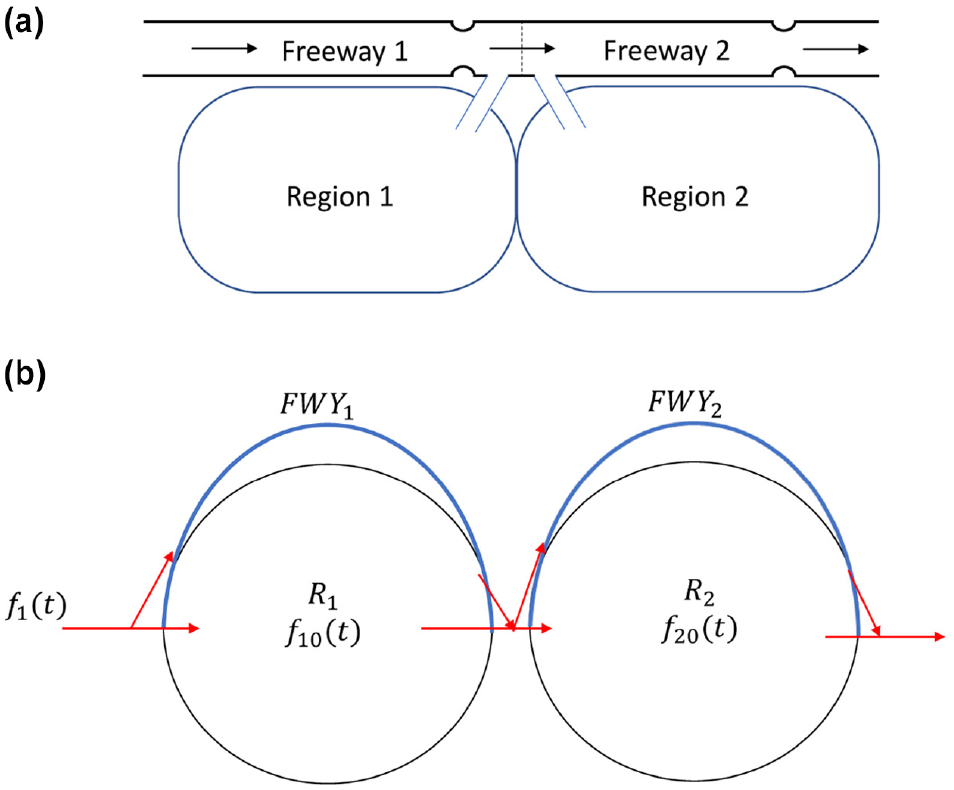
A mixed network with two urban networks and two freeways: (a) realistic representation; and (b) schematic representation.
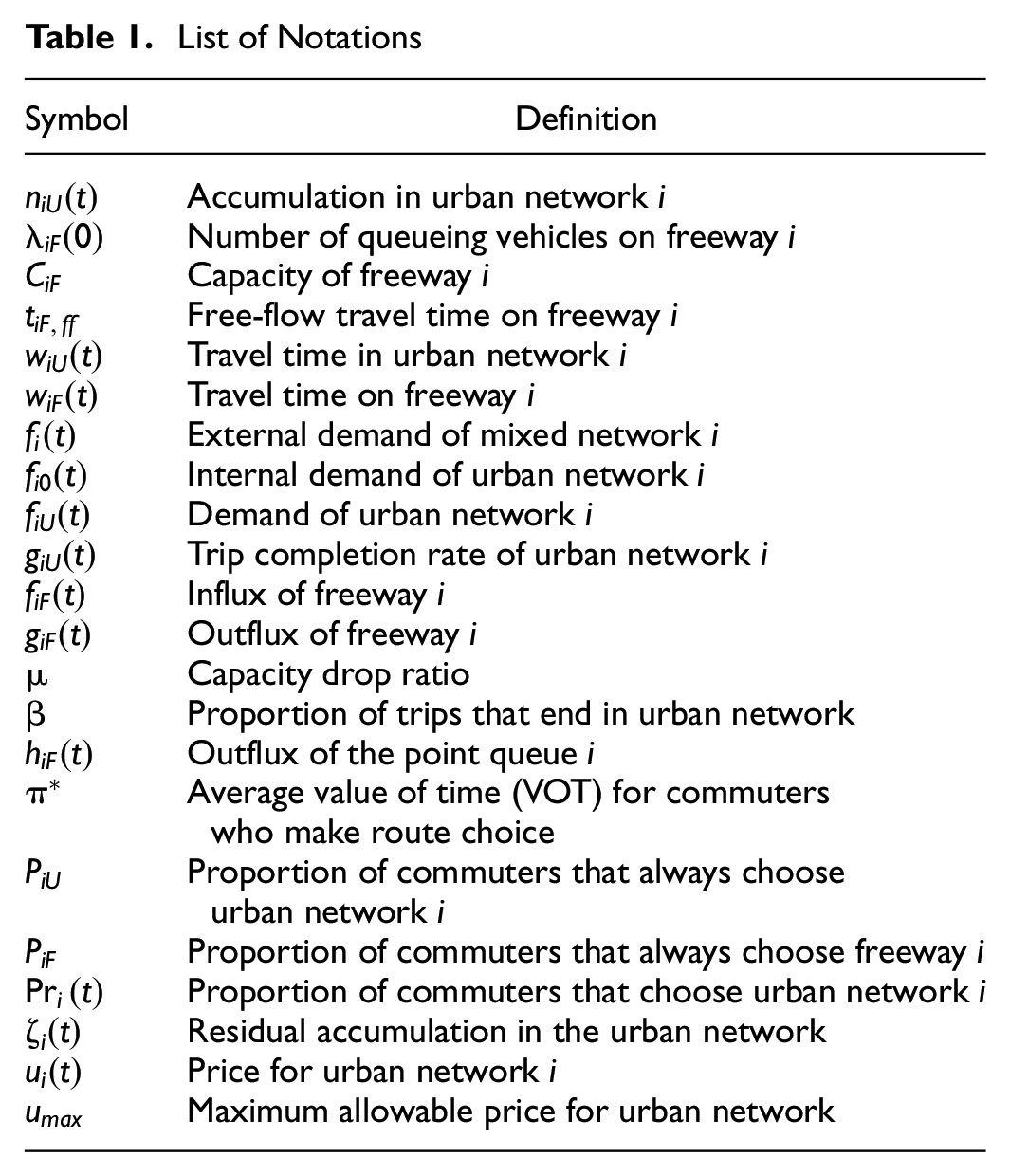
A list of notations in provided in Table 1.
List of Notations
Traffic Dynamics
The traffic dynamics of each urban network depend on the sum of internal and external demand, and the outflux. The internal demand includes commuters who start their trips inside the urban network. They can finish trips either within or downstream of the urban network. The external demand is generated upstream of the mixed network. Those commuters can end trips in the urban network or travel through the network. We assume that there is no demand generated inside the freeway. Thus, each freeway’s traffic dynamics is determined by its external demand and supply.
Note that, although it is known that tolling may affect the commuters’ behavior by shifting the demand to other periods, we assume that the exogenous total demand is not influenced by the toll, that is, completely inelastic demand.
The Urban Traffic Dynamics
We consider a homogeneous urban network i with length of

and

where

and the travel time in the urban network can be obtained by the ratio of the trip length and average speed.
The Freeway Dynamics
We apply the point queue model (PQM) to model the traffic dynamics of a freeway, because it has been extensively applied to study the congestion effect of a bottleneck. As demonstrated in (
37
), a point queue is an approximation of the road by omitting the length of the road but retaining the influx and outflux. It can be derived as limits of two link-based queueing models: the link transmission model (
38
) and the link queue model (
39
). So, a point queue is sufficient for analyzing the total delay caused by queues. We choose the number of queueing vehicles,

where

where
In reality, the discharging rate drops to a value that is smaller than the downstream capacity, when a queue forms upstream to the bottleneck. Here, we apply a phenomenological model of capacity drop to calculate the discharging flow rate ( 40 ).
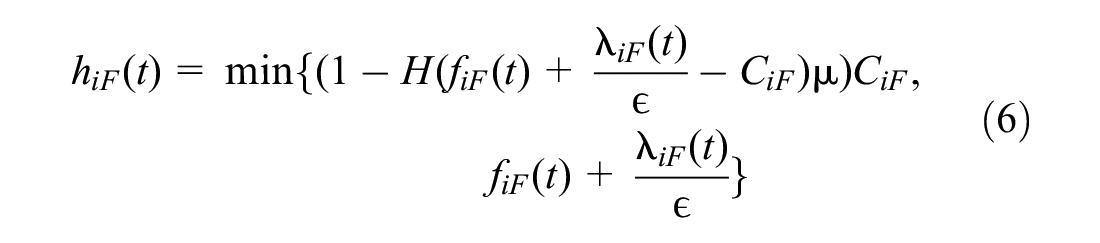
where
We denote

Connection between Multiple Mixed Networks
In this section, we show how the dynamics are modeled in a complex network with multiple urban networks and freeways. Here, we define a new variable:

It is straightforward that the total external demand of the first mixed network is
Route Choice
As mentioned earlier, commuters need to pay the corresponding toll to enter an urban network, but they can use the freeway for free. Since commuters only pay the price when they enter, this pricing scheme is cordon-based.
The original Wardrop’s user equilibrium (UE) states (
41
) that “the journey times on all the routes actually used are equal, and less than (or equal to) those which would be experienced by a single vehicle on any unused route.” Here we extend the UE principle for individual vehicles choosing different routes based on generalized cost. We denote

while, if commuter j chooses the urban network i, then

where

where
For example, if the VOTs follow the simplified variant of the Burr distribution ( 35 , 42 ), the proportion of commuters choosing the urban network at t is

where
The Complete Dynamics
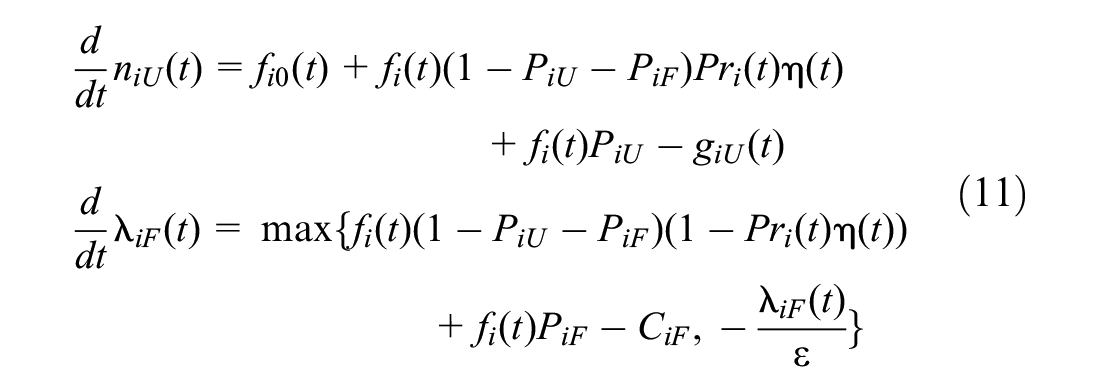
Inside a mixed network i, a proportion of
Two Pricing Schemes for Urban Networks
When designing pricing schemes, two objectives are commonly considered: system performance and revenue. In this section, we propose two pricing schemes for a single mixed network when the travel time on the freeway is longer than the urban network. First, we apply feedback control to obtain prices that maximize the outflux of the urban network. Then, we propose a pricing scheme to maximize the revenue for the urban network.
A Feedback Control Approach
There are two types of equilibrium state, depending on the demand profile. When the demand is low, the maximum outflux is reached when all commuters choose to use the urban network. So, it is straightforward that the price should be set as 0 to attract as many commuters as possible. On the other hand, when the demand is high, the pricing scheme should keep the urban network’s accumulation at its critical value. Next, we will discuss the latter case in detail. The results will provide some insights into the design of pricing schemes.
Solution of the Control Problem with High Demand
We define a new variable

where
Combining (10), we can obtain the following equation to calculate price:
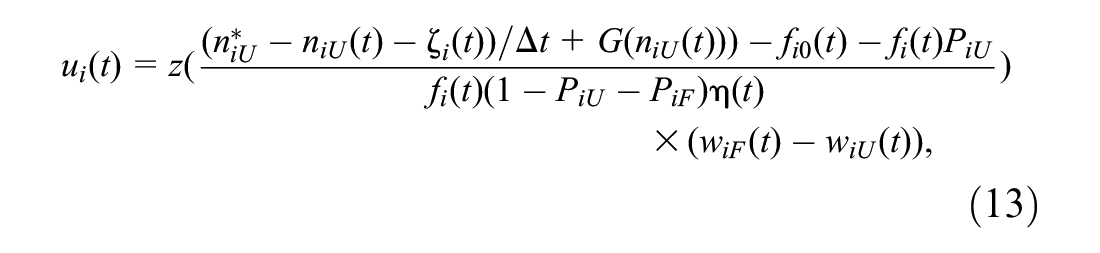
where
As an example, if the VOTs follow a Burr distribution, then the price would be
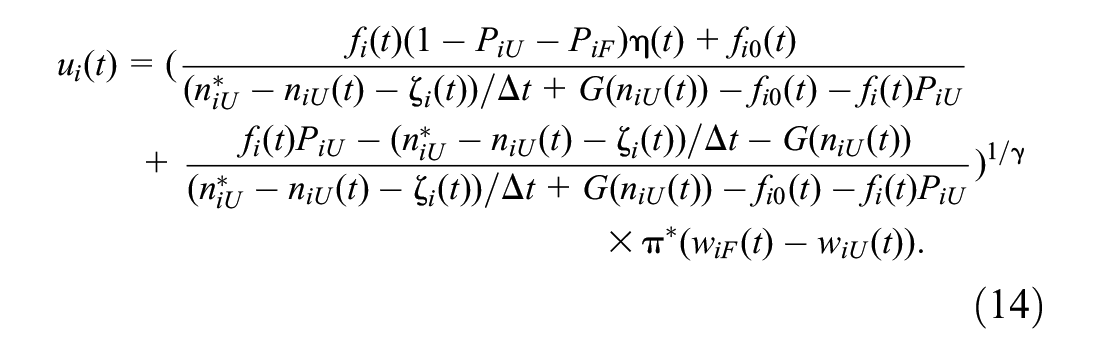
As another example, if the VOTs follow an exponential distribution:
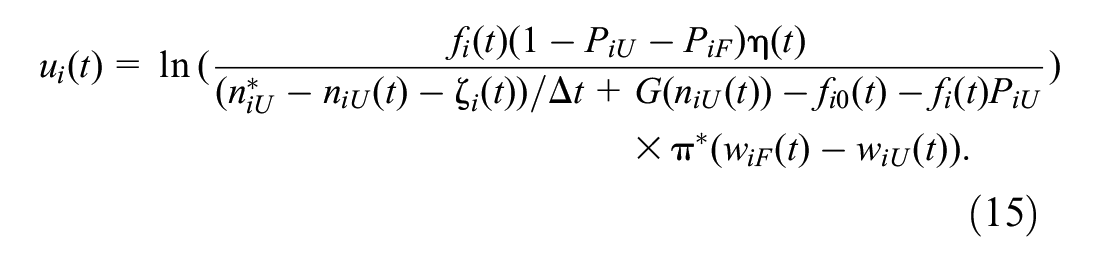
In both (14) and (15), the relationship between the residual accumulation and price can be written in the following form:

which can be considered a general route choice model.
Design of Controller
The block diagram of the control system for mixed network i is shown in Figure 2. The objective is to determine a pricing scheme for the peak period that maximizes the urban network’s outflux by affecting commuters’ route choices. To achieve the objective, the controller calculates the price based on the congestion level. The toll is then fed into the plant, which determines route choice and the traffic dynamics of the system. In this control system,
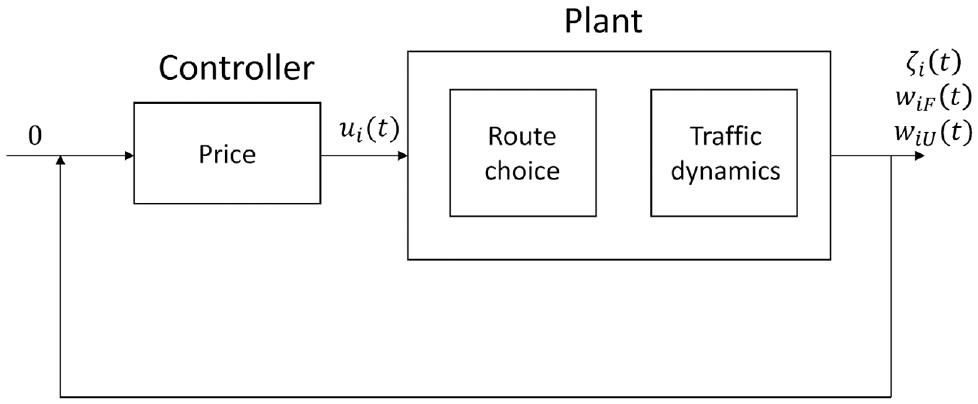
Block diagram of the control system.
Figure 3 shows the design of the controller. Based on the analysis in the previous section, we can see that when the accumulation is around or over the critical value, the price is the product of a positive number and the travel time difference; otherwise, the price is 0. Then, the non-negative price

where

where
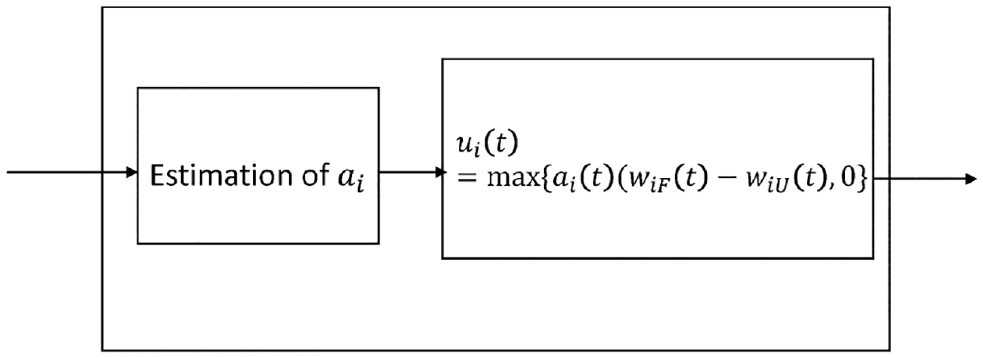
Design of the controller.
An Optimal Control Approach
In this section, we are interested in the revenue problem. We want to propose another pricing scheme that can maximize the operation revenue for the urban network over a time period. The demand of paying commuters at time t is composed of two groups. The first group includes commuters who always choose the urban network. The second group refers to commuters who make their choice considering the travel time and dynamic tolls. So, the demand of paying commuters is
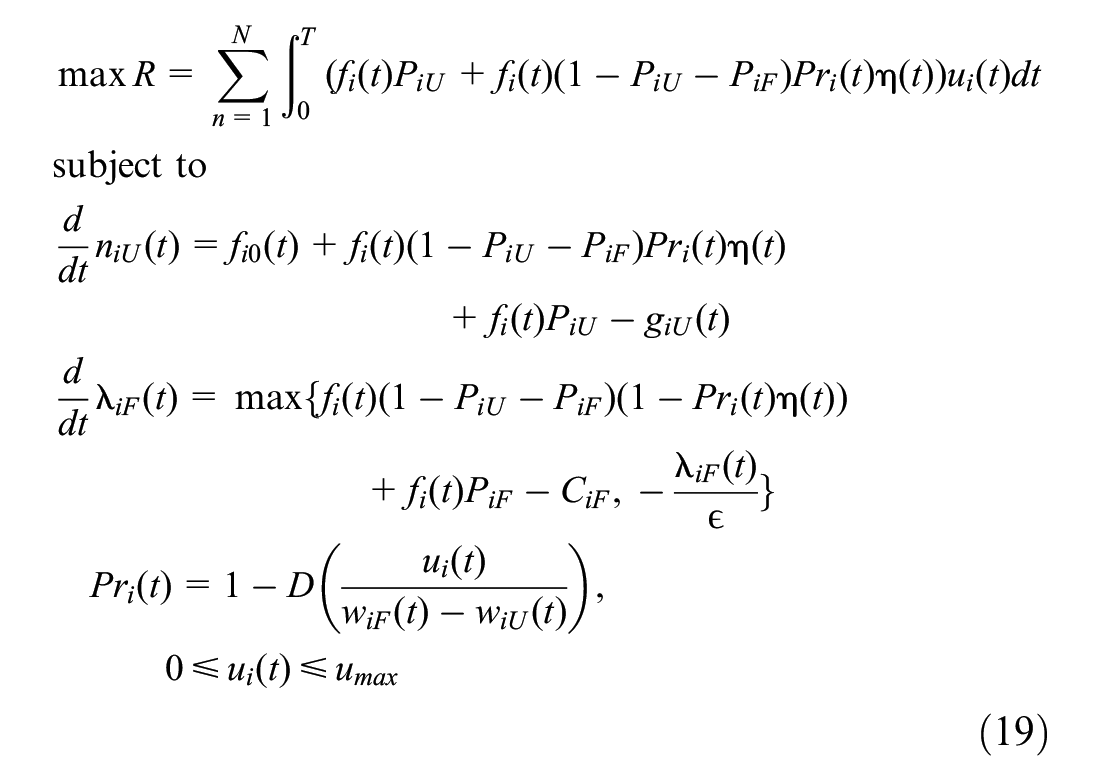
where
Case Study
Case Study for a Single Mixed Network
We first present the result for a single mixed network, as show in Figure 4. An approximate formula for the corresponding NEF has been given in ( 43 ).
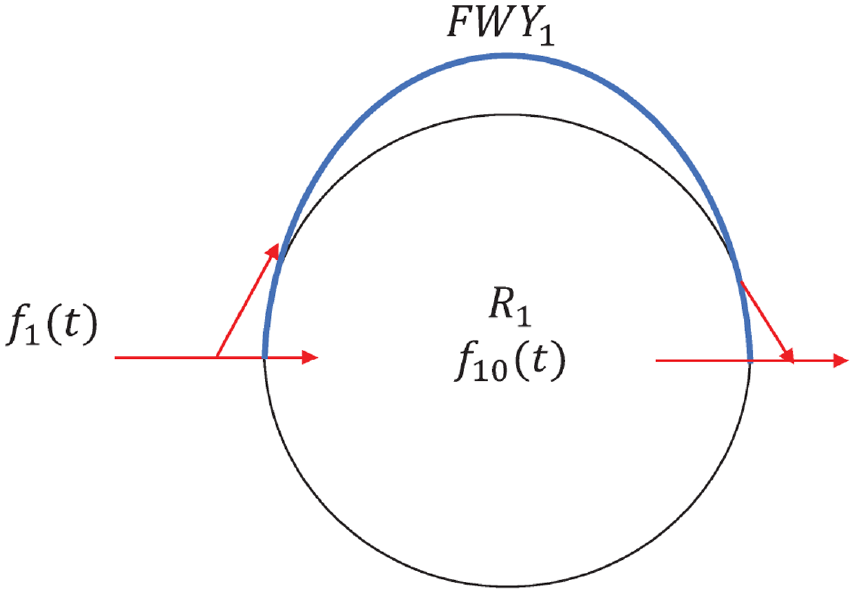
A mixed network with a freeway and an urban network.
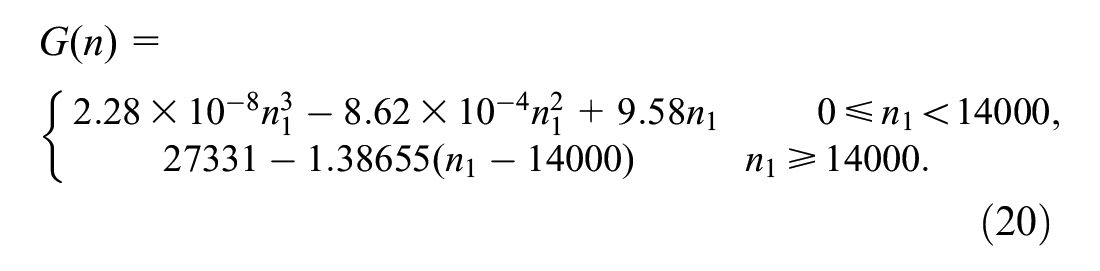
The maximum average outflux from is 33,168 vehicles per hour, which is achieved at an accumulation of 8,271 vehicles. The maximum (jam) accumulation is 34,000 vehicles. The MFD,
The initial accumulation in the urban network is 8,000 vehicles, and the freeway is initially empty. For the first 60 min,
The Performance-Optimization Pricing Scheme
The coefficients in the controller is chosen as
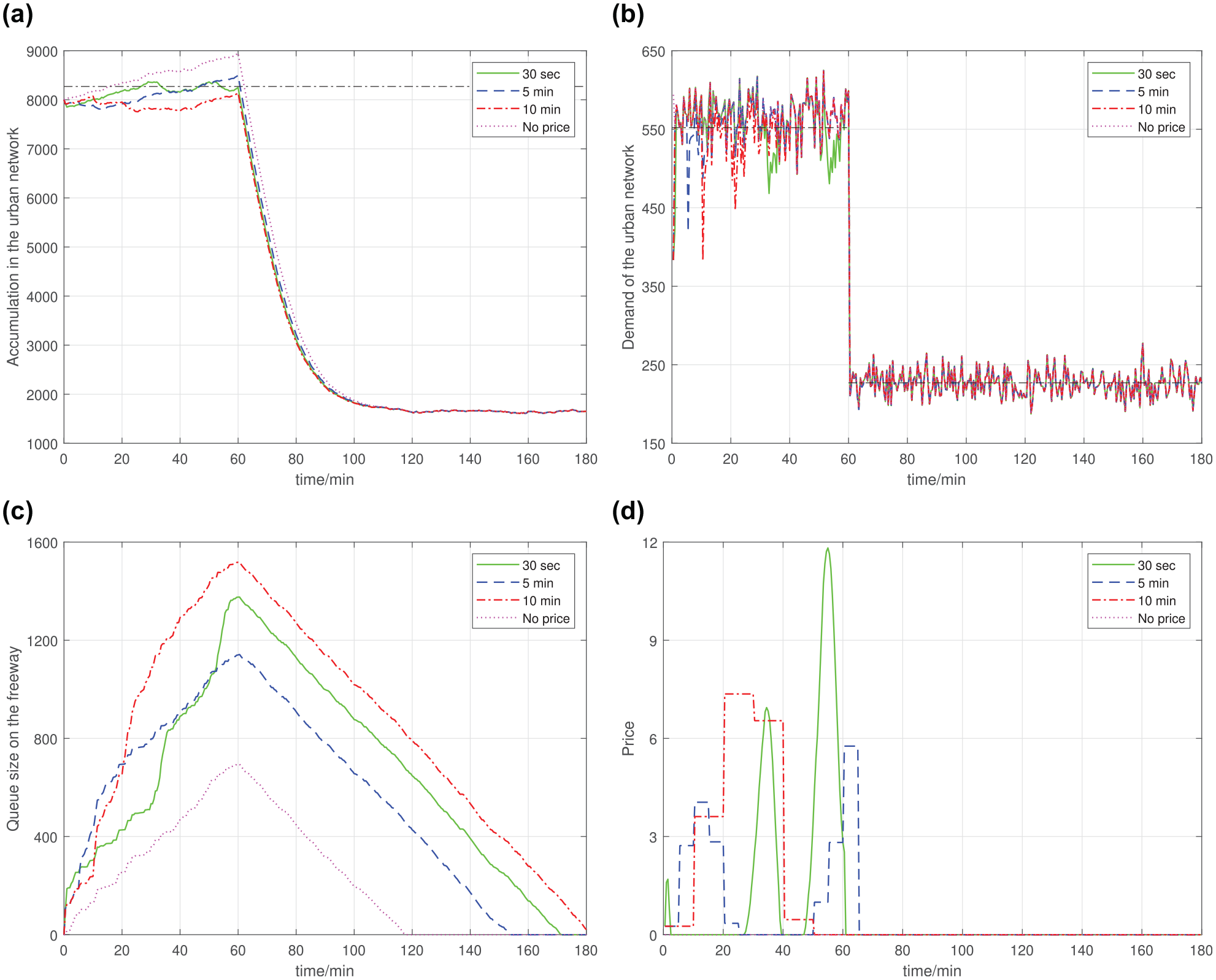
Results for performance-optimization pricing scheme at different frequencies for updating price: (a) accumulation in the urban network; (b) demand of the urban network; (c) queue size on the freeway; and (d) price.
In Figure 5a, the accumulation in the urban network drops when the initial price is applied to the system, because
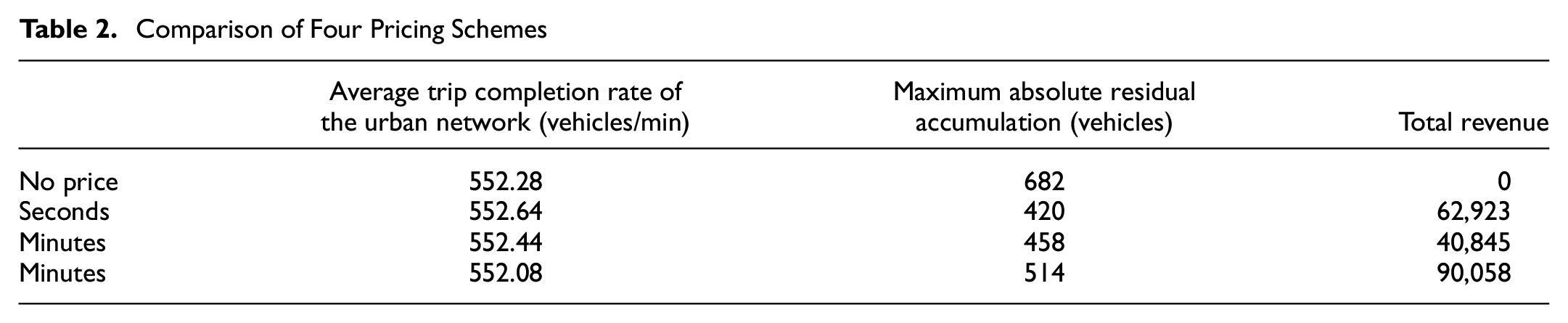
We also compare the revenue and the average outflux of the urban network, and the maximum absolute residual accumulation (in high demand) in different pricing schemes in Table 2. The maximum absolute residual accumulation is 682 vehicles if no price is implemented. If we increase the duration of the high demand period, the value would keep increasing. When the prices are updated every 30 s, the urban network has the highest average trip completion rate when the upstream demand is high. When the prices are updated every 5 min, the average trip completion rate is 0.2 vehicles/min lower, and the maximum absolute residual accumulation is 38 vehicles higher than in the 30-s case. If the update frequency is every 10 min, the urban network has the lowest average trip completion rate, but the highest revenue.
Comparison of Four Pricing Schemes
Based on the results in Figure 5 and some practical issues for implementing tolls, we will update the prices every 5 min for the case study for two mixed networks later.
The Revenue-Maximization Pricing Scheme
In this section, we test the impact of the maximum allowable price on the performance and revenue by setting two
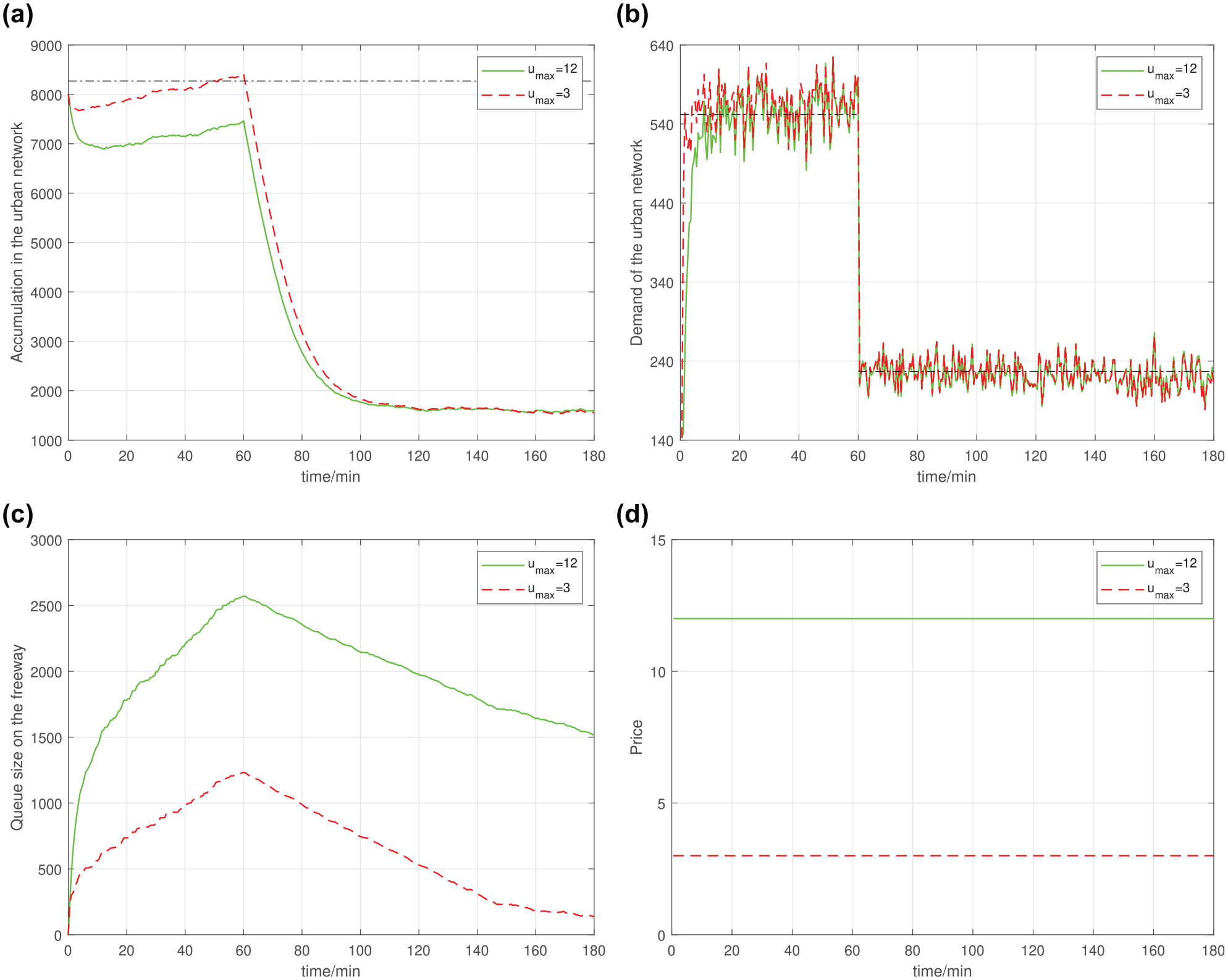
Results for the revenue-maximizing pricing schemes under two maximum allowable prices: (a) accumulation in the urban network; (b) demand of the urban network; (c) queue size on the freeway; and (d) price.
In Figure 6a, when
In addition, at the end of the study period, the revenue is
Comparing the results of those two types of schemes, we draw the following conclusions: (1) the performance-optimization pricing scheme is dynamic when the demand is high, while the revenue-maximization pricing scheme is static; (2) the revenue-maximization pricing scheme creates much more revenue than the performance-optimization pricing scheme; and (3) the revenue-maximization pricing scheme leads to a poor traffic condition: a very long queue on the freeway and low use of the urban network.
Thus, we think performance-optimization pricing schemes would be more helpful in practice. In the next section, we will test this pricing scheme in a more complex traffic network.
Case Study for Two Mixed Networks
In this section, we provide a case study for an extended mixed network, as shown in Figure 1. Both urban networks exhibit the same NEF in (
20
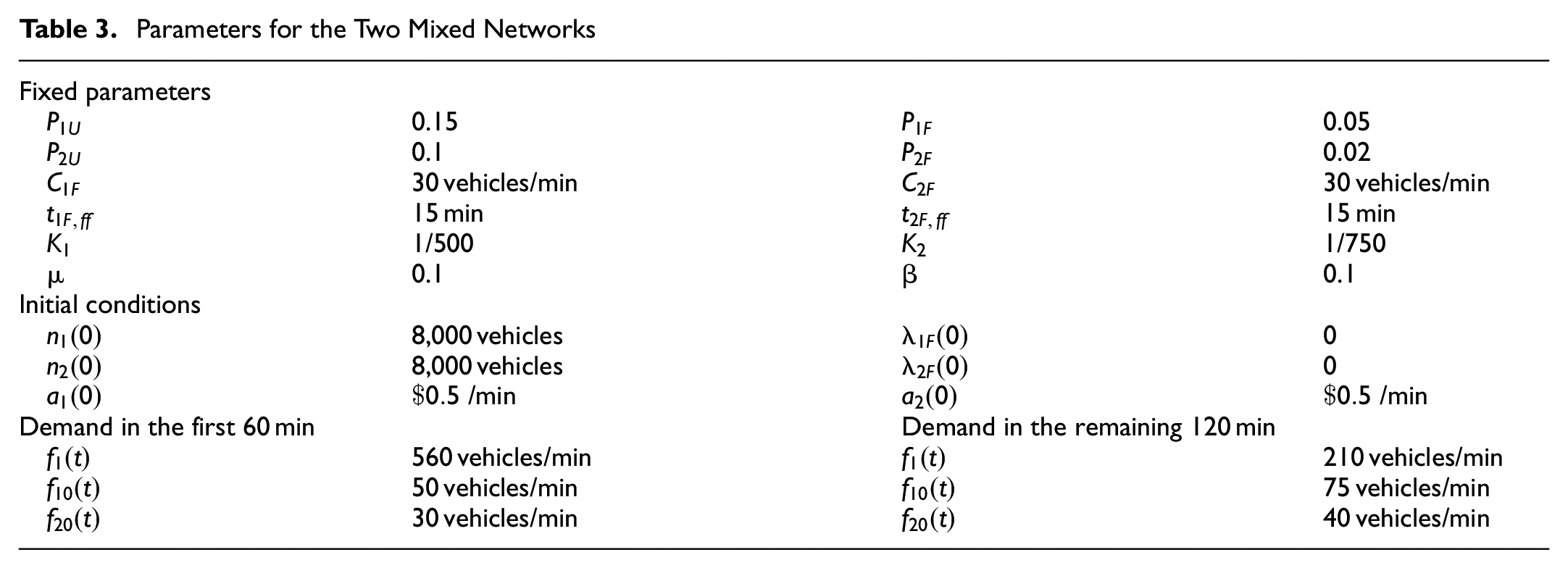
). The study period is 180 min, the traffic dynamics are updated every 30 s, and the prices are calculated every 5 min. A detailed description of traffic and operation parameters can be found in Table 3. Note that we assume the demands follow Poisson distributions, and the value in the cells shows the average value. In addition, to include the randomness in the choice model, we set
Parameters for the Two Mixed Networks
The numerical results are illustrated in Figure 7. In Figure 7a, for each network, the accumulation crosses the optimal value just once when the upstream demand is high. When the demand becomes low, the accumulation in the first network fluctuates around 1,646 vehicles. The accumulation in the second urban network is away from the optimal value in the first 15 min, because the external demand is relatively low. It then fluctuates around the optimal value. When the demand becomes low, the accumulation is around 1,919 vehicles, which is higher than the first urban network. This can be explained by Figure 8: when the queue on the freeway is not eliminated in the first mixed network, the external demand of the second mixed network is higher. In Figure 7b, the total demands of those two urban networks have a similar trend when the demand is high, except that the demand of the second urban network is less stable. The second urban network has a higher demand when the upstream demand decreases. As shown in Figure 7c, the maximum and average queue size on the second freeway is smaller than that on the first freeway. Since the demand of the second freeway is relatively low when the price is 0, the queue length is eliminated at 130 min, which is earlier than the first freeway (153 min). In Figure 7d, the prices for urban networks are non-negative when the demands are high, and eventually become 0 when the demands are low. The maximum price for the second urban network (
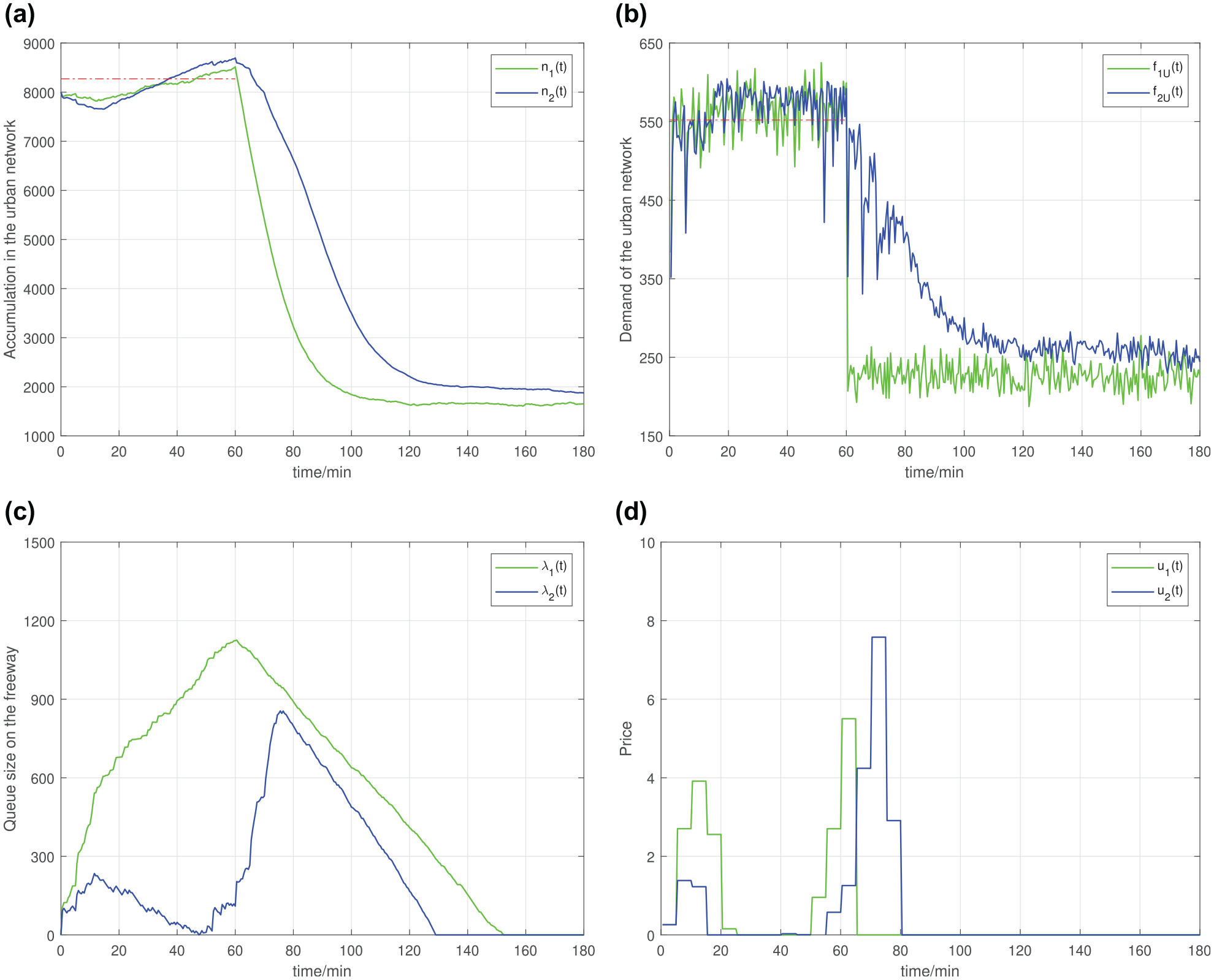
Results for the extended network when prices are updated every 5 min: (a) accumulations in urban networks; (b) demands of urban networks; (c) queue sizes on freeway; and (d) prices.
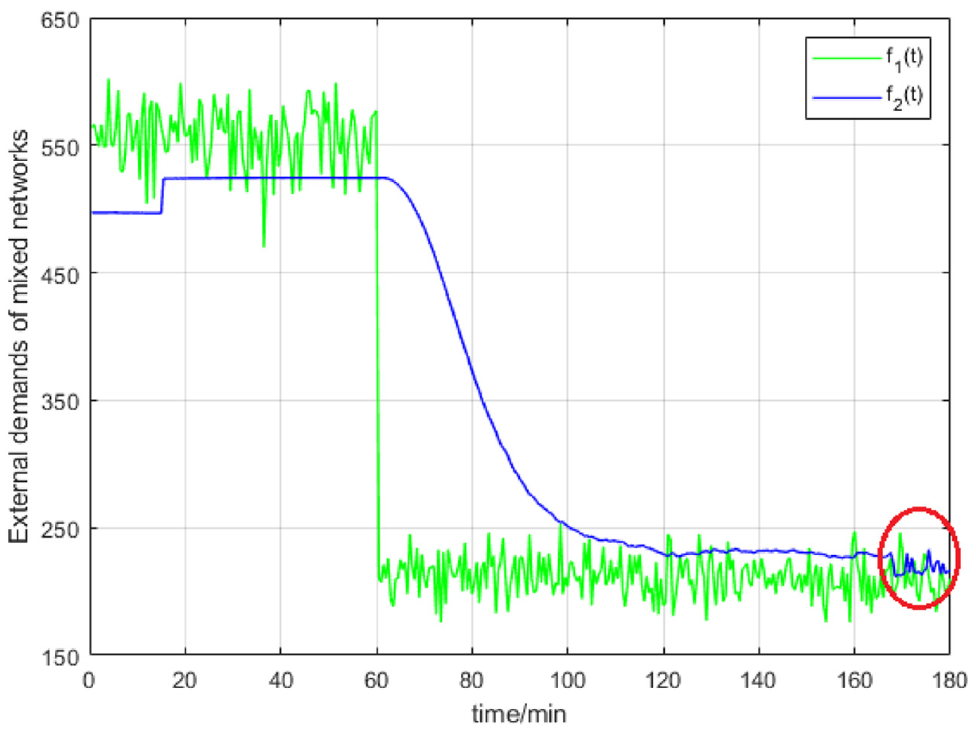
External demands of two mixed networks.
In addition, we present the external demands of each mixed network in Figure 8. For the first mixed network, the influx follows a Poisson distribution with an average value of 560 vehicles/min and 210 vehicles/min for the high and low demand cases, respectively. The external demand of the second mixed network in the first 15 min is about 497 vehicles/min, which equals the outflux to leave the freeway in the first mixed network (i.e.,
Conclusions
In this study, we investigate cordon-based pricing schemes for mixed networks with urban networks and freeways. In most control strategies for urban networks, the operation objective is to optimize the urban network’s performance, that is, to maximize the outflux. In real-world application, another common operation objective is to maximize the operation revenue. To compare those two objectives, we first apply feedback control to design pricing schemes to optimize the urban network’s performance. We also propose an optimal control problem to obtain the revenue-maximization pricing scheme. The differences between those pricing schemes are illustrated with numerical examples.
We then provide dynamics of the traffic system. Each urban network has a well-defined MFD, and the traffic dynamics on the freeway are captured by a PQM. Commuters with different VOTs choose their routes based on the UE principle. Thereafter, we consider two different operation objectives, and design pricing schemes for mixed networks. The first objective is to optimize the outflux of urban network. A feedback pricing scheme is proposed to meet this objective. The second pricing scheme aims to maximize the operation revenue, and it is formulated as an optimal control problem. Numerical examples are then provided. To obtain the maximum revenue, the price is at the maximum allowable value. However, the traffic condition is poor when the demand is high. When a high maximum allowable price is set, the queue size on the freeway is very long and the urban network is underused; when the maximum allowable price is low, the urban network is congested. Thus, the performance-optimization pricing scheme would be more practical in real-world operation. When discussing the performance-optimization pricing schemes, we compare the system performance when the prices are updated at three different frequencies. We also include a case study to show how the feedback pricing scheme works in an extended mixed network when we update the price every 5 min.
The following are some potential future research topics.
In this study, we apply an optimal control approach when solving the revenue-maximization problem. We will be interested in proposing MFD-based economic model predictive control schemes ( 45 ) to solve the problem in our future study.
In this study, we optimize the performance of two networks separately, based on the traffic conditions in each mixed network. We will be interested in addressing the two-region coordinated congestion pricing design problem.
We will be interested in the distribution of trip lengths in an urban network, such as deterministic distributions of trip lengths ( 46 ) and constant trip length ( 47 ).
When the trip distribution is introduced, we would like to propose a distance-based pricing strategy for the urban network ( 26 , 27 ). We will be interested in comparing the performance of cordon-based and distance-based pricing schemes.
We will also be interested in the departure time choice and related pricing schemes in mixed networks ( 24 , 30 ).
We will introduce new modes in the system, such as carpools and transit systems ( 48 ).
Footnotes
Author Contributions
The authors confirm contribution to the paper as follows: study conception and design: X. Wang and V. Gayah; data collection: X. Wang; analysis and interpretation of results: X. Wang, V. Gayah; draft manuscript preparation: X. Wang and V. Gayah. All authors reviewed the results and approved the final version of the manuscript.
Declaration of Conflicting Interests
The author(s) declared no potential conflicts of interest with respect to the research, authorship, and/or publication of this article.
Funding
The author(s) disclosed receipt of the following financial support for the research, authorship, and/or publication of this article: This research was supported by National Science Foundation Grant CMMI-1749200.