







Abstract
As there are many barriers to the effective operation of paratransit services required by the Americans with Disabilities Act (ADA), both riders and transit agencies have incentives to shift some paratransit ridership to more effective transit services. To address these barriers, transit agencies have started partnering with technology-enabled third-party companies (e.g., transportation network companies, taxi companies) to provide new on-demand mobility options for people with disabilities. Previous studies identified the benefits and challenges of implementing on-demand services through a public-private partnership, but did not fully investigate the implementation of this emerging on-demand service from the perspective of serving individuals with disabilities. This study conducted online surveys and semi-structured interviews with 10 transit agencies across the United States to understand how this new on-demand mobility option has complemented ADA paratransit services, and what challenges and outcomes the partnerships have experienced over time. Findings indicate that despite the positive impact of implementing the on-demand service on overall service operation and delivery, transit agencies still experienced challenges in providing accessible and reliable on-demand services for riders. Transit agencies and partnering mobility service companies should work together to increase technology adoption, availability and reliability of wheelchair accessible services, and driver sensitivity to the needs of individuals with disabilities, as well as to support the sustainability of the program through continuous evaluation.
Keywords
As required by the Americans with Disabilities Act (ADA), public transit agencies provide complementary ADA paratransit service to people with disabilities who are unable to use the fixed-route bus or do not have an accessible path to a transit stop. This curb-to-curb and door-to-door service provides a vital link to health care, employment, and community activities, but people with disabilities still report many barriers to effective service ( 1 , 2 ). Paratransit ridership and trips have grown ( 3 , 4 ) in response to limited fixed-route services, the aging of the population, inaccessible transit stops and pedestrian infrastructure, and challenges amongst transit agencies to implement effective processes to determine paratransit eligibility ( 4 , 5 ).
Transit agencies face increasing pressure to contain paratransit costs while maintaining service quality ( 6 ). An ADA paratransit service is the most expensive form of accessible transportation; in the U.S., by 2030, the total annual funding required is expected to grow to $3.3 billion for paratransit operating expenses and $598 million for capital costs ( 7 ). All stakeholders have incentives to shift some paratransit ridership to more effective transit services. ADA paratransit customers report low satisfaction ( 8 ) and several challenges using these services, such as inadequate level of service, scheduling problems, and long wait and travel times, as well as excessive hold times and difficulty arranging trips over the phone ( 1 , 2 , 9 , 10 ). For paratransit riders, therefore, the motivation to search for alternative transportation modes is to gain improved response times, flexibility, and enhanced community mobility. For transit agencies, the benefits include improved service and cost containment.
Public-sector agencies are searching for innovative approaches to address the limitations of current service models. To provide a more cost-efficient ADA paratransit service, transit agencies frequently attempt to reform the management structure, assign a portion of dedicated paratransit trips to non-dedicated service providers, and use advanced information communication technology ( 11 , 12 ). The explosive growth of transportation network companies (TNCs), along with the efforts of existing transportation providers (e.g., taxi companies) working to harness technology, have brought a new trend to the service model ( 13 , 14 ). A growing number of transit agencies have initiated partnerships with technology-enabled third-party companies to provide new on-demand mobility options for people with disabilities and older adults ( 15 , 16 ). These specific mobility services use comprehensive technology platforms and offer real-time information features. Technology-enabled mobility service companies include TNCs (e.g., Uber, Lyft), taxi companies that adopt information and communication technologies in operating the service, and adaptive TNCs. Adaptive TNCs (e.g., UZURV, Roundtrip) function like Lyft and Uber, in that they have no capital and hire operators with their own vehicles, but drivers are specialty-credentialed, and drug and alcohol tested to Federal Transit Administration (FTA) guidelines.
While a traditional ADA paratransit service requires scheduling at least 24 h in advance, the on-demand services offer a flexible, same-day booking service using comprehensive technology platforms. These on-demand services provided through public-private partnerships aim to complement an ADA paratransit service or provide a dial-a-ride service option to transportation-disadvantaged populations (e.g., people with disabilities, older adults). The on-demand mobility services also offer various real-time information features (e.g., request and pay for a ride through a smartphone; track the location of the vehicle on its way to pick up a customer; review and rate both customers and drivers; and set prices dynamically based on demand). Technology-based on-demand services are convenient to engage and use ( 17 , 18 ). Although existing studies have examined the benefits and challenges of implementing these services through public-private partnerships, there is still a lack of understanding of this emerging on-demand service from the perspective of serving individuals with disabilities.
This study aims to understand how transit agencies partner with technology-enabled third-party companies to provide an on-demand transportation option for people with disabilities. The research further explores the challenges that transit agencies experience implementing the on-demand service through partnerships and the impact of the on-demand service on service outcomes.
Background
Partnerships with technology-enabled third-party companies present transit agencies with opportunities to improve their service efficiency and quality, particularly for individuals with disabilities, older adults, and rural populations ( 16 ). The adoption of real-time information on public transit has already increased customer satisfaction, service reliability, and ridership ( 19 – 22 ). In addition to improved usability with real-time information features, on-demand services can benefit individuals with disabilities, especially those living in rural and underserved areas, since flexible transit services can increase the level of service, reduce dependency on paratransit, and overcome first/last mile challenges by transporting riders to fixed-route stops and stations ( 23 – 25 ). The purpose of the emerging option is not to replace the traditional paratransit service but to be a part of a transportation menu, fill gaps, or serve specific needs ( 26 ).
Transit agencies that implemented on-demand services reported reduced operating costs and positive customer feedback across a range of factors, including convenience, comfort, reliability, and travel time ( 18 , 27 ). However, they also reported several challenges in operating the on-demand service. Curtis et al. ( 18 ) conducted interviews with 20 transit agencies to investigate active and inactive partnerships between transit agencies and TNCs for various target markets (e.g., first/last mile, paratransit alternative, low density area). Based on the interviews with transit agencies that implemented the on-demand service specifically targeting ADA paratransit customers, researchers identified three major challenges that transit agencies face in partnership with TNCs: (i) providing wheelchair accessible vehicles (WAVs); (ii) providing access to services for non-smartphone users; and (iii) data sharing.
Another growing concern with the on-demand service is that TNC drivers may not receive the necessary training to assist people with disabilities. Driver training is mandated for paratransit drivers, whereby they receive occupational safety training related to transfers and loading/unloading of non-ambulatory riders. Taxi drivers also often take a disability awareness certification course to learn how to properly assist such passengers. This training, however, is not required by nonprofessional TNC drivers, leading to mistreatment and abuse ( 28 , 29 ). A study by NCMM, SUMC, and FTA ( 30 ) reported that TNC drivers and their vehicles are often only appropriate for ambulatory persons with disabilities as most TNC drivers do not receive robust training on how to help an older adult or individual with a disability in and/or out of the vehicle safely.
Although a few studies have identified challenges in operating alternative transportation services through partnerships between transit agencies and third-party companies, these studies primarily focused on the partnerships with regular TNCs such as Uber and Lyft. This study further explores on-demand services, but expands the scope of partnerships to various technology-enabled third-party companies (e.g., adaptive TNCs, taxi companies). This study specifically focuses on how transit agencies are implementing and improving the service to meet the needs of people with disabilities, and further explores the challenges transit agencies have encountered over time, including the impact of the COVID-19 pandemic on service delivery.
Methods
The recent emergence and adoption of new on-demand mobility service models, combined with the lack of research on the topic, suggested the need for an exploratory research design. Data were gathered using online surveys and semi-structured interviews with cognizant officials from 10 geographically dispersed U.S. transit agencies that are implementing on-demand mobility services. This “practice-based evidence” approach ( 31 ) has been used in rehabilitation research to obtain data and insights about everyday practices within disciplines lacking guidelines or standards of practice. The study was approved by the Institutional Review Board at the University at Buffalo before data collection.
Recruitment
Researchers reviewed the websites of 229 transit agencies from 44 states in the U.S. listed in the APTA Public Transportation Ridership Report ( 32 ) between May and August 2019. Researchers identified on-demand programs that were publicly marketed on each website. In addition, researchers reached out to transit agencies that did not publicly market the on-demand programs but were included in the report by Curtis et al. ( 18 ). Transit agencies were included if they provided on-demand mobility services to people with disabilities through a partnership with technology-enabled mobility service companies, including TNCs (e.g., Uber, Lyft), taxi companies, and/or adaptive TNCs (e.g., UZURV, Roundtrip).
Numerous types of on-demand services and partnerships that targeted people with disabilities were identified. On-demand programs that aimed to complement an ADA paratransit service and/or provide a dial-a-ride service to people with disabilities or older adults were included. While 30 taxi subsidy programs were in effect, only three programs adopted technology features, and therefore, only these three were included in the final recruitment sample. Although the taxi subsidy program requires booking at least 1–2 h in advance, it utilizes a technology platform that provides flexible and accessible services with WAVs and therefore was included in the sample. All 17 transit agencies that met the inclusion criteria were contacted for potential participation in this study.
Data Collection
Individuals who were involved in the development or administration of the on-demand programs from selected transit agencies were recruited to participate in a web-based survey and follow-up semi-structured interview between August and October 2020. The title or role (e.g., chief, director, and manager) of the interviewees differed by each transit agency. Recruitment involved a two-step process: (i) selected transit agencies were contacted in search of cognizant officials who oversaw the on-demand program; and (ii) these identified officials were then contacted to ask for their participation. Identified officials sometimes joined the interview alone, and other times were joined by their team members. The representative or the head of the team completed the survey for each transit agency before the interview, and verbal consent was obtained from all participants at the time of the survey and interview. All interviews took place via a web-based video conferencing service (Zoom). The first author led all interviews and read the scripted questions. The co-author was present for all interviews and assisted with note-taking. Each member of the research team was free to interject spontaneous follow-up questions as appropriate. The interviews lasted approximately 45 min to 1 h. Each interview was audio-recorded, and the recordings were subsequently transcribed by a third-party service. Participants were not compensated for their time.
Measures
The survey consisted of questions about the features of the on-demand service, the major benefits and challenges to operating the on-demand service, and the impact of the new service on ridership and operation costs. The follow-up interview explored challenges to implementation of the on-demand mobility service and opportunities for improving it.
In the survey, participants were given closed-ended questions to identify the features of the on-demand service related to vehicle accessibility, technology, management structure, and training requirement. Five-point Likert response formats were used to rate changes in total ridership and overall operation cost, as well as improvement in the service reliability and customer satisfaction—from strongly disagree (= 1) to strongly agree (= 5)—before COVID-19. An open-ended question allowed participants to provide more detailed responses on the benefits and challenges of implementing the service. A copy of the survey and interview questions are available on request from the first author.
Data Analysis
Descriptive statistics were computed for the quantitative data (i.e., service impact) and used to reinforce interview findings. Data analysis was conducted using open coding and thematic coding methods for open-ended responses for the surveys and interviews. The analysis procedures followed three steps: (i) open coding of the data to identify common patterns and primary coding categories; (ii) refinement of thematic categories into focused clusters; and (iii) thematic coding of raw data using coding categories and sub-categories ( 33 , 34 ). Researchers also enumerated the frequency of a particular theme by using each transit agency as the unit for counting. The use of descriptive counts on qualitative data can provide useful information by showing the level of consensus and response patterns and help to validate any inferences made about the level of consensus ( 33 , 35 ). For each interview question, researchers identified emergent themes and shared interpretations via weekly meetings over a month. After numerous team discussions, the researchers achieved consensus on the final categories and themes. All analyses were conducted using Microsoft Excel, v.2016.
Results
Among the 17 potential participants that initially met the study eligibility criteria, one participant was later identified as not meeting the inclusion criteria (i.e., although partnered with Lyft, the program required a minimum of 24-h advance reservation), one transit agency chose not to participate, four transit agencies never responded to repeated requests for participation, and one transit agency only participated in the survey. The final sample included 10 transit agencies. One transit agency inaccurately completed the survey; therefore, only nine surveys were analyzed.
As shown in Table 1, among 10 participants, the programs of six participants were only available to current ADA paratransit customers. Two programs were eligible for the current ADA paratransit customers and older adults that met certain age criteria. Two programs were available for individuals with disabilities, whether or not they met eligibility criteria for ADA paratransit service, as well as older adults that met certain age criteria. Participants reported partnering with different third-party companies to implement the on-demand service. Two participants only involved local taxi companies, two participants partnered with adaptive TNCs (e.g., UZURV, Roundtrip), and the remainder partnered with a combination of third-party companies (i.e., regular TNCs, adaptive TNCs, taxi companies, and wheelchair transport companies [WTCs]).
List of Transit Agency Participants
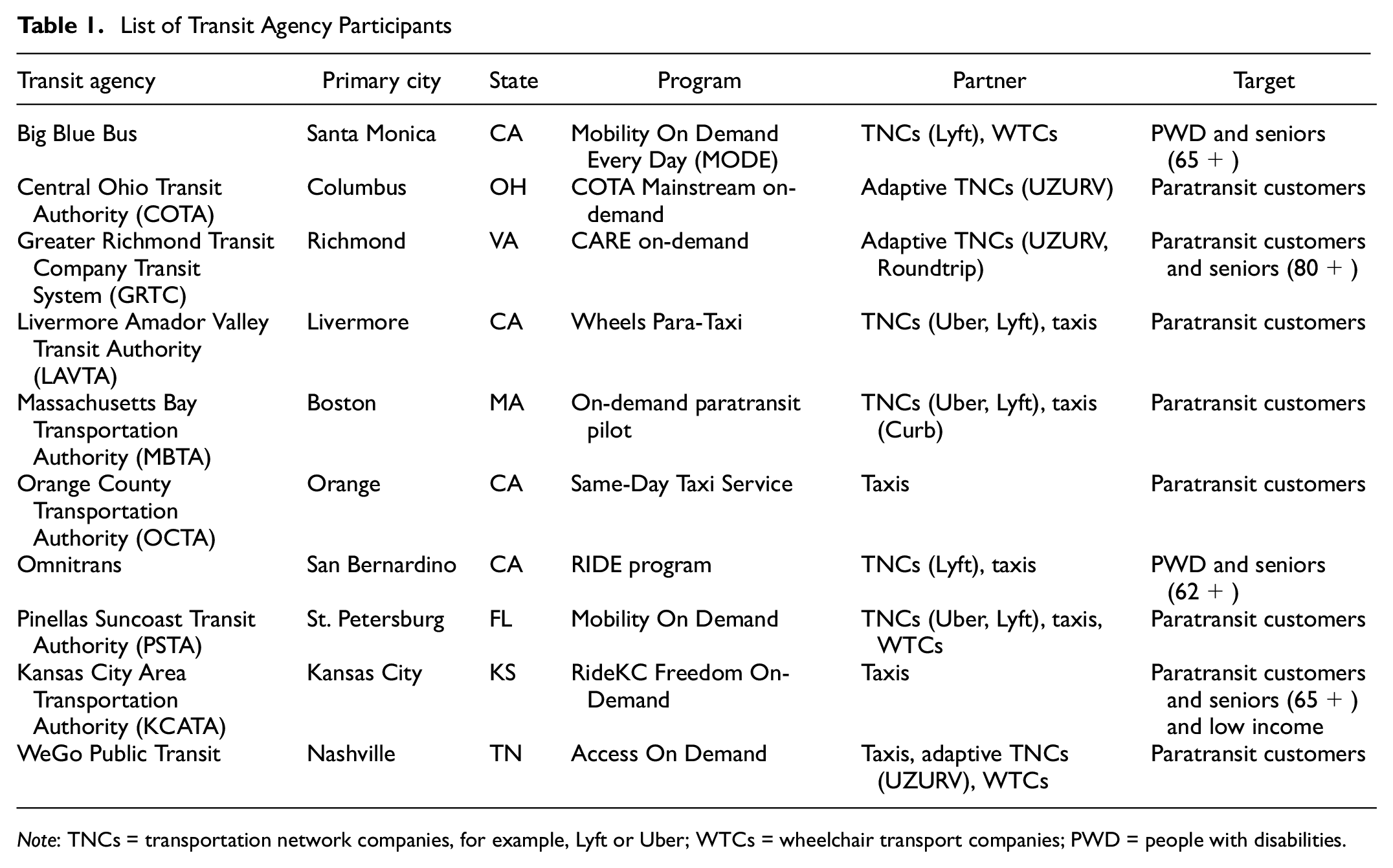
Note: TNCs = transportation network companies, for example, Lyft or Uber; WTCs = wheelchair transport companies; PWD = people with disabilities.
Nine participants were operating a permanent on-demand service, and most of the participants (n = 8) started the on-demand program between 2015 and 2019. One of the participants had operated their service since 2008; it was initially a taxi reimbursement program and TNCs were added in 2019. Instant booking was available with seven on-demand programs, while three participants that partnered with adaptive TNCs required booking at least 1–2 h in advance. The majority (n = 8) of participants operated the on-demand service within and beyond three-quarters of a mile of their fixed-route services, except for two participants that provided service only within three-quarters of a mile of their fixed-route service area. The base fare differed by transit agencies ranging from $1.50 to $7 per trip.
Data analysis from the surveys and interviews yielded six themes related to the on-demand service implementation: (i) goals; (ii) partnerships; (iii) implementation challenges; (iv) impact of the on-demand service; (v) lessons learned; and (vi) impact of COVID-19. These themes are discussed in detail below.
Goals for Implementing the On-Demand Service
Transit agencies initiated their respective public-private partnerships to achieve different goals. The most frequently mentioned reason for approaching emerging mobility transportation providers was to reduce operating costs (n = 8). Some transit agencies (n = 4) had difficulty meeting the demand of non-ADA trips and, at the same time, were unable to provide quality service for their existing customers. They wanted to divert ADA paratransit and dial-a-ride ridership to a more cost-efficient service or even replace the dial-a-ride service. They expected the new service model would reduce operating costs, increase the capacity of ADA and non-ADA services, and provide more rides to customers within the same budget: “Our capacity for non-ADA service was very small. We didn’t have that much capacity because of the demand of the ADA paratransit service” (COTA). “We could greatly expand the vehicle capacity and give a lot of people, a lot more rides within the same budget” (Big Blue Bus).
Next, transit agencies were aware of the challenges that ADA paratransit customers faced using the existing service and aimed to provide same-day, on-demand mobility options for their customers (n = 7). For example, one participant mentioned, “People in the disability community wanted more of a choice, and they didn’t want to have to plan their days 24 h in advance … that if they got up, and they wanted to go somewhere, they wanted to be able to do that” (WeGo Public Transit). Three transit agencies also specifically indicated that they aimed to improve customer satisfaction. One participant mentioned that one of the intentions of implementing the service was to increase community mobility (MBTA). Another mentioned that the service was designed for the customers to travel easily across different regions and outside ADA service areas (KCATA).
Partnerships Between Transit Agencies and Third-Party Private Companies
Interviewees formed partnerships with different types of mobility service providers depending on the availability of local resources and service requirements. First, three participants indicated that they formed a partnership with a third-party company (i.e., mostly taxi companies) with whom they already had historical partnerships on ADA paratransit service. Both OCTA and PSTA mentioned that their level of familiarity with the partners helped them to easily initiate the pilot program.
Second, participants who prioritized accessibility in the service contracted with emerging adaptive TNCs (e.g., UZURV) (n = 3). For example, GRTC initially looked at taxi subsidy options but found UZURV and Roundtrip more successfully met the requirements they specified in their request for proposal (RFP) (i.e., provide same-day service, call center for non-tech-savvy customers, and both ambulatory and non-ambulatory transport). Both UZURV and Roundtrip subcontract with local WTCs to supply WAVs. WeGo Public Transit contracted with local taxi providers, local wheelchair transportation providers, and UZURV to participate in both ADA paratransit and on-demand services. Although some participants stated that they looked into TNC options, they chose not to partner with TNCs because of barriers in providing wheelchair accessible transportation and issues with driver background checks.
Lastly, some participants involved TNCs such as Lyft and Uber to provide technology-based options for their customers and improve customer satisfaction. Through TNC partnerships, customers had opportunities to request and pay for a ride through a smartphone, see the location of the vehicle, and pay for a ride at a more affordable cost through subsidized fares. Transit agencies that partnered with regular TNCs, however, reported modifying their programs over time. For example, MBTA launched a pilot program in 2016, but experimented with the program over time by varying trip caps, subsidy caps, and copay amounts. Omnitrans had a previous partnership with one TNC but decided to switch to another one, not because of the price component, but as the new partner provided better data.
Challenges Implementing the On-Demand Service
Participants frequently mentioned that they encountered the following challenges while implementing the on-demand service: (a) technology inequity; (b) lack of WAV availability; (c) driver training issues; (d) difficulty with data collection and service monitoring; (e) increased demand; and (f) lack of customer understanding.
Technology Inequity
Participants expressed that most of their customers are not comfortable with new technology and are reluctant to use the app to book a ride. Sometimes, customers did not have access to a computer or smartphone. To reduce this technology gap, some participants (n = 3) provided technology training to their customers. All of the participants (n = 10) provided a call-in option for booking the on-demand service, but the agency responsible for managing these reservations differed by partnership type. For example, participants who partnered with taxi companies and/or adaptive TNCs relied on their contractors’ call center services (n = 5).
Problems emerged when the on-demand service was provided through TNCs, as Uber and Lyft were initially developed as app-based-only services. While some participants found ways to offer call center options, others could not provide an equal level of service for individuals who did not have access to a smartphone or who were unfamiliar with booking a ride via an app. One participant mentioned that Lyft subcontracted a third-party company to provide a call-in option, and when writing a new procurement, they required any bidders to offer a non-technology booking solution (MBTA). Another participant covered a service fee for the call concierge service such as “GoGoGrandparent” so that their customers could book a TNC ride with assistance (LAVTA). Two participants only provided a call-in option and did not provide an app booking option; riders called the main number and the call center was operated either by a transit agency directly (PSTA) or a call center contractor (WeGo Public Transit) to book a ride. One participant did not offer a non-technology booking option for TNC service, and customers therefore had limited access to the service (i.e., customers were asked to use taxi service if they do not have access to smartphones) (Omnitrans).
Lack of WAV Availability
Providing an equitable service to wheelchair users with regard to service availability and reliability was still identified as a challenge for transit agencies providing the on-demand service. Many cited the high cost of operating and maintaining WAVs as the primary reason for the lack of vehicles. Participants reported that the insufficient WAV supply caused on-demand customers to experience long wait times. One participant mentioned that the transit agency experienced difficulty anticipating the demand for WAVs, which created challenges meeting the demand, especially during peak hours (KCATA). One participant did not have a formal contract with its partners, and thus had limited control over the way this partner supplied WAVs (LAVTA). Providing sufficient wheelchair accessible service appeared to be more challenging when transit agencies partnered with TNCs, such as Lyft or Uber.
To increase WAV availability and increase WAV service reliability through the partnership, participants indicated using various strategies: (a) subsidizing per service hours; (b) contractors subcontracting with WTCs; and (c) contractors purchasing more WAVs. In one instance, a participant subsidized its TNC partners for WAV hours served on the road:
In April of 2019, we began being able to subsidize Lyft and Uber for wheelchair accessible vehicle hours, served on the road, [whether it accepted ambulatory or non-ambulatory rides] to increase the availability of WAV. And that’s been pretty successful … Since we implemented subsidy, it has gone up to about 98% reliability and an average estimated time of arrival around 11 or 12 minutes, which again is a really great improvement but [still] not quite perfectly equitable (MBTA).
In addition, this participant acknowledged that, from that vantage point, the program was no longer cost-effective. They still considered the subsidy as a worthwhile investment since it provided riders with increased options. Second, several interviewees reported that their partners worked with third-party subcontractors to provide wheelchair accessible service (n = 3). For example, two participants brought on UZURV and UZURV then subcontracted with non-emergency medical providers in the area so that customers would have accessible vehicle options with the on-demand service (COTA, GRTC). Third, interviewees indicated that their partners, especially taxi companies, tended to purchase more WAVs to increase availability (n = 2):
The taxi company was such a great partner, just in the community itself and with us. They kept going out and purchasing more vehicles to meet the demand and because it’s helping their business as well. And it has been really good for the people who had the complaints about, “I’m always late” or “there isn’t a vehicle available”, or “I have to wait too long” (KCATA).
Besides their individual efforts to increase the availability of WAVs, participants indicated state-level efforts to provide more WAVs on TNC platforms. For example, the TNC Access for All Act in California requires every TNC ride in California to have a fee attached if that ride-hailing service does not meet the WAV performance criteria in their platform. Those fees collected by the state are expected to subsidize wheelchair accessible rides on TNC; however, there is still little evidence that the effort has increased the availability and reliability of wheelchair accessible services.
Driver Training Related Issues
Six out of 10 participants reported that their on-demand service mandated ADA sensitivity training. Participants took different approaches to handle training-related issues. First, participants indicated that they specified training requirements in the contract (n = 3). For example, taxi providers in Nashville are mandated to complete ADA sensitivity training once a year to keep their license (WeGo Public Transit). COTA also has language in its contract that requires drivers to receive background checks, drug and alcohol checks, as well as training for passenger assistance. This participant mentioned that driver training had given them a higher level of accountability. Second, participants periodically monitored drivers to ensure they met the standards and qualifications (n = 2). One participant mentioned:
We go and check their profile or their file to ensure that every course was completed and signed off on by the trainer and the driver. Staff also regularly attend training sessions just to see what the quality of that training is, providing input or feedback to the contractor on some of the training. We also regularly show up to their safety meetings to see how continuous training is being conducted. And we do provide feedback also on other
current service issues that we’re experiencing and see how we can get that information upfront to the riders (OCTA).
Third, participants intervened when they received complaints about the driver and found that training requirements were not met (n = 2). One participant mentioned:
If we get any complaints that the drivers are not doing what they should be doing with regard to transporting a customer with a disability, then we will immediately request documentation from the provider with proof that the driver actually did complete the training. If it’s not to our satisfaction, then one of the things that we do have per contract that we can request or demand or strongly suggest that driver no longer be part of the [transit agency’s] account … If that driver can’t comply with our standards that we hold our internal operators to, then that driver can no longer handle any trips associated with our account (WeGo Public Transit).
Driver training with TNCs was identified as one of the biggest challenges that participants faced. Most of the participants partnering with TNCs reported that the TNCs maintained responsibility for their driver training. Despite little transit agency involvement in TNC driver/rider relationships, some interviewees described still monitoring complaints and addressing any issues identified:
Early on, we did get some complaints from people who use service animals. “Lyft driver wouldn’t pick up me and my dog or my service animal,” and when things like that come up, we send those directly to Lyft. We try to work with them and they send messages to their drivers in the area, telling them that if they don’t pick up people with disabilities or service animals, they’ll be removed from their platform. So, we’ve seen that improve, I don’t think I’ve seen one of those complaints lately, or in a while, but early on, we did get, we did see some of those (Big Blue Bus).
Challenges with Data Collection and Monitoring the Service
Participants did not report any obstacles collecting data from certain partners, especially adaptive TNCs; however, participants who partnered with regular TNCs reported difficulty getting access to trip data (n = 6). The rules for handling personally identifiable information mean that the data that transit agencies can receive are tightly regulated, and participants indicated difficulty obtaining more detailed information such as exact pick-up time or response time from TNCs (n = 5). In addition, one participant addressed a need to integrate different service providers into one platform, which would allow the transit agency to monitor and manage the on-demand program more easily (PSTA).
Increased Demand
Interviewees reported that they fund the on-demand service through regular ADA operating costs, 5310 federal grants, which are transportation funding opportunities passed from federal to state to local governments that assist private nonprofit groups in meeting the transportation needs of older adults and people with disabilities (49 U.S. Code 5310), and other local tax measures (e.g., Measure I). They generally found the funding to be sustainable to implement the on-demand service. Several participants (n = 6), however, also raised concerns about the on-demand service’s financial sustainability with both induced and latent demand. This refers to individuals taking more trips with the on-demand service than the ADA paratransit service, and individuals who did not previously use ADA paratransit becoming new on-demand riders, respectively. One participant described the changes in the usage of different transportation services:
The more trips that move from regular [ADA] paratransit to MOD [the on-demand service], cost per trip goes down. Therefore, the customer was saving four trips a month on regular [ADA] paratransit now to put those four trips on MOD [the on-demand service]. In theory, our [operation] costs for overall [ADA] paratransit services should decrease … But as riders go from regular [ADA] paratransit to the on-demand lifestyle, they take more trips, and they’re doing all the cool things that they couldn’t have [done] before or going to Walmart and then Red Lobster (PSTA).
Two other participants described how the increased demand can potentially impact the sustainability of the on-demand service: Customers take about 60% more trips between dedicated providers and on-demand than we would forecast to take otherwise without the program’s existence. All of which turns into about a wash financially [i.e., net zero], which again, when coupled with the improvements to customer service, makes it a pretty easy program to keep going … And any conversations we have around the future of this program really do revolve around the dance of how do we keep it sustainable from a financial perspective while not hamstring the availability of customers to take on the different trips (MBTA).
The first year we doubled our demand and then kept it within the same budget, but after that, that’s where things get complicated because if that trend keeps going, then we’re over budget … this happens in every other transit agency that has used Lyft, that we’ve seen for the most part that the demand for it just overwhelms the program. So, we put together a stakeholder group … to come up with ideas of how to create certain rules so that we could limit the demand and to keep the service sustainable … we increased the age for seniors from 60 to 65 … and we limited the number of trips (Big Blue Bus).
Participants (n = 5) who experienced challenges related to increased demand have had to make changes to control the demand. Besides increasing the age of eligibility (Big Blue Bus), several participants (n = 4) adjusted the fare for the on-demand service. This includes increasing or planning to increase the fare/copay (Big Blue Bus, MBTA); establishing the on-demand service fare as slightly more expensive than the ADA paratransit fare (COTA); or decreasing the miles for the base rate (KCATA). Two participants put a monthly cap to limit the number of trips taken by the on-demand service while trying to shift their customers over to the on-demand service (Big Blue Bus, MBTA). Another participant mentioned that they only operate the service during limited service hours and have no intention of expanding service hours to keep it cost-neutral (WeGo Public Transit).
Lack of Customer Understanding
Participants expressed challenges communicating with and educating their customers about the new program. Most of their customers were long-term ADA paratransit riders and these riders seemed to have difficulty understanding the differences between traditional ADA paratransit and the new service (n = 5). For example, as most ADA paratransit services have a fixed fare, customers had difficulty understanding a fare structure that fluctuated with trip length. While these were some of the initial challenges that participants encountered with their respective pilot programs, they did express that they experienced fewer complaints as the customers adapted to the new service model.
Impact of the On-Demand Service on Operation Costs and Service Experience
Survey results indicated that participants generally perceived the impact of the on-demand service on operation cost, service performance, and customer experience as positive. About two-thirds of the participants responded positively that the overall operation cost decreased after implementing the on-demand service. All participants agreed that the service reliability and customer satisfaction improved after implementing the on-demand service.
During the interviews, almost all participants agreed that the on-demand service costs less per trip than ADA paratransit or non-ADA paratransit service and requires less fixed costs. One participant specifically indicated that they provide double rides at the same cost (Big Blue Bus). While participants expected cost savings through a shift of the demand from ADA paratransit to the on-demand service, some observed that customers do not shift over to the on-demand service because of the lower fares and their familiarity with the existing service. Moreover, some participants experienced induced demand while others experienced latent demand. One participant already operated ADA paratransit service at diminished costs before implementing the on-demand service (PSTA). Thus, some participants did not observe significant cost savings in overall operating costs.
Although some did not see cost saving benefits, overall, participants greatly valued the on-demand service and all agreed that it was valuable to continue the on-demand service (n = 10). One participant that did not experience financial cost savings with the on-demand service still expressed the benefits of having the alternative option available: There is not really a financial cost saving, but … it’s just the right thing to do … it’s just something that we’re doing, that we’re offering for the community and trying to sustain and keep it out there so that there’s some non-ADA service out there. So that if you don’t live where you need to live, or if you just can’t get to whatever it is that you need to get to, we have something else available. I think the more options you give people, then you tear down some of those barriers (KCATA).
Participants also identified several benefits for customers, including greater travel flexibility, higher customer satisfaction, and improvement in on-time performance. Participants formally and informally asked their customers about their experience using the on-demand service and generally received positive feedback from them (n = 5). Interviewees indicated that their customers valued the flexibility of booking same-day and on-demand service, which allowed for spontaneous events, non-shared trips, having a choice of providers, and faster response times. Participants also mentioned that they received complaints in response to measures taken by transit agencies to control the demand (e.g., limitation on number of trips, fare increase), inefficient customer service, long wait times, and booking issues.
Lessons Learned and Future Plans
Interviewees identified three key lessons learned implementing the on-demand service. They emphasized the importance of (i) tailoring the program to meet the community’s needs, (ii) involving target customers in the design (or development) process and valuing their feedback, and (iii) trying it initially as a pilot program and learning from the experience before a full-scale launch. For example, one participant emphasized the importance of tailoring the service to what would work best for each respective community and organization:
I think one key thing is to do your homework and make sure that it is tailored and works for your organization … Originally, we thought that the voucher program [at other locations] could work here. But we discovered that it didn’t work, at least to what we thought it could. So, we had to tweak and be willing to adjust to what works best for your community, for your client. Because what may work for me may not work for someone else … I would tell people that you can take ideas and suggestions from other locales and see what works best for you. But like I said, make sure it fits your needs, fits what’s best for your client base in your community (GRTC).
With regard to involving target customers in the process, one participant mentioned, “It is important to actively engage with rider advocacy groups every step of the way and understand what it is that they want out of on-demand services” (MBTA). KCATA also reached out to non-profits in the area who serve targeted populations and sent marketing materials to test accessibility. They asked volunteers to pilot the app and involved individuals with disabilities and older adults throughout the process. As a result, they received some of the best feedback from customers who commonly give the most critical feedback on the service.
Lastly, one participant recommended starting the on-demand service as a pilot program:
I say “try it.” If you have the opportunity and there’s a grant or there’s a partner, call it a pilot, and if it doesn’t work, it doesn’t work. But I think that if you don’t try something, you’re not going to know what’s successful. And even if it doesn’t work, maybe try to figure out what you can learn from that, find the good, and fix what doesn’t work by trying something else. And then I would also say, have a solid implementation plan, make sure that your staff understands why you’re doing the things you’re doing (KCATA).
Another participant mentioned,
One of the key things that we did at the beginning was that by design, we did not go with the full-scale launch, it was kind of a soft launch and kind of dip your toe into it a little bit … I would encourage folks who consider doing it get an opportunity to work out some of the kinks and so forth that may exist, and just continue to keep track of how things are monitoring and gradually, your business will grow, and basically, that’s what happened (GRTC).
Interviewees were also asked what they would do differently if they were to start the on-demand service from scratch. Since data collection is a critical component of service evaluation, participants emphasized the need for data requirements and their intention to acquire more data for more analysis (n = 3). Other participants addressed the importance of having a monitoring mechanism in place (n = 2). One participant, in particular, who partnered with multiple providers, addressed the needs of a singular software platform that can capture the same data from different providers and effectively monitor and evaluate the service (PSTA). In addition, as participants still struggled to meet the demand for WAVs, some of them indicated plans to expand the partnership to increase the availability of WAVs (n = 3).
Impact of COVID-19
Interviewees consistently reported a significant decrease in the total ridership of both ADA paratransit and on-demand services during COVID-19. Several transit agencies (n = 4) specifically mentioned that they observed the on-demand service ridership to decrease by more than 50% during the pandemic (i.e., at the time of the interview) compared with pre-COVID-19 conditions. Some transit agencies suspended fares for fixed-route and paratransit services during the pandemic while they continued the fare for the on-demand service. One participant reported that their on-demand riders shifted back to ADA paratransit as a result (PSTA). Despite the free fare with ADA paratransit service, one participant did not see a shift in ridership during COVID-19, mostly because people wanted to avoid shared rides (Omnitrans). One transit agency that initially attempted to control demand by increasing the fare for the on-demand service in comparison to the ADA paratransit service, but eliminated all service fares during the pandemic, reported exponential growth in the on-demand ridership during the pandemic (COTA). Participants described some of the benefits of using the on-demand service during the pandemic:
Despite five, six months into the pandemic, we still have the same folks who are comfortable utilizing this service, even though they have to pay. I believe it’s because of the benefits. You get direct nonstop service, it’s not a shared ride, so customers can board, like a taxi to destination (GRTC).
We did see a significant decrease in the request for Access on Demand [on-demand service] in late March and April. By the middle of May, a lot of people have actually started to go back to work. And instead of using our traditional ADA, they actually transitioned over to the Access on Demand [on-demand service]. So some of that is because, for the most part, it’s a single-seat ride, so they didn’t have to share. It was more social distance (WeGo Public Transit).
Despite the decrease in total ridership, some participants did not experience a decrease in operating costs during the pandemic (n = 4). Participants mentioned that costs were basically the same from an operational standpoint despite a decrease in trips on the dedicated fleet (MBTA, LAVTA). Instead, they experienced an increase in costs incurred on cleaning services related to COVID-19, so the operational costs actually increased even though the trips decreased on the dedicated side.
During COVID-19, interviewees observed changes in service performance because of the decline in ridership. Participants reported improvements in on-time performance with both ADA paratransit and on-demand services (GRTC, WeGo Public Transit). For some participants, however, COVID-19 had a negative effect on their service performance. One participant mentioned, “It’s because [the provider is] more limited in drivers. So that’s why there’s longer wait times. And some of the services specifically for our clients with wheelchairs, for example, they have a longer window that they need to go ahead and reserve those vehicles because COVID-19 has impacted the number of drivers available” (Omnitrans).
Discussion
Implementing on-demand services through partnerships with technology-enabled third-party companies was viewed as highly valuable across all the study participants. The partnerships allowed transit agencies not only to reduce costs associated with operating an ADA paratransit service, but also to provide an enhanced mobility service for their customers. Even transit agencies that did not experience financial savings still observed a positive impact of the on-demand service on customer satisfaction. These findings are consistent with Lucken et al. ( 16 ), which found the relative longevity of on-demand paratransit pilots through public-private partnerships, as compared with other types of on-demand services, was likely because of their cost savings and service improvements.
Transit agencies in this study did their due diligence to find available resources and adopt unique partnerships with different types of mobility service providers to achieve their goals. For example, some transit agencies engaged multiple local providers to meet the service requirements of individuals with disabilities, to provide an enhanced mobility service through innovative technology platforms, and to overcome limitations with existing TNC partnerships. When launching a new service, transit agencies can learn from other existing cases, but it is also critical to allow individuality and tailor the service format to fit the agency’s specific needs. Understanding the available local resources, learning from pilot program experiences, as well as modifying the service to meet a community’s needs, are critical steps for successful public-private partnerships that serve the needs of people with disabilities. While involving target populations during the program development process can help ensure the program addresses specific needs and improves the rider experience, community members participating in the process should be appropriately compensated for their time and insights.
While transit agencies were committed to providing an equal level of service for individuals with disabilities, they still expressed challenges providing reliable access to WAV and ensuring equivalent response times. Curtis et al. ( 18 ) also reported difficulty providing wheelchair accessible service at a level equivalent to non-WAV rides given the TNC service model. Similar to Curtis et al. ( 18 ), the present study also found that transit agencies have adopted diverse strategies to provide more accessible services to their targeted customers. For transit agencies that solely rely on the regular TNC and subsidize WAVs by service hours, the on-demand service may not be a cost-effective option. Partnerships with adaptive TNCs seemed successful in providing reliable wheelchair accessible service as these companies tended to subcontract with local non-emergency medical transport companies that had a sufficient supply of WAVs. Adaptive TNCs may also have their drawbacks. One of the adaptive TNCs, UZURV, does not offer an app booking option on its technology platform, and customers need to book a ride 1–2 h in advance. Despite some drawbacks for transit agencies, adopting different strategies may still be a worthwhile approach since diversifying partnerships and service operation methods can increase access to on-demand services for individuals with different needs, especially for wheelchair users. Transit agencies and partnering mobility service companies should work together to utilize local resources and adopt innovative technology to provide user-friendly options and increase the availability and reliability of WAVs.
Transit agencies still identified technology access, driver training, and data collection as the main challenges in implementing on-demand service partnerships. Previous studies have also identified these issues (8, 17, 36, 37). Transit agencies employed various strategies to provide equivalent access to the on-demand service for non-smartphone users. Some transit agencies only offered the call-in option as a significant percentage of their customers were unfamiliar with technology. When ridership increases, however, customer calls can overwhelm the call center and may increase fixed costs. Transit agencies should not neglect customers without a smartphone from having the option to use the technology-based on-demand service, but they must also provide opportunities to utilize app booking and access real-time information for better usability. Transit agencies can connect with local programs, such as a local intergenerational program in Santa Monica, CA (e.g., Appy hour), to train their customers and increase their familiarity with using new technology.
Issues surrounding driver training and data collection still persist, making transit agencies hesitant to partner with regular TNCs. Interviewees that formed TNC partnerships mostly left the responsibility of driver training to their partners, but active cooperation between partners seemed to solve issues related to driver attitude and behavior, especially when serving riders traveling with service animals. A more comprehensive partnership between transit agencies and third-party companies should include driver training to assist populations with various needs. The report by NCMM, SUMC, and FTA ( 30 ) also suggests a need for including specific driver training requirements when forming a TNC partnership to increase driver sensitivity to the needs of individuals with disabilities and build an understanding of the specific implications of varying disability conditions.
Robust data sharing and monitoring are also essential for transit agencies to make informed decisions on how to provide a more efficient and effective service. Similar to Curtis et al. ( 18 ), this study found that issues related to collecting disaggregated data from TNCs remain unresolved because TNCs are concerned about the risks associated with compromising rider privacy, complying with public records laws, and becoming vulnerable to competition. Transit agencies that make preliminary arrangements, write data sharing agreements early in the process, and specify data collection requirements when writing their RFP would help overcome some hurdles.
As the on-demand service gained popularity and ridership increased, transit agencies faced challenges sustaining the program with a limited budget. Interviewees expressed concerns about these increased demands (i.e., induced demand and latent demand) overwhelming the program. Previous studies also indicated that the improved flexibility of the TNCs caused customers to travel more, which perhaps resulted in lower cost reductions ( 27 , 38 ). For program sustainability, transit agencies should periodically monitor and evaluate the program and apply appropriate strategies to control the demand, if necessary. The strategies that transit agencies often take include, but are not limited to, instituting a monthly trip cap, increasing fares, and changing eligibility criteria. Transit agencies should also clearly communicate with their customers about any impending changes. On the other hand, transit agencies should be aware that their efforts to control demand may inherently limit the use of on-demand transportation options among riders with disabilities. They should work on providing sustainable programs but also offer equitable opportunities for these riders.
During COVID-19, transit agencies observed a significant decrease in on-demand ridership. Despite some shifts back to ADA paratransit service because of lower or no fares, the on-demand service provided a safe, alternative mobility option during COVID-19. As some transit agencies still operated ADA paratransit service as a shared ride, customers seemed to value having a single-ride option and traveling safely without being exposed to other passengers. The on-demand service performance, however, was affected by the shortage of drivers during COVID-19. Safety concerns and the lack of steady demand have led many TNC drivers to move on to other work forces ( 39 , 40 ), which may affect service delivery when the on-demand service customers fully return for normal activities. Transit agencies may have to involve other local mobility services to provide reliable service and assist their partners with providing incentives to their drivers. In addition to Uber and Lyft resorting to bonuses to their drivers ( 41 ), transit agencies, for example, can also incentivize drivers with additional bonuses for each ride and assist with insurance payments.
This study had several limitations. First, qualitative data analysis is inherently prone to biases during data analysis. The current study mitigated this intrinsic challenge by using two data coders representing diverse discipline backgrounds and professional experiences. Second, interviewees may have felt reluctant to disclose attributes of their on-demand programs that could be negatively construed, which is a risk with any self-reflective interview process. Third, the small sample size limits the generalizability of the results. Fourth, given that the study was conducted during the COVID-19 pandemic, survey responses on the impact of the on-demand service on various outcomes before COVID-19 are subject to recall bias. Finally, there still remains a lack of understanding on how the emerging on-demand services are meeting the transportation needs of individuals with disabilities. Few transit agencies have conducted formal customer surveys to understand the comprehensive customer experience. Future studies on the on-demand service are required to further understand the impact of the service on user mobility and customer experience.
Conclusion
As transit agencies continue to adopt these new service models to enhance customer experience and decrease the cost burden for operation, challenges remain in providing accessible and reliable on-demand transportation options to people with disabilities. To address these challenges, transit agencies should diversify their partnerships according to available local resources and work with partnering mobility service companies to continuously integrate enhanced innovative technology in the service platform. They should also devote efforts toward educating their customers on how to fully utilize the new technology, and at the same time, they should not neglect populations without access to these technology options. Ultimately, for program sustainability, transit agencies should continuously monitor, evaluate, and customize their on-demand service to ensure their public-private partnerships serve the mobility needs of people with disabilities.
Footnotes
Author Contributions
The authors confirm contribution to the paper as follows: study conception and design: J. Choi, J. L. Maisel; data collection: J. Choi, J. L. Maisel; analysis and interpretation of results: J. Choi, J. L. Maisel; draft manuscript preparation: J. Choi, J. L. Maisel. All authors reviewed the results and approved the final version of the manuscript.
Declaration of Conflicting Interests
The author(s) declared no potential conflicts of interest with respect to the research, authorship, and/or publication of this article.
Funding
The author(s) disclosed receipt of the following financial support for the research, authorship, and/or publication of this article: The contents of this paper were developed under a grant from the National Institute on Disability, Independent Living, and Rehabilitation Research (NIDILRR) (grant number 90REGE0007). NIDILRR is a Center within the Administration for Community Living (ACL), Department of Health and Human Services (HHS).

The contents of this paper do not necessarily represent the policy of the National Institute on Disability, Independent Living, and Rehabilitation Research (NIDILRR), Administration for Community Living (ACL), U.S. Department of Health and Human Services (HHS), and readers should not assume endorsement by the U.S. federal government.