







Abstract
Automated systems present great capabilities with a wide range of options. In this respect, vehicle preferences and factors affecting these preferences are important for the future of automated systems. While automated systems offer varied features and improvements for drivers and general traffic safety, the relationship between drivers’ perceptions of traffic systems and driver skills have not been studied. The present study, therefore, focuses on country differences and the relationships between traffic climate and driver skills and their impact on the preferred level of vehicle automation for drivers in Turkey and Sweden. The study was conducted with 318 drivers (age: mean [M] = 22.41, standard deviation [SD] = 2.77) from Turkey and 312 drivers (age: M = 28.80, SD = 8.53) from Sweden in 2020. A questionnaire package asking for demographic information and preferred levels of vehicle automation—Traffic Climate Scale (TCS) and the Driver Skill Inventory (DSI)—was completed. A series of analyses of covariance (ANCOVA), hierarchical regression, and moderated moderation analyses were conducted. Drivers from Turkey preferred higher automation levels than drivers from Sweden. Drivers with higher perceived safety skills, with lower perceived perceptual-motor skills or perceiving the traffic system as more externally demanding preferred higher automation levels. Drivers’ automation preferences were affected by various individual and country-level factors. For the first time, drivers’ automation preferences were elaborated in relation to traffic climate and driver skills in two countries with different levels of traffic safety. Theoretical and practical implications of the findings are discussed in the light of the literature.
Vehicles with various technical capabilities (such as adaptive cruise control) are now a part of traffic systems. The SAE International Standard J3016 defined vehicles with different levels of automation from level 0 (no automation) to 5 (full automation). The dynamic driving sub-tasks and the functional capabilities of the vehicles vary for each level of vehicle automation. The higher the level of automation, from 0 to 5, the more the vehicle systems are able to operate different driving tasks ( 1 ). Navarro ( 2 ) also highlighted that from level 0 to 5, while the automated system’s control and ability increase, the human involvement in driving decreases. Automated driving systems could have various benefits for drivers, traffic systems, and society. For example, the implementation of automated vehicle systems could decrease the number and cost of accidents and increase mobility for elderly and disabled road users ( 3 , 4 ).
Nordhoff et al. ( 5 ) discussed the importance of acceptance studies in determining the future implementation of automated vehicle systems and whether the road users will use the target system or not. Different sociodemographic and individual-level characteristics have been related to the acceptance of automated vehicles. For example, young road users reported more positive attitudes toward full automation than older road users ( 6 , 7 ). In another study, Qu et al. ( 8 ) found that road users were more likely to see benefits in the usefulness and were less likely to focus on system concerns and concern scenarios as age increases. In contrast, other studies have reported no difference in intention, acceptance, or trust because of age ( 9 , 10 ).
Furthermore, in different studies, male road users have been shown to have more positive attitudes and intention to use vehicles with full automation ( 6 , 11 ). Similarly, Qu et al. ( 8 ) found that males perceived more benefits in the usefulness of autonomous vehicles. In addition, Syahrivar et al. ( 12 ) found that driving experience and frequency were negatively correlated with Hungarian participants’ automated vehicle preferences.
In addition, driver skills are one of the crucial dimensions of driver-related human factors and have been associated with the information processing and motor skills of drivers. In a general sense, driver skills focus on the abilities of drivers (i.e., what drivers can do) while driving ( 13 – 15 ). Driver skills were associated with various driving outcomes such as speeding behaviors ( 16 ), aberrant and positive driver behaviors ( 17 , 18 ), and accidents ( 19 ). The Driver Skills Inventory is a widely used reliable and valid measurement of driver skills under two dimensions: perceptual-motor skills and safety skills ( 20 ). While perceptual-motor skills focus on technical or performance aspects of driving such as “managing the car through a skid,” safety skills are more related to the drivers’ safety motives or orientation such as “avoiding unnecessary risks” ( 20 , 21 ). In that respect, Sümer et al. ( 22 ) proposed a general asymmetric relationship between perceptual-motor skills and safety skills with unsafe driving outcomes. This asymmetry highlighted that perceptual-motor skills were positively related and safety skills were negatively related to unsafe driving outcomes such as penalties.
Vehicle automation is of great importance for driver skills. Navarro ( 2 ) discussed how the need for driver skills gradually decreases from manual driving to full automation. From the opposite perspective, for the roles of driver skills in the traffic system and the potential effects of automated vehicles, driver skills may play a crucial role in the drivers’ preferred level of vehicle automation. In other words, drivers may evaluate the capabilities of vehicles and choose the optimal option which is the most compatible with their own driver skills. For example, if drivers perceive themselves to lack certain skills, they may prefer vehicles with those features. Thus vehicles with new technologies could play a compensatory role for particular skills.
In addition to these individual (micro) level differences, different studies have reported significant macro-level country differences in various aspects of automated vehicles ( 7 , 12 , 23 , 24 ). In one study, road users from China, Japan, Germany, and the U.S. reported different patterns of automated vehicle acceptance. For instance, unlike German, Japanese, and U.S. drivers, Chinese drivers had higher acceptance across different conditions ( 23 ). Syahrivar et al. ( 12 ) also found that while Indonesian participants reported more desire for control and a more favorable attitude toward and intention to use automated vehicles, Hungarian participants preferred higher levels of automation.
One of the macro-level factors associated with road safety is the traffic climate ( 25 ). Özkan and Lajunen ( 26 ) defined traffic climate as “the road users’ (i.e., drivers’) attitudes and perceptions of the traffic in a context (e.g., country) at a given point in time.” The traffic climate perception of road users has been measured with the Traffic Climate Scale under three dimensions: external affective demands, internal requirements, and functionality ( 27 ). External affective demands indicate the emotional engagement in the traffic system with items such as “chaotic” and “pressurizing” ( 28 ). “Demands alertness” and “cautiousness” are the example items of internal requirements highlighting the required skills and abilities needed to be successfully integrated into the traffic system ( 28 , 29). Finally, the functionality dimension focuses on the characteristics of a functional traffic system such as “harmonious” and “planned” ( 28 ).
The traffic climate involves different components such as policies and practices and is affected by the existing traffic environment ( 30 ). Various studies have, for example, shown associations of traffic climate with positive driver behavior ( 31 ), dangerous driver behaviors ( 32 ), as well as violations ( 30 , 31 ) and accidents ( 31 ). Overall, Gehlert et al. ( 28 ) stated that a safe traffic system would have low external affective demands and be high in functionality and road users’ perceptions of the traffic system would be related to their risk perception and behaviors. For example, Zhang et al. ( 32 ) also reported that drivers perceiving the traffic system as high in internal requirements showed more cautious and less dangerous driver behaviors. In that sense, these characteristics of the traffic environment can affect various components, such as the drivers’ attitudes ( 30 ). Additionally, policy makers might also benefit from road users’ perceptions of the traffic climate ( 29 ). For example, more functional and less demanding traffic systems could be among the core values of policy and planning strategies.
Qu et al. ( 8 ) examined the relationship between the traffic climate and autonomous vehicle acceptance. Internal requirements and functionality were positively associated with willingness to use automated vehicles. Drivers with higher external affective demands showed less concerns about autonomous systems. Overall, traffic climate was a strong predictor of acceptance of autonomous vehicles ( 8 ). Thus, it was suggested that the traffic climate perception of drivers would be related to the drivers’ preferred levels of vehicle automation.
In light of the previously reported country differences in attitudes toward automated vehicles ( 7 ), traffic climate ( 31 ), and driver skills ( 33 ), it is expected that the relationships examined in the present study would show differences between Turkey and Sweden. Various studies ( 33 – 35 ) and reports ( 36 ) have shown significant differences between Turkey and Sweden in different aspects of road safety. For instance, even though drivers from Turkey reported higher safety skills ( 33 ), they also showed more violations ( 35 ) and experienced more accidents ( 34 , 35 ) compared with drivers from Sweden. In addition, drivers from Turkey had lower intentions to comply with the speed limit and less positive attitudes toward complying with the speed limit ( 34 ).
In line with self-reported differences, the estimated road traffic fatality rates per 100,000 population were 12.3 for Turkey and 2.8 for Sweden ( 36 ). Additionally, Sweden is one of the best-performing countries in road safety ( 36 , 37 ). With respect to these differences, investigating vehicle automation preferences and how different factors (traffic climate and driver skills in the present study) related to the preferred level of vehicle automation between the two countries will provide valuable information about the nature of proposed relations across the two countries with different road safety indexes.
The Aim of the Present Study
In light of the potential benefits of automated vehicles ( 3 , 4 ) and relationships between the varying micro- and macro-level variables and road users’ attitudes and perceptions of different levels of vehicle automation ( 5 , 23 ), it is expected that understanding the relationships between individual and country-level factors and the acceptance of automated systems will have a crucial role in the future of vehicle automation and road safety. Despite the significance of driver skills (i.e., Lajunen and Özkan [ 20 ]) and traffic climate (Gehlert et al. [ 28 ], Öztürk et al. [ 29 ], Chu et al. [ 30 ], and Üzümcüoğlu et al. [ 31 ]) for various driving outcomes and road safety, to the best of our knowledge, there has been no research on driver skills and a limited amount of research into traffic climate (i.e., Qu et al. [ 8 ]) in relation to the acceptance of vehicle automation. With respect to that, the present study examines the relationships between macro/country-level (country difference and traffic climate) and micro/individual-level (driver skills) variables on the one hand, and the preferred level of vehicle automation on the other. The current study was designed to advance the existing research on vehicle automation preference by investigating the relationship between driver skills for the first time in the literature and also investigating the relationships between the traffic climate in two different countries with different levels of traffic safety. It is believed that the present study provides a valuable contribution to the studies on the acceptance and the future of vehicle automation.
Accordingly, the three main objectives of the study were:
to compare the preferred level of vehicle automation among drivers from Turkey and Sweden;
to examine the relationships between the traffic climate and the preferred level of vehicle automation on the one hand, and driver skills on the other,
to investigate the moderating roles of driver skills and country in the relationship between traffic climate and the preferred level of vehicle automation (see Figure 1).
These aims were investigated through a series of ANCOVA, hierarchical regression, and moderated moderation analyses. Following the introduction, the paper is organized into the following sections: methods, results, discussion, and finally, conclusions.
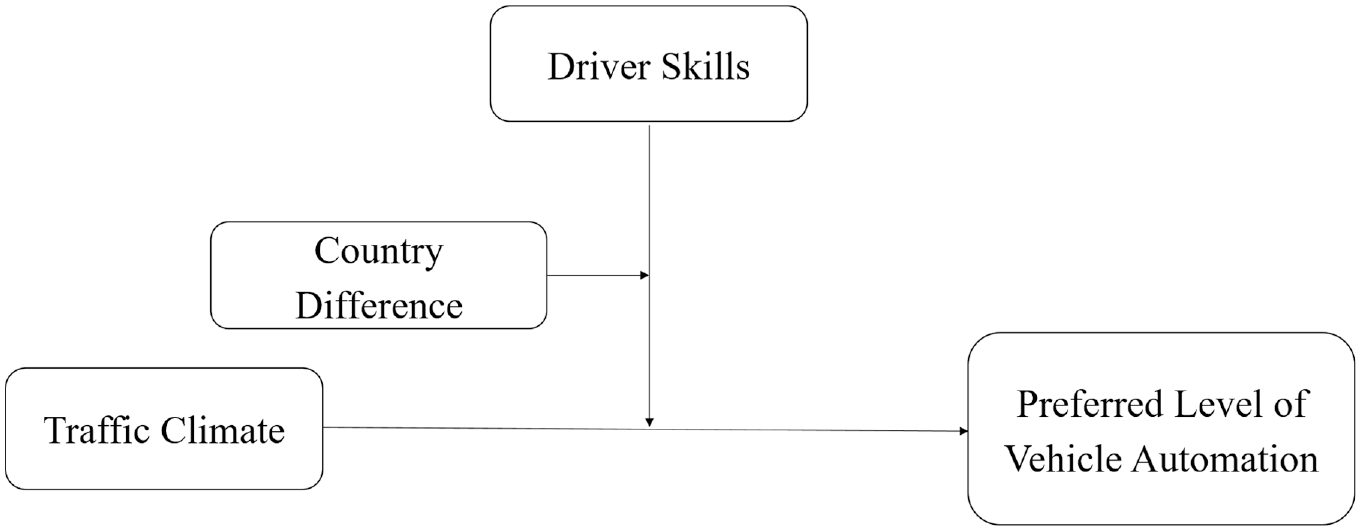
Final model of the study.
Methods
Participants
The study was conducted with a total of 318 drivers from Turkey and 312 drivers from Sweden. There were 105 males and 213 females drivers between the ages of 19 and 38 years old (mean [M] = 22.41, standard deviation [SD] = 2.77) in the sample from Turkey and 124 males, 186 females, and two other gender identity drivers between the ages of 20 and 55 years old (M = 28.80, SD = 8.53) in the sample from Sweden. At the time of the survey, all participants declared that they were university students and had a valid full driver’s license for a car (type B driving license). See Table 1 for a more detailed description of the participants.
Sample Characteristics of Drivers From Turkey and Sweden
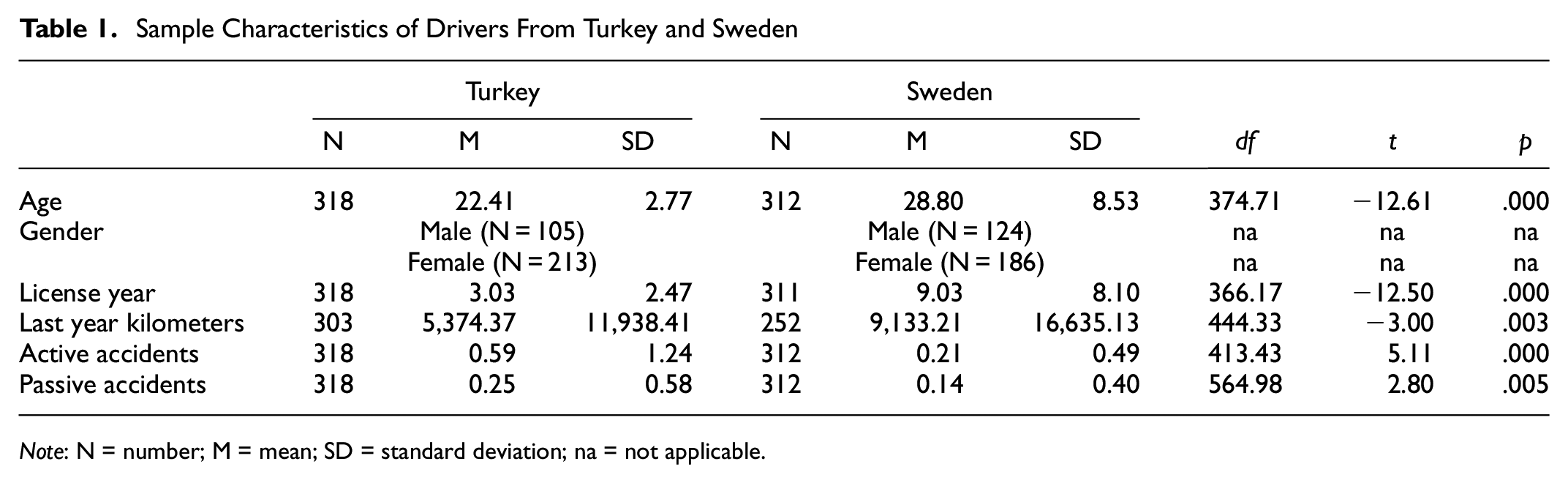
Note: N = number; M = mean; SD = standard deviation; na = not applicable.
The comparisons of the samples for age, license year, last year kilometers and the number of active (situations in which drivers hit any object, other road users, or both) and passive (situations in which other road users hit drivers) accidents in the last three years are presented in Table 1. Overall, drivers from Sweden were older with a longer interval since obtaining a license and higher last year kilometers than drivers from Turkey. In contrast, drivers from Turkey experienced more passive and active accidents than drivers from Sweden. Considering the demographic differences between the samples of the two countries, age, gender, and license year were entered into the analyses as control variables to control additional factors caused by demographic differences and driving experience.
Materials
The questionnaire was compiled in English as the common language between the researchers. Previously validated instruments, if available in either language, were used while the rest of the questionnaire was translated into Turkish and Swedish and then back-translated to English. The study was part of the thesis of the first author and also included the Multidimensional Traffic Locus of Control Scale, but these results are not within the scope of this paper, so they are not presented here. (For further details, please see Öztürk [38].)
Demographic Information Form
The demographic information forms included items related to the demographic characteristics of the drivers, being age, gender, license year, kilometers driven in the last year, and the number of active and passive accidents.
Preferred Level of Vehicle Automation
The level of vehicle automation preferred by the drivers was measured with a single question “Below, the description of different levels of automation are given. As a driver, which of these levels do you prefer?” Six levels of automation (from 0: no automation to 5: full automation) were presented with brief explanations with regard to the capabilities of vehicles with that system and the role of the driver.
Traffic Climate Scale
The scale was developed by Özkan and Lajunen ( 27 ) to measure road users’ perceptions of the traffic system of a country under three dimensions. Items showing external affective demands, such as annoying and aggressive, can be characterized by emotional engagement with the external driving environment. Items showing internal requirements, such as demands alertness and demands cautiousness, focus on the skills and abilities expected from the road user to be able to participate successfully in the traffic system. Functionality items, such as planned and harmonious, are the characteristics of a functional traffic system. Responses are given to indicate to what degree those adjectives and statements describe the traffic system in a 6-point Likert scale ranging from 1 (does not describe it at all) to 6 (describes it fully). The original version of the scale consists of 44 items. Following the suggestions of Üzümcüoğlu et al. ( 39 ), a 16-item short version was used for the analyses in this study. The factors and number of items were external affective demands with eight items, functionality with five items, and internal requirements with three items ( 29 ). The Cronbach’s alpha values for Turkey and Sweden were .84 and .79 for external affective demands, .81 and .80 for functionality and .85 and .74 for internal requirements. The averages of the dimensions of traffic climate were 4.70 (SD = 0.81) and 2.94 (SD = 0.73) for external affective demands; 5.34 (SD = 0.76) and 4.29 (SD = 0.91) for internal requirements; and 3.12 (SD = 0.91) and 4.00 (SD = 0.77) for functionality in Turkey and Sweden respectfully.
Driver Skill Inventory
The measurement was developed by Lajunen and Summala ( 21 ) to measure drivers’ self-evaluation of their own driver skills under the two factors of perceptual-motor skills (e.g., fluent driving) and safety skills (e.g., avoiding unnecessary risks). In the present study, The Turkish ( 40 ) and Swedish ( 33 ) adaptations of the scale were used. The scale consists of 20 items with 5-point Likert-type responses from 1 (very weak) to 5 (very strong). The DSI showed two factors, namely perceptual-motor skills with 12 items in Turkey and 11 items in Sweden and safety skills with seven items in Turkey and eight items in Sweden ( 38 ). The Cronbach’s alpha reliabilities varied between .88 and .82 for perceptual-motor skills, and between .77 and .78 for safety skills, for Turkey and Sweden, respectively. The averages of self-reported driver skills were 3.41 (SD = 0.64) of perceptual-motor skills and 3.95 (SD = 0.60) of safety skills for drivers from Turkey and 3.56 (SD = 0.53) of perceptual-motor skills and 3.70 (SD = 0.62) of safety skills for drivers from Sweden.
Procedure
Approval for the study was granted by the Middle East Technical University (METU) Human Research Ethics Committee (Protocol Number: 511 ODTU 2019). The Swedish and Turkish versions of the questionnaire were distributed using Qualtrics. Data were collected from March 2020 and July 2020. Social media challenges were used to announce and distribute the survey links in two countries by using convenience and snowball sampling methods. Additionally, in Turkey, university students were also recruited through lecturers from other universities and the Department of Psychology METU Research Sign-Up System. Some of the students obtained bonus points for their participation. In Sweden, the university students’ e-mail addresses were obtained from the student registration and grading document system (LADOK). A recruitment e-mail was sent to the students from different universities, including a link to the online questionnaire. The data collection procedure was anonymous and confidential. Participants receiving bonus points were given a unique id by the system which automatically gives the bonus points.
Data Analysis
Data cleaning and analyses were conducted with SPSS v26 software. Respondents were excluded from the study if they were not university students, did not have a valid driving license, or were identified with an outlier value for age and kilometers driven in the last year (z score > 3.5). In the first step, the samples from both countries were compared for driver characteristics. The other gender identity group was excluded from further analyses given the limited sample size (N = 2) in Sweden and in Turkey (N = 0). To minimize the effects of differences between two samples (see Table 1), age, gender, and license year were used as control variables in the further analysis. A one-way between-subjects ANCOVA in which the statistical effects of age, gender, and license year were controlled was conducted to examine the difference in the preferred level of vehicle automation across the two countries. Following the country difference, the second aim of the study was examined with hierarchical regression analysis. Four separate hierarchical regression analyses were tested to investigate the relations of traffic climate and driver skills on the preferred level of vehicle automation of the drivers. Age, gender, and license year were entered as control variables in the first step. After controlling the statistical effects of demographic variables, the dimensions of traffic climate and driver skills were entered into the model separately for Turkey and Sweden. Finally, the third aim was examined with six moderated moderation analyses by using the Hayes PROCESS tool (Model 3) to test the relationship between traffic climate and the preferred level of vehicle automation according to driver skills in the two countries while controlling for age, gender, and license year. In these analyses, two independent variables (perceptual-motor skills and safety skills), two moderators (traffic climate [external affective demands, functionality, and internal requirements] and country [0: Turkey, 1: Sweden]) and one dependent variable (preferred level of vehicle automation) were tested (see Figure 1).
Results
Country Differences in the Preferred Level of Vehicle Automation
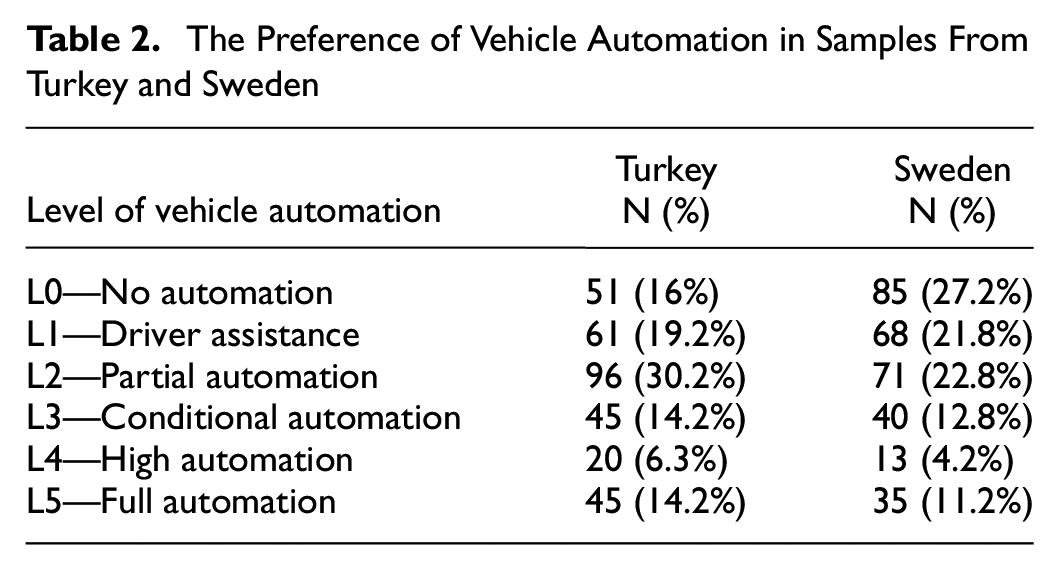
For the automated vehicle, the preferences of the drivers from Turkey and Sweden are shown in Table 2. A one-way between-subjects ANCOVA was conducted to examine the country differences on the preferred level of vehicle automation while controlling the effects of age, gender, and license year. A significant difference was determined between the countries (F[1, 622] = 14.07, p < .001, ηp 2 = .02). Drivers from Turkey (N = 318, M = 3.18, SD = 1.57) preferred higher levels of vehicle automation than drivers from Sweden (N = 309, M = 2.77, SD = 1.59).
The Preference of Vehicle Automation in Samples From Turkey and Sweden
The Roles of Country, Traffic Climate, and Driver Skills on Automation Preference
According to the hierarchical regression results, in Turkey (see Table 3.), the final models together with control variables were significant for traffic climate (F[6, 311] = 2.43, p = .026) and driver skills (F[5, 312] = 6.61, p < .001). External affective demands (95% CI [.06, .70]) and safety skills (95% CI [.04, .61]) were positively, and perceptual-motor skills (95% CI [−.91, −.35]) were negatively associated with the preferred level of vehicle automation.
Hierarchical Regression Analyses on Automation Preference
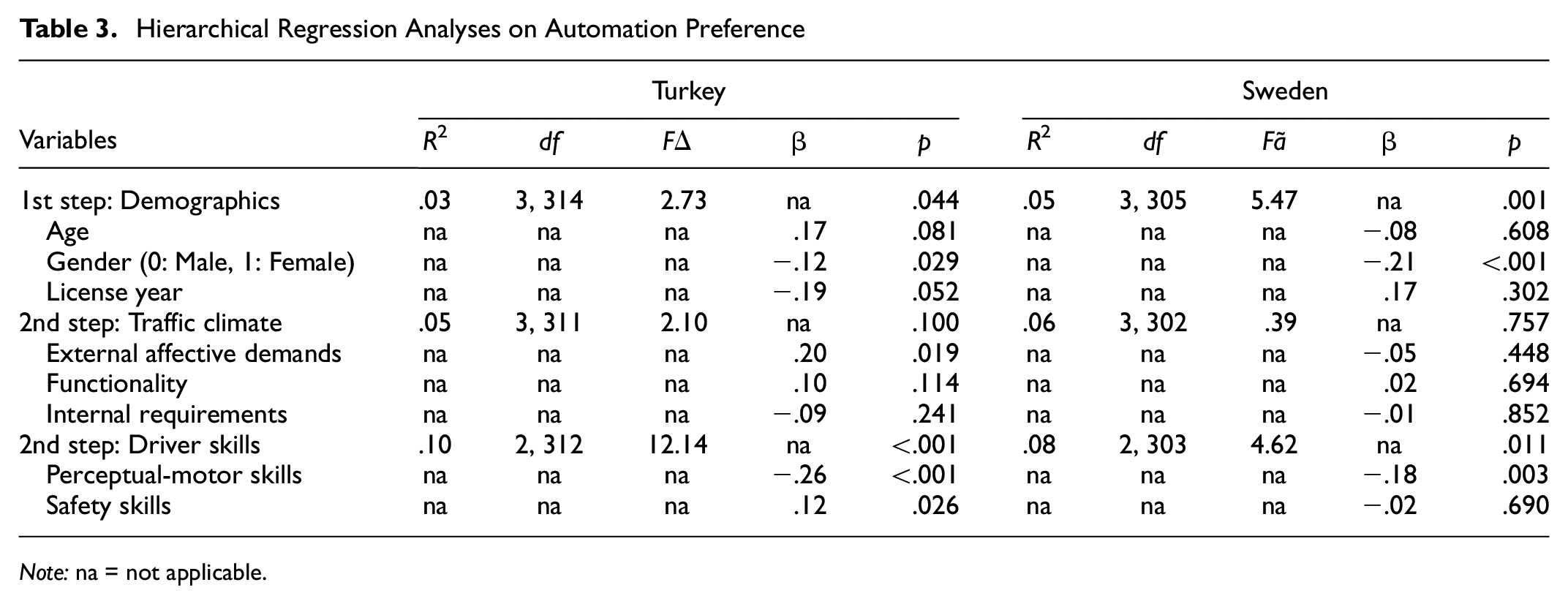
Note: na = not applicable.
In Sweden (see Table 3), the final models together with control variables were significant for traffic climate (F[6, 302] = 2.92, p = .009) and for driver skills (F[5, 303] = 5.21, p < .001). Perceptual-motor skills (95% CI [−.87, −.19]) were negatively related to automation preference.
In both countries, after controlling for the statistical effects of age, gender, and license year, drivers with lower perceptual-motor skills preferred higher levels of automation. Additionally, drivers from Turkey who perceive the traffic system as more externally demanding and drivers with higher safety skills preferred vehicles with higher levels of automation.
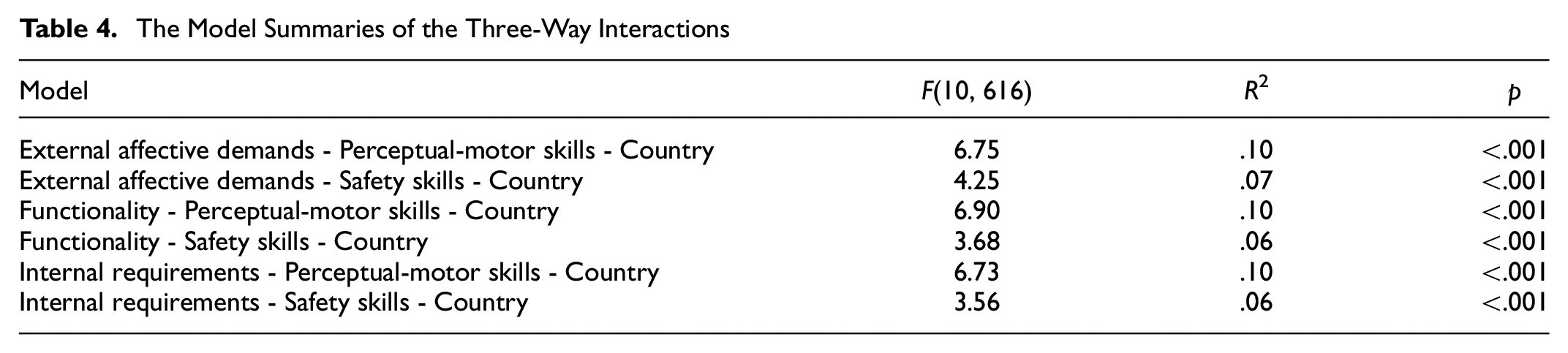
Following the separate hierarchical regression analyses, the role of driver skills by country in the relation between traffic climate and the preferred level of vehicle automation was investigated through six moderated moderation analyses. All models were statistically significant (see Table 4.)
The Model Summaries of the Three-Way Interactions
Only one significant three-way interaction effect (see Table 5) was found between safety skills, external affective demands, and country (b = .52, t[616] = 1.99, p = .047). The interactions of safety skills and external affective demands on the preferred level of vehicle automation were significant only for the sample from Sweden (b = .38, F[1, 616] = 3.96, p = .048). The relationship was negatively significant on low level of safety skills (b = −.33, t[1, 616] = −2.06, p = .040). In order words, external affective demands were negatively related to the preferred level of vehicle automation for drivers with lower safety skills in Sweden.
The Parameter Estimates of External Affective Demands and Safety Skills on Automation Preference by Country
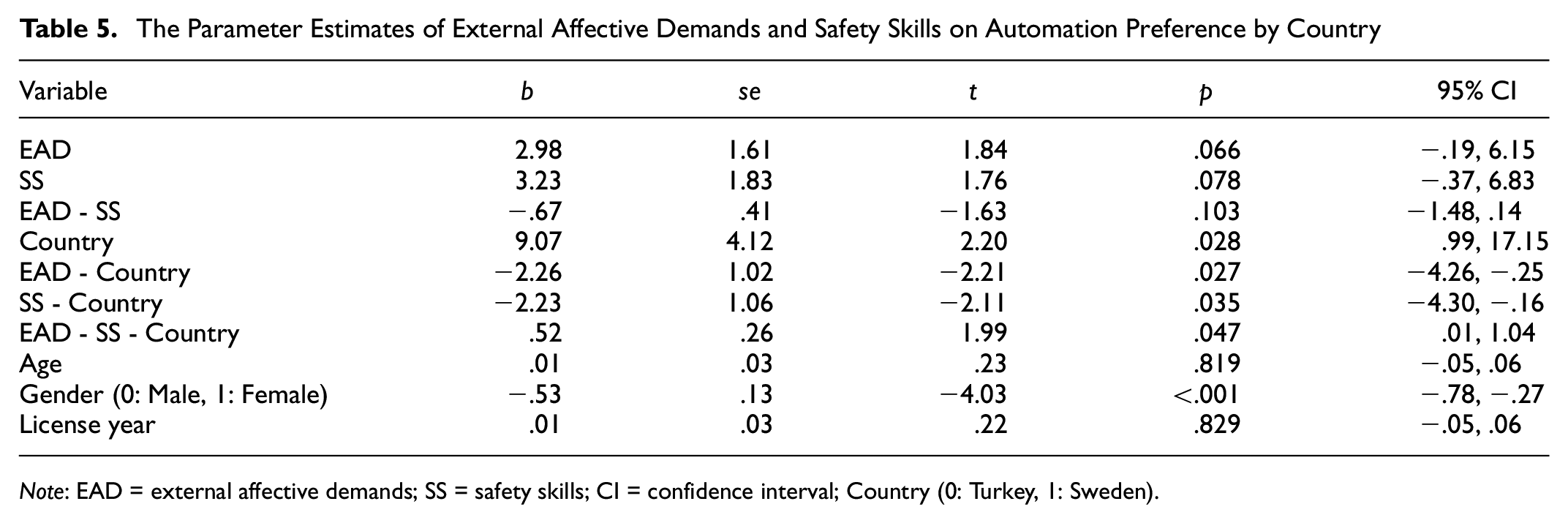
Note: EAD = external affective demands; SS = safety skills; CI = confidence interval; Country (0: Turkey, 1: Sweden).
Discussion
In the present study, individual (driver skills) and country-level (traffic climate) factors affecting the preferred level of vehicle automation of drivers from Turkey and Sweden were studied. In this context, first, the differences were examined between Turkey and Sweden for the preferred level of vehicle automation. Subsequently, the roles of country, traffic climate, and driver skills in the preferred level of vehicle automation were examined.
The first aim of the current study was to compare the drivers’ preferred levels of vehicle automation in Turkey and Sweden. First of all, contrary to general positive attitudes toward automated vehicles reported in previous studies ( 7 , 41 ), the majority of the drivers in both countries preferred vehicles with lower levels of automation based on the distribution of preferred levels of vehicle automation across samples. In other words, although, when each level was examined separately, drivers expressed positive attitudes toward vehicles with higher levels of automation, the preference was more concentrated to lower levels of vehicle automation when they were requested to prefer one from options. Various studies have reported some potential technical problems that might result in accidents with automated vehicles ( 41 , 42 ). For example, traffic safety, technical unreliability, and moral dilemma have been reported to be the top three concerns of road users ( 41 ). Similarly, in another study ( 43 ), Portuguese drivers mostly preferred publicly available vehicles, which correspond to SAE levels 0 to 2, compared with vehicles with higher automation from level 3 to level 5. Moreover, in Turkey, Bıçaksız et al. ( 44 ) found that drivers mainly accepted vehicles with lower levels of automation. Similarly, in the present study, a significant proportion of the drivers preferred vehicles with lower levels of automation and which were also present on the roads in both countries.
Furthermore, similar to a previous study by Bıçaksız et al. ( 44 ), high automation was the least preferred type of vehicle. Highly automated vehicles could be the least preferred given the uncertainty created by the automated system and take-over requests and also limited capacity compared with fully automated vehicles. Together with the higher preference toward lower levels of automation, supporting the previous findings ( 12 , 41 ), it could be suggested that drivers may want to have a certain level of control over the vehicle and driving and might also want to proactively decrease uncertainty. For example, drivers who enjoy driving may like to have control over their vehicles. Supporting previous studies ( 7 , 12 , 41 , 45 ), significant country differences were determined in the preferred level of vehicle automation. Drivers from Turkey preferred higher levels of vehicle automation than drivers from Sweden. Various factors, some of which are discussed in the present study, could be associated with that difference.
The second aim of the current study was to examine the association between drivers’ preferred levels of vehicle automation and traffic climate and driver skills across Turkey and Sweden. The dimensions of traffic climate did not show significant direct effects on the preferred level of vehicle automation except for external affective demands in Turkey. Drivers who perceived the traffic system in Turkey to be more externally demanding also preferred vehicles with higher levels of automation. External affective demands are related to characteristics of the external driving environment and are associated with dangerous and chaotic situations ( 28 , 30 ). Qu et al. ( 8 ) indicated that drivers perceiving the traffic system as less emotionally demanding are more concerned about the problems caused by automated systems. Similarly, in the present study, drivers perceiving the traffic system as more externally demanding may prefer higher levels of automation considering the potential benefits for the traffic system by focusing on various functions and capabilities of vehicles with higher automated systems. In other words, those functions and benefits might be perceived as a way to overcome the extra demands coming from the external driving environment.
Perceptual-motor skills were negatively associated with the preferred level of vehicle automation in both countries. In other words, drivers with lower levels of perceptual-motor skills preferred higher levels of vehicle automation. Perceptual-motor skills focus on technical skills such as controlling the vehicle ( 21 ). From that point of view, drivers who perceive themselves as skillful in their vehicle control and other technical abilities while driving preferred vehicles with lower levels of vehicle automation. Similarly, Özkan et al. ( 46 ) found that drivers may resist using in-vehicle technologies that may result in losing control over driving. Navarro ( 2 ) also showed that as the level of vehicle automation increases, the need for driver skills and driver control over driving decreases. Considering these, drivers who were confident about their perceptual-motor skills may not prefer driving vehicles that offer lower control over driving.
In contrast, drivers with lower levels of perceptual-motor skills may prefer higher levels of vehicle automation because of the possible compensatory role of the automated system for their perceived lack of skills. Navarro ( 2 ) also stated that, with the increased level of vehicle automation, systems would take some of the driving tasks from drivers. By driving vehicles with higher levels of automation, drivers may be able to ease some of the driving duties. In other words, if drivers perceive themselves to be lacking some technical skills or unable to handle certain aspects of driving, automated systems could help to fill that gap.
Contrary to the negative association between perceptual-motor skills and the preferred level of vehicle automation, safety skills were positively associated with the preference toward higher levels of vehicle automation in Turkey. In other words, drivers with higher levels of safety skills also preferred vehicles with higher levels of automation. Similarly, Özkan et al. ( 46 ) also reported positive associations between safety skills and positive attitudes toward intelligent speed adaptation systems. The proposed safety benefits of automated systems ( 42 ) could play an essential role. For example, in a study by Hagl and Kouabenan ( 47 ), drivers reported higher risk controlability and a lower chance of being involved in an accident when using advanced driver-assistance systems.
The three-way interaction model tested to examine the third aim showed only for the external affective demands, safety skills, and country. For drivers from Sweden with lower safety skills, higher external affective demands were associated with preferring lower levels of automation. This finding is the opposite of the relationship between safety skills and external affective demands in Turkey. However, considering the traffic safety and climate differences between the two countries where the traffic climate in Sweden was perceived to be more functional and less demanding ( 29 ), even though the direct relationships between both variables were not significant in Sweden, the significant interaction effect might indicate that further research is needed to understand the dynamics between this interaction. Additionally, the lack of significant interaction effects as opposed to various direct effects might be an indicator of these variables affecting the preferred level of vehicle automation in two separate ways depending on the country.
A few critical limitations should be mentioned in the present study. First, although the results presented significant associations, the total explained variances were relatively small. The findings should be interpreted considering these, and future improvements in the models might be needed. Moreover, the study was conducted with only university students, and there was also a considerable difference in age and experience between the samples from Turkey and Sweden. From this point of view, the comparison of the findings with more representative groups in a wider age range, taking into account other demographic variables such as income that may affect automated vehicle preferences, seems to be important for the generalizability of the results. Additionally, previous studies have found differences between drivers and non-drivers in various aspects of automated driving ( 8 , 12 ). Non-drivers had more concerns about automated driving than drivers ( 8 ). The samples of the present study consisted of drivers, so examining the findings with different groups may provide more detailed and comprehensive results for the future of automated vehicles. Finally, some of the participants received course credit for their participation in the study which might be an additional motivation factor for their participation. However, considering that data were collected anonymously and the outcome measures were not performance measures such as rewarded memory task ( 48 ), it is reasonable to assume reward or motivational difference had little or no impact on the results.
The findings of the current study also have some important theoretical and practical implications for the research and marketing of automated vehicles. Driver skills have been found to be an important factor for the preferred level of vehicle automation. Similar to the discussion of Hohenberger et al. ( 11 ) on promoting positive emotions and reducing negative emotions, the findings related to driver skills could be used to promote the future use of automated vehicles. Focusing in particular on the safety aspects of automated vehicles and potential contributions to perceptual-motor skills might result in positive attitudes toward higher levels of automation. However, more emphasis on not needing drivers or drivers’ technical skills may have negative consequences, especially for drivers with higher perceptual-motor skills. Additionally, drivers’ inferences with higher levels of automated vehicles could play a crucial role in the future use of the vehicles.
Besides, skill degradation might be one of the important challenges of automated systems ( 49 ). With the increased level of vehicle automation, a gradual decrease in driver skills might be expected ( 2 ), and skills needed to operate in the traffic system may change over time with the different capabilities of automated systems ( 2 , 50 ). Based on that assumption, there might be a need for special training focusing on special driver skills ( 50 ). Therefore, crucial changes in the internal requirements dimension of the traffic climate, the perceptual-motor skills required to operate different automation levels, and general item content of DSI could be observed. For example, some additional items such as “successfully take over and stabilize the vehicle” and “continuing to monitor the environment for potential risks while the system has control of the vehicle” might be added depending on the levels of automation.
Noy et al. ( 42 ) discussed that there might be considerable changes in the traffic system with the inclusion of automated vehicles. For example, Alessandrini et al. ( 3 ) reported particular benefits of automated vehicles for elderly road users and road users with mobility impairments, which might increase the number of privately owned vehicles. In contrast, Stoiber et al. ( 51 ) reported that most of the participants would prefer pooled use and shuttles over privately owned fully automated vehicles. The ability to order automated vehicles might increase pooled vehicles and decrease the use of private vehicles. Either way, it is believed that the implications of automated vehicles will have a gradual but substantial impact on the traffic climate of any country.
While the traffic climate is seen as an important factor in Turkey, the lack of a significant effect in Sweden may be related to the traffic system in Sweden being safer. For both self-reported measurements ( 29 ) and road safety statistics ( 36 ), the traffic system in Sweden is seen as less demanding, more functional, and safer compared with Turkey (and many other countries in the world). For this reason, the possible benefit of higher levels of vehicle automation for the traffic system may be more obvious for road users in Turkey, while the possible benefit to traffic climate for road users in Sweden may not have a significant effect. For the marketing of autonomous vehicles, focusing on the benefits of these vehicles to the general traffic climate for road users may have a stronger effect in Turkey than a similar campaign in Sweden. On the other hand, different factors may be more important in this respect for road users from Sweden.
Conclusions
In conclusion, Ashkrof et al. ( 52 ) stated that different factors such as the demographic characteristics of road users might have impacts on the acceptance of automated vehicles. Overall, in contrast to Sweden, vehicles with higher levels of automation were more preferred in Turkey. Driver skills had a crucial role in the preference toward certain levels of vehicle automation. Drivers who evaluate themselves as having lower levels of perceptual-motor skills and higher levels of safety skills or drivers perceiving the traffic system to be highly externally demanding preferred vehicles with higher levels of automation. In addition, the traffic climate might play a specific direct or indirect role in automation preferences depending on the country. The findings of the present study showed that micro- and macro-level variables have crucial relationships with the preferred level of vehicle automation.
Footnotes
Authors Note
This study is a part of the doctoral dissertation of the corresponding author.
Author Contributions
The authors confirm contribution to the paper as follows: study conception and design: İbrahim Öztürk, Henriette Wallén Warner, Türker Özkan; data collection: İbrahim Öztürk, Henriette Wallén Warner, Türker Özkan; analysis and interpretation of results: İbrahim Öztürk, Henriette Wallén Warner, Türker Özkan; draft manuscript preparation: İbrahim Öztürk, Henriette Wallén Warner, Türker Özkan. All authors reviewed the results and approved the final version of the manuscript.
Declaration of Conflicting Interests
The author(s) declared no potential conflicts of interest with respect to the research, authorship, and/or publication of this article.
Funding
The author(s) disclosed receipt of the following financial support for the research, authorship, and/or publication of this article: This study was funded by the Swedish Institute (SI) during the first author’s scholarship period at the Swedish National Road and Transport Research Institute (VTI).
