







Abstract
Cell phone use while driving (CUWD) is an underreported contributor to crashes in the U.S.A. Although research indicates that the public is at least somewhat aware of its risks, law enforcement officers’ beliefs have been understudied. Officers’ attitudes are important for the following reasons: they influence citation rates; enforcement of the law is necessary to change driver behavior; and officers have experience and knowledge with respect to CUWD that the public may not. Ohio law enforcement officers (N = 1,549) were recruited via convenience samples from multiple agencies in May 2019. We were primarily interested in officers’ support for legislative strategies and their perceptions of barriers to enforcing the law. We also assessed how they prioritized the enforcement of laws restricting CUWD relative to common automobile offenses, the level of risk they assigned to CUWD, and their estimation of CUWD frequency among Ohio drivers. We found that officers supported stronger enforcement of laws restricting CUWD (i.e., preferring primary to secondary enforcement) and viewed CUWD as risky and prevalent. Officers frequently cited secondary enforcement as an obstacle to enforcing laws restricting CUWD. Officers were less supportive of secondary enforcement in relation to CUWD because it is a less-effective version of regulation; their support for secondary enforcement was even lower if they supported primary enforcement. Drivers and policymakers may need to be educated about the problems secondary enforcement poses for law enforcement and be made aware that officers support stronger enforcement, including primary methods.
Keywords
In 2018, over 36,000 people died in automobile crashes in the U.S.A. At least 8% of these deaths were associated with driver distraction ( 1 ). Cell phone use while driving (CUWD) makes crashes three times more likely ( 2 ). It causes poorer reaction times, hazard detection, lane control, and speed maintenance and, ultimately, greater crash risk ( 3 – 6 ). The public appear aware of the dangers of CUWD and support laws restricting it ( 7 – 9 ).
However, citations of cell phone use have appeared to lag behind public support ( 10 ). Support among law enforcement officers has been understudied but is important for several reasons. First, officers have a wide degree of latitude in traffic enforcement, and their beliefs about it predict their enforcement activity ( 11 – 13 ). Furthermore, high-visibility traffic enforcement influences driver behavior; without enforcement, laws are less successful ( 14 – 17 ).
Second, distracted driving is underreported—crash reports and laws differ by jurisdiction ( 3 ), so crash data give an incomplete view of the risks of distracted driving. Law enforcement officers may have more knowledge of driver distraction because they observe typical driver behavior more and have greater experience of crashes. Indeed, in research demonstrating officers’ accuracy in identifying factors contributing to crashes, they more frequently cited distracted driving as a contributor to crashes than the reasons reported in crash data ( 18 ). This suggests that officers may have experience of causes of crashes that are not captured in crash reports, which leads them to view distracted driving as a more serious problem than members of the public. Consequently, law enforcement officers’ policy support for restricting cell phone use may be particularly informative because officers may base their attitudes on information they have obtained that is not captured in crash reports.
Finally, relative to the public and policymakers, law enforcement officers are more likely to have experienced difficulties with current policies. For example, lack of time and support from prosecutors and judges are cited as common barriers to enforcing impaired driving laws ( 11 ) and traffic laws in general ( 13 ). Identifying these barriers is important because they reduce officers’ motivation and ability to enforce laws.
However, few studies have been conducted with respect to enforcement of restrictions concerning distracted driving. Studies have been qualitative ( 19 , 20 ) or involved only a relatively small number of officers ( 18 , 21 ). Building on this previous research, we recruited a large sample of Ohio law enforcement officers. We asked them to rank several traffic enforcement priorities to report their support for various potential laws that would reduce distracted driving (e.g., primary versus secondary enforcement, levels of fines and points, etc.). The intention was to evaluate their perceived risk of dangerous driving behaviors, and to estimate their perceived prevalence of distracted driving. We reasoned that these two factors would be important predictors of support for stronger enforcement, because they parallel the severity and susceptibility that predict behaviors and support for enforcement among drivers ( 9 , 22 ).
Method
Participants
The participants consisted of 1,549 officers recruited from the Ohio State Highway Patrol, the Ohio County Sheriff’s Office, and local (e.g., city or township) police departments between May 6 and June 7, 2019 (Appendix A). The Ohio State Highway Patrol shared the survey link via their internal portal, which reaches all of their approximately 1,600 officers, most of whom completed the survey (∼66%). Professional organizations sent emails to their members, and we used publicly available contact information to approach police and County Sheriff’s departments in underrepresented areas. Sixty-one (69%) of Ohio’s 88 County Sheriff’s offices were represented by at least one respondent in our sample and 50 out of 88 counties (57%) had police respondents. Officers were informed about the non-incentivized 10-minute survey before choosing to continue. The Ohio State University Institutional Review Board determined the research was exempt (Protocol 2019E0502).
Procedure
Law enforcement officers were asked to indicate their support for various strategies to reduce distracted driving, report their beliefs about obstacles to enforcing CUWD laws, state their priorities with regard to CUWD law enforcement relative to traditional traffic violations (such as speeding or drink driving), and estimate their perceived frequency of CUWD. In addition, they answered questions concerning the perceived risks of CUWD and other dangerous driving behaviors. To encourage participation, we did not assess demographics because these would constitute identifying information for officers from small departments (i.e., female officers or those who are members of racial minority groups). In previous research, demographic variables were not associated with officer attitudes or perceived barriers ( 21 ) and, thus, would not have provided much useful information in this case, but could have discouraged participation.
Measures
Measures are reported here in the order that they appeared for participants. Full question wordings are available at https://osf.io/wztne.
Officer Characteristics
We asked officers to provide the following: department; work ZIP code; years in the job (e.g., 0–10 years, 11–20 years, 21+ years); and time on traffic duty (e.g., 0–4 hours/week, 5–28 hours/week, 29+ hours per week).
Support for Enforcement of Restrictions on CUWD
Our main outcome variable was support for enforcement of restrictions on CUWD. We selected enforcement policies based on previous research investigating support for enforcement of restrictions on CUWD among drivers ( 9 ) and taking into account penalties for traffic crimes (e.g., fines, points) that could hypothetically be applied to distracted driving. Participants indicated support for six potential enforcement policies for reducing the prevalence of CUWD, including primary and secondary enforcement of restrictions to reduce distracted driving. Participants provided their responses using a scale from “Strongly opposed” (1) to “Strongly in favor” (6). In addition, participants indicated preferred monetary fines (in $100 increments) and license points (0–4) for first and repeated instances of CUWD. We transformed scores to range from 1 to 6 and averaged them to create an index, in which higher scores indicated greater support for stronger enforcement of restrictions to reduce distracted driving. We analyzed support for secondary enforcement separately, because this was the current law in Ohio for adults. Consistent with this decision, greater support for secondary enforcement related to lower support for the other policies.
Enforcement Priorities
All respondents were then asked to rank their priorities in relation to five areas of traffic enforcement that consistently emerged as key targets for enforcement identified by our law enforcement consultants and in other research (17): “Seat belt use”; “Cell phone use while driving”; “Drink driving”; “Drugged driving”; and “Speeding.” Thus, participants scored each enforcement area from “Most important” (1) to “Least important” (5), similar to previous work ( 11 ).
Perceived Prevalence of CUWD
As in previous research ( 9 ), participants estimated the prevalence of CUWD in Ohio using a sliding scale from “0% or (never)” to “100% (every trip).” They gave estimates for four driving situations: “While the car is in motion”; “At a stop sign or stoplight”; “On residential streets”; and “On highways.” These items were averaged to form an index of perceived prevalence.
Risk Perceptions
Participants estimated the risk to the average Ohio driver engaging in CUWD “While the car is in motion,”“At a stop sign or stoplight,”“On residential streets,” and “On highways” using six-point verbal scales from 1 = “Not at all risky” to 6 = “Extremely risky.” These responses were averaged to form an index of CUWD risk perception as in previous research ( 9 ) in which higher scores indicated greater perceived risk.
Measurement of Obstacles to Enforcement
In consultation with police officers and chiefs, County Sheriffs and deputies, and the Ohio State Highway Patrol, we presented officers with four obstacles that consistently emerged: “Distraction is a secondary offense for adults,”“Cannot tell if a driver is under 18 to pull over for distracted driving,”“Laws differ by jurisdiction,” and “Difficult to prove driver distracted.” Officers could select multiple obstacles and were also given the option to describe additional obstacles.
Analysis Strategy
Data analysis was conducted using SPSS version 27. With regard to overall support for enforcement of restrictions on CUWD, perceived prevalence, and risk perceptions, participants responded to multiple items that were averaged into indices. We intended these items to be intercorrelated, unidimensional measures of these concepts. To check that items were sufficiently intercorrelated, we used Cronbach’s α ( 23 ) cutoff of .80 ( 24 ). To understand which variables were predictors of support for stronger enforcement of restrictions on CUWD, and whether they differed by department, we performed linear regression analyses on our main outcome variable: support for overall enforcement of restrictions on CUWD and support for secondary enforcement. The model included CUWD risk perceptions, enforcement priority, perceived prevalence, department, sum of obstacles selected, weekly time spent enforcing traffic laws, and years of enforcement experience.
Results
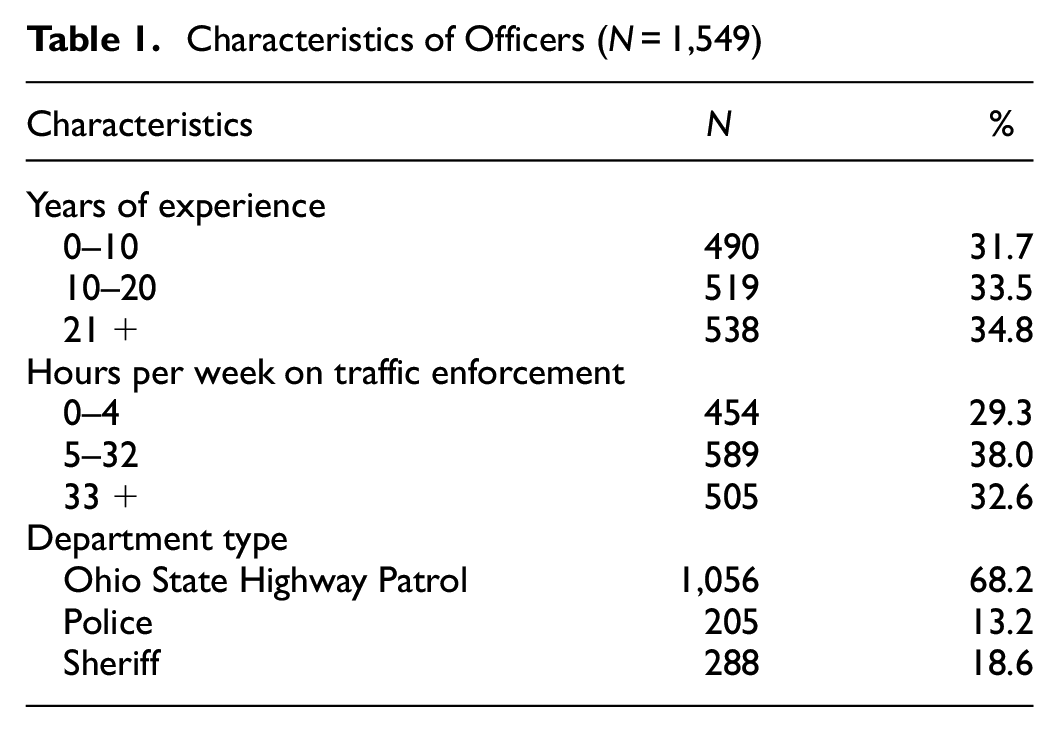
Officers averaged about 16 years of experience, with 35% reporting 21 or more years in the force. Most spent at least five hours per week on traffic enforcement (70.6%). More officers came from the Ohio State Highway Patrol (68.2% of sample) than other departments (Table 1).
Characteristics of Officers (N = 1,549)
Descriptive statistics appear in Table 2. The majority of officers (94.1%) supported primary enforcement of restrictions to reduce distracted driving; only half (50.5%) supported secondary enforcement, which was the current law at the time in Ohio for adults.
Officer Descriptive Statistics
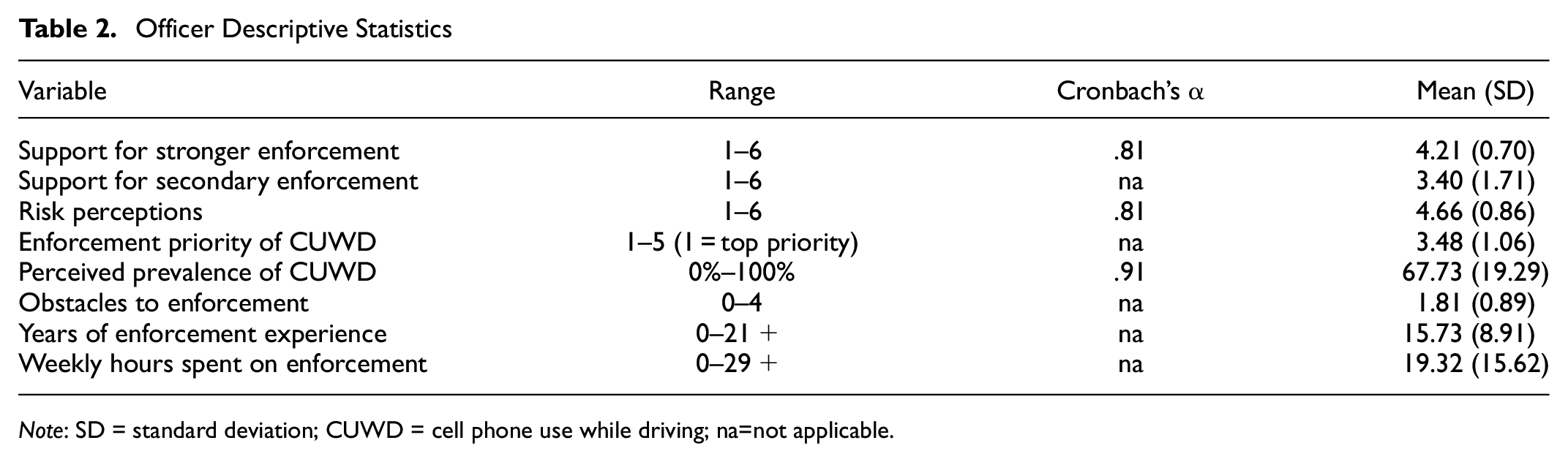
Note: SD = standard deviation; CUWD = cell phone use while driving; na=not applicable.
Most officers (79.8%) indicated that because distracted driving was a secondary offense, this was a barrier to them enforcing the law (Table 3). All but 15 officers (1%) selected at least one barrier; most (56%) selected two or more.
Number and Proportion of Officers Who Support Policies and Who Have Experienced Barriers
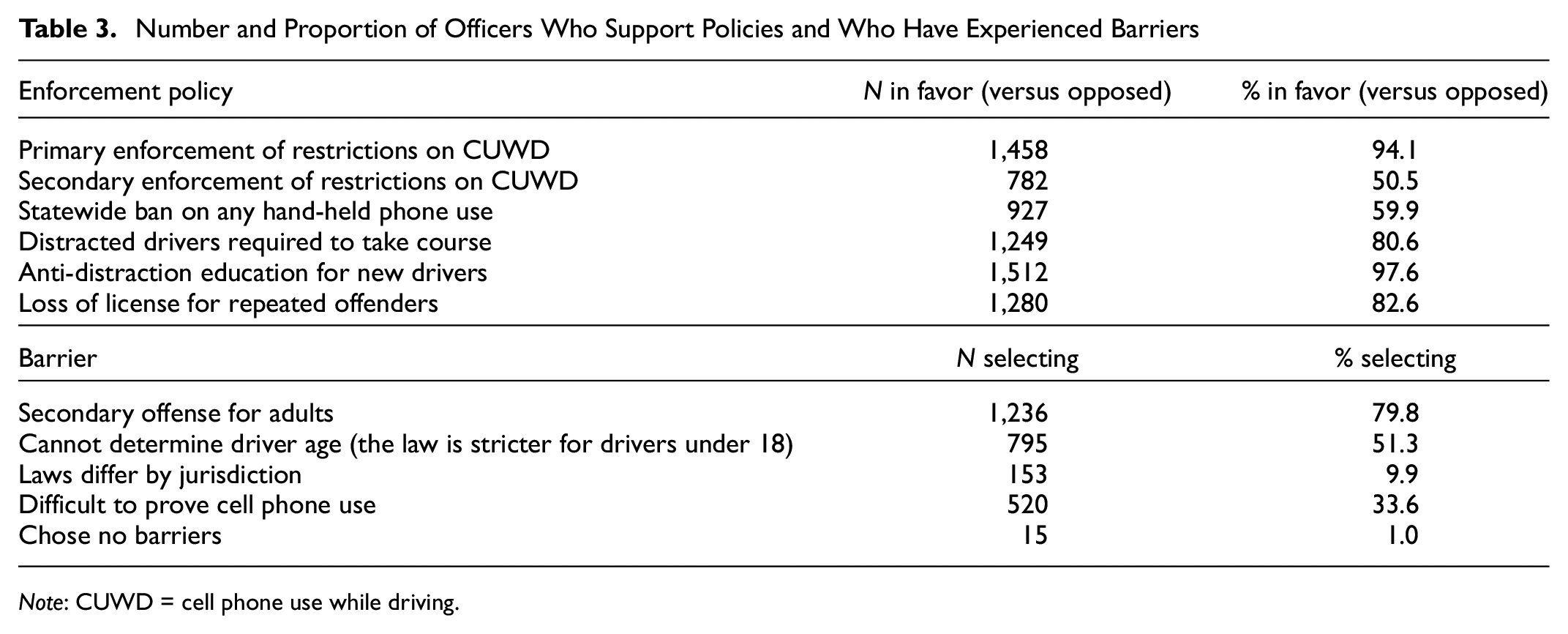
Note: CUWD = cell phone use while driving.
Officers who supported stronger enforcement of restrictions on CUWD across five potential enforcement policies had more years of enforcement experience, perceived distracted driving as riskier and more prevalent, placed a higher priority on CUWD relative to other traffic safety issues (i.e., a lower number), and perceived more obstacles to enforcing the current law (Table 4).
Linear Regression Results of Enforcement of Restrictions on CUWD as Predicted from Officer Characteristics
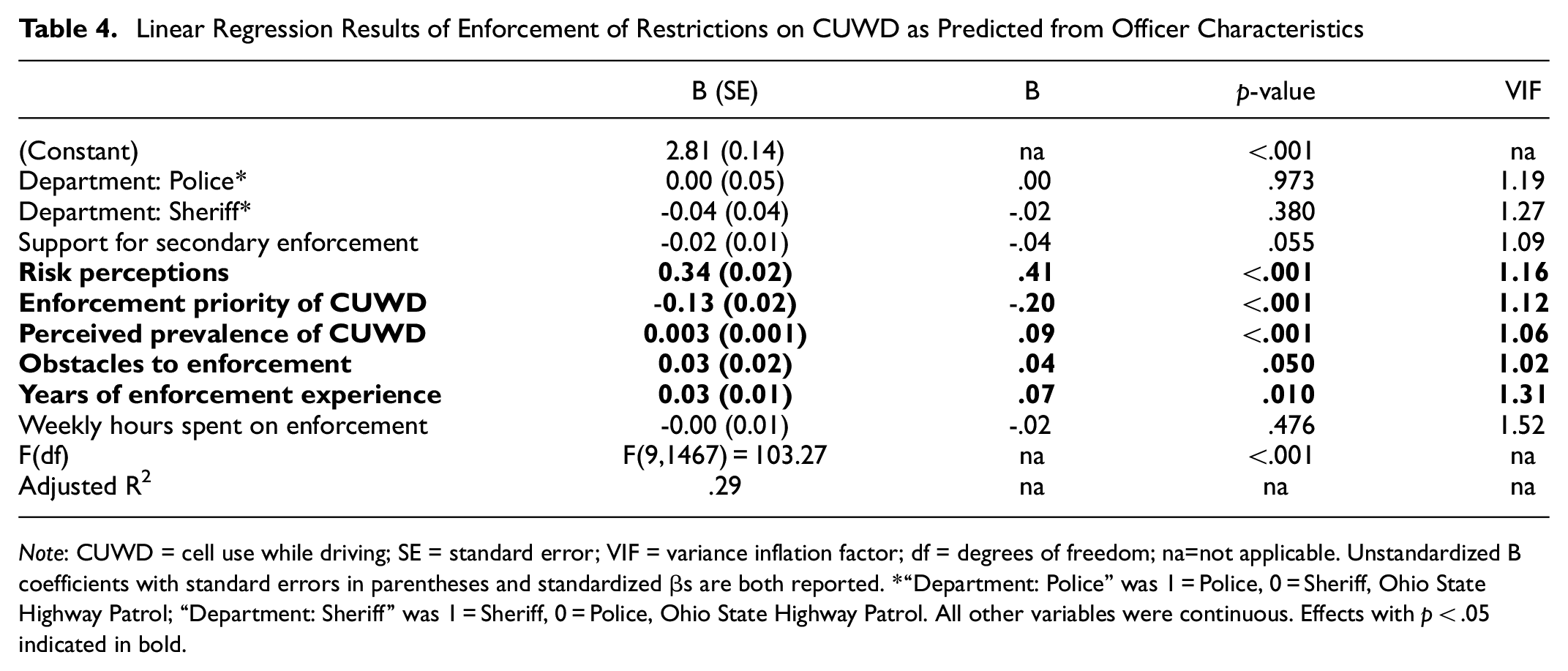
Note: CUWD = cell use while driving; SE = standard error; VIF = variance inflation factor; df = degrees of freedom; na=not applicable. Unstandardized B coefficients with standard errors in parentheses and standardized βs are both reported. *“Department: Police” was 1 = Police, 0 = Sheriff, Ohio State Highway Patrol; “Department: Sheriff” was 1 = Sheriff, 0 = Police, Ohio State Highway Patrol. All other variables were continuous. Effects with p
Discussion
Using large online convenience samples of Ohio law enforcement officers in which the majority of officers responded to our survey, the participants identified at least one barrier to enforcement of restrictions on CUWD, and supported stronger policies to reduce distracted driving (including primary enforcement). Secondary enforcement itself was the most prevalent barrier to enforcement of restrictions (79% of officers selected it as a barrier) and roughly 50% were opposed to secondary enforcement, even though in Ohio at the time CUWD was a secondary offense for adults. Officers with more law enforcement experience tended to have more support for stronger enforcement and less for secondary enforcement. Beliefs were also important—officers who supported more enforcement perceived CUWD as riskier and more prevalent and rated it as a higher priority for enforcement.
In contrast to support for stronger enforcement of other policies, support for secondary enforcement was higher for those with less experience of traffic enforcement and who gave a lower priority to CUWD enforcement. Risk perceptions and prevalence of CUWD did not predict support for secondary enforcement. Respondents from the County Sheriff’s and police departments indicated higher support for secondary enforcement relative to the Ohio State Highway Patrol (see Appendix Table 1 for correlations and Appendix Table 2 for linear regression analysis).
Additionally, in this research, we focused on Ohio law enforcement officers because we were confident in our ability to reach many of them and achieve a response rate that would mitigate concerns about self-selection relative to national surveys with lower response rates. Other research on law enforcement has shown a state’s laws influence identification of barriers; thus, our officers are likely to have identified more obstacles specifically because the current Ohio law included two barriers to enforcement that were documented in other research (i.e., teen driver bans and secondary enforcement) ( 21 ). The characteristics of Ohio officers that related to support for enforcement and identification of barriers (i.e., professional experience and beliefs about risks and prevalence) would also probably predict officers’ support for enforcement in other states. Similar investigations conducted in other states would be beneficial to understanding the attitudes of traffic enforcement officers outside of Ohio and the effects of variation in laws across jurisdictions on beliefs about the risks and prevalence of CUWD.
Unlike previous research ( 19 – 21 ), Ohio officers did not identify the most frequent barrier as being the difficulty of identifying distracted drivers or proving driver distraction. It could be that a more explicit item (e.g., “Drivers concealing cell phone use”) would have increased the number of officers reporting this as a barrier, or perhaps Ohio drivers did not bother concealing distraction because of permissive laws—officers estimated that Ohio drivers are quite distracted (Appendix A). Another difference is the lack of support for a hands-free law (i.e., one that would restrict cell phone use to hands free and punish drivers for holding phones in their hands). Sixty percent of Ohio law enforcement officers as opposed to 86% in a national sample of officers ( 21 ) supported a hands-free law. Ohio officers commenting on the survey suggested that the law on hand-held phones ignores other distracting behaviors (e.g., interacting with dashboard systems) and that drivers could also have been reacting negatively to the word “ban,” which previous research has identified as a term that reduces support among drivers ( 9 ). Taken together, the available research suggests that officers experience many barriers to enforcing restrictions on CUWD, and that the barriers depend on state law and officer experience.
Policymakers and drivers may need to be educated about the problems posed by secondary enforcement in relation to law enforcement. Support for current secondary enforcement was fairly low among law enforcement officers, and a majority of them identified it as a barrier to enforcing the law. Additionally, nearly all officers supported stronger primary enforcement. Furthermore, because officers have first-hand experience of causes of crashes that could be underreported, such as driver distraction ( 18 ), their risk perceptions and support for enforcement should carry special weight because they have access to information that may not be captured in other data (e.g., crash reports). This information may help policymakers understand barriers to enforcing current laws, particularly secondary enforcement. As law enforcement buy-in is necessary for drivers to change their behavior successfully ( 14 – 17 ), policymakers can also be confident that stronger enforcement is supported and will be enforced by officers. Because officers support stronger enforcement, this suggests they believe that crashes could be prevented by strengthening the law.
Limitations
Although our sample is larger than other surveys of officers’ opinions on CUWD ( 18 , 21 ), our results are similarly limited by the use of convenience samples. Although most of the Ohio State Highway Patrol participated, and most County Sheriff’s departments were represented (Appendix A), our sample of police officers may not represent all police departments, particularly smaller departments in rural areas. Moreover, because officers chose to participate, our sample may perceive traffic safety to be more personally important than those who did not participate.
In addition, in an effort to keep the survey as short as possible, we were not able to measure some variables. For example, it could have been useful to know how much each obstacle impeded law enforcement or which obstacle officers identified as the most important. In addition, we did not assess departmental norms or supervisor beliefs or priorities, which are important predictors of which laws officers will enforce ( 12 , 13 ). In addition, we did not assess knowledge (e.g., of crash data, state laws, etc.) or current levels of enforcement (e.g., numbers or warnings and tickets issued under current law). Finally, because we explained 29% of variance in support for enforcement of restrictions on CUWD as opposed to only 8% of the variance in support for secondary enforcement, this is further evidence that more research is needed to identify variables that lead to support for less strict enforcement.
Conclusions
Overall, we found that Ohio law enforcement officers support the enforcement of restrictions on CUWD and view CUWD as risky and prevalent. Officers frequently cited secondary enforcement as an obstacle to enforcing the law with regard to CUWD and supported secondary enforcement less than primary enforcement. Policymakers and drivers may need to be educated about the problems secondary enforcement poses for law enforcement and be made aware that officers support stronger primary enforcement. Stronger laws, along with high visibility of law enforcement officers and frequent enforcement could improve traffic safety and save lives ( 17 , 25 ).
Supplemental Material
sj-docx-1-trr-10.1177_03611981221134625 – Supplemental material for Barriers to Enforcing Laws and Support for Restricting Cell Phone Use While Driving among Law Enforcement Officers
Supplemental material, sj-docx-1-trr-10.1177_03611981221134625 for Barriers to Enforcing Laws and Support for Restricting Cell Phone Use While Driving among Law Enforcement Officers by Brittany Shoots-Reinhard, Hayley Svensson, Mason Shihab, Ellen Peters and Motao Zhu in Transportation Research Record
Footnotes
Acknowledgements
We would like to thank the Buckeye Sheriff’s Association, the Ohio Chiefs of Police, the Ohio State Highway Patrol, and the Ohio Governor’s Office for their assistance with recruiting participants. In addition, our thanks go to the Ohio Distracted Driving Task Force, several law enforcement officer consultants, the Ohio State’s Decision Psychology research colloquium, and two anonymous reviewers for comments and suggestions.
Author Contributions
The authors confirm contribution to the paper as follows: study conception and design: B. Shoots-Reinhard and E. Peters; data collection: B. Shoots-Reinhard; analysis and interpretation of results: B. Shoots-Reinhard, E. Peters, H. Svensson, M. Shihab, M. Zhu; draft manuscript preparation: B. Shoots-Reinhard, E. Peters, H. Svensson, M. Shihab, M. Zhu All authors reviewed the results and approved the final version of the manuscript.
Declaration of Conflicting Interests
The author(s) declared no potential conflicts of interest with respect to the research, authorship, and/or publication of this article.
Funding
The author(s) disclosed receipt of the following financial support for the research, authorship, and/or publication of this article: This work was supported by grants from the Ohio Department of Transportation and the Risk Institute at the Ohio State University Fisher College of Business.
Ethics Approval
The Ohio State University Institutional Review Board determined the research was exempt (Protocol 2019E0502).

Data Accessibility Statement
Supplemental Material
Supplemental material for this article is available online.
References
Supplementary Material
Please find the following supplemental material available below.
For Open Access articles published under a Creative Commons License, all supplemental material carries the same license as the article it is associated with.
For non-Open Access articles published, all supplemental material carries a non-exclusive license, and permission requests for re-use of supplemental material or any part of supplemental material shall be sent directly to the copyright owner as specified in the copyright notice associated with the article.
