







Abstract
In Japan, following an accident wherein a visually impaired was hit by a train inside a railroad crossing, the installation of tactile walking surface indicators (TWSIs) at railroad crossings have become widespread. Attention and guiding patterns as well as escort patterns have been installed in front and inside railroad crossings, respectively. However, the extent to which the latter is more discriminable than the former has not been verified. This study determined the ease of identifying the Japanese official TWSIs and both patterns using the soles of the feet. Twenty blindfolded participants used TWSIs, scanned the raised surfaces with their soles, and responded to the type of TWSIs using three-alternative forced-choice. Compared with attention and guiding, escort patterns were misidentified with subjective sureness and long identification times. In about 90% of times that attention and guiding patterns were incorrectly identified, they were misidentified as escort patterns. The escort patterns were misidentified as attention patterns in about 70% of the times in which they were misidentified. Trials with misidentification had significantly longer identification times and lower sureness (but moderate sureness) than trials with correct identification. Approach angles to TWSIs had practically no effect on the identification. When escort patterns are installed inside the railroad crossings and attention and guiding patterns are installed outside, the visually impaired may misidentify them and accidentally enter or stay at the railroad crossing. Therefore, new installation methods to effectively identify all TWSIs, especially escort patterns, or develop new TWSIs with superior ease of identification should be verified.
Keywords
Visual information is a significant resource of sensory information that enables humans to gather the content and location of a wide range of environmental information accurately and efficiently and to determine their current location and destination orientation. When visual impairment interferes with access to environmental information, it reduces the ability to travel alone ( 1 ) and limits outings and social participation ( 2 – 6 ). Visually impaired people can travel independently using sensory information with respect to hearing, smell, kinesthesia, and touch scattered in the environment ( 7 – 10 ). However, sensory information is not always present in the same place and, therefore, is unreliable for visually impaired people while walking. Thus, some visually impaired people suffer from loss of localization, head injuries and falls ( 11 – 15 ), and hip fractures ( 16 – 18 ).
Tactile walking surface indicators (TWSIs) have attracted international attention in infrastructure development to improve the accessibility of the environment for visually impaired people. TWSIs are useful tactile cues with raised surfaces that can be detected by foot or white cane. They are permanently placed on the ground and are always in the same place, providing reliable tactile information for visually impaired people to determine their current location, destination, and the presence of danger. ISO 23599 ( 19 ), the international standard for TWSIs, defines two types of patterns: attention patterns and guiding patterns (Figure 1). Attention patterns are square grid layouts of truncated domes used to draw attention to either hazards or to hazard and decision points. Attention patterns are installed especially at the edges of railroad platforms and in front of stairways and crosswalks to avoid falls and traffic accidents ( 19 , 20 ). Guiding patterns are constructed using parallel flat-topped elongated bars. In Asian countries, including Japan, there is a prevailing view that TWSIs should provide continuous travel paths throughout the environment ( 21 ). Guiding patterns are installed on sidewalks to connect specific locations; therefore, people with impaired vision can walk independently to their destinations. These patterns can also help with precise orientation in a particular direction ( 22 – 24 ) and assist with accurate alignment and walking at crosswalks ( 25 – 27 ).
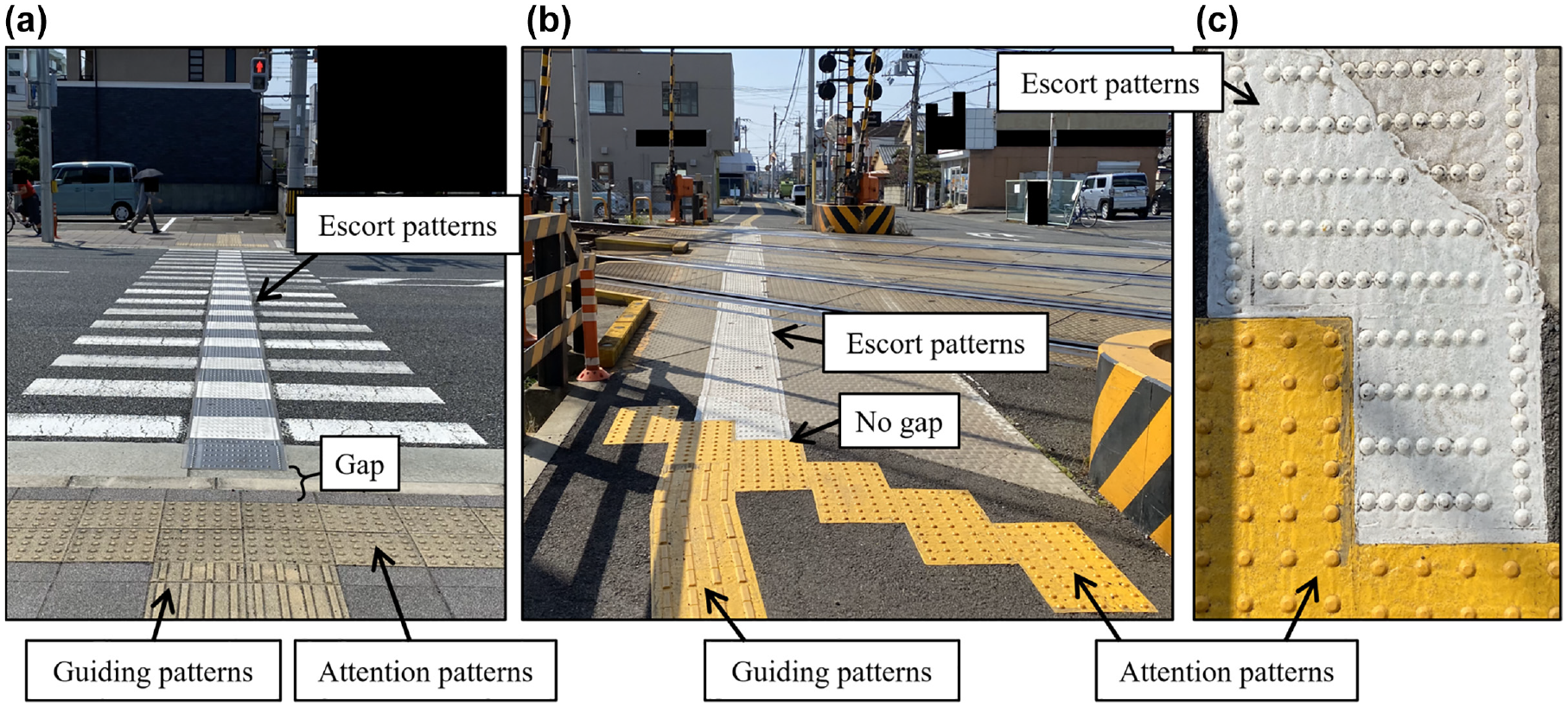
Example of installation of tactile walking surface indicators (TWSIs) at an intersection based on the guidelines of the National Police Agency in Japan. Attention and guiding patterns (yellow) are installed on the sidewalk, and the escort patterns (white and gray) are placed in the center of the crosswalk. There is a gap between the attention patterns and the escort patterns, and these are installed apart from each other at the intersection (a). Example of installation of TWSIs at a railroad crossing based on the guidelines of the Ministry of Land, Infrastructure, Transport and Tourism in Japan. Attention and guiding patterns (yellow) are placed outside the railroad crossing, and the escort patterns (white) are set straight inside the railroad crossing (b). Close-up of the connection between the escort and the attention patterns in (b). They are connected without gaps at the railroad crossing, in contrast to the installation of the intersection (c) (color online only).
Sometimes unique TWSIs that are not specified in ISO 23599 are installed for particular applications ( 21 , 28 ). In Japan, the original TWSIs in official use are escort patterns (known in Japan by the formal name “escort zones”). The escort pattern was developed by the Aichi Prefectural Police in Japan in 1997 as a new TWSI for visually impaired people to navigate safely at crosswalks ( 29 ), and its standard design and installation method are specified by the guidelines set by the National Police Agency ( 30 ). The escort pattern consists of dotted horizontal lines and vertical lines with truncated domes arranged in a ladder-like pattern toward the direction in which pedestrians are crossing. The escort patterns are installed in a straight line, in the center of the crosswalk at the intersection (Figure 1a; 30 ). Visually impaired people should be able to safely cross the street without deviating from the crosswalk by walking along the escort pattern. This is because humans have difficulty navigating accurately using only vestibular and proprioceptive sensory information, and spatial errors rapidly accumulate between actual and estimated self-locations with each step ( 31 , 32 ). Therefore, visually impaired people gradually and unconsciously turn left or right while walking straight ahead ( 33 – 35 ). This phenomenon, known as veering, is one of the causes of visually impaired people accidentally steering off the roadway in the middle of a crosswalk.
In contrast, the effectiveness of guiding patterns installed at crosswalks was tested in 1991, before escort patterns were developed ( 36 ). In this walking experiment, guiding patterns with raised bars parallel to the crossing direction were placed straight in the center of the crosswalk, and three visually impaired people and five blindfolded, sighted people were able to cross the street at the crosswalk along the guiding patterns. However, the installation of guiding patterns at crosswalks was not practical because of concerns about the loud noise and the wear of the raised lines, generated by the strong contact of the tires of vehicles entering the crosswalk with the raised bar of the guiding pattern at a vertical or near-vertical angle ( 29 , 37 ). Therefore, escort patterns were developed as new TWSIs as an alternative to guiding patterns. Because the escort pattern is ladder-shaped toward the direction in which pedestrians are crossing, the tires of vehicles entering the crosswalk can pass between the dotted horizontal lines of the escort pattern, at least with less contact than that with the raised bars of the guiding patterns. This is expected to result in lower noise and wear on walking surfaces as vehicles pass through the escort patterns. Another advantage of escort patterns is that the truncated dome is independently glued to the ground, so there is less risk of the domes becoming detached or missing compared to the raised bars of guiding patterns ( 29 ). A small-scale experiment with two visually impaired people reported that escort patterns are useful for accurate and efficient walking at crosswalks ( 37 ).
Meanwhile, in Japan, an accident in April 2022 in which visually impaired people left behind at a railroad crossing were run over by a train triggered discussions about installing TWSIs inside and outside railroad crossings ( 38 ). The railroad crossing where this accident occurred was so narrow that there was no distinction between the sidewalk and the roadway, and attention patterns (approximately 60 cm wide) were placed at four locations on either side of the road near the crossing gates. The narrow attention patterns were installed to alert visually impaired people that there was a dangerous area inside the railroad crossing ahead of the attention patterns. However, the victim did not touch the attention patterns with their foot or white cane, and passed by them and entered the railroad crossing. Immediately thereafter, an alarm began sounding to warn of an approaching train. The victim reached the attention patterns at the exit of the railroad crossing, but continued to stand in front of the crossing gate (i.e., inside the crossing) waiting for the train to pass by, and was run over by the train. Based on the victim’s behavior, the Ministry of Land, Infrastructure, Transport and Tourism (MLIT) in Japan determined that one of the causes of the accident was that the victim mistakenly believed they were outside the railroad crossing when they were actually inside. MLIT then thought that if different types of TWSIs were installed inside and outside railroad crossings, visually impaired people would be able to more reliably identify whether they were inside or outside the crossing by tactile discrimination of the type of TWSIs. In June 2022, MLIT revised the “Guidelines for Roadway Mobility Enhancement,” which stipulated the following two points ( 38 ): (1) attention patterns should be actively installed in front of railroad crossings, and at the same time, guiding patterns should be installed to guide visually impaired people to the location of attention patterns; (2) on the inside of railroad crossings, TWSIs that are different from the attention and guiding patterns should be installed. The reason for not stipulating that guiding patterns be installed inside railroad crossings was that there was a risk that they could be mistaken for guiding patterns installed outside railroad crossings. Here, the escort pattern, which had already been widely installed at crosswalks at intersections in Japan, began to attract attention as a TWSI to be installed inside railroad crossings. Immediately after the accident, the number of railroad crossings with escort patterns gradually began to increase, encouraged by the desire of visually impaired people to have TWSIs installed inside railroad crossings as soon as possible (Figure 1, b and c ).
In the rapidly changing situation, there was a discrepancy between the National Police Agency’s ( 30 ) guidelines, which set forth the standard method of installation of escort patterns on crosswalks at intersections, and the MLIT’s subsequent guidelines ( 38 ), which set forth the method of installing TWSIs at railroad crossings. The National Police Agency’s guidelines require that an escort pattern be placed at the crosswalk 30 cm away from the curb, which is the boundary between the sidewalk and roadway, and that an attention pattern be placed on the sidewalk. This ensures that the attention pattern and the escort pattern are always installed at a distance at crosswalks at intersections (Figure 1a). On the other hand, the guidelines by MLIT prescribe the method of installing attention patterns on the outside of railroad crossings and TWSIs (different types of attention and guiding patterns) on the inside, without separating them (Figure 1c). In addition, the guidelines present photographs of actual railroad crossings with escort patterns on the inside as examples of compliance with the regulation. The orientation and mobility (O&M) experts argue that if the attention and escort pattern at railroad crossings are installed without separating them, visually impaired people may not be able to discriminate these TWSIs ( 39 ). In addition, they express concerns that escort patterns placed at railroad crossings have not been tested to determine whether they help visually impaired people pass safely through railroad crossings.
ISO 23599 ( 19 ) specifies that attention and guiding patterns should be easily discriminated from each other to indicate different information: warning of danger and indication of a route. Therefore, extensive research has examined the dimensions in which attention and guiding patterns can be discriminated by visually impaired people ( 40 , 41 ). However, while the number of railroad crossings with escort patterns is increasing, it has not been verified to what extent escort patterns are identifiable as such and further discriminable from both attention and guiding patterns. If visually impaired people misidentify escort patterns inside the railroad crossing and the attention and guiding patterns outside the railroad crossing, it could cause them to remain inside or enter it. In addition, there are also higher-risk situations, such as just before a train passes a railroad crossing, where there is no time to search and compare multiple TWSIs. Therefore, it is essential to be able to scan a single TWSI and identify its type accurately and quickly.
This study aimed to determine the ease of identification of escort patterns and attention and guiding patterns, which are official TWSIs that are now beginning to be installed at railroad crossings in Japan, by carefully scanning them using the foot.
Methods
Participants
To simulate visually impaired individuals who had recently acquired visual impairment and were not accustomed to identifying TWSIs with their feet, 20 young, sighted participants (aged 21.5 ± 0.6 years old, 16 males and 4 females) wearing eye masks were recruited. Participants with normal vision were selected because artificially restricting the visual function of sighted participants allowed for uniform control of factors (e.g., age, experience with O&M training, use experience of TWSIs, and understanding about the dimension and arrangement of the raised surface) that might affect the results of this experiment. In addition, the results for the blindfolded, sighted participants can be interpreted as the performance of visually impaired people who have just lost their visual functions and have no experience in walking with TWSIs and in O&M training, and the evaluation can focus on people who have relative difficulty in tactile identification of TWSIs. Furthermore, since human tactile spatial sensitivity declines with age regardless of visual impairment ( 42 – 44 ), we can infer that if the escort patterns were difficult to identify tactilely for the younger participants in this experiment, they would be equally or more difficult to identify for the older people, who have a markedly higher prevalence of visual impairments ( 45 ). Participants with impaired or traumatic lower limb motor and tactile function were excluded. All participants had seen the attention patterns, guiding patterns, and escort patterns in a real environment and knew the placement of their raised tactile surface. However, they were not shown the experimental stimuli and were not told the sizes of the stimuli.
Differences in the thickness of the sole of the shoes worn by visually impaired people affect the identification of TWSIs since this difference can change the intensity of the tactile information that the raised tactile surface of the TWSIs provides to the soles. Therefore, in this experiment, the participants wore only athletic shoes. These shoes had been used at least once a week for over six months and were considered the most comfortable to walk in. The heel and ball of their shoes were 22.2 ± 4.6 and 9.8 ± 3.2 mm thick, respectively, without significant differences among the participants.
This experiment was conducted with the approval of the ethical review board of the Faculty of Biology-oriented Science and Technology, Kindai University (approval number: R4-2-010). All participants provided informed consent before the experiment.
Stimuli
We used three types of stimuli: escort pattern, attention pattern, and guiding pattern (Figure 2). Each stimulus was made by gluing raised dots or bars of polylactic acid (PLA) produced by a three-dimensional (3D) printer (Raise3D E2, minimum layer height: 0.02 mm, XY step size: ±0.78 μm, Raise 3D Technologies, Inc.) onto a flat acrylic plate (attention and guiding patterns: width 300 mm, length 300 mm; escort pattern: width 450 mm, length 400 mm).
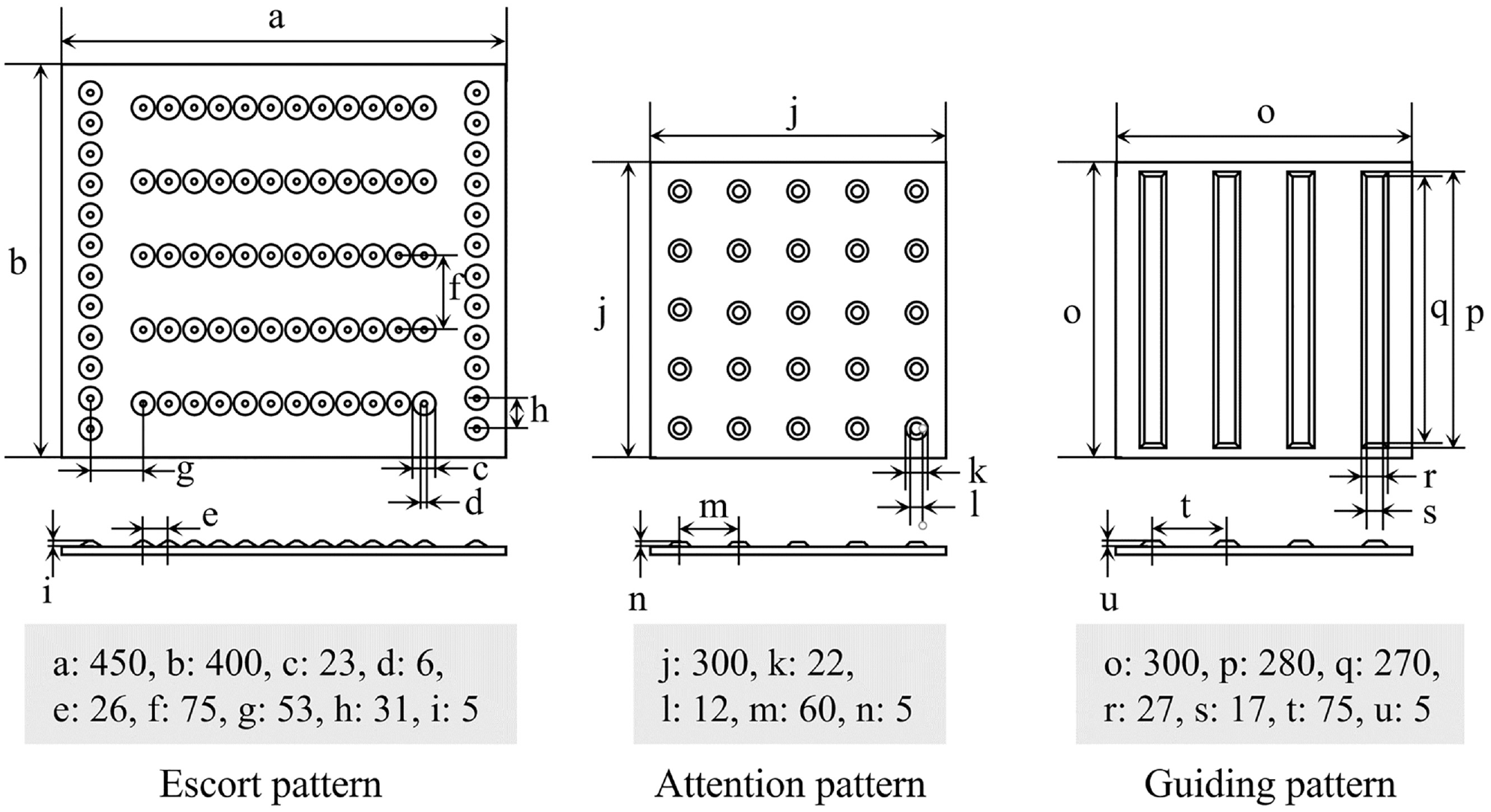
Top and side views of the stimuli used in the experiment. The numbers represent dimensions (mm).
The escort pattern was a ladder-like walking surface with two vertical dotted lines at each end and five horizontal dotted lines oriented perpendicular to these. The dotted horizontal lines consisted of 12 truncated domes (top diameter: 6 mm, bottom diameter: 23 mm, height: 5 mm) arranged with a center-to-center spacing of 26 mm. In this experiment, there were five of these dotted horizontal lines, arranged parallelly so that the distance between the long axes of each was 75 mm. In addition, two dotted vertical lines were placed 53 mm from the center of the truncated domes at the left- and right-hand ends of the dotted horizontal lines, intersecting perpendicularly with the dotted horizontal lines. Each dotted vertical line consisted of 12 domes aligned so that the center-to-center spacing was 31 mm.
In the attention pattern, 25 truncated domes (top diameter: 12 mm, bottom diameter: 22 mm, height: 5 mm) were arranged to form a square grid of 5 rows by 5 columns, spaced 60 mm apart between the centers of the adjacent truncated domes. In the guiding patterns, four flat-topped elongated bars (top width: 17 mm, bottom width: 27 mm, top length: 270 mm, bottom length: 280 mm, height: 5 mm) were arranged in parallel, spaced 75 mm apart between the long axes of the adjacent flat-topped elongated bars. The attention pattern and the guiding pattern designs were based on JIS T 9251 ( 46 ) and ISO 23599 ( 19 ), and the design of the escort pattern was based on the guidelines of the National Police Agency of Japan ( 30 ).
Experimental Variables
This experiment was a within-participant design with two factors: the type of TWSI and the approach angle to the TWSI. The approach angle was chosen as the experimental variable because it was predicted that the spatial distribution of pressure exerted on the sole by the TWSIs’ raised tactile surface would vary as visually impaired people stepped on them from different angles, potentially affecting their ability to identify the TWSIs.
The approach angles to the TWSIs were defined with two conditions (0° and 45°) for the attention pattern and with four conditions (0°, 45°, 90°, and 135°) for the guiding and escort patterns (Figure 3). The approach angle of 0° was the orientation of visually impaired people walking along these TWSIs ( 30 , 46 ). Attention patterns of symmetrical approach angles of 90° and 135° were excluded.
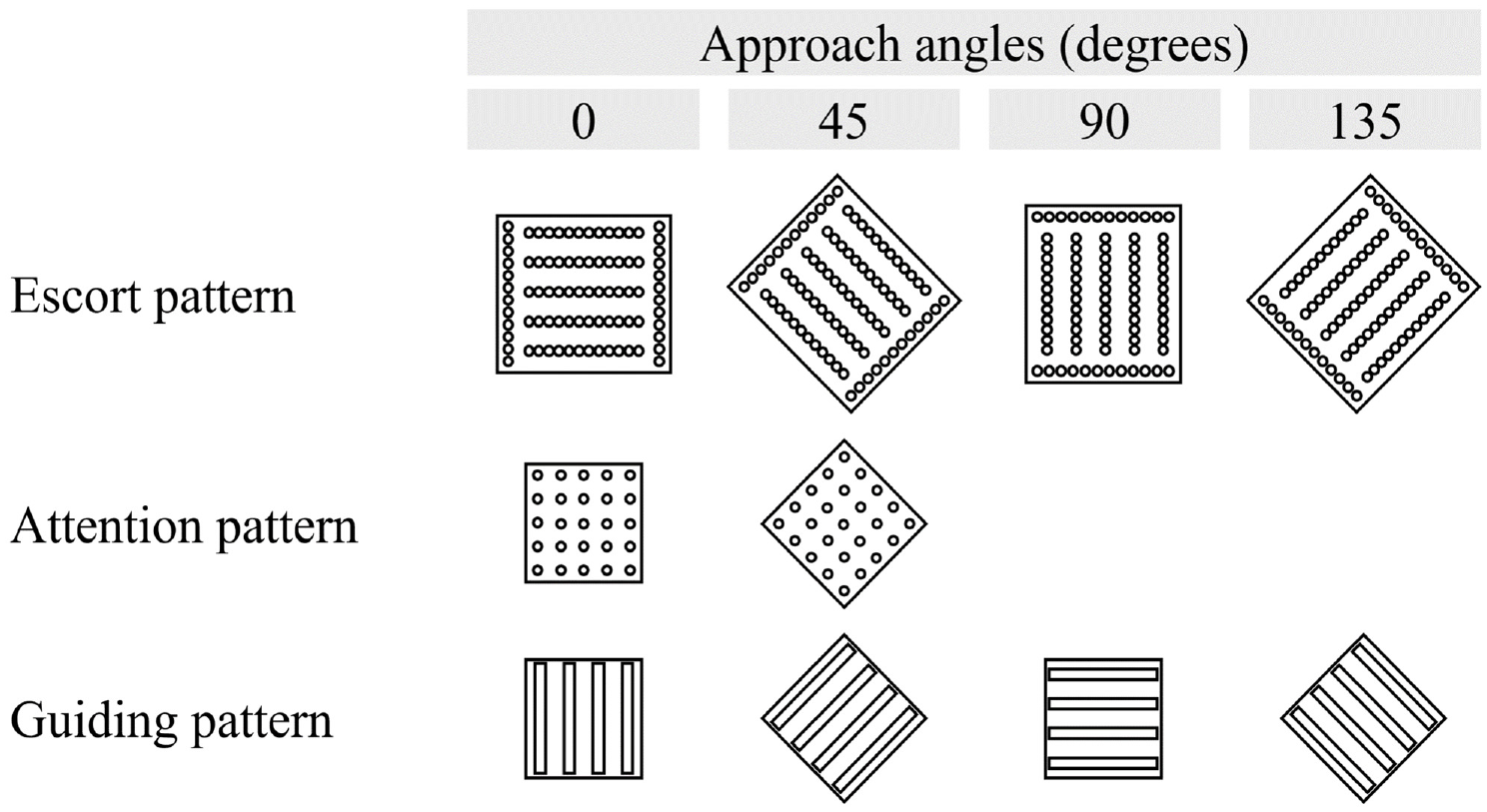
Ten experimental variable conditions were used, combining three types of tactile walking surface indicators (TWSIs) and four approach angles. Participants walked from the bottom of the image to the top and stepped on each TWSI.
Procedure
Participants wearing eye masks and athletic shoes walked to the center of a single TWSI on receiving a cue from the experimenter. They lifted their legs and moved them freely in any direction to rub or step on the raised tactile surfaces of the TWSIs with the soles of their shoes and responded as quickly as possible to the type of TWSIs by three-alternative forced choices (attention pattern, guiding pattern, or escort pattern). In addition, they rated their subjective sureness on a seven-point scale of equally spaced intervals ranging from 1 (not sure) to 7 (very sure). They could stand on each stimulus for each trial as long as they wanted until they were ready to respond with which pattern they were on, and the time they took from when they stepped on the panel to when they responded was recorded. They were prohibited from turning their bodies while scanning the TWSIs. Two hundred trials (10 experimental conditions × 20 cycles) were conducted. The order of the experimental conditions was randomized within each cycle.
Data Collection and Analysis
Firstly, the percentage of errors for each experimental condition was calculated as the error rate (%). The types of TWSIs that were mistaken for each other were counted and calculated as the error breakdown (%). Secondly, the identification time was measured using a stopwatch from the moment when the participant’s shoe contacted the TWSIs until they verbally identified the type of TWSI they thought they were on. Thirdly, the participants’ subjective sureness in their answers on a seven-point scale was recorded.
These data were summarized for each approach angle condition and each type of TWSI. In addition, the mean of the results for all approach angles for each type of TWSI was calculated to determine the ease of identification independent of the specific condition of the approach angle. In addition, for discrimination time and sureness, the results of each type of TWSI were divided into trials in which the stimuli were correctly identified and misidentified, and the differences between them were analyzed.
Significant differences in means between experimental conditions were analyzed by a corresponding t-test with Holm’s ( 47 ) correction method. When testing significant differences between trials with correct and incorrect identification for each type of TWSI, the data of the participant who never produced a misidentification was excluded. Cohen’s ( 48 ) criterion was used to determine the effect size.
Results
Error Rate and Breakdown
Multiple comparison tests found no significant differences between the approach angle conditions for all types of TWSIs.
In contrast, the error rate of the escort pattern, which collapsed all conditions of the approach angle, was significantly higher than those of the attention and guiding patterns (escort pattern versus attention pattern: t(19) = 4.53, p < 0.001, a large effect size of d = 1.18; escort pattern versus guiding pattern: t(19) = 5.55, p < 0.001, a large effect size of d = 1.65). However, no significant differences were found between the attention and guiding patterns. The mean and standard deviation were 18.7% (3.7 times out of 20 trials) ± 12.9% for the escort pattern, 6.4% (1.3 times out of 20 trials) ± 8.0% for the attention pattern, and 2.9% (0.6 times out of 20 trials) ± 5.3% for the guiding pattern (Table 1 and Figure 4a).
Details of the Results Averaged over All Approach Angles Per Type of Tactile Walking Surface Indicator (TWSI)
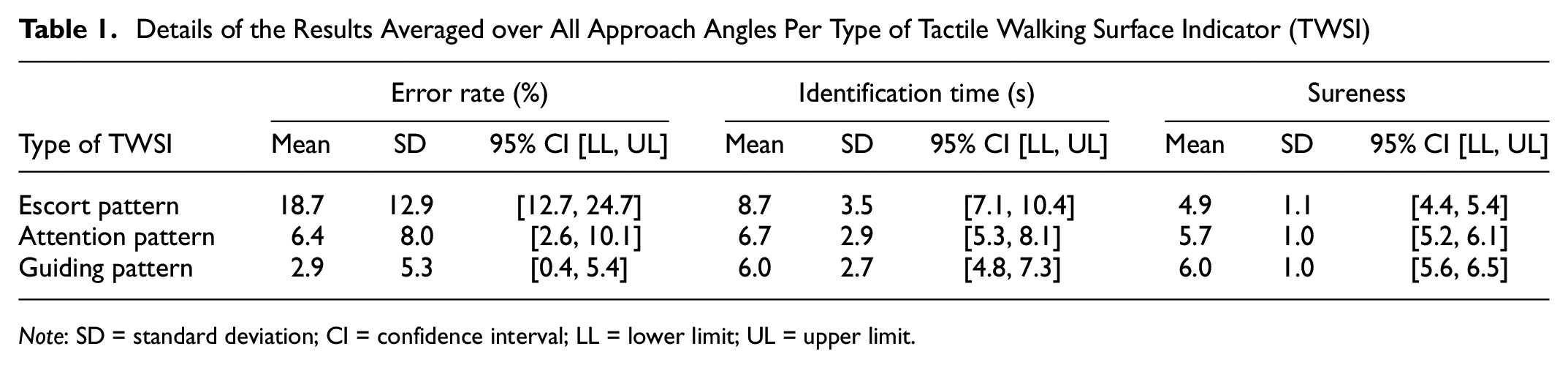
Note: SD = standard deviation; CI = confidence interval; LL = lower limit; UL = upper limit.
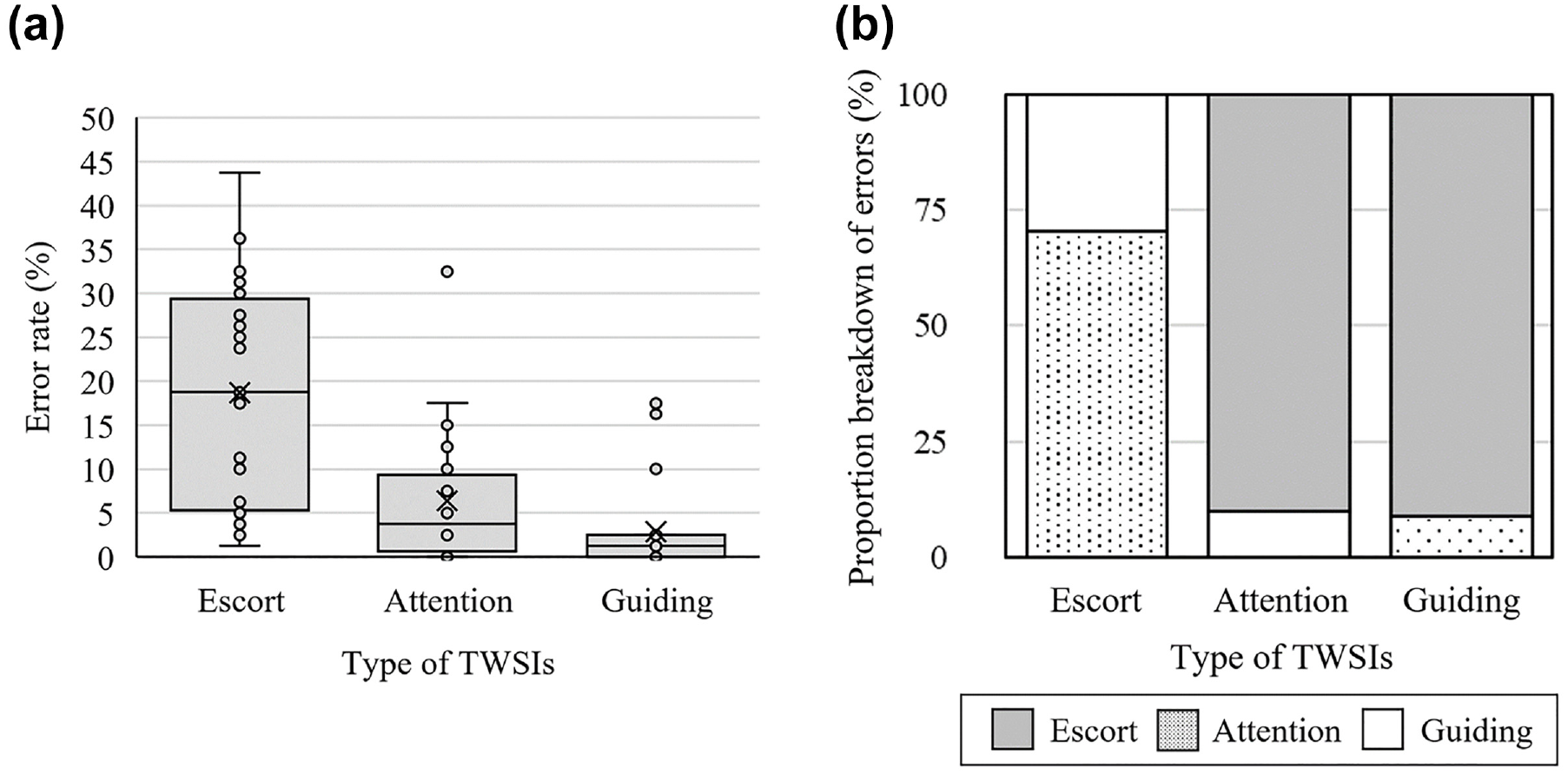
(a) Error rates averaged over all approach angles per type of tactile walking surface indicator (TWSI) and (b) proportion breakdown of errors averaged over all approach angles per type of TWSI.
More than half of the participants identified the escort pattern incorrectly more than once out of approximately five times.
As for the breakdown of errors, the escort pattern was misidentified as the attention pattern in 70.2% (2.6 out of 3.7 times) of the trials in which an error occurred, and as the guiding pattern in 29.8% (1.1 out of 3.7 times; Figure 4b). Similarly, the attention pattern was misidentified as the escort pattern in 90.2% (1.2 out of 1.3 times) and as the guiding pattern in 9.8% (0.1 out of 1.3 times). The guiding pattern was misidentified as the escort pattern in 91.3% (0.5 of 0.6 times) and as the attention patterns 8.7% trials (0.1 of 0.6 times).
Identification Time
Multiple comparison tests showed that the identification time in the escort pattern was significantly shorter for the 90° approach angle than those for the 45° and 135° approach angles (45 versus 90: t(19) = 2.97, p = 0.014, a small effect size of d = 0.26; 90 versus 135: t(19) = 3.50, p = 0.040, a small effect size of d = 0.22). In the guiding pattern, 0° had significantly shorter identification times than 45°, 90°, and 135° (0 versus 45: t(19) = 5.08, p < 0.001, a medium effect size of d = 0.76; 0 versus 90: t(19) = 4.92, p < 0.001, a medium effect size of d = 0.65; 0 versus 135: t(19) = 5.40, p < 0.001, a medium effect size of d = 0.74). No significant differences were found between the other conditions except for the above for the escort and guiding patterns and between the 0° and 45° approach angle conditions for the attention pattern. The mean and standard deviation of the identification times were, in decreasing order of approach angle, 8.7 ± 3.4, 9.1 ± 3.6, 8.2 ± 3.6, and 8.9 ± 3.7 s for the escort pattern, 6.9 ± 3.0 and 6.5 ± 3.0 s for the attention pattern, and 4.6 ± 2.3, 6.6 ± 3.0, 6.3 ± 3.1, 6.6 ± 3.2, and 6.6 ± 3.2 s for the guiding pattern (Figure 5a).
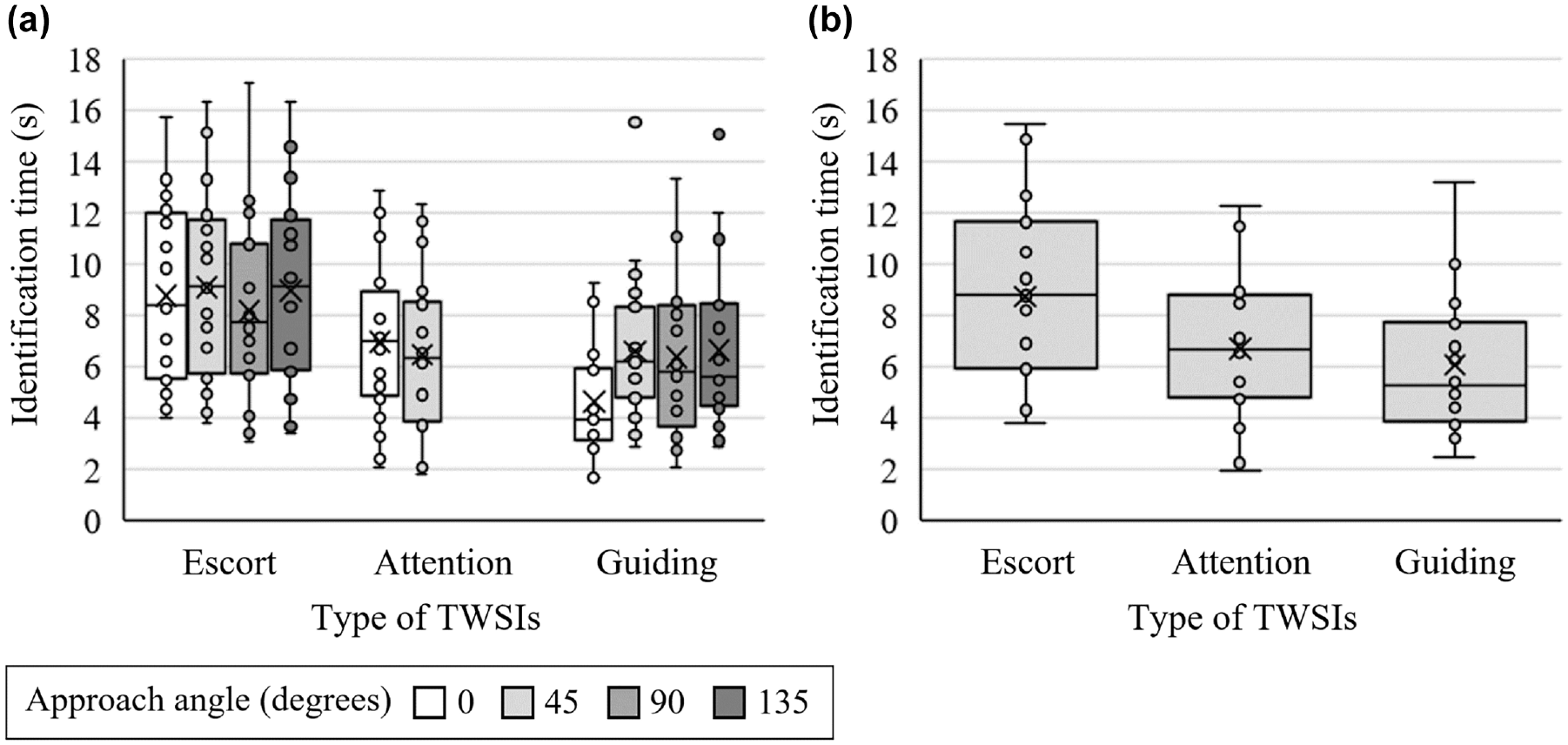
(a) Identification time for each approach angle per type of tactile walking surface indicator (TWSI) and (b) identification time averaged over all approach angles per type of TWSI.
Identification times in the escort pattern, which collapsed all conditions of the approach angle, were significantly longer than those in the attention and guiding patterns (escort pattern versus attention patterns: t(19) = 5.20, p < 0.001, a medium effect size of d = 0.65; escort pattern versus guiding patterns: t(19) = 5.90, p < 0.001, a large effect size of d = 0.88). No significant differences were observed between the attention and guiding patterns. The mean and standard deviation were 8.7 ± 3.5 s for the escort pattern, 6.7 ± 2.9 s for the attention pattern, and 6.0 ± 2.7 s for the guiding pattern (Table 1 and Figure 5b). In the escort pattern, 7 out of 20 participants required longer than 10 s, and many individuals with longer identification times were observed.
For all TWSI types, trials with misidentification had significantly longer identification times than trials with correct identification (escort pattern: t(19) = 2.52, p = 0.021, a medium effect size of d = 0.76; attention pattern: t(14) = 4.33, p < 0.001, a large effect size of d = 1.29; guiding pattern: t(10) = 3.82, p = 0.003, a large effect size of d = 1.59). Means and standard deviations for trials with correct identification and misidentification were 8.5 ± 3.4 and 11.9 ± 5.4 s for the escort pattern, 7.2 ± 2.7 and 10.5 ± 3.3 s for the attention pattern, and 6.6 ± 2.9 and 11.6 ± 5.6 s for the guiding pattern (Figure 6). Trials with misidentifications had, on average, approximately 3–5 s longer identification times than trials with correct identifications.
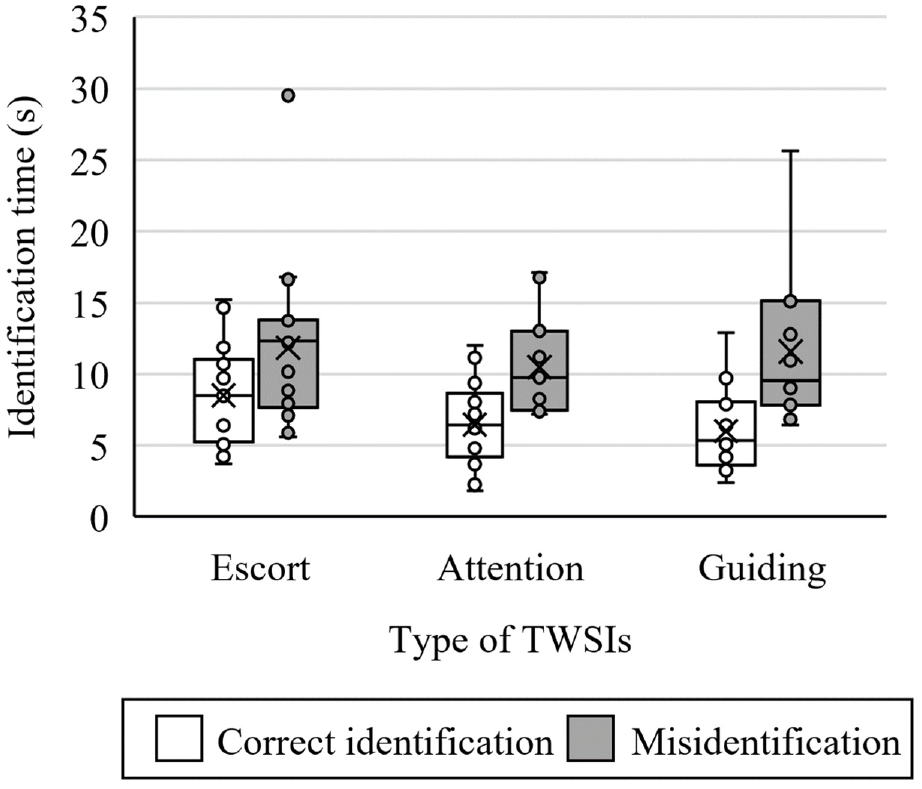
Identification time for each type of tactile walking surface indicator (TWSI), divided into trials in which the stimulus was correctly and incorrectly identified.
Sureness
Multiple comparison tests showed that the sureness in the escort pattern was significantly higher for an approach angle of 90° that those for approach angles of 0°, 45°, and 135° (0 versus 90: t(19) = 3.23, p = 0.018, a small effect size of d = 0.35; 45 versus 90: t(19) = 3.33, p = 0.018, a medium effect size of d = 0.51; 90 versus 135: t(19) = 4.21, p = 0.003, a small effect size of d = 0.36). In the guiding pattern, the mean at 0° was significantly higher than those at 45°, 90°, and 135° (0 versus 45: t(19) = 4.78, p < 0.001, a medium effect size of d = 0.55; 0 versus 90: t(19) = 4.15, p = 0.003, an almost medium effect size of d = 0.48; 0 versus 135: t(19) = 3.88, p = 0.004, a medium effect size of d = 0.52). No significant differences were observed between the other conditions except for the above for the escort and guiding patterns, and between the 0° and 45° approach angle condition for the attention pattern. The means and standard deviations of the sureness were, in decreasing order of approach angle, 4.9 ± 1.1, 4.7 ± 1.1, 5.2 ± 1.0, and 4.9 ± 1.2 for the escort pattern, 5.6 ± 1.1 and 5.7 ± 1.0 for the attention pattern, and 6.4 ± 0.9, 5.9 ± 1.0, 5.9 ± 1.1, and 5.9 ± 1.0 for the guiding pattern (Figure 7a).
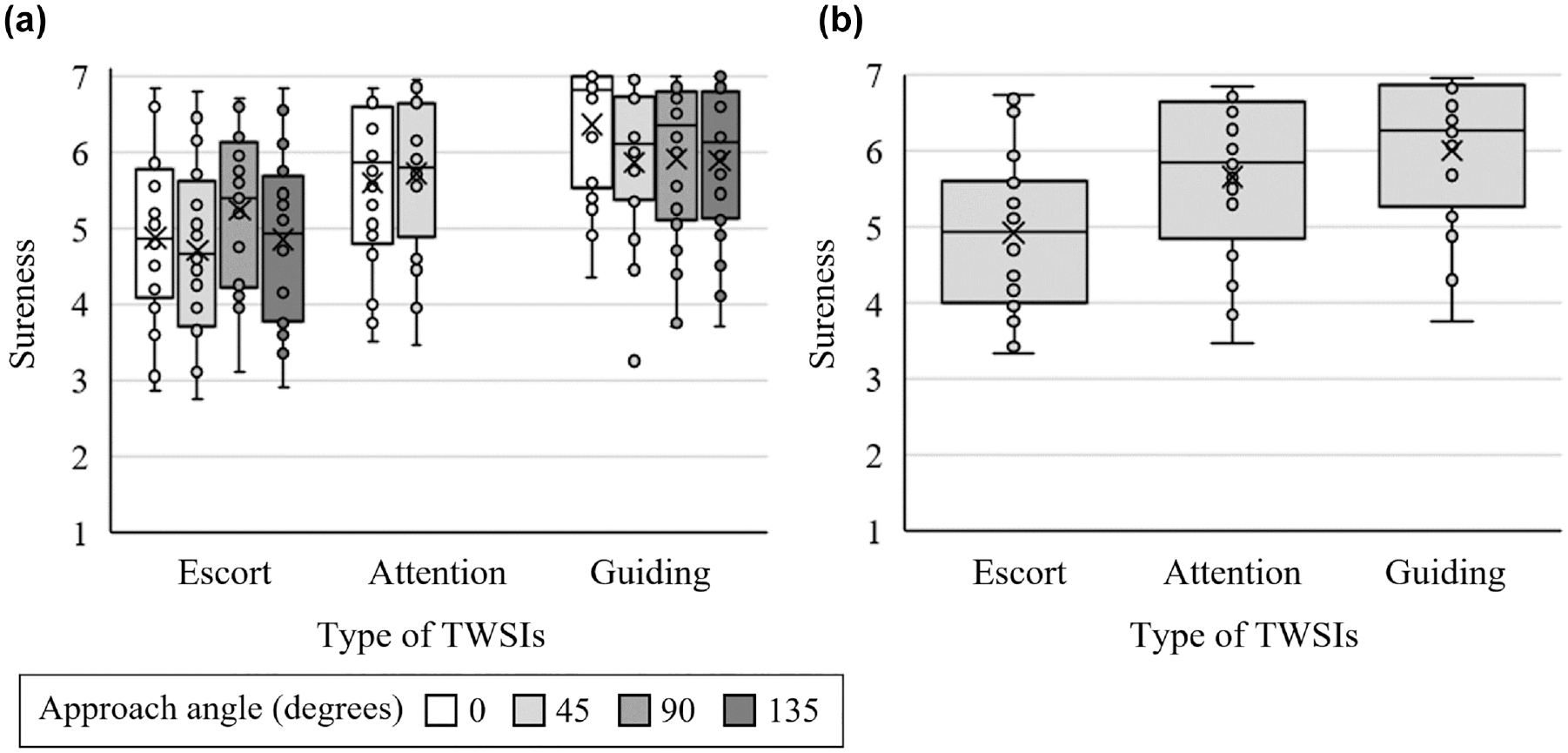
(a) Sureness for each approach angle per type of tactile walking surface indicator (TWSI) and (b) sureness averaged over all approach angles per type of TWSI.
The mean in the escort pattern, which collapsed all conditions of the approach angle, was significantly lower than those of the attention and guiding patterns (escort pattern versus attention patterns: t(19) = 4.68, p < 0.001, a medium effect size of d = 0.72; escort pattern versus guiding patterns: t(19) = 6.30, p < 0.001, a large effect size of d = 1.10). No significant differences were found between the attention and guiding patterns. The mean of the escort pattern (4.9 ± 1.1) was lower than that of the attention pattern (5.7 ± 1.0) and the guiding pattern (6.0 ± 1.0), with almost the same standard deviation (Table 1 and Figure 7b).
For all TWSI types, trials with misidentification had significantly lower sureness than trials with correct identification (escort pattern: t(19) = 3.11, p = 0.006, a medium effect size of d = 0.72; attention pattern: t(14) = 4.40, p < 0.001, a large effect size of d = 1.13; guiding pattern: t(10) = 3.76, p = 0.004, a large effect size of d = 1.94). Means and standard deviations for trials with correct identification and misidentification were 5.2 ± 1.2 and 4.3 ± 1.4 for the escort pattern, 5.6 ± 1.1 and 4.3 ± 1.5 for the attention pattern, and 6.0 ± 1.2 and 4.1 ± 1.5 for the guiding pattern (Figure 8). Trials with misidentifications had, on average, approximately 1–2 less sureness than trials with correct identifications. However, even on trials with misidentification, half of the participants responded with a sureness of 4 or higher (i.e., medium sureness).
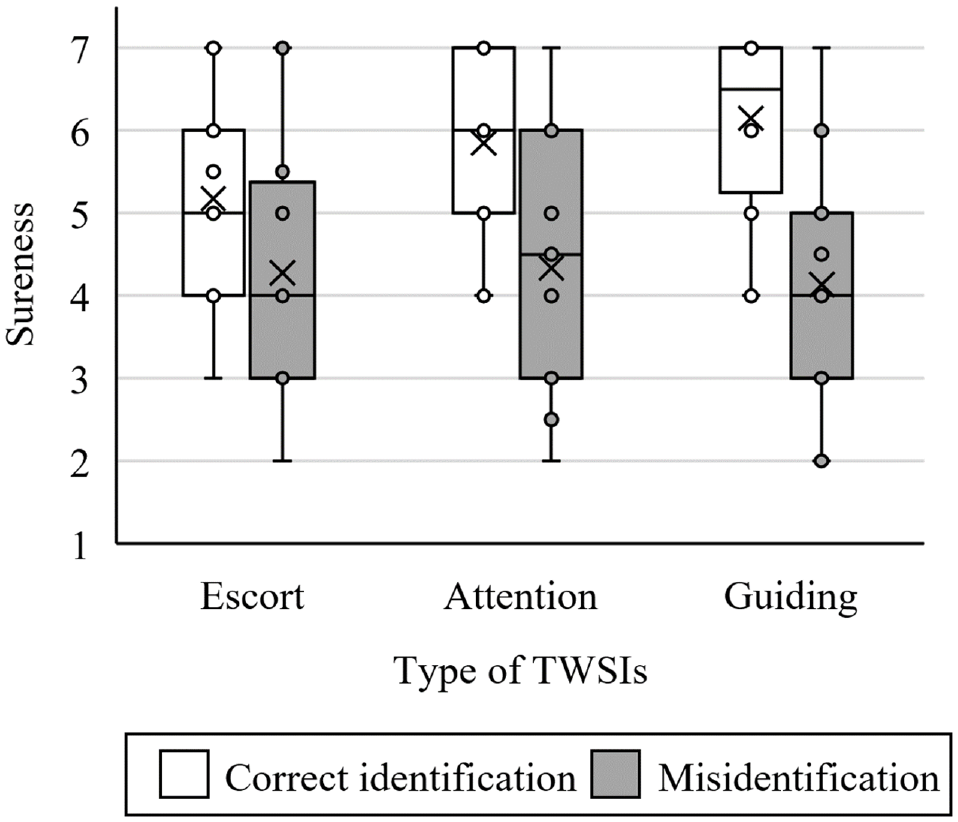
Sureness for each type of tactile walking surface indicator (TWSI), divided into trials in which the stimulus was correctly and incorrectly identified.
Discussion
Difficulty in Identification of Escort Patterns
The results reaffirmed the high ease of identification of attention and guiding patterns in a previous study ( 49 ) and revealed, for the first time, that escort patterns could not be accurately identified just by tactile information from the sole. Considering that the distinguishable dimensions of attention and guiding patterns have been standardized based on quantitative evidence ( 40 , 41 ), the novel finding that escort patterns, which have been officially used in Japan for many years, are not always identifiable for visually impaired people is a noteworthy finding. The results further demonstrate the great difficulty of creating walking surfaces that are reliably discriminable from one another tactually. Landscape engineers, planners, and engineers should not assume, without quantitative evidence, that walking surfaces that differ significantly in appearance can be easily distinguished, even tactually.
We found that escort patterns were misidentified as attention patterns approximately 70% of the times in which they were misidentified, and attention and guiding patterns were misidentified as escort patterns approximately 90% of the times they were misidentified (Figure 4b). Therefore, the recognition of and appropriate use of attention and guiding patterns may be significantly adversely affected by combining them with the escort pattern. Thus, the use of any additional TWSI that has not been found to be highly discriminable from other TWSIs used together, and readily identified, endangers the very population it is intended to aid. For example, visually impaired people may engage in the following accident-risk behaviors in a real environment: (1) visually impaired people misidentify attention patterns installed outside the railroad crossing as escort patterns and try to enter the railroad crossing; (2) visually impaired people misidentify escort patterns installed inside the railroad crossing as attention patterns and try to stay at the railroad crossing. These assumptions are not pessimistic but may occur in real cases because of various factors and situations that interfere with the judgment of visually impaired people. For example, if a train alarm sounds just before or after visually impaired people enter a railroad crossing, they may be subjected to a mental load such as impatience and anxiety. Under these circumstances, these people will have fewer attentional resources and less time available to identify TWSIs and will be more likely to fail to recognize them. Even when the escort pattern is found first inside a railroad crossing without detecting attention and guiding patterns outside the railroad crossing, the likelihood of misidentifying the escort pattern as an attention pattern is increased.
Identification time and sureness results also indicate potential problems with escort patterns. The overall average time required for participants to identify the escort pattern was relatively long at 8.7 s (Table 1, Figure 5b) and reached 11.9 s for the misidentified trials (Figure 6). If visually impaired people take excessively long to identify escort patterns, they may not have sufficient time to pass through railroad crossings or evacuate to safety zones. In addition, confident misidentification of escort patterns suggests that those visually impaired people cannot recognize that they have misidentified the escort pattern (Figure 8). As a result, they would misidentify the escort pattern as an attention pattern and actively stay at the railroad crossing or make no effort to search and compare other TWSIs that might be in their vicinity.
Other factors that make the identification of escort patterns difficult should also be noted. Although the participants in this experiment wore comfortable athletic shoes, identifying the escort pattern would be more difficult if they were wearing thicker shoes. In addition, the tactile spatial acuity of the sole decreases with age ( 43 ); therefore, older visually impaired people are expected to have more difficulty identifying TWSIs. Many visually impaired people also try to identify TWSIs with a cane. However, since identifying attention and guiding patterns with a white cane is significantly less discriminative than with the sole ( 49 ), it is plausible that the escort pattern is also difficult to identify with a cane.
Effect of Approach Angle on Identification of TWSIs
For all TWSIs, there was no significant difference in the error rate among the approach angle conditions. In contrast, with respect to identification times, the 90° approach angle in the escort pattern and the 0° approach angle in the guiding pattern resulted in significantly shorter and higher sureness than the other approach angles. These conditions were characterized by the common feature that the long axis direction of the raised lines’ convexity coincided with the participants’ forward–backward direction. The human legs are structured to move back and forth easily through the extension and flexion of the knee and hip joints. Therefore, participants were able to smoothly move the soles of their feet in contact along these raised lines, which may have provided some tactile information on the spatial distribution of walking surfaces that was useful for identifying the type of TWSI. However, the slight improvement in identification time and sureness was insufficient to be practically meaningful for walking at the railroad crossing. Therefore, it is not recommended to install escort patterns with a 90° rotation or to have visually impaired people turn to scan the TWSIs while walking. The former is contrary to the existing rules for installing escort patterns ( 30 ) and is confusing. The latter has a risk of increasing the identification time of TWSIs and causing loss of established orientation.
Future Research to Improve the Ease of Identification of TWSIs
When visually impaired people walk over guiding and attention patterns outside the railroad crossing and escort patterns inside the crossing, the pressure distribution exerted by the raised tactile surface of TWSIs on the soles of their feet changes as the TWSIs change. Visually impaired people familiar with TWSIs placed at railroad crossings may be able to identify the type of TWSI by correlating the pressure distribution changes with the order of the TWSIs they pass. However, the amount of tactile information obtained by stepping on TWSIs while walking is poorer than that when TWSIs are carefully scanned with the soles of the feet, as in this experiment. Therefore, additional cues are required to enable visually impaired people to more reliably detect changes in the type of TWSI while walking.
As a possible cue, it may be practical to provide a blank area without TWSIs at the boundary where the type of TWSI changes, especially between attention patterns and escort patterns that separate the inside and outside of a railroad crossing. Currently, escort patterns, attention patterns, and guiding patterns are installed continuously without gaps at railroad crossings in Japan (Figure 1c), in accordance with the illustration shown in the guidelines of MLIT ( 38 ). This method makes it difficult for visually impaired people to notice changes in tactile information. On the other hand, in the guidelines of the National Police Agency ( 30 ), when escort patterns are installed on crosswalks, they should be placed approximately 30 cm away from the curb’s edge (Figure 1a). This provision creates a separation of at least 30 cm between the escort pattern on the crosswalk and the attention patterns on the sidewalk, which may make it easier for visually impaired people to distinguish them. In a previous study ( 50 ), approximately 90% of 48 visually impaired people ranging from their 20s to 70s and wearing a variety of shoes found a 600 mm long blank area in the middle of attention patterns placed in a straight line when walking along them. The high tactile contrast produced by the blank area not only increases the chances of its detection but also warns of a change in the type of TWSI beyond the blank area, which makes it easier to identify the type of TWSI. In addition, the blank area is a promising solution in that it is not affected much by the thickness of the soles of shoes worn by visually impaired people and the decrease in the tactile sensitivity of the soles of their feet caused by aging ( 43 ), and that new installation of TWSIs and modifications to existing installations can be achieved relatively inexpensively.
In the case that blank areas are effective in identifying the type of TWSI, it is important to determine the optimal depth of the blank areas. When visually impaired people passed through the attention patterns set in a linear pattern from an orthogonal direction, the detection of attention patterns was more precise when the depth of the attention patterns was 600 mm rather than when it was 300 mm ( 51 ). In this case, the depth of TWSIs suitable for detection during walking on the smooth ground was revealed. In contrast, it was predicted that there is a suitable depth for detecting the disappearance of TWSIs during walking over them. However, if the blank area is excessively long, visually impaired people may stop there and be unable to find the TWSIs placed beyond the blank area, or they may have to spend extra time to find them. The depth range that maximizes the effect of a blank area needs to be comprehensively examined, along with the interaction of how TWSIs are placed throughout the railroad crossing (e.g., width and depth of the attention patterns at the junction with the escort pattern) and walking conditions (e.g., walking speed, step length). If blank areas do not help detect escort patterns, new TWSIs must be developed. In addition, such empirical evaluations should be conducted with a diverse group of visually impaired people with different O&M training experiences and ages. In the stage of the practical application of any TWSIs, it is necessary to provide O&M training to visually impaired people to teach the knowledge and mobility techniques to walk at the railroad crossing.
Conclusions
In conclusion, while attention and guiding patterns that conform to international standards are highly identifiable, escort patterns, which are TWSIs unique to Japan, could be difficult to accurately identify using only tactile information from the soles of the feet. In addition, the misidentification of escort patterns with attention patterns outside the railroad crossing, along with subjective sureness, may encourage visually impaired people to remain in the railroad crossing. The longer identification time for the escort pattern increases the likelihood that visually impaired people will be unable to cross the railroad crossing and be exposed to danger. The afore-described evidence indicates the potential risks of escort patterns that are beginning to be installed prematurely at railroad crossings in Japan. If TWSIs are to be used as a means of assisting the visually impaired to walk across railroad crossings safely, it is necessary to verify new installation methods to accurately and efficiently identify all TWSIs, especially escort patterns, or to develop new TWSIs with superior ease of identification.
Footnotes
Acknowledgements
We would like to thank K. Nishi for his assistance in collecting data.
Author Contributions
The authors confirm contribution to the paper as follows: study conception and design: W. Toyoda, M. Ogata; data collection: W. Toyoda; analysis and interpretation of results: W. Toyoda, M. Ogata; draft manuscript preparation: W. Toyoda. All authors reviewed the results and approved the final version of the manuscript.
Declaration of Conflicting Interests
The author(s) declared no potential conflicts of interest with respect to the research, authorship, and/or publication of this article.
Funding
The author(s) disclosed receipt of the following financial support for the research, authorship, and/or publication of this article: This work was supported by JSPS KAKENHI Grant Number 23K11958.
