







Abstract
The train line planning problem (LPP) determines passenger travel path accessibility by optimizing train routes and stop plans. This study considers the uncertainty of passenger service choice behavior and the partial periodic operation pattern in the multimodal rail transit network (MRTN), defines system resilience as the network’s ability to resist interference, and constructs a resilience-oriented LPP model with constraints for passenger assignment that account for uncertain service choice behavior. A customized iterative solution procedure is designed to solve this model. In each iteration, a passenger assignment algorithm that integrates an available travel path search method is developed to determine passenger travel paths, and an improved adaptive large neighborhood search (IALNS) algorithm with a network decomposition strategy is designed to solve the LPP. The proposed approach is examined on Shanghai MRTN, with analysis of influences of travel path resilience requirement, uncertainty in passenger service choice behavior, and partial periodic operation strategy. The results indicate that incorporating path resilience into LPP can enhance network resilience with limited operational cost increases, accounting for passenger uncertain service choice behavior can more accurately match the transport capacity with passenger demand, and the partial periodic pattern can balance the regularity and flexibility of the line plan. Furthermore, the IALNS algorithm outperforms Gurobi on large-scale cases, and the proposed approach can well balance operational costs, generalized passenger travel time, and network resilience. Case study findings provide insights for rail operators in line planning.
Keywords
Introduction
Driven by urbanization, China’s urban clusters have experienced rapid development, accompanied by significant growth in rail transit. Within these regions, multiple rail transit networks operate at different levels with specific functions coexist. The interconnection of urban rail transit (URT) and suburban railway (SR) lines through transfer stations facilitates passenger travel, fostering integrated transportation services and intermodal travel paths.
Integrating SR and URT networks into a multimodal rail transit network (MRTN) and collaboratively optimizing their transportation plans can enhance passenger convenience and accessibility. However, because of distinct operational characteristics between SR and URT trains, passengers with the same origin–destination (OD) may choose different train services (i.e., different travel paths), introducing uncertainty in service choice behavior ( 1 , 2 ). This uncertainty, coupled with passengers’ unrestricted movement between networks via transfer stations, means disruptions in one network may lead passengers to another network and prompt them to choose alternative travel paths. As illustrated in Figure 1, after a disruption between section A–B, passengers originally travelling through paths 1 and 4 may shift to paths 2, 3, or 5. When alternative travel paths are limited, affected passengers are forced to concentrate on fewer paths, which heightens the risk of operational disruptions on other lines.
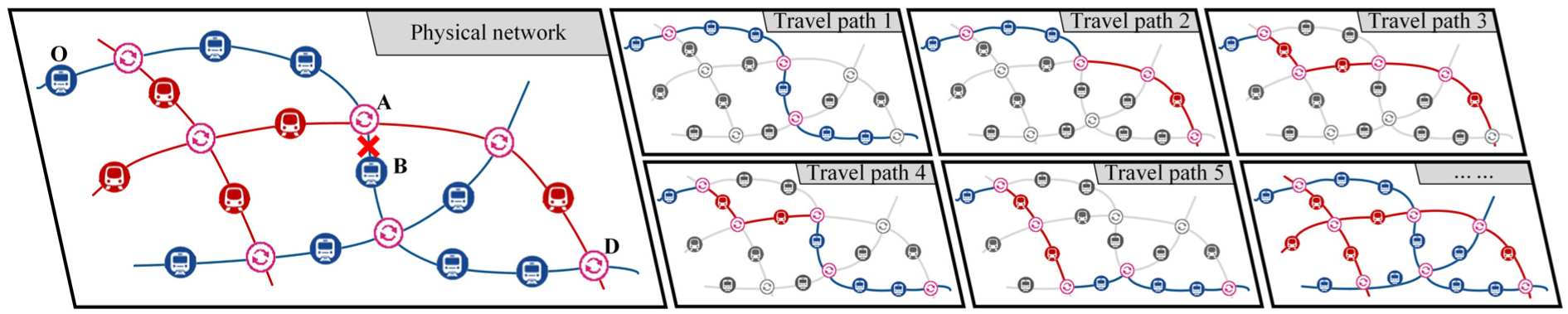
An example of passenger travel paths in MRTN.
This imposes higher requirements on rail transit operators, as passengers consistently expect to switch to alternative paths when partial services are disrupted to complete their journey. This capacity to maintain journey continuity despite operational delays or disruptions represents a core aspect of rail transit network resilience ( 3 ). However, current research on network resilience primarily focuses on assessing the impact of station or section disruptions on overall network performance from a static network topology perspective ( 4 – 6 ), and there is less emphasis on enhancing the resilience of transportation plans. We contend that infrastructure resilience constitutes the foundation of network resilience and establishes the system’s lower resilience bound, while transportation planning is crucial for leveraging the infrastructure’s resilience potential, determining the upper resilience bound. Besinovic ( 7 ) identified the integration of resilience considerations into transportation planning as a future direction for resilience research. Therefore, enhancing the resilience of transportation plans is crucial for developing services that are more resilient and adaptable to disruptions.
The transportation planning process consists of multiple components across various decision levels ( 8 ), requiring meticulous multitiered planning by operators, as illustrated in Figure 2. Some scholars have incorporated resilience into transportation planning by considering train timetable redundancy from a predisruption perspective ( 9 , 10 ) or postdisruption train schedule adjustments ( 11 , 12 ), which primarily focus on enhancing timetable robustness or rapid operational recovery ability from the perspective of train operation times, without establishing connections to the physical network of rail transit infrastructure. The line planning problem (LPP), which determines train routes, stop plans, and frequencies based on the rigid infrastructure network to meet passenger demand, directly affects passenger travel path accessibility through the flexible train operation network it formed. However, current research lacks systematic studies in this domain. A resilience-oriented line planning approach is much needed to provide a passenger-centric transportation services.

Procedure of transportation planning.
Passenger flow is a critical factor in optimizing the LPP. However, as rail transit operators in most countries implement seamless transfers to enhance passenger travel experience, they typically only have access to tap-in timestamps at origin stations and tap-out timestamps at destination stations ( 13 ). Consequently, passenger assignment is frequently addressed as a subproblem of the LPP to estimate section flows by inferring travel paths. Passenger path choices are influenced by multiple factors ( 1 , 2 , 13 , 14 ), resulting in uncertainty in service choice behavior, as depicted in Figure 1. This necessitates approaches that accurately model passenger choice behavior and integrate with LPP optimization.
Currently, trains can operate either a periodic or an aperiodic pattern in rail transit systems. A periodic pattern has strict regularity ( 15 – 18 ), that is, the trains’ route, frequency, and stop plan are the same in various operation periods, which greatly facilitates passenger convenience ( 17 ), but may underutilize train capacities during low-demand periods ( 15 ). Conversely, an aperiodic pattern allows independent operation of each train to better adapt to passenger flow fluctuations ( 19 ), but sacrifices the service regularity ( 20 ). Given the distinct operational characteristics of SR and URT, we propose a partial periodic pattern for LPP optimization that combines the benefits of periodic and aperiodic patterns.
In summary, collaborative line planning for URT and SR shows promising potential for enhancing passenger travel experience and operational safety. However, differing passenger flow characteristics between URT and SR necessitate tailored operation patterns. Furthermore, uncertainty in passenger choice behavior arising from the simultaneous operation of different train types require resilient line plans based on accurate passenger travel path identification. Consequently, this study develops a resilience-oriented LPP approach for MRTN. The following section reviews related literature and distinguishes our study from prior research.
Literature Review
In this section, we primarily focus on the modeling aspects of line planning studies. The line plan, as a strategic operational plan, serves as the cornerstone for subsequent phases of transportation planning and thus receives considerable attention in the literature. Schöbel ( 21 ) provided a comprehensive review of LPP, recognizing it as an NP-hard optimization problem. Based on the operational strategy, the modeling method of LPP studies can be categorized into periodic or aperiodic patterns.
Periodic line planning operates on the principle of regularity, solving the LPP for a single period (typically the peak hour) and replicating this solution across all subsequent periods. Given the inherent nature of this problem, the periodic event scheduling problem (PESP) model was first introduced by Serafini and Ukovich ( 22 ) to schedule a predefined set of events within equally spaced intervals. This model provides a sufficient solution framework and has consequently been widely adopted in periodic LPP. Subsequent research has expanded on this foundation. Bussieck et al. ( 23 ) employed a mixed-integer linear programming (MILP) model to optimize traffic lines using periodic timetables. Zhang et al. ( 18 ) integrated line planning into timetabling via an expanded PESP framework. Heydar et al. ( 24 ) developed a MILP model to minimize both the scheduling period length and total train dwell time. Schöbel ( 25 ) formulated a MILP model to reduce total passenger travel time by jointly optimizing line planning and timetables. Fu et al. ( 16 ) incorporated nontransfer rates into line planning under constrained train route and stop plan combinations to address diverse passenger demand. Li et al. ( 26 ) established an integer linear programming model to maximize direct service coverage for passenger OD pairs using minimal train lines, introducing periodic operation indicators to evaluate periodicity. Yao et al. ( 27 ) addressed frequent passenger transfers by proposing a novel extended direct-service network for dynamic line generation that captures passenger transfer behavior. Pu and Zhan ( 28 ) devised a two-stage robust optimization model to balance transport capacity with fluctuating demand under passenger demand uncertainty.
Rail transit systems often experience temporally and spatially unbalanced demand, which can lead to periodic line planning mismatches between transport supply and passenger demand. Specifically, high-frequency lines may exhibit low passenger load factors during offpeak periods. To enhance flexibility in accommodating passenger demand, some scholars adopt aperiodic line planning, which imposes no predefined rules on train operations ( 19 ). Cao and Feng ( 29 ) developed a two-stage stochastic integer programming model to allocate capacity in response to random daily fluctuations in passenger demand. Cacchiani et al. ( 30 ) proposed MILP models to derive robust solutions under demand uncertainty, where the uncertainty in passenger demand is formulated with scenario-based methods. Hu et al. ( 31 ) investigated the collaborative optimization of timetable scheduling, passenger flow control, and skip-stop patterns on subway lines, treating time-dependent passenger arrival rates as uncertain parameters. Zhao et al. ( 32 ) established a Stackelberg game-based bilevel programming model to optimize line plans under time-varying demand, incorporating passenger flow assignment. Hao et al. ( 33 ) formulated a mixed-integer nonlinear programming model to optimize line plans and timetables with time-dependent demand. Qi et al. ( 34 ) introduced a general framework for jointly optimizing train stop planning and timetabling using flexible train compositions for passenger and freight cotransportation on high-speed railways with time-dependent demand.
Given the preceding examples, one cannot make a statement about the superiority of one pattern over the other. Therefore, some scholars have proposed a multiperiod approach to optimize line planning in response to varying passenger flows across different time periods. Yan and Goverde ( 15 ) designed a multifrequency LPP model by introducing an extended period length, allowing each line to have a different frequency and distinct period intervals based on demand. This model offers direct travel options for OD pairs with fewer passengers in nonperiodic cases and prevents travel time losses by avoiding unnecessary dwell times that would occur if these OD pairs were assigned to dedicated low-frequency lines. Similarly, Borndörfer et al. ( 35 ) and Şahin et al. ( 36 ) divided the planning horizon into multiple periods and permitted distinct lines with different periods. The multiperiod line plan was proven to outperform the single-period line plan in relation to feasibility and associated costs ( 36 ). Gu et al. ( 37 ) applied the multiperiod concept to the China Railway Express network, which features multiple cycles and varying frequencies, thereby achieving a balanced allocation of transportation resources. Yan et al. ( 38 ) constructed a macro train connection network to coordinately optimize multiperiod line planning and rolling stocks, which addressed the issue of rolling stocks unavailability between periods and generated a coordinated full-day line plan. However, the multiperiod approach tends to result in numerous line frequencies, which can lead to a loss of train regularity and passenger inconvenience. Therefore, Robenek et al. ( 39 ) and Zhou et al. ( 40 ) proposed a new operational approach that combines the regularity of periodic timetables with the flexibility of aperiodic ones.
One of the core objectives of LPP is to balance transportation supply and passenger demand. Early LPP methodologies primarily minimized operation costs, with limited consideration of passenger-related factors. Passengers were often preassigned to the shortest trip paths based on the physical network ( 41 ). Claessens et al. ( 42 ) and Goossens et al. ( 43 ) optimized line plans by incorporating fixed and variable train costs, modeling passenger demand as link volumes constrained by capacity. As networks expand and train service diversity increases, passenger may change their travel paths from the shortest path to others, which is influenced by the operational state of trains ( 44 ). This necessitates an iterative approach for LPP and passenger assignment that integrates passenger path choice into LPP mathematical formulations. However, passengers with differing attributes may choose variable travel paths and train services, resulting in spatial and temporal behavioral heterogeneity. This has attracted significant research attention. Passenger behavior studies can be categorized into travel path choice behavior ( 14 , 45 ) and train service choice behavior ( 1 , 2 ). Passenger travel path choice models typically generate passenger paths from candidate train routes (i.e., line pools), and determine the selection probability of each path by logit-based models ( 13 ). Schöbel and Schol ( 45 ) proposed the Change&Go network to assign passengers and precisely capture passenger transfer behavior. Borndörfer and Karbstein ( 46 , 47 ) introduced a direct connection model, where passengers were efficiently assigned on the physical network. Fuchs et al. ( 48 ) and Hartleb et al. ( 49 ) optimized the problem by selecting lines from the pregiven candidate train routes, while Yao et al. ( 27 ) constructed an extended direct-service network without the need for a pregenerated candidate train routes. Train service choice behavior typically applies to scenarios involving multiple train service types (e.g., full/short-length services [ 2 ], fast/slow services [ 50 ]), accounting for passengers’ uncertain choice behaviors (e.g., waiting at platform, transfer behavior) to assign passengers to specific trains. This requires passenger arrival times and train schedules, typically integrated with timetabling ( 1 , 2 , 50 ). Recently, this has been applied in LPP with some approaches. Zhao et al. ( 32 ) and Zhou et al. ( 40 ) introduced the concept of train estimated departure time to obtain time information of trains, which can extended the line plan to the train plan diagram (excluding safety headways), and evaluated the match degree between the line plan and passenger demand. Zhu et al. ( 51 , 52 ) assigned passengers to trains by the probability of the passenger boarding each feasible train and the probability distribution of the number of trains that a passenger is unable to board because of capacity constraints. Peng et al. ( 53 ) considered the impact of passenger heterogeneity on service choice, and determined fast/slow trains departure intervals through the ratio of them to assign passengers.
To our knowledge, this is the first study to model the LPP incorporating network resilience. Research on network accessibility ( 14 , 54 – 56 ) inspires us to use passenger travel path accessibility to evaluate network and transportation plan resilience. Table 1 lists the comparison between relevant literature and this study from aspects of passenger behavior, transfer consideration, operation pattern, objectives, and solution method. As reviewed earlier, a variety of related studies have been dedicated to the fields of LPP, primarily optimizing the line plan of either periodic or aperiodic pattern. Yan and Goverde ( 15 ) and Şahin et al. ( 36 ) proposed multiperiod patterns, which permit distinct line plans across periods. However, the multiperiod pattern tends to generate lots of different line frequencies, resulting in reduced train regularity. Zhou et al. ( 40 ) introduced a partial periodic pattern but focused solely on single-line operations, lacking network-wide application. Since passenger assignment is a subproblem of LPP, most studies address it through travel path choice behavior or train service choice behavior, with few considering both transfers and train service choice behavior ( 32 ). However, the objectives of these studies focus on operation costs, passenger traveling time, and so forth, without consideration of network resilience.
Comparison between the Related Literature and This Study
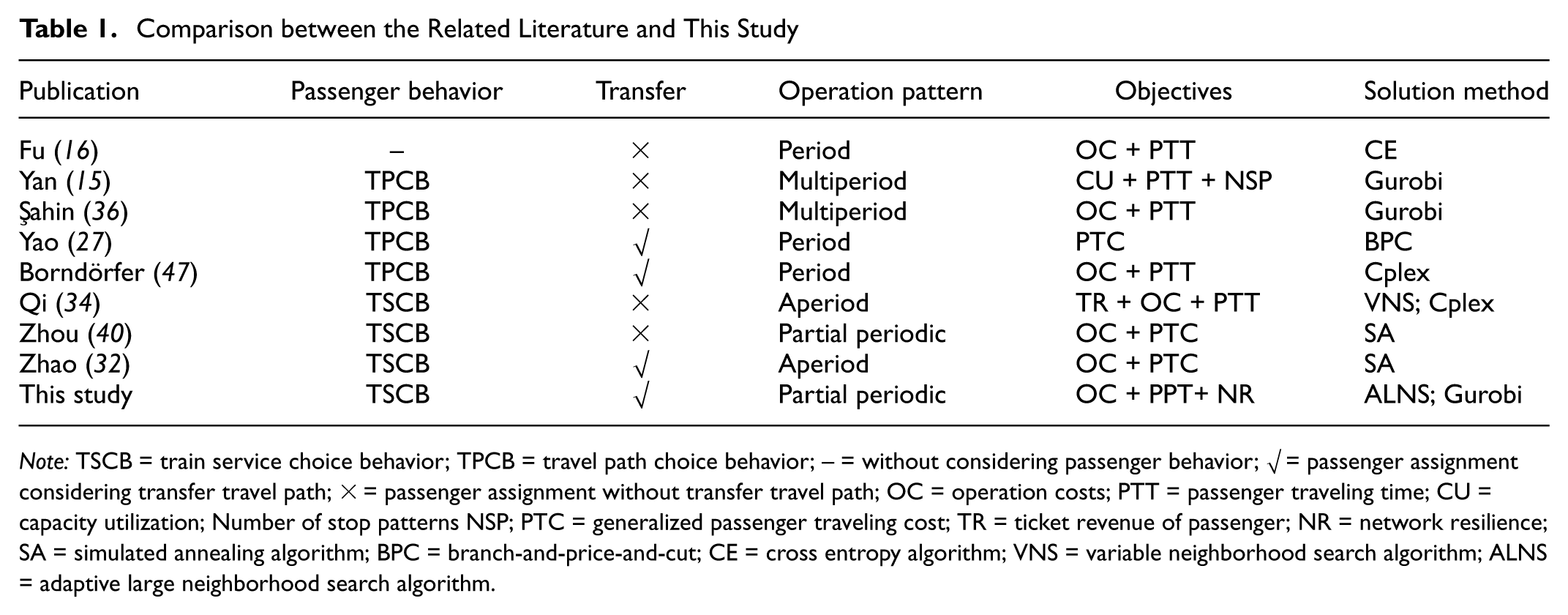
Note: TSCB = train service choice behavior; TPCB = travel path choice behavior; – = without considering passenger behavior; √ = passenger assignment considering transfer travel path; × = passenger assignment without transfer travel path; OC = operation costs; PTT = passenger traveling time; CU = capacity utilization; Number of stop patterns NSP; PTC = generalized passenger traveling cost; TR = ticket revenue of passenger; NR = network resilience;
SA = simulated annealing algorithm; BPC = branch-and-price-and-cut; CE = cross entropy algorithm; VNS = variable neighborhood search algorithm; ALNS = adaptive large neighborhood search algorithm.
To address these gaps, this study proposes a resilience-oriented LPP approach for MRTN considering uncertain passenger service choice behavior. This approach explicitly correlates the resilience of the flexible train operation network with the rigid physical infrastructure network. Furthermore, it designs a partial periodic pattern to accommodate the distinct operational characteristics and passenger flow patterns of MRTN. In addition, uncertainty in passenger service choice behavior is incorporated into the passenger assignment within the LPP. Finally, a solution algorithm is developed and examined in a large-scale case. The influences of travel path resilience requirements, uncertainty in passenger service choice behavior, and partial periodic operation strategy on the line plan are analyzed. The key contributions are summarized as follows:
We introduce the concepts of valid travel paths and available travel paths to characterize the path accessibility and passenger service choice behavior uncertainty, developing the searching method. This method accurately simulates passenger choice behavior in reality.
We propose a mathematical model tailored for LPP in MRTN. Building on the partial periodic pattern, the model aims to reduce operational costs, decrease generalized passenger travel time, and enhance network resilience, while incorporating passenger assignment constraints that account for uncertainty in choice behavior.
We develop an iterative solution procedure, which incorporates a passenger assignment algorithm, and an improved adaptive large neighborhood search (IALNS) algorithm with a network decomposition strategy to obtain high-quality solutions within an acceptable computation time. The proposed methodology was applied in the Shanghai MRTN and proved reliable.
Problem Statement
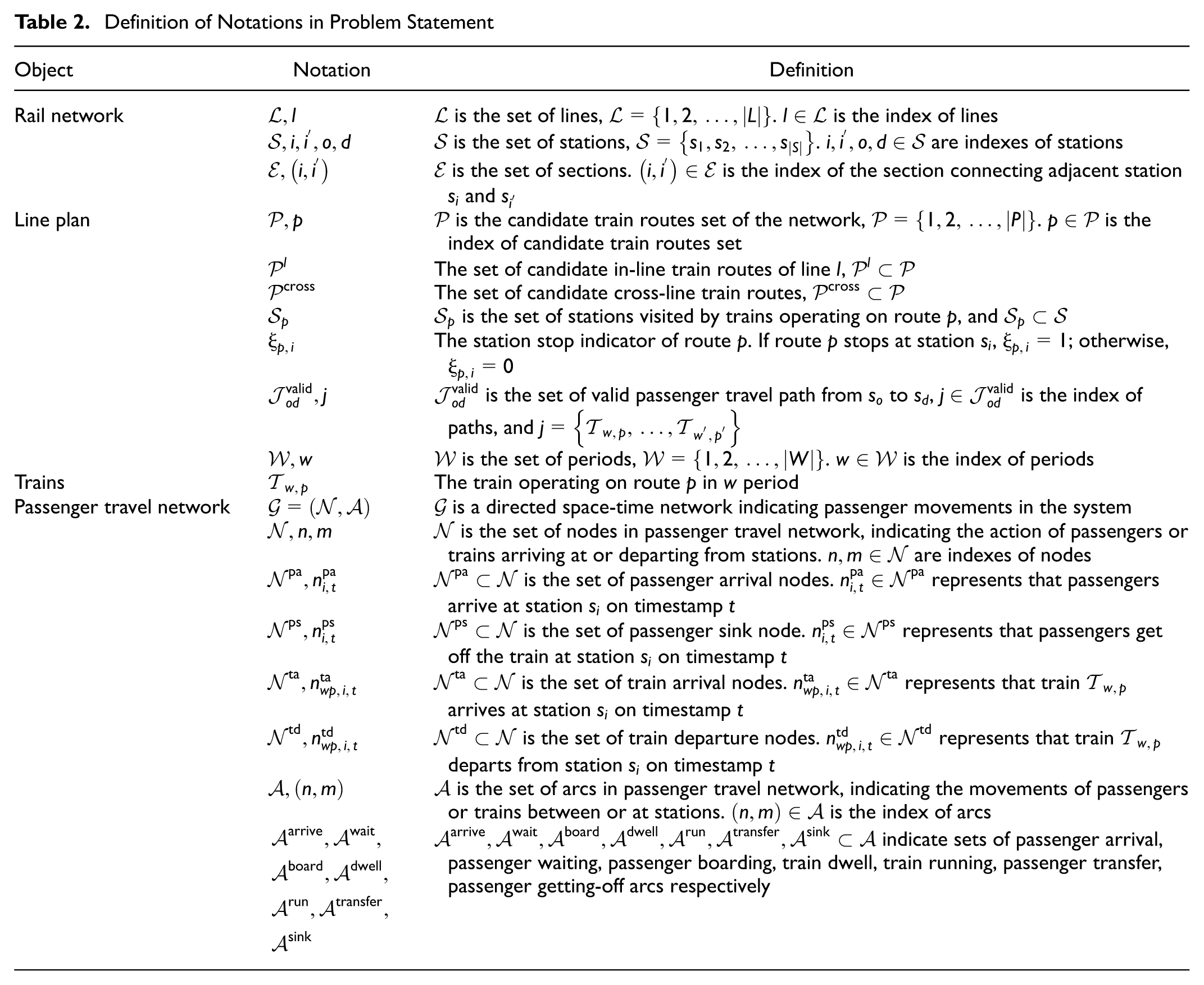
For clarity in the problem statement, relevant notations are listed in Table 2.
Definition of Notations in Problem Statement
The LPP for MRTN
The Resilience-Oriented LPP Description
This study considers a MRTN consisting of
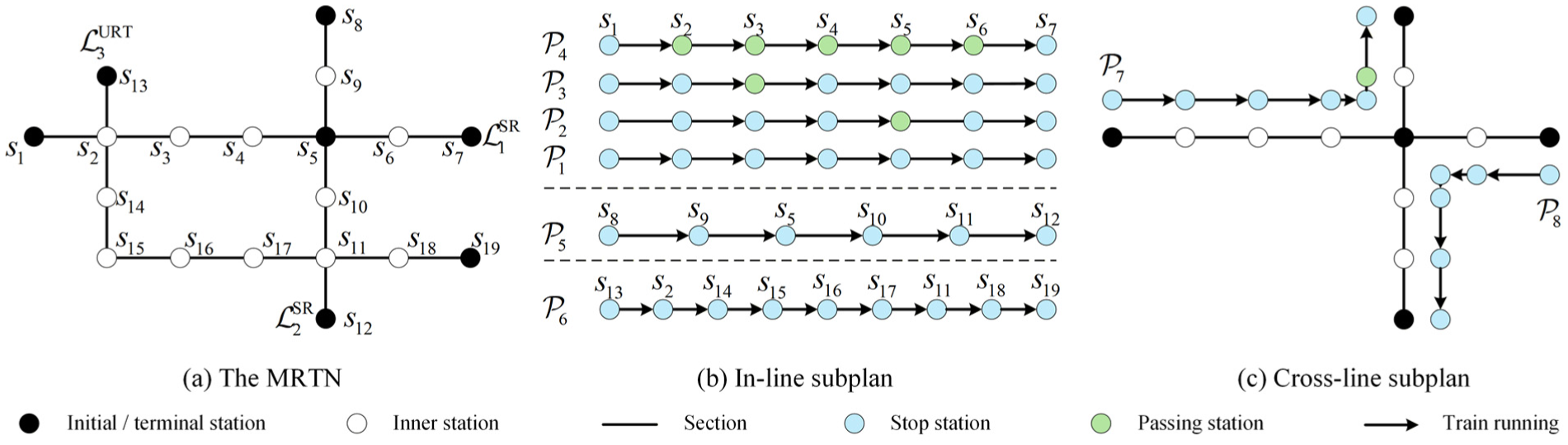
Illustration of the MRTN and subplans: (a) the MRTN, (b) in-line subplan, and (c) cross-line subplan.
It can be observed that the passenger travel path accessibility is determined by the line plan. When passengers travel from
With trains operating on
With trains operating on
With trains operating on
Therefore, we quantify network resilience by measuring the number of available travel paths. The resilience-oriented LPP is to optimize train routes (i.e., origin, terminal stations, and stop plans) and frequencies to accommodate passenger demand and enhance network resilience.
Candidate Train Routes and Valid Travel Paths
To accommodate passenger travel habits and coordinate express (i.e., only stop at origin and terminal stations), rapid (i.e., selectively stop at some stations), and local trains, we employ the candidate train route approach and define
To combine the benefits of the regularity of trains in periodic pattern and the flexibility of trains in aperiodic pattern, the partial periodic pattern allows the coexistence of both periodic and aperiodic trains. In other words, given a set of equal-duration periods
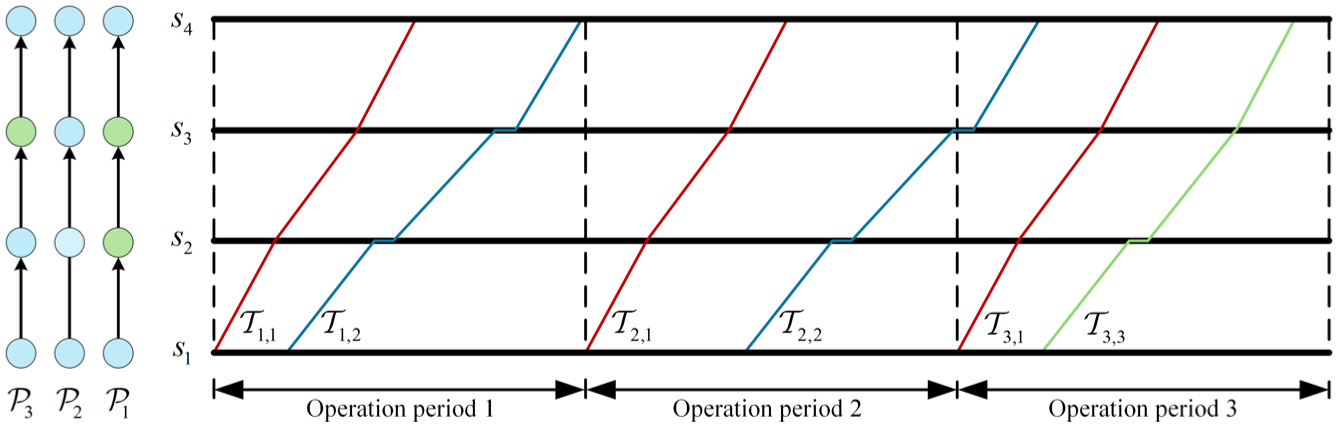
Illustration of partial periodic operation pattern.
Then, we introduce the concept of valid travel path. Define
Path nonrepetition constraint. No two valid paths may share identical sections. For instance, in Figure 3, when both
Transfer and travel time limit constraint. A valid path’s transfer counts must not exceed a specified limit
Leveraging these properties, we can generate the valid passenger travel path set using candidate routes. For instance, we assume all the candidate routes shown in Figure 3 operate trains in period 1, and transfer count limit
Schedule-Based Passenger Assignment
Available Travel Paths Considering Uncertain Service Choice Behavior
Passengers with different attributes select different trains based on factors such as fare and travel time, leading to uncertainty in service choice behavior. As shown in Figure 5, when passengers travel from
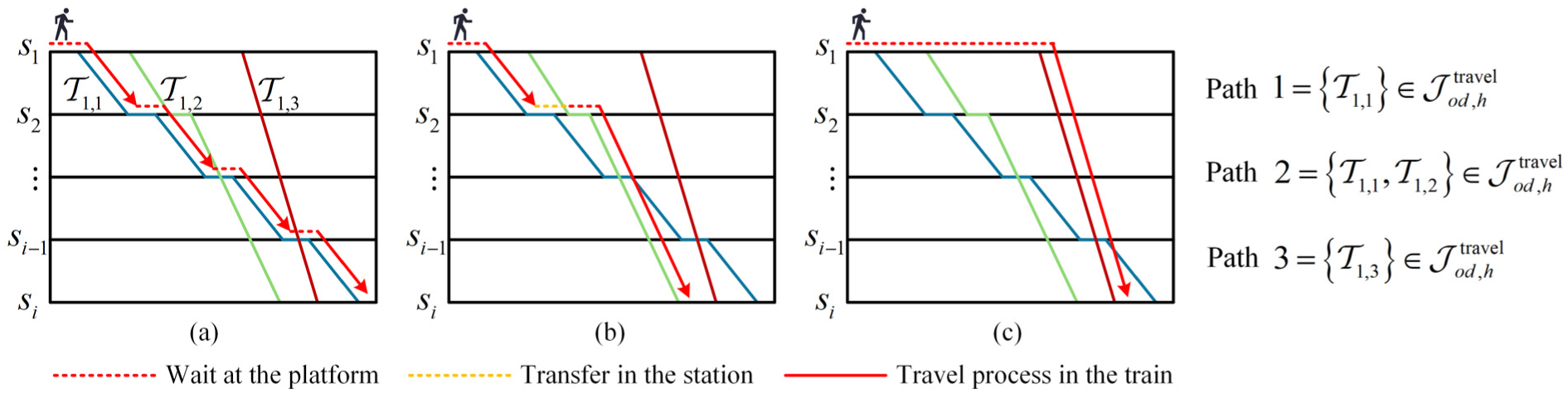
Illustration of passenger uncertain travel paths. (a) Passenger traveling directly to the destination without transfer; (b) Passenger traveling via a transfer to reduce travel time; (c) Passenger traveling via the fastest train with a long waiting time.
Then, we define
Construction of Passenger Travel Network
The passenger travel network, represented as a directed graph
Nodes
Four types of nodes are generated:
The passenger arrival node
The train arrival node
The train departure node
The passenger sink node
Directed Arcs
Seven types of directed arcs are generated to represent the travel process of passengers, detailed as follows:
Passenger arrival arcs
Passenger waiting arcs
Passenger boarding arcs
Train dwell/passing arcs
Train running arcs
Passenger transferring arcs
Passenger getting-off arcs
Figure 6 illustrates the passenger travel network for dynamic flow analysis, where
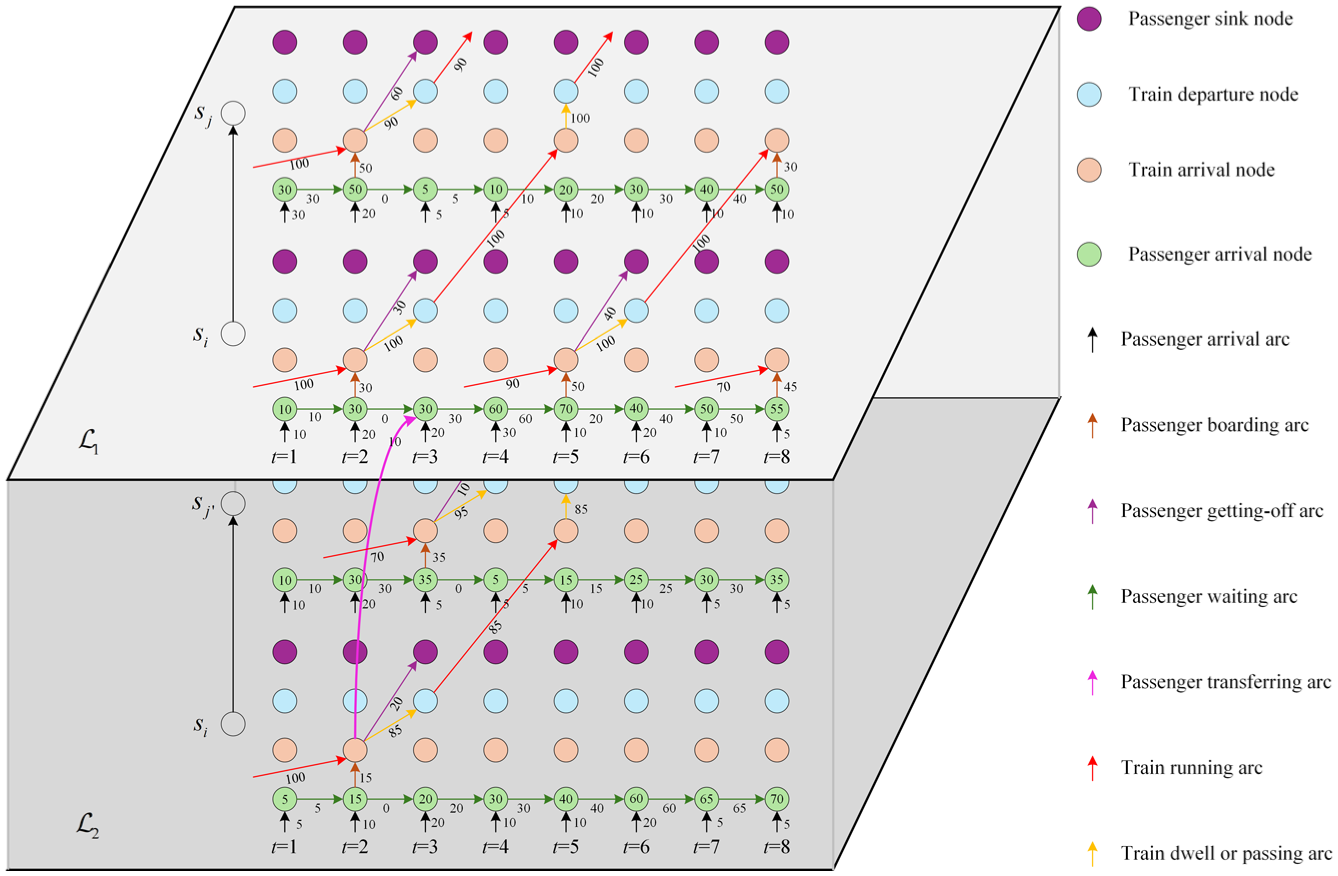
Illustration of passenger travel network.
Assumptions
Without the loss of generality, the assumptions are as follows:
Passenger origin–destination-time is given to represent passenger demands, including their OD stations, quantities, and arrival times, which remain invariant to changes in the line plan, with only their travel paths subject to alteration.
Train arrival and departure activities occur exclusively at discrete timestamps. In-vehicle/waiting passengers may alight/board at train arrival nodes, without considering detailed alighting/boarding processes.
SR and URT possess fixed transport capacities respectively, with predetermined running times for each section and dwell times at each station.
Estimated departure times at origin stations are determined without considering safety headways, as these are typically satisfied in subsequent train timetabling.
Mathematical Formulation
This section presents the detailed modeling process. Notations are listed in Tables 2 and 3.
Definition of Notations and Decision Variables in Mathematical Formulation
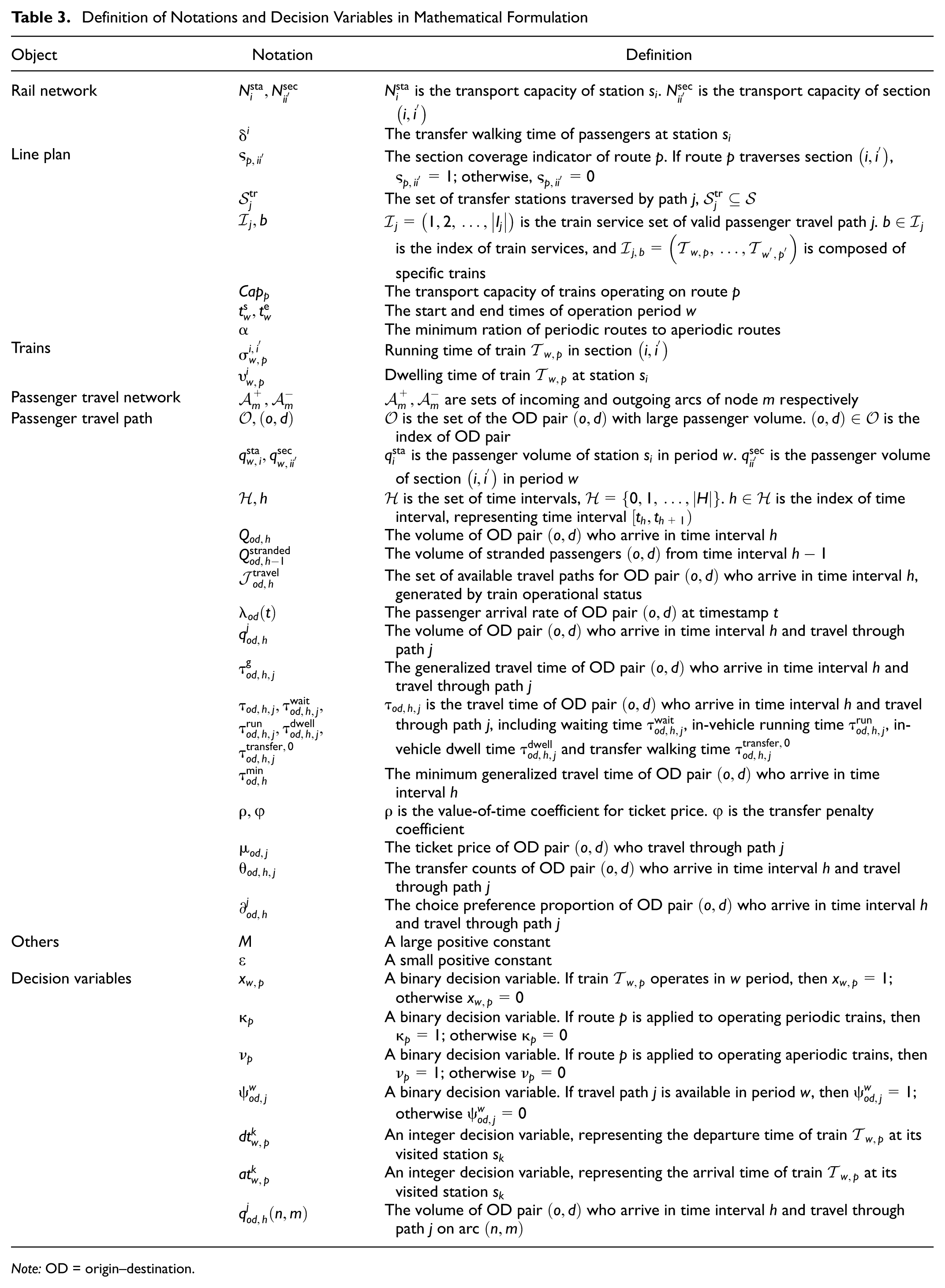
Note: OD = origin–destination.
Train Operation Constraints
Resilience of Passenger Travel Paths
Passenger travel paths consist of train services, as shown in Figure 7. We partition each valid path

When a path involves transfers, it must be ensured that at least one train of each train service in path
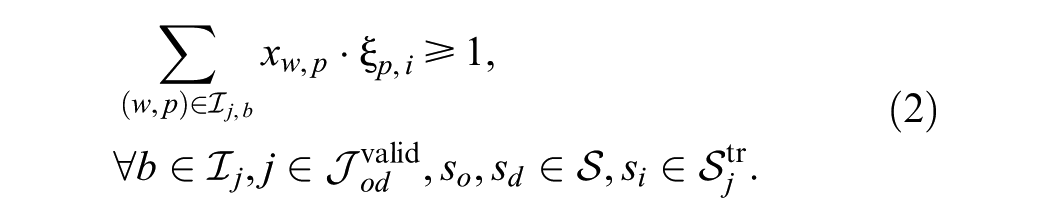
Therefore, constraint (3) evaluates whether path
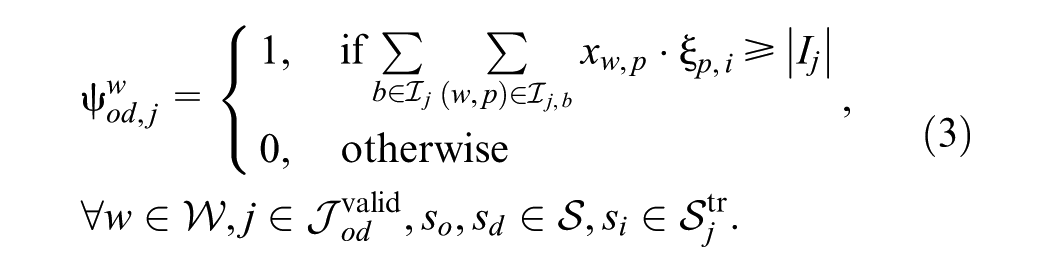
Since constraint (3) is nonlinear, it is replaced by constraints (4) and (5). When
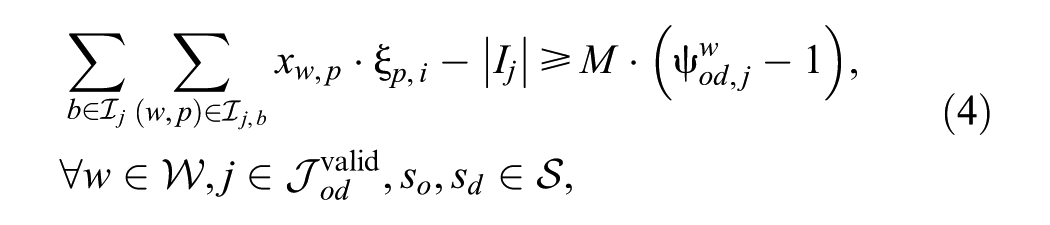

Constraint (6) defines the number of available paths for each OD pair in period


Figure 7 illustrates the operational process of the preceding constraints. When passengers travel from
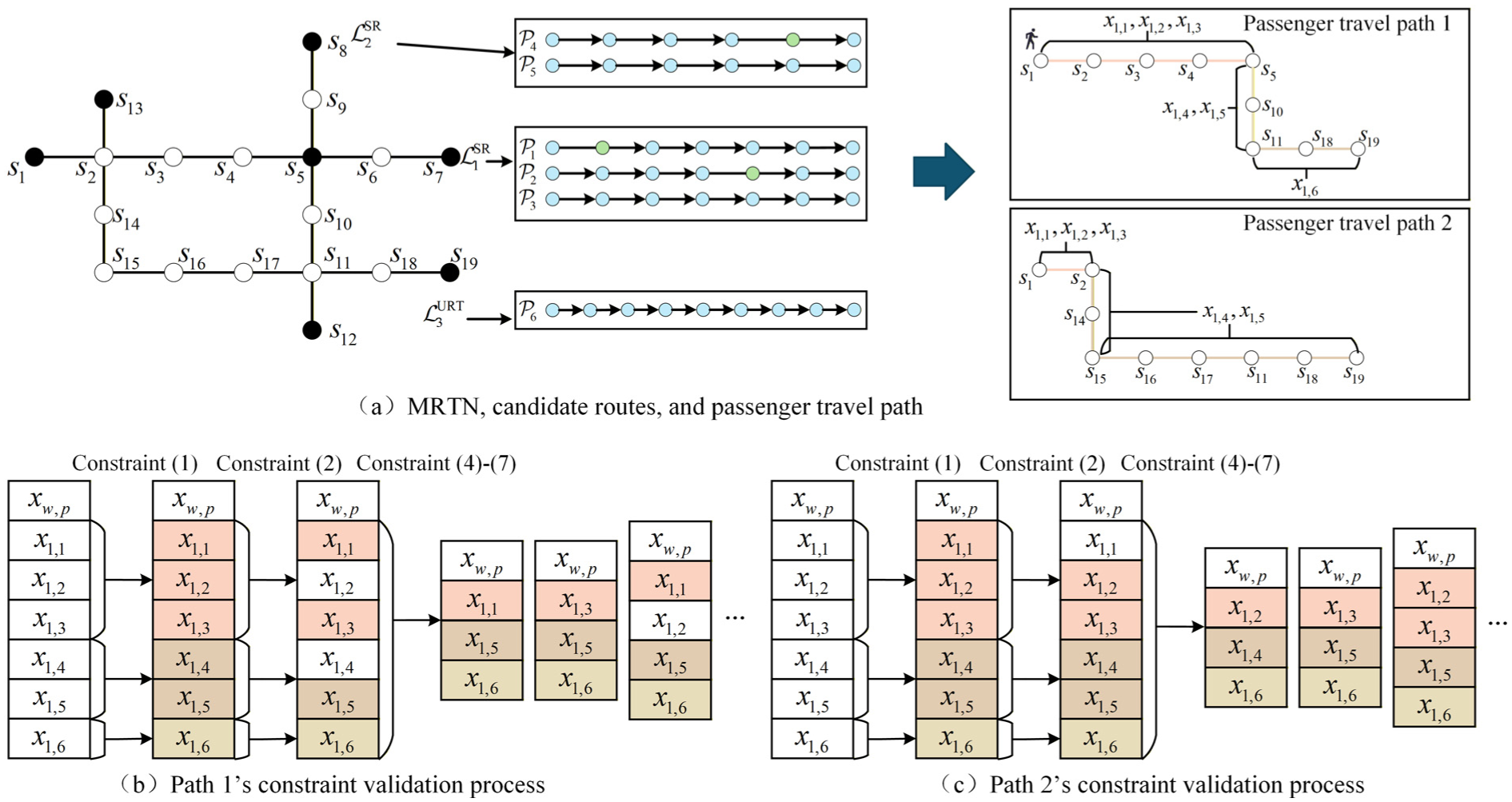
Illustration of travel path resilience constraints: (a) MRTN, candidate routes, and passenger travel path, (b) constraint validation process for path 1, and (c) constraint validation process for path 2.
Operation Pattern for Train Routes
Constraint (8) prevents a route from being simultaneously applied to both periodic and aperiodic. Constraint (9) ensures the number of periodic routes is not less than a specified proportion


Constraints (10)–(12) collectively ensure that (1) when a route is designated as periodic, each period should operate a train on this route, and (2) when a train route is designated as aperiodic, at least one train must operate on this route in one period:



Train Estimated Departure and Arrival Times
To calculate passengers’ waiting time, we introduced the estimated departure time in the preceding sections. Constraint (13) ensures operated trains must depart from origin stations between the start and end times of their designated period. Then, constraints (14) and (15) compute all succeeding departure and arrival times based on section running times and station dwell times.



Train Headway Time
Periodic trains operate to enhance schedule memorability for passengers. Therefore, when two periodic trains with identical route operate in consecutive periods (i.e.,




Train Technical Constraints
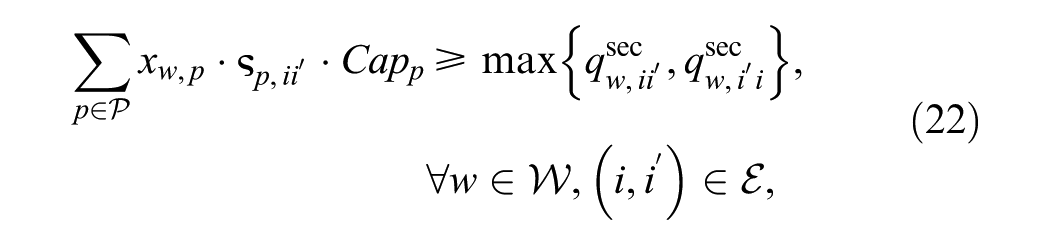
The number of passing trains in a section/station is limited by the section/station capacity, which is guaranteed by constraints (20) and (21). Constraints (22) and (23) ensure the total transport capacity in period



Passenger Assignment Constraints
Passenger Travel Process
For the convenience of calculation, the continuous time of periods is discretized into several equal time intervals, denoted by

For each OD pair arriving in
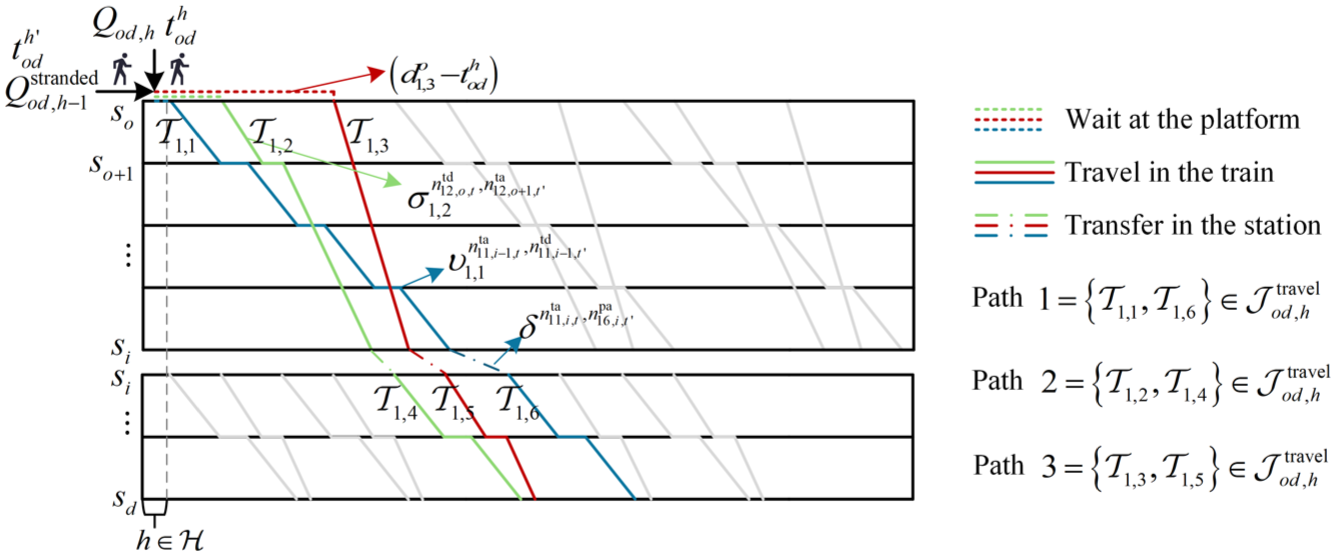
Passenger travel process considering uncertain service choice behavior.
Then, the passenger volume for each path

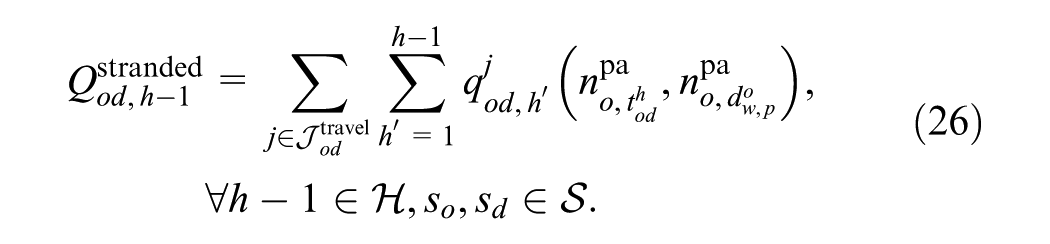
Constraint (27) converts ticket price, transfer counts, and travel time into generalized travel time:

Constraint (28) calculates the travel time of each path

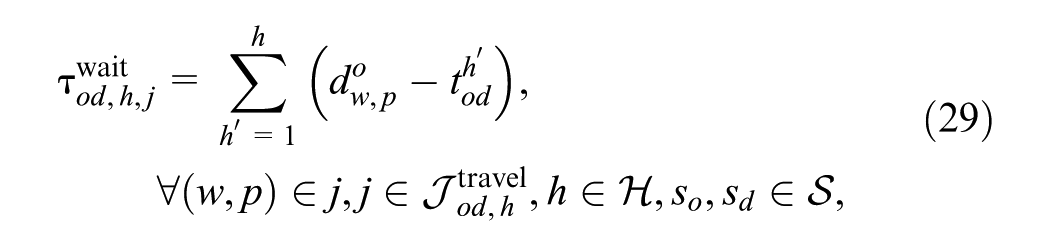
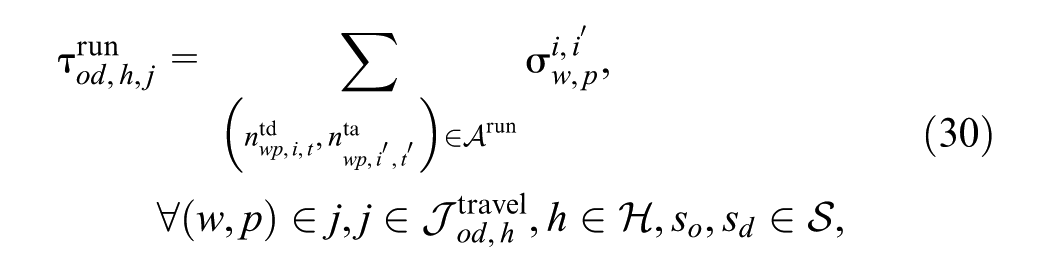
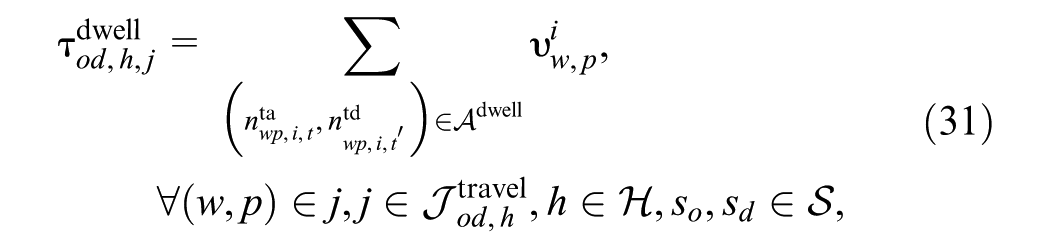
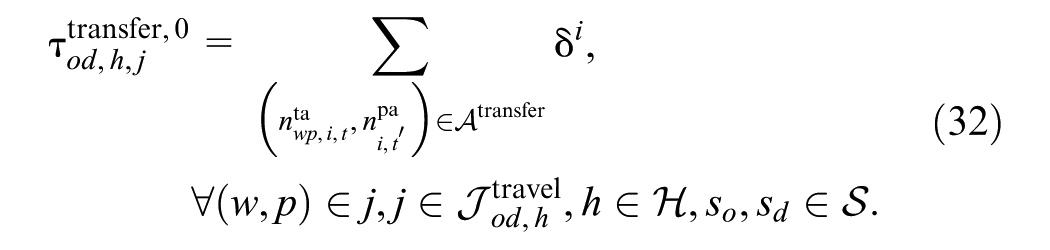
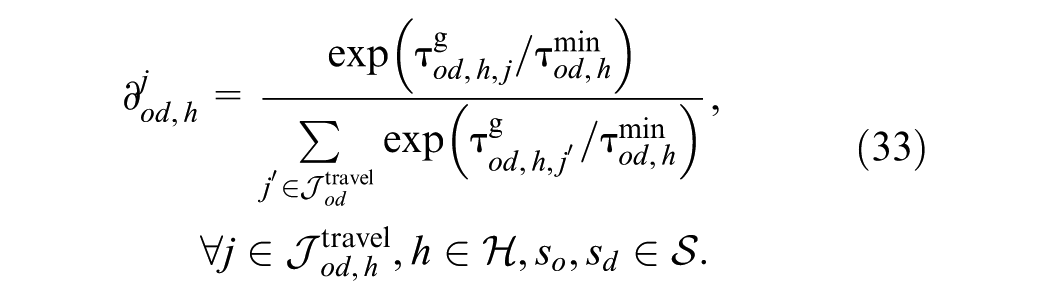
Next, the Logit-based choice model is established to determine the travel path choice preference proportion with constraint (33):
Flow Conservation and Service Capacity Constraints
The conversation of passenger flow needs to be guaranteed, as shown in Figure 9.
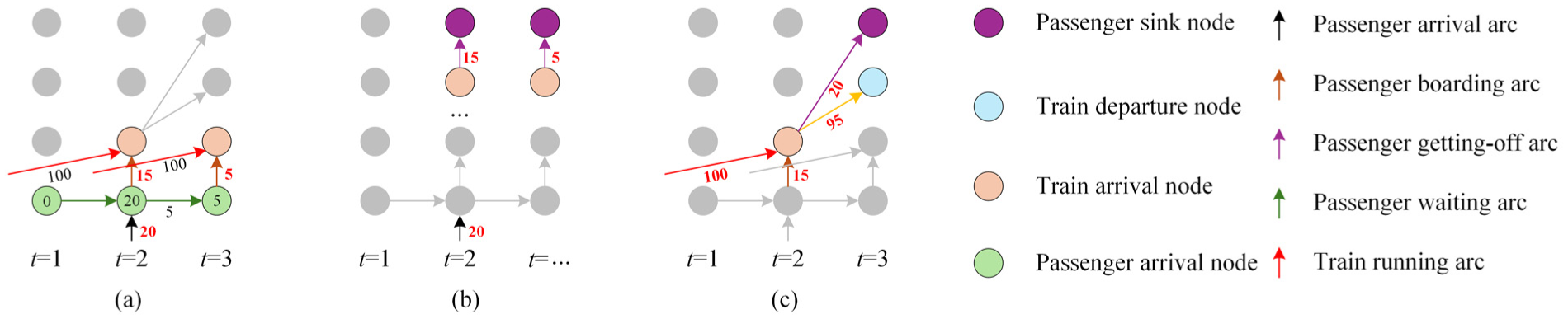
. Illustration of passenger flow conservation. (a) Passenger inflow conservation; (b) Passenger outflow conservation; (c) Passenger flow conservation on each node.
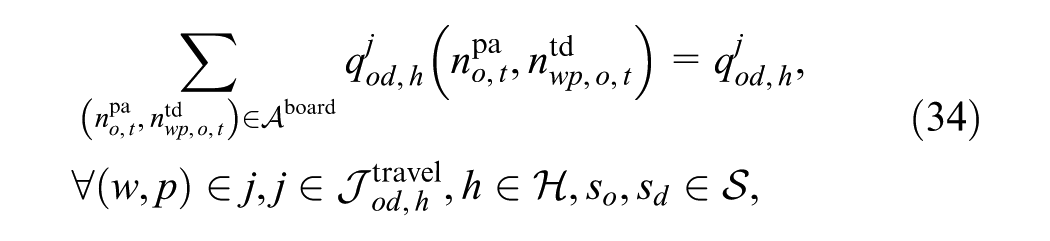
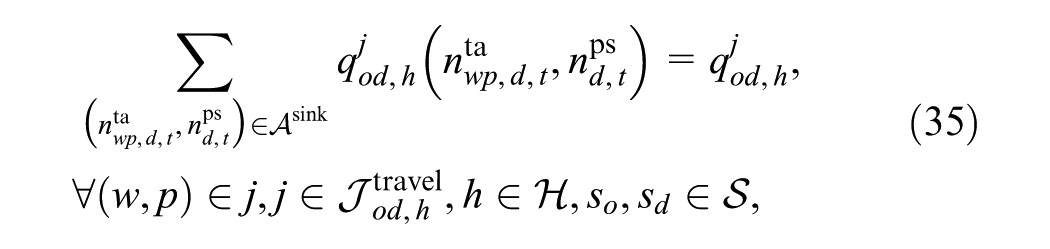
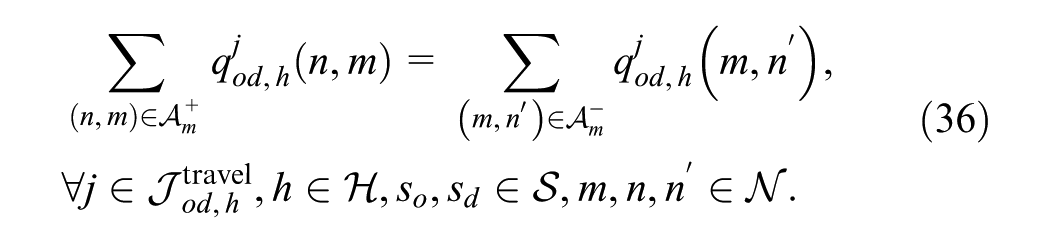
Constraint (34) ensures the volume of passengers traveling via boarding arcs equals the inflow volume at the station (i.e., Figure 9(a)), while constraint (35) matches the volume of passengers alighting via getting-off arcs to the outflow volume (i.e., Figure 9(b)). Constraint (36) further guarantees flow conservation on each node (i.e., Figure 9(c)).
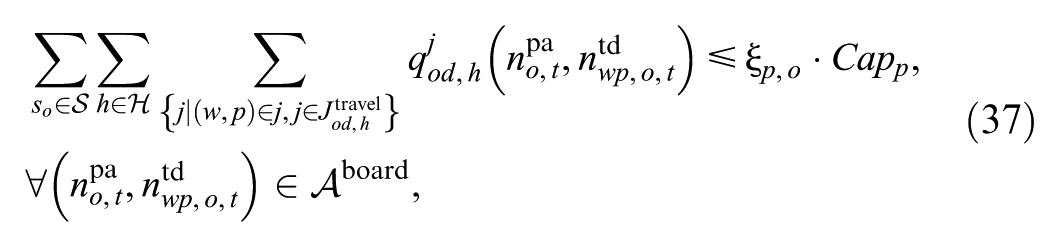
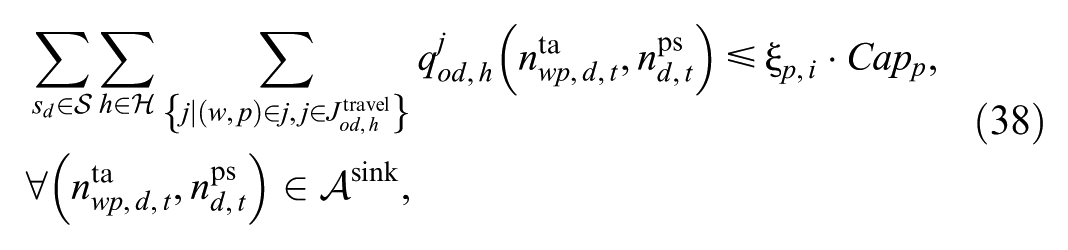
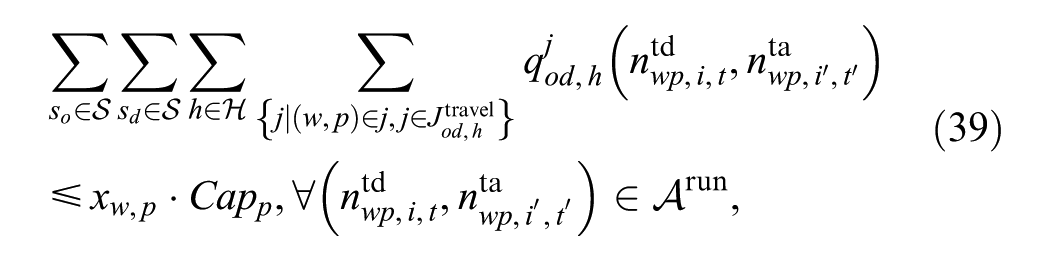
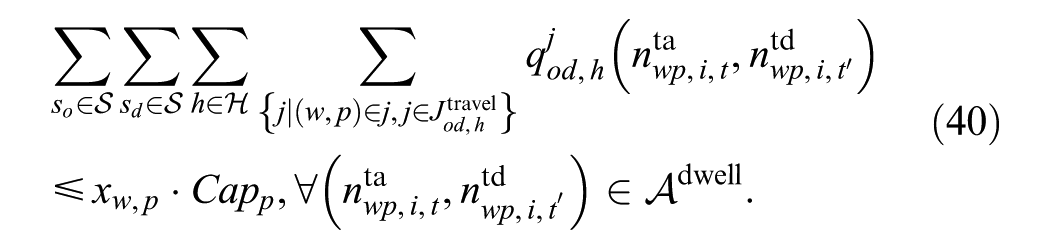
Constraint (37) ensures that only when train
Objective Function
The objectives of this study are to reduce passenger generalized travel time, reduce operational costs, and enhance MRTN resilience.
The first objective function is expressed as

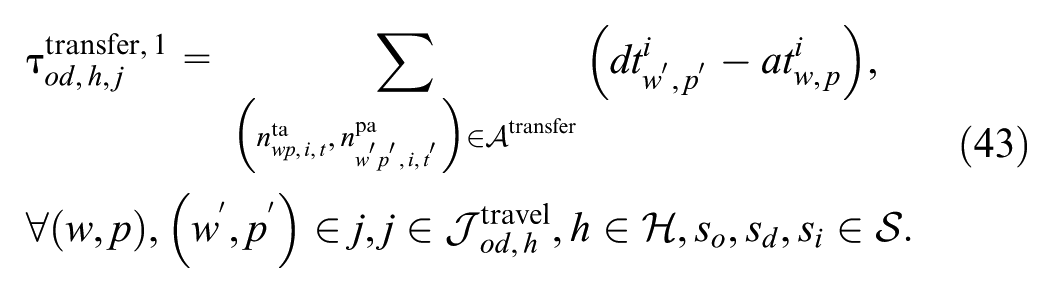
where
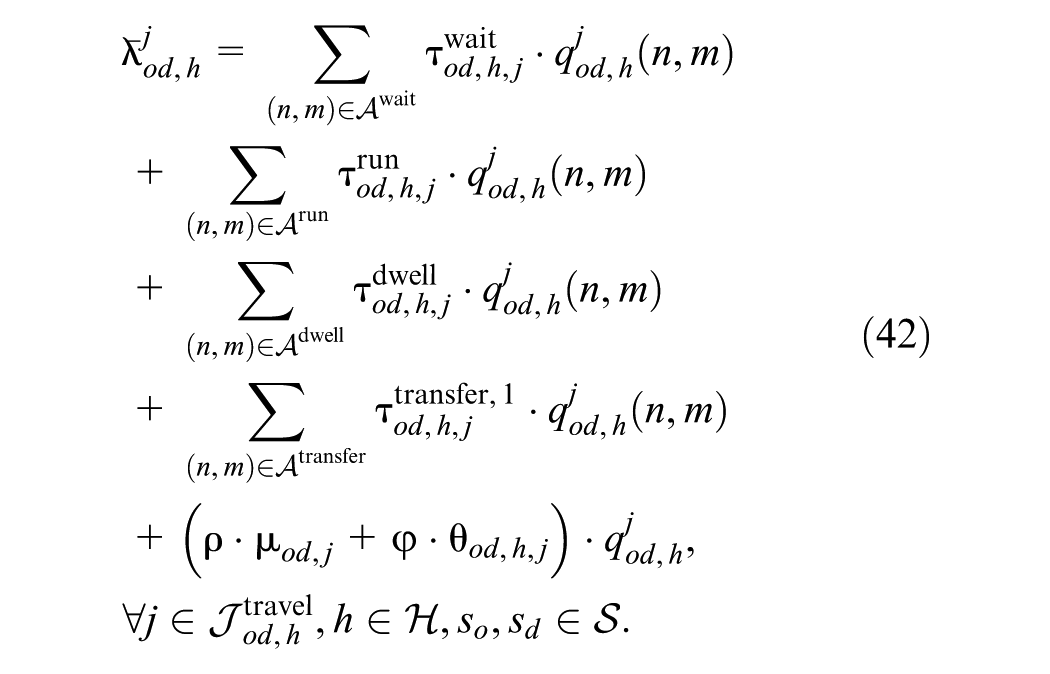
Waiting time
The second objective function aims to reduce the operation cost, comprising organization cost and travel cost. Organization cost is a fixed expense determined by the number of trains, whereas travel cost is proportional to trains’ running and dwell time. Thus, the second objective function is formulated as
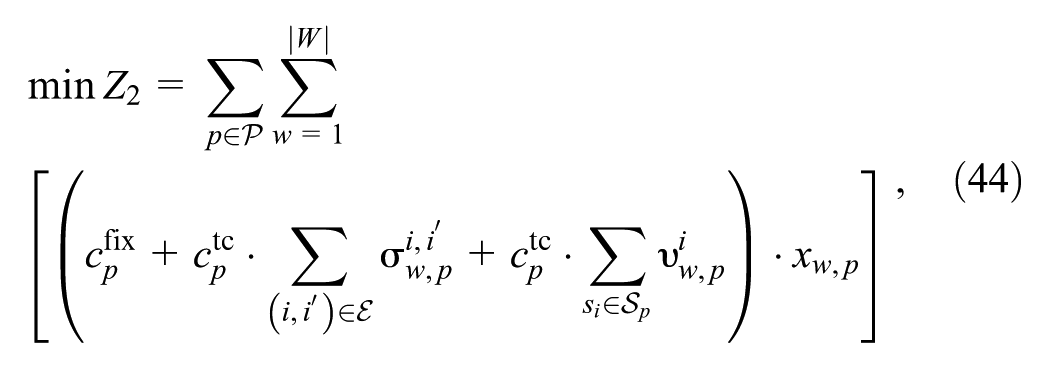
where
The third objective function aims to enhance MRTN resilience by increasing the number of available passenger travel paths, which is expressed as

The research problem is formulated as a multiobjective optimization problem. We use the linear weighted method to manage three objective functions, designed as

where
Solution Algorithm
The proposed problem constitutes a complex integrated model with high-dimensional variables, complex constraints (e.g., resilience constraints, multimodal operation pattern constraints, passenger assignment constraints with uncertain choice behavior) and multiple objective functions, necessitating efficient algorithms to obtain satisfactory solutions. Therefore, we establish the solution framework depicted in Figure 10. By inputting network structure information, passenger OD data and so forth, we construct a set of candidate train routes. We then generate an initial solution, carry out passenger assignment, and perform neighborhood search based on the assignment results. The specific flow of the algorithm is as follows:
The adaptive large neighborhood search (ALNS) algorithm has demonstrated efficacy in rail transit optimization, enabling an efficient searching process ( 2 ). The algorithm possesses customizable destroy and repair operators, and additional operators (e.g., the adjustment, periodicity check, and resilience check operators developed in this study) can be incorporated to meet specific problem requirements. This disturbance-repair iterative mechanism aligns well with the core logic underlying resilience-oriented optimization. Therefore, we develop an IALNS algorithm for neighborhood search phase.
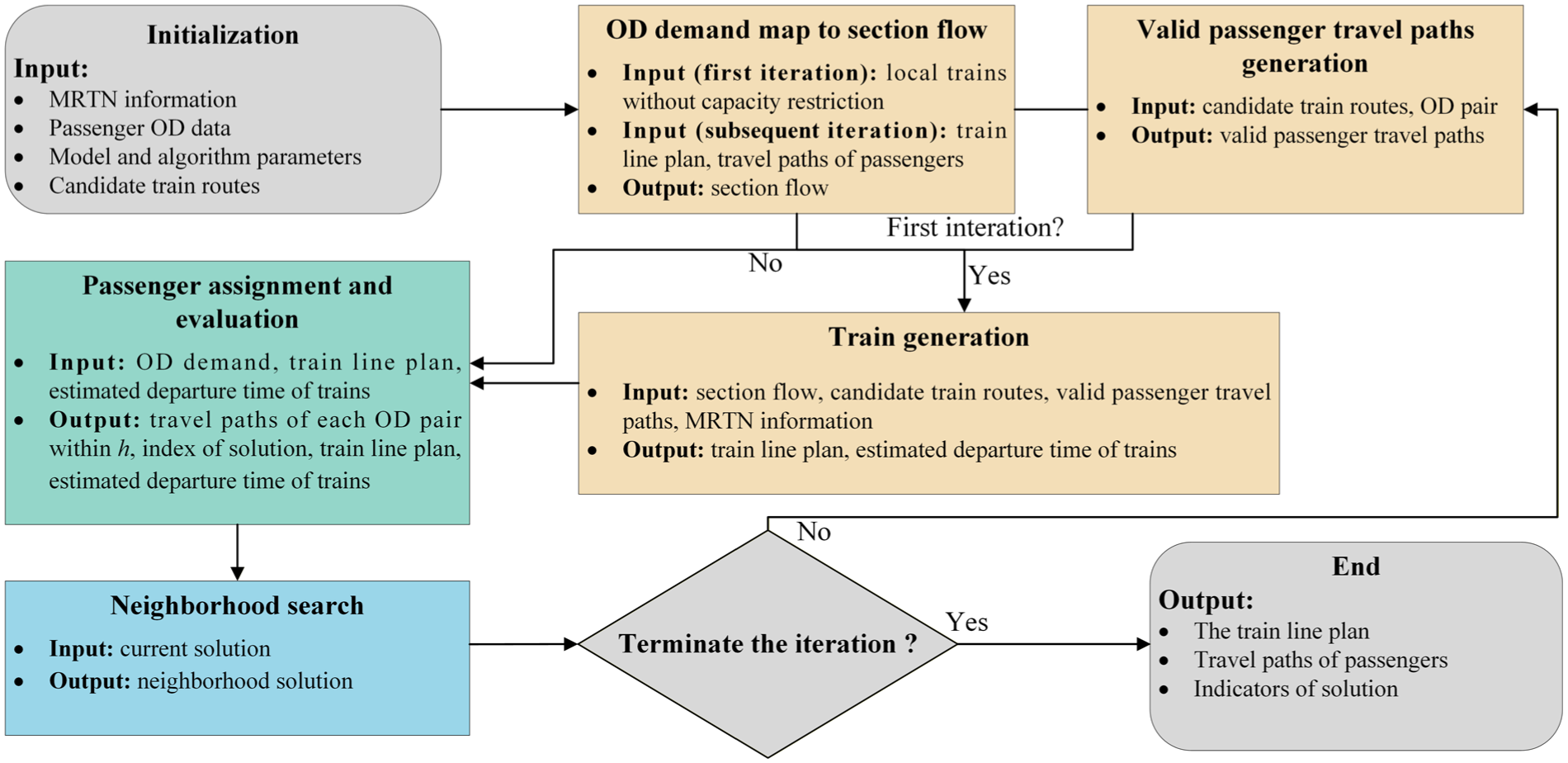
Iterative procedure for solving the proposed problem.
Initial Solution Generation
Mapping the OD Demand to Section Flow
In the first iteration, we operate local trains without capacity restrictions along each transit corridor and construct the passenger travel network. Then, in-line OD demand is assigned to sections using in-line trains, while cross-line OD demand is assigned to sections along shortest paths. In subsequent iterations, we map OD demand according to the line plan and passenger travel paths generated by neighborhood search and passenger assignment.
Valid Passenger Travel Paths Generation
Assuming all candidate routes operate trains in every period, based on section running times and station dwell times, we use Yen’s k-shortest paths method to determine valid travel path set
Train Generation
Initialize Train Routes Operation Pattern
From
Initialize Periodic and Aperiodic Trains
According to constraints (10)–(12), periodic operation of route
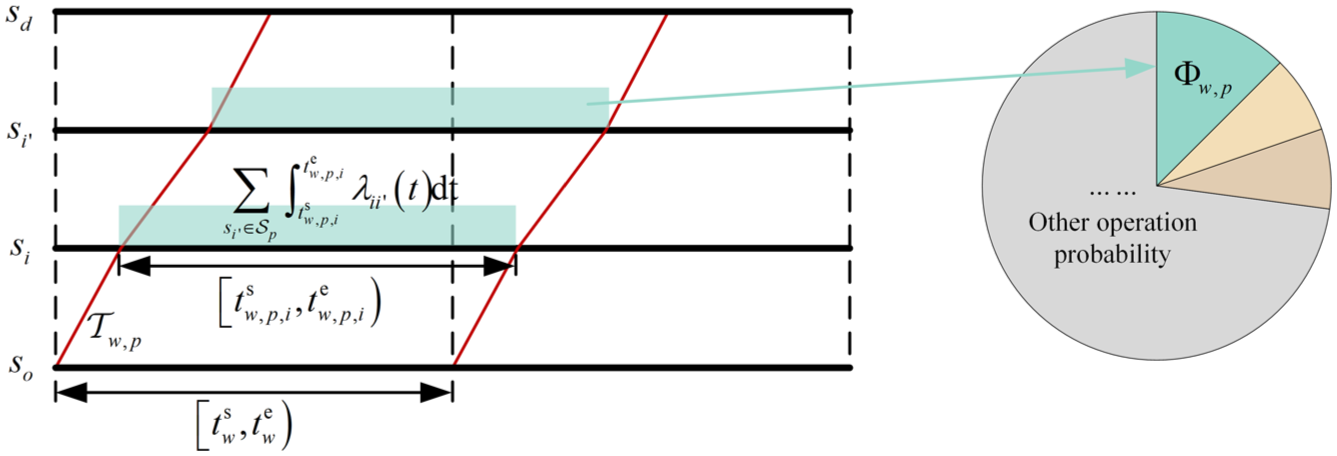
Initialization of aperiodic trains.
Consequently, its maximum passenger service capacity is derived as

Then, we generate a random integer
Initialize Train Arrival/Departure Times
We first determine departure times at origin stations of periodic trains in the first period by constraint (13). Then, departure times of these trains in subsequent periods are determined with constraints (16)–(19), while aperiodic trains are evenly inserted into each period based on periodic trains’ departure times. Finally, arrival/departure times for all trains at each station are computed by constraints (14) and (15).
Passenger Assignment Algorithm
A passenger assignment algorithm incorporating an available travel path searching method is developed to derive passenger travel paths. Figure 12 illustrates the algorithm’s procedure.

Procedure of passenger assignment algorithm.
Evaluation Functions
To facilitate neighborhood solution adjustments, we establish the following metrics, which can be calculated based on the results of passenger assignment.
Passenger Load Factor
The passenger load factor serves to evaluate a train’s operational efficiency to decide whether to stop the train or not. Define
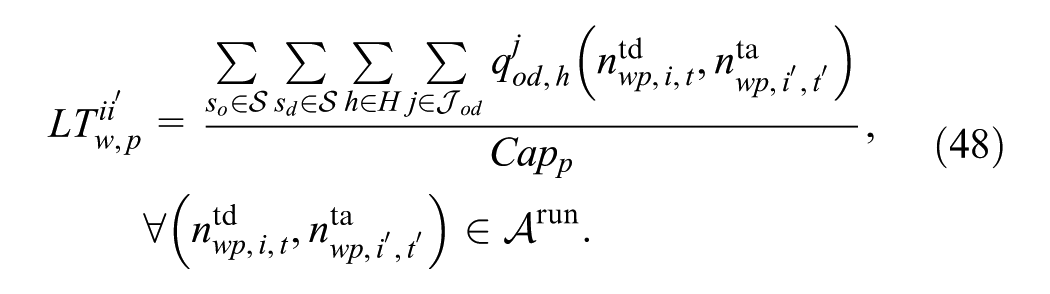
Passenger Service Capacity
When adding a train, its passenger service capacity must be evaluated. We quantify this capacity
The Number of Travel Paths Formed by a Train
We assess the importance of an operated train for network resilience by evaluating the number of travel paths it forms. We define

where
The Number of Additional Travel Paths Formed by a Train
By traversing all trains across the network, the number of additional passenger travel paths can be generated by adding a train
Passenger Demand of Boarding and Getting-Off a Train at a Station
Since candidate routes constrain the model’s feasible region, a route’s stop plan must be evaluated to ensure rationality, which is evaluated by the passenger demand it can serve. Define
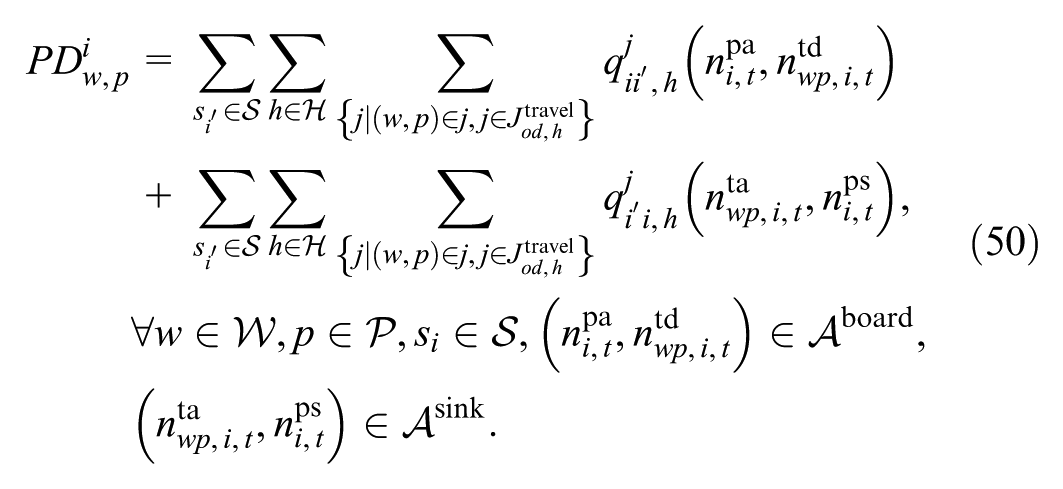
Volume of Passenger Arrivals and Departures at a Station
The volume of passenger arrivals and departures at a station serves as a key criterion for evaluating station stop quality. Define
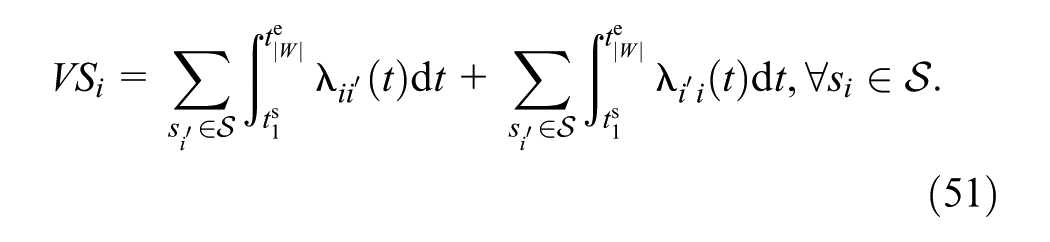
IALNS Algorithm
The IALNS algorithm utilizes a two-stage approach to solve LPP: first, performing optimization for each subplan, then followed by global adjustment of network plan, as shown in Figure 13.
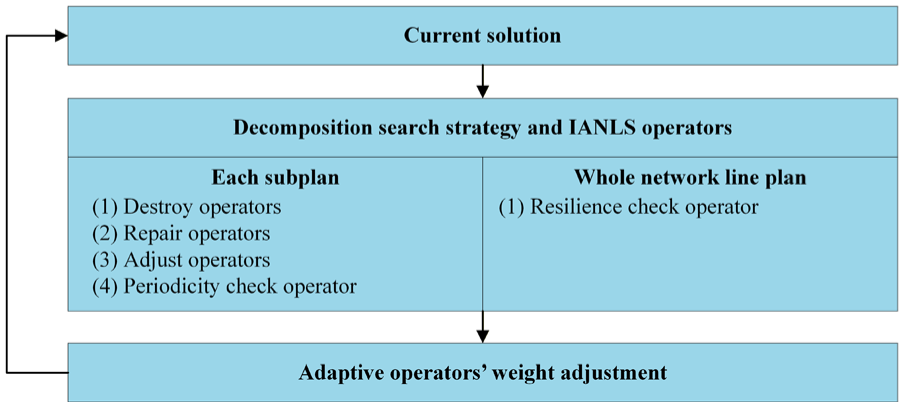
Procedure for the IALNS algorithm.
IALNS Operators
We have meticulously designed the operators for subplans and network plan. For subplans, beyond the conventional destroy and repair operators commonly used in ALNS, several new operators are customized: 1) adjust operator, which alters the accessibility of passenger travel paths by modifying train stop plans; and 2) periodicity check operator, which verifies the feasibility of partial periodic pattern. For the whole network line plan, a resilience check operator is newly introduced to assess the resilience of the entire network. The combination of these operators can facilitate the generation of neighborhood solutions.
Subplan
Destroy operator 1: Reduce periodic trains. If passenger load factors of some periodic trains are excessively low or highly fluctuating, part of them should be deleted, and the corresponding route are converted to aperiodic pattern.
Destroy operator 2: Delete aperiodic trains. If the passenger load factor of an aperiodic train is excessively low or highly fluctuating, delete this aperiodic train.
Repair operator 1: Change aperiodic trains to periodic trains. If passenger load factors of aperiodic trains are relatively high and balanced, convert the corresponding route to periodic pattern.
Repair operator 2: Add aperiodic trains. If an aperiodic train has substantial passenger service capacity in a nonoperation period
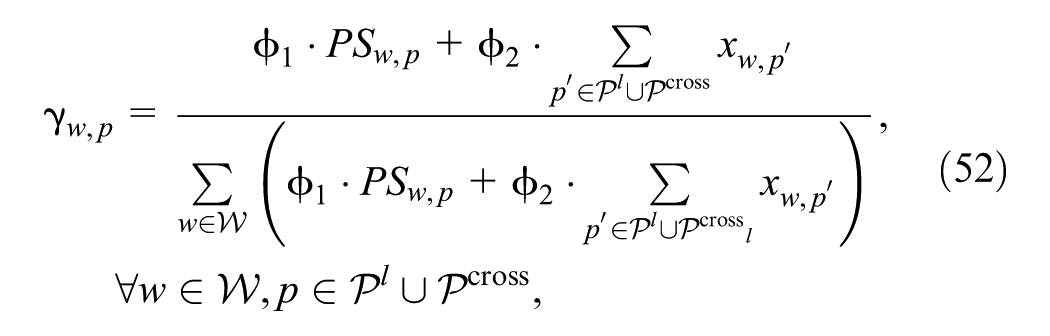
where
Adjust operator 1: Change stop station to passing station. If
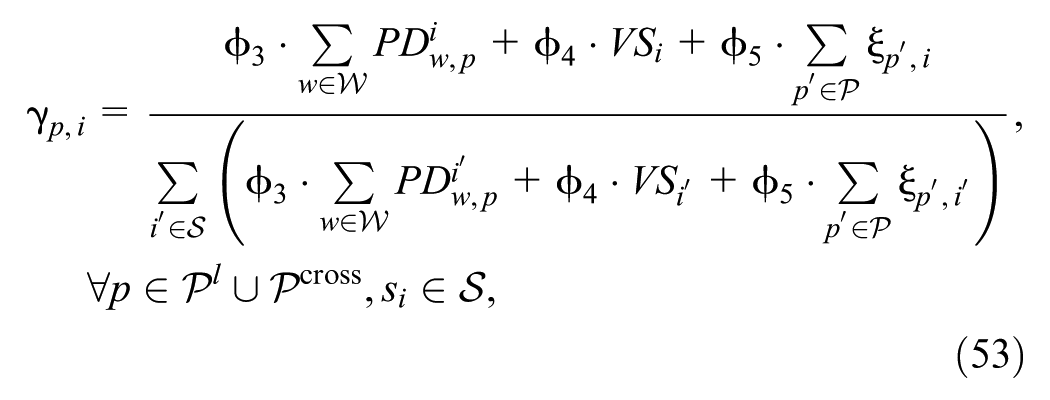
where
Adjust Operator 2: change passing station to stop station. Similar to the adjust operator 1.
Considering the ration constraint (9) for periodic and aperiodic routes, the preceding operators may produce infeasible solutions. Therefore, a periodicity check operator verifies the feasibility of each new solution. If a new solution violates constraint (9), the aperiodic train with the lowest passenger load factor is deleted until the constraint is satisfied.
Network Plan: Resilience Check Operator
After applying operators to each subplan, the network line plan must be verified for compliance with constraints (1) and (3)–(7) to ensure the travel path resilience. If violations occur, roulette wheel selection is employed: the cancelation probability of an operated train is determined by
Adaptive Operators’ Weight Adjustment
In each iteration, operators are selected to generate new solution. Each operator is assigned a weight

where
Equation 55 defines the acceptance probability for solution

where
Case Study
Shanghai MRTN is used to examine the proposed approach, which comprises 18 URT lines and four SR lines, as shown in Figure 14. URT operates local trains with full-length and short-length services, but without cross-line services. SR employs express, rapid, and local trains, including cross-line services. OD data for URT are sourced from a day in 2024, whereas OD data for SR are derived from engineering project forecasts since SR lines are still in the planning phase. The study horizon spans from 05:00 to 23:00, discretized into 18 periods with a duration of 60 min each. Passenger assignment is performed at 5-minute intervals, yielding 216 time intervals. Train capacities are 1,280 passengers for URT and 1,096 for SR. Parameters such as station/section capacities
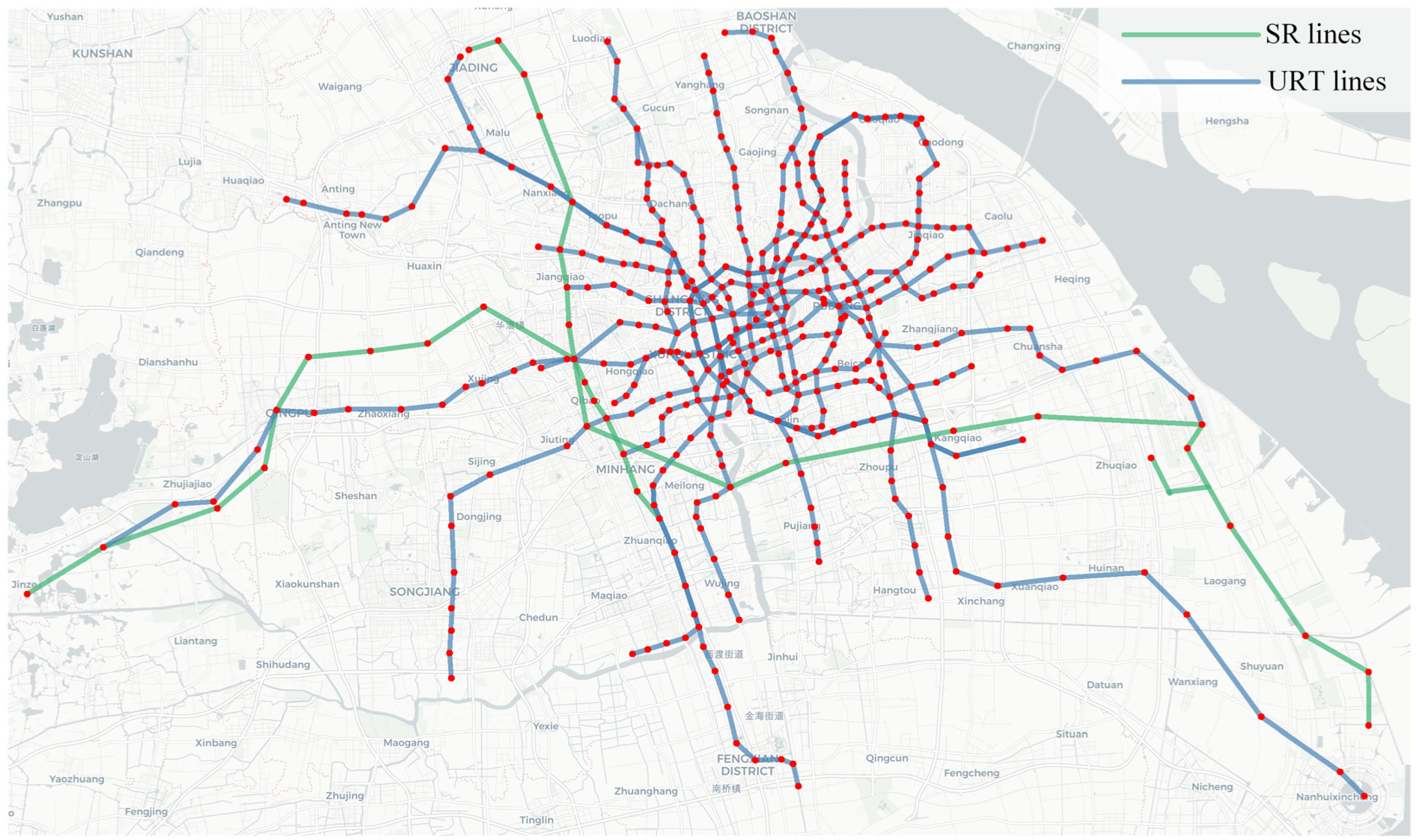
Layout of the studied MRTN.
Computational Speeds
We establish scenarios with progressively extended time horizons to evaluate IALNS algorithm performance. The maximum computation time is set to 14,400 s, with IALNS iterations fixed at 500. Table 4 compares the results across scenarios. Gurobi exhibits superior performance for shorter time spans, but its efficiency is gradually surpassed by IALNS as the time span increases. For time spans exceeding 4 h (scenario 1–3 and 1–4), Gurobi fails to obtain an optimal solution within 14,400 s. This occurs because longer time horizon require: 1) increased number of constraints (1)–(7) to satisfy path resilience requirements for each period
Comparison between Gurobi and IALNS Algorithm
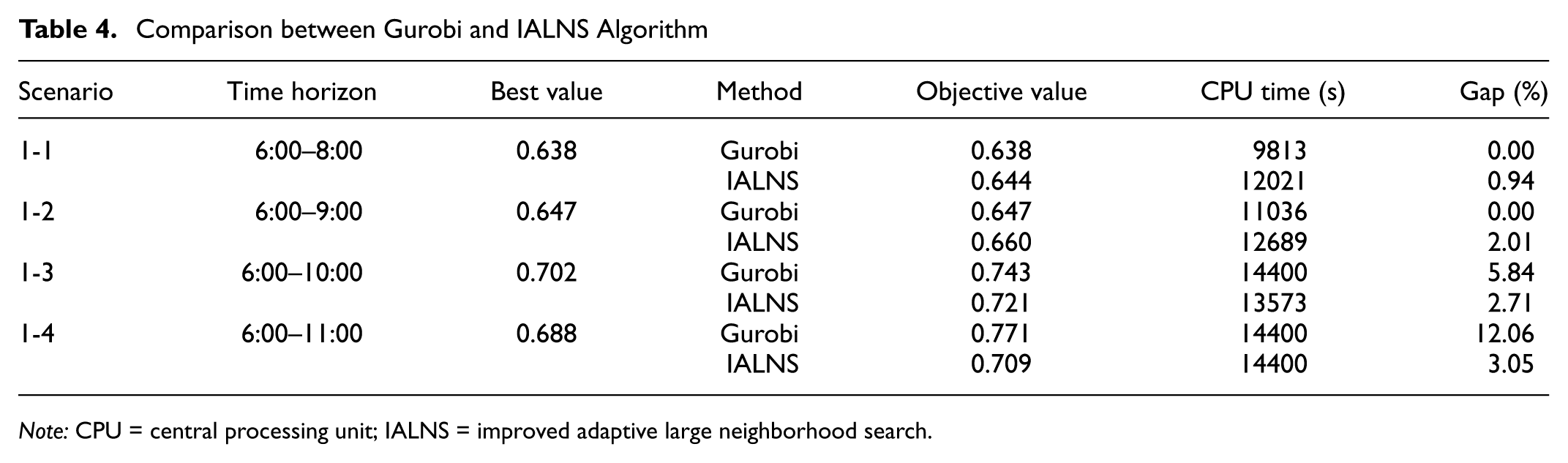
Note: CPU = central processing unit; IALNS = improved adaptive large neighborhood search.
Influence of Travel Path Resilience Requirement
This study employs passenger available travel path quantity as a metric for network resilience. By adjusting available path number requirements
Comparison between Different Resilience Requirements
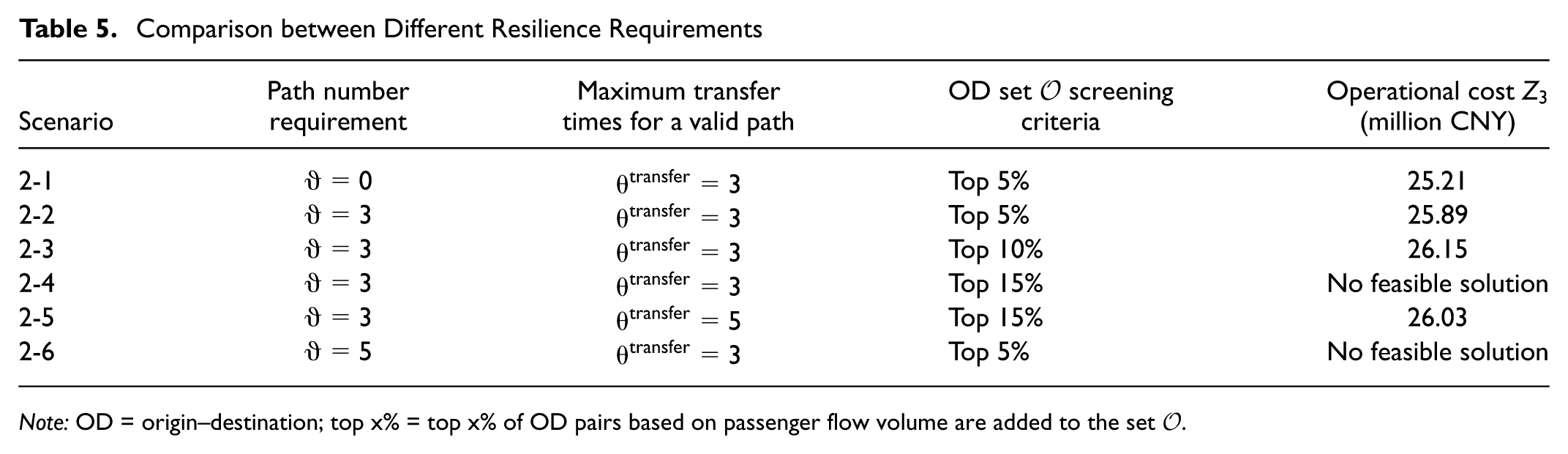
Note: OD = origin–destination; top x% = top x% of OD pairs based on passenger flow volume are added to the set
Scenarios 2-1 and 2-2 demonstrate that resilience constraints may increase operational costs. As depicted in Figure 15, 28% of passenger flow on
In conclusion, network resilience constraints can enhance network resilience with limited operational cost increases, which is effective for large-scale MRTN.
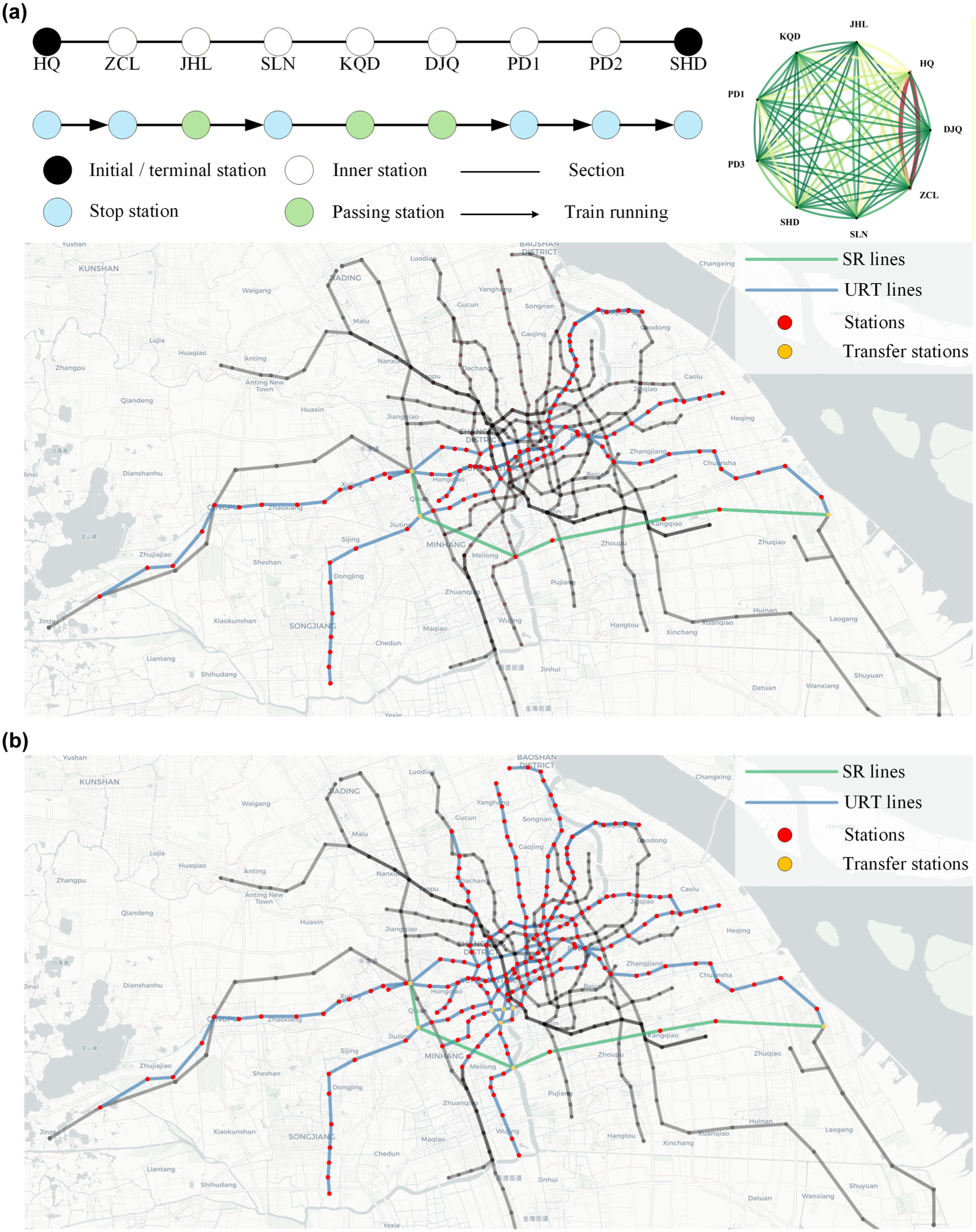
Comparison of network resilience between scenarios 2-1 and 2-2: (a) scenario 2-1, and (b) scenario 2-2.
Influence of Uncertainty in Passenger Service Choice Behavior
We established scenario 3-1 (first-come-first-served) and scenario 3-2 (uncertain service choice behavior) to verify their impact on train operations. Figure 16 shows timetables for
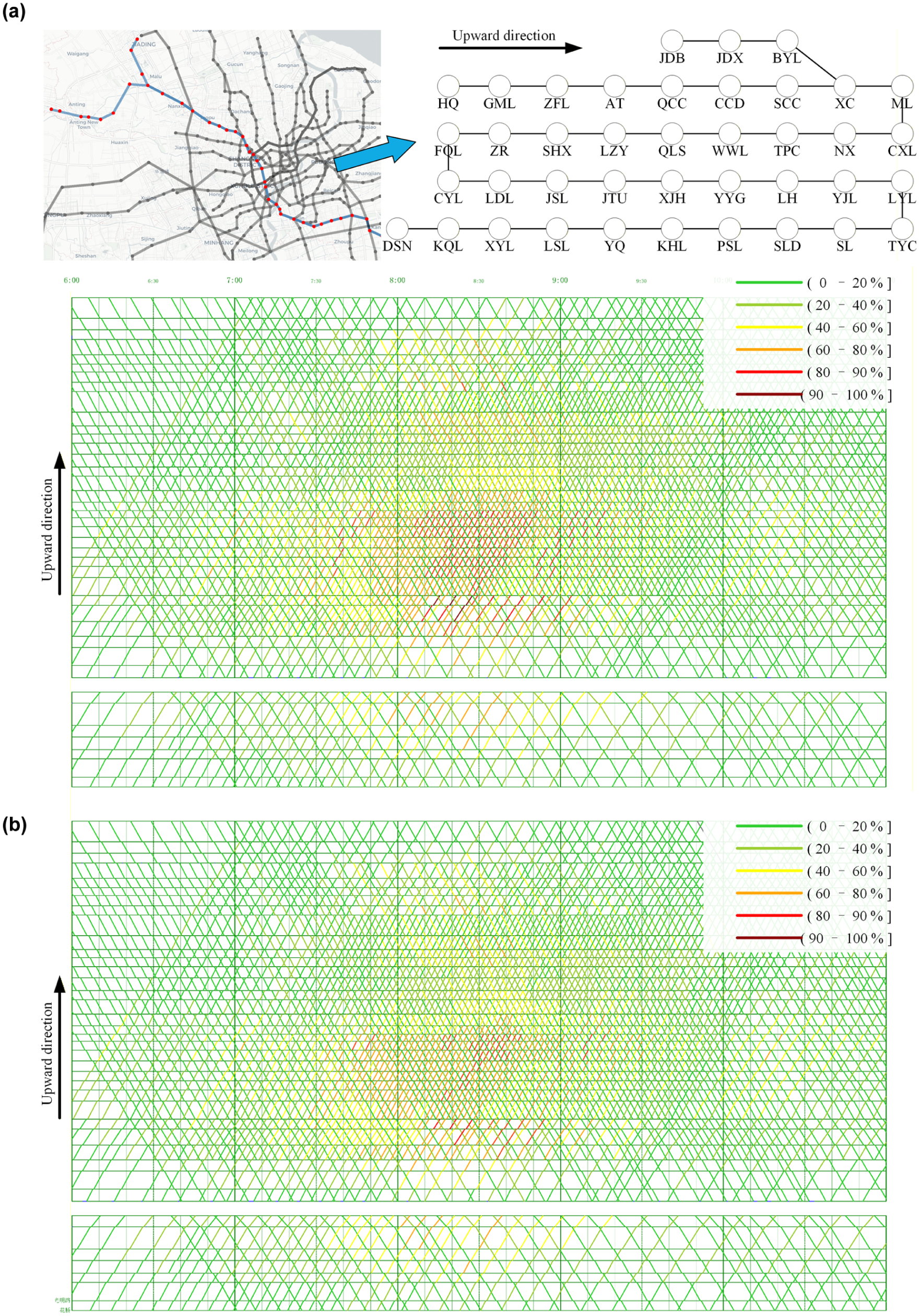
Comparison of passenger load factors in
Influence of Partial Periodic Operation Strategy
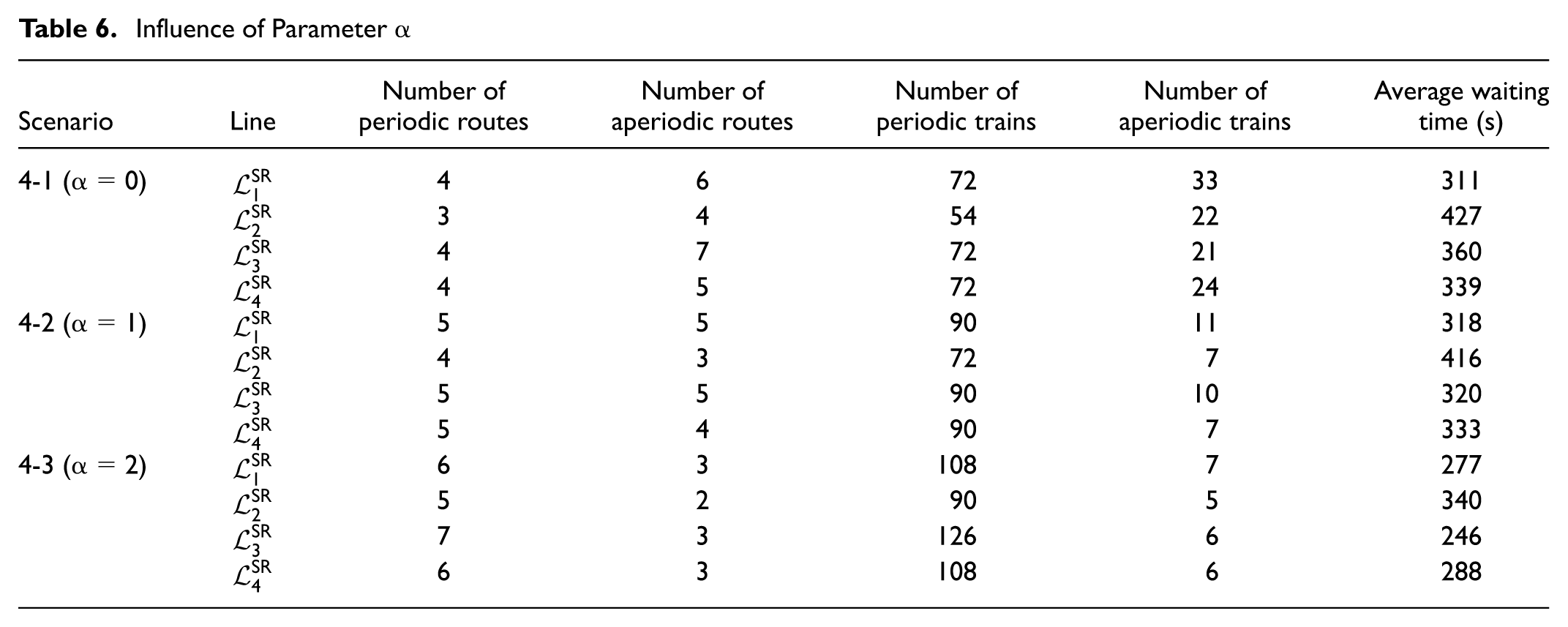
Some scholars have explored periodic pattern in China’s HSR and URT, though this remains theoretical and has not been implemented. Therefore, examining the application potential of partial periodic pattern on the newly emerging SR in China is intriguing. We adjust parameter
Influence of Parameter
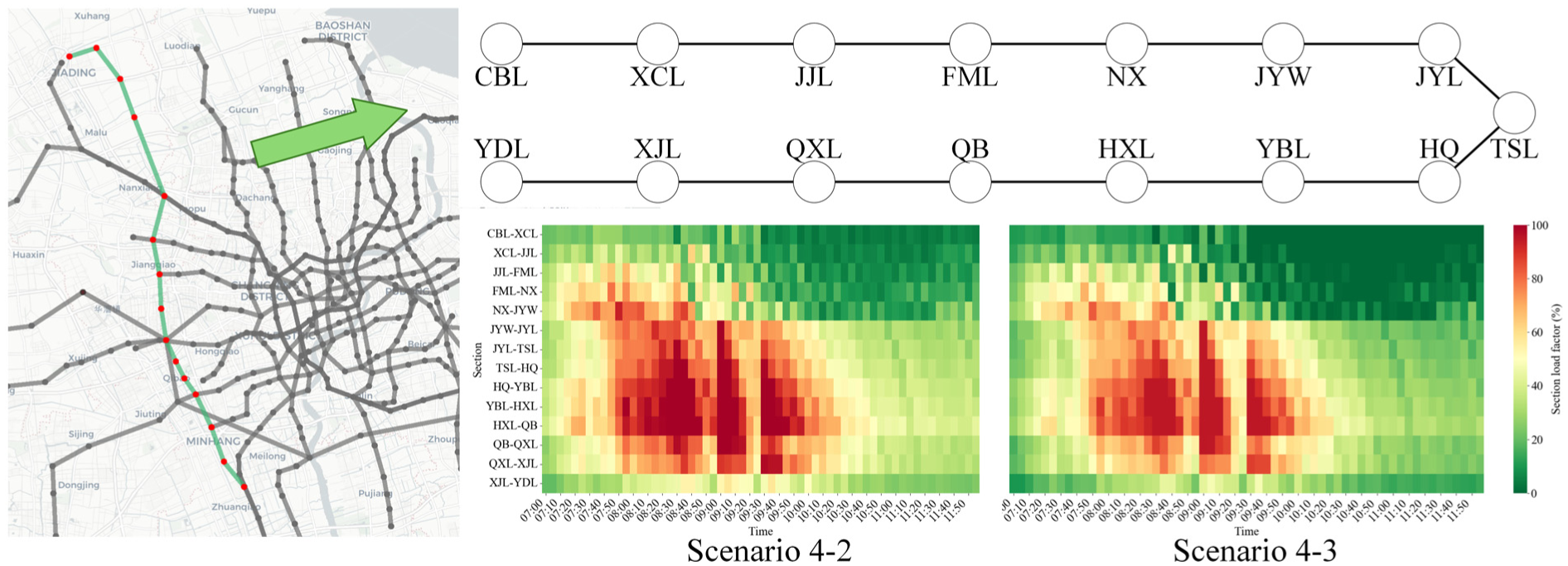
Comparison of section load factors in
Conclusions
This study addresses the LPP incorporating passenger service choice behavior uncertainty in a MRTN. A resilience-oriented model is proposed to determine train routes, stop plans, frequencies, and routes’ operation patterns, aiming to reduce operational costs, decrease generalized passenger travel time, and enhance network resilience. An iterative solution procedure is designed to solve the proposed model, which incorporates a passenger assignment algorithm with available travel paths searching method to derive passenger travel paths, and an IALNS algorithm for large-scale cases.
Shanghai MRTN serves as a case study to validate the proposed approach. Results indicate: 1) the approach can obtain high-quality solutions within a reasonable computation time; 2) using the resilience constraints of travel paths can increase the path accessibility with limited operational cost increases; 3) uncertain service choice behavior influences passenger distribution across trains, improving capacity-demand alignment; and 4) partial periodic operation pattern can maintain operational regularity while adapting to demand fluctuations.
Although this study introduces novelty through the travel path resilience to line planning, there are potential extensions: 1) computational results indicate that solution time increases significantly with network scale or time horizon expansion—combining ALNS with exact algorithms or exploring deep learning-based surrogate models maybe a good direction in addressing this limitation and 2) the reliance on historical OD data fails to fully capture sudden shifts in passenger behavior. Incorporating uncertainty in passenger volumes is essential for further enhancing network resilience.
Footnotes
Acknowledgements
The authors acknowledge Shanghai Suburban Railway Operation Co. Ltd. for providing data support.
Authors’ Note
We acknowledge DeepSeek for language polishing of this article and have reviewed, edited, and take full responsibility for the published content.
Author Contributions
The authors confirm contribution to the paper as follows: study conception and design: Yijia Shan, Ruihua Xu, Ling Hong; data collection: Yijia Shan, Longhao Zhang, Yangze Lan; analysis and interpretation of results: Yijia Shan, Ruihua Xu, Jianhao Ge; draft manuscript preparation: Yijia Shan, Ruihua Xu, Jianhao Ge. All authors reviewed the results and approved the final version of the manuscript.
Declaration of Conflicting Interests
The authors declared no potential conflicts of interest with respect to the research, authorship, and/or publication of this article.
Funding
The authors disclosed receipt of the following financial support for the research, authorship, and/or publication of this article: This research was supported by the National Natural Science Foundation of China (grant no. 72171174) and the Science and Technology Program of Shanghai Shentong Metro Group Co. Ltd. (grant no. ST-TY020-2024).
