







Abstract
Freight transportation is an essential component of urban systems, as it supports economic activity and provides consumer services. However, current urban freight models are often disconnected from passenger transport simulations. This separation limits their ability to support integrated policy analysis, especially in the context of shared infrastructure and rising e-commerce demand. This study conducts a comprehensive review of agent-based urban freight modeling literature, focusing on behavioral realism, integration with passenger models, and representation of logistics processes. Key limitations are identified, including the absence of consistent agent structures, decision hierarchies, and insufficient alignment with land-use and emission models. Existing frameworks often treat freight activity in isolation, lack temporal depth, and fail to represent cross-sector interactions such as those driven by online shopping. To address these limitations, this study presents an integrated conceptual framework that embeds urban freight modeling within an existing agent-based urban system simulation platform. The extended framework introduces logistics actors such as shippers, carriers, receivers, and consumers. It incorporates them across long-term, medium-term, and short-term decision modules. Freight decisions, including firm transitions, fleet strategies, logistics planning, and delivery scheduling, are modeled in alignment with passenger systems. The integration occurs within a shared simulation environment, where freight and passenger activities interact through a common traffic flow simulator and virtual activity schedules. This framework enables behaviorally consistent and policy-sensitive simulation of urban mobility systems, particularly in the context of e-commerce-driven freight demand. Results of this study provide a foundation for future development of integrated models capable of supporting strategic planning, emission reduction, and multimodal transport policies.
Introduction
Urban freight transportation is a vital component of city logistics as it allows the movement of goods and services that sustain households, businesses, and institutions. It encompasses a complex network of actors such as shippers, carriers, receivers, logistics service providers, and consumers whose decisions collectively influence shipment volume, routing, frequency, and environmental performance. A behaviorally consistent model of this system is essential for anticipating infrastructure demands, minimizing emissions, and assessing policy measures ( 1 ). Yet, compared with passenger models, urban freight models have historically relied on aggregate flows and static origin–destination assumptions, which limits their ability to capture behavioral detail or integrate with broader urban systems.
In recent years, urban freight modeling has advanced toward more behaviorally realistic paradigms. These include agent-based models (ABMs) that represent freight actors and simulate supply chain decisions across strategic, tactical, and operational layers ( 2 ). This evolution reflects a broader shift in transport modeling toward capturing the interactions and heterogeneity inherent in urban mobility systems. Yet, despite these developments, conventional approaches to integrated urban systems modeling continue to separate freight and passenger flows, which restricts their ability to assess cross-sector policy impacts or the use of shared infrastructure ( 3 ).
The rapid growth of e-commerce has intensified these challenges. The surge in residential deliveries, supported by on-demand platforms, blurs the traditional boundary between goods and people movement ( 3 , 4 ). These evolving dynamics necessitate modeling frameworks capable of jointly representing consumer behavior, logistics decision-making, and network operations within an integrated framework. Emerging agent-based platforms have begun to address the intersection of freight and passenger systems. However, they often lack conceptual clarity and a structured organization of freight decisions, particularly for e-commerce logistics that span both business-to-business (B2B) and business-to-consumer (B2C) flows ( 1 ).
However, major conceptual and structural gaps remain in current agent-based freight and passenger modeling frameworks. While recent platforms have advanced the simulation of freight and passenger systems independently, the lack of systematic integration across decision layers and actors continues to limit comprehensive urban mobility analysis. Existing models often fall short in integrating logistics behaviors such as shipment generation, delivery scheduling, and routing with co-evolving passenger activities, including e-commerce adoption and travel substitution. Furthermore, there is limited consistency in how shared infrastructure (e.g., curb space, road capacity) and cross-sector externalities (e.g., emissions, congestion) are represented. A unified framework is needed to synchronize passenger and freight decisions across strategic, tactical, and operational levels, while maintaining behavioral realism and supporting policy experimentation.
This paper presents a comprehensive literature review on the evolution of urban freight modeling and highlights the need for a structured, integrated freight simulation framework that aligns with passenger ABMs. The objective is to synthesize key developments, identify major modeling challenges, and propose a conceptual framework for urban freight systems. This study contributes a conceptual architecture for integrating urban freight within an activity-based passenger simulation environment. Prior agent-based freight extensions often emphasize shared traffic simulation as the main integration mechanism. The proposed framework advances beyond this baseline by defining and structuring explicit coupling points between passenger activity patterns, virtual activities, and freight demand and operations.
The remainder of this paper is organized as follows. The next section describes the methodology. Following that, major challenges in the existing literature are identified and explored. Finally, the paper outlines future research directions, including a comprehensive conceptual framework for an integrated urban systems model that supports the convergence of freight and passenger activity in the e-commerce era.
Methodology
This study conducts a comprehensive literature review to examine the evolution, current state, and integration challenges of urban freight modeling, with a specific focus on ABM approaches. The review targets peer-reviewed publications, technical reports, and relevant gray literature sourced from Google Scholar, ScienceDirect, and Transport Research International Documentation (TRID) database. In addition to academic studies, government and transportation agency documents are included to incorporate applied perspectives on freight systems and modeling practices. Figure 1 illustrates the methodological workflow used in this study.
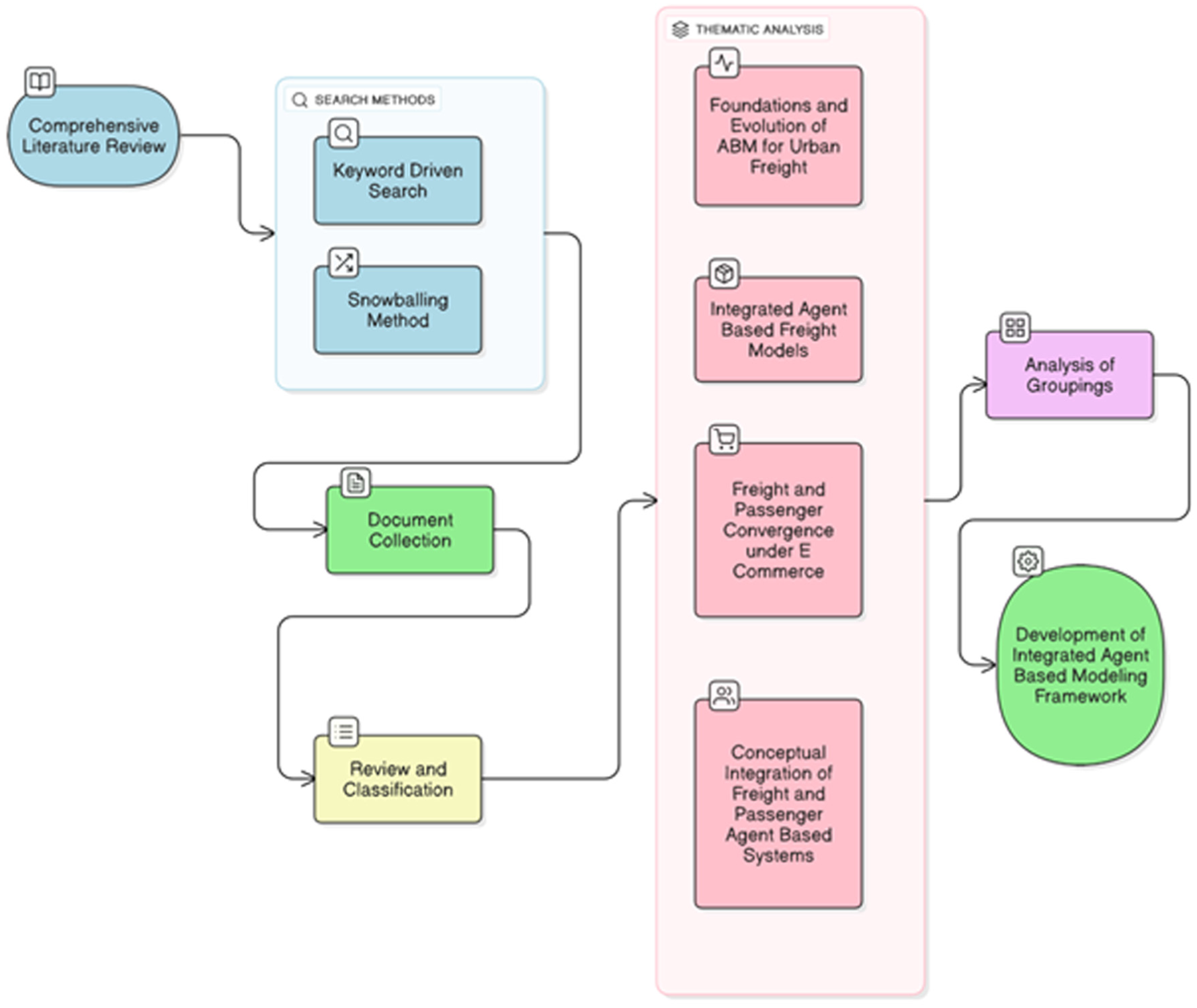
Workflow of the study.
To guide the literature search, a set of keywords was developed around themes such as “urban freight modeling,”“agent-based freight modeling,”“e-commerce logistics,”“integrated passenger–freight models,” and “freight and land-use interactions.” Articles published over the last two decades were prioritized, with emphasis placed on studies that either contribute to behaviorally disaggregated freight modeling or address conceptual integration with land use and passenger transportation systems. A snowballing method was also employed to identify additional relevant publications from the reference lists of key sources.
The systematic search across the three databases employed multiple keyword combinations to ensure comprehensive coverage. Individual keyword searches yielded: Google Scholar (“urban freight modeling”, 147 results; “agent-based freight modeling”, 21 results), ScienceDirect (“urban freight modeling”, 123 results; “agent-based freight modeling”, 19 results; “e-commerce logistics”, 662 results), and TRID (“urban freight modeling”, 11 results; “agent-based freight modeling”, 1 result; “e-commerce logistics”, 47 results; “freight and land-use interactions”, 42 results). Combined searches using Boolean operators (e.g., “urban freight” AND “agent-based” AND “behavioral”) and additional keyword combinations resulted in approximately 1,300 total potentially relevant documents. Following title and abstract screening, 335 papers were selected for detailed review. After full-text examination to assess methodological rigor and thematic relevance, 66 papers were retained. After removing duplicates across databases, 48 unique papers remained. Snowballing from reference lists contributed an additional eight papers. The final review corpus comprised 40 papers that directly informed the thematic synthesis presented in the section “Review of Agent-Based Urban Freight Modeling.” Figure 2 illustrates the complete literature selection process, including inclusion and exclusion criteria applied at each stage.
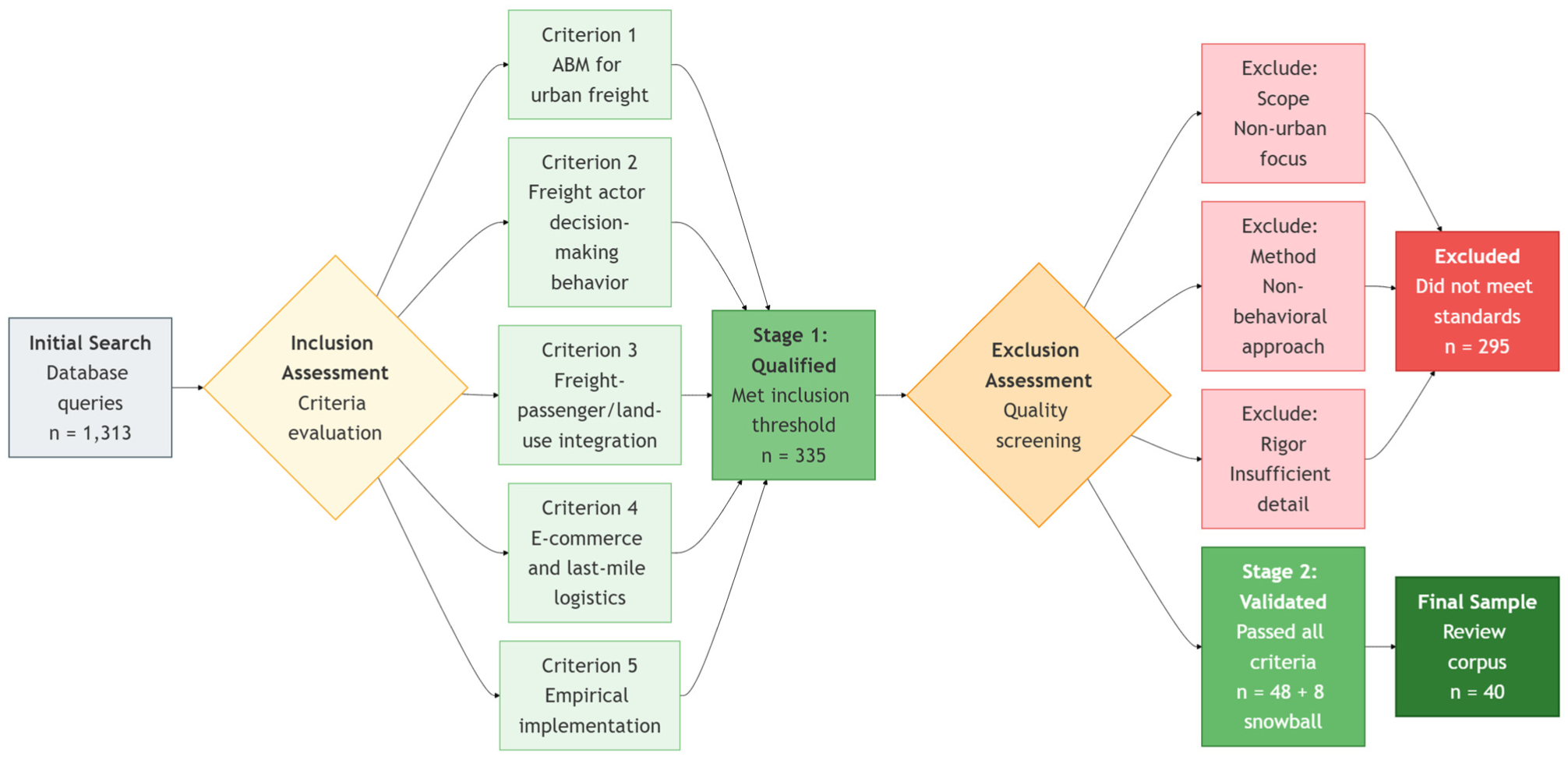
Systematic literature selection process.
Papers were included if they: (1) introduced or advanced ABM techniques for urban freight systems, (2) explicitly modeled decision-making behavior of freight actors, (3) addressed integration between freight and passenger systems, land use, or environmental models, (4) examined e-commerce impacts on urban mobility, or (5) presented empirically implemented frameworks. Papers were excluded if they focused solely on intercity freight without urban components, employed only aggregate modeling approaches, or lacked methodological detail.
Following collection, the selected documents were reviewed and classified based on their contributions to four key thematic areas: (1) the foundations and evolution of agent-based urban freight modeling, (2) the development of integrated agent-based freight models, (3) the convergence of freight and passenger mobility under e-commerce-driven logistics, and (4) conceptual integration of freight and passenger agent-based systems. These groupings were then analyzed to uncover limitations, conceptual gaps, and emerging opportunities for integrated modeling approaches. Insights from this review directly informed the development of an integrated agent-based freight modeling framework that parallels the long-, medium-, and short-term decision modules of a passenger simulation platform.
Review of Agent-Based Urban Freight Modeling
Foundations and Evolution of Agent-Based Urban Freight Modeling
Urban freight modeling has long aimed to explain how different actors generate flows, select logistics services, and use urban infrastructure. These actors include shippers, carriers, receivers, and households ( 1 , 5 , 6 ). Classic public-sector guidance emphasized aggregate forecasting tools but noted early the need for behavioral realism and better supply-chain representation ( 5 ). The literature demonstrates a clear methodological shift, moving from aggregate origin–destination matrices toward behaviorally detailed, supply-chain-informed approaches (6–8). These developments highlight the importance of modeling multiple decision horizons at the strategic, tactical, and operational levels. They also emphasize the need to integrate freight with land use, passenger transport, and environmental performance ( 9 ). In this context, a systems perspective that connects production, distribution, and consumption with transport infrastructure has provided a conceptual foundation for integrated city logistics ( 1 ). At the same time, the rise of ABMs in passenger transport offered valuable insights. These insights are now considered essential for representing complex and dynamic last-mile logistics environments ( 10 ).
Early microsimulations challenged aggregate freight forecasting by revealing that commercial vehicles follow chained delivery tours rather than independent trips ( 4 , 11 ). This finding exposed fundamental limitations in trip-based approaches and motivated the shift toward behaviorally detailed, tour-based agent models. Early ABMs demonstrated that logistics outcomes depend on organizational decisions, not just infrastructure. GoodTrip incorporated shipper-carrier relationships ( 12 ), while concurrent work revealed how shipment characteristics propagate through supply chains to influence vehicle routing and tour formation ( 13 , 14 ). Hunt and Stefan ( 11 ) formalized tour-based freight microsimulation. Their work showed that multistop delivery patterns require modeling approaches that differ fundamentally from trip-based methods. This methodological shift paralleled developments in passenger travel modeling and established the foundation for integrated frameworks.
Development of Integrated Agent-Based Freight Models
Roorda et al. ( 2 ) established the conceptual foundation for modern agent-based freight modeling. They organized decisions into strategic, tactical, and operational layers within interconnected markets that include commodities, logistics services, traffic, and infrastructure. This hierarchical framework, which links agents through contracts and decision chains, became the architectural template for later implementations. SimMobility Freight ( 15 ) operationalized Roorda’s framework by implementing synchronized long-, medium-, and short-term freight decision layers within the broader SimMobility platform. Critically, it shares a mesoscopic traffic simulator with passenger agents, which allows joint evaluation of network and curb performance. This capability is a key innovation for integrated policy analysis. Empirical calibration used diverse Tokyo datasets including freight surveys, GPS traces, parking studies, and driver interviews ( 29 ). However, e-commerce demand remains modeled separately from passenger virtual activity scheduling, limiting behavioral integration despite infrastructural alignment.
CRISTAL ( 16 ), embedded within the POLARIS platform, uses Commodity Flow Survey data and advances behavioral integration. It models collaborative market dynamics such as contract negotiation, real-time information exchange, and platform-based coordination across multimodal fleets that include trucks, vans, cargo bikes, and drones. Like SimMobility, it operates within a shared passenger–freight traffic assignment environment. Its distinctive contribution lies in explicit modeling of logistics platforms and gig-based delivery, though empirical validation remains limited and collaborative behaviors remain largely theoretical.
MASS-GT ( 17 ) is one of the most comprehensively validated agent-based freight platforms. It has been calibrated using Dutch freight surveys, vehicle trip diary surveys, supply-use tables, e-commerce data, and traffic counts. A key feature is the explicit separation of conventional commodity flows from parcel (B2C) demand, which recognizes fundamental differences between B2B and B2C logistics. Tour formation uses optimization heuristics, and the network module calculates link-level emissions. The model supports scenario testing for policies such as distance-based charges, zero-emission zones, asset sharing, and last-mile mode innovations. However, strategic firm dynamics are not modeled, and passenger–freight interactions remain limited to separate demand generation rather than integrated behavioral modeling.
E-Commerce and the Convergence of Freight and Passenger Mobility
E-commerce fundamentally blurs the freight–passenger boundary: online shopping generates parcel deliveries while eliminating (or complementing) personal shopping trips. This substitution dynamic challenges traditional modeling approaches that treat goods and people movement as independent systems. Household-based ABMs have begun capturing these behavioral linkages ( 18 , 19 ), though full integration remains limited.
These dynamics have significant impacts on urban infrastructure, particularly in the last mile. ABMs of last-mile delivery systems demonstrate how operational design, stop frequency, and delivery mode (e.g., lockers, home delivery, or microhubs) affect traffic impacts, service quality, and emissions ( 3 , 10 ). In sectors such as e-groceries, where perishability and strict delivery time windows are critical, accurately modeling logistics constraints becomes especially important (20–26).
The overlap between personal and freight mobility is further intensified by shared platforms and gig-based delivery systems. Ride-hailing fleets, mobility-on-demand services, and crowd shipping blur traditional modal boundaries and turn private travel into part-time delivery capacity. These hybrid systems raise complex questions about fleet utilization, urban congestion, and curb access, highlighting the need for simulation tools capable of capturing this convergence (27–29).
ABM platforms such as MASS-GT, SimMobility, and CRISTAL have incorporated elements of e-commerce behavior. However, the core challenge remains representing the behavioral interdependencies between consumers, logistics providers, and infrastructure within an integrated framework. These trends motivate a shift away from separate freight and passenger models toward fully integrated simulations capable of evaluating trade-offs across both domains.
Conceptual Integration of Freight and Passenger Agent-Based Systems
To reflect the growing interdependence of urban mobility systems, several recent efforts have aimed to explicitly integrate passenger and freight models within unified agent-based frameworks. Integrated ABMs now co-simulate consumer shopping decisions (e.g., online versus in-store), logistics responses (e.g., delivery versus pickup), and shared infrastructure use (e.g., curb access, congestion pricing), capturing substitution and complementarity effects across domains ( 2 , 30 – 34 ).
Integration requires consistency across decision layers to capture emerging behaviors including crowd shipping and vehicle role-switching ( 7 , 35 ). SimMobility and CRISTAL achieve this through shared traffic simulators that enable joint scenario testing ( 16 , 24 ). However, true behavioral integration is still missing. Connecting consumer online shopping to freight generation within a unified activity scheduling framework has not yet been achieved.
Despite this progress, methodological challenges persist. Key issues include scalable calibration and validation, alignment of agent classifications, and synchronization of time scales across decision layers ( 1 , 10 ). National-level ABMs further highlight the complexity of connecting interregional commodity flow estimation with urban last-mile logistics ( 17 , 36 – 37 ). To meet these challenges, there remains a need for integrated, extensible frameworks that connect urban freight and passenger systems without sacrificing behavioral realism. Table 1 provides a comparative synthesis of the major platforms reviewed earlier.
Comparative Synthesis of Agent-Based Freight Modeling Platforms
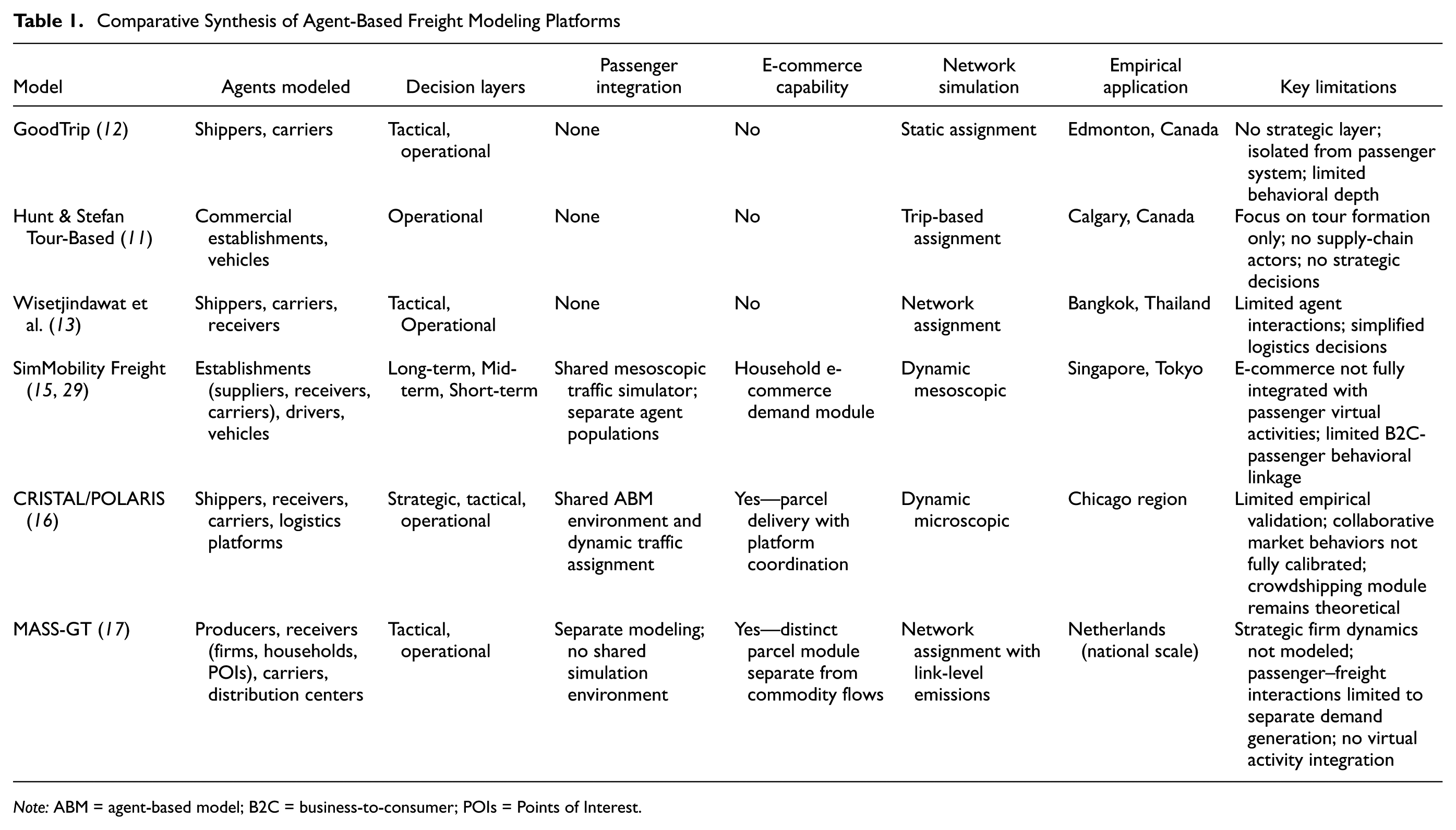
Note: ABM = agent-based model; B2C = business-to-consumer; POIs = Points of Interest.
Synthesis and Lessons Learned: Design Patterns and Limitations
The preceding review reveals recurring design patterns and persistent limitations that collectively define the current state of agent-based urban freight modeling. To make the review more actionable, we synthesize these findings into six lessons organized around agent ontology, tour formation, e-commerce demand representation, validation strategy, computational scalability, and decision-hierarchy coupling.
Lesson 1: Agent Ontologies Are Inconsistent
Across the reviewed models, the set of agents represented varies substantially. Many early models focus on core supply-chain actors (shippers, carriers, receivers) and less consistently include consumers or logistics platforms as first-class agents. Later platforms extend the agent repertoire to include drivers, vehicles, and platform operators, but do so inconsistently and without standardized role definitions. Few models in the review adopt a unified agent ontology that is fully aligned with both supply-chain theory and passenger modeling conventions. This fragmentation makes cross-model comparison difficult and limits the ability to build on or extend prior work.
The lesson for framework design is that explicitly defining a set of agents (shippers, carriers, receivers, consumers, and logistics platforms) with consistent behavioral roles across strategic, tactical, and operational layers is a prerequisite for reproducible and extensible modeling.
Lesson 2: Tour Formation Lacks Behavioral Grounding
The shift from trip-based to tour-based freight modeling is one of the field’s most important methodological advances, originating with Hunt and Stefan ( 11 ) and reinforced by subsequent platforms. However, the mechanism used to form delivery tours has remained largely optimization-driven: models rely on variants of vehicle routing problem (VRP) solvers, nearest-neighbor heuristics, or savings algorithms to construct delivery sequences. Many models use these VRP-style procedures as operational approximations, but they are rarely embedded in a broader descriptive decision process with calibration to observed routing behavior. Consequently, tour logic is often portable as an algorithm but not as an empirically grounded behavioral model.
Routing decisions in practice are shaped by driver familiarity, customer relationships, time-window constraints, and real-time conditions that static VRP formulations are not designed to capture. A more behaviorally grounded tour generation approach remains an important goal. Such an approach could incorporate discrete choice models or GPS-calibrated rules.
Lesson 3: E-Commerce Demand Lacks Behavioral Integration
In the reviewed literature, e-commerce demand is most often represented through a dedicated B2C demand generation module that operates independently of the passenger simulation. SimMobility Freight, for example, uses a household-based e-commerce model but does not systematically connect parcel demand generation to the virtual activity scheduling of passenger agents. This architectural separation means that the behavioral substitution between online shopping and physical shopping trips, a critical dynamic for accurately estimating vehicle kilometers traveled (VKT) and emissions, cannot be captured endogenously.
This separation can bias estimates of both freight demand and passenger trip generation under e-commerce growth scenarios, since the two systems are calibrated independently rather than as interdependent behavioral outcomes. True integration requires that consumer online shopping decisions be generated within the same activity scheduling module as physical trips, with parcel demand flowing directly into the freight simulation as a consequence of those decisions.
Lesson 4: Validation Lacks Behavioral Depth
The most comprehensively validated platforms (e.g., MASS-GT and SimMobility Freight) rely on rich empirical datasets including freight surveys, GPS traces, traffic counts, supply-use tables, and parking studies. These sources support system-level calibration and aggregate output validation effectively. However, behavioral validation at the agent level, verifying that individual agents make decisions consistent with observed carrier, shipper, or consumer behavior, is rarely attempted. For example, few studies validate whether simulated carrier stop sequencing, time-window adherence, or delivery time-of-day patterns match observed behavior, beyond matching aggregate volumes. Cross-validation against out-of-sample data or holdout scenarios is similarly uncommon.
This gap means that models may reproduce aggregate patterns for reasons that are not behaviorally correct, reducing confidence in their predictive validity for novel policy scenarios. This matters most for policies that change constraints or incentives, such as curb pricing, delivery time-window restrictions, or consolidation requirements, where aggregate calibration alone may not preserve behavioral responses. Future frameworks should pair system-level calibration with disaggregate behavioral tests, using stated preference surveys, operator interviews, and controlled simulation experiments to verify the plausibility of agent-level outcomes.
Lesson 5: Computational Reduces Behavioral Resolution
Models that operate at the city or regional scale, such as MASS-GT and SimMobility Freight, typically adopt mesoscopic or simplified network representations to manage computational cost. Microscopic traffic simulation is largely confined to small study areas or corridor-level analyses. Parallel computing and distributed simulation are less commonly emphasized in freight ABMs than in large-scale passenger microsimulation.
The consequence is a persistent trade-off: detailed behavioral modeling of individual agents is feasible only at small scales, while city-scale applications require behavioral simplifications that may distort policy-relevant outputs. Critically, this trade-off between scalability and realism is typically resolved implicitly by adopting a conventional network resolution. Instead, it should be made an explicit design parameter tied to the specific policy question and data availability.
Lesson 6: Decision Layers Are Decoupled
A recurring structural limitation is the absence of explicit coupling between strategic, tactical, and operational decision layers. While frameworks such as SimMobility Freight and CRISTAL organize freight decisions across long-, medium-, and short-term horizons, synchronization between these layers and their alignment with corresponding passenger decision modules is often only partially operationalized. For example, fleet composition and depot location decisions (strategic) should constrain feasible delivery schedules and tour structures (operational), yet these dependencies are often weakly enforced. Similarly, long-term firm dynamics such as entry, exit, and relocation are either absent or treated as fixed background inputs rather than co-evolving model outcomes.
This decoupling limits the ability to evaluate how upstream strategic decisions propagate through to operational freight activity and, ultimately, to shared network and emissions outcomes. A framework that enforces structural consistency across long-term decision simulators (LDS), medium-term decision simulators (MDS), and short-term decision simulators (SDS), mirroring the architecture of passenger models, is therefore essential for achieving behaviorally coherent and policy-sensitive urban logistics simulation. Table 2 summarizes these lessons by pairing each cross-cutting pattern with its modeling consequence and the corresponding framework response.
Summary of Cross-Cutting Design Patterns and Framework Responses in Agent-Based Urban Freight Modeling
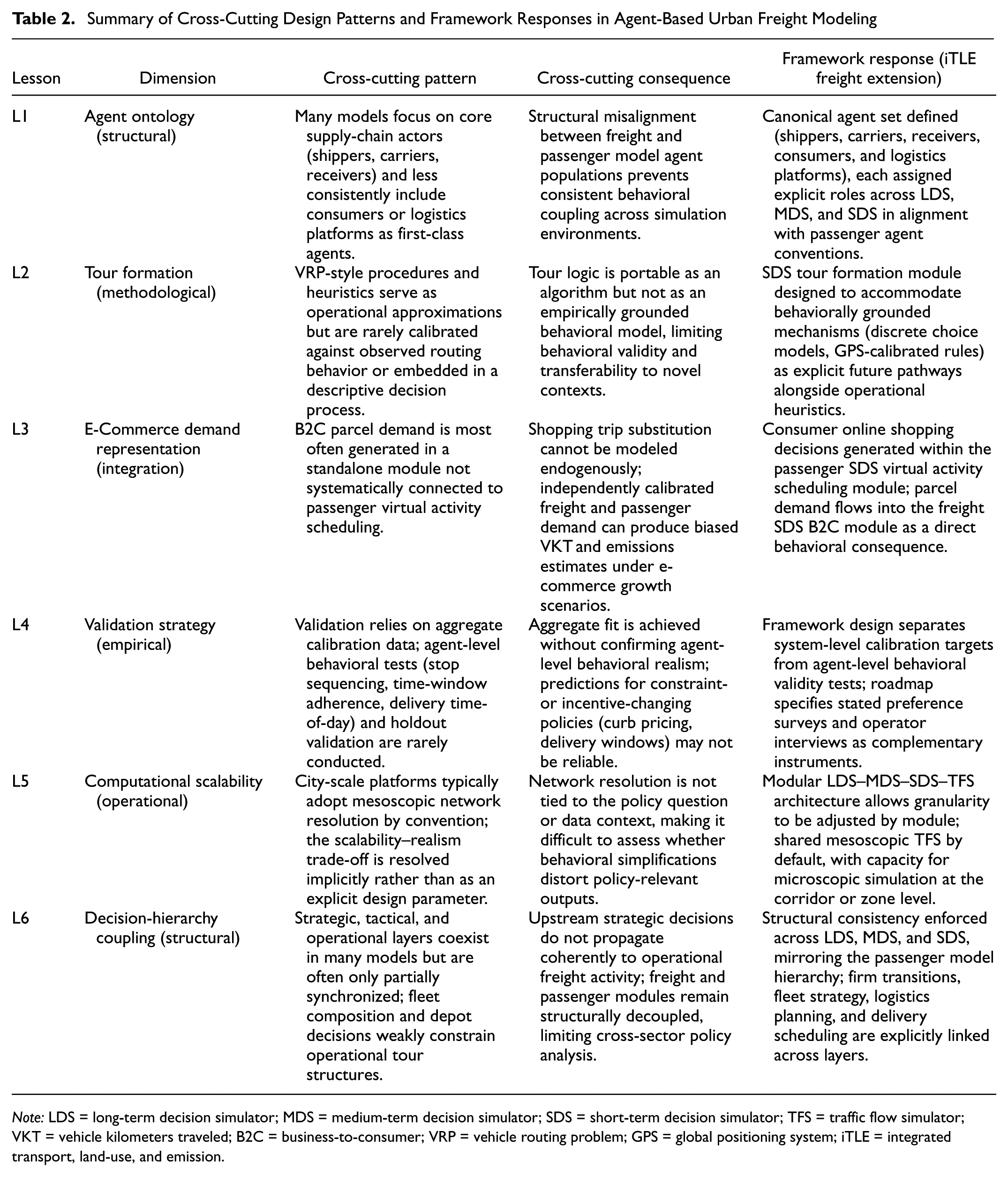
Note: LDS = long-term decision simulator; MDS = medium-term decision simulator; SDS = short-term decision simulator; TFS = traffic flow simulator; VKT = vehicle kilometers traveled; B2C = business-to-consumer; VRP = vehicle routing problem; GPS = global positioning system; iTLE = integrated transport, land-use, and emission.
Research Gaps, Directions, and Framework Proposal
Gaps in Current Modeling Approaches
Despite significant advancements in agent-based freight modeling and the emergence of integrated simulation platforms, several structural and conceptual gaps persist across the literature. First, many urban freight models continue to treat logistics behavior in isolation from passenger systems, relying on simplified representations of goods movement that lack behavioral realism and fail to capture the growing convergence of passenger and freight mobility. Existing passenger–freight integrations often focus on shared infrastructure or demand interaction but do not incorporate consistent agent structures, decision horizons, or market relationships across both domains.
Second, although several frameworks incorporate decision layers at long, medium, and short time scales for passengers, freight modeling has largely lacked a comparable multilevel design. Freight decisions such as logistics planning, vehicle assignment, and delivery routing are often embedded in single layer simulations. This limits the ability to align those decisions with dynamic land use, traffic, or emissions models. Furthermore, e-commerce logistics, defined by high-frequency B2C demand, technology-enabled coordination, and hybrid fleet operations, remains underrepresented in conceptual agent-based model designs.
Third, methodological challenges persist related to scalability, alignment of agent definitions, and integration across simulation environments. SimMobility and CRISTAL demonstrate the need for clearer delineation of decision hierarchies and more transparent integration with passenger activity scheduling, especially in virtual environments (e.g., online shopping versus physical trips).
Strategic Directions for Integration
To address these challenges, there is a need for a unified conceptual framework that supports consistent simulation of freight and passenger behavior across common temporal, spatial, and operational layers. This study proposes a freight modeling framework that aligns directly with the agent-based integrated urban system modeling platform’s LDS, MDS, and SDS, thereby facilitating behavioral consistency and system-level integration.
In this paper, “passenger–freight integration” refers to coupling in which decisions in one domain generate or influence outcomes in the other through explicit information exchange. This goes beyond simply representing both types of traffic on the same network. Integration requires shared simulation elements (such as synthetic populations, activity schedules, or network representations) and defined coupling points across long-, medium-, and short-term decision layers. To clarify scope, Table 3 defines five integration levels and indicates which are addressed in the proposed framework versus identified as extensions.
Levels of Passenger–Freight Integration and Scope in This Study
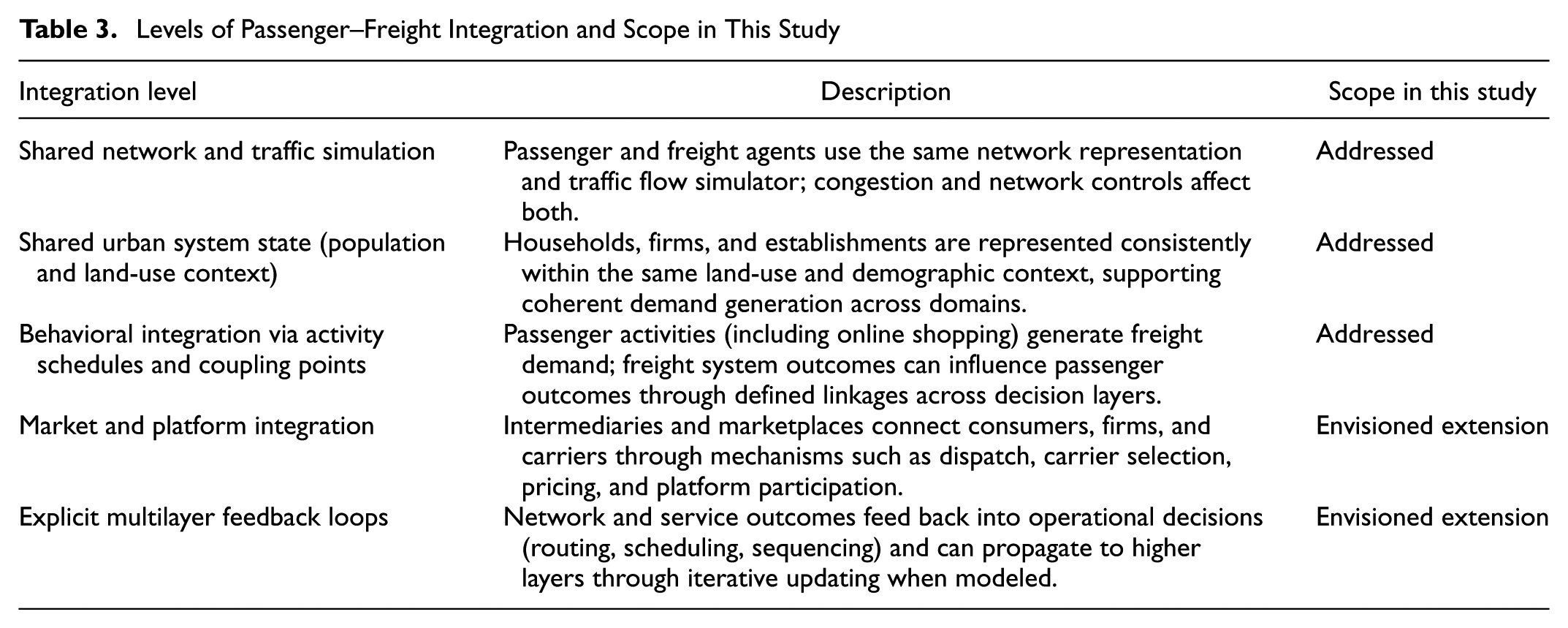
Building on the preceding definition and levels, the proposed integration strategy focuses on the following directions:
Structuring freight decisions within the LDS–MDS–SDS hierarchy to mirror passenger modeling conventions.
Introducing logistics actors such as shippers, carriers, receivers, and consumers as decision-making agents with strategic roles such as firm transition, tactical roles such as fleet strategy, and operational roles such as delivery tour formation.
Enabling shared use of mobility infrastructure and synchronized traffic simulation through a common traffic flow simulator (TFS).
Linking freight delivery operations, especially e-commerce, with virtual passenger activities such as online shopping to capture cross-sector behavioral convergence.
The following sections present the structure and components of the proposed integrated freight modeling framework. The approach begins with an overview of the existing agent-based integrated microsimulation platform, which was originally developed for passenger behavior simulation. It then introduces a conceptual freight extension designed to align with the platform’s long-term, medium-term, and short-term decision modules. This unified structure enables coordinated simulation of urban logistics and travel behavior within a shared modeling environment. It supports policy-relevant analysis in the context of evolving e-commerce and shared mobility trends.
Overview of the Existing iTLE Framework
The integrated transport, land-use, and emission (iTLE) framework is designed as an integrated microsimulation platform that captures the interactions between population dynamics, land-use development, passenger mobility, and environmental impacts (38–40). As illustrated in Figure 3, the iTLE model is structured around five interdependent modules: (1) population and built-environment synthesis, (2) LDS, (3) MDS, (4) SDS, and (5) TFS. Each of these components represents a distinct decision horizon and supports temporal consistency and policy experimentation.
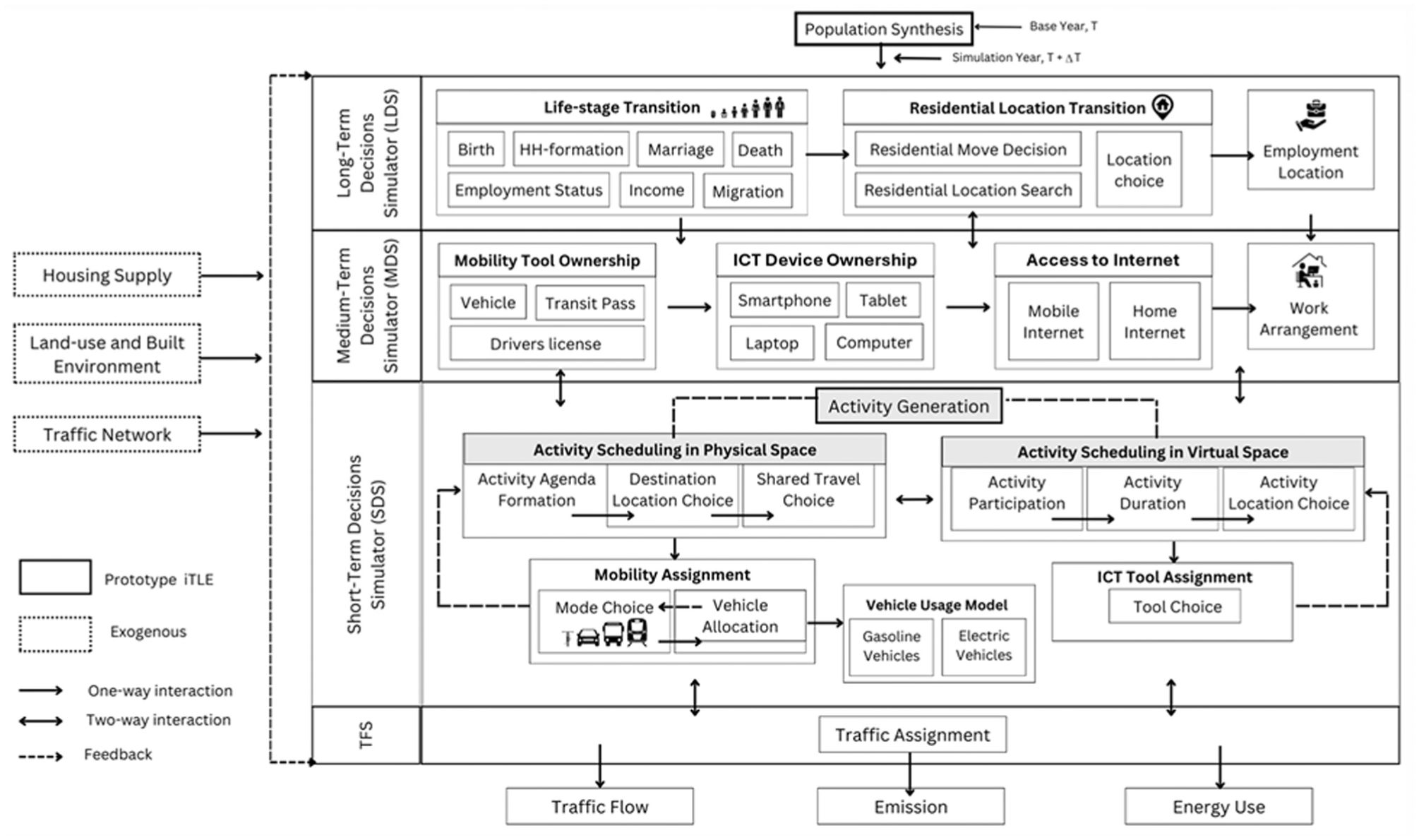
Framework of the iTLE model.
The LDS module models major life cycle and firm transitions, such as household formation, migration, employment change, and firm entry, exit, and relocation. These transitions affect land-use patterns, residential and employment locations, and the size and distribution of the urban population and economic base. The MDS module captures medium-term choices such as mobility tool ownership (e.g., private vehicles, transit passes), information and communication technology (ICT) device access, work arrangements. These decisions set the stage for short-term activity and travel behavior.
The SDS represents day-to-day mobility by simulating physical and virtual activity scheduling, mode choice, vehicle allocation, and ICT tool use. It serves as the activity-based travel demand component of the iTLE system, operating on a tour-based structure to simulate activity generation, agenda formation, scheduling, and tour formation for each agent on a typical weekday. This enables the model to capture both physical movements (e.g., commuting, shopping) and virtual participation (e.g., remote work, online interactions), ensuring behavioral realism in urban passenger travel. The resulting trips are routed through a shared mesoscopic TFS, which produces outputs on traffic conditions, energy consumption, and emissions.
Conceptual Framework for Freight Integration
While iTLE was initially developed to simulate passenger systems, this study extends the platform by developing and integrating a conceptual framework for urban freight modeling that operates within the same LDS–MDS–SDS–TFS structure. The freight model, shown in Figure 4, introduces logistics agents such as shippers, receivers, carriers, and consumers. These agents make strategic, tactical, and operational decisions that align behaviorally with passenger agents. In the LDS, freight actors undergo firm transitions, relocations, and fleet restructuring. The MDS captures logistics planning, carrier type selection, and ICT adoption such as e-commerce platforms and artificial intelligence (AI)-based routing tools. This structural consistency allows freight and passenger systems to be modeled within a shared agent-based simulation environment, improving integration, policy relevance, and system-level realism.
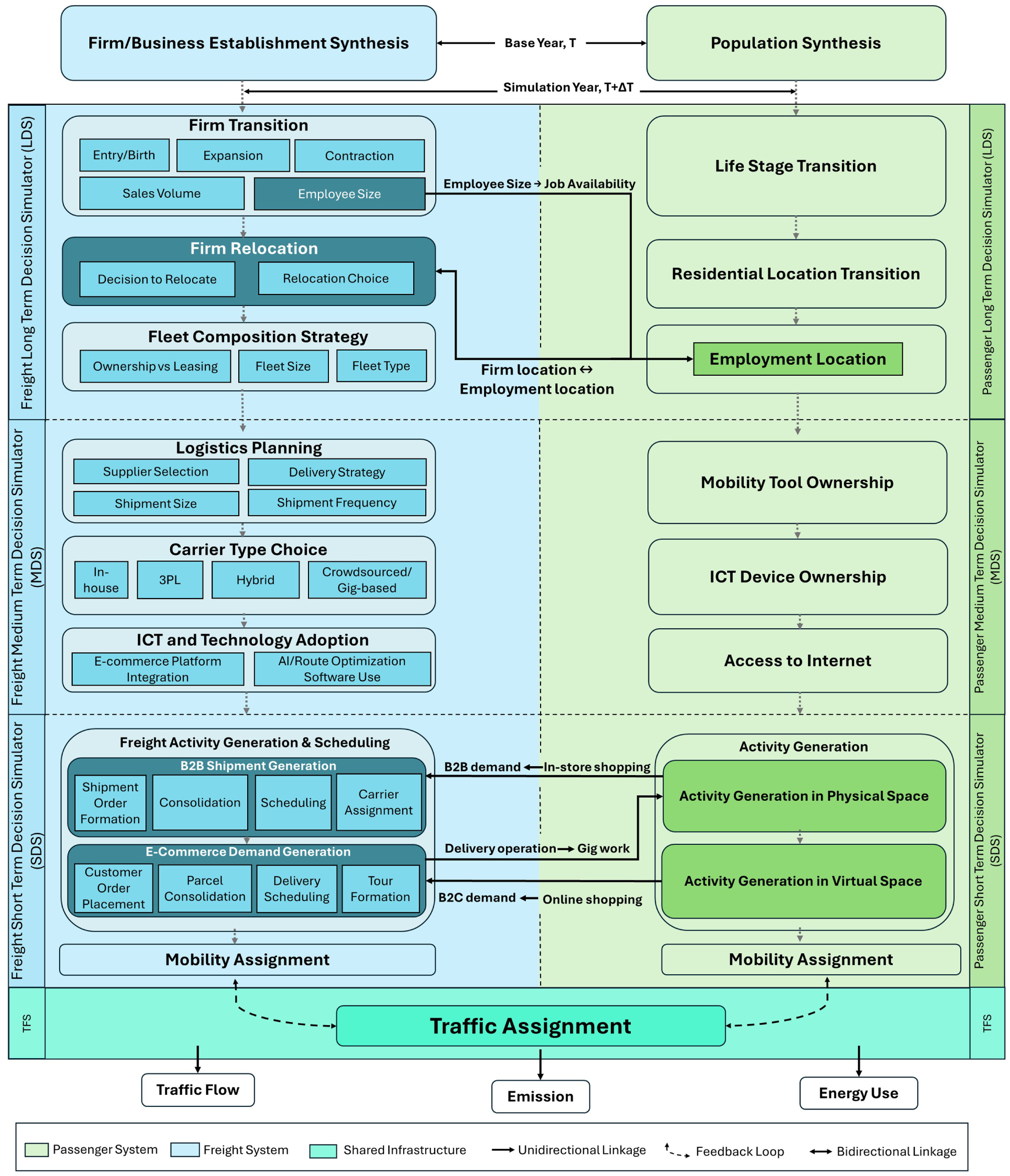
Conceptual framework of the new Integrated Transport, Land-Use and Emission (iTLE) model.
To ensure consistency in urban traffic simulation, both passenger and freight activities feed into a shared mobility assignment and vehicle allocation module, which supports scenarios involving dual-use fleets, shared curb access, and gig-based delivery systems. Resulting flows are input to the TFS for traffic assignment and emissions estimation, enabling integrated evaluation of policies such as congestion pricing, zero-emission zones, and dynamic curb management.
The freight framework is embedded within the iTLE architecture, which creates a strong foundation for simulating interactions between passengers and freight. This structure supports behaviorally detailed and policy-sensitive urban planning and logistics research. Building on this integrated architecture, the next sections provide a detailed breakdown of each module within the freight framework. To operationalize this conceptual structure, the freight framework adopts the same modular hierarchy as the passenger side of iTLE, organizing logistics decisions across long-term, medium-term, and short-term horizons.
Long-Term Decisions Simulator
The LDS captures the strategic, and structural choices made by firms and logistics actors that shape the foundational landscape of urban freight activity. These decisions, typically made over multiyear time horizons, establish the baseline conditions for freight generation and logistics capacity, influencing all downstream planning and operations.
One major component of LDS is firm transition, which simulates the life cycle of firms, including entry, growth, contraction, and exit, based on economic trends, sectoral shifts, and spatial development. For example, a new e-commerce fulfillment center entering the market could generate significant upstream and downstream freight activity. In contrast, a small manufacturing firm might downsize or exit because of digital disruption or rising operational costs, which would reduce its shipping volume. These dynamics are essential for modeling how freight demand evolves over time and how logistical activity concentrates or dissipates geographically.
Another key component is firm relocation, which addresses how and when firms change their physical locations in response to external pressures such as land costs, zoning regulations, labor availability, or supply-chain optimization strategies. For instance, a logistics-intensive wholesaler might relocate from an urban core to a peri-urban site with better highway access and lower real estate costs. Similarly, a food distributor may move operations closer to customer zones to shorten delivery distances and improve service reliability. Simulating relocation patterns helps forecast spatial shifts in freight intensity and infrastructure demand across urban areas.
The third component, fleet composition strategy, represents firm-level decisions about the configuration and characteristics of their vehicle fleets. This includes the selection of vehicle types (e.g., light commercial vehicles, medium trucks, or cargo bikes), the adoption of various fuel technologies (e.g., diesel, electric, or hybrid), and decisions around fleet size and acquisition models (e.g., owned versus leased vehicles). For example, a parcel delivery firm might invest in electric vans to comply with low-emission zone mandates, while a seasonal goods supplier might lease additional capacity during periods of peak demand. These decisions have direct implications for emissions, noise, curb usage, and the viability of different logistics services under evolving urban policies.
Altogether, the LDS plays a foundational role in modeling the long-term behaviors of logistics actors, ensuring that freight systems are grounded in realistic firm and fleet dynamics and that they evolve in a manner consistent with spatial, economic, and regulatory trends.
Medium-Term Decisions Simulator
The MDS captures tactical logistics choices that occur on a recurring or planning cycle basis. These choices typically take place weekly, monthly, or quarterly, depending on firm operations and prevailing market conditions. These decisions, shaped by the long-term characteristics defined in the LDS, directly influence the operational environment modeled in SDS. MDS provides a bridge between strategy and execution, reflecting how businesses continuously adapt their logistics strategies in response to demand fluctuations, technological advancements, and evolving service expectations.
One core component of MDS is logistics planning, which models how firms organize the flow of goods across their supply chains. This includes decisions about shipment frequency and size, the distribution structure (such as direct-to-customer fulfillment, multitiered networks, or cross-docking), and the use of warehouses and intermediate hubs. For example, a wholesaler may consolidate client orders into bulk weekly shipments to reduce logistics costs, whereas an online grocery provider might rely on frequent restocking of local depots to meet perishable delivery needs. These choices affect network loading, inventory turnover, and spatial delivery patterns, and are influenced by product characteristics, storage constraints, and service level agreements.
The carrier type choice component reflects how firms select and allocate delivery resources. Options include maintaining an in-house fleet, contracting with third-party logistics providers (3PLs), utilizing crowdsourced or gig-based delivery platforms, or adopting hybrid strategies that combine multiple modes of fulfillment. A retailer, for instance, may contract a 3PL for national distribution while using local gig workers for urban last-mile deliveries. These decisions shape the availability and characteristics of delivery vehicles, influence service flexibility, and determine which actors perform vehicle routing and scheduling tasks in the short-term layer.
The final component, ICT and technology adoption, captures firms’ decisions to adopt digital tools and logistics technologies that enhance planning, coordination, and execution. This includes the use of AI-enabled route optimization tools, integration with e-commerce marketplaces or warehouse management systems, and the adoption of data-sharing platforms for improved visibility and collaboration. For example, a carrier might implement dynamic dispatching software to reduce delays, while a retailer may invest in click-and-collect systems that synchronize with real-time inventory. Such technologies play a critical role in enabling responsive logistics systems that can adapt to operational disruptions, policy changes, and consumer expectations.
Collectively, the MDS equips the freight simulation framework with the behavioral mechanisms and planning depth needed to realistically represent the intermediate decision processes that shape urban logistics outcomes.
Short-Term Decisions Simulator
The SDS represents the operational layer of urban freight activity, focusing on logistics decisions executed at daily or hourly intervals. This layer bridges tactical planning with real-world delivery execution and includes two distinct modules: B2B shipment generation and e-commerce (B2C) demand generation. These modules reflect distinct logistical paradigms, such as contract-based bulk shipments and individualized last-mile deliveries. They also share several decision components and connect to the broader agent-based traffic simulation.
The B2B shipment generation module captures scheduled freight flows between firms, such as shipments from manufacturers to retailers or from wholesalers to distribution centers. The process begins with shipment order formation, driven by procurement needs, inventory thresholds, or long-term contracts. These shipments are then consolidated across customers and delivery points to optimize vehicle efficiency. Once orders are aggregated, shipment scheduling aligns dispatch timing with receiver constraints and service requirements. Vehicle and carrier assignment allocates tours to in-house fleets or third-party providers, and route and path formation defines network trajectories based on cost, congestion, and delivery feasibility.
The e-commerce demand generation module models the flow of residential and small-parcel deliveries arising from consumer online purchases. It starts with customer order placement, translating e-commerce activity into freight demand. Orders are then consolidated spatially at warehouses or microhubs to optimize last-mile fulfillment. Delivery scheduling aligns time slots with customer preferences and fleet constraints, followed by tour formation, which creates optimized delivery sequences under spatial and temporal efficiency criteria. Vehicle allocation assigns assets such as vans, bikes, or crowd shipping agents to each tour. Route and path formation then determines how vehicles move through the city based on traffic, curb access, and regulatory conditions.
Both passenger and freight agents share the same dynamic TFS, allowing real-time co-simulation of road network performance. This shared environment captures interdependencies, such as how delivery vehicle routing affects passenger trip times or how curb availability constrains tour formation. The framework integrates consumer decision making with logistics execution in the SDS, which allows urban planners and policy makers to simulate policy scenarios such as congestion pricing, dynamic curb regulations, or delivery time restrictions. These scenarios can then be evaluated in a behaviorally consistent and system wide manner.
An important aspect of the integration is the feedback from network performance to operational decisions, represented by the bidirectional arrow between the TFS and the SDS in Figure 4. The TFS produces time-varying performance indicators such as link travel times, congestion, and reliability, which can inform short-term decisions in the SDS, including departure time (and, where flexible, delivery slot choice), route choice, stop sequencing, and schedule adjustments when delays occur. These operational choices then feed back into network conditions by shifting vehicle flows across space and time and by affecting localized conditions around curbside operations (loading and unloading), which can in turn influence subsequent operational decisions. Capturing this two-way coupling is nontrivial because it introduces circular dependencies between decisions and performance and may require iterative updating between the SDS and TFS or replanning, increasing computational burden and raising issues related to stability, calibration, and behavioral realism. In practice, many applications use simplified decision rules or limited feedback frequency to manage these computational and behavioral challenges. This underscores the importance of adaptive operational behavior in integrated passenger–freight systems.
Ultimately, the SDS facilitates a holistic view of urban mobility by operationalizing both the supply and demand sides of passenger and freight movement. It serves as the connection for evaluating how individual behaviors, logistical constraints, and shared infrastructure shape the performance, equity, and sustainability of urban transportation systems.
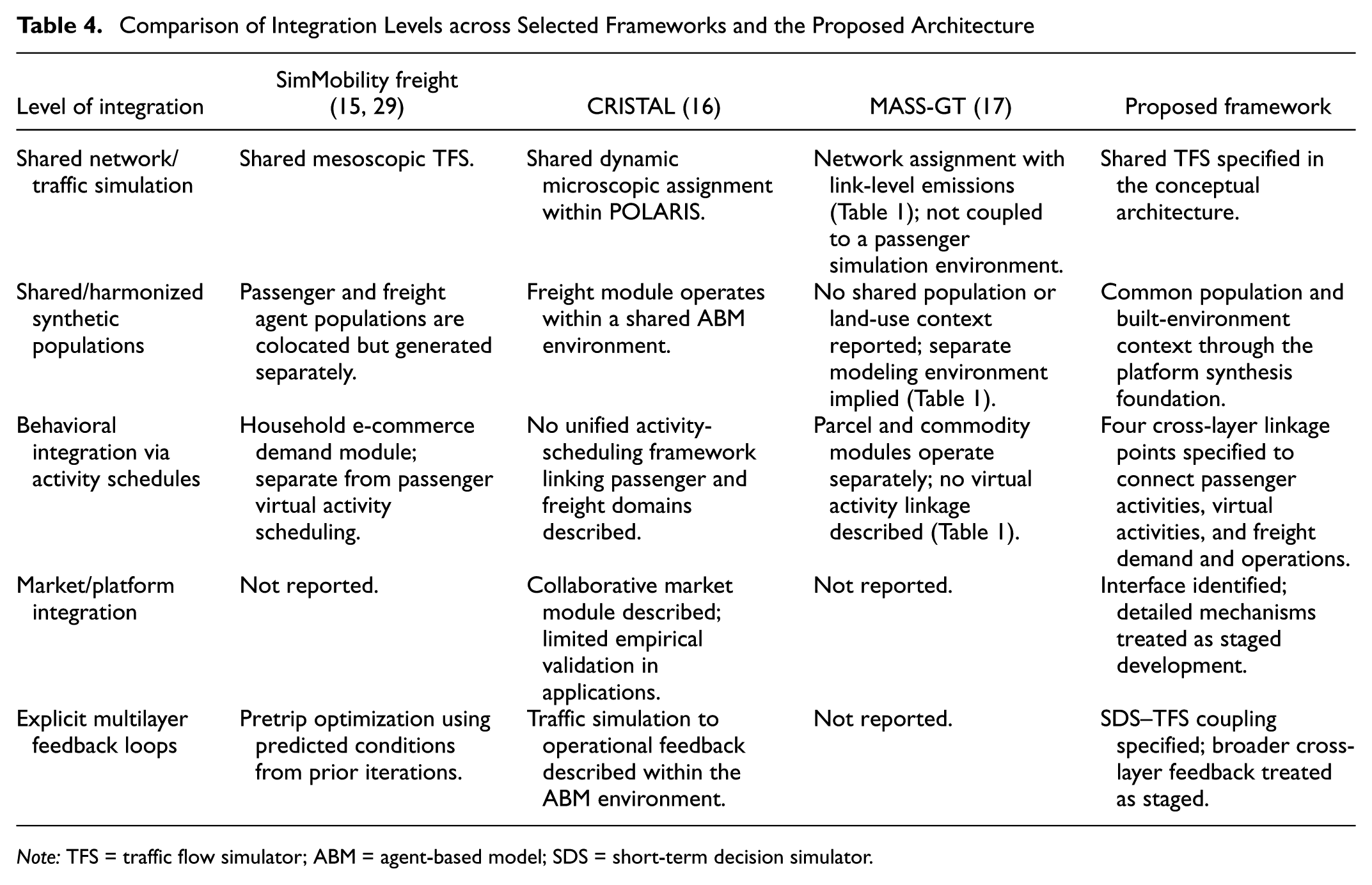
The conceptual architecture described earlier is intended to move beyond shared network simulation by making the passenger–freight coupling points explicit and aligning decisions across long-, medium-, and short-term layers. To situate this contribution, Table 4 compares the integration elements described for selected agent-based frameworks using the integration levels defined in Table 3 and summarizes where the proposed architecture adds additional coupling capability.
Comparison of Integration Levels across Selected Frameworks and the Proposed Architecture
Note: TFS = traffic flow simulator; ABM = agent-based model; SDS = short-term decision simulator.
The comparison highlights that shared network and traffic simulation is comparatively well established across existing frameworks, while stronger forms of integration, particularly behavioral coupling through activity schedules and clearly specified passenger–freight linkage mechanisms, are less consistently described. The novelty of the proposed framework is therefore in specifying these coupling mechanisms within a multilayer decision architecture aligned with LDS, MDS, and SDS, and in outlining a staged approach to incorporate operational feedback between SDS decisions and network conditions via the shared TFS. The next subsection details the integration points adopted in the proposed framework and describes how information is exchanged across decision layers to enable two-way passenger–freight interactions.
Integration Points with Passenger System
Beyond infrastructural integration through the shared TFS, the framework achieves behavioral integration through four key linkages operating at long-term and short-term decision layers (Figure 4). First, the firm relocation-employment location linkage operates at the long-term level. Employment location on the passenger side is bidirectionally linked to firm relocation decisions on the freight side. Firm relocation decisions consider the spatial distribution and availability of potential employees, while firm location changes affect where employment opportunities exist for passenger agents. This linkage ensures that the spatial distribution of jobs and workers is represented consistently across freight and passenger systems.
Second, firm expansion and contraction events directly influence employee size, which in turn affects passenger employment location choices. As firms expand, they hire additional workers, creating new employment opportunities that influence where passenger agents choose to work. Conversely, when firms contract, workforce reductions eliminate jobs, prompting affected workers to seek employment elsewhere. This unidirectional linkage from employee size to employment location captures how firm growth and downsizing decisions propagate through the urban labor market, shaping employment patterns and commuting flows.
Third, in-store shopping activities by passenger agents create retail goods replenishment demand, establishing a direct link between consumer behavior and business-to-business freight operations. When passenger agents choose to shop in physical stores rather than online, this generates freight demand for inventory restocking, influencing delivery frequencies, shipment sizes, and tour formations for wholesale and retail supply chains. This unidirectional linkage captures how aggregate consumer shopping patterns drive B2B logistics activity.
Fourth, the e-commerce integration operates through two complementary mechanisms at the short-term level. The first mechanism captures how virtual shopping creates freight demand. When passenger agents schedule online shopping activities as part of their daily or weekly routines, these virtual activities generate B2C parcel delivery orders. These orders must then be consolidated at warehouses or distribution centers, scheduled for delivery, and fulfilled by freight carriers. This mechanism shows how a passenger activity decision (shopping online instead of visiting a store) directly creates freight system demand. The second mechanism operates in the opposite direction, showing how freight operations create passenger activities. The execution of e-commerce delivery tours generates gig-based work opportunities that passenger agents can choose to perform. Individuals who opt to work as delivery drivers use their personal vehicles or bicycles to execute freight operations, turning what would traditionally be freight carrier activities into passenger agent activities. This mechanism captures how the same individuals move fluidly between consumer and service provider roles in the urban mobility system. Together, these two mechanisms capture the complete e-commerce cycle: passenger consumption behavior generates freight demand, while freight delivery needs create employment opportunities for passenger agents.
These four integration points distinguish the proposed framework from existing platforms that achieve only infrastructural integration through shared network models. By linking behavioral decisions across domains, the framework shows how employment location affects both firm relocation and hiring dynamics. It also captures how shopping activities generate freight demand through in-store purchases and online channels. In addition, it reflects the dual roles individuals may play as consumers and service providers. Together, these connections allow the framework to evaluate policies that influence passenger and freight systems at the same time. For instance, curb pricing affects both passenger parking decisions and delivery dwell times, low-emission zones influence both household vehicle choices and firm fleet strategies, and gig economy regulations affect both individual employment decisions and freight carrier operations. These policy scenarios cannot be adequately evaluated without the behavioral integration linkages described here.
Data Requirements and Practical Barriers
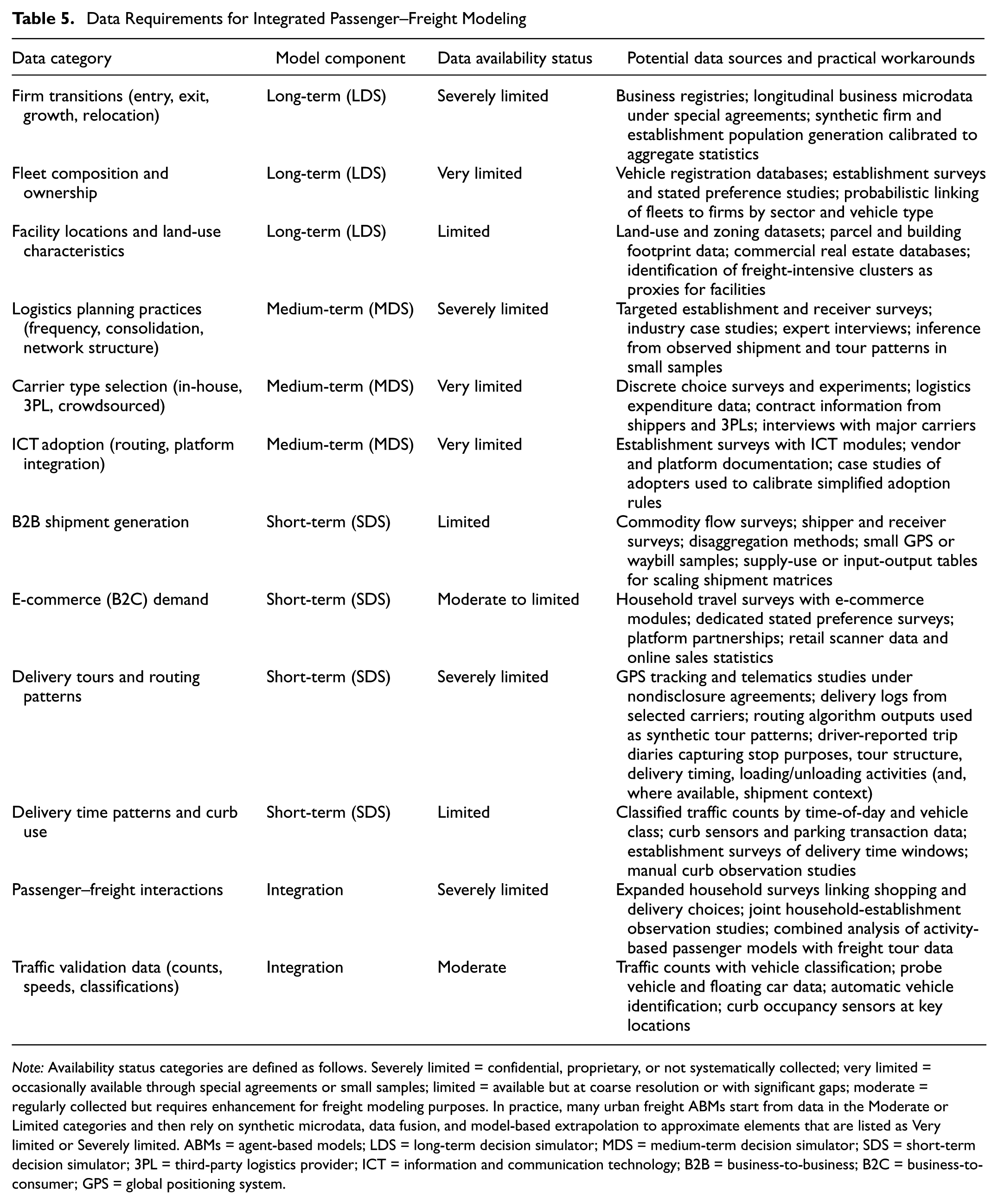
Despite these constraints, recent urban freight ABM applications indicate that initial implementation is feasible using partial data, synthetic microdata, and targeted small-sample collaborations. Table 5 summarizes comprehensive data requirements, current availability, and practical workarounds.
The section “Minimum Viable Data Package, Agency Data-Collection Strategies, and Calibration/Validation Targets” then specifies minimum data thresholds for a first implementation, a staged agency collection plan, and calibration and validation targets.
Systematic Data Requirements by Decision Layer
Long-Term Decisions Simulator
Modeling firm transitions, fleet composition, and facility location requires multiple types of data. First, longitudinal business registry data are needed to track establishment entry, exit, growth, and relocation over time. Second, vehicle ownership records must be linked to establishments, including information on fleet size, vehicle types, and fuel technologies. Third, spatial attributes including land costs, zoning regulations, accessibility to transportation networks, and facility characteristics are essential for understanding location decisions.
These data are severely limited in availability. Longitudinal business microdata is confidential and rarely accessible. Vehicle registrations exist but are not linked to establishments. Resources such as Statistics Canada’s Business Register, the US Census Bureau’s Longitudinal Business Database, and Eurostat’s Business Demography Statistics provide aggregate statistics but lack freight-specific operational attributes. Even when accessible through special agreements, these databases rarely contain logistics-relevant information such as shipment volumes, supply-chain relationships, or distribution strategies.
Medium-Term Decisions Simulator
Modeling logistics planning, carrier selection, and technology adoption requires operational and organizational data. These include data on shipment frequencies, consolidation practices, and distribution network structures. Information on carrier relationships is also needed, covering the use of in-house versus third-party logistics, contracted services, and crowdsourced delivery. Finally, data on ICT adoption are essential for understanding how technology shapes logistics decisions. This includes information on route optimization software, warehouse management systems, and e-commerce platform integration.
These data are very limited in availability. Operational logistics data are commercially sensitive and proprietary. Commodity flow surveys conducted in the United States and Canada capture aggregate flows but lack the behavioral detail needed for disaggregate modeling. Establishment surveys face low response rates (typically 5–10%) and systematically under sample large logistics-intensive firms that generate disproportionate freight activity. Interview-based approaches can provide rich behavioral insights but are resource-intensive and difficult to scale.
Short-Term Decisions Simulator
Modeling operational deliveries requires three main data categories. First, B2B shipment characteristics are needed, including origins, destinations, weights, time windows, and receiver constraints. Second, e-commerce demand data must cover household order frequencies, product types, delivery preferences, and substitution patterns between online and in-store shopping. Third, delivery operations data are essential, encompassing GPS trajectories, tour structures, stop sequences, dwell times, routing decisions, and curb usage patterns.
These data are severely limited, particularly for detailed operational information. GPS tracking data from commercial fleets are proprietary and rarely shared because of competitive concerns and privacy issues. E-commerce transaction data are held by platforms such as Amazon, Instacart, Uber Eats, and similar services, and are not publicly accessible. While household travel surveys increasingly include questions about online shopping, these typically lack depth on delivery logistics, order characteristics, and behavioral trade-offs. Delivery tour data are essential for validating routing models and understanding curb usage. However, they require either GPS tracking studies (expensive and limited in sample size) or access to carrier operational databases (rarely granted to researchers).
Driver-reported trip diaries collected from a sample of freight vehicle operators provide an important complementary data source for calibrating and validating short-term (and related medium-term) behavioral components. Unlike shipper-based datasets such as the commodity flow survey, these diaries describe realized tours and stop activity patterns from the vehicle or driver perspective. They can complement GPS traces by adding contextual details that GPS alone often cannot infer reliably, including stop purpose, tour formation structure, delivery timing or slot adherence (when flexible), and loading and unloading activities such as service time and curbside behavior. In some cases, diaries can also provide basic shipment context when reported or linked to carrier records. As a result, diary data can support calibration of vehicle type choice (when represented in the medium-term layer) as well as tour formation, sequencing, and delivery timing decisions in the short-term layer. In practice, trip diary studies are resource-intensive and sample sizes are often limited, so they are typically used to establish representative tour typologies and time-of-day patterns that are then applied more broadly in model calibration.
Integration and Validation
Validating integrated passenger–freight models requires several types of data. Classified traffic counts must distinguish commercial vehicles by time of day and facility type. Curb occupancy data are needed to show delivery vehicle dwell times, loading/unloading durations, and spatial conflicts with passenger vehicles. Finally, joint passenger–freight interaction data must capture how online shopping substitutes for in-store trips and how delivery timing affects household activity schedules.
These data range from limited to moderately available. Traffic count data exist in most urban areas, but vehicle classification is typically coarse (light versus heavy vehicles) and does not distinguish freight from service or passenger vehicles. Automated vehicle classification systems exist but are deployed at limited locations. Curb monitoring systems using sensors or video analytics are emerging but not yet widespread. Most critically, joint household–establishment data that link consumer shopping decisions to resulting freight flows are virtually nonexistent in current data collection programs.
Despite these constraints, recent urban freight ABM applications show that progress is still possible with partial data. Typical workarounds include synthesizing firm and establishment populations from business registers, probabilistically linking vehicle registrations to establishments, and using aggregate flow tables to calibrate shipment generation. Small GPS or telematics samples, obtained under nondisclosure agreements, are often used to infer generic tour types, dwell time distributions, and curb usage patterns that can be applied more broadly. Targeted add-on questions in household travel surveys and focused establishment surveys can gradually enrich both passenger and freight modules without requiring full-scale new data collections. Table 5 summarizes data requirements, current availability, and potential sources for obtaining these data.
Data Requirements for Integrated Passenger–Freight Modeling
Note: Availability status categories are defined as follows. Severely limited = confidential, proprietary, or not systematically collected; very limited = occasionally available through special agreements or small samples; limited = available but at coarse resolution or with significant gaps; moderate = regularly collected but requires enhancement for freight modeling purposes. In practice, many urban freight ABMs start from data in the Moderate or Limited categories and then rely on synthetic microdata, data fusion, and model-based extrapolation to approximate elements that are listed as Very limited or Severely limited. ABMs = agent-based models; LDS = long-term decision simulator; MDS = medium-term decision simulator; SDS = short-term decision simulator; 3PL = third-party logistics provider; ICT = information and communication technology; B2B = business-to-business; B2C = business-to-consumer; GPS = global positioning system.
Data availability represents a fundamental barrier to implementing integrated agent-based freight models. As Table 5 demonstrates, most critical data requirements are severely limited or very limited in availability, with essential data for delivery tours, e-commerce demand, and passenger–freight interactions particularly difficult to obtain. Required data are often proprietary, commercially sensitive, or simply not collected systematically. While emerging sources such as GPS tracking, platform partnerships, and smart infrastructure sensors offer new opportunities, comprehensive freight data collection remains expensive and logistically challenging. The proposed iTLE-Freight framework, despite its conceptual rigor, faces these same data constraints as existing platforms including SimMobility Freight, CRISTAL, and MASS-GT. Successful implementation will require strategic investments in targeted data collection, public–private partnerships for data sharing, and pragmatic approaches such as synthetic population generation and data fusion that can function despite incomplete information. These data challenges underscore the need for institutionalized freight data collection by metropolitan planning organizations, comparable to the routine household travel surveys that support passenger modeling.
Computational Considerations
Concerning computational burden, the main source of processing demand comes from the short-term freight module (SDS) and its interaction with the TFS. This is particularly true when the model simulates detailed vehicle movements for both passenger and freight agents. The behavioral integration linkages use one-way data passing rather than iterative coupling. As a result, they do not add a substantial additional burden. Experience with established agent-based platforms shows that daily simulations for large metropolitan regions are feasible on modern multicore servers or modest computing clusters. Performance can be improved further by parallelizing origin–destination pairs and network loading. The freight modules can also reuse much of the existing passenger simulation infrastructure. In practice, the framework can be implemented in stages. Early applications can limit the spatial extent or time horizon and represent some freight flows in aggregate. Resolution and scenario complexity can then be increased gradually as computational resources allow.
A practical pathway would begin with shared network and traffic simulation through the TFS and a minimal behavioral coupling mechanism. One early step is to connect household shopping behavior and parcel demand generation to the passenger activity schedule through the e-commerce linkage described under Linkage 4 (section “Integration Points with Passenger System”). This initial coupling is feasible because the platform’s existing virtual activity scheduling capability already represents online shopping and ICT-mediated participation as passenger activities ( 38 , 39 ). This provides a passenger-side foundation for freight demand generation without requiring immediate implementation of high-frequency operational replanning. Freight operational detail can then be added progressively, including tour formation and scheduling, the in-store shopping to B2B replenishment linkage (Linkage 3), and tighter SDS–TFS feedback where needed. Market and platform mechanisms can be introduced as longer-term extensions. This staged strategy enables early demonstration of two-way passenger–freight interaction while maintaining a clear roadmap toward deeper integration.
Minimum Viable Data Package, Agency Data-Collection Strategies, and Calibration/Validation Targets
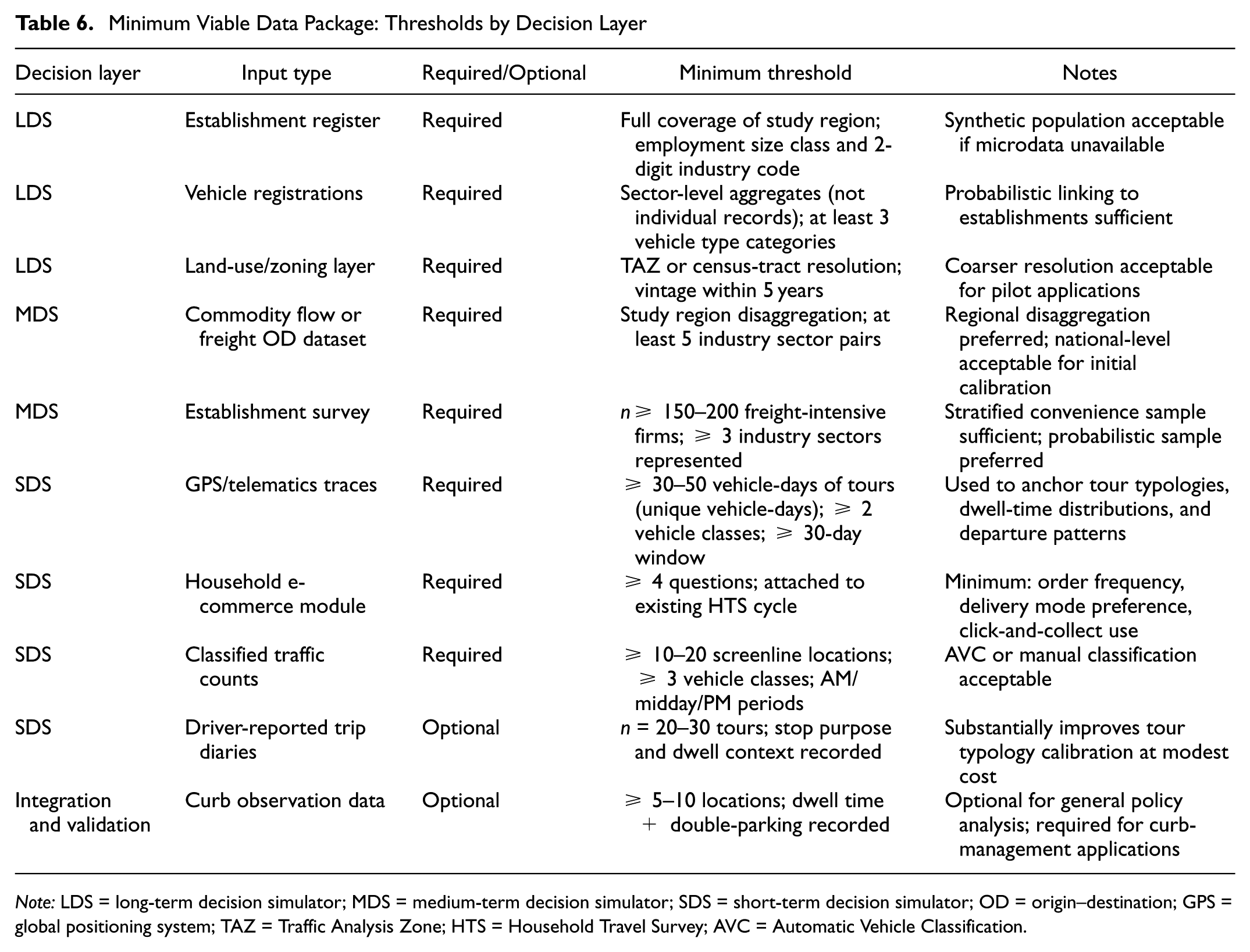
Building on the full data inventory and availability assessment in the section “Systematic Data Requirement by Decision Layer” and Table 5, this section defines the minimum viable data package, the smallest subset of inputs sufficient to support a first implementation, alongside a staged agency collection plan and explicit calibration and validation targets. Where the section “Systematic Data Requirement by Decision Layer” documents what is ideally needed and why it is difficult to obtain, this section focuses on what is realistically required to begin, how agencies can build toward it, and what success looks like. Table 6 defines the minimum viable data package by specifying minimum thresholds for each input type (sample sizes, temporal coverage, and spatial or classification resolution) and indicating whether each input is required or optional.
Minimum Viable Data Package: Thresholds by Decision Layer
Note: LDS = long-term decision simulator; MDS = medium-term decision simulator; SDS = short-term decision simulator; OD = origin–destination; GPS = global positioning system; TAZ = Traffic Analysis Zone; HTS = Household Travel Survey; AVC = Automatic Vehicle Classification.
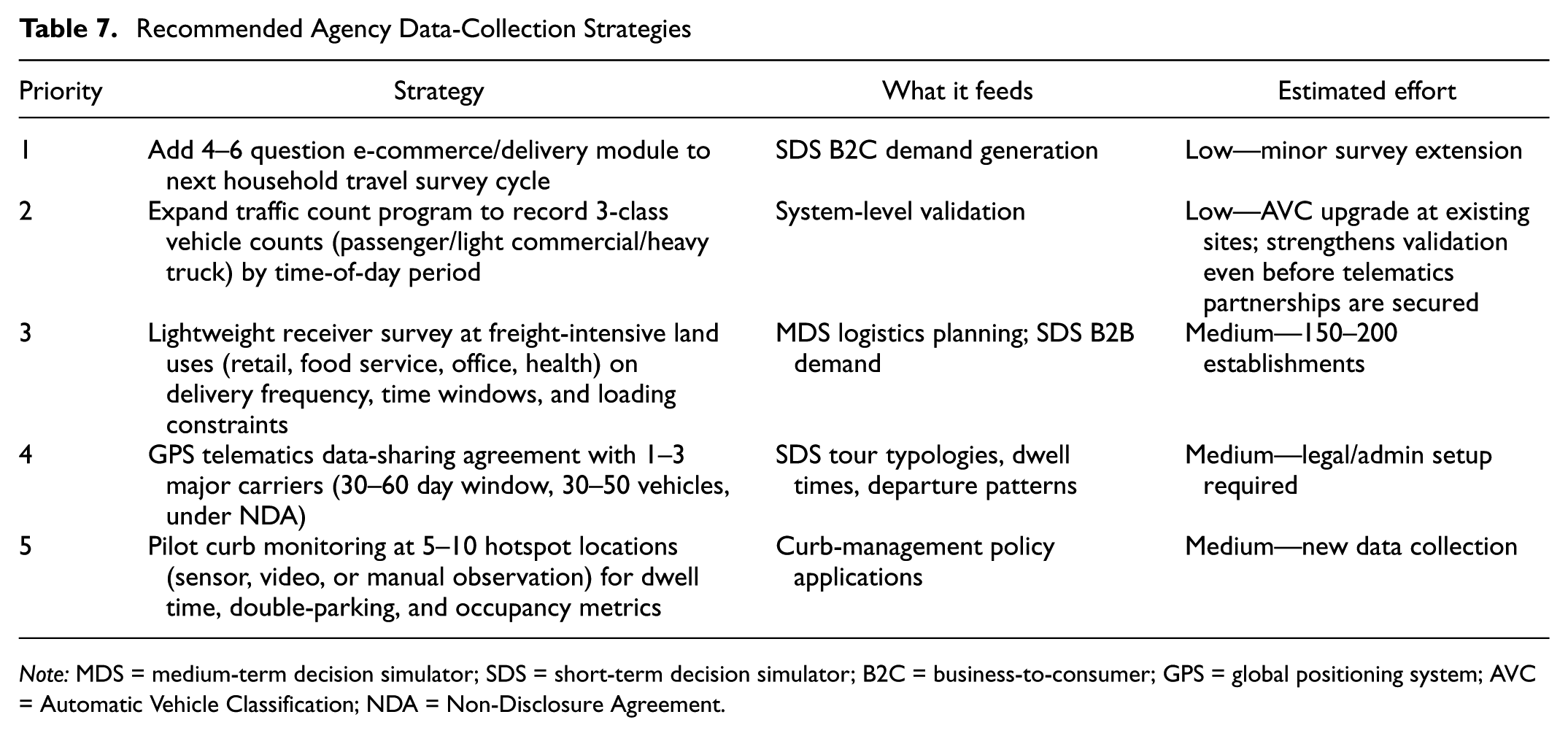
Table 7 outlines five staged data-collection strategies that agencies can implement by building on existing programs, ranked by implementation priority and linked to the model component each strategy supports. The two low-effort actions are sequenced first as they require no new partnerships and can be initiated within a normal agency planning cycle. Taken together, the five strategies constitute a progressive data-building roadmap that incrementally reduces reliance on synthetic data and data fusion workarounds as local freight data infrastructure matures.
Recommended Agency Data-Collection Strategies
Note: MDS = medium-term decision simulator; SDS = short-term decision simulator; B2C = business-to-consumer; GPS = global positioning system; AVC = Automatic Vehicle Classification; NDA = Non-Disclosure Agreement.
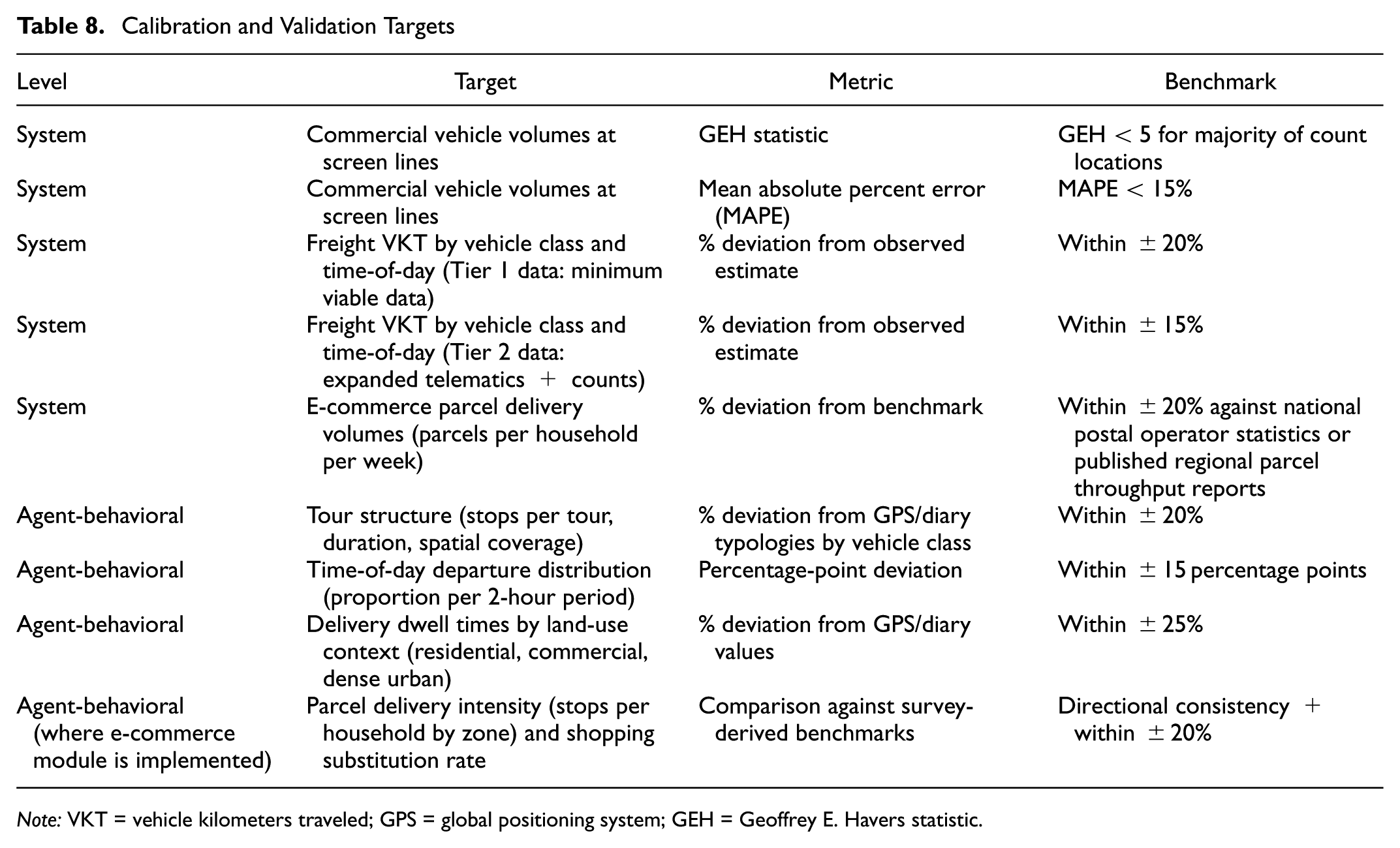
Table 8 provides explicit calibration and validation benchmarks organized by system-level and agent-behavioral targets. These reflect commonly used starting criteria in applied transport model calibration and are intended to be tightened as local data quality improves. At the system level, the benchmarks focus on reproducing classified commercial vehicle volumes at screenline locations. Acceptance thresholds follow standard transport model practice: GEH < 5 and MAPE < 15%. Additional metrics include freight VKT by vehicle class and aggregate e-commerce parcel volumes. The freight VKT target is split into two tiers that correspond to the data availability levels established in Table 6: a ±20% tolerance applies when working with the minimum viable data, tightening to ±15% once expanded telematics and count data are available. Parcel delivery volumes are validated against national postal operator statistics or published regional parcel throughput reports, the most defensible publicly available comparators for this metric. At the agent-behavioral level, the benchmarks target tour structure distributions, time-of-day departure patterns, and delivery dwell times by land-use context; the dwell-time target is particularly critical for curb-management policy applications where dwell behavior is the key parameter connecting operational decisions to shared infrastructure performance. Where an e-commerce module is implemented, additional validation against parcel delivery intensity and shopping substitution rates is recommended. Cross-validation against a withheld geographic subarea or a separate base year provides a stronger test of model transferability than in-sample calibration alone and is recommended as data availability permits.
Calibration and Validation Targets
Note: VKT = vehicle kilometers traveled; GPS = global positioning system; GEH = Geoffrey E. Havers statistic.
Cross-validation against a withheld geographic subarea or a separate base year is recommended once sufficient data are available. For curb-management use cases, delivery dwell times by land-use context should be treated as a primary acceptance criterion, as dwell behavior is the key parameter linking operational decisions to shared infrastructure performance in those applications.
Policy Relevance
Although the proposed framework remains conceptual, a few illustrative applications show how integrated passenger and freight modeling provides policy insights that cannot be obtained from separate models. One example involves low-emission zones implemented alongside rapid growth in e-commerce. The framework would capture multilayer responses: in the long term, firms weigh fleet electrification and potential facility relocation; in the medium term, carriers adopt microhubs or cargo bike delivery; and in the short term, delivery tours adjust to range and charging constraints. At the same time, the passenger model reflects how households respond to delivery fees or restrictions by shifting between home delivery, click-and-collect, and in-store shopping.
A second example concerns dynamic curb management, where pricing and allocation policies affect freight dwell times, delivery scheduling, parking decisions, and ride-hailing or personal vehicle behavior. Because curb space is shared, only an integrated model can capture how congestion, conflicts, and spatial demand patterns evolve across user groups. A third example involves e-grocery delivery systems where household choices directly remove or create trips. When households choose delivery, the passenger model removes shopping trips, and the freight module adds clustered delivery stops. This setup makes it possible to assess changes in total vehicle kilometers traveled across various urban densities and to evaluate options such as click and collect or microhub placement.
These applications highlight three essential capabilities of the integrated framework: linking household behavior to freight demand, analyzing competition for shared infrastructure, and tracing how policies propagate through long-term, medium-term, and short-term decisions. They illustrate why integrated tools are increasingly needed as cities adopt congestion pricing, emission zones, and curb-management strategies that influence both passenger and freight systems.
Conclusions
Urban freight systems are becoming increasingly important in shaping the performance, sustainability, and livability of cities. The emergence of e-commerce, growing reliance on home deliveries, and proliferation of on-demand logistics services have intensified the interactions between freight and passenger travel. However, current urban systems modeling platforms continue to treat freight and passenger systems in isolation, leading to conceptual fragmentation, behavioral inconsistencies, and missed opportunities for integrated policy evaluation. This study addresses this gap by conducting a structured literature review of agent-based freight modeling approaches and proposes an integrated conceptual framework compatible with established passenger simulation platforms.
The review shows that agent-based freight models have made progress in capturing the heterogeneity of logistics actors and decisions. However, many remain constrained by narrow temporal scopes, inconsistent agent structures, and limited integration with urban land use or passenger mobility systems. Most frameworks focus either on long-term economic transitions or short-term delivery routing, lacking consistent linkages across decision layers. In addition, the rapid rise of e-commerce logistics, particularly B2C flows, remains underrepresented in existing models. This gap persists despite the growing contribution of B2C activity to urban freight volumes and congestion.
This paper introduces an integrated freight modeling framework designed to operate within the long-term, medium-term, and short-term decision layers of an activity-based microsimulation platform. The framework introduces freight-specific modules for firm transitions, logistics planning, and operational delivery management. These modules align with passenger structures in relation to activity scheduling, virtual participation, and traffic assignment. E-commerce demand is explicitly linked to virtual activity participation, which allows consistent representation of shopping behavior and delivery impacts. Integration is further achieved through shared vehicle allocation, mode assignment, and traffic simulation environments that support joint evaluation of policy measures such as curbside access regulation, low-emission zones, and shared fleet strategies.
Implementation of this integrated framework faces significant data challenges. Unlike passenger systems, where household travel surveys provide established data infrastructure, freight data remain fragmented, proprietary, and difficult to obtain. Most critical data requirements are severely limited in availability. These include delivery tour information, e-commerce demand patterns, and behavioral interactions between passenger and freight activity. Successful deployment will require sustained public–private partnerships, innovative use of emerging data sources such as GPS tracking and platform partnerships, and pragmatic approaches including synthetic population generation and data fusion methods. The value of the framework lies in its ability to provide a coherent conceptual structure. It identifies what a fully integrated passenger–freight model should include, highlights gaps in current partial integration efforts, and offers a roadmap for gradual development as data infrastructure improves.
Findings from this study highlight the need for continued development of scalable, integrated, and behaviorally grounded simulation architectures. These architectures need to be capable of capturing the complex and evolving nature of urban freight–passenger interactions. Future research should prioritize the calibration of joint models using real-world freight and e-commerce data. It should also explore the integration of supply-chain logistics and warehousing decisions and evaluate emerging technologies such as crowdsourced delivery and AI-based routing within these frameworks. The unified freight–passenger platform proposed in this paper provides a foundational structure to support these goals and facilitates evidence-based planning in an era defined by e-commerce and integrated urban mobility.
Supplemental Material
sj-docx-1-trr-10.1177_03611981261451187 – Supplemental material for Agent-Based Urban Freight Modeling: Lessons Learned from the Literature and a Framework for Passenger–Freight Integration
Supplemental material, sj-docx-1-trr-10.1177_03611981261451187 for Agent-Based Urban Freight Modeling: Lessons Learned from the Literature and a Framework for Passenger–Freight Integration by Niaz Mahmud and Muhammad Ahsanul Habib in Transportation Research Record
Footnotes
Acknowledgements
The authors would like to thank Climate Action Awareness Fund (CAAF), Natural Sciences and Engineering Research Council of Canada (NSERC) Discovery Grant and NSERC Alliance for their contributions in supporting this research. The authors are grateful to Jen Bell for her time to proofread the manuscript.
Authors’ Note
The authors utilized ChatGPT-4o for language editing and grammar checking to refine the manuscript’s clarity at some places. The final content was then carefully reviewed and verified by the authors multiple times before finalizing.
Author Contributions
The authors confirm contribution to the paper as follows: study conception and design: N. Mahmud, M. A. Habib; data collection: N. Mahmud, M. A. Habib; analysis and interpretation of results: N. Mahmud, M. A. Habib; draft manuscript preparation: N. Mahmud, M. A. Habib. All authors reviewed the results and approved the final version of the manuscript.
Declaration of Conflicting Interests
The authors declared no potential conflicts of interest with respect to the research, authorship, and/or publication of this article.
Funding
The authors received no financial support for the research, authorship, and/or publication of this article.

Supplemental Material
Supplemental material for this article is available online.
References
Supplementary Material
Please find the following supplemental material available below.
For Open Access articles published under a Creative Commons License, all supplemental material carries the same license as the article it is associated with.
For non-Open Access articles published, all supplemental material carries a non-exclusive license, and permission requests for re-use of supplemental material or any part of supplemental material shall be sent directly to the copyright owner as specified in the copyright notice associated with the article.
