






Abstract
Merging behavior in work zones with lane closures involves complex interactions, often among multiple vehicles. Although the merging maneuver of a vehicle is contingent on the behavior of surrounding vehicles, much of the existing research fails to consider the interdependence of these interactions. This oversight has resulted in a significant knowledge gap within the literature on work zone merging behavior. To address this gap, this study examines how the speeds of vehicles surrounding a merging vehicle, specifically the lead and following vehicles in both the open and closed lanes, collectively influence merging speed decisions. Video data from two work zones in New South Wales, Australia, were analyzed using a simultaneous equation modeling approach to capture the endogenous relationships among vehicle speeds. The results revealed significant interdependence, particularly between the merging vehicles and following vehicles in both closed and open lanes. The findings underscored the coordinated and interdependent nature of vehicle speed adjustments during lane merging, where the merging vehicle’s speed both influences and is influenced by surrounding traffic in their current lane (closed lane) and target lane (open lane). The use of a system-level modeling approach proved essential to capture these reciprocal dynamics and the temporal interplay among vehicle responses. These findings suggest that modeling merging decisions without accounting for these mutual influences may overlook critical safety concerns, especially in mixed-traffic environments involving heavy vehicles. The study provides new insights into vehicle interactions in work zones, with implications for improving traffic management and safety assessments in such settings.
Introduction
Work zones often present elevated crash risks owing to deviations from normal driving conditions. The key challenge in freeway work zones is ensuring the safe and efficient movement of motorists, which is more complex than in non-work-zone sections. Comparing different areas of a work zone, research has shown that the merging area is associated with more crashes than other areas ( 1 , 2 ), indicating that lane changes in these environments can be particularly challenging for drivers. These challenges are heightened when a lane is closed, requiring drivers to find an appropriate gap and execute a safe merging maneuver.
Given the high crash risk associated with lane changing, researchers have examined driver behavior during merging situations in work zones to identify ways to improve safety ( 3 ). Findings from previous studies indicate that the types of vehicles in the surrounding traffic play a significant role in influencing a driver’s merging decision ( 4 , 5 ), with higher crash risks observed in scenarios involving a greater proportion of heavy vehicles. Literature further suggests that the positions of vehicles immediately surrounding a merging vehicle (i.e., current lane leading vehicle, current lane following vehicle, target lane leading vehicle, and target lane following vehicle) significantly affect the driver’s merging decision, location, and speed ( 4 , 6 – 9 ). These neighboring vehicles can be either light or heavy vehicles, which can further influence the merging decision ( 6 ).
The behavior of different vehicle types in high-risk situations is influenced by their distinct characteristics and therefore cannot be assumed to be the same. It has been found that rear-end collision risks in work zones vary according to vehicle type, while highlighting the high crash risk associated with a high proportion of heavy vehicles ( 7 , 10 ). Further, the headway and acceleration patterns of light vehicles have been found to differ from those of heavy vehicles within work zone premises. These findings underscore the importance of thoroughly examining the types of vehicles surrounding the merging vehicle, along with their respective speeds, to develop a comprehensive understanding of the risks associated with merging maneuvers in work zones.
Building on the abovementioned findings, some researchers have evaluated crash risks by considering either the type of vehicle or vehicle speed in isolation. This has been quantified by showing higher conflict probabilities in lane-shifting zones when heavy vehicles are present, yet their analysis still treats vehicle impacts as largely independent ( 11 ). Although heavy-vehicle volume has not been found to significantly affect overall safety under certain configurations ( 1 ), this does not negate the possibility that specific vehicle combinations and their speed relationships play a role in shaping localized merging risk. Researchers have also highlighted how smaller vehicles such as two- and three-wheelers experience disproportionately high crash risk in terms of time to collision and deceleration rate to avoid a crash ( 12 , 13 ), further underscoring the need to examine not just who is present in the traffic stream, but how they are moving in relation to one another. These insights further establish the importance of understanding how vehicle types interact under constrained merging conditions. However, the influence of surrounding vehicle configurations, including both their speeds and types, on the behavior of merging vehicles remains underexplored.
Evidently, the involvement of different types of vehicles significantly influences safety in work zones. Although studies have extensively explored the impact of vehicle types on work zone safety, the findings also highlight the importance of considering the relationship between the speeds of merging and surrounding vehicles as a whole cluster at once considering their interdependence. Although some of the existing studies considered vehicle types in pairs (e.g., 2 , 14 ) and found that characteristics of the longitudinal acceleration of the merging vehicle is influenced by the target-lane lead and lag vehicles ( 15 ), no studies have considered merging vehicles as a cluster that includes the leader and follower vehicles of both current lane and target lanes at once. To comprehensively understand drivers’ merging speed choices in work zones, it is important to consider the interdependence of all vehicles around the merging vehicle based on their presence. This presents a significant knowledge gap in the work zone literature.
This paper addresses the knowledge gap by focusing on the interdependence of vehicle speeds when involved in lane-merging events in work zones. The literature highlights the distinct behaviors of different vehicle types and their potential impact on traffic dynamics within work zones. This is pertinent to this study as well, in relation to exploring how the presence of surrounding vehicles influences merging speed choices. With the need to explore the interdependence between the speeds of the merging vehicle and surrounding vehicles during lane-merging events in work zones, this study investigated how various vehicle-type combinations and their respective speeds influence merging speed decisions using data collected from two work zones in New South Wales, Australia. A simultaneous equation modeling (SEM) approach was then employed to capture the complex, interrelated nature of merging vehicle speed and the speeds of vehicles in both the current and target lanes ( 16 ). The findings of this study offer valuable insights into the interdependent nature of vehicle speeds during merging maneuvers in work zones, which could assist authorities and road safety planners in designing more effective and safer traffic management strategies.
Methods
The methodology of this study is discussed in two parts: first, the field data collection procedure is described, followed by a discussion on the statistical modeling approach used in this research.
Data Collection
Data for this study were collected using roadside fixed cameras from two work zones in New South Wales, Australia. In one work zone, the slow lane was closed, whereas the fast lane was closed in the other one. Closed lanes are also commonly known as merging lanes or current lanes in literature, whereas open lanes are those into which vehicles merge, and are known as the target lanes ( 14 ). Both sites shared similar geometric and operational characteristics relevant to merging behavior, including straight road segments without horizontal curves, consistent 2-to-1 lane closure configurations, similar lane widths, and clear weather conditions during data collection. Although posted and work zone speed limits varied slightly, no congestion was observed at either site. These similarities supported the validity of combining data from both sites for analysis. In each work zone, two cameras were positioned in a way that one camera focused the region within the taper while the other camera focused the region outside the taper. This arrangement of cameras allowed us to collect crucial factors related to the merging maneuvers, such as the type of merging vehicle, merging location, and presence and types of surrounding vehicles during the time of merge. Merging vehicles refer to the vehicle that was initially traveling on the merging lane and had to change their lane to the open lane because of the upcoming lane closure.
The camera setup was strategically planned to capture clear, uninterrupted footage of merging maneuvers, even when large vehicles like trucks were present. By positioning the cameras so as to cover both the taper area and advanced warning area, the risk of visual obstruction was significantly reduced, allowing for thorough observation of the merging activity. This configuration ensured that the recorded data were both accurate and reflective of real-world traffic conditions. Figure 1 illustrates the views of the cameras that were focused on the taper area in both work zones.
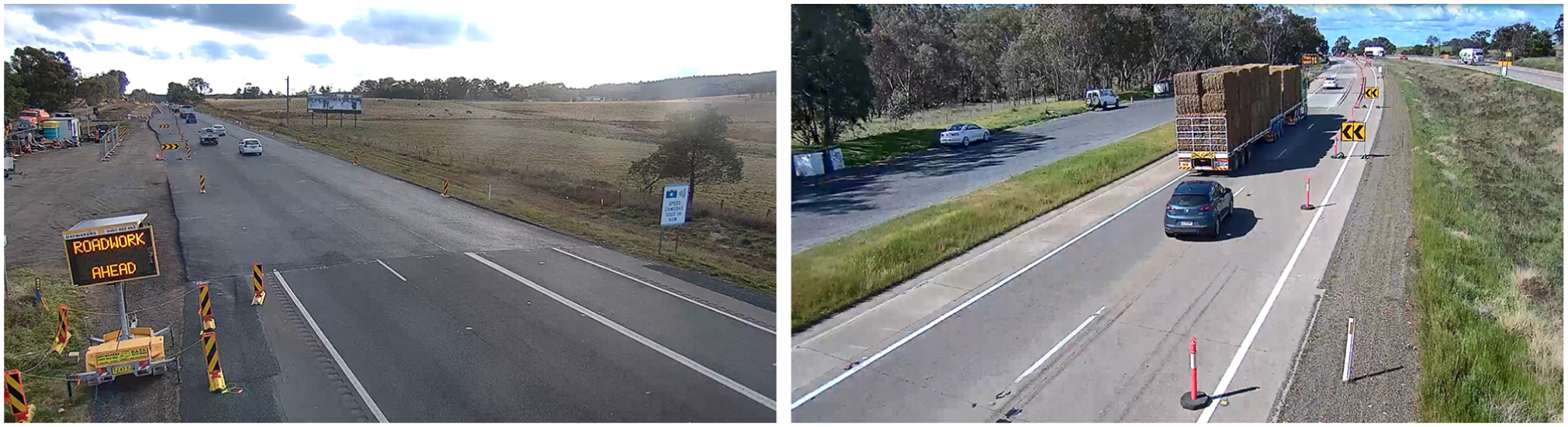
Layout of the selected work zones.
Although the cameras operated continuously throughout the day, distinct time periods were selected at each site for detailed analysis to capture variations in traffic patterns. These periods were strategically selected to coincide with peak traffic flow and to capture a range of conditions across the day, facilitating a well-rounded assessment of merging behavior under varying traffic demands.
Each merging maneuver was examined during the video data extraction process, with corresponding information recorded for the time and type of lane closure. The extracted variables included the classification of the merging vehicle (light or heavy), the types of leading and following vehicles in both the merging and open lanes, and the coordinates of the merging location. Light vehicles encompassed all passenger vehicle types, whereas heavy vehicles referred to all truck and bus categories. The primary objective of the video data extraction was to identify the presence and types of surrounding vehicles during each merging event, as these contextual elements are considered influential in the driver’s merging decisions ( 6 ) and crash risk ( 4 ). Surrounding vehicles were identified using lanewise longitudinal ordering from the extracted trajectory data. For each merging event, the current lane leader and follower were defined as the closest vehicles ahead of and behind the merging vehicle in the same lane, provided they were within close proximity at the time of the merging. The notion of close proximity adopted in this study (40 m) is consistent with influence-zone lengths (approximately 30 to 40 m) commonly used in multivehicle anticipation and conflict-assessment models ( 17 , 18 ), while additionally accounting for downstream follower vehicles that are behaviorally critical in merging contexts. The same nearest-in-lane rule was applied to identify the target lane leading and following vehicles. In addition to positional criteria, behavioral cues observed during video review further validated these classifications. For example, in many cases, merging drivers waited for a particular vehicle to pass or merge before activating the indicator and initiating the maneuver, confirming the influence of that specific vehicle.
Data extraction was carried out using an automated image processing tool (DataFromSky) that processes the collected video through image processing and computer vision techniques. This tool has been widely used in previous research and is considered to produce reliable data. The trajectory data extracted via DataFromSky already undergo internal smoothing and noise filtering as part of the software’s image processing–based multiobject tracking pipeline. The resulting trajectories of all vehicles were manually checked and found to be stable and free from abnormal fluctuations. Through a manual validation process, consistency checks (e.g., continuous IDs of vehicles, complete traces) were performed before analysis of the trajectory data.
Statistical Analysis
This study employed a SEM approach to analyze the dynamic interaction of vehicle speeds during lane-merging maneuvers in freeway work zones. Given the interdependencies among the merging vehicle and its surrounding vehicles in both the current and target lanes (e.g., 14, 19), it was necessary to adopt a modeling framework capable of accounting for these bidirectional relationships ( 14 ). Therefore, in this study, a simultaneous equation model addresses the hypothesis that the speeds of the merging vehicle and surrounding vehicles involved in a merging maneuver are not independent but, instead, exert reciprocal influences on each other. As the use of traditional regression approaches would have resulted in biased and inconsistent parameter estimates owing to the endogeneity of the speed variables, a SEM approach was utilized to overcome the mutual dependence between variables, allowing for more accurate estimation of the relationships within the merging environment. Moreover, SEM facilitates a comprehensive understanding of how a change in one vehicle’s behavior may influence the other vehicles while a merging maneuver takes place, and influence the behavior of other vehicles involved in the same merging sequence. This insight is particularly valuable in the context of freeway work zones, where space and time for maneuvers are limited and drivers’ reactions are tightly coupled.
From the available SEM approaches, a three-stage least squares (3SLS) regression approach was selected for this study, as it appropriately addresses the simultaneity across equations and potential endogeneity of explanatory variables ( 14 ). The methodological process consisted of variable selection, collinearity checks, testing for endogeneity, and final model estimation using 3SLS. Vehicle speeds were modeled as continuous outcomes conditional on the observed interaction context during each merging event. The modeling framework explicitly accounts for surrounding vehicles being simultaneously present, by specifying separate systems of simultaneous equations for distinct interaction configurations, including scenarios involving a merging vehicle with a leading vehicle (Equations 1 and 2), a merging vehicle with a following vehicle (Equations 3 and 4), and cases where both a leading and a following vehicle were present (Equations 5, 6, and 7).
Within each interaction context, the speeds of the merging vehicle and the interacting surrounding vehicle(s) were treated as endogenous and jointly determined. This formulation reflects the dynamic and anticipatory nature of merging behavior in constrained freeway work zones, where drivers continuously adjust their speeds in response to the relative position and behavior of nearby vehicles. For example, the merging vehicle’s speed may adjust in response to downstream gap availability as reflected by the following vehicle’s speed, while both upstream and downstream vehicles may simultaneously modify their speeds in anticipation of the merging maneuver. Each speed variable therefore appears as a dependent variable in its own structural equation while serving as an explanatory variable in other equations where behavioral interaction is theoretically justified and empirically observed. This context-specific system structure captures the interdependent yet directionally organized speed adjustments that arise during merging maneuvers without imposing artificial simultaneity across vehicles that are not present in each event.
Other covariates in the model included categorical variables that described the merging location (e.g., within the taper area), lane closure arrangement, and presence and types of surrounding vehicles during lane merging (current lane leading and follower vehicles and target lane leading and follower vehicles) along with the traffic volume. Before checking for endogeneity within the variables, a pairwise correlation test was performed to identify any correlation between the variables. No multicollinearity was observed among the variables.
The speed variables used in the modeling were extracted at a single behaviorally relevant time point: the exact point that the merging vehicle crosses the logic gate, which was placed between the two lanes of the road, rather than across multiple time steps. Because each merging event contributes only one cross-sectional observation per vehicle, temporal autocorrelation within vehicle trajectories does not arise in this analysis. In addition, broader temporal variation across merging events is accounted for through the inclusion of traffic flow, which captures prevailing traffic conditions that influence speed persistence, congestion intensity, and maneuvering constraints at the time of the merge. By conditioning the simultaneous equation system on traffic flow, the model absorbs much of the systematic temporal structure associated with evolving traffic states.
Endogeneity Testing
To determine the appropriate modeling framework for estimating the systems of equations representing speed interactions during lane-merging events in work zones, a residual-based endogeneity testing approach was adopted. The objective was to identify whether the speeds of surrounding vehicles exhibited endogeneity with respect to the merging vehicle’s speed decision, which would influence the suitability of employing 3SLS or seemingly unrelated regression.
The procedure commenced with the separate regression of each vehicle’s speed variables: the merging vehicle, current lane leading vehicle, current lane following vehicle, target lane leading vehicle, and target lane following vehicle, based on their presence as mentioned in the previous section. The procedure included the type and presence of the surrounding vehicle, merging vehicle type, merging location, and lane closure arrangement as independent variables. The residuals were saved for subsequent use in each regression.
Next, a regression model was estimated with the merging vehicle speed as the dependent variable and the speeds of present surrounding vehicles as independent predictors. In this model, the residual terms obtained from the earlier auxiliary regressions (one for each surrounding vehicle) were added as additional explanatory variables, along with other independent variables. This specification allowed for a diagnostic test of endogeneity by assessing whether the residuals captured the variation that was otherwise unaccounted for by the exogenous regressors. The same procedure was performed for other vehicle speed variables based on their presence. To test for endogeneity, joint significance tests were conducted on the residual terms using the Stata test command. If the residual term for a particular vehicle speed was statistically significant (p-value < 0.05), it was interpreted as evidence that the corresponding speed variable was endogenous in the system ( 14 ).
Given the presence of at least one endogenous regressor in a system and the presumed correlation across the error terms of the simultaneous equations, the 3SLS modeling framework was selected for all three models as the most suitable estimation strategy. This approach allowed for a consistent and efficient estimation by simultaneously addressing endogeneity and accounting for error term correlations among the equations.
Model Estimation Using 3SLS
The simultaneous system of equations was specified such that each vehicle’s speed was a function of the speeds of other vehicles and of the other independent variables discussed above. The model was estimated using the reg3 command in Stata with the 3SLS option. The five equations are defined as follows ( 14 ):







where S M , S L , and S F are speeds of the merging vehicle, leading vehicle, and the following vehicle, respectively, and Z is vector of exogenous variables (traffic flow, vehicle types, vehicle position, merging location, and lane closure type). These equations were jointly estimated using 3SLS according to the scenarios mentioned in the previous section, which iteratively applies instrumental variable regression within a system estimation framework, accounting for cross-equation correlations in the error terms and improving efficiency relative to single-equation approaches. Starting with all potential explanatory variables, a backward elimination approach was used to gradually remove the least significant variables to find the simplest models that still explained the data well. This process focused on minimizing the Akaike information criterion. A likelihood ratio test was performed to ensure that the final simplified models still had sufficient explanatory strength.
Results
Descriptive Statistics
From the videos of two work zones where vehicles had to change lanes owing to lane closure, merging data of vehicles were extracted for analysis. As the common practice is to drive in the slow lane unless overtaking or lanes are closed, 75.1% of merging events were identified in the work zone where the slow lane was closed.
Among the merged vehicles, most were light vehicles (93.1%). Further consideration of the merging location revealed that most of the merging maneuvers (73.4) were captured within the taper area, which was a common behavior for both light and heavy vehicles. Among the identified merging maneuvers, most occurred in the presence of a target lane-leading vehicle. Table 1 summarizes the total dataset considered in this study. In the modeling system, the speeds of merging and surrounding vehicles were modeled as functions of the speeds and types of surrounding vehicles, along with the traffic volume, lane closure type, vehicle type, surrounding vehicle position, and merging location choice.
Descriptive Statistics
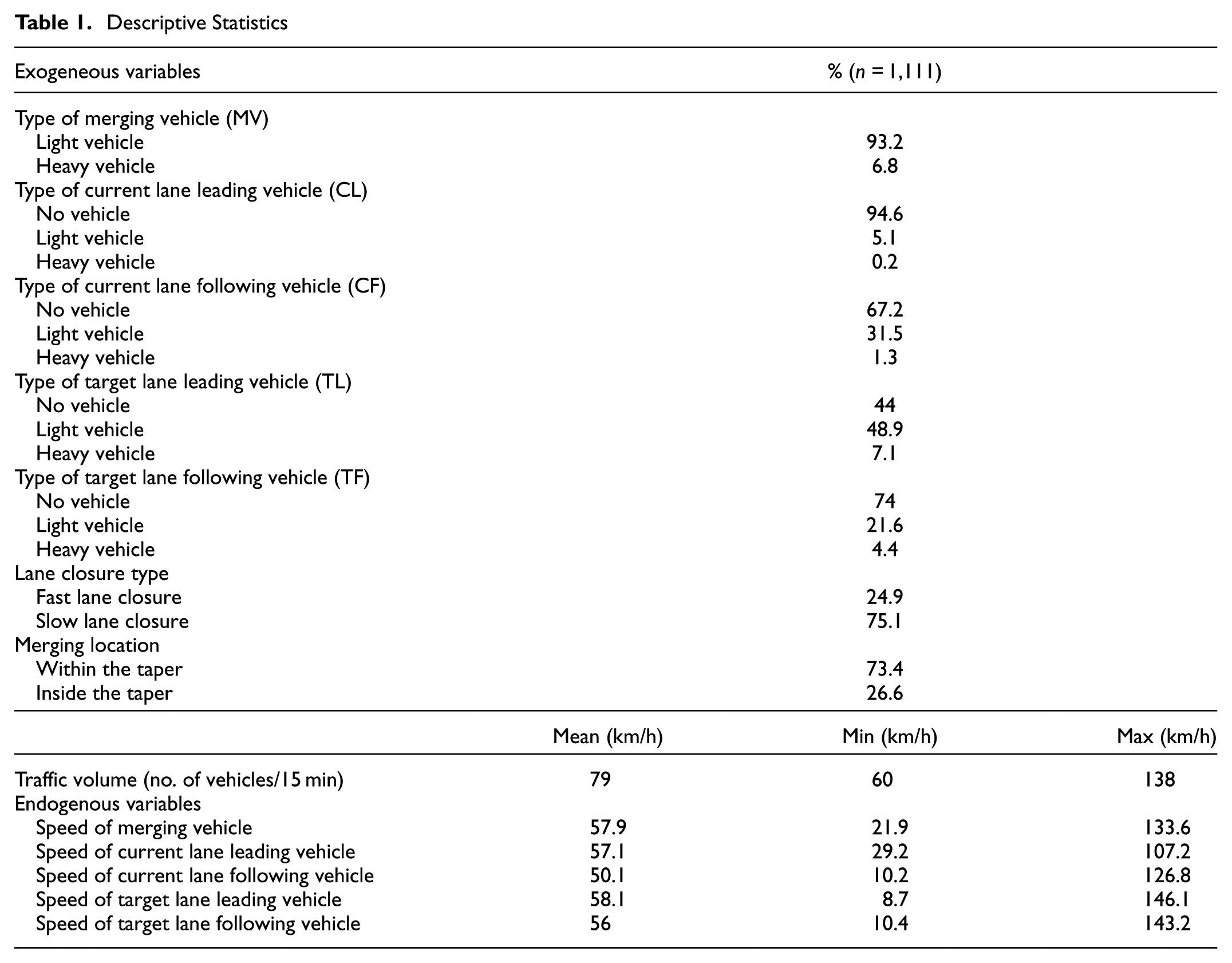
From the study variables, the vehicle type of each position refers to the type of vehicle that was present when the merging vehicle performed the merging maneuver. The speeds of different vehicles refer to the speeds of the respective vehicles in the given positions at the time the merging vehicle changed lanes. Merging location refers to whether the merging vehicle performed the merging maneuver within the taper area or outside the tape area. The lane closure type refers to whether the merging maneuver was captured during a slow or fast lane closure.
Results
This section presents the results of the systems of simultaneous equations estimated using the 3SLS method to analyze speed interactions during merging maneuvers in work zone environments. The modeling framework treats vehicle speeds as jointly determined outcomes arising from strategic and anticipatory interactions among drivers. Separate systems were estimated for three observed interaction contexts: (i) interaction between the merging vehicle and a leading vehicle, (ii) interaction between the merging vehicle and a following vehicle, and (iii) simultaneous interaction involving a merging vehicle, a leading vehicle, and a following vehicle.
The first system captured situations in which the merging vehicle interacted exclusively with a leading vehicle, either in the current lane or the target lane. The results indicated that merging speed was shaped primarily by traffic conditions and spatial context rather than by the instantaneous motion of the leading vehicle. The model results are shown in Table 2.
Model Results: Merging Vehicle–Leading Vehicle
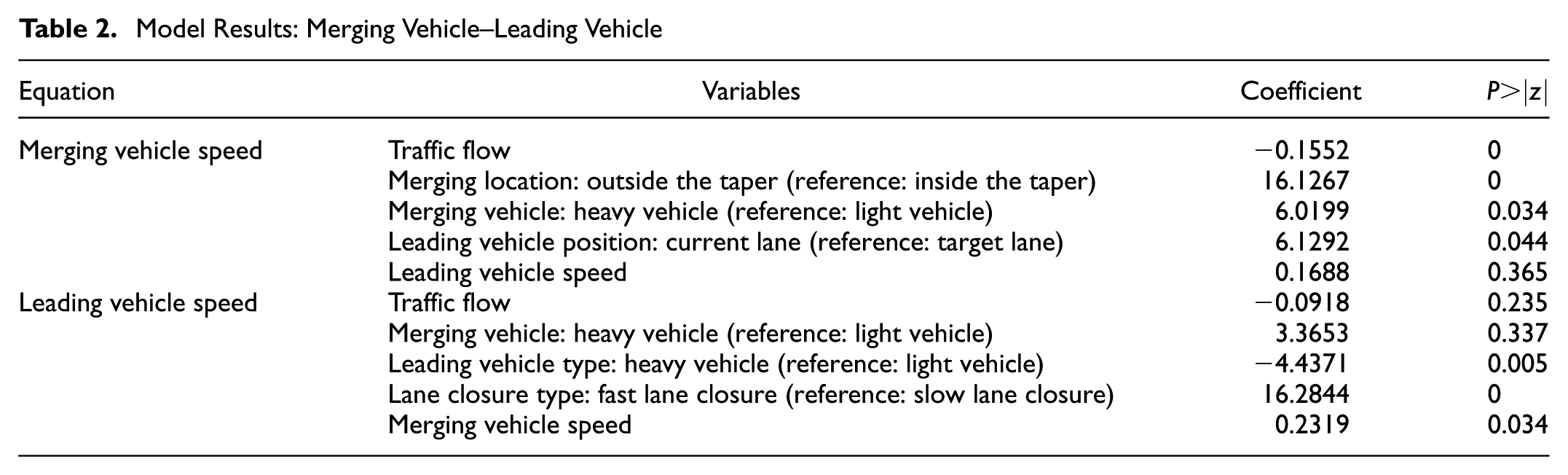
Merging vehicles systematically reduced their speed as traffic flow increased, reflecting increased caution and reduced maneuvering flexibility under heavier traffic conditions. Merging outside the taper was associated with substantially higher merging speeds relative to merges occurring inside the taper, indicating that drivers exploited the greater spatial freedom available upstream of the taper to execute the maneuver more assertively. Type of merging vehicle also affected the merging speed. Heavy merging vehicles operated at higher speeds than light vehicles, a relationship that was statistically significant at the 95% confidence level and most likely reflects differences in acceleration behavior, visibility, and driver expectations. The spatial position of the leading vehicle further influenced merging behavior. When the leading vehicle was located in the current lane rather than in the target lane, merging vehicles adopted higher speeds, suggesting that perceived conflict pressure was lower when the closest upstream vehicle was not located in the destination lane. In contrast, the leading vehicle’s speed itself did not exert a statistically significant influence on merging speed, indicating that upstream vehicle motion alone played a limited role in regulating merging behavior under lead-only interaction conditions.
In the leading vehicle speed equation, merging vehicle behavior fed back into upstream traffic. Leading vehicles adjusted their speed upward in response to higher merging speeds, reflecting anticipatory or cooperative responses to the merging maneuver. Lane closure configuration also played a decisive role: fast lane closures were associated with substantially higher leading vehicle speeds, consistent with more assertive speed regulation under constrained lane availability. In addition, heavy leading vehicles traveled at lower speeds than light vehicles, reflecting inherent differences in vehicle dynamics and driving behavior.
The second system examined interactions between the merging vehicle and a following vehicle. The results for this configuration revealed a markedly different behavioral structure in which downstream conditions played a central role in shaping merging decisions. Table 3 illustrates the model results on merging vehicle–following vehicle interactions.
Model Results: Merging Vehicle–Following Vehicle
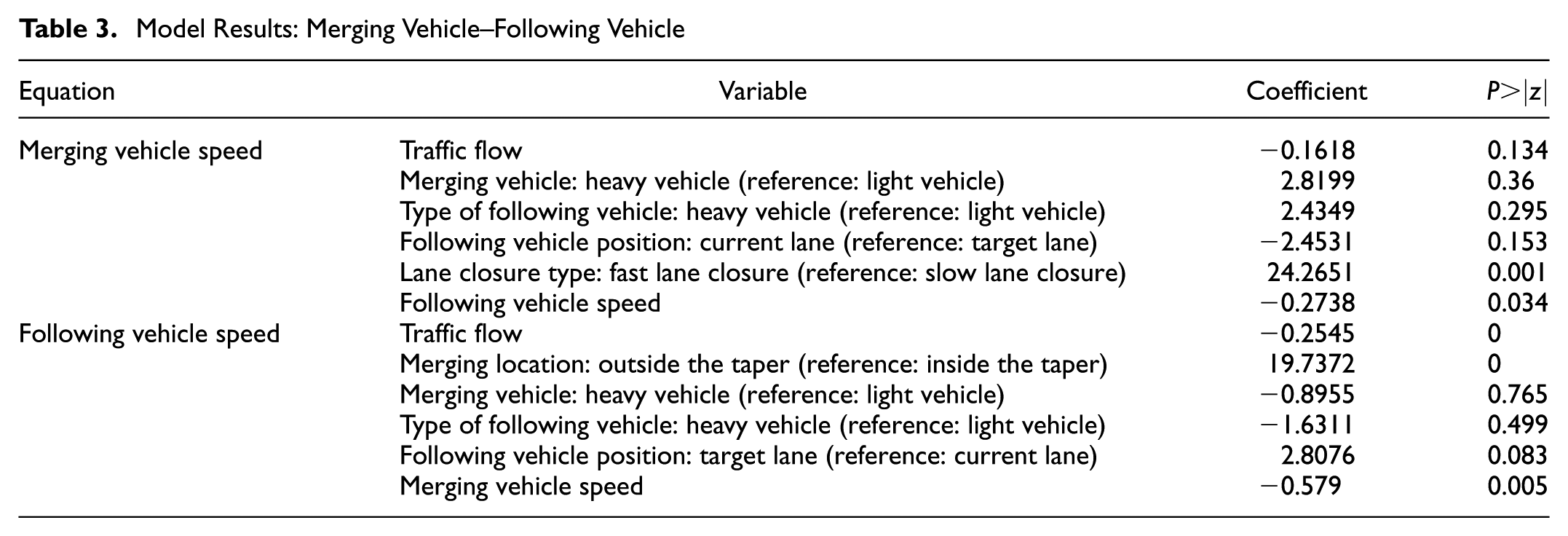
Merging vehicle speed responded strongly to the behavior of the following vehicle. Higher downstream speeds were associated with substantially lower merging speeds at the 95% confidence level, indicating that merging drivers actively regulated their speed to accommodate downstream gap acceptance constraints. This finding highlights the importance of downstream vehicles in limiting or enabling merging opportunities. Fast lane closures remained strongly associated with higher merging speeds, illustrating the influence of work zone configuration. Traffic flow exhibited a negative association with merging speed and was statistically significant at the 90% confidence level, suggesting that increasing traffic density moderately constrained merging behavior.
The following vehicle speed equation revealed clear bidirectional interaction. Following vehicles reduced their speed as traffic flow increased, reflecting congestion effects. They traveled substantially faster when merging occurred outside the taper, indicating smoother downstream flow under less constrained merging conditions. Most importantly, following vehicle speed decreased strongly as merging vehicle speed increased, demonstrating that downstream drivers actively responded to merging maneuvers by adjusting their own motion. Following vehicle position further moderated this response: following vehicles located in the target lane traveled faster than those in the current lane, with this effect statistically significant at the 90% confidence level.
Together, these results indicated that merging and following vehicles engaged in a tightly coupled adjustment process, with downstream behavior exerting primary influence on merging decisions. The third system represented situations in which the merging vehicle interacted simultaneously with both a leading and a following vehicle. This configuration captured the most behaviorally complete merging environment and revealed a clearly structured pattern of influence, and the model results are illustrated below in Table 4.
Model Results: Merging Vehicle–Leading Vehicle and Following Vehicle
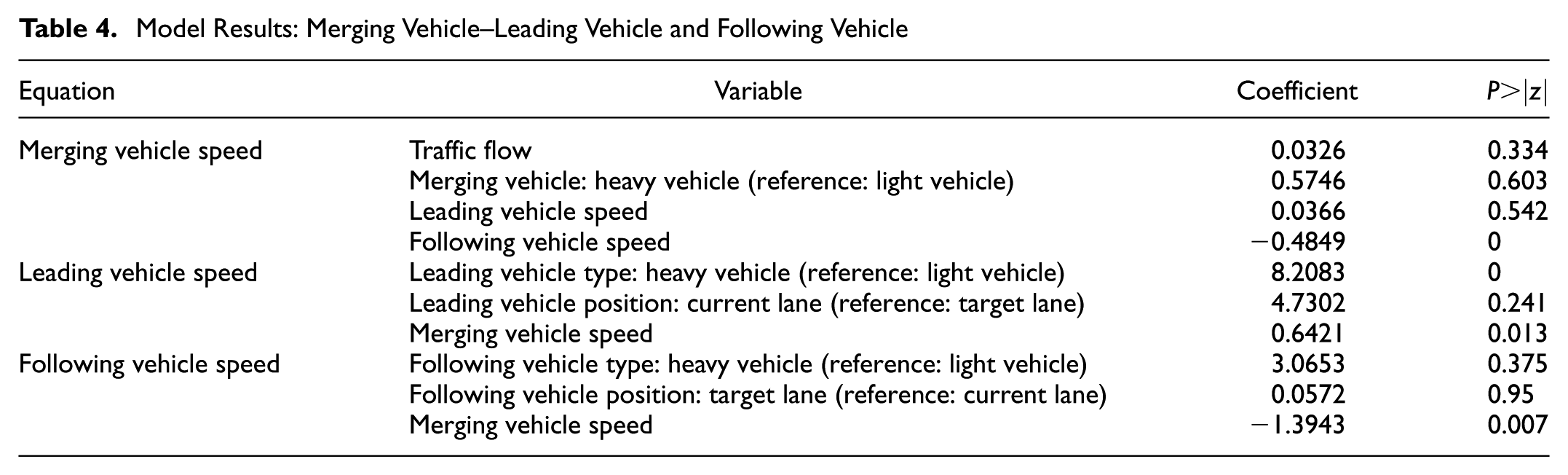
Under these conditions, merging vehicle speed responded strongly and consistently to downstream behavior. The following vehicle speed exerted a dominant influence on merging speed at a high level of statistical confidence, confirming that downstream constraints remained the primary driver of merging decisions, even when upstream vehicles were also present. In contrast, the direct influence of leading vehicle speed on merging behavior remained weak and statistically nonsignificant, reinforcing the limited upstream role observed in the other interaction contexts. Merging vehicle behavior, however, propagated through the traffic stream in both directions. Leading vehicles increased their speed in response to higher merging speeds, indicating upstream adaptation to the merging maneuver. Following vehicles exhibited an even stronger response, with their speeds decreasing substantially as merging speed increased. This asymmetric propagation pattern indicated that merging acts as a disturbance that is transmitted more strongly downstream than upstream. Other explanatory variables did not attain statistical significance in this system, suggesting that once both upstream and downstream vehicles are present, instantaneous behavioral responses dominate over static vehicle characteristics or positional attributes.
Categorical vehicle-type variables were coded using dummy indicators, and their coefficients represent category-specific baseline speed levels rather than incremental behavioral effects. The relatively large absolute values reflected the role of these dummies as intercept shifts within the simultaneous equation structure, where endogenous speed variables captured most of the continuous variation. Accordingly, the magnitude of these coefficients corresponded to average operating speed differences across vehicle-type categories observed in the data, rather than to instantaneous speed adjustments. These coefficients were therefore not intended to imply literal changes in speed but, instead, provide the necessary reference levels for estimating the interdependent speed relationships of interest.
Across all interaction contexts, a consistent behavioral pattern emerged. Following vehicles exerted the strongest and most significant influence on merging speed decisions, whereas upstream vehicles played a comparatively limited direct role. The merging vehicle occupied a central position in the interaction structure, responding primarily to following-vehicle behavior and transmitting speed adjustments to both leading and following vehicles. Importantly, the estimated systems did not reflect fully symmetric simultaneity. Instead, they revealed a directionally structured equilibrium in which downstream constraints dominated merging decisions and merging maneuvers propagated primarily toward downstream traffic. These findings provide strong empirical support for modeling merging behavior using a simultaneous equation framework that explicitly accounts for interaction context and vehicle presence, and they underscore the importance of downstream gap acceptance in shaping speed dynamics during work zone merging.
Discussion
The results of this study provide important insights into the interdependent behavior of vehicle speeds in work zone merging areas, particularly within taper zones. The observed relationships among merging-, leading-, and following vehicle speeds revealed a tightly coupled dynamic system in which drivers continuously adapted to one another’s behavior in real time. These adaptations were shaped not only by situational awareness and available maneuvering space but also by vehicle type, lane position, and work zone configuration. Although the simultaneous equation framework did not explicitly model driver control inputs such as acceleration choice, the estimated structural relationships captured behaviorally meaningful interdependencies among interacting vehicles. These interdependencies reflected real-time adaptive responses such as gap seeking, defensive maneuvering, and anticipatory speed adjustment, which were consistent with established theories of merging behavior in constrained work zone environments.
Across the estimated interaction contexts, the results consistently showed that merging vehicle speed was most strongly influenced by downstream traffic conditions. In scenarios where both leading and following vehicles were present, following vehicle speed exhibited a dominant influence on merging speed, reflecting the critical role of gap acceptance and rear-end collision avoidance in merging decisions. When the following vehicle traveled at lower speeds, merging drivers tended to increase their speed to position themselves within available gaps, whereas higher following vehicle speeds constrained merging opportunities and shaped more cautious merging behavior. These findings aligned with previous studies emphasizing the importance of following vehicles in determining acceleration and speed adjustment during merging maneuvers ( 15 ). Following vehicles often signal urgency or risk, prompting merging drivers to proactively adjust their speed to avoid abrupt braking or unsafe deceleration events.
In contrast, the direct influence of leading vehicle speed on merging behavior was consistently weaker and, in several interaction contexts, statistically nonsignificant. This suggests that once downstream constraints are present, merging drivers prioritize information about gap availability behind the lead vehicle rather than the absolute speed of the vehicle ahead. Nevertheless, the spatial position of the leading vehicle remained behaviorally relevant. When the leading vehicle was located in the current lane rather than the target lane, merging vehicles tended to operate at higher speeds, indicating reduced perceived conflict and lower immediate pressure to yield. This finding is consistent with the notion that drivers assess merging feasibility based on a holistic understanding of surrounding traffic configurations, rather than relying solely on the nearest upstream vehicle.
Traffic volume also played a systematic role across the models. Higher traffic volumes were associated with lower merging speeds, reflecting reduced maneuvering space and heightened caution under congested conditions. This effect has been widely documented in the literature, which identifies traffic volume as a key determinant of merging behavior and speed regulation in work zones ( 14 , 15 ). Under heavier traffic conditions, drivers appeared to adopt more defensive strategies, trading off speed for stability and safety in response to constrained gaps and increased interaction complexity.
The results further highlighted the central role of the merging vehicle as a behavioral catalyst within the interaction system. Merging vehicle speed significantly influenced the speeds of both leading and following vehicles, particularly in configurations where following vehicles were present. This indicates that merging maneuvers propagated through the traffic stream, prompting upstream and downstream drivers to adjust their speeds in anticipation of potential conflicts. Such behavior is consistent with the vehicle interaction system hypothesis, which illustrates that individual maneuvers can trigger coordinated responses extending beyond immediate neighboring vehicles ( 20 ). In particular, the strong downstream response to merging behavior underscored the sensitivity of following drivers to perceived merging intent and the need to preserve safe headways in constrained environments. In merging situations, particularly in constrained environments, the feasibility of the maneuver was governed less by the motion of the upstream leading vehicle and more by the availability of a safe downstream gap. Spatial-proximity-based surrogate safety measures indicated that collision risk was primarily determined by the distance available to avoid a conflict, which depends on the speed of the following vehicle and the reaction capability of its driver ( 21 ), rather than on the behavior of the vehicle ahead. As a result, merging drivers adjusted their speed primarily to manage collision risk associated with trailing vehicles, consistent with gap-acceptance and conflict-avoidance behavior. Conversely, upstream leading vehicles responded to merging maneuvers by adjusting their own speed in anticipation of potential interactions, producing the observed asymmetric influence structure.
Vehicle type further amplified these interaction effects. The presence of heavy vehicles, especially when acting as merging or following vehicles, was associated with stronger speed adjustments by surrounding drivers. Followers in both the current and target lanes exhibited heightened responsiveness when heavy vehicles were involved, most likely owing to their larger size, longer stopping distances, and perceived risk. Prior studies have shown that the presence of heavy vehicles increases driver caution and prompts greater longitudinal speed adjustments, particularly in constrained or high-risk environments such as work zones ( 4 , 22 ). Drivers may adopt more conservative strategies to avoid being positioned alongside or immediately behind large vehicles, especially during merging events. Conversely, experienced truck drivers may display greater confidence in such situations, potentially contributing to observed heterogeneity in speed responses across vehicle combinations ( 1 ).
Lane closure configuration also emerged as a critical contextual factor shaping merging dynamics. Fast lane closures were associated with higher merging and surrounding vehicle speeds, indicating that drivers anticipated greater urgency and reduced flexibility when the faster-moving lane was closed. This finding is consistent with previous research showing that fast lane closure scenarios often lead to earlier merging behavior, frequently outside the taper zone, as drivers seek to secure acceptable gaps before reaching the most constrained section of the work zone ( 7 ). These anticipatory behaviors most likely explain the higher speeds observed under fast lane closure configurations, as drivers accelerate to position themselves advantageously within the traffic stream.
From a broader behavioral perspective, the results supported the notion that drivers adjust their speeds based on a comprehensive assessment of the surrounding traffic environment rather than reacting solely to their immediate leader. Speed adaptations in the current lane follower and target lane follower reflected a chain of interdependent responses, whereby changes in merging speed propagated through adjacent lanes and influenced multiple vehicles simultaneously. This systemic adaptation was particularly pronounced in work zones, where limited space, reduced margins for error, and heightened perceived risk intensified driver attentiveness and responsiveness. In such contexts, abrupt or poorly coordinated speed changes are more likely to result in conflicts or safety-critical events, motivating drivers to engage in more deliberate and anticipatory speed regulation.
Overall, the estimated systems revealed a directionally structured interaction pattern rather than a fully symmetric simultaneity among all vehicles. Downstream traffic conditions dominated merging decisions, whereas merging maneuvers themselves served as a trigger for speed adjustments throughout the surrounding traffic stream. These findings contribute to a more holistic understanding of merging behavior in work zone taper areas and reinforce the importance of accounting for full interaction structures when analyzing driver behavior in constrained environments. From a practical standpoint, the results suggest that effective work zone traffic management strategies should explicitly account for downstream vehicle behavior. Traffic control interventions such as speed harmonization measures, pacing vehicles, or dynamic merge guidance systems in the target lane may help create smoother gaps and reduce pressure on merging drivers. Early warning signs and variable message systems that encourage consistent speeds and adequate headways could mitigate abrupt speed changes and improve safety in taper zones. Such strategies are particularly important in mixed-traffic environments with a high proportion of heavy vehicles, where speed differentials and braking limitations heighten collision risk.
Although this study provides valuable insights into speed interdependence during work zone merging maneuvers, several limitations should be acknowledged. The data were collected from two work zone sites in New South Wales, Australia. Although these sites were selected to represent typical merging conditions, the limited geographic scope may affect the generalizability of the findings. The use of a small number of sites is common in work zone research owing to data collection challenges ( 9 , 14 ). Future research should expand the dataset to include a wider range of work zone configurations, traffic conditions, and regional contexts to enhance external validity. Additionally, future studies could investigate merging behavior in work zones equipped with countermeasures such as speed feedback signs, rumble strips, automated speed enforcement, and other smart work zone technologies to evaluate their effectiveness in harmonizing vehicle speeds and reducing interaction-induced risk.
Conclusions
This study demonstrated the interdependent nature of vehicle speeds during lane-merging events in work zones, highlighting how the behavior of surrounding vehicles, particularly in the follower position, significantly influences the speed choice of the merging vehicle. The SEM approach revealed that the speed decisions of all five vehicle positions were not made in isolation but were mutually responsive. Notably, the presence and speed of heavy vehicles, particularly in the target lane, were found to exert a considerable influence on merging behavior. These findings underscore the importance of accounting for multivehicle interactions when assessing the safety and operational efficiency of work zones.
Footnotes
Acknowledgements
The authors thank iMOVE CRC and Transport for New South Wales for providing the traffic movement videos collected in a research project that was funded by iMOVE CRC, Transport for New South Wales, and Deakin University, and supported by the Cooperative Research Centres program, an Australian Government initiative.
Author Contributions
The authors confirm contribution to the paper as follows: study conception and design: T. Ranawaka, A. Debnath; data collection: T. Ranawaka; analysis and interpretation of results: T. Ranawaka, S. Siriwardene, A. Debnath; draft manuscript preparation: T. Ranawaka, S. Siriwardene, A. Debnath. All authors reviewed the results and approved the final manuscript.
Declaration of Conflicting Interests
The authors declared the following potential conflicts of interest with respect to the research, authorship, and/or publication of this article: Professor Debnath is an associate editor of the Transportation Research Record.
Funding
The authors received no financial support for the research, authorship, and/or publication of this article.

The views and opinions expressed in this paper are those of the authors and do not necessarily reflect the policies and practices of the funding organizations.