







Abstract
The primary aim of our study was to examine the influence of media exposure on body dissatisfaction and disordered eating in middle-aged women. A sample of 101 women, aged between 35 and 55 years, completed questionnaire measures of media exposure, thin-ideal internalization, social comparison, appearance investment, aging anxiety, body dissatisfaction, and disordered eating. Television, but not magazine exposure, was positively related to body dissatisfaction and disordered eating. In contrast, both television and magazine exposure were positive correlates of all four proposed media-processing variables (internalization, social comparison, appearance investment, and aging anxiety), which were themselves positive correlates of both body dissatisfaction and disordered eating. Structural equation modelling revealed that the influence of media exposure was fully mediated by the proposed media processes. The analyses also indicated that our proposed sociocultural model of disordered eating provided a reasonably good fit to the data, suggesting that sociocultural theory can be extended to women of middle-age. An important practical implication of this finding is that strategies aimed at challenging and minimizing these media processes may reduce some of the negative impact of media exposure in middle-aged women.
Keywords
Disordered eating is common among women in Western societies (Stice, 2002) and has steadily increased over the past several decades (Harrison & Cantor, 1997; Hesse-Biber, Leavy, Quinn, & Zoino, 2006). Disordered eating encompasses a range of problematic eating attitudes and behaviours—ranging from weight and shape concerns to dieting and extreme weight control methods (e.g., fasting, binge eating, and purging) to clinically diagnosable eating disorders (e.g., anorexia and bulimia nervosa; Ricciardelli & McCabe, 2004). Research in this area has focused predominantly on young undergraduate women (typically 18-24 years), and there is now extensive knowledge of the factors that promote and maintain disordered eating in this particular group (Stice, 2002). Much less is known about the factors that contribute to disordered eating in middle-aged women (aged 35-55 years). It is important that this gap in the literature is addressed given the growing recognition that disordered eating is a significant issue for women of this age group (Peat, Peyerl, & Muehlenkamp, 2008).
A considerable number of studies have found that middle-aged women commonly report disordered eating attitudes and behaviours (e.g., Lewis & Cachelin, 2001; Marcus, Bromberger, Wei, Brown, & Kravitz, 2007; Midlarsky & Nitzburg, 2008). Furthermore, the rates of disordered eating found in this population are often comparable with those of younger women (McKinley, 1999; Perez, Hernandez, Clarke, & Joiner, 2007; Procopio, Holm-Denoma, Gordon, & Joiner, 2006). Whereas clinical eating disorders (e.g., anorexia and bulimia nervosa) are most prevalent in adolescent girls and young adult women (American Psychiatric Association, 2000), research indicates that middle-aged women also experience these disorders (Cumella & Kally, 2008; Forman & Davis, 2005) and that these disorders may in fact be on the rise in this particular population (Wiseman, Sunday, Klapper, Harris, & Halmi, 2001). Collectively, these findings suggest that more research is needed to identify the contributory factors for disordered eating in midlife. In addition to the aetiological implications, research of this nature may assist in the development of effective intervention and treatment programs for women of this age group.
Of the many variables thought to promote eating pathology, sociocultural factors are considered paramount (Thompson, Heinberg, Altabe, & Tantleff-Dunn, 1999). Sociocultural theory (e.g., Thompson et al., 1999) contends that beauty ideals for women are primarily reinforced and transmitted by three sociocultural influences: family, peers, and the media. Hence, this account has come to be referred to as the “tripartite influence model” (Shroff & Thompson, 2006). The model postulates that the standard for the ideal female body is so excessively thin as to be virtually unattainable, leading many women to experience body discontent. Women who are dissatisfied with their bodies may then engage in disordered eating in a bid to approximate the thin ideal. This account is highly plausible given the concomitant shrinking female body ideal and rise in body dissatisfaction and disordered eating witnessed over the past several decades (Feingold & Mazzella, 1998). An additional aspect of the model is its articulation of two primary processes by which sociocultural influence translates to body discontent, namely internalization of the thin ideal and social comparison. Internalization of the thin ideal refers to the extent to which an individual “buys into” societal standards of attractiveness, and it is considered a necessary prerequisite for any adverse effect on body image (Thompson & Stice, 2001). Women also often utilise the thin ideal as a source of appearance comparison (Tiggemann & McGill, 2004). Given that the majority of women “fall short” of this stringent beauty standard, the comparison is almost inevitably upward, promoting body discontent (Dittmar, 2005).
All of the posited relationships outlined in the tripartite model have been supported in younger women (Coomber & King, 2008; Stice, Schupak-Neuberg, Shaw, & Stein, 1994; van den Berg, Thompson, Obremski-Brandon, & Coovert, 2002). However, very few studies have examined these relationships in women beyond this narrow age range. This limitation is surprising given that as women age they experience a number of developmental changes that move them further away from the thin beauty ideal. These changes, which include increased weight gain, a redistribution of weight from the lower body to the waist and hips (Voda, Christy, & Morgan, 1991), and a doubling of the percentage of body fat by age 50 (Rodin, Silberstein, & Striegel-Moore, 1985), mean that middle-aged women are typically less consistent with the thin ideal than younger women. As a result, they may be particularly vulnerable to body dissatisfaction and extreme methods of weight control. In contrast, it has been argued that other factors associated with aging may afford women some protection against body dissatisfaction and disordered eating. One such factor might be the importance of physical appearance, which some (Pliner, Chaiken, & Flett, 1990; Thompson et al., 1998) but not all (Webster & Tiggemann, 2003) studies have found diminishes with age. Additionally, it has been suggested that a lack of same-age media peers may lead older women to shift their body comparisons to more realistic figures, such as friends and family members (Bessenoff & Del Priore, 2007; Grogan, 2008). Thus, the relationships among the variables contained in the tripartite influence model may differ for middle-aged women.
The overall aim of the present study is to test an extended sociocultural model as it applies to middle-aged women. Our particular focus is on media influence, a factor that has a well-documented negative impact on body image and eating practices in younger women (see Grabe, Ward, & Hyde, 2008, for a review). Curiously, despite its intuitive role in also promoting these issues during midlife, actual media use has received little research attention in women of this age group. Thus, we aim to address this significant gap in the literature. Furthermore, by testing an extended sociocultural model, we seek to provide valuable information regarding the cognitive processes by which media use actually translates to poor body image and disordered eating during midlife. Identification of these processes is important not just to broaden theoretical understanding but also to better inform clinical efforts with this population.
There are a number of factors which suggest that the media may be detrimental to middle-aged women’s body experience. The oldest members of this cohort were girls in the mid-1960s, which marked the beginning of a period when fashion models (e.g., Twiggy) and other exemplars of female beauty portrayed in the media started to become impossibly thin (McLaren, Hardy, & Kuh, 2003). Since this time, women in media content have further shrunk in size such that they are representative of only 5% of women (Wolszon, 1998). Additionally, in recent times there has been an influx of ultra-thin middle-aged female celebrities who are featured across a wide range of media content, including commercials (e.g., Elle McPherson; Elizabeth Hurley), movies (e.g., Michelle Pfeiffer; Demi Moore), comedy dramas (e.g., Courtney Cox; Teri Hatcher), soap operas (e.g., Lesley Anne Down; Hunter Tylo), and even video clips (e.g., Madonna; Kylie Minogue). These famous women have created a new and unrealistic “normative” midlife physique (Bordo, 2003), which may place middle-aged women at further risk of poor body image and maladaptive eating. Accordingly, we predicted that media exposure would be positively related to both body dissatisfaction and disordered eating in midlife women.
There is a small amount of evidence for some individual aspects of the tripartite influence model in middle-aged samples, but these have not been tested within one model. In particular, body dissatisfaction has been reliably associated with dieting (Allaz, Bernstein, Rouget, Archinard, & Morabia, 1998; Bennett & Stevens, 1996) and disordered eating (Lewis & Cachelin, 2001; Marcus et al., 2007; Midlarsky & Nitzburg, 2008) in women of this age group. Other studies have found that internalization (a posited underlying process) is positively associated with body dissatisfaction (Forbes et al., 2005; Katz, 2005; Matz, Foster, Faith, & Wadden, 2002). Another study (Kozar & Damhorst, 2009), which examined the influence of social comparison (the second posited underlying process) on the body image of adult women (30-80 years), found that comparison with fashion models was positively associated with current-ideal body discrepancy and body dissatisfaction. Although social comparison tendency was found to decrease with age, this finding may have been due to the youthful nature of the comparison targets, which according to social comparison findings (Tiggemann & Polivy, 2010), may have decreased their relevance to middle-aged women.
There are two additional underlying processes which may be relevant to middle-aged women, namely appearance investment and aging anxiety. Appearance investment refers to the extent to which an individual’s attention, thoughts, and actions focus on their looks and define their sense of self (i.e., the importance of appearance to self-worth; Cash, Melnyk, & Hrabosky, 2004). Theoretically, the media cultivate appearance investment in women by linking a thin body with a wide variety of interpersonal and emotional benefits, such as happiness, desirability, and status (Tiggemann, 2005). A small body of research demonstrates that middle-aged women who are highly invested in appearance experience higher rates of body dissatisfaction and disordered eating (Katz, 2005; McCabe, Ricciardelli, & James, 2007; McLean, Paxton, & Wertheim, 2009).
Aging anxiety is a factor that may be specific to middle-aged women and not younger women. During midlife, women experience the onset of physical signs of aging, such as wrinkling and sagging of the skin, which are synonymous with a decline in female physical attractiveness (Saucier, 2004). Additionally, the typical weight gain and increased body fat deposition with age (Rodin et al., 1985) move women further away from the thin body associated with youth (Gupta & Schork, 1993). Thus, it is not surprising that anxiety about physical aging is associated with higher rates of body dissatisfaction (Katz, 2005; Lewis & Cachelin, 2001), drive for thinness (Gupta & Schork, 1993), and disordered eating (Lewis & Cachelin, 2001; Midlarsky & Nitzburg, 2008) in midlife women. We propose that the media are major sources of aging anxiety due to their emphasis on youthful beauty and their relentless pressure on women to defy the natural aging process.
In sum, the primary aim of our study is to investigate the role of actual media use on body dissatisfaction and disordered eating among middle-aged women. The second aim is to test a model of disordered eating in middle-aged women based on the tripartite influence model (Shroff & Thompson, 2006). In particular, we predict that the influence of media exposure on body dissatisfaction will be mediated by four cognitive processes: internalization of the thin ideal, social comparison, appearance investment, and aging anxiety.
Method
Participants
The participants were 101 middle-aged women, aged between 35 and 55 years (M = 44.26, SD = 5.46). The women were mothers of children, aged 10 to 16 years, who attended a metropolitan school in Adelaide, South Australia. The school is in a middle-class area, according to the socioeconomic indexes for areas (SEIFA)—a summary measure of relative socioeconomic advantage and disadvantage, economic resources, and education and occupation (Australian Bureau of Statistics, 2006). The majority was married (87%), and most worked in administrative (39%) or professional occupations (32%). The ethnic composition of the sample was White Australian (74%), Indigenous Australian (8%), British (10%), Asian (3%), and other (unspecified) ethnicities (5%). In terms of education, 21% had not completed high school, 19% had completed high school, 30% had completed further tertiary study, and 30% had a university degree. Their mean body mass index (BMI) score was 26.67 (SD = 6.43), indicating that the women were, on average, at the lower bound of the overweight range (BMI = 25 – 29.99), as defined by Garrow and Webster (1985). The largest group of women (44%) fell within the normal weight range (BMI = 18.5—24.99); 33% were classified as overweight; 22% were classified as obese (BMI > 30); and only 1% was classified as underweight (BMI < 20). The BMI distribution was comparable to national Australian data for women of this age group (Australian Bureau of Statistics, 2009), indicating a representative sample with respect to BMI. The majority of women (77%) wanted to weigh less, with the average desired weight loss approximately 10 kilograms (over 20 pounds; M = 9.77, SD = 11.72).
Materials and Procedure
The data collection was conducted between August and November 2009. Ethics approval to conduct the study was obtained from the Social and Behavioural Research Ethics Committee (SBREC) at Flinders University. Upon receiving permission from the principal of a local school, a letter of introduction was distributed via class teachers to students between Grades 5 and 12 (n = 335) who were asked to pass it on to their mothers. The letter outlined the aims and requirements of the study and described two small incentives for participation: a $2 donation to the school for every returned questionnaire and the opportunity to be entered in a raffle for a facial, valued at $50. A questionnaire and raffle ticket were mailed to all women willing to take part in the study. No identifying information was requested, and participants were asked to write only their phone number on the raffle ticket to further ensure their anonymity. Informed consent was satisfied via the return of the questionnaire in accordance with SBREC guidelines. Completed questionnaires were received from 101 women, yielding an overall response rate of 30.1%. This figure is likely to underestimate the true response rate because some letters may not have reached their intended targets (mothers) given that we relied upon children for their distribution. In addition, households with more than one child in the targeted year levels would have received multiple letters of invitation.
The questionnaire itself consisted of a number of sections including: background information; two open-ended questions regarding body image role models; a purpose-designed measure of media exposure; and established measures of internalization of the thin ideal, social comparison, appearance investment, aging anxiety, body dissatisfaction, and disordered eating. Starting with background information, participants were asked to report their age, marital status, occupation, education level, ethnic background, ideal and current weight, and height. The latter two variables were used to calculate Body Mass Index (BMI) as a ratio of weight (kg) to height (m2). Two open-ended questions were included to ascertain who (if anyone) the women aspired to look like and why. The questions were, “If you could look like anyone, who would it be?” and “Why?”
Media exposure (television and magazines)
A measure was developed to assess exposure to appearance-related media. Participants were provided with a list of 14 television shows and 15 magazines. They were asked to record the frequency with which they viewed each show and read each magazine on a scale ranging from 1 (never) to 5 (every time it’s on/comes out). For both television and magazines, scores were summed to produce a total score, with possible ranges of 14 – 70 for television and 15 – 75 for magazines and with higher scores indicating greater exposure.
The final list was derived from an initial pool of 20 television programs and 27 magazines considered appealing to middle-aged women. Television programs were chosen from the local (Sunday Mail) TV Guide which contains descriptions of free-to-air and Foxtel (cable) programs. Magazines were chosen from the ACP Magazines Ltd. website (http://www.acp.com.au/) and via inspection of the magazine stand at the local newsagency. A convenience sample of three middle-aged female raters (a 44-year old loans officer, a 41-year-old receptionist, and a 45-year-old hairdresser) was directed to the television programs’ official websites and provided with an excerpt (both written and pictorial) of each magazine to ensure their familiarity. These raters were instructed to categorise each television show and magazine according to its degree of appearance focus and its representation of thin middle-aged women from 0 (no emphasis) through 1 (some emphasis) to 2 (large emphasis). Mean inter-rater reliability averaged across the two categories was adequate for both television (r = .81) and magazines (r = .82). Each television show and magazine was subsequently attributed a modal rating for each category. Exemplar television shows include The Mentalist—a crime investigation drama (0, 0), E! News—an entertainment news program (1, 1), and Desperate Housewives—a comedy drama with portrays the lives of a group of thin and attractive middle-aged women (2, 2). Exemplar magazines include Burke’s Backyard—a gardening magazine (0, 0), Harper’s Bazaar—a fashion magazine (1, 1), and OK—a celebrity gossip magazine (2, 2). A minimum rating of 1 in both categories was required for inclusion in the final list. Four appearance-based lifestyle television programs considered appealing to middle-aged women were also included in the final list of television shows.
Internalization of the thin ideal
The Internalization General subscale of the Sociocultural Attitudes Towards Appearance Questionnaire-3 (Thompson, van den Berg, Roehrig, Guarda, & Heinberg, 2004) was used to assess the internalization of socially accepted standards of thinness and beauty. Following the method used by Keery, Shroff, Thompson, Wertheim, and Smolak (2004), all items referring to social comparison, a separate and distinct construct, were omitted. Participants rated the extent of their agreement with the five remaining statements (e.g., “I would like my body to look like the models who appear in magazines”) on 5-point Likert scales from 1 (definitely disagree) to 5 (definitely agree). The five items were summed to produce a total score, with higher scores indicating stronger internalization (after some reverse coding). Keery et al. reported high internal consistency (α = .92) for a similar measure in an Australian sample of female adolescents.
Social comparison
The Physical Appearance Comparison Scale (Thompson, Heinberg, & Tantleff, 1991) was used to assess the tendency to compare one’s overall appearance with that of others. Participants used 5-point Likert scales from 1 (never) to 5 (always) to indicate the frequency with which they engaged in five behaviours involving comparison with others in social settings (e.g., “In social situations, I sometimes compare my figure to the figures of other people”). The five items were summed to produce a total social comparison score, with higher scores indicating a greater social comparison tendency (after some reverse coding). Tiggemann and McGill (2004) reported almost acceptable internal consistency (α = .69) for the scale in a female undergraduate sample.
Appearance investment
The revised version of the Appearance Schemas Inventory (Cash et al., 2004) was used to assess core beliefs and assumptions regarding the importance, meaning, and influence of appearance in everyday life. The 20-item scale includes items such as “If I look good on a given day, it’s easy to feel happy about other things” and “I try to be as physically attractive as I can.” Participants used 5-point Likert scales from 1 (strongly disagree) to 5 (strongly agree) to indicate their level of agreement. The 20 items were summed (after some reverse coding) to obtain a total appearance investment score, with higher scores representing greater appearance investment. Slevec and Tiggemann (2010) reported high internal consistency for the total scale with a sample of middle-aged women (α = .90).
Aging anxiety
The Physical Appearance subscale of the Anxiety About Aging Scale (Lasher & Faulkender, 1993) was used to assess the degree of anxiety about age-related changes to physical appearance. Participants were asked to rate the accuracy of five statements on 5-point Likert scales from 1 (strongly disagree) to 5 (strongly agree). An example item is “I have never dreaded the day I would look in the mirror and see grey hairs” (reversed coded). Items were coded and summed such that higher scores reflected higher aging anxiety. McKinley and Lyon (2008) reported adequate internal consistency (α = .75) for the scale with a female sample aged between 50 and 68 years.
Body dissatisfaction
The Body Areas Satisfaction Subscale of the Multidimensional Body-Self Relations Questionnaire (Brown, Cash, & Mikulka, 1990) was used to assess body satisfaction. The 9-item measure covers the full body, including weight. Participants indicated their degree of satisfaction using 5-point Likert scales from 1 (very dissatisfied) to 5 (very satisfied). For ease of interpretation, all items were reverse scored such that higher summed scores indicated greater dissatisfaction. Cash and Henry (1995) reported moderate internal consistency (α = .82) for the scale with a sample of women aged between 18 and 70 years.
Disordered eating
Disordered eating was assessed by three subscales (Drive for Thinness, Bulimia, and Body Dissatisfaction) of the Eating Disorder Inventory (Garner, Olmstead, & Polivy, 1983). The Drive for Thinness subscale measures excessive preoccupation with weight and dieting, as well as intense pursuit of thinness. The Bulimia subscale measures tendencies to think about and engage in bouts of uncontrolled overeating, as well as thoughts of compensatory behaviour. The Body Dissatisfaction subscale assesses dissatisfaction with specific body areas (i.e., the stomach, thighs, hips, and buttocks), as well as overall body shape. Participants rated how often each item was true for them from 1 (always) to 6 (never). In the present study, untransformed scores were used, as recommended for nonclinical populations by Schoemaker, van Strien, and van der Staak (1994). Possible scores ranged from 23 to 138, with a higher score indicating greater disordered eating. Tiggemann and Lynch (2001) reported high internal consistency for the same composite measure in a sample that included middle-aged women (α = .94).
Results
Body Image Role Models
Sixty-one (60%) participants responded to the open-ended question “If you could look like anyone who would it be?” A plurality of women (31%) aspired to look like actresses (e.g., Jennifer Aniston, Angelina Jolie, Elizabeth Hurley), and all actresses nominated (except one) were middle-aged (35-55 years). Actresses were overwhelmingly nominated for their attractive appearance (95%; e.g., slim, attractive, beautiful hair, nice smile, gorgeous figure, natural beauty, “looks fabulous for her age”). The second most popular response was myself (16%), followed by models (10%; e.g., Elle McPhersonx), “a younger me” (10%); and “no-one” (10%), and then singers (8%; e.g., Olivia Newton-John). As with actresses, the majority of models and singers nominated were of middle-age. For those 6 women who aspired to look like “a younger me,” the reasons stated were a thinner body (2), a younger body without sagging skin (1), and a generally more youthful appearance (3).
Relationships Among Variables
For the continuous data, there were no missing values. The means, standard deviations, and coefficient alphas for all variables, along with the zero-order correlations, are presented in Table 1 . For all proposed mediators (i.e., media processing variables) and outcome variables, the means were close to the midpoint of the scale. For the zero-order correlations, both television and magazine exposure were positively correlated with internalization, social comparison, appearance investment, and aging anxiety. Although both media variables were related to each other, only television exposure was also a significant correlate of body dissatisfaction and disordered eating. All hypothesized media processing variables (internalization, social comparison, appearance investment, and aging anxiety) and outcome variables (body dissatisfaction and disordered eating) were also significantly intercorrelated.
Means, Standard Deviations, Alphas, and Correlations Among Variables
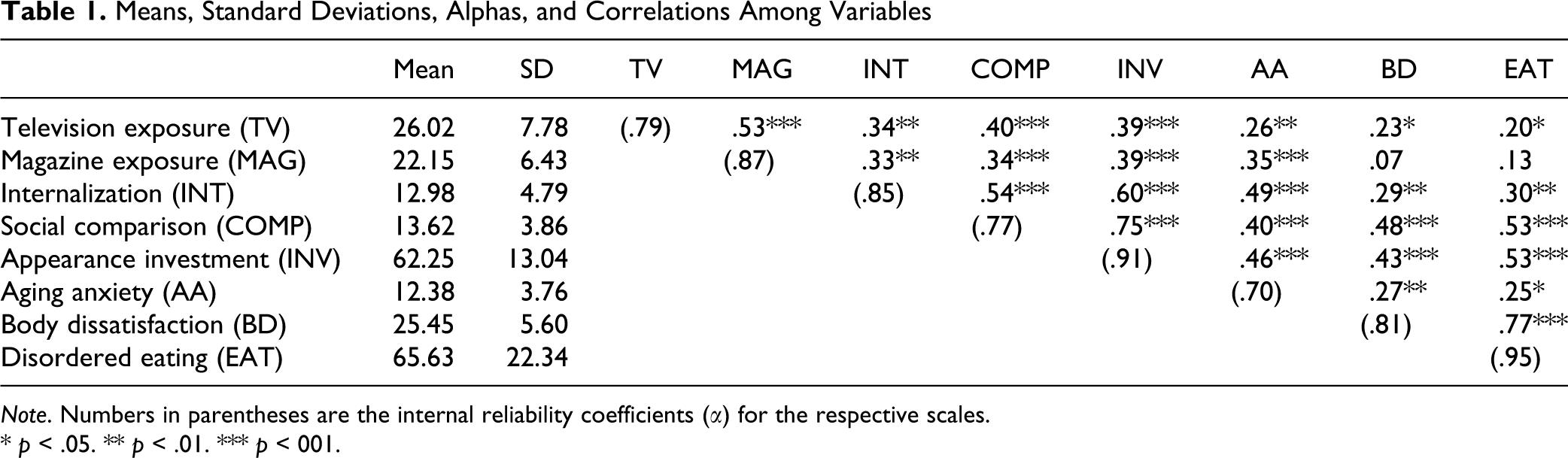
Note. Numbers in parentheses are the internal reliability coefficients (α) for the respective scales.
* p < .05. ** p < .01. *** p < 001.
Test of the Hypothesized Sociocultural Model
The sociocultural model was examined by Structural Equation Modelling (SEM) with maximum likelihood estimation using Amos Version 17. Television and magazine exposure were conceptualised as indicators of the latent variable—media exposure. As documented in Table 1, the four proposed media processing variables were highly intercorrelated and thus were taken as indicators of the latent variable—media processing. According to Hu and Bentler (1999), adequacy of model fit to the data can be determined by four indexes: the comparative fit index (CFI), the Tucker-Lewis index (TLI), the standardized root-mean square residual (SRMR), and the root mean square error of approximation (RMSEA). They recommend that models with CFI and TLI values of .95 and above and SRMR and RMSEA values at .05 or below indicate a good fit to the data. An acceptable fit to the data is indicated by CFI and TLI values ranging from .90 to .94 and SRMR and RMSEA values ranging from .06 to .10.
Fit statistics for the proposed model were comparable with the statistics outlined above. The CFI and TLI values were .97 and .95, respectively, indicating a good fit to the data. The SRMR and RMSEA values were .06 and .08, respectively, indicating an acceptable fit to the data. Taken together, these values confirm that our proposed model was an acceptable-to-good fit to the data. The structural coefficients for the model are presented in Figure 1 . As can be seen, media exposure accounted for 38% of the variance in media processing, media processing accounted for 25% of the variance in body dissatisfaction, and body dissatisfaction accounted for 59% of the variance in disordered eating.
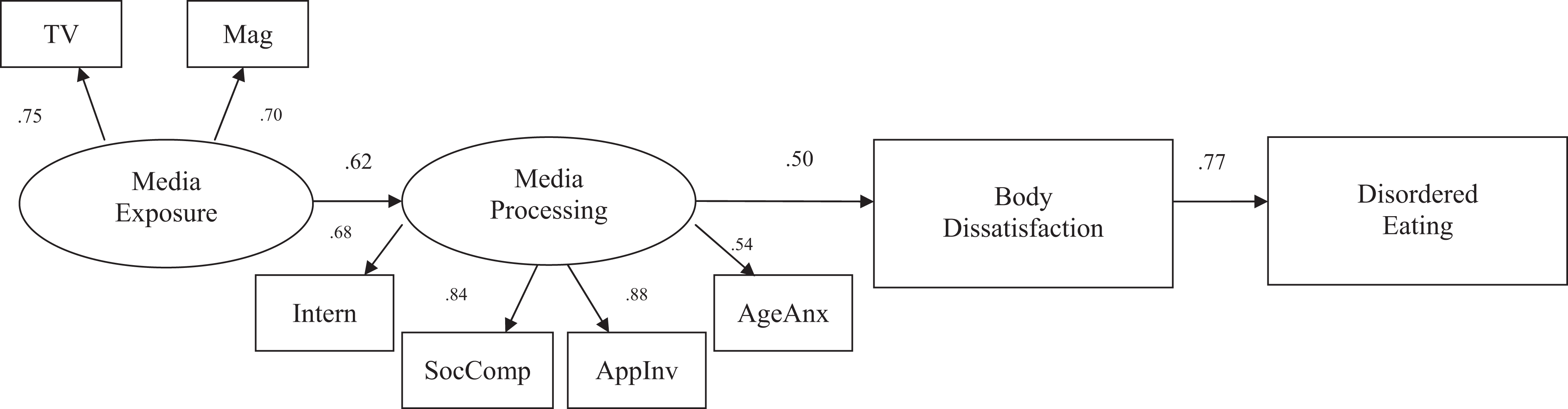
Factor loadings and path coefficients for the final structural model. TV = television exposure; Mag = magazine exposure; Intern = internalization; SocComp = social comparison; AppInv = appearance investment; AgeAnx = aging anxiety
In order to determine whether the media processing variable fully mediated the influence of media exposure on body dissatisfaction, following the procedure outlined by Holmbeck (1997), the model was re-estimated with the direct pathway included, that is, not constrained to be zero as in the initial model. Mediation is indicated when the addition of the direct path to the constrained model does not significantly improve the fit. In other words, the direct pathway is nonsignificant when the mediator is taken into account. Here the inclusion of the direct pathway between media exposure and body dissatisfaction did not significantly improve the fit of the model, χ2 (1) = 1.36, p = .24, indicating no direct influence. Thus, the link between media exposure and body dissatisfaction is indirect, in accordance with the hypothesized model.
Discussion
Despite a growing body of evidence to suggest that disordered eating is prevalent among middle-aged women (Peat et al., 2008), little is known about the specific contributing factors. The primary aim of the present research was to investigate the role of media exposure. We found that media exposure (especially television) was positively correlated with disordered eating as well as body dissatisfaction. The second aim of our study was to test a sociocultural model of disordered eating based on the theoretical framework provided by the tripartite influence model (Shroff & Thompson, 2006). The model provided a reasonably good fit to the data, suggesting that sociocultural theory can be extended beyond traditional undergraduate women to middle-aged women. In accordance with the predicted model, media exposure was not associated with body dissatisfaction directly, but rather via a number of mediating cognitive processes, specifically thin-ideal internalization, social comparison, appearance investment, and aging anxiety.
The major contribution of our study is its confirmation of a link between actual media use and both body dissatisfaction and disordered eating. This is an important finding because it suggests that middle-aged women may indeed be vulnerable to the negative effects of media so well-documented in younger women (see Grabe et al., 2008, for a review). In fact, the media may be a particularly strong sociocultural influence in women of this age group, given their natural deviation from the thin and youthful standards of beauty promulgated in media content (Saucier, 2004). The relevance of media to midlife body image was further supported by our qualitative data, with media figures (especially actresses) overwhelmingly nominated as body image role models. Interestingly, of the media figures nominated, the majority were middle-aged. Although age-appropriate, these famous women sport ultra-thin bodies that rival those of their younger counterparts. Thus, they send a powerful yet unrealistic message that a thin body is idealised, achievable, and, most importantly, expected during midlife (Bordo, 2003). Failure to measure up to this new “normative” midlife physique may be particularly detrimental to everyday middle-aged women, a hypothesis that could be examined in future research. Future research might also attempt to address a limitation of our study in that our use of an open-ended response format for reporting of body image role models may have cued nomination of media figures (rather than family or friends) due to their perceived greater familiarity to the unfamiliar researcher.
Interestingly, of the two media variables examined, only television viewing (not magazine reading) was individually significantly associated with body dissatisfaction and disordered eating. This finding is in contrast to that typically found with undergraduate women, for whom magazine exposure is generally more detrimental (Levine & Murnen, 2009). Although requiring verification in additional middle-aged samples, there are good reasons to suspect that television may be a more potent influence on middle-aged women. From a social comparison perspective (Tiggemann & Polivy, 2010), the marked overrepresentation of youthful women in magazine content (Bessenoff & Del Priore, 2007) may render it a less relevant source of beauty ideals than television content in which middle-aged women appear to be well represented (e.g., commercials, movies, comedy dramas, soap operas, and video clips). In addition, reality makeover shows, which appear heavily geared towards middle-aged women, have emerged recently on our television screens. Two prominent reality programs, The Biggest Loser and Extreme Makeover, present narratives of average people (commonly middle-aged women) attempting to achieve the “perfect” face and body via extensive cosmetic surgical procedures along with stringent dietary and exercise routines. The “authentic” nature of these programs may render their two key messages particularly persuasive: (a) average is a deficiency that must be improved and (b) a transformation of the physical will result in an all round “better you” (Banet-Weiser & Portwood-Stacer, 2006).
Both television viewing and magazine reading were related to internalization and social comparison, which in turn were both related to body dissatisfaction and disordered eating. Body dissatisfaction was also highly correlated with disordered eating, which confirms previous research with middle-aged samples (Lewis & Cachelin, 2001; Marcus et al., 2007; Midlarsky & Nitzburg, 2008). Thus, all of these individual relationships posited in the tripartite influence model (Shroff & Thompson, 2006) appear to hold for middle-aged women. The strong association found between media exposure and social comparison has important theoretical implications because it appears to contradict the notion that older women shy away from media-based body comparisons. Furthermore, social comparison was more strongly related to both body dissatisfaction and disordered eating than was internalization, suggesting that it may be a particularly detrimental process. Given this finding, future researchers might usefully explore the precise nature of media-based comparison in middle-aged women, including the preferred age of media-comparison targets.
Our contention that appearance investment and aging anxiety are additional factors of relevance to middle-aged women was also supported. Both were positively related to body dissatisfaction and disordered eating, in line with previous research with samples of (or including) middle-aged women (Gupta & Schork, 1993; Lewis & Cachelin, 2001; Midlarsky & Nitzburg, 2008). Thus, both variables should continue to be included in further research of these issues. The relevance of aging anxiety highlights the difficulties in attempting to generalise research findings from those of undergraduate samples. It seems that middle-aged women may engage in maladaptive eating not just to achieve a thin body but also to appear more youthful, a factor likely to be of little relevance to younger women.
The present findings suggest that the media may be an important source of both appearance investment and aging anxiety during midlife. The relationship between media exposure and appearance investment is not surprising given the media-driven link between thinness and numerous interpersonal and emotional benefits (Tiggemann, 2005). Although purely speculative, the equation of appearance with self-worth may also be encouraged by the private lives of middle-aged female celebrities, a source of constant media fodder. Celebrities, such as Angelina Jolie, appear to “prove” that thinness in midlife bestows many real-life benefits (e.g., sexual desirability, happiness, and wealth) that may be particularly persuasive. Furthermore, these famous women’s apparent defiance of the aging process may promote a fear of aging in everyday women. When combined with the media’s worship of youthful beauty and barrage of “anti-aging” advertisements and television programs (e.g., Extreme Makeover), they send a powerful message that female aging is a deficiency that requires amelioration (Saucier, 2004).
The second aim of the present study was to test our proposed sociocultural model based on the tripartite influence model (Shroff & Thompson, 2006). We found that the model achieved a reasonably good fit to the data, suggesting that sociocultural theory provides a useful framework for understanding disordered eating in middle-aged women. Importantly, as predicted, we found that the media was not associated with body dissatisfaction in a direct manner but rather via a number of cognitive processes: internalization, social comparison, appearance investment, and aging anxiety. More specifically, watching television and reading magazines appear to influence these cognitive structures, which in turn are associated with poor body image. An important practical implication of this finding is that strategies aimed at challenging and minimizing these processes may reduce some of the negative impact of media exposure in middle-aged women.
The results of the present study should be interpreted in the context of a number of limitations, including the homogeneity of the sample. Most of the women in this study were White, married, mothers, and of medium socio-economic status. Some cross-cultural research (Wildes, Emery, & Simons, 2001) has identified higher rates of body dissatisfaction and disordered eating among White women, as well as a heightened vulnerability to sociocultural risk factors (Abrams & Stormer, 2002; Jefferson & Stake, 2009; McKnight Risk Factor Study, 2000; Sabik, Cole, & Ward, 2010). Nevertheless, these findings are far from conclusive. Other studies have found that sociocultural risk factors impact ethnic groups equally (Shaw, Ramirez, Trost, Randall, & Stice, 2004) and that rates of disordered eating are on par, or in fact greater, in ethnic minorities and non-Western samples (Podar & Allik, 2009; Shaw et al., 2004). Our results are also limited to the particular BMI characteristics of the sample, with the largest group of women falling within the “normal” weight range. It is possible, for example, that women in this weight range are more likely to engage in media-based comparisons than heavier women, for whom the thin ideal may be considered largely beyond reach. Future research may usefully examine the impact of media on middle-aged women of varying body shapes and sizes.
In addition to investigating more diverse physical and cultural groups, future studies may also usefully explore whether lesbian identity serves as a protective factor against disordered eating and its associated risk factors during midlife. This pattern has been found to be the case in younger lesbians (Kozee & Tylka, 2006), as well as in two samples that included lesbians of middle-age (Morrison, Morrison, & Sager, 2004; Share & Mintz, 2002). However, to the authors’ knowledge, middle-aged lesbians have yet to be the specific target of investigation. Future research might also examine the role of sexist beliefs in specifically middle-aged samples, given the positive association found with endorsement of thin beauty ideals in a general sample of women (Swami et al., 2010).
An additional methodological limitation of the present study was that although Structural Equation Modelling (SEM) can test the strength of causal connections assumed on the basis of a causal model, it is still essentially a correlational technique. For example, although the media may indeed induce social comparison, it is also possible that those with this tendency are driven to seek out particular appearance-related media, perhaps for the purpose of self-evaluation. Only experimental and longitudinal studies can provide greater clarification regarding the temporal sequencing of these variables.
In conclusion, the present study extends research in the important area of body image and disordered eating in middle-aged women. We confirmed that sociocultural theory provides a very useful framework. More specifically, we demonstrated that exposure to thin idealised images in media content may have an adverse impact on body image and eating practices in midlife, providing an important platform for further research. If future studies verify our findings, programs that aim to foster a critical and sophisticated understanding of media images and messages may benefit this midlife population of women. We additionally established that the association between media and body dissatisfaction is not direct but rather mediated by a number of underlying cognitive processes, which may provide further targets for treatment and intervention. More specifically, strategies that decrease social comparison with media figures, encourage the adoption of realistic beauty ideals, challenge the central importance and meaning of appearance, and foster acceptance of age-related changes may reduce the negative impact of media exposure in middle-aged women.
Footnotes
The author(s) declared no potential conflicts of interest with respect to the research, authorship, and/or publication of this article.
The author(s) received no financial support for the research, authorship, and/or publication of this article.