






Abstract
The transition to parenthood has been linked to an increase in traditional attitudes and behaviors. The goal of our study was to determine whether feminist mothers differed from feminist non-mothers on attitudes and behaviors related to motherhood. Self-labeled feminist mothers (n = 344) and non-mothers who indicated that they wished to have children (n = 361; anticipated mothers) were asked about their feminist beliefs, their actual or expected division of labor after they had children, and actual or expected child surname choices. Results indicated that liberal feminist beliefs were higher among anticipated mothers. Liberal feminist beliefs with a focus on equality in the workplace may not be as salient to mothers. Cultural feminist beliefs, however, were higher among actual mothers. Cultural feminism, which focuses on valuing care, communal traits, and the role of women as mothers, may be particularly appealing to mothers. Additionally, feminist anticipated mothers expected a more egalitarian division of labor than feminist mothers actually experienced. Finally, feminist anticipated mothers expected to make significantly more nontraditional name choices for their children than feminist mothers actually made. Feminist women may experience social pressures that are unanticipated by women who are not yet mothers. The impact of cultural feminism on feminist motherhood is also discussed.
Keywords
Transitions, especially to parenthood as well as to marriage, have been linked to an increase in attitudes and behaviors associated with traditional gender roles. One study found that parents, particularly first-time parents and women, experienced an increase in endorsement of traditional gender roles after the birth of a child (Katz-Wise, Priess, & Hyde, 2010). In experienced parents, the addition of children to the family resulted in a smaller degree of change in beliefs and behavior, but the trend toward traditionalism continued with each additional child. Other research has pointed to marriage as a trigger for a change to more traditional attitudes and behaviors. One study found that as women became involved in committed relationships and marriage, their career aspirations often changed to include a stronger preference for part-time, as opposed to full-time, employment (Johnstone, Lucke, & Lee, 2011). This shift was not linked solely to marriage itself but also extended to the actual or anticipated addition of children. Combining the influence of marriage with having children, a cross-sectional study that content analyzed women’s blog posts about surname choices for their children noted that considerably more women planned to use a nonpatriarchal surname (i.e., not solely giving the child the father’s surname) than was true of women who already had children (Nugent, 2010).
The pattern wherein mothers have more traditional gender roles than non-mothers has typically been investigated in general samples. Feminist women may be particularly concerned with maintaining egalitarianism in both attitudes and behavior during these life transitions. Self-labeling as a feminist has rarely been examined in this context, although feminist attitudes in general are commonly studied. Research has suggested that, among undergraduate women, being in the later stages of feminist identity development (Downing & Roush, 1985), which may or may not include self-labeling as a feminist, was related to more egalitarian expectations for long-term committed relationships (Yoder, Perry, & Saal, 2007). These dimensions included division of labor, expectations for education and employment, and beliefs about power and authority within the relationship. Other research has suggested that among married couples, a more egalitarian division of household labor and child care was associated with holding more liberal gender attitudes (Deutsch, Lussier, & Servis, 1993; Kroska, 2004; Stevens, Minnotte, Mannon, & Kiger, 2006). Additionally, liberal gender attitudes have been linked to expectations for a more egalitarian division of child care among college students (Askari, Liss, Erchull, Staebell, & Axelson, 2010) and to using less traditional surname choices when women marry (Hoffnung, 2006; Twenge, 1997).
Because liberal gender attitudes have been found to be related to more egalitarian attitudes and behaviors, the trend toward traditional and conservative beliefs and behaviors associated with the life transitions of marriage and parenthood may not be present among self-labeled feminist women. Although liberal gender attitudes are strongly associated with holding a feminist identity (Liss, O’Connor, Morosky, & Crawford, 2001; Nelson et al., 2008), self-labeling as a feminist has been shown to be uniquely predictive of certain feminist behaviors above and beyond feminist beliefs (Yoder, Tobias, & Snell, 2011). The goal of the current investigation was to better understand whether cross-sectional samples of self-labeled feminist mothers and feminist women who were not yet mothers but anticipated having children in the future (anticipated mothers) were, in fact, different in terms of both beliefs and behaviors.
Given that we were interested in studying self-labeled feminist women, we choose to look specifically at different feminist beliefs, rather than more general liberal gender attitudes that would likely have less variability among self-labeled feminists. Feminism is not a single strain of thought but encompasses a variety of perspectives. A self-labeled feminist may identify with one or more types of feminism, and one’s endorsement of specific types of feminism may change based on life experiences, including the transition to parenthood.
Henley and her colleagues identified and operationalized five different feminist perspectives: (a) liberal feminism, which focuses on equality between the sexes; (b) radical feminism, which sees sexism as the most fundamental form of oppression and concentrates specifically on the oppression of women by men; (c) socialist feminism, which acknowledges the mutuality of sexism and classism; (d) cultural feminism, which focuses on revaluing and celebrating traditionally feminine traits; and (d) women of color feminism (or womanism), which acknowledges the intersectionality of gender and racial oppression (Henley, Meng, O’Brien, McCarthy, & Sockloskie, 1998). Although large attitudinal differences between actual and anticipated feminist mothers might not be expected, small differences might be because of a change in perspective that may accompany motherhood.
Although there might be small attitudinal differences between feminist mothers and anticipated mothers, we may expect larger differences in regards to behaviors. Unlike attitudes, what one actually does may be more strongly influenced by outside forces such as one’s partner, other family members, the broader community, and social expectations about the role of the mother. Data have documented that the division of labor tends to become more traditional after the transition to parenthood (Coltrane, 2000; Dew & Wilcox, 2011). At the same time, liberal attitudes have been shown to predict a more egalitarian division of labor (Deutsch et al., 1993; Kroska, 2004; Stevens et al., 2006). Furthermore, books attempting to define and describe what it means to be a feminist mother have pointed to a more equal division of child care as one component of feminist motherhood (Gordon, 1990; O’Reilly, 2008). Given this, it is unclear whether feminist women would have either an equal or egalitarian (e.g., neither member doing more than 60%; Ferree, 1991) division of child care. It could also be that the division of child care experienced by feminist mothers would be similar to that experienced by more general samples. Studies have found differing rates of child care performed by mothers, but the rates generally exceed the 60% ceiling necessary to meet the definition of an egalitarian division of labor. For example, 64% of the child care was performed by the mother among a sample of high socioeconomic status (SES) women with egalitarian attitudes (Claffey & Mickelson, 2009), and 75% of the child care was performed by mothers in a more general sample (Kroska, 2003). Feminist women who do not have children may anticipate a more egalitarian division of child care, but it is not clear whether feminist women with children will actually achieve it.
Another behavior where feminist mothers may make more traditional decisions than feminist women anticipating motherhood expect to make is marital and child surname choice. These choices are concrete behaviors where one’s feminist ideals may be positioned against social demands and expectations of one’s spouse. The traditional choice is to adopt the husband’s name as a surname after one gets married and to give children their father’s surname. These decisions are important because these choices are part of the patriarchal system where women’s genealogical identity is erased and the assumption is that men are the only members of the family who can legitimately carry on family lineage and tradition (Nugent, 2010). Research on predictors of nontraditional marital name choices have consistently found that higher education (Gooding & Krieder, 2010) and liberal and feminist gender attitudes (Hoffnung, 2006; Twenge, 1997) are related to less traditional name choices.
There is considerably less research on children’s surnames—the variable of interest in the current study. One previous study found that, in a sample of women who kept their own surname, the vast majority gave their children their husband’s surname (Johnson & Scheuble, 2002). When the women in this study did give their children their own surname, it was most frequently as a middle name. Another study by Nugent (2010) content analyzed online discussions women had about child surname choices and revealed that women felt a multitude of pressures to give their children their spouse’s name. Women in Nugent’s study felt this decision resulted in many dilemmas about balancing the needs of the self versus the needs of the child, spouse, and the immediate and extended family. However, her study also found that some women were able to resist social pressures and arrive at a nontraditional surname choice for their children (e.g., alternating surnames for children, dual surnames, and the mother’s surname). Feminist women who have not yet confronted child surname choices may underestimate the extent to which they will encounter social pressures favoring traditional name choices. Therefore, a larger percentage of feminist non-mothers may report desiring nontraditional surname choices as compared to the percentage of feminist mothers who actually make nontraditional surname choices for their children.
Our study investigated feminist beliefs and actual and expected behaviors in a cross-sectional sample of self-labeled feminist mothers and anticipated mothers. We believed that there would be small differences in beliefs between actual and anticipated mothers. We also examined actual and expected division of child care among mothers and anticipated mothers, respectively. We hypothesized that mothers would actually do a larger proportion of child care than was expected by anticipated mothers. We also hypothesized that anticipated mothers would expect a division of labor that was egalitarian (i.e., no more than 60%). We had no specific hypothesis about whether the actual division of child care reported by mothers would be egalitarian. Finally, we investigated actual and anticipated child surname choices among feminist women with and without children. We hypothesized that mothers would be less likely to give their children nontraditional surname choices than was expected by anticipated mothers. Additionally, we believed this pattern would hold when looking only at married women who chose to retain their surname upon marriage.
Method
Participants
Self-labeled heterosexual, feminist women were recruited as part of a multistudy data collection, which included nonheterosexual and nonfeminist participants. The purpose of this data collection was to better understand the relationship between feminism and mothering. Other data from this data collection, which also included nonfeminists, has been published elsewhere (Liss & Erchull, 2012); all participants included in the prior investigation were not included in the current study. Both feminist mothers and feminist women without children were specifically recruited. In order to better compare these groups, only feminist non-mothers who reported that they wanted to have children were included in our sample and are thus referred to as “anticipated mothers.” All sampled feminist anticipated mothers were between the ages of 18 and 40, so only feminist mothers who fell within this age range were included in the analyses. This screening resulted in a sample of 705 women of whom 344 (49%) were mothers and 361 (51%) were anticipated mothers.
Demographic characteristics for both actual and anticipated mothers are detailed in Table 1. On average, participants were 29.32 years old (SD = 5.81); actual mothers were significantly older than were anticipated mothers, t(703) = −21.28, p < .001. Thus, we used age as a covariate in group comparisons. The sample was highly educated, and actual mothers reported having completed significantly more education than did anticipated mothers, t(703) = −4.06, p < .001. The majority of the participants self-labeled as middle or upper-middle class. There were no significant differences between actual and anticipated mothers on this variable, t(702) = −.76, p = .45. The majority of the sample self-labeled as White/Caucasian. When percentages of White versus non-White respondents were compared across groups, there was no difference between actual and anticipated mothers, χ2(1) = .47, p = .49. All the mothers included in our study were married and cohabiting with their partner. Given that one goal of our study was to compare actual division of child care among mothers to the expected division of child care of anticipated mothers, including mothers who were not cohabiting with a partner would have unnecessarily inflated the amount of child care done by mothers. Thus, when comparing married versus nonmarried participants, mothers were significantly more likely to be married than were anticipated mothers, χ2(1) = 387.75, p < .001.
Demographic Characteristics by Group

Note. Groups with different subscripts were significantly different at p < .05.
Procedure and Measures
Participants completed an online survey after being recruited from a number of online sources. Numerous websites and blogs targeting feminists were specifically used as recruitment sources. E-mails were sent to the moderators of these web pages asking them to post a brief description of the research and a link to the survey on their site. The study was described as being on “attitudes about mothering.” The informed consent page for the survey more specifically described the research as looking at “the relationship between mothering and feminism.” Participants were also recruited via postings on more general blogs, Craigslist (a public forum for posting want ads and requests), and Facebook (a popular social networking site). All recruitment messages also encouraged people to share the survey link widely, resulting in some snowball sampling.
Demographics
Participants were asked to provide information about their age, race, sexual orientation, education level, SES, and relationship status. Participants were also asked whether they had children, and if not, whether they wanted to have children. Finally, feminist self-labeling was assessed using a yes–no question. Only women who answered “yes” to the question “Do you consider yourself to be a feminist” were included in our study.
Feminist beliefs
Five types of feminist beliefs were assessed. The 36-item short form of the Feminist Perspectives Scale (FPS) was used to assess four of these beliefs (Henley, Spalding, & Kosta, 2000) on a scale ranging from 1 (disagree strongly) to 7 (agree strongly). These beliefs included radical feminism (e.g., “Men’s control over women forces them to be the primary caretakers of children”), socialist feminism (e.g., “Capitalism forces most women to wear feminine clothes to keep a job”), cultural feminism (e.g., “Women's experience in life's realities of cleaning, feeding people, caring for babies, etc. makes their vision of reality clearer than men's”), and women of color feminism (or womanism; e.g., “Racism and sexism make double the oppression for women of color in the work environment”).
Given that the liberal feminist subscale of the FPS has been found to have unacceptably low internal consistency reliability (Henley et al., 1998), we included the 11-item short form of the Liberal Feminist Attitude and Ideology Scale (LFAIS; Morgan, 1996) to assess liberal feminist beliefs (e.g., “A woman should have the same job opportunities as a man”) on a scale ranging from 1 (strongly disagree) to 6 (strongly agree). Cronbach’s αs from the original investigation of the short form of the FPS were .73, .59, .57, and .73 for the radical, socialist, cultural, and woman of color feminist perspectives, respectively; in the current investigation, these αs were .73, .71, .66, and .79, respectively. The Cronbach’s α for the short form of the LFAIS from the original investigation was .81, and it was .75 in the current study.
Child care participation
Child care chore participation was assessed using a list of seven child care chores that has been used in previous research (Askari et al., 2010; Erchull, Liss, Axelson, Staebell, & Askari, 2010). These chores included feeding children, bathing children, diapering children, arranging for child care or babysitting, responding to children crying in the middle of the night, caring for sick children, and chauffeuring children. Participants were asked to consider only the proportion of the chores completed by either themselves or their partner, ignoring contributions from other family members or paid labor, so that participation estimates would sum to 100% across each participant and her partner. Mothers were instructed to indicate the percentage of chores they did (or had done); anticipated mothers were asked to indicate the division of labor they expected to have after they had children. An average child care participation score was calculated. Prior research with this scale has looked only at expected chore participation among nonparents, and the Cronbach’s α from one of the original investigations was .92 (Erchull et al., 2010). In the present study, the αs were .83 for the entire sample, .78 for actual mothers, and .84 for anticipated mothers.
Name choice
Participants who already had children were asked what surname they gave to their child. Choices included: my spouse’s name, my name, hyphenated my name and my spouse’s name, gave my name as a middle name, and an open-ended “other.” After data were collected, the open-ended responses were explored, and new categories were developed. The final categories were father’s name, mother’s name, hyphenated name, mother’s name as middle name, new last name shared by the parents, a double last name (two legal last names with no hyphen between them), alternating children, and an “other” category for choices that could not be readily categorized. These two “other” responses were not included in analyses. Participants who had not yet had children were provided with the same original options but were asked about their plan for their desired children. Responses were recoded into the revised categories delineated above.
Married participants were also asked about their own surname choice. Original response options included: took my spouse’s name, kept my own last name for all purposes, use my name professionally and my spouse’s name socially, hyphenated my name to have both last names, use my own name as a middle name, and an open-ended “other” choice. As described above, the recoded options were developed as a result of analyzing open-ended responses. The final category list consisted of spouse’s name, own name, situational name use, hyphenated name, own name as middle name, retained a last name from a prior marriage, double last name, created a new shared last name, and a category of one “other” responses that was not included in analyses.
Results
Intercorrelations among the continuous variables are provided for both actual and anticipated mothers in Table 2. For mothers, all feminist beliefs were positively intercorrelated, and participation in child care chores was not significantly related to any feminist belief. For anticipated mothers, all feminist beliefs positively intercorrelated except for the relationship between cultural feminism and women of color feminism. Expected participation in child care chores was positively correlated with cultural feminist beliefs and negatively correlated with radical and women of color feminist beliefs. Given the degree of interrelationship among these variables, multivariate analysis of variance was deemed appropriate.
Bivariate Correlations for Continuous Variables for Actual and Anticipated Mothers
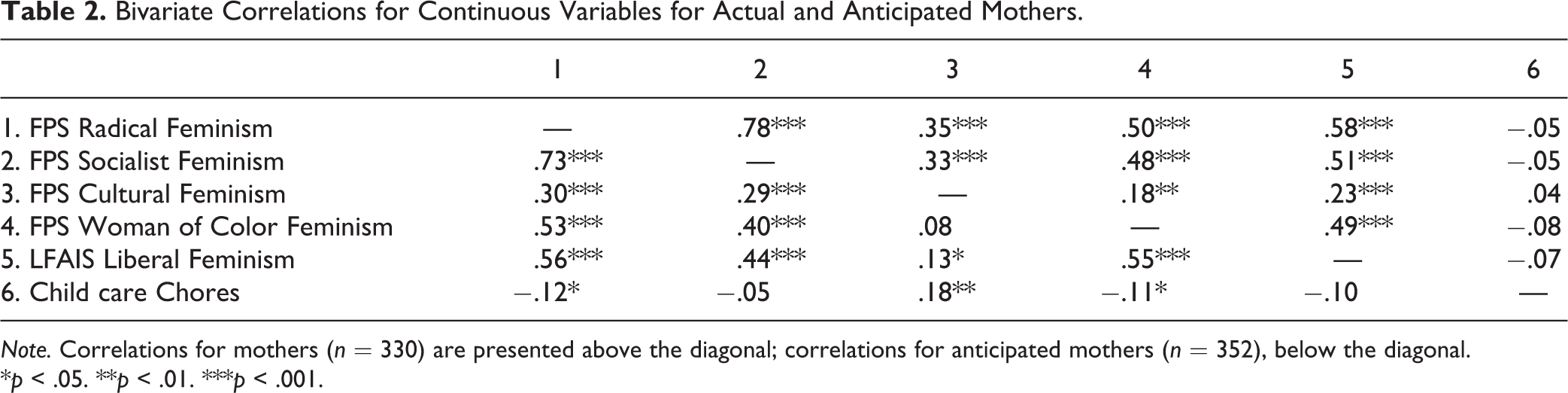
Note. Correlations for mothers (n = 330) are presented above the diagonal; correlations for anticipated mothers (n = 352), below the diagonal.
*p < .05. **p < .01. ***p < .001.
In order to determine whether actual and anticipated feminist mothers differed in their beliefs and behaviors, we ran a multivariate analysis of covariance (MANCOVA) in which motherhood status was the independent variable, the five feminist belief variables and child care chore participation were the dependent variables, and age was a covariate. The MANCOVA was significant, F(6,674) = 10.91, p < .001, η p 2 = .09, indicating that, overall, actual and anticipated mothers differed from each other. Examination of the univariate analyses of covariance indicated that the groups were significantly different on three of the variables (see Table 3 for means, standard deviations, and univariate F-test results). Mothers scored lower than anticipated mothers on liberal feminism. Mothers scored higher than anticipated mothers on cultural feminism and also completed significantly more child care chores than anticipated mothers expected to complete. Mothers reported completing approximately 67% of the child care chores, a number that fell outside the standards of an egalitarian division of labor (more than 60%) as defined by Ferree (1991). Anticipated mothers expected to complete approximately 57% of child care chores, a number that does not represent strict equality but does fall within the bounds of egalitarian chore participation (Ferree, 1991).
Univariate Comparisons of Actual and Anticipated Mothers
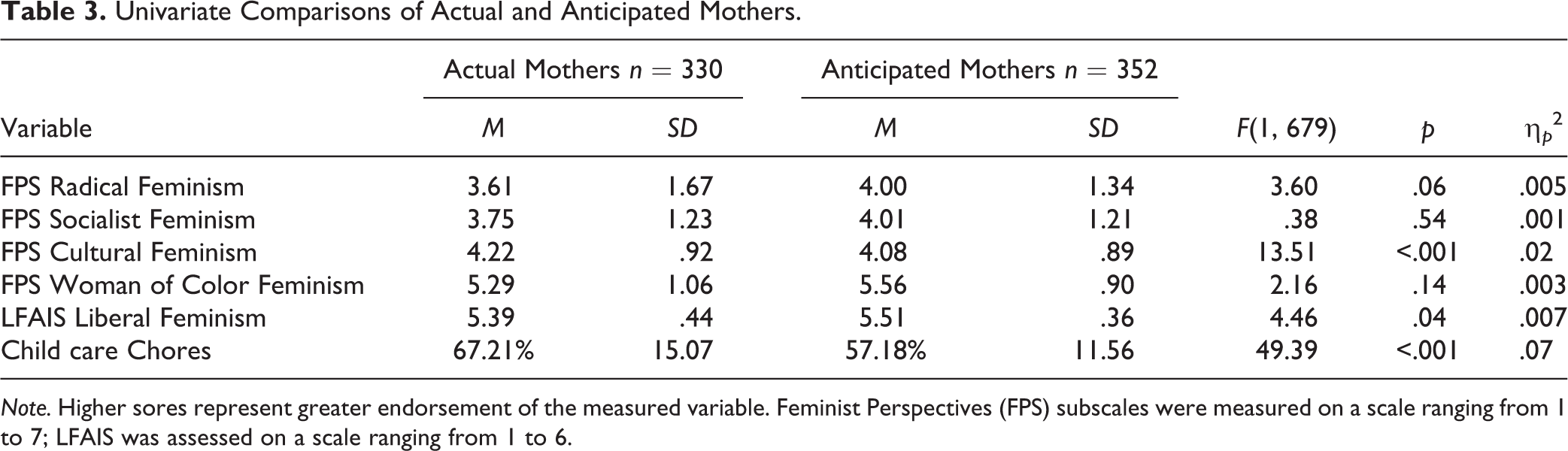
Note. Higher sores represent greater endorsement of the measured variable. Feminist Perspectives (FPS) subscales were measured on a scale ranging from 1 to 7; LFAIS was assessed on a scale ranging from 1 to 6.
Actual and expected child surname choices for mothers and anticipated mothers were compared (see Table 4). The pattern indicated that there was a difference between what mothers actually did and what anticipated mothers expected to do. For example, 75% of mothers gave their children their father’s last name whereas only 45% of anticipated mothers expected that they would do so. Additionally, whereas only 8% of mothers hyphenated their child’s surname, 27% of anticipated mothers expected to do so.
Child Surname Choices for Actual and Anticipated Mothers
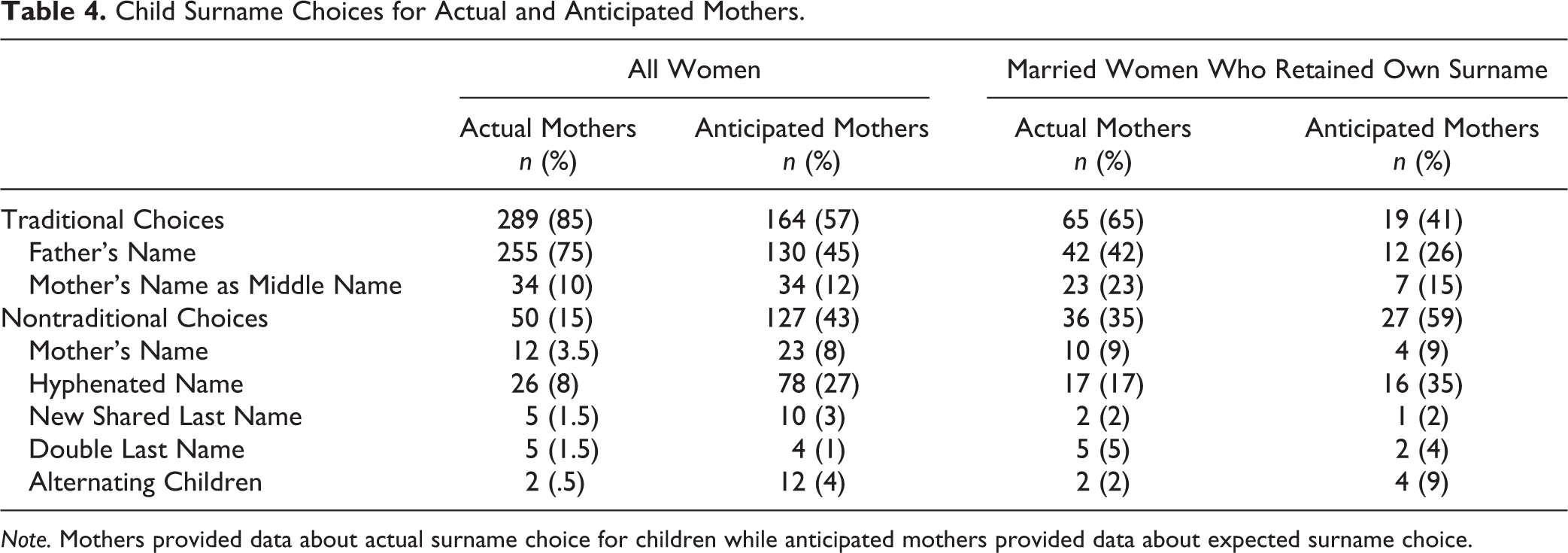
Note. Mothers provided data about actual surname choice for children while anticipated mothers provided data about expected surname choice.
In order to simplify the data for ease of interpretation, child surname data were collapsed to two categories. We looked at the use of father’s name as surname compared to the use of other, less traditional surname choices. Father’s surname included those who indicated that the mother’s surname was given to children as a middle name because children who have this name pattern still have their father’s last name as their one and only surname. The less traditional surname options included hyphenated names, double last names, a new shared last name, the mother’s last name, and alternating names for alternating children.
This collapsed variable was then used as a dependent variable in a hierarchical logistic regression so that we could control for age differences between mothers (coded as 1) and anticipated mothers (coded as 0). Age was entered in the first step, and it did significantly predict surname choice, B = −.10, Wald = 35.54, p < .001, χ2(1) = 38.15, p < .001, Cox and Snell R 2 = .06, Nagelkerke R 2 = .09. When motherhood status was entered into the equation, the overall model remained significant, χ2(2) = 68.29, p < .001, Cox and Snell R 2 = .10, Nagelkerke R 2 = .15, and the model was significantly improved, χ2 Δ(1) = 30.14, p < .001. In this final model, age was no longer a significant predictor, B = −.03, Wald = 2.36, p = .13, but motherhood status was, B = −1.28, Wald = 28.82, p < .001. Above and beyond age, mothers were more likely to select a traditional surname for their children than was expected by anticipated mothers.
Given that a majority of women change their surname upon marriage (Hoffnung, 2006; Johnson & Scheuble, 1995), we were specifically interested in child surname choice among those women who did not change their names. All married women who completed the survey provided information about their own surname choice, so these analyses included all the mothers and the 103 (28.5%) anticipated mothers who were married. Of these women, 30% of the mothers kept their own name at marriage and 51% of the anticipated mothers did so. This represented a significant difference χ2(1, N = 445) = 15.68, p < .001.
Data about actual and expected child surname choice for married actual and anticipated mothers who retained their own surname upon marriage are presented in Table 4. The most common choice among mothers was to give the child their father’s last name, followed by giving the child their name as a middle name, a choice that still involves giving the child the father’s last name. For anticipated mothers, hyphenating their child’s last name was the most popular expected choice followed by giving their child the father’s last name.
Following the pattern of the collapsed analysis above, we ran a hierarchical logistic regression comparing the actual and expected child surname choices of mothers and anticipated mothers who retained their own surname upon marriage, controlling for age. The same simplified categories were used; giving the child the father’s last name (including giving the mother’s name as a middle name) was compared to all other less traditional categories. Age was entered in the first step, but it did not significantly predict surname choice in this analysis, B = −.07, Wald = 3.31, p = .07, χ2(1) = 3.39, p = .07, Cox and Snell R 2 = .02, Nagelkerke R 2 = .03. When motherhood status was entered into the equation, the overall model became significant, χ2(2) = 7.32, p = .03, Cox and Snell R 2 = .05, Nagelkerke R 2 = .07, and the model was significantly improved, χ2 Δ(1) = 3.94, p = .047. In this final model, age was not a significant predictor, B = −.03, Wald = .49, p = .48, but motherhood status was B = −.81, Wald = 3.88, p = .049. Again, controlling for the effects of age, mothers who retained their own surnames after marriage were more likely to give their children their father’s surname than was expected by anticipated mothers.
Discussion
The goals of the current study were to compare the beliefs, experiences, and expectations of self-labeled feminist women who had, or wanted but did not yet have, children. Given that previous research has indicated that women may become more traditional after becoming parents (Katz-Wise et al., 2010), we were interested in seeing whether differences consistent with this pattern would be observed among self-labeled feminist women. Feminists are likely particularly concerned about issues related to traditional gender roles and may actively seek to resist patriarchal norms.
We investigated differences in both beliefs and behaviors in a cross-sectional sample of feminist women who had children and those who did not have children but indicated that they desired to be parents. Because ours was a cross-sectional study, it was impossible to determine whether or not the differences seen reflected actual changes in beliefs or behaviors when one has children. However, our data found small differences in attitudes between actual and anticipated feminist mothers and larger differences in behaviors such that feminist mothers made considerably more traditional choices than was expected by feminist women who did not yet have children.
We found small but statistically significant differences for two of the five different feminist beliefs assessed: liberal and cultural feminist beliefs. Mothers scored higher on cultural feminism whereas anticipated mothers scored higher on liberal feminism. There were no significant differences for any of the other belief variables. The items on the LFAIS are largely focused on issues of equality in the workplace, the ability of women as leaders, and an awareness that men and women are not treated equally. Issues of workplace equality and leadership may be less central to mothers who are focused on a role that is specific to women (the role of being a mother). Although mothers may be more likely to support some aspects of social change for equality, such as family friendly work environments and increased access to high-quality child care, those issues are not specifically addressed in the LFAIS. It should also be noted that there was a similar difference on the measure of radical feminism although it failed to meet traditional standards for statistical significance.
The difference in cultural feminist beliefs may be related to the fact that it is a belief system that endorses women’s role as mothers and is, thus, complementary to motherhood. Cultural feminist beliefs involve embracing and valuing traditionally feminine experiences, such as mothering, and more communal traits, such as care and compassion (Hewett, 2008). Some feminist theorists have specifically linked cultural feminism to particular parenting practices that may be appealing to feminists. Specifically, attachment parenting (Sears & Sears, 2003), which includes breastfeeding on demand, co-sleeping, and carrying one’s child often as a way to form close bonds with one’s child, has been called “cultural feminist theory in practice” (Bobel, 2008, p. 116) and has been promoted as a specifically feminist way to parent (Etelson, 2007). Furthermore, Friedman (2008) noted that attachment parenting was of particular interest to feminist women, and data have shown that self-labeled feminist mothers were more likely to endorse practices associated with attachment parenting than were nonfeminist mothers (Liss & Erchull, 2012). It is important to note that the effect sizes for both the significant and the nonsignificant differences between actual and anticipated mothers on the feminist belief variables were all very small. Given this, it is particularly important to look at differences between actual and expected behaviors that may show greater effects.
Our next hypothesis involved the actual and expected division of child care of feminist identified mothers and feminists who were not yet mothers but anticipated having children in the future. We hypothesized that feminist anticipated mothers would expect an egalitarian division of labor, and this hypothesis was supported. We also hypothesized that feminist mothers would participate in a greater proportion of the child care than was expected by feminist anticipated mothers. This hypothesis was also supported. It should be noted, however, that our data do not provide a direct comparison about chore participation. Actual mothers provided data about what actually happened in their families. Anticipated mothers, on the other hand, provided data about what they expected to happen in the future.
Although we did not have a specific hypothesis as to whether feminist mothers would actually report an egalitarian division of child care, the feminist mothers in our sample, all of whom were married, reported completing an average of 67% of the child care. This number fell outside the range of egalitarianism (of less than 60% as defined by Ferree, 1991) and was fully and significantly 10 percentage points higher than the division of labor expected by anticipated mothers. It should be noted that the mothers in our sample, all of whom self-labeled as feminist, indicated that they did a smaller percentage of child care than has been found in more general samples where mothers reported completing approximately 75% of the child care (Kroska, 2003).
Some feminist writers have suggested that that one aspect of being a feminist mother involves an equal sharing of parenting (O’Reilly, 2008). However, our data indicated that this is not happening. In fact, the women in our sample are not even meeting the more relaxed standard of an egalitarian division of labor. It is likely that the experience of being a mother changes one’s perceptions about what is ideal, expected, and appropriate, as well as changes the context of a woman’s life including others’ expectations for her. We did not ask whether the mothers in our sample felt that their current division of labor was fair; future research may wish to explore this dimension. It is possible that feminist mothers may compare themselves to nonfeminist mothers thereby viewing their relationships as relatively more egalitarian and, thus, their own level participation in child care as fair. On the other hand, research has suggested that women with liberal gender ideologies are more likely to compare themselves to men than to other women and are, thus, more likely to perceive an inequitable division of labor to be unfair (Greenstein, 1996).
The fact that feminist mothers in our sample did considerably more child care than feminist anticipated mothers expected may suggest that once women become mothers, the cultural pressures associated with the ideology of intensive mothering (Hays, 1996) become more salient and difficult to resist. The expectation that women should be highly involved in their children’s lives and that mothers are especially important permeates our cultural understanding of motherhood (Hays, 1996). Some theorists have even suggested that the history of the feminist movement has led feminist women to embrace intensive parenting ideologies (O’Brien Hallstein, 2008). The feminist movement has focused on the individual choice of women to have children in combination with relatively little discussion about how to be a feminist parent (O’Brien Hallstein, 2008). O’Brien Hallstein (2008) suggested that this combination put the nexus of responsibility for child outcomes directly on the mother who chose to involve herself in parenting. Feminist women may also be making active choices to be extremely involved in the parenting of their children because these choices are consistent with an attachment or natural parenting perspective (see Bobel, 2008; Friedman, 2008). Regardless of the causes for the inequity in child care responsibilities, this pattern is not one that feminist women who desired, but did not have, children expected. Although longitudinal research is necessary to better understand the way in which the transition to motherhood impacts women’s beliefs, expectations, and behaviors, the current cross-sectional study lays the groundwork for such research.
Our final hypotheses revolved around women’s actual and expected surname choices for their children. We hypothesized that feminist mothers would make more traditional choices than anticipated mothers expected to make, and we believed this pattern would hold even when looking only at married women who had retained their surname upon marriage. Both of these hypotheses were supported. When looking at the entire sample, 85% of the mothers reported using a patrilineal surname choice whereas only 57% of anticipated mothers expected to do so. Even when looking at just the married women who had retained their own surname, 65% of the mothers chose a patrilineal surname for their child, whereas only 41% of the anticipated mothers expected to do so. Thus, once again, expectations of anticipated mothers did not match the reality of the actual mothers in our sample, and motherhood status was a significant predictor of surname choice even when controlling for the effects of age. Our data are consistent with those from Johnson and Scheuble (2002) who found that, of women who kept their own last name but were not necessarily feminist identified, approximately 75% selected a patrilineal surname for their children. It should be noted that in our sample married anticipated mothers had less traditional choices for their own last name than did married actual mothers. It is possible that some of the married women who were not yet mothers and who retained their own surname may change their surname once children are added to the family.
Research looking at the struggles women go through as they consider possible surnames for their children indicates that the dilemma of what to name one’s child is complex (Nugent, 2010). In a qualitative study of Internet discussions about child surname choice, many of which occurred on feminist-oriented sites, a common theme was that women saw surname choice as relating to a struggle between their own needs and the needs of their child and/or their spouse (Nugent, 2010). Women often felt that it was important to them to maintain a matrilineal history through their child’s surname. At the same time, they felt considerable social pressure to preserve a patrilineal tradition, an issue they felt was important to their male partners. Although some women in the Internet discussions found creative ways to solve these dilemmas (including hyphenating names, selecting a new surname for all members of the family, having a dual surname, and alternating surnames for different children), many other women selected a patrilineal name but felt uncomfortable about it. Our quantitative data are consistent with the discussions Nugent (2010) studied, and our data further suggest that feminist women who are not yet mothers may not be expecting the complexities of, or the pressures associated with, selecting a surname for the children they hope to have.
Although ours is a cross-sectional, rather than longitudinal, study, our data are consistent with longitudinal research that has demonstrated a shift toward traditionalism after the introduction of a child into one’s family (Coltrane, 2000; Dew & Wilcox, 2011). Of course, given the cross-sectional nature of our data, it is impossible to determine whether the differences we detected actually represented a shift toward more traditional choices when feminist mothers had children or whether the differences reflect the different life positions of the two groups that we studied. However, the fact that we covaried age in our analyses does reduce the possibility that we are solely seeing a cohort effect.
The fact that feminist mothers had higher scores on cultural feminism is worth noting because cultural feminism is an ideological position that has been problematized by many feminists (e.g., Alcoff, 1988; Bohan, 1993). It is often characterized as placing value on qualities that are seen as unique to women and part of a more traditional feminine role. Additionally, cultural feminism has been criticized for being essentialist by focusing on differences between men and women as fixed and related to individuals’ biological sex or innate personalities. For example, several items on the FPS cultural feminism subscale (Henley et al., 1998) imply that women are inherently more peaceful, less violent, and more communal than men. Other items reflect the idea that traditional feminine roles (such as being caring, cleaning people, feeding people, and caring for babies) give women a special, and better, way of viewing the world. Feminist writers who critique this ideology note that valuing such traditional feminine roles may result in greater acceptance among women of their subordinate status (Bohan, 1993).
The fact that the feminist mothers in our sample reported doing a disproportionate and non-egalitarian amount of child care and were largely choosing patrilineal surnames for both themselves and their children suggest that they may have embraced a more subordinate role than, at the very least, their younger counterparts who did not yet have children expected. Whether this is a more subordinate role than they would have wished or desired could only be answered with longitudinal research. Nevertheless, a cultural feminist perspective, which values motherhood as a unique role women (and only women) can fulfill, may be a way that feminist mothers reduce the cognitive dissonance (Festinger, 1957) they experience as a result of engaging in behaviors that may be inconsistent with their feminist beliefs. On the other hand, a cultural feminist perspective may, as described above, be an active choice made by feminist women who endorse a natural or attachment parenting perspective (Bobel, 2008; Friedman, 2008). Thus, the high rates may not represent a traditional shift but, rather, an active endorsement of cultural feminist ideologies as a form of empowerment. Nevertheless, both Bobel (2008) and Friedman (2008) problematize these approaches because of the inherent inequality and regressive implications about gender involved in these parenting styles.
Practice Implications
Understanding the changes that feminist women may make as they experience life transitions such as marriage and parenthood will help clinicians and practitioners working with a feminist population. We did not assess how the feminist mothers in our sample felt about their child’s surname choice or about the division of labor in their family. However, data have shown that marital dissatisfaction is linked to violated expectations about the division of labor in the family after the birth of a child (Dew & Wilcox, 2011). These concerns may be enhanced among feminist women who may have placed particular value on equality in their families. How potential inequality about division of household labor affects new feminist mothers’ satisfaction with their role as mothers and with their marriage after childbirth is an avenue for both research and clinical exploration. Furthermore, our data suggest that clinicians would be well served to consider how their feminist clients negotiate decisions about marital and child surname choice and whether these decisions affect marital satisfaction or their sense of personal identity.
Limitations and Suggestions for Future Research
The generalizabilty of our findings should be considered within the context of a number of limitations. First, our sample was recruited online and, thus, represented a subgroup of feminist women who were active on Internet discussion groups and blogs. Additionally, our participants were largely well educated and White. The extent to which our results would generalize to a more diverse sample of self-labeled feminist women is unclear. Our sample of partnered, affluent mothers may have had the financial ability to leave paid employment after the birth of a child, a choice that many women are not able to make. Furthermore, we limited our sample to heterosexual women and to mothers who were married. Thus, marital status may have been a factor in explaining the differences between actual and anticipated mothers. We chose to limit our sample of mothers in this way because the issues experienced by nonheterosexual and nonmarried mothers may be well different. For example, if single mothers were included in our sample, they would have reported doing 100% of the child care, which would have inflated our sample mean for the mothers. By excluding this group, we were better able to compare the expected child care of anticipated mothers (who likely expected parenting within a partnership) to the actual child care done by mothers. We limited our sample to heterosexuals because the division of labor within nonheterosexual couples may well be different than that found within heterosexual couples, perhaps because of a different power dynamic not related to traditional gender role expectations (Goldberg & Perry-Jenkins, 2007). Furthermore, surname choice among lesbians takes on different dimensions, not related to traditions of patriarchy (Clarke, Burns & Burgoyne, 2008). These issues are worth investigating in their own right.
It should also be noted that the goal of our study was to look specifically at feminist women, not to compare feminist and nonfeminist women. It is quite possible that feminist mothers experience a reduced child care burden compared to nonfeminists mothers because liberal ideologies have been linked to a more egalitarian division of labor (Kroska, 2004). Additionally, feminist mothers may well have chosen patrilineal surnames for their children at lower rates than would have been found in a nonfeminist sample. For example, whereas we found 85% of feminist mothers gave their children a patrilineal surname, other research with a general sample of women found that approximately 92% of mothers gave their children patrilineal surnames (Johnson & Scheuble, 2002). Future research may wish to make direct comparisons between self-labeled feminist and nonfeminist women. It would also have been useful to inquire about the extent to which women reported that their husband endorsed feminist beliefs. Furthermore, as previously noted, ours was a cross-sectional study and did not document whether attitudes, beliefs, or behaviors actually change with the addition of children to the family, a question that could only be answered with a longitudinal design.
Conclusion
Our study investigated differences in beliefs and behaviors among self-labeled feminist mothers and feminist women who desired, but did not yet have, children. These anticipated mothers clearly expected greater equality in child care and less traditionalism in child surname choice than was the case of the lived experience of the feminist mothers. The specific factors that may lead to these differences need to be explored in future research, but it is likely that social pressures, as well as the internalization of the ideology of intensive parenting (Hays, 1996), contribute to the process. How feminist women make the transition to motherhood is worth exploring. Do they experience disappointment if their goals of equality are not met? How do changes in beliefs relate to differences between actual and expected behaviors? Do cultural feminist beliefs serve to help women justify inequality and subordinate status as some have suggested (Bohan, 1993) or are feminist women actively adopting cultural feminist ideologies that support specific parenting choices? Our study lays the groundwork for future research on how feminist women make the transition to motherhood and on how being a mother affects feminist women.
Footnotes
Declaration of Conflicting Interests
The author(s) declared no potential conflicts of interest with respect to the research, authorship, and/or publication of this article.
Funding
The author(s) received no financial support for the research, authorship, and/or publication of this article .
References
Supplementary Material
Please find the following supplemental material available below.
For Open Access articles published under a Creative Commons License, all supplemental material carries the same license as the article it is associated with.
For non-Open Access articles published, all supplemental material carries a non-exclusive license, and permission requests for re-use of supplemental material or any part of supplemental material shall be sent directly to the copyright owner as specified in the copyright notice associated with the article.
