






Abstract
One of the most devastating long-term outcomes of childhood maltreatment is a sense of shame, which is connected to distress and reduced well-being. The aim of the current study was to examine a dual-path model and to test the relations between childhood maltreatment, shame, and well-being as mediated by both self-objectification and a sense of disrupted body boundaries among 531 female college/university students living in Israel. Results from the structural equation modeling analyses indicated that both self-objectification and disrupted body boundaries significantly mediated the association between childhood maltreatment and sense of shame. In addition, both were associated with reduced levels of well-being, through the mediating role of shame. Finally, we discuss the role these paths may play in the detrimental long-term effects of childhood maltreatment and how they may be targeted in clinical interventions for adult survivors.
Despite great efforts to prevent childhood maltreatment (e.g., Prinz, Sanders, Shapiro, Whitaker, & Lutzker, 2009), researchers have noted its high prevalence among both clinical and nonclinical populations. A large survey of a national sample of children and youth in the United States indicated that 12% experienced at least one form of maltreatment during the previous year (Finkelhor, Vanderminden, Turner, Hamby, & Shattuck, 2014). Meta-analyses of studies using nonclinical populations revealed that approximately 22% of the women reported childhood physical abuse (Stoltenborgh, Bakermans-Kranenburg, van Ijzendoorn, & Alink, 2013), 18% reported childhood sexual abuse (Stoltenborgh, van Ijzendoorn, Euser, & Bakermans-Kranenburg, 2011), 15% reported physical neglect, and 16% reported emotional neglect (Stoltenborgh, Bakermans-Kranenburg, & van Ijzendoorn, 2013). Other researchers have detected similar rates among samples of college and university students (e.g., Pereda, Guilera, Forns, & Gomez-Benito, 2009).
The experience of childhood maltreatment may have long-term comprehensive effects on survivors’ subjective well-being. Well-being refers to the way in which individuals evaluate their lives and mental health (Diener, 1984). According to the tripartite structure model, which offers the most common conceptualization of well-being, this evaluation involves emotional and cognitive components (Busseri & Sadava, 2011). More specifically, the individual’s well-being is represented by the balance among the individual’s positive affect, negative affect, and life satisfaction (Deci & Ryan, 2008; Diener, Lucas, & Oishi, 2005; Linley, Maltby, Wood, Osborne, & Hurling, 2009). A history of childhood maltreatment is related to lower levels of well-being among college student samples (e.g., Webb, Heisler, Call, Chickering, & Colburn, 2007) and in samples specifically focused on female students (Richmond, Elliott, Pierce, Aspelmeier, & Alexander, 2009).
The General Framework––Childhood Maltreatment, Shame, and Well-Being
One of the most profound and devastating long-term outcomes of childhood maltreatment is a sense of shame (e.g., Feiring & Taska, 2005). Shame is an intense negative feeling of inferiority, powerlessness, and severe self-devaluation (Tangney, 1995). Abuse-related shame often includes survivors’ devaluation of themselves and a high level of concern about how they appear to others in the aftermath of the abuse (Feiring & Taska, 2005; Vidal & Petrak, 2007). This may evolve to general shame, which refers to an individual’s overall exaggerated level of self-consciousness, in which the self is perceived as faulty and inadequate (Lewis, 1987, 2000). Individuals may manifest a sense of shame with regard to their bodies, personal characteristics, and/or behaviors (Andrews, Qian, & Valentine, 2002).
Children who have been exposed to maltreatment often receive continuous messages that may stimulate their sense of shame (Finkelhor & Browne, 1985). These messages may be delivered directly or implicitly, and/or may rely on the child’s prior knowledge, or their perceptions of having been involved in behaviors considered to be deviant, disgraceful, or dishonorable (Finkelhor & Browne, 1985; Rahm, Renck, & Ringsberg, 2006; Wilson, Droždek, & Turkovic, 2006). In this manner, the abusive experiences may affect children’s self-perceptions, that is, as evil, worthless, and shameful (Finkelhor, 1987; Janoff-Bulman, 1992). Indeed, researchers often observe shame among survivors of childhood maltreatment (Feiring & Taska, 2005; Gold, Sullivan, & Lewis, 2011; Kim, Talbot, & Cicchetti, 2009; Van Buren & Meehan, 2015). Shame has been shown to be positively correlated with various indicators of distress and reduced well-being in general (Choma, Shove, Busseri, Sadava, & Hosker, 2009) and among survivors of childhood maltreatment in particular (Ginzburg et al., 2006, 2009). While these links have already been examined, their underlying mechanisms deserve further attention. Since abusive acts are often directed at, and experienced through, victims’ minds and bodies, we propose a dual-path model in which the relations between childhood maltreatment, shame, and well-being are mediated by both self-objectification and a sense of disrupted body boundaries.
Path I––The Mediating Role of Self-Objectification
Philosophers (e.g., Sartre, 1943) have viewed objectification as a process, often occurring during interpersonal interactions, in which human beings lose their sense of subjectivity and become objects for the use, satisfaction, and enjoyment of others. These interpersonal interactions require the existence of power relations between the objectifier and the objectified, with the latter drawn into a submissive stance (Dworkin, 1985). Then, through internalization, objectified individuals may undergo a process of self-objectification, a phenomenon in which they perceive their own selves as instruments (Fredrickson & Roberts, 1997; Nussbaum, 1995). Self-objectification may therefore be manifested in individuals’ sense of feeling invisible and lacking autonomy (Talmon & Ginzburg, 2016).
In accord with the above, childhood maltreatment can be considered a potentially objectifying experience. Abusive acts often incorporate elements of aggression directed toward the victims, whose minds and bodies are used by the perpetrators in order to vent their own impulses and urges (Fredrickson & Roberts, 1997). These acts contain an initial denial of the victims’ autonomy and humanity, turning them into passive objects in this dynamic (Dworkin, 1987; Gervais & Davidson, 2013). Neglectful environments, in which children’s personal experiences and needs are not confirmed or met (Dubowitz, Black, Starr, & Zuravin, 1993; Linehan, 1993), may represent another type of violation of children’s subjectivity.
To date, the links among these variables have received minimal empirical attention. The limited research that does exist has focused narrowly on body self-objectification, that is, the tendency to view oneself as an object to be looked at and evaluated on the basis of one’s appearance and attractiveness (Fredrickson & Roberts, 1997). Findings in this area have been mixed, with one group of researchers demonstrating a positive association between severity of trauma symptoms and body self-objectification (Miles-McLean et al., 2015) and another research group finding no relation between sexual trauma history and body self-objectification (L. B. Watson, Matheny, Gagne, Brack, & Ancis, 2013).
Fredrickson and Roberts (1997) suggested that self-objectification may be linked with an increased sense of shame. Adopting an external objectifying viewpoint, self-objectifying individuals may become observers and critics of their own selves. Moreover, being disregarded and disparaged by others, these individuals may internalize others’ devaluing viewpoints, a central component of shame (Lewis, 1987). Indeed, researchers have documented an association between self-objectification and shame, mainly with regard to body shame. More specifically, they have shown that body self-objectification among women is associated with high levels of body shame (Fredrickson, Roberts, Noll, Quinn, & Twenge, 1998; Szymanski & Henning, 2007). Furthermore, Gervais and Davidson (2013) showed that the association between intimate partner violence and body shame was mediated by body self-objectification among female college students.
The experience of self-objectification may have an impact not only on the perception of the “self” but also on the individual’s psychosocial adjustment. Researchers have documented a negative correlation between body self-objectification and well-being (Mercurio & Landry, 2008; Muehlenkamp & Saris-Baglama, 2002). Therefore, in the current study, we hypothesized that the link between self-objectification and well-being would be mediated by a sense of shame.
Path II––The Mediating Role of Disrupted Body Boundaries
Body boundaries represent the sense of the self as a physical entity—separate from the outer world (Kochan-Wójcik, 2011; Sakson-Obada, 2014)—and denote a clear difference between the “self” and the surrounding “not self” (Anzieu & Turner, 1989). These boundaries provide the individual with a fundamental sense of sustainability and existence (James, 2001). Body boundaries are experienced as a barrier that protects the individuals, separating them from their surroundings (Fisher, 1971; Krzewska & Dolińska-Zygmunt, 2013).
Individuals differ in their sense of body boundaries: Well-defined body boundaries enable people to be sensitive to their body sensations and to interpret them in a meaningful way (Sakson-Obada, 2014). Individuals with well-defined body boundaries are able to regulate their physical distance from others in a way that allows them to feel safe and comfortable, both physically and emotionally. By contrast, individuals with a sense of disrupted body boundaries may find it difficult to identify their body sensations. This difficulty may be expressed as either apathy toward their bodies (Streeck-Fischer & Kolk, 2000) or, alternatively, an exaggerated sensitivity to body signals, which may evoke a sense of threat (Schmidt, Lerew, & Trakowski, 1997).
The body often “remembers” things that the mind does not, thereby functioning essentially as a living memorial of the traumatic event (Rothschild, 2000). A disruption of body boundaries may be associated with various forms of childhood maltreatment, although there is no empirical supporting evidence for this link. Abusive physical and sexual acts, by their nature, involve an invasion in which the victims may lose control over their bodies, and these acts can impair victims’ recognition of their body boundaries (Rothschild, 2000). When the abuse occurs at an early developmental stage—at a stage when children do not yet have a clear sense of their bodies or body boundaries (Abrahamsson & Simpson, 2011)—they may develop a sense of lack of belonging to and ownership of their bodies, a sense that is manifested in disrupted body boundaries. In cases in which the victims are also dependent on the abusers, their bodies may contain a plethora of conflicting experiences (Krystal, 1988).
Disruption of body boundaries may also be associated with other forms of childhood maltreatment. The boundaries of the body are built and shaped in accord with emotional and psychological processes. The caregiver’s responsiveness to and fulfillment of the child’s emotional and physical needs provide the foundation for the child’s emotional and physical sense of self (Fisher, 1971; Winnicott, 1954). Therefore, in cases of emotional abuse and/or neglect, as well as in cases of physical neglect, the development of the representation of the body boundaries may be undermined.
To the best of our knowledge, the association between childhood maltreatment and disrupted body boundaries has yet to be studied directly; nevertheless, there is indirect evidence supporting this association. For instance, women with dysphoric body disorder reported higher levels of both childhood abuse and neglect as compared to the norms for a sample of women in a health maintenance organization (Didie et al., 2006). In addition, experiences of early interpersonal trauma have been shown to be related to a disruption in the sense of body identity as well as to negative attitudes toward the body (Sakson-Obada, 2014). Furthermore, childhood maltreatment has also been shown to be connected with reduced interoceptive awareness (Kong & Bernstein, 2009) and alexithymia (Paivio & McCulloch, 2004), both of which reflect reduced sensitivity to internal signals that represent bodily and emotional sensations. Finally, survivors of childhood maltreatment have manifested greater difficulties in regulating the physical distance between themselves and others and feel discomfort when physically close to others, as compared to individuals who have not been maltreated (Geanellos, 2003; Rothschild, 2000; Sakson-Obada, 2014; Vranic, 2003).
The experience of disrupted body boundaries may be linked with a sense of shame and, in turn, with reduced well-being. The boundaries surrounding the body demarcate the individual and constitute a major component of the individual’s being, essence, and identity. As such, body boundaries play a major role in individuals’ conceptualizations of the physical aspects of their selves (Merleau-Ponty, 1996; Sakson-Obada, 2010). A perception of the body as undefined, unstable, and permeable may result in feelings of self-alienation and/or negative feelings toward the body (Wesely, 2003). Thus, in the absence of well-defined boundaries, individuals might perceive their “selves” as incomplete and inadequate, which may lead to a sense of shame (Lewis, 1987). In contrast, well-defined body boundaries provide individuals with a sense of being protected and may be considered the basis for a well-defined self and for well-being (Burris & Rempel, 2004). As far as we know, the association between disrupted body boundaries and shame and well-being has not yet been directly examined. However, indirect support for these associations comes from studies showing that disrupted body boundaries are related to more eating disorder symptoms (Korolik & Kochan-Wójcik, 2015), and body awareness is related to less distress (Ginzburg, Tsur, Barak-Nahum, & Defrin, 2014).
In summary, despite the high prevalence of childhood maltreatment in nonclinical populations, and its long-term implications for the way survivors perceive their bodies and selves, there is a lack of empirical evidence regarding the mediating roles of self-objectification, disrupted body boundaries, and shame in the relations between maltreatment and well-being.
The Current Study
Our aim in the current study was to examine a dual-path model in order to elucidate the mechanism underlying the associations between childhood maltreatment, shame, and well-being among female college/university students. As illustrated in Figure 1, it was hypothesized that (1) childhood maltreatment would be positively associated with shame and negatively associated with well-being. (2) Shame would be negatively associated with well-being. (3) The association between childhood maltreatment and shame would be mediated by self-objectification and disrupted body boundaries; more specifically, childhood maltreatment would be positively associated with self-objectification and disrupted body boundaries and both would be positively associated with shame. (4) The association between self-objectification and well-being would be mediated by shame; more specifically, self-objectification would be positively associated with shame, and shame would be negatively associated with well-being. (5) The association between disrupted body boundaries and well-being would be mediated by shame; more specifically, disrupted body boundaries would be positively associated with shame, and shame would be negatively associated with well-being.
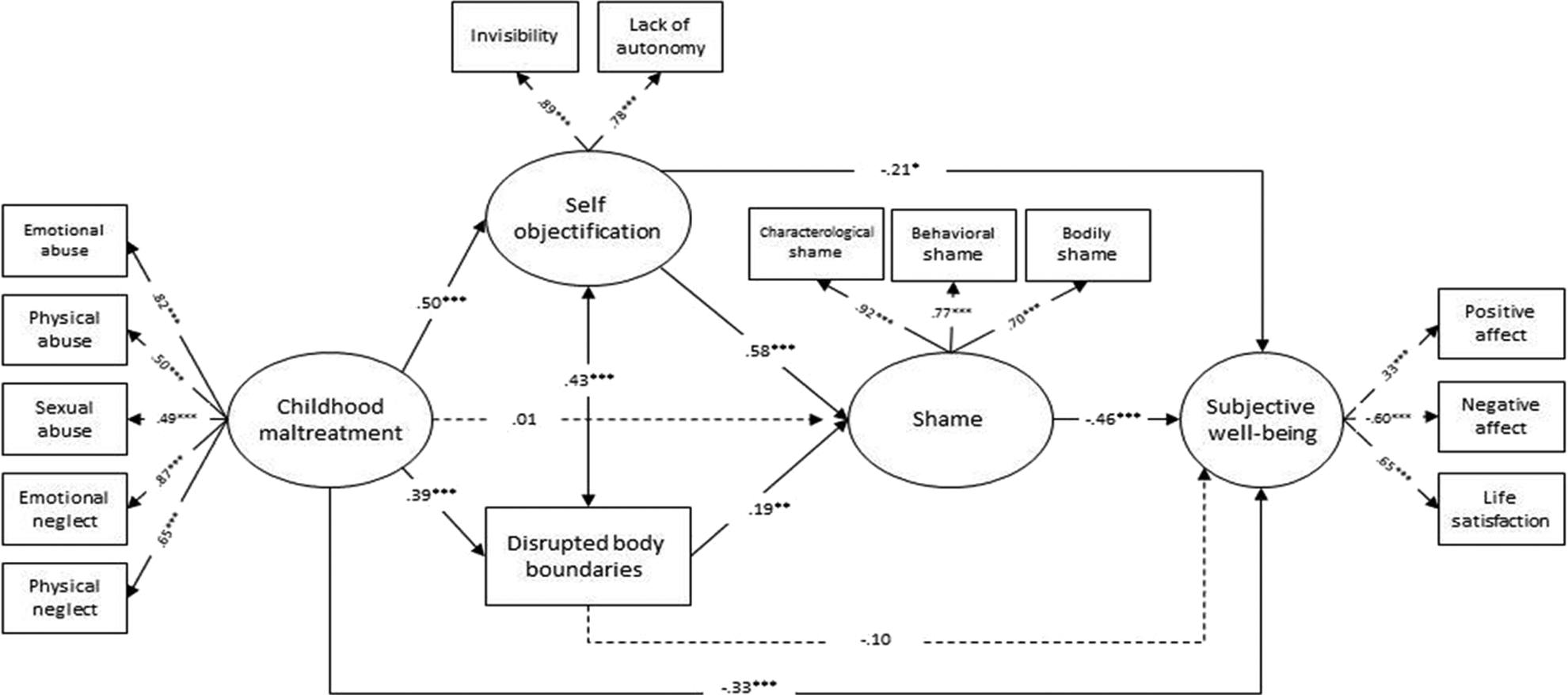
Dual-path model testing the relations between childhood maltreatment, shame, and well-being as mediated by both self-objectification and sense of disrupted body boundaries. The solid lines represent significant effects. The dashed line represents a nonsignificant effect. Rectangles indicate measured variables, and circles indicate latent variables. *p < .05. **p < .01. ***p < .001.
Method
Participants
A convenience sample of 531 Israeli female college/university students participated in this study. The average age of the participants was 25.28 years (SD = 4.82, range = 18–56). Most of the sample, 79.7% (n = 421), were undergraduate students; 16.9% (n = 89) were master’s degree students; 2.1% (n = 11) were PhD students; and 1.3% (n = 7) studied in accredited vocational institutions. 1 Most of the study participants (66.7%, n = 354) were single, and 33.3% (n = 177) reported that they were currently in an intimate relationship.
Measures
Childhood maltreatment
Childhood maltreatment was assessed with the Childhood Trauma Questionnaire (CTQ; Bernstein et al., 2003), which consists of 28 items reflecting five forms of childhood maltreatment: physical abuse (e.g., “Hit hard enough to see a doctor,” “Hit severely enough that bruises were noticed”); sexual abuse (e.g., “Was touched sexually,” “Was hurt if didn’t perform a sexual act that was requested”); emotional abuse (e.g., “Was called names by family members,” “Felt that parents wished he/she was never born”); physical neglect (e.g., “Did not have enough to eat,” “Wore dirty clothes”); and emotional neglect (e.g., “Felt loved”––reverse scored, “Was made to feel important”––reverse scored). The items were rated on a 5-point Likert-type scale with response options ranging from 1 (never true) to 5 (very often true). Sum scores were used, with higher scores representing greater levels of childhood maltreatment. Positive correlations between CTQ scores, as reported by adolescents who were admitted to inpatient psychiatric clinics, and as per their therapists’ ratings (Bernstein et al., 2003), support the validity of the CTQ scores. Reported internal consistency for scores on the CTQ among a community sample were .61 for physical neglect, .83 for physical abuse, .87 for emotional abuse, .91 for emotional neglect, and .92 for sexual abuse (Bernstein et al., 2003). The Hebrew version of the CTQ was widely used; Cronbach’s αs for the CTQ subscales among a sample of Israeli university students were .82 for physical neglect, .80 for physical abuse, .83 for emotional abuse, .88 for emotional neglect, and .81 for sexual abuse (Finzi-Dottan & Karu, 2006). Cronbach’s αs for the current sample were .77 for physical abuse, .85 for sexual abuse, .85 for emotional abuse, .51 for physical neglect, and .91 for emotional neglect.
Self-objectification
Self-objectification was assessed using the Self-Objectification Scale (Talmon & Ginzburg, 2016), a scale that was originally written in Hebrew. It consists of 17 items reflecting two factors: invisibility (e.g., “Sometimes I feel invisible,” “Sometimes I feel that others take no notice of me, as if I’m not in the room”) and lack of autonomy (e.g., “Sometimes other people make decisions for me,” “Sometimes when people ask me what I want, I don’t know how to respond”). The items were rated on a 5-point Likert-type scale, ranging from 1 (hardly agree) to 5 (strongly agree). Mean scores were used, with higher scores representing greater levels of self-objectification. Talmon and Ginzburg (2016) demonstrated support for structural validity (via both exploratory and confirmatory factor analyses), convergent validity (via positive correlations with a measure of body surveillance), and internal consistency (.89 for invisibility and .86 for lack of autonomy) in a sample of Israeli participants. Cronbach’s αs for the current sample were .90 for invisibility and .83 for lack of autonomy.
Disrupted body boundaries
Sense of disrupted body boundaries was assessed with the Sense of Body Boundaries Survey (Krzewska & Dolińska-Zygmunt, 2013), which consists of 17 items reflecting the individual’s sense of physical separateness from his or her surroundings and his or her sense of body vulnerability (e.g., “I feel that my body is susceptible to outer influences,” “My feeling of physical separation from the environment is rather vague”). We asked respondents to indicate, on a 5-point Likert-type scale, the extent to which the statement described their body experience, ranging from 1 (definitely don’t agree) to 5 (strongly agree). Mean scores were used, with higher scores representing more disrupted body boundaries. Krzewska and Dolińska-Zygmunt (2013) demonstrated support for convergent validity (via a positive correlation with another measure of dysfunctional body boundaries), internal consistency (.87), and test–retest reliability (2 month = .83, 3 month = .68). This survey was translated from Polish to Hebrew for the current study, using a synthesis of multiple independent translations. Cronbach’s α for this sample was .89.
Shame
Shame was assessed with the Experience of Shame Scale (ESS; Andrews et al., 2002), which consists of 25 items representing three aspects of the shame experience: characterological shame (e.g., “Have you felt ashamed of your personal habits?,” “Have you avoided people because of your manner?”); behavioral shame (e.g., “Do you feel ashamed when you do something wrong?,” “Have you felt ashamed when you said something stupid?”); and bodily shame (e.g., “Have you felt ashamed of your body or any part of it?,” “Have you worried about what other people think of your appearance?”). We asked respondents to indicate on a 4-point Likert-type scale ranging from 1 (not at all) to 4 (very much) to what extent they experienced the feeling, as described in each item, over the past year. Mean scores were used, with higher scores representing greater levels of shame. Convergent validity of scores on the ESS subscales was supported by their positive correlations with another measure of shame. Reported internal consistency and 11-week test–retest reliabilities for scores on the ESS were .86 and .78 for characterological shame, .87 and .74 for behavioral shame, and .90 and .82 for bodily shame (Andrews et al., 2002). This scale was translated from English to Hebrew for the current study, using a synthesis of multiple independent translations. Cronbach’s αs for this sample were .91 for characterological shame, .93 for behavioral shame, and .86 for bodily shame.
Well-being
High subjective well-being is often conceptualized as a combination of a high level of positive affect, a low level of negative affect, and a high level of life satisfaction (e.g., Linley et al., 2009). We measured well-being via the use of the Positive and Negative Affect Schedule (PANAS; D. Watson, Clark, & Tellegen, 1988) and the Satisfaction With Life Scale (SWLS; Diener, Emmons, Larsen, & Griffin, 1985).
The PANAS (L. B. Watson et al., 1988) consists of 10 items assessing positive emotions (e.g., determined, attentive) and 10 items assessing negative emotions (e.g., distressed, guilty). We asked respondents to rate the extent to which they felt a particular feeling over the previous 2 weeks on a 5-point Likert-type scale ranging from 1 (not at all) to 5 (very often). Mean scores were used, with higher scores representing greater levels of positive and negative affect. Ben-Zur (2002) translated and back-translated the PANAS into Hebrew and demonstrated support for both structural (via exploratory factor analyses) and convergent validity (via significant correlations with anxiety, anger, and curiosity) that were similar to those found in the English-language version. Cronbach’s αs for the PANAS subscales among an Israeli sample were .84 for positive affect and .91 for negative affect (e.g., Ben-Zur, 2002). Cronbach’s αs for the current sample were .77 for positive affect and .80 for negative affect.
The SWLS (Diener et al., 1985) consists of 5 items that assess a person’s life in general (e.g., “In most ways my life is close to ideal”). The respondents reported to what extent they agreed with each item on a 7-point Likert-type scale ranging from 1 (very much opposed) to 7 (strongly agree). Mean scores were used, with higher scores representing greater levels of life satisfaction. Reported internal consistency and 2-month test–retest reliability for scores on the SWLS were .87 and .82, respectively (Diener et al., 1985). Validity of the Hebrew version of the SWLS was supported by its significant correlations with other measures of well-being and life satisfaction (Anaby, Jarus, & Zumbo, 2010). The scale’s internal consistency among an Israeli sample was .86 (Anaby et al., 2010). Cronbach’s α for the current sample was .87.
Procedure
We recruited participants through the Internet in one of the three ways. The first way was via student Facebook groups whose members attended a variety of Israeli universities/colleges, studied in a number of different fields, and were at different stages in their education (i.e., BA, MA, and PhD students). These types of Facebook groups are generally closed and are accessible only to students. 2 The second way was through online Israeli student forums, and the third way was through a post published on the researcher’s “wall,” using a snowball technique. We invited potential participants to participate in a study being conducted among university students in Israel on the long-term effects of negative childhood experiences. The inclusion criteria were being a female college/university student, being 18 years of age or older, and being able to read and write in Hebrew. We used a raffle drawing, awarding a 100 Israeli shekel (approximately US$27) retail store gift card to each of five randomly chosen individuals, as a participant incentive. The questionnaires were presented in the following order: Self-Objectification Scale, Sense of Body Boundaries Survey, ESS, CTQ, PANAS, and SWLS. Participants took between 15 and 30 min to complete the questionnaires (mode = 23, median = 28 min), and they were permitted to complete them in installments over the course of 1 week.
Data Analysis
First, we examined descriptive analyses of the study variables. A series of Kolmogorov–Smirnov tests revealed that the study variables were not normally distributed. Second, we computed Spearman correlations to assess the direction and magnitude of the relations between the study variables. In order to investigate the relations between the study variables, we employed a structural equation modeling (SEM) technique using the AMOS 22 software package (Arbuckle, 2013). Using SEM enables users to examine the direct and indirect effects of the latent constructs simultaneously and to evaluate how well the hypothesized model’s structure fits the data. We used multiple indicators for each latent variable in the tested model.
A latent variable of childhood maltreatment was indicated by five observed measured scores: physical abuse, sexual abuse, emotional abuse, physical neglect, and emotional neglect. A latent variable of self-objectification was indicated by its two measures: invisibility and lack of autonomy. A sense of disrupted body boundaries was indicated by scores on the Sense of Body Boundaries Survey. A latent variable of shame was indicated by the three measured scores: characterological, behavioral, and body shame. Finally, we followed Busseri and Sadava’s (2011) recommendation to evaluate well-being by estimating it as a latent composite variable reflected in the negative loading of negative affect, the positive loading of positive affect, and the positive loading of life satisfaction.
In accord with Kline’s (2011) procedure, SEM equations were computed stepwise. First, a measurement model was computed to examine the fit of the observed variables to their corresponding latent factors. Second, a structural model was constructed to test the hypothesized relations between all of the latent constructs. To examine whether the study model was affected by participants’ demographic backgrounds, we conducted a third model, controlling for the effects of participants’ ages, educational levels (undergraduate vs. graduate student), and relational statuses (single vs. in an intimate relationship).
We used several complementary fit indices to examine the overall quality and fit of the hypothesized model to the data: comparative fit index (CFI), normed fit index (NFI), Tucker–Lewis index (TLI), and root mean square error of approximation (RMSEA). For CFI, NFI, and TLI, values greater than .90 indicate a fair/good fit between the model and the data (Arbuckle, 2013; Yadama & Pandey, 1995). An RMSEA value of .06 or less and a nonsignificant test of close fit (PCLOSE) also indicate a good fit (Hu & Bentler, 1999). Last, we used a χ2 analysis to examine the significance of the difference between the model and the data: a non-significant χ2/df value ranging between 1 and 3 indicates an adequate model fit (Arbuckle, 2013).
Missing data analysis indicated that, across variables, 6–19.8% of values were missing. Little’s (1988) missing completely at random (MCAR) model, aimed at analyzing missing values, revealed that the data were not MCAR, χ2(93) = 173.2, p < .001. Supplementary t tests showed that the missing values in some of the variables were related to the observed data: Specifically, participants with missing values in the three observed measures of shame reported higher levels of physical abuse compared to those with complete data in these measures. Participants with missing data in the subjective well-being observed measures had higher levels of disrupted body boundaries as compared to those with complete data in these measures. Given the evidence that the data are not missing completely at random (not MCAR), and furthermore, that the missingness was related to the observed data, the mechanism is MAR (missing at random), that is, the mechanism of missingness relates to the observed data. To correct the possible bias related to missing information in the observed data, missing data were replaced with maximum likelihood estimations based on all variables in the model, a procedure referred to as full information maximum likelihood (Arbuckle, 1996), by running models in AMOS 22 (Arbuckle, 2013).
Results
Means, standard deviations, and correlations among the measured variables are presented in Table 1. As noted, we formed four latent factors based on multiple indicators of each construct, reflecting childhood maltreatment, self-objectification, shame, and well-being. As we show in Table 1, the indicators of each construct were consistently intercorrelated. In addition, in accord with Hypothesis 1, the indicators of childhood maltreatment were positively associated with characterological and body shame and negative affect and negatively associated with life satisfaction. In accord with Hypothesis 2, the indicators of shame were positively associated with negative affect and negatively associated with positive affect and life satisfaction.
Descriptive Statistics and Zero-Order Correlations Among Observed Variables.

*p < .05. **p < .01. ***p < .001 (all two-tailed).
Measurement Model
First, we evaluated the measurement model’s fit. The analysis indicated that the measurement model demonstrated a fair/good fit to the data, χ2/df = 2.59, NFI = .94, TLI = .94, CFI = .96, RMSEA = .05, PCLOSE = .21. All of the observed indicators loaded significantly onto their corresponding hypothesized latent factors as presented in Figure 1. All latent variables were associated with each other: Childhood maltreatment was significantly associated with self-objectification (r = .50, p < .001), disrupted body boundaries (r = .40, p < .001), shame (r = .37, p < .001), and well-being (r = −.44, p < .001); self-objectification was significantly associated with disrupted body boundaries (r = .54, p < .001), shame (r = .69, p < .001), and well-being (r = −.74, p < .001); disrupted body boundaries was significantly associated with shame (r = .51, p < .001) and well-being (r = −.58, p < .001); and shame was significantly associated with well-being (r = −.78, p < .001).
Structural Model
The model was assessed both with and without the covariates of age, education, and relational status, but since the covariates had no bearing on the final model or relations among variables, we are reporting below only the non-controlled model.
To test the hypothesized relations between all of the latent constructs, we conducted a structural model. The fit indices of the model indicated a fair/good fit between the model and the data, χ2/df = 2.59, NFI = .94, TLI = .94, CFI = .96, RMSEA = .05, PCLOSE = .21. The model explained 15.7% of the variance of body boundaries, 24.6% of the variance of self-objectification, 49.6% of the variance of shame, and 78.6% of the variance of well-being. The results of the SEM are depicted in Figure 1, with a presentation of the standardized estimates of the direct effects. As can be seen, the model yielded the following direct effects: In accord with Hypothesis 3, childhood maltreatment was significantly associated with self-objectification and disrupted body boundaries: The higher the level of childhood maltreatment, the higher the self-objectification and disruption of body boundaries. Self-objectification and disrupted body boundaries were related to each other, and both were significantly associated with shame: The higher the self-objectification and disruption of body boundaries, the stronger the sense of shame. Finally, childhood maltreatment, self-objectification, and shame were significantly related to well-being: The higher the level of childhood maltreatment, self-objectification, and shame, the lower the respondents’ well-being.
In addition, we observed two significant serial mediation effects. In accord with Hypothesis 4, the association between childhood maltreatment and well-being was mediated by self-objectification and shame, B = −.11, SE = .03, p < .001, 95% CI [−.001, −.02]. This effect indicated a partial mediation, as the direct association between self-objectification and well-being remained significant. In accord with Hypothesis 5, the association between childhood maltreatment and well-being was mediated by disrupted body boundaries and shame, B = −.03, SE = .01, p = .002, 95% CI [−.001, −.03]. This effect indicated a full mediation, as the direct association between disrupted body boundaries and well-being was nonsignificant. That is, the association between childhood maltreatment and well-being was mediated by shame, through both self-objectification and disruptions in body boundaries.
Discussion
As we hypothesized and conceptualized in the dual-path model, the adverse relation between childhood maltreatment and well-being may be explained through two distinct serial mediation routes. The route by which the association between childhood maltreatment and well-being is serially mediated by disrupted body boundaries and shame reflects a full mediation. Finkelhor’s (1987; Finkelhor & Browne, 1985) Traumagenic Dynamics Model may serve as a framework for understanding the manner in which childhood maltreatment potentially affects survivors’ perceptions of their bodies and may lead to their increased sense of shame. More specifically, as suggested by Finkelhor (1987), exposure to childhood maltreatment may result in two core experiences. The first is the survivors’ experience of having their bodies repeatedly invaded, and the second is their experience of having their bodies and lives threatened. These experiences may distort survivors’ self-concept, worldview, or affective capacities; distortions that may be manifested in their increased sense of powerlessness and inferiority, that is, the foundation for a sense of shame.
We found the association between self-objectification and well-being to be partially mediated by shame. Our findings support Fredrickson and Roberts’ (1997) objectification theory that posits that experiences of being objectified and treated as inhuman promotes an internalization process of those experiences, which in turn contributes to reduced well-being. Our results are consistent with Miles-McLean et al. (2015), who found that experiences of unwanted sexual advances were related to more body self-objectification, which in turn was related to body shame and then to psychological distress.
In addition to identifying the two distinct mediation paths, we found that self-objectification and disrupted body boundaries were associated with each other. This association may be interpreted as an indication of a link between individuals’ subjectivity and the mental representations they have of their bodies. The sense children have of their bodies is shaped through their intimate relationships with primary caretakers (Merleau-Ponty, 1996), as the skin and physical body are the basis for the development and formation of a child’s “psychological body” (Bick, 1968). In a somewhat parallel process, children’s sense of subjectivity is also formed through their relationships with their primary caretakers, who will optimally be individuals who are sensitive to and validate the children’s emotional and physical needs (Ogden, 1985; Winnicott, 1960).
Practice Implications
Our work has the potential to improve mental health interventions for female adult survivors of childhood maltreatment. More specifically, our findings about the mediating roles of self-objectification, disrupted body boundaries, and shame suggest that these may be fruitful targets of intervention to reduce shame and increase well-being. Dialectical behavioral therapy (DBT) may be particularly relevant because it attends to emotional and bodily experiences in an integrative and coherent manner; DBT has been specifically applied to trauma (Wagner & Linehan, 2006) and has shown efficacy in reducing psychological distress associated with childhood sexual abuse (Bohus et al., 2013) and borderline personality disorder (Linehan, 1993).
DBT, which combines elements of cognitive–behavioral therapy, Eastern traditions (such as Buddhism), and a dialectical philosophical viewpoint, is based on the following techniques: listening, validation, dialectics, and troubleshooting. Through the validation technique, the therapist recognizes and validates the patient’s emotional state (Linehan, 1993), a validation which likely comes in direct contrast to the kind of denial of needs and desires that may have typified the patient’s childhood. Through validating patients’ emotional, cognitive, and behavioral reactions, the therapist not only acknowledges their existence but also attributes a degree of wisdom, accuracy, and truth to clients’ responses (Swales, Heard, & Williams, 2000). Thus, the validation might be useful in decreasing clients’ sense of invisibility and increasing their sense of autonomy.
Mindfulness exercises, which are another integral part of DBT, are exercises in which clients pay attention to their bodies (Linehan, 1993), taking note of bodily sensations in a nonjudgmental or accepting way (Baer, 2003). Therefore, by practicing mindfulness, clients may increase their awareness of their bodies and its boundaries. Moreover, therapists should make efforts to emphasize the importance of the body in therapy rather than denying its existence (Yarom, 2014). Studies have shown an indication of the effectiveness of DBT in reducing patients’ sense of shame (Neacsiu, Lungu, Harned, Rizvi, & Linehan, 2014) and distress (Bohus et al., 2013; Langmuir, Kirsh, & Classen, 2012). These effects may be attributed to a beneficial effect of validation and mindfulness techniques in elevating clients’ subjectivity and body awareness.
Limitations and Future Directions
The findings of this study should be considered in light of a number of limitations. First, the use of self-report questionnaires implies that the tested variables are conscious subjective processes. Thus, although we measured all variables via the use of widely utilized and validated questionnaires, one must keep in mind that participant responses represent self-perceptions. Second, we based our assessment of childhood maltreatment on participants’ retrospective reporting. Third, the measures we used in this study were not originally written in Hebrew. Although some of these measures are regularly used in their translated versions, the potential influence of culture and language must be taken into account (Kim, Han, & Phillips, 2003; Van de Vijver & Tanzer, 1997). The low reliability of the physical neglect subscale of the CTQ must also be taken into consideration. As suggested by Paivio and Cramer (2004), the lower reliability of this subscale may reflect the relative diversity of the participants’ life experiences in this area. In addition, although researchers have shown that the order in which items are presented does not have a substantial effect on personality measurement scores (Schell & Oswald, 2013), the possibility of bias resulting from a lack of randomization of the order of the measures should be noted.
Despite the growth in the use of online data collection and accumulation of evidence supporting its reliability, validity, and contribution to participants’ greater perceived anonymity (Gosling, Vazire, Srivastava, & John, 2004; Ward, Clark, Zabriskie, & Morris, 2014), a possible bias resulting from online participant recruitment should be taken into account. Further, due to our use of convenience sampling of a relatively homogeneous sample, and the lack of information about participants’ ethnic and/or sexual identities, readers should refrain from generalizing from our results to the general population as well as to other subgroups. In addition, our inferences regarding the causal mediation relations between the study variables should be viewed cautiously, given the fact that the current study had a cross-sectional design (for discussion of mediational analysis with cross-sectional data, see, e.g., Shrout, 2011). Concerns of this nature are heightened further when a serial mediation model is employed. Thus, one cannot discount the possibility that shame might have led to self-objectification and disrupted body boundaries, rather than the other way around. However, the proposed model was based on hypotheses generated from theory that an individual’s perception of shame may derive from internalizations of early interpersonal violence and/or a disrupted relationship; this sense of shame may, in turn, be connected to reduced well-being (e.g., Choma et al., 2009; Finkelhor & Browne, 1985). In order to validate this model, longitudinal studies are needed.
Although the findings of the current study indicate that self-objectification and a sense of disrupted body boundaries are associated with a sense of shame and reduced well-being, the role they play in other detrimental effects of childhood maltreatment should also be examined. One of these effects is deliberate self-injury, which has been shown to be more than twice as high among women survivors of childhood abuse (e.g., Gladstone et al., 2004; Noll, Horowitz, Bonanno, Trickett, & Putnam, 2003) than among women who did not experience abuse. Deliberately harming one’s body can be seen as an attempt to reclaim ownership over it, in the absence of a clear sense of its boundaries. The skin defines the boundaries, and the blood and scars that leave their marks on the skin may constitute evidence of the self (Suyemoto, 1998).
Future research might also incorporate other potential mediators to our model. For example, impaired functioning, loneliness, and depressive symptoms might be additional mediators in the self-objectification and well-being links. As reported by Fredrickson and her colleagues (Fredrickson et al., 1998; Fredrickson & Harrison, 2005), higher levels of self-objectification are associated with impaired motor and cognitive performance among adolescent and adult female subjects, which may in turn relate to lower levels of well-being. Since a lack of subjectivity and a sense of invisibility may increase an individual’s sense of loneliness and depressive mood (e.g., Muehlenkamp & Saris-Baglama, 2002; Szymanski & Henning, 2007), these variables might also help explain how self-objectification relates to lower levels of well-being.
An additional topic worthy of future research relates to the possible effects of childhood maltreatment on self-objectification and disrupted body boundaries among male childhood maltreatment survivors. Although experiences of early interpersonal trauma have been shown to be associated with a disruption in sense of body identity among both male and female survivors (Sakson-Obada, 2014), the relation between childhood maltreatment and self-objectification was studied only among female survivors. Finally, research is needed on interventions that target self-objectification and disrupted boundaries to determine whether they lead to reductions in shame and increases in well-being among female survivors of child maltreatment.
Conclusions
Self-objectification and disrupted body boundaries are abstract concepts, which denote internalized and private reactions to the experiences of childhood maltreatment. The current research findings indicate that these phenomena are linked to childhood maltreatment and connected to shame and well-being among a nonclinical population. Our findings suggest the illusion of adjustment and functioning among student survivors, by demonstrating these internal and negative phenomena. Those who plan student services may use these findings to design interventions for this population, and clinicians may learn to attend to and validate client’s subjective understandings of disrupted body boundaries and shame.
Footnotes
Authors’ Note
Research materials are available to readers on request.
Declaration of Conflicting Interests
The author(s) declared no potential conflicts of interest with respect to the research, authorship, and/or publication of this article.
Funding
The author(s) received no financial support for the research, authorship, and/or publication of this article.