







Abstract
We tested whether women’s sense of authenticity can be compromised by the expression of masculine characteristics and whether feelings of authenticity directly or indirectly connect masculine expression to a diminished sense of interest in a science position. In Study 1 (N = 105), we randomly assigned female undergraduates to present themselves as possessing traditionally high masculine characteristics or possessing non-masculine characteristics. They recorded a video “interview” for a science laboratory position and reported on their feelings of authenticity. Women in the masculine-expression condition reported less authenticity, which was in turn associated with less interest in the position. Study 2 (N = 240 women) showed that expressing masculine characteristics in a written “application” led to lower levels of authenticity and, in turn, less interest in the position. This effect occurred most strongly among women relatively high in feminine identification and low in masculine identification. These studies indicate that women who express masculine characteristics in science settings may experience less authenticity, which can in turn contribute to diminished interest in a science position. These findings suggest that efforts to improve women’s experiences in stereotypically masculine settings should focus on mitigating psychological connections between gender and success in those settings. Online slides for instructors who want to use this article for teaching are available on PWQ's website at http://journals.sagepub.com/doi/suppl/10.1177/0361684320947648
Considerable social and empirical attention has been paid to the experiences of women in disciplines that are traditionally dominated by men. In disciplines where women remain underrepresented (e.g., engineering), a perceived culture of masculinity contributes to women’s negative experiences and outcomes (Cheryan et al., 2017). Indeed, disciplines with larger gender disparities are more likely to be stereotypically associated with masculinity (Cheryan et al., 2017; Miller et al., 2015), and contexts that communicate a culture of masculinity lower women’s interest and sense of belonging (Cheryan et al., 2009). The communication of masculine expectations can occur at the earliest stages of job selection. For example, job advertisements in male-dominated areas feature words such as competitive, aggressive, and assertive more frequently than advertisements in female-dominated areas (Gaucher et al., 2011). Such agentic traits and descriptors (e.g., aggressive) are more likely to be stereotypically associated with men than women, a pattern that has remained stable across at least the last 7 decades in the United States (Eagly et al., 2019) and reflects the qualities that people infer from the social roles that women and men typically hold (Eagly & Wood, 2012). Moreover, stereotypic associations between masculinity (or agency; Abele, 2003) and certain social roles can place women pursuing those roles in a difficult position. They must portray stereotypically masculine (agentic) qualities to be perceived as competent (Glick et al., 1988), but violating gendered stereotypes can make them vulnerable to “backlash” in the form of negative evaluations (Rudman & Phelan, 2008). Thus, the implicit or explicit association between masculinity (agency) and certain fields may contribute to women’s underrepresentation and negative experiences in them.
We built on this understanding in the current research by exploring how the self-presentation of masculine qualities in a context that explicitly values them can negatively impact women’s experience of state authenticity. State authenticity reflects a person’s “in the moment” feeling that they are being their “real or true self” (Sedikides et al., 2017, p. 521). Theoretically, state authenticity is comprised of several facets, including facets of true self-alienation and authentic living (Lenton et al., 2016; Wood et al., 2008). The self-alienation component reflects a feeling that one does not know and is disconnected from their true self, whereas the authentic living component reflects the feeling of expressing one’s true self (Lenton et al., 2016; Wood et al., 2008). Both of these facets are robustly connected to psychological health and well-being (Rivera et al., 2019). For example, experimentally increasing the feeling of knowing one’s true self leads to greater perceptions of meaning in life (Schlegel et al., 2011), and experimentally undermining the experience of knowing and being connected to one’s true self leads to greater perceptions that one is immoral (Gino et al., 2015). The general experiences of being authentic and inauthentic are common in people’s daily lives and are tethered to particular types of life events (Lenton et al., 2016). People report feeling authentic (i.e., most like themselves) in activities that are largely fun and familiar, whereas people report feeling inauthentic when they experience pressure to conform to external standards, isolation, and evaluation concerns or when they fail to adhere to expectations (Lenton et al., 2016).
The types of experiences that are commonly linked to feelings of inauthenticity may be relevant to the experiences that many women have in disciplines that value or are stereotypically associated with masculinity. For example, the themes of isolation that characterize many self-narratives about inauthenticity (Lenton et al., 2016) theoretically overlap with the well-documented lack of belonging that many women experience in contexts that communicate a culture of masculinity (Cheryan et al., 2017). Research showing that daily levels of authenticity positively correlate with daily levels of belongingness supports this possibility (Heppner et al., 2008). Inauthenticity also tends to be tethered to the experience of external demands and failures to fulfill expectations, which resonates with the violation of traditional gender norms (Eagly et al., 2000), which occurs when women express more agentic characteristics to be viewed as competent (Glick et al., 1988). More broadly, Schmader and Sedikides (2018) have proposed that environments that inhibit one’s default self-concept, thwart personal goals, or signal stigmatization contribute to an experienced lack of psychological fit, which subsequently decreases feelings of authenticity and leads to the adoption of an avoidant behavioral orientation. Perceptions that masculinity is valued or required to be successful in a domain may therefore compromise women’s sense of authenticity by decreasing an experiential sense of “fit” within that particular domain.
Indeed, the goal congruity model (Diekman et al., 2017) suggests that women experience a lack of congruity or fit between the communal goals that they tend to favor and the goals that stereotypically masculine domains (e.g., science) or roles (e.g., leadership positions) permit them to fulfill. The model posits that this incongruity significantly contributes to women’s motivations and outcomes. For example, women’s (but not men’s) positivity toward a career in science is increased when that career is described as affording the fulfillment of communal goals (Diekman et al., 2011). This implies, then, that contexts emphasizing the importance of agentic (masculine) characteristics may contribute negatively to women’s authenticity by communicating a mismatch, or lack of fit, between their typical communal goal values and the agentic goal affordances that become attached to that particular domain.
The self-presentation of characteristics perceived to be valued in domains that convey a culture of masculinity may also contribute to inauthenticity. According to Schmader and Sedikides (2018), a person should feel less authentic when they are unable to engage in self-expression “without needing to navigate others’ expectations or social constraints” (p. 233). This might explain why social power positively contributes to a general feeling of being authentic (Kifer et al., 2013) and why self-presentation that conflicts with prescriptive gender stereotypes might undermine it. That is, stereotypes about the traits women should possess and portray (e.g., sensitive; Prentice & Carranza, 2002) can explicitly conflict with the traits that are valued and expected in domains characterized by masculinity. Women must navigate the self-presentation demands introduced by this juxtaposition.
Work on “backlash” reveals that women must express characteristics that conflict with prescriptive gender stereotypes to be perceived as competent, but such expression introduces significant social costs in terms of being perceived as less likable and experiencing more negative social interactions (Rudman & Phelan, 2008). The diminished experience of interpersonal fluency created by these sorts of social demands and conflicts should therefore contribute to greater feelings of inauthenticity among women who face them in contexts that value masculinity (cf. Schmader & Sedikides, 2018). Somewhat consistent with this possibility, people who seek to avoid stigmatization by presenting themselves in a way that masks a devalued characteristic (e.g., mental illness) report feeling more dishonest and report that their actions are less guided by their conscience. These outcomes were interpreted as indicative of inauthenticity (Newheiser & Barreto, 2014). Responding to the perceived self-presentation demands of contexts that explicitly or implicitly convey a culture of masculinity may therefore place women at a heightened risk of feeling inauthentic due to a general threat to social fit.
It is also possible that contexts that emphasize the desirability of masculine characteristics can undermine women’s authenticity by threatening the perceived fit between their self-concepts and the immediate environment. This might be particularly true for women who see themselves as especially feminine or non-masculine. That is, these individuals might experience a lack of self-concept fit due to being in a context that thwarts the activation of key aspects of the self (i.e., the gendered characteristics that they strongly identify with). This potential thwarting of integral aspects of the self is, according to Schmader and Sedikides (2018), one of the central mechanisms that influence state feelings of authenticity. The possibility of experiencing disruption to self-concept fit further suggests that gender identification might play a role in determining how contexts that emphasize masculine expression affect women’s sense of authenticity. Women particularly high in feminine identification or low in masculine identification may be especially vulnerable to deficits in authenticity when they are contexts that specifically disrupt self-concept fit by accentuating the demand for masculinity.
Overall, the emerging literature on state authenticity and the factors that give rise to it suggest that women may experience diminished authenticity when they are in contexts or domains that are perceived to place value on masculinity. Such values and the expectations that come with them can introduce a lack of congruity between goals and goal affordances (Diekman et al., 2017), can increase self-presentation demands that are characterized by evaluative pressures and standards that make self-expression less fluent, and can thwart the activation of integral self-aspects for women high (low) in feminine (masculine) identification. Both theory (Schmader & Sedikides, 2018) and research on the nature of state authenticity (Sedikides et al., 2017) suggest that these factors affect a feeling of fit that should be linked to a subjective feeling that one is being less authentic.
In addition, because state inauthenticity is linked to avoidant behavioral orientations (Lenton et al., 2016), women’s feelings of inauthenticity may connect negatively to their interest in pursuing opportunities in masculine domains (e.g., science, technology, engineering, and math [STEM]; cf. Schmader & Sedikides, 2018). We designed the current research to test whether contexts that value and invite the self-presentation of masculinity can compromise women’s authenticity and whether these differences in state authenticity relate to women’s interest in a setting where masculinity is explicitly valued. This latter aspect of the research connects our focus on state authenticity to a motivational outcome (i.e., interest) that is robustly associated with women’s engagement in domains where they are underrepresented (Thoman et al., 2013; see also, Harackiewicz et al., 2016; Smith et al., 2007).
Study 1
As an initial test of these ideas, we randomly assigned female undergraduates in Study 1 to present themselves as possessing traditionally masculine characteristics (e.g., competitive) or to present themselves as possessing characteristics not stereotypically associated with masculinity or agency (e.g., being team-oriented). We did this in the context of an ostensible video interview for a position in a domain where cultures of masculinity are known to undermine women’s experiences (i.e., a science laboratory; Cheryan et al., 2017). Immediately after recording their “audition,” all participants completed three distinct, but interrelated, measures of authenticity (Newheiser & Barreto, 2014; Wood et al., 2008) that have been used elsewhere in the literature. Finally, all participants completed a questionnaire that included an assessment of interest in the position (Smith et al., 2007). The inclusion of this variable therefore provided an opportunity to test aspects of the “authenticity as fit” model (Schmader & Sedikides, 2018) by assessing how experiences of authenticity affect a motivational orientation (i.e., interest) linked to engagement in a domain.
Hypotheses and Analysis Plan
We aimed to test a number of specific primary and secondary hypotheses. First, as a manipulation check, we had independent raters code the audition recordings based on how much they contained expressions of the masculine and non-masculine characteristics that participants were randomly assigned to portray. We predicted that those in the masculine condition would express masculine (non-masculine) characteristics significantly more (less) than those in the non-masculine condition.
As a test of our primary hypothesis, we subjected all three measures of authenticity to a multivariate analysis of variance (MANOVA). We hypothesized that women who were randomly assigned to express masculine characteristics would report less authenticity (on each measure) when compared to those who were assigned to express non-masculine characteristics.
Next, we tested whether there was an indirect effect of condition on interest in the science laboratory position through feelings of authenticity. We hypothesized that participants in the masculine expression condition would report lower interest in the laboratory position to the extent that they experienced lower levels of authenticity. Put differently, the masculine (vs. non-masculine) expression condition was expected to exert a negative indirect effect on interest in the position through its negative effect on authenticity.
Finally, we explored whether individual differences in gender (masculine or feminine) identification moderated any of the primary effects. Because gender identification could be important for the experience of self-concept fit in a masculine setting, it seemed plausible that women who strongly identify with feminine norms, or weakly identify with masculine norms, could be more sensitive to the effects of masculine expression on feelings of authenticity. Of course, it is also possible that simply being a woman in a context that values and calls for the expression of traits stereotypically associated with men could create a lack of fit that contributes to inauthenticity regardless of gender identification (cf. Scmader & Sedikides, 2018). We conducted exploratory moderation analyses via regression to test these possibilities.
Method
Participants
Female adults (N = 106; M age = 21.37 years, SD age = 5.90) from an Introduction to Psychology course at Montana State University participated for partial course credit. We did not collect information about participants’ race or ethnicity in this study, but the population we drew from is largely White. Our sampling plan was to recruit as many participants as possible during a full academic term, requiring at least 50 participants per condition. This target number was based on feasibility expectations, given our resources and a power analysis indicating that this minimum sample size would enable us to detect a medium sized effect at power equal to .80 in a MANOVA with correlated repeated measures. We stopped data collection at the end of the academic term. Participants knew that they were participating in a research study and were told that the study focused on personality and job interview success. Because we used a selection feature in the subject pool recruiting software, participants were unaware that only women were eligible for the study (i.e., the advertisement made no mention of exclusion based on sex, and only women in the subject pool were able to see the advertisement).
Procedure and Manipulation
Participants completed the study in a private, individual setting. A trained female experimenter explained that the session consisted of two distinct studies. In the first study, participants completed a series of standard personality measures as part of an ostensible inquiry into “personal characteristics.” A trained experimenter told participants that the purpose of the second study was to examine the “effectiveness and practicality of video applications for hiring decisions.” The cover story mentioned that we were working with other scholars who are interested in evaluating the merits of different types of applications and we are using our lab to begin exploring that question with them. We did not directly assess whether participants believed this cover story, which is a limitation, but we generally assumed that it would create a viable experimental context for the tasks. Participants were told that they would see an advertisement for a lab position with information about what the “lab director” desires in an applicant. After giving the instructions, the experimenter left the participants alone in the private cubicle to begin the video audition task. Participants were instructed to make a 3- to 5-minute audition tape for a hypothetical lab position in a science department. Participants read an overview of the science lab, including a message from the lab director about the desired characteristics of a research assistant. This message served as the independent variable.
In the masculine expression condition, participants read that the director of this lab prefers candidates that primarily express high masculine traits (competitive, aggressive, and assertive). These words were selected from a masculine word list created by Gaucher and colleagues (2011), which was based on other published lists of words classified as agentic or masculine. In the non-masculine expression condition, participants read that the director prefers candidates that express a mix of traits that are not associated with masculine stereotypes (team-oriented, rational, and cooperative) and instead reflect communal and competence traits that are not viewed as stereotypically masculine (Eagly et al., 2019). We refer to these as non-masculine because of the inclusion of traits that might be perceived as feminine (cooperative). Our intent was to create a condition that was more gender-neutral in the sense that the characteristics would not be unambiguously gendered. Critically, these instructions were presented via a computer in the form of an advertisement flyer so that the experimenter remained blind to experimental condition assignment.
Each participant positioned herself in front of a digital camera and responded to three interview questions that were presented via text on the computer screen (“Why would you be the best person for this position?” “What skills and characteristics will you bring to the table to make this lab better?” and “Describe why you value the characteristics that this lab is looking for and explain how you exemplify them?”). They were instructed to present themselves in a way that would make them attractive to the lab director, thus motivating them to portray themselves in either high masculine or relatively less masculine ways. This procedure was carried out in a private computer cubicle where the participant could not be observed by the experimenter, although the experimenter was present in the room on the other side of the cubicle. Participants did believe that their videos would be analyzed. After making their video, they proceeded to a second set of questionnaires focused on feelings of authenticity, motivation, and impressions of the lab position.
Measures
All materials and data are accessible at the Open Science Framework (https://osf.io/ab3r2/?view_only=1cfb6fd7b3f14b5a84ef1e6facbe37ff)
Personal Attributes Questionnaire (PAQ)
In the purported “Phase 1” part of the study, participants completed the PAQ (Spence et al., 1974), which assesses how much participants define themselves according to traditional notions of masculinity and femininity. Participants indicated how descriptive a series of traditionally feminine (e.g., submissive) and masculine (e.g., aggressive) traits were to them on a 1 (not at all) to 5 (perfectly) Likert-type scale. Responses were averaged into separate masculine (M = 3.71, SD = 0.57, α = .70) and feminine composites (M = 4.11, SD = 0.49, α = .73). 1
Authenticity
After completing the audition tape, participants completed three measures of felt authenticity, which served as the critical dependent variables. The first measure asked participants to indicate how honest, trustworthy, and consistent with their conscience they felt during the audition tape. This measure was taken directly from work on concealable identities and authenticity (Newheiser & Barreto, 2014). Responses to these items were made on 1 (strongly agree) to 7 (strongly disagree) Likert-type scales, reverse scored, and averaged (M = 5.17, SD = 1.67, α = .92). In addition, participants completed a series of items modeled after items on the Authentic Personality Questionnaire (Wood et al., 2008). Four items (self-alienation) reflected feelings of being disconnected from one’s true self (e.g., “I don’t know how I really feel inside,” “I feel alienated from myself”) and four items (authentic living) reflected the feeling of behaving consistently with one’s true self (e.g., “I am being true to myself,” “I feel like I’m being myself”). We reverse scored the self-alienation items so that higher scores would reflect less self-alienation and thus greater authenticity. All responses were made based on how participants felt “right now, at this moment” and were recorded on 1 (not at all true of me) to 7 (very true of me) Likert-type scales. Responses were averaged into separate reverse-scored self-alienation (M = 5.13, SD = 1.49, α = .81) and authentic living (M = 4.79, SD = 1.68, α = .90) composites. All of the scales were scored such that higher scores reflect greater feelings of authenticity and less self-alienation.
Interest in the position
Finally, participants completed a measure that included four items (Smith et al., 2007) focused on interest in the lab position. The interest items were “I would describe the lab I auditioned for as very interesting,” “I think that working in this lab would be boring” (reverse scored), “I feel that I would enjoy working in this lab,” and “Working in this lab would be fun.” Responses were made on a 1 (strongly agree) to 7 (strongly disagree) Likert-type scale. Mean scores were used, with higher scores reflecting greater interest (M = 4.63, SD = 1.34, α = .90). The measure included 16 additional items (Smith et al., 2007) that focused on other aspects of the experience (e.g., how much participants cared about making the video, importance of auditioning for the lab). These items and the data they generated are available on OSF.
Results
Manipulation Check
Two independent coders who were blind to conditions watched the audition videos and rated each participant based on the characteristics emphasized in the manipulation advertisements (cooperative, team-oriented, rational, competitive, aggressive, and assertive). They indicated how much each participant seemed to possess these characteristics on a 1 (not at all) to 7 (very much) Likert-type scale. We averaged ratings to create composite non-masculine and high masculine observer evaluations. We computed intra-class correlations (ICCs) from two-way mixed models with consistency as the type. Based on Cicchetti (1994), we concluded that the ICCs for the masculine ratings (ICC = .71, 95% CI [.56, .80]) and the non-masculine ratings (ICC = .62, 95% CI [.42, .75]) were “fair” to “good” based on the 95% confidence intervals. The composites were subjected to MANOVA with experimental condition (high masculine expression vs. non-masculine expression) entered as a between-subjects factor. Degrees of freedom in these analyses differ from those below because some participants had missing video data due to a camera malfunction. Participants were unaware of this malfunction, and their experience completing the study was identical to the other participants. There was a significant multivariate effect, F(2, 90) = 50.88, p < .001. Objective observers perceived participants in the non-masculine condition (M = 5.09, SD = 1.10) as expressing the non-masculine characteristics more than participants in the high masculine expression condition (M = 3.70, SD = 1.22), F(1, 91) = 32.44, p < .001, d = −1.20. In contrast, objective observers perceived participants in the non-masculine condition (M = 2.57, SD = 0.90) as expressing the high masculine characteristics less than participants in the high masculine expression condition (M = 4.84, SD = 1.37), F(1, 91) = 84.62, p < .001, d = 1.96. These results confirm that our manipulation was effective.
Effect of Condition on Authenticity
We subjected each authenticity measure to a MANOVA testing for the effect of experimental condition. There was a significant multivariate effect, F(3, 102) = 4.41, p = .006. As presented in Table 1, women in the high masculine expression condition, compared to those in the non-masculine condition, reported lower authenticity as measured by the Newheiser and Barreto (2014) measure, F(1, 104) = 11.74, p = .001, d = −.66, and the reverse-scored self-alienation measure, F(1, 104) = 4.25, p = .042, d = −.40. There was a non-significant effect on the authentic living measure, F(1, 104) = 3.45, p = .066, d = −.36. Only the effect on the Newheiser and Barreto measure reached significance when employing a Bonferroni adjustment for multiple comparisons (adjusted α = .05/3 = .017).
Effects of Condition on Each Measure of Authenticity and Interest in Studies 1 and 2.
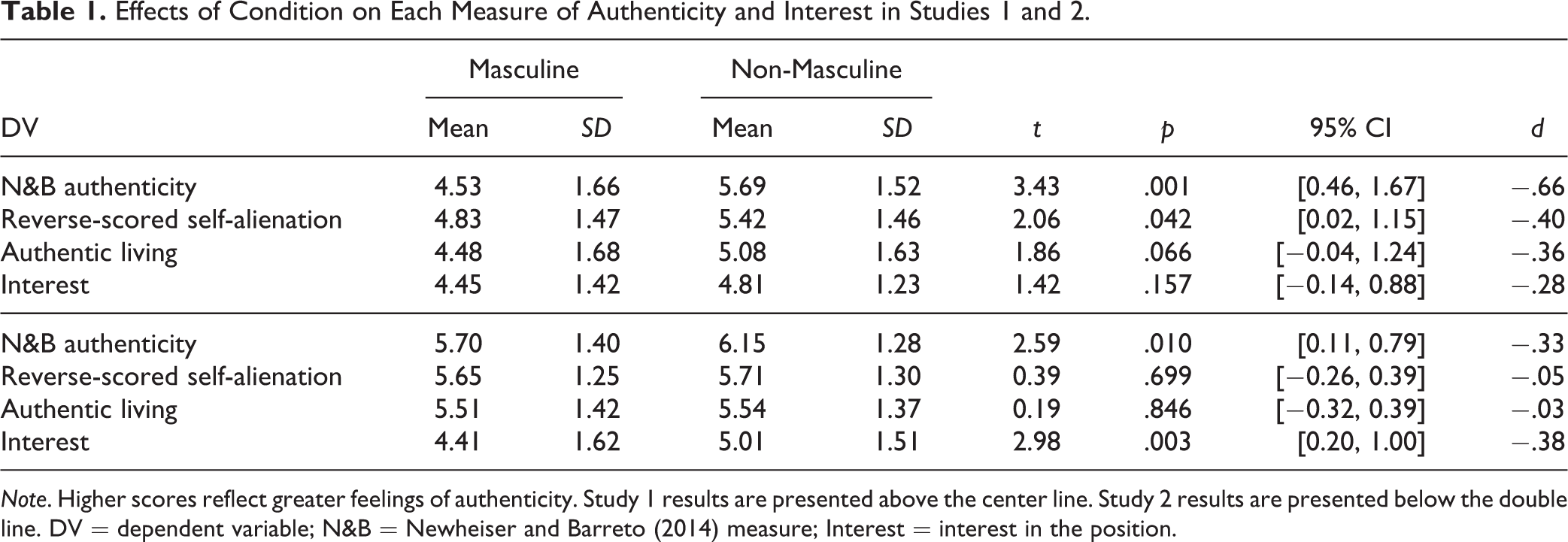
Note. Higher scores reflect greater feelings of authenticity. Study 1 results are presented above the center line. Study 2 results are presented below the double line. DV = dependent variable; N&B = Newheiser and Barreto (2014) measure; Interest = interest in the position.
Downstream Consequences of Authenticity on Interest in the Position
We also conducted separate indirect effects tests with the PROCESS (Version 2.16.3) (Hayes, 2013; Model 4) macro for SPSS using the bias corrected method for generating bootstrap confidence intervals (CI). These analyses tested whether the experimental manipulation had a negative effect on interest to the extent that it led to lower levels of authenticity. For each analysis, experimental condition was entered as the independent variable, an authenticity measure was entered as the mediator, and interest was entered as the dependent variable. There was no total effect of our manipulation on interest in the position, t(104) = 1.42, p = .157, 95% CI [−0.14, 0.88], d = −.27. However, we did observe a significant positive correlation between interest and each of the authenticity measures (see Table 2). Critically, there were also significant indirect effects involving the Newheiser and Barreto (2014) authenticity measure (b = −.22, 95% CI [−0.51, −0.04; see Figure 1) and the reverse-scored self-alienation measure (b = −.20, 95% CI [−0.46, −0.02]). The indirect effect was not significant for the authentic living measure (b = −.22, 95% CI [−0.54, 0.005]). These results generally suggest that expressing high masculine characteristics led to lower interest in the lab to the extent that it negatively influenced authenticity.
Correlations Among Key Study Variables in Studies 1 and 2.
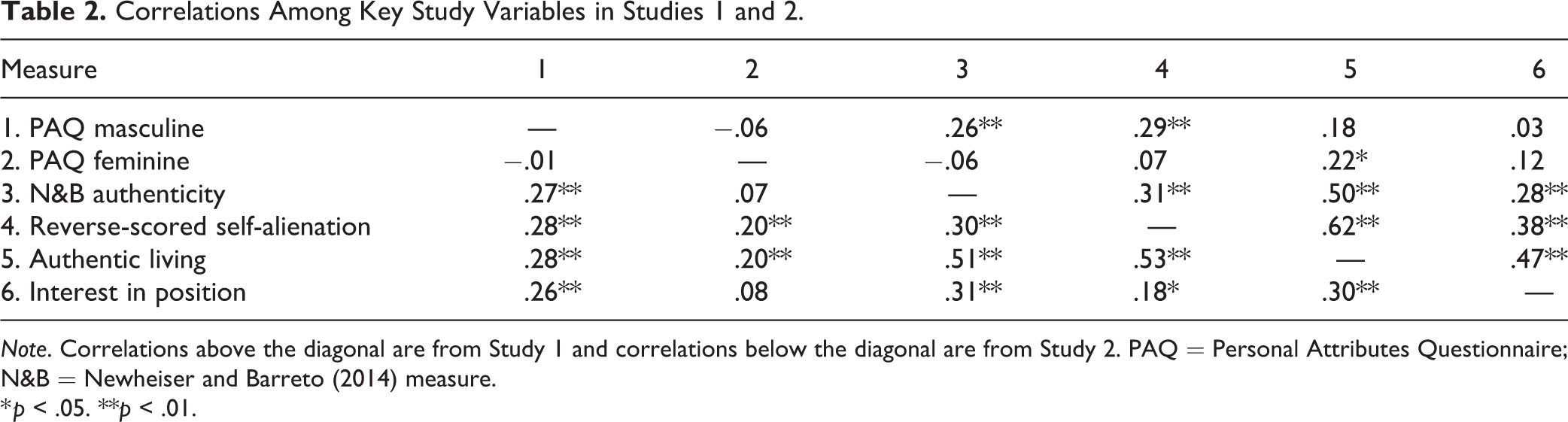
Note. Correlations above the diagonal are from Study 1 and correlations below the diagonal are from Study 2. PAQ = Personal Attributes Questionnaire; N&B = Newheiser and Barreto (2014) measure.
* p < .05. **p < .01.
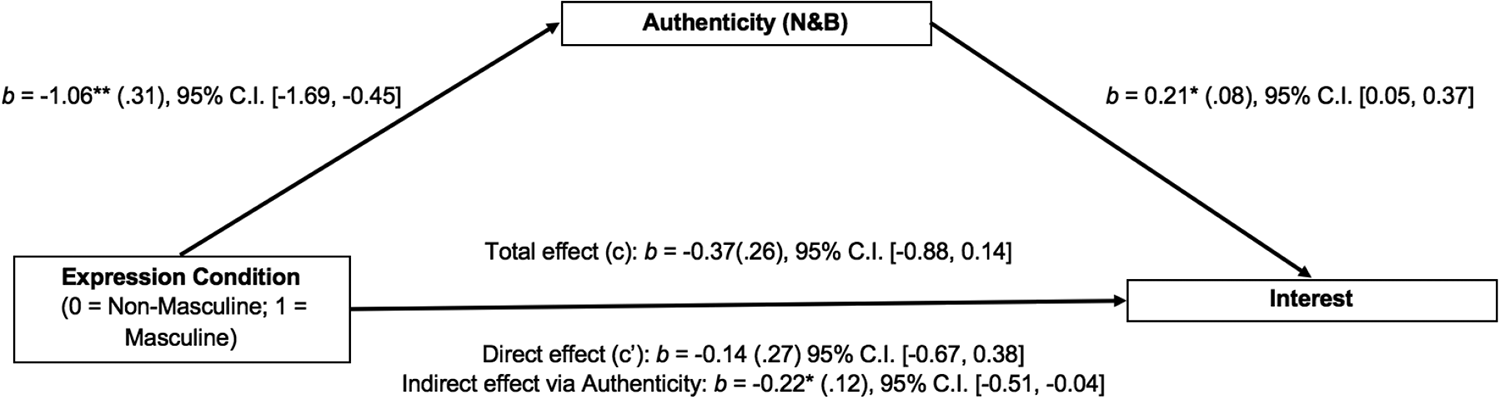
Indirect effect model testing the effect of condition on interest through the Newheiser and Barreto (2014) measure of authenticity in Study 1. *p < .05. **p < .01.
Moderation by Identification Variables
Finally, we explored the potential moderating influence of gender identity (as indexed by the PAQ) on each of the measures of authenticity and the indirect effects on interest noted above. We did this using the PROCESS macro for SPSS (Hayes, 2013, Model 7). Feminine and masculine identification and their interactions with condition were entered simultaneously into these models so that the effects of feminine and masculine identification were isolated. Gender identification variables were mean-centered and experimental condition was dummy-coded in these analyses. Non-significant Condition × Masculine Identification, b = −.29, SE = .53, t(100) = 0.54, p = .591, and Condition × Feminine Identification interactions, b = .61, SE = .63, t(100) = 0.97, p = .335, were observed on the Newheiser and Baretto (2014) measure of authenticity. Similarly, non-significant Condition × Masculine Identification interactions were also observed on the reverse-scored self-alienation, b = .13, SE = .49, t(100) = 0.27, p = .790, and authentic living measures, b = −.55, SE = .55, t(100) = 1.00, p = .320, and non-significant Condition × Feminine Identification interactions were observed on the reverse-scored self-alienation, b = −.26, SE = .57, t(100) = 0.46, p = .649, and authentic living measure, b = −.25, SE = .65, t(100) = 0.39, p = .696. Not surprisingly, given these null interaction effects on authenticity, there was no evidence that gender identification moderated the indirect effect of condition on interest through authenticity (i.e., all indices of moderated-mediation were not significantly different than zero).
Discussion
Consistent with our primary hypothesis, women reported feeling less authentic after recording themselves expressing high masculine (vs. non-masculine) traits. Additionally, secondary analyses revealed that the effect of the masculine expression condition was negatively linked to participants’ interest in the purported laboratory position to the extent that it elicited lower levels of authenticity. There was little evidence that gender identification moderated these effects. However, given that this study was likely underpowered to adequately test interaction effects, all of the results involving moderation should be taken with caution. The overall pattern of results in Study 1 suggests that expressing high masculine characteristics can lead to lower levels of authenticity among college women, which in turn is associated with a reduced interest in pursuing a position that explicitly values high masculinity.
Study 2
We conducted a second experiment to build on these findings. Our primary goal was to replicate the effect of high masculine expression on women’s sense of authenticity in a different modality. Although our video manipulation was likely high in experimental realism, the majority of initial screening interviews in occupational settings occur in a written mode of expression. People attempt to portray desired characteristics to make themselves look good “on paper” so that they will be invited to later “in person” interviews. It may be that these written expressions of high masculine characteristics are experienced as less personal and not of the same strength as public presentations where one’s physical self is the agent of observed expression (like the video task in Study 1). We, therefore, aimed to test whether expressing high masculine characteristics known to be valued by a laboratory director would lead to lower levels of authenticity, even when that expression was made in a written form. We also aimed to examine whether these effects are specific to women or whether male participants would show similar responses. Furthermore, to fully replicate the analyses and results of Study 1, a third aim of Study 2 was to assess whether differences in authenticity would be associated with diminished interest in the position and to explore whether gender identification moderated any of these direct or indirect effects. Our primary hypothesis was that women (but not men) would report less authenticity after writing about how they exemplify high masculine (vs. non-masculine) characteristics, which in turn would be linked to less interest in the laboratory position.
Method
Participants
Introductory psychology students (N = 316; M age = 19.21 years, SD age = 1.21; 240 females, 76 males) at Texas A&M University participated for partial course credit. Participants identified themselves as White (59.17%), Hispanic/Latinx (20.57%), Black/African American (10.44%), Asian (6.96%), and Multiracial (2.85%). Our sampling plan was to recruit as many female participants as possible during an academic term, targeting at least 100 women per condition, and as many male participants as we could enroll (given the typical proportion of women to men in the subject pool) with a minimum of at least 75 men per condition. This sample size was based on the resources available to us and a power analysis indicating that this sample size would exceed that required to reliably detect a medium sized effect at power equal to .80. We extended data recruitment through the first 2 weeks of a second academic term in order to meet our minimum sample size target for women. Our final sample of women was N = 240 (M age = 19.19, SD age = 1.20). They identified themselves as White (60.5%), Hispanic/Latinx (18.9%), Black/African American (11.3%), Asian (5.5%), and Multiracial (3.4%).
We did not meet our desired target of men. Only 76 male participants enrolled in the study. This was not an unlikely result, given the typical gender distribution of this subject pool. However, because of the lack of statistical power, we cannot meaningfully interpret the data involving male participants in comparison to female participants. We do not present data from male participants in this article but do provide the data from male participants in the OSF for scholars interested in exploring it and drawing their own conclusions.
Procedure and Manipulation
Participants arrived at the lab in groups of one to three. A trained experimenter who was blind to conditions described the entire study as being focused on personality and written responses to open-ended job application questions. After the introduction, all participants were ushered into private computer cubicles where they completed all of the tasks and measures on computers, including a manipulation of high masculine or non-masculine characteristic expression and the authenticity and lab interest measures from Study 1.
Prior to the manipulation, participants read that one aspect of the study focuses on people’s responses to open-ended questions that appear on job applications. The focus was particularly centered on the ways that people describe evidence of possessing the experiences and characteristics that are desired by the employer. All participants learned that we had a real advertisement for a laboratory position that was recently available in a science department at a large research institution. They saw an advertisement that, depending on random assignment, emphasized the importance of the same high masculine or relatively low masculine characteristics. These were the same advertisements that were featured in Study 1. After reading the advertisement, they responded to a question purportedly taken from the job application that asked applicants to describe in detail why they would be the best applicant for the position, to provide evidence that they value the characteristics that this lab is looking for, and to explain how they exemplify these characteristics. To increase personal engagement, all participants were told that we would evaluate their responses and may wish to contact them with follow-up questions about their responses. We asked them to provide their name and email address in an effort to bolster a link between their response and their identity. Participants had 5 minutes to craft their responses and then moved on to completing the primary outcome measures. All participants were debriefed at the end of the study.
Measures
PAQ
As in Study 1, participants completed the PAQ (Spence et al., 1974), which assesses how much participants define themselves according to traditional notions of masculinity and femininity. Separate masculine (M = 3.52, SD = 0.60, α = .76) and feminine (M = 4.13, SD = 0.54, α = .76) characteristics were computed. The response format for this study was slightly different in Study 2 due to unintentional change in how the questionnaire was programmed. Participants indicated where they fell on a 5-point continuum between two opposing anchors (e.g., not at all aggressive vs. very aggressive) rather than indicating how well a descriptor (e.g., aggressive) described them.
Authenticity
After the manipulation, participants completed the authenticity measures with the same instructions utilized in Study 1 (Newheiser & Barreto measure, M = 5.93, SD = 1.36, α = .94; reverse-scored self-alienation measure, M = 5.68, SD = 1.27, α = .84; authentic living, M = 5.52, SD = 1.39, α = .92). As in Study 1, the scales were scored in the same direction so that higher scores on each measure reflected greater feelings of authenticity.
Interest in the position
Finally, participants completed the Study 1 questions designed to assess reactions and impressions of the ostensible laboratory position they “applied” for (Smith et al., 2007). As in Study 1, we present analyses on the four interest items (M = 4.71, SD = 1.59, α = .93), but all of the data are provided in the OSF for interested readers.
Results
Manipulation Check
To assess the effectiveness of our manipulation, we utilized Linguistic Inquiry and Word Count software (Version 2015) (Pennebaker et al., 2015) to identify how frequently the targeted characteristics in each condition were mentioned in participants’ essays. We created a total count of masculine characteristics (i.e., total number of times an essay mentioned assertive, aggressive, or competitive) and a total count of non-masculine characteristics for each participant. The scores were subjected to a MANOVA to test whether the masculine expression condition led to greater (less) expressions of masculine (non-masculine) characteristics in the essays. There was a significant multivariate effect, F(2, 237) = 185.23, p < .001. Essays in the non-masculine condition (M = 2.03, SD = 1.86) contained more of the non-masculine target words than essays in the masculine condition (M = 0.01, SD = 0.10), F(1, 238) = 141.75, p < .001, d = −1.53. In contrast, essays in the non-masculine condition (M = 0.21, SD = 0.53) contained fewer of the high masculine target words than essays in the high masculine condition (M = 2.53, SD = 1.91), F(1, 238) = 162.44, p < .001, d = 1.65. These results confirm that our manipulation was effective.
Effect of Condition on Authenticity
We subjected the authenticity measures to a MANOVA to test whether the masculine expression condition led to higher levels of authenticity than the non-masculine condition. A significant multivariate effect emerged, F(3, 236) = 2.79, p = .041. As shown in Table 1, women who expressed masculine characteristics (vs. non-masculine) reported lower authenticity as measured by the Newheiser and Barreto (2014) measure, F(1, 238) = 6.69, p = .010, d = −.33. No significant effects of condition emerged on the reverse-scored, self-alienation measure, F(1, 238) = 0.15, p = .699, d = −.05, or the authentic living measure, F(1,238) = 0.04, p = .846, d = −.03. The effect on the Newheiser and Barreto (2014) measure was significant with a Bonferroni adjustment (.05/3 = .017).
Downstream Consequences of Authenticity on Interest in the Position
We used the PROCESS macro (Model 4) to test whether the experimental condition exerted an indirect effect on interest in the position via authenticity. Separate indirect effects models were tested, which positioned each measure of authenticity as the mediator between experimental condition and the dependent variable (i.e., interest). We found a total effect of condition on interest such that women in the masculine (vs. non-masculine) expression condition reported significantly less interest in the lab position, t(238) = 2.98, p = .003, d = −.38. In addition, as seen in Table 2, interest in the position was significantly and positively correlated with each of the authenticity measures. Consistent with Study 1, there was also a significant indirect effect of condition on interest in the position through authenticity as captured by the Newheiser and Barreto (2014) measure (b = −.15, 95% CI [−0.32, −0.04]; see Figure 2). Parallel indirect effects models featuring reverse-scored, self-alienation and authentic living as mediators did not return significant indirect effects. Thus, the effect of condition on women’s interest in the position was partially mediated by a negative effect on their felt authenticity as captured by the Newheiser and Barreto (2014) measure.
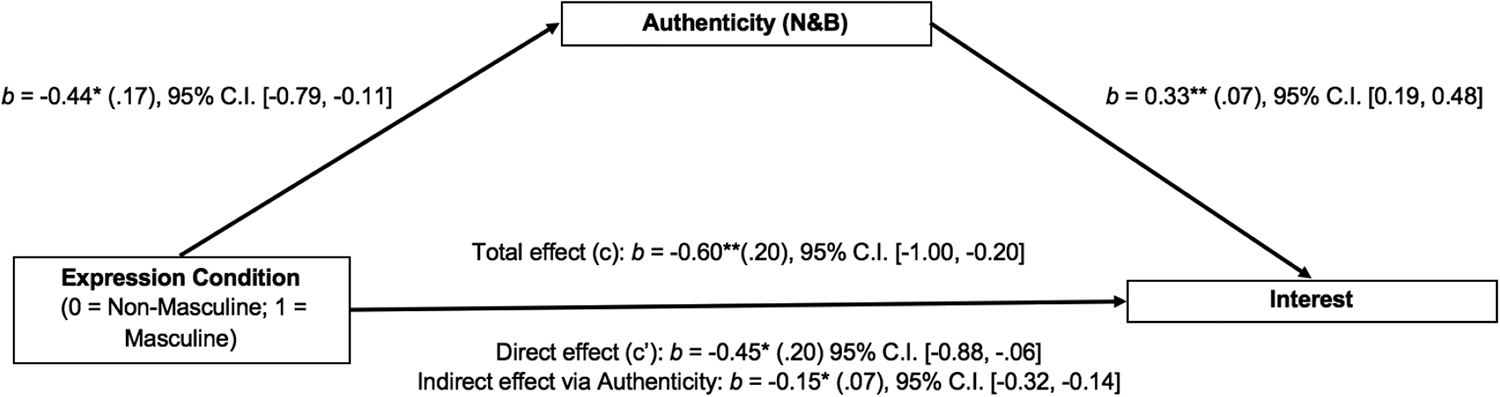
Indirect effect model testing the effect of condition on interest through the Newheiser and Barreto (2014) measure of authenticity in Study 2. *p < .05. **p < .01.
Moderation by Gender Identification
Finally, we examined the potential moderating influence of gender identity (as indexed by the PAQ) on each of the measures of authenticity and the indirect effects noted above. We did this using the PROCESS macro for SPSS (Hayes, 2013, Model 7). Feminine and masculine identification and their interactions with condition were entered simultaneously into these models so that the effects of feminine and masculine identification were statistically isolated. Gender identification variables were mean-centered, and experimental condition was dummy-coded in these analyses.
For the Newheiser and Barreto (2014) measure, there were significant Condition × Masculine Identification, b = .72, SE = .28, t(234) = 2.60, p = .010, and Condition × Feminine Identification interactions, b = −.77, SE = .31, t(234) = 2.47, p = .014. A probe of the Condition × Masculine Identification interaction using the Johnson-Neyman technique (Spiller et al., 2013) revealed that women in the masculine expression condition reported significantly (p ≤ .05) less authenticity than women in the non-masculine condition at values of masculine identification in the 61st percentile and lower (see Figure 3, Panel A). No effect of condition was observed at values above the 61st percentile. A probe of the Condition × Feminine Identification interaction using the Johnson-Neyman technique (see Figure 3, Panel B) revealed that women in the masculine expression condition reported less authenticity than women in the non-masculine condition at values of feminine identification above the 41st percentile. No effects emerged at values below the 41st percentile on feminine identification. Finally, both masculine-identification (moderated mediation index = .21, 95% CI [.05, .45]) and feminine-identification (moderated mediation index = −.21, 95% CI [−0.57, −0.02]) moderated the indirect effect of condition on interest. The indirect effect of masculine expression on interest through the Newheiser and Barreto (2014) measure emerged for women low in masculine (−1 SD) identification (b = −.25, 95% CI [−0.51, −.08]) and high in feminine (+1 SD) identification (b = −.23, 95% CI [−0.48, −.06]).
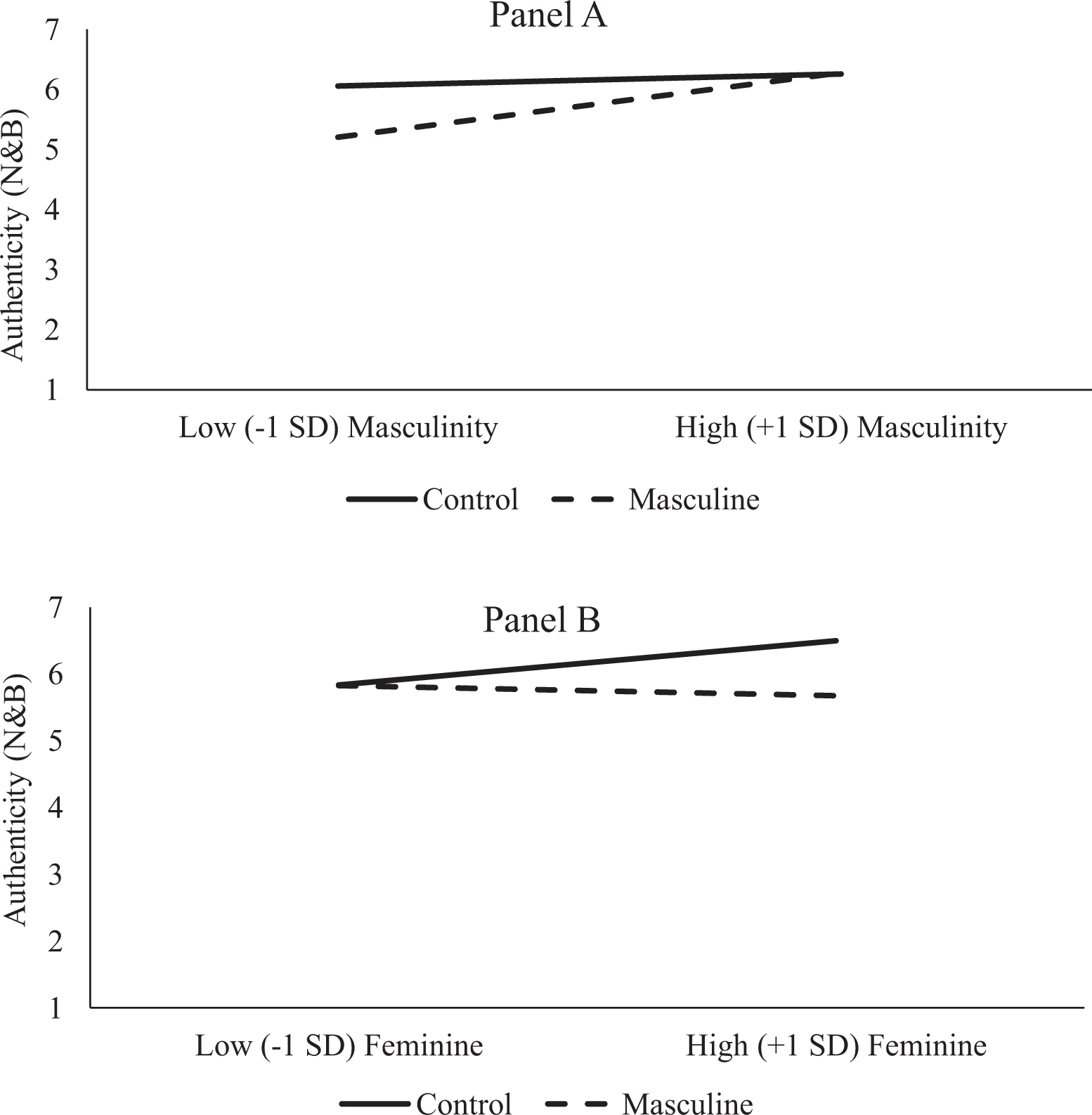
Condition × Masculine Identification and Condition × Feminine Identification interactions on the Newheiser and Baretto (2014) measure of authenticity in Study 2. Higher scores on the y-axis reflect greater feelings of authenticity.
For the reverse-scored, self-alienation measure, there were no significant Condition × Masculine Identification, b = .23, SE = .26, t(234) = 0.87, p = .388, or Condition × Feminine Identification interactions, b = −.11, SE = .30, t(234) = 0.37, p = .715. There was also no evidence of moderated-mediation involving masculine or feminine identification.
For the authentic living measure, there was a significant Condition × Feminine Identification interaction, b = −.77, SE = .32, t(234) = 2.42, p = .017, but the Condition × Masculine Identification interaction, b = .29, SE = .29, t(234) = 1.02, p = .307, was not significant. A probe of the Condition × Feminine Identification interaction using the Johnson-Neyman technique revealed that women in the masculine expression condition reported significantly less authenticity than women in the non-masculine condition at values of feminine identification above the 91st percentile. Women in the masculine expression condition reported significantly more authenticity than women in the non-masculine condition at values of feminine identification below the 8th percentile. There was also evidence of moderated mediation on the authentic living measure (moderated mediation index = −.21, 95% CI [−0.54, −0.04]) such that the negative indirect effect of masculine expression on interest through authentic living was significant for women high (+1 SD) in feminine identification (b = −.12, 95% CI [−0.34, −0.01]).
Discussion
Consistent with Study 1, Study 2 revealed a negative effect of women’s masculine expression on the Newheiser and Baretto (2014) measure of authenticity, which provides additional support for the hypothesis that expressing masculine characteristics in certain contexts can undermine women’s feelings of being authentic. In addition, and in contrast to Study 1, Study 2 found that feminine identification significantly moderated the effect of masculine expression on two of the three measures of authenticity. The negative effect of masculine expression was observed for women high in feminine identification on both the Newheiser and Baretto (2014) measure and the Wood et al. (2008) authentic living measure. There was also evidence that masculine identification moderated the effect on the Newheiser and Baretto (2014) measure such that women low in masculine identification experienced less authenticity after expressing masculine characteristics. Although these interactive effects suggest that women who experience a lack of self-concept fit might be most vulnerable to the negative effect of masculine expression on feelings of authenticity, it is important to note that these interactive effects did not emerge in Study 1. It is possible that the smaller sample size in Study 1 and the different response formats on the PAQ across these studies contributed to these inconsistencies. Regardless, tests of the indirect effects indicated that masculine expression was indirectly associated with lower interest in the position through authenticity most consistently at high (but not low) levels of feminine identification and at low (but not high) levels of masculine identification for the Newheiser and Baretto (2014) measure. This suggests that the threats to authenticity engendered by written applications that induce a need for masculine expression may be most significant among women who identify strongly with femininity or weakly with masculinity. Of course, most initial written applications are followed by in person interviews that might introduce a more potent threat to authenticity, such as that engendered in Study 1, even for women lower in feminine identification and higher in masculinity. Regardless, the overall pattern of results converges with those of Study 1 but additionally suggests that written expressions of masculinity might exert their effects most strongly on women whose gender identification does not fit with an explicitly masculine environment.
General Discussion
The primary goal of this research was to broadly test whether displaying masculine characteristics would lead women to feel less authentic. We explored this question in the context of hypothetical job applications for a science related position. Because masculine traits are typically valued above feminine traits in science (Handley et al., 2015; Saunders & Easteal, 2013), and inauthenticity is thought to reflect a lack of perceived fit with one’s environment (Schmader & Sedikides, 2018), we hypothesized that women induced to express masculine characteristics would feel less authentic than women induced to express non-masculine characteristics. The results from Study 1 supported this hypothesis. Women who displayed masculine (vs. non-masculine) traits during a video audition reported feeling less authentic. In Study 2, expressing masculine (vs. non-masculine) characteristics on paper generally led to lower levels of authenticity among women relatively high in feminine identification and among women relatively low in masculine identification.
A secondary focus of this research was to examine whether the inauthenticity experienced as a result of expressing masculine characteristics may have downstream consequences for women’s interest in the hypothetical science job that they were ostensibly applying for. Findings from both studies indicated that, to the extent that displaying masculine characteristics led to lower felt authenticity, women who were primed to express masculine characteristics reported less interest in the hypothetical science position. This effect was moderated by feminine identification and masculine identification in Study 2 such that authenticity mediated the effect of masculine expression on interest among women high in feminine identification and low in masculine identification. These conditional indirect effects emerged most consistently on the Newheiser and Barreto (2014) measure. In general, these results are notable and consistent with the Schmader and Sekikides (2018) model of authenticity as experienced fit. This model posits that the experience of inauthenticity carries with it an avoidant behavioral orientation that can impact people’s experiences in domains where they feel inauthentic. Our secondary findings suggest that women may feel less interested in pursuing opportunities in a science context to the extent that they experience less authenticity in that context. Thus, authenticity may be a contributing factor to women’s disengagement with domains that are dominated by masculine culture.
Women’s Authenticity in Masculine Contexts
Our findings highlight a potentially important consequence for some women who express masculine characteristics in occupational settings. The psychological effects of inauthenticity are well-documented and include outcomes such as heightened negative affect, anxiety, depression, and a lack of meaning in life (Rivera et al., 2019). There are interpersonal costs as well. For example, people who conceal a devalued identity, such as mental illness, have less successful social interactions with others because the very act of hiding one’s stigmatized identity will increase feelings of rejection for both the person hiding the identity and the interaction partner, limiting overall closeness and acceptance (Newheiser & Baretto, 2014). If a person feels that their behavior is not authentic, perhaps because they are presenting themselves in ways that express stereotypically valued characteristics, then a diminished sense of authenticity can threaten a sense of belonging and undermine what might otherwise be positive social interactions. Since social interactions are, in many ways, vital to connecting with people in one’s field, establishing a reputation, and achieving career goals, it is reasonable to speculate that this cost may be critical to women’s experiences in fields stereotypically characterized by masculinity.
In addition, our findings linking authenticity to interest in the hypothetical science position suggest that shifts in authenticity may contribute to women’s higher dropout rates and the persistent gender disparities in masculine fields. The anticipated, sought, or actual experience of interest is a fundamentally important phenomenological predictor of career paths that people invest in and choose to pursue (Thoman et al., 2014; see also Harackiewicz et al., 2016). Research indicates, for example, that interest predicts the academic major a college student will choose (Harackiewicz et al., 2002) and that people are more interested in career paths when those paths fit internalized motives (Allen et al., 2015). Our studies suggest that authenticity may be an important intervening variable between pressures to portray masculinity and a diminished sense of interest in science positions. It may even be part of a negative cycle in which declines in authenticity and interest reciprocally influence one another. Indeed, suggestive longitudinal research indicates that authenticity and motivation predict changes in each other (J. Kim et al., 2018), suggesting that this process might have temporally enduring effects.
More broadly, our work is some of the first to shed light on a causal process underlying the experience of state authenticity in science settings. They are particularly compatible with Schmader and Sedikides’s (2018) model of state authenticity, which posits that state authenticity is an indication of psychological fit across various levels. At the level of motivations, there is little doubt that many contexts are discordant with the motives of groups who are underrepresented in those contexts. For instance, work derived from goal congruity theory (Diekman et al., 2017) suggests that stereotypically masculine contexts are not typically perceived to provide opportunities to pursue communal goals (Diekman et al., 2010), which is discordant with the communal orientation stereotypically attributed to females and the roles that they traditionally fill in society. In addition, women who do not identify with the gendered characteristics that are valued in a masculine setting may be most at risk of experiencing a lack of fit between the setting and their self-concept. This might explain why we observed a pattern in Study 2 indicating that the negative effects of masculine presentation were strongest for women high in feminine identification and low in masculine identification.
Limitations and Future Directions
The possibility that experiential fit across various levels (e.g., self-concept, social) plays a role in these effects also highlights a limitation of our current studies. While we suspect that level of fit is a strong candidate for the proximal mechanism linking masculine expression to authenticity, we did not directly test how our manipulations influenced the experience of psychological fit, and our findings are silent regarding fit as a critical mechanism of these effects. Our work does, however, offer some suggestive hints that feelings of morality might be a mechanism that contributes to diminished authenticity. Both studies revealed that the effect of masculine expression on our authenticity measures was most pronounced on a measure that asks participants to indicate how honest, trustworthy, and in accord with their conscience they felt. Newheiser and Barreto (2014) referred to this measure as indicative of authenticity and found that it was particularly relevant for understanding the experiences of people who are induced to mask a stigmatized identity. We included this measure as an index of authenticity to connect our studies to this influential earlier work. However, we do have concerns that feelings of honesty and the like are not directly indicative of authenticity as it is typically conceived in psychological science (Wood et al., 2008). Existing work on authenticity might even suggest that moral feelings, such as those captured by feelings of being honest and trustworthy, give rise to feelings of authenticity due to the fact that people tend to think of true selves as fundamentally tethered to morality (Christy et al., 2016; Strohminger & Nichols, 2014). Of course, the stronger effects on this measure across the studies could also be due to the fact that participants responded to these items specifically based on how they felt during the interview tasks. The other authenticity measures asked participants to respond based on how they felt “right now, at this moment.” The stronger effects may therefore be due to the closer psychological connection between that measure and people’s feelings about the interview experience. Future research could address that possibility, as well as test for theoretically plausible mechanisms such as psychological fit.
The specificity of these effects to women should also be clarified in future research. We attempted to do so in Study 2 but were ultimately unsuccessful in recruiting enough men to meaningfully analyze their data. This is a limitation of our studies. It is possible, given the role of gender identification for some of these effects, that men high in feminine (or possibly low in masculine) identification will report the same types of effects as women who identify similarly. However, given that more women will be high in feminine (or low in masculine) identification at the population level, evidence that men high in femininity (or low in masculinity) might also experience lower levels of authenticity in these settings does not undermine the practical argument that women, on average, may be more vulnerable to them. The inability to test the importance of other demographic variables (e.g., race/ethnicity), particularly in Study 1, is also a notable limitation that future research should address. Likewise, studies that examine how more implicit or subtle messages about a culture of masculinity (e.g., Cheryan et al., 2009) influence women’s felt authenticity would substantially broaden the limited scope of our focus on explicit messages. Although data suggest that job advertisements in traditionally masculine domains do contain gendered language (Gaucher et al., 2011), our explicit laboratory instructions to self-present in masculine ways may have been more direct than what is typically encountered in the real world. Finally, research using a multi-method approach to complement our limited self-report findings should be carried out. Behavioral measures of motivation and interest, in particular, would improve upon our foundational studies and better elucidate how expressing masculinity influences women’s experience of authenticity and engagement in domains that are characterized by a masculine culture.
Practice Implications
Although more work is clearly needed, our findings do point to some notable practical implications regarding women’s experiences in fields that are stereotypically associated with masculinity. The idea that gendered-stereotypes can thwart women’s aspirations in certain careers is certainly not new, and interventions to increase women’s interest in these careers often feature direct efforts to challenge or alter those stereotypes (Cheryan et al., 2013). Our work certainly resonates with these perspectives and suggests that explicit connections between masculinity and a laboratory position may create a less authentic psychological experience for women pursuing that position. Similar to calls for action to change hiring practices and policies that disadvantage women faculty in STEM (Mitchneck et al., 2016; Smith et al., 2015), our results point to the need for faculty researchers and lab managers to reconsider and reimagine their hiring practices for research assistants who do not emphasize masculinity. Our work also informs counseling and coaching strategies that too often try to “fix the student” to adapt to the demands of a given situation to win the STEM job (Fox et al., 2009) and suggests the very act of “fitting in” may backfire and undermine motivation. This is because people hold lay assumptions that feelings of authenticity should be used as a guide to determine the most satisfying aspiration (Rivera et al., 2019). Application settings that allow for the authentic expression of the self could be one way to help solve the perpetual problem of the loss of undergraduate women in STEM fields (Seymour & Hunter, 2019).
In addition, our work highlights a potential psychological pitfall for women who adopt a “lean-in” (Sandberg, 2013) inspired mantra and increase their conformity to masculine norms in occupational settings in order to be successful. Indeed, our findings align with other work on the misgivings and consequences of the lean-in message (J. Y. Kim et al., 2018; Smith & Huntoon, 2014) and suggest that adhering to masculine norms may lead many women to experience feelings of inauthenticity, which, in addition to thwarting motivation, have detrimental consequences for psychological health and well-being (Rivera et al., 2019). Thus, from a practical standpoint, our findings imply that efforts to improve women’s motivation for, and psychological experiences in, stereotypically masculine contexts should focus on mitigating the connections between masculinity and those contexts first and foremost.
Conclusion
Overall, our findings make a novel point about the potential relationship between masculine expression and women’s experiences in masculine settings. Of course, some women may desire to express themselves and perform their gender in very masculine ways. That said, on average, expressing masculine characteristics compromised women’s sense of feeling authentic, which is a fundamentally central aspect of well-being, and influenced women’s subsequent interest in a science position. This suggests that an explicit effort to fit in may unfortunately lead women to feel like their actions do not align with who they truly are. Women should, therefore, not be encouraged to fit in with gendered norms; rather, policies and interventions should focus on mitigating beliefs that certain gendered characteristics are necessary for success in stereotypically masculine domains and allow women to present themselves in ways that foster a sense of authenticity.
Supplemental Material
Supplemental Material, Dormanen_Sanders-et_al - Assimilation Undercuts Authenticity: A Consequence of Women’s Masculine Self-Presentation in Masculine Contexts
Supplemental Material, Dormanen_Sanders-et_al for Assimilation Undercuts Authenticity: A Consequence of Women’s Masculine Self-Presentation in Masculine Contexts by Rose Dormanen, Courtney S. Sanders, Joseph Maffly-Kipp, Jessi L. Smith and Matthew Vess in Psychology of Women Quarterly
Footnotes
Declaration of Conflicting Interests
The author(s) declared no potential conflicts of interest with respect to the research, authorship, and/or publication of this article.
Funding
The author(s) received no financial support for the research, authorship, and/or publication of this article.

Note
References
Supplementary Material
Please find the following supplemental material available below.
For Open Access articles published under a Creative Commons License, all supplemental material carries the same license as the article it is associated with.
For non-Open Access articles published, all supplemental material carries a non-exclusive license, and permission requests for re-use of supplemental material or any part of supplemental material shall be sent directly to the copyright owner as specified in the copyright notice associated with the article.
