







Abstract
In digital spaces, Black women's natural physical characteristics are marginalized by racially biased photo-editing technologies. This has implications for Black women who are vulnerable to appearance concerns at the intersections of dual pressures to adhere to white and culturally specific body and appearance ideals (i.e., double consciousness body image). In this cross-sectional online survey-based study, we applied aspects of the tripartite influence model to examine whether double consciousness body image internalization was associated with body image- and facial image-based photo editing among 354 young Black women. In doing so, we considered photo editing as a behavior reflective of social pressures to adhere to sociocultural appearance ideals promoted in digital spaces. Additionally, we explored the potential moderating role of online victimization in the associations between double consciousness body image internalization and photo editing. Double consciousness body image internalization was significantly positively associated with body image- and facial image-based photo editing. Online victimization moderated the associations between double consciousness body image internalization and both body image- and facial image-based photo editing, such that these relations were stronger at higher frequencies of online victimization. We discuss the implications of our findings for promoting young Black women's healthy body image and safety on social media platforms.
Keywords
Photo editing (i.e., manipulating photos prior to display or distribution) is widespread given the rapid advancements in augmented reality and facial recognition technologies in the past decade (Gioia et al., 2023; Swerzenski, 2021). Social media platforms, such as Instagram, Snapchat, and TikTok, offer standard and augmented reality photo-editing beauty filters for users to alter their appearance in photos (Gioia et al., 2023). Standard beauty filters can be used to smooth the appearance of skin, apply virtual makeup, lighten eyes, and alter skin tone (Mihaila & Braniste, 2021). Augmented reality beauty filters use artificial intelligence and computer vision to modify body and facial imagery in real time, including to align more closely with white appearance ideals, such as smaller facial features, larger eyes, defined chin, and thinness (Mihaila & Braniste, 2021). Photo-editing tools and beauty filters have been critiqued as reinforcing unrealistic standards of beauty to the detriment of young people's body image (Beos et al., 2021; Schroeder & Behm-Morawitz, 2024). Recently, scholars have begun to explore racial biases in artificial intelligence, digital algorithms, and beauty filters (Riccio et al., 2024; Riccio & Oliver, 2023). For instance, a recent study using computer vision algorithms found that beauty filters transformed faces (i.e., skin tone, facial features) to conform to white beauty ideals (Riccio et al., 2024). Still, research examining Black women's body image in relation to photo editing is lacking despite having potential far-reaching social and psychological implications for Black women whose natural features are marginalized and devalued in digital spaces.
The use of culturally specific measures is necessary when investigating Black women's body image and photo-editing behaviors. There is a long history of racial bias in photographic media. Since its invention, the medium of photography has relied on celluloid film and digital sensors that are calibrated for White skin tones. In the mid-1990s, enhancements to the standard “Shirley card” (skin color reference cards used to calibrate skin tone) were developed to address this structural bias in photographic technology; however, the adaptations also relied on lighter-skinned models which functioned to reinscribe biased photographic norms and social notions of whiteness as the default (Hawley, 2024; Lewis, 2019; Roth, 2009). Consequentially, Black women have been underrepresented in mainstream media, and those featured predominantly approximate white beauty ideals—typically portrayed as young, slender, with lighter skin tones, smaller facial features, and straightened hair (Boepple & Thompson, 2018; Jankowski et al., 2017; Perkins et al., 2023).
These restricted portrayals send a clear and persistent message about which appearances are deemed most beautiful, thereby engendering limited access to cultural and economic capital. As a result, many Black women internalize these beauty ideals, and pressures to conform can lead to heightened use of photo-editing technologies in social media-based self-portrayals. Prior studies have reported Black women's internalization of white appearance ideals (Avery et al., 2021; Awad et al., 2015; Capodilupo & Kim, 2014; Jones & Shorter-Gooden, 2003) while also idealizing Black cultural feminine appearance ideals, such as having bigger buttocks, smooth skin, a toned/muscular physique, bigger breasts, and a curvier body figure (Capodilupo, 2015; Hunter et al., 2020; Kelch-Oliver & Ancis, 2011; Overstreet et al., 2010). Yet, Black women's double consciousness body image internalization, which involves simultaneously embracing white and Black cultural body and appearance ideals, remains understudied (Wilfred & Lundgren, 2021).
This study aimed to address the dearth of research on young Black women's double consciousness body image and photo-editing behaviors. We focused specifically on participants aged 18–30 given this age segment's substantially higher usage of visual content-based social media platforms, such as Instagram and TikTok, relative to other age groups in the United States (Pew Research Center, 2024). Younger women are also shown to have lower body appreciation than older women (Frederick et al., 2022; Tiggemann & McCourt, 2013). Furthermore, we focused on this age segment to build on prior research examining Black women's social media use characteristics and risks which have involved samples aged 18–30 (Matsuzaka et al., 2022, 2023; Onuoha et al., 2024; Volpe et al., 2025).
Informed by the tripartite influence model (Thompson et al., 1999), the present study examined the associations between double consciousness body image ideal internalization and body image- and facial image-based photo editing among young Black women. Delineating between body image-based photo editing (i.e., editing photos or parts of photos to manipulate aspects of the body) and facial image-based photo editing (i.e., editing photos or parts of photos to manipulate aspects of the face) may also be advisable given literature highlighting how, for Black women, appearance ideals center around body size and shape as well as facial characteristics (Awad et al., 2015; Wilfred & Lundgren, 2021).
Research examining the associations between Black women's body image and photo editing should also consider the role of online victimization (i.e., harmful social interactions facilitated via digital technologies), which often targets individuals based on their appearance (Tynes et al., 2010; Zimmer-Gembeck et al., 2021). For instance, a prior study found that young Black women who experienced more frequent online sexual victimization (i.e., sexual exploitation, abuse, or harassment in online contexts), which is often appearance-based, had lower body esteem (Matsuzaka et al., 2022). Thus, we explored the potential moderating role of online victimization in the associations between double consciousness body image internalization and body image- and facial image-based photo editing.
Tripartite Influence Model and Photo-Editing Behaviors
The tripartite influence model is a theoretical model of body image disturbance that posits that greater perceived pressure—from peer, parent, and media influences—to adhere to socially desirable body image ideals increases body dissatisfaction via heightened appearance-ideal internalization and appearance comparison tendencies (Thompson et al., 1999). In this study, we applied components of the tripartite influence model to examine the associations between double consciousness body ideal internalization and photo editing. We did not apply the tripartite influence model to explore the mediating influences of appearance-ideal internalization and appearance comparison in the relations between sociocultural appearance influences and body dissatisfaction. Instead, we studied the association between appearance ideal internalization (as measured by double consciousness body image internalization) and sociocultural appearance influences (as measured through photo-editing behaviors). In doing so, we conceived of photo editing as a behavior representative of pressures to adhere to sociocultural appearance ideals, as promoted on media platforms by peers, parents, and other social influences.
Prior research suggests a bidirectional relation between appearance concerns and photo-editing behaviors (Gioia et al., 2023; McGovern et al., 2022; Rodgers & Rousseau, 2022). McGovern et al. (2022) referred to this bidirectional relation as the “feedback loop” whereby photo editing both results from as well as reinforces appearance concerns (p. 506). For instance, adolescent girls’ and young women's investment in an unhealthy appearance has been linked with the use of photo editing to enhance online self-presentation (McLean et al., 2015; Sun, 2021). On the other hand, photo editing has been studied as an antecedent to appearance concerns (Beos et al., 2021; Chang et al., 2019; Lamp et al., 2019; Terán et al., 2020; Tiggemann et al., 2020). Studies conducted in Australia, China, and the United States indicated that photo editing is significantly related to more facial dissatisfaction (Beos et al., 2021; Tiggemann et al., 2020), body surveillance or critiquing your body from an observer's perspective (Lamp et al., 2019), and body shame (Terán et al., 2020). In a study involving Asian, Black, Latina, and white college-aged women in the United States, young Black women's appearance-ideal internalization mediated the relations between Instagram use and a greater desire for the curvy body ideal (Gahler et al., 2023). This study was notable for its incorporation of a nonwhite appearance ideal (i.e., curvy ideal). Still, to our knowledge, no prior studies using the tripartite influence model have included a measure for double consciousness body image internalization. The study by Gahler et al. (2023) was also novel in its use of social media-specific predictors of appearance-ideal internalization, moving beyond the focus on traditional media pressures.
More research is needed to adapt the tripartite influence model to consider the influences of social media among young Black women who have high rates of social media use relative to their white counterparts (Pew Research Center, 2024). Technological advances in software allow people to edit and post visual content featuring highly idealized self-representations onto social media platforms (Chen et al., 2023; Gahler et al., 2023). In turn, these self-representations are open to peer, parental, and social responses ranging from validation through likes, shares, and positive comments, to online victimization via exclusion, harassment, or derogatory comments (Fardouly et al., 2017; Näsi et al., 2014). Applying the tripartite influence model, we explored the moderating role of online victimization as a harmful social interaction through which peer, parental, and other social influences are enacted on media platforms.
The Potential Moderating Role of Online Victimization
Online victimization refers to harmful technology-facilitated social interactions that often target appearance, behaviors, and identities that are marginalized (Tynes et al., 2010). Tynes et al. (2010) conceptualized four different types of online victimization: general online victimization (e.g., name-calling, bullying, or harassment, humiliation), online sexual victimization (e.g., unwanted sexual imagery or messages, sexual solicitation), online individual racial victimization (e.g., personal experiences with racially motivated exclusion, harassment, or threats), and online vicarious racial victimization (e.g., vicarious exposure to others’ experiences with racially motivated exclusion, harassment, or threats). These types of online victimization may be experienced by Black women in unique ways (Volpe et al., 2025). For instance, prior research indicates that Black women experienced various forms of gendered and racialized violence on social media, such as being called an angry Black woman, being sexually objectified or body-shamed, experiencing colorism, and receiving gendered racist comments (Musgrave et al., 2022; Riccio et al., 2024; Volpe et al., 2025).
Musgrave et al. (2022) highlighted how online victimization often targets social groups that experience systemic oppression on the basis of their sex, gender, and racial identities. Indeed, adolescent girls and young women are at greater risk of online victimization than their peers who are boys and men (Sun & Fan, 2018). Black and Latinx women disproportionately experience online harassment in comparison to White women (Francisco & Felmlee, 2022). Women of color across both the United States and the United Kingdom are more likely to receive hostile and negative identity-related tweets on Twitter (Amnesty International, 2018). Furthermore, Black women's bodies and appearance are often targets of victimization at the nexus of sexist and racist discourses that devalue Black women's appearance, although this has yet to be empirically examined in digital contexts (Lewis & Neville, 2015; Matsuzaka et al., 2022).
Appearance is suggested to play an important role in experiences of online victimization (Näsi et al., 2014; Zimmer-Gembeck et al., 2021. Indeed, social interactions have been discussed as a central means by which appearance ideals are reinforced on social media (Näsi et al., 2014). For instance, visual self-presentation on social media, such as posting a selfie, may be met with positive and negative feedback, ranging from likes to harmful comments about appearance (Bell et al., 2018). It is possible that people may engage in photo-editing behaviors in attempts to avoid further experiences of online victimization, although this has yet to be empirically examined. Research has shown that fears of being negatively evaluated by peers are associated with greater engagement in photo editing (Mustafa & Akram, 2022). Thus, in the present study, we conducted a novel investigation of whether the association between appearance ideal internalization and engagement in photo-editing behaviors may vary by the frequency with which participants experience online victimization.
The Current Study
Although previous studies have examined the bidirectional associations between appearance concerns and photo editing among adolescent girls and young women (Chang et al., 2019; Lamp et al., 2019; McLean et al., 2015; Sun, 2021; Tiggemann et al., 2020), young Black women remain underrepresented in this research. It is crucial to understand young Black women's photo-editing behaviors, given that their bodies and facial features are often devalued and excluded in digital spaces due to racial biases in beauty filters (Riccio et al., 2024; Riccio & Oliver, 2023). Specifically, it is critical to examine whether young Black women's internalization of white and Black cultural body ideals and online victimization experiences are associated with their photo-editing behaviors. In the current study, we investigated the potential moderating role of online victimization in the associations between young Black women's double consciousness body image internalization and body image- and facial image-based photo editing (see Figure 1). We controlled for subjective socioeconomic status (SES) in our regression models given prior studies showing that higher SES is associated with a more positive body image (Babayan et al., 2018; Winter et al., 2021). We hypothesized the following:
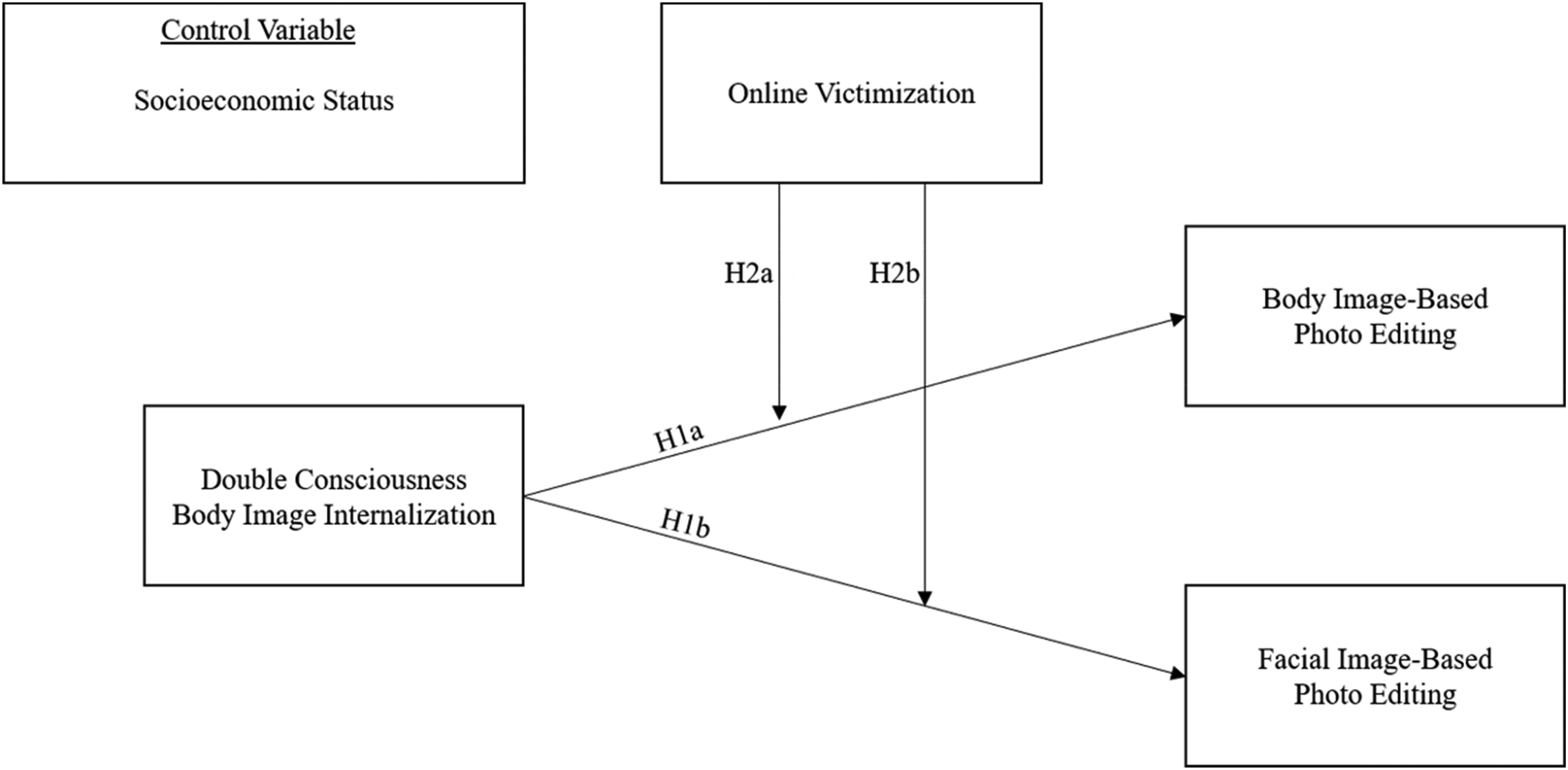
Conceptual framework.
H1: Double consciousness body image internalization would be associated with more (a) body image-based photo editing and (b) facial image-based photo editing.
H2: Online victimization would moderate the association between double consciousness body image internalization and (a) body image-based photo editing and (b) facial image-based photo editing, such that these associations would be stronger at more frequent (vs. less frequent) levels of online victimization.
Method
Participants and Procedure
This study involved a sample of 354 Black American women (Mage = 24.34 years; SDage = 3.70; range = 18–30). Most participants identified as cisgender women (99.7%, n = 353) with one participant (0.3%) identifying as a transgender woman. On average, participants reported having an average SES (MSES = 5.88; SDSES = 2.30; 1 = worst off to 10 = best off; see description below). The majority of the sample identified as heterosexual (75.1%; n = 266), followed by bisexual (17.5%; n = 62), gay/lesbian (4.8%; n = 17), and queer (0.8%; n = 3). Seven participants (1.7%) self-described their sexual orientation. Most participants identified as African American (72.6%; n = 257), followed by 10.2% as biracial or multiracial (n = 36), 9.0% as African (n = 32), 5.4% as Afro-Latina (n = 19), and 2.8% as Caribbean/West Indian (n = 10). The median household income in the sample was $25,000‒$34,999. Our sample reflected a broad distribution of educational levels, with 37.9% (n = 134) having graduated from high school, 25.9% having obtained a college degree (n = 92), and 6.0% (n = 21) having completed graduate school. Approximately one-third of our sample was currently enrolled in college (n = 120). Most reported working full-time (37.3%; n = 132) or part-time (20.6%; n = 73) and over one-third were unemployed, either as full-time students (17.8%; n = 63), nonstudents (17.5%; n = 62), or as stay-at-home parents (6.8%; n = 24).
Upon receiving institutional review board approval at a large Southeastern university, we recruited participants through Qualtrics Panels. Qualtrics Panels partners with panel organizations to recruit high quality samples from geographically diverse regions in the United States, such as the East, Midwest, South, and West. Data for this study are from a larger cross-sectional United States-based study in 2022 that investigated Black women's digital media use, identities, and mental health. Participants were required to self-identify as Black women between the ages of 18 and 30. Prior to taking the survey hosted on Qualtrics, participants reviewed a study description and provided informed consent. The survey took approximately 25 min to complete and included multiple attention checks. Upon survey completion, participants reviewed a debriefing form and received details on compensation. Participants who completed the survey received compensation from Qualtrics Panels in the form of their choosing, whether gift cards, game points, cash, airline miles, and other options. Given their direct handling of compensation, we did not have access to compensation details (Boas et al., 2020).
Measures
Double Consciousness Body Image
We used the 34-item unidimensional Double Consciousness Body Image Scale (DCBIS; Wilfred & Lundgren, 2021) to measure double consciousness body image internalization. Sample items included: “I feel pressure from society to have a small nose” and “I have had or have seriously considered surgery to make my butt bigger.” Participants indicated their agreement with statements on a 5-point scale (1 = never to 5 = always). Mean scores were computed such that higher scores indicated greater double consciousness body image internalization. The DCBIS has shown convergent validity with other measures related to body image and disordered eating. The DCBIS had excellent internal consistency in a sample of Black American women (α = .96; Wilfred & Lundgren, 2021) and with our sample (α = .98).
Online Victimization
We used the 21-item Online Victimization Scale (OVS; Tynes et al., 2010) to measure online victimization. The OVS was validated in a sample of young Black American women as having a four-factor structure: general online victimization, online individual racial victimization, online vicarious racial victimization, and online sexual victimization (Matsuzaka et al., 2022). In this study, we assessed online victimization from a unidimensional perspective given our desire to understand online victimization as an aggregate measure. Sample items included: “People have said negative things about how I look, act, or dress online” and “People have said mean or rude things about me because of my race or ethnic group online.” Participants rated the frequency of their experiences of online victimization on a 5-point scale (1 = never to 5 = always). Mean scores were computed such that higher scores indicated more frequent online victimization. The OVS has shown evidence of convergent validity, with positive correlations with anxiety and stress (Tynes et al., 2010). In a study involving young Black American women, the subscales in the OVS showed good to excellent internal consistency (αrange = .87–.95; Matsuzaka et al., 2022). In this study, the OVS showed excellent internal consistency (α = .96).
Body Image- and Facial Image-Based Photo Editing
We used two subscales of the Adapted Photo Manipulation Scale-R (APM-R; Gioia et al., 2023; McLean et al., 2015) to measure body image- and facial image-based photo editing. Specifically, we used the three-item body image-based photo-editing subscale (e.g., “How often do you make a specific part of your body look larger or look smaller?”) and the two-item facial identity-based photo-editing subscale (e.g., “How often do you edit or use apps to smooth skin?”). We did not use the filter use subscale (e.g., “How often do you adjust the light/darkness of the photo?”) because of its focus on changing the aesthetics of the photo at-large versus editing aspects of individual appearance. Participants indicated how frequently they engaged in photo editing on a 5-point scale (1 = never to 5 = always). Mean scores were computed for each subscale with higher scores indicating more photo editing. This APM-R was validated among a sample of Italian adolescents and shown to have acceptable internal consistency (αbody = .75; αfacial = .74). In the present study, the body image-based photo-editing subscale had good reliability (α = .87). Based on the Spearman–Brown formula, the facial image-based photo-editing subscale had a good predicted reliability of .82.
Subjective SES
We used Adler and colleagues’ (2000) measure to capture participants’ subjective SES. Participants viewed an image of a ladder and indicated their socioeconomic position using a 10-point scale (1 = worst off to 10 = best off).
Analytic Approach
We used Statistical Package for Social Sciences (SPSS 28.0) to calculate descriptive statistics and bivariate correlations among the study variables. We used Pearson correlation tests to examine the correlations between SES, double consciousness body image internalization, online victimization, and body image- and facial image-based photo editing. Hierarchical multiple regression models were constructed to test our hypotheses. In step 1, we entered subjective SES as a control variable. In step 2, we added double consciousness body image internalization and online victimization. In step 3, we added the interaction term between double consciousness body image internalization and online victimization. The variables used to compute the interaction term were mean centered (Aiken et al., 1991). For moderation analysis using simple slopes testing, we plotted the interactions at low (1 standard deviation below the mean) and high (1 standard deviation above the mean) levels of double consciousness body image internalization and online victimization (Dawson, 2014).
Results
Preliminary Analyses
See Table 1 for descriptive statistics and bivariate correlations among our study variables. Subjective SES was weakly positively correlated with body image-based photo editing and facial image-based photo editing. Subjective SES was not significantly associated with double consciousness body image internalization or online victimization. Double consciousness body image internalization was strongly positively associated with online victimization, while being moderately positively associated with body image-based photo editing and facial image-based photo editing. Online victimization was moderately positively associated with body image-based photo editing and facial image-based photo editing. Body image- and facial image-based photo editing were strongly positively correlated.
Descriptive Statistics and Bivariate Correlations Among Main Study Variables.
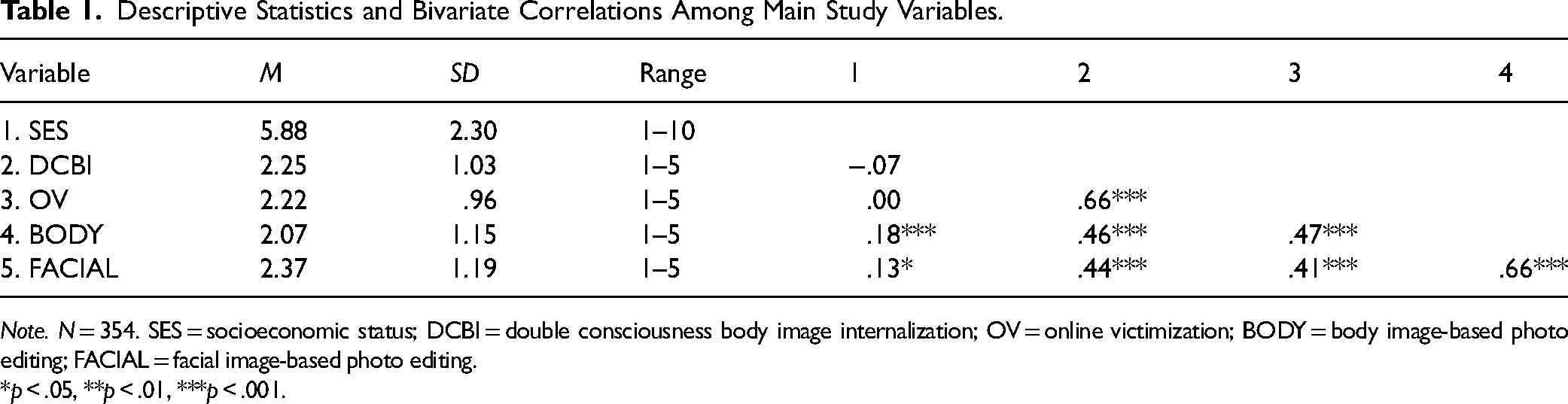
Note. N = 354. SES = socioeconomic status; DCBI = double consciousness body image internalization; OV = online victimization; BODY = body image-based photo editing; FACIAL = facial image-based photo editing.
*p < .05, **p < .01, ***p < .001.
Testing the Hypotheses
As shown in Table 2, the final regression model predicting body image-based photo editing was significant and accounted for 30.2% of the adjusted variance, F(4, 349) = 39.15, p < .001, R2 = .31. In step 1, the model was significant, F(1, 352) = 11.25, p < .001, R2 = .03. The inclusion of subjective SES as a control variable predicted 2.8% of the adjusted variance, ΔR2 = .03, F(1, 352) = 11.25, p < .001. In step 2, the model was significant, F(3, 350) = 49.81, p < .001, R2 = .30. The inclusion of double consciousness body image internalization and online victimization in this step contributed significantly to the model, ΔR2 = .27, F(2, 350) = 66.99, p < .001. In the final step, the addition of the interaction term contributed slightly to the model, ΔR2 = .01, F(1, 349) = 5.31, p = .02.
Final Models Predicting Body Image- and Facial Image-Based Photo Editing.
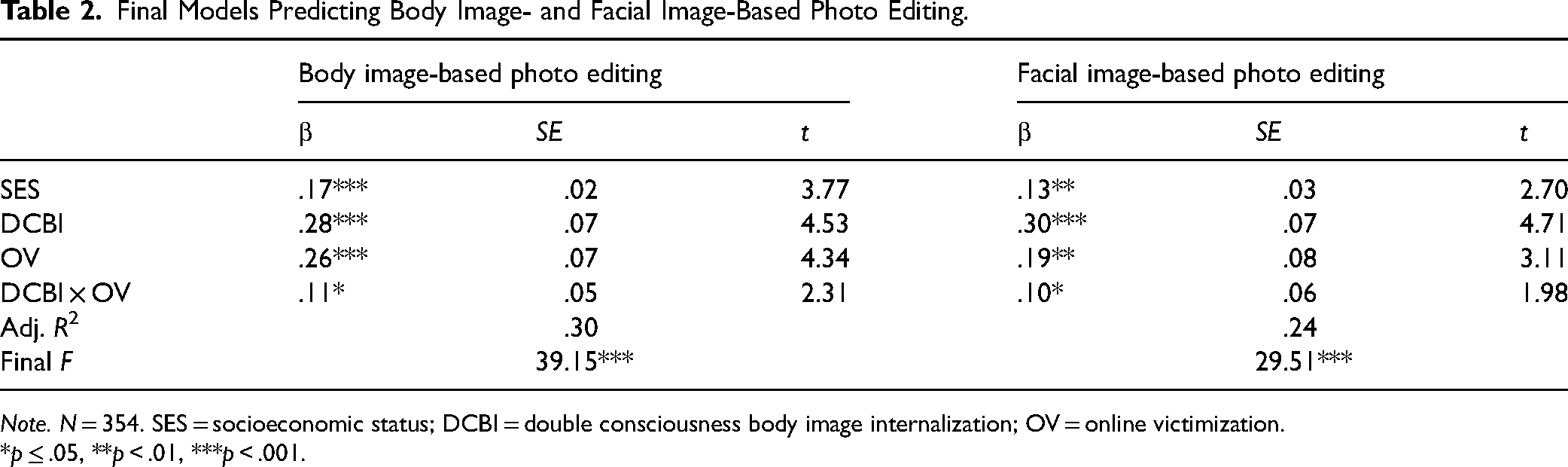
Note. N = 354. SES = socioeconomic status; DCBI = double consciousness body image internalization; OV = online victimization.
*p ≤ .05, **p < .01, ***p < .001.
The final regression model predicting facial image-based photo editing was significant and accounted for 24.4% of the adjusted variance, F(4, 349) = 29.51, p < .001, R2 = .25. In step 1, the model was significant, F(1, 352) = 5.88, p = .02, R2 = .02. The inclusion of subjective SES as a control variable predicted 1.4% of the adjusted variance, ΔR2 = .02, F(1, 352) = 5.88, p = .02. In step 2, the model was significant, F(3, 350) = 37.73, p < .001, R2 = .24. The inclusion of double consciousness body image internalization and online victimization in step 2 contributed significantly to the model, ΔR2 = .23, F(2, 350) = 52.78, p < .001. In the final step, the addition of the interaction term contributed slightly to the adjusted variance, ΔR2 = .01, F(1, 349) = 3.92, p = .048.
H1 tested whether double consciousness body image internalization would be associated with more (a) body image-based photo editing and (b) facial image-based photo editing. H1a and H1b were supported. Double consciousness body image was associated with more body image-based photo editing (H1a), β = .28, t[349] = 4.53, p < .001, and more facial image-based photo editing (H1b), β = .30, t[349] = 4.71, p < .001. These findings suggest that young Black women with higher levels of double consciousness body image internalization were more likely to engage in both body image- and facial image-based photo editing.
H2 tested whether online victimization would moderate the association between double consciousness body image internalization and (a) body image-based photo editing and (b) facial image-based photo editing, such that these associations would be stronger at more frequent levels of online victimization. H2a and H2b were supported. Results indicated that online victimization significantly moderated the association between double consciousness body image and body image-based photo editing (H2a) (
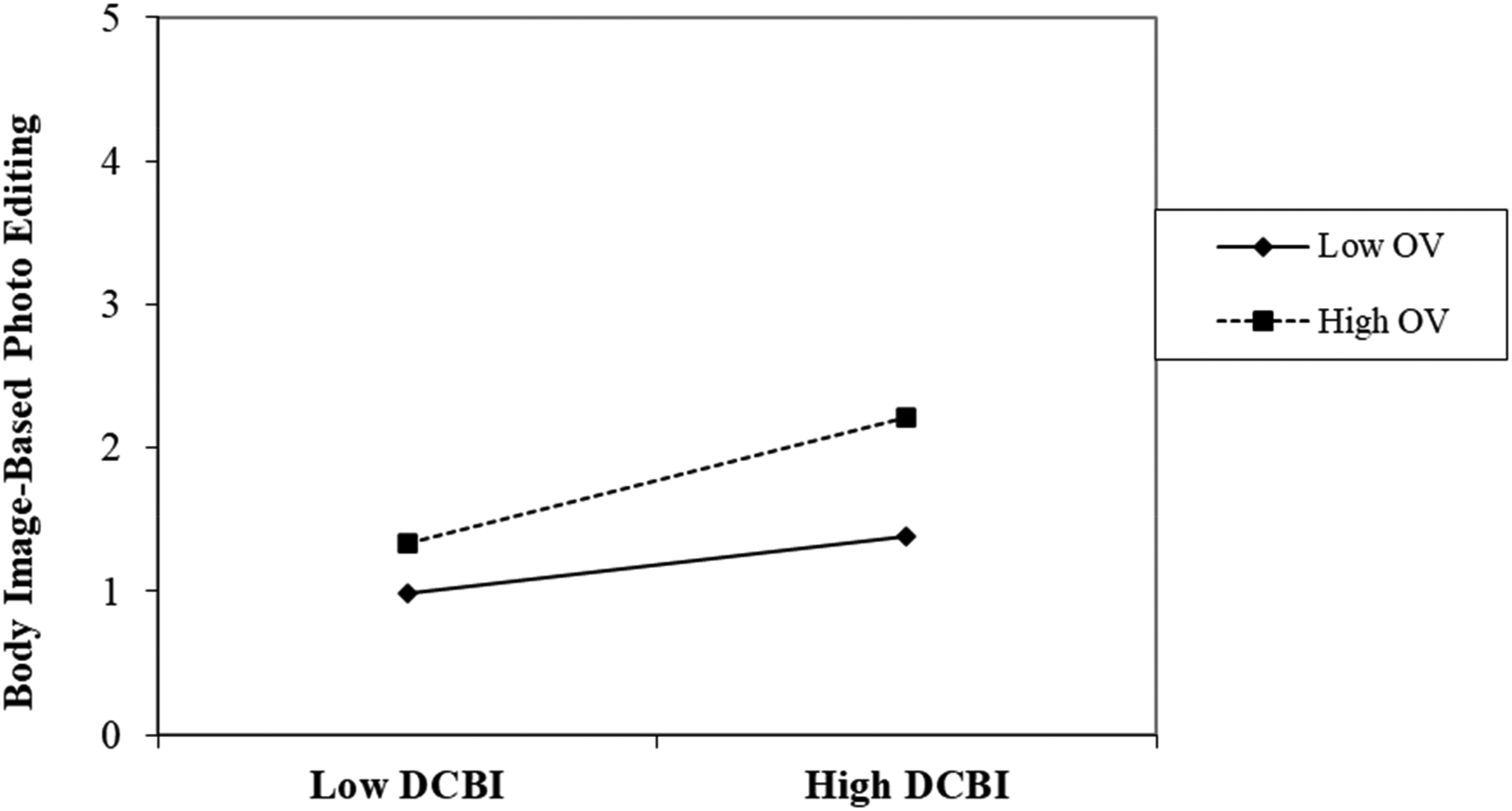
Simple slopes analysis of the associations between double consciousness body image- and body image-based photo editing at two levels of online victimization.
Results indicated that online victimization also moderated the association between double consciousness body image internalization and facial image-based photo editing (H2b) (
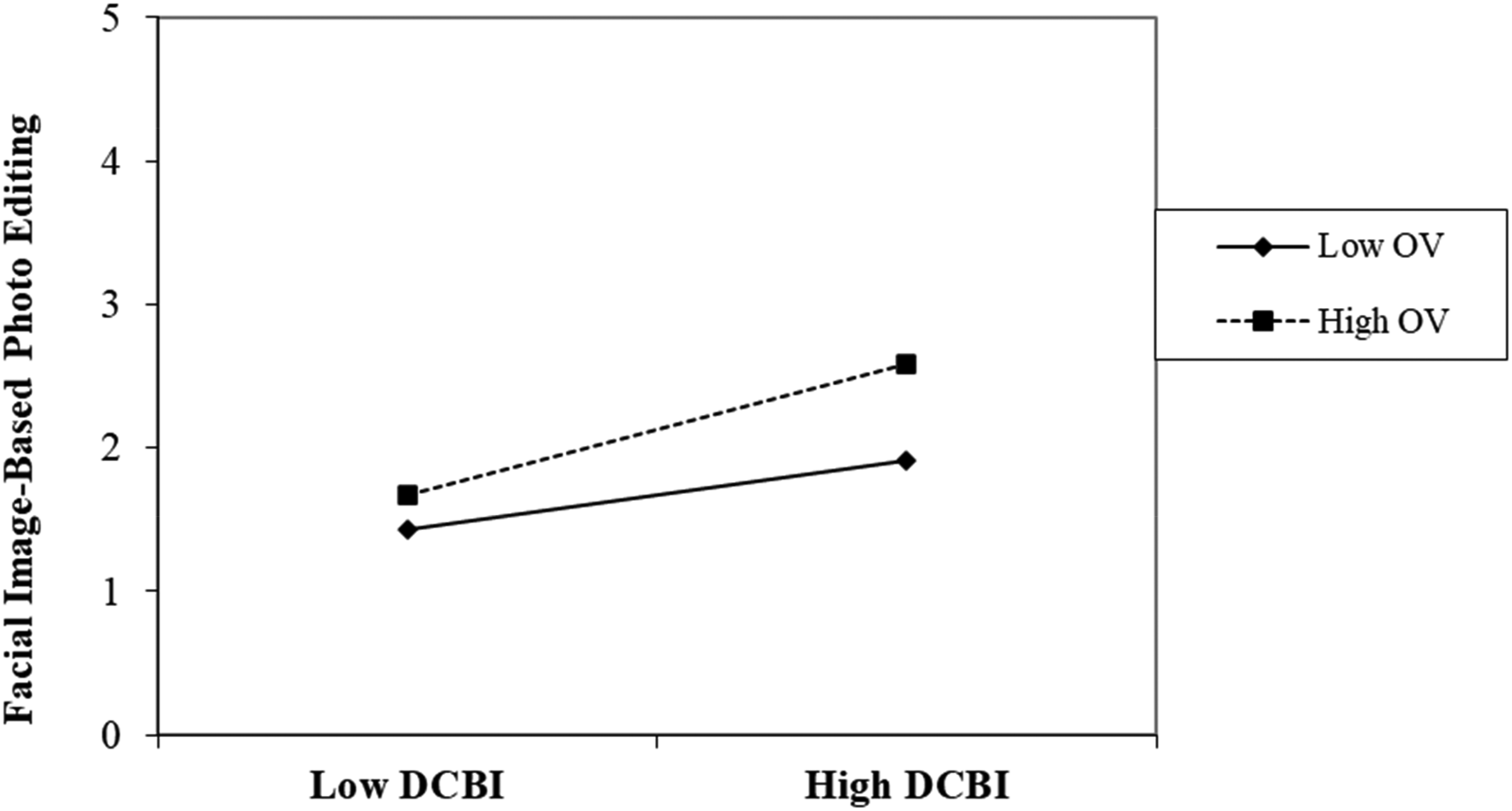
Simple slopes analysis of the associations between double consciousness body image- and facial image-based photo editing at two levels of online victimization.
Discussion
Informed by the tripartite influence model, the purpose of this study was to examine the associations between young Black American women's double consciousness body image internalization and body image- and facial image-based photo editing as well as the potential moderating role of online victimization in these associations. Consistent with our first hypothesis, we found that participants with greater internalization of double consciousness body image ideals were more likely to engage in photo editing of both their bodies and faces. Consistent with our second hypothesis, the associations between participants’ internalization of double consciousness body image ideals and their body image- and facial image-based photo editing were stronger among participants who experienced more frequent online victimization.
This study contributes to the literature in a few ways. First, this study answers the call for the use of more culturally relevant measures in research examining Black women's body image (Matsuzaka et al., 2022; Watson et al., 2019; Wilfred & Lundgren, 2021). In doing so, we provide novel insights into the association between young Black women's double consciousness body image internalization and photo-editing behaviors. Second, we contribute to an emerging body of literature examining Black women's body image in social media contexts (Frederick et al., 2022; Gahler et al., 2023; Matsuzaka et al., 2022). This includes building on prior tripartite influence model-informed research showing the associations between social media-specific variables and appearance-ideal internalization (Gahler et al., 2023). Specifically, we provide evidence of the association between appearance ideal internalization (i.e., double consciousness body image internalization) and sociocultural appearance influences (i.e., photo-editing behaviors). Third, our finding of online victimization as a moderator highlights the interplay between online social experiences, media engagement, and body image among young people.
We found that participants who more strongly internalized white and Black cultural appearance ideals were more likely to engage in photo editing of their bodies and faces. This finding contributes further evidence of the associations between appearance concerns and photo editing as shown in prior studies informed by the tripartite influence model (Beos et al., 2021; Terán et al., 2020; Tiggemann et al., 2020). These findings interrupt the body of literature that has centered the experiences of Asian and white adolescent girls and young women (McLean et al., 2015; Sun, 2021) by demonstrating that the association between appearance concerns and photo editing may also apply to young Black women. The links from double consciousness body image internalization to body image- and facial image-based photo editing were significant, even among the current sample which, on average, reported relatively low levels of double consciousness body image internalization and engagement in photo editing. Similarly, the associations between double consciousness body image internalization and body image- and facial image-based photo editing were stronger for those experiencing more frequent online victimization, despite online victimization occurring only moderately frequently among the samples. The associations between double consciousness body image internalization, photo editing, and online victimization may be even stronger for young Black women with higher levels of double consciousness body image internalization, more frequent photo-editing behaviors, or those who experience more frequent online victimization.
As expected, the associations between double consciousness body image internalization and both body image- and facial image-based photo editing were stronger for young Black women who experienced more frequent online victimization. These findings corroborate prior research demonstrating the relations between online victimization and body image-related concerns among adolescents and young people (Matsuzaka et al., 2022; Näsi et al., 2014). Thus, at both low and high frequencies of online victimization, harmful social encounters may magnify the associations between internalized restrictive appearance ideals and body image- and facial image-based photo editing. Given research indicating that photo editing may be associated with fears of being negatively evaluated (Mustafa & Akram, 2022), it is possible that by digitally manipulating body parts or facial characteristics, our participants may have been trying to avoid further experiences of online victimization; however, this needs to be explored through future research.
Finally, our results suggested that having a higher self-perceived socioeconomic standing was associated with more body image- and facial image-based photo editing, which contrasts with results from prior studies linking SES to positive body image outcomes (Babayan et al., 2018; Winter et al., 2021). We explain this discrepancy by pointing to the unique pressures that Black American women with higher SES navigate as they increase their proximity to white institutional spaces (e.g., retail spaces and professional workplaces; Hogans & Lyu, 2022). It is possible that young Black women with higher SES may feel pressure to enhance their online self-presentation, particularly for professional purposes; however, future research on the topic is recommended.
Limitations and Future Directions
Several limitations should be considered when interpreting our results. First, this study used a cross-sectional design and, as such, we were unable to make causal inferences from the data. However, we used the direction of the associations proposed in the tripartite influence model (Thompson et al., 1999) to inform our interpretation of the findings. Future longitudinal research is recommended to examine whether double consciousness body image internalization and appearance comparison explain relations between social media-based peer and family pressures, body dissatisfaction, and photo-editing behaviors. Second, as the influence of social media use on young women's body image is suggested to vary by type and how social media platforms are being used (Evens et al., 2021; Lazuka et al., 2020), this study could have been enhanced by collecting data on which social media platforms our participants used, along with other related psychosocial factors, such as their motivations for photo editing and whether they edited alone or as a social activity. We also recommend future research examining how Black women are portrayed in social media, such as in commercial marketing/advertising and influencer roles, and how this may influence their body image as well as photo-editing behaviors.
Third, our study had a specific focus on young Black American women aged 18–30, given their social media use. Thus, our results are not generalizable to Black women younger than age 18 or older than age 30 or to Black women outside of the United States (Park et al., 2024). Research is recommended to explore potential differences in photo-editing behaviors across different age segments of Black women. As scholars have stressed the importance of measuring aspects of social media use engagement, rather than just frequency (Choukas-Bradley et al., 2022; Volpe et al., 2021, 2023), future studies examining whether age is associated with various types of photo editing, ranging from the use of basic lighting filters to augmented reality beauty filters, are warranted.
Next, there were methodological limitations to our study. While we used the DCBIS as it was originally validated (i.e., as a unidimensional scale; Wilfred & Lundgren, 2021), items from the scale ask participants about body image pressures that they have received from a variety of sources, including society, their families, and peers. Given prior research that highlights the critical role that different social message sources play in body image processes (Watson et al., 2019), future studies should seek to determine whether there are distinct associations between appearance-ideal message source, online victimization, and photo editing. Although our study showed the DCBIS had good internal consistency, we recommend that future studies test the factor structure of the DCBIS among Black American women with varied ethnic identities (e.g., African American, African immigrant, Afro-Latina, Caribbean/West Indian, etc.).
In addition, we used indexes of the APM-R (Gioia et al., 2023; McLean et al., 2015) to measure body image- and facial image-based photo editing. We selected this measure given the lack of validated multidimensional scales specifically measuring body image- and facial image-based photo editing, which have cultural relevance to Black women who report both body and facial image concerns (Awad et al., 2015; Wilfred & Lundgren, 2021). Although the body image index had items broad enough to encompass culturally specific appearance ideals among Black women (e.g., “How often do you make specific parts of your body look larger or look smaller?”), the facial image index may have been limited in its ability to capture Black women's experiences, given that the index only includes two items related to smoothing skin or removing blemishes (e.g., “How often do you edit or use apps to smooth skin?”). Furthermore, the composition of the facial image-based photo-editing subscale via two items is below the recommended minimum of three items per factor, therefore it may not fully capture the construct (Hair et al., 1995). Thus, we recommend the development and validation of a culturally specific multidimensional scale measuring photo editing among Black women.
Implications for Practice and Advocacy
Our study findings can be applied by practitioners to better serve young Black American women presenting with appearance concerns and related maladaptive social media behaviors (Keum et al., 2022). While not generalizable to the broader population of young Black American women, our findings build on prior studies suggesting that young Black women may be facing gender- and race-based risks online (Amnesty International, 2018; Matsuzaka et al., 2022). Physicians, nurses, mental health counselors, psychologists, and social workers should assess how much and in what ways young Black American women are engaging with social media, experiencing online victimization, and negotiating appearance pressures online (Keum et al., 2022; Rodgers & Rousseau, 2022).
Findings from this study highlight the need for advocacy that focuses on reducing appearance concerns and encouraging healthier social media practices among young Black women. For instance, we recommend the increased accessibility of culturally relevant online resources for young Black women experiencing appearance concerns. This might include using online resources to build awareness about blogs, campaigns, Black feminist influencers, and websites that promote healthy body image development among Black girls and women (e.g., Crunk Feminist Collective, #BlackGirlMagic, #YouOkSis; Peterson-Salahuddin, 2022). It is also important to promote greater media literacy among young Black women so they may better identify social media content that depicts unrealistic ideals; and understand the harms that are associated with comparing oneself to unrealistic appearance ideals (Evens et al., 2021; Rodgers et al., 2022). Finally, there is a need for greater regulation of social media algorithms with efforts to identify and address racially biased algorithms on photo-editing tools (Harriger et al., 2022).
Conclusion
The current study contributes to a greater understanding of the associations between double consciousness body image internalization, online victimization, and photo-editing behaviors among young Black women. Our results suggested that young Black women with greater internalization of white and Black cultural appearance ideals were more likely to engage in body and facial photo-editing behaviors. The associations between participants’ internalization of double consciousness body image ideals and their body image- and facial image-based photo editing were stronger among participants with more frequent experiences of online victimization. Taken together, findings from this study suggest that young Black women's body image, online social interactions, and photo-editing behaviors may be intertwined. Future research is recommended to provide greater clarity around the interplay of these variables. Practitioners are recommended to explore how young Black women are receiving, internalizing, and negotiating potentially harmful appearance ideals in digital spaces.
Footnotes
Declaration of Conflicting Interests
The author(s) declared no potential conflicts of interest with respect to the research, authorship, and/or publication of this article.
Funding
The author(s) received no financial support for the research, authorship, and/or publication of this article.
