







Abstract
In the current article, we tested the social interaction model of objectification to explore the effects of the activation and compatibility of sexual goals on women's perceptions of sexual objectification and behavioral intentions. Studies 1 (N = 272) and 2 (N = 141), conducted in Italy, demonstrated the importance of women's sexual goals in shaping favorable perceptions and subsequent behavioral intentions in sexually objectifying interactions. However, in both studies, when women desired sexual attention but did not receive it, they reported the highest levels of perceived benefits from remaining in the interaction, along with greater motivation for future interactions. Study 3 (N = 232), conducted in the United States, replicated the importance of women's sexual goal activation in fostering positive perceptions and intentions to continue the interaction. Nevertheless, contrary to the findings of the first two studies, the results showed that compatibility of sexual goals was preferable to incompatible conditions. The current research provides evidence supporting the social interaction model of objectification's proposition that, during objectifying interactions, women cognitively evaluate whether the interaction aligns with their own sexual goals. It also highlights the significant role of cultural differences in shaping perceptions of sexual goal compatibility in the objectifying interaction process.
Introduction
Imagine you see someone you find attractive. It is the first time you have seen them, and you want to catch their attention, as you are looking for a casual romantic partner. As they approach, their gaze focuses on your body and they complement you on your appearance. How would you perceive this interaction? What would you feel or want to do in response? Now, let's consider the same scenario, but in a situation where sexual attraction is not on your mind. You are simply spending time with friends, but this person approaches, gazing at your body and making comments about your appearance. In this situation, would you perceive the interaction in the same way and react similarly? Most likely not, suggesting that different factors can influence how people perceive and respond to the same behaviors (e.g., body gazes and sexual remarks) in social interactions.
The body gazes and sexual remarks mentioned in the scenarios above are among the most common and pervasive forms of subtle sexual objectification (hereafter used interchangeably with “objectification”) that women experience daily within a cisheterosexual patriarchal society (Fredrickson & Roberts, 1997; Holland et al., 2017; Koval et al., 2019; Sáez et al., 2025). Despite the pervasive nature of objectification in women's lives, psychological research has primarily focused on the negative consequences of being the target of objectification (for a review see Roberts et al., 2018), leaving the exploration of factors that might influence how women perceive and respond to objectification within social exchanges largely unaddressed. This gap in the literature relegates women to a passive role in the objectification phenomenon, ignoring their active role in perceiving, responding, and even confronting such interactions.
To address this gap, we grounded our work in the social interaction model of objectification (SIMO; Gervais et al., 2020) and empirically tested whether the compatibility of women's sexual goals with those of an interaction partner influences women's perceptions and behavioral intentions within objectifying interactions. The SIMO is the first theoretical model, to our knowledge, that focuses on factors preceding the initiation of objectifying interactions, including the motivations behind perceptions, to help predict behaviors within those interactions. Among the various factors identified by the SIMO, the presence of sexual goals of both the target and perceiver in objectifying interactions plays a key role in determining resulting behaviors. In particular, the SIMO suggests that the perceiver's sexual goals and objectifying behaviors can either fit or misfit with the target's sexual goals and objectifying behaviors. The level of fit is then theorized to prompt a cost–benefit analysis to determine whether to continue or terminate the social interaction. Importantly, to our knowledge, these tenets have only been proposed at a theoretical level. Therefore, we aimed to empirically test the role of women's sexual goals in predicting responses to objectifying behaviors.
Across three experiments, we manipulated sexual goals in a sample of women and examined whether the activation of these goals, as well as their compatibility with those of a man as an interaction partner, could influence their perception of the benefits versus costs of staying in the interaction. We also examined whether these goals and their related compatibility predicted intentions to either continue or exit the social exchange. Finally, to consider the generalizability of the tenets of the SIMO, we explored these questions in two patriarchal cultures (Aloè et al., 2025; Yoon et al., 2015), Italy (Studies 1 and 2) and the United States (Study 3). Because sexual objectification largely stems from the perceptions and behaviors of the dominant social group, namely, cisgender heterosexual men (Fredrickson & Roberts, 1997), in our research we focused our attention on the group most frequently targeted by such dynamics: cisgender women (Holland et al., 2017; Koval et al., 2019), specifically within heterosexual interactions.
Sexual Objectification of Women
Sexual objectification refers to the process by which individuals are reduced to their bodies or sexualized body parts (Bartky, 1990; McKinley & Hyde, 1996), and are perceived not as whole persons, but as instruments meant to serve others’ desires (Nussbaum, 1995). Sexual objectification of women is notably pervasive in contemporary societies (Holland et al., 2017; Koval et al., 2019) and it is often reinforced by ideologies that justify unequal gender relations (e.g., Bareket & Fiske, 2023; Calogero & Jost, 2011). Feminist scholars have long argued that objectification functions as a mechanism to sustain patriarchal structures. Objectification strips women of their humanity and disciplines those who resist conventional appearance norms, thereby reinforcing gendered power relations (Bartky, 1990; Langton, 2009; MacKinnon, 1987; Manne, 2017; Nussbaum, 1995). This leads women to perceive themselves, and be perceived by others, as objects meant to fulfill men's sexual desires (e.g., Jost & Kay, 2005; Rawat, 2014). Far from being harmless, objectification theory (Fredrickson & Roberts, 1997) posits that repeated objectifying experiences foster the internalization of the objectifying gaze, namely, self-objectification, which is associated with a range of adverse psychological outcomes, including appearance anxiety, body shame, reduced flow experiences, and diminished internal bodily awareness. These outcomes, in turn, are expected to predict poorer mental health, such as increased depression, sexual dysfunction, and eating-related disorders.
Although men can also be sexually objectified (e.g., Heimerdinger-Edwards et al., 2011), this phenomenon predominantly affects women's experiences (Fredrickson & Roberts, 1997) and, understandably, most research has focused on the sexual objectification of women (see Pecini et al., 2023, for a recent review). In line with this framework, our research examined the perceptions and behavioral intentions of a sample of women when exposed to instances of objectification by a man as an interaction partner. At the same time, we acknowledge that future research should explore how objectification is experienced across different gender identities (Flores et al., 2018; Mosley et al., 2023; Tebbe et al., 2018). Furthermore, although our references to “men” in this context align with prior research on sexual objectification, we acknowledge that the category of “men” is not monolithic. Specifically, our research refers to cisgender heterosexual men, as they are the most identified agents of objectifying behavior in this literature (Fredrickson & Roberts, 1997). However, we recognize that gender identity and sexual orientation intersect with objectification dynamics in important ways (Pecini et al., 2023).
Objectification is perpetuated through multiple sources, including exposure to beauty ideals portrayed in traditional and social media (see Ward, 2016, for a review), cultural products that emphasize sexualization targeted at girls and women (e.g., sexualized clothing or toys; Sherman et al., 2020), and interpersonal interactions that convey messages of sexual objectification (see Gervais et al., 2020, for a review). According to objectification theory (Fredrickson & Roberts, 1997), objectifying interactions exist on a continuum, ranging from subtle behaviors, such as objectifying gazes or sexual gazes (i.e., heterosexual men's visual inspection of women's bodies or sexual body parts) and comments targeting one's body or specific body parts, to more extreme manifestations, such as rape and sexual violence (Sáez et al., 2019).
In this research, we focused on the most subtle objectification manifestations as objectifying gazes and complimentary remarks about appearance. This decision was made for several reasons. First, subtle forms of social sexual conduct are more prevalent in everyday interactions than more overt behaviors (e.g., Gervais & Vescio, 2007; Holland et al., 2017; Vescio et al., 2005). These behaviors often go unnoticed since they are normalized within social contexts, making them more difficult to confront or resist compared to blatant acts of objectification. Second, these subtle forms are also more ambiguous, leading to difficulties in interpretation, as such behaviors blur the line between innocuous social interactions and/or mating attempts and objectification. This ambiguity can provide perpetrators, namely, those enacting objectifying behaviors, with plausible deniability (e.g., “I can look as long as I don’t touch;” “can’t you take a compliment?”), making it difficult for women to clearly identify such behaviors as objectifying or to reject them without feeling doubt, uncertainty, or concern about backlash. By examining these subtle forms of objectification, we aimed to shed light on the complexities involved in how women experience, interpret, and navigate objectifying social exchanges.
Extending this evidence to everyday exchanges, subtle interpersonal objectification also undermines body image, well-being, and the quality of social interactions. For instance, women receiving appearance-related feedback exhibit increased body self-surveillance, body shame, eating disorders, and reduced self-esteem (Kahalon et al., 2018; Slater & Tiggemann, 2015; Tylka & Sabik, 2010). In heterosexual interactions, prioritizing appearance over internal qualities is associated with increased self-objectification and perceptions of the interaction as less authentic (Garcia et al., 2016). Compliments on appearance have also been linked to greater body surveillance and body dissatisfaction (Calogero et al., 2010; Watson et al., 2015). Similarly, an experimental study by Sáez et al. (2021) showed that women interviewed by a male confederate who subtly objectified them (i.e., focusing attention on their appearance) perceived the interaction as less pleasant and spent less time engaging with him compared to a neutral condition. More broadly, experiences of body evaluation have been associated with more favorable attitudes toward cosmetic surgery and greater internalization of sociocultural beauty ideals (Calogero et al., 2010; Watson et al., 2015), as well as with increased state appearance anxiety (Gu & Zheng, 2025).
Overall, substantial empirical evidence documents the detrimental consequences of subtle forms of objectification in everyday social interactions. At the same time, emerging work indicates that objectifying experiences are not uniformly perceived as negative. Women may respond to objectifying behaviors in diverse ways, including ignoring them, blaming themselves, confronting the objectifier, or even feeling flattered (Shepherd, 2019). Gervais et al. (2011), for instance, showed that sexual objectification during a job interview impaired women's cognitive performance while paradoxically increasing their motivation to interact with the objectifying male confederate. Meltzer (2020) also demonstrated that the interpretation and impact of appearance-focused attention depend on relational context: In daily interactions, attention from male strangers was more likely to be construed as sexual objectification and predicted lower state self-esteem, whereas similar attention from a romantic partner was associated with higher appearance-based esteem and, subsequently, higher state self-esteem. Moreover, in Western societies, the sexual objectification of women is widely normalized and even encouraged (Fredrickson & Roberts, 1997), which may lead some women to perceive it as a routine element of social encounters. Internalization processes further contribute to this variability: Women who self-objectify and link their self-worth to others’ evaluations may seek validation through sexually objectifying interactions (Kahalon et al., 2018). Consistent with this, Riemer et al. (2020) found that women's willingness to interact with men who engage in complimentary objectification is particularly pronounced among those who endorse the belief that sexualization is pleasurable.
Taken together, these findings illustrate that women are not passive recipients in social interactions involving objectification. Rather, their interpretations and responses are shaped by a constellation of internalized beliefs, relational dynamics, and situational constraints. Importantly, acknowledging women's active role does not imply intentional pursuit of sexual objectification, nor does it attribute responsibility for the objectification they experience. Instead, it highlights the ways in which women may perceive, interpret, and navigate men's objectifying behaviors, especially subtle ones, as a function of their goals and the interactional context. Building on this literature, our research aims to examine the role of sexual goals and their compatibility with those of the interaction partner within the SIMO framework.
The Social Interaction Model of Objectification
The SIMO framework by Gervais et al. (2020) provides a theoretical basis for analyzing the various factors influencing sexually objectifying exchanges, both before and during the interaction. According to the SIMO, sexually objectifying behaviors are initiated when one or both parties hold sexual goals within a broader men-centered social structure. In heterosexual men, these sexual goals often manifest as objectifying behaviors, such as sexualized gazes or comments directed toward a woman's body. Importantly, for some, but certainly not all men, sexually objectifying a woman may function as a way of flirting or signaling sexual interest (Walton & Pedersen, 2022). However, this does not imply that objectification is the only or preferred way men express desire. In fact, research shows that men's attitudes toward the sexual objectification of women are far from uniformly positive (e.g., Modica & Murnen, 2024), highlighting important individual and contextual differences in how such behaviors are perceived and enacted. Notably, according to the SIMO, men who strongly endorse ideologies such as gender system justification, sexism, or individualistic cultural orientations are more likely to engage in sexual objectification, suggesting that both situational and ideological factors shape these behaviors (Gervais et al., 2020). In women, the activation of sexual goals may emerge through self-sexualizing behaviors, ways of presenting themselves that are culturally associated with attracting male attention. This pattern is consistent with patriarchal norms that position women as sexual objects rather than agents (Fredrickson & Roberts, 1997), which can lead women's own sexual desire to be shaped by pressures to appear sexually desirable to men.
Returning to the SIMO, for both interactants, these goals activate a cost–benefit analysis, a cognitive mechanism through which individuals assess whether their interaction partner aligns with fulfilling their sexual objectives. This mechanism draws from social exchange theory (Thibaut & Kelley, 1959), which posits that social behavior is governed by a series of exchanges where individuals seek to maximize rewards and minimize costs. According to social exchange theory, interactions persist when the perceived rewards (e.g., affection, validation) outweigh the perceived costs (e.g., time, emotional discomfort). Conversely, when costs exceed rewards, the interaction is likely to cease. Similarly, the SIMO suggests that individuals are more likely to engage in or remain within sexually objectifying exchanges when the perceived benefits (e.g., achieving sexual goals) outweigh the associated costs (e.g., discomfort or potential rejection). Thus, the compatibility of goals influences the cost–benefit analysis, as both parties evaluate whether the behaviors align with their respective goals. This focus on sexual goal compatibility may explain why some objectifying exchanges are perceived positively or escalate into prolonged interactions, while others dissolve or result in conflict. The SIMO identifies one condition of sexual goal fit (a) and two conditions of sexual goal misfit (b and c), specifically: (a) both individuals have active sexual goals; (b) the man has active sexual goals, while the woman does not; (c) the woman has active sexual goals, while the man does not. According to the model, exchanges are perceived more positively under condition (a), where sexual goals align, compared to conditions (b) and (c), which represent sexual goal misfit.
Thus, the theoretical assumptions of the SIMO have provided new insights into objectifying exchanges between heterosexual interactants by highlighting the pivotal role of their sexual goals in shaping the interaction's trajectory and outcomes. In this research, we aimed, for the first time, to empirically test this model by examining across diverse populations whether different combinations of goal fit and misfit influence interactants’ cost–benefit analyses and, consequently, their intentions to either continue or disengage from the social interaction.
The Current Research
This research aimed to examine factors influencing women's perceptions and behavioral intentions during interactions involving subtle sexual objectification (e.g., gazes or comments on their bodies) by a man. Using the SIMO framework (Gervais et al., 2020), we focused on how the fit or misfit of women's sexual goals with their partner's goals, and the resulting cost–benefit analysis, determine whether such interactions persist or end. In line with the model's assertions, we hypothesized that:
To test these hypotheses, we conducted three studies that experimentally recreated the three conditions outlined by the SIMO; that is, the activation of sexual goals in women, in men, or in both partners, and the degree of compatibility between these goals within the interaction. We then measured the perceived benefits (vs. costs) of staying in the interaction, along with participants’ behavioral intentions (i.e., avoid and approach the interaction partner). To ensure greater methodological consistency, in Studies 2 and 3 we included a neutral control condition as a baseline; namely, a scenario in which no sexual interest was present in either men or women and no interaction took place. Additionally, to enhance the generalizability of our findings, we conducted the studies in two distinct cultural contexts: Italy (Studies 1 and 2) and the U.S. (Study 3). All studies were conducted in 2022. Prior to commencing the research, we obtained ethical approval from the relevant committees for both the studies conducted in Italy (Approval No. 2022.56) and those conducted in the U.S. (Approval No. 2022-012). An a priori power analysis was conducted for all three studies using G*Power software (Faul et al., 2007). All materials used, 1 along with supplementary analyses, are available at the following link: https://osf.io/rscfg/?view_only=b8328665043c4057817016f74da459b1.
Study 1
Study 1 was conducted in Italy to examine whether the activation of sexual goals (versus non-activation) and the fit (or misfit) of these goals within the interaction would influence participants’ cost–benefit analysis (i.e., mechanism which seeks to maximize rewards and minimize costs) of remaining in the interaction and their behavioral intentions. To test this, we manipulated the activation of sexual goals (active vs. non-active) and the fit of these goals with those of the imagined interactant; that is, the congruence of these goals with those of the imagined partner. Participants then evaluated the perceived benefits versus costs of staying in the interaction and reported their behavioral intentions (i.e., whether to avoid or approach the man).
Method
Participants and Procedure
An a priori power analysis for an ANOVA with three groups was conducted to estimate the required sample size, targeting a statistical power of .80 and a small to medium effect size (f = 0.20). The results indicated that a total sample size of approximately 250 participants would be necessary. The inclusion criteria allowed participation from heterosexual women aged 18 and above. A total of 272 participants who self-identified as “woman” and “heterosexual” took part in the study. 2 The average age was 26.88 years (SD = 11.25), with an age range from 18 to 75 years. The majority of these participants (97%) held Italian nationality.
Participants were recruited by the authors and research assistants who shared the invitation to participate via word-of-mouth and social media posts. The study was presented as research on the perception of social interactions. Individuals who expressed interest were provided a link to access the survey, created using the Qualtrics platform. In the first section of the survey, participants received general information about the study, inclusion criteria, and data handling procedures. Those who consented to participate proceeded with the study. Following this, based on their randomly assigned experimental condition, participants were instructed to imagine either having active sexual goals or not (see the experimental manipulation section). They were also asked to imagine interacting with someone displaying active (vs. inactive) sexual goals, manifested as subtle sexually objectifying behaviors directed at them. To strengthen the experimental manipulation and to check that participants carried out the task accurately, participants were asked to write about what they had imagined (only participants who correctly completed the task were included in the analysis). Following this, participants completed measures capturing a cost–benefit analysis and behavioral intentions. Lastly, participants provided demographic information, were thanked for their participation, and debriefed. Participants did not receive any monetary compensation for their involvement in the study.
Experimental Manipulation
The experimental manipulation consisted of two sequential imagination tasks. In the first task, participants were presented with a scenario designed to either activate or not activate their own sexual goals. In the second task, they were asked to imagine an interaction with a man whose sexual goals were either activated, expressed through subtle sexually objectifying behaviors (e.g., Gervais et al., 2020), or not activated, as indicated by his lack of interest in the participant. In the condition in which men had an activated sexual goal, and consistent with SIMO predictions (Gervais et al., 2020), the male character's objectifying behaviors were varied in intensity to enhance ecological validity. These ranged from more ambiguous cues (e.g., prolonged gazes) to more explicit, yet still subtle behaviors (e.g., compliments on physical appearance). Overt or extreme forms of objectification (e.g., unsolicited physical contact) were intentionally excluded to maintain a focus on the more nuanced expressions of objectification that women commonly encounter in everyday interactions (Holland et al., 2017).
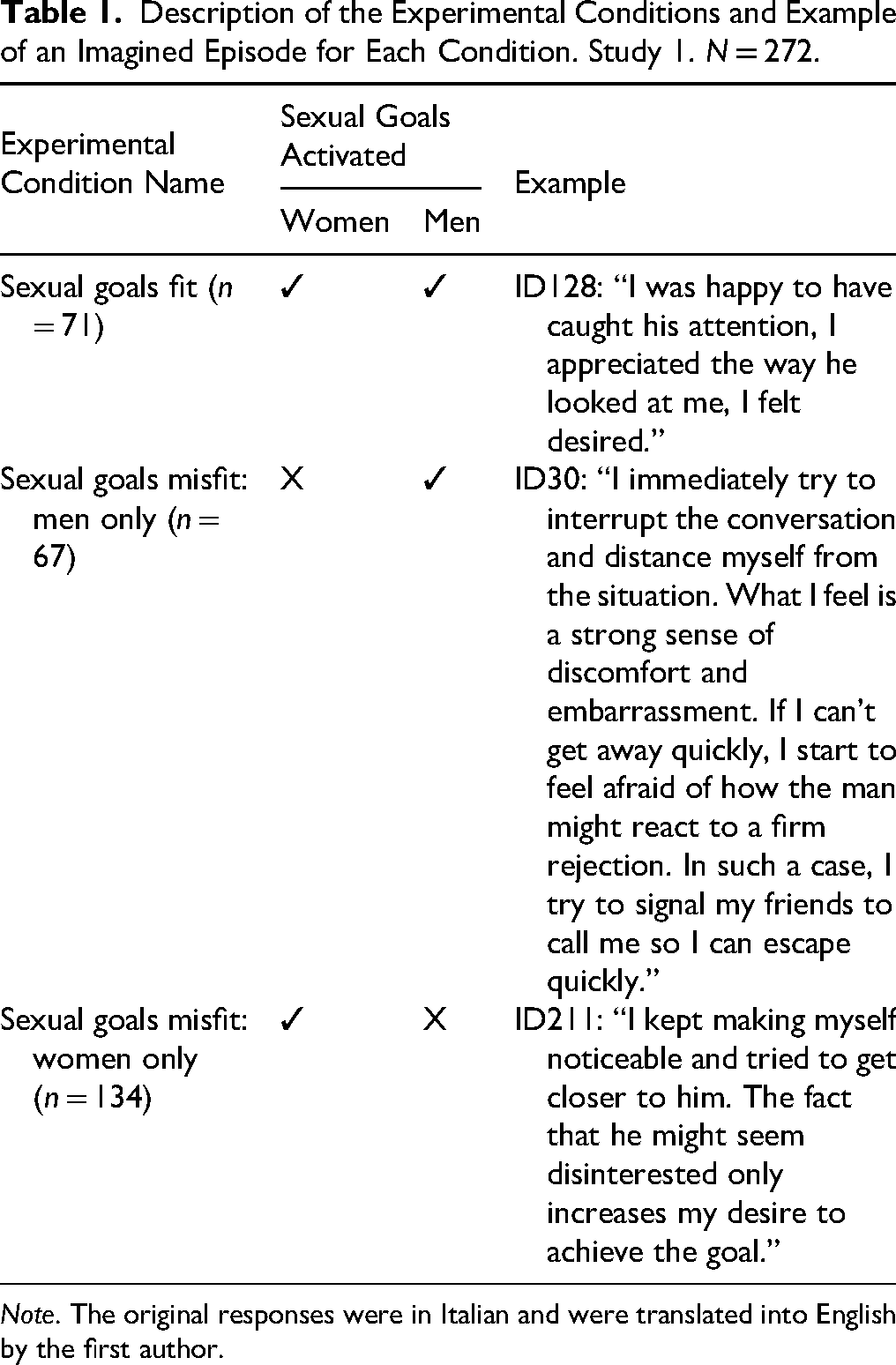
The manipulation resulted in three experimental conditions reflecting the conditions proposed in the SIMO (Gervais et al., 2020): one of sexual goal fit (both the participant and the man had active sexual goals; sexual goals fit condition) and two of sexual goals misfit, where either only the man (sexual goals misfit: men only condition) or the participant (sexual goals misfit: women only condition) had active sexual goals.
Specifically, to manipulate the presence (vs. absence) of sexual goals, participants read the following instructions: “Imagine you are going to a bar with your friends. That night you want to have fun and you are looking for a casual partner [you only want to be with your friends and to focus on having fun with them]. Once in the bar, you see a man. You want him to notice you and try to catch his eye [You don’t want him to notice you and try to avoid eye contact with him].” 3 Next, participants were instructed to imagine a specific encounter with the man. Women in the sexual goals fit condition, after imagining they were interested in gaining the man's attention (i.e., sexual goals present) imagined, “When you are ordering a drink, he approaches you, gazing from your head to your waist and stops to stare at your breasts. He says you look very hot in your outfit and compliments the natural curves of your body.” Women in the sexual goals misfit: men only condition after imagining they did not want the man to notice them (i.e., sexual goals absent), then imagined the same scenario as women in the sexual goals fit condition in which the man approaches, gazes at, and compliments them. Lastly, women in the sexual goals misfit: women only condition after imagining they were interested in gaining the man's attention (i.e., sexual goals present) imagined, “When you are ordering a drink, he does not notice you. He does not seem interested in you and does not look at you for longer than a quick glance. He avoids eye contact and keeps talking with his friends.” Notably, in the latter condition, no objectifying behaviors were present; that is, the male character's sexual goals were not activated. This condition constitutes a theoretically relevant misfit interaction within the SIMO framework.
After completing the imagination task, participants were asked to write down what they imagined. This task was requested both to strengthen the manipulation and to verify that the participants had completed the required task, and it also acted as an exclusion criterion when responses were missing or irrelevant (see Table 1 for a graphical display of the experimental manipulations and an example of what participants imagined).
Description of the Experimental Conditions and Example of an Imagined Episode for Each Condition. Study 1. N = 272.
Note. The original responses were in Italian and were translated into English by the first author.
Measures
The following scales were administered to participants in a randomized order, with the items within each scale also being randomized.
Cost–Benefit Analysis. We created four items to assess the extent to which participants perceived the benefits of remaining in the interaction as outweighing the costs. Participants were presented with four potential interaction responses and asked to evaluate the associated benefits or costs of each action using an eleven-point scale ranging from −5 (“Very negative: Costs overwhelmingly outweigh benefits”) to +5 (“Very positive: Benefits overwhelmingly outweigh costs;” see Louis et al., 2005, for a similar procedure). The items were: “Continuing the interaction with the man,” “Spending more time with the man,” “Avoiding an interaction with the man,” and “not talking with the man,” with the last two items reverse scored. To facilitate the interpretation of the results, item scores were converted to a fully positive scale ranging from 1 to 11, with higher scores indicating greater perceived benefits (vs. costs). Responses were then averaged to form a composite score. The internal consistency of responses in our study was good (α = .89) and comparable to the reliability reported by Louis et al. (2005; α = .77).
Behavioral Intentions. We adapted items from the Positive and Negative Behavioral Tendencies Scale (Tam et al., 2009) to assess behavioral intentions toward the specific target of the imagined interaction. The original scale consists of three subscales assessing intentions to confront, avoid, or approach the target. Given the aim of our research, although all nine items from the scale were presented to participants, we focused on the items measuring intentions to avoid or approach the target. Specifically, participants responded to three items measuring intentions to avoid the target (e.g., “Keep the man at a distance,” “Have nothing to do with the man,” and “Avoid the man”; α = .96) and three items measuring intentions to approach the target (e.g., “Spend time with the man,” “Find out more about the man,” and “Talk to the man”; α = .94 4 ). The response scale ranged from 1 (totally disagree) to 7 (totally agree). Scores were averaged to compute final indices of avoidance and approach intentions. The Cronbach's alpha coefficients found in our study for avoidance tendencies (α = .96) and approach tendencies (α = .94) were excellent and generally consistent with those reported in the original scale by Tam et al. (2009), which were α = .90 for negative behavioral tendencies and α = .79 for approach tendencies.
Planned Analyses
Regarding the analytical strategy, we tested H1 and H2 using a one-way ANOVA with experimental condition as the independent variable. To test H3, we employed a structural equation model (SEM) based on observed variables. SEM allows for the simultaneous estimation of multiple dependent variables, providing a clear advantage over traditional path analysis with multiple regression, which estimates each path separately. This analytic strategy was applied consistently across all three studies.
Results and Discussion
Preliminary Analysis
Prior to the main analysis, a confirmatory factor analysis (CFA) was conducted using Mplus software (version 8.3, Muthén & Muthén, 2017) to test the empirical distinctiveness of the variables. Model fit was evaluated using the indices recommended by Hu and Bentler (1999), namely: a non-significant χ2, a Comparative Fit Index (CFI) and a Tucker–Lewis Index (TLI) greater than 0.95, a Standardized Root Mean Square Residual (SRMR) of 0.08 or less, and a Root Mean Square Error of Approximation (RMSEA) of 0.06 or less. Subsets of items (i.e., parcels, two for each latent variable) were created and used as observed variables based on the item-to-construct balance method (Little et al., 2002). The results indicated a good model fit, χ2(6) = 5.62, p = .467, RMSEA ≈ 0.00, CFI = 1.00, TLI = 1.00, SRMR = 0.01. The perfect fit for CFI and TLI resulted from software rounding and a nearly saturated model. Factor loadings ranged from .91 to .97 (ps < .001), and correlations between the latent constructs were all significantly below |1| (95% confidence intervals), indicating that the variables represented statistically distinct constructs.
Main Analysis
Table 2 reports the means and standard deviations for each experimental condition (see also Figure 1). Differences between means are also displayed. The results of the one-way ANOVA revealed a main effect of the experimental condition on the cost–benefit analysis, F(2, 269) = 70.65, p < .001, η2p = .34, intentions to avoid, F(2, 269) = 139.48, p < .001, η2p = .51, and to approach the target, F(2, 269) = 126.05, p < .001, η2p = .48.
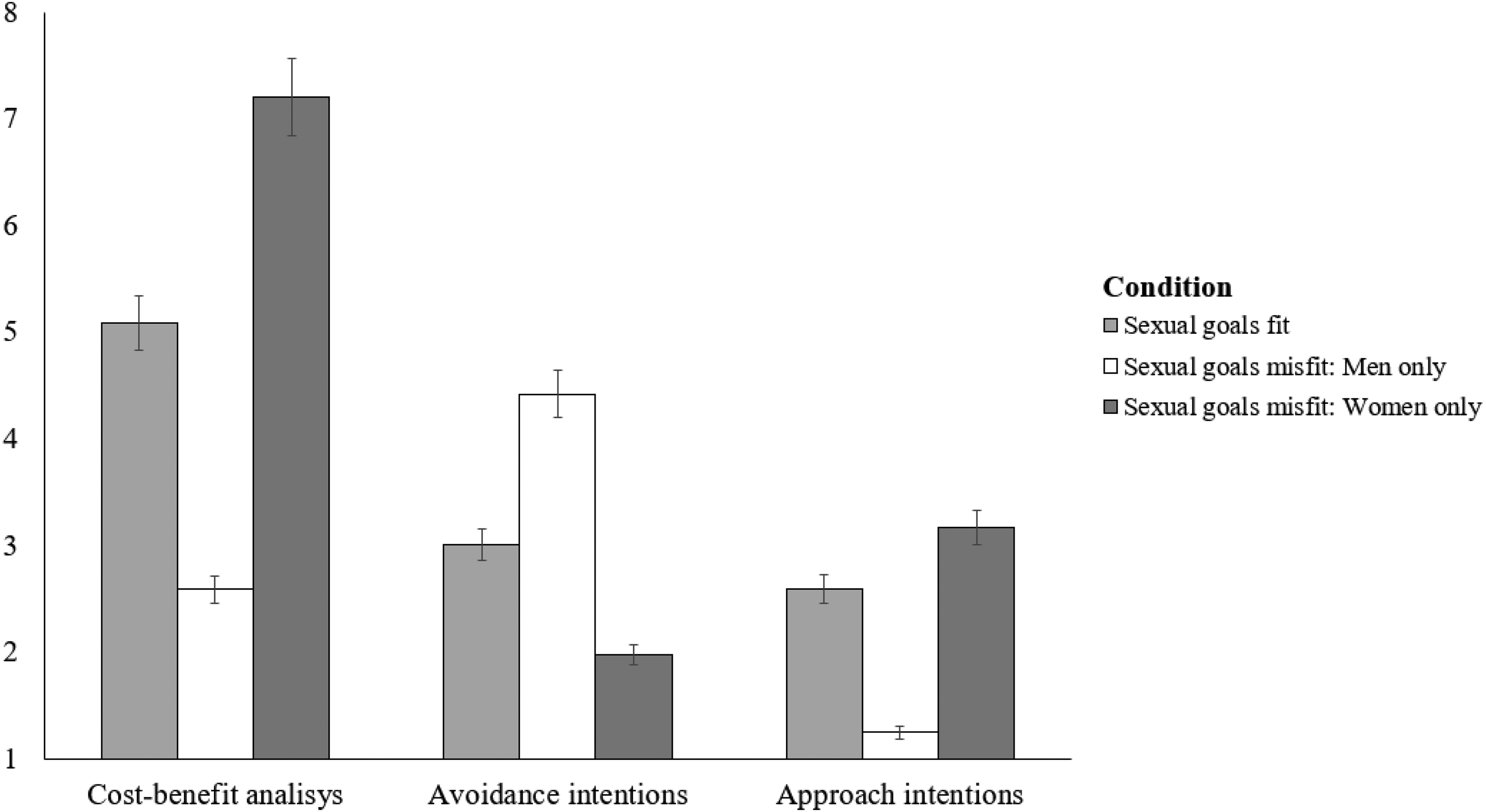
Mean scores separated for experimental condition. Study 1 (N = 272). Note. The response ranges were from 1 to 11 for the cost–benefit analysis, and from 1 to 5 for behavioral intentions. Error bars show standard errors.
Results of the One-Way ANOVA. Study 1. N = 272.
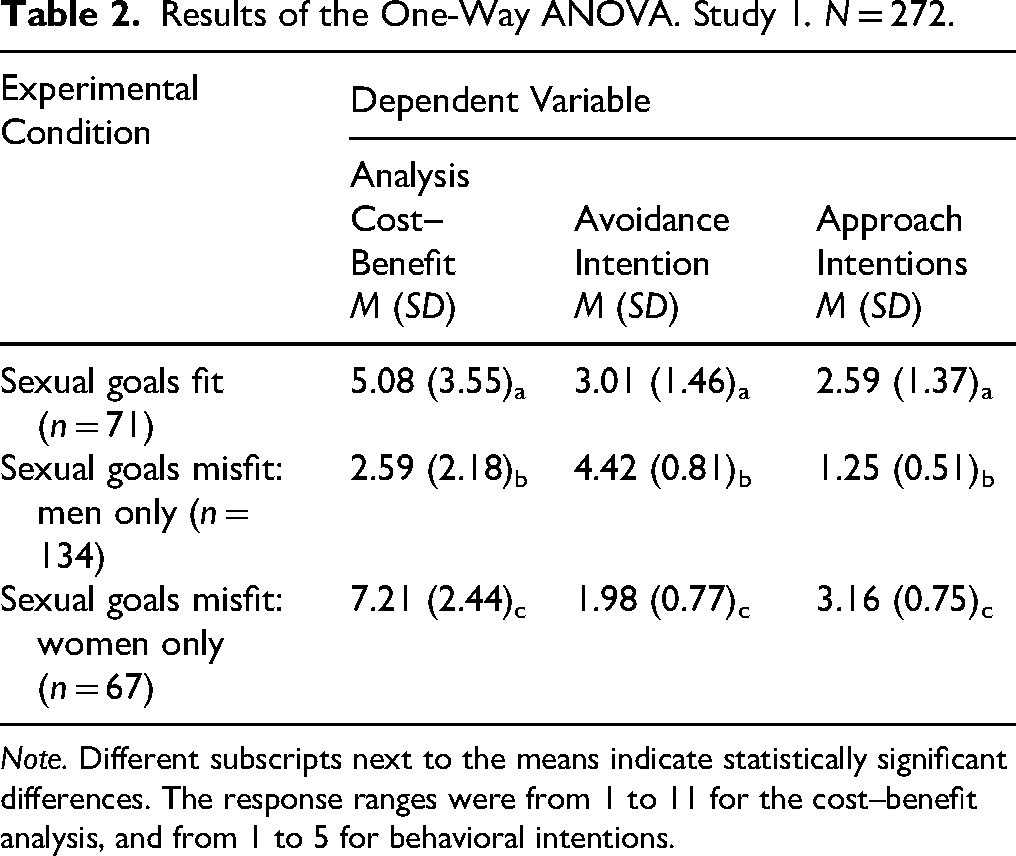
Note. Different subscripts next to the means indicate statistically significant differences. The response ranges were from 1 to 11 for the cost–benefit analysis, and from 1 to 5 for behavioral intentions.
Bonferroni post-hoc analysis indicated that in the sexual goals fit condition, where participants had activated sexual goals and imagined interacting with a man exhibiting sexually objectifying behaviors, the perception of benefits associated with remaining in the interaction was significantly higher compared to the sexual goals misfit: men only condition, where participants experienced the same sexually objectifying exchange without activated sexual goals, t(203) = 5.41, p < .001. Similarly, participants in the former condition reported less interest in leaving, t(203) = −7.55, p < .001, and greater interest in staying in the interaction, t(203) = 7.99, p < .001, compared to the sexual goals misfit: men only condition. Unexpectedly, however, participants in the sexual goals fit condition reported lower perceived benefits (vs. costs), t(136) = −4.11, p < .001, greater interest in leaving, t(136) = 5.26, p < .001, and lower interest in staying in the interaction, t(136) = −3.07, p = .003, compared to the sexual goals misfit: women only condition, where only the woman had activated sexual goals.
Analysis of Indirect Effects
To examine the indirect effect of experimental conditions on behavioral intentions (i.e., avoidance and approach intentions) through cost–benefit analysis, we employed path analysis utilizing structural equation modeling (SEM) with observed variables. Specifically, two dummy variables were created as independent observed variables, using the sexual goals fit condition as the reference level (i.e., we aimed to investigate differences between this condition and the others). In the first contrast, the sexual goals misfit: men only condition was coded as 1, while the other two conditions were coded as 0. In the second contrast, the sexual goals misfit: women only condition was coded as 1, with the other two conditions coded as 0. Cost–benefit analysis served as the mediator, while the two behavioral intentions (i.e., avoidance and approach) were the dependent variables. Bootstrapping procedures were utilized to test the significance of the indirect paths (Hayes, 2013).
To avoid achieving perfect fit (i.e., a model with 0 degrees of freedom), we first tested a full model in which all parameters were estimated. This included associations between independent variables and the mediator, the mediator and dependent variables, direct paths from independent variables to dependent variables, and correlations between variables at the same level. Subsequently, a second more parsimonious model was evaluated, excluding non-significant parameters from the first model. From the first step (i.e., perfect fit), the direct path from the sexual goals misfit: women only condition to approach intentions was non-significant and therefore excluded from the second model. This latter model showed excellent fit to the data, χ2(1) = 1.17, p = .28, RMSEA = 0.03, TLI = 1.00; CFI = 1.00; SRMR = 0.01.
As illustrated in Figure 2, both dummy variables were significantly associated with the mediator, which in turn predicted approach and avoidance intentions. Specifically, participants in the sexual goals misfit: men only condition perceived more costs than benefits associated with remaining in the interaction relative to those in the sexual goals fit condition (b = −2.50, SE = 0.46, p < .001). Conversely, participants in the sexual goals misfit: women only condition attributed more benefits than costs to continuing the interaction compared to the sexual goals fit condition (b = 2.12, SE = 0.51, p < .001). Moreover, an imbalanced cost–benefit analysis was directly related to behavioral intentions; perceiving the interaction as having more benefits (relative to costs) was associated with more approach intentions (b = 0.22, SE = 0.02, p < .001), whereas perceiving the interaction as having more costs (relative to benefits) was associated with more avoidance intentions (b = −0.27, SE = 0.02, p < .001). The sexual goals misfit: men only condition also positively predicted avoidance intentions (b = −0.76, SE = 0.14, p < .001) and negatively predicted approach intentions (b = −0.87, SE = 0.12, p < .001); participants in this condition reported greater intentions to avoid and fewer intentions to approach any continued interactions with the man compared to participants in the sexual goals fit condition. Furthermore, the direct effect from the sexual goals misfit: women only condition to avoidance intentions was significant (b = −0.40, SE = 0.11, p < .001), showing that compared to the sexual goals fit condition, those who imagined sexual goals in an encounter with a dismissive man expressed lower motivation to terminate the interaction.
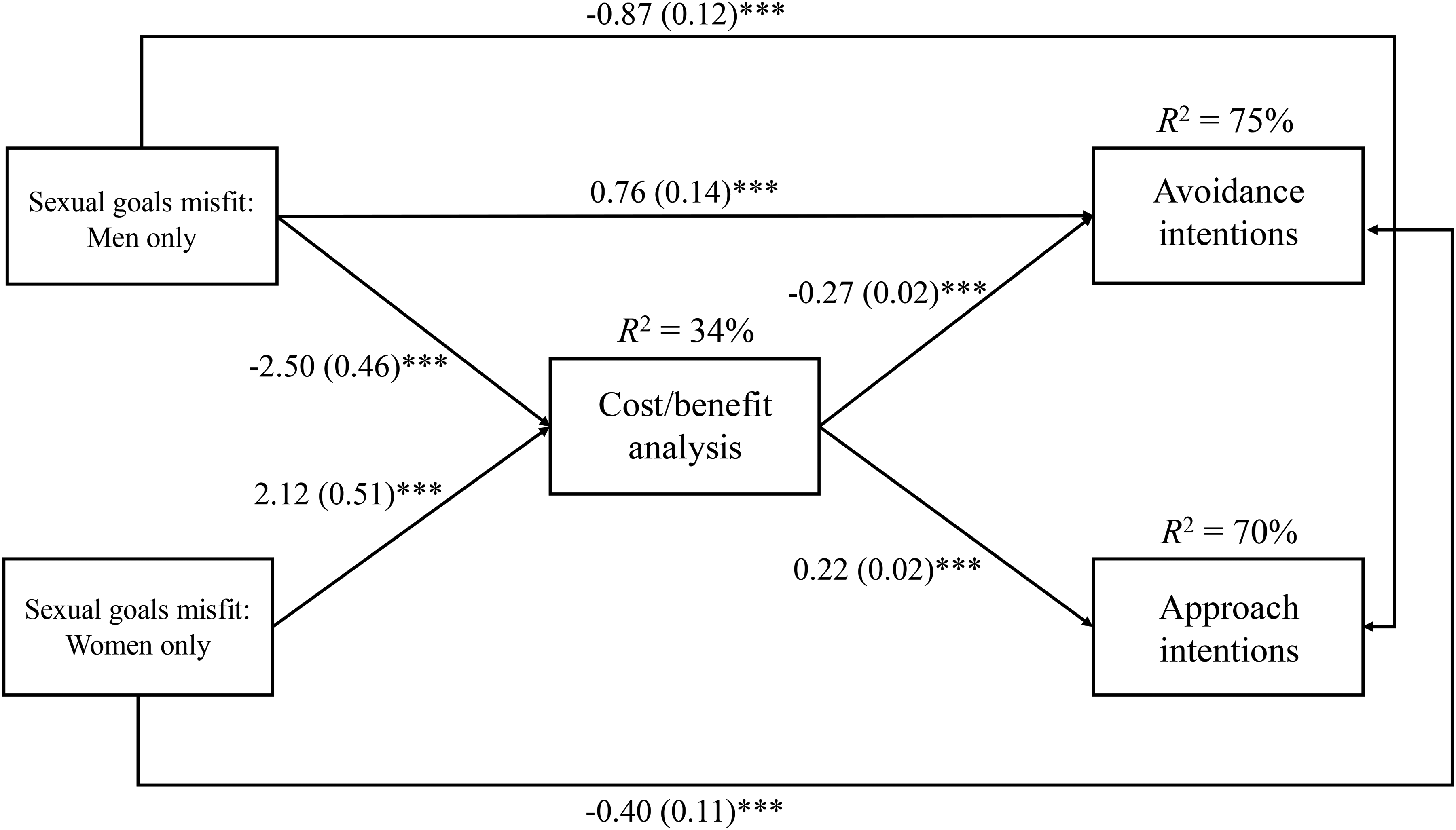
Path analysis of the effects of experimental conditions on behavioral intentions via cost–benefit analysis. Study 1 (N = 272). Note. Dummy variables: “Sexual goals misfit: men only” condition coded = 1, other conditions coded 0; “Sexual goals misfit: women only” condition coded = 1, other conditions coded 0. Only significant paths indicated. Unstandardized coefficients are reported (standard errors in parentheses). Correlation between IVs (r = −.56, p < .001) and DVs (r = −.46, p < .001) are not reported in the figure.
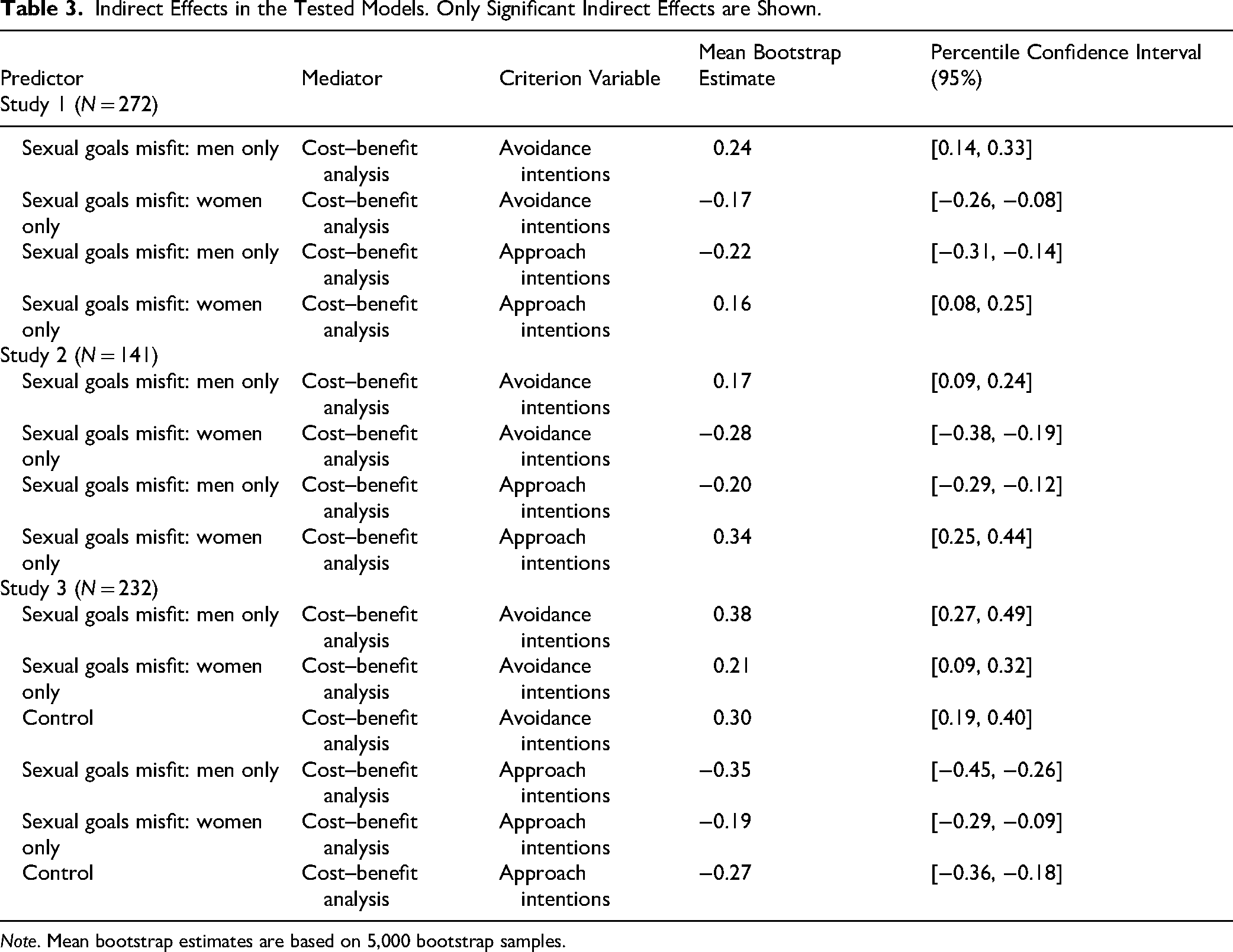
As presented in Table 3 bootstrapping procedures confirmed the significance of all indirect paths, thereby supporting the indirect effect of sexual goal fit/misfit on behavioral intentions through cost–benefit analysis. Women in the sexual goals misfit: men only condition reported greater intentions to avoid and fewer intentions to approach the objectifying man in the scenario compared to women in the sexual goals fit condition due to perceiving more cost than benefits of the interaction. Conversely, women in the sexual goals misfit: women only condition reported fewer intentions to avoid and more intentions to approach the dismissive man in the scenario compared to women in the sexual goals fit condition due to perceiving more benefits than costs for the interaction.
Indirect Effects in the Tested Models. Only Significant Indirect Effects are Shown.
Note. Mean bootstrap estimates are based on 5,000 bootstrap samples.
The results of Study 1 provided initial support for the assumptions of the SIMO, suggesting that perception and subsequent behavioral intentions in a sexually objectifying interaction are influenced by the presence of sexual goals and the compatibility of these goals with those of the interaction partner. However, the results of Study 1 also partially disconfirm the model, indicating that the condition of incompatibility, in which only the participants had active sexual goals, was not perceived more negatively than the condition of sexual goal compatibility. Notably, due to a technical error in the preparation of the questionnaire, there was an unbalanced distribution of participants across the different experimental conditions. Thus, in order to examine the replicability of these results and resolve the methodological issues of this study, we conducted a second study, also carried out in Italy. In this study, we also introduced a condition not originally predicted by the SIMO, a control condition in which the participant imagined an interaction characterized by the absence of sexual goals on both sides.
Study 2
The main aim of Study 2 was to replicate the results of Study 1, which provided initial, though partial, confirmation of the SIMO. In this study, the issue related to participant distribution across experimental conditions was resolved, and importantly, a control condition with the absence of sexual goals was introduced as a basis for comparison. The hypotheses remained the same as in Study 1: In the sexual goals fit condition, we predicted that the perception of benefits (vs. costs) and the intention to continue the interaction would be higher compared to the sexual goals misfit conditions; conversely, intentions to leave the interaction would be lower. In line with the SIMO's assumptions, the relation between sexual goals fit/misfit and behavioral intentions were expected to be explained by a cost–benefit analysis.
Method
Participants and Procedure
Sample size for Study 2 was determined employing the smallest effect size obtained in the previous study. Thus, an a priori power analysis for an ANOVA with four groups targeting a statistical power of .80 and a large effect size (f = 0.70) showed that less than 50 participants were sufficient to test the hypotheses. However, as a precaution, the final sample size was increased.
The inclusion criteria and procedure were the same as in Study 1. A total of 141 participants who self-identified as “women” and “heterosexual” took part in the study, with an average age of 27.07 years (SD = 4.59), ranging from 19 to 40 years. Most participants (n = 137) indicated that they held Italian nationality. In this study, we also asked participants to indicate their relationship status. Fifty-two participants reported being single, and 88 reported being in a relationship.
The questionnaire was distributed online by the authors of the paper and research assistants and completed by participants online. The structure of the questionnaire was identical to that of Study 1, with the exception that in this case, participants were randomly assigned to one of four conditions. In this study, a control condition was also included (see section below for a description of the condition). As in the prior study, participants did not receive any monetary compensation for their involvement in research.
Experimental Manipulation
The same experimental manipulations and instructions used in Study 1 were presented to participants in this study. In this study, a fourth condition (control condition) was included. The instructions for this control condition were as follows: “Imagine you are going to a bar with your friends. That night, you only want to be with your friends and focus on having fun with them. Once in the bar, you see a man. You don’t want him to notice you and try to avoid eye contact with him. When you are ordering a drink, he does not notice you. He does not seem interested in you, and he does not look at you for longer than a quick glance. He avoids eye contact and keeps talking with his friends.” As before, participants wrote down what they imagined, and only those who correctly completed the task were included in the analysis.
Measures
The same measures employed in Study 1 were used in the current study. Specifically, the cost–benefit analysis measure (α = .93) and the behavioral intention measures to avoid (α = .91) and to approach the target (α = .93) were presented to participants in a random order. The items within the scales were also randomized.
Results and Discussion
Preliminary Analysis
Sensitivity analysis showed that our final sample was sufficient to detect a medium to large effect size, f = 0.28, assuming an α of .05 and a power of .80, for a one-way ANOVA with 4 groups. As in Study 1, a CFA was conducted to test whether the variables represented distinct constructs. The same procedure used in the previous study was applied. Fit indices indicated a good model fit to the data, χ2(6) = 8.91, p = .18, RMSEA = 0.06, TLI = 0.99, CFI = 1.00, SRMR = 0.01. Factor loadings ranged from .86 to .94 (ps < .001), and correlations between latent constructs were all significantly below |1|, indicating that the variables measured statistically distinct constructs.
Main Analysis
Means, standard deviations, and tests of between-subjects effects are reported in Table 4 (see also Figure 3). Results of the one-way ANOVA confirmed a main effect of the experimental condition on cost–benefit analysis, F(3, 137) = 37.03, p < .001, η2p = .45, intentions to avoid, F(3, 137) = 36.46, p < .001, η2p = .44, and intentions to approach the target, F(3, 137) = 45.23, p < .001, η2p = .50.
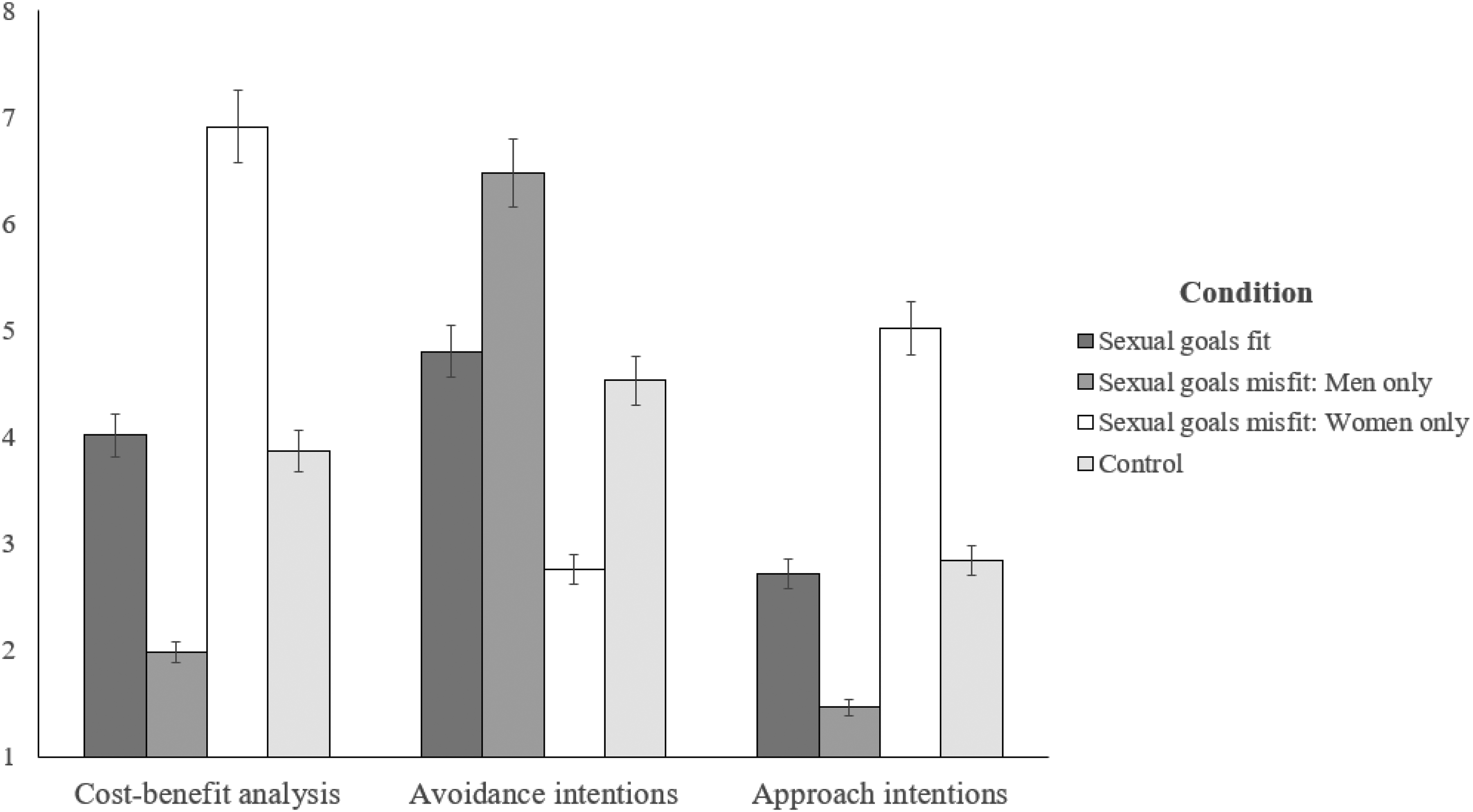
Mean scores separated for experimental condition. Study 2 (N = 141). Note. The response ranges were from 1 to 11 for the cost–benefit analysis, and from 1 to 5 for behavioral intentions. Error bars show standard errors.
Results of the One-Way ANOVA. Study 2. N = 141.
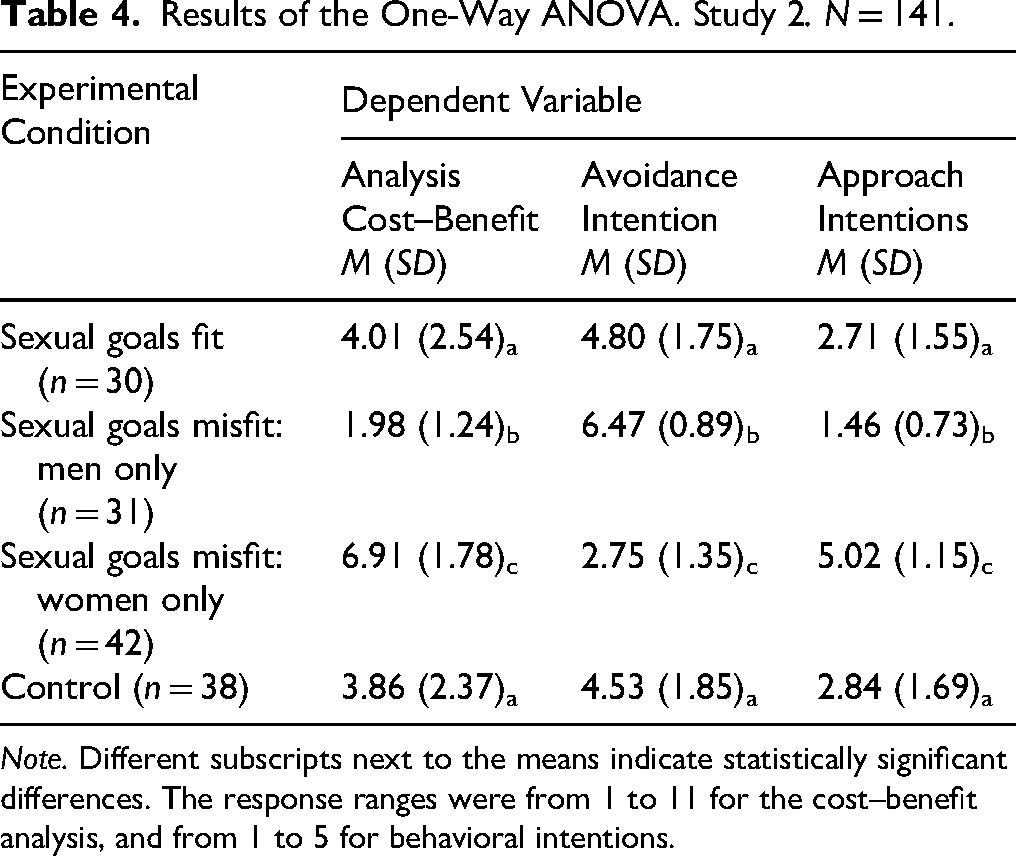
Note. Different subscripts next to the means indicate statistically significant differences. The response ranges were from 1 to 11 for the cost–benefit analysis, and from 1 to 5 for behavioral intentions.
Bonferroni post-hoc analysis indicated that the pattern of results was similar across all dependent variables. Specifically, in the sexual goals fit condition, participants reported greater benefits (vs. costs), t(59) = 3.96, p < .001, less interest in leaving, t(59) = −4.67, p < .001, and greater interest in remaining in the social exchange, t(59) = 4.00, p < .001, compared to the sexual goals misfit: men only condition, but fewer benefits (vs. costs), t(70) = −5.37, p < .001, greater interest in leaving, t(70) = 5.35, p < .001, and less interest in remaining in the exchange, t(70) = −6.81, p < .001, compared to the sexual goals misfit: women only condition. There were no significant differences between the sexual goals fit and the control condition for the cost–benefit analysis, t(66) = 0.25, p = .80, interest in leaving, t(66) = 0.62, p = .54, or remaining, t(66) = −0.33, p = .74, in the exchange.
Analysis of Indirect Effects
As in Study 1, we tested the indirect association from experimental conditions to behavioral intentions through a cost–benefit analysis using a SEM with observed variables. In this model, the independent variables were represented by three dummy variables contrasting the sexual goals fit condition with the other misfit and control conditions. Specifically, the sexual goals misfit: men only condition was coded as 1 (with other conditions coded as 0), the sexual goals misfit: women only condition was coded as 1 (with other conditions coded as 0), and the control condition was also coded as 1 (with other conditions coded as 0). Cost–benefit analysis was included as the mediator, while the behavioral intentions (i.e., avoidance and approach intentions) served as the dependent variables.
Consistent with the previous study, we first tested a full model that estimated all parameters. The second model, in which non-significant paths were excluded (specifically, the associations from the control condition to cost–benefit analysis, avoidance, and approach intentions, as well as the direct relation between the sexual goals misfit: men only condition and approach intentions), demonstrated excellent fit to the data, χ2(4) = 5.52, p = .24, RMSEA = 0.05, CFI = 1.00; TLI = 0.99; SRMR = 0.02.
The results (see Figure 4) indicated that both sexual goals misfit conditions were significantly associated with an imbalanced cost–benefit analysis. Similar to the results in Study 1, participants in the sexual goals misfit: men only condition (vs. sexual goals fit condition) perceived greater costs than benefits associated with remaining in the interaction (b = −1.95, SE = 0.36, p < .001), whereas participants in the sexual goals misfit: women only condition (vs. sexual goals fit condition) attributed greater benefits than costs to continuing the interaction (b = 2.98, SE = 0.40, p < .001). The connection between the cost–benefit analysis and behavioral intentions also mirrored the pattern found in Study 1; greater perceived benefits (relative to costs) were related to more approach intentions (b = 0.47, SE = 0.04, p < .001) and greater perceived costs (relative to benefits) were related to more avoidance intentions (b = −0.41, SE = 0.05, p < .001). Finally, with respect to direct effects, the sexual goals misfit: men only condition was associated with more avoidance intentions compared to the sexual goals fit condition (b = 0.81, SE = 0.24, p < .001), whereas the sexual goals misfit: women only condition was associated with less avoidance (b = −0.74, SE = 0.34, p = .03) and more approach intentions (b = 0.96, SE = 0.26, p < .001) compared to the sexual goals fit condition.
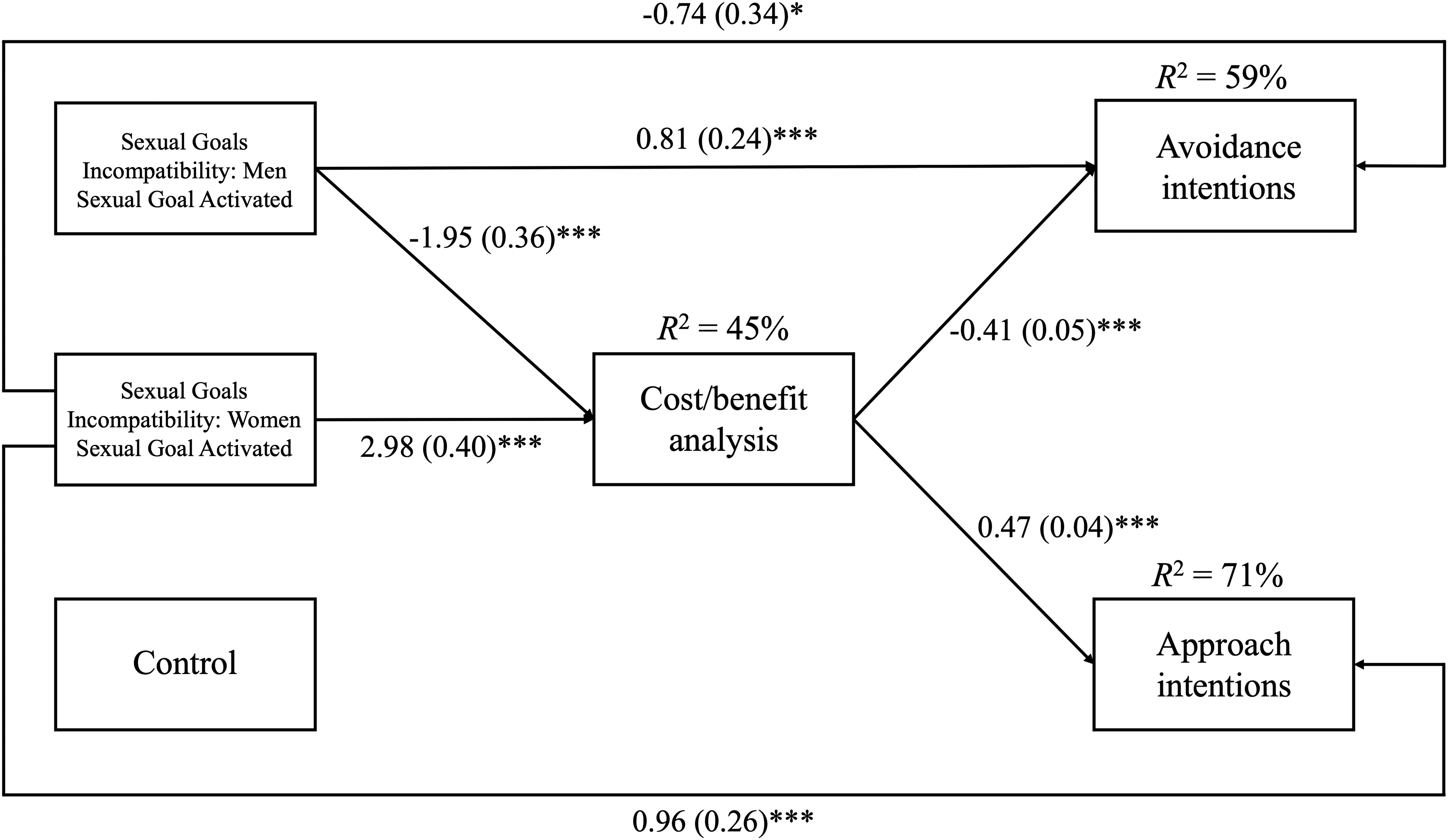
Path analysis of the effects of experimental conditions on behavioral intentions via cost–benefit analysis. Study 2 (N = 141). Note. Dummy variables: “Sexual goals misfit: men only” condition coded = 1, other conditions coded 0; “Sexual goals misfit: women only” condition coded = 1, other conditions coded 0. “Control” condition coded = 1, other conditions coded 0. Only significant paths indicated. Unstandardized coefficients are reported (standard errors in parentheses). Correlation between IVs (“Sexual goals misfit: men only” with “Sexual goals misfit: women only,” r = −.35, p < .001; “Sexual goals misfit: men only” with “Control,” r = −.32, p < .001; “Sexual goals misfit: women only” with “Control,” r = −.40, p < .001) and correlation between DVs (r = −.43, p < .001) are not reported in the figure.
As detailed in Table 3, all indirect paths were significant. Participants in the sexual goals misfit: men only condition (vs. sexual goals fit condition) reported more avoidance and less approach intentions through greater perceived costs (than benefits) of the interaction, while participants in the sexual goals misfit: women only condition (vs. sexual goals fit condition) reported less avoidance and more approach intentions through greater perceived benefits (than costs) of the interaction. 5
The results of our second study replicated those of the first. Specifically, in line with Study 1, and according to the claims of the SIMO, we found that individuals with activated sexual goals perceived interactions with a man who exhibits sexually objectifying behaviors more positively than those who encountered the same behavior but did not have active sexual goals. Thus, the activation and compatibility of sexual goals appear to influence individuals’ perceptions and subsequent behavioral intentions in sexually objectifying exchanges. However, once again, in the sexual goals misfit: women only condition – where women desire sexual attention they are not receiving—participants reported the highest levels of perceived benefits (vs. costs) of remaining in the interaction, along with less interest in leaving and greater interest in staying. Given that this result may be influenced by specific sexual scripts inherent to the cultural context in which the study was conducted (i.e., Italy), and to provide further and more robust confirmation of our findings, we tested our hypotheses in the third study within a different context, namely the U.S.
Study 3
Study 3 was conducted in the U.S. with the primary aim of replicating the findings from the first two studies within a different patriarchal cultural context. Furthermore, since the results from the previous studies did not fully align with the SIMO, we aimed to investigate whether conducting the study in the U.S. (where the SIMO was originally developed) would yield different outcomes and help clarify the findings observed in the first two studies conducted in Italy. The hypotheses remained consistent with those of the earlier studies.
Method
Participants and Procedure
As in the previous study, the a priori power analysis was conducted employing the lowest effect size observed in the previous studies (i.e., η2p = .38). Similar to the preceding procedure, and as a precautionary measure, a greater sample size was collected. The inclusion criteria were consistent with those used in Studies 1 and 2. A total of 232 participants, who self-identified as “women” and “heterosexual,” participated in the study, with a mean age of 32.20 years (SD = 4.97), ranging from 19 to 47 years. Of these, 66 participants indicated that they were in a relationship. In this study, we also collected information on participants’ race. Specifically, 178 participants identified as White, 26 as Black or African American, 10 as Asian, 3 as American Indian or Alaska Native, and 15 as Other. Unlike the previous studies, data collection was conducted online through Amazon's Mechanical Turk (MTurk) under the title “Navigating social interactions.”
Following informed consent, participants were randomly assigned to one of the four conditions, sexual goals fit, sexual goals misfit: men only, sexual goals misfit: women only or control (as in Study 2), and asked to write down the experience imagined. Only participants who successfully completed this task were included in the analysis. Next, participants completed the measure of cost–benefit analysis (α = .93), 6 as well as the measures of behavioral intentions to avoid (α = .93) or approach the man (α = .95) used in the previous studies. The scales and items for these measures were randomized across participants. Finally, participants were thanked, debriefed, and compensated with U.S. $0.50.
Results and Discussion
Preliminary Analysis
Following the same procedure, and prior to the main analysis, a CFA was conducted to assess the empirical distinctiveness of the three criterion variables (i.e., cost–benefit analysis, approach intentions, and avoidance intentions). The results indicated that the model fit the data well, χ2(6) = 10.59, p = .10, RMSEA = 0.06, TLI = 0.99, CFI = 1.00, SRMR = 0.01. Factor loadings ranged from .85 to .98 (ps < .001), and the latent constructs were statistically distinct, as all correlations were significantly below |1|.
Main Analysis
Table 5 presents the means, standard deviations, and results of the between-subjects effects tests (see also Figure 5). A one-way ANOVA revealed a significant main effect of the experimental condition on cost–benefit analysis, F(3, 228) = 21.78, p < .001, η2p = .22, as well as on avoidance intentions, F(3, 228) = 22.84, p < .001, η2p = .23, and approach intentions, F(3, 228) = 37.35, p < .001, η2p = .33.
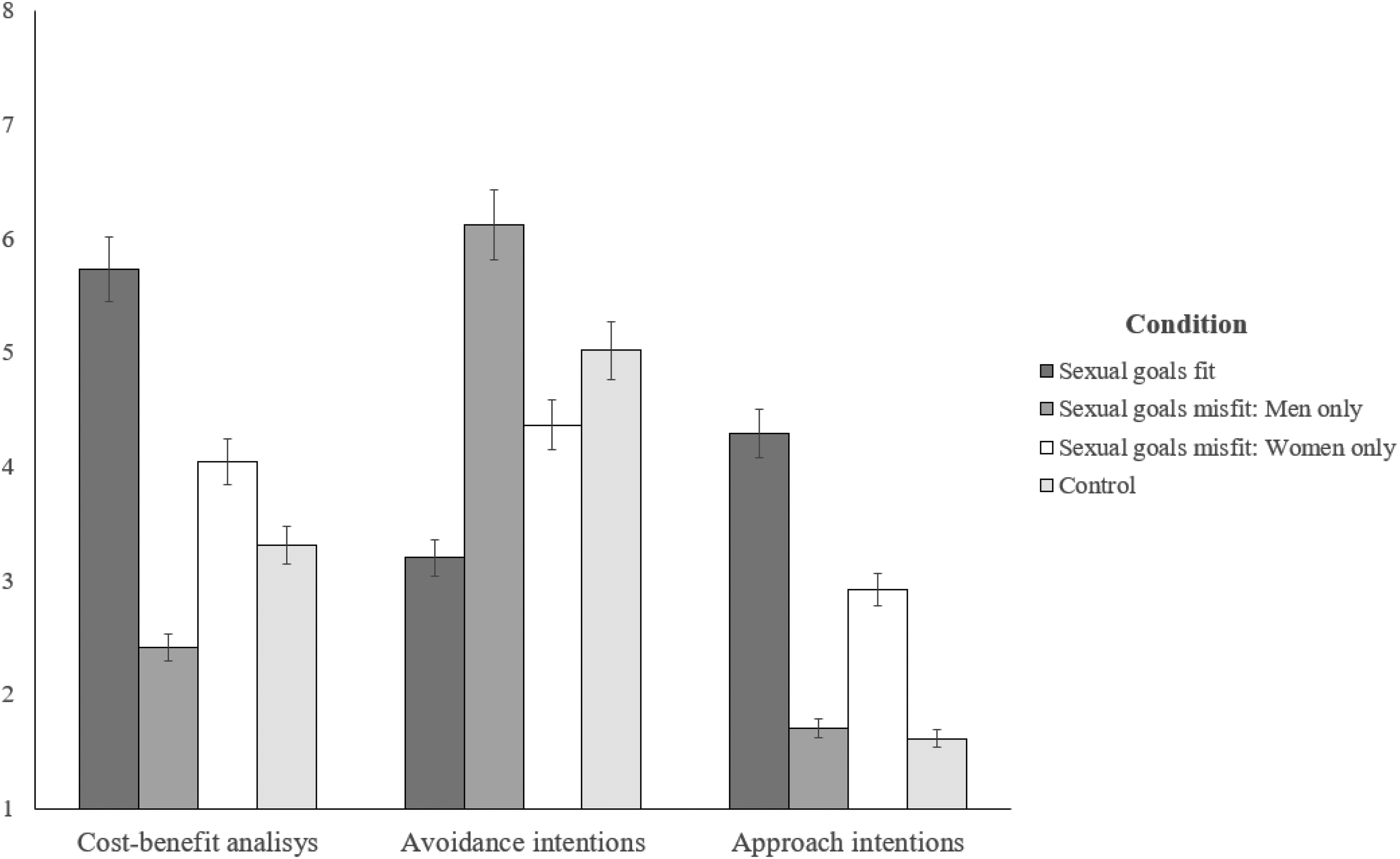
Mean scores separated for experimental condition. Study 3 (N = 232). Note. The response ranges were from 1 to 11 for the cost–benefit analysis, and from 1 to 5 for behavioral intentions. Error bars show standard errors.
Results of the One-Way ANOVA. Study 3. N = 232.
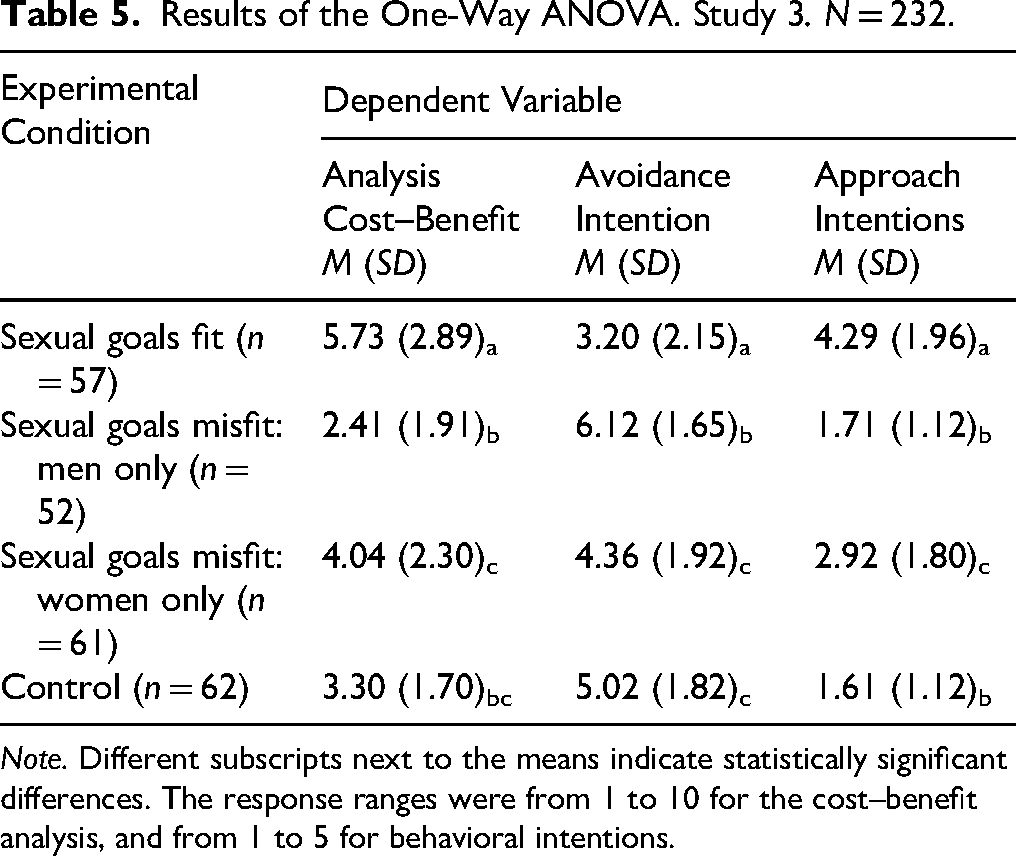
Note. Different subscripts next to the means indicate statistically significant differences. The response ranges were from 1 to 10 for the cost–benefit analysis, and from 1 to 5 for behavioral intentions.
The Bonferroni post-hoc analysis indicated a consistent pattern across all dependent variables. Women in the sexual goals fit condition perceived more benefits than costs, expressed less interest in avoiding the man, and greater interest in approaching the man compared to women in the sexual goals misfit: men only condition (cost–benefit analysis: t[107] = 7.12, p < .001; avoidance: t[107] = −8.01, p < .001; approach: t[107] = 8.54, p < .001), women in the sexual goals misfit: women only condition (cost–benefit analysis: t[116] = 3.49, p < .001; avoidance: t[116] = −3.09, p = .003; approach: t[116] = 3.94, p < .001), and women in the control condition (cost–benefit analysis: t[117] = 5.52, p < .001; avoidance: t[117] = −4.96, p < .001; approach: t[117] = 9.05, p < .001).
Analysis of Indirect Effects
Finally, as in the previous studies, a mediation model using SEM with observed variables was tested. The three dummy codes (with sexual goals fit condition as baseline) represented the independent variables, cost–benefit analysis was the mediator, and the two behavioral intentions (i.e., approach and avoidance) were the dependent variables. Dummy variables were created following the procedure employed in Study 2.
The full model showed that the direct associations from sexual goals misfit: women only condition to avoidance intentions and from control condition to avoidance intentions were non-significant; thus, they were not estimated in the second path analysis. This trimmed model presented excellent fit indices, χ2(2) = 2.61, p = .27, RMSEA = 0.04, CFI = 1.00; TLI = 0.99; SRMR = 0.01. As can be seen in Figure 6, results supported the predictions; that is, all three paths from IVs to the mediator were significant (b = −3.32, SE = 0.47, p < .001, for sexual goals misfit: men only; b = −1.69, SE = 0.44, p < .001, for sexual goals misfit: women only; b = −2.43, SE = 0.44, p < .001, for control), and the mediator was associated with both avoidance (b = −0.59, SE = 0.04, p < .001) and approach (b = 0.48, SE = 0.03, p < .001). Specifically, women in each of the conditions perceived the interaction as having more costs than benefits.
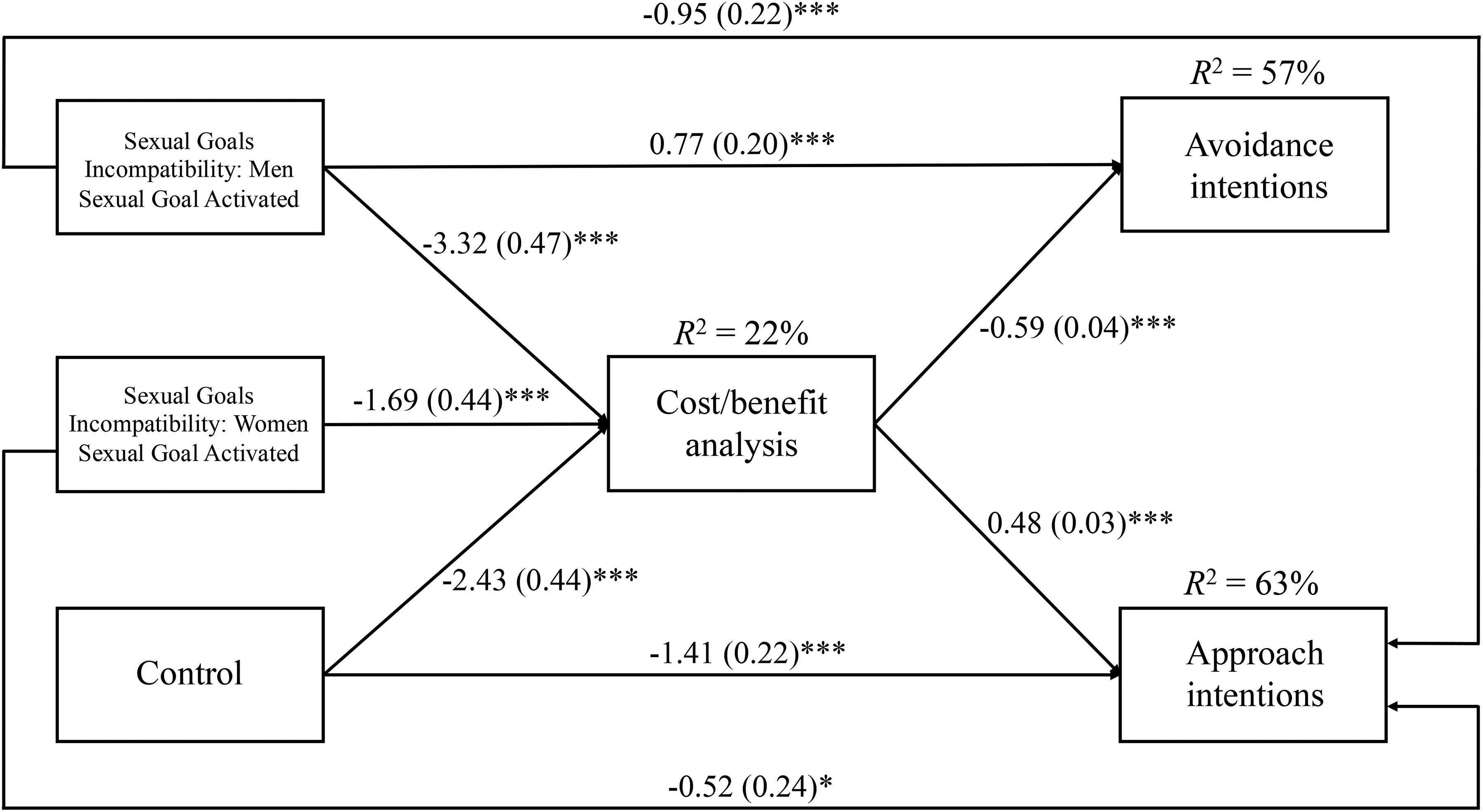
Path analysis of the effects of experimental conditions on behavioral intentions via cost–benefit analysis. Study 3 (N = 232). Note. Dummy variables: “Sexual goals misfit: men only” condition coded = 1, other conditions coded 0; “Sexual goals misfit: women only” condition coded = 1, other conditions coded 0. “Control” condition coded = 1, other conditions coded 0. Only significant paths indicated. Unstandardized coefficients are reported (standard errors in parentheses). Correlation between IVs (“Sexual goals misfit: men only” with “Sexual goals misfit: women only,” r = −.32, p < .001; “Sexual goals misfit: men only” with “Control,” r = −.33, p < .001; “Sexual goals misfit: women only” with “Control,” r = −.36, p < .001;) and correlation between DVs, (r = −.35, p < .001) are not reported in the figure.
Similarly, direct effects showed that the sexual goals misfit: men only condition was associated with more avoidance intentions (i.e., compared to sexual goals fit condition; b = 0.77, SE = 0.20, p < .001) and less approach intentions (i.e., compared to the sexual goals fit condition; b = −0.95, SE = 0.22, p < .001). The sexual goals misfit: women only and control conditions were also associated with less approach intentions (relative to the sexual goals fit condition; b = −0.52, SE = 0.24, p = .03, for sexual goals misfit: women only; b = −1.41, SE = 0.22, p < .001 for control). Finally, all indirect effects were significant (see Table 3); compared to the sexual goals fit condition, participants in the misfit and control conditions reported more avoidance and less approach intentions through greater perceived costs than benefits. 7
The results of the third study confirm the findings of the previous studies regarding the comparison between entering a sexually objectifying interaction with or without sexual goals. Indeed, the data suggested that when sexual goals are activated, a sexually objectifying relationship is perceived more positively (greater perceived benefits vs. costs of the interaction) which shapes women's intentions to continue the interaction. Interestingly, the misfit condition in which only the women had active sexual goals operated differently in this study compared to the previous ones. In the first two studies, this misfit interaction was perceived as the most enticing condition; however, in this study, the sexual goals misfit: women only condition was perceived less favorably than the fit condition. This aligns with the SIMO's prediction that the compatibility of sexual goals is important in determining the resulting behavioral intention in an objectifying social interaction. At the same time, this result highlights the potential influence of culturally-relevant contextual factors that may shape participants’ perceptions of the imagined situations. Finally, consistent with the hypotheses, the cost–benefit analysis mechanism explained the indirect relation between experimental conditions and behavioral intentions. This result aligns both with the findings of Studies 1 and 2 and the claims of the SIMO.
General Discussion
Although extensive research has highlighted the detrimental effects of objectification on women's psychological and physical well-being, such as body dissatisfaction and reduced self-esteem (Roberts et al., 2018), a growing number of studies complicate this narrative by showing that not all women reject or experience objectifying encounters negatively (Erchull & Liss, 2013; Gervais et al., 2011; Liss et al., 2011; Meltzer, 2020; Riemer et al., 2020). These findings underscore that women's responses to objectification are more context-sensitive than traditionally assumed. Rather than being passive recipients, women appear to navigate objectifying encounters strategically, making judgments based on the alignment of interpersonal goals (Gervais et al., 2020), at least at the level of their reported behavioral intentions. Our results offer initial experimental evidence that the presence and compatibility of sexual goals plays a key role in shaping how objectification is perceived. Across all three studies, women who did not hold sexual goals and experienced objectification perceived the interaction as more costly than beneficial compared to women in misfit conditions, an effect consistent with the predictions of the SIMO. These women were more likely to distance themselves from the interaction, reporting greater avoidance and lower intentions to engage with the man, compared to women with sexual goals, regardless of whether objectification occurred.
Women also reported acting strategically to pursue their goals in other forms of goal misalignment. For example, when seeking a casual partner but perceiving disinterest from men, both Italian and U.S. women reported lower perceived costs and being more likely to approach the men, compared to women not interested in sex who faced objectifying advances. It is possible that the absence of objectifying behavior, precisely because such behavior is common and often expected in heterosexual interactions, was interpreted positively by participants. In this view, the non-objectifying man may have been perceived as possessing desirable personal qualities (e.g., being respectful or valuing women beyond their sexuality), consistent with low adherence to sexist attitudes and patriarchal ideology as outlined in the SIMO framework. This perception, in turn, could have motivated stronger interest in further interaction. Although this interpretation is speculative, given that we did not assess whether women felt genuinely valued for non-observable traits or merely rejected, it underscores the importance of examining how expectations surrounding objectification influence women's perceptions and interest in further interactions.
Furthermore, research on mate pursuit suggests that behaviors signaling selectivity or difficulty to attract, such as not showing immediate sexual interest, may increase perceived mate value and elicit greater romantic motivation (Birnbaum et al., 2020), at least when they produce moderate levels of uncertainty or difficulty, which can enhance interest without triggering rejection concerns (Hazel et al., 2023). In this light, the absence of objectifying cues might not have been interpreted simply as disinterest or neutrality, but rather as a sign of selectivity, potentially reframing the interaction as more valuable or promising, especially when aligned with participants’ own sexual goals. In addition, it is important to consider the interpersonal context we asked participants to imagine. Because the scenario explicitly involved the pursuit of a casual sexual partner rather than a long-term romantic relationship, the perceived costs of the encounter were likely lower. Lower investment expectations in casual (vs. long-term) relationships may help explain why women in this condition responded more positively, or at least less negatively, than those in the other experimental conditions.
Some cross-national differences also emerged, suggesting that sociocultural context may shape how women respond to objectifying interactions. Specifically, in Studies 1 and 2 with Italian participants, women with sexual goals perceived a disinterested man as relatively low in cost and reported greater willingness to approach, and less intention to avoid him, compared to all other groups, including women in the sexual goal fit condition. By contrast, in Study 3, U.S. women in the same misalignment condition (i.e., women with active sexual goals facing male disinterest) evaluated the interaction more negatively than those in the sexual goal fit condition, but still more positively than women in the reverse misalignment (i.e., women without sexual goals facing objectifying men).
Cultural differences in how patriarchal norms are institutionalized may explain the different sexual interaction styles between Italian and U.S. women. Although men in both contexts often hold ambivalent expectations, namely, viewing women as both “nurturers” and “sexual pleasers” (e.g., Bareket et al., 2018), the way these expectations are expressed and reinforced may differ across cultures. In Italy, for example, persistent perceptions of gender inequality, particularly within the family domain (e.g., IPSOS, 2018), suggest that traditional gender roles remain relatively strong (Scappini et al., 2023) and may shape how sexual interactions are interpreted and navigated.
Within this framework, one interpretation of our findings is that internalized norms in Italy emphasizing women's role as sexually pleasing men may shape responses even in the absence of explicit male interest. In such contexts, women with active sexual goals may be more likely to persist despite disinterest, prioritizing the pursuit of male desire, or the potential to elicit it, over initial signals of non-reciprocity. This could contribute to the paradoxical finding that disinterested partners are perceived as relatively low in cost and elicit greater approach motivation.
A complementary explanation concerns differences in gendered sexual scripts. Compared to the U.S., where courtship norms tend to be more egalitarian and allow greater flexibility, Italian women may be less accustomed to occupying an initiating role. Within the experimental context, imagining oneself in such a role, particularly in the face of rejection, may have been experienced as relatively novel and engaging, and oriented to a societal view where women also “had to” sexually please men (e.g., Fredrickson & Roberts, 1997).
A further, yet related, explanation may draw on the unequal power dynamics that characterize gender relations. In this case, beyond sexual motivations, power-related motives might also shape women's reactions to rejection. Compared to the U.S., Italy exhibits more pronounced gender disparities, including a higher gender pay gap (World Economic Forum, 2024), lower labor force participation among women, reduced access to secondary education for women (United Nations Development Program, 2025), as well as a persistent internalization of traditional gender stereotypes (Carvalho Silva et al., 2024). As a result, Italian women may have been more motivated to remain in the interaction to gain male attention and, perhaps unintentionally, to reinforce dynamics of subordination to the man, perceived as the higher-status individual. In line with this, Italian women might have viewed the task of approaching a man as requiring greater effort, and the motivation to persist in the interaction, even in the face of rejection, could serve as a form of effort justification. Consistent with cognitive dissonance theory, individuals tend to attribute greater value to situations in which they have invested substantial effort (Festinger, 1957). However, given that this finding was not hypothesized a priori, future research is needed to test the robustness of this result.
It is also worth noting that individual differences may further contribute to shaping women's responses to rejection and to sexual goal (mis)alignment. Although our interpretation has primarily focused on cultural and structural explanations, psychological dispositions such as high rejection sensitivity (Downey & Feldman, 1996) or anxious attachment styles (Campbell & Marshall, 2011) might increase perceived interpersonal threat and heighten motivation to maintain the interaction despite signs of disinterest. Moreover, endorsement of gender stereotypes or feminist identity may shape how individuals respond to objectifying encounters. For instance, individuals with a stronger feminist identity may be more likely to recognize instances of objectification as forms of gender-based discrimination, interpret them more negatively, and distance themselves from the interaction (Shi & Zheng, 2020). In addition, characteristics of the objectifying person, such as age, perceived attractiveness, racial or ethnic background, and ingroup/outgroup membership, may also influence how their behavior is perceived and responded to (e.g., Rinehart & Yeater, 2012; Rinehart et al., 2018). These elements point to the importance of adopting an intersectional lens in future research, acknowledging that reactions to objectification may differ based on the intersecting identities of both targets and perpetrators.
The inclusion of a control condition, where neither the woman nor man was interested, offered additional insights about perceived goal compatibility. This condition represents a form of alignment through mutual disinterest, a condition not originally considered in the SIMO. Nevertheless, women's responses to such interactions may be influenced by cultural factors. Italian women perceived interactions with no goals as more beneficial than U.S. women. For Italian women, this scenario resembled the goal compatibility condition, where they had sexual goals and experienced objectifying behaviors, implying that perceived compatibility can lead to neutral or even positive evaluations. In contrast, U.S. women regarded mutual disinterest as evoking similar costs to when they lacked sexual goals and were objectified. An Italian woman might interpret a situation where both parties show no interest as comfortable neutrality, fostering ease and acceptance. However, a U.S. woman might view the same situation as lacking meaningful engagement, interpreting it as a wasted interaction that leads her to disengage. These potential cultural differences highlight the importance of examining how societal norms shape perceptions and behaviors in romantic interactions, although these interpretations remain speculative and warrant further empirical investigation.
In the current work, women's cost–benefit analysis explained the relation between the fit condition and the determination of avoidance and approach intentions. Women's intentions were shaped by whether the interaction was appraised as more costly (which was associated with increased avoidance and decreased approach) or more beneficial (which was associated with decreased avoidance and increased approach). This finding provides additional support for the SIMO's proposition that, during the interaction phase, women engage in a cognitive appraisal of the situation, evaluating whether the encounter aligns with their pre-existing sexual goals. These evaluations appear to play a key role in guiding immediate behavioral tendencies, highlighting the dynamic nature of goal-context fit as a psychological mechanism in navigating objectifying interactions. However, as theories of system justification and social dominance suggest (Sidanius & Pratto, 2001), this agentic process may also contribute to the maintenance of gender inequality. In line with the SIMO, women may strategically engage with objectifying interactions in ways that align with internalized sexist norms, particularly when such interactions appear goal-congruent, thus inadvertently legitimizing a social system characterized by unequal gender relations. These perceptions may have broader consequences not only for intergroup relations but also for interpersonal interactions. Although women who self-sexualize are sometimes seen as agentic, they are also more likely to be judged negatively in terms of morality, competence, and warmth (De Wilde et al., 2021), and such devaluation is not without consequence. For instance, perceptions of low morality are strongly linked to greater attribution of responsibility and blame, including in contexts involving gender-based violence (Pacilli et al., 2024; Pagliaro et al., 2021). This suggests that women's strategic enactment of sexual agency may paradoxically expose them to increased social sanctions, including reduced credibility and greater vulnerability to victim-blaming (Balint, 2024).
Theoretical and Practical Implications
This work represents an initial step toward centering women's perspectives in objectifying interactions, an angle too often overlooked. One of the studies’ core implications is the recognition that women are not passive recipients of objectification, but active agents whose interpretations, expectations, and behavioral responses shape how these interactions unfold. Although this view resonates with feminist scholarship (see Balint, 2024), psychological research has often perpetuated a contradictory framing, treating objectification as something that simply “happens” to women, as though they lack voice or agency in these moments. Ironically, this scientific framing risks reproducing the very logic of objectification by stripping women of subjectivity. Our findings push back against this assumption, demonstrating that women respond in strategic and relationally embedded ways, and that understanding objectification requires attending to the active role women play in navigating these experiences.
Women can engage both as sexual objects and as sexual subjects in response to men's sexual behavior. Although the literature on objectification has largely focused on intrapersonal processes, particularly self-objectification and its well-documented negative consequences (Kahalon & Klein, 2025; Roberts et al., 2018), recent attention to interpersonal objectification is beginning to challenge this one-sided view. For example, experimental studies have shown that interpersonal objectification disrupts women's cognitive flow (Guizzo & Cadinu, 2017), highlighting the active cognitive regulation women may employ in these contexts. Notably, a close reading of objectification theory (Fredrickson & Roberts, 1997) suggests that self-objectification may itself be a form of agency, an attempt to exert control and gain value in a cultural context that persistently objectifies women. The present research builds on this foundation by considering how women actively appraise and respond to objectifying interactions, sometimes resisting, sometimes accommodating, and often navigating these experiences in line with their own goals. In other words, in our studies, sexual goals appear to function as a motivational lens through which women appraise interpersonal cues. When these goals are active, women may interpret objectifying behaviors not merely as external evaluations but as relational opportunities aligned with their aims. This interpretation activates agentic responses, such as pursuing further interaction, rather than passive acquiescence or withdrawal. Thus, our data suggest that women's agency is not only preserved in objectifying contexts, but it may, under certain motivational conditions, be actively exercised.
In Studies 1 and 2 with the Italian sample, a slightly unexpected result emerged; women with sexual goals who did not experience objectification reported greater intentions to continue an interaction with the man. While the SIMO did not hypothesize this possibility, it is possible that cultural differences may shape women's perceptions of such exchanges. That is, these women may be challenged to attract the man's attention instead of avoiding him. Although this could be a mere artifact of different cultural scripts (Klein et al., 2019), it is especially worrisome that this difference emerges if it means that these women are considering their worth as dependent upon whether or not they receive sexual attention. To be clear, some women do report enjoyment from sexualized attention and this has been found to momentarily boost self-esteem (Moffitt & Szymanski, 2011; Riemer et al., 2020). However, perceiving one's self-worth as dependent upon men's approval in the patriarchal landscape where no woman is “good enough” has adverse long-term consequences for women's mental and physical well-being (see Roberts et al., 2018 for review).
Our findings also carry important practical implications. First, they may inform clinical work aimed at helping women process experiences of sexual objectification by highlighting the role of personal goals and cognitive appraisals in shaping behavioral responses. Understanding that women may react differently depending on whether objectification aligns or conflicts with their sexual goals could support therapeutic interventions focused on boundary-setting, agency, and also gendered expectations. Second, these insights may contribute to psychoeducational programs and prevention efforts, by encouraging critical reflection of how cultural norms surrounding appearance and sexuality influence interpersonal dynamics. Addressing these dynamics explicitly may help individuals, particularly young women, better understand, anticipate, and navigate objectifying encounters in ways that align with their values and sense of self.
Limitations and Future Directions
This work is only a first step in testing the SIMO (Gervais et al., 2020) and has some limitations that we hope to see addressed in future research. One limitation of these studies lies in the use of mental simulation. Although this method is efficient and widely used in psychological research (e.g., Miles & Crisp, 2014; Shepherd, 2019; Visintin et al., 2024), and relatively easy to implement, it may not fully capture the complexity and emotional salience of real-life objectification experiences. Additionally, although this format allowed us to standardize the interaction context, it may have reduced psychological realism for some participants. For instance, women in committed, monogamous partnerships may have found it difficult to imagine desiring sexual attention from a male stranger; however, it is worth noting that relationship status (see Study 2 and Study 3) did not affect results. Similarly, participants with prior experiences of sexual objectification may have been more sensitive to objectifying cues in the scenario, potentially leading to stronger effects on their responses. It is also plausible that participants higher in self-sexualization, whether at the trait level or momentarily activated through sexual goal activation, could respond more positively to potentially objectifying behaviors. Future studies could complement imagination tasks with more ecologically valid approaches, such as live interactions or immersive virtual environments as well as by measuring or manipulating relevant contextual and individual factors (e.g., relationship status, prior experiences with sexual objectification, self-sexualization).
Furthermore, although our studies did not directly assess perceived safety or risk of sexual violence, these are crucial factors that may shape approach and avoidance behaviors (Gervais et al., 2020), particularly in response to objectifying partners. Research shows that women may initially respond in a polite or compliant manner to conform to traditional gender roles (Jack & Dill, 1992), which can later be misinterpreted as sexual interest. When these signals are followed by rejection, men may perceive the woman as having led them on, potentially triggering anger or even aggression (Glick & Fiske, 1996). It could therefore be that women's behavioral compliance in early stages of the interaction might be further amplified by perceived threat. When women anticipate the possibility of male aggression or sexual violence, they may adopt cautious, compliant, or appeasing behaviors as a protective strategy. Future work should therefore examine how perceptions of threat and risk of sexual violence may moderate women's responses to objectifying or ambiguous interactions, particularly in contexts marked by goal misalignment.
Another important limitation concerns the nature of the sample and interactional context examined, which focused exclusively on cisgender, heterosexual interactions, thereby excluding sexual and gender minorities. Prior research has documented that experiences of sexual objectification also affect individuals with diverse gender identities (e.g., transgender individuals; Comiskey et al., 2020) and sexual orientations (e.g., lesbian women; Haines et al., 2008; bisexual women; Kashubeck-West et al., 2018). Given the pioneering scope of this study, we chose to concentrate on a population that is frequently and systematically targeted by everyday sexual objectification (Fredrickson & Roberts, 1997; Holland et al., 2017; Koval et al., 2019). Nonetheless, future research should examine how gender identity and sexual orientation may shape or moderate these relational processes, as these populations may encounter unique forms of objectification and relational harms that differ in nature and consequence.
Moreover, a further limitation of the present research lies in the cultural specificity of our samples. As participants were recruited exclusively from Western countries, the findings cannot be readily generalized to non-Western populations. Given that sexual scripts and responses to objectification are shaped by sociocultural norms, it is essential for future research to test whether these dynamics hold across different cultural contexts. Although our interpretation draws on known cultural patterns, we did not directly assess participants’ endorsement of sexual scripts or broader sociocultural orientations. As such, our explanation of cultural differences should be considered exploratory. In line with this, and in support of the antecedent factors suggested by the SIMO, future studies would benefit from including direct measures of cultural orientations and perceived gender (in)equality to more rigorously examine the role of these contextual factors in shaping women's interpretations of objectifying interactions.
Although the present studies relied on a quantitative design, future research could greatly benefit from qualitative approaches that explore how women make sense of objectifying interactions in their own terms. This may be especially valuable when considering whether and how such experiences align with women's sexual goals and motivations. Although we did not analyze these data in depth, participants were asked to briefly describe the imagined interaction. These descriptions varied substantially, suggesting that objectification is not always perceived in the same way, even under the same experimental conditions. Qualitative methods could help uncover the personal, relational, and contextual factors that shape these diverse interpretations.
Last, future research would benefit from examining whether women's intentions to avoid or approach interactions with objectifying (vs. non-objectifying) men are associated with actual interpersonal behaviors. Due to the self-report nature of the present research, we were unable to draw definitive conclusions about participants’ real-world actions. For instance, in mismatched interactions, where a man objectifies a woman who is not interested in him, a woman may wish to confront him, yet concerns about power dynamics or potential backlash (e.g., Kaiser & Miller, 2001; Swim & Hyers, 1999) may inhibit her response. Regardless of women's reported intentions to avoid or approach further interaction, men are likely to react to these behaviors, potentially altering the evolving interpersonal dynamic. Although this study did not examine such iterative processes, future research could usefully investigate how women interpret and respond to men's reactions to their initial avoidance or approach behaviors. Patriarchal socialization often teaches women to reject advances in subtle and “polite” ways (Bohns & DeVincent, 2019; Stratmoen et al., 2020), while men are taught to persist in the face of rejection. As a result, miscommunications, or even deliberate misinterpretations of women's initial responses to objectification, may increase the risk of sexually coercive outcomes (Perilloux et al., 2012; Stratmoen et al., 2020; Treat et al., 2016). Addressing these limitations, future studies employing well-controlled, ecologically valid interactions between men and women could yield valuable insights into how women experience and navigate objectifying encounters in real time.
Conclusion
Traditional objectification literature has primarily assumed a passive role for women in objectification interactions. Although acknowledging the negative outcomes women experience from being socialized in a culture of objectification (Fredrickson & Roberts, 1997), we argue that objectification is not something that merely happens to women. Rather, it is an interactional process in which women play a very active role. To address this critical point, the SIMO (Gervais et al., 2020) was introduced as the first theoretical model of objectification that incorporates women's sexual goals, focusing on the motivations behind their perceptions to predict their cognitions and behaviors within such interactions. The current work is the first experimental test of the SIMO, exploring how the activation and compatibility of sexual goals influence women's perceptions of sexual objectification and their subsequent behavioral intentions. Importantly, results revealed that these effects were explained by cost–benefit evaluations: Women with activated sexual goals perceived objectifying interactions more positively and evaluated them as more beneficial than costly, which in turn strengthened their intentions to continue the interaction. Cultural differences also emerged: Italian women evaluated the goal misalignment condition (in which women with activated sexual goals faced male disinterest) more favorably, whereas U.S. women preferred goal compatibility. These findings emphasize the importance of considering women as active agents in objectifying interactions, as well as the critical role of cultural context in shaping women's responses to objectification.
Finally, our results offer implications beyond the interpersonal level. In social and political climates where women's sexual autonomy is increasingly contested, the right to define one's own sexual goals and evaluate interactions accordingly becomes not only a matter of personal agency but of broader structural relevance. Recognizing women as motivated agents in navigating sexualized dynamics is essential for supporting both psychological and political dimensions of sexual empowerment.
Supplemental Material
sj-docx-1-pwq-10.1177_03616843261454689 - Supplemental material for The Role of Sexual Goals Fit in Interactions: Testing the Social Interaction Model of Objectification
Supplemental material, sj-docx-1-pwq-10.1177_03616843261454689 for The Role of Sexual Goals Fit in Interactions: Testing the Social Interaction Model of Objectification by Chiara Pecini, Abigail R. Remsza, Gemma Sáez, Gian Antonio Di Bernardo, Luca Andrighetto and Sarah J. Gervais in Psychology of Women Quarterly
Footnotes
ORCID iDs

Funding
The authors received no financial support for the research, authorship, and/or publication of this article.
Declaration of Conflicting Interests
The authors declared no potential conflicts of interest with respect to the research, authorship, and/or publication of this article.
Supplemental Material
Supplemental material for this article is available online.
Notes
References
Supplementary Material
Please find the following supplemental material available below.
For Open Access articles published under a Creative Commons License, all supplemental material carries the same license as the article it is associated with.
For non-Open Access articles published, all supplemental material carries a non-exclusive license, and permission requests for re-use of supplemental material or any part of supplemental material shall be sent directly to the copyright owner as specified in the copyright notice associated with the article.
