







Abstract
Literature is a significant agent in the transmission of culture. Through literature expected behavior and patterns of life are passed on from generation to generation. The anticipated power of children’s literature is even stronger. Socializing the target audience has always been one of its main aims. Consequently, books for children are governed by dominant social, cultural, and educational norms. This article explores the reciprocity between cultural transmission and the transmission of literature. It examines adaptations of international literary classics in their capacity of cultural intermediaries between old masterpieces and young audiences. Focusing on ways of transmitting family ideologies to children, the repository of Dutch adaptations of Reynard the fox, Till Eulenspiegel, Robinson Crusoe, and Gulliver’s travels serves as a case study.
Introduction
Reading can be a duty or a delight, Locke stated in Some thoughts concerning education. And if the latter is the case, it might easily become a danger. Foreshadowing recent discussions on literary education, Locke stated that if reading is imposed on a child as an obligatory task, the child might develop an aversion to reading and it might take long before it is tempted to it again. 1 Worse, it would increase the risk of children choosing “books only for fashionable amusements, or impertinent troubles, good for nothing.” 2 Therefore, the choice of books for children is of vital importance, Locke declared. Children’s reading material should be attractive, accessible, and acceptable:
[...] some easy pleasant book, suited to his capacity, should be put into his hands, wherein the entertainment that he finds might draw him on, and reward his pains in reading and yet not such as should fill his head with perfectly useless trumpery, or lay the principles of vice and folly.
3
Considering Locke’s preference for stories affording “useful reflections,” it is not difficult to understand his choice of Aesop’s Fables, in which animals personify human beings and each story presents a moral worthy to act upon, such as the value of looking ahead, diligence, and perseverance. Locke’s recommendation of Reynard the Fox, however, is another matter. Reynard the Fox is also an animal story. But unlike Aesop’s Fables, it is a rough story, full of references to violence, sex, and questionable politics. Moreover, its titular hero is a thorough scoundrel, who steals, lies, betrays, rapes, abuses, and murders, but nevertheless triumphs in the end.
The story is rooted in the Western European oral folklore tradition. It can be defined as a satire in which cleverness triumphs over physical strength and social power. The story reads as follows. Reynard the fox is summoned to the court of King Noble the lion, because he has committed many crimes: thievery, betrayal, abuse, and rape. When he does not turn up, Noble sends three messengers to fetch him. Brown the bear is known for his physical strength, but Reynard traps him, using his greed for honey. Tibert the cat is known for his intelligence, but Reynard traps him as well, using his greed for mice. Only the third messenger, Reynard’s cousin Grimbard the badger, brings Reynard to court. Heavy charges are laid upon him and he is convicted to be hanged. However, using his wit and smooth talk once again, he manages to deceive the king and the queen, exploiting their greed for gold and their lust for power. Noble sets him free and, after murdering some more, Reynard escapes. 5
In spite of this controversial hero, the story is used as reading material for children to this very day, at least in Western European countries. 6 The versions for children either draw on the French animal epic Roman de Renard (twelfth/thirteenth century), the Flemish version in verse Van den vos Reynaerde (thirteenth century), its successor in prose Reynaerts historie (fourteenth century) or Goethe’s German reworking of the latter Reineke Fuchs (1794). The fact that a rascal like Reynard could become so popular among educators makes you wonder.
The explanation can be found in the major role international literary classics play in the transmission of culture. In his preface to the school edition of Van den vos Reynaerde in 1909, the well-known Dutch reform pedagogue Jan Ligthart phrased the matter excellenty.
7
“Reynard, Reynard the Fox is simply a scoundrel,” he wrote. “A thorough scoundrel. A low, cunning scoundrel. A mean, and moreover, a nasty scoundrel.”
8
Nevertheless, (…) scholar and layman, old and young, in every civilized country, in their turn take to heart what this sly, villainous character does to his fellow men. This seems to speak seriously against us. Do we enjoy low pieces of roguery? We, who not always act morally, but wish to do so at all times. Could we perhaps be somewhat related to this rough, but elegant brute? Do we have something of a fox’s nature in ourselves?
9
In accordance with the new child protection legislation put into action in Western European countries at the end of the nineteenth and the beginning of the twentieth century, Reynard would most certainly have been deprived of his parental rights on account of the risk of moral ruination of his cubs. 12 However, Ligthart refers to a powerful social ideology at that time: the family as the corner stone of society. The estimation of the family home as the perfect domesticity refers to the nineteenth-century family cult, which Alston shows to be affecting Western European children’s literature to this very day: “The home is presented as a haven of family and idealised domesticity; it is an adult construct, an image that is so prominent that it has become naturalised.” 13
The pregnancy of the family ideology in this period’s literature for children becomes especially clear from its inscription in already existing stories, such as the Reynard story, not only in the text itself but also in the accompanying illustrations (Figure 1 ). Comparing new versions for children with the original medieval story sheds light on the way the narrative was rewritten into a story in which family values played a much more important part. Like Ligthart, also other rewriters used the family ideology to justify putting children in touch with the classic, but controversial hero. It served a twofold consequence. By transmitting Van den vos Reynaerde to the new generation, rewriters contributed to the preservation of cultural heritage in the shape of a literary artifact on one hand. On the other hand, they used the old story to transmit a specific social value by putting a spotlight on it. As a result, besides a part in cultural preservation the classic played a part in social initiation.
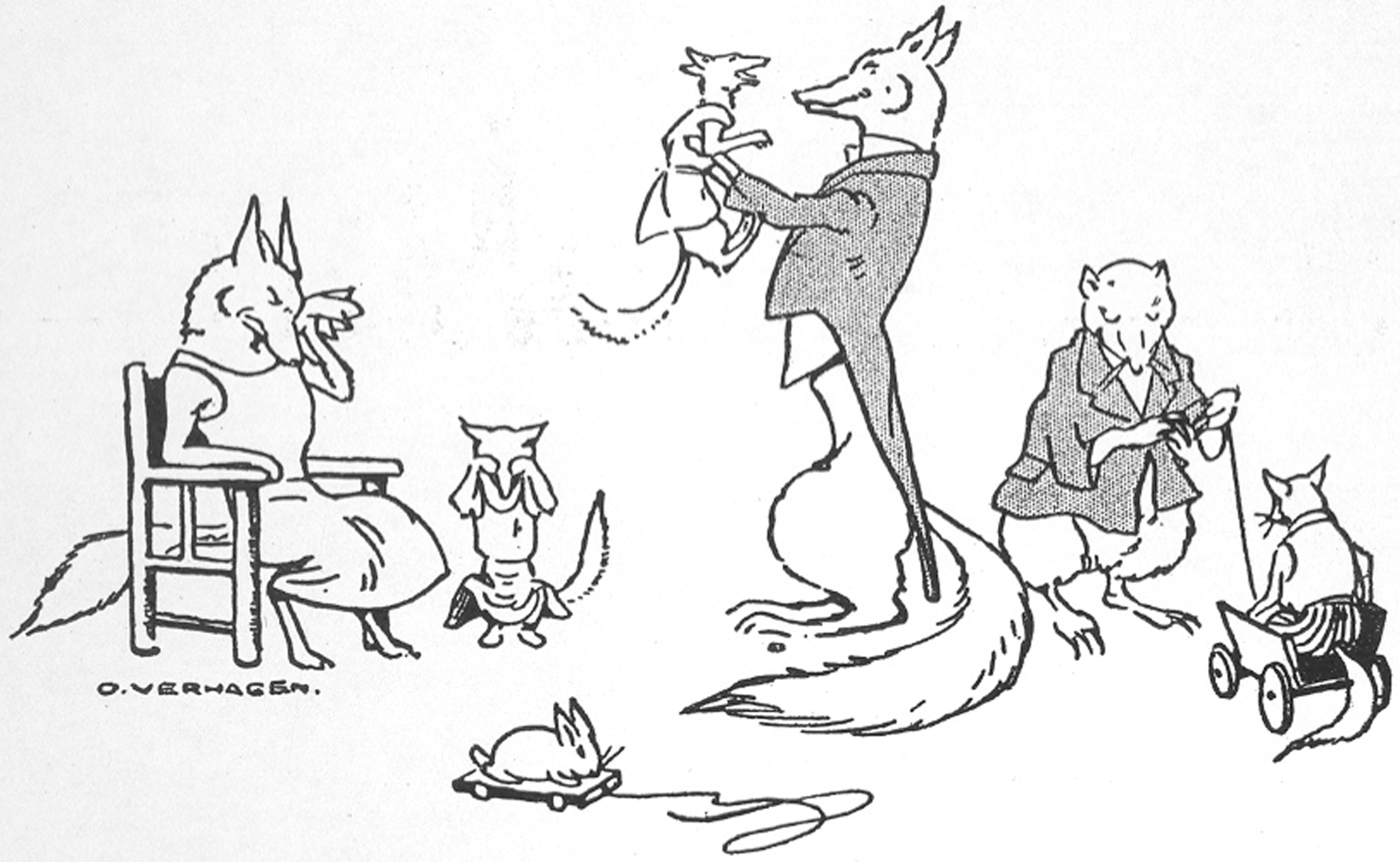
O. Verhagen in: W. Kuhfus, Reinaart de Vos [Reynard the Fox], (Den Haag: G.B. van Goor Zonen’s uitgeversmaatschappij, 1931), 40.
The same mechanism can be found in children’s versions of other international classics. This article will demonstrate how old stories, such as the Reynard story, were used to initiate young readers in the ideological foundations of the prevailing culture on the basis of their authority as classics. The key question is: how did rewriters transform the old stories to transmit contemporary culture? To answer this question, both a textual analysis based on the comparison of old texts and their new versions and a cultural contextualization of the results of that analysis was performed, focusing on the representation of the family.
Dutch adaptations serve as a case study. 14 Besides Van de vos Reynaerde, Dutch adaptations of three other international classics have been analyzed on the subject of family ideology. They were selected on their amount of adaptations published between 1850 and 1950. Among the many international classics that were rewritten for children in this period, Van de vos Reynaerde (thirteenth/fourteenth century), Till Eulenspiegel (fifteenth century), Robinson Crusoe (Daniel Defoe, 1719), and Gulliver’s travels (Jonathan Swift, 1726) were rewritten most. 15
Four representations of the family can be discerned. A short historical outline of the family ideology these representations were based on will be given first. After expounding the literary and cultural theories the analysis was based on, the representations will be demonstrated using exemplary passages from several adaptations: (1) the family as a source of domestic happiness in adaptations of Robinson Crusoe, (2) the family as a safe haven in adaptations of Gulliver’s travels, (3) the family as educational environment in adaptations of the Reynard story and Till Eulenspiegel, and (4) the family as the worldly counterpart of the holy trinity in adaptations of Robinson Crusoe. Each paragraph will also contain a short introduction to the original stories.
The Nineteenth Century Family Ideology
Alston’s finding that family life, or a substitute for family life, has always been a key component in children’s books, is not surprising: both the expansion of reading material explicitly intended for children and the cultivation of the “home sweet home” construction of the family are rooted in eighteenth-century bourgeois culture. 16 This does not imply it were new phenomena. Locke’s treatise shows how reading material for children had already been an issue in the seventeenth century and both educational and religious reading material for children from earlier centuries have been found. 17 Besides, the family as an affective community can also be discerned in sources such as correspondences and diaries from long before the eighteenth century. Moreover, it had been a subject of paintings, for example, from the Golden Age. Although the latter chiefly concerned the propagation of virtues, it did so by portraying the family circle. 18 However, the discourse and especially the propagation of the family as an emotional unity apt to suppress social wrongs originated in eighteenth-century upper-middle classes.
From the eighteenth century onward, the family started to lose its function as an economic unity, clearing the way for a Western European family discourse emphasizing the family as an emotional unity, based on affective relationships between its members. 19 Means to separate work and private life brought forth a family discourse characterized by emotionalism; love became the originator and the cement of family life. 20 At the end of the eighteenth-century bourgeois morality offensives started to propagate family life as a condition for the elevation of the working classes. 21 The family circle would be a safe haven, far from the dangers of the outside world, that would prevent both men, women and children from worldly dangers. The most important values to be educated within the imposed family ideal were moderation and self-control; a happy home would keep the men out of the pub, children under supervision all the time, and women inside to do the housekeeping.
Although family life started to be cultivated in the eighteenth century, it was the nineteenth century in which the “home sweet home” family cult culminated in a deluge of passionate pleas for family life. The family cult was expressed in the attention family life got in the social debate, but initially the bourgeois way of living with the man as bread winner and the woman as housewife remained an ideal that was not actually attainable for most lower-class families. 22 As a consequence, more accurate than to describe the nineteenth century as the century of the family, it would be to describe it the century of the family ideology.
In children’s literature, in the nineteenth century still particularly valued for its formative function, many traces of family ideologies all based on the ideal of domesticity can be found. 23 Especially in retellings of old stories, one can discern how these ideologies were implemented in the stories, for one is able to compare the retellings with the original stories, stemming from a former cultural context with different ideas about the function of the family. This implementation was a parallel and at the same time a means to the implementation of the ideology in society.
Literature in Culture
Literature is one of the modes of expression of culture. It absorbs social values and contexts; explicit and implicit norms, patterns of behavior, expectations, assumptions, opinions, and prejudices. “A large part of any book is written not by its author, but by the world its author lives in,” Hollindale writes. 24 Consequently, even for a writer himself, the ideology of a text might be hidden; writers transmit the world they share with their readers, including all passive and widely shared values that seem to be so inseparable of this world one might no longer be conscious of them. The whole of implied presuppositions, moral values, written and unwritten rules can be referred to as the “metanarrative” of a text, defined by Stephens and MacCallum as “the implicit and usually invisible ideologies, systems and assumptions which operate globally in a society to order knowledge and experience.” 25 Accordingly, Greenblatt’s plea for the use of literature in cultural studies becomes relevant. He writes: “if an exploration of a particular culture will lead to a heightened understanding of a work of literature, so too a careful reading a work of literature will lead to a heightened understanding of the culture within which it was produced.” 26
However, literature does not merely reproduce a social status quo or the prevailing ideologies of a particular time and place. It also helps to shape, refine, and even change culture. Moreover, literature does not have to comment explicitly on a given culture, for example, in the form of a parody or satire, to bring about cultural change. Wrapped in implicit and explicit ideological codes, wrapped in its metanarrative, every work of literature presents a system of social norms and values that does not only represent but also constructs a view of the world. The reason is that such a system never coincides completely with the culture in which the work of literature is produced, if only because even the most precise description implies choice: the choice what to describe, in which order and style, using what words—a choice that resembles the key question of education. Works of art “do not merely passively reflect the prevailing ratio of mobility and constraint; they help to shape, articulate, and reproduce it through their own improvisatory intelligence,” Greenblatt writes. 27 Therefore, in his view, every work of art in its capacity to absorb, transmit, and question cultural codes, that is, in its mode as an expression of culture, can be defined as an educational tool. 28
“Education is considered as a reciprocal process between children and educators, initiating children into the codes of a given culture,” Dekker writes. 29 The conscious aim to transmit the prevailing culture to the next generation implies an attitude to cultural change. After all, educators have to constantly ask themselves what aspects of the given culture they would like to transmit to children and how. They will have to choose the cultural elements they consider worthy of transmission. Otherwise put, only a selection of a given culture is transmitted. 30
The Authority of Classics
Publishing canonical texts for children sheds light on the process of selection. It is a tangible way to transmit culture, because it concerns the transmission of actual cultural artifacts. Therefore, it could be called cultural transmission in the shape of literary transmission. The fact that the Reynard story was chosen to be published for children first of all tells us it was considered a literary artifact worth passing on to the next generation. The same holds for other international classics that were adapted. However, in the case of classics, selection is not limited to the choice of the work of literature. Neither of these texts was published for children in their original shape, they were adapted. Moreover, this adaptation was not limited to the old and/or foreign language, but concerned the content of the stories as well.
The classics were adapted to readers of a new cultural context by “rewriters.” There were all kinds of rewriters: children’s writers who also published original children’s books, teachers, writers of adult literature, occasional writers, and publishers. Besides, a large amount of adaptations was published anonymous.
The rewriters intended to eliminate possible cultural tension between the original text and its new context, such as an outdated world view or other incompatible cultural contrasts, using transformation strategies such as the deletion of certain passages or an adjustment of the content, and sometimes they even chose to add elements to the original story. In this way, they tried to bring the old text to the living environment and life experiences of its new readers. This means that, just as the choice of the classics to transmit implies a selection of texts, adapting them implies a selection of textual elements. Moreover, it implies a manipulation of the selected elements.
The stories were adapted to the norms and values of the new context in which the stories were to function as stories for children. Besides transmitting culture, both the selection and the manipulation of the selection brought about cultural change; old values were replaced by new values and new ideas about the child as a reader and as a human being influenced the way the old stories were retold. As Stephens and MacCallum formulate it: “(...) retellings of canonical literary texts have a double edge: they serve in the transmission of cultural values, but also shape those cultural values according to dominant metanarratives through processes of discursive and narrative selection and modification.” 31
As metanarratives are fluent, adaptations die out quickly after the first publication, making room for a more up-to-date adaptation of the same source text. Consequently, the original masterpieces are retold time and again. This gives adaptations a thoroughly contemporary character; they only suit a particular time and place. When they become out-of-date, they are replaced by a new version. This contemporary character can provide us with a lot of information about the period in which the texts came into being and the context in which they functioned. Adaptations of historical literary texts not only make it possible for the source text to live on as a literary phenomenon but can also themselves be considered as social phenomena that illuminate the cultural codes of a given time and place that are chosen for transmission, such as the representation of the family.
Between 1850 and 1950, Ligthart was not the only one bringing the topic of family life into the limelight in a new version of the Reynard story. Several rewriters incorporated or reinforced this quality of the questionable hero. Reynard the lying, murdering, and raping subject of King Nobel the lion was transformed into a sociable father.
This bourgeois family ideology can be discerned in other rewritings from the same period as well. Also children’s versions of Till Eulenspiegel, Robinson Crusoe, and Gulliver’s travels show an increased attention to the topic of the family, by expanding scenes taking place in the family circle, or adding them to the original story. Domesticity became an indispensable ingredient of the narratives. Both form and content of the new versions contributed to the perpetuation of the ideal of domesticity and its transmission to the new, young readers of the stories. Domesticity functioned as a tool to stimulate identification, as an aspect of the completion of the plot and as an element in the narrative structure of the stories.
The way the family theme is dealt with, both on the level of the content and in the structure of the stories, sheds light on the family ideology behind the textual transformations. Domesticity is the core of them all, but, as we shall see, the function of domesticity evolves. Nevertheless, the selection and modification of the original texts contributed to the establishment and perpetuation of a bourgeois family value that formed the heart of morality offensives inflicted upon a large part of Western Europe; the cornerstone of society became the foundation on which rewriters reconstructed the old masterpieces. The adaptations functioned as argumenta ad verecundiam; they appealed to the authority of old classics to initiate the children in contemporary culture. Wearing the colors of old international masterpieces, the adaptations transmitted a contemporary ideology.
The Family as a Source of Domestic Happiness
The emotional function of the family was put to the fore in many adaptations. Those of Robinson Crusoe are exemplary. The original story The life and strange surprising adventures of Robinson Crusoe of York by Daniel Defoe was published in 1719. Although most people are familiar with the story about the castaway living twenty-eight years on an inhabited island where he has to learn to survive on his own and civilizes Friday, the noble savage, before he is rescued, the passages of Robinson as planter and his troubled conversion to Christianity are less well known. The explanation might be the many rewritings that left these elements out.
As opposed to this deletion, a bourgeois value of domesticity was added. The topic of the family as an emotional unity, as propagated in bourgeois morality offensives, shifted from functioning as a point of departure in the original story of 1719 to an actual literary motif in many adaptations published between 1850 and 1950. In some adaptations, it even became a narrative theme. This can be demonstrated by looking at the argumentation of Robinson’s father, when he, right at the beginning of the story, refuses to give Robinson permission to become a sailor.
In Defoe’s original version, Robinson’s father argues along the lines of a society ridden by classes based on birth. Born in a family of businessmen, Robinson belongs to the upper-middle class. According to his father, this has a lot of advantages. It is the class “most suited to human Happiness,” he states. People like them are “not exposed to the Miseries and Hardships, the Labour and Sufferings of the mechanick Part of Mankind, and not embarass'd with the Pride, Luxury, Ambition and Envy of the upper Part of Mankind.”
32
His father had taken care of Robinson’s education and he does not want Robinson to waste it. Robinson should not bargain his privileged position by going to sea, because that would not suit a young man of his birth. By Robinson’s account: [...] he press'd me earnestly, and in the most affectionate manner, not to play the young Man, not to precipitate my self into Miseries which Nature and the Station of Life I was born in, seem’s to have provided against.
33
In Defoe’s original version, Robinson’s father also adds another argument to his plea: Robinson’s brothers are already dead. He does not want to run the risk to lose his third son as well, for he needs his remaining son to continue family traditions and take care of his parents.
The adaptations published between 1850 and 1950 transferred the pitch of his plea. Instead of mainly emphasizing Robinson’s class duties, the emotional argument of keeping the family together was put to the fore. There is a clear development from adaptations published in the second half of the nineteenth century to adaptations from the first half of the twentieth century. Already in the adaptation of J. J. A. Goeverneur (1871), the most productive Dutch writer and rewriter for children in the nineteenth century, and in the adaptation of A. van Schouwenburg (1887) Robinson’s father puts less emphasis on the class argument. 34 It was completely deleted in subsequent adaptations. 35 In the first half of the twentieth century, the class Robinson belonged to did not play any part in the story anymore. Breaking up the family became the main argument against gratifying Robinson’s longing for the sea. “My dear child,” his mother says in the adaptation of A. Marits (1934) “you surely do not want to leave us alone in our old age? Your elder brothers have been taken from us so young. Their children never had a father... In the future you could be a support to us and to them. Really, a drifter’s life is not a happy one. Nothing is better than a quiet life in one’s own home.” 36
Robinson turns a deaf ear to his parents' pleas, however. He goes to sea and is wrecked. Repentance comes too late. Miserable on the desert island Robinson contemplates what would have happened if he had not been as unwise as to go to sea. He could have had a nice and cosy family life, he imagines: I pictured myself walking through the streets of York, greeted by everyone, a man of distinction. I opened the door of my home, my wife smiled at me and I could hear the lively voices of my children in the living room.
37
I was a boy and I was standing in a room that was brightly lit. The light came from twelve candles on a large cake. A soft hand caressed my hair. “Be brave, my boy,’ my Father said with emotion in his voice. My mother stood at the table. In the beginning I could not see what she was doing. Then I saw it. A rocking horse—no—a kid! It wanted to knock into me—I walked away—and woke up.
38
Other rewriters, like Mens (1948), chose Christmas to glamorize family life: We came home, and the whole house smelled of roasted meat and buttery cake. We sat down to table; father cut the Christmas goose and later that evening the pudding was served, lighted with dozens of candles. After dinner we gathered around the hearth, where father told us about the birth of Christ, Bethlehem’s star and the three wise men...
39
In many adaptations, Robinson tries to imitate family life on the island by gathering animals around him, imagining them his family members. See, for example, the illustration in an anonymous version published in the thirties (Figure 2 ).
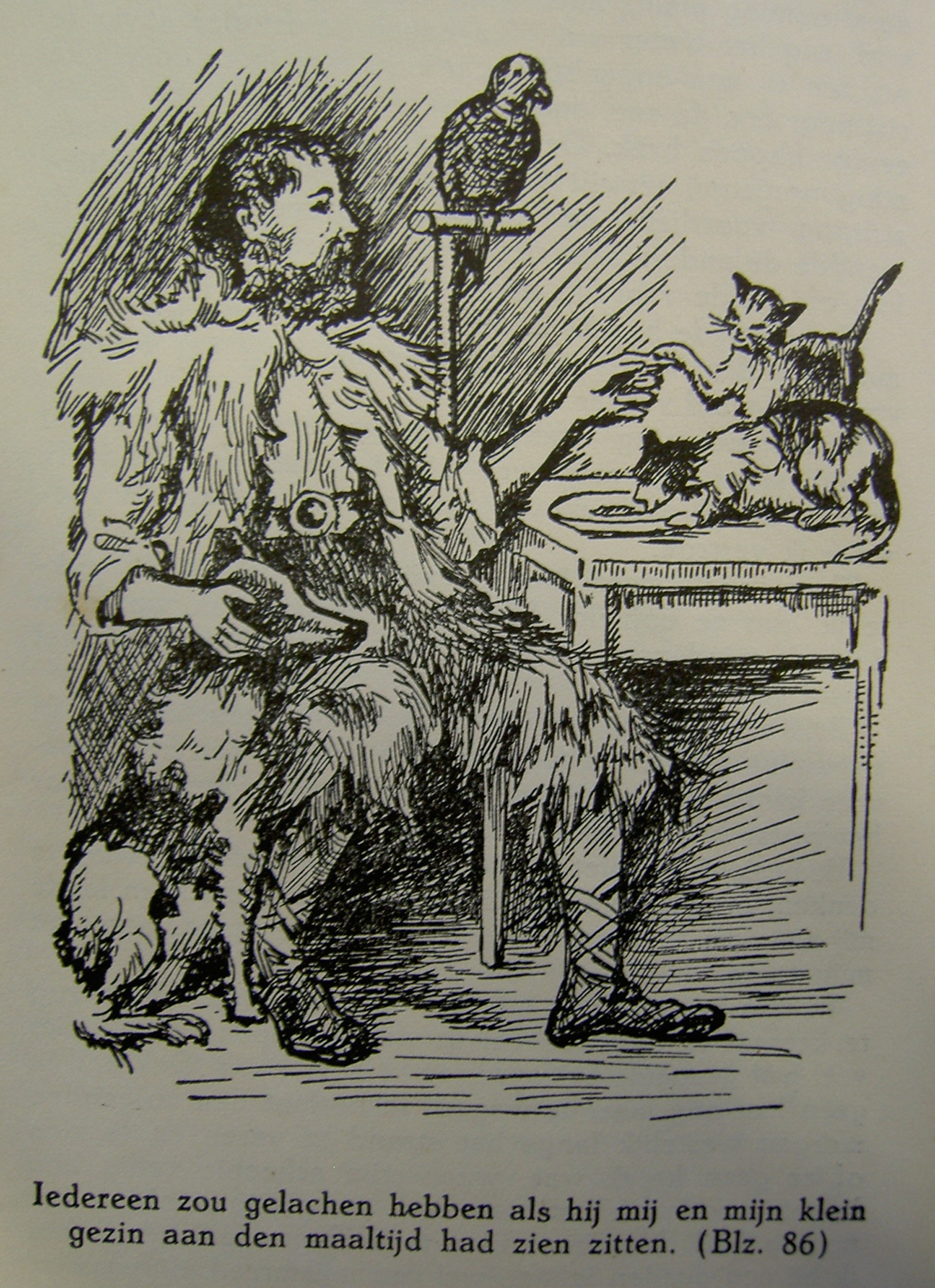
Anonymous in: Anonymous, Robinson Crusoë (Amsterdam: Nieuwe Jeugdbibliotheek, 193×), 82.
Robinson considers each new animal literally an extension of his family. For example, when one of his cats has kittens in the adaptation of K. Beversluis (1908), he writes: “In the monotonous life I had to live during these rainy days, this enlarging of my family provided me a pleasant variety.” 40
The exaltation of domesticity culminates in Robinson’s education of Friday in the adaptations. When the “noble savage” arrives, Robinson civilizes him not only by teaching him the English (in the adaptations sometimes German or Dutch) language and good manners, but by introducing him to the pleasures of domesticity as well. Friday’s remark in Mens' adaptation (1948) proves it successful. Sitting cosily at the fireside Friday looks at Robinson, stretches out his arms, and says: “I am happy, master.” 41 The initiation to this social value of Friday in the book served the transmission of the same value to readers of the book. It can be read as a moral message to the children reading the story: devotion to family life makes one happy.
The Family as a Safe Haven
The most essential narrative pattern of children’s literature is the structure home-departure-adventure-homecoming, Nikolajeva writes. 42 The main character leaves his familiar surroundings and has to find his way in strange environments, just as a child has to find its way in the world, to return home more experienced. In children’s literature “home” and “homecoming” almost always implies home and homecoming in the family circle. Defoe’s Robinson Crusoe contains this narrative structure. However, his homecoming is not a family homecoming. When he finally returns to England, both his parents are dead. This was changed in the children’s versions published between 1850 and 1950. In many of them, Robinson’s parents, or at least one of them, are still alive, so Robinson can return to the bosom of his beloved family. In some versions, he takes Friday with him, to be adopted as a family member. Moreover, in one of the adaptations, they even return to the island for a while, to find other savages and sailors having raised happy families together as well. 43
Robinson and his family live happily ever after. However, in the original story Robinson’s longing for sea returns, even after having started a family himself. So he embarks again, the prelude to the sequel of the book. However, this second embarking and the sequel have never been subject to rewritings for children. And that is exactly the difference between children’s literature and literature for adults Nodelman describes: as children’s literature has a linear narrative pattern, the structure of literature for adults is cyclical: A character leaves home, a dangerous or difficult adventure makes him long to go back, he returns, but after a while the outside world starts to appeal again and the cycle starts anew. 44
The presentation of the family as a safe haven and a happy ending to the story can also be found in the adaptations of Gulliver’s travels. Just as Robinson Crusoe the original story contains the cyclical narrative pattern described above. Lemuel Gulliver takes four journeys, each of them bringing him to strange, fantastic countries, first to Lilliput, the country of little people with megalomaniac minds, second to Brobdingnag, the country of humble giants and third to the islands of Laputa, Balnibarbi, Luggnagg, Glubbdubdrib, and Japan laboratories of unworldly scientists. After every journey, Gulliver returns to his wife and children, but they can never avert him from leaving again. Initially, Gulliver always seems happy to come home to his wife and children. However, Gulliver’s fourth journey brings him to the land of the Houyhnhnms, noble animals that are half human half horse, and their contemptuous slaves the Yahoos, who look suspiciously like human beings. Unwilling to, he has to leave this extraordinary country as well and this time his homecoming is not as harmonious. Gulliver considers his relatives Yahoos and does not want to have anything to do with them again. He retreats to live in the stables with the horses, who resemble the Houyhnhnms.
Swift played his readers an ironic trick. As Gulliver tells the story as a first person narrator himself, this mental breakdown at the end of his fourth travel retrospectively unsettles the whole narration. Gulliver turns out to be an unreliable narrator, which means all narrative elements, including the happy homecomings, are undermined. Not surprisingly, the rewriters chose to avoid this, by either opting for a more reliable third person narrator or by retelling only the first two travels of Gulliver. Consequently, in most adaptations, the story ends happily in the family circle.
However, a few rewriters faithfully rewrote all four parts of the original masterpiece. They did change the ending of the book, though, for example, Kieviet (1907). He concluded with a happy homecoming in the family circle, which is emphasized both in the text and in the accompanying illustration (Figure 3 ): “His children’s delight in their beloved father’s homecoming beggars description. Christmas was merrier than ever.” 45
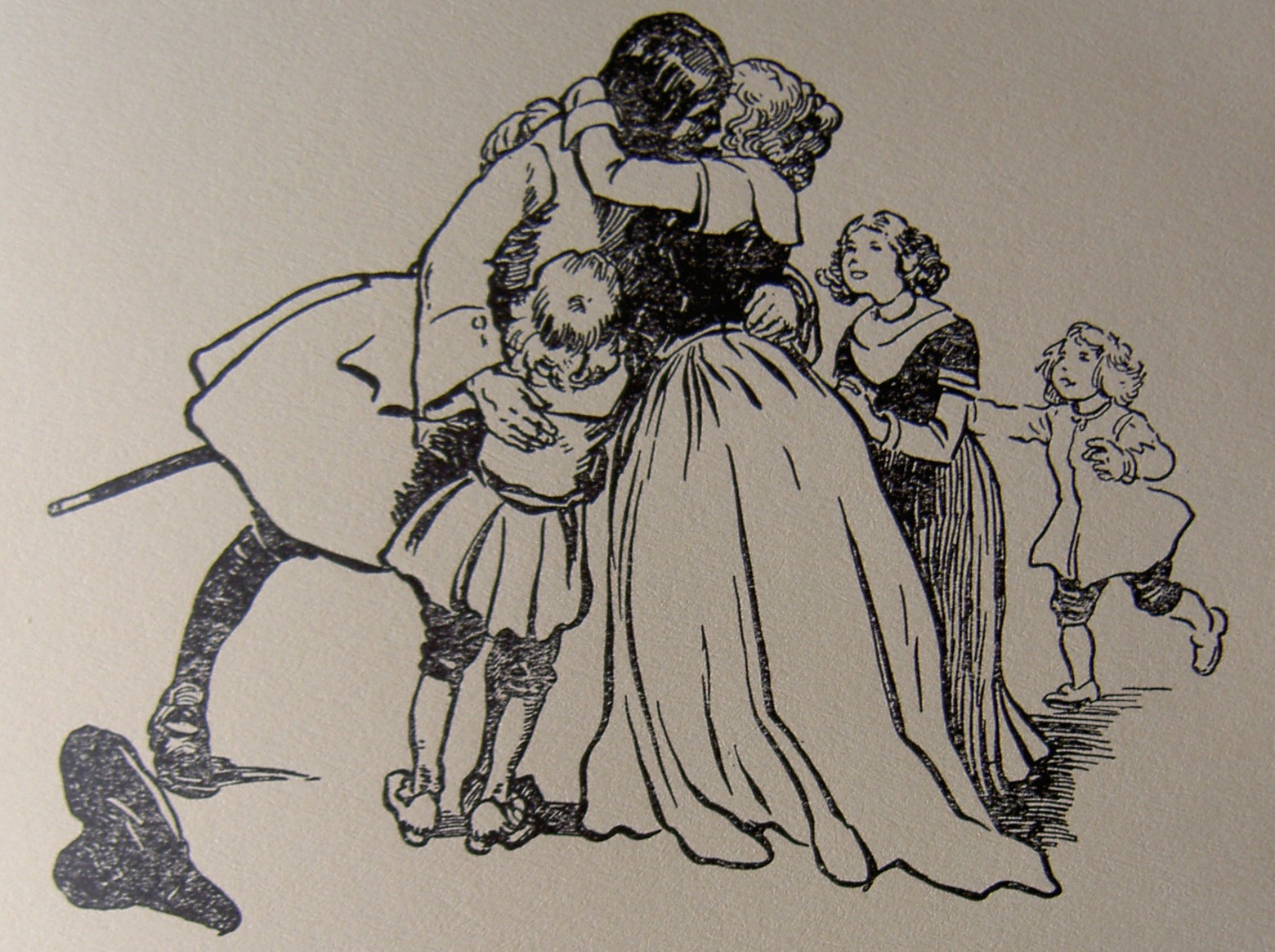
Netty Heyligers in: Kieviet, C.J., Gulliver’s reizen [Gulliver’s travels], (Amsterdam: Van Holkema & Warendorf, 1922), 137.
In conclusion we can say that in the adaptations of Robinson Crusoe and Gulliver’s travels published between 1850 and 1950 coming home meant returning to the safe and warm bosom of the family. Happy family circles enabled the children’s versions of Robinson and Gulliver their emotional homecoming; only among their families, these sorely tried heroes were able to calm their restless nature and find peace.
The Family as Educational Environment
On the occasion of the inauguration of Queen Wilhelmina in 1898, the Dutch pastor and professor of philosophy P. H. Ritter wrote: “Writing about the future without mentioning the family, equals speaking of a tree without mentioning its roots, for it is the family living room in which the future of the people is prepared.” 46 The family was considered primary educational environment. Even the wicked fox Reynard and his wife took care to educate their cubs in some adaptations, although they use some questionable examples, as in Louwerse’s adaptation (1897). After Reynard has tricked the bear into sticking his head in the log of a tree, claiming it holds an abundance of honey and thereby causing him to be attacked by an abundance of bees, Reynard’s wife takes their cubs to learn a lesson from the wounded bear:
“We would like to see the glutton,” Hermelijne said. “Yesterday I told the children a story how a boy with a sweet tooth got a nasty surprise. “Now you know what happens to gluttons, youngsters,” I said, and it is always good to confirm a story with an example, so here we are to see uncle Brown.”
47
This pedagogical theory can be traced in adaptations of the medieval stories about Till Eulenspiegel. Just as Reynard, Till Eulenspiegel is a trickster, rooted in folklore tradition. His many tricks, originating from fifteenth-century oral narratives were collected and put into writing in a sixteenth-century chapbook. The main theme of the stories in this chapbook is the ridiculing of the social organization of late medieval society. Till goes through many jobs, each time mocking his employers and often also making a fool of dignitaries and other people. His stories contain many scabrous passages in which Till uses his excrements to perform this mockery. Obviously, in times the children’s book served the socialization of the child this was not considered appropriate. Nevertheless, the stories have become popular children’s stories, in adapted form of course. In most versions, Till’s tricks were highly censured. However, some rewriters used the strategy of pedagogical explanation to moderate Till’s jokes, For example, Louwerse (1900).
He used the idea of failing parental authority to explain the tricks Till played on his contemporaries, tricks Louwerse explicitly declared not to appreciate. Analogous to contemporary educational ideas, he blamed it on Till’s upbringing: Till’s father only laughs about everything his son is up to, neither his father nor his mother takes Till’s teachers' complaints on his behavior seriously. 49
Two decennia later, rewriter Henriëtte Blaauw even referred to the division of educational roles between the mother and the father. As mothers, claimed to have such mild characters, were mainly charged with bringing up the children through loving them, fathers were supposed to discipline, if necessary punish them, according to the educational discourse at that time.
50
In Blaauw’s adaptation, Till’s father died when Till was very young. Added to his mild mannered mother Till’s bad manners were explained: The boy grew up well, and he might have turned out rather different if his father had not passed away so early. Till thought he could lord over the farm and he did not pay attention to any of his mother’s admonitions.
51
In 1929, Gruys-Kruseman also depicted Robinson Crusoe as a delinquent, a young man that met contemporary’s description of misconduct because of overindulgence: I was spoiled and pampered by my mother and I soon realized I could not do anything wrong in the eyes of my father. In the mornings, I often walked past the school instead of going inside and when my father noticed that he shook his respectable head, but did not even grumble about me. Mother smiled and raised her finger. Later I realized a more strict education would have been much better for me, yes, it would have kept me from many sorrows and hardships.
53
The Family as the Worldly Counterpart of the Holy Trinity
In the nineteenth century, the organization of Dutch society was more and more segregated into several religious and sociopolitical groups. This “pillarization” process can be discerned on the level of children’s literature as well; every group had its own writers or at least its own lists of recommended books for children that would support their initiation within a particular conviction and the accompanying philosophy of life (or at least would not frustrate it). The representations of the family ideal in the adaptations of the classics show a similar mutual divergence, according to the religious conviction of the rewriters.
It was probably the puritan character of Defoe’s masterpiece Robinson Crusoe that kept catholic rewriters from changing the story into an explicit catholic narrative, for no explicit catholic adaptations have been found. One of the few discussions among catholic educators in which adaptations of the classics were mentioned explicitly, was found in the Opvoedkundige Brochurereeks, an educational series of pamphlets from the Roman Catholic orphanage for boys in Tilburg. In one of these brochures Friar Doodkorte, teacher on a catholic school for boys, pleaded for a “catholization” of existing stories such as fairy tales and international classics. 54 However, his superior, Friar Rombouts, did not consider that necessary. In his brochure, Rombouts did argue for children’s books that combined the excitement of adventurous stories with moral education, a combination that educators at that time often ascribed to Robinson Crusoe, 55 but he did not have a rewriting of Defoe’s classic in mind. He argued for new stories, in which Robinson’s heroism would be combined with Roman Catholic idealism: stories about the heroic deeds of missionaries. 56
Many rewriters gave Robinson Crusoe a general Christian touch, but some protestant rewriters did keep or color their versions explicitly Protestant. In some cases, one can even discern a particular persuasion. For example, the already mentioned teacher and writer of many historical youth novels Louwerse gave his rewritings a specific Calvinistic tone. His rewritings of Robinson Crusoe give the clearest examples of the way contemporary ideological and even political views on the function of the family were incorporated in reading material for children. This can be demonstrated by his approach to the educational principle of obedience.
Obedience was one of the main points in the pedagogical discourse. It was considered indispensable for functioning as a good citizen in contemporary society. Moreover, to confessional pedagogues, a child’s obedience to its parents represented its subordination to God. In one of his political treatises, the leader of the neo-Calvinistic Antirevolutionary Party and prime minister of the first confessional government of the Netherlands, Abraham Kuyper, proclaimed this family pedagogic into family politics. He regarded family life as the cornerstone of society. He used the ideal composition of the family as a metaphor for society. According to Kuyper the ideal family consisted of (1) the father, who provided enough family income for (2) the mother to be able to stay home and take care of (3) the children. Father and mother related to each other as the government and the parliament; the authority and the supervision of authority. Kuyper also used Christian metaphors and considered worldly fatherhood the reflection and even representation of divine Fatherhood. Moreover, Kuyper stated the family to constitute the foundation of religion, nation and society which, in his view, represented the Holy Trinity. Consequently, not only was society reflected in family life, family life was reflected in society as well. Therefore, unconditional filial obedience was required. Society depended on it. 57
The original Robinson Crusoe already represents the importance of filial obedience. Robinson is disobedient by going to sea and only after many trials and tribulations on the desert island he finds God and shows repentance. In both his adaptations for children, Louwerse emphasizes the importance of filial obedience as the worldly reflection of the subjection to God even more. For example, by adapting the passages on Robinson’s illness.
In the original story, after some time on his island, Robinson falls seriously ill. On the verge of death, he is visited by an apparition. A man carrying a spear-like weapon and surrounded by fire descends and fulminates: “Seeing all these Things have not brought thee to Repentance, now thou shalt die.”
58
Waking up, Robinson immediately realizes his fault: I had alas! no divine Knowledge; what I had received by the good Instruction of my Father was then worn out by an uninterrupted Series, for 8 Years, of Seafaring Wickedness, and a constant Conversation with nothing but such as were like my self, wicked and prophane to the last Degree.
59
In Louwerse’s adaptations, Robinson’s illness functions as a turning point as well. However, he changed the apparition during the illness. Instead of a divine apparition, in his first adaptation (1888 [1869]) Robinson’s father appears. Referring to the father as the worldly counterpart of God the Father, Robinson realizes that by disobeying him, he disobeyed God: He contemplated his life to this very moment, asking himself: ‘Is God able to help me? Have I not sinned too much and too often against his commands? God wants us to love and honour our parents. I was disobedient; I left them disgracefully and gave them so much pain and sorrow. [...] Did I think of God? No, instead of praying I swore. The good God will punish me, just as my father predicted!’ Thus he complained, hiding his head in the sea grass he slept on as if he was afraid to see the angry eye of God. A short moment later he stared ahead with glazing eyes and it was as if he saw his old, good father standing in front of him.
60
In his second adaptation, Louwerse replaces the apparition as well. In this version, Robinson is chased by monsters shouting: “Villain, now you are punished! You hurt your parents and you will never do well again, never, never, never! We will chase you everywhere, everywhere!”
62
But just as the monsters are ready to pounce on him, Robinson’s mother appears. She asks him if he wants to get better. After Robinson tearfully answers he wants to, she tells him he should convert to God: Call Him! Bow to Him and ask Him for forgiveness of all the evil you did! Beg Him for help and assistance! Be devout! That is the way you should go to become as happy as possible, Robinson!
63
The symbolics of God the Father personified in Robinson’s worldly father in Louwerse’s first adaptation culminates in the ending. Although in the original story both his parents have died when he returns home, in Louwerse’s adaptation he finds his “good father” still alive. The latter welcomes him as the Prodigal Son and forgives him his sins, just as the Prodigal Son was forgiven:
64
Robinson could not control himself any longer. He spoke, his voice forced and sounding different: “Might your remorseful son hope for forgivene...?” Overwhelmed by tears he could not go on. And when the reassuring “yes” sounded, he lost his grip completely. Uttering the words: “It is me, I am your son,” he ran to his father and, crying, embraced him by his knees. “My son, my son! Did you finally come back to me?” the old man cried, overwhelmed by joy, and pulled him to his chest.
65
That is how I suffered because I had been disobedient, irreligious and lazy. Let my story be a warning and an instructive example. Be diligent, obey your parents and masters and never forget the good God!
66
Conclusion
Books for children are an important agent in the socialization of children. As socialization implies cultural initiation, children’s books play a part in cultural transmission. Adaptations of literary classics form a substantial part of children’s literature. Adapted to the new cultural context, the old masterpieces have both a representational and a formative function. They enable children to get to know their cultural heritage, but rewriters only choose those elements they consider worth passing on and adapt the old narratives to contemporary norms and values. Consequently, adaptations of literary classics for children bring about cultural change as well.
Up until the second half of the twentieth century, children’s literature operated under the primacy of pedagogical power. Compared to the original works, Dutch adaptations of international masterpieces, such as Reynard the Fox, Till Eulenspiegel, Robinson Crusoe, and Gulliver’s travels, show a shift in the representation of family values. Contributing to the social implementation of bourgeois family values, all adaptations blew up the importance of domesticity. This served both the accessibility and the acceptability of the stories as children’s stories. On one hand, it pulled the stories into the world of experiences of the new young readers, as the family would have been their first and most well-known living environment. On the other hand, it transmitted an important social ideal.
Determined by the contemporary cultural ideal of bourgeois family values, domesticity was propagated on the level of content by the addition of happy family scenes, on the level of the narrative structure by giving the family an indispensable part in the completion of the plot and on the level of reception by increasing the ethical tolerability of transmitting the old stories to children. In other words, the reconstruction of domesticity was both a tribute to the adherence to the ideal of domesticity and an ingenious way to introduce it as a desirable social scheme to children.
Footnotes
Acknowledgment
The author would like to thank Prof. Dr. J. J. H. Dekker for his fruitful feedback on earlier versions of this article.
The author(s) declared no potential conflicts of interest with respect to the research, authorship, and/or publication of this article.
The author(s) received no financial support for the research, authorship, and/or publication of this article.