







Abstract
This article reconceptualizes orphanages as child care, exploring the ways in which working-class fathers used institutions in times of family crisis to meet their child care needs. By examining the white, largely widowed men who placed their children in the United Presbyterian Orphan’s Home in Pittsburgh from the 1880s through the 1920s, the study sheds light on working-class fatherhood, a little understood aspect of family history. Using rich new sources not previously available to scholars, the article incorporates rigorous quantitative analysis of the records of 590 children at the institution, providing new insight into the lives of working-class fathers struggling to balance their labor and parenting responsibilities as they used the orphanage as a strategy for family survival.
Grandpap was a machinist by trade. He helped build the Duquesne Works of the United States Steel Corp. (USX) He was a Jack-of-all-trades. It was said, “If Jimmy Caldwell couldn’t fix it, it couldn’t be fixed.” He belonged to the Masons in Carnegie, PA. He was an intelligent, self-educated man.
1
In 1880, at the age of twenty-three, James Caldwell and his new bride, twenty-year-old Jessie, set sail from Scotland. James had a career as a police officer but had already made at least one trip to the United States to scout out a new future for himself. During the voyage across the Atlantic, Jessie gave birth to their first child and, after landing in Philadelphia, the new family set out on foot to cross the state of Pennsylvania. They stayed with other Scottish families along the 300-mile journey west to Pittsburgh, where James found work as a cemetery caretaker and then in the electric light department of one of Andrew Carnegie’s steel mills. Their family grew quickly, and ten years later they had six children and were expecting a seventh when tragedy struck. First, one-year-old Joseph died, and a few months later, Jessie died shortly after giving birth to Alexander. Suddenly widowed, with a newborn and five other children to care for, James turned for help to the United Presbyterian Orphan’s Home (UPOH) run by the women of his church.
James Caldwell with children Mayme, Roberta, Susie, and Archie, circa 1891 after he placed them in the United Presbyterian Orphan’s Home. [Source: Collection of the author.]
The orphanage managers would not take infants, so James likely placed baby Alexander in a private home or with a wet-nurse, where he survived only seven months. They would also not accept nine-year-old Katiebell, who had epilepsy, and whom they judged to be “feeble minded.” The managers helped James get her admitted to Elywn, a state-run institution near Philadelphia that developed a specialization in epilepsy in this period, and he paid the fees. James later moved Katiebell to the Polk Institute, another state facility closer to Pittsburgh, where she died at the age of eighteen. In the meantime, the remaining four Caldwell children spent between one and nine years in the orphanage, with James paying fifty cents a piece each week for their board. (Figure 1) After a year, Susie aged out of the institution, and she returned home to keep house for her father. Archie got into some mischief when he was eleven and James had to remove him from the home. Roberta stayed a few more years until she, too, aged out, and James made informal indenture arrangements for her to join Archie, working on a farm in Butler County. Finally, in 1900, James took home his youngest daughter, the managers noting, “Mr. Caldwell having established a home at McKees Rocks in charge of his eldest daughter Susie removed Mamie … as she was past twelve years of age.” 2
When his family faced the catastrophic loss of its wife and mother, James used the orphanage as child care, remaining involved in his children’s lives. He visited them at the home, as evidenced by this photograph taken on Federal Street in Allegheny City (now Pittsburgh’s Northside neighborhood) near the institution. He even made a generous financial contribution when he attended an annual Donation Day fundraising event. 3 For James, orphanage care served as a family survival strategy, permitting him to maintain ties to his children and between the siblings.
The James Caldwell story sheds light on the experience of working-class fathers: a little understood aspect of family history, as well as the broader history of child care, in the United States. This article explores the men who, like Caldwell, used the UPOH as a form of child care from the 1880s through the 1920s. The essay takes into account the ways in which the experiences of working-class men differed from those of single women with children. It considers to what extent men were involved with the care of their children and probes the connection between their breadwinning role and family life. Ultimately, the essay reconceptualizes orphanages as child care and examines the ways in which working fathers used the institutions for their own purposes, as a strategy for family survival.
Working-Class Fatherhood
Historians have barely begun to tell the story of working-class fatherhood. Reacting to early masculinity studies, which largely ignored men’s role as fathers, scholars in the 1980s and 1990s began drafting the broad brushstrokes of the history of fatherhood. 4 But their work, drawing on evidence such as letters, diaries, and advice literature, focused on white, middle-class men living in the American North. Influenced by the notion of increasingly gendered “separate spheres,” a model first put forth by women’s historians in the 1960s and 1970s, these scholars viewed the nineteenth century as a period of decline for fathers. 5 Starting in the early nineteenth century with the changes wrought by industrialization and urbanization, men’s patriarchal power within the family eroded as work took them away from the home. In this view, women’s responsibility in the home increased (giving them authority in the domestic sphere) as men’s family role narrowed to breadwinning (accomplished in the masculine, public sphere). Where they were once involved with children and caretaking more directly, fathers fell to a more peripheral status, reduced to distant disciplinarians and occasional playmates. 6
By the 1990s, however, some historians were challenging this declension model, observing that the nineteenth century was not a simple, straightforward tale of decline for father’s role in the family. These scholars also noted that there are multiple “fatherhoods,” with racial, class, and other variations. 7 At the same time, women’s historians themselves questioned the usefulness of a strict separate spheres model. While it had created an interpretive framework in which to view the rise of women’s maternal power, its limiting rhetoric (of complete “separation” of men’s and women’s roles) effectively shaped how historians represented the era (as separate entities with no common history). 8 Not only did some historians of the family find the domestic realm to be more of a common meeting ground than implied by separate spheres, but several historians of fatherhood have also recently challenged the notion that men withdrew altogether from child caring responsibilities. On the contrary, they argue that fathers maintained a child care role in the nineteenth century; many were present at their children’s birth, helped make key decisions about issues such as infant feeding, had important emotional connections through their role as playmate, and continued to guide their older children into adulthood, assuring a secure future for them. 9 In this revised view, breadwinning did occupy men’s time and attention, but it did not necessarily shift all of their thought and emotion away from the home nor cause them to grant less importance to it.
While historians to date have looked exclusively at white, middle-class men, the experience of UPOH fathers suggests that their central observation may also apply to white, working-class men. Specifically, the fathers who turned to the orphanage did so largely as involved parents: for many of them, the institution provided a form of child care, allowing them to sustain connections with their children. Historians have suggested that working-class families maintained an instrumental, economic view of children through the nineteenth century, well past the time when the middle-class had shifted to a more sentimental, emotional view of children, free of any income-producing expectations. Because the working class continued to see the family as a collective effort, a working unit in which all members contributed to its viability, these scholars have argued that the middle class used its own, new perception of children as a way to distance itself from those below them in the social hierarchy. 10 While this may have been true of middle-class attitudes, actual working-class behavior was far more complicated. As we shall see, UPOH fathers supervised their children’s care at the institution, worked to reestablish their homes, and displayed intense emotional bonds. For these men, the orphanage served as a means of family survival rather than an abdication of their parenting responsibilities.
Families in Crisis
By the end of the nineteenth century, Pittsburgh was earning its reputation as a mighty engine of American industrial capitalism. The Steel City embodied the intense, simultaneous processes of industrialization, urbanization, immigration, and migration that set the stage for child care crises in many families. For instance, factories not only changed the nature of work and the workday but also were dangerous places that killed and maimed, leaving families without a breadwinner. The crowding of workers in the city gave rise to tenement housing, abysmal sanitation, polluted water, and epidemics that contributed to infant and maternal mortality. And waves of immigration, particularly from Eastern and Southern Europe, and migration, largely of African Americans from the Upper South, dramatically increased the city’s population, changing its racial and ethnic composition, and isolating some families from extended networks of support. Pittsburgh’s infamous reputation as “hell with the lid off”—a reference to the omnipresent smoke and fire belching factories—reflected both the city’s typicality and distinctiveness: it possessed all the urban ills of a typical, industrial Northern city, but in a concentration unlike most others. In choosing the city as the site of extensive investigation for the six-volume Pittsburgh Survey, turn-of-the-century social reformers recognized that it served as a veritable petri dish for the problems they wished to address. 11 Indeed, many poor families were just one mill accident or tuberculosis case away from a child care emergency.
Working-class families struggling with overlapping stresses in the new industrial economy—from the loss of a spouse, to illness, inadequate housing and wages, and weakened family support networks—could quickly plunge into crisis, necessitating help with child care. In 1878, when the UPOH opened, poor families had limited options if they needed institutional assistance. For those who needed or preferred residential care, there were only eighteen institutions in the Pittsburgh region (including a few in adjacent counties) that would accept children, and most restricted admission on the basis of religion, age, gender, disability, or race, further narrowing the options. 12 Of course, most families facing some sort of crisis cobbled together care through relatives, friends, and neighbors, leaning on financial resources from religious associations, beneficiary societies, and the meager “outdoor” government relief programs that were available. In 1907, for instance, 9,269 children lived in families that received outdoor relief from the city or county (usually in the form of food, coal, or shoes), while 6,000 children lived in institutions. 13 But Pittsburgh’s public relief was relatively small, since elites preferred to keep their taxes low and to contribute to charity on their own terms, and private organizations were generally not up to the task of dealing with the immensity of need and the unpredictable swings in the industrial cycle. 14
Many parents relied on public schools, which opened in Pittsburgh in 1837, to provide a few hours of supervision while they worked. Others turned to day nurseries, an early prototype of modern “day care.” 15 However, far more parents appear to have preferred orphanage care to day nurseries: one turn-of-the-century study, for instance, counted twice as many Pittsburgh children in institutions than day nurseries, and a 1929–1930 study found only thirteen day nurseries operating in the city. 16 In 1890, several UPOH managers founded the Allegheny Day Nursery but were forced to close it just two years later for lack of demand. They blamed competition from a neighboring day nursery and even their own clients: “the poor of the city,” they noted, needed to be “educated to know that we are a help to them.” 17 While the number of day nurseries in Pittsburgh undoubtedly mushroomed around the turn of the century as they did elsewhere in the country, poor families continued to strongly favor the “help” they could receive at orphanages, making them arguably the most significant and popular precedent of modern institutional child care. 18
The United Presbyterian Orphan’s Home (UPOH) represents a fairly typical child welfare institution in the United States during this turn-of-the-twentieth century period. Founded and managed by largely middle-class, white women responding to deteriorating social conditions in the city, the orphanage usually housed around sixty, and sometimes as many as seventy-five, children in a converted single-family residence. Grounded in an earlier tradition of women’s benevolent voluntary work, and motivated by the Social Gospel movement and a strong sense of maternalism, the UPOH managers also founded an old age home and a hospital, both still operating today. 19 Parents applied for admission of their children to the orphanage by appearing in person or writing, and then filled out a formal application including references and an agreement on boarding fees, payment schedule, and who would provide clothing for each child. While the managers hired a small staff that lived at the orphanage, the women remained very hands-on and intimately involved in daily operations throughout the home’s first fifty years, including all admission and dismissal decisions. The orphanage accepted children between the ages of two and twelve, though it occasionally made exceptions for particularly difficult cases. While not as isolating as some orphanages at the time—residents attended the local public school and did not wear uniforms—the rules were still quite strict and children followed a highly structured daily routine, with absolute silence observed at meals. Parents were allowed to visit once a week. After the turn of the century, progressive reformers placed increasing pressure on UPOH to modernize some of its practices such as these, though the institution remained largely unchanged for several more decades. The home eventually shifted its mission and is still operating today, now caring for troubled teens and their families.
Fathers and Their “Orphans”
Despite Charles Dickens-like representations in popular culture of orphanages as grim repositories of parentless children, most orphanage residents actually had at least one living parent, and sometimes two. 20 And at UPOH during its first fifty years of operation, a surprisingly large percentage of these parents were fathers. In order to more precisely quantify the number of men using the orphanage, and to analyze their interactions with the home, I created a custom relational database using original admissions and dismissal records. Combined with narrative “case histories” the managers kept on each resident and references in meeting minutes, these documents allowed me to code 590 UPOH children, capturing over fifty variables for each child. Because the database is relational, I was able to preserve the relationships between children, their parents, and sibling groups, permitting me to track family units over time. All children were assigned a unique case number, referenced in the footnotes throughout this essay, and given substitute names to maintain anonymity. The UPOH record set includes every child admitted to the orphanage during its first ten years of operation (1878–1888), after which I sampled every fourth family that applied for admission to the orphanage. 21 All of the UPOH parents were white, and the vast majority was Protestant and American born, with most of the children Pittsburgh born. While these demographics reflected patterns at the city’s other orphanages, it is of course possible that the trends found in this data were not typical of other US cities. 22 Nonetheless, these records provide a rare insight into the lived experience and actual behavior of working-class men in their role as fathers in the era of industrial capitalism.
The vast majority of UPOH fathers were coping with the loss of a spouse: unable to replace their wives’ domestic labor, they turned to the orphanage in times of acute family crisis. For some, this occurred when their wives were incapacitated due to physical or mental ailments (see Table 1). For instance, when James McGregor, who worked in the jewelry business, placed his daughter in UPOH, the managers noted the “mother [is] living but insane and in the County Home.” 23 Similarly, Fred Seldon, a stationary engineer, sent his two-year-old son, Douglas, to stay at UPOH after his wife, Ruth, “being insane, had been two months confined in St Frances [sic] Hospital.” Seldon found it impossible to juggle the demands of a toddler and wage labor: he could not even leave work to sign the admission papers and sent a friend in his place to deliver Douglas to the orphanage. After three months, Ruth “recovered and came for Douglas” and the family was reunited. 24 No solo fathers reported their wives as “deserted” when placing their children at the orphanage, though 18% of children of solo mothers had fathers who had deserted their families. 25
Spousal Status of UPOH Solo Parents
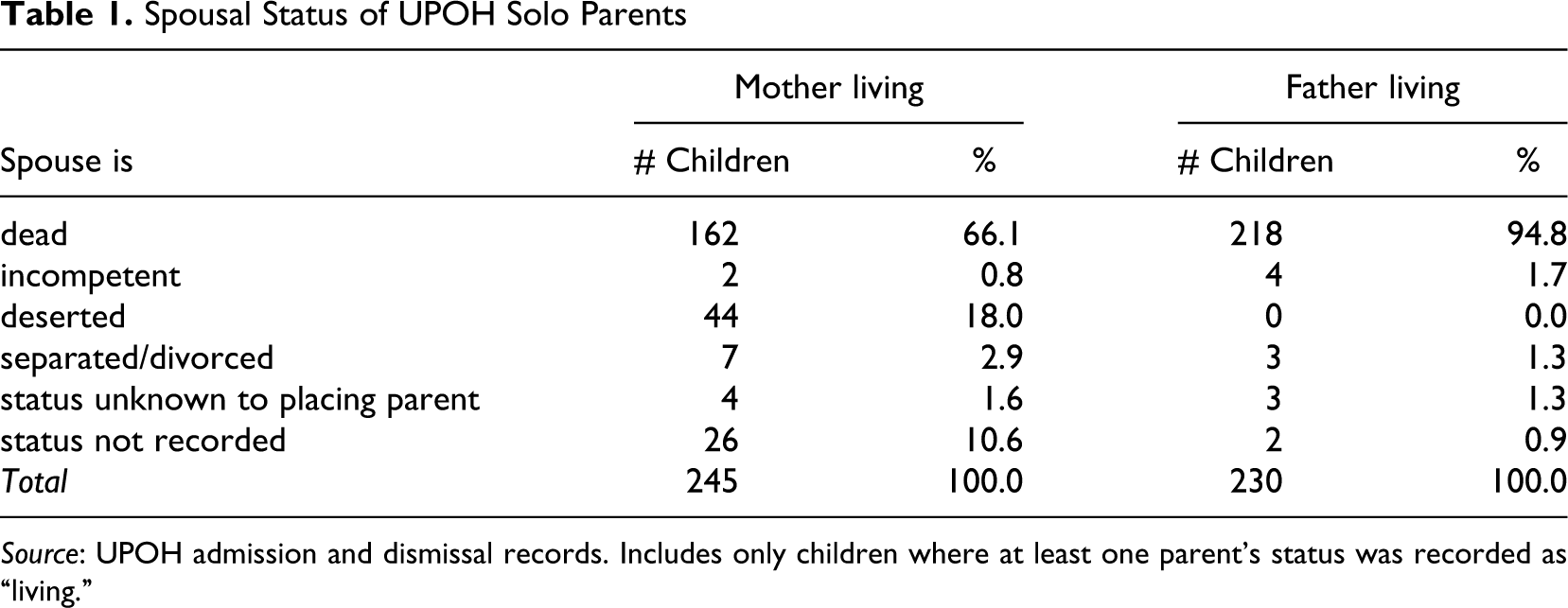
Source: UPOH admission and dismissal records. Includes only children where at least one parent’s status was recorded as “living.”
Far and away more often, fathers turned to the institution for assistance when they were widowed. Ninety-five percent of children placed in UPOH by their fathers were motherless. Because many mothers died in childbirth or with babies still at home, widowers were often in an especially difficult situation, since the orphanage would not accept children until the age of two, necessitating other arrangements for infants and separating siblings. For example, the managers could only take three of the four children of a Hungarian man, “whose wife was burned to death … and the neighbors were trying to care for the family.” 26 Occasionally, the managers helped fathers locate help for their infants or bent the rules to accept younger children in particularly distressing cases: for example, after a man applied to the orphanage, they decided, “We suggest to this father that he place the baby with Mrs. Hickey of Shousetown until it is a year old and then we could take it.” 27 The managers noted in their 1896 report, “This year we have received infants, as we had been so often asked to take motherless babes. In one case the little one was only a few days old, and we were obliged to give it to a competent nurse to care for till it is old enough for us to take.” 28
Solo fathers in this period had more trouble maintaining their own households after the loss of a spouse than their female counterparts; instead of remaining as heads of households, widowers were much more likely to become boarders. They were also slightly more likely than widows to move in with other relatives. 29 Furthermore, in the early twentieth century widowers had an increasingly hard time keeping their families together. Historian S. J. Kleinberg has found that in Pittsburgh, Baltimore, and Fall River, Massachusetts, the proportion of widowers heading their own households dropped significantly, particularly among men aged 25 to 34, those most likely to have young children at home. Correspondingly, their rate of living with relatives or in a boarding home rose dramatically. Older men, aged 35 to 54, were somewhat more likely to remain heads of their own households, but their rate also declined after the turn of the century, as more of this cohort also went to live with relatives and in boarding homes. 30
To illustrate, in 1900, when James Caldwell retrieved his youngest child, Mayme, after nine years in UPOH, he had two of his daughters living at home and helping to keep house. Yet, within a few years, Caldwell was unable to maintain his own home: by 1910, Susie had married and moved to her husband’s farm, and James became a boarder with another family. Caldwell had placed out two of his other teenaged children on a farm in a neighboring county and brought two girls home to live with him, but his mix of strategies ultimately failed to produce a stable household in the long-term. Ten years later, he was sixty-two, still working as a factory machinist, and boarding with yet a different family. Sometime after 1920, James started to alternate staying with Susie and Mayme, the two daughters who had lived with him and kept house for him during their teen years. 31
Like James Caldwell, the majority of UPOH fathers was solidly working class, even lower-middle-class: their families had at least a somewhat reliable income and were likely getting by until a crisis, or series of crises, made caring for their children impossible. Occupational data collected by UPOH provides a good indicator of families’ class status at the time of children’s admission to the orphanage. 32 Over half of the men (55%) were employed in semi-skilled and skilled labor, including occupations such as steamfitter, bricklayer, and carpenter. Another 13% were white-collar laborers, employed as clerks, statisticians, newspaper reporters, and insurance salesmen. While 32% of the fathers were manual laborers, and thus more vulnerable to economic swings and more likely to be living at the margins of poverty, these data suggest that as many as two-thirds of UPOH families hailed from the upper rungs of the working class. They may have been working hard to make ends meet, perhaps, but not necessarily destitute, at least while the fathers were able breadwinners. When husbands lost their wives’ domestic labor (or when wives lost their husbands’ financial contributions), these families slipped into poverty and became dependent on the orphanages for child care assistance.
Yet, newly widowed fathers struggled to keep their children at home and generally did not immediately turn to the orphanages for assistance. For example, when John Humphrey admitted his two boys to the home, the managers noted, “his wife died … and since then he has been keeping house, but finds it impossible to do so any longer.” 33 Similarly, Stanley West, “struggled to keep his family together for a year and then was compelled to place [his five children] in the Home as no suitable person could be found to take care of them.” 34 While some fathers turned to the orphanage for help in the hours and days immediately following the death of a spouse, UPOH men waited an average of sixteen months to institutionalize their children. 35 Although this was ten months sooner than their female counterparts—widowed mothers waited an average of twenty-six months—the long delay from the time they were widowed to the time they placed their children suggests that most fathers tried other strategies, possibly including providing day-to-day care themselves.
One of the most surprising findings of this study is the sheer number of fathers who turned to UPOH for help. From 1878 to 1929, the orphanage served a nearly equal number of children of solo fathers as solo mothers (41% vs. 42% of all children). In addition, a handful of fathers were still living with their wives in intact nuclear families when their children entered the orphanage. Altogether, 46% of UPOH children in this period claimed a living father. 36 This figure reflects the status of children’s parents, alive or dead, regardless of who admitted them to the orphanage. For instance, some children had living fathers but were admitted to UPOH by a grandparent. Looking at who did the actual placing and retrieving of children from the institution further reveals the substantial involvement of fathers.
Over time, the proportion of children admitted by their fathers alone rose steadily, from one-third to nearly one-half of all admissions (see Table 2). While some of these children also had living mothers, they were generally ill or institutionalized, leaving the fathers saddled with child care duties they struggled to fulfill. The proportion of children retrieved by their fathers is even more striking: while just over a quarter of the children went home to fathers in the 1880s (vs. 37% to mothers), by the 1920s, over half went to fathers (vs. just over a quarter to mothers). In other words, within a few decades of its inception, UPOH was admitting and dismissing more children of solo fathers than solo mothers. At least one other Pittsburgh orphanage, the Children’s Temporary Home, served “a disproportionate number” of widowers’ children. 37 Furthermore, a 1907 report of institutionalized children throughout the city found more children of widowers than widows living in orphanages and other homes. 38 Historians have reported mixed findings in other US cities: one of three orphanages Nurith Zmora examined in Baltimore, the Hebrew Orphan Asylum, served nearly equal numbers of widows and widowers, while the other two served mostly widows. Where Kenneth Cmiel found that mothers brought children to the Chicago Nursery and Half-Orphan Asylum twice as often as fathers, S. J. Kleinberg studied the St. Vincent’s Home in Fall River, Massachusetts, among others, and concluded, “Children’s homes housed a disproportionate number of widowers’ children.” 39 The Pittsburgh data suggest, however, that at least in the Steel City, orphanages served a crucial child care role for working-class, widowed men.
Number of Children Admitted to and Dismissed from UPOH, by Decade and Parent Involved
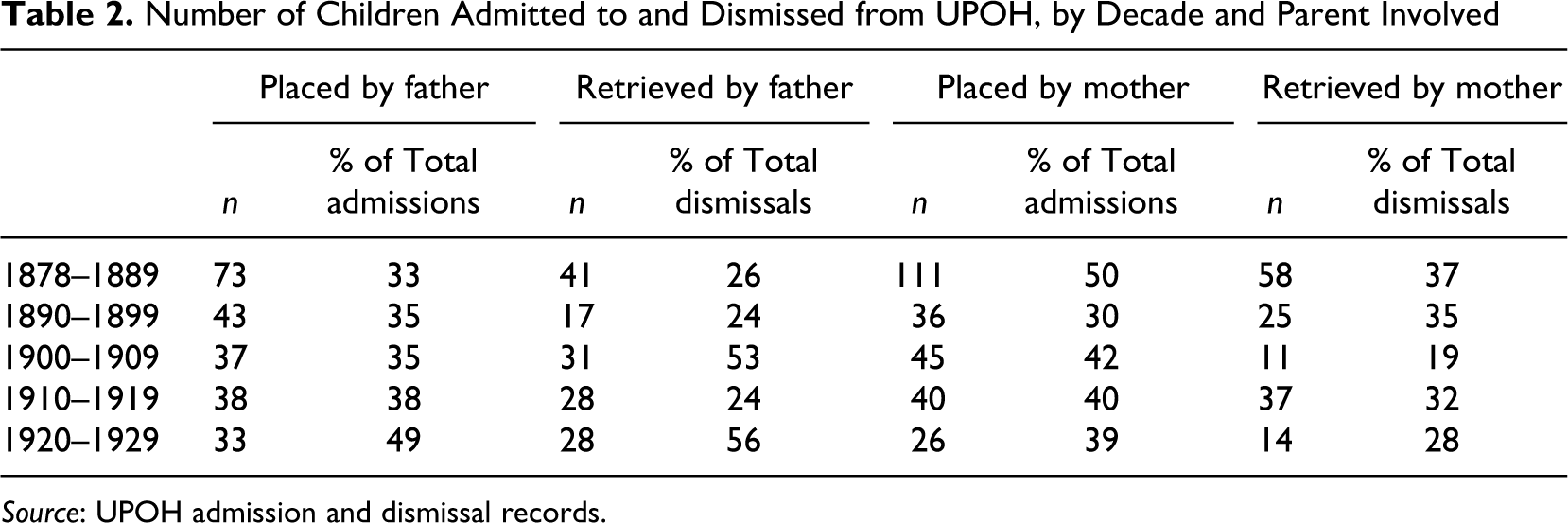
Source: UPOH admission and dismissal records.
Despite the large number of fathers using orphanages at the turn of the century, the historiography of child welfare has avoided serious attention to the care-giving responsibilities of men. 40 Histories of family life have tended to focus on women’s reproductive labor, failing to account for the child care obligations and strategies of fathers. Ironically, historians of child welfare have reinforced the idea that child care is solely a “women’s issue,” replicating the historical invisibility of fathers, by narrowly focusing on single women with children. This is not to suggest that a focus on women is misplaced, as they were indeed the primary child care providers and even today bear the disproportionate burden of child care responsibility. However, the historiographic construction and reconstruction of orphans as specifically fatherless children, does more than merely overlook a group of men: it reproduces the assumption that child care is women’s work.
The Emotional Bonds of Fatherhood
The women who ran UPOH viewed widowed fathers with great pity but also questioned their ability to provide adequate parenting. In fact, the managers implied that children of solo fathers might be better off in orphanages where they could receive surrogate mothering. For example, they lamented, “the most helpless being in the world is a man bereft of the mother of his children.” Pointing to the inevitable collapse of a home without a mother, they continued, “Heart sick at the sight of their neglect as he returns night after night from his daily toil to his desolate home, he gives up the effort longer to maintain a home, and turns in his distress to the Home his church has provided to shelter such motherless ones.” 41 When UPOH donor Ella Hamilton sent a quilt she had made for the orphanage, she enclosed a note saying, “especially should we love and pity those little ones who have been deprived of dear mothers….” 42 In the view of these women, the orphanage residents required mothering; they pitied widowers but felt that single men could not sufficiently parent their children.
Yet, the actions and words of UPOH fathers suggest that many maintained close emotional bonds with their children and remained involved with their lives while supervising their care in the institution. When Jeremiah Greeley, a potter from East Liverpool, Ohio, lost his wife, he found that his own ill health prevented him from caring for his two boys. The UPOH managers noted, “the father was in such delicate health that he decided to go to Florida hoping the change of climate would benefit him. The parting with his children was the saddest one witnessed in the Home.” Greeley was only separated from his boys for the winter season, however, as he found a way to quickly retrieve them: “It was but a few brief months before the father returned, married again and took his boys to his new home.” 43 Historian Judith Dulberger has demonstrated the intense emotional ties working-class parents maintained with their children during their stay in an upstate New York orphanage. Using a remarkable cache of highly sentimental letters, Dulberger disputes that the working class was merely instrumental in their treatment of children, viewing them primarily as potential laborers. Even before the turn of the century, she found orphanage parents displaying strong attachments to their offspring, suggesting this was not a uniquely middle-class phenomenon. 44
While the UPOH managers rarely preserved correspondence from parents, a surviving letter illustrates one father’s struggle to remain geographically and emotionally close to his children. A farm laborer in nearby Ohio, widower Wallace Taft tried for nearly a year after his wife’s death to keep his three boys, aged eleven, nine, and four near him. But he was not “able to provide a home for the children and they were for a time in the County Home in Dayton [Ohio]….” That institution wanted Taft to give up custody of his boys, however, so they could place them out, which he refused to allow. Instead, he admitted them to UPOH, paying $10 out of his monthly $16 wage. 45 In the fall, seven months after the boys arrived at the orphanage, Taft wrote to the managers asking, “do you think that i can get any thing to do in your City as i will [be] out of work when we get our corn gathered.” He informed them that he would be “coming out to see the boys in 2 or 3 weeks” and offered to bring references. He was concerned with more than simply finding work, however, as his letter revealed his longing to be with his children: “if you can find me any thing to do i would be very happy as i want to be neer my boys.” He asked the managers to “tell them that i am coming to see them and i hope that they will know me when they see me … i dream of them almost every night ….” 46
For this father, and doubtless many others, wage labor played an essential role in allowing him to support his children, but fathering went beyond breadwinning. Taft longed to be close to his children, worried about their relationship with him—fretted even that they would forget what he looked like after seven months in the orphanage—and dreamed of them at night. He acknowledged his role as financial provider, saying, “i must have some thing to do or i will no[t] be able to pay for my boys this winter as it takes all of my wages in the summer to pay for them.” Yet Taft combined his desire to support his children with his desire to be near them, closing his letter to the managers with, “if [I] could just get work there i would be all right.” 47 There is no indication that the managers helped Taft find work, but he was eventually able to retrieve all three of his boys from the orphanage.
In addition to maintaining close emotional attachments to their children, UPOH fathers stayed involved in their lives. Men wrote letters to the managers (there are many references to such letters in the meeting minutes, though very few were saved) and came to the institution on weekly visitation days. Most fathers’ interactions with the orphanage and their children were fairly routine and went unrecorded by the managers, though occasionally visits became sites of conflict, which were then noted in the institutional record. For instance, managers told Mr. Waldron “not to bring eatables for his children more than they can eat in his presence,” as leftovers could cause trouble with the other children. But he complained about the policy, writing “that he has been prohibited to bring anything to his children to eat.” 48 Parents continued to break this rule, and the managers instructed the “Matron to inforce the rules about … bringing fruit” and also limited parents “visiting [to] once a week,” suggesting they had been pushing this boundary as well and visiting more often. 49 Fathers had to tread carefully with their behavior and complaints, however, as managers could dismiss children. For example, they dismissed the Jones boys “to their father on account of his disrespectful talk to our Sec[retary] ….” 50 They also threatened Daniel Tarrington with his children’s dismissal, warning him “he must not come to the Home intoxicated ….” 51 That same month, the managers wrote to “Mr. Chaney stating we regret having heard he visited his child … taking with him whiskey and treating the hired help.” 52 The point is not so much that some fathers behaved questionably during their visits, but that they were regularly coming to see their children and staying involved with them during their time in the orphanage.
Fathers sometimes made special requests to see their children. For instance, Mr. Baum “asked that the children be allowed to sit with him in Church.” 53 Though the managers refused, the request itself suggests that Mr. Baum was attending services at the same place as his children and wished to use the church as a means of connection with them. Similarly, the managers noted, “Mr. Wright wanted to take his little girl for the weekend and her birthday.” 54 The managers did allow home visits from time to time, though they denied this particular request. A few fathers even volunteered in the home: when his wife died, Mr. Pelham, a “physical director in the public schools,” placed his three children in UPOH as “there was no one to care for them.” But he “volunteered to come Saturday afternoons and instruct the children,” an offer the managers gladly accepted, suggesting he could conduct fire drills. 55 However, most UPOH fathers likely did not have much time for volunteer activities: they were consumed with the wage earning that would eventually allow them to reestablish their households.
Yet many men actively participated in decisions about the care their children received at the orphanage. For instance, Mr. Cornwall told the managers during the admissions process that “he does not want his child vaccinated,” but they replied that “unless his child [was] vaccinated and all rules complied with his child [would] be refused.” 56 Similarly, UPOH managers discussed “the Baldwin child whose father refused to have it treated at the Hospital” and decided to dismiss her. Mr. Baldwin “came and paid his bill and took all the children,” suggesting he was dissatisfied with their handling of his daughter’s care and preferred to take all of his children home, rather than leave them at the orphanage. 57 Following the Baldwin incident, the UPOH managers decided “that the same action [dismissal] be taken in similar cases.” 58 This left some parents with no alternative other than to retrieve their children if they disagreed with the managers’ assessment of medical “needs,” including apparently elective surgery. For example, UPOH noted, “Mr. Monroe has taken his three children today as he does not approve of having their tonsils removed.” 59 Likewise, fathers sometimes chose to take their children home rather than allow their hair to be cut short—a routine practice at the orphanage for health and practical reasons, but one that was highly stigmatizing and physically marked children, especially girls, as institutional inmates. Thus, Cassie Donaldson’s father protested when she turned twelve and was on the verge of leaving the home: “Her father does not want her hair cut if she has to be dismissed.” 60 These fathers were personally involved in overseeing the care their children received at the orphanage, even to the point of removing them when they disagreed with certain policies.
Some fathers also reacted to the news in 1929 that UPOH planned to relocate to Mars, Pennsylvania, by retrieving their children. The new orphanage, located in a rural area twenty-five miles north of the city in another county, offered spacious grounds and amenities such as a swimming pool but required considerable effort, time, and cost for parents to reach. Before the move, Mr. Morgano “took his two girls out,” as he “did not want them to go to the country.” 61 Similarly, after a year of trying the new arrangement, Mr. Gordon wrote to the managers, saying he “Thinks he will take the children out where he can see them ….” 62 Though these were the exceptions rather than the rule, for at least some men, the greater physical separation from their children was more than they could bear, and they chose instead to remove them from the orphanage.
Regaining Family Stability
Solo fathers appear to have had a more difficult time reestablishing homes for their children than their female counterparts. Children of widowers stayed in the orphanage, on average, five and a half months longer than children of widows (14.5 months total vs. 9.2 months). 63 Widowed men frequently negotiated with the managers to keep their children at the orphanage when threatened with their dismissal for owing board money, or when children got into trouble or became too old to stay. Oftentimes, fathers were no longer maintaining their own homes and had no place to keep children. For instance, James Schneider, a basket maker living in Allegheny, managed to keep his three children for two years following the death of his wife, apparently in childbirth with the youngest. When he placed the three in UPOH, he told the managers it was “only until he gets work,” but ten months later he was behind on his board bill and they were threatening to return the children. Schneider “paid some on his bill” and appeared in person before the board “to see about our keeping the children as he has no place to take them.” Evidently persuaded, the managers voted to “reconsider the action in dismissing these children and keep them as long as the man is making an effort to pay for them.” 64 Similarly, when “Stephen Moore stole a cake after Donation day,” the managers notified his father, who replied, “he cannot take him as he has no place for him,” and they chose not to dismiss him “on account of this offense.” 65
While the working-class men tended to earn higher wages than women and would seem to be more likely able to afford bringing their children home, the very nature of men’s employment could prevent this. For men, wage labor generally meant working outside the home for long hours, which necessitated help with domestic tasks such as shopping, cleaning, food preparation, sewing, and child minding. If they did not have friends and family to assist with these tasks, men had to rely on their earnings to pay for help as they had little time to perform these duties themselves (and often no training or experience in things such as cooking or mending). For those laboring in many factories, the “swing shift” kept home and work schedules in flux and meant frequent night work. Some fathers faced parenting challenges unique to their sex, such as Mr. Walton who, with the involvement of the United States in World War I, asked the UPOH managers “to keep his children until he knows whether he can take them or not [as he] may have to go to war.” 66 Solo mothers were likely able to bring their children home sooner because they juggled part-time labor with their family responsibilities and often combined wage and domestic work, by, for instance, taking in boarders or doing piecework. This meant, of course, that many widows and their children barely scraped by on miserably small incomes. 67 But the structure of men’s labor also negatively impacted their ability to reestablish their households.
While it took longer for fathers to reunite their families, they eventually succeeded in taking home slightly more of their children than solo mothers. Though both widows and widowers took home the good majority of children they had placed in UPOH, solo fathers retrieved 72% of their offspring and mothers retrieved 69% (see Table 3). This difference may be explained, in part, by remarriage rates among men (discussed further below). On the flip side of reclaiming slightly more of their children, solo fathers were less likely than mothers to see their children dismissed to other relatives or friends and were also less likely to send their children to another institution or school. Where solo mothers used these strategies somewhat more often to care for their children, the total number was quite small. Overall, the dismissal outcomes were quite similar for UPOH children of widows and widowers.
Dismissal Outcomes of UPOH Children by Sex of Surviving Parent
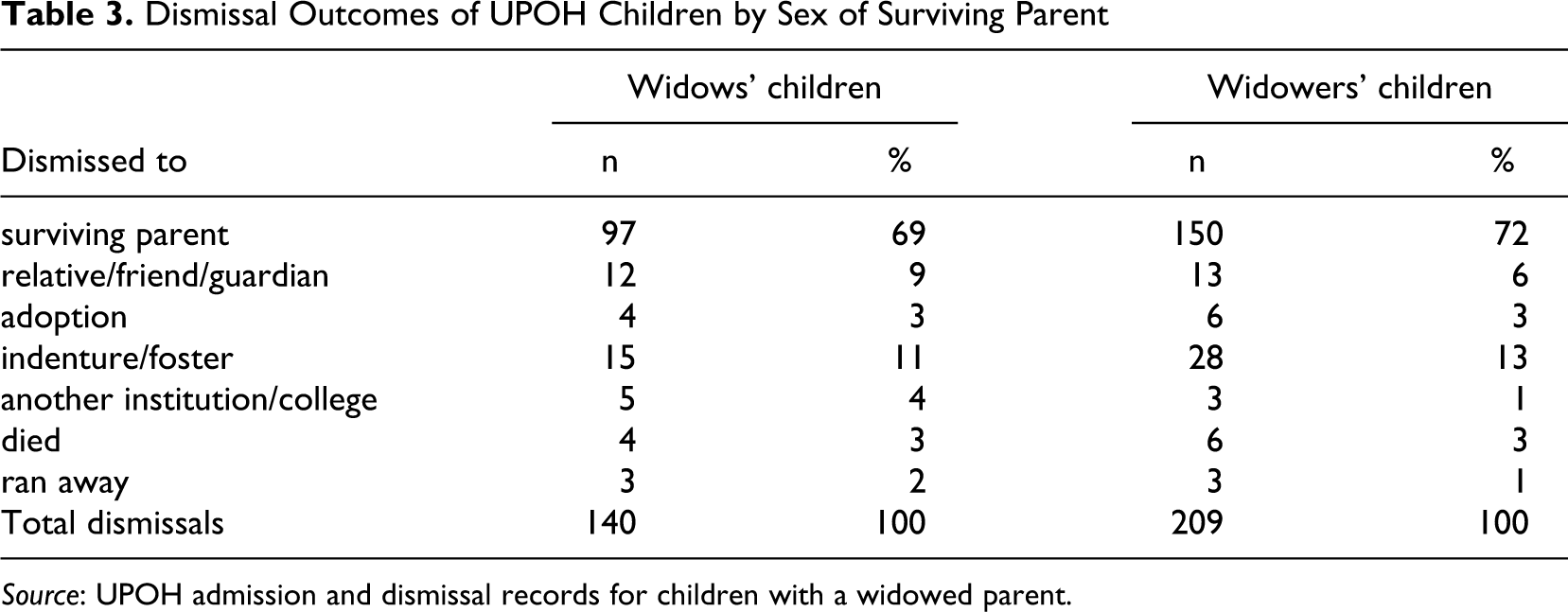
Source: UPOH admission and dismissal records for children with a widowed parent.
Similarly, neither mothers nor fathers permitted the adoption of more than a few of their children. 68 For example, when James MacLeod, an electrician living in Homestead, remarried he found he still could not take his son and asked the managers to “find a home for him.” He consented to the placement of eleven-year-old Liam in a foster home but specified his son was “not to be adopted.” 69 Though far less common than going home to a surviving parent, the second most likely dismissal outcome for both widows’ and widowers’ children was an indenture or foster placement.
Formal indentures gradually gave way in this period to the emerging foster care system, but solo fathers and mothers largely resisted both forms of “placing out” their children in private homes. 70 For example, the widower D. M. Christopher turned to UPOH only when he became “prostrated by disease and entirely without means of support for himself or his children.” He told the managers, “If he be restored to such a condition that he can provide for his children he desires to do so. Otherwise, good homes are to be found for them.” 71 Occasionally, fathers preferred to make these arrangements themselves. For instance, after Ernest Coulter lost his first wife and remarried, he discovered, “The second wife was not a good woman and [she] finally left the family,” forcing him to admit his three children to the orphanage. Eleven months later, the managers placed eight-year-old Mary in a private home, “at the written request of the father.” 72 The proportion of children of solo fathers and mothers dismissed to indenture or foster homes was roughly equal; however, these figures reflect the dismissal status of all widows’ and widowers’ children, regardless of who admitted them to the orphanage. In other words, it includes some children with a living, solo parent who were sent to UPOH by relatives, a private institution, or even the courts. If we look at just children actually admitted by a solo parent, there is a more striking difference in the rate of placement: of the dismissals of all children admitted by their fathers, 16% were in indenture or foster placements versus 7% for mothers. 73 Viewed this way, solo fathers were more than twice as likely to place out their children than mothers. These numbers suggest that men either viewed this type of training and care more favorably than women, or had more difficulty in bringing children back into their households (for reasons such as the structure of men’s employment), or both.
The sex of a child influenced parent’s decisions when retrieving children, including the choice to indenture them. Widowers were more likely to place out their girls (18% of widowers’ girls in placements vs. 13% of boys), whereas widows preferred to place their boys (1% of widows’ girls vs. 7% of boys; see Table 4). Fathers were also much less likely to send their daughters to another institution or college and more likely to send boys to stay with a relative or friend. Overall, mothers brought home about three-quarters of both sons and daughters, while fathers took home a slightly greater proportion of their sons. Thus, the children of widowed mothers stood the greatest chance of reunification with their surviving parent, while widowers’ children, especially their girls, were the least likely to go home again. Yet, again, the larger point is that the great majority of widowers’ children eventually went home to their fathers.
Dismissal Outcomes of UPOH Children by Sex of Child and Surviving Parent
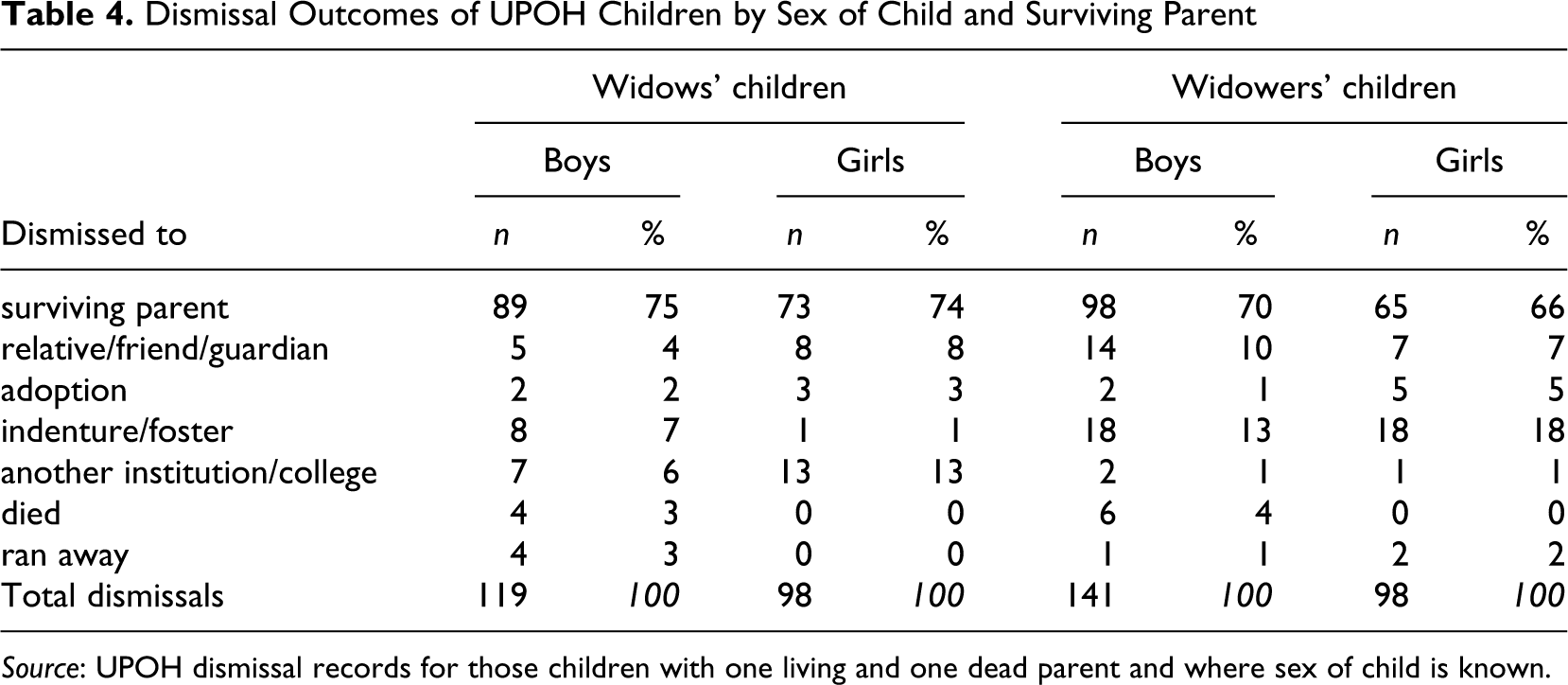
Source: UPOH dismissal records for those children with one living and one dead parent and where sex of child is known.
A child’s sex also factored into his or her length of stay at the orphanage. Boys of solo mothers not only went home in the greatest proportion but also most quickly, staying a median of 6.3 months (see Table 5). Fathers were slower to bring home both their boys and girls but took the longest to reunite with their sons, at a median of 15.5 months—more than twice that of widows’ sons. If teenaged boys were providing remunerative work for their mothers, an incentive for them to be brought home quickly and in larger numbers, then we would expect them to be equally valuable laborers for their fathers. Yet fathers took the longest to reunite with their sons, suggesting that potential wage earning was perhaps not the decisive factor in their choice of when to retrieve boys. Furthermore, Kleinberg argues that in Pittsburgh during this period, white widows with children actually decreased their families’ dependence on child labor, gradually replacing the income contributed to the family economy through child labor with their own waged labor. 74 Working-class widowers, too, then, may have been depending less on their sons for financial contributions to the family.
Median Length of Stay for UPOH Children of Widowed Parents, by Sex of Child and Parent
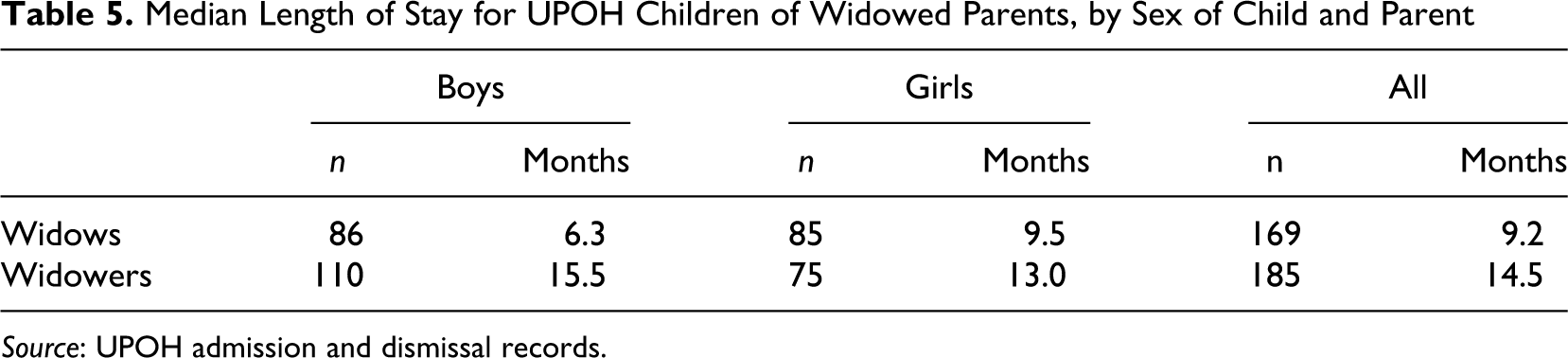
Source: UPOH admission and dismissal records.
We might expect fathers to take home their older daughters to keep house for them and to take care of younger siblings yet that also does not seem to be the general trend. By the early twentieth century, one reason may have been Progressive era compulsory education laws, which required daughters to be in school rather than keeping house for their fathers. Overall, girls of widowed fathers returned home less often than any other group and stayed nearly as long as widowers’ boys, with a median stay of thirteen months. While these data do not reveal fathers’ internal decision-making process regarding the role of children in the family, it does illuminate working-class men’s behavior, which suggests that they were not strictly interested in using their children as potential laborers to contribute to the family economy.
One final factor affecting children’s chances of reunification with their fathers was remarriage. In the general population, widowers were more likely than widows to remarry and tended to do so to obtain child care assistance from their new brides. 75 For instance, UPOH managers noted they “returned [Colin] to his father … because Mr McDougal had been married and has a home of his own in which to care for him.” 76 A railroad brakeman, James McDougal managed to keep Colin for seventeen months before placing him in the orphanage but required the domestic labor of a new wife before he could bring Colin home again. Widows bereft of their husbands’ income discovered it was difficult to find a new partner, a particularly daunting fact for women with young children. In turn-of-the-century Pittsburgh, ten percent of widowers but only two percent of widows remarried. 77 These findings have led some scholars to assume that widowers with young children frequently remarried and did so quickly after the death of their spouse. 78
However, the large number of solo fathers who resorted to orphanage care for their children tells a different story. Indeed, in countering this theory of quick remarriage, Kleinberg examines marriage dockets in turn-of-the-century Pittsburgh and concludes, “Widowers and younger widows were most likely to marry again, but it was never a common occurrence.” 79 Statistical data from UPOH support this assertion. While the proportion of children returned to a parent upon a remarriage was greater for fathers than mothers, in neither case was it the primary reason children returned home (17% of widowers’ children returned home after a remarriage vs. 4% of widows’ children). 80 In addition, of those children who did eventually return to their fathers, only a quarter did so because of their fathers’ remarriage. 81 For widowed men, remarriage was not the most likely path to family reunification nor was it necessarily quick. The data suggest that men did not rush out to find new wives: the median length of time elapsed from the death of a spouse to remarriage was two years. 82 Thus, remarriage was neither common nor speedy among UPOH widowers, though it contributed to fathers’ ability to take home a slightly greater proportion of their children overall than widows.
The story of working-class fatherhood, as reflected in the experiences of UPOH men, is one of involvement and reunification. These fathers were nearly all widowers, struggling to care for their children, and made the choice to institutionalize them only after a considerable length of time. What is more, UPOH fathers remained connected with their children while in the orphanage and worked to bring them home again. Though family reunification was clearly more difficult for men than women, these fathers succeeded the majority of the time in using the orphanage as temporary child care for their children.
Conclusion
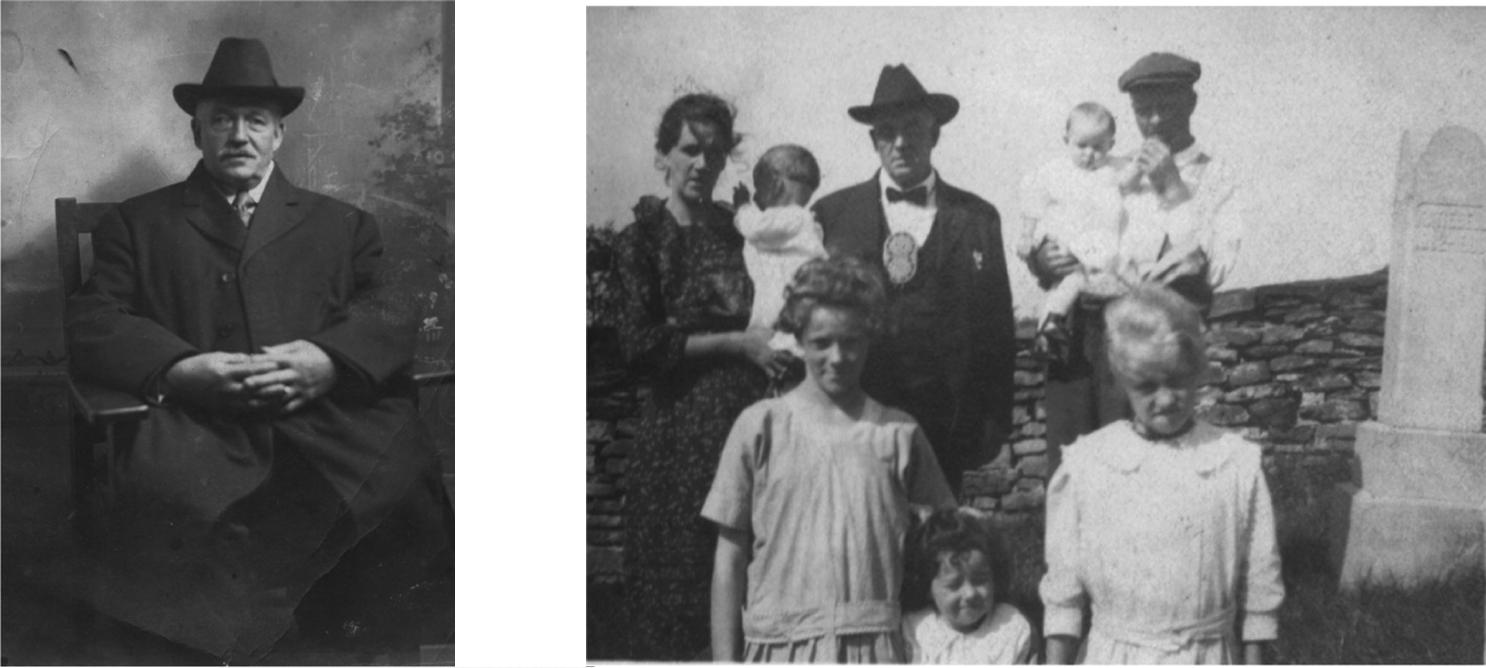
Around 1921, James Caldwell visited the grave of his wife, Jessie, who had died in childbirth thirty years earlier, leaving him a widower with six children to care for (Figure 2). On that sunny day, his daughters Bertha and Mayme and their families accompanied him to the cemetery, where someone captured the scene in a snapshot, showing James surrounded by babies and young children, living testaments to his struggle to keep his family together despite tragedy. Many years later, his grandchildren remembered him teaching them the Highland Fling and other dances, the way he would sing in his Scottish brogue, and the money for candy that always accompanied his visits. 83 For James, placing his children in an orphanage had served as a family survival strategy and allowed him to keep most of his children together. What is more, he was able to sustain those relationships throughout a lifetime and provided a generational connection between adult siblings and their families. He died in 1935 at the age of seventy-eight, and his children buried him next to their mother.
James Caldwell, circa 1930 (left), and visiting the grave of his wife and three deceased children with some of his surviving children and grandchildren, circa 1921 (right). [Source: Collection of the author.]
The experiences of men like James Caldwell remind us that fathers have often played significant roles in child care, especially in times of family crisis. Like many other widowers, Caldwell found breadwinning and parenting did not easily combine and institutional managers were ready to take pity on his motherless children. But his ongoing involvement with them through their time in the orphanage, indentureship, and beyond, reveals the ways in which widowers did successfully deal with their child-rearing responsibilities. Indeed, the lived reality of the working-class fathers who used UPOH as their own family survival strategy challenges us to reconsider how child care has been constructed and reconstructed solely as “women’s work.”
Footnotes
Acknowledgment
The author wishes to gratefully acknowledge Jean Carr and the Women’s Studies Program at the University of Pittsburgh; Tera Hunter, Steve Schlossman, and Lisa Tetrault for many years of engagement with this work; and Kate Lynch for her support and helpful feedback on this article. Thanks especially to John Zimmerman for making it all possible.
The author(s) declared no potential conflicts of interest with respect to the research, authorship, and/or publication of this article
The author(s) received no financial support for the research, authorship, and/or publication of this article.