







Abstract
This article presents knowledge about adversity and the changing nature of families in early modern townships. It proposes that the shape of the family changed across Nantwich (Cheshire) townships with some neighborhoods presenting very high numbers of female heads of household. While stressing variations, it presents new evidence on the subject of close family relationships. It puts forward the view that the elevated numbers of women living together demonstrates commitment, resilience, and emotional investment in female-centered families. This finding challenges heteronormative definitions of intimate relationships and indicates the need for further research to achieve a better understanding of intimacy in early modern families. This study additionally examines subjects of charity, health, hardship, credit and debt, and the accompanying struggles that were played out in the social sphere. In an important observation concerning the ever-changing composition of the family, this investigation ascertains that the family configuration changed according to fluctuating socioeconomic circumstances. What is also offered here is a contribution to knowledge about the county of Cheshire from the Hearth Tax for which there are no available Hearth Tax studies. This study investigates wills, inventories, probate records, deeds, poor accounts, and parish records and provides an insight into hardship through a close study of all of the poor in one street in 1664. It finds that poor children worked hard and when apprenticed were also compulsorily separated from the family home and that child mortality was equally high among rich and poor people in early modern Nantwich townships.
Life in early modern England was difficult for families. It was especially tough for those at the poorer end of the social scale. While the available level of resources was important for most, for poor people living through periods of hardship, charitable dependence might mean the severe disruption of family life, and, in many cases, it also meant the fragmentation of the family. The perspective offered here underlines the changing nature of the family during the broad interval of 1603–1684 in Nantwich, a market town in Cheshire in Northwest England. With an emphasis on the circumstances of poor families, an analysis is presented of social hardship and the world of misfortune of those affected by illness and poverty. According to the Nantwich Parish Registers, Nantwich families were deeply affected by the loss of children to illness. Each family lost at least one child during cyclical epidemics of illness such as measles. What is emphasized here is an interpretation of the circumstances surrounding the number of children who died during this period, particularly those who perished in infancy.
Unlike the North of England and Southwest England, Cheshire has not yet been a focus of investigation by Hearth Tax scholars. 1 In providing an intensive local study, this research contributes to the national picture of England from Hearth Tax studies by offering an investigation of Nantwich Hundred, in Cheshire, Northwest England. The Centre for Hearth Tax Research at Roehampton University has enabled much wider access to Hearth Tax records, but further research is needed to allow for wider comparisons across English counties. 2 This study of Nantwich provides an intensive analysis of the Hearth Tax returns to determine the distribution of wealth within the townships of the Hundred of Nantwich. Such local studies have been the hallmark of Hearth Tax investigations. 3 While Margaret Spufford and Tom Arkell have both called for broader works that compare counties, or urban and rural communities, local studies remain essential as the primary mode of communicating new research about specific localities. 4 Studies of local communities are important for the close and detailed view of early modern society they provide. It is well known that intensive local studies may lose their value and importance if they are not taken seriously or merely regarded as “footnotes to the history of the nation-state.” 5 Historians have concluded that regional and local histories must be carried out before there are attempts to evaluate events of national importance and that broader comparisons can only be made when information regarding specific counties is available. During the last twenty years, the study of numerous local and regional cultures of early modern England has begun to change the historiography of England in the sixteenth and seventeenth centuries, with the study of local and regional communities in determining, not just events of local interest, but also influencing the underlying social, political, economic, and ideological changes that occurred in the wider society. 6 The analysis offered here contributes to the overall picture of Cheshire from the Hearth Tax and offers a local study of families, heads of household—particularly women as heads of household, as well as all of the impoverished families who lived in one street in Nantwich in the year of 1664.
While primary source material such as the Hearth Tax provides information about the wealthy and those of middling status, there are few sources that refer in close detail to the poorer members of society. 7 One such source considered here is the charity known as the “Buglawton Rent.” 8 The Buglawton Rent charity was put into operation to provide financial support for the poor. However, there were strings attached. What it gave with one hand it took away with the other. While giving assistance, it took youngsters away from the family. The nature of this charitable provision provides an important historical insight into the lives of poor people in the town. The Buglawton Rent charity usefully refers to all the poor in one street, Hospital Street, in Nantwich; contributes to early modern scholarship about the poor and apprenticeships, confirming the reality that the system was disruptive to family life and was regarded with feelings of mistrust by families. 9
Scholars of poverty in early modern England have found that parents of poor children were mostly skeptical of apprenticeship charities. Crawford, for example, argues that children could be apprenticed, usually to husbandry or housewifery, from seven or eight years of age. Those “able” to work started very young indeed and poor parents resisted their children being placed in apprenticeships. 10 The Buglawton Rent demonstrates that parents received more money for those children who were apprenticed. Crawford argues that these were not sought after positions, “although apprenticeships are generally thought of as providing training and skills, pauper apprenticeships provided little of either, and less to girls than to boys.” 11 The children were indentured into poorer trades, at younger ages, and for longer periods of time. The training “was for a lifetime of comparatively unskilled labor.” The Buglawton Rent encouraged parents to put their children into apprenticeships that would only keep them within the cycle of poverty. Crawford states that “in practice, many of the children apprenticed had only one parent.” 12 The administrators of the Buglawton Rent charity placed strong emphasis on “working” children and the evidence presented later in this article indicates the deep-seated resistance of single parents to parish apprenticeships. Research on poor relief has shown that children younger than ten years of age were the largest single category of those in need of relief. As for the mother, among the poor, the more children a woman had, the worse off she became. 13
In many respects, the Buglawton Rent might be interpreted as wealthier town members dominating poor people by judging the worthiness of the poor to receive the charity. Clearly, parents of poor children and civic authorities had very different aims. Parents sought assistance so that their children could remain with the family. The authorities, “believing that idleness was an inherited disposition,” wanted to remove children and “subject them to labour discipline.” 14
Before studying the circumstances of the poor in further detail it is important first to establish the prevalent socioeconomic conditions within which they lived. In this regard, the geographical proximity of Nantwich to the Capital is significant. London’s impact on the nation was important from both the economic and social point of view. 15 Manchester had the closest and most regular ties with London and it also had the largest Puritan contingent of all towns in the Northwest. 16 Nantwich was a wealthy town, and, like Manchester, it held strong trading links with London. 17 It was economically developed with a strong nonconformist element. 18 Nantwich was located geographically at a strategic communications point at the center of two main arterial routes between the north and south. The prevailing economic and social conditions of the town were important determinants of the levels of female independence within the domestic domain. However, in practice, some women played an important role in household management, they were also active participants in the domestic industry, were skilled in matters pertaining to agriculture while others were proficient in the professions of midwifery and nursing. My exploration of women’s wills demonstrate that they were also landowners who distributed their wealth according to their own wishes after their deaths. 19
Nantwich’s prosperity was derived from the salt industry, dairying, and shoemaking. The salt “wiches” of Cheshire indicate early salt production. 20 Additional salthouses in Nantwich were said to have been owned by “very many men of the country.” 21 There were tolls governing and regulating its production, particularly in the winter months, when salt was used more extensively to preserve foodstuffs. By the early sixteenth century, there were 300 salt workers in Nantwich with 400 salt houses in operation. 22 During the reign of Elizabeth I, the number of salt houses declined to about 200. 23 By 1691, there were only 50 salt houses operational in Nantwich. 24 The long period of salt production in Nantwich declined in the mid-seventeenth century, and shifted to Northwich and Middlewich which were closer to the Lancashire coalfields. 25 The decline in the salt industry in Nantwich was one of a number of economic features that disrupted the lives of many people in early modern Nantwich. 26
I
In the sphere of observing family life, the Nantwich Hearth Tax records of 1664 provide a reflection of the distribution of the town’s resources. The perspective offered here stresses information about the constitution of those families who paid the Hearth Tax in Nantwich. Among the various questions raised is one that concerns the numbers of those who paid and who did not pay the tax, and who was named as the head of the household. When I refer to Nantwich, I mean the “Hundred” of Nantwich as it appears on the Hearth Tax records. The “Hundred” was made up of sixty-seven “townships.” A “township” could include a very small hamlet of only a handful of homes. These accounts register every head of each household in Nantwich that had a “hearth.” Where there was a hearth, the head of the household incurred a charge. Those who could pay the Hearth Tax were included in the accounts by name, and each paid according to the number of hearths they had, while the names of those who had a hearth but could not pay were recorded separately. 27 Certain dwellings had only one hearth, while some had as many as four or five.
The names of those charged and not charged were recorded under the name of the township to which they belonged. For example, those townships with a high proportion of taxed hearths indicates that the people within that township were relatively well off. A high proportion of untaxed hearths indicate that there were a high proportion of poor folk. 28 The head of each household, whether chargeable or not, was counted. It is this calculation that provides the number of families per township. However, the relationship between poverty and exemption is not entirely straightforward. According to Tom Arkell, “the original Hearth Tax bill did not distinguish clearly between the liability of owners and occupiers.” 29 There was one clause in the original bill that made the basic unit of taxation the household or family. The clause stated that “the payments and duties hereby charged, shall be charged only on the occupier for the time being of such hearth or stove, dwelling in such house whereto such hearth or stove shall be belonging, his executors or administrators, and not on the landlord, who let or demised the same, his heirs, executors or assigns.” 30 Exemptions were covered by three amendments. 31 Occupiers were liable to pay the Hearth Tax if they had to pay local taxes, or if the house was worth more than twenty shillings and the occupier had more than ten pounds in their possession. The Hearth Tax is an indicator of poverty, as poverty was one reason people did not have to pay local taxes, but the Hearth Tax itself did not decide on the level of poverty required to be exempt. It was the state of the house and its worth for exemption that is important for determining the levels of poverty.
The Nantwich Hearth Tax of 1664 sorted the population of Nantwich into the categories of lords, ladies, men, spinsters, widows, or gentlemen. The registrar calculated the total number of heads of households at the conclusion of the Hearth Tax survey for Nantwich in 1664 to be 3,281. The Hearth Tax did not calculate how many people were in a family, that is, residing with heads of households; rather, it counted only heads of households. For this reason, it is difficult to ascertain exactly how many people lived in the town, but the numbers of hearths within a household provide some clues. Some historians consider this information to be speculative and not absolutely accurate but most consider the Hearth Tax to be a reliable source. Grace Wyatt, who, in 1990, published a substantial demographic reconstitution of Nantwich as it appeared in 1674, argues that since the findings of the Hearth Tax returns agree with the earlier findings of Wrigley and Schofield, who did not use the Hearth Tax, the source is “not gravely defective.” 32
The 1664 Nantwich Hearth Tax records provide a basic, but very accurate and concrete statistical measure of the distribution of wealth and population in the town of Nantwich. The evidence of the Hearth Tax is an important means of establishing, first, the precise numbers of households in the town. Second, it offers a means of identifying the distribution of wealth within the town (because it lists the names of the wealthy as well as the less prosperous). Third, because it records female heads of households, it provides a means of establishing knowledge about the levels of female independence within townships.
In addition to the information provided by the Hearth Tax, other primary sources such as the Nantwich parish registers are a valuable resource that records the numbers of baptisms, marriages, and burials in Nantwich. When used in conjunction with the Hearth Tax records, they shed much light not only upon the numbers of people there were in Nantwich but also indicate the numbers of people born, the numbers who died, and the average age at marriage. While an in-depth study of wills and inventories is beyond the scope of this study, a summary of Nantwich wills and inventories is offered subsequently to give an idea of the information they contain about family life. In Nantwich, the wills and inventories in which people bequeathed goods and property give intimate details about the women who contributed to the society and economy of Nantwich.
II
To find out who lived in the homes of those who paid the Hearth Tax, the following pages consider the Hearth Tax and Nantwich’s resident families. In 1664, according to the Nantwich Hearth Tax, a “perfect duplicate of all the hearths and homes within the several hundreds in the Countie palatine of Chester” within the Hundred of Nantwich there was a total number of sixty-seven satellite settlements or “townships.” Distributed among these Nantwich “townships” were, according to the Hearth Tax, 3,281 heads of households. 33 Within these households were women who were independent, that is, single and able to support themselves. In the Hearth Tax of 1664, as shown in Table 1, of this number, there were 339 female heads of households.
Analysis of Total Numbers of Women Charged and Not Charged Hearth Tax in Nantwich in 1664.

One observation is that female heads of households contributed independently to the economy of Nantwich. Since 103 women of the total of 154 women charged were independent, the figures show that twice as many single or independent women were charged than were widows. The number of 112 women living independently and not charged was the highest number of any category of women. This analysis of the Hearth Tax demonstrates that a high proportion of female heads of households were living independent of a male partner, financially supported themselves, and, in many circumstances, maintained other members of the community. The high number of hearths within households indicates that such women belonged to large homes and that some women retained as many as four hearths. 34 Such households, at the very least, were supporting other people, but the most likely situation is that women who supported more than one hearth were in charge of a smallholding or enterprise. 35 On the other hand, those who were not charged commonly had only one hearth, and they usually, though not always, lived alone. The wills and inventories provide more information about those within the household and sometimes those people who sat at the hearths of the households recorded in the Nantwich Hearth Tax are mentioned in the wills and inventories of Nantwich women. The wills, as with the Hearth Tax, confirm that, at the very least, women were often in control of the circumstances of their own lives, and, in the majority of cases, they were also intimately involved in the lives of those they employed. In most cases, the extent of their wealth is indicative of their success in a number of avenues of trade and business. The wills and inventories also demonstrate considerable female involvement in the Nantwich economy as landowners and participants in agriculture and in the financial management of estates. 36
III
Another approach to understanding family life is offered through the comparison of the demography of Nantwich with the Hearth Tax. A demographic study of Nantwich in 1674 carried out by Grace Wyatt concluded that there were local and regional differences in demographic history that required further research. 37 Her analysis found overall that the gentry dominated Nantwich. My study of Nantwich is a contribution toward an understanding of the more personal details of the social, economic, and ideological conditions that existed in townships (see Table 2 and 3). The following analysis compares the Hearth Tax findings for 1664 with those of Wyatt’s study of 1674. In 1674, according to Wyatt, Nantwich parish had thirty-two large houses with six or more hearths. This accounted for 7½ percent of all taxed hearths. Most of the houses had only one or two hearths, and 128 households were exempted from Hearth Tax. 38 Some Nantwich inhabitants in 1674 resided in large houses, but there were also a high proportion of exempt houses. Because the Hearth Tax recorded only heads of households, it is necessary to decide upon the size of the average family who lived in Nantwich. Wyatt argues that Eversley’s multiplier of 4.5 persons per household is probably too high for Nantwich. She claims this because the Hearth Tax records for this period contained a high number of exemptions and because of the number of houses that varied in size. 39 On the other hand, Arkell offers a slightly lower multiplier of 4.3. 40 The total number of heads of households, claimed by the Hearth Tax of 1664, was 3,281. Having counted every household on the survey, I would offer a slightly revised figure; my calculation is that Nantwich had the number of 2,749 households in 1664. Of this number, 1,705 households paid the Hearth Tax and 1,044 households did not.
Total Number of Heads of Nantwich Households in Sixty-seven Townships.

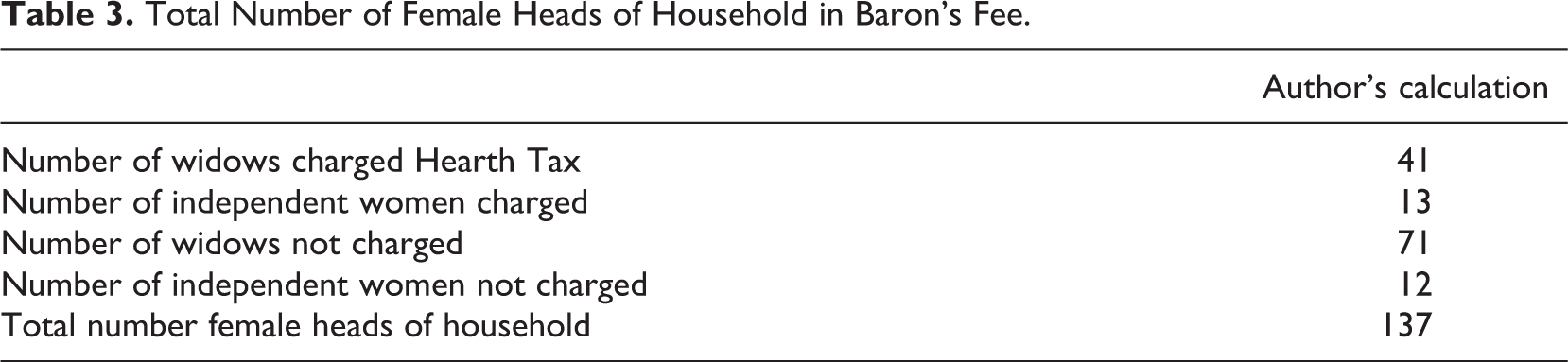
Total Number of Female Heads of Household in Baron’s Fee.
In contrast, Phillips and Smith in their study of the region found that Nantwich in 1664 had a number of 3,052 households. They converted the number of households to people in the years 1563 and 1664 and found a 60 percent growth on the population of Nantwich in 1563. To arrive at this figure, they used a multiplier of 4.75. When the total number of households of 3,052 was multiplied by 4.75 it gave Nantwich, in 1664, a population of 14,497. 41
My study of the Nantwich Hearth Tax found that within the hundred of Nantwich, as described in the Hearth Tax, there was a wide variety of large and small settlements, some sixty-seven in number. Some townships, such as Baddily, for instance, had households with a high number of hearths. For instance, Sir Thomas Mainwaring’s household had fifteen hearths. John Crewe’s household was large enough to have the township named after him, and he had a total of twenty-two hearths. Sixty households in Crewe paid the Hearth Tax, while thirteen did not, which meant that this township was a wealthy one. At the other end of the scale, Dodcot had a total of forty-nine paying hearths while thirty-two did not pay.
To allow for the wide margins that existed between those who paid and those who did not, I have calculated a figure for the residents of Nantwich as follows. If each household that did not pay Hearth Tax contained at least two people, that would give a number of 2,088, and if those households charged were allowed a multiplier of 4.4 (between Eversley’s multiplier and Arkel’s multiplier) and to allow for those with a higher number of hearths, that would give a figure of 7,502 people within these households. Taking account of both the households that did, and did not pay in this way, and by allocating a multiplier of 4.4 to the paying household only, this gives a total number of people living in Nantwich in 1664 of 9,590.
In 1664, Nantwich had a high proportion of houses with more than one hearth. Even in those houses that were exempted from charge, there usually resided more than one person. 42 In houses where there were one or more hearths, a group of people, sometimes a number of servants, or other kinsfolk resided in the home as part of the family. Because of the cyclical nature of illness that took the lives of people in the town, especially young Nantwich children, the numbers of inhabitants in Nantwich changed significantly from one year to the next. This change would occur even more dramatically every six years because of the cyclical nature of illness such as measles and smallpox. A definite or fixed population is too difficult to establish since the population of Nantwich fluctuated especially during the epidemic years.
In 1664, the two Townships of Audlem and Baron’s Fee had the highest proportion of nonpayment of Hearth Tax. These two areas had the highest proportion of poor in Nantwich. Baron’s Fee, the largest Nantwich Township with 493 households, was considered to find out about the distribution of gender and wealth within the township.
In Baron’s Fee, the high number of 105 women living alone, as widows or as women of independent means was not exceptional. This figure represented a quarter of the total number of households and similar high proportions of women of independent means can be found in other townships. In some smaller townships, for example, in the case of Sowlestone, there was a total number of nine female heads of households charged, and none were widows. The tiny townships of Bispham, Whiston, Crewe, and Shavington also had a high proportion of paying independent female heads of households. 43 In Alsager Township, of the total number of sixteen female heads of households recorded, eight independent women were charged and one widow was charged, while one widow was not charged, and six women who lived independently were not charged. 44 Of those who lived independently and were charged, Elizabeth Alsager had four hearths, Jane Knight had four hearths, Ann Fletcher had two hearths, Mary Hancock had one, and Margaret Alsager had one. The six women who were not charged, had one hearth each, and Widow Baddily, who was charged, had two hearths.
The expression of female involvement found in the Nantwich Hearth Tax examined is one of obvious participation in the social and economic sphere. My examination of Nantwich women’s wills restates the conclusions of the Hearth Tax and observes that although women may not have dominated the Nantwich economy, their performance in their economic domain was sufficient to ensure that the wealth they acquired during their lifetimes was sufficient to be passed down to future generations. 45 It has been argued that early modern English parents made significant emotional and material investments in the upbringing of small children. English wills demonstrate parents’ keen investment in children through legally defined property rights that went beyond kinship commitments. 46
Clarke and Crawford argue that the areas of reproduction, children, and language are traditionally female dominated. 47 While this holds true for women of Nantwich, in addition they were often in control of their own lives and were responsible for the support and care of those they employed. In most cases, the extent of their wealth is indicative of their success in a number of avenues of trade and business.
IV
Not everybody was blessed with the favorable state of affairs enjoyed by financially independent women. Evidence regarding the socioeconomic circumstances of Nantwich townsfolk reveals that seventeenth-century Nantwich, like many other English towns or the same period, was much troubled with hostility and townsfolk behaving violently while civic authorities imposed harsh sentences on offenders. For example, records from the Chester Consistory Court, 48 Cheshire Quarter Sessions, 49 Cheshire Inquisitions Post Mortem 50 confirm the manifestation of discord in seventeenth-century Nantwich. Many women were in debt and some women and wives of “gentle” status found themselves in court where details of concubines and prostitution emerged. 51 There were many and varied indications of this discord. Some townsfolk who were employed by local gentry refused to work. Neighbors were at loggerheads with the Nantwich Churchwardens who repeatedly found themselves the targets of hatred. Churchwardens were the recipients of much foul speech and violent acts. Neighbors fought each other over trivial matters, while some clashed in church, pushing each other out of pews, anxious to maintain their status in the church hierarchy that accurately reflected the social order of the town. Nantwich nurses were forced to look after plague victims and were then cheated of their pay. They had their complaints heard by the Justices of the Peace at Nantwich Quarter Sessions. The starving, “maymed soldiers” of the “Scotch” invasion appealed for justice, as did the many widows of Nantwich soldiers who died in the wars. The records are full of details of the social conflict that arose from hardship imposed upon Nantwich at the time of the Civil War. Certain townsfolk were incarcerated for stealing a few shillings. Also, during this period, women were dealt with harshly and some women were publicly whipped. While slander had always been a crime, women became more susceptible to verbal crime. Those accused of verbal crime incurred harsh penalties in Nantwich. In 1627, for example, Margaret Knowsley presented a petition to the Justices asking for the remission of the third penalty in her sentence for slandering the Minister, Mr. Jerrome. She was to have “three manners of punishments on three several Saturdays.” 52 She was first to be whipped, to make acknowledgment of her crime in “as many places as the Justices of Nantwich shall think fit” and third, to be “carted” and “bound” to “her good behavior.” 53 Despite her plea, she was forced to endure all three penalties. She was whipped, proclaimed at the cross, and carted before all Nantwich. 54 In 1688, Elizabeth Hayes of Etchells was convicted for stealing twelve shillings from her employer, John Ryle. She was placed into safe custody, where she was to be punished by “putting fetters and gyves upon her and by moderate whipping of her and that you allow no more for her maintenance than what she shall earne for her labor, in case of sickness.” 55
The evidence from a number of sources reveals hostile popular attitudes toward the Churchwardens. For example, in 1627, Churchwarden Thomas Sparrow reported Nantwich Laborer, Thomas Harrison, who had accused Sparrow of being the cause of the execution of three men. Harrison responded violently to the report. The churchwarden counterattacked by seeking revenge through the Justices for Harrison’s violent conduct in the Nantwich church. 56 Thomas Sparrow asked the Justices to “inflict some punishment.” 57
Further discord between the “ears and eyes” of the Consistory court, the Churchwardens, took place on February 24, 1653, when Sir Thomas Mainwaring, heard how Richard Jackson, Shoemaker, attacked the Churchwardens “with a great logge of wood” and refused to pay a church “Ley” (tax) of sixpence. 58 Mainwaring later issued the Churchwardens with a warrant for Jackson’s arrest.
Women who nursed the sick were underpaid. Sometimes they were not paid at all. For example, two Nantwich Nurses, Margaret Walker and Ellin Danham, were sent for by the Constables of Middlewich to nurse plague victims in Manchester in 1649. They traveled at great inconvenience to and from Manchester but were paid with money that they could not spend. They were forced to petition the Justices with the complaint that they had received “clipt money” and were out of pocket “having spent more than they have received.” 59
Women and children suffered hardship from the effects of war because their marriage partners were either crippled or killed and widows of the wars were reduced to poverty. In 1651, Anne Merryman, Elizabeth Crowther, Katherine Peake, and Anne Parke requested financial assistance from pension because their husbands had been killed. Anne Parkes, who was described as “a very poore woman,” in her petition appealed to the Justices for a pension because her husband was killed in service in Scotland. None of the women received pensions immediately, but instead, overseers of the poor at Nantwich were ordered to provide for them until the next sessions. 60 It took until 1661, immediately following the Restoration, for the Justices to issue an order to widows for orphans and maimed soldiers to appear before them in relation to the payment of pensions. 61 During this period, those so affected by this kind of misfortune would certainly have lived in the most difficult of circumstances.
V
There are few article sources that record the details of the lives of the poor. With the notable exceptions of works by Wrightson and Levine, 62 Hindle, 63 and Crawford, 64 the lives of the poor feature very little in early modern history. What is offered here is an approach that lays emphasis on the poor. In a copy of the will of Sir Thomas Crewe, Knight, the son of Elizabeth Crewe, of Nantwich, was a deed called the Buglawton rent, which was established in 1642. This document recorded the provision that was made for the Nantwich poor who lived in Hospital Street. Documents such as the Buglawton Rent provide a further insight into the world of the poorest members of society. In this instance, the Buglawton Rent records a number of details about how poor people survived in uncertain times.
While the deed was intended primarily to ensure that the poorer inhabitants of Nantwich were taken care of, it also was intended to ensure that the roads and bridges that encouraged trade were kept in good repair. It included the following provisions: The rent and profit of Buglawton to be employed half of it yearly till the way be mended and the bridge be made at Holbeck, the other half yearly to the poor at Nantwich. After the bridge is finished, the whole rent of Buglawton to be employed to erect and maintain a hospital or to be put in stock to keep the poor of Hospell Street in work, or to be distributed yearly among the poor of that street, with some allowance for the preacher.
65
In 1663, those who paid the Buglawton fees were Sir Thomas Mainwaring Baronet, Thomas Massey, who was described as the “Maynd of Buglawton,” and Mr. Thomas Dodd. They paid twice a year at “Ladyday” and “Michalmas.” 68 The sum of £30.5.5d was distributed among the poor of Nantwich in 1663. The name of every adult person who received the charity was recorded, together with the number of children in their care and the sum they received. The individual names of children in poverty were not recorded, but the numbers of children recorded were often high. Sometimes, but not always, the gender of the child was given, and a comment about whether or not they were productive in some way or apprenticed appeared. It is not known from the document how many people in total lived in Hospital Street, Nantwich, in 1663, but it does record that there were 195 poor people in total. Forty-four of these were women, 34 were men, and 117 were children. There were two married couples living in poverty, and five “single” women. Of the total of 117 children, 18 were apprentices. The charity did not always distinguish between boys and girls, but there does not appear to have been a division of labor according to gender. Five of the eighteen apprentices were boys. One of the most striking features of life among the poor recorded by the charity is that “able” children appear to have begun work at an early age, although the precise ages of children were not recorded. The children were described in vague terms as “big” or “little.” Some children were described as “orphans,” some as “poor,” “lame,” or “weak.” Most children described as “able” were employed, while only 1 of the 117 children went to school.
Despite the intention of the charity to support only productive poor families, the records for 1663 show that 4s in child support was paid to one woman by the name of Ellen Wright, a single woman who gave birth to an illegitimate child. 69 The sum of 3s was also paid to widow Elizabeth Higson, who provided food and shelter for an unnamed woman who bore an illegitimate child. 70 Women with illegitimate children were closely linked to those who required support and lived on the edge of poverty. Single mothers faced significant difficulties in keeping their children and living above the poverty line throughout the medieval and early modern periods. 71 However, this generosity was exceptional. Attitudes appeared to change in the subsequent years when so-called bastard children were no longer supported by the charity. Spufford argues that from the 1580s, “village puritan elites” imposed a stricter moral code of behavior on the poorer villagers. This change is reflected in the increasing number of cases of fornication, adultery, incontinence, and illegitimacy presented in the ecclesiastical courts. 72
In some situations, the mothers of the employed or apprenticed children received twice the amount of money as did those who had children and who were dependent upon their parents. The charity rewarded hard work; relief was not allocated according to the needs of the family nor was it paid according to the numbers of children and it did not consider orphans above apprentices. For example, Jane Holcroft, a widow, received 8s.6d. in 1663 for her son who was an apprentice, Widow Lowe, received 8s for her apprentice son, John Hitchin, an apprentice received 4s, and Tim Whittickar, an apprentice, received 4s, and Widow Santer received 7s to maintain her “2 able daughters.” 73 In contrast, the four orphaned children of William Halls, who were described as “2 able, and 2 little,” received only 9s.
The children were employed in occupations such as knitting and button making. For example, the children of Margery Lugfoot were employed in knitting. 74 A woman described as “Lawrence Minshull’s widow” had five children, two of whom were “bound out.” 75 Anne Smith, widow, received 7s for “1 son that works.” 76 Philip Nugent’s boy who worked at home was a “buttonmaker.” 77 Dorothy Rycroft, however, received 7s from the charity for a “son which goes to school.” 78
In the following year of 1664, the evidence suggests that the social climate changed somewhat to further harden the hearts of those who administered the charity. This was particularly the case for those who bore illegitimate children. The benefactors became conspicuously less tolerant of children who were born outside of wedlock and unwed mothers were regarded with criticism for placing a burden on society. A note dated 1664 stated the following: By a letter of 1st of March 1664 by commands my Lord Crewe received your account and designed me to remember him to you only this much. He wished me to acquaint you for the future he would not have anything given to bastards, but to leave them to the [town’s] provision and that such who do, or will put children forward to apprentices may have the most encouragement.
79
The circumstances of the laboring poor in early modern England are not particularly well known. Most investigation of apprenticeship has focused on the eighteenth century because of the increased survival rate of indentures and an enduring interest in the settlement laws. Hindle’s research, however, investigates “the problems and opportunities presented by the compulsory binding out as apprentices of the children of the labouring poor.” 80 Hindle finds that boys were very significantly overrepresented in apprenticeships. They almost invariably comprised at least two-thirds of those bound out. Despite the common assumption that children could be apprenticed from the age of eight, Hindle found that most parishes waited until children were ten. 81 The exact trades the children were bound into appear to depend on the trades available in particular counties. Magistrates rarely refer to the trades to which pauper children were bound. 82 Most girls were put to domestic service and housewifery. Boys were usually bound to husbandmen but whether they were or not depended on the county and the work available. The forcible removal of pauper children to be bound in apprenticeships that lasted for approximately seven years is a distinctive feature of seventeenth- and eighteenth-century poor relief.
The Buglawton Rent provides evidence of the reluctance of parents to have their children removed from them. It was an indictment by the parish officials on the family’s ability to bring up their children to be contributing adults as well as removing potential economic help. Hindle contends that children may have performed nonpaying work that actually freed up parents and older children to be more productive in paid work. 83 The “substitution effect” was undermined by the forcible removal of younger children who could have been trained by the family. The apprenticeship system was fraught with difficulties for the parish officials, Justices of the Peace, and magistrates who had to implement it and the families that were separated as a result.
The Churchwardens of Nantwich dealt harshly with women and children who were dependent upon the parish. For example, on July 26, 1659, Barbara Hughes of Bunbury, who was described as “a poore woman with four small children, and not any means whereby to subsist,” found herself evicted from her dwelling by the Nantwich Churchwardens. She was forced to approach the bench with a request to build a house, since she was “destitute of a habitation.” She requested “liberty to erect a cottage upon Bunbury common.” It was ordered at Nantwich “to have a cottage built upon waste with the consent of the Lord to provide her a place of habitation as before.” 84
The previously mentioned evidence is representative of the attitudes of the town’s elite toward poor people. Children were compelled to work hard in the absence of a parent and few were educated. The evidence of the Buglawton Rent presented here shows that there were more poor women than there were men, but of all those who endured hardship from poverty, the greatest number were children, particularly children born outside of wedlock.
VI
It is a well-known reality that crime was strongly connected with material hardship in early-modern England. 85 This was certainly the case with people of Nantwich. During one decade from 1660 to 1670, evidence from the court records shows that Nantwich townsfolk encountered considerable financial troubles. Litigation in Nantwich increased significantly during this period. 86 There was steady increase in court business with three distinct high points in the distribution of prosecutions. These periods were 1610–1620, 1630–1640, and 1660–1670. From 1541 to 1600, court business rose steadily, but after this period there were three peaks in what was an otherwise even rhythm of prosecutions. The first increase occurred in the decade 1610–1620, when the numbers of cases increased sharply from 766 in 1600, to 1,168 cases in 1610. After a decrease between 1620 and 1630 to 722 causes, a second dramatic increase occurred in 1630–1640, when the Consistory Court instances peaked at 1,284. The rise was then followed by a sharp decrease. The obvious fall in causes is accounted for by the upheaval of the Civil War, when from 1642 to 1650 there were only 119 causes, and no court matters heard during the interregnum between 1650 and 1660. When the Consistory Court resumed business in 1660, however, there was a third rise with 841 causes being heard between 1660 and 1670. The highest annual increase within the second peak decade of 1660–1670, took place in 1663, when the court heard 126 causes in a single year. Investigation of the particular circumstances of litigation found that many of the Nantwich townsfolk involved were in debt. In addition, the loss of infants, or the anticipation of such loss, drove some women to take extreme measures and there was acute social stress related to infant deaths in Nantwich throughout the decade of 1660–1670. It is noteworthy that the variation in the distribution of Nantwich families between 1660 and 1779 was found in Grace Wyatt’s study of Nantwich and the surrounding parishes. She recommends further analysis to explain this distribution. 87 First, she highlights the importance of studying the numbers of children who were born in Nantwich during the period 1660–1670, and second, she recommends that further research is warranted in relation to investigate child mortality, in particular, that is, with information that points to the deaths of small children through cyclical illnesses, such as fevers, measles, and smallpox. 88
In consideration of Wyatt’s recommendations, first then, one must consider the numbers of births. The Nantwich Parish Registers of Saint Mary’s Church recorded a total number of 1,017 baptisms in Nantwich between the years 1660 and 1670. Thirty-seven children were children born outside Nantwich and baptized, which meant that 980 children born in that decade were born in the Parish of Nantwich. 89 According to the Nantwich Parish Registers, there were on average 98 children born every year from 1660 to 1670. Two typical years can be shown in more detail. From January 1, 1662, to December 31, 1662, there were 88 children baptized. 90 Eighty-five children were born within Nantwich, while 3 were born outside Nantwich. In this year, there was only 1 illegitimate child baptized. Between March 25, 1663, and March 24, 1664, a total number of 91 children were baptized at Nantwich church. Of this number, 88 were born in Nantwich, 3 were born outside Nantwich, there were 3 sets of twins baptized, and there were 4 illegitimate children baptized. 91
The Nantwich records show that there was a cyclical pattern of burials of children. The numbers of children buried doubled every six years from 1650 to 1699. Wyatt argues that “At age 1–4, six parishes had more female infant mortality between 1650 and 1699, one had less and one had the same.” 92 Although this is a slightly later period than the one under analysis, there is no evidence to suggest that things would have been much different during the period 1660–1670. The Nantwich study reflects an increase in adult burials as well as children. The study found that there were cyclical epidemics such as smallpox, measles, and infectious diseases. Young children were more likely to die from infectious diseases than were older children. Many of the peak mortality years followed a seasonal pattern. Measles occurred between September and July, peaking at the end of March and concentrated in a few months. Children aged between one and four years were most likely to die. It was found that “many women would not live to the end of their child-bearing period.” 93 Similarly, it was suggested that “most of the burials of women dying within one month of the baptism of her child, and practically all those within one week would be as a result of traumatic childbirth.” 94 Maternal mortality in childbirth improved after the mid-seventeenth century. Crawford argues that of women who died in the age of twenty-four to thirty-four years, maternal mortality accounted for one in five deaths. Maternal mortality rose from 1600 to a peak during 1650–1674 of 17.0 per 1,000 live births. It fell to 9.0 per 1,000 live births in the last quarter of the eighteenth century. 95 Schofield has argued that maternal mortality rates were not very high, a 6–7 percent risk of dying in childbed but “no pregnant woman could be sure that she would be among the survivors.” 96 The appreciation for midwives is evident from women’s wills where women often bequeathed things to midwives in recognition of their skill. 97
Wyatt’s suggestion that “something restricted women from having as many children as they might have done” is an interesting one. 98 Fertility is far more difficult to determine than mortality and both parish and registers and wills are poor indicators of overall fertility. Moreover, births could go unregistered if the child died before baptism. 99 A study of Nantwich people traced from marriage to burial shows that the biggest group was those with no children, and next were those with only one child. It is probable that women dying in childbirth will partly account for these figures. 100 Bad midwifery practices were also considered to be a cause, but Wyatt insists that more research is needed in this area. She does claim, however, that midwives were, in part, responsible. 101 The evidence suggests that most Nantwich women agreed that the midwives who practiced in Nantwich were proficient in their profession. Deaths, therefore, were most likely to be as a result of disease rather than the dangers of childbirth.
VII
The more general symptoms of discontent and difficulty in Nantwich were also reflected in public battles over social space. In early modern England, the arrangement of the pews inside Nantwich church was strictly organized according to social status and public battles took place there. 102 The arrangement provides a unique, almost photographic perspective of the social hierarchy that existed in the town in 1633. Nantwich folk waged bitter wars against each other over pew ownership. The position of the pew within the church reflected the outside world and the battle over pew space was a metaphor for a battle over social status that took place on other levels. Pew disputes occurred frequently. For example, Anne Taylor cited John Davies in 1639 for “elbowing her, sitting upon her in a pew that she called out in pain so that her hat was almost thrust off her head and her band turned about her neck.” 103
During what was described as the “metropolitical visitation of the Archbishop of York” to Nantwich in 1633, the uniformity of pews, that is the system by which all pew space was considered equal, was “set down” for the good and peace of the church and for avoiding all “future suits and controversy.” 104 Clearly, the procedure was not successful.
The arrangement of seating in Nantwich church shows most clearly that in public there was a clear division between male and female, between husband and wife, widow and widow, and servant and servant. Children appear not to have been included in the plans, but this may be because only heads of households were named on the actual document. The placement of each pew was ordered strictly to conform to the social hierarchy that existed in Nantwich in 1633. Whether they were married to each other or not, women and men rarely sat together in church. Men sat with men of similar rank. Women sat in the pews with women of similar station. Widows sat with widows of similar standing, and servants sat with the other servants of the richer townspeople. Depending upon social status, some women, usually widows also sat with the servants of richer women.
In total, Nantwich church sat 186 people. There were 43 women and 143 men seated. The 108 pews were in 1633 expanded to include an increased number of 18 people. Of the 186 people in the church, 62 paid for their seats. The average cost of purchasing one’s own pew in the church was £2.5s.0d. Wealthy members of Nantwich society, such as Henry Delves, paid as much as £5.0s.0d. 105 The Churchwardens, Sabboth Church and Thomas Bickerton recorded high-ranking women who were on par with the rank of Henry Delves, as being the wives of Thomas Maisterson, Thomas Wilbraham, Hugh Halsall, and Roger Wright. These women sat below those seats of even higher ranking members. Their seats, built high in the church, reflected their lofty status. The seats were “built on high above the cross isle next to the great middle isle on the south side upwards.” 106 In these seats sat the Nantwich elite Mr. Jeffrey Minshull and Mr. Matthew Mainwaring. 107
In the range next to the South Church wall, upward, in pew number 10, with Jane Lovatt and Lady Sproston’s servants, sat Margery Elcock. Margery was the mother of John Elcock, whose pew was positioned third on the north side, middle row, next to the north alley of the Church. 108 John Elcock sat next to Mr. George Mainwaring, who, according to a small cross on the schedule of the uniformity of the church pews, had not paid for his seat. Which means that he could not pay. In the surrounding pews were shoemaker John Tench and gentleman Edward Hayes. 109
The attempt by the church to prevent controversy over pew ownership failed and the Chester Consistory Court continued to record pew disputes long after the declaration of uniformity was made in 1633.
VIII
In answer to the questions presented at the beginning of this article, this study establishes from the Nantwich Hearth Tax that many women were heads of their own households. If a high number of hearths in a household are considered to be a sign of wealth, then some women, such as those in Alsager township who were listed as heads of households, were indeed wealthy. The wills of Nantwich women confirm similar findings of affluence. In townships such as Barons Fee, the elevated numbers of women living together imply familial commitment, resilience, and emotional investment among women. However, in contradiction of this discovery, many women were forced into prostitution through hardship and defended their reputations in court. 110 This outcome suggests that further research is required to examine intimate relations within the family and among the broader community.
Infant mortality was equally high among rich and poor families, but those children who were born to poorer families faced a life of hard work and where apprenticed were separated from the family home. The family did not permanently consist of parents and siblings. Its configuration varied according to its financial circumstances and many families struggled to make ends meet in a fluctuating local economy.
The laws governing the births of illegitimate children were severe, as was the punishment of women who bore children outside of marriage during the years of 1660–1675. Charity did not directly address the needs of those in poverty but rewarded hard work. Relief from poverty was not allocated according to the needs of the family nor was it paid according to the numbers of children nor indeed did it support orphans above apprentices. Charity was paid to encourage economic productivity among the poor and of all of those in poverty it was children who most often received poor relief. The upbringing of children was difficult for poor families. The apprenticeships system inherent in the Buglawton Rent charity was greatly disruptive to families in poverty, causing further distress to families through the compulsory removal of children who were then employed in occupations such as knitting and button making. There was little education provided for children of the poor with only 1 child of the 117 attending school. During cycles of illness, more particularly during epidemics such as measles, young children lost their lives at a higher rate than usual, putting yet more stress on families. At certain periods, an entire family might be wiped out by illness. Most families in Nantwich were touched by the loss of at least one child.
As a consequence of the many adversities it encountered, the constitution of the family changed continually in an attempt to neutralize the misfortunes of life. Rising tension about social status, territorial squabbles, the distress caused by the deaths of children, scarcity of money for war widows pensions, and essential services such as nursing, all of these characteristics made survival a very serious concern for the families of early modern Nantwich townships.
Footnotes
Declaration of Conflicting Interests
The author(s) declared no potential conflicts of interest with respect to the research, authorship, and/or publication of this article.
Funding
The author(s) received no financial support for the research, authorship, and/or publication of this article.