







Abstract
Using a variety of archival sources, this article traces the transition in Cuenca, Spain, from the bilateral family system that predominated in late medieval Castile to the final triumph of the patrilineal, agnatic family system in the seventeenth century. The central measure of this transition is the interlocking fates of the dowry and the arras (bride price). As the patriarchal, patrilineal family became entrenched during a period of demographic crisis, the price of dowries skyrocketed while the bride price declined in value and ultimately disappeared. The article includes a discussion of funding strategies for the dowry, inheritance law, and the degree of homogamy in marriages which relied on the dowry system.
Marriage in premodern Europe, as historical demographers and historians of the family are fond of pointing out, was not about romance but social reproduction, alliances, and the transmission of property from one generation to the next. Property, marriage, and inheritance were inextricably bound together, and in Spain, they became even more so during the sixteenth and seventeenth centuries. The period was one of inflation, which struck the marriage market as well. As early as 1541, Fr. Francisco de Osuna noted the increased cost of dowries and suggested that the royal government limit their amount. 1 He seemed to be unaware of the fact that in 1534, the crown had done just that by linking dowry amounts to income level. In the seventeenth century, the link between marriage and the dowry had become so fixed in the popular mind that one chronicler in Madrid reported that people believed a girl could not marry without one, recording the popular saying, “no dowry, no marriage.” 2 The government continued to set limits on the cost of dowries and the arras (bride price), and in the seventeenth century, the political reformers known as arbitristas identified the high cost of dowries as one of the many problems besetting the nation. 3
Dowry inflation, however, is not primarily the subject of this article. Rather, it is what the dowry represents: the final replacement in Castile of one general model of family organization by another. While everyone is familiar with the dowry, trousseau, and other goods that a bride brought to her new home and husband, it was not always thus in Castile. In reality, the dowry was a relatively new institution that had arrived in Castile from Catalonia in the twelfth century and was incorporated into royal law in the thirteenth century. Prior to the thirteenth century, the Castilian marriage system was completely the opposite of what it was to become: then, it was the man who brought the marriage goods, known as the arras, to the union, and not the woman. 4 The arras was introduced to Spain by the Visigoths in the fifth century C.E. For several centuries, the Roman dowry virtually disappeared, while the arras was enshrined in Visigothic law and practice. As is well-known, the Germanic tribes generally saw marriage as an equal union between two families, in which the wife’s male relatives were accorded the same importance as the husband and his relations. In addition, under Visigothic law, the children inherited equally without distinction of gender or birth order. The Visigothic laws survived the Muslim invasion, and during the medieval Reconquista, conditions continued to favor the woman. In the cities of Castile, local city charters based on Visigothic law known as fueros were drafted with an eye toward fostering the creation of families in frontier zones. Single men were encouraged to settle in a town by attaching citizenship rights to marriage with a local girl. The privileges that marriage afforded wound up making the woman a prized acquisition, one worth paying for. Further, to protect the interests of the bride’s family, local charters often gave not only the bride’s father the right to agree to the marriage but also her mother and her mother’s relatives could chime in as well. During the height of the Reconquista in the eleventh and twelfth centuries, men were handing over ever-larger portions of their personal fortune to secure a desirable union. Despite laws limiting the arras to one-tenth of the husband’s net worth, one often finds marriage gifts of up to one-half of a man’s fortune. On top of that, the groom’s family had to pay for the wedding banquet. 5
In the thirteenth century, the conditions that were so favorable to the bride’s family, or to put it in anthropological terms, a bilateral family system, began to weaken in Castile. The barometer of this change is the dowry: instead of a situation in which men paid a good part of their personal fortune in order to ally themselves with a certain woman and her kin, now the bride’s parents were obliged to offer money for the same privilege. The new custom arrived from Barcelona, a commercial city with close contacts to Northern Italy, where the reconversion to the dowry and Roman law had been in progress for several centuries. Catalan merchants were not long in realizing that giving away the arras to women outside of their family was bad business. They also saw that partible inheritance laws were contrary to the goal of capital accumulation. 6 In Castile, noble families which had begun to coalesce around seigneurial properties also began to realize that they needed to adopt new strategies to protect their property from divisions owing to the partible inheritance laws. Beginning in the thirteenth century, one sees infiltrating into the Castilian nobility’s genealogical consciousness the trinity of primogeniture, patrilineality, and masculinity: instead of seeing the “family” as a horizontal entity, including relatives from both sides, paternal and maternal, elites preferred to envision the family on the basis of common descent from a single male ancestor on the father’s side. 7 Later, in the fifteenth century, the use of entail to consolidate family properties became more common, and finally, the 1505 Leyes de Toro administered the coup de grâce for the equal partition of the family fortune among all the children by confirming the customs of the “increase” and the “fifth” so that if the testator wished, he could effectively favor a sole beneficiary of his property without having to go through the trouble of creating an entailed estate, which required obtaining a royal license. 8 The end result of all of these changes was the concentration of family wealth in one single lineage, defined by paternal descent. No longer was the opinion of the maternal relatives legally important nor was an alliance with them, and so the bridegroom, who had once played the part of the purchaser of social status, now turned into its seller.
With this brief excursion into the history of inheritance and marriage in medieval Spain, we now have enough of a background to appreciate the situation in New Castile at the beginning of the sixteenth century. Although the medieval marriage system had one foot in the grave, it was still very much alive in New Castile. This is a fact that has eluded virtually all social historians of the early modern period. In Toledo, the old Visigothic capital of Hispania where significant Mozarabic influence survived for centuries after the Muslim conquest, 9 late medieval records show that the two systems represented by the dowry and arras may be found cohabitating in the fourteenth and fifteenth centuries. That is to say, the residents of the city resorted to both systems when they sought to marry, and the dowry had not yet dethroned the arras’s literal or symbolic value. 10 But, at what point and in what manner did the dowry finally replace the arras? To answer that question, this article will take advantage of the notarial archives of the small city of Cuenca, located 100 miles east of both Toledo and the growing metropolis of Madrid. In 1500, the population numbered about 4,000 to 5,000 inhabitants and peaked in 1560 at around 14,000. The city’s economy, based primarily on the wool trade and textile production, prospered throughout the century. 11 As will be seen, during the sixteenth century, both the arras and dowry were the essential components of a good marriage in Cuenca. The economic difficulties experienced by the city in the seventeenth century, however, forced families to strategize carefully, and in this circumstance, women and the bilateral family system were the net losers.
The contemporary obsession with the social position and respectability that the dowry and arras represent drowns out the everyday reality for most Spaniards, who did not have the property to aspire to either grant. Before taking up our analysis of the dowry’s success, it is useful to pause for a moment to describe the norm for the majority of couples. The most basic arrangement, used by the poorest people in Castile, Valencia, and Portugal, was that of communal property. 12 Each partner brought goods and cash to the marriage and upon the dissolution of the marriage whatever had been earned during the partnership would be divided equally among the heirs. This egalitarian, gender-neutral arrangement, being commonly understood and written into canon and royal law, did not require the services of a notary, so its prevalence escapes the notice of historians who limit themselves to the notarial archives. Fortunately, the historian Marie-Catherine Barbazza thought to compare the notarial and church records of 232 marriages that were celebrated in the village of Pozuelo de Aravaca (Madrid) between 1580 and 1607. She found that only 100 dowry contracts were drawn up during that time—in other words, well over half of all the couples in the village resorted to the informal arrangement of communal property. 13 In the city of Cuenca, occasionally testaments throw some light on what kinds of goods became the basis for communal property. For example, when Andrés Cubero married Mari Móstoles around 1530, he contributed to the marriage ten head of cattle worth about fifty ducats, a mule worth fourteen ducats, and some household items worth two ducats. His wife brought to the marriage household goods worth ten ducats and ten goats. 14 In another testament from this period, Ana González declared that she brought to her marriage twelve linen sheets, seven linen pillow cases, and some personal items altogether worth twenty ducats while her husband, Juan de Molleda, brought six asses worth thirty ducats. 15 During their lifetimes, these two couples prospered and had property to pass on to their heirs. Less fortunate was Catalina de Aguilar who declared that when she married her husband (sometime before 1540), she gave him a substantial sum of 146 ducats which she had earned all on her own—but when he died, none of it was left and she had to support herself through her own work for the next twenty years. 16
Persons of social standing, however, desired to marry with a contract that guaranteed just what property would be handed over and to whom. It is here with the transfer of property that we see individual families jockeying for position and the overall change in emphasis that would lead to the final triumph of the patriarchal, patrilineal family. In both Castile and Catalonia during the sixteenth century, upon marriage a wife could receive a dowry (dote, dot) from her father (or other relative) and bride price (arras, creix) from her husband. While all of the property belonged to the wife and was destined to support her after her husband’s death, in the meantime, whatever she received was meant to establish the couple and was to be administered by her husband. In Castile, where partible inheritances were the norm, the dowry was considered an advance on the daughter’s portion of her inheritance and could not exceed it. 17 In Catalonia, which followed a single-heir system, the dot was a one-time gift and was kept limited to preserve the patrimony for the principal heir, always a male, as much as possible. This is the same system, Jutta Sperling points out, which in Italy substantially disinherited women and marginalized them from the management of their own property. 18 The dowry typically consisted of some combination of cash and household goods, although it could include other forms of wealth except for land, which was reserved for male heirs.
Having laid out the general situation, now let us return to the example of Cuenca. At the beginning of the sixteenth century, when a couple in the city decided to enter into a marriage contract, the two parties (the groom and the bride’s father or other male relation) made out individual contracts for each gift—since the dowry and arras came from separate legal traditions, they were still drafted as separate documents. 19 First, on betrothal, the husband-to-be would meet with his betrothed’s father and the notary, who would record “a promissory dowry note” (carta de promisión de dote) which laid out the financial terms of the marriage. For example, on December 1, 1549, Juan de Novela, a carpenter and resident of Cuenca, promised to pay a dowry of thirty ducats in gold coin, a cloak, and another article of clothing in keeping with his social and economic standing, so that his daughter Petronila could marry Alonso de Yepes, a shoemaker. The money and goods were due thirty days before the wedding was to be celebrated, whenever that might be. 20 Once the wedding date was set or shortly after the wedding, the groom would return to the notary with his father-in-law and acknowledge the receipt of the dowry. At that point, the terms of the dowry were explained again, and if there was a trousseau (ajuar), it was itemized and valued. The husband then offered his new wife the arras, as the ancient Gothic terminology from the Fuero Juzgo dictated, “in honor of [her] virginity and person.” At the beginning of sixteenth century, owing to the way in which the dowry and arras documents were created, at different dates and sometimes with different notaries, it is not possible to establish accurately the frequency or an average value of the arras gift relative to the dowry since the arras document often does not accompany the receipt for the dowry. Later in the century, however, as the arras lost ground in importance, the two procedures began to merge into one all-inclusive document, and it does become possible to follow them together.
By the middle of the sixteenth century, the city of Cuenca had become a prosperous textile-manufacturing town of some 14,000 inhabitants. The town’s lay population was socially diverse, ranging from titled nobles such as the Marquis of Cañete, to Italian wool merchants from Genoa and Milan, native-born, French, and Flemish artisans, and a host of shopkeepers, servants, and truck farmers. At midcentury, probably owing to the general prosperity of the city’s working classes, the number of couples who wanted to marry with both dowry and arras skyrocketed. Because of the popularity of the custom, it is relatively easy to come up with a good sample of contracts that allow us to comment with confidence about what was the norm for the time (Figure 1). Thanks to a dynamic population and healthy economy, the marriage market seems robust although socially conservative, with most marriages taking place between persons of the same social status, even from the same professional background. This conforms to the cautionary remarks of Fr. Juan de Dueñas, who wrote in 1546:
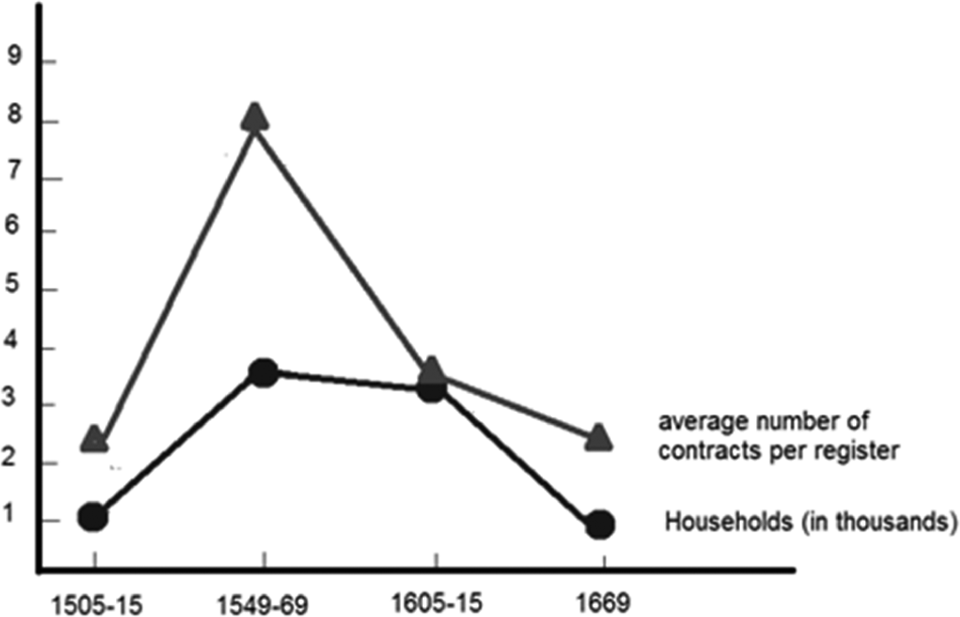
Frequency of dowries in notarial registers compared to Cuenca’s population.
Each one should marry one who is equal and similar to him. The hidalgo with the hidalgo. The farmer with the farmer. The artisan with the artisan. That way, there will be true love between them because…all animals love their same and join with it. The lion with the lion, the sheep with the sheep, and eagles with eagles…. When this similarity and equality are lacking in marriage there is no lack of insults, abuses, and injuries, because one will call the other lower class, and another will call the other Jew, from which there arises resentment, hatred, rancor, and bad blood.
21
In addition, given the relative lack of social climbing that is evident in these matches, it is quite apparent that Conquenses at mid-sixteenth century considered a proper marriage to include both the dowry and the arras. In seventy-nine letters acknowledging the receipt of the dowry, seventy (89 percent) mention that the husband is providing a bride price (Figure 2).
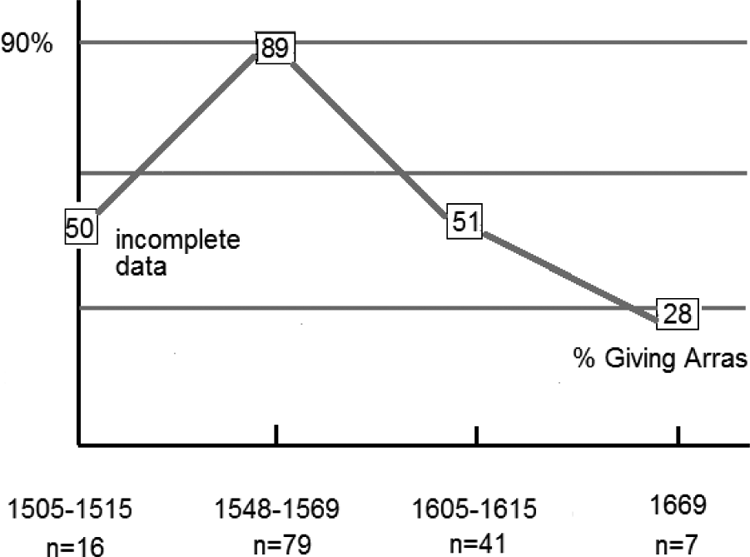
Frequency of the arras in marriage contracts, in percentage.
In other words, a woman in midcentury Cuenca remained a valuable partner, so much so that nearly all men were making substantial contributions to her estate in the form of the arras. What is more, in 1543, the Crown went to the trouble of lowering the ancient limitations on the arras to 8 percent of the husband’s yearly income, which implies that more was being paid. 22 The second, more ominous point to make (Figure 3) is that while the average value of the arras remained relatively constant in 1505 and 1555, the dowry’s cost increased by 159 percent, a clear sign of things to come. Finally, it is important to note the great social diversity of those who participated in this market—(Figure 4) we find everyone from servants to nobles paying for dowries, but what really stands out is the presence of the lower classes. The city’s economy to a great extent was based on the textile industry; according to the 1561 census, a little more than half (58 percent) of the city’s active population were artisans. 23 This sector’s prosperity, combined with its social aspirations, is seen reflected in the dowry contracts of the time: in Cuenca, the great majority (70 percent) of dowry contracts came from the artisan class. Even more surprising is the fact that humble persons such as wool carders are present in the sample (Figure 5). The median value of a dowry to marry a wool carder was around 90 ducats, and the arras given to the bride was about 10.5 ducats: the dowry was worth more or less three times what an unskilled laborer could earn in year, and the arras was worth about four months’ pay, that is, well above the limit of 10 percent of one’s annual earnings set by the crown. 24
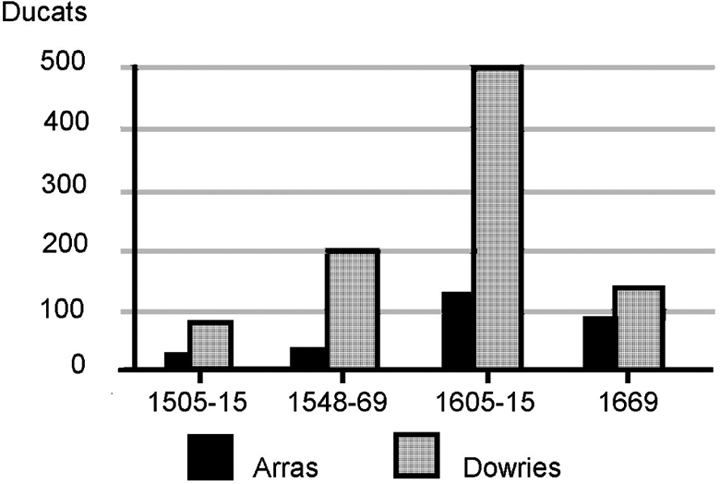
Mean value of the arras and dowry, in ducats.
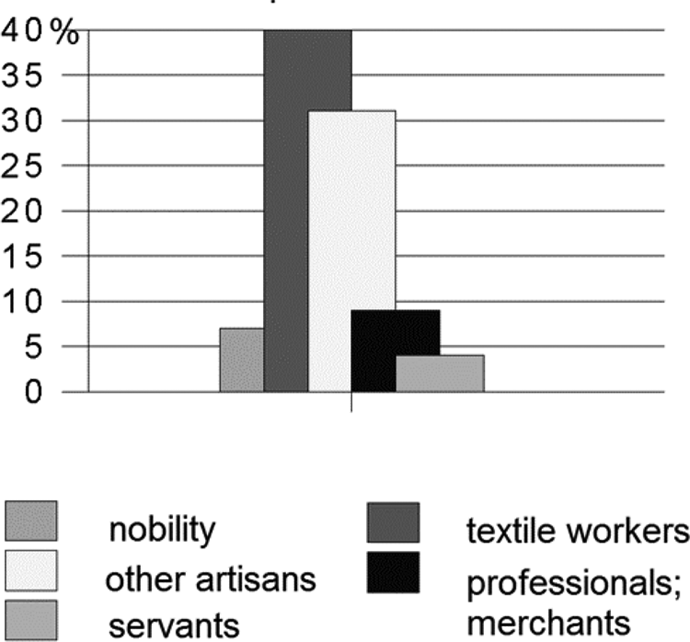
Occupations appearing in marriage contracts, 1548–1569.
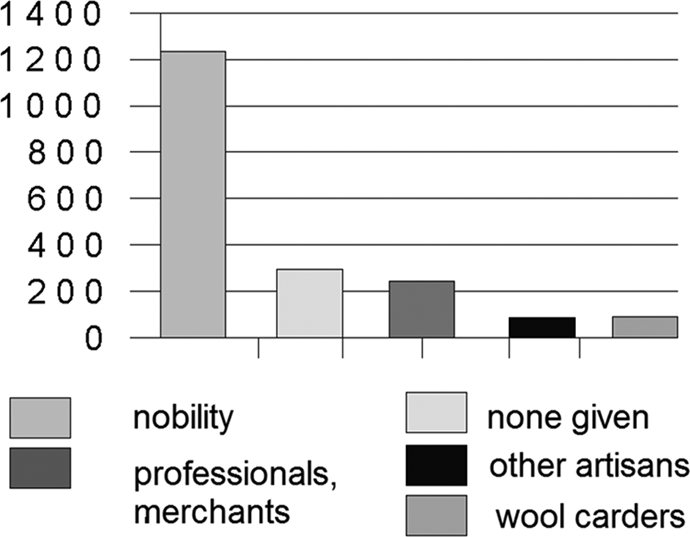
Average price paid for a dowry by husband’s occupation, 1548–1569, in ducats.
The fact that a young girl’s family was willing to pay a dowry equivalent to about three years’ salary says everything about this market. By the middle of the sixteenth century, a young man with a trade, no matter how humble, was an attractive partner. Since 1500, the city’s population had exploded from 1,000 to 3,461 vecinos. 25 The husband’s huge advantage in this market is demonstrated by the fact that someone as inconsequential as a wool carder could command a dowry that was the equivalent of three years’ salary. A young artisan could count on his wife’s dowry to begin his career, while the bride’s father was forced to pay a high price to secure merely an acceptable marriage for his daughter. Since most marriages were homogamous, parents were paying a premium just so their daughter would avoid marrying beneath her class, or, an even worse fate, not at all. There is no other way to explain how it was that wool carders, the lowest of wool workers, could negotiate such favorable dowries. How much more favorable seemed a marriage with a nobleman, who could command a dowry worth several thousand ducats!
Because the dowry was such a significant expense, it is worthwhile to look at how families paid for it. As can be seen in Figure 6, the sources for financing of the dowry varied according to the economic resources of the bride’s family. Among artisans and servants, household goods added up to a little less than half the dowry’s total value. These marriages were similar to the model of communal property practiced by poorer Conquenses as discussed above—the bride’s wedding chest served as the working foundation of the new household. Nonetheless, one-third of the total dowry came as cash, which was also important for giving the young artisan the wherewithal to set up his shop. 26 The wealthy, on the other hand, received large amounts of capital—cold cash—that could be invested directly into their affairs while the girls’ families avoided granting houses and land that was meant for the boys. The bride also brought a trousseau, but its value was overshadowed by the need to supply a large infusion of capital into the fledgling household.
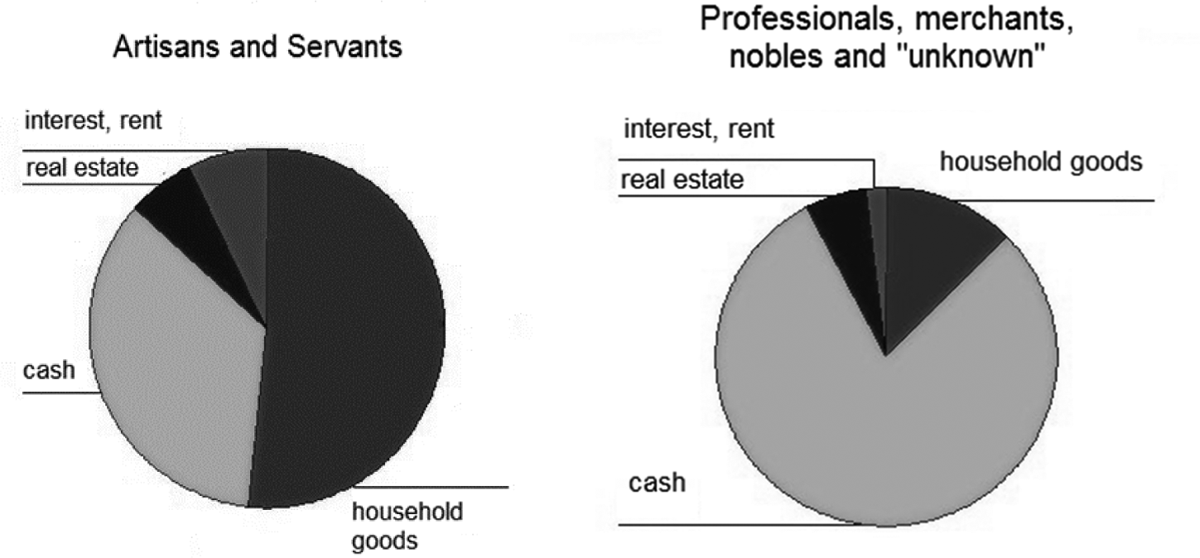
Financing the dowry, by social class, 1548–1569.
At this juncture, we might ask what was the relationship between the century’s famous price revolution and the inflation of dowries. If we take as a base the year 1570, both prices and dowries had gone up by 2.5 times since 1500, but as I mentioned before, the arras remained relatively flat in value. After 1570, dowries increased by another 2.5 times in value while prices increased much more slowly, by 30 percent. It doesn’t take an economist to know that when something is in short supply, its price goes up. Unfortunately for the city’s young women, that merchandise was a husband. What could cause the price of a dowry, which had already risen by 122 percent since the beginning of the century, to increase another 144 percent over the next forty years?
The answer is not difficult to find. During the last years of the century, disaster fell on Cuenca, and with it, the death knell of the medieval marriage system. As is well-known, disaster came in the form of epidemic disease and economic collapse that was felt most strongly in the textile industry, the city’s most important business. Between disease and depression, at the bottom of the social scale, the numerous textile workers disappeared from the population base, as did the Italian merchants at the top who had once guided the region’s wool production toward Genoa and Milan. In some fifty years, between 1591 and 1648, Cuenca lost over half its population. 27 In every family, fathers and sons were absent, some because of sudden death, others through the military draft, and still others through emigration. According to one study, the marriage rate in the city fell by 20 percent. 28 Even if a girl could come up with the money for a dowry, there were few suitable matches. As a consequence, fewer people married, with or without a dowry.
There are a few signs of stress in the marriage market as early as the middle of the sixteenth century. One index of the health of this market is information about just who paid for the lady’s dowry. This seems obvious, but it is not. According to law, the bride’s father was obligated to pay for her dowry, which was considered an advance on the girl’s inheritance. At the beginning of the sixteenth century, this was so: 81 percent of dowries were paid by the parents (Figure 7). However, the other 19 percent were paid by the bride herself, or less often by her employer, an astonishing fact that can be traced back to the city’s prosperous economy. Servants’ contracts from this period were designed to allow a girl to work toward a dowry and honorable marriage; a girl who entered into the typical contract for six years at age twelve could expect to receive each year not only bed, board, and clothing but also a new set of clothes on termination of the contract and several ducats’ pay. Sometimes, employers also freely contributed to the girl’s dowry. 29 At midcentury, as is to be expected, the parents continued to pay for the dowry, but the situation had become more complicated. Because of the pressure for all worthy damsels to marry well, the sources for financing dowries had diversified: employers, the bride herself, but also charitable institutions, and even the husband all contributed. The fact that so many different entities beyond the parents were participating speaks eloquently about how the dowry was regarded. In short, it had become indispensable yet ever more difficult to put together because of its high price. Everyone involved, not only the parents, sought the necessary resources to dower the city’s respectable young ladies.
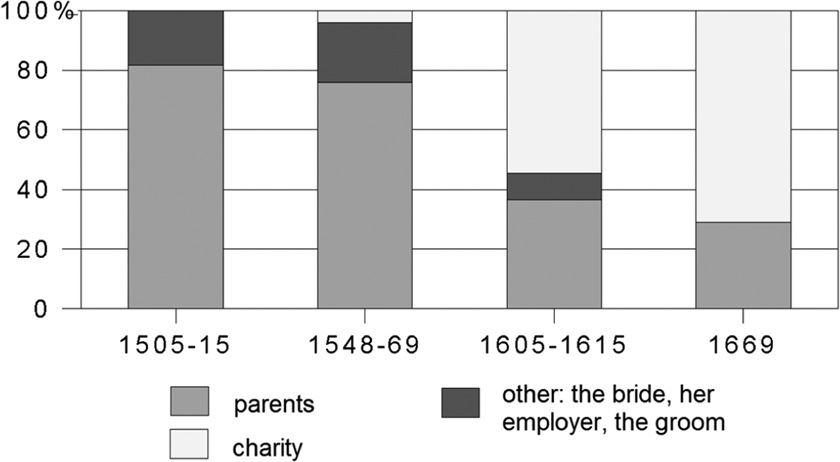
Who paid for the dowry, by time period.
In the middle of this inflationary trend, the city of Cuenca never managed to found a dowry bank like Florence did in the fifteenth century. That city of bankers invented a system whereby as soon a girl was born, the parents could begin contributing to a fund that would come due when she turned sixteen. 30 Instead, the city of Cuenca turned to charity. With ever increasing frequency, young women had to resort to charity, a custom which already had become common in Barcelona, where the obsession for dowries had been long established. 31 In the second half of the sixteenth century, Cuenca’s residents also became obsessed with creating foundations dedicated to dowering orphan girls from their lineage. 32 Such giving can be found in 9 percent of the city’s testaments from this period and would jump to 20 percent in the early seventeenth century—clearly an indication of Conquenses’ concerns. 33 Institutions and individuals with deep pockets also stepped forward. There was the Arca de Limosna de San Julián, administered by the Cathedral, and the Charity of San Julián, founded by canon Juan Fernández de Heredia at midcentury. 34 An example: in 1556, Melchior de Cuellar, an embroiderer, resident of Cuenca, married Juana Ruiz, daughter of Francisco Ruiz, deceased, and Ana Hernández. Evidently, Juana’s family applied for dowry assistance from Canon Heredia, who gave fifty ducats in gold to help Juana marry Melchior on San Julian’s day, 1556. A year later, Heredia founded St. Peter’s Convent, which then administered the dowry fund in his name. 35
Figure 7 clearly shows the social and financial cost of dowry inflation and the impact of the downturn in the city’s economy. By 1615, half of dowries in the city were being paid by charities, at a mean value of seventy-five ducats. The value of such dowries for orphans and poor girls was far less than what parents normally would pay. If we remove charitable dowries from the average
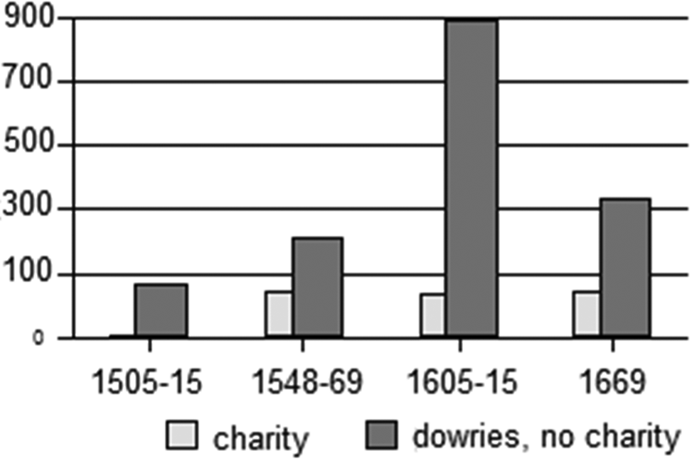
Mean value of charity fund dowries compared to all others (in ducats).
The bottom of the marriage market fell out in the middle of the seventeenth century, when the city entered a sort of economic and demographic free fall. One simple sign of the crisis is the fact that while wills are easy to find, dowry and apprentices’ contracts become scarce in the notaries’ registers. Since there were far fewer artisans in the city, their presence in the dowry market fell by half (Figure 9). And, the strong social endogamy that was present in sixteenth-century marriages began to weaken. For lack of a viable marriage pool, few individuals were able to marry someone from a very similar background. Now, matches took place inside two general groups: the bourgeoisie and nobility on the one hand and artisans and servants on the other. We can speculate that owing to the small number of youths from all social classes, everyone had to accept less than perfect alternatives, and in some cases, pay more for the privilege. Among the wealthy, the cost of a good marriage shot up (Figure 10). For example, in the sixteenth century, a typical dowry paid to a merchant or professional cost about 255 ducats. Around 1610, the same dowry now cost seven times more—1,865 ducats! To finance such expensive dowries (Figure 11) rather than to hand over cash or tangible assets such as real estate, the upper classes turned to promising the interest from government bonds and private loans. Cuenca’s ruling class had turned into a leveraged rentier class, just like their richer cousins in Madrid, and they paid for their dowries by the same means.
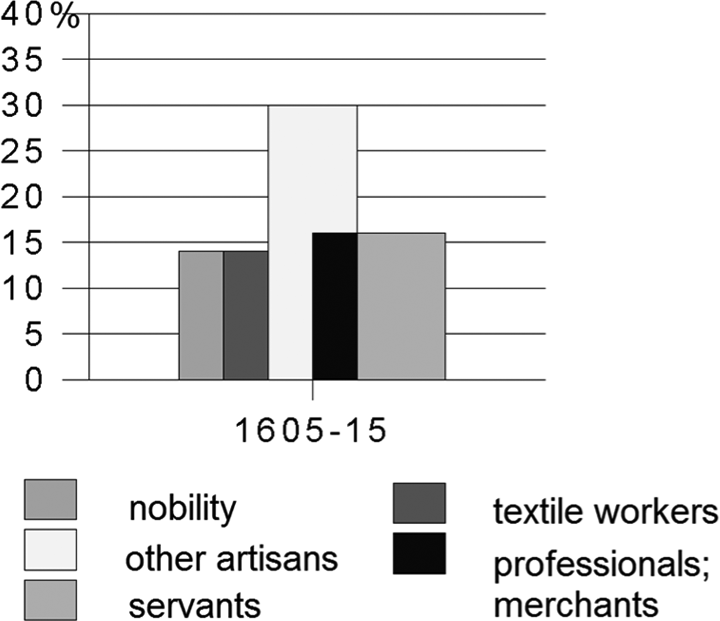
Occupations in marriage contracts, 1605–1615.
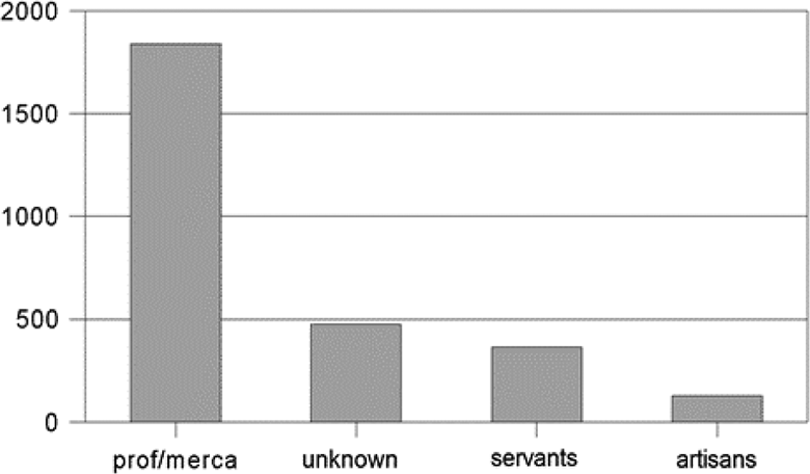
Mean value of the dowry in ducats, by husband’s occupation, 1605–1615.
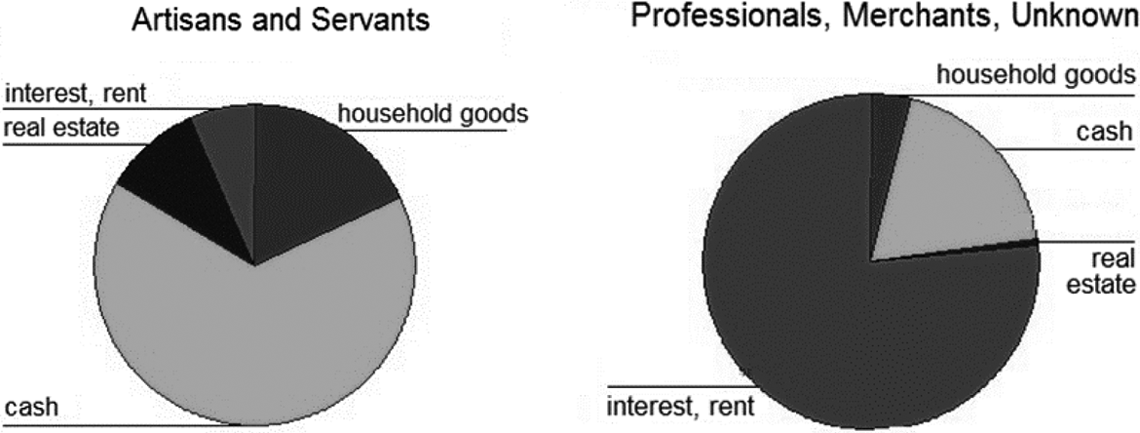
Financing the dowry, by social class, 1605–1615.
The contrast with the lower classes could not be greater. Economic conditions were so dire that families virtually gave away their children as servants, just so they would be able to eat. No longer could a girl earn her dowry and hope chest while serving for six or seven years. 37 Her parents, if they could afford a dowry, followed the model set in the previous century, building their daughter’s new life on cash, household goods, and the odd inherited house. Orphan or poor girls from good families who married with a dowry paid for by a charity were matched with artisans, who no longer paid for the arras, perhaps because they simply lacked the money to do so or perhaps because it was not necessary any more. If a girl was orphaned and poor, what possible advantage could the man gain through his marriage to her other than the cash that the girl brought? Why pay anything at all? Gradually, the arras disappeared from marriage contracts until it almost never was granted in any marriage. The same process—dowry inflation, a large number of dowries granted via charities, and the disappearance of the arras—occurred in Madrid at this time as well. 38 And with the disappearance of the arras at the end of the seventeenth century, we have arrived at a situation which is the complete opposite of where we began this article, in the late Middle Ages, when an alliance with a woman’s family was worth paying for because the union brought social, economic, and political advantages to the husband. Now, in the middle of the crisis of the seventeenth century, with the city half empty and full of impoverished orphans, the bride had turned into a supplicant and her family, if any existed, a source of credit to nurture her husband’s wealth. With this sorry state of affairs, we see the final triumph at all levels of society of the patriarchal and patrilineal family of the modern age.
Footnotes
Author’s Note
A version of this essay was published in Perspectives on Early Modern Women in Iberia and the Americas: Studies in Law, Society, Art and Literature in Honor of Anne J. Cruz, edited by Adrienne L. Martín and María Cristina Quintero (New York: Escribana Books, 2015), 167–76.
Acknowledgments
The author wishes to thank Miguel Romero, the director of Universidad Nacional de Educación a Distancia in Cuenca, for commissioning the first version of this article, delivered as a public address in Cuenca on March 18, 2010.
Declaration of Conflicting Interests
The author(s) declared no potential conflicts of interest with respect to the research, authorship, and/or publication of this article.
Funding
The author(s) disclosed receipt of the following financial support for the research, authorship, and/or publication of this article: The author wishes to thank the John Simon Guggenheim Memorial Foundation for funding the research that made this article possible.