







Abstract
Despite the advancements in the study of early modern Ukraine during the last decade, social history of the Cossack Hetmanate still remains scarcely explored. In particular, the study of cities in the Cossack’s autonomy and of social groups specific to city areas still remains outside scholarly attention. This article addresses one of these social groups—servants who constituted the largest group in the Hetmanate cities, such as in Poltava city located in Central Ukraine. This article provides an account on sex and age structures, social affiliations, geographical origin, and wage system of this social group in Poltava. The sources comprise of the data from Rumyantsev Register (1765–1769) and confession records (1775).
Despite the advancements in the study of early modern Ukraine, during the last decade, social history of the Cossack Hetmanate (Cossacks’ autonomous territory situated on the left bank of the Dnieper River) still remains scarcely explored. In particular, this applies to the study of cities and its areas in the Cossack’s autonomy, as social groups specific for city areas often remain outside scholarly attention. The main reason was that for a long time, Ukrainian Soviet historiography considered servants only from the perspective of the exploitation and stratification of the population and not looking at them as a separate group of urban society. This article addresses one of such social groups—servants who constituted the largest group in many Hetmanate cities. In this study, I investigate sex and age structures, social affiliations, geographical origin, and wage system of this social group in the city context of the Hetmanate society using an example of Poltava city located in Central Ukraine (see Figure 1).
Poltava city was one of the ten military administrative centers of Hetmanate, a Ukrainian Cossack autonomy within the Russian Empire at that time. The city received confirmation of Magdeburg rights on self-government from the Hetman Kirill Razumovsky in 1752. Since then, an electoral council managed the city, headed by the elders. However, part of its population—clergy and Cossacks—did not subordinate to municipal authorities, did not pay taxes to the city treasury, and did not serve the municipal obligations. Poltava was not an important industrial center, and its economy was based on agricultural production, mainly of cattle. Therefore, the bulk of the city’s population acquired their livelihood from the lands that belonged to households and were situated out of the city. However, another large part of the population was crafts artisans who worked for the local market and where the social group of servants largely belonged as I show it below (see Figure 2).
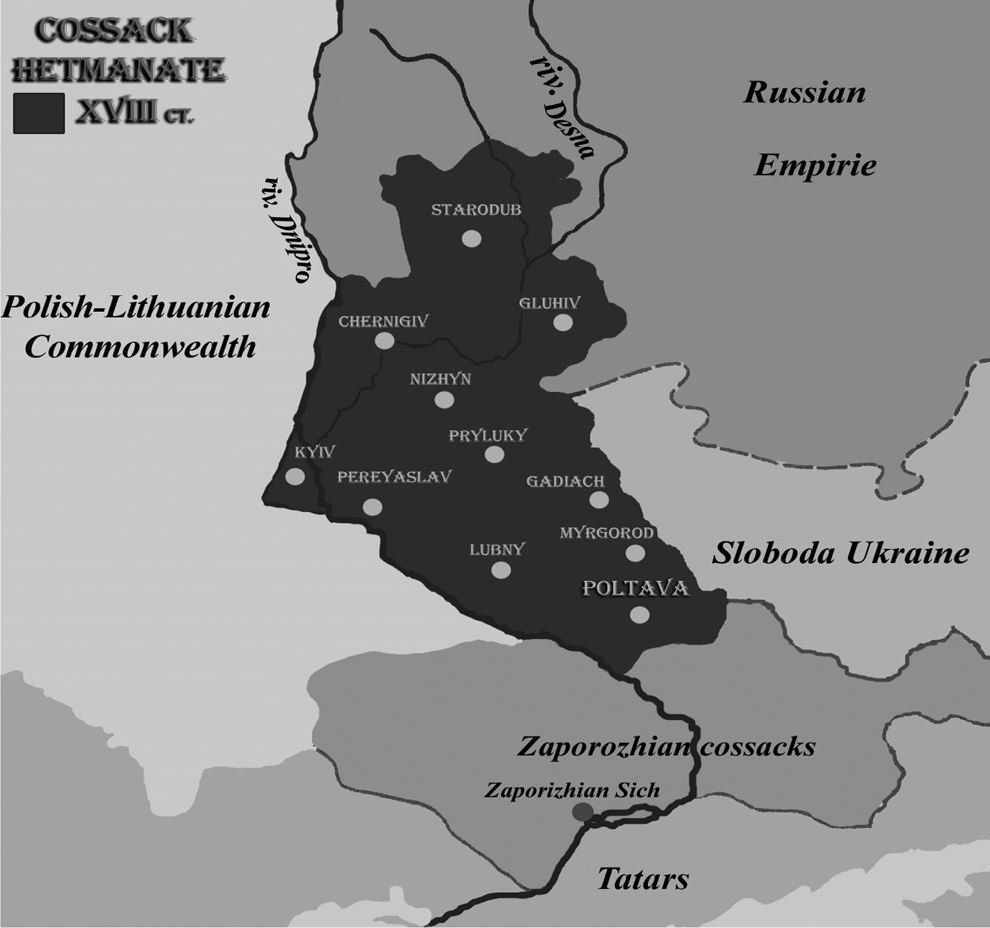
Map of Cossack Hetmanate in eighteenth century.
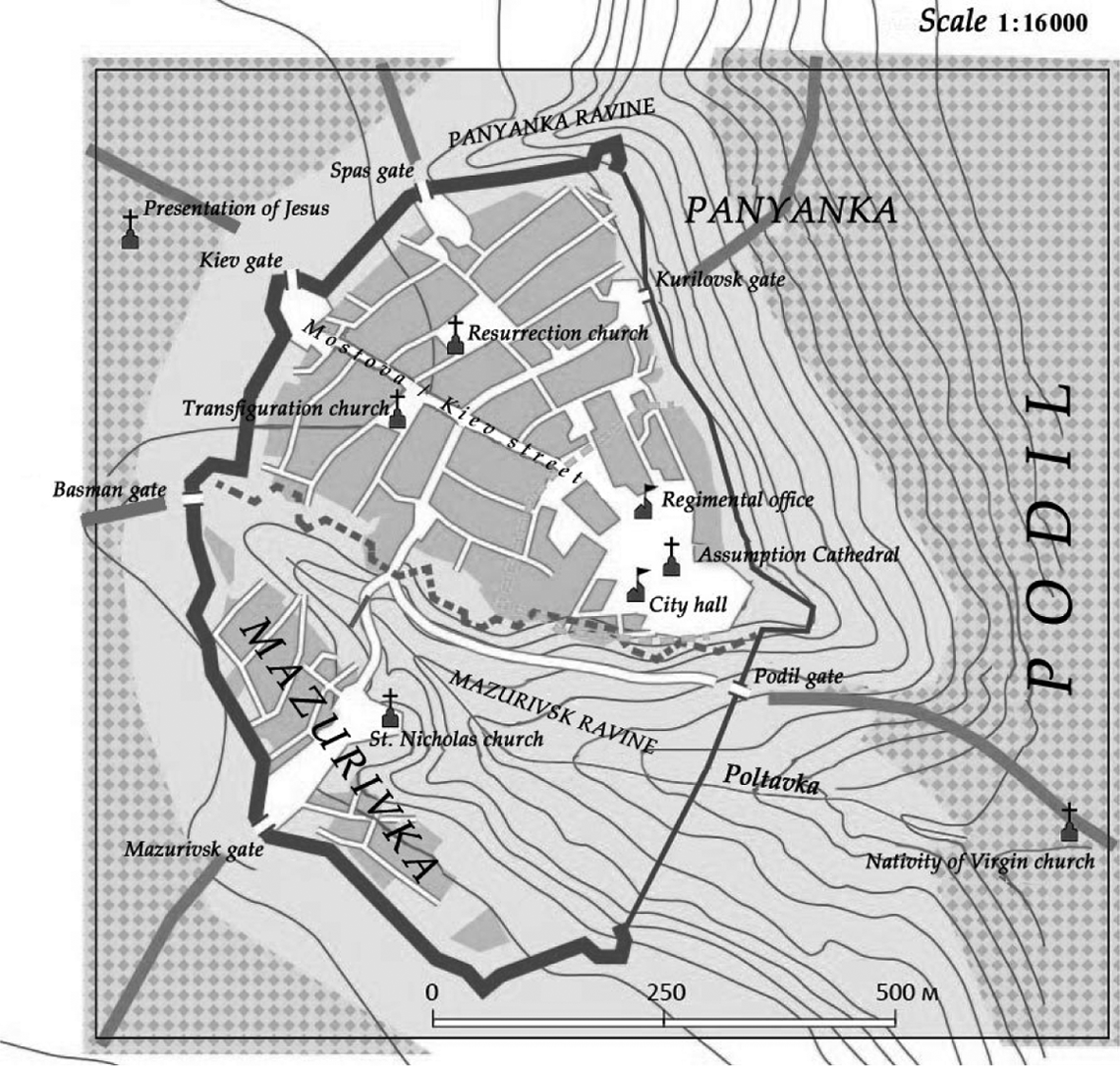
Map of Poltava city in the second half of eighteen century (Author of the map - Dmytro Vortman).
To study the social group of servants, I use the data from Rumyantsev Register for the period between 1765 and 1769 and confession records initiated by Russian Orthodox churches in Poltava city in 1775. Rumyantsev Register was one of the many projects of Catherina II to provide well-ordered state education. It received Rumyantsev name because this idea was brought to life by then president of the Little Russian Collegium, Earl Rumyantsev.
In addition, the description contains the information about cities, towns, villages, and hamlets, and it describes in detail their population, specifying age, gender, marital status, health, and the size of taxes paid. This document is valuable in our research also, and, that in addition to the data about age, sex, and social status of the widowed Poltava residents, it contains information about the size and structure of the family, property status, including data on households, arable land, forests, hayfields, pastures, mills, distilleries, malt and livestock, the size of taxes, and so on.
Compared to historical demographic studies on the eighteenth-century and nineteenth-century Western Europe where servants are presented as a recognized social group, in the Ukrainian historical sources, including those that I use in this study, the term “servant” is not used explicitly. Instead, in the census book of Poltava, which was created as a part of Rumyantsev Register (or Rumiantsevskiy Census) in 1765–1766, servants are referred to as “maids and workers,” “female workers,” “male workers,” and so on. 1
In another source, the confession records of five local parishes (1775), which is similar to perish registers of Catholic Church (status animarum), this group is referred to as “attendants.” 2 However, a close examination of these groups in both sources indicates that these references were often used as synonymous and labels to refer to social strata as domestic servants, laborers, students of artisans, innkeeper, cabs, and other similar professions. In addition, scholars indicate the ambiguity of the usage of this term in other European contexts mainly due to the methodological difficulties and problems with the sources. 3 Another issue that is discussed in this article is the problem of prevalence of the institute of service in the Eastern Europe. It was triggered by the appearance in the mid-1960s of John Hajnal theory of predominance of a special type of marriage that was characterized by the late age of entry into the first marriage and a large proportion of people living alone in the Western Europe. However, people in Eastern Europe married in the early age and the proportion of singles were close to a zero. According to Hajnal, Western Europeans married late because they had to acquire professional skills and material wealth at first. One of the ways to achieve this was the employment as a servant, 4 while in the East, this problem barely existed. Another British researcher Peter Laslett extended this theory, who considered the existence of services as one of the features of Western European households. According to his estimates, the Western part of Europe differed from Eastern part also by the type of family structure—simple nuclear family dominated in the Western Europe, while big multifocal family usually appear on the East. In the last case, the need for additional man power significantly decreased. He also introduced into scientific use the notion “life-cycle service,” meaning the individuals who worked as servants during their lives after leaving the parental household and to the establishment of their own family. 5 Today, a lot of empirical research are partly and in many cases completely confirmed this theory, showing the heterogeneity of the studied region. 6 Therefore, in this study, I also try to find out whether it is possible to evaluate Poltava servants in this category. Therefore, in this study, following an example of Sarti. I define servants as everyone who was registered in the households of Poltava city under the above-mentioned terms, that is, maids and workers, female workers, male workers, and so on.
According to Rumyantsev Register, in 1765–1769, Poltava had some 1,230 inhabitants, of around 7,000 of the total city’s population, who can be defined as servants; among them were 578 men and 652 women. As such, their share in the overall city population was 17.8 percent. 7 In the confession records, this number is slightly higher—about 20 percent in five city’s parishes (see Table 1). The servants inhabited 338 households, of total 882 households, which constitute 40.6 percent of the total households’ share. That said, it is plausible that during ten years that have passed between the creations of two sources, the share of servants in the city increased.
Share of Servants in Population Structure of Poltava City, 1775.
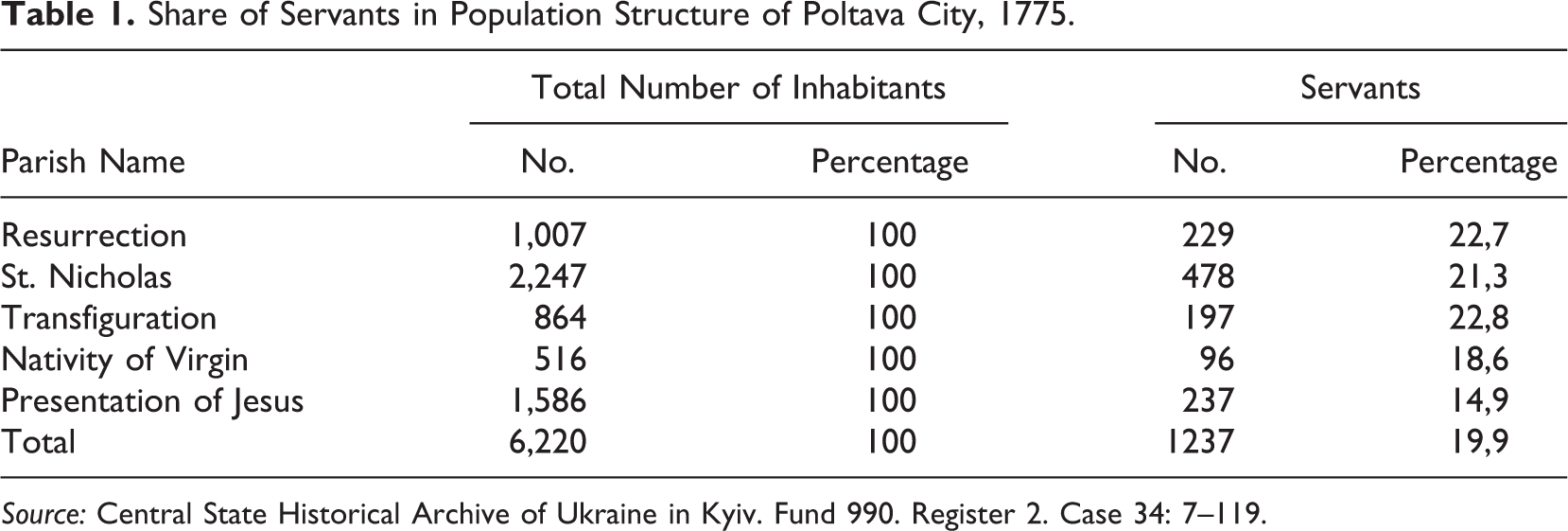
Source: Central State Historical Archive of Ukraine in Kyiv. Fund 990. Register 2. Case 34: 7–119.
Table 1 shows that in the parishes of three churches—Resurrection, Nicholas, and Transfiguration—located in the central part of the city, the so-called fortress, the total share of servants was bigger than in the Nativity of Virgin and Presentation of Jesus which were located in suburbs. This distribution could be explained by the fact that the central areas of the city, compared to the suburbs, were mostly located in the households of wealthier inhabitants—the clergy, merchants, and the so-called gentry—Cossack officers. Additionally, the shares of servants seem to be smaller in the parishes where inhabitants were less wealthy or lived in the suburbs. For example, St. Nicholas Church perish was located in the central part, but most of its parishioners lived in the suburbs. This is also why the share of servants there was smaller than in the Resurrection and Transfiguration parishes, which included residents of the central part of the city. The same situation applies to the parishes of Nativity of Virgin and Presentation of Jesus churches which were also located in the suburbs.
Overall, the percentage of servants in Poltava is not too high compared to the results obtained for the territory Hetmanate gathered by other Ukrainian scientists. For example, according to Hurzhii, 8 in the studied period “in some areas the part of laborers sometimes reached up 25% of all residents.” This percentage is similar to the region of Central and Eastern Europe, especially to many Polish cities. As stated by Poniat, 9 the share of servants in Warsaw in 1787 was 21.5 percent, in Wieluń in 1791 was 16.8 percent, and in Cracow in 1795 was 27.8 percent. Similarly, according to Szołtysek, 10 in the West Polish, the proportion of servants generally accounted for 25.6 percent of all population. In rural areas of Kujawy, in north-central Poland, it was equal to 24 percent. 11 Surprisingly, the share of servants in Central and Easter Europe seems to be higher than in Western European cities, where the share of servants in the cities was about 10 percent of the population. 12 It should also be noted that numbers received by me significantly exceed the data suggested by Mikolaj Shołtysek for the eastern regions of Poland, including Polesia and Red Rus. 13 In my view, this is related to the differences in economic structure and in the form of family organization. In the aforementioned regions, large family was dominant, whereas in Poltava, it dominated nuclear structure. 14
This could be linked to the differences in who were considered as servants in each of the contexts, and a more throughout and comparative analysis of this issue is needed.
Returning to the case of Poltava city, the percentage of households that had servants, around 40.6 percent, was much closer to Polish cities than those in Western Europe. For example, in Krakow in 1795, the presence of servants was recorded in 45 percent of the households. Poniat suggests that this occurrence could indicate that their labor was used not only by the elite but also by the representatives of other social strata. This phenomenon is considered to be characteristic of preindustrial Europe in general. 15
Regarding the sex ratio of servants in Poltava, in 1765–1766, it was in favor of females. In 1775, however, the share of men and women became nearly equal—620 and 617, respectively. On the level of an individual parish, there was no imbalance either (see Table 2). In St. Nicholas, Resurrection, Transfiguration women were in slight advantage, while in other parishes, they were a slight advantage of men.
Gender Distribution of Servants in Poltava City, 1775.
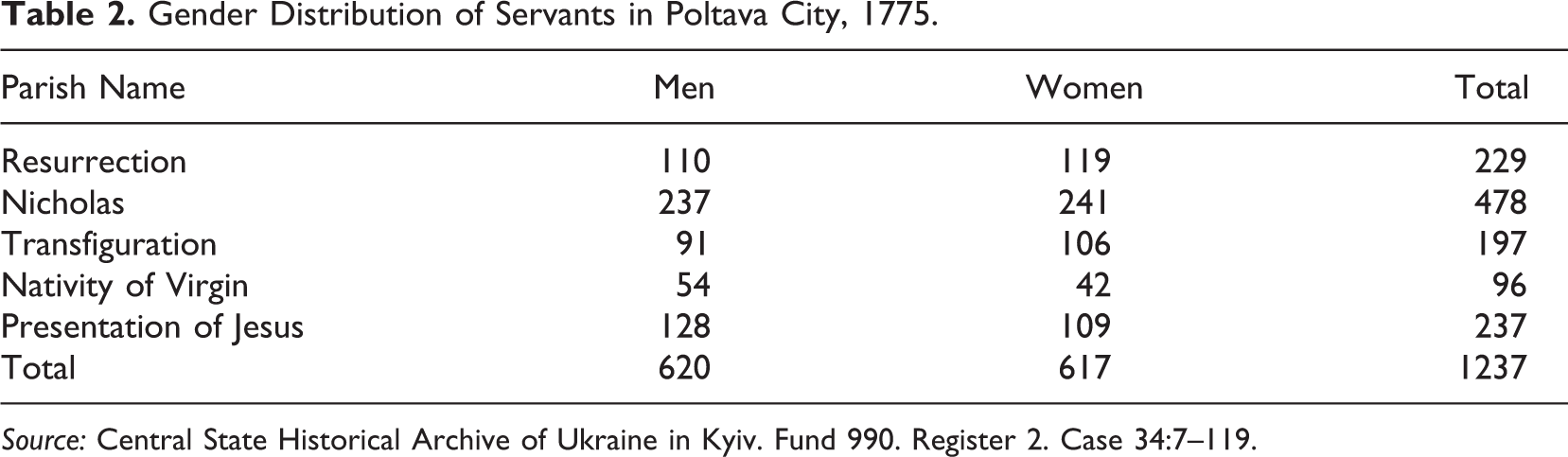
Source: Central State Historical Archive of Ukraine in Kyiv. Fund 990. Register 2. Case 34:7–119.
With regard to age distribution, the confession records show that more than half of the servants were children—59 percent (729 people). Such a high number could be linked to that fairly often in this source adolescents, those belonging to the age-group of fifteen to nineteen, were counted as adolescents. Beside the sex balance was observed, albeit with a small superiority of females (370) over males (359; see Table 3).
Number of Children among the Servants in Poltava in 1775.
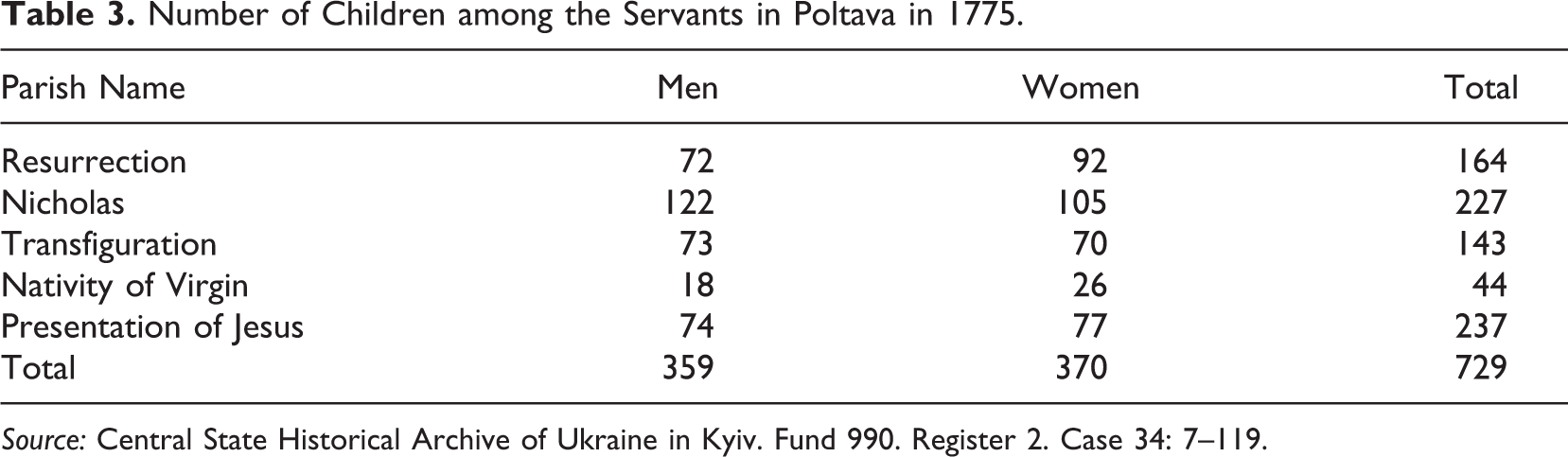
Source: Central State Historical Archive of Ukraine in Kyiv. Fund 990. Register 2. Case 34: 7–119.
Similarly, among the servants recorded in Rumyantsev Register, exactly half of the servants, 50 percent (615 people), were also adolescents under the age of eighteen, with a predominance of females (353) over males (262; see Figure 3).
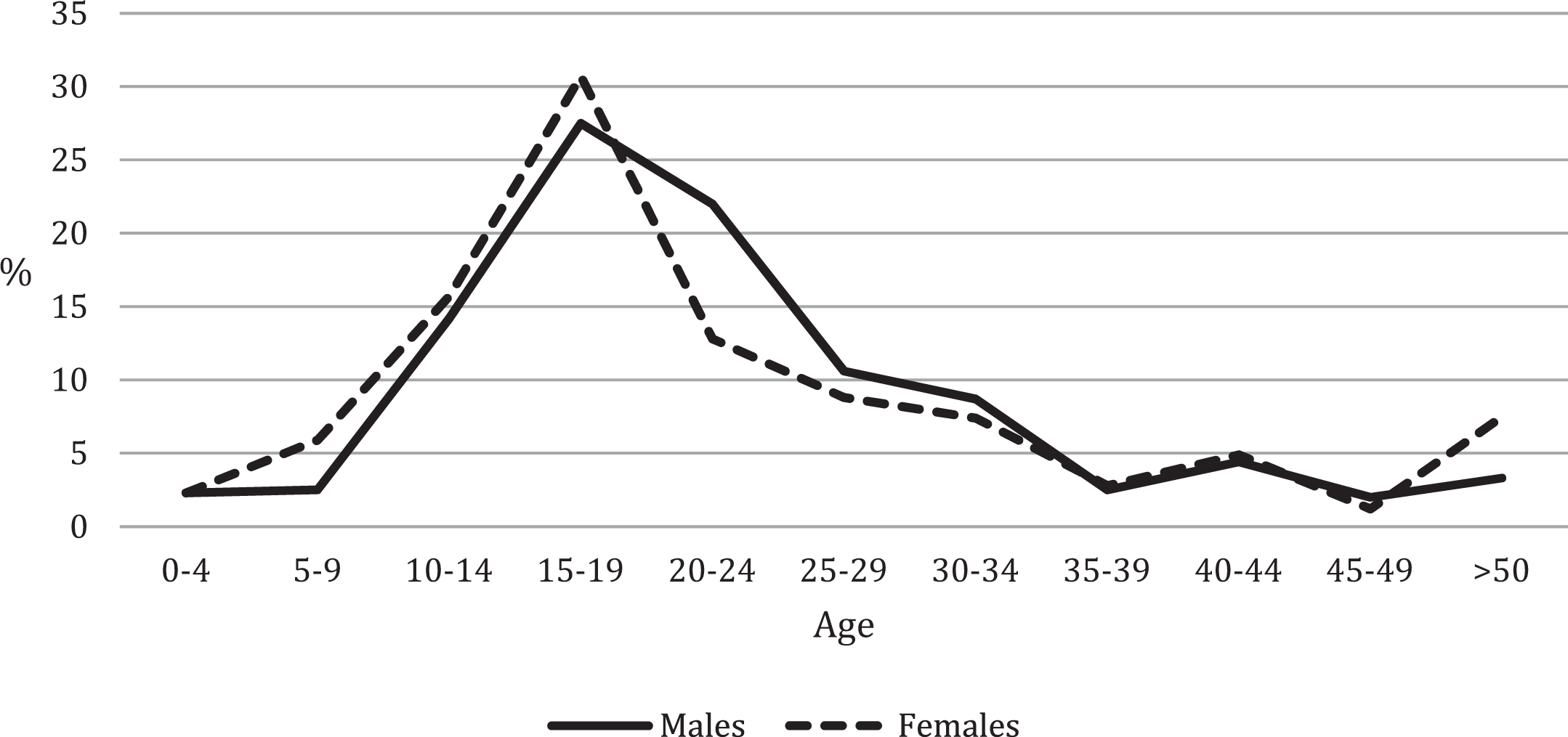
Age structure of servants in Poltava (1765–1766). Source: Misto Poltava v. Rumyancevskomy opisy Malorossii 1765-1769 (KКyiv, Ukraine: Nash Chas, 2012), 43–504. Data for 564 males and 648 females.
Provided that in both sources, many servants were counted as children, the overall age structure of this social group should be explored. Because Rumyantsev Register contains a small numbers of servants, fourteen men and four women, I do not include these in the chart. In the confession records, there were also significant damages to the source and the lists of Nicholas Church most of pages are missing. Therefore, I analyze only those servants whom I was able to identify, in total 930 individuals (see Figure 4).
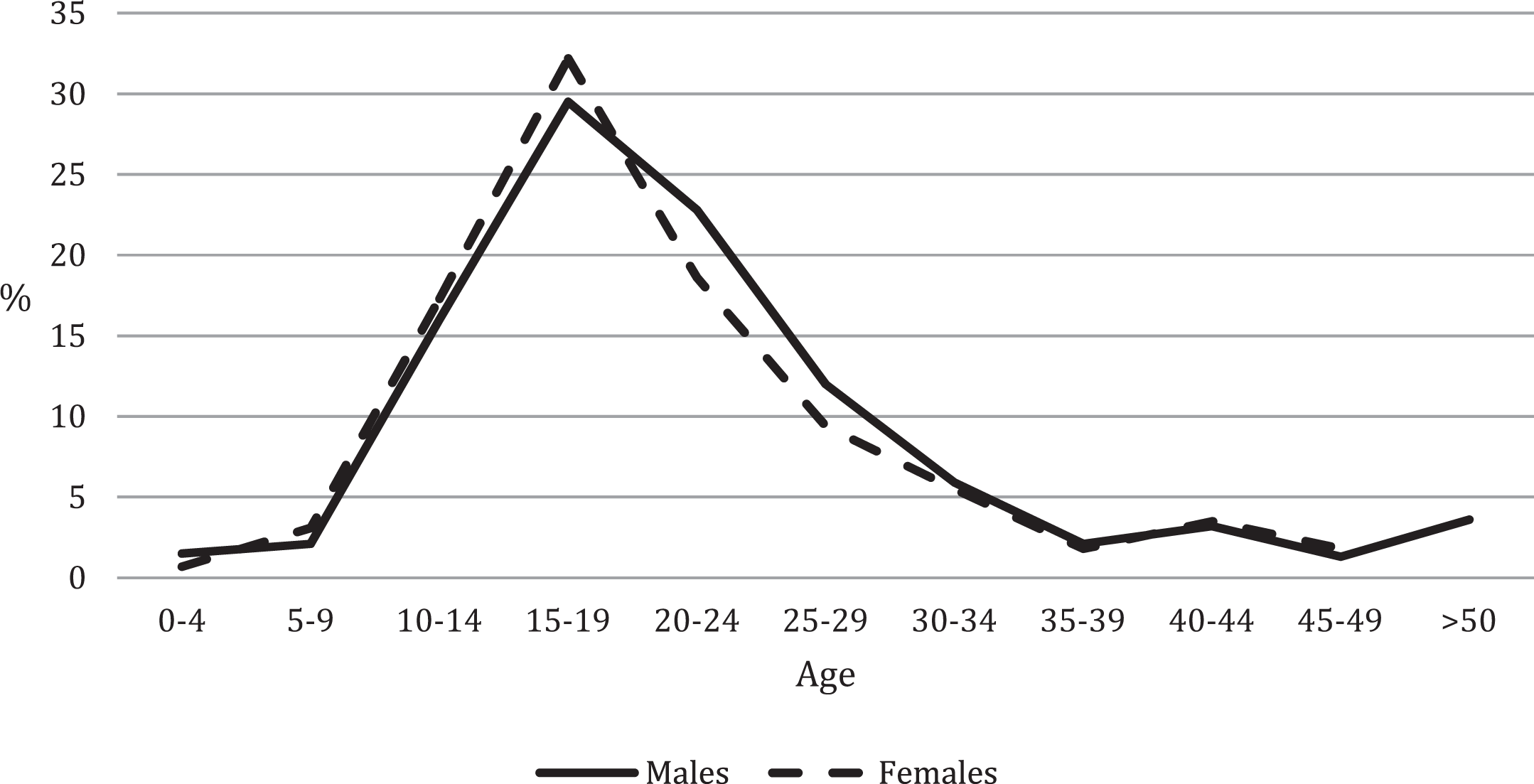
Age structure of servants in Poltava, 1775. Source: Central State Historical Archive of Ukraine in Kyiv. Fund 990. Register 2. Case 34: 7–119. Data for 474 males and 456 females.
After we divided servants in age-groups, it turns out the vast majority were relatively young people between the ages of 10 and 30. In 1765, this age-group was 77.5 percent (939 persons), and by 1775, it increased to 80 percent (735 people). Most of them were adolescents between the ages 15 and 19: 29.1 percent in 1765 and 30.9 percent in 1775. And 17.1 percent and 20.7 percent, respectively, were young people between the ages 20 and 24. These numbers coincide with the data of Cesary Kuklo, who noted that the age-group 15–24 always contains the largest share of servants in big cities in Poland. 16 Overall, the average age of Poltava servants, according to the Rumyantsev Register, was 21.7 for men and 22.3 for women. According to the confession records, average age was 22.3 for men and 22.8 for women. In both cases, it was lower than the average age of first marriage among the residents of Poltava—28.1 for men and 22.3 for women. 17 This may be an additional argument in favor of the fact that in Poltava there existed the life-cycle service.
Graphics of the age structure are very much alike the graphics made by Mikołaj Szołtysek for the Western regions of the Commonwealth. 18
Thus, in accordance with the data, it could be suggested that young people worked as servants and laborers when being between fifteen and twenty-four years of age, not married, and in this way, they might want to acquire life experience outside of their own homes. Similarly, Mateusz Wyżga observes a similar situation in a parish near Krakow that the period of service was not considered by people of that time as degrading, but it rather was the next stage of their life cycle during which a young person would gain experience and accumulated capital required for the creation of an own household. 19
To what extent this situation corresponded to the reality of Hetmanate is difficult to define because previous writings by the Soviet historians typically related this issue to severe social inequality in the society rather than to life style: “the poorest strata of the society gradually lost their recourses and ultimately lost their money, which forced them to get hired by wealthy strata. In search of work, farmers were forced to leave their homes, native places and seek employment in the cities.…” 20 However, Irina Voronchuk suggests that Ukrainian youth began to engage in wage labor for profit as early as Polish youth did. 21 In my opinion, the fact that the majority of Poltava servants belonged to the age-group of fifteen to twenty-four years, and that their average age was lower than the average age of the first marriage, gives the reason to express cautious assumption about distribution in the city such phenomenon as life-cycle service.
Examples of being in the service for acquiring experience and making money can be the story of Luka Zhornyachenko. He was born in village Dykanka, twenty-year-old, a servant of shoemaker Semen Tetervak, 22 who did not come from a “completely devastated family.” In Rumyantsev Register, it is stated that his father, Yuhim Zhornyak (fifty-three years old, pospolytyj, which means peasant), was a widower and that he shared the household with his younger brother Yakov (twenty-six years old). Besides Luka, Yuhim also had a younger son—Gregory (sixteen years old) who was learning shoemaking craft. 23 The family of his brother was not big and consists of his wife Maria (twenty-six years old) and son Ivan (seven years old). The boy was crippled and “could not see with both eyes.” 24
In the household, brothers had the vegetable garden, according to current measures of approximately 0.42 hectares, and a small garden—0.03 hectares. In addition, they had eleven arable plots, with total area of about 15 hectares and 0.3 hectares of forest. 25 They also had cattle in the farm: “old Bulls—2; cows (old milky)—4, young—5; sheep (old)—10; sheep (young)—6; pigs (old)—2, piglets—3.” 26 As it can be observed, this family had movable and immovable property in their disposal that could provide them with the necessary resources for existence. Despite it, both Yuhim’s children, instead of working within their own household, studied shoecraft. Certainly, we cannot make any generalizations from this single case; however, it may suggest that not only poverty and social stratification were the causes of work migration from villages to cities.
In addition, the age distribution indicates that the servants were a vigorous and relatively mobile part of the population. Rumyantsev Register contains necessary data to study this issue. It should be mentioned that only in the cases of male servants, the place of origin and social status were indicated. For example, “Peter Hrechenko, born in Myrhorodskiy Regiment of small town Shishaki, peasant origin, 20 years old, healthy.” 27 According to the calculations, in Poltava city, there lived 542 such servants at that time (see Table 4).
Origin of Poltava Servants, 1765–1769.
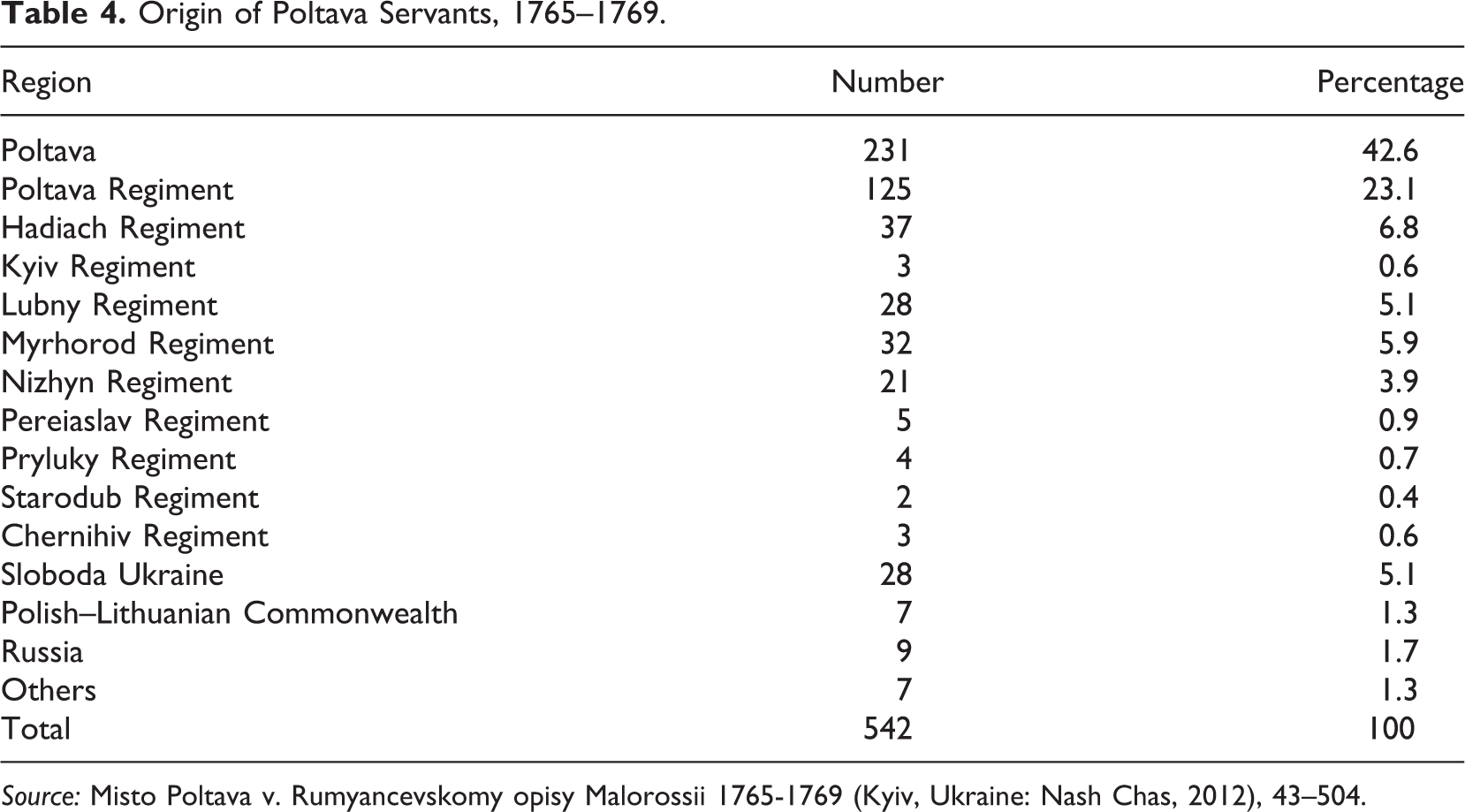
Source: Misto Poltava v. Rumyancevskomy opisy Malorossii 1765-1769 (KКyiv, Ukraine: Nash Chas, 2012), 43–504.
As we can see from Table 4, almost half of the servants (42.6 percent) came from Poltava city and another large group came from small towns and villages of Poltava regiment (125 persons; 23.1 percent). In total, these counted for 65.7 percent. This suggests that the vast majority of working migrants moved within their own region, at least in the case of Poltava regiment. The largest share among them, 21.7 percent (118 persons), were immigrants from nearby regiments of Hetmanate, such as Hadiach, Myrhorod, Lubny, and Nizhyn (see Figure 2). Following them were those originating from Sloboda Ukraine (28 persons; 5.1 percent). The vast majority among them was representatives of neighboring Okhtyrka Regiment (19 people). Immigrants from more distant regiments of Hetmanate, such as Kyiv, Pereyaslav, Pryluky, Starodub, and Chernihiv, constituted all together less than 3.2 percent (17 persons). This suggests that when the region was more remote, the lower number was the number of the newcomers. As it can be observed, those originating from Pereyaslav and Pryluky regiments, that were situated closer, were presented as 5 and 4 people, respectively, while those common from Kiev and Chernigov, to which the distance was longer, were only 3, and from the most remote Starodub regiment were only 2 people. Among the last were the peasants, Olexiy Malinowski, who worked in Poltava’s artilleryman Andriy Dublyansky 28 and, Pavlo Lukashenko, who worked in Poltava centesimal Ataman Ivan Minenko. 29
A small proportion of 1.7 percent (nine people) were immigrants from the Russian territories. For six of them, the sources only indicate that they originated “from Great Russia,” while for the other three, there was provided some more detained information. For example, the servant of a widow Lybov Grechka was Semen Beketov who came from Valuysky County, 30 the servant of a priest Mikita Nesvita was Gordiy Pereverzev who came from Kursk Сounty, 31 and the servant of a regimental doctor Gregory Tam was Musiy Kuzhel who came from Putivl. 32
From the right bank of the Dnieper River—at that time, the territory of the Polish–Lithuanian Commonwealth, seven servants (1.3 percent) came to Poltava. In the documents, they often were signed as “of Polish origin.” Regarding two of them, Sava Medvydyschenko and Pavel Motsakovskiy, it was stated that the first “came from small a town Nemyrov, and that he has a Cossack rank,” 33 and for the second that he “came from a small town Kaniv, also belongs to Cossacks.” 34
Another 1.3 percent (seven people) that I defined as “others” were Stepan Mohylenko, who originated from Bahmutskiy province, in Eastern Ukraine; he was a teacher in the family of Dmitry Bilushenko who himself was bunchukovyj tovarysh—one of the highest military status in Hetmanate 35 ; Trophim Razinkin who came from Pishanka Sloboda 36 ; Dmitry Grek of whom it was said that he was “from Greece” 37 ; Ivan Pavlov “Armenian origin” 38 ; Gregory Kucherenko “Georgian origin” 39 ; Petro Litvin “Lithuanian origin” 40 ; and Ivan Zhydko “from the Jews.” 41
The data in this article partly concur with the results presented by Ivan Kowalski, who explored another regimental center of Rumyantsev Register—Pereyaslav, also located in Central Ukraine, today Kyiv Oblast. He found that in the city of Pereyaslav, there were “530 workers and students, of who 58,71% came from the Pereyaslav regiment, 7,46% from the territory of the right-bank Ukraine, 10,25% from the villages and towns of Chernihiv, Kyiv, and Nizhyn regiments.” 42 As it can be observed, the general structure of working migrants was similar at that time around Hetmanate because the vast majority in Pereyaslav, similarly to Poltava, were also residents of the regiment, 43 another large group originated from the nearest regiments, and the third largest share came from the territories of neighboring the Polish–Lithuanian Commonwealth. In this case, the difference with the case of Poltava is only in the set of regiments, namely, that the largest neighboring territory that supplied servants was Sloboda Ukraine.
The sources of Poltava indicate that social membership only for 494 servants of a total number. Although we could not find the data for 48 people (8.9 percent) of the servants, most of those were data on peasants. Unlike in Pereyaslav city, in Poltava’s census, all the burgers (mieszczaństwo) were placed under the same category. And this is also the reason why servants who belonged to this social group were not registered in the city. Those who came from Poltava were recorded as Cossack’s children or peasants. The majority of Poltava servants belonged to the last group (62 percent), where quite a large part (27.7 percent) were from the Cossacks, 0.9 percent from the clergy, and 0.5 percent were odnodvirci—the social group in Russia that consisted of militarized farmers. They were aforementioned ethnic Russians: Grigory Pereverzev, Semen Beketov, and Trophim Razinkin. Therein, Poltava’s servants differ from Pereiaslav’s ones where the main majority were Cossacks (35.43 percent), peasants (24.94 percent), and burgers (12.79 percent). The servants with uncertain social status accounted for 18.85 percent. 44 However, if we will combine the latter two groups, as it was in Poltava, distribution will be similar: the vast majority would belong to peasants.
Servants in Poltava apparently were hired for one year. At least their remuneration determined by this term. Perhaps at the end of this year, the “contract” was renewed or perhaps young people moved to another host. At least, the story of nineteen-year-old Evdokia Dziuba convicted of infanticide in 1779 confirms this thought. She started working as a servant after she became an orphan at the age of ten years. During nine years, she changed seven owners. She worked for one year for the five of them and two years for the rest. 45 And the main question during which time the servants in Poltava were in the same household requires additional study and other sources are required.
Quite a significant proportion—22.5 percent (122 people)—among the analyzed group were students of artisans. In the source, they were also called “an employee.” And only in the report about payment method, they were recorded as “took on the study of tailor skills without payment.” 46 Names of a craft type depended on the specialization of a master. Most of those in the sources here studied the shoemaking craft (48 individuals, 39.3 percent) and tailoring (46 persons, 37.7 percent). The rest of the students were potters, fullers, furriers, painters, weavers, blacksmiths, and goldsmiths.
One of them was Athanasius Kalynychenko, a native of the town of Romny in Lubensky Regiment. He was hired by a merchant Pavlo Rudenko “without a recruitment for familiarizing to merchants.” 47 This microgroup was consisted of almost completely men. Exceptions were only two girls, Varvara and Agrafena, who were “taken on study of weaving skills without payment.” 48
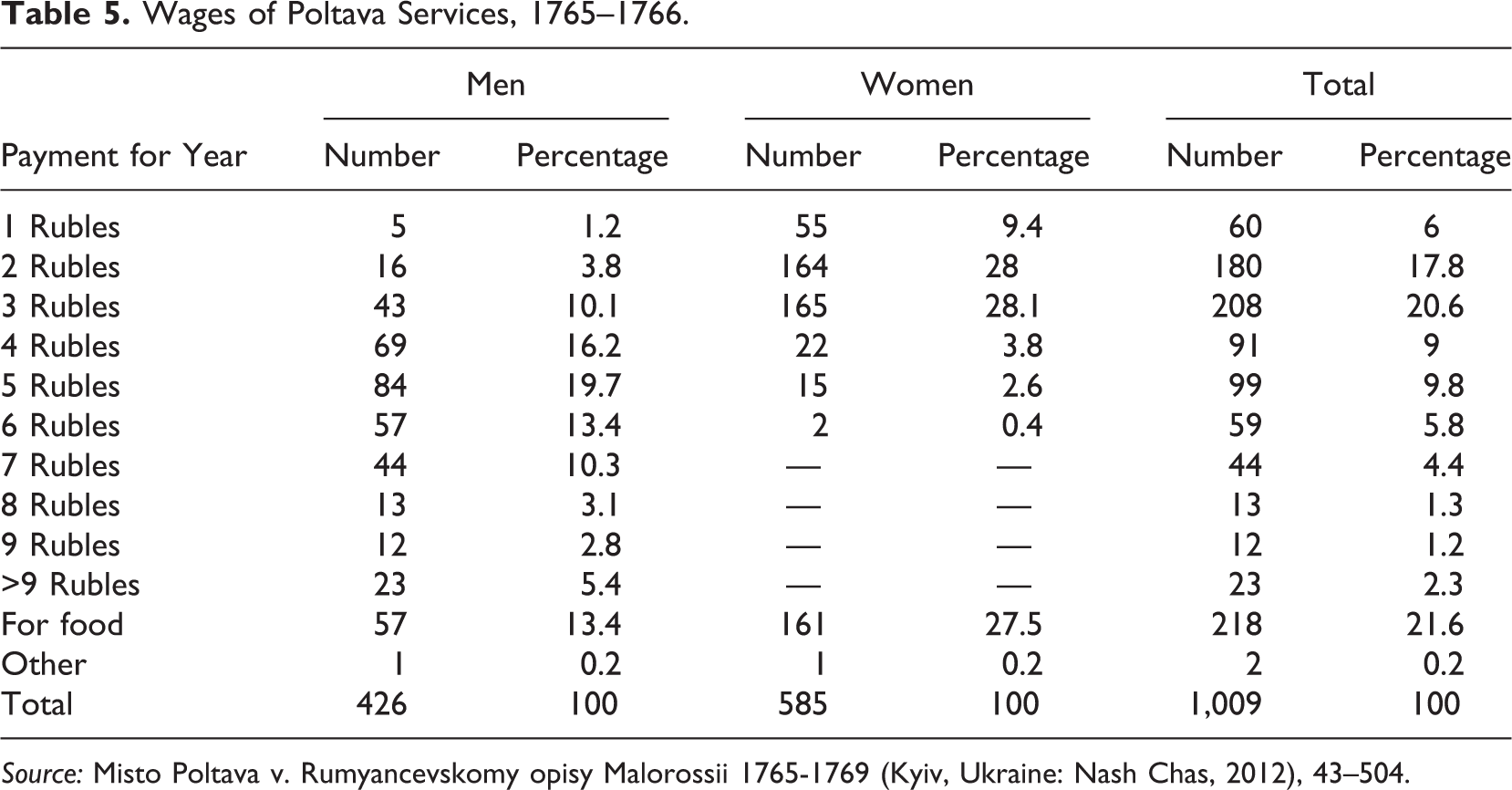
In general, we can say that servants and “workers” were the group of different ranks united by their professional status. In the preindustrial era, they made up the largest microgroup of the professional society not only in Western Europe. 49 Part of them, mostly the young people or old people, are mentioned in the sources as “decrepit from the old age” worked only for food. They were usually mentioned as “taken at subsistence.” However, significant part of the servants received money for their work. In many cases, particularly of women, the hosts could also provide food and clothing as well as could “added to the payment.” The total number of people for which in the Rumyantsev description was reported the size of payment was by my count 1,009 people—585 women and 424 men. I didn’t count students of artisans in this group (see Table 5).
Wages of Poltava Services, 1765–1766.
Source: Misto Poltava v. Rumyancevskomy opisy Malorossii 1765-1769 (КKyiv, Ukraine: Nash Chas, 2012), 43–504.
As it can be observed, a large part of 21.6 percent (218 persons) were those who worked only for food. However, their percentage among men was less than half—13.4 percent (57 persons), while among women it was 27.5 percent (161 persons). Some of these women were widows (44 persons), 50 and the majority were young and elderly females.
With regard to the wages, there often was gender and age imbalance as men and older ones usually received bigger salaries.
As can it be observed in the Table 5, salaries of women ranged from twenty-five cents to five rubles. The smallest salary was received by a ten-year-old girl Ksenia, who worked in the household of the viyskoviy tovarysh—one of the highest military ranks in Hetmanate—Ivan Bogdanovich. 51 The highest wage of five rubles was paid to a twenty-five-year-old woman Maria who worked in the house of alderman (ratman) Gregory Paskevich 52 and to a twenty-two-year-old widow Yavdoha in the family of Poltava’s vogt (vijt) Petro Chernysh. 53
Usually, the payment for the female labor was in the range of between one and two rubles received by 28 percent (164 persons) of females and two to three rubles received by 28.1 percent (165 persons) of females. In the second group, the majority consisted of women who received salary two rubles—152 persons. Much wider than the female has been a general scale of wages for men, which ranged from between fifty cents, that was received by a ten-year-old Poltava citizen Gavrilo Norychenko from Cossack Yakim Artyukh, 54 to fifty rubles, which were paid by a merchant Stepan Momontov 55 to his servant “from Great Russians”—Ivan Prokopov. Within this scale, the distribution of men’s payment was more equal than among females. As can be observed from Table 5, most of the maids earned within one to three rubles (56.1 percent) and servants’ wages ranged between two to seven rubles. Overall, the average wage for women in Poltava in 1765–1766 was one rubles sixty-two kopecks and for men was four rubles ten kopecks.
Conclusions
Summarizing the results, I can conclude that:
In the total structure of Poltava’s population in the second half of the eighteenth century, the share of servants ranged 17 percent to 20 percent. This indicator seems plausible for the whole territory of Hetmanate during the studied period, and it corresponds with the data received by Polish scientists studying the Polish–Lithuanian Commonwealth. However, this share is significantly higher than Western Europe. The preconditions for these differences should be explored in further studies. Analysis of the age structure confirms that most of the servants were young people. Their average age for both men and women was around 22. It is likely that in the case of young people, the time of doing the service was seen by the society as a step to gain life experiences outside the parental home rather than to gain entire independence from them similarly to Northwestern Europe. This aspect, however, needs further exploration. The largest proportion of servants were natives of Poltava city and of the small towns and villages in Poltava regiment. The second largest share of servants originated from the neighboring regions, mostly natives of other regiments within Hetmanate, and from Sloboda Ukraine. By social affiliation, this group united different social rank, such as professionals, among who were children of the peasants, Cossacks, clergy, and others. The wage structure among the servants was gender imbalanced: the average salary of women was more than three times lower than that of men (one ruble sixty-two kopecks and four rubles ten kopecks, respectively). There were also significant differences between the age-groups, where the oldest received higher wages.
Footnotes
Declaration of Conflicting Interests
The author declared no potential conflicts of interest with respect to the research, authorship, and/or publication of this article.
Funding
The author received no financial support for the research, authorship, and/or publication of this article.