






Abstract
The multibillion-dollar family history industry is booming in popularity as millions of people around the world are seeking to connect with their ancestral pasts. This article presents some of the findings of a recent Australian study that explored the research practices and historical thinking of family historians. The data presented and discussed here are drawn from 1,406 survey responses and present a demographic and social overview of the survey respondents. It categorizes the cited motivations of family historians in Australia for commencing their familial research, which are much more intrinsic and personal than other studies in this field suggest.
Family history research, identified as one of the top three leisure pursuits in the world, is a multibillion-dollar industry with literally millions of participants around the globe. With the increasing democratization of historical records and improved digital access, individuals are, in unprecedented numbers, connecting with, personalizing, and interrogating the past. Proclaimed an “epidemic,” 1 genealogy and family history research has become “the fastest growing hobby in both Britain and America, as well as mainland Europe, Canada and Australia” 2 and is considered one of the “most important phenomena in public history of the past decade.” 3
There have been several important studies into the research behaviors and motivations of family history researchers. Some have focused on professional genealogists who were, unsurprisingly, found to be “records experts, and knowledgeable about the time periods and geographic areas of their study,” 4 while others looked at the information-seeking practices of amateur family historians only. 5 Many have studied both professional and amateur family historians by means of comparison, 6 while Anne-Marie Kramer examined both family historians and nonfamily historians in the same project to “give a wider insight into the role of genealogy in personal lives than a focus solely on family historians might afford.” 7 Despite these studies (and others), the family history industry remains touted in the literature as under-researched and under-theorized.
Consequentially, the recent surge of family history research in popularity necessitates further investigation, and many scholars have proposed possible motivations as to why family history has captured the interest of millions of people. Jacobson queried whether researching one’s family history was a substitute for religion, 8 and Lambert claimed that “secular changes are afoot in society that continues to stimulate people’s desire to delve into the past” 9 as a feasible catalyst for the undertaking of family history research. Ashton and Hamilton asked “might history, and in particular family history, be a substitute for being in heaven? Are municipal family history and local studies libraries and archives the new parish?” 10
However, despite “secular changes afoot within society,” this does not entirely speak to why people are “delving into the past” in unprecedented numbers. Perhaps a human characteristic that many individuals share is to belong to something larger than their singular “self,” that they are positioned and represented within the broader narrative of humanity. While many people will pass on genetic traits to their progeny, the hyper-individualistic nature of modern society—evidenced by the prolific publication of the personal via a multiplicity of social networking sites—suggests that many humans desire others to know about their attitudes and experiences: essentially, who they are. Family history research is an important vehicle by which this can occur. For family historians, the study of one’s family history may create a sense of meaning “related to the process of finding coherence as part of the mastery of life,” 11 a purpose also ascribed to the role of religion. 12
Some have suggested that the surge of interest in family history research represents an increase in concern with nationalistic identity due to progressively multicultural and multiethnic societies. As Lambert writes, “the multicultural identity argument has achieved some currency within the last few decades precisely because Australia has adopted a multicultural and relatively colour-blind immigration policy, and has embarked on a process of reconciliation with the Aborigines.”
13
Family history research is representative of both personal and cultural identity, and one could question whether the current family history boom is representative of a desire to uncover rootedness or a sense of belonging. Indeed, a seeking of the “point of origin”
14
is often assumed to be the primary genealogical motivation for the family historian which, according to Jacobson, is a motivation fueled and exacerbated by “rapid social change and the breakdown of traditional forms of social organization.”
15
In the face of increasing globalization, transnational migration, greater social class mobility, and what can be viewed as a depersonalized modern society, many people are exposed to a sense of social dislocation and seek to discover where “they belong.” Nash explores this idea with specific reference to those researching within postcolonial countries such as Australia, New Zealand, and North America by claiming the turn to European roots is deeply embedded in the discourses of race, ethnicity, cultural difference, cultural identity and multiculturalism…where ideas of home, roots, belonging, authenticity, and the indigenous are so loaded by the histories of colonization, imperialism, slavery, and the dispossession of native people as well as recent migrations and indigenous people’s claims.
16
Ashton and Hamilton adopt a different perspective. They explain that “public exposure of painful pasts in a post-colonial context have stimulated searches aimed at reuniting families,” and that proving ancestral ties are imperative for Indigenous peoples’ political claims. 17 For the non-Indigenous, Nash contends “genealogy is an appealing tool for navigating through tangled questions of culture and belonging…for those positioned between Indigenous people and the recent migrants of the 20th and 21st centuries,” 18 and British scholar Jerome de Groot questions whether the surge of popularity in genealogy and family history research might indicate “an upsurge in nationalistic concern with identity in the face of an increasingly devolved and complicated country” as people strive to prove their geographic ancestral inheritance. 19 These notions surreptitiously underscore the power of family history research as it can provide evidence which can potentially be used as tools of inclusions/exclusions toward migratory peoples. Almost all nations have experienced the ebb and flow of migration, and while many migrants have been integrated into the grand narrative of their new territory, “their contributions are always subordinated to the story of the founding people.” 20
Connection and disconnection have also been identified as prime motivators for the undertaking of family history research. Katrina Hackstaff wrote that the breakdown of traditional family structures is a mitigating factor in the genealogical boom and claimed that from the 1970s, interest in family history arose due to “a cultural imaginary that transcends individual experience and symbolizes unity and continuity compensate[ing] for the fragmented and tenuous families we currently live by.” 21 Through this lens, people are looking to the past to gain what they feel they should have as opposed to what they do have insofar as familial relations are concerned. Yet, this factor must be problematized. As society itself shifts and transforms, so too does what constitute as the typical family. In the twenty-first century, the nuclear family is no longer the expected norm. We should instead consider that rather than attributing the fracturing of traditional family structures to the genealogical boom, such fracturing is more of a reflection of the evolutionary nature of society itself.
As a means of connection, “genealogy is a tool to bring living kin closer…or producing kinship…[and] is also a way to bring back the dead.” 22 Here, the process of family history research becomes a form of memorialization and forges relationships with the long dead echoing Lambert’s notion of the parasocial relationship. 23 Such a relationship allows the living to care for and about the dead, and consequentially, the dead are simultaneously rendered immortal. In this context, family history research becomes a heuristic in which to make emotive connections with the specters of the familial past and to forge relationships with ancestors one will never (and can never) know in a social context due to the fracturing of temporal, geographical, and intergenerational distance(s). However, irrespective of form, whether it be religious motivations, nationalistic concerns, or changing family and societal structures, family history research establishes, creates, and recreates connections with others, both the living and the dead. Overwhelmingly, identity, meaning-making, connections, and cultural/national affiliation are predominantly cited within the literature as the prime motivators for the explosion of genealogical interest.
Considering these motivations, it becomes clear that they are predominantly motivations of a “grand” nature. That is, they all align to the macro world of the family historian. At this level, family history has the potential to operate as a mechanism of cultural and/or racial inclusion or exclusion, or alternatively, it can “serve to anchor and protect exclusive national cultures.”
24
Importantly, these motivations do not consider the personal motivations of why family history research is such a popular pastime. The microsphere of the family historian is simply not illuminated. Yet, this microsphere does need to be interrogated. For example, ancestors thought to be insalubrious can be ignored or discarded together, along with any familial narratives deemed by the family historian as being “unsavoury.” In this manner, the family historian can potentially create their ancestral identity or have the pleasure of “choosing an ‘authentic’ identity”
25
deemed worthy or representative of who they think they are. Such acceptance and/or rejection of emergent ancestors appear to be entirely dependent on the personal experiences and attitudes of the family historian in question. This, naturally, will change over time. A brief example: for much of the twentieth century in Australia, the revelation of a convict ancestor was considered shameful, and many researching their family history went to extreme lengths to either disguise their ancestral history or discard the convict ancestor altogether. Lambert refers to this as the “convict stain” and reports The most dramatic evidence of the stain, so far as genealogists are concerned, was the practice of destroying federal census data throughout the 20th century on the grounds that this “protected” citizens from potentially embarrassing information about their ancestry.
26
What appears to be absent after the scoping of literature is an overview of the intrinsic motivations which propel individuals to research their familial pasts. This research, as a point of difference to other studies, sought to explore the personal motivations of Australian family historians. The literature did not provide an obvious social profile of Australian family historians, which this research has also considered. As such, this article responds to three investigative questions: What type(s) of people engage in family history research in Australia? Why do these people commence their family history research? and Can these motivations be categorized?
Research Design and the Epistemological Position of the Study
Aims of the Study
The data in this article were drawn from the survey of a larger study into the motivations and historical thinking of family historians in Australia. The larger study aimed to add an Australian voice to the existing conversation in the field of family history research with regard to motives and to provide baseline data about the extent to which historical thinking was present among members of the family history community. It also sought to explore the personal impact of family history research on the participants. As a multiphase qualitative study, three research areas were developed to provide an insight into how the phenomenon of family history research was understood and interpreted by the participants through a synthesis of survey, interview, and case study data.
The Sample Population of the Study
The sample population of this study was purposive in that only practicing Australian family historians were invited to participate. The invitation for participation in the research did not delineate between professional and amateur family historians as other studies have done, nor did it consider those who were not researching their family history as participants by means of comparison. The study was advertised in four Facebook groups dedicated to family history and genealogy, and personal e-mails inviting participation were sent to 280 family and local history societies in Australia. In total, 1,406 people participated in the study.
The Research Design and Analysis
The larger study was developed over three phases. Phase 1 was anonymous online survey. The survey contained both factual and attitudinal items and a combination of open and closed questions, and there were thirty-one questions in total. The survey collected comprehensive demographic data and attested to issues of motivation and the affective consequences of family history research on the respondent. All findings were analyzed and discussed prior to shifting to phase 2 of the study. Phase 2 of the study was a series of semi-structured interviews. Phase 3 was the development of two case studies where all previous data were triangulated.
This article reports on some of the findings of the survey in phase 3 of the larger study, in particular the demographic data, and the responses to the question “Why did you start to research your family history?” The survey was developed using SurveyMonkey research software (2014 version), and the quantifiable questions were immediately converted into statistical data and represented graphically. The data for the qualitative questions were coded individually to establish codes and frequency (first-level coding) and then recoded (second-level coding) to develop thematic nodes. Analytic frameworks were then applied to some data where applicable. Consequentially, each qualitative question was interpreted and reinterpreted in a cyclic progression multiple times, characteristic of the philosophical hermeneutic epistemological position. Figure 1 diagrammatically displays the synopsis of the coding process.
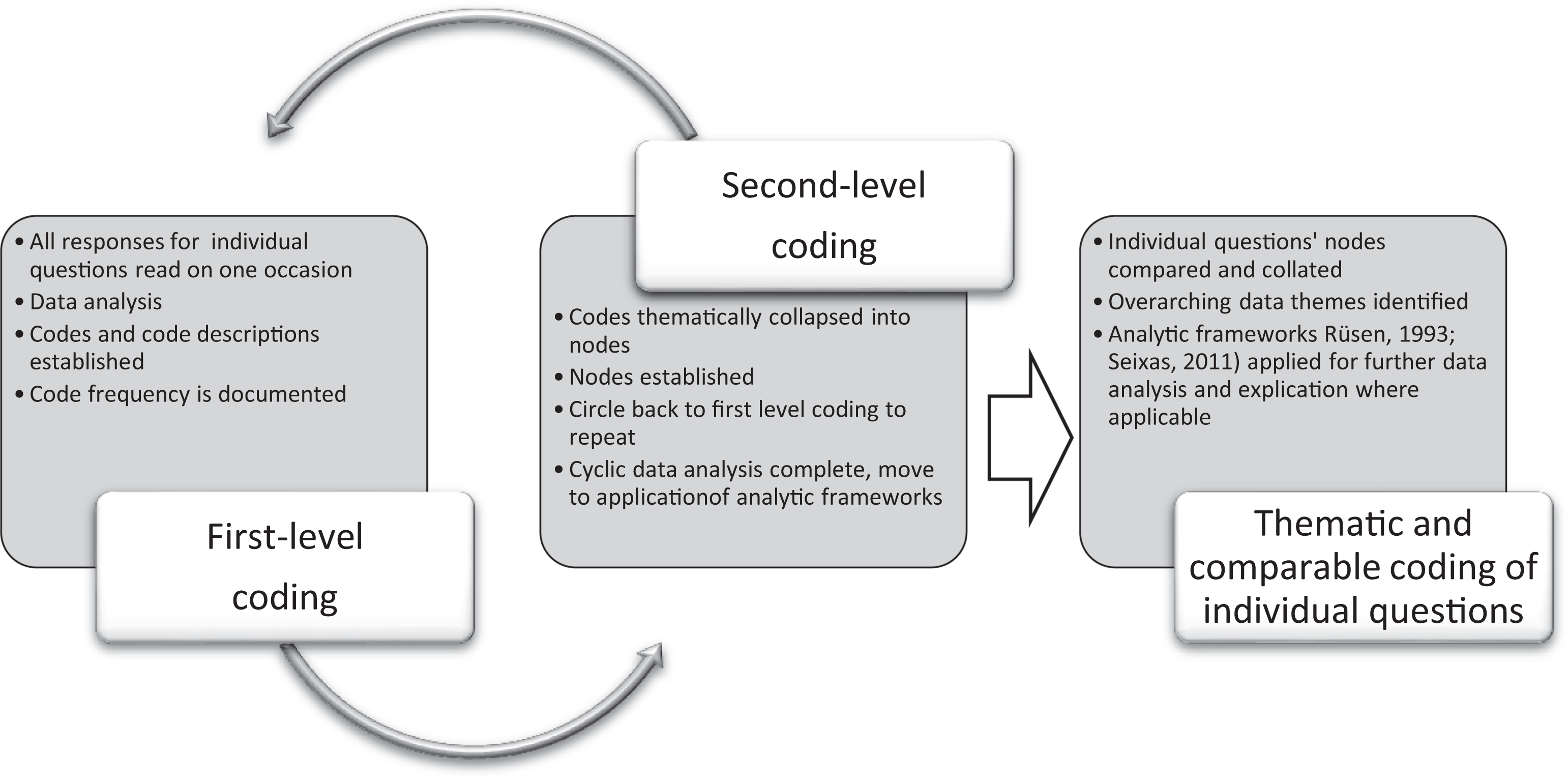
The coding process for the survey data.
The Epistemological Position of the Study
This investigation stems from a philosophical hermeneutic epistemological position which is particularly useful for the examination of the sociocultural world. Hermeneutics, as a paradigm, is intersubjective in nature, and it is most often understood as “the art or technique of understanding and interpretation.” 28 This paradigm assists in the avoidance of misunderstanding through a continuous and circular dialogic conversation between researcher and text. As a philosophy of interpretation, “contemporary hermeneutics has expanded the scope of the term text to include not only documents in the conventional sense but also organisational practices and structures, social and economic activities, cultural artefacts, and the rest.” 29 Central to this is Gadamer’s analogy of the fusing of horizons. In adopting this epistemology, this research explored how the participants’ own experiences of the phenomenon of family history research, already unconsciously mediated and interpreted by the participants, “fused” to the horizons of the researcher’s own interpretations and understandings of the phenomenon.
This horizon is ever-shifting and malleable, for as understanding develops, the horizon changes. As such, each iterative reading of the data resulted in the interpretation and subsequent reinterpretation through repeated cycles of dialogic conversations in a hermeneutic circle defined by Piercey as a “back and forth movement between the preconceptions one brings to the inquiry and the theoretical insights one takes away from it.” 30 Thus, the hermeneutic circle is the conduit for understanding and meaning-making which evolve as the horizons between the researcher and the text are fused. In this research, the philosophical hermeneutic interpretive paradigm was particularly valuable as the narratives told by family historians about their research and subsequent findings are usually well rehearsed and culturally mediated. The continual and cyclic coding process ensured a robust dialogic conversation which sought to interrogate and interpret the respondents’ data. It was understood that the responses were themselves interpretations, and the repeated cyclic interrogation of the data assisted in alleviating this as a concern.
Who Are Australia’s Family History Researchers? A Demographic Overview
The data revealed that while there was not any one distinguishable or defining feature which could be presented as being “typical” of a family historian, generalizations could be made about the type of individual who responded to the survey. There was a gender disproportion in the data with more women (76 percent) than men (24 percent) responding, and most respondents were married or in a significant partnership (72 percent). Respondents were overwhelmingly Australian (91.5 percent) with New South Wales (NSW) being the most heavily represented as the birthplace of respondents at 57 percent and the Northern Territory the least represented at less than 0.5 percent of the sample. Most of the respondents indicated an Anglo-Celtic ethnic or cultural origin (72 percent) followed by a European (20 percent) ethnic or cultural origin. Aboriginal and Torres Strait Islander peoples represented 1 percent of the sample.
Interestingly, the survey data revealed a challenge to the perceived age of family historians in Australia. Family historians are usually anecdotally portrayed as elderly, yet respondents indicated an average age of fifty-four years, with ages ranging from sixteen to ninety-one years old. This suggests that Australian family historians are becoming younger. While this variable can perhaps be explained by the recruitment method of respondents (being via Facebook and e-mail), family history research is arguably becoming a more popular pastime among younger people.
These data support the findings of previous studies which claim that family history research is rapidly increasing in popularity in Australia, particularly within the last two decades. The respondents of this survey were asked to identify which year they began their familial research, and once data were quantified and represented graphically, a significant trend emerged. The graph below highlights the steady increase in active participants in the family history (FHR) community over recent decades and reveals that 43 percent of respondents have commenced their family history research within the last fifteen years (Figure 2).
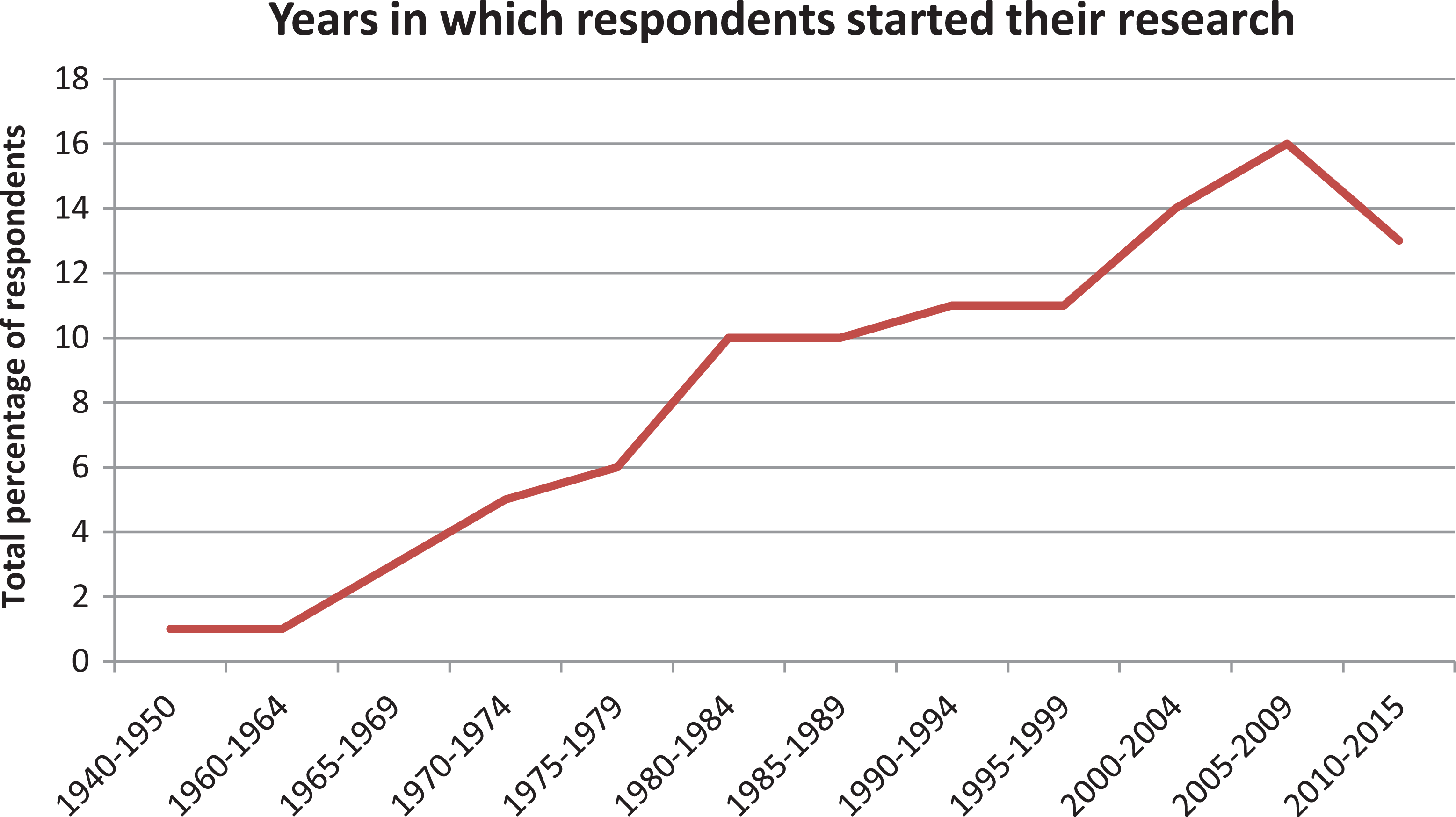
Year in which respondents commenced their familial research.
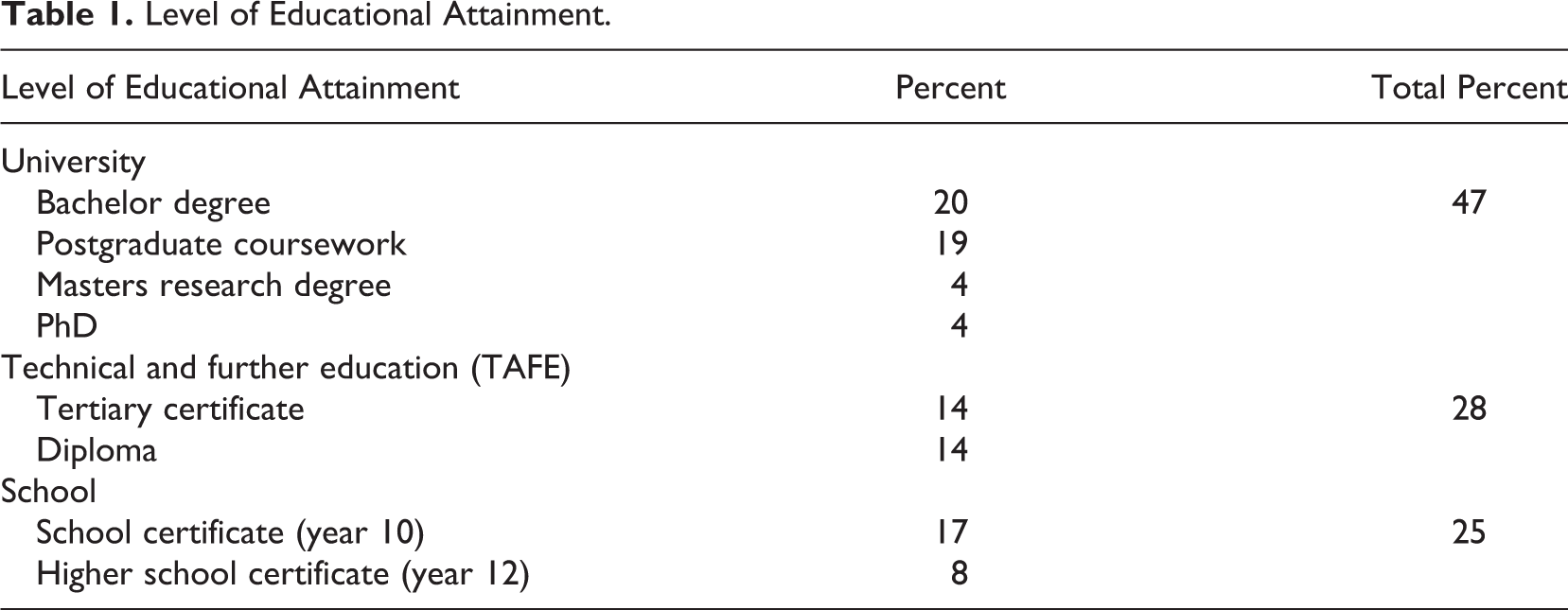
The family historians who responded to the survey were also well-educated with the data reporting that 75 percent of the sample had completed some variety of study postsecondary school (see Table 1). Many of these were university graduates or had completed a trade certificate or a diploma.
Level of Educational Attainment.
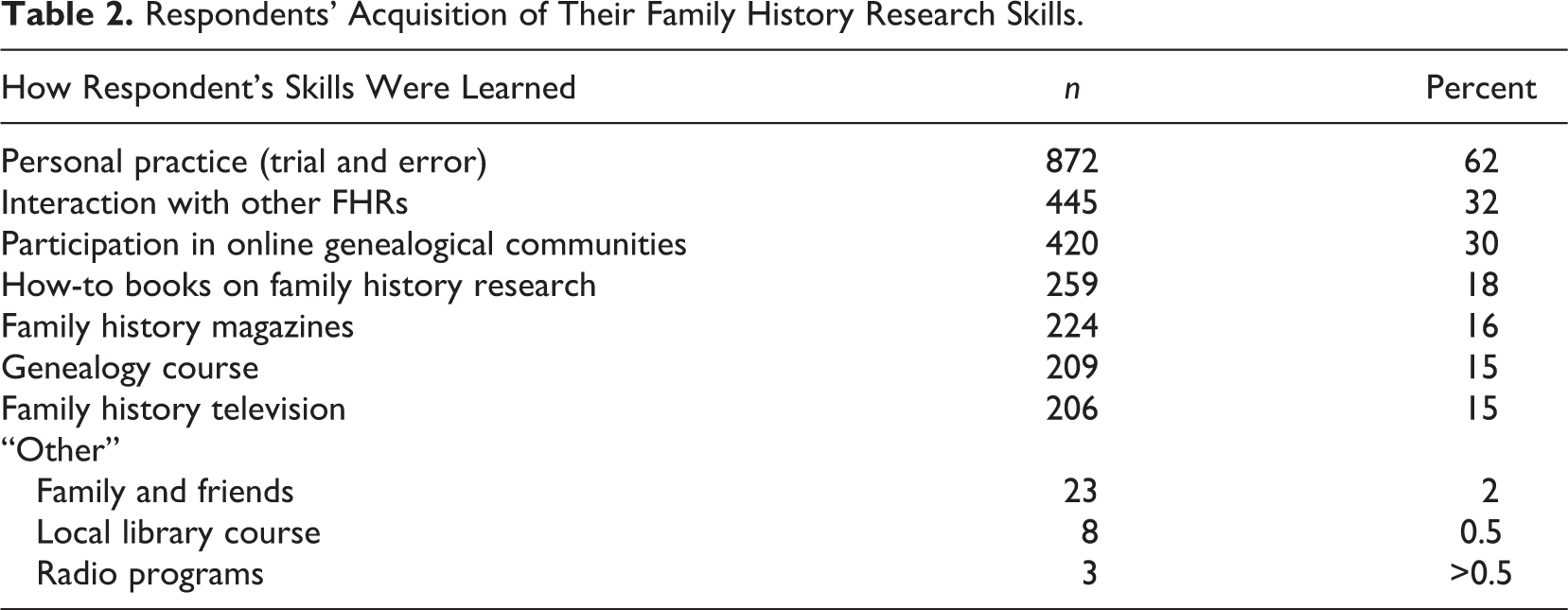
While some respondents had indicated a study of history at a tertiary level, most survey respondents had not undertaken any tertiary training in the history discipline. Rather, most of the respondents’ exposure to historical disciplinary nuances had been at high school and, given the average age of family historians in this study, this was a temporal lapse of nearly forty years for the typical respondent. Critically, this positions family history research as a public pedagogy as historical research skills are acquired independently of formalized institutions of learning. Most respondents reported learning to do their research through a process of “trial and error” before reaching out to the broader family history community for guidance. Despite family history research being a predominantly self-taught enterprise as Table 2 shows, most survey respondents (93 percent) believed they were successful researchers.
Respondents’ Acquisition of Their Family History Research Skills.
The survey also revealed a wide variety of occupations among Australia’s family history community. It is significant that the survey data revealed most (83 percent) respondents did not engage with history or historical records within their occupation, yet each respondent participated in an average of four additional “historical activities” other than their family history research. These historical activities were often cited as watching historical movies and documentaries, reading historical novels, visiting museums, traveling to places of historical significance, visiting cemeteries, collecting historical artifacts, listening to podcasts, or reading historical nonfiction. This indicates that engagement with history through their familial research and other historical activities was motivated by interest, rather than an extension of their professional obligations. As the data show, most respondents did not learn their historical research skills through a tertiary institution, nor did they acquire their skills through their place of employment.
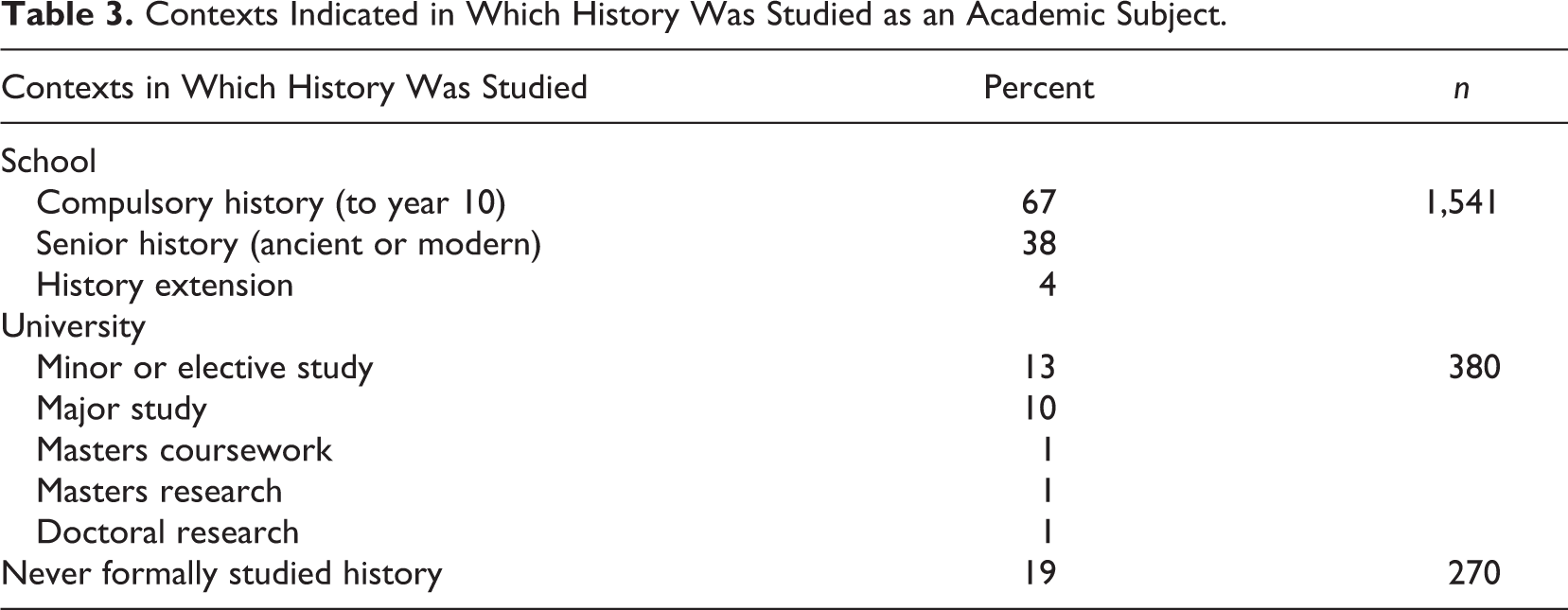
Respondents indicated all the contexts in which they had studied history as an academic subject, and three primary areas were identified: school, university, and those who had never formally studied history. Compulsory history in secondary school was the largest context in which the discipline of history was studied in an academic subject, and this was represented by 67 percent of the respondents. Prior to the introduction of the Australian Curriculum, history as an academic subject was compulsory to year 10 in NSW only, so this result is unsurprising as most of the survey respondents indicated they were born in NSW (notably, this does not necessarily mean they were schooled in NSW). The next largest representation of the studying of history as an academic subject was also in secondary school where respondents indicated they had either studied senior ancient or modern history (38 percent) or history extension (4 percent). The next largest category, at 19 percent, was “never formally studied history.” Included in this category were respondents who indicated they had undertaken a diploma in family history. A small number of respondents had studied history at a tertiary level, but these appeared to be mostly for bachelor degrees. Only 3 percent of respondents had studied history at a postgraduate level. Table 3 presents this finding.
Contexts Indicated in Which History Was Studied as an Academic Subject.
Despite most family historians teaching themselves, and each other, the skills to undertake historical research, Australian family historians have an array of research tools and facilities in their research repertoires. The volume of tools and facilities selected by respondents demonstrated this, with an excess of 10,000 (N = 10,631) tools and facilities selected, which averaged eight tools and/or facilities per respondent. Those surveyed appear adept at applying various research tools and facilities to support and enhance their research process. The largest number of tools and facilities (51 percent) employed by the respondents were digitally based, and these were predominantly Internet websites, Internet archives, software applications, and television documentaries. However, it was surprising that this number was not higher due to the amount of digital information publicly available online. Almost an equal number of tools and facilities (49 percent) utilized by the family historians surveyed indicated more customary and “physical” research tools (or tools that are physically tangible which can be referred to as “conventional”) such as materials supplies by family members, library archives, books, historical artifacts and ephemera, museums, and magazines which were also used in abundance. This emphasizes how skilled Australian family historians are at historical research as many appear confident in the employment of different research tools and are able to move between digital and conventional research tools with fluidity to suit their research agendas and goals.
Motivations for Initiating Family History Research
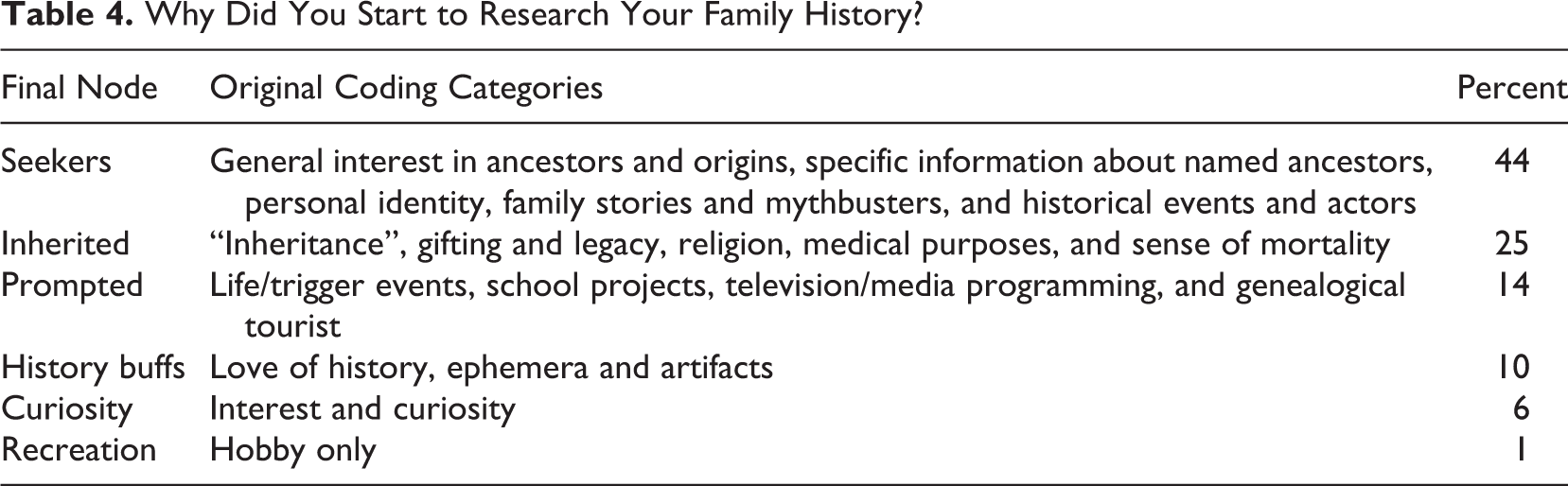
Like the respondents themselves, their reasons and motivations cited for the commencement of their family history research were extensive and diverse. The question “Why did you start to research your family history?” was posed in the survey and while individual responses to the question were undoubtedly varied, six main themes emerged from the data. These main themes were comprised of eighteen initial codes, which were then thematically collapsed as Table 4 shows.
Why Did You Start to Research Your Family History?
The Seekers
The largest group of respondents, at 44 percent of the total sample, were named the “seekers” who initiated their familial research as a means of interrogating the past. Respondents in this group were probing previous historical times to provide an answer to a (self-directed) question in the present. While all family historians could be said to be seekers in some respect, the respondents in this group were seeking something specific as opposed to a banal interest in their familial past. Often, many respondents were simply seeking the names of ancestors, places where ancestors may have resided, personal characteristics and traits of their ancestors (“I wanted to know what my grandfather looked like,” respondent 24), or alternative specific information about named family members (“to find my father’s uncle who’s supposed not to exist despite being named in a photograph,” respondent 211). Included in this group were those interested in uncovering or augmenting a personal identity; however, this group comprised but a fraction (3 percent) of the total sample.
Of more interest in the seekers group were those who were searching the past for “the truth.” Respondents told of seeking to prove or disprove family stories in an attempt to distinguish familial fact from fiction (“To put the truth into family folklore,” respondent 647). For many, it was the silences of the past that attracted their attention as they sought to uncover “truths” they felt had been deliberately withheld from them as exemplified by respondent 1285 who wrote that “No one would tell me anything so I decided to research it to see what they were hiding.” Yet, the idea of searching for truth in the past is muddied at best. For what exactly is truth in historical research? Reputed historians have been grappling with this question for centuries with those such as Von Ranke and Bury advocating the scientific approach to historical truth, and others such as Barthes and Collingwood espousing that history is a particular form of fiction for which one must develop an historical imagination to effectively produce. 31 While the respondents in this group were not looking for truths pertaining to significant historical events, such as the world wars or the settlement of Australia, they were searching for truths regarding their ancestors only. Often cited was the need to uncover the truth about a specific person in the past, so it could be used as a means of explaining their actions to those in the present as respondent 1014 tells: “I realised after his death that my father had told many untruths about his early life. I wanted to find out why.” The danger here, of course, is that historical evidence may be discarded until the preferred truth is revealed and that the seeking of “truth” attests to metahistorical issues such as the perspective, interpretation, contextualization, and empathy of the researcher. Indeed, the family historian seeking the truth in the past must also see themselves as an historical being complete with prejudices influenced by their own experiences. Robert Parkes refers to this as the “historiographic gaze.” 32
The final group of respondents named as seekers were those who wrote that their interest in family history research was spurred by an ancestor who could be placed contextually against a larger historical event, such as a World War, or the Australian gold rush or historical actors such as royalty. For these respondents, being able to claim affiliation with an historical event or actor was the primary motivation for the commencement their family history research. Typically, the respondent had learned of the connection through family lore and sought evidence to prove the connection as respondent 645 wrote: “my grandmother always said that we were descended from William the Conqueror. I wanted to prove it.” However, this number was small totaling only 4 percent of the sample and reveals seeking connections between the respondent and wider historical events, and actors could not be considered an important motivation for the undertaking of family history research. This motive is significant in that it was underreported. The data indicate that searching for a “grand” historical connection was not important to the family historians surveyed and that they were more concerned with aligning to micro-historical narratives.
The Inherited
The group of respondents labeled “Inherited” was the second largest group of respondents at 25 percent of the total sample. The overarching characteristic of this group was the somewhat obligatory sense of responsibility felt by respondents to undertake their familial research. For these people, the desire to undertake family history research was driven by extrinsic personal factors as opposed to intrinsic personal factors, yet they were factors of a personal nature nonetheless and, as such, were representative of the micro-historical sphere. Such factors were motivated by obligation, gifting and legacy, medical purposes, the literal “inheritance” of the familial research. This category of respondent does not align with any motivations outlined by previous studies, nor does it neatly align with the deeply personal characteristics of the seekers as outlined above. This motivation has not been reported in the literature and augments the scholarly discourse of why individuals commence family history research.
Many of the inherited respondents quite literally inherited their familial research. Some spoke of a beloved parent or relative who had died and consequentially felt obliged to continue the research out of respect and reverence for the dead (“My grandfather had started the family tree, and when he died I kept it going. It made me feel closer to him,” respondent 13). For these respondents, the personal connection to the deceased resulted in an imposed personal connection to the past, that is, they felt somewhat duty bound to continue the family history research. This duty was predominantly accepted with enthusiasm, yet some expressed indifference or even reluctance (“assisting uncle, now deceased, no one else interested so it had to be me,” respondent 980). For these individuals, the desire to delve into the past was simultaneously intrinsically personal yet extrinsically motivated.
For other respondents in the inherited group, the initial commencement of their family history research was intended as a gift to another family member (“My mother was turning sixty and knew little of her family. I did it as a gift to her,” respondent 1302) or else was intended to be a familial legacy to future family members (“to leave a legacy for my children’s children,” respondent 1191). The desire to collate and preserve the past for the future was included in the inherited group for the obvious reason that it was intended to form an inheritance for those family members in the future. For these respondents, a sense of obligation was conveyed in their response to this question comparable to those who had directly inherited their research; however, their motivations were more intrinsic. The self-prescribed role of these respondents was powerful as many saw their role as that of the “gatekeeper” of family lore and knowledge and as respondent 41 informs: “If it wasn’t for me, no one would know anything about the family. It’s all up to me. If anyone ever wants to know anything about our ancestors, only I can tell them.”
Also included in the inherited group were those who desired to uncover any inheritable genetic medical traits and/or conditions which may impact negatively on those in the present. For these respondents, family history research was a tool in which certain medical traits could be identified, traced, and perhaps eradicated (“To find the medical history of the family after mother dies of pancreatic cancer like her mother had,” respondent 124). This group was small (2 percent) and was not significant in and of itself yet is included here as it has not been commonly identified as a motivation for the commencement of family history research prior to this study. Coinciding with much of the data pertaining to the motivations of family historians surveyed, this motive too was inward-looking and personal.
The Prompted
The third largest group of respondents at 14 percent of the total sample were the “prompted.” Like the inherited group, the dominant motivation for the instigation of their family history research was due to an external influence. Such influences were manifested through a significant trigger event, a school project, television, or other media programming or travel to a place of personal genealogical interest. For this group of respondents, the external influence had a substantial impact on their intrinsic motivation to undertake family history research.
A large number of the prompted respondents cited a significant life event as a catalyst for motivating them to undertake their family history research. Such life events usually took the form of a death of a loved one, a marriage, or the birth of a child (“Because I was pregnant with my first child and wanted to know what my background was,” respondent 633). With regard to the death of a family member, regret was often exhibited as the respondent lamented the loss of familial information that vanished with the deceased as told by respondent 607 who wrote “My mother dies [sic] when I was eighteen so I never really knew her ‘story.’ In 1984 I became a mother myself and wanted to know more about my mother, her background, and my family.” Such information was usually the family stories, the information which could (or should) have added flesh to the familial bones. Many respondents communicated that the death had sparked a desire to collect and collate family information extensively, so future generations would not be deprived of familial narratives (“All the old people were dying, and their stories were being lost,” respondent 78). For others, the birth of a child was the catalytic life event which prompted the respondent to undertake their family history research. For some of these respondents, the impending birth often sparked a desire to know more about the family they were adding to, while others believed their child should know its familial roots (“My children deserve to know where they came from,” respondent 9). These motivations accentuate the alignment with the motivations of the inherited group where the external factor impacts on the intrinsic motivation of the respondent.
A smaller number of respondents in the prompted group cited less personal motivations for commencing their family history research. Some were introduced to family history research through their own school projects, and the interest had been sustained for many years (“Required to do a family tree as first unit in year 8 and got hooked,” respondent 654), or the school projects of others such as children or grandchildren. Other less personal motivations included those who had listed television programs such as Who Do You Think You Are? as the impetus for their family history research as exemplified by respondent 1043 who wrote that “The television program ‘Who Do You Think You Are?’ made it look easy.” However, this was a very small amount (n = 9 respondents).
A small number of respondents in the prompted group cited travel to places of personal familial significance, such as a country or town, had triggered their interest in family history research (“I was about to visit relatives in England and I wanted to know how I was related to them,” respondent 1232). While this number was insignificant on its own, much has been written in recent times on the growing phenomenon of genealogical tourism which warrants exploration. Genealogical tourism is defined as “travel for the purpose of seeking roots…is understood to be focussed on the descendants of a diaspora living in contemporary multicultural societies and travelling to ancestral homelands in search of identity and belongingness.” 33 In accordance with this definition, the respondents in this category are not theoretically genealogical tourists as defined as many did not travel to “ancestral homelands” deliberately seeking an identity. Rather, most expressed an interest in family history research after visiting a location of ancestral significance as evidenced by respondent 759 who wrote they “Became interested in where my family came from after visiting Port Arthur, Tasmania.” Only a small number of respondents told that they had traveled to “ancestral homelands” after commencing their family history research, and as such, it was not a motive for the commencement of family history research, but rather this information was mentioned elsewhere in the survey.
The History buffs
The group assigned as the “history buffs” was small, numbering only 10 percent of the overall sample. This group cited either a passion for history (N = 49) or an inherited piece of historical ephemera or an artifact (n = 94) as the primary motivation for the commencement of their family history research. For those claiming a love of history as the catalyst for commencing their familial research, this finding is significant. It emphasizes how few respondents undertake family history research as an amplification of an interest in history itself, and many in this group did not delineate between “history” and “family history,” claiming they were indistinguishable (“I have always loved history, any sort and family history is just an extension of that,” respondent 1008). These respondents did not seek to insert their family into grand historical narratives, nor did they seek to place such narratives into a familial context. Rather, they simply viewed family history research as an extension of the broader house of history. This finding also exposes (and reinforces) the personal nature of both family history research and its connection to the past due to these respondents’ belief that history and family history are one and the same.
A larger number of respondents labeled history buffs were those who became interested in family history research due to the acquisition of an historical artifact or familial heirloom. Such artifacts took the form of diaries, letters, Bibles, medals, and clocks; yet overwhelmingly, photographs were most cited as the ephemeral catalyst for these respondents to undertake family history research. This is evidenced by respondent 780 who wrote that “My mother had an old photograph of some family relatives which she had tried to name on the back of a photograph. My thought was ‘who is this old lady who is a part of me?’” For this group, the physical act of holding the remnants of the past rendered the artifact instantly meaningful as personal connection and a sense of ownership were established. Anna Clark has labeled this experience “historical inheritance” and argues “historical inheritance is critical to our historical consciousness.” 34 The survey data of this study support Clark’s argument from this perspective as the respondents in this group were not interested in family history prior to the acquisition of the historical artifact.
The Curious
This group of respondents indicated a mere curiosity or interest as their motivation for the commencement of their family history research. They simply wrote either “interest” or “curiosity,” and no further information was provided. This group was small at 6 percent of the sample, and while these respondents did not provide deep responses of personal connections to the past, nor did they provide a response seeking an affiliation with grand historical events or actors. It is interesting, however, to note that some of the respondents in this group went on to speak of the “addictive” nature of family history research further in their surveys, thus indicating that an interest had evolved into something of meaning and substance over time.
Recreation
This last group of respondents comprised less than 1 percent of the total sample and primarily included those who said that their family history research was just a hobby. To these respondents, their motivation for the commencement of their research was recreational (“to keep the brain cells from rusting,” respondent 1044). Significantly, the lack of respondents in this group suggests that for the family historians surveyed, their familial research was considered as much more than a hobby. Paradoxically, the personal connection to the past that family history research provides is underscored precisely by the deficiency of numbers of respondents in this group.
Discussion
The categorizations of the types of family historians in Australia is an important finding of the study. These categorizations described in the findings augment the existing discourse about the motivations of family historians and can assist in deepening what is known and understood about the family history phenomenon more broadly. Such categorizations may also be used to disrupt the tension between the macro-motivations outlined in previous studies and the micro-motivations underscored in this research. These previously outlined motivations necessitate a discussion in comparison with the survey data of this study.
Some have expressed the possibility of religious motivations behind the desire to delve into one’s family past. 35 This was certainly a plausible and interesting theory, particularly in the wake of increasing secularism within Australian society, yet very few respondents (N = 5) expressed a desire to undertake their research as the result of a religious impetus. A much more subtle religious ambience emerged as some respondents (n = 33) conveyed an impending sense of the finality of mortality as a motivation for starting their family history research as typified by respondent 1067 who wrote they commenced their familial research because it was “a long wished for retirement project and an interest in family history that may have been associated with a growing sense of my own mortality.” However, given that these respondents comprised less than 3 percent of the total sample, it can be argued that religion was not a strong motivation for respondents in this study to commence their familial research.
Another motive proposed in the literature is that family history research enables the family historian to make meaning of the self in the present, and motivations attesting to issues of personal identity were expected to be well-represented in the survey data. However, the data were surprising in this respect. Respondents listing personal identity as their main motivation for undertaking their familial research composed only 3 percent (N = 47) of the total sample and is exemplified by respondent 1231 who wrote “a desire to know myself better.” The data report that most family historians surveyed did not begin their family history research looking to create a personal identity at least not consciously. Personal identity was most often vaguely alluded to as expressed by respondent 63 who wrote that “I just wanted to know where I came from.” Rather, identity augmentation and/or formation was reported as a consequence of respondents’ family history research as opposed to a motivation for its commencement. For example, many respondents told of how personal characteristics such as determination, research skills, and lateral thinking were realized and developed during the research process. This is not intended to disregard the findings of other studies in this area, but for the individuals in this study, not many initiated their research to “find themselves.” Rather, this seemed to be an impact not a motivation as such.
Nor, it seems, do they delve into their familial pasts due to the fracturing of traditional family structures as has been proposed. Not a single respondent listed this as a reason for commencing their family history research. However, this does need to be problematized. The fracturing of traditional family structures as outlined in the literature underscores an inherent societal issue. It speaks to the malleable and ever-shifting nature of society itself and, by extension, its familial configurations. While no single respondent outlined this as a motivation for commencing their family history research, it is possible that it was illuminated in other ways. For example, someone searching for a long-lost parent or grandparent would have been impacted by a fracturing of family and yet would have been categorized as a seeker. This particular idea deserves further research attention, however to do so here is beyond the scope of this article.
More broadly, an intensifying concern with nationalistic identity as a direct result of increasing multicultural and multiethnic societies has also been suggested as a possible motive to undertake family history research. However, the survey data here did not appear to support this motive. There was, however, a general interest in familial origins or as Cannell writes “a point of origin” 36 cited as a popular motive among respondents, yet it must be noted that specific details were often not provided. Rather, vague information such as “to know where my ancestors came from” (respondent 208) or “to know why my ancestors came to Australia” (respondent 1275) was common. Such a general interest in both ancestors and origins amounted to 17 percent of the total sample and could thus be considered a substantial motive; however, not one respondent indicated any type of concern with national identity as such. This finding suggests that even a general interest in familial roots is intrinsic and personal, and Nash’s claim that a surge in genealogical interest was a result of belonging to a postcolonial society was simply not evidentiary. Nor was any substantiation that rapid social change or social dislocation offered as a catalyst for familial research as has been suggested.
Conclusion
Antithetically to previous studies in this area, the family historians in this research appeared to be interested mainly in the micro-historical narratives of the past as they pertained to their own individual familial stories. This finding underscores the inherently personal nature of family history research. There was a small exception in which some respondents claimed an affiliation with a well-known historical event or actor as the catalyst for undertaking their research, but such affiliation was still from a micro-historical perspective as even grand historical narratives of nationhood were situated within a familial context. This article has emphasized the personalization of the past for the family historians surveyed. As outlined, other studies have bounded motivations attesting to issues of nationhood and belonging, of (post)colonial impacts, of societal division, of religion, and of familial fracturing as motivations for undertaking family history research, but each of these motivations is outward-looking. They are motivations of a “grand” nature. For family historians in this study, the reasons and motivations for undertaking familial research were much more intrinsic, inward-looking, and personal. As such, this article has provided a categorization of the motivations of family historians in the hope that they can intersect the tension between macro- and micro-motives for why family history research is initiated. These categorizations, in conjunction with the demographic data presented, can be used as the foundation of a social profile of Australia’s family historians as we can see who they are and why they “do” family history research.
Footnotes
Declaration of Conflicting Interests
The author declared no potential conflicts of interest with respect to the research, authorship, and/or publication of this article.
Funding
The author received no financial support for the research, authorship, and/or publication of this article.
