







Abstract
The nuptiality transition in the Don Army Territory 1867–1916 depended on residence, economy, and religion. In rural areas, population growth and the scarcity of good land undermined the Orthodox tradition, though it was defended by the Church; rural Armenian-Gregorians persisted in early marriage, unlike Old Believers, Buddhists, and Lutherans. In cities, Armenian-Gregorians and Jews, unlike Catholics, adopted late marriage. Age at marriage among Orthodox was slightly later in cities and their hinterlands, against the tradition that Church conservatism favored. The different trajectories of nuptiality reveal a struggle between religion, economics, and urban life, making nuptiality a scene of contradictory influences.
Keywords
In most traditional societies, marriage was inextricably linked to economics and religion. On the one hand, religion could impose marriage schedules and doctrines on sexuality and fertility; 1 on the other hand, in rural areas, access to cultivable land conditioned the establishment of a couple and thus age at marriage. 2 This was eminently the case in the southern Russian governorate called the Don Army Territory (named after the fact that it provided an irregular army in the service of the Tsar; it was mostly agrarian with a few towns clustered in the south and turned to trade—see below—). Until the First World War, marriage was the central social institution that sanctioned procreation and governed inheritance and access to resources. Early marriage was made possible by the close involvement of parents in selecting partners for their offspring. 3
For rural Orthodox, the decline in mortality associated with the hygiene transition, including notably water cleansing 4 starting in the last quarter of the nineteenth century, resulted in an increase in marriageable youth. But the concomitant ecological crisis led to a shortage of good quality land, and therefore to difficulties in settling. At the same time, the powerful Orthodox Church was engaged in a conservative policy that, even without explicit regulation of age at marriage, favored the Cossack order, for which weddings were an important moment of social recognition and age at marriage was traditionally early. How did this system respond to the increasing total number of young people coming of age and demanding resources?
Our hypothesis is that the possible contradiction between economy and social coercion should be reflected in nuptiality, which combines intimate, religious, social, and economic dimensions. The longitudinal follow-up that we made possible for the Don Army Territory during the demographic transition at the turn of the twentieth century will inform us about the course of this tension.
In rural areas also resided Old Believers, who are schismatic Orthodox and who in the rest of Russia were ostracized at that time. In the Don Army Territory, they contributed to the irregular army as Cossacks, but by definition, were not subject to the authority of the Holy Synod. Geographically and anthropologically close, did their nuptiality resemble that of rural Orthodox, which would fuel the idea that rurality and denominational proximity would maintain early marriage? We shall see that this was not the case. Was the maintenance of early marriage then the prerogative of Orthodox? The case of rural Armenian-Gregorians will show that it was not. The explanatory picture of early marriage thus becomes not simple. In rural areas, there were also Lutherans, of German origin, who may have been torn between a Western pattern of later age of marriage and the possibility of aligning themselves with the pattern of earlier age of marriage practiced by their rural Orthodox neighbors.
As life in the city offered other opportunities than agricultural work, its economy could change the rules in favor of later marriage, against the resistance shaped by Church conservatism. The influence of religions in the city is also nuanced, which the cases of Catholics, Jews, Armenian-Gregorians, and to a lesser extent, Muslims will allow us to document. Starting from the question of the relationship of nuptiality to economy and religions, we shall find a relative diversity between and within the same denominations. We shall see that nuptiality, as expected, remained dependent on the total numbers of marriageable persons by age and sex that structured the matrimonial market. These numbers themselves depended on the mortality and fertility conditions that had recently prevailed for each group.
The intersection of geography, urban or rural residence, and religious obedience, controlling for the numbers of marriageable persons and for price fluctuations, will help us to evaluate the respective contributions of economic and religious factors. In particular, in the same cities, did denominations respond in the same way to urbanization and the transformation of production, or was there a religious component that could explain differences in marriage patterns?
The coexistence in this governorate of eight denominations, representative of those present in Russia at that time, 5 its rurality and its cities, the diversity of its settlement—including peasants, Cossacks, Kalmyk Cossacks, Germans, Jews, Muslims, Armenians—allows for comparing nuptiality associated with different types of economy—the commons system, the city economy (centered on trade)—and very different denominations. This is a boon, coupled with the chance to have detailed data that have proven to be of high quality.
We thus document the transition of nuptiality, based on high-quality archives, for a region east of the St. Petersburg-Trieste line where marriage was both early and universal according to the matrimonial typology defined by Hajnal. 6 Some studies of marriage patterns in Russia have focused on the early nineteenth century, prior to the abolition of serfdom in 1861; 7 others have relied on the single pre-revolutionary census of 1897 for the whole of Russia; 8 still, others have relied on disparate historical sources rather than on time series evidence. 9
After having recalled the context and defended the quality of the data (section “Context and data”), recalled (classical) indicators of nuptiality, clarified their obtaining based on the population reconstruction, 10 presented the time series of these indicators of nuptiality from 1867 to 1916 for the longest by denomination-district (section “Determinants”), we propose a vector auto-regression (VAR) linking the short-term fluctuations of these indicators to those of grain price, redemption payments, and total numbers of marriageable men and women, by denomination × geographic ensemble (sections “Vector Autoregressive Regression” and “Results”). These allow the specificity of each denomination-ensemble to be respected, and thus comparison between groups, which is what we are looking for. The regressions for each group are linked together, which will allow us to obtain better estimations of relationships and to assess geographic or denominational covariations between denominations-ensembles.
Nuptiality time series during the demographic transition in the Don Army Territory finally show that between denominational and economic constraints, marriage reflects a field of often contradictory forces (section “Discussion”). Economic necessity did not always prevail, and different patterns can be of the same obedience. From 1894 onwards, the delay in marriage made possible by the decline in mortality was adopted only by certain religious groups. Nuptiality trajectories then draw a landscape going towards more contrast between conservatism and new practices of later marriage or more definitive celibacy. By addressing groups residing side by side but with such diverse trajectories, this case study helps to show the subtlety and historicity of the nuptiality transition.
Context and Data
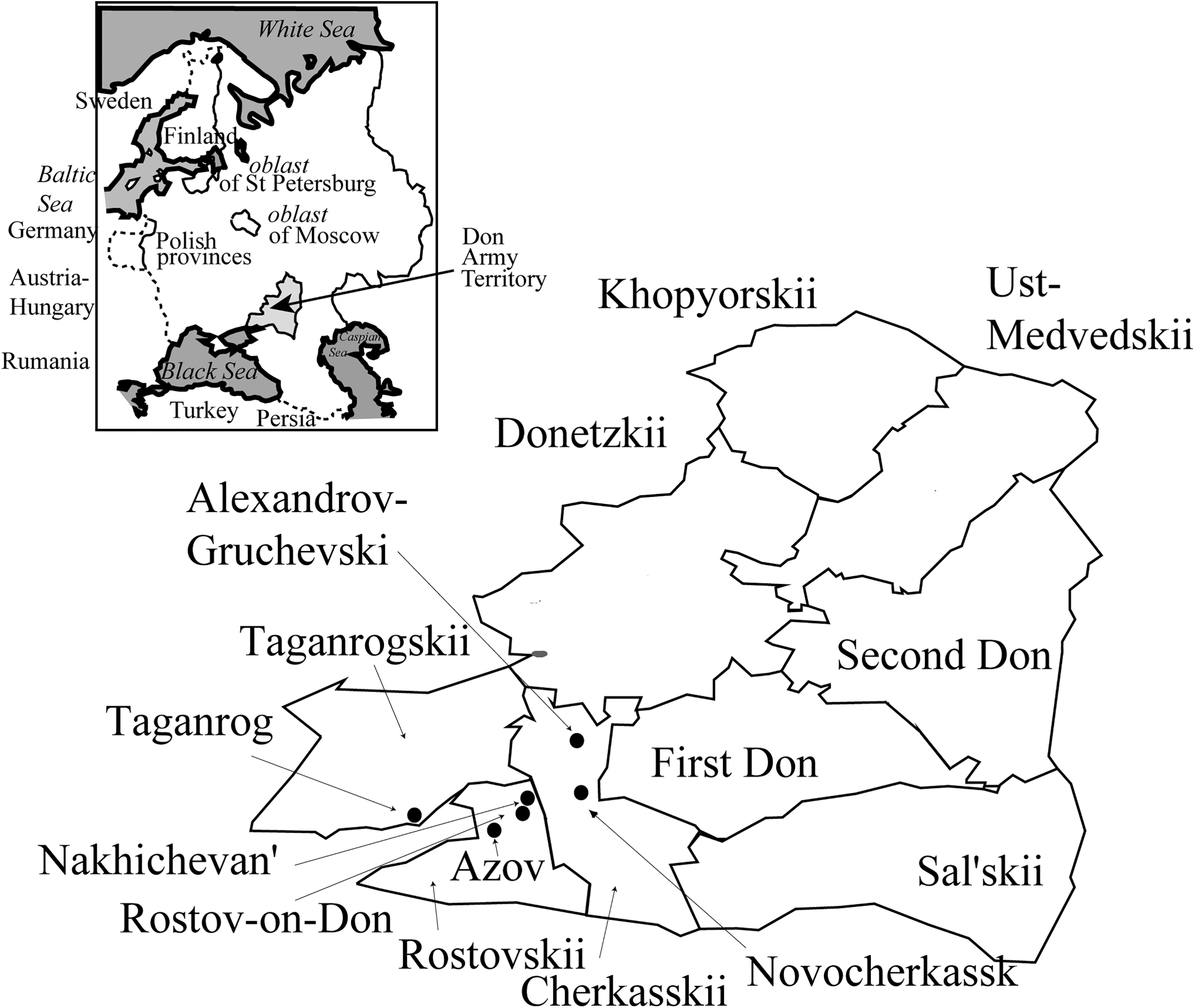
Cities and districts of the Don Territory in 1900. In the corner, the Don Army Territory (152,700 km2 ) in 1900 European Russia. Source: M. Gilbert, The Dent Atlas of Russian History (2nd edition, London 1993). Cities (indicated by dots) and districts of the Don Army Territory.
The quality and detail of its statistics, notably marriage time-series by religion, district, and age of the spouses that begins in 1867 and ends at the 1917 Revolution allows the comparison of the economics and demographics of marriage across almost all denominations present in the Tsarist Empire. Marriages, deaths by age, births, and population counts were recorded by the Statistical Committee until the law of December 18, 1917, when the Soviet state took over. 18 The population reconstruction 19 by marital status is based on annual civil registration of deaths by age, births, marriages, and migrants, and the censuses of 1873 (which was conducted for the Don Army Territory only) and 1897, and this for each denomination-district. The initial age pyramid, fertility indices, migration rates, and life expectancies parameterizing Lederman life tables work as controls in a large-dimension stochastic minimization of the distance between reconstructed and recorded deaths by age, births, marriages, migrants, and censuses, where the dynamic is Lotka-McKendrick. We shall work with the reconstructed age distributions, where the fit for Lotka-McKendrick, by construction, corrects age heaping, if any, in the original data. The sensitivity analysis on simulated data shows satisfactory fit. 20 It allows for flawed or missing data, overcomes identifiability issues, and avoids replacing unknown quantities with assumed values. 21 It finally yields nuptiality rates by sex, denomination, district, and city, from 1867 for the earliest districts to 1916 for the latest. The detailed statistics of marriage between the civil status of bride and groom (both single, single and widowed, both widowed) allow for estimating rates of first nuptiality. 22 We do not have the room for detailing the reconstruction method, and it was done elsewhere at length. 23
During the period under consideration, the Don Army Territory was subdivided into districts (okrug) represented in Figure 1; the two districts of Rostovskii and Taganrogskii 24 were gained in 1888. Cities were identified in the 1897 census as Rostov-on-Don, Novocherkassk, Taganrog, Alexandrov-Gruchevski, and Nakhichevan’. 25 In rural areas, in addition to their own land allotments, which could be bought, sold, or transmitted by inheritance, Cossacks had proprietorial rights over all natural resources of their villages. 26 Most lived by working or letting their lands, but they could hold any position, including in the Church and commerce. The data we exploit cover all inhabitants, Cossacks and non-Cossacks, of the region. Cossacks were Orthodox, (Orthodox) Old Believers (and Coreligionists), or Buddhists, but we also consider non-Cossack Orthodox, and also exploit data on Jews, Catholics, Lutherans, Armenian-Gregorians, and Muslims, none of whom were Cossack.
Inter-Denominational Marriages
We do not have direct statistics on inter-denominational marriages. We do, however, have the distribution by district and sex from 1867 to 1916 of the numbers of conversions to Orthodoxy, without mention of age. These numbers give upper bounds of the numbers of conversions for marriage during the year of marriage. The ratios of these upper bounds to the numbers of marriageable by denomination for the whole Territory are very low: almost zero for Buddhists and Armenian-Gregorians, between 0.3% and 1.0% between 1891 and 1916 for Old Believers. The ratios of these upper bounds to the numbers of marriageable Orthodox range on average around 0.08% (maximum 1%) for men and 0.03% for women for Upper Don, nil for Lower Don, around 0.03% (maximum 0.5%) for men and 0.01% (maximum 0.2%) for women in cities. In any case, conversions are considered as migration in the reconstruction. Inter-denominational marriages therefore do not affect the calculation of marriage indicators.
Descriptive Analysis
To situate, Table 1 provides an overview of the diversity of nuptiality indicators by denomination-district around the year 1900. Coale
33
indicated
Nuptiality indicators in the Don Army Territory, by district and religious denomination, around 1900 (mean 1897–1903).
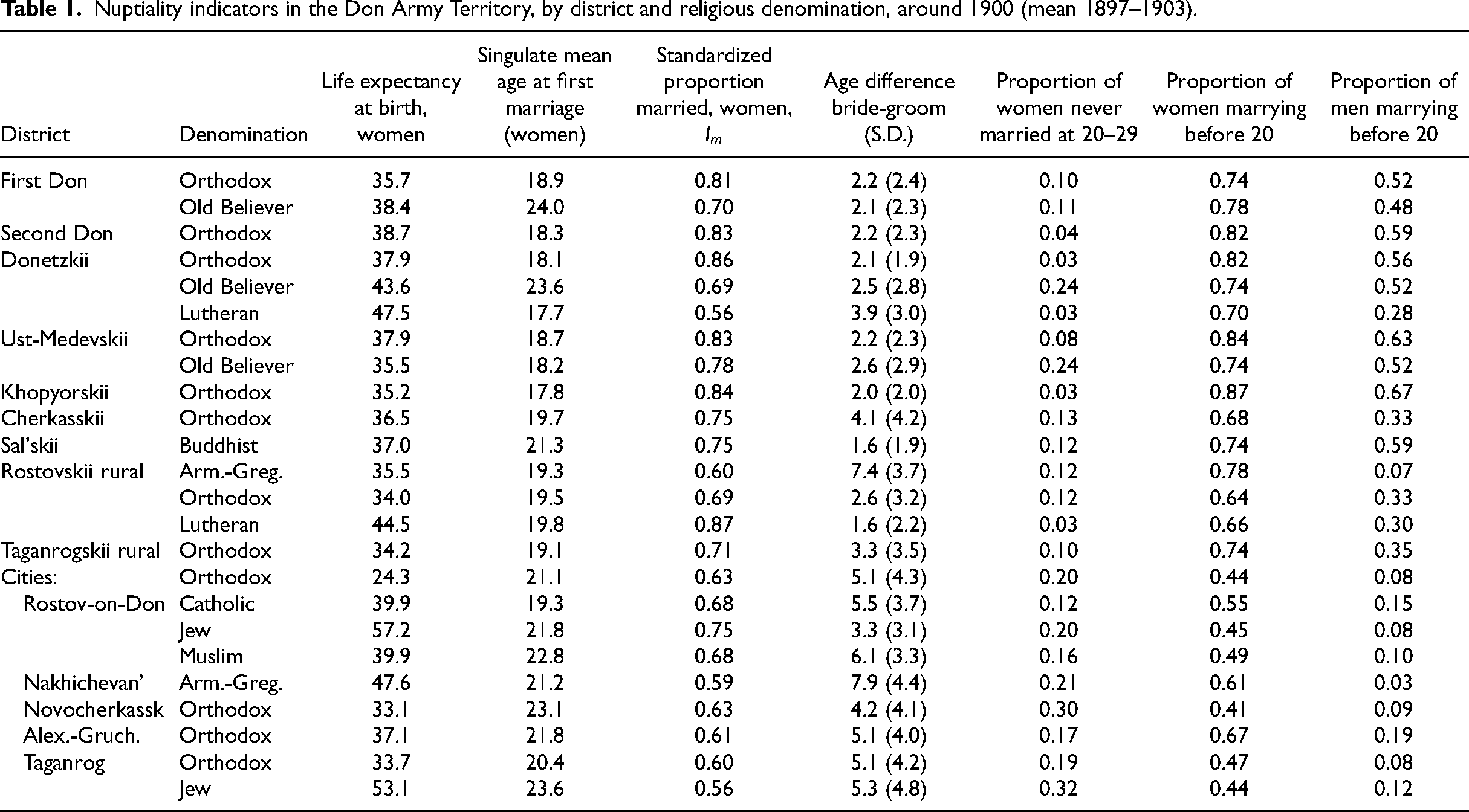
The column on the female life expectancy at birth gives a hint at mortality conditions and its variations across denominations: rural Lutherans and Jews had a life expectancy at birth substantially higher than other denominations; Orthodox and Old Believers had the lowest. Table 1 shows that women substantially married younger in the upper Don (districts of First and Second Don, Ust-Medevskii, Khopyorskii, Donetzkii) than in the rural lower Don (Cherkasskii, Taganrogskii, Rostovskii, Sal'skii) and in cities.
Figure 2 presents the times series of the SMAM, Figure 3 the proportion of women never married between 20 and 29, Figure 4 those of
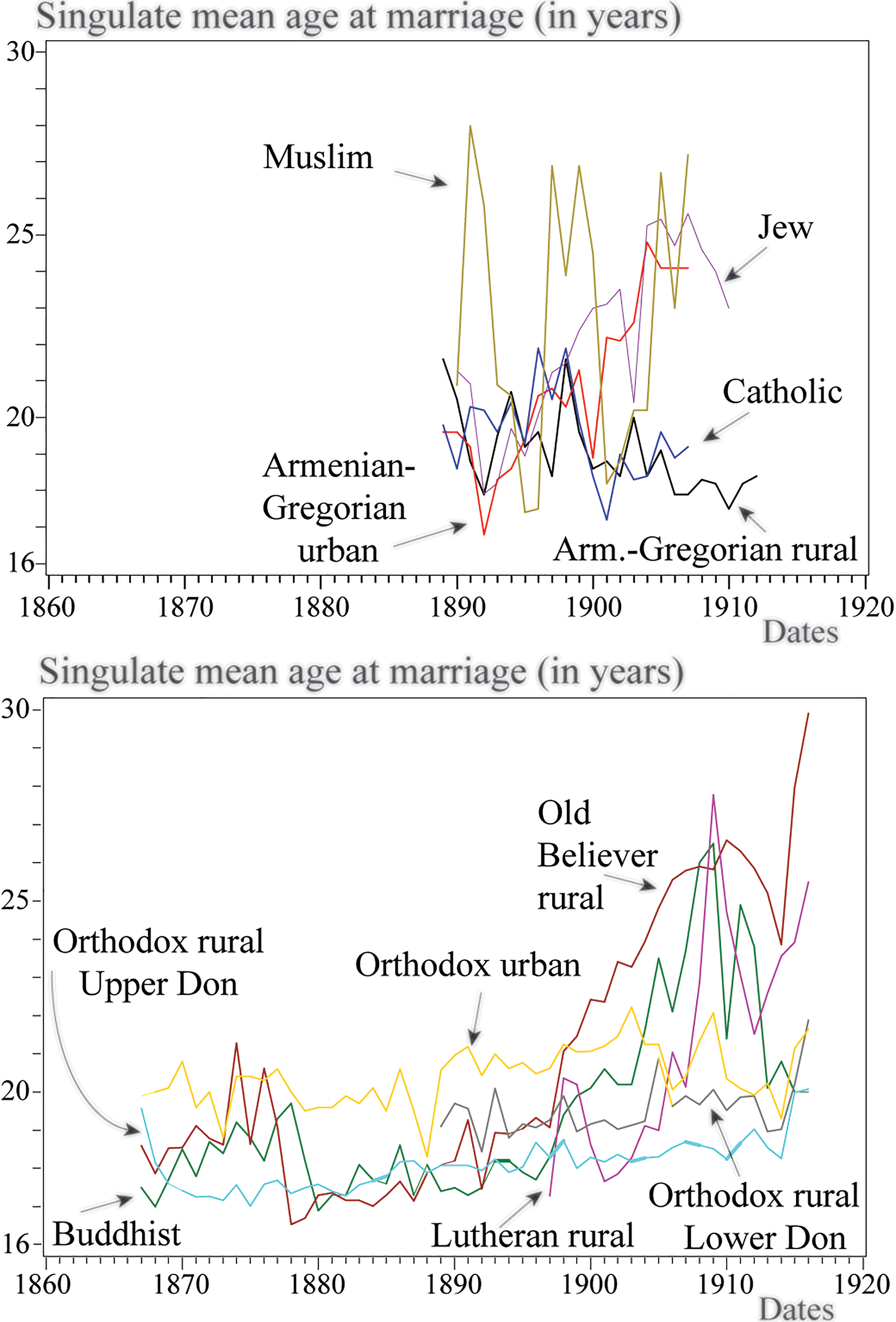
Women's singulate mean age at first marriage, in years, by residence-denomination in the Don Army Territory.
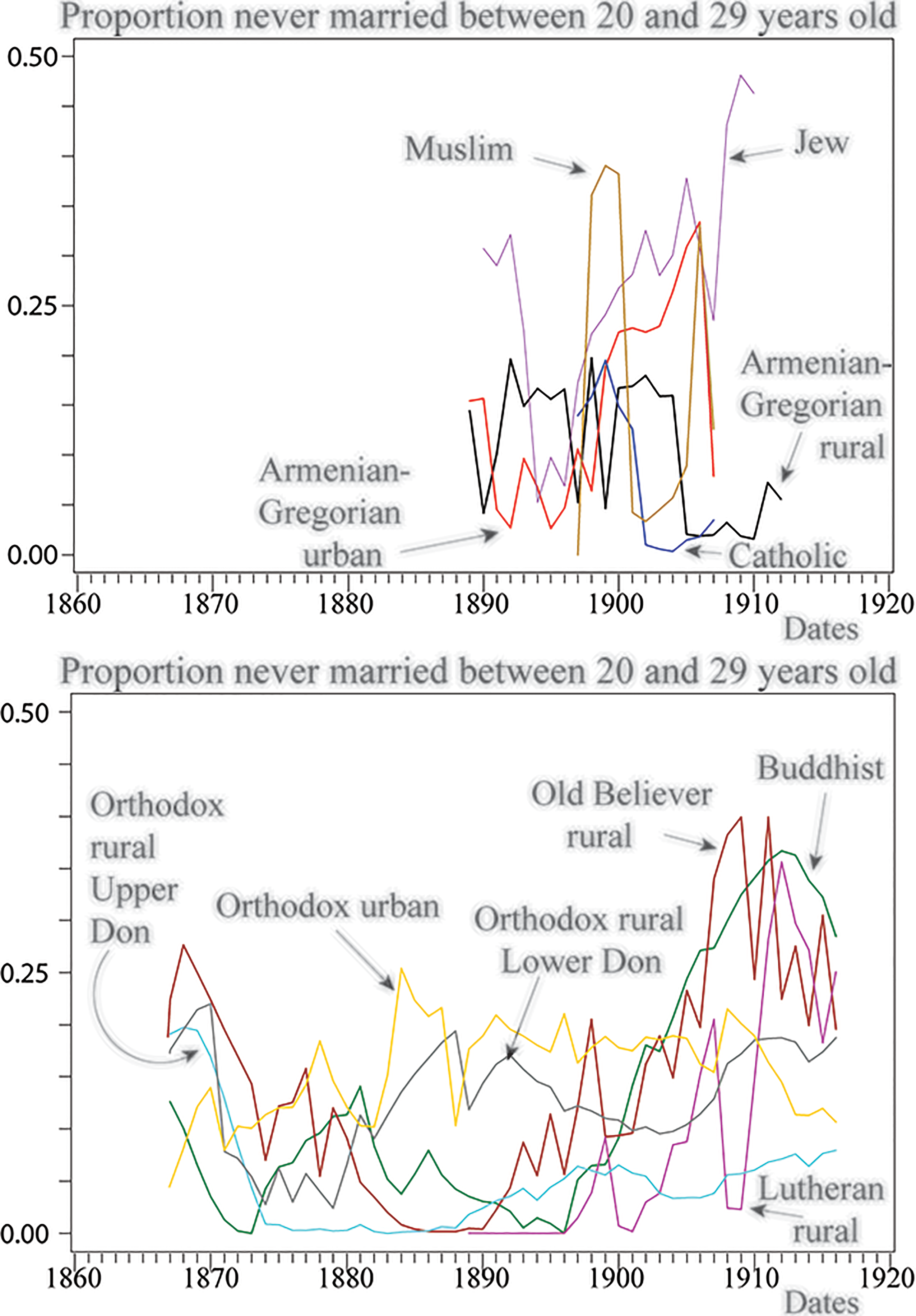
Proportion of never married women between 20 and 29 by residence-denomination in the Don Army Territory.
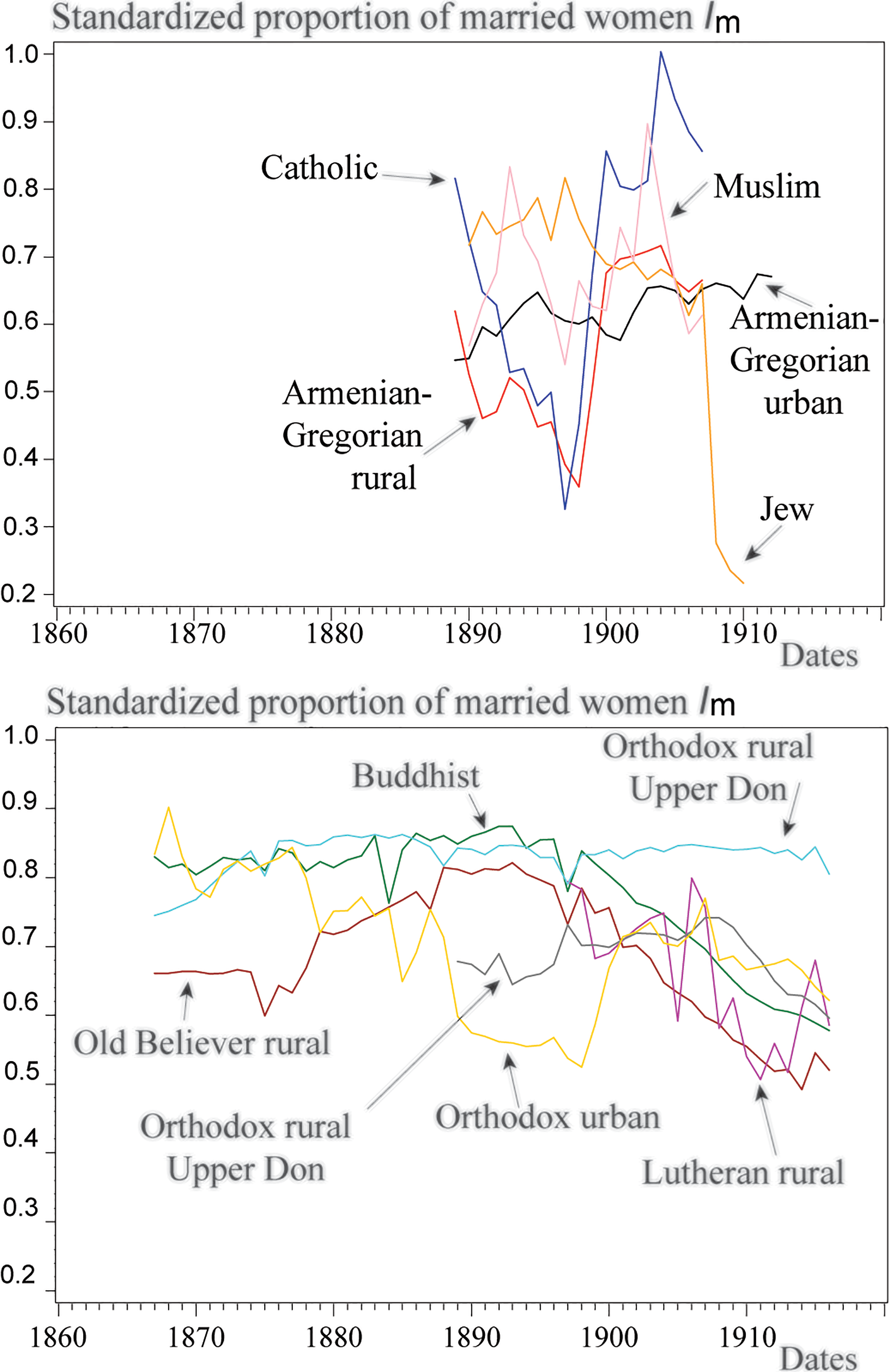
Standardized proportion married
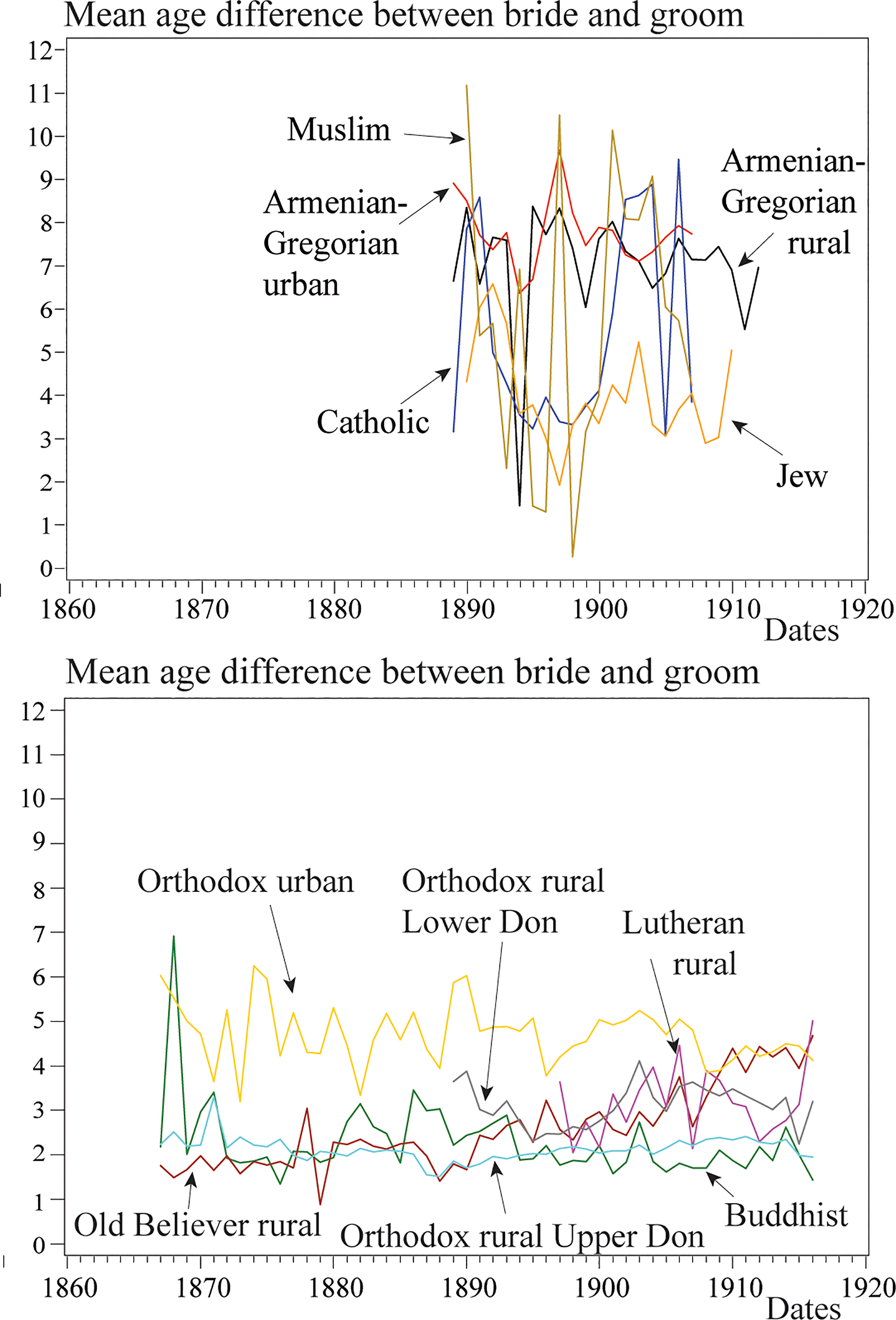
Mean age difference in years between bride and groom by residence-denomination in the Don Army Territory.
Orthodox and Old Believers The SMAM for Orthodox in the Don Army Territory over the period 1897–1903 is closer (18.6 years for rural Orthodox, 21.5 for urban Orthodox) to the levels of White Russia (22.7), Ukraine (20.8), 36 and in the Balkans (20.3 years in Romania, 20.8 in Bulgaria, 20.1 in Serbia) 37 than to those for England (26.2) or Sweden (27.5) 38 around 1900. Likewise, the proportions never married at 20–29 years of age are at the level of Bulgaria (0.14), Romania (0.14), and Serbia (0.09) (not computed for White Russia and Ukraine), in contrast to 0.67 in England and 0.58 in Sweden 39 . Orthodox then tended to marry early, 40 as it has been estimated elsewhere in Russia at that period, for example in Ekaterinburg over the period 1907–1919, where the majority of a sample of 285 men and women married at the age of 19. 41 Until 1894, Old Believer men did marry slightly younger (4 months on average) than Orthodox, but the age difference between bride and groom was smaller for Old Believers than for Orthodox, so that Old Believer women married at the same age as Orthodox women. After 1894, Old Believer men married slightly older (7 months on average) than Orthodox men and women only 3 months older than Orthodox women. Table 1 and Figure 5 also show that Old Believers and Orthodox in rural areas had approximately the same small age difference between bride and groom before 1894 (when Nicolas II came to the throne). Orthodox city-dwellers married later and had larger age differences between partners (Table 1). The dispersion around the SMAM (measured by the standard deviation shown in parentheses in Table 1) was also larger in cities. The proportions of men and women marrying under 20 are also consistent with the age difference of 4–6 years for urban Orthodox men, who married later than rural Orthodox, rural Old Believers, and rural Buddhists, for whom the age difference was closer to 2 years. The variance was comparatively high for urban Orthodox, which is consistent with continuous immigration of Orthodox from rural districts.
Buddhists Early marriage concerned Buddhists, who were authorized to practice polygamy, although we have no data on how much it was practiced. Most Buddhists lived as nomads in the steppes of the district of Sal'skii. They were 14,392 men and 13,651 women at the 1897 census. After the year 1853, some began growing corn and vegetables. Table 1 and Figures 2 to 5 show that Buddhist men were like rural Orthodox in having early marriage and the age difference between bride and groom of around 1 year. An exception is the high value of the SMAM from 1898 to 1912. The excessive rainfall followed by summer drought in 1898 ruined most of the Don Army Territory and Sal'skii in particular, 42 where this catastrophe, by reducing the resources available for marrying, may be behind the abrupt upturn in the SMAM after that date.
Lutherans Lutherans were most numerous in the district of Taganrogskii, but also in Dontezkii and rural Rostovskii (14,436 men and 13,870 women in the entire Territory at the 1897 census). They lived in their specific milieu marked by central European influences. 43 They married young around 1900 but age at marriage increased rapidly after that date (Figure 2), as did age difference between bride and groom from 2 to 4 years (Figure 5).
Armenian-Gregorians (13,896 men and 13,222 women in the whole Don Army Territory at the 1897 census) resided either in rural Rostovskii, occupied primarily with grain culture, sheep breeding, and limited amounts of sericulture and viticulture, or in the city of Nakhichevan’, where they specialized in commerce (mainly of agricultural products including timber, hides, and skins, as well as bricks and sheet glass). Rural women married as early as rural Orthodox (Figure 2), though the age difference between bride and groom was larger for both rural and urban (Figure 5).
Catholics Contrasts along denominational lines persisted among city-dwellers. For Catholics, the age difference between bride and groom fluctuated between 1 and 8 years, perhaps because of the relatively small numbers involved (1,068 men, 768 women in Rostov-on-Don at the 1897 census). Roman Catholicism was relatively tolerant toward spousal age differences. 44 The Catholics for the whole Territory included Germans, but for Rostov-on-Don, which is the only geographical entity for which the data are of sufficient quality to allow reconstruction, the Catholics were mainly Poles. 45
Jews were 7,852 men and 8,126 women at the 1897 census, of whom 5,771 and 6,012 women were in Rostov-on-Don. They formed a community closed in upon itself, 46 whose culture and daily life were deeply imbued with religion. They still married early and maintained a 3–4 year age difference between bride and groom. Schellekens 47 found that early marriage was common among Ashkenazi Jews in Eastern Europe in the seventeenth and early eighteenth centuries on religious grounds (“early marriage was seen as a means to prevent the sin of premarital sex”). Livi-Bacci 48 saw Jews as the “forerunners” during the decline in marital fertility, though Schellekens, 49 studying Amsterdam in the period 1625–1724, contested such a role for Jews in the transition from early and universal marriage to the “West European” pattern of late marriage and high levels of permanent celibacy. For Jews, too, Figures 2 to 5 show that the years 1890–1910 capture the moment of nuptiality transition. The strikes and riots in Rostov-on-Don from 1902 up to the 1905 Revolution were contemporaneous with the onset of the transition, a parallelism that suggests political events had a role in triggering the emergence of a new pattern, one perhaps already latent but hitherto held in check by tradition.
Muslims Muslims were 928 men and 372 women in Rostov-on-Don at the 1897 census. The 1897 census also provides the distribution of languages crossed with the districts indicates that Tatar was the most spoken language in Rostov-on-Don after Russian, Yiddish, German, and Polish, and much more spoken than many other languages. These Muslims were thus probably Muslim Tatars. As was the case for Catholics, the large fluctuations in the time series in Figures 2 to 5 are due partly to the small number of available women. The scarcity of women may have been exacerbated by the practice of polygamy. 50 For Muslims in seventeenth-century Amsterdam, Schellekens and Eisenbach 51 referred to the “nature of familial relationships and the segregated roles of women” and to the “traditional Muslim family considered to be strongly patrilineal and patrilocal, with male dominance and responsibility prescribed by the Quran.” Such attitudes are scarcely conducive to marital transition. Early marriage of women was maintained by the fact that parents were “especially anxious for their daughters to marry young” so as to preserve pre-marital chastity because “honor and esteem depend largely on the sexual conduct of women in the household.” 52
Overall then, Figures 2 to 5 show that not all groups were involved in the transition toward late marriage (Catholics in Rostov-on-Don and rural Armenians-Gregorians kept marrying early). The transition was slow for Orthodox, and the three Orthodox groups were at different levels. The other groups, some urban like Jews or Armenian-Gregorians, some rural like Buddhists, Lutherans, and Old Believers, embraced the transition quickly after 1894.
Determinants
Resources: Marriage was directly related to available resources. For Cossacks (who were Orthodox, Old Believers, or Buddhists), weddings cost “between 50 and 100 roubles more than the yearly surplus produced by the average Cossack farm.” 53 The classical argument is that improved survival of parents and siblings created a shortage of resources that pushed back the date for new family formation. 54
In the Model section below, we show why the first differences of the SMAM,
We estimate the total number of first-time marriageable persons as the sum of first-time married of the year and the total number of singles in a range of years around age at first marriage for each sex. The estimation of Eq. (4) below gives the largest total number of significant coefficients for
Grain price: Grain price can play a direct role by modifying people's capacity to pay for a wedding and start a new household. The fluctuations in the price of barley and oats on the market of Rostov-on-Don 56 are close to those plotted by Mironov 57 for Russia as a whole. The short-term fluctuations in the time series of the prices of barley, rye, wheat, buckwheat, and oats are strongly correlated with each other (correlations range between 0.69 and 0.86).
Steel price: Metal industry constituted another source of employment and salaries, but it did not develop until 1900, following the establishment of metallurgy at Taganrog in 1896 and the Sulinovsky metallurgy factory in Cherkasskii in 1900. In 1894, the Don produced 24.3% of Russian coal but less than 1% of Russian charcoal and 1.1% of steel. 58 The fluctuations in the price of charcoal and steel would thus be of secondary importance as a determinant of marriage behavior for the Don populations, the great majority of whom relied on agriculture, crafts, and commerce for their livelihood.
Land price: Peasants (mostly Orthodox but non-Cossacks) had to pay for the land allotments they had received after the abolition of serfdom in 1861. The level of redemption payments varied greatly between districts, due to the different proportions of peasants and the different conditions under which land allotments were made. As stipulated in the edict of 19 February 1861, for noble-owned serfs, and “for the remainder of the peasant population in 1863 and 1866, the peasants were to ‘redeem’ the land by repaying the government in instalments spread over a term of 49 years.” 59 Our data show that indeed redemption payments ended in 1910 for all districts. Redemption payments could cover many unobservable differences in land quality or about the prevalence of serfdom.
Literacy could be a key variable for explaining changes in marriage behavior, notably because people who could read and write were more likely to move to cities where couples married older. Unlike rural agricultural jobs, most city jobs required the ability to read and write.
60
No time series evidence is available, but the proportions able to read and write increased rapidly for all districts between the 1873 census and that of 1897: typically for the rural Don, in the First Don for example, the proportion for the 7–15 old increased from 3% to 18% for girls and from 13.5% to 41.8% for boys. For the 16 years old and over, these increases were from 2.1% to 9.4% and from 23.3% to 53.3%. In Rostov-on-Don at the 1897 census, for the 7–15 old, 52.4% of girls and 68.9% of boys could read and write. These proportions were 34.3% and 66.0% for the 16 years old and over. Literacy was higher among men than among women, one reason being that men benefited from the great army reform of 1874, which cut the length of military service from 25 to 6 years and offered considerable further reductions for those who had received education before beginning their service.
61
Although simple correlations between variables which are distributed spatially and temporally may be misleading, because of temporal and spatial correlations, and although we do not have literacy data by denomination, the correlations between the SMAM,
Spatial heterogeneity: The follow-up of the SMAM,
Vector Autoregressive Regression
First-differences of nuptiality indicators are approximately linear to those of grain price and numbers of marriageable We treat denominations-ensembles rather than districts because the correlation matrices are smaller and more readable. The SMAM avoids the age structure effect, but the age-specific rates that comprise it are still dependent on the marriage market of the current year, through age preferences between men and women. In two-sided matching theory,
62
the total number of marriages 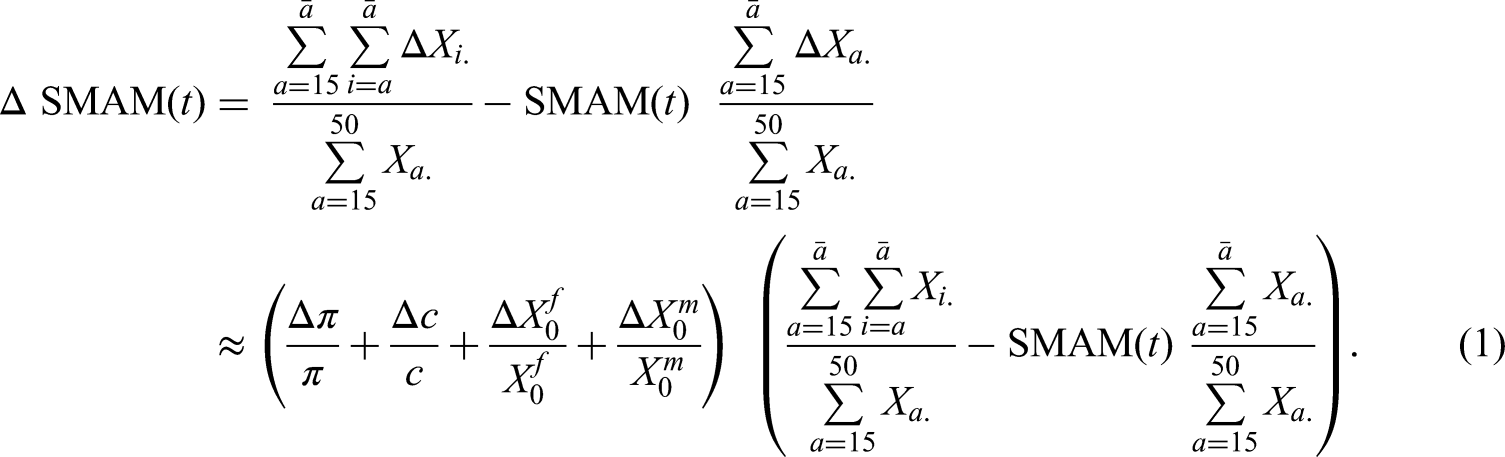
Standardized proportion of married women Likewise, from the count of the dead and the newly married, the total number of married women changes with the probability of dying 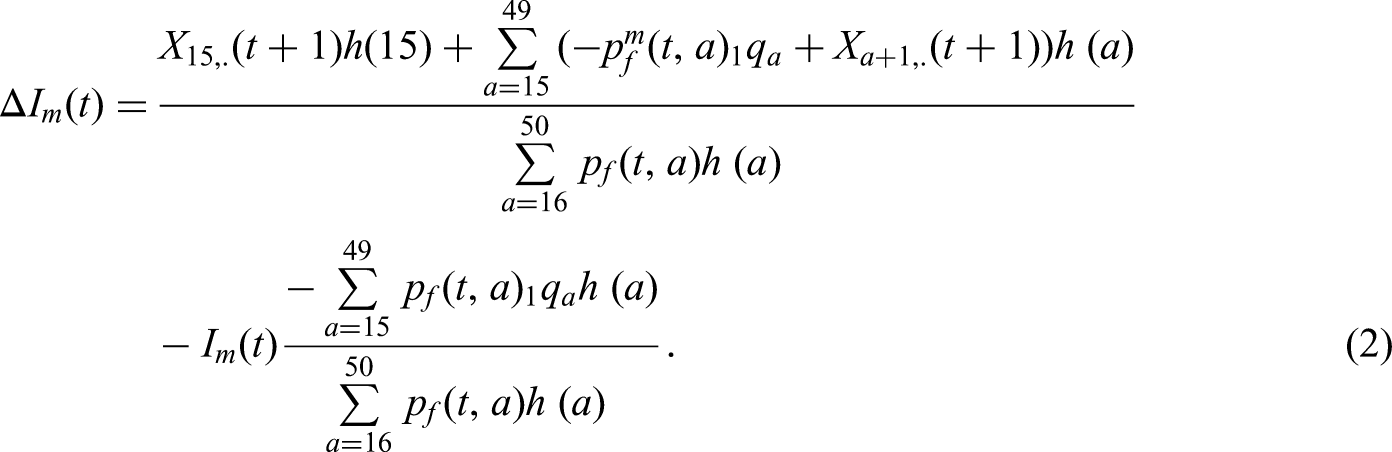
Proportion of never-married women 20 to 29 Formally, the proportion of never married women between 20 and 29 years of age is obtained from the formula of
Age difference at marriage With 
Geographical-Denominational Covariations, Controlling for the Marriage Market and Grain Price
This incursion into the mechanisms underlying the indicators of nuptiality allows us to formulate, test, and validate the multivariate vector auto-regressive (VAR) model:
The time-series are not of the same length (Rostov-on-Don containing a large mix of denominations was appended only in 1888, and statistics before that date are not available). We distinguish two periods to estimate Eq. (4): 1867–1889 for the (rural) Upper Don Orthodox, urban Orthodox, rural Old Believers, and Buddhists (results in Table 2), then again these groups for the period 1889–1916 to which we add (rural) Lower Don Orthodox (results in Table 3). The two periods are approximately of equal length and long enough to allow econometric estimation. We then re-estimate Eq. (4) with rural Armenians-Gregorians over 1889–1912 (Table 3), making sure that the coefficients for the previous groups have not changed substantially. And so on until all groups are considered. To each of these tables and for each dependent variable corresponds a correlation matrix (Tables 4 to 7).
Seemingly unrelated regressions (by group), 1867–1889: N = 23 years × 4 groups. Standard deviations in parentheses. All variables are first-differenced.
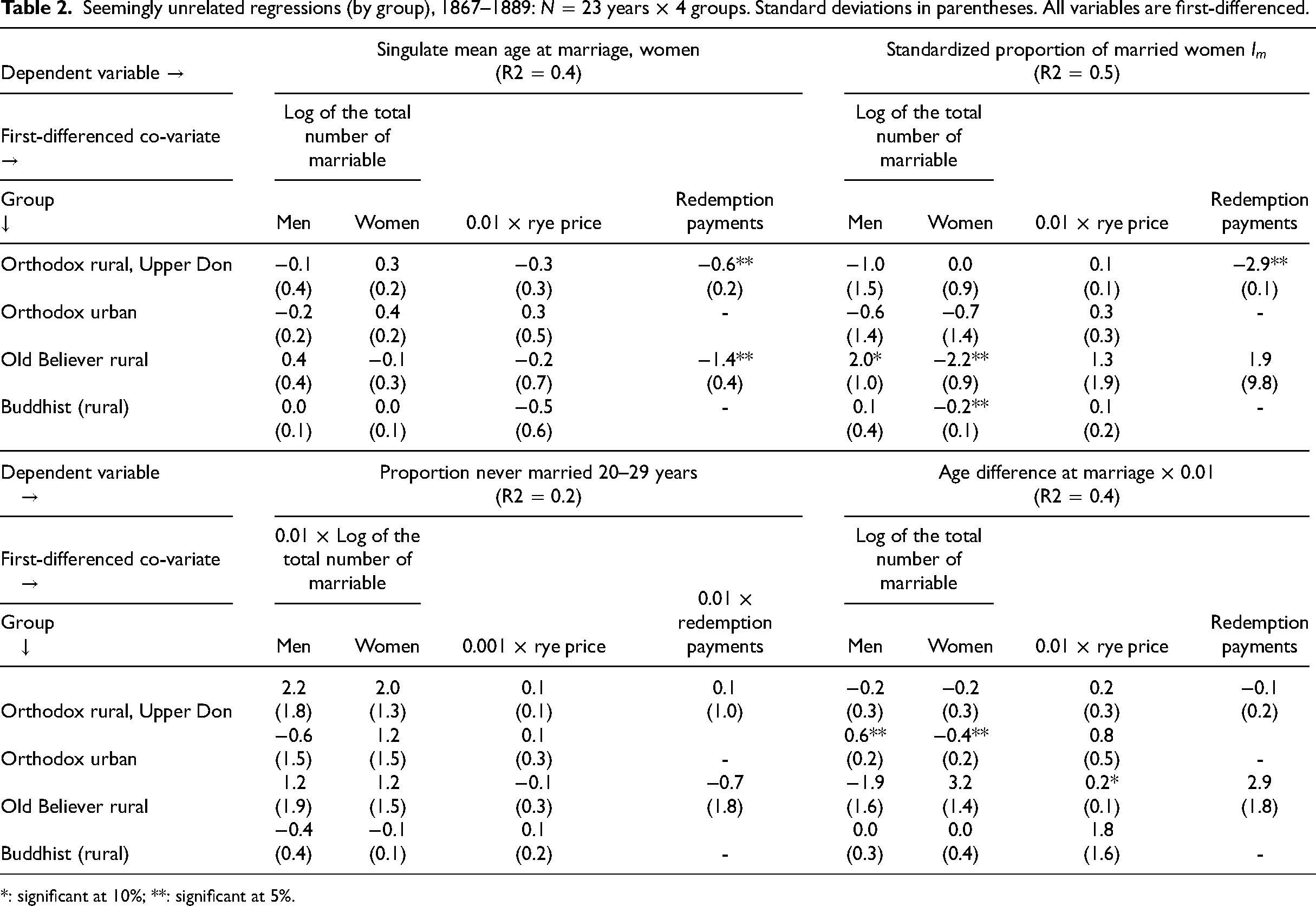
*: significant at 10%; **: significant at 5%.
Seemingly unrelated regressions (by group), 1889–1916: N = number of group-years. Standard deviations in parentheses. All variables are first-differenced.
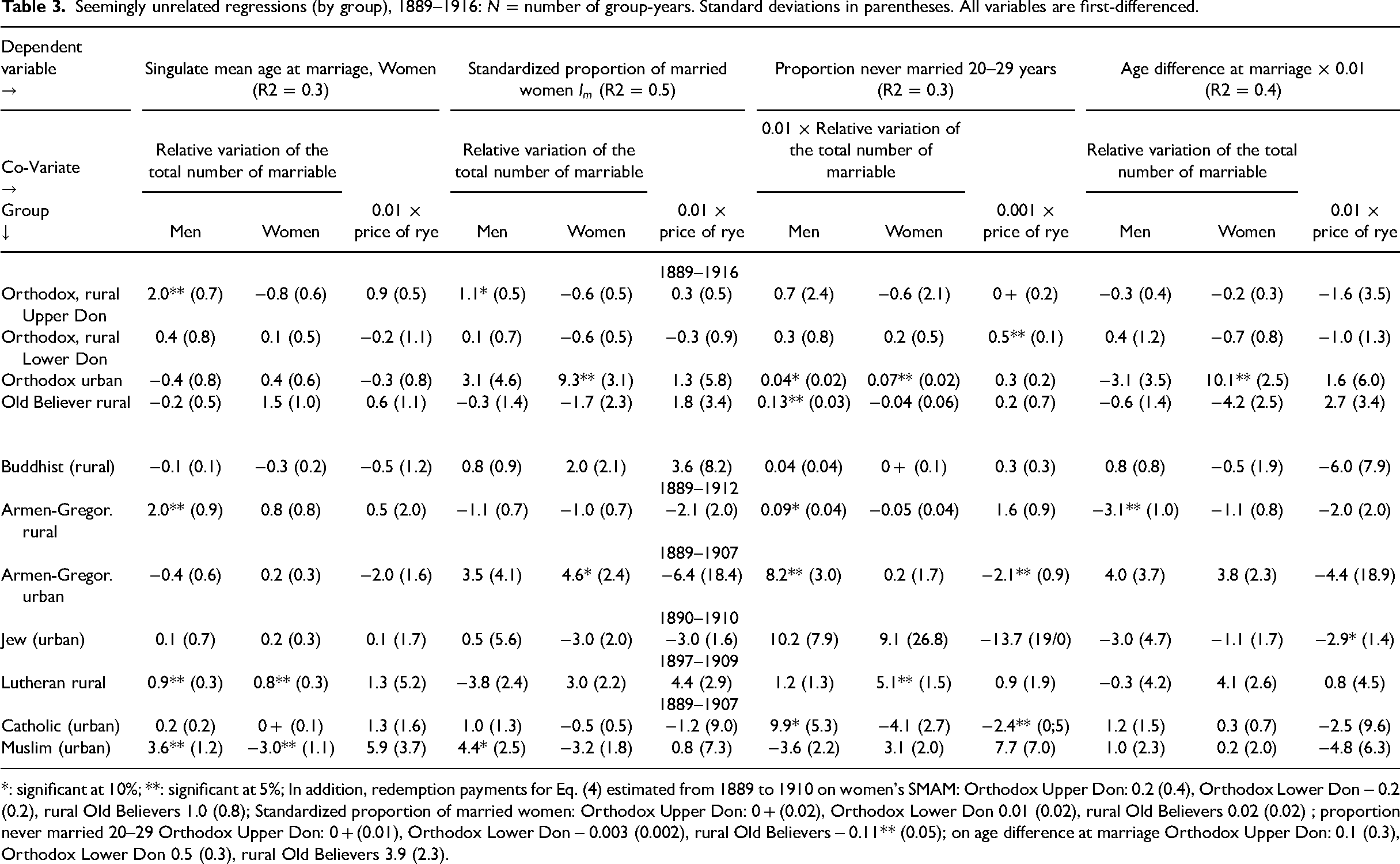
*: significant at 10%; **: significant at 5%; In addition, redemption payments for Eq. (4) estimated from 1889 to 1910 on women's SMAM: Orthodox Upper Don: 0.2 (0.4), Orthodox Lower Don − 0.2 (0.2), rural Old Believers 1.0 (0.8); Standardized proportion of married women: Orthodox Upper Don: 0 + (0.02), Orthodox Lower Don 0.01 (0.02), rural Old Believers 0.02 (0.02) ; proportion never married 20–29 Orthodox Upper Don: 0 + (0.01), Orthodox Lower Don − 0.003 (0.002), rural Old Believers − 0.11** (0.05); on age difference at marriage Orthodox Upper Don: 0.1 (0.3), Orthodox Lower Don 0.5 (0.3), rural Old Believers 3.9 (2.3).
Therefore elasticity differences can be compared between groups, with tests performed between the coefficients calculated for each system (e.g., the comparison between Buddhists and Catholics is performed for the system estimated for the period 1889–1907).
Results
The estimation of (4) yielded no significant coefficient associated with 1-year lagged variables; so we re-estimated (4) without lagged variables and present the results in Tables 2 and 3.
Debt constraints For the period 1867 to 1889 (Table 2), more redemption payments are associated with younger age at marriage among rural Upper Don Orthodox and Old Believers (coefficients − 0.6, − 1.4 for the SMAM) and less contribution to marital fertility (− 2.9 for Upper Don Orthodox for
Grain price For the period 1867–1889, we find no significant coefficient of grain price. For the period 1889–1916, as we include Lower Don Orthodox and urban groups, an increase in grain price increases the proportion never married between 20 and 29 (coefficient 0.5) among Lower Don Orthodox, which is consistent with the cost of marriage, and decreases this proportion among urban Catholics and urban Armenian-Gregorians (− 2.1 and − 2.4), which is consistent with the fact that these groups lived from trade. However, for the SMAM,
The marriage market For the period 1867–1889 (Table 2), consistently, the decrease in the total number of marriageable women for rural Old Believers and Buddhists increases
For the period 1889–1916 (Table 3), the SMAM increases with the total number of marriageable men for rural Upper Don Orthodox (coefficient 2.0), urban Armenian-Gregorians (2.0), rural Lutherans (0.9), and (urban) Muslims (3.6), but is not influenced by the total number of marriageable women, except for Lutherans (0.8) and Muslims (− 3.0). The former consecrated marriage after a period of living together (interview in 2013 with Lutheran pastor Jacques-Noël Pérès, from the Faculté théologique of Paris) and the latter practiced polygamy. More marriageable men are associated with a higher proportion of never-married people between the ages of 20 and 29 among Catholics, rural and urban Armenian-Gregorians, rural Old Believers, and urban Orthodox: the causality that makes sense is that more unmarried women aged 20–29 left more unmarried men and thus more marriageable men. The groups concerned by significant coefficients in Table 3 are also groups where women were relatively rare. This is not the case with rural Orthodox or Jews, for which the coefficients, consistently, are not significant. This mechanism applies to rural Lutheran and urban Orthodox women. The former case does not concern a group with scarcity of women and the latter case may reflect the delay in the integration of migrant women into the urban milieu. The age difference between bride and groom increases with the total number of marriageable women for Urban Orthodox (coefficient 10.1 in Table 3), as women migrated at least as old as men. The other groups did not suffer as much from a chronic deficit of women and no effect is significant on the age difference.
Co-variation between denominations The correlation matrices
Discussion
Orthodox: The Alliance of Church and Tradition Tested by Economy, Demography, and Ecology
While Upper Don Orthodox perpetuated early marriage (brides aged 17–18), conceding over the years a slight upward trend, urban Orthodox adopted a slightly later marriage (20 years until 1889, 22 years after) and Lower Don Orthodox (19 years until 1889, 20 years after) fell between these two models. Figures 2 to 5 showed that all Orthodox groups are distinct from other denominational groups, even (rural) Buddhists and rural Old Believers, who might have been thought to be close by virtue of their rurality and their participation in the irregular army as Cossacks.
This situation is consistent with five keys to reading: economic, demographic, and ecological, which go in the direction of postponing age of marriage; politico-religious and traditional, which push toward early age.
Economic: In the countryside, the rule of periodic division of peasant land encouraged newlyweds to form a new production unit, eligible for its own share of land: pressure for early marriage and thus for more labor units came equally from the landlord, the peasant family, and the commune. 64 This steppe-specific possibility distinguished the Don Army Territory from Western European societies, where the selection of a single heir often put younger brothers at higher risk of celibacy. 65 In proto-industrialization theory, 66 resource constraints forced young men to delay marriage until they had accumulated sufficient capital, a theory that was to be modulated by the place of residence after marriage. 67 In the Don Army territory, according to this theory, if resources remained abundant, the availability of accessible and profitable land made it possible to persist in early marriage. In addition, our econometric analysis showed that short-term fluctuations did not respond much to that of grain price, which rules out homeostatic regulation of marriage by grain price. Until 1889 however, fluctuations in redemption payments were related to those in age at marriage, in the expected sense that a delay in payment accompanied a delay in marriage.
Demographic: The downward trend in mortality from the mid-1880s onward,
68
without a simultaneous associated decline in fertility, tended to result in a relative excess of marriageable women, because they had comparatively lived through better mortality conditions, as they married younger than men. If families made an effort to marry off their daughters, then the oldest marriageable women (but still very young) could be preferred, which delayed age at marriage by that much. The process continued as long as mortality declined and fertility did not compensate for it to decrease the total number of births. Also, a chronic increase in the total number of marriageable women led to a decrease in
In addition, a sustained increase in the total number of young people led to a greater financial demand on the part of parents to support more surviving children. Then there was the need to equip young men for military service, since the 1875 law required Cossacks to pay for their own equipment. It was necessary to finance weddings, which were very expensive social events for families, amounting to 1 year's income. 69
Ecological: The increasing total number of households resulting from the maintenance of early marriage among Orthodox favored the ecological crisis, the reasons for which lie in the absence of a mechanism for preserving the communal system that allowed free and equal access to natural resources. This crisis worsened in the second half of the nineteenth century. 70
Political-religious and traditional: We have mentioned the role of marriage as a factor of social recognition in villages. This role was encouraged by the Russification campaign launched by Alexander III and continued by Nicholas II, through which Orthodox priests strengthened their control over the population and encouraged religious observance, tradition, and allegiance to the tsar (we are not saying that they “regulated” age at marriage, but note that early age of marriage was not likely to increase if tradition and conservatism were advocated). The persistence of early marriage in Figures 2 to 5 is consistent with the effectiveness of this campaign in impeding the adoption of late marriage among the Orthodox. This campaign intensified under Nicholas II beginning in 1894, while other groups were beginning their transition to late marriage. This favored the maintenance of
Urbanization as a Factor of Delaying Marriage for Orthodox
The growth of cities, industry, and commerce provided sources of income other than field work, especially with the resource crisis in the countryside, where good-quality land was becoming rarer. Migration to cities developed rapidly (for example, between 1889 and 1907, the average annual rate of population growth was 4.2% for Orthodox in Rostov-on-Don and 3.3% for Armenian-Gregorians in Nakhchivan’). Migrants to cities were more likely to be men than women (e.g., net migration of 3642 women to cities for 4921 men in 1885–1889). Immigrant women to cities were also at least as old as men: 23.3 years old for women, 23.5 for men from 1872 to 1895; these figures are 24.2 and 22.4 from 1896 and 1899; 25.4 and 24.2 from 1900 to 1916. As men usually married younger women (Figure 5), relatively older migrant women participated in delaying age of marriage. Cities also created an environment in which young men could take the time to find and court a partner, rather than being married off early by parents or matchmakers, as in the countryside. 71 In the Don countryside, the means of achieving independence and acquiring wealth or land in rural society was marriage; in cities, opportunities for wage labor brought the possibility of independence without immediate marriage. Life in city provided access to other forms of income for which early marriage was not a precondition. It thus challenged the traditional marriage system and the social norm that encouraged young people to establish independent households.
Toward Late Marriage among Urban Jews and Urban Armenian-Gregorians
For the other denominations, Figures 2 to 5 and Eq. (4) showed similarities in trajectories between (urban) Jews (residing in Rostov-on-Don) and urban Armenian-Gregorians (residing mostly in Nakhichevan’, which is a city adjacent to Rostov-on-Don), but the correlation between the residuals of the regression (4) for these two groups is not significant. Meanwhile, the correlation of 0.45 for the SMAM in Table 4 between residuals of (4) for urban Armenian-Gregorians and urban Orthodox may reflect the fact that these two groups had recently moved out of the countryside 72 and were likely to seek the same urban professional opportunities. In contrast, Jews for example had been confined to the cities for a long time and were inserted there, with more established relationships—we may speculate—conditioning the choice of spouses. Jews show similar trajectories to urban Armenian-Gregorians, too, but the correlation of short-term fluctuations is not significant. Thus, the transformation of the marriage pattern was not something mechanical or uniform: if the result was late marriage, the groups on the way could vary independently of one another or not.
In Rural Areas, Buddhists, Old Believers, and Lutherans Toward Later Marriage
However, late marriage from 1894 onwards was not confined to city dwellers, but was adapted by (rural) Old Believers and Buddhists, who might have been expected to be close to rural Orthodox, who still married early. Despite their relative geographical isolation in the southern steppes of Sal'skii and their Mongolian origin which distinguished them from other inhabitants of the Don Army Territory, Buddhists also undertook this movement towards later marriage with a SMAM increasing from 17 years in 1894 to 20 years in 1914 with a peak of 26 years in 1909. Even nomads had to face the increasing total number of women due to the decrease in mortality and its consequences on sex balance in the marriage market.
The social and geographical isolation of Old Believers and rural Lutherans was not enough to stop the drift towards late marriage. Old Believers could have been expected to be conservative because of their isolated way of living (since their rejection of the reform introduced by Patriarch Nikon in 1666–1667). They however adopted late marriage after 1894. The schism with the Orthodox preserved them from the authority of the Holy Synod, which worked for early marriage for Orthodox as part of the Russification campaign.
Lutherans, of German origin and language and residing in the hinterland of the city of Taganrog and allowed to reside in rural areas only since the 1870’s, may have been influenced by the westerner model of later marriage, if not by the city life in Taganrog. However, Lutherans were well isolated from other groups, making a point of self-sufficiency for their colonies in Russian territory, economically as well as culturally, educationally, or linguistically. 73
The persistence of early marriage among (urban) Catholics On the other hand, Catholics who lived mainly in Rostov-on-Don remained faithful to the early marriage model: city life alone thus does not explain the transition; religion interfered for this group as it did for urban Orthodox. The reason we proposed was that the Catholics of Rostov-on-Don were mostly Poles. In Taganrog, the Catholics also included Germans, but the data are not of sufficient quality to allow reconstruction. In Rostov-on-Don, in any case, the origin allied with religion succeeded in preventing the transition to late marriage.
Muslims Among Muslims, the large fluctuations between late and early marriage are based on small numbers, so it is difficult to say.
Divergence among Armenian-Gregorians
While urban Armenian-Gregorians married later, rural Armenian-Gregorians persisted in marrying early. Batiev and Sushchij 74 explained the divergence: while rural Armenian villages had become isolated, endogamous enclaves, Armenian-Gregorians residing in the city of Nakhichevan’ lost their language to Russian and chose Western education, mores, and clothing. Thus, a same denomination could be divided on the behavior of marriage.
The nuptiality transition is multiple The links between religion, residence, and economy are thus not simple. There is no mechanistic determination between marriage pattern, denomination, and residence. Each group was caught in a web of determinisms: The city should have favored late marriage because of the relative freedom of the formation of couples and the relative independence from parents; the countryside should have favored the tradition of early age; a single obedience should have standardized behavior. However, the case of the Don Army Territory, with its multiple denominations and groups, demonstrates that the pattern of marriage retained the imprint of history left by the choices of individuals and the struggles for influence. The case of urban Armenian-Gregorians is typical, where the choice of acculturation led them to follow the Westernizing trend, while their rural counterparts caught in communal isolation ignored the transition of nuptiality. In contrast, but also typical, urban and Lower Don Orthodox tended to delay age of marriage, against the directives of the Holy Synod, which tightened discipline. This was not so much a matter of religion as of the deliberate action of the archconservative K. P. Pobiedonostsev, Over Procurator of the Most Holy Synod of the Russian Orthodox Church. In office from 1880 to 1905, but keeping influence until 1917, he professed hatred of the industrial revolution and urban growth and supported a reactionary policy to counter the influence of Western-oriented liberal and secular ideas. 75 Assuming that the transition to late marriage was underway, agents could therefore accelerate the transition, as among urban Armenian-Gregorians, or slow it down against economic or ecological necessity, as among Orthodox.
Conclusion
It is fortunate to have in the same territory in the period of demographic transition eight denominational groups combining with the urban-rural contrast and different economic modes (agrarian, commercial, and industrial). The transition offers a rare moment when behaviors can be distinguished from each other, and helps point out situations of isolation or, on the contrary, covariations. The picture that we reveal shows less a mechanism, although late marriage settles durably before the first world war for many groups, urban as rural, than a place of struggles of influences between economic mode, urbanity, religion, westernization, and influence of neighbors. Urban lifestyle favored late marriage, as with Jews or urban Armenian-Gregorians, but not exclusively. Catholics were urban, but kept marrying early; Buddhists, Lutherans, Old Believers were rural, and even socially conservative and isolated, due to geography for the first, that they were German settlers for the second, to the schism having led to social ostracism for the third, but still moved toward late marriage. The Orthodox Church strengthened its control over the faithful—we do not say that it went as far as regulating age at marriage. In rural areas, the Orthodox Church found as an ally the rules of Cossack communities where weddings were an element of social cohesion. There, a drama was being played out, that of demographic growth sustained by the downward trend in mortality, coupled with the ecological crisis and the resulting shortage of quality land. The maintenance at all costs of early marriage, in the Cossack tradition, despite some emigration to the cities, precipitated the ecological crisis at the end of the nineteenth century. 76
The transition of nuptiality was therefore not linked to a single determinant; the determinants did not add up to each other, but reflected choices or political coercion for each group. The transition was played out within each group, and these groups were more or less linked to each other, mainly according to geographical criteria, but never strongly, and denominational groups behaved in relative isolation from the Orthodox, although this latter denomination constituted the numerical majority.
In the theory of minority group status, fear of acculturation and economic or political disadvantage encourages group preservation and a high birth rate. Minorities in the Don Army Territory were defined by their religious allegiances but also by their “ethnicity” (Jews, Lutherans (mainly Germans), Muslims, Armenian-Gregorians), language (Yiddish, Armenian, German), occupation (trade and industry versus agriculture), and by their experience of political persecution. The latter included the loss of churches for the Armenian-Gregorians from 1903; a settlement zone for Jews created in 1791 and a series of repressive policies, including 1882 (reduction of the settlement zone), 1887 (numerus clausus for Jewish children in secondary schools), 1891 (10,000 Jews expelled from Moscow), 1892 (exclusion of Jews from civil service positions), 1903 (pogrom in Kishinev) and 1905 (pogroms in Russia, including Rostov-on-Don), 1914–1917 (ban on Jews settling even temporarily in Cossack territories).
This segregation of minorities may have shaped attitudes toward marriage, contributing to the formation of distinct identities. One might think that the struggle for minority survival would encourage early marriage from a pro-natalist perspective, a corollary of nationalism. This is not what we observe for Jews, Lutherans, urban Armenian Gregorians, even rural Old Believers, and to a lesser extent Buddhists: on the contrary, for these minorities, the decline of mortality was associated with later marriage and subsequently lower overall fertility. For non-Orthodox groups, late marriage as a strategy to avoid the burden of large families was comparable to that observed in the Western demographic transition underway since at least the mid-nineteenth century.
The disparity in marriage behavior after 1894 split society between and within denominations or drew connections (between urban Armenian-Gregorians and urban Orthodox for example). The interest of this case study is to clarify the contrasts within the same denominations, the coexistence of different denominations within the same cities, and to relativize situations of social or geographical isolation. This could not have been done without the reconstruction by district-denomination over a fairly long period, when the data for the other regions of Russia are often based solely on the census of 1897, incapable by construction of revealing temporal follow-up. This could not have been done either without the seemingly unrelated regressions that preserved the specificity of each group over time while taking into account and quantifying covariation.
The nuptiality transition finally was not an unequivocal matter where the same causes produce the same effects: the proximity of residence or denomination was not mechanical but only created a structure indicating the direction of the marriage model adapted to the economy of the moment. Within this temporal structure, the coercion imposed by a politico-religious authority or the force of conservatism could still thwart the movement. On the contrary, the flight forward to the model of late marriage, sometimes at the cost of acculturation, could accelerate it. The transition of nuptiality put in play religion and economy. Thus a social question concerning the intimate revealed the opposition between Westernization and conservatism, which, in the Orthodox case at least, took nationalistic tints (through Russification).
Correlation matrix for the singulate mean age at first marriage in Eq. (4) and Table 3. Each correlation refers to the longest common period within 1889–1916 of the reconstructed SMAM.
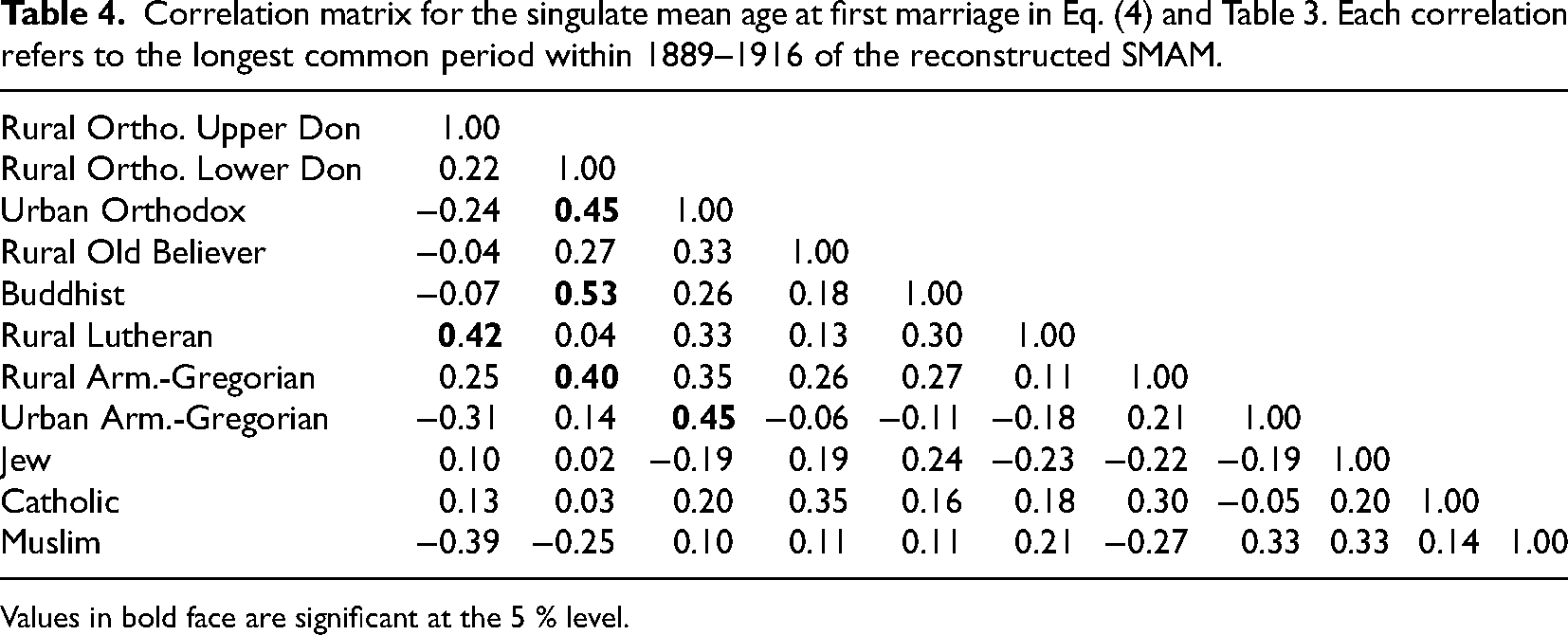
Values in bold face are significant at the 5 % level.
Correlation matrix for the proportion of never married women 20–29 (Eq. (4) and Table 2). Each correlation refers to the longest common period of the reconstructed proportion.
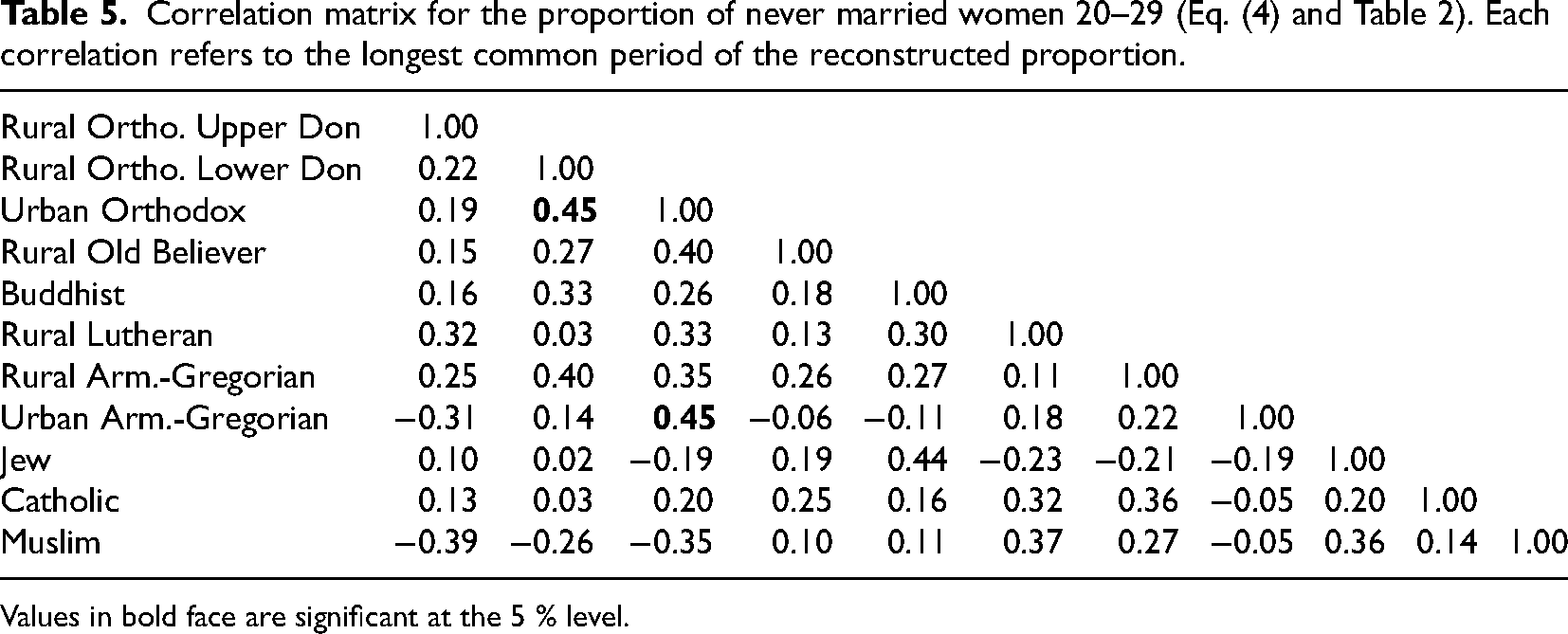
Values in bold face are significant at the 5 % level.
Correlation matrix for the standardized proportion of married women
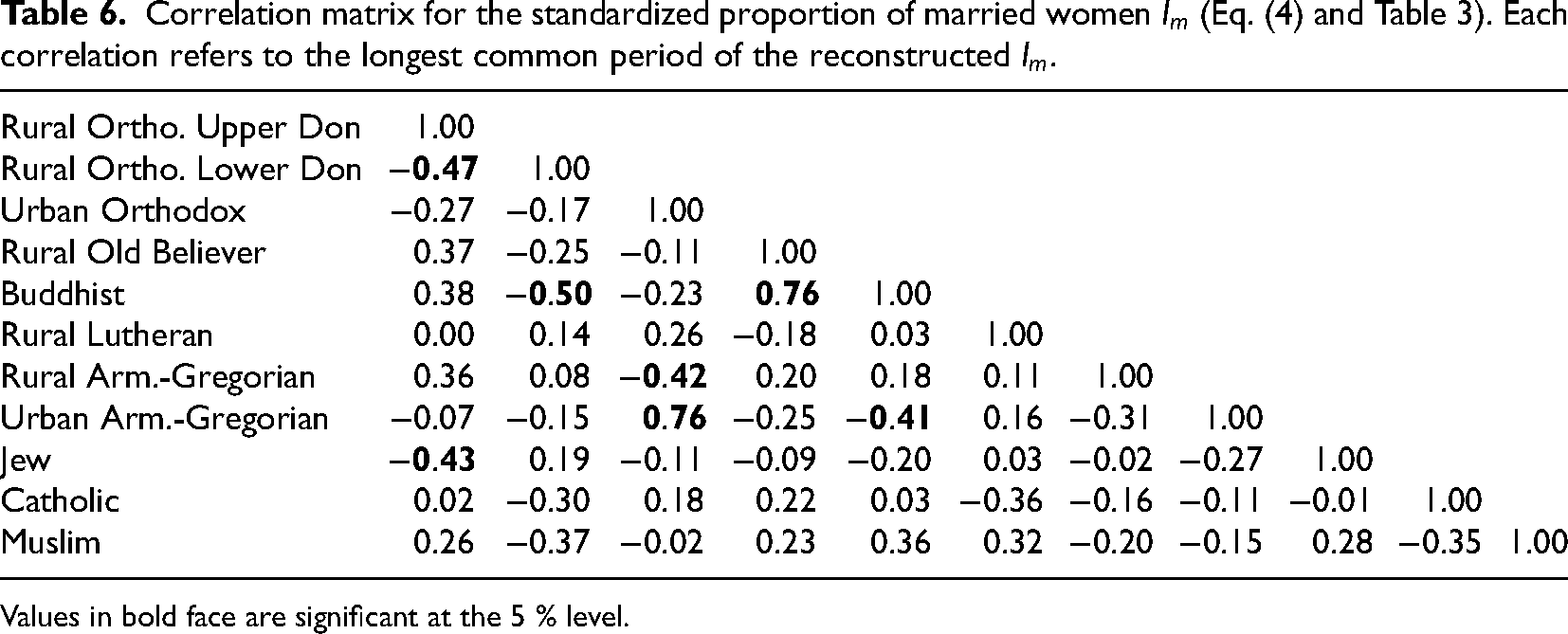
Values in bold face are significant at the 5 % level.
Correlation matrix for the age difference at marriage (Eq. (4) and Table 2). Each correlation refers to the longest common period of the reconstructed age difference.
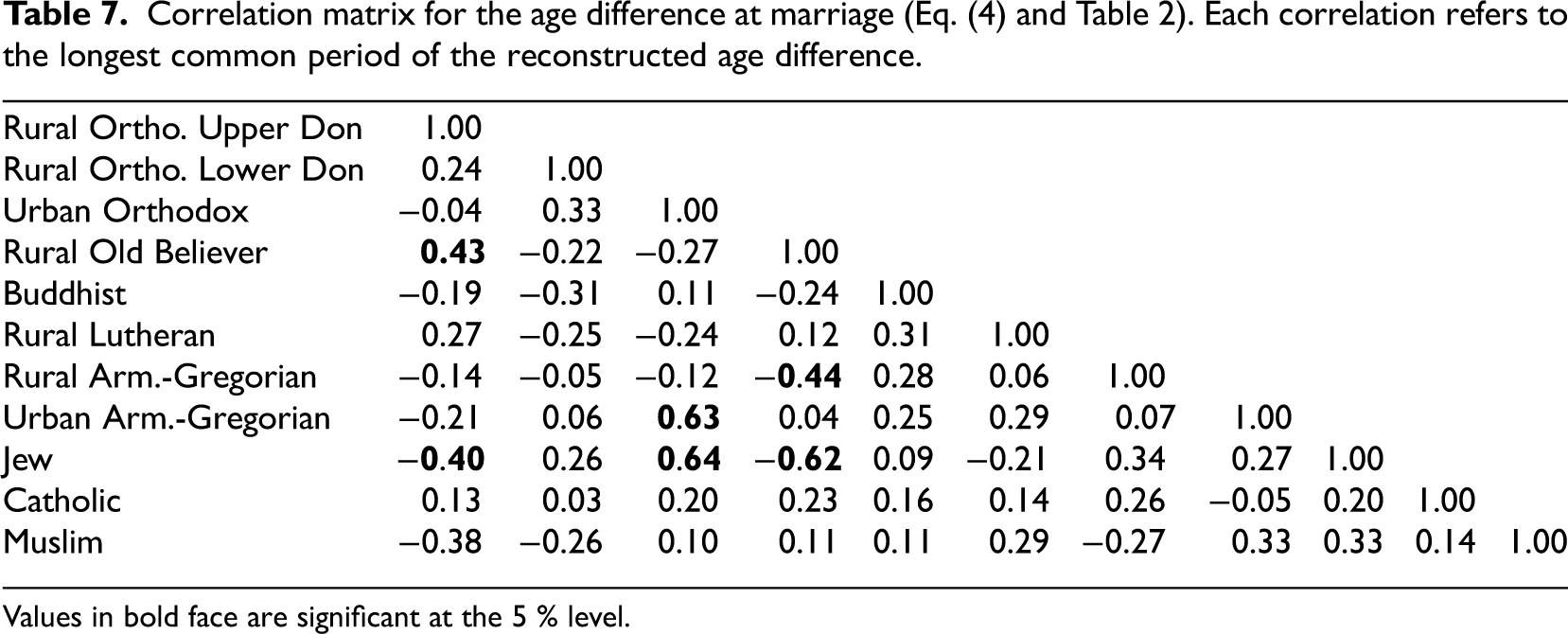
Values in bold face are significant at the 5 % level.
Footnotes
Appendix A
Declaration of Conflicting Interests
The authors declared no potential conflicts of interest with respect to the research, authorship, and/or publication of this article.
Funding
The authors received no financial support for the research, authorship, and/or publication of this article
