







Abstract
This article undertakes a demographic analysis of the landed elite of Warwickshire from the late Middle Ages to the early eighteenth century. It analyzes nuptiality and endogamy in marriages of peers and upper gentry (knights, baronets, and esquires). Major findings include: the marriage pattern before the eighteenth century was one in which women “married down;” significant changes occurred around 1550 and after 1650; generalizations about the demography of peers cannot necessarily be extrapolated to the upper gentry; and the marriage patterns of English Catholics after 1550 differed from those of English Protestants and resembled those of continental Catholic elites.
This article undertakes a demographic study of the landed elite of Warwickshire, examining the marriage patterns of peers and upper gentry (knights, baronets, and esquires) from the late Middle Ages to the early eighteenth century. Whereas previous demographic studies of the English landed classes have been largely limited to the peerage, the availability of genealogical sources online now makes it possible to study a larger segment of the landed elite. 1
It sets the marriage patterns of the Warwickshire landed elite in the broader context of marriage strategies in Western European aristocracies, and compares the marriage patterns of peers to those of the upper gentry. It also examines the role of the church in family strategy before the Reformation, and compares the marriage patterns of Protestant and Catholic elite families after the Reformation. It emphasizes the marriage patterns of women, which have received less attention than those of men. A major finding is that the marriage pattern before the eighteenth century was one in which women “married down” to men of lower status rather than, as frequently assumed, one in which women “married up” to men of higher status.
Historiography
The foundations for the demographic study of the British landed elite were laid by T.H. Hollingsworth in his “Demographic Study of the British Peerage” (1964). 2 This is still the only demographic study of a Western European ruling elite which covers the entire period from the early modern era to the twentieth century. In his study of peers’ children born between 1550 and 1959, Hollingsworth states that “1577–1721, 1721–1880, 1880–1929, and 1929–1959 are the four approximate periods when the peerage was static in its degree of exclusiveness, and around 1721, 1880 and 1929 there were three ‘social revolutions’” in which the proportion of the members marrying other members of the peerage dropped dramatically. 3
Hollingsworth found the first revolution—that of 1721—the most difficult to explain, since it did not coincide with a period of significant political or economic change. However, historians of the family, drawing on qualitative sources such as letters, diaries, and memoirs, have identified the late seventeenth and early eighteenth century as a turning point in family strategy: a shift away from arranged marriages based on the interests of the family to marriages based on personal affection.
In The Family, Sex and Marriage in England 1500–1800 (1977), Lawrence Stone posits a series of successive family types: the medieval ‘open lineage family’ 1450–1630; the ‘restricted patriarchal nuclear family,’ 1550–1700, and the ‘closed, domesticated nuclear family,’ 1640–1800, with the third type becoming dominant after 1700. 4 He attributes this last change to the decline of patriarchy and the rise of “affective individualism.” 5
Stone's Family, Sex and Marriage and his later An Open Elite? (1984) are the only long-term demographic studies which deal with the landed gentry as well as the peerage. In these two works, his sample consists of what he calls the “squirearchy,” a mixture of peers, knights or baronets, and esquires in three counties. Esquires make up a large majority of its members. 6
The typology of family forms which Stone sets forth in Family, Sex and Marriage has been highly controversial. 7 However, the idea that the period around 1700 was a turning point in family structure and motivations to marry was already widely accepted. Even before Hollingsworth's study was published, G. E Mingay characterized the period 1690–1790 as one in which for landed classes outside the highest aristocracy, ”the important material questions of wealth and rank were not allowed to take overriding precedence’ over personal happiness.” 8
The only long-term demographic study of the British aristocracy since Stone's is Kimberley Schutte, Women, Rank and Marriage in the British Aristocracy, 1485–2000 (2014). This is the first demographic study covering the early modern period which deals entirely with women. 9 Schutte states that she expected to find “a revolution in the marital behavior of women and the self-perception of the nobility,” probably in the eighteenth century, but instead found “more than four-and-a-half centuries of continuity” down to World War I. 10 However, the statistical portion of her analysis emphasizes the period from the mid-eighteenth century to 1920, suggesting that she does see significant change in the mid-eighteenth century. 11
Stone's typology of family forms implies major changes around 1550 as well as around 1700. 12 Since Hollingsworth's study begins in 1550, it does not shed light on the forms that prevailed in the late Middle Ages, and no demographic historian has undertaken a systematic analysis of this period in Britain. However, studies of continental elites in France, Italy, and Iberia show that significant changes in family forms and family strategy took place around 1550 as well as after 1650. This study uses a longer time frame than earlier studies of British elites in order to investigate whether this earlier change also took place in Britain.
Sources and Data
The author has compiled a database of members of the county elite of Warwickshire who were born between 1400 and 1749. The inclusion of the upper gentry as well as peers makes the findings more comparable to those of continental aristocracies.
Warwickshire was chosen because the county possesses a good series of local government records and because its gentry has been the subject of detailed studies covering the period from the fifteenth through the seventeenth century. The landed elite of Warwickshire after the Reformation also included a significant minority of Roman Catholics, creating a “natural experiment” for comparing the marriage patterns of Protestants and post-Tridentine Catholics.
The members of the Warwickshire upper gentry in the period 1400–1600 are chiefly identified from county studies: the lists for the fifteenth century compiled by Christine Carpenter from subsidy lists and other sources; and the lists of Justices of the Peace compiled by Cathryn Enis for the second half of the sixteenth century, and by Ann Hughes for the first half of the seventeenth century. Justices of the Peace after 1660 are identified from the Commissions of the Peace 1674–1749. 13
Contemporary lists of notables include the “Catalogue of Residents in the County of Warwick, in the Reign of Elizabeth,” compiled by local antiquarian Henry Ferrers in 1577–1578; An Alphabetical Account of Nobility and Gentry, published in 1673; and a list of “Warwickshire Nobles and Gentlemen in 1733 and 1742,” drawn up by the Warwickshire Justice of the Peace Thomas Mason. 14 All of these compilations include many men who were not officeholders. Additional members of the upper gentry are those identified as knights, baronets, or esquires in the heralds’ visitations of 1619 and 1682, and in the Hearth Tax returns of 1670. 15
The database includes the children of men who at the time of their death were peers, knights, baronets, or esquires. The definition of “peers” includes not only those who held titles in the peerage of England and sat in the House of Lords, but also those holding titles in the peerage of Scotland or the peerage of Ireland.
The database includes all children born between 1400 and 1749 and known to have survived to the age of fifteen. The total of 3502 individuals (1784 sons and 1568 daughters) includes 469 children of peers (252 sons and 217 daughters), 1018 children of knights or baronets (505 sons and 513 daughters), and 1863 children of esquires (1027 sons and 838 daughters). “Eldest” and “younger” refer to birth order at the age of fifteen. Only the first marriages of these children are analyzed.
Landed Elites in Britain and Continental Europe
The landed classes of early modern Britain differed from those of continental Europe in that only those holding titles in the peerage were legally considered nobles. Large landowners without titles were classed as “gentry.” In other European countries, a much larger number of landholders were classed as nobles and enjoyed many more legal privileges than did British peers. 16 Jonathan Dewald states that “England fitted somewhere in the middle of [the] range, with its gentry more numerous than in Germany or Spain, but less so than in Spain.” He estimates that in the fourteenth century the peerage and gentry together made up about 2 percent of the total population of England. 17 Felicity Heal and Clive Holmes state that the number of gentry increased much faster than the general population in the sixteenth century, due to the growth in numbers of royal administrators and the availability of monastic lands, but that it stabilized in the seventeenth century. 18 In the fifteenth and sixteenth centuries, the English peerage usually had fifty to sixty members. The “inflation of honors” under James I and Charles I more than doubled the size of the peerage in the first half of the seventeenth century, and Gregory King counted 160 peerage families in 1688. The size of the English peerage remained stable at slightly under 200 members from 1700 to 1780. 19
Smaller landowners made up the gentry, equivalent to provincial aristocracies in continental Europe. The “upper gentry” or “county gentry,” consisting of the wealthiest landowners who were not peers, held the titles of “knight” (and after 1611 also “baronet,”) or “esquire.” The “lower gentry,” who were classed only as “gentlemen,” are also referred to as “parish gentry,” since they owned less land and exercised power only at the local level.
This study deals with the “county elite” of peers and upper gentry who dominated landholding and officeholding at the county level. Stone defines this group in the late seventeenth century as [t]hose members of the aristocracy, baronetage, knightage, and squirearchy whose main territorial base took the form of at least one large country house and a substantial landed estate…[T]hese men formed…the county elite, whose characteristics were a combination of great power (at some point in the family's history), participation in local administration, substantial landed wealth, broad but not deep education, a generous style of life, and high status, the minimum status attribute being the nominal title of squire. 20
The number of peers and upper gentry resident in Warwickshire or active in its affairs remained relatively stable throughout the fifteenth and sixteenth century at about eighty families. By the late seventeenth century the number had risen to over one hundred families, though some of the less wealthy esquires might not qualify as members of the “county elite” by Stone's definition. 21
Marrying Up and Marrying Down
Qualitative evidence such as letters, diaries, and memoirs can provide context for the changes in marriage patterns described in demographic studies. Conversely, quantitative evidence can challenge assumptions about aristocratic marriage patterns which have been made on the basis of qualitative evidence. This is particularly true of the key concept of “endogamy” or marriage into the same social group. 22
Discussions of marriage in the medieval and early modern family consistently state that the goal of elite families was social endogamy: they sought to marry their children into families of equal or higher status.
Barbara Harris states that in Yorkist and early Tudor England, “[a]ristocratic parents who were contemplating their daughters’ futures had two related goals. First and foremost was ensuring their daughters’ financial security and social position by marrying them to men of their class… Second, within the limits set by their own economic, political, and social resources, they sought to marry their daughters into the wealthiest, highest ranking, most powerful families possible. The ultimate goal was to secure sons-in-law from families with more of these assets than their own.” 23
These goals had not changed two hundred years later, although families now had to use different means to achieve them, since personal affection had become a greater factor in choosing a spouse. Amanda Vickery states that in the eighteenth century, “noble endogamy was still emphatically the norm, only now parents had to achieve by education and an exclusive marriage market that which had previously been enforced by fiat. After all, if young people met only suitable companions, they would assuredly make a suitable free choice.” 24
However, qualitative studies cannot tell how often families achieved their goal. Endogamy may indeed have been the “norm” in the sense the term is used in sociology: “the unwritten rules and expectations that govern behavior within a society or social group, [which] define what is considered acceptable, appropriate, or typical…”
25
However, it is not clear to what extent “endogamy” was an accurate description of behavior in real life.
Schutte states that “written evidence [i.e., women's letters, diaries, and memoirs] likely reflects the ideal [,] while the statistics give a picture of what was actually happening … Aristocratic women and their families were consistent in their stated desire that they marry endogamously. That was the ideal outcome for such a woman. But life is frequently not ideal.” 26
Historians of the English elite family have so far made little use of quantitative evidence to determine whether women usually “married up” to men of higher status—a practice known as “hypergamy”—or “married down” to men of lower status—a practice known as “hypogamy.” 27 This has implications for the much-debated question of whether Britain had an “open elite.”
It was acceptable for a man from an established elite family to marry a woman of lower status but great wealth; the wife's status would not affect that of the husband. But how willing were elite families to allow their daughters to marry a “new man” trying to enter the elite? 28
Continental European Elites
Demographic studies of landed nobilities and urban patriciates in early modern Italy, Iberia, and France have demonstrated that hypogamy was the dominant marriage strategy in these continental elites until at least the mid-seventeenth century. 29
According to Georges Duby, the dominant marriage strategy in Western European aristocracies in the High and Late Middle Ages was one in which families left some younger sons unmarried to avoid dividing their lands, but married as many daughters as possible to obtain valuable alliances. Since there were more elite women than elite men on the marriage market, some women had to marry down if they were to marry at all. 30 The medieval marriage system thus was hypogamous. Over the course of the sixteenth and seventeenth centuries, continental aristocracies restricted the number of daughters who married, a development which scholars have attributed chiefly to the rising costs of dowries, and the marriage system increasingly tended toward hypergamy.
Studies of Italian elites, which focus on urban patriciates rather than landed elites, show that hypogamy was the norm in the fifteenth century. In their study of the Florentine castato (tax) of 1427, David Herlihy and Christiane Klapish-Zuber find that “women tended to marry down while men tended to marry up,” with the average wealth of the bride's family exceeding that of the groom's family. 31 Anthony Molho notes the increasing number of nuns in ruling-class Florentine families and describes this development as a “great rush to the convent, …which by the middle of the [sixteenth] century would assume massive proportions.” 32
This rush to the convent was even greater in sixteenth and seventeenth-century Venice. Jutta Sperling states that that after 1550 patrician girls were withdrawn from the marriage market to avoid mésalliances, and “[i]n the seventeenth century, Venetian patrician women were more likely to enter a convent than to marry within their class.” 33
In sixteenth-century France, according to Michel Nassiet, noble parents attempted to contract at least one marriage with a social equal (usually for the eldest daughter), with the other daughters either remaining unmarried or marrying down. By the seventeenth century, families married only one daughter per generation. “The frequency of hypogamy diminished in the seventeenth century as large numbers of the daughters of nobles remained unmarried and religious vocations were frequent” due to the revival of Catholic spirituality after the Council of Trent. 34 By the end of the seventeenth century, these trends resulted in a court aristocracy which was hypergamous rather than hypogamous. According to Emmanuel Le Roy Ladurie, “[i]n the France of Louis XIV, ‘a slight inferiority of the family of the wife in comparison with that of the husband is considered normal’.” 35
This transition from a hypogamous marriage pattern in the late Middle Ages to a hypergamous pattern by the late seventeenth century is also seen in Iberian aristocracies. In the Castilian aristocracy of the fifteenth century, according to Isabel Beceiro Pita and Ricardo Córdoba, few women remained unmarried, and it was relatively easy for “new men” to marry into the aristocracy. However, “in the sixteenth and seventeenth centuries the Castilian nobility became closed and immobilized, forming a ‘caste’ whose members must marry each other if they are not to descend the social scale…” 36 In Portugal, Nuno Gonçalo Monteiro describes a “common aristocratic model” prevailing after 1650, in which only one son and one daughter married in each generation. Half of all sons and all daughters remained unmarried, and about a third of all sons and all daughters entered the church. 37
The Warwickshire Landed Elite
In contrast to studies of continental aristocracies, studies of the elite English family generally assume that hypogamy was rare throughout the late medieval and early modern periods. Scholars asserting that elite English families throughout the period were more reluctant to marry daughters than to marry sons to spouses of lower status include Ralph Houlbrooke (1985)
Hollingsworth's statistics on marriage patterns call these assumptions into question. His definition of the first “social revolution” in marriage patterns around 1721 consists of two elements: first, women became more likely than men to remain unmarried, and second, women became more likely than men to marry a spouse of equal rank. 40 This means that from the late sixteenth century to the early eighteenth century, the British peerage actually had a hypogamous marriage pattern: one in which women were more likely than men to marry down. Was this pattern also characteristic of the landed gentry? We will examine Warwickshire as a case study.
Peers
Before 1603, the number of peers resident in Warwickshire or active in its affairs at any one time ranged between six and ten. In the seventeenth and early eighteenth centuries, after the expansion of the peerage by Stuart kings, the number of peers with Warwickshire connections ranged between thirteen and fifteen. From the early seventeenth century onward, all of those peers belonged to the “new peerage” created after 1603, and almost all were drawn from local Warwickshire gentry families. Although Warwickshire peers of the fifteenth and sixteenth centuries had included families prominent in national politics, Hughes states that in the first half of the seventeenth century, “most of the peers frequently resident in Warwickshire were not crucially separated from the leading gentry in wealth, status or influence”. 41
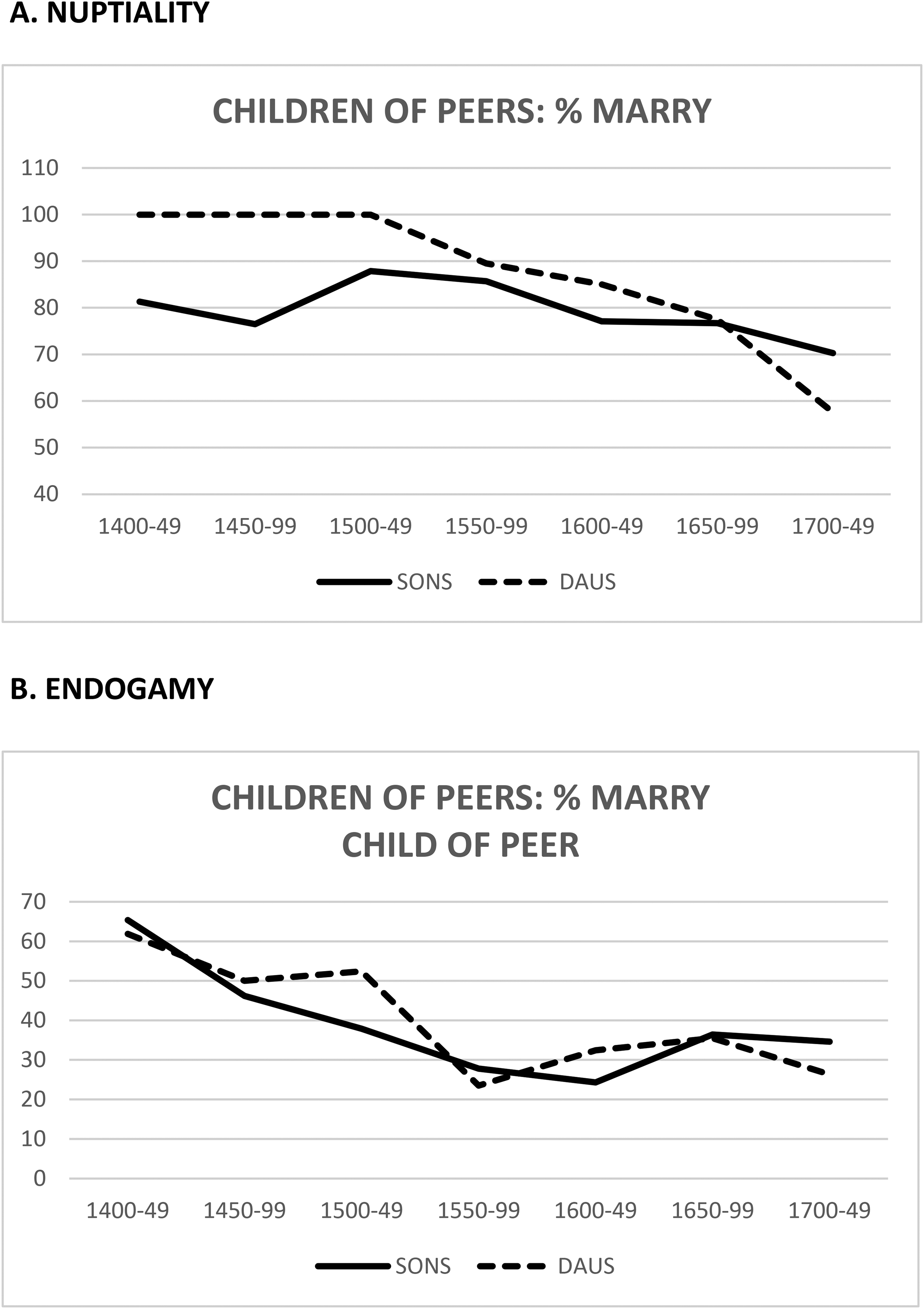
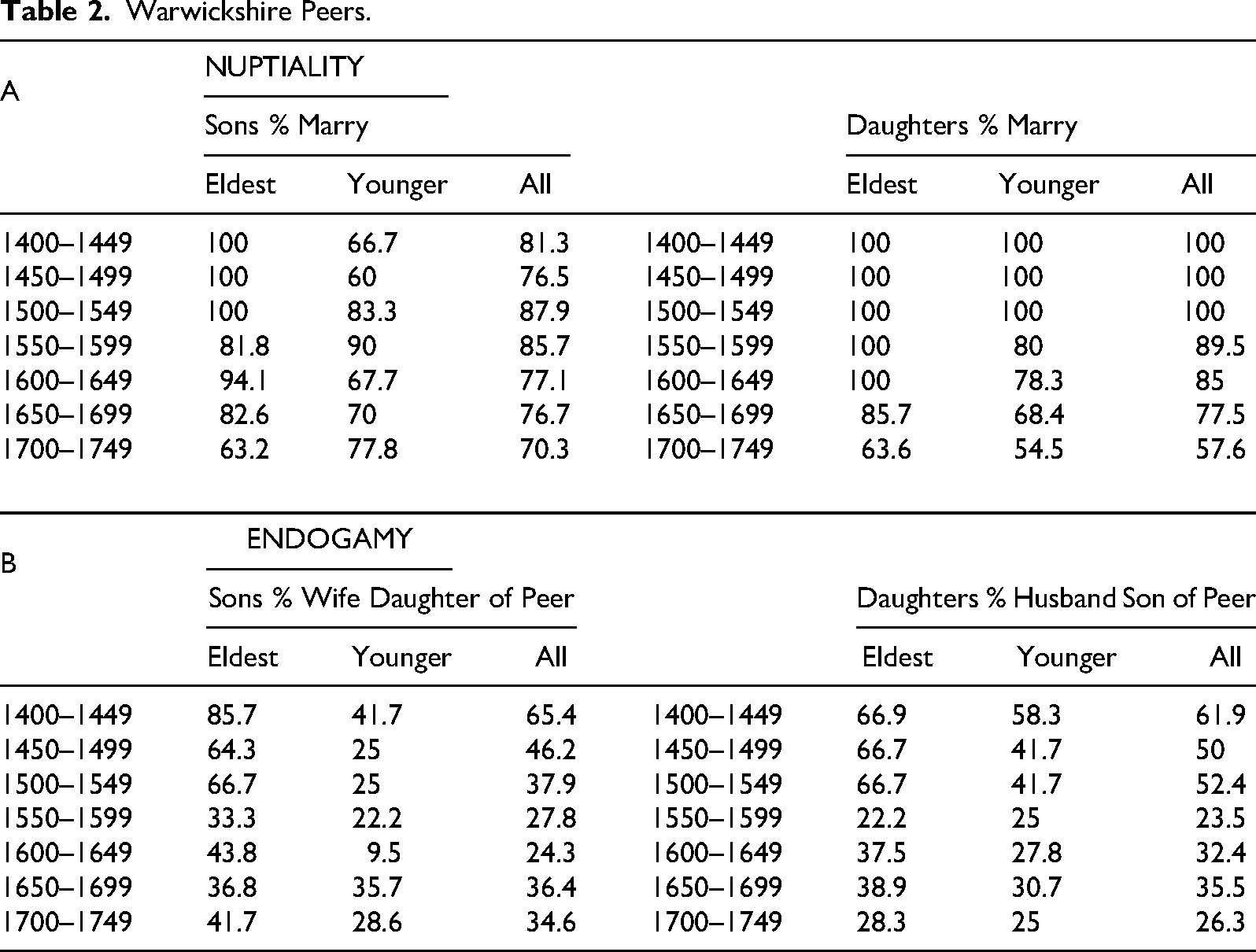
The analysis of the marriage patterns of Warwickshire peers will be divided into three chronological sections: 1400–1550 (before the beginning of Hollingsworth's study of the demography of British peers), 1550–1699 (the period before Hollingsworth's first “marriage revolution”), and 1700–1749 (the period of his “marriage revolution.” It will examine both nuptiality (the proportion of all persons eligible to marry who actually married) and endogamy (the proportion of all persons who married within their social rank) (Figure 1).
Warwickshire Peers.
1400–1549
In the period 1400–1550, all eldest sons and all daughters of Warwickshire peers married, as did about three-quarters of all younger sons. This is consistent with the prevalent strategy among continental nobilities in the late Middle Ages and with Joel Rosenthal's finding that 98 percent of the men who held a title in the English peerage between 1300 and 1500 married at least once. 42 The universal marriage of daughters of Warwickshire peers is also consistent with Harris's finding that in the period 1450–1550, 94 percent of the daughters of English peers and knights married. Even in families with four or more daughters, parents tried to find husbands for as many daughters as possible, “given…the value of marriage ties in reinforcing their kin and patronage networks.” 43
About half of all the marriages of sons and of daughters of Warwickshire peers were endogamous. In the case of sons, there was a sharp distinction between eldest sons, of whom two-thirds married within the peerage, and younger sons, of whom less than a third did so. Although primogeniture did not apply to daughters, eldest daughters tended to make more prestigious marriages than their younger sisters: almost two-thirds of eldest daughters married within the peerage, compared to slightly less than half of younger daughters. Sons were more likely than daughters to “marry up” to a spouse of higher rank within the peerage: 15 percent of all sons did so, compared to 8 percent of all daughters.
1550–1699
After the middle of the sixteenth century, the marriage of daughters was no longer universal. In the late sixteenth century, fewer daughters than sons remained unmarried (10 percent of daughters and 15 percent of sons), but by the second half of the seventeenth century, the proportion of unmarried daughters was equal to that of sons (23 percent).
The change coincides with the Protestant and Catholic Reformations, though a direct connection is difficult to prove. Of the fourteen unmarried daughters born between 1550 and 1699, four were nuns, all of them members of the family of Smith alias Carrington. However, the Protestant Fulke Greville, 5th Baron Brooke (c. 1643–1710), left four of his seven daughters unmarried. Even Protestant peers were no longer committed to the ideal of marrying as many daughters as possible.
Endogamy rates fell sharply in the second half of the sixteenth century. Throughout the seventeenth century, about a third of all sons and all daughters of Warwickshire peers married children of peers, a rate similar to that found by Hollingsworth for the British peerage as a whole. Sons continued to be more likely than daughters to marry a spouse of higher rank within the peerage (15 percent of sons and 11 percent of daughters).
1700–1749
In the Warwickshire peerage, marriage rates of both sons and daughters declined in the first half of the eighteenth century, far more sharply for daughters (to 58 percent) than for sons (to 70 percent). Significant numbers of eldest sons and eldest daughters—the children whose marriages were most tightly controlled by their families—remained unmarried. The proportion of lifelong bachelors among eldest sons rose to over a third of those born in the first half of the eighteenth century. 44 No eldest daughters born before 1650 died unmarried, but over a third of eldest daughters born in the first half of the eighteenth century did so.
There were also now more cases of eldest sons and eldest daughters making marriages based on personal choice, consistent with the greater emphasis on individual affection expressed in letters, diaries, and literature. 45 Louisa Augusta Greville (1743–c.1779), the eldest daughter of Francis Greville, 1st Earl of Warwick, evidently enjoyed the support of her family in achieving considerable independence in her career and marriage. Louisa won prizes for her engravings while still in her teens, and she made her own choice of marriage partner. She did not marry until the relatively late age of twenty-seven, and her husband was the son of a book publisher. 46
Warwickshire peers met Hollingsworth's first criterion for experiencing a “marriage revolution” in the first quarter of the eighteenth century: more daughters than sons remained unmarried. However, it was not until the cohort born 1725–1749, who married in the third quarter of the eighteenth century, that they met his second criterion: more daughters than sons made endogamous marriages. The “marriage revolution” among Warwickshire peers thus occurred a generation later than 1721, the date Hollingsworth assigns to the “marriage revolution” in the British peerage as a whole.
In the early eighteenth century, the rank of spouses in non-endogamous marriages moved down the social ladder. For children of Warwickshire peers, marriages to children of knights or baronets made up the largest category of spouses outside the peerage until the cohort born 1650–1699. After this date, marriages to children of baronets declined sharply and children of esquires became the largest category of spouses outside the peerage. This increasing preference for children of esquires is consistent with David Thomas's statement that in the eighteenth century, “the sons of peers were…more likely to marry commoners [i.e., daughters of untitled men] than to marry daughters of knights or baronets.” 47 Daughters of peers were even less likely to marry into the baronetage. Schutte finds “an extraordinarily low rate” of such marriages and states that “[b]eginning in the seventeenth century, the level of such marriages is so low that it seems clear that the upper ranks are actively avoiding such unions, preferring marriage to a non-titled man or no match at all to one with a mere “Sir.” She attributes this to “the whiff of social climbing associated with the title of baronet which followed the debasement of the knighthood before that.” 48 The Warwickshire peerage resembles continental elites in experiencing a decline in nuptiality from the mid-sixteenth century onward. However, it differs markedly from continental elites in that endogamy also declined, whereas continental elites became increasingly endogamous to the point of resembling castes.
Landed Gentry
Was the marriage system of the Warwickshire gentry typical of the county elite as a whole? The upper gentry or “county gentry” consisted of knights (and after 1611 also baronets) and esquires. Although knights in some English counties were as wealthy as lesser peers, Carpenter emphasizes the large income gap between peers and knights in fifteenth-century Warwickshire. 49 The creation in 1603 of the “new nobility,” drawn almost entirely from local gentry families, decreased the income gap between peers and upper gentry.
In the fifteenth century, the titles of “knight” and “esquire” still had military connotations, but by 1500, they were primarily associated with service in civil rather than military offices. At any one time in the fifteenth and sixteenth centuries, only ten to thirteen men in Warwickshire held the non-hereditary title of “knight.” James I and Charles I not only greatly increased the number of knights but also sold knighthoods outright, angering those who had acquired their titles as a reward for service. Some prominent gentry—including the Lucys of Charlecote, the greatest medieval knightly family in Warwickshire—no longer sought what they considered to be a debased title.
In 1611, James I created the hereditary title of “baronet,” which was to be sold to raise money for the crown. Traditionalists looked down on the new title because of its mercenary associations. In Warwickshire, most baronetcies were acquired by esquires who were not members of knightly families. Eight of the fifteen Warwickshire baronets created before the Civil War came from families which had never produced knights, as did eighteen of the twenty-two created after the Restoration. By the second half of the seventeenth century, baronets outnumbered knights. The Hearth Tax of 1670 recorded sixteen baronets and only seven knights, and Thomas Mason included nineteen baronets, along with only one knight, in his 1733 list of “Warwickshire Nobles and Gentlemen.” 50 The number of esquires in Warwickshire remained steady at about sixty families throughout the sixteenth century and rose to about seventy-five families by the 1670s. Throughout the entire period covered by this study, esquires made up about two-thirds of the upper gentry of Warwickshire (Figure 2).
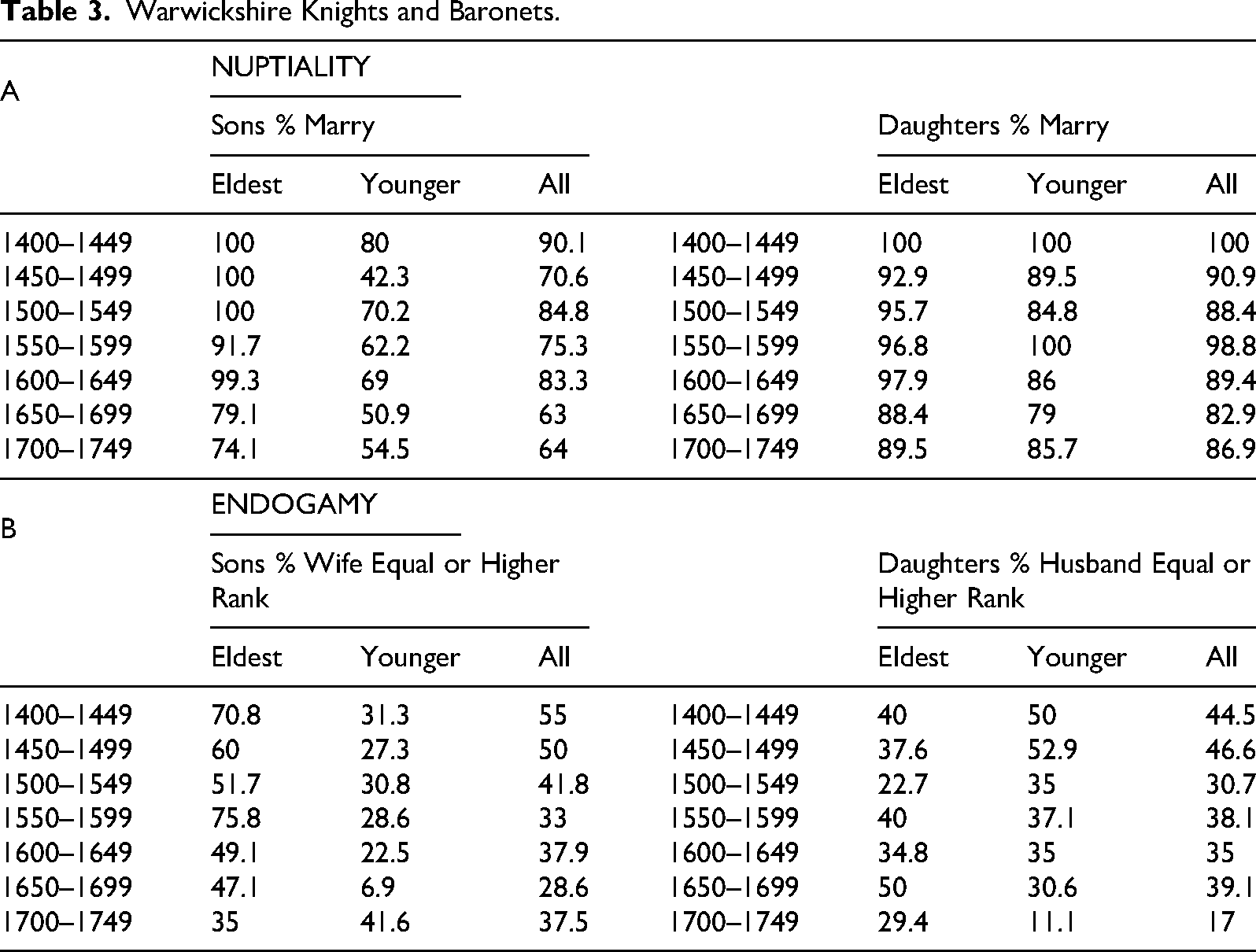
Knights and baronets.
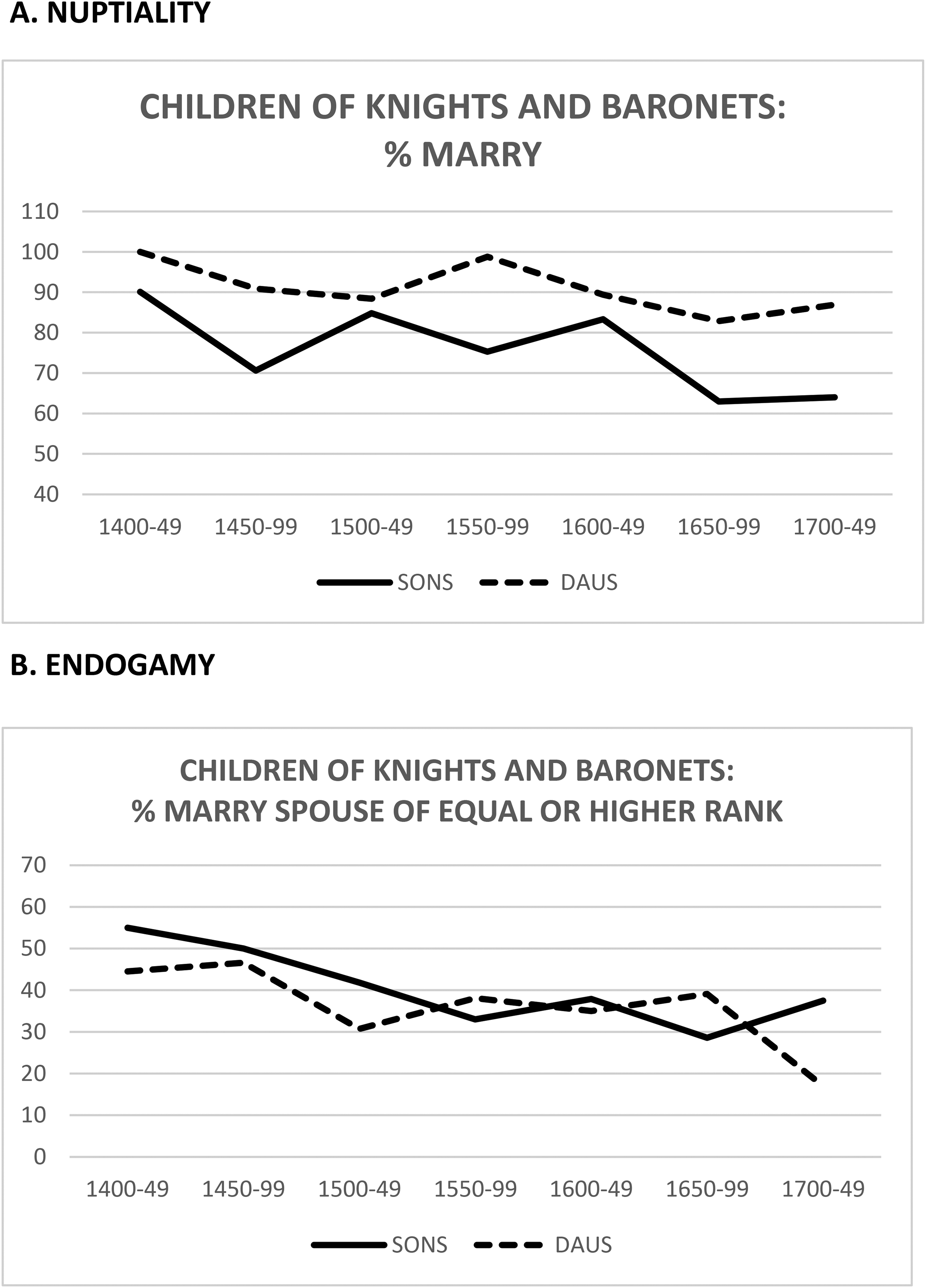
In her study of the Yorkist and early Tudor periods, Harris treats peers and knights as a single category of aristocrats. She states that “[a]lthough knights are usually categorized as the top stratum of the gentry, in crucial ways their resources and positions were more akin to those of the nobility” with respect to their large landholdings, cultural outlook, political activities, and intermarriage. 51 However, this similarity between knights and peers apparently did not extend to their marriage patterns, at least not in Warwickshire. Although the marriage patterns of sons of knights (and later baronets) resembled those of sons of peers in both nuptiality and endogamy, the marriage patterns of daughters of knights and baronets differed significantly from those of daughters of peers.
Sons of knights or baronets exhibited a pattern of declining nuptiality roughly similar to the pattern of sons of peers. Of sons born in the period 1400–1549, approximately 80 percent of each rank marriage. This rate declined to approximately 65 percent of the sons born in the period 1700–1749.
Endogamy rates in the fifteenth century were similar for men from all ranks of the landed elite: about half of all sons of peers, knights, and esquires married wives of equal or higher rank.
From the sixteenth century onward, the endogamy rate for both sons of peers and sons of knights or baronets declined. By the early eighteenth century, only about a third of the sons of peers and the sons of knights or baronets married wives of equal or higher rank. Intermarriage between sons of knights or baronets and daughters of peers declined sharply in the eighteenth century. In contrast, endogamy rates for sons of esquires remained steady or even rose slightly over this period.
Warwickshire knights and baronets practiced a marriage strategy for their daughters that differed significantly from that of peers. After 1550, peers abandoned the medieval ideal of marrying as many daughters as possible in order to maximize alliances. Although 90 percent of all peers’ daughters in the birth cohort 1550–1599 eventually married, the proportion fell steadily throughout the seventeenth century, and only 58 percent of the peers’ daughters in the birth cohort 1700–1749 ever married. Among daughters of knights and baronets, in contrast, the proportion marrying only declined from 99 percent in the birth cohort 1550–1599 to 87 percent in the birth cohort 1700–1749.
The contrast in marriage strategies is even more striking in large sibling groups. In the period 1400–1550, 92 percent of peers and 71 percent of knights who had four or more daughters actually married at least four of them. In the early eighteenth century none of peers who had four or more daughters actually found husbands for four or more of them. Among knights and baronets, however, the proportion of fathers with four or more daughters who actually married four or more of them remained steady at 71 percent throughout the entire period 1550–1749. For unknown reasons, knights and baronets continued to practice the medieval system of maximizing alliances through the marriage of as many daughters as possible, even after peers abandoned this system.
Three well-documented families of knights and baronets—the Willoughbys in the Elizabethan era, the Temples in the early seventeenth century, and the Throckmortons in the early eighteenth century—allow us to see the marriage strategies adopted by fathers with large numbers of daughters.
Sir Francis Willoughby (1547–1596) of Middleton, Warwickshire, and Wollaton, Nottinghamshire, was an Elizabethan courtier who planned the marriages of his six daughters with an eye to social and political advancement. After his only son died in 1580, Sir Francis secured the continuity of the Willoughby line by marrying his oldest daughter Bridget (aged fourteen) to her distant cousin Percival Willoughby (aged twenty) of Bore Place, Kent. In 1587 he negotiated the marriage of his second daughter Dorothy to the nephew of his patron Henry Hastings, 3rd Earl of Huntingdon, as well as the marriage of his third daughter Margaret to Robert Spencer, heir to one of the largest fortunes in England. In all three of these matches, Sir Francis rode roughshod over the wishes of his daughters, two of whom had already formed attachments to other suitors.
Yet there were limits to patriarchal power. Sir Francis's hopes for arranging equally advantageous marriages for his younger daughters were thwarted by family dysfunction. 52
He enlisted the help of his son-in-law Robert Spencer in negotiating marriages for the two youngest daughters. However, his estranged wife refused her consent to these matches, even though Spencer assured her that “he himself had made divers motions for their marrying such men of worth, both for living and behaviour, as had he sisters of his own, he should have been glad they might have had them.” 53
The most successful of the three fathers, at least in the short term, was Sir Thomas Temple, 1st Baronet (1567–1637) of Avon Dassett, Warwickshire, and Stowe, Buckinghamshire. Sir Thomas was the grandson of a Warwickshire grazier. Unlike Willoughby and Throckmorton, he had no courtly connections and sought only to marry his children into the regional landed elite. When he succeeded to his estate in 1603, he had an income of £3000 per annum, equal to that of some peers, which he used to enable all of his four sons and nine daughters to marry. 54
Sir Thomas's second son John received land; his third son Thomas was educated at Oxford University and Lincoln's Inn as preparation for a career as a clergyman and a lawyer; and his fourth son Miles was apprenticed to a London merchant. All nine daughters married, eight of them to knights or baronets. Only the youngest daughter Millicent married down, probably as a result of the financial difficulties her father experienced during the depression in the wool trade in the 1620s.
However, Sir Thomas's provisions for his large family were later blamed for the debt problems that plagued the Temple family for the rest of the seventeenth century. At the end of the century, the diplomat Sir William Temple noted the ruin of “many estates by the necessity of giving great portions to daughters.” 55 His view is echoed by historians Felicity Heal and Clive Holmes: “Sir Thomas had a string of nine daughters, and his generous provision of about £2000 in portion for each of them generated a tangle of debts.” 56 Although contemporary observers criticized Sir Thomas at least as much for his generous provision for his younger sons, 57 later critics focused only on the folly of giving lavish marriage portion to so many daughters.
A century later, Sir Robert Throckmorton, 3rd baronet (1662–1720), of Coughton, Warwickshire, and Weston Underwood, Buckinghamshire, faced the prospect of providing for seven daughters in addition to his only son. Although his resources were limited because of the financial penalties imposed on Catholic recusants, Sir Robert originally intended to marry all of his daughters and to provide for them equally.
In 1703 he drew up a settlement allotting each daughter a portion of £2500, approximately one year's income from his estates. However, would-be suitors—even those ranking as mere gentlemen—demanded portions of £5000 to £6000. It took fifteen years of negotiations to marry his eldest daughter Anne at the unusually late age of twenty-six. In the meantime, two of the younger daughters became nuns. Once Anne was finally married in 1718, Sir Robert revised his settlement to provide larger portions to the remaining daughters. 58 Sir Robert succeeded in marrying five of his seven daughters, and the financial sacrifices he made in order to pay their marriage portions shows that marrying as many daughters as possible was important to him. But only two daughters married men of their own rank, even though the Throckmortons were one of the most prominent Catholic families in England. K. S. Gibson argues that the Throckmortons were less concerned with equality of social status than with preserving shared Catholic values, and that the daughters’ marriages cemented valuable alliances with prominent families at the Jacobite court in exile at Saint-Germain. 59
Daughters of knights and baronets exhibited a distinctive pattern of endogamy as well as a distinctive pattern of nuptiality. In the period 1400–1549, about half of all daughters of peers married spouses of equal rank, but only a third of all daughters of knights did so. Endogamy decreased sharply for daughters of peers after 1550, but the proportion of daughters of knights or baronets who married husbands of equal or higher rank remained stable at about a third of all marriages from the fifteenth through the seventeenth century. It then dropped sharply in the early eighteenth century, the period in which Thomas and Schutte document a steep decline in marriages between the children of peers and children of baronets. Except for a brief reversal in the birth cohort 1650–1699, sons of knights or baronets were always more likely than daughters to marry a spouse of higher rank than themselves (Figure 3).
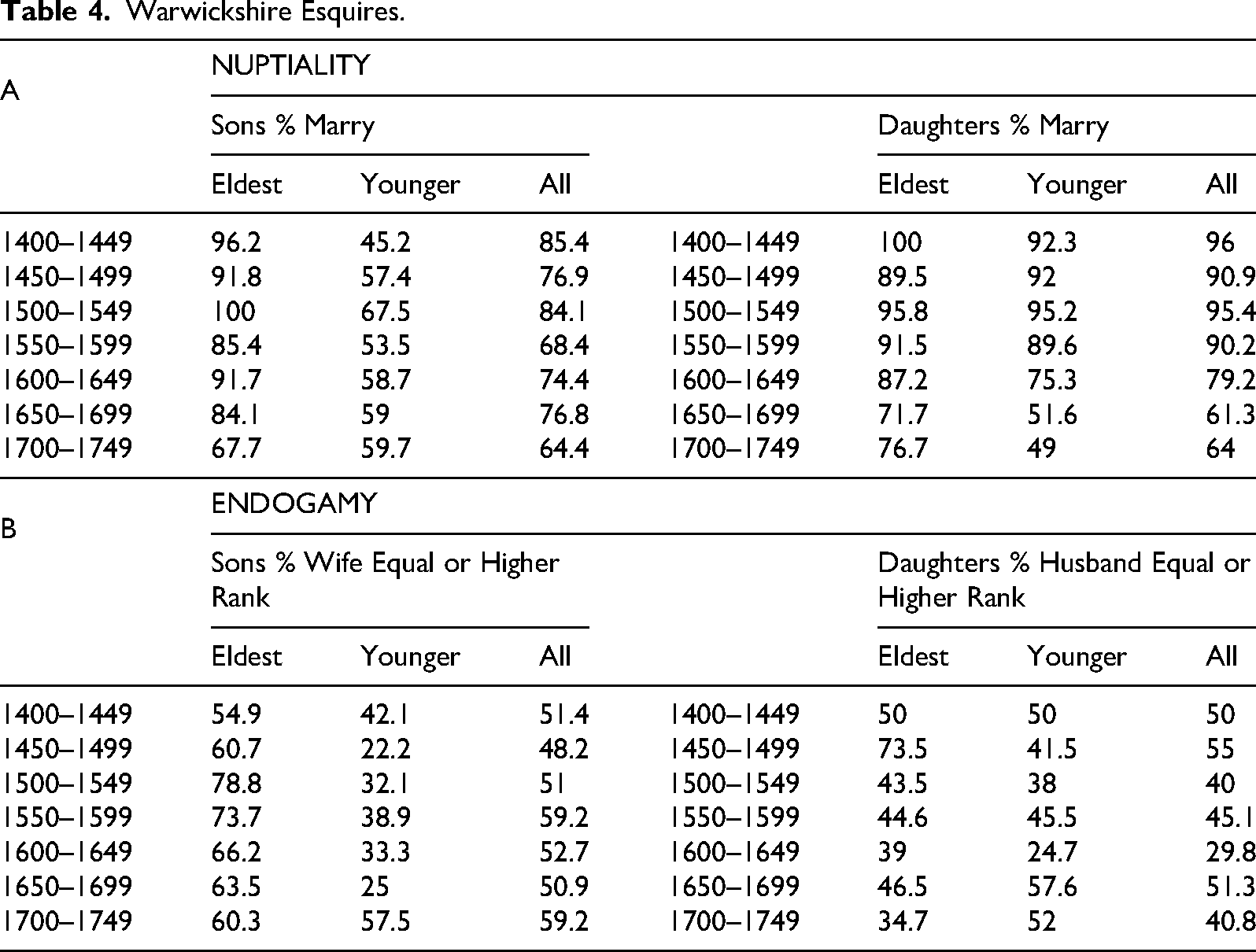
Esquires.
Esquires
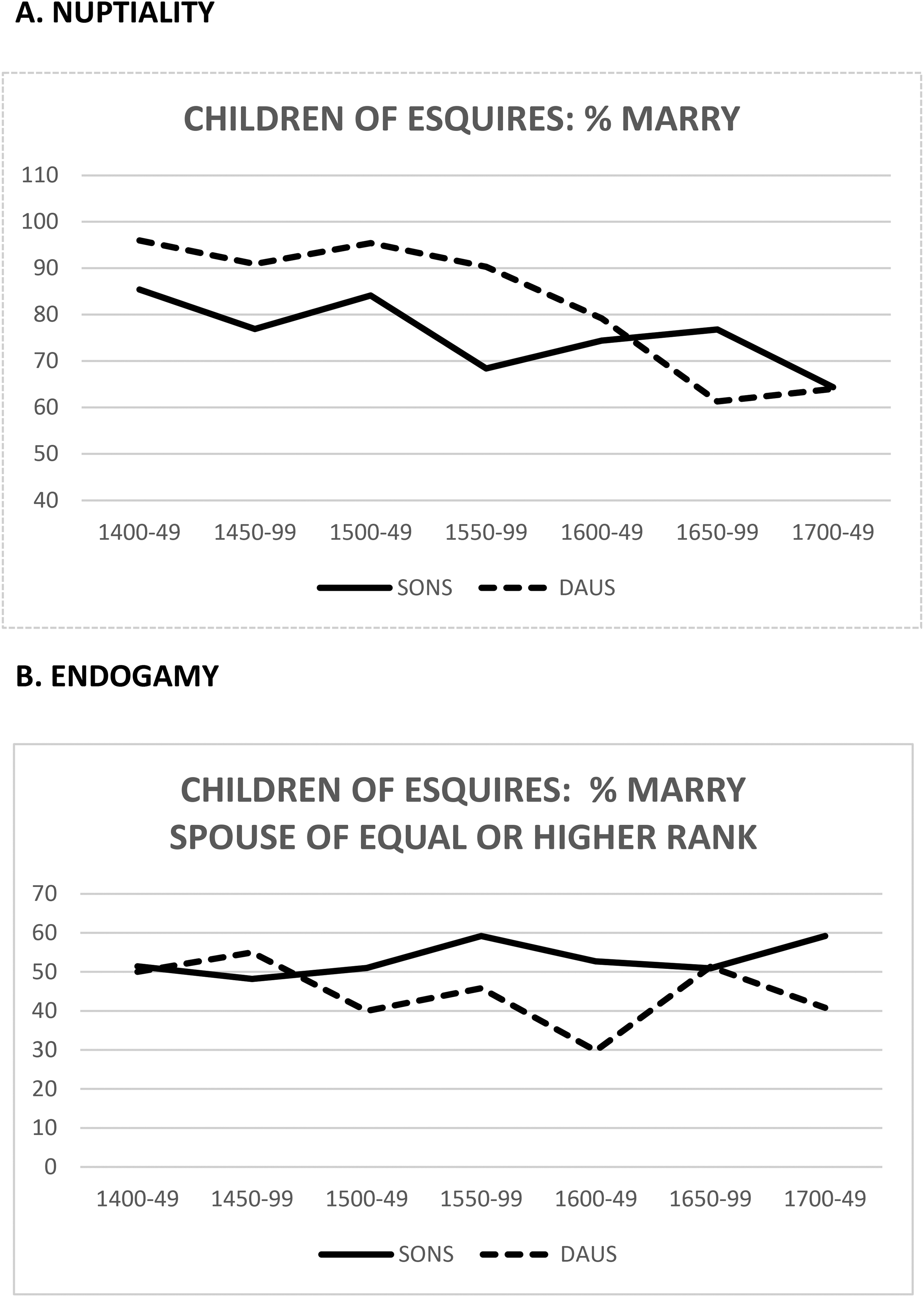
The marriage patterns of Warwickshire esquires were more similar to those of peers than to those of knights and baronets, especially in the case of daughters. Sons of esquires exhibited a pattern of declining nuptiality roughly similar to that of sons of peers and sons of knights or baronets. About 80 percent of each rank married in the period 1400–1549, declining to about 65 percent in the birth cohort 1700–1749.
Endogamy rates in the fifteenth century were also similar to those of other ranks in the landed elite, with about half of all sons marrying wives of equal or higher rank. However, from the sixteenth century onward, the endogamy rate of sons of esquires diverged from that of other ranks. Although endogamy rates for sons of peers and sons of knights or baronets declined steadily, the endogamy rate for sons of esquires remained steady or even increased. In the early eighteenth century, over half of the sons of esquires married wives of equal or higher rank, whereas only a third of the sons of peers and of knights or baronets did so.
Daughters of esquires resembled daughters of peers much more than they resembled daughters of knights or baronets in their patterns of nuptiality and endogamy. Before the end of the sixteenth century, very few daughters of esquires remained unmarried. However, their nuptiality rate declined rapidly after 1600. In the birth cohort 1700–1749, only 64 percent of all daughters of esquires married, a rate slightly higher than daughters of peers (58 percent) but far lower than daughters of baronets (87 percent).
Esquires evidently did not share the interest of knights and baronets in continuing the medieval pattern of marrying as many daughters as possible. In the period 1400–1549, 90 percent of esquires who had four or more daughters actually married four or more of them. The proportion doing so declined to 72 percent in the seventeenth century, then fell sharply to only 38 percent in the early eighteenth century. This placed esquires halfway between the rate for baronets (72 percent) and that of peers, none of whom married four or more daughters. Endogamous marriages of esquires’ daughters remained steady in comparison to other ranks of the landed elite, declining only from 48 percent in 1400–1549 to 41 percent in 1700–1749. Throughout the entire period 1400–1749, daughters of esquires were less likely than sons to marry up to a spouse of higher status, and more likely than sons to marry down to a spouse of lower status.
The marriage system of esquires remained hypogamous, showing few signs of moving toward the “marriage revolution” described by Hollingsworth for the peerage. Esquires came close to having half of all children marrying a spouse of equal or higher rank (i.e., within the county elite) and half marrying down to a spouse outside the county elite.
The Role of the Church in Family Strategy
The Catholic Church played an important role in the marriage strategies of continental elites in the early modern era. J.P. Cooper notes that by 1700, about half of all sons and daughters of the Catholic elites of Italy and France remained unmarried, whereas less than a quarter of all sons and daughters remained unmarried in the Protestant patriciate of Geneva and in the English peerage. Cooper concludes that “lack of entry into the Church is the obvious difference between the British peerage and the other groups.” 60 To what extent did the church play a role in the marriage strategy of the Warwickshire landed elite before and after the Reformation?
Pre-Reformation
In her study of the fifteenth-century Warwickshire gentry, Carpenter states that only a small number of younger sons entered the church, primarily because of the expense of education. 61 Of the 389 sons of Warwickshire peers and upper gentry born between 1400 and 1514 (i.e., those who would have been eligible to enter the church before the Henrician Reformation), twenty-four actually did so (6 percent of all sons). These included six sons of peers, four sons of knights, and fourteen sons of esquires. These clerics were concentrated in a relatively small number of families. Of the six sons of peers, four belonged one family: the Suttons, Barons Dudley. Of the sixty-three families of knights and esquires, only twelve families placed sons in the church, and only two placed more than one son in the church.
Of the 278 daughters of peers and upper gentry born between 1400 and 1514, only fifteen (5 percent) can be identified as unmarried. Eight of them were laywomen, demonstrating that the convent was not the only alternative to marriage. Of the seven daughters who entered the convent, two were daughters of knights and five were daughters of esquires. These seven nuns made up 3 percent of all daughters of the Warwickshire landed elite, a proportion similar to that estimated by Harris. This is lower than the proportion of daughters documented as entering the church in any continental elite in the fifteenth century.
Three of the five families who placed daughters in the church were members of a close-knit family alliance consisting of the Throckmortons, Middlemores, and Peytos. All three families placed sons as well as daughters in the church. The Throckmortons of Coughton made more use of the church than any other family. Although no other members of the Warwickshire gentry in the early Tudor period named more than one clerical relative in their wills, Sir Robert Throckmorton (c.1451–1518) named a brother, a sister, and two daughters. 62 Sir Robert's younger brother William, a doctor of civil and canon law, became a master in chancery and a servant of Cardinal Wolsey. Sir Robert placed his youngest sister Elizabeth (1467–1547) in Denny Abbey near Cambridge, where she became abbess by 1512. After the dissolution of the abbey in 1536, Elizabeth retired to Coughton to live with her nephew Sir George Throckmorton. She and two companions, also former nuns at Denny, “continued to wear habits and ‘prescribed to themselves the Rules of the Order as far as it was possible in their situation’.” 63
The church thus played a significant role in the family strategies of certain families before the Reformation. However, it played a much smaller role in the Warwickshire landed elite than it did in continental aristocracies.
Post-Reformation: Protestants
The Warwickshire landed elite became predominantly Protestant in the late Elizabethan era, as the Dudley brothers built up a following of Puritan gentry in the county and purged Catholics from the Commission of the Peace. 64 When forced to make a choice between religion and eligibility for office, most of the Warwickshire upper gentry chose religious conformity. Hughes notes that the Warwickshire gentry in the early seventeenth century maintained a moderately Puritan outlook. 65
Out of the 1265 sons of Protestant peers and upper gentry born between 1515 and 1749, thirty-five became Anglican clergymen (three sons of peers, eleven sons of knights or baronets, and twenty-one sons of esquires). They represented 3 percent of all sons, about half the proportion of sons of peers and upper gentry who had entered the church in the century before the Reformation.
The proportion of sons entering the church fell abruptly after the Henrician Reformation, reflecting the general decline in clerical recruitment that O’Day attributes to “the unsettled state of affairs and to the contempt in which the ministry seems generally to have been held. In addition, there were fewer opportunities for advancement within the Church.” 66 Only three sons of the Warwickshire upper gentry became Protestant ministers during the reign of Elizabeth. However, the proportion of sons becoming Anglican clergymen rose over the course of the seventeenth century and levelled off after 1650 at 6 percent of all sons, similar to the proportion before the Reformation. By this time, Anglican clerics were accepted as gentlemen and intermarried with the upper gentry.
Early historians of the British aristocratic family, such as Lawrence Stone, assumed that the Protestant Reformation had led to an increase in the proportion of daughter who married:
“The marriage market was flooded with girls who had hitherto been consigned to nunneries, but who now had to be married off, at considerable expense. Despite a heavy and growing drain on the family resources, more than 95 percent of all surviving daughters born in the late sixteenth century to the English nobility eventually married.” 67
It was not until historians began to investigate the marriage patterns of aristocratic women that it became evident that the Protestant Reformation did not have the demographic effects originally ascribed to it. Harris shows that the 95 percent marriage rate cited by Stone was not a result of the Reformation but was instead the typical rate for the late Middle Ages and early sixteenth century. 68 So few women had been nuns that the dissolution of the convents had little demographic effect; marriage rates actually declined rather than rising in the Elizabethan era.
Post-Reformation: Catholics
A minority of the Warwickshire landed elite remained Catholic, even though this meant exclusion from public office. Children of Catholics made up about 16 percent of all children of the Warwickshire landed elite born in the second half of the sixteenth century; however, their numbers declined through demographic attrition to about 8 percent of all children born after 1650. Many of the Elizabethan Catholic families died out in the seventeenth century, and they were not replaced by new families. Of the five Catholic families surviving into the early eighteenth century only one—the Cannings—had risen into the landed elite since 1603.
In the late sixteenth and seventeenth centuries, according to John Bossy, the “English mission,” which sought to bring England back into the Catholic fold, was financed primarily by gentry families. The gentry also provided most of the clergy trained at English seminaries on the continent. 69 Clerics who returned to England usually served as chaplains to Catholic gentry, ministering to the local population of Catholics clustered around gentry residences.
Of the 147 sons of Warwickshire Catholic peers and upper gentry born between 1515 and 1749, twelve entered the church (8 percent of all sons). Of these twelve clerics, six were educated at the seminaries established by William Allen for the English mission, four were Jesuits, and two were Benedictine monks. Over half of the clerics were members of the “great families” of Middlemore, Morgan, Sheldon, and Smith alias Carrington. Although in 1700 the Throckmorton family supported more clergy in England than any other Catholic family, 70 they did not place any sons in the church.
Bossy states that in the English Catholic clergy as a whole, the gentry were increasingly prominent in clerical recruitment in the first half of the seventeenth century, but that recruitment from the gentry declined after 1680. 71 This was definitely true of the Warwickshire clerics, three-quarters of whom were born between 1550 and 1649. Only three sons of Warwickshire Catholic upper gentry families born after 1650 entered the church, all of them Jesuits and members of the Sheldon family. In the eighteenth century, the proportion of clerics among sons of elite Warwickshire Catholic families (5 percent) was similar to the proportion before the Reformation and to the proportion of Anglican clerics in elite Warwickshire Protestant families. It was far lower than the proportion in contemporary continental aristocracies, whose sons had access to careers in the hierarchy of the Roman Catholic Church.
Although the Warwickshire landed elite placed fewer daughters than sons in the church before the Reformation, this pattern was reversed in post-Reformation Catholic families. Once English “convents in exile” were established in the Low Countries and France after 1598, the proportion of daughters entering the church rose rapidly and far exceeded the proportion of sons. 72
In contrast to pre-Reformation convents, whose members were predominantly drawn from the lower gentry, the English convents in exile drew over 90 percent of their members from the peerage and upper gentry. 73 Since nuns’ dowries in these convents in the late seventeenth century ranged between £300 and £500, Claire Walker argues that “it was patently cheaper for the daughters…in the upper echelons of the gentry, who paid 1000–5000 pounds [as a marital portion] to marry Christ rather than a secular groom.” 74
The thirty-three nuns in this study came from eleven different families and made up 21 percent of the 158 daughters of the Catholic landed elite born between 1550 and 1749. Even before convents became an option, Catholic daughters were more likely than Protestant daughters to remain unmarried: in the birth cohort 1550–1599 the proportion of unmarried laywomen among Catholics (13 percent) was over twice as high as among Protestants (6 percent). The difference was probably due to the financial burdens imposed on Catholic parents by fines on recusants. It is clear that Catholic parents, and some Catholic daughters, preferred the convent to spinsterhood once the choice became available. Of the 105 daughters born between 1600 and 1749, thirty (29 percent) became nuns.
Several women in this sample, all of whom came of age in the founding generation of the convents in exile in the early seventeenth century, clearly chose the convent as part of the wave of post-Tridentine Catholic spirituality that was also sweeping the continent. As Alexandra Walsham notes, choosing to take the veil sometimes represented a rebellion against the choices made by the woman's family. 75
Margaret Throckmorton (b. 1591), the eldest daughter of John Throckmorton, esq., was sent to London to stay with relatives, and to be put on the marriage market. But while traveling on the continent, she decided that she preferred the religious life. After visiting an aunt who was a canoness at St. Monica's Augustinian priory at Louvain, she secretly returned there to join her despite her family's objections. According to the Chronicle of St. Monica's, “She was admitted to the cloister treading the world valiantly under foot, and all enticing allurements. Whereof she wanted not store, for leaving many great matches which attended only her consent, she wisely and piously chose [Jesus Christ] for Spouse…” 76 She entered St. Monica's in 1613 and became prioress in 1633.
Catherine Brent (1601–1681), whose father Richard conformed in order to hold office, had a spiritual experience at the age of seventeen which led her to proclaim her Catholic faith openly. She persuaded her father and most of her twelve siblings to become recusants. In 1629 she entered the Benedictine convent at Cambrai, where she became abbess in 1641. A few years later, her sisters Elizabeth and Eleanor entered the same convent. 77
Another Warwickshire nun of the founding generation at Cambrai was Catherine Sheldon (d. 1650), the daughter of William Sheldon and Elizabeth Petre. In her obituary “she was singled out for her ‘great love of regular observances, particularly in the office of the quire’.” 78 In her case, taking the veil was a family tradition, particularly on her mother's side. Catherine had no fewer than fifteen cousins who also entered convents.
There is no direct evidence for the motives of women who entered convents after the founding generation. Walsham describes the pattern of recruitment to the English convents on the continent as “for the most part a family affair, a function of the agency of mothers and fathers, uncles and aunts, who placed young girls in their schools and encouraged them to become nuns.” 79 Walker takes a more cynical view of this process: “it is likely that … women who took the veil after many years in the school did so because of a lack of worldly experience than out of any deep-seated religious compulsion.” She believes that “fathers and mothers were lured by economic and social considerations.” 80
In her analysis of the marriage negotiations carried on by Sir Robert Throckmorton, Gibson argues that there is no evidence that the two daughters who entered convents in 1713 “were coerced into it to save money. If that had been the case [,]then it is likely that more of [the daughters] would have professed, especially as Sir Robert did have difficulty raising portions.” 81 Nevertheless, by the early eighteenth century, Warwickshire Catholic elite families were placing as many daughters in convents as did families in continental elites. Of the eighteen Catholic daughters born 1700–1749, only nine married (50 percent), and seven of the nine unmarried daughters entered convents (39 percent of all daughters).
Several of the highest-ranking families, including Smith alias Carrington, Sheldon, Throckmorton, and Ferrers, placed daughters in convents over several generations. Sometimes two to four sisters took the veil. This practice is consistent with Walker's statement that “[o]nce the cloisters were in existence and a steady stream of women was crossing the Channel, it more or less became customary in some families for at least one daughter to take the veil. The presence of several generations of nuns from clans…implies that the cloister was considered a respectable course of life for recusant gentlewomen.” 82
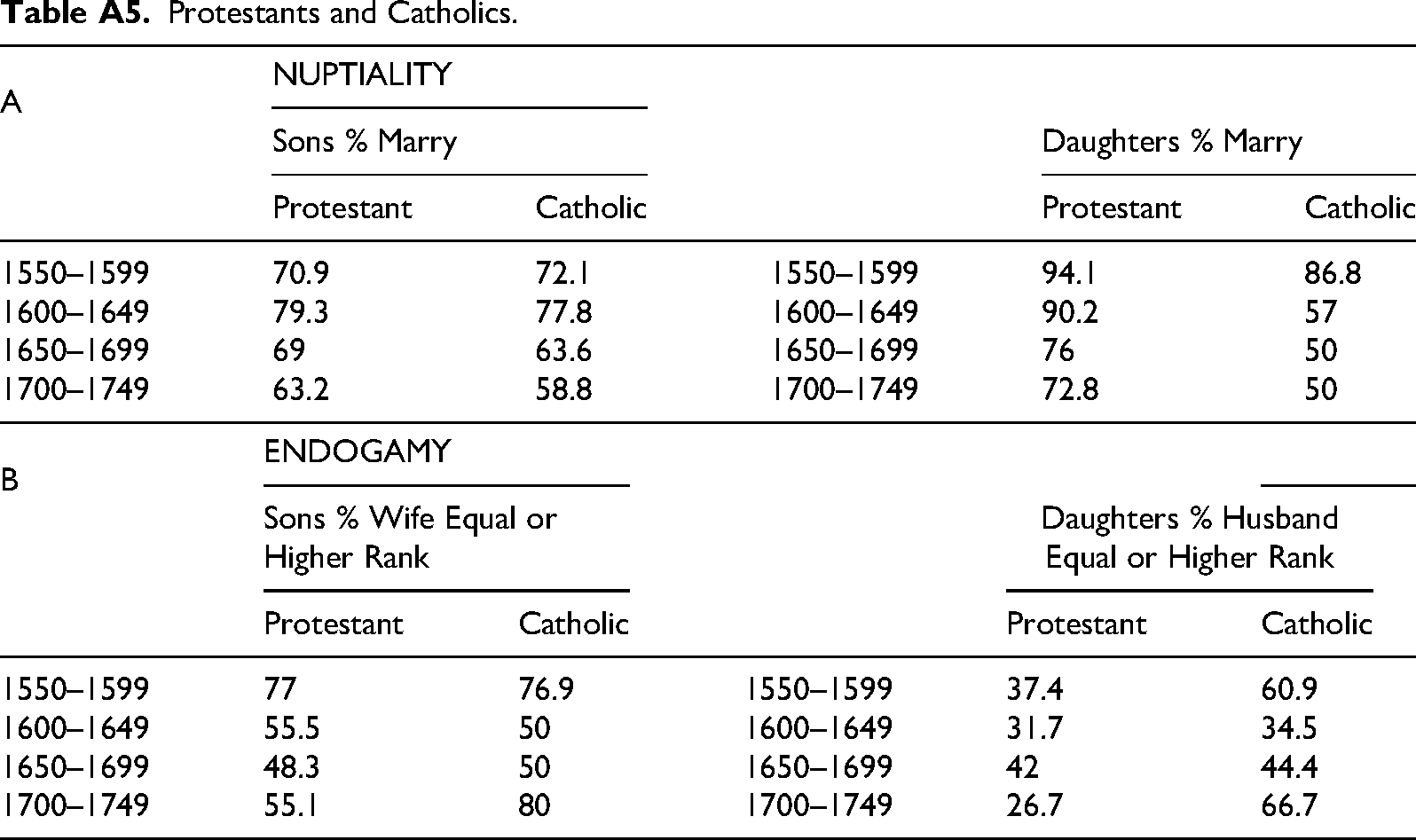
Protestants and catholics.
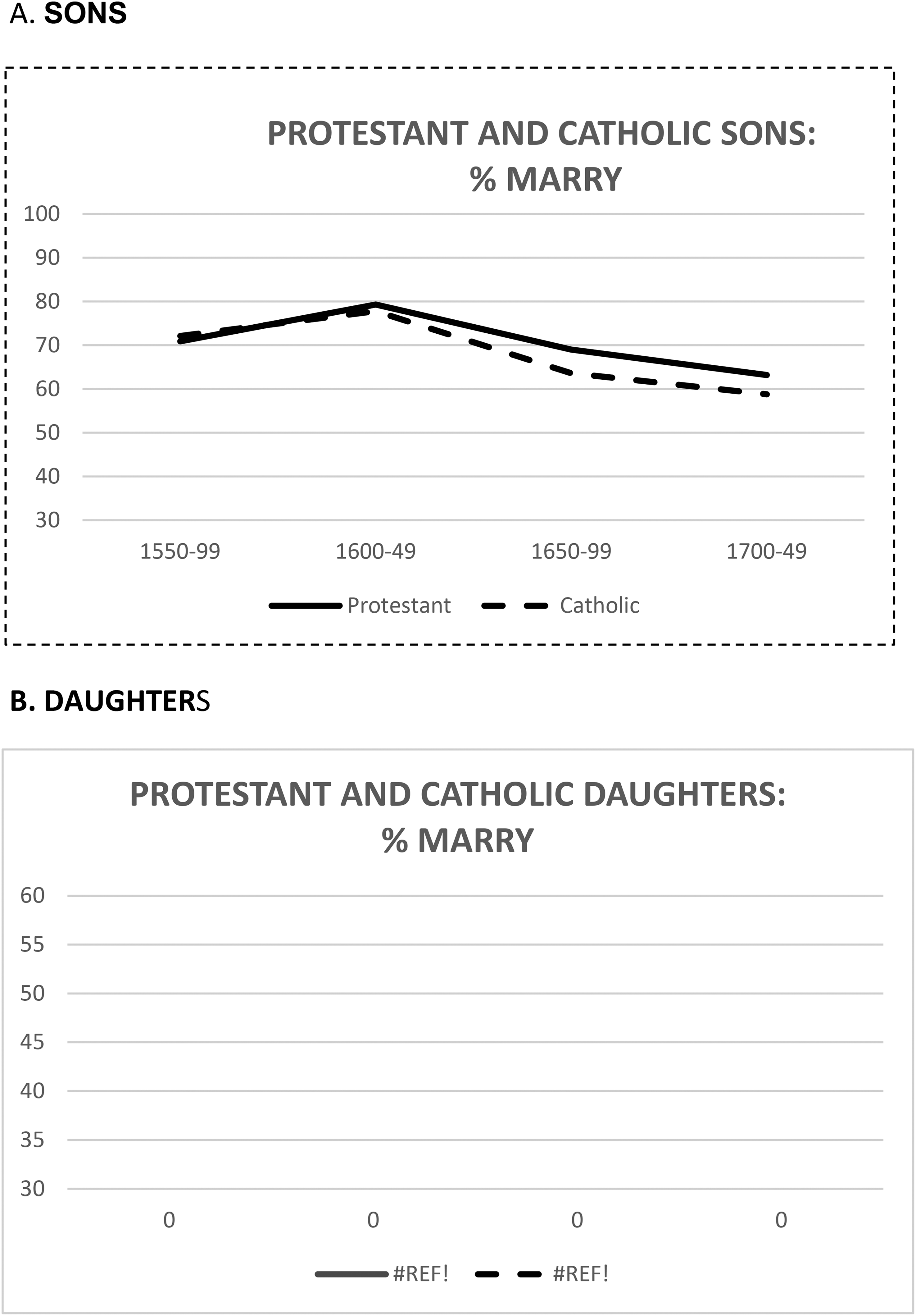
The demographic characteristics of sons of the Warwickshire Catholic elite in the Elizabethan era were roughly similar to those of their Protestant counterparts. In the birth cohort 1550–1599, nuptiality was nearly identical at 71 to 72 percent for each religious group. The marriage rate declined gradually for both Protestant and Catholic sons to about 60 percent in the early eighteenth century. The endogamy rate for Catholic sons was similar to that of Protestant sons from 1550 to 1649, but rose abruptly after 1650. Among sons born 1700–1749, 80 percent of Catholic sons married a wife of equal or higher rank, compared to 55 percent of Protestant sons.
Demographic differences between the two religious groups were much greater among daughters than among sons. In the period 1550–1599, the marriage rate of Catholic daughters (87 percent) was already lower than that of Protestant daughters (94 percent). It dropped precipitously in the next generation, whereas the rate for Protestants declined more gradually. Only about half of the Catholic daughters born in the seventeenth and early eighteenth centuries married, a rate similar to the “common aristocratic pattern” in continental Catholic aristocracies.
In contrast, almost three-quarters of all Protestant daughters born in the eighteenth century married.
Throughout the period 1550–1749, daughters in Catholic families were more likely than daughters in Protestant families to marry a husband of equal or higher rank. The endogamy rate for Catholic daughters rose rapidly in the early eighteenth century, whereas that of Protestant daughters declined. Among daughters of the Warwickshire landed elite born 1700–1749, Catholics were more than twice as likely to marry a husband of equal or higher rank (67 percent) than were Protestant daughters (27 percent). This pattern of declining nuptiality and rising endogamy for both men and women suggests that the Warwickshire Catholic landed elite was following a marriage strategy similar to that of continental Catholic aristocracies.
Conclusions
What conclusions can be drawn from this study of the marriage patterns of the Warwickshire landed elite?
First, the Warwickshire peerage and the landed elite as a whole underwent significant changes in marriage patterns in the late sixteenth century as well as in the early eighteenth century. The sixteenth-century decline in nuptiality, especially that of daughters, is consistent with changes in continental elites in this time period. Until the early eighteenth century, the marriage pattern was hypogamous, in which women “married down” to men of lower status, rather than, as often assumed, hypergamous, in which women “married up” to men of higher status.
Second, generalizations about the marriage patterns of peers cannot simply be extrapolated to the upper gentry. Although Warwickshire peers followed a marriage pattern similar to that described by Hollingsworth for the British peerage as a whole in the period 1550–1749, the upper gentry did not experience the “marriage revolution” which Hollingsworth describes as occurring around 1721. At the middle of the eighteenth century, the marriage patterns of the upper gentry remained hypogamous, even though that of the peers was moving toward hypergamy.
Knights and baronets continued to practice the medieval strategy of marrying as many daughters as possible to obtain alliances, and esquires experienced much less change in endogamy than did the higher ranks of the landed elite. Further study is needed to determine whether these were regional idiosyncrasies or whether such differences between peers and upper gentry were also typical of other parts of England.
Third, the church played little role in the family strategy of the Warwickshire landed elite before the Reformation, and changes among Protestants after 1550 were not primarily driven by the Reformation. After 1550, the marriage patterns of Catholics diverged from those of Protestants, and patterns for Catholic daughters resembled those of continental Catholic elites.
Finally, a major difference between the marriage patterns of the early modern Warwickshire landed elite and those of continental aristocracies is that endogamy declined after the mid-sixteenth century, whereas continental elites became increasingly endogamous in the sixteenth and seventeenth centuries. As Hufton remarks, “the English gentry were more flexible than their continental counterparts in [marrying outside their social class]…Continental aristocratic families were more aware that daughter disposal indelibly marked the standing fo the bride's family. Better an unmarried daughter at home or in the cloister than a record of social failure.” 83
The reasons for this divergence between English and continental elites after the mid-sixteenth century require more explanation, since it has been shown that the Protestant Reformation in England did not have the demographic effects originally attributed to it. Historians of the family in continental Europe have emphasized dowry inflation as the major driver in demographic change, but it is not clear why rising dowries should not have had the same effects in England as they did on the continent. The persistence of a marriage pattern in which women “married down” shows that during the early modern period, the British landed elite was indeed more open than its continental counterparts.
Footnotes

Funding
The author received no financial support for the research, authorship, and/or publication of this article.
Declaration of Conflicting Interests
The author declared no potential conflicts of interest with respect to the research, authorship, and/or publication of this article.
Notes
Author biography
Appendix
Hollingsworth. Derived from T.H. Hollingsworth, Demography of the British Peerage, Table 1: Exogamous and endogamous marriages, . 9 and Table 11: Proportion (per 1000) remaining unmarried, 20. Warwickshire Peers. Warwickshire Knights and Baronets. Warwickshire Esquires. Protestants and Catholics.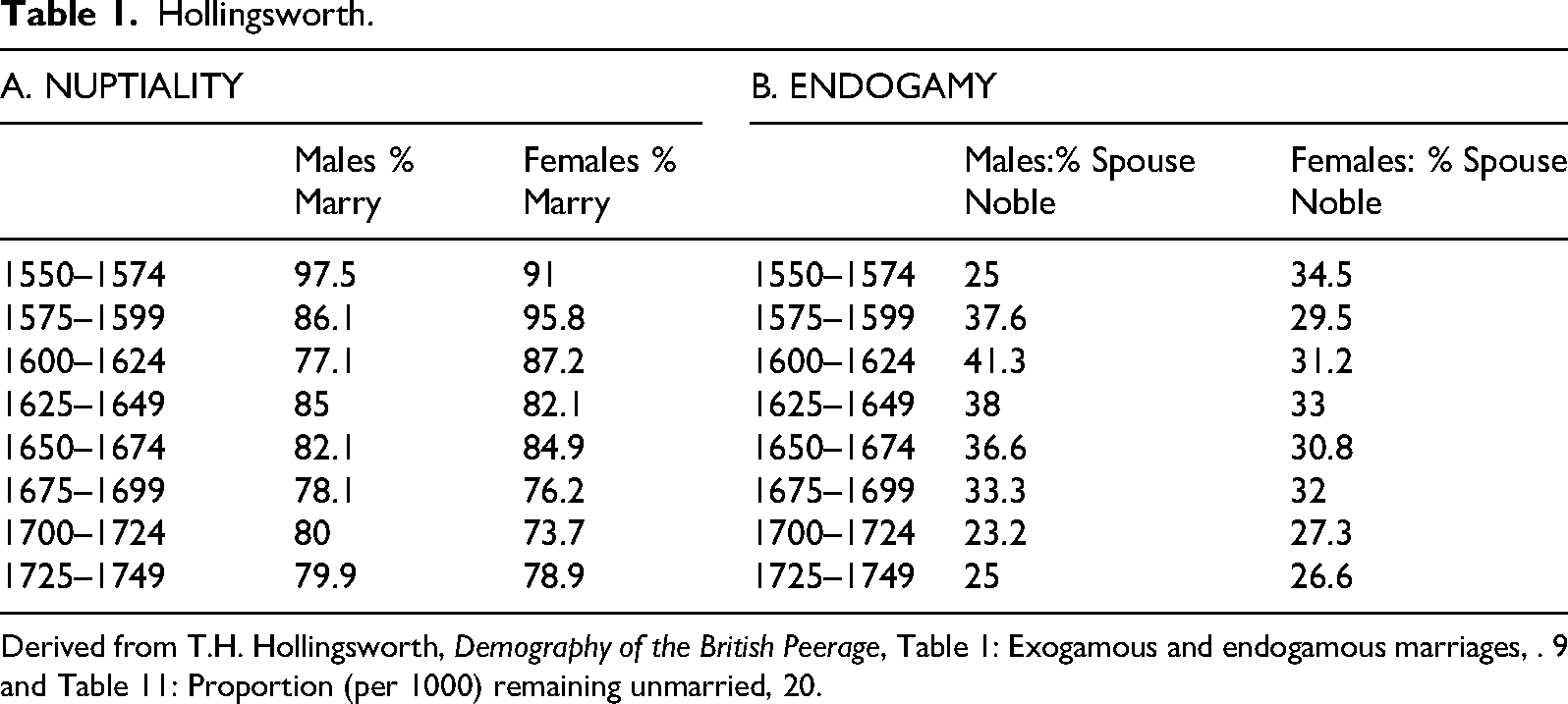
A. NUPTIALITY
B. ENDOGAMY
Males % Marry
Females % Marry
Males:% Spouse Noble
Females: % Spouse Noble
1550–1574
97.5
91
1550–1574
25
34.5
1575–1599
86.1
95.8
1575–1599
37.6
29.5
1600–1624
77.1
87.2
1600–1624
41.3
31.2
1625–1649
85
82.1
1625–1649
38
33
1650–1674
82.1
84.9
1650–1674
36.6
30.8
1675–1699
78.1
76.2
1675–1699
33.3
32
1700–1724
80
73.7
1700–1724
23.2
27.3
1725–1749
79.9
78.9
1725–1749
25
26.6
A
NUPTIALITY
Sons % Marry
Daughters % Marry
Eldest
Younger
All
Eldest
Younger
All
1400–1449
100
66.7
81.3
1400–1449
100
100
100
1450–1499
100
60
76.5
1450–1499
100
100
100
1500–1549
100
83.3
87.9
1500–1549
100
100
100
1550–1599
81.8
90
85.7
1550–1599
100
80
89.5
1600–1649
94.1
67.7
77.1
1600–1649
100
78.3
85
1650–1699
82.6
70
76.7
1650–1699
85.7
68.4
77.5
1700–1749
63.2
77.8
70.3
1700–1749
63.6
54.5
57.6
B
ENDOGAMY
Sons % Wife Daughter of Peer
Daughters % Husband Son of Peer
Eldest
Younger
All
Eldest
Younger
All
1400–1449
85.7
41.7
65.4
1400–1449
66.9
58.3
61.9
1450–1499
64.3
25
46.2
1450–1499
66.7
41.7
50
1500–1549
66.7
25
37.9
1500–1549
66.7
41.7
52.4
1550–1599
33.3
22.2
27.8
1550–1599
22.2
25
23.5
1600–1649
43.8
9.5
24.3
1600–1649
37.5
27.8
32.4
1650–1699
36.8
35.7
36.4
1650–1699
38.9
30.7
35.5
1700–1749
41.7
28.6
34.6
1700–1749
28.3
25
26.3
A
NUPTIALITY
Sons % Marry
Daughters % Marry
Eldest
Younger
All
Eldest
Younger
All
1400–1449
100
80
90.1
1400–1449
100
100
100
1450–1499
100
42.3
70.6
1450–1499
92.9
89.5
90.9
1500–1549
100
70.2
84.8
1500–1549
95.7
84.8
88.4
1550–1599
91.7
62.2
75.3
1550–1599
96.8
100
98.8
1600–1649
99.3
69
83.3
1600–1649
97.9
86
89.4
1650–1699
79.1
50.9
63
1650–1699
88.4
79
82.9
1700–1749
74.1
54.5
64
1700–1749
89.5
85.7
86.9
B
ENDOGAMY
Sons % Wife Equal or Higher Rank
Daughters % Husband Equal or Higher Rank
Eldest
Younger
All
Eldest
Younger
All
1400–1449
70.8
31.3
55
1400–1449
40
50
44.5
1450–1499
60
27.3
50
1450–1499
37.6
52.9
46.6
1500–1549
51.7
30.8
41.8
1500–1549
22.7
35
30.7
1550–1599
75.8
28.6
33
1550–1599
40
37.1
38.1
1600–1649
49.1
22.5
37.9
1600–1649
34.8
35
35
1650–1699
47.1
6.9
28.6
1650–1699
50
30.6
39.1
1700–1749
35
41.6
37.5
1700–1749
29.4
11.1
17
A
NUPTIALITY
Sons % Marry
Daughters % Marry
Eldest
Younger
All
Eldest
Younger
All
1400–1449
96.2
45.2
85.4
1400–1449
100
92.3
96
1450–1499
91.8
57.4
76.9
1450–1499
89.5
92
90.9
1500–1549
100
67.5
84.1
1500–1549
95.8
95.2
95.4
1550–1599
85.4
53.5
68.4
1550–1599
91.5
89.6
90.2
1600–1649
91.7
58.7
74.4
1600–1649
87.2
75.3
79.2
1650–1699
84.1
59
76.8
1650–1699
71.7
51.6
61.3
1700–1749
67.7
59.7
64.4
1700–1749
76.7
49
64
B
ENDOGAMY
Sons % Wife Equal or Higher Rank
Daughters % Husband Equal or Higher Rank
Eldest
Younger
All
Eldest
Younger
All
1400–1449
54.9
42.1
51.4
1400–1449
50
50
50
1450–1499
60.7
22.2
48.2
1450–1499
73.5
41.5
55
1500–1549
78.8
32.1
51
1500–1549
43.5
38
40
1550–1599
73.7
38.9
59.2
1550–1599
44.6
45.5
45.1
1600–1649
66.2
33.3
52.7
1600–1649
39
24.7
29.8
1650–1699
63.5
25
50.9
1650–1699
46.5
57.6
51.3
1700–1749
60.3
57.5
59.2
1700–1749
34.7
52
40.8
A
NUPTIALITY
Sons % Marry
Daughters % Marry
Protestant
Catholic
Protestant
Catholic
1550–1599
70.9
72.1
1550–1599
94.1
86.8
1600–1649
79.3
77.8
1600–1649
90.2
57
1650–1699
69
63.6
1650–1699
76
50
1700–1749
63.2
58.8
1700–1749
72.8
50
B
ENDOGAMY
Sons % Wife Equal or Higher Rank
Daughters % Husband Equal or Higher Rank
Protestant
Catholic
Protestant
Catholic
1550–1599
77
76.9
1550–1599
37.4
60.9
1600–1649
55.5
50
1600–1649
31.7
34.5
1650–1699
48.3
50
1650–1699
42
44.4
1700–1749
55.1
80
1700–1749
26.7
66.7