







Abstract
The Don Army Territory 1867–1916 brought together seven denominational groups, spread across cities and rural areas with contrasting economies. The trajectories of legitimate fertility proved diverse: While urban Orthodox and those in the Lower Don, rural Old Believers, and rural Armenian-Gregorians maintained a high fertility level until 1916, urban Jews, urban Catholics, and urban Armenian-Gregorians showed low fertility. Upper Don Orthodox slowly were reducing their fertility; Buddhists remained at an intermediate level; and Lutherans’ fertility declined in spite of wide fluctuations. These curves and the analysis of short-term fluctuations confirm the precedence of the mortality decline, but put into perspective the effects of urbanization, geography, literacy, and social stratum. They highlight the gradual divergence between the fertility trajectories of Orthodox Cossacks and those of Orthodox peasants. They show the scission that occurred among Armenian-Gregorians. These fertility trajectories do not reveal a single mechanism after the mortality decline, but, depending on the group, intertwine historical events, social conformity, women's latitude to decide, isolation or rallying, and the dilemma between tradition and the aspiration for modernity.
Introduction
The pre-revolutionary Don Army Territory 1 was an oblast in southern Russia crossed by the Don river. Its best-known cities were Rostov-on-Don, its economic capital, Novocherkassk, its political capital, Taganrog, Nakhichevan’, which was founded by Armenians displaced from Crimea by the military authorities under Catherine II, and Alexandrovsk-Gruchevski, which owed its growth to coal mining. The oblast is famous for the Don Cossacks, who formed an irregular army in the service of the Tsar, but society was not limited to the Cossacks alone, who, together with their wives and children, made up only 41% of the population at the 1897 census. High fertility, coinciding with a mortality decline, 2 early marriage, 3 and the arrival of large numbers of migrants from the rest of Russia 4 following the 1868 law 5 authorizing migration, and the addition of the districts of Taganrogskii and Rostovskii (with their cities of Taganrog and Rostov-on-Don) in 1887 brought the population from 0.9 million in 1860 to 3.4 million in 1914. To provide context for the diverse population of this region, according to the table compiled from the 1897 census listing economic sectors by language, 6 78% of speakers of Great Russian, Little Russian, and Belarusian worked in agriculture or agricultural processing, compared with 3% in commerce. These proportions were 54% and 24% for Armenian speakers, 4% and 47% for Yiddish speakers, 25% and 13% for Polish speakers, 58% and 2% for German speakers, and 93% and 0% for Kalmyk speakers (Kalmyk being part of the Mongol-Buryat language family). The interest in studying the demographics of this region between 1867 and 1916, beyond the knowledge gained from a case study, lies in the fact that it took place in a contrasted geography between cities, with their hinterlands occupying the lower Don valley, and the deeper countryside occupying the upper Don valley. It took place in a region with contrasting sociological characteristics between urban and rural areas and between seven denominational groups occupying distinct economic, social, and military positions. This segmentation makes the region a natural experiment for comparing the diversity of fertility trajectories and their determinants. Membership of a denominational group encompassed different types of occupation, different levels of education, different levels of hygiene, and specific attitudes.
Research Question
What insights into pre-revolutionary fertility does the case of the Don Army Territory offer for documenting the demographic transition? Did geographical proximity, social contacts, shared administration, and economic exchanges lead these groups to experience more or less synchronized declines in fertility? If so, membership in a denominational group may have played a major role in shaping fertility patterns. Conversely, did groups of different denominations, origins, and sometimes languages behave differently in terms of fertility? If so, this would imply that the influence of denominational affiliation was limited. The same question arises within the same denominational groups. What roles did remain for demography (age at marriage, juvenile or infant mortality, migration, illegitimate fertility), economics, sociology and types of settlement, and tradition?
The fertility decline has been extensively documented in Europe. It was interpreted as resulting from the rise of secularization and individualism 7 or from the influence of changing attitudes linked to access to and knowledge of birth control (rather than economic changes). 8 Membership of a denominational group may influence attitudes towards childbearing. As a cultural factor, it might prevail over economics in the fertility decline. 9
Can denominational institutions stem the fertility decline? Lesthaeghe and Wilson 10 showed that in Western Europe, Catholic institutions and Protestant organizations helped to partially halt the fertility decline by promoting family values and sexual morality. Kok and van Bavel 11 gave the example of the Netherlands between 1845 and 1945, where Protestant pastors and Catholic priests fought against pregnancy prevention through preaching and calls for discipline. However, according to these authors, while their injunctions were somewhat successful in rural areas, they had little effect in cities. In the case of the Don Army Territory, we shall examine the urban-rural contrast through the Armenian-Gregorian and Orthodox denominations, each of which had settled in cities and rural areas. McQuillan 12 attributed higher fertility in two Catholic villages compared to three Lutheran villages in Alsace between 1750 and 1860 to the more coercive power of Catholic priests. Liczbińska 13 attributed the difference in legitimate fertility rates between Catholics (8.8 children) and Lutherans (4.4 children) in the city of Poznań, Poland, at the end of the nineteenth century to the Catholic Church's interventionism in couples’ lives and the liberalism of the Lutheran Church. However, these rates were specific to Poznań. McQuillan and Gehrmann 14 (and references therein) attributed the higher fertility of Catholics compared to Protestants in Germany, Switzerland, the Netherlands, Poland, and Albania to differences in denominational education. Brown and Guinnane 15 for Catholic Bavaria 1880–1910 and Van Bavel and Kok 16 for the Netherlands 1845–1945 showed that religion influenced fertility only if it was supported by intense social control. This is a question that will arise for the Don Army Territory. Schellekens and van Poppel, 17 from the study of Catholics, Protestants, and Jews in The Hague between 1860 and 1909, showed that religion delayed the fertility decline, and that Jews and Protestants were the first groups to experience a fertility decline, before Catholics. Kok and van Bavel 18 also found that liberal Protestants were the first to experience a fertility decline in the Netherlands.
Which denominational groups pioneered the fertility decline? However, the image of Protestants and Jews as more modern and Catholics as more traditional was challenged by Benz, 19 who showed that Catholics in the city of Baden in 1869 preceded Jews in fertility control and that this control was not solely due to dogma or institutional sanctions, but rather to communication between women, an argument first proposed by Henry. 20 Likewise, Gehrmann 21 attributed the fertility decline among Lutherans in Ortenau (Baden-Württemberg) in the 1770–1840 marriage cohorts to greater freedom of action, despite strict Lutheran doctrines on sexuality and pregnancy. The reconstruction of Coale's indices will enable us to answer the question of which denominational groups were pioneers in the fertility decline.
The question of the geography of transitions is linked to the question of the timing in the onset of the transition. For Catholic France from 1806 onwards, Bonneuil 22 showed that three regions constituting the hinterlands of large cities (Normandy, Champagne-Ardennes, and the Garonne Valley) pioneered in the fertility decline. A wave of decline originating in these three areas spread throughout the country until the early twentieth century, as soon as the mortality decline allowed it. For the Don Army Territory, we will situate the fertility curves of the groups in their geographical space.
Regarding the influence of mortality on fertility, Reher 23 showed that the decline in infant mortality preceded that of fertility. However, infant mortality could also decline as a result of declining fertility, as mothers could take better care of their fewer children, for example by feeding them better. 24 This suggests a possible endogenous relationship between mortality and fertility, which we will test on our data during econometric estimation. The relationship between mortality and fertility ranges from ceasing breastfeeding after an infant's death to the desire to replace the deceased child and to the anticipation of future mortality. Gortfelder 25 found that in Estonia from 1926 to 1949, juvenile mortality increased the risk of another birth, especially as fertility declined. The reason given was the pursuit of a final family size. The fertility decline had first begun in cities. Van de Walle, 26 based on the Princeton European Fertility Project, indicated that fertility had been more sensitive to juvenile mortality (ages 1 to 5) than to infant mortality. Following this recommendation, and as infant and juvenile probabilities of dying declined at roughly the same rate in the Don Army Territory, creating collinearity, we will use the juvenile probability of dying in the regressions.
Fertility decline due to socio-economics? However, Schellekens and Eisenbach, 27 in the case of Israeli Arab Muslims 1955–1972, put forward the “characteristics hypothesis,” according to which religiosity is irrelevant in the face of socio-economic conditions: The values conveyed by religions do have an effect, depending on the degree of adherence of believers, but believers do not always have an accurate understanding of denominational rules, particularly with regard to the prohibition of contraception or the place of women in society. 28 Denominational obedience may also reflect local socio-economic determinants such as literacy. 29 We will examine the possible effect of literacy, based on the data available from the 1897 census. With regard to economic influence, Lesthaeghe and Wilson 30 proposed that, for Western Europe 1870–1930, the fertility decline followed the transition from labor-intensive family production to a wage-based economy, and that religion only changed the timing of the transition without affecting its causes. In Sweden between 1880 and 1930, the fertility decline coincided with the onset of industrialization and urbanization in a predominantly rural society. 31 For France, Bonneuil, 32 using cointegration models based on fertility Coale's indices reconstructed from départemental time series from 1806 to 1906, showed that once mortality was detached from the most severe conditions, the environment lost its influence on fertility variations, while covariations between sets of departments validate the hypothesis of a wave of innovation. 33
Among the factors contributing to the economy, net migration can indicate the economic attractiveness or repulsion of a region. Emigration could reflect the willingness to keep a traditional way of life that seems more possible in the region of destination, 34 or, on the contrary, to escape the demands of community life and the rigors of farm work. People planning to emigrate may also limit their fertility in anticipation of imminent mobility. Immigrants, for their part, may limit their fertility while waiting to become better established in their new residence, or they may be led to adopt family attitudes prevalent in their new place of residence. This is why we will consider fluctuations in the intensity of net migration 35 as a possible determinant of fluctuations in fertility Coale's indices. Here, migration refers to the movement of people away from their usual place of residence to a new place of residence, 36 across a district or city border. Immigrants include people coming from other districts or cities or from outside the Don Army Territory; emigrants include those leaving for another district or city, or a region located outside the Don Army Territory. Net migration intensities are obtained through the population reconstruction and are based on resident populations.
For the Don Army Territory specifically, using data from the 1897 census, Coale et al.
37
estimated the overall fertility, legitimate fertility, and illegitimate fertility indices (whose formulas we give in the method section) at = 0.627,
Regarding illegitimate births, Vishnevski 40 found that, in 1880, such births accounted for 17.8% of all births in the 80 biggest cities of European Russia, compared with 4.6% in other cities and 1.9% in rural areas. These figures were 17.2%, 3.9%, and 1.8% in 1890, 13.4%, 3.9%, and 1.8% in 1900, and 12.1%, 4.1%, and 1.5% in 1910. Although these figures are skewed by differences in age structures by marital status, they reflect a time-varying urbanization gradient. We will find such a disparity between urban and rural areas in terms of illegitimate births.
Coming after this rich literature, what does the case study of the Don Army Territory contribute? It offers an exceptional terrain for following up and comparing the fertility trajectories of seven denominational groups (Orthodox, Old Believers, Jews, Catholics, Armenian-Gregorians, Lutherans, and Buddhists), living side by side in the same Territory, if not in the same city, subject to the same administration, dependent on each other economically, and linked by political events. The literature review allowed for selecting explanatory variables: denominational affiliation crossed with geographical location, economy through the intensity of net migration and grain price 41 (and redemption payments for Orthodox and Old Believers), and demography through age at marriage, juvenile mortality, and illegitimate fertility. We will test the effect of these variables on legitimate and illegitimate fertility Coale's indices.
The case study of the Don Army Territory allows for comparing other denominational groups who were present in Western Europe, besides Lutherans, Catholics, and Jews. Even for these three denominational groups, the context in southern Russia was different. The case study therefore allows for testing the determinants available in time series relating to economy (net migration, grain price), geography (Upper/Lower Don, urban/rural divide), age at marriage, and mortality, and for testing spatial correlations for the possibility of a wave of innovation sweeping across the Territory. The reconstruction of the population 42 and associated mortality, marriage, fertility, and net migration intensities in time series make it possible to go beyond the snapshot provided by the 1897 census alone and reveal the changes that took place during the period. By comparing the fertility destinies of the district-denominational groups, we will answer questions about the influence of the denominational obedience, the possibility of a geographical gradient, an urban/rural divide, pioneer groups, the precedence of the decline in infant or juvenile mortality, the importance of socio-economic factors (urbanization, industrialization, migration), and the influence of literacy.
After presenting the context and data quality, and recalling the method used to reconstruct fertility Coale's indices, the curves will reveal the diversity or similarities in fertility declines: We will highlight a northwest-southwest gradient, the divergence in fertility declines between Orthodox and between Armenian-Gregorians, and the rapid decline in legitimate fertility among Jews, Catholics, urban Armenian-Gregorians, and rural Lutherans. The analysis of short-term fluctuations where legitimate and illegitimate fertility Coale's indices and juvenile mortality are endogenous will make it possible to test the influence of the proposed determinants, with the appropriate delays. It will reveal that geographically close groups, some of whom were affiliated with the same religious organizations, reacted differently to the increased possibilities of limiting the number of pregnancies. The correlation matrices between the disturbances will reflect the influences from one district-denomination to another. The case study will highlight the role of social stratum and the fragility of explanations based on denominational obedience, the economy, urbanization, and education.
Background and Data
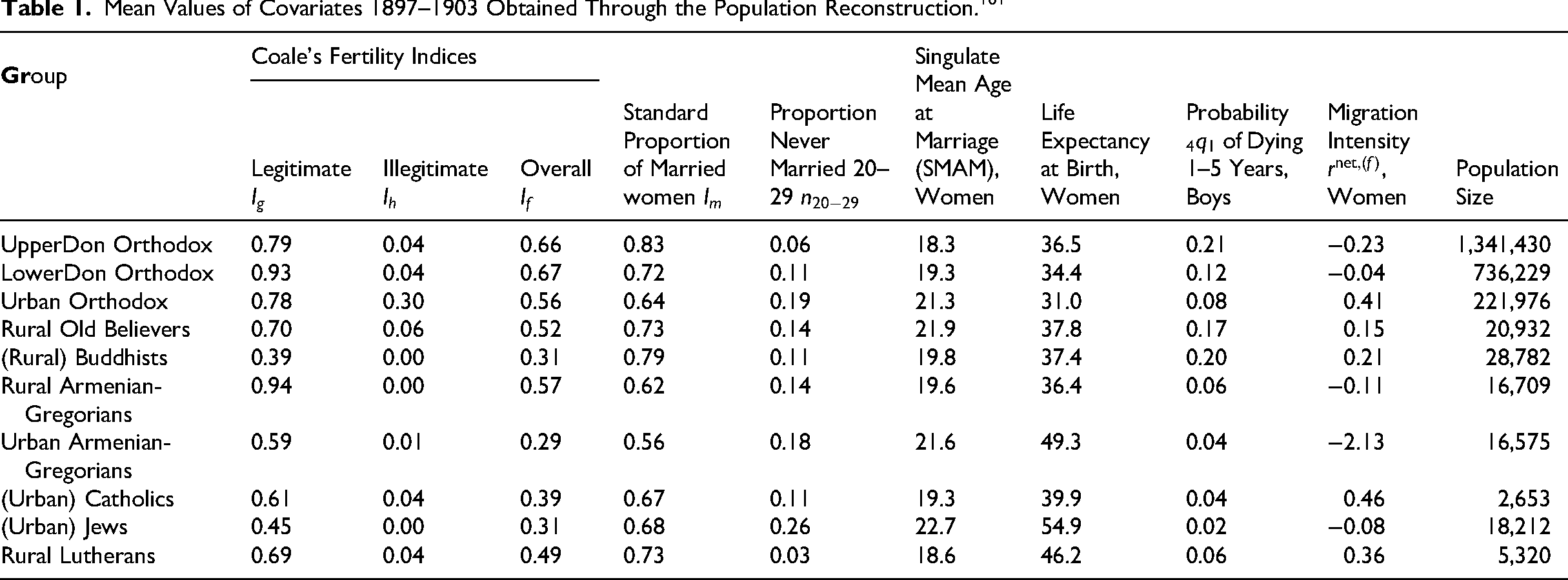
Figure 1 shows the subdivision of the oblast into its cities (marked by dark spots) and districts (okrug). The two districts of Rostovskii and Taganrogskii belonged to the Ekaterinoslav Province before 1887. The Upper Don Valley, the most rural region, comprised the districts of First Don, Second Don, Ust-Medevskii, Donetskii, and Khopyorskii; the Lower Don Valley comprised the districts of Cherkasskii, Rostovskii, and Taganrogskii. Hereinafter, these two groups refer to the districts without their cities Rostov-on-Don, Azov, Taganrog, Nakhichevan’, Novocherkassk, and Alexandrovsk-Gruchevski. The Territory was dominated numerically by Orthodox (91% at the 1897 census), but also included Old Believers, who were schismatic Orthodox attached to a traditional way of life, 43 as well as Lutherans, who were German settlers, 44 Armenian-Gregorians living in rural areas (mainly Rostovskii) or in the city of Nakhichevan’, Buddhists in the southern district of Sals’kii, Jews residing in the cities of Taganrog and Rostov-on-Don, and, in this latter city, Catholics. The population figures are shown in the last column of Table 1.
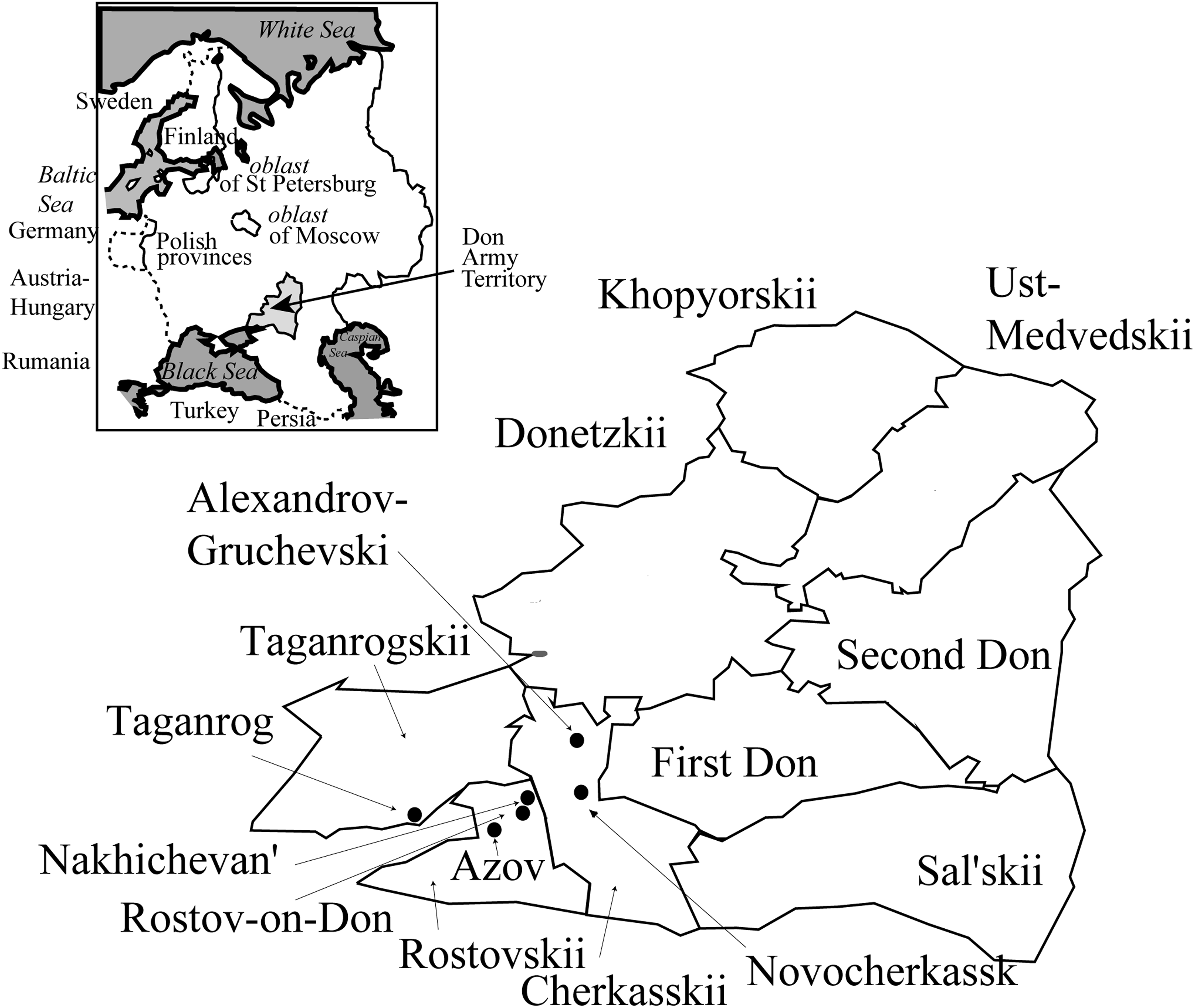
Districts and cities of the Don Territory in 1900. In the left-hand corner, The Don Army Territory (152,700 km2) in 1900 European Russia. Source: M. Gilbert, The Dent Atlas of Russian History (2nd edition, London 1993).
Mean Values of Covariates 1897–1903 Obtained Through the Population Reconstruction. 101
Data quality The Don Army Territory was allowed to provide an irregular army to serve the Tsar, instead of its men being enlisted in the regular army. For this reason, the Chancellery kept a register of the population, both Cossack and non-Cossack, which makes it possible to verify the civil register kept by the Orthodox Church of births, deaths, and marriages, as stipulated in the Compendium of Laws of the Russian Empire, volume X, articles 25–33. For its part, the Church forwarded the data from its own records to the Statistical Committee (Compendium of Laws, volume X, articles 28, 34, 35, 78). Matters of marriage and divorce were dealt with by denominational courts (Compendium of Laws, volume X, articles 24, 33, 38, 73). This double registration and its concordance provide an initial guarantee of data reliability. 45 The 1873 census, 46 which was conducted only in the Don Army Territory, provides a useful benchmark, in addition to the 1897 census, 47 which was conducted for Russia. The reconstruction presented below provides a robust test of data quality, insofar as, as the time series are long enough, registration errors cause errors to spread rapidly, producing aberrant mortality or fertility values, revealing poor data recording. 48 Such series are few and were discarded, while validated series are consistent. The absence of outliers in the reconstructed time series of mortality, marriage, net migration rates, and fertility indices provides further assurance of the quality of the data.
Method
The population reconstruction by stochastic optimization
49
is too lengthy to be described in detail here. Its principle consists of minimizing the distance between reconstructed and recorded time series of births by sex, deaths by age and sex, population counts by sex,
50
migration statistics if any,
51
and age and sex pyramids from the 1873 and 1897 censuses.
52
The dynamic is McKendrick's, giving population age classes at 1st January of year t+1 as resulting from age classes at 1st January of year t modified by the life and net migration tables by sex s of year t. The minimization program provides the optimal argument solution time series
By district-denominational group, we therefore have time series of Coale's total fertility index
Examining temporal correlations between fluctuations in relevant time series will allow for testing short-term causal relationships in Granger's sense. As fertility and juvenile mortality indicator time series are often declining, estimating the relationships between fertility indicators, their determinants, and indicators for other districts and denominational groups requires stationarity of the series (that the distributions of the random variables do not depend on time), to get rid of temporal auto-correlations. This is achieved through first differences. As fertility may depend on juvenile (or infant) mortality (in a mechanism of catching up for deceased children), but the latter may depend on fertility (in a mechanism of limited resources for child care), legitimate and illegitimate fertility indices (
Results
The mean values of the covariates for the period 1897–1903 presented in Table 1 show that most rural groups (rural Orthodox, (rural) Old Believers, and rural Armenian-Gregorians) had high fertility levels and most urban groups (urban Armenian-Gregorians, Jews, and Catholics) had relatively low fertility levels. However, the division between rural and urban areas does not perfectly correspond to the division between high and low fertility levels, as shown by urban Orthodox and (rural) Buddhists. In addition, groups of the same denomination differed slightly (Orthodox) or considerably (Armenian-Gregorians).
Figure 2 shows a northeast-southwest spatial gradient in legitimate fertility among rural Orthodox. Each map has its own scale to highlight spatial gradients, whereas a single scale would obscure these gradients and merely show the fertility decline over time. All Orthodox districts in the Upper Don had slightly lower mean fertility levels than Orthodox districts in the Lower Don (excluding cities).
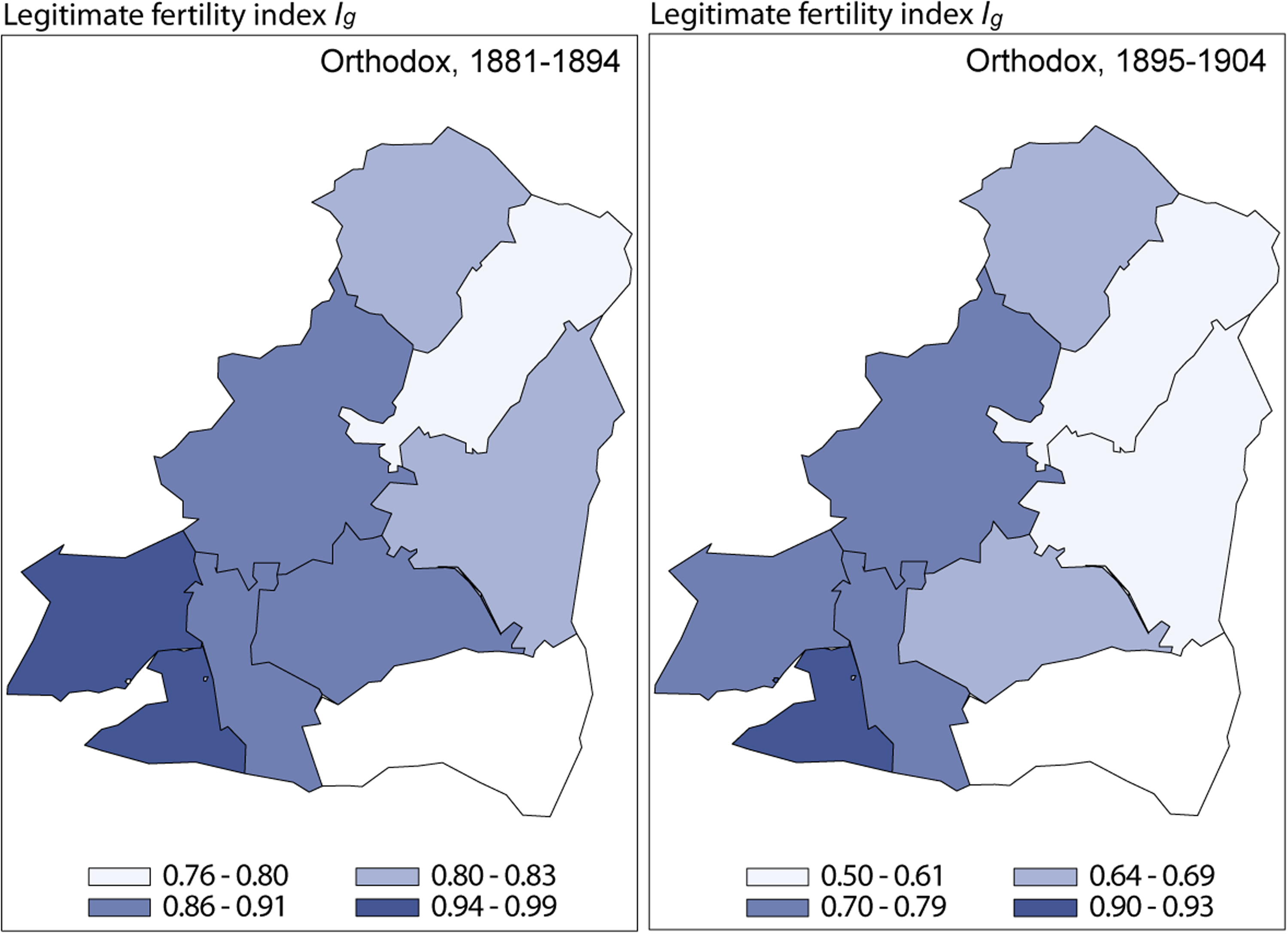
The geographic gradient in legitimate fertility persisted among rural Orthodox.
The grouping of denominational groups’
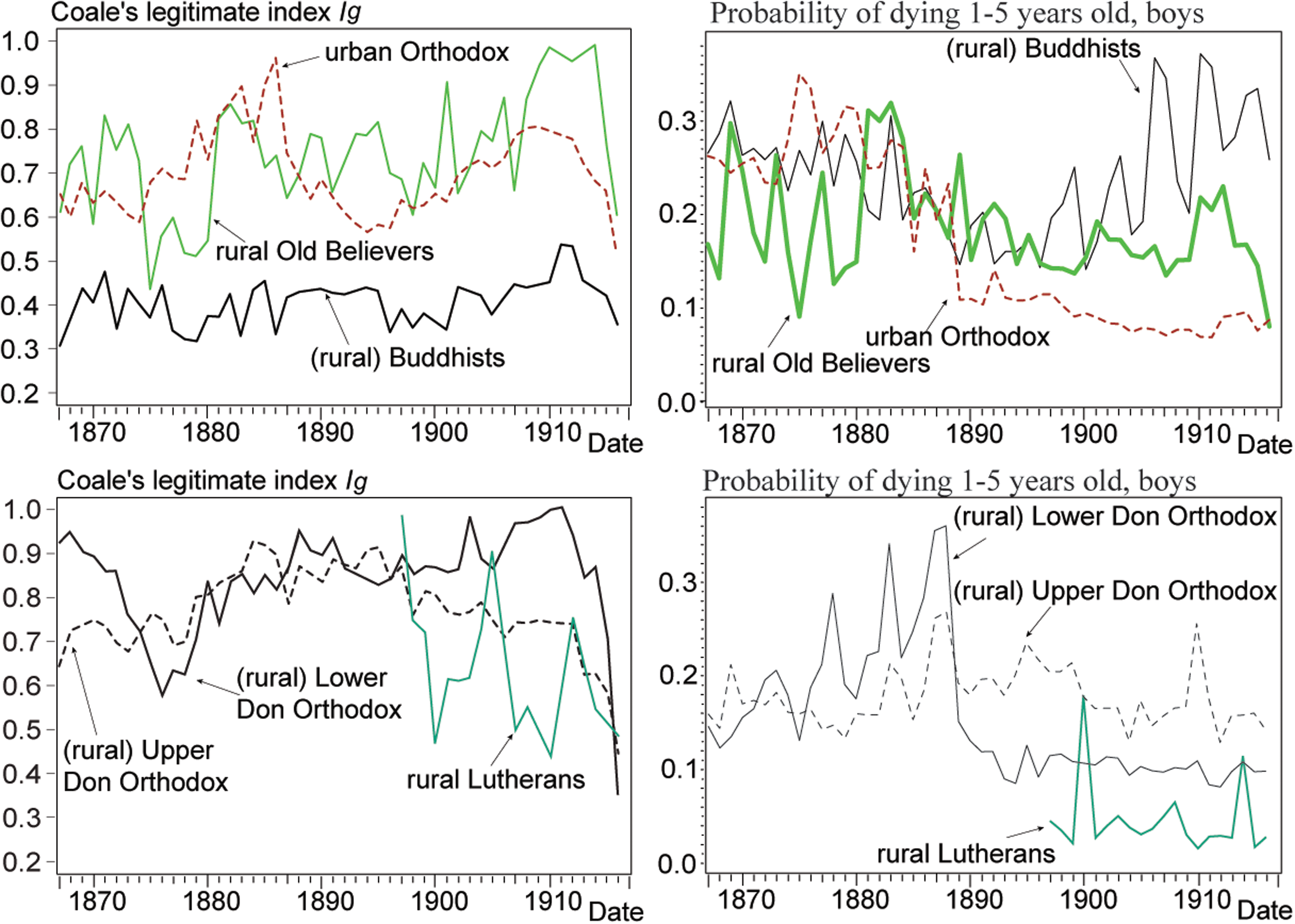
Legitimate fertility and juvenile mortality in the Don Army Territory (before 1887, the Lower Don was limited to the Cherkasskii district and “urban Orthodox” referred only to Novocherkassk, as Rostovskii and Taganrogskii were incorporated into the Don Army Territory only at that date).
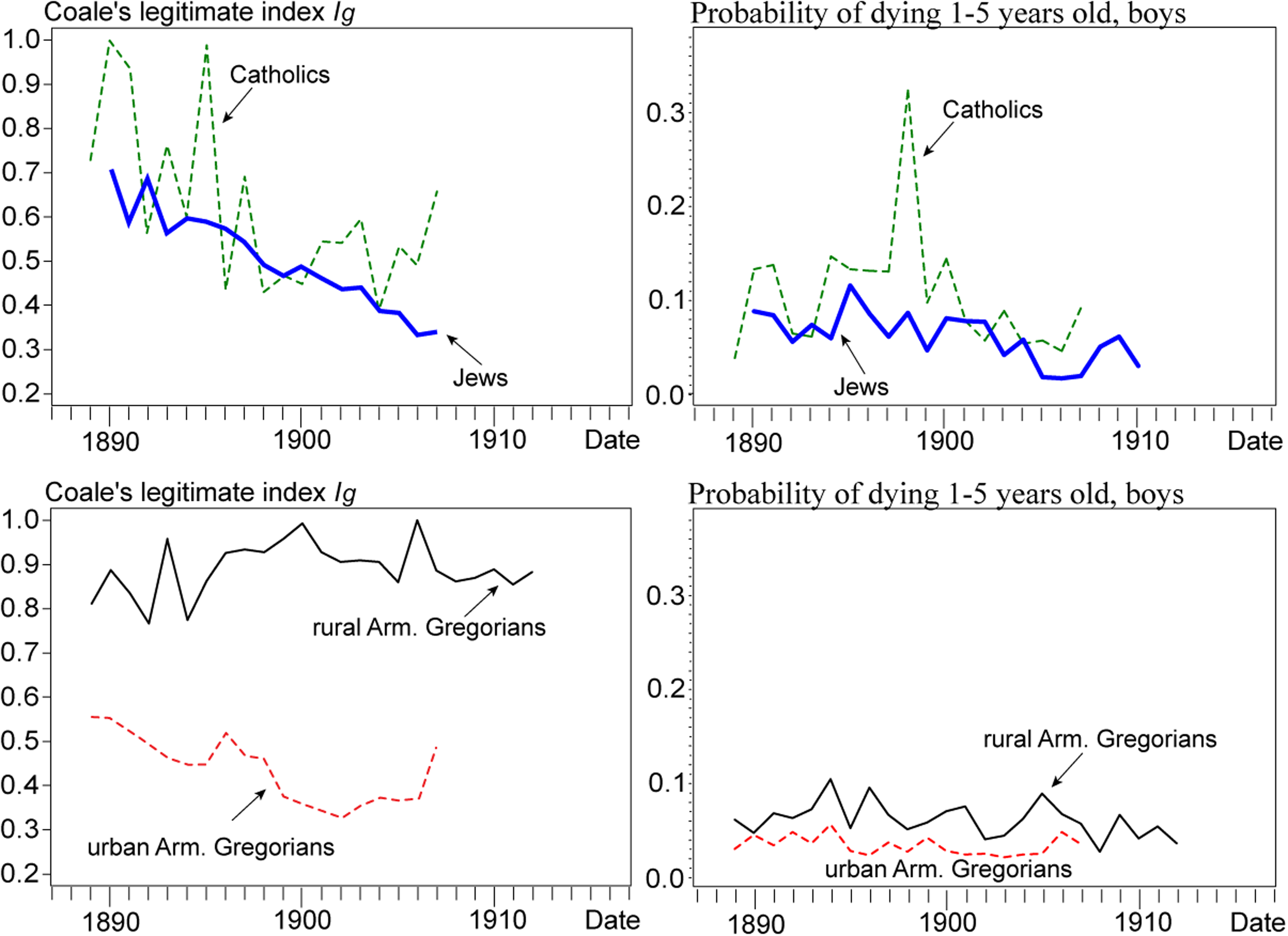
Legitimate fertility and juvenile mortality in the Don Army Territory (Continued from Figure 3).
The case of Buddhists, who were semi-nomads (and Cossacks), is particular. They maintained their fertility at a relatively low level, despite a relatively high infant mortality. This value may puzzle readers who expect rural populations to have a high fertility level. However, firstly, the reconstruction is robust and validates such a low level. The period of population reconstruction is long enough that a possible under-registration of births should lead to inconsistencies, which is not the case (too few births would be associated with comparatively too many deaths, leading to implausible life expectancies). Secondly, documentation on the Buddhists Kalmyks of Mongolia between 1862 and 1918 shows that they, too, had a low fertility level for a pre-modern society. 63 One reason cited is monastic life and endemic venereal diseases. For the Sal'skii district, we found corroborating testimony from a contemporary statistician, though his assessment remains qualitative, that Kalmyk families had significantly less children than Orthodox families. 64
Figure 4 shows a joint decline in legitimate fertility and juvenile mortality among urban Armenian-Gregorians (residing in the city of Nakhichevan’), Jews (residing in the cities of Rostov and Taganrog), Catholics (from Rostov), and (rural) Lutherans, despite marked fluctuations (which are also found in the recorded birth data). For urban Armenian-Gregorians and Jews, the fertility decline had predated the start of the reconstructed series. For Catholics, the decline should have started in 1896.
Figure 4 shows the gap between rural Armenian-Gregorians in the Rostovskii district (outside cities) and those in the city of Nakhichevan’, which was located in the Rostovskii district. The divergence had occurred before 1889, the first date in the reconstructed time series. Here are two groups that were geographically close and of the same denominational obedience, but which took radically different paths, the former remaining in the old demographic regime, while the latter had moved into a low fertility regime.
Figure 5 shows that illegitimate fertility was virtually non-existent among Jews, Armenian-Gregorians, and Buddhists. It primarily concerned urban Orthodox. Life in the city definitely did not reduce legitimate fertility among Orthodox, as might be expected based on the literature on urban life and fertility. Its effect however was felt in the surge in illegitimate fertility. However, the figures for illegitimate births in Rostov-on-Don may be inflated by the registration of abandoned children born elsewhere. We do not have the statistical data needed to estimate this bias.
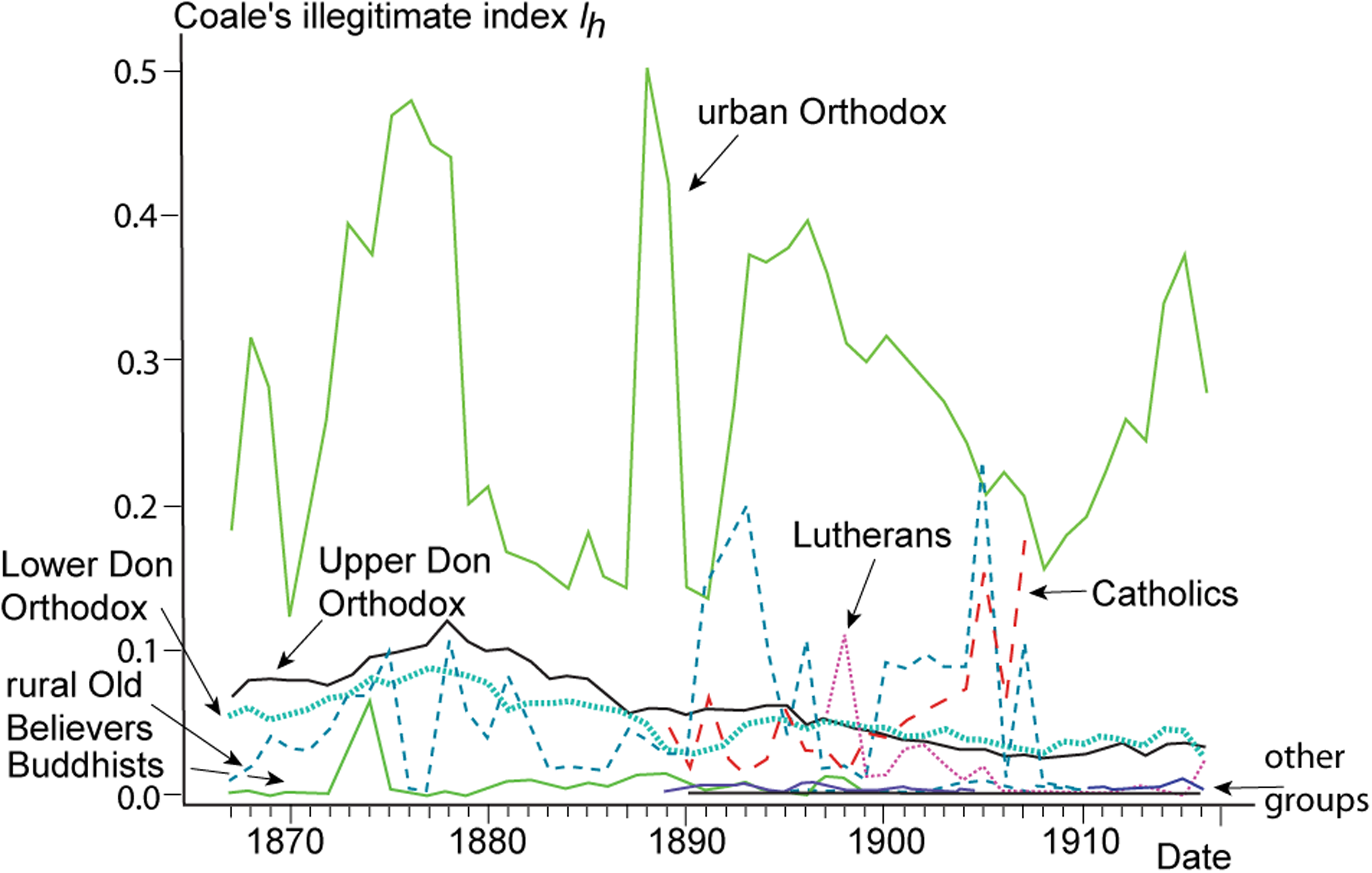
Illegitimate fertility index (before 1887, the Lower Don was limited to the Cherkasskii district and “urban Orthodox” referred only to Novocherkassk, as Rostovskii and Taganrogskii were incorporated into the Don Army Territory only at that date).
Short-Term Fluctuations
Tables 2‒4 present the coefficients estimated by model (1). Table 2 shows that when the (one-year-lagged) changes in juvenile mortality or the SMAM have a significant effect on those of
Regression of the First-Differenced Legitimate Fertility Index Ig in the Simultaneous Seemingly Unrelated Regressions (System (1)). Δ Designates First Difference.
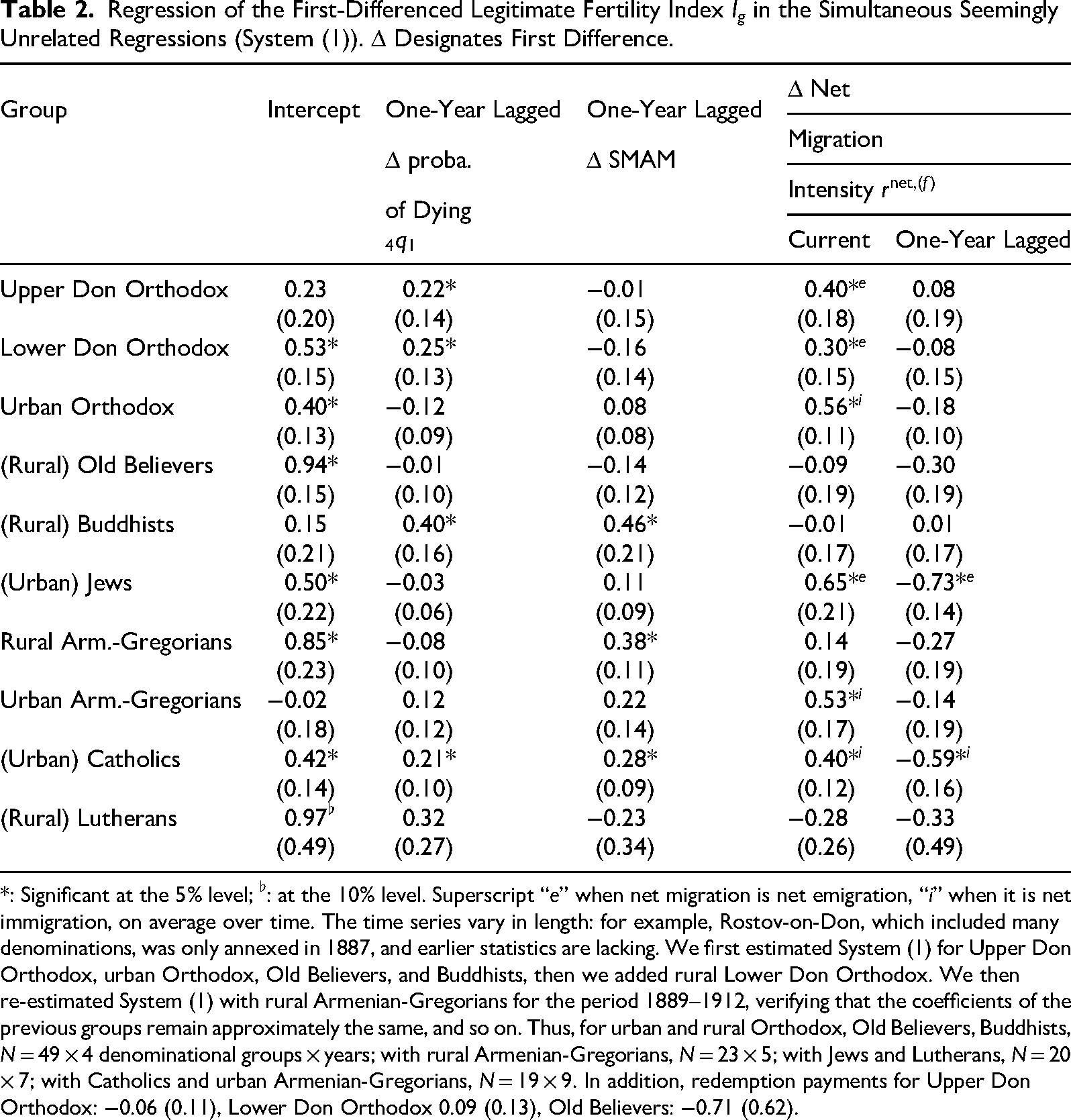
*: Significant at the 5% level; ♭: at the 10% level. Superscript “e” when net migration is net emigration, “i” when it is net immigration, on average over time. The time series vary in length: for example, Rostov-on-Don, which included many denominations, was only annexed in 1887, and earlier statistics are lacking. We first estimated System (1) for Upper Don Orthodox, urban Orthodox, Old Believers, and Buddhists, then we added rural Lower Don Orthodox. We then re-estimated System (1) with rural Armenian-Gregorians for the period 1889–1912, verifying that the coefficients of the previous groups remain approximately the same, and so on. Thus, for urban and rural Orthodox, Old Believers, Buddhists, N = 49 × 4 denominational groups × years; with rural Armenian-Gregorians, N = 23 × 5; with Jews and Lutherans, N = 20 × 7; with Catholics and urban Armenian-Gregorians, N = 19 × 9. In addition, redemption payments for Upper Don Orthodox: −0.06 (0.11), Lower Don Orthodox 0.09 (0.13), Old Believers: −0.71 (0.62).
Regression of the First-Differenced Probability of Dying
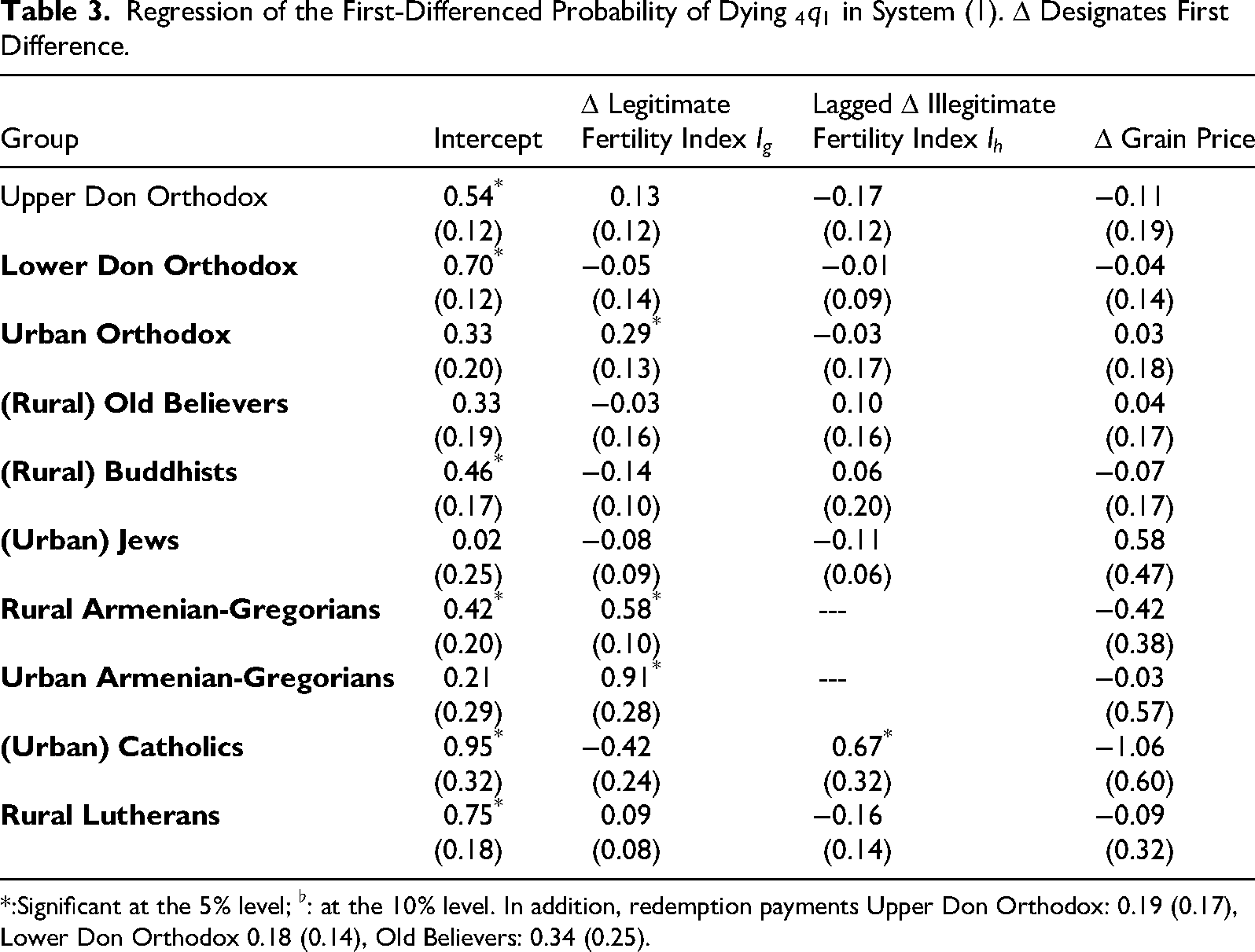
*:Significant at the 5% level; ♭: at the 10% level. In addition, redemption payments Upper Don Orthodox: 0.19 (0.17), Lower Don Orthodox 0.18 (0.14), Old Believers: 0.34 (0.25).
Regression of the First-Differenced illegitimate fertility index Ih in System (1). Δ Designates First Difference.
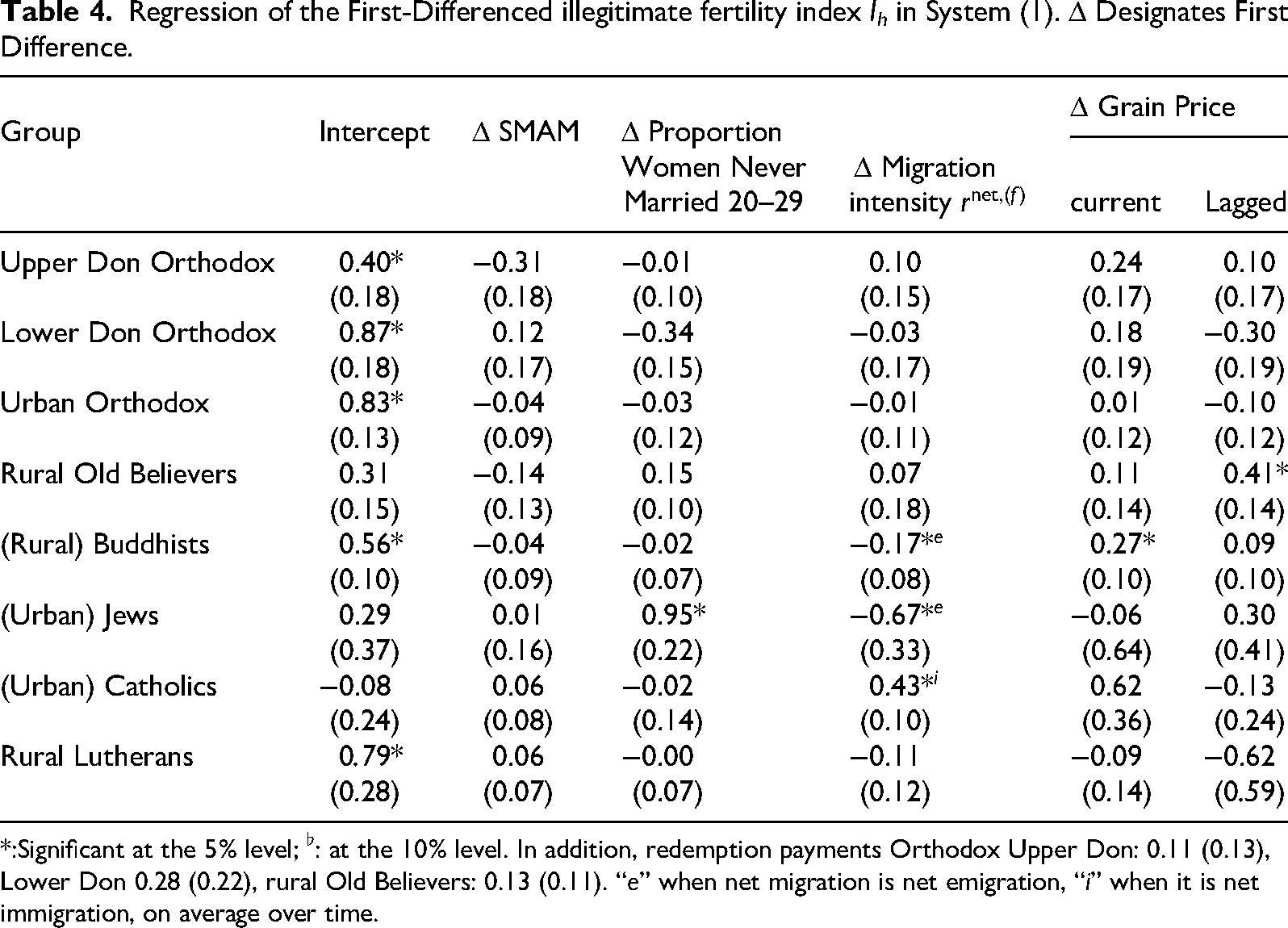
*:Significant at the 5% level; ♭: at the 10% level. In addition, redemption payments Orthodox Upper Don: 0.11 (0.13), Lower Don 0.28 (0.22), rural Old Believers: 0.13 (0.11). “e” when net migration is net emigration, “i” when it is net immigration, on average over time.
Variations
Table 3 shows a significant effect of
The variations
The correlation matrix of residuals in System (1) presented in Table 5 between groups indicates a spatial medium-level correlation of short-term fluctuations between urban and Upper Don Orthodox for
Correlations Between Residuals of Equations in System (1). Standard deviations in parentheses for large enough correlations.
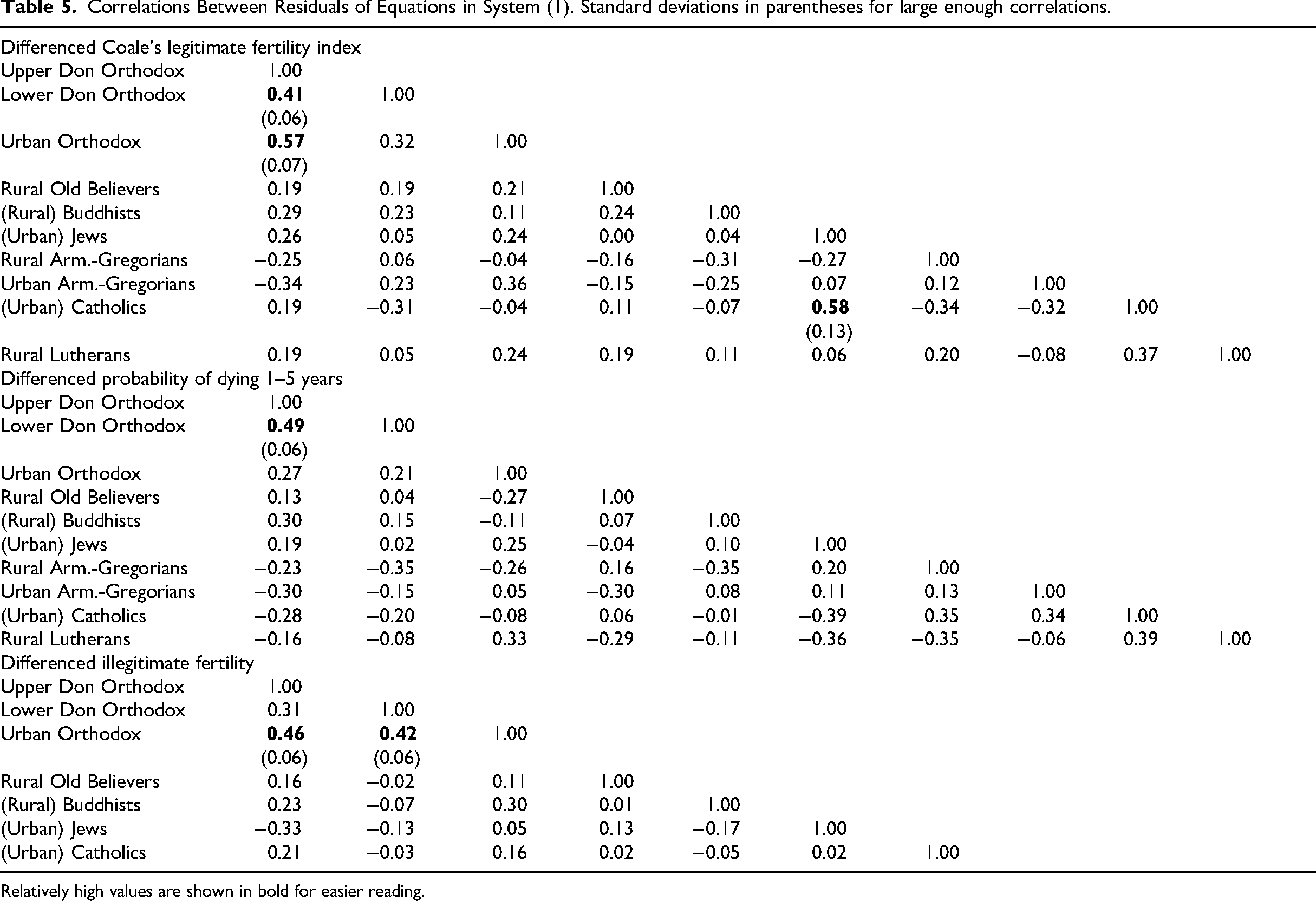
Relatively high values are shown in bold for easier reading.
Discussion
Diversity within same denominational groups, similarities between denominational groups: Figures 3‒5 and the analysis of short-term fluctuations have shown that the seven denominations, which nevertheless resided side by side, followed diverse fertility trajectories during this period.
This was made possible by the likely heterogeneous dissemination of contraception and abortion. Mironov 65 has compiled contemporary accounts from across Russia, notably from Almazov, 66 relating to the spread of contraception in Russian cities. The use of contraceptives was believed to have led to a fertility decline in St. Petersburg. For example, in 1893, physician Boryakovsky 67 railed against the spread of condoms and the “epidemic of miscarriages.” He also mentioned priests in the confessional admonishing men against the use of coitus interruptus. Abortion was prohibited 68 and exposed offenders to 4‒10 years of hard labor, possibly exile to Siberia, prayers and fasting, and excommunication from the Eucharist for 10 years. 69 Citing Afinogenov 70 and Popov, 71 Mironov listed rudimentary methods of abortion, including physical constraints and the ingestion of substances, ranging from a spoonful of gunpowder dissolved in water to self-inflicted abuse and the artificial prolongation of breastfeeding. 72
Between access to contraception, a personal desire to have fewer children, and tradition, the Upper Don Orthodox were the only group among the three Orthodox groups and Old Believers to experience a steady, albeit slow, decline, beginning in 1896. Did the divergence after 1896 between Orthodox stem from the lesser presence of clergy in the Upper Don compared to the Lower Don and cities? The ratio of the total number of secular clergy, drawn from the reports of the Statistical Committee of the Don Army Territory from 1881 to 1909, to the population size was highest in the city of Novocherkassk (20.6 per 1,000 in 1884, 14.0 in 1894, 3.9 in 1905), but it was somewhat higher in the Upper Don (4.5, 3.4, and 2.6 in those three years) compared to Lower Don (5.2, 2.4, and 1.5) and comparable to the ratio for urban Orthodox (14.5 in 1884 (at that time only for the cities of Novocherkassk and Alexandrovsk-Gruchevski), 4.1 in 1894, and 2.0 in 1905 (adding Rostov and Taganrog, which were annexed to the Territory after 1887)). The fertility decline in the Upper Don was therefore not due to a lack of Orthodox clergy. The slight but undeniable decline in fertility among Upper Don Orthodox can therefore hardly be attributed to a relative shortage of priests. The priests may not have had the power to influence the number of pregnancies either. 73
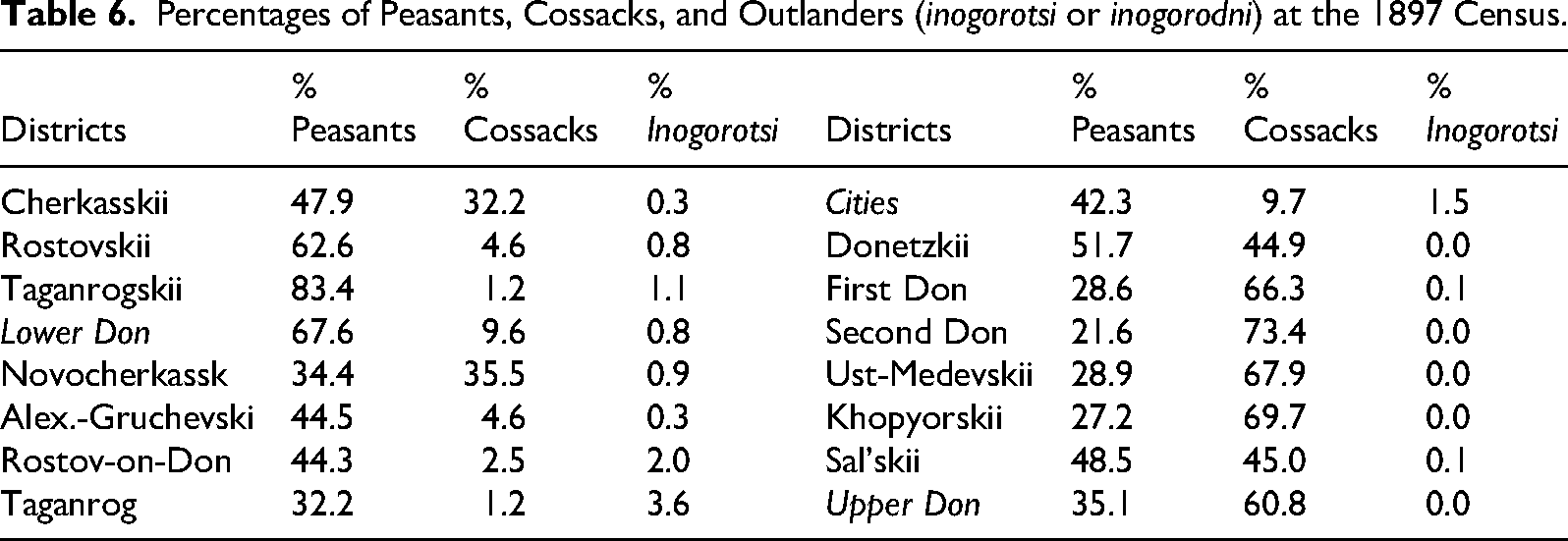
Did the divergence after 1896 between Orthodox stem from a higher level of education in Upper Don than in Lower Don and in cities, insofar as education has often been associated with initiation or better mastery of contraception? We do not have time series data on education levels, only data from the 1897 census. This census indicates that 7.5% (SD = 1.4, N = 5) of women over the age of 16 in Upper Don (excluding Sal'skii, which was predominantly populated by Buddhists) could read and write, compared to 16.9% (SD = 3.5, N = 3) in Lower Don and 30.4% (SD = 10.5, N = 5) in cities. These peasants and Cossacks were also Orthodox: The 1897 census indicates that 86% of the population in cities was Orthodox, 93% in the Lower Don, and 91% in the Upper Don excluding Sals’kii, meaning that the vast majority of these peasants and Cossacks were Orthodox. These percentages of Orthodox are so high that, even without interpolation from the margins of the tables on literacy, the percentages of Orthodox women over the age of 16 who could read and write maintain the hierarchy that literacy was least prevalent among Upper Don Orthodox and most prevalent among urban Orthodox. A possible reason for this difference is that schools and teachers were established by spreading out from the cities, 74 which gave the Lower Don an advantage in this regard over the Upper Don—and thus peasants over Cossacks—as Table 6 shows: Peasants outnumbered Cossacks by a factor of 7 (67.6% to%9.6%) in the Lower Don and by a factor of 4.4 (42.3% to9.7%) in the cities, while Cossacks outnumbered peasants by a factor of 1.7 (60.8% to35.1%) in the Upper Don. In any case, the fact remains that the Upper Don, with its low literacy rate, preceded the Lower Don, with a higher literacy rate, in the fertility decline. The result is that education, which has been claimed to promote birth control, does not function here as a determinant of declining fertility. The case of the Don Army Territory thus provides a notable counterexample to the effects of literacy on the fertility decline.
Percentages of Peasants, Cossacks, and Outlanders (inogorotsi or inogorodni) at the 1897 Census.
Cossacks and peasants were different social strata, or social classes; in Russian сословие. Hence a possible explanation in terms of social stratification for the decline in legitimate fertility among Upper Don Orthodox, compared with the sustained high fertility levels among urban and Lower Don Orthodox. In Cossack households, men and women were described as living as equals, with the Cossack wife managing the household and taking care of everything in her husband's absence. 75 Their husbands’ absences due to military campaigns meant that Cossack women not only performed manual labor but also hired and managed workers and servants. 76 Cossack women knew how to trade part of their harvests. They participated in social life and local democracy. Although they did not participate in the stanitsa assemblies nor had the right to vote there, they could still submit their requests there. They did so during votes held at intervals that varied by stanitsa—ranging from 3 to 17 years—regarding the annual allocation of arable land and pastures. 77 They were therefore not ordinary peasant women crushed by work and trapped in the routines of rural life. They had a form of education, even if it was oral, which we can assume was more receptive to the adoption of new ideas and practices than the more rudimentary education of peasant women. In spite of their low level of literacy, we suggest that the level of involvement in social life and the economy may have favored a better dissemination of knowledge related to the limitation of the family.
By contrast, peasant women did not enjoy this autonomy nor were they required to take initiative. Their husbands did not go off on military campaigns. The lot of the peasant woman is described as unenviable in comparison to that of the Cossack woman. 78 Like the heroine of Tolstoy's novel Anissia, the Life Story of a Peasant (set in the 1860s in the Tula oblast), she was submissive to her husband and was worn out prematurely by work in the fields. Winter brought her no respite, as she spent her time weaving and carding wool.
Thus, the social status of Cossacks meant that Cossack women may have enjoyed greater freedom to gather and learn about contraception, whereas peasant women were constantly tied to their work and subject to constant subjugation. This argument echoes Henry's proposal 79 on the importance of communication between women, and Gehrmann's 80 argument on women's freedom of action. Furthermore, as Table 6 shows, inogorotsi (also called inogorodni), who were immigrant peasants from the rest of Russia and arrived with high fertility, preferred to settle in the best employment area, which was the Lower Don (due to industrial agriculture and the nascent steel industry in Alexandrovsk-Gruchevski, located in the Cherkasskii district (Lower Don)). 81 These inogorotsi were likely to have more traditional attitudes towards childbearing, favoring high fertility.
Other denominational groups contribute to further diversifying the picture of fertility in the Don Army Territory.
Urban and rural Armenian-Gregorians offer a second case of a same denomination showing even more divergent trajectories (Figure 4). In the city of Nakhichevan’, the low level of
On the one hand, the fertility trajectories of groups of same denomination (Orthodox and Armenian-Gregorian) diverge, while on the other hand, different denominational groups show similar trajectories, such as Jews, Catholics, and urban Armenian-Gregorians. In terms of timing and levels, urban Armenian-Gregorians and Jews appear to have been pioneers, starting before 1889, followed by Catholics. The timing of the fertility declines corresponds to that of the decline of juvenile mortality, as shown in Table 1 and Figure 4, right panel. Unfortunately, we do not have indicators of literacy level by denomination and therefore cannot compare the timing of the declines with literacy levels. This succession of denominational groups in the fertility decline is unlikely to have been due to mixed marriages: For the entire Don Army Territory at the 1897 census, among the Orthodox, 113 out of 2,314,222 spoke Yiddish (compared to 15,005 individuals out of the 15,978 recorded as Jews, or 94%); 155 spoke Polish and 356 spoke German (compared to 88% of Catholics who were recorded as speaking Polish (31%) or German (57%) and 97% of Lutherans who spoke German); and 125 spoke Kalmyk (compared to 99.4% of Buddhists). Among the 10,047 Catholics, 0 spoke Yiddish; among the 15,005 Jews, one person spoke Polish and 15 spoke German; among the 28,306 Lutherans, three spoke Yiddish and 40 spoke Polish; among the 27,118 Armenian-Gregorians, 101 spoke Russian, and 0 spoke Polish, German, or Yiddish. Therefore, assuming that converts did not in significant proportions adopt the majority language spoken in the denominational group they joined, this correspondence between languages and religions reflects very low rates of conversion, which confirms Avrutin 84 for Russia as a whole and casts doubt on the possibility that declines in fertility were due to mixed marriages.
The mortality decline preceded the fertility decline, as Figures 3 and 4 show. The often cited reason is an adjustment of fertility in relation to the number of surviving young children, or lower infant or juvenile mortality among women who have fewer pregnancies and more time to devote to childcare.
85
However, as is well known, a mortality decline does not necessarily lead to a fertility decline. This is evidenced here by the cases of urban Orthodox and those in the Lower Don, rural Armenian-Gregorians, and Old Believers. The positive significant coefficients in the short-term analysis of delayed juvenile mortality fluctuations on those in
The fertility declines among Jews, Catholics, and urban Armenian-Gregorians coincided with the onset of industrialization and urbanization, but this was not the case for urban Orthodox and those in the Lower Don, although they lived in an industrial employment area. Urbanization and industrialization therefore played a role in declining legitimate fertility for all groups but the Orthodox.
Resources and fertility: Rural economic affairs, daily life, and certain military matters were governed at the assembly (called сход or сбор) of the stanitsa (Cossack village) or at the assembly (called община) of the volost (peasant village). Land was normally divided into equal shares (pai) of 30 desiatins (1 desiatin is about 1.09 hectare) for each Cossack (law of April 21, 1869 86 ) or around 3.75 desiatins for each peasant. 87 When this economy functioned, it provided sufficient resources for couples to maintain a high fertility level. This was the case in the Upper and Lower Don, as shown in Figure 3, at least in the beginning of the period. However, three factors disrupted this mechanism. First, the Don Army Territory in the last quarter of the nineteenth century entered an environmental crisis, to the point that a special commission led by Lieutenant General Maslakovets 88 was convened in 1898 to analyze its causes. Maslakovets denounced the mismanagement of the stanitsa forests and the lack of protection against illegal logging. In 1907, the honorary vice-consul of France in Rostov-on-Don reported to the Ministry of Foreign Affairs that the average total number of desiatins, even taking into account state-owned lands, did not exceed 14 desiatins per male Cossack. 89 The availability of low- and medium quality land declined slowly, while good quality land declined faster. 90 Likewise, the amount of land allocated to each peasant was reduced to 1.8 desiatins in the 1880s. 91 Second, a law enacted in 1875 required Cossacks to finance their own equipment, which constituted a considerable expense. Third, the increasingly constrained resources resulting from declining mortality and environmental degradation should have prompted rural Orthodox to have fewer children, but their SMAM declined only slightly, 92 by an average of 0.06% per year from 1867 to 1916, and their legitimate fertility indices remained high, declining only slowly in the Upper Don (Figure 3). Over this period, the population size of the Upper Don continued to grow by an average of 2% per year. Furthermore, if fertility had reacted strongly to resource degradation, fluctuations in grain price should have influenced the fertility level. Analysis of short-term fluctuations has shown that this was not the case. We have also noted the coincidence of a peak in illegitimate births, especially among urban Orthodox, following the economic crisis of 1873: There would therefore be no homeostatic regulation by grain price, but economic crises would delay the age at marriage, which would explain at least in part the peaks in illegitimate fertility in the years following 1873.
Analysis of short-term fluctuations has shown the influence of net migration on legitimate fertility. Net migration is linked in part to employment and associated with the shift from family production to wage labor.
93
The positive effect of current net emigration on
This attempted explanation also applies to (urban) Catholics and urban Armenian-Gregorians—both of whom received net immigration on average over the period. These two groups have also significant positive coefficients associated with net immigration on
Throughout the observation period, Buddhists behaved in a manner of their own, with a
(Rural) Lutherans were distinct, with large fluctuations in legitimate fertility and the non-significance of all coefficients in the regression of the short-term fluctuations of
With regard to the geography of the decline of legitimate fertility, we find that fertility first declined in cities among Jews, Catholics, and Armenian-Gregorians, but, as we have already mentioned, urban Orthodox, who lived alongside these minorities on the same streets, 97 maintained a high fertility level until 1914, while their counterparts in the (rural) Upper Don gradually reduced their fertility levels, and (rural) Lutherans even more rapidly. The Don Army Territory therefore qualifies the presumed primacy of cities over rural areas in the fertility transition.
Table 4 has shown that illegitimate fertility responded to few determinants. We found the influence of grain price only for (rural) Old Believers and (rural) Buddhists, in a scheme of delaying marriage when price is higher. We found that fewer immigrant women arriving in the Catholic group (which consisted of 88% of Polish and German speakers, as we mentioned) increased
A comparison with historical events shows that the 1905 pogrom in Rostov (176 people killed and 500 beaten and mutilated
98
) was followed in 1906 by a slight increase in
The Don Army Territory, with its diverse denominational groups spread across the region, thus defies simple patterns of fertility transition within a single region: Neither denomination alone, nor the rural-urban divide alone, nor geographical proximity alone, nor declining mortality alone explain the variety of fertility trajectories. Orthodox and Old Believers remained attached to the model of high fertility, but Upper Don Orthodox gradually broke away. Armenian-Gregorians were keeping high fertility in rural Rostovskii, but joined the low fertility pattern in the city of Nakhichevan’. They were pioneers of the fertility decline, together with Jews, then Catholics and Lutherans. However, the case of Buddhists does not correspond to either the maintenance of high fertility or the transition to low fertility.
Women may have been motivated to have fewer children, if only to be able to provide better care for those already born. The concomitant mortality decline provided the opportunity. The dissemination of knowledge about contraception provided a capability. Acceptability—this is what we are proposing—was linked to the status of women, which in turn was associated with social stratum: either peasant woman overwhelmed by work and submissive, or Cossack woman enjoying a certain latitude in decision-making. The case of the Don Army Territory is therefore consistent with the motivation-opportunity-ability-acceptability theory inspired from Edmond Locart. 99 And we suggest that acceptability was the source of the divergence in trajectories for the Orthodox.
For Armenian-Gregorians, while rural dwellers remained faithful to tradition, city dwellers quickly embraced the Western way of life, of which birth control was a part.
Bonneuil 100 showed that neither declining mortality nor economic growth (here marked by migration, grain price, and the urban-rural divide) necessarily lead to declining fertility. Rather, these variables generate a shifting virtual equilibrium associated with a shifting norm of family size. Practices may follow this shifting norm, reacting to a greater or lesser extent to short-term fluctuations, but the paths may be as varied as the trajectories reaching a (moving) target (in the case of rural Armenian-Gregorians, Lower Don Orthodox, or Old Believers, these trajectories did not even start out towards the target). On the one hand, there was a demand from couples for fewer pregnancies, fueled by the increased expected survival of children born and threatened resources. On the other hand, attitudes inherited from the past and the difficulty of accessing contraception could slow down change. Less childbearing within marriage here went hand in hand with women's greater latitude in decision-making. This latitude could be conferred by city life, as was the case for urban groups other than the Orthodox. The city was therefore not the primary determining factor. As we have seen, this latitude could stem from belonging to a valued social class—that of the Cossacks—which enjoyed land and social privileges, where men were often required to be away and relied on women to run the farms. The large number of groups studied and the diversity of their denominational, economic, and military situations made it possible to qualify the effects of denominational obedience, literacy, the urban/rural divide, and resource constraints. However, women's decision-making latitude was exercised within a context specific to each denomination-district or denomination-city, where one must take into account tradition, knowledge of and access to contraceptives, and the cultural preference for a norm of fewer surviving children (the appeal of the Western model among urban Armenian Gregorians, for example, which had resulted in a rapid decline in legitimate fertility among this group).
Conclusion
The Don Army Territory allowed for comparing no fewer than seven denominational groups, with two denominations spread across cities and rural areas, at a time when fertility transitions were underway in western Europe. This is why it provides an exceptional field of observation, made possible by the reconstruction of flows in time series. Beyond the case study, the Don Army Territory questions certain mechanisms of fertility transition theory that have sometimes been presented as causal, such as religion, literacy, urbanization, and economics.
One of our questions concerned the role of denominational obedience in stemming the decline in fertility. We have seen that the answer offered a range of behaviors. On the one hand, urban and Lower Don Orthodox, (rural) Old Believers, and rural Armenian-Gregorians remained firmly committed to the pattern of high fertility level until 1914; on the other hand, Jews, Catholics, and urban Armenian-Gregorians adopted the pattern of low fertility level fairly quickly; on a third side, Upper Don Orthodox slowly reduced their fertility; fourthly, Buddhists remained at a relatively low level; fifthly, Lutherans’ fertility was subject to wide fluctuations, albeit with a downward trend and reaching low values. Membership in a denominational group therefore did have an effect on fertility behavior, but this effect was not unambiguous and allowed for divergence within the same groups.
Urban Armenian-Gregorians and Jews were the pioneers of the fertility decline, closely followed by Catholics and Lutherans. This answers our second question about who led the decline.
The case of the Don Army Territory showed the fertility decline associated with urban residence, as expected. This association applies to Jews, Armenians-Gregorians, and Catholics. But the case of urban Orthodox, with their high fertility level, shows that this link was not unconditional; and the case of Lutherans and Upper Don Orthodox shows that residing in rural areas did not prevent these groups from undertaking their transitions in fertility.
The case of the Don Army Territory showed that literacy was not such a good indicator. Social stratum is a better one. This result was made possible by statistics broken down by social stratum, which is rare in pre-1914 statistics. This further underscores the interest in studying the Don Army Territory. These two variables could have been confused in other contexts, as people belonging to a high social stratum are often the first to learn to read and write. The geography of social stratification explains the northeast/southwest gradient in legitimate fertility, which answers our third question about the geography of the transition.
As expected, the decline in juvenile or infant mortality preceded that of fertility, when it occurred, for each group. This answered our fourth question. Analysis of short-term fluctuations has shown once again that fertility responded to mortality for certain groups. It has also highlighted the effect of net migration and the limited effect of grain price, thus answering our fifth question on the influence of the economy.
This study has limitations related to the possibility of reconstructing fertility Coale's indices, the length of the reconstructed series, and the limited nature of the information available on practices and the economy. However, few historical case studies have such a wealth of data, made possible by the quality and abundance of the information available.
The Don Army Territory paints a diverse picture of the fertility transition, with its ten groups (urban, Upper- and Lower-Don Orthodox, Old Believers, Buddhists, Jews, Catholics, rural Lutherans, and rural and urban Armenian-Gregorians) showing a variety of trajectories: maintenance at a high level for some, maintenance at an intermediate level for another, rapid decline for some, slow decline for another, and a steady decline punctuated by sharp fluctuations for another. When declining mortality and the spread of contraception had made fewer pregnancies feasible, women's decision-making latitude made the differences between groups. However, women's decision-making latitude still had to contend with infant and child mortality, economic factors, tradition, social judgment, and access to contraceptives, which meant that denominational groups that began a fertility decline experienced varying patterns of decline.
Footnotes
Ethics approval
The paper is respectful of all ethical issues.
Funding
The authors received no financial support for the research, authorship, and/or publication of this article.
Declaration of Conflicting Interests
The authors declared no potential conflicts of interest with respect to the research, authorship, and/or publication of this article.
Data Availability Statement
Available on request.
Generative AI and Figures,Images and Artwork
No use of AI.
