






Abstract
In an effort to increase strength in hamstring tendon grafts for anterior cruciate ligament reconstruction, braiding or weaving of the tendons has been suggested. The purpose of this study was to examine the biomechanical properties of two braiding techniques compared with a four-stranded tendon graft using a sheep model. Digital extensor tendons from 5 adult sheep were harvested in 28 matched pairs and randomly allocated to French plait or four-stranded weave. The grafts were tested in a hydraulic testing machine with the tendons secured in brass grips frozen with liquid carbon dioxide. The tendons were preconditioned to a distraction of 1 mm for 10 cycles followed by testing to failure at 50 mm/sec, with a data acquisition rate of 1000 Hz. The stiffness, ultimate load to failure, and the mode of failure were recorded. All braided samples failed at the midsubstance, while the four-stranded controls failed at the grip interface. There was a significant reduction in strength and stiffness of the braided samples compared with the controls. This study demonstrated that braiding decreases the strength and stiffness of a four-stranded tendon graft by up to 54% and 85%, respectively. This finding is supported by the work of Hearle et al. (1969), who demonstrated that the decrease in strength of fiber bundles is equal to the square of the cosine of the twist angle. The twist angle in our samples was approximately 45°, which equates to a decrease in strength of 50%.
Much controversy surrounds reconstruction of the ACL with regard to graft choice, tensioning, flexion angle at tensioning, and fixation method.1,3,4,6,7,11,13,14,16–18,20 Most surgeons performing ACL reconstruction use an intraarticular autogenous graft from either the patellar tendon or hamstring tendons. It has been suggested that hamstring tendon grafts are weaker than patellar tendon grafts, although there are conflicting data where multiple strands of the hamstring tendons are used.1,7,14–16,18,20
In an effort to improve the strength of ACL reconstructions, Cooper et al. 2 examined the effect of twisting the patellar tendon graft. They reported that a 90° twist significantly increased the tensile strength of the patellar tendon. The results of Munns and coworkers 10 in 1994 agree with the findings of Cooper et al., while other groups have reported no significant difference in graft strength with twisting. 9 Recently, it has been proposed that braiding hamstring tendons will increase the graft strength. 19 To our knowledge, there are no biomechanical studies to date that support this theory. The purpose of this study was to examine the biomechanical properties of two braiding techniques compared with a four-stranded tendon graft using an in vitro sheep tendon model.
Materials and Methods
Digital extensor tendons from 5 adult sheep (18 months old) were harvested in 28 matched pairs, and 14 pairs were randomly allocated to two braiding techniques: French plait or a four-stranded weave. The contralateral matched tendons were used as controls (Fig. 1). The two tendons were doubled over to make a four-stranded construct for both braids and matched controls. The tendons were braided to a length of 7 cm with both techniques. All tendons were kept moist with phosphate-buffered saline during preparation and stored frozen before testing. The tendons were thawed overnight at room temperature before testing. 21
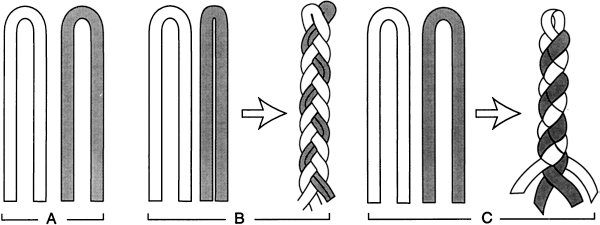
Schematic representation of the two braiding techniques illustrating the three groups. A, four-stranded technique (control). B, plait group. C, weave group.
Tendons were tested using an MTS 858 Bionix Testing Machine (MTS Systems Corp., Eden Prairie, Minnesota) with a standard gauge length of 25 mm. The tendons were secured in brass grips, which were frozen with liquid carbon dioxide for a maximum of 2 minutes. 12 Care was taken not to freeze the gauge length (25 mm) of the tendons. The tendons were preconditioned to a distraction of 1 mm for 10 cycles followed by testing to failure at 50 mm/sec, with a data acquisition rate of 1000 Hz. The stiffness (in newtons per millimeter) for the first 10 cycles was calculated (Table 1). The stiffness, ultimate load to failure, and the mode of failure were recorded in testing to failure.
Structural Properties of Braided Tendon Grafts Compared With Control Grafts

Data were analyzed using a one-way analysis of variance followed by a Tukey's honest significant difference test with significance set at P < 0.01. The ratios of the braided tendons to the contralateral control tendons were also calculated.
Results
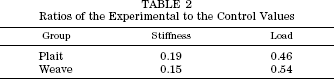
The gauge length of all tendons was unaffected by freezing of the brass grips. Some freezing of the tendons at the grip interface was unavoidable; however, this did not significantly affect our results. 12 No slippage of tendons in the grips during testing was detected. The tendon components of the braided samples failed primarily at midsubstance (Fig. 2), while the four-stranded controls failed at the grip-tendon interface. Inter- and intrafiber failure were noted in both groups. The precondition stiffness for the braided tendons was significantly lower than that of controls (P < 0.001) (Table 1). The structural data to failure revealed a significant reduction in strength and stiffness of the braided samples compared with that of controls (P < 0.001) (Table 1). Table 2 shows the ratios of the experimental to control values.
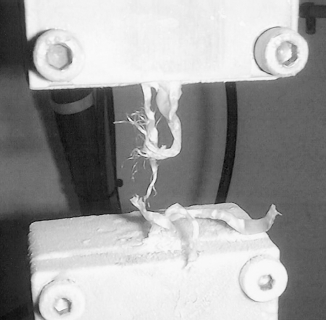
Mechanical testing sample after testing to failure demonstrating midsubstance failure and fiber failure.
Ratios of the Experimental to the Control Values
The load-displacement curves reflected the different patterns of failure. The braided samples failed in a step-wise manner of multiple peaks with no well-defined yielding region. The four-stranded controls demonstrated the characteristic sigmoidal curve common for dense connective tissue with a toe region, linear region, yield, and failure (Figs. 3 and 4).
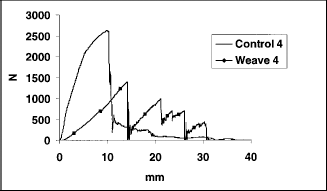
Load versus displacement of a control four-stranded graft and weave sample from the same animal. The control sample demonstrates the classic sigmoidal shape, while the weave sample is less stiff, less strong, and presents step-wise failure.
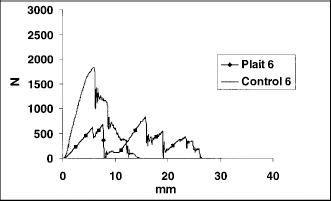
Load versus displacement of a control four-stranded graft and plait sample from the same animal. The control sample demonstrates the classic sigmoidal shape while the plait sample is less stiff, less strong, and presents step-wise failure.
Discussion
Anterior cruciate ligament reconstruction is the most common soft tissue procedure performed by orthopaedic surgeons. A number of different fixation methods exist for tibial and femoral fixation along with a variety of graft choices.7,8,11,14,18 The mechanical properties of the graft are an important parameter in the reconstruction and rehabilitation. The suggestion for the use of braiding to strengthen tendon grafts appears to have been based on an assumption that braiding is used in the construction of ropes, yarns, and sutures to increase strength. 19 This, however, is not the case. Indeed, braiding is used extensively in the manufacture of ropes, yarns, and suture, but it is used to improve flexibility and handling properties, not strength. Studies by Hearle et al. 5 on ropes and yarns show a decrease in fiber bundle strength mathematically related to the angle of the twist. Strength was shown to decrease by the square of the cosine of the twist angle.
The twist angle in our samples was approximately 45°, and the square of the cosine of the twist is approximately 0.5. This equates to a decrease in strength of 50%, which correlates well with our findings of a decreased strength of 54%. Moreover, the stiffness of the braided samples decreased up to 85%. This is also significant, as the stiffness of the construct plays a crucial role in ACL reconstruction and overall stability of the knee.
These results indicate that braiding of tendon grafts in ACL reconstruction is not advisable because it significantly reduces both strength and stiffness of the graft. Considering that the strength of the graft is strongest immediately after reconstruction, aggressive rehabilitation of a knee with a braided graft may overload the graft and result in premature failure.