






Abstract
Background: Little is known about the frequency of or risk factors for injuries in middle school or junior high school football players.
Purpose: To examine the associations of player characteristics (injury history, conditioning, player position, special equipment) and physical parameters (body mass index, weight, height, grip strength) with risk of injury.
Study Design: Prospective cohort study.
Methods: We documented risk factors for injury in 646 middle school football players, 10 to 15 years of age, in the Oklahoma City, Oklahoma, school district during the 1998 and 1999 seasons. Player characteristics and physical parameters were measured at the beginning of both seasons. Logistic regression methods were used to determine whether baseline variables were associated with the odds of subsequent injury.
Results: More playing experience was the only variable significantly associated with the risk of injury in multivariate analyses. This association was observed regardless of the type of injury and even after indirectly controlling for time at risk of injury by restricting analyses to first-string players. Increasing age was significantly associated with the risk of fractures.
Conclusions: Results suggest that physical characteristics play a minor role in risk of injury from football in this age group.
Although the number of middle school, or junior high school, football players (ages 10 to 15) is unknown, it is estimated that more than 1.1 million young men play high school football in the United States each year, and at least 350,000 injuries occur annually.10,18 Recent data indicate that sports-related injuries are responsible for 2.6 million emergency department visits annually by children and young adults. 1 Many studies have reported the frequency of and risk factors for injuries in high school football players.2,3,5–7,9,13–15 Few studies, however, have assessed the frequency of injuries in middle school football players and none have examined the risk factors for injury in this age group. Knowledge of the variables influencing and contributing to the risk of injury in football is important for the development of effective prevention strategies. The purpose of this study was to describe the epidemiology of and risk factors for injury in middle school football players.
Materials and Methods
A prospective study was conducted of risk factors for injury in middle school football players during the 1998 and 1999 seasons. The study population consisted of 646 (1998, N = 292; 1999, N = 354) volunteer, male, middle school football players, in grades 6 to 8, 10 to 15 years of age, from the nine middle schools in the Oklahoma City, Oklahoma, School District. A player was eligible to participate in the study if he was on the football team roster and present on the day baseline measurements were collected at his school. This study was approved by the Institutional Review Board of the University of Oklahoma Health Sciences Center and by the Oklahoma City School District.
Baseline physical measurements were taken and a brief questionnaire was administered to all participating players before or within the first 4 weeks of the regular football season. Trained interviewers used a standardized questionnaire to collect information from each player, and a single interviewer did most (98%) of the interviews. A single observer made baseline physical measurements, and the results were recorded on a standardized form. Practice and game injuries were recorded throughout the season on a standardized injury form that captured basic information about the type of injury and the circumstances in which the injury occurred. Either the football coach or an athletic trainer initiated the injury report. All injured players and their parents were contacted by telephone to confirm the type and location of the injury and to determine whether treatment had been received.
Interview Data
The interview included demographic data and information on number of years playing football for a school team (player experience), injury history (defined as a football injury in the previous season that kept the player out of at least one game), preseason conditioning (activities performed at least 2 days per week), use of special equipment (such as knee or ankle braces), and other team sports played.
Baseline Physical Measurements
Physical measurements collected for each player included height, weight, and grip strength as measured with the Smedley grip strength dynamometer. The best of three scores was recorded and used in the analysis for each player. Body mass index (BMI) was calculated from the formula: BMI = weight (in kilograms)/height (in meters squared).
Coaching Data
Information about coaching was also collected on a standardized form. These data included the number of years of football-coaching experience of the coach, size of the coaching support staff, number of conditioning days per week during the regular season, number of full-contact practice days per week, and the average number of hours spent in practice and conditioning per week.
Injury Definition
The outcome of interest in this study was injury. Injury was defined as any injury that resulted in a football player missing one or more practices or games or a head injury that resulted in alteration or loss of consciousness and that required the player to leave the practice or game. Analyses were performed of all injuries combined and also separately for specific types (for example, fracture) or locations (for example, upper or lower extremity) of injuries. For the 1998 season, either an athletic trainer or the football coach initiated an injury report, while in the 1999 season, athletic trainers completed all injury forms based on examination of the athlete.
Statistical Analyses
Game and practice incidence rates were calculated as the number of injuries divided by the number of athletic exposures. One athletic exposure was defined as a player participating in one game or one practice. Game athletic exposures were calculated by multiplying the total number of players on a team by the number of games in the entire season. Practice athletic exposures were calculated by multiplying the total number of players on a team by the number of practices per week for the entire season. Game and practice athletic exposures were calculated separately for each school and then summed across schools. The relative risk of being injured in a game as compared with a practice was calculated as the ratio of game to practice incidence rates.
Statistical analyses were performed with use of the Statistical Analysis System 6.03 edition (SAS Institute Inc., Cary, North Carolina). The Wilcoxon test was used for comparison of median values when the distributions were not normal (age, height, weight, BMI, grip strength, experience). The chi-square and Fisher's exact test were used for comparisons of categorical data. Stepwise logistic regression analysis was used as an exploratory technique to determine whether baseline variables were associated with the odds of subsequent injury. Odds ratios and Wald chi-square 95% confidence intervals (CI) were calculated. Only one injury per player was counted in the analysis, even though a player may have sustained more than one injury during the season. There were no statistically significant differences in risk by calendar year, and, thus, the analyses are based on combined data for both years. Analyses based on the entire team would include some players who played very little and some who had a lot of exposure time. On the other hand, first-string players would, on average, have similar amounts of playing time (“time at risk”). Since actual amount of playing time was not available for each individual player, subanalyses of first-string players were performed in an effort to indirectly control for playing time (exposure potential). A P value of 0.05 or less was used to define statistical significance.
Results
A total of 646 middle school football players participated in this study over a 2-year period. Only 45 players (7%) were present in both years. Physical measurements and other data obtained at baseline are shown in Table 1. There was more than a 250-pound difference between the heaviest and the lightest players and a difference of nearly 2 feet in height. Seventy-two players (11%) wore some sort of special equipment, with knee and ankle braces being the most common. Five percent (N = 30) of middle school players reported having had a football injury in the previous season, and most players (84%) stated they participated in preseason conditioning. The most common preseason conditioning activity was weight lifting, with more players focusing on upper body training than lower body training.
Baseline Measurements for 646 Middle School Football Players from the Oklahoma City School District, 1998–1999
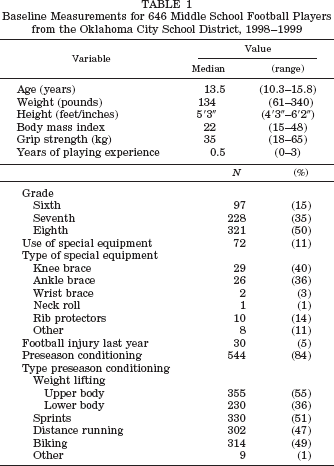
The game injury rate was 8.84 injuries per 1000 athletic exposures, and the practice injury rate was 0.97 per 1000 athletic exposures over the 2-year study. The relative risk of injury was significantly higher in games compared with practices (relative risk = 9.11; 95% CI = 4.3 to 18.9). Significantly more injuries occurred in the month of September (data not shown), which represents the middle of the season for the middle school football program. The proportion of injured players who sustained one or more additional injuries was 13% (N = 7) (data not shown). There was an inverse relation between coaching experience and overall injury rate (data not shown). That is, as the number of years of coaching experience increased, the injury rate decreased. However, this finding did not reach statistical significance.
There was a total of 64 injuries in 54 players over the course of two seasons (Table 2). A few players had more than one injury during the season or more than one injury at the time of an incident. Significantly more injuries occurred to the upper body than to the lower body (61% versus 39%, respectively, P < 0.05). Injuries to the arm, wrist, and hand accounted for 67% (26 of 39) of the upper body injuries. More injuries occurred to the wrist in 1998 than in 1999, and more than half of the wrist injuries reported in 1998 (two fractures, three sprained wrists) occurred in players from a single football team (data not shown). Most of the fractures occurred to the fingers, wrist, and arm, and fewer occurred to the leg and ankle. More fractures to the arm occurred in the 1999 season. The most common lower extremity injuries were to the knee and ankle, each accounting for 44% of the lower extremity injuries. One player (a linebacker) sustained a fracture of the proximal femur during practice. Only one head injury, which did not involve impairment of consciousness, was reported during the 2-year study. A physician evaluated 62% (40 of 64) of the injuries.
Characteristics of the 64 Injuries to Middle School Football Players from the Oklahoma City School District, 1998–1999
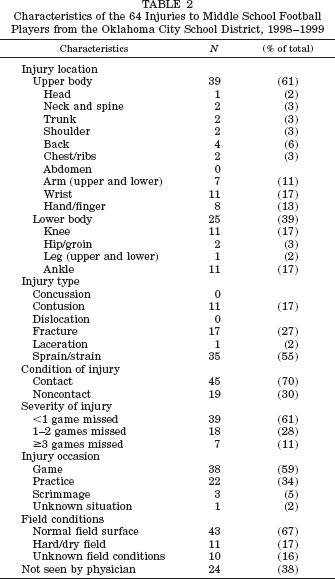
Overall, contact injuries accounted for 70% of the injuries, and noncontact injuries were more common in the 1998 season than in the 1999 season. Of the noncontact injuries, 47% (9 of 19) occurred during running, and all of them were ankle injuries. Unfortunately, injuries as a result of contact with the ground were not separately captured. Eleven of the 64 injuries (17%) occurred on a hard, dry surface, and 10 of these injuries (91%) occurred during the 1998 season. In 1998, the summer was particularly hot and dry, contributing to a very hard field surface.
Most of the injuries caused players to miss less than one game. However, seven (11%) of the injuries caused players to miss more than three games. Five of these injuries were fractures and two were sprains.
Unlike high school football players, middle school players commonly play many different positions, particularly the more athletic players. Because of this, it is difficult to accurately identify the denominator to sufficiently calculate incidence rates by player position. When all injuries were combined, there was a significant difference in the proportion of injuries by player groups. Fifty-two percent of the injuries (33) occurred to players while on offense, 36% (23) on defense, and 13% (8) occurred in special teams players. The proportion of injuries was highest for running backs (13, or 20%), followed by linebackers (10, or 16%), and offensive linemen, defensive backs, and special teams (8, or 13% each). Running backs also sustained more different types of injuries; sprains and strains were the most common (7 of 13, or 54%). Most sprains and strains occurred to the wrist and hand. Half of the injuries to linebackers were fractures (5 of 10), more than at any other position. Offensive lineman received the most contusions (5 of 11). One-half to two-thirds of all injuries at every position were strains or sprains.
Table 3 shows the results of the univariate risk factor analysis comparing injured and uninjured football players. In general, injured players were significantly stronger and were more experienced than uninjured players. These differences might simply reflect the fact that the stronger, more experienced players had more playing time and thus a greater opportunity for injury. To account for this, analyses were repeated based only on data regarding first-string players. In this analysis, no statistically significant variables were identified, although the injured players again tended to be stronger and more experienced than uninjured players.
Comparison of Baseline Measurements in Injured and Uninjured Middle School Football Players
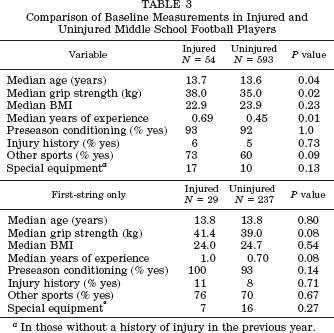
In those without a history of injury in the previous year.
Multivariate stepwise logistic regression was used as an exploratory technique to determine whether any of the baseline variables could independently predict odds of injury. When we compared injured and uninjured players, player experience was the only variable significantly related to the odds of injury, while we controlled for age, race, BMI, grip strength, injury history, and coaching experience. For every 1-year increase in experience, the odds of injury increased by 53% (estimate = 0.423, SE = 0.200, odds ratio = 1.53, 95% CI = 1.03 to 2.26). There was no significant interaction between experience and any of the other variables included in the model. Separate multivariate analyses were also calculated for both lower and upper body injuries. No significant risk factors were identified.
When logistic regression was restricted to fractures, age was the only significant risk factor related to risk after adjusting for all other factors (estimate = 0.653, SE = 0.333, odds ratio = 1.92, 95% CI = 1.04 to 3.68). There was no significant interaction between age and any of the other variables. No variables were significantly associated with the risk of knee or ankle injuries. However, the number of such injuries was small, reducing our ability to identify significant predictors.
Discussion
The rate of injury among middle school football players was much lower than that reported for high school football players, a little more than 2 injuries per 1000 athletic exposures. In contrast, high school injuries occur at a rate of 8 to 9 per 1000 athletic exposures. 9 However, the risk of injury during a game for middle school players was nine times the risk of injury during practice, a relative risk similar to that observed in collegiate football. 9
Surprisingly, there was a high turnover of players among the middle school football players. Only 45 players (less than 15%) from the 1998 season returned to play in the 1999 season, which is a fairly low number of returning seventh and eighth grade players. The reasons for this turnover are unclear, but it may suggest that football participation at the middle school level provides the first opportunity for young players to participate in a contact sport. Those who enjoy it and show talent may be selected to continue to play, whereas those who do not will not continue.
Risk Factors
This is the first study to assess the relationship between physical characteristics and the risk of football injury in this age group. In general, univariate analyses indicated that injured players were significantly stronger, bigger, and more experienced than uninjured players, even when the analysis was restricted to first-string players in the attempt to control for playing exposure. However, after controlling for all variables simultaneously, only experience was a significant predictor of injury. Experience may not be a risk factor for injury per se but, rather, a surrogate for amount of exposure time or athleticism. The more athletic and experienced players are more likely to play and to play more than one position, and thus they are more likely to have the opportunity for injury. Experience may also predispose a player to injury if experience is a surrogate measure for players who are more aggressive as a result of pubescence. This explanation would be consistent with the findings of Linder et al., 8 who reported a significantly higher proportion of injuries to players with higher compared with lower Tanner stage. Experience may also be related to risk of overt injury because it reflects accumulated trauma.
The results of this study suggest that the physical characteristics of middle school football players play a minor role in influencing risk of injury, perhaps because the factors that contribute to specific types of injuries vary. When all injuries are combined, it is not possible to identify the contribution to risk of any single factor. It would be preferable to examine risk factors for specific types of injuries, but such studies would need to be much larger than the present investigation. It may also be that in this age group individual characteristics are less important in influencing risk of injury. If this is the case, more emphasis should be placed on teaching the fundamentals of playing, the playing environment, and coaching techniques. It is interesting to note that, on the team information form completed by almost every coach at the beginning of the season, no coach recorded teaching of fundamentals as part of their weekly practice regimen. It is also of interest that the school with the highest injury rate participated in more contact practices per week (four) than any other school in the entire district, including high schools.
Types of Injuries
Goldberg et al. 4 described the injury experience of 5128 boys 8 to 15 years of age who participated in youth football. Of the 257 injuries, the most common type was fracture (35%), followed by sprains (25%), and contusions (17%). The upper extremities were most likely to be injured, with fractures the most common upper extremity injury. Linder et al. 8 reported on 54 injuries among 340 junior high school football players in Georgia over a 2-year period. They found sprains and strains to be the most common injury (45%), followed by contusions (33%), and fractures (18%). Similar to Goldberg et al., Linder et al. found upper extremity injuries were more common than lower extremity injuries.
In the present study, we also found sprains and strains to be the most common type of injury reported (53%). The frequency of sprains and strains by extremity differed by season. All of the wrist sprains occurred during the 1998 season, whereas more lower extremity strains, such as those to the ankle and knee, occurred during the 1999 season. Environmental conditions in 1998 may have increased the risk of wrist injuries because the summer was particularly hot, with one of the lowest accumulated rainfall seasons on record. Water conservation limited the watering of football fields, and this made the field surfaces very hard. This factor also may explain the high proportion of injuries in 1998 from contact with the ground. Multivariate analysis failed to identify any individual player characteristics in this age group that were significant predictors of sprain or strain injuries.
In a retrospective study describing the distribution of types of sports-related injuries in school-aged children, fractures were the second most common type of injury (29%, 199 of 677). 16 In the present study, fractures were also the second most common injury (28%), followed by contusions (17%). Most of the fractures were to the arm and wrist, whereas fewer were to the leg and ankle. In multivariate analysis of fractures, age was the only significant predictor of fracture after controlling for player experience, race, BMI, grip strength, injury history, and years of experience of the coach. It is well known that preadolescent athletes are at risk of fractures, particularly at the epiphyseal plates where immature bone is most vulnerable. 17 The young athlete is more at risk of fracture than of ligament injury, owing to the relative strength of the soft tissue as compared with the bone. 17 It is interesting to note that the average age of those who sustained a fracture in this study was 13.8 years (range, 12.8 to 15.4), the age at which the velocity of bone growth is greatest. 17 Although the exact mechanism of each fracture was not fully ascertained in this study, approximately 30% of epiphyseal fractures are reported to occur at the distal radius of the wrist, and 3% occur at the distal ulna. The proximal phalangeal and thumb metacarpal epiphyseal plates are the most common site of fractures to the finger and represent approximately 15% of epiphyseal injuries. For the ankle, the distal fibular and tibial epiphyseal plates are common areas for epiphyseal injuries and account for approximately 18% of epiphyseal injuries.11,12
Another reason for the fractures observed in the present study might be the lack of appropriate teaching of fundamentals, such as falling and tackling. The most commonly reported mechanism of injury to the wrist was falling on an outstretched hand. Linebackers had the most fractures compared with any other player position. One team reported a disproportionate number of wrist fractures in 1998 compared with other teams. It is unclear whether the lack of training fundamentals or the environmental conditions or both increased players’ risk of arm and wrist fractures during the 1998 season beyond what is expected for a population of this age.
There were no concussions reported during the 2-year study. Whether this was a function of reporting bias is unclear. The frequency of concussion in this age group is unknown. One head injury was reported, but it did not meet the definition of a concussion, and the player did not sustain any acute effects of the injury. Only one brachioplexus injury was reported over the 2-year interval, which suggests that this injury is also rare in this age group.
There were several limitations to this study. First, football coaches were primarily responsible for identifying injured players in the first season. Coaches were contacted at the beginning of every week to collect injury forms. Most of the coaches were cooperative and were clearly interested in reducing the risk of injury to players. However, some coaches believed that the emphasis of the study was to identify and subsequently reprimand coaches who reported unusually high injury rates, which might have introduced a reporting bias by the coaches. As a way to compensate for this possible bias, injured players who were contacted by telephone in the first season were asked by the investigator to give the names of any other players on their team who sustained an injury. This technique identified additional injuries that were not initially reported. In the second year of this study, athletic trainers recorded all injuries, and, thus, information concerning the frequency of injury to players and the location of injured area was more accurate.
The injury definition used to define a previous injury was somewhat different from our operative injury definition during the prospective study. Because we were asking players to recall incidents from a year ago, we wanted to reduce recall bias. We thought that players were probably more likely to remember missing a game because of an injury than missing a practice. Thus, we acknowledge that the definitions are not the same, but rather, this question provided a history of more severe injuries, with less potential for recall bias.
Information concerning the mechanism of injury was also limited in this study. Injuries that occurred because of contact with the ground were not specifically designated as such. Personal communication with the injured players and their parents suggested that contact with the ground was the main mechanism of wrist injuries.
Future studies in this age group should focus less on intrinsic factors and more on extrinsic factors for injury among middle school football players. Especially important would be emphasis on the teaching of football fundamentals, because the results of this study demonstrate that there are a high number of new football participants in the middle school district each year.