






Abstract
Background: Although player fatigue and playing intensity have been suggested to contribute to injuries in rugby league players, no study has confirmed if the level of physical fitness is a risk factor for injury in rugby league players. The aim of this study was to identify risk factors for injury in subelite rugby league players.
Hypothesis: Low physical fitness levels are risk factors for injury in subelite rugby league players.
Study Design: Cohort study; Level of evidence, 2.
Methods: One hundred fifty-three players from a subelite rugby league club underwent preseason measurements of muscular power (vertical jump), speed (10- and 40-m sprint), and maximal aerobic power (multistage fitness test) over 4 competitive seasons. All injuries sustained by players were prospectively recorded over the 4 competitive seasons.
Results: The risk of injury was greater in players with low 10- and 40-m speed. Players with a low maximal aerobic power had a greater risk of sustaining a contact injury. In addition, players who completed less than 18 weeks of training before sustaining their initial injuries were at greater risk of sustaining a subsequent injury.
Conclusions: Subelite rugby league players with low speed and maximal aerobic power are at an increased risk of injury. In addition, players who complete less than 18 weeks of training before sustaining an initial injury are at greater risk of sustaining a subsequent injury. These findings highlight the importance of speed and endurance training to reduce the incidence of injury in subelite rugby league players.
Rugby league is a collision sport played throughout several countries worldwide, including Australia, New Zealand, France, Russia, Wales, Scotland, Ireland, Papua New Guinea, Fiji, Samoa, and South Africa. 2 The sport has similar rules and movement patterns to rugby union; however, unlike rugby union, rugby league does not have a line-out, involves 13 players per team (rather than 15), and involves an immediate play-the-ball after each tackle. 2 In Australia, approximately 171 000 adults and children play rugby league, 1 with the majority of these participants competing at the subelite level. The game is physically demanding, requiring players to compete in a challenging contest involving frequent bouts of high-intensity activity such as running, passing, and sprinting, separated by short bouts of low-intensity activity such as walking and jogging. 18 During the course of a match, players are exposed to numerous physical collisions and tackles. 2 As a result, musculoskeletal injuries are common. 6
Several studies have documented the incidence, site, nature, and cause of injuries in rugby league.8,15 Depending on the level of competition, the incidence of injury in rugby league has been reported to be in the range of 26.8 to 67.7 per 1000 playing hours,7,13–15 with the majority of injuries occurring in tackles.7,13 Although these studies have provided important information on the extent of the injury problem in rugby league and the cause of these injuries, the implementation and evaluation of effective injury prevention strategies are also dependent on the identification of injury risk factors. 25 To date, no study has investigated risk factors for injury in rugby league players.
Poor player fitness levels and low training frequency have been reported to be risk factors for injury in rugby union players.16,21,24 However, although player fatigue 8 and playing intensity7,14 have been suggested to contribute to rugby league injuries, no study has confirmed if low physical fitness is a risk factor for injury in rugby league players. In addition, although previous injury has been identified as a risk factor for subsequent injury in other collision sports,16,20,21 the influence of previous injury on subsequent injury in rugby league is unknown. Therefore, the purpose of this study was to identify risk factors for injury in subelite rugby league players.
Materials and Methods
One hundred fifty-three rugby league players participated in this 4-year prospective study (2000–2003). Of the 153 players, 84 players (54.9%) played 1 season, 51 players (33.3%) played 2 seasons, 14 players (9.2%) played 3 seasons, and 4 players (2.6%) played all 4 seasons. The number of players participating in each season was 66, 66, 47, and 65, respectively, giving a total of 244 player-seasons. All players were registered with the same subelite rugby league club and were competing in the Gold Coast Group 18 (New South Wales Country Rugby League, Australia, 2000–2002) or South-East Queensland (Queensland Rugby League, Australia, 2003) senior rugby league competition. In rugby league in Australia, there are several different playing levels, which can be generally classified as elite (fully paid professional players), subelite (receive moderate remuneration to play rugby league but also rely on additional employment to generate income), and nonelite (fully amateur players). The players in the present study were defined as subelite, as they were receiving moderate remuneration to play rugby league but were also relying on additional employment to generate income. 13 All subjects received a clear explanation of the study, including the risks and benefits of participation, and written consent was obtained. The Institutional Review Board for Human Investigation approved all experimental procedures.
Fitness Testing Battery
Each season lasted from December through September, with matches played from January through September. All players underwent fitness testing in December as part of their preseason training program. Players who played more than one season had their fitness reassessed at the beginning of each subsequent preseason preparation period. Muscular power (vertical jump), 4 speed (10- and 40-m sprint), 11 and maximal aerobic power (multistage fitness test) 22 were the fitness tests selected. The age, playing experience, and body mass of players were also documented. Players were instructed to refrain from strenuous exercise for at least 48 hours before the fitness testing session and to consume their normal pretraining diets before the testing session. At the beginning of the fitness testing session, body mass was recorded for all players using calibrated analog scales (Seca, Hamburg, Germany). Scales were calibrated using a 3-point calibration of 20-, 60-, and 100-kg weights. After measurement of body mass, players underwent a standardized warm-up (progressing from low to higher intensity activity) and stretching routine. Fluid intake was permitted ad libitum after the measurement of body mass. Players performed 2 trials for the speed (10-and 40-m sprint) and muscular power (vertical jump) tests, with a recovery of approximately 3 minutes between trials. Players were encouraged to perform low-intensity activities and stretches between trials. The field testing session was concluded with players performing the multistage fitness test (estimated maximal aerobic power).
Muscular Power
Lower body muscular power was evaluated by means of the vertical jump test 4 using the Yardstick vertical jump device (Swift Performance Equipment, New South Wales, Australia). Players were requested to stand with feet flat on the ground, extending their arms and hands, and the standing reach height was marked. After assuming a crouch position, each subject was instructed to spring upward and touch the Yardstick device at the highest possible point. No specific instructions were given regarding the depth or speed of the countermovement. 4 Vertical jump height was calculated as the distance from the highest point reached during standing and the highest point reached during the vertical jump. Vertical jump height was measured to the nearest 1 cm, with the highest value obtained from 2 trials used as the vertical jump score. The intraclass correlation coefficient for test-retest reliability and typical error of measurement for the vertical jump test were 0.96 and 3.3%, respectively.
Speed
The running speed of players was evaluated with a 10- and 40-m sprint effort 11 using electronic timing gates (Speed Light Model TB4, serial No. 4921001, Southern Cross University Technical Services, Lismore, Australia). The timing gates were positioned 10 and 40 m cross-wind from a predetermined starting point. Players sprinted from a standing start. 11 Players were instructed to run as quickly as possible along the 40-m distance. Speed was measured to the nearest 0.01 second, with the fastest value obtained from 2 trials used as the speed score. For the 10- and 40-m sprint tests, the intraclass correlation coefficients for test-retest reliability were 0.95 and 0.97, respectively, and the typical errors of measurement were 1.8% and 1.2%, respectively.
Maximal Aerobic Power
Maximal aerobic power was estimated using the multistage fitness test.
22
Players were required to run back and forth (ie, shuttle run) along a 20-m track, keeping in time with a series of signals on an audiocassette. The frequency of the audible signals (and, hence, running speed) was progressively increased, until subjects reached volitional exhaustion. The multistage fitness test tape was calibrated before each test in accordance with procedures outlined by Ramsbottom et al.
22
Maximal aerobic power (
Definition of Injury
Players participated in 1 match per week. All injuries sustained to the total cohort of 153 players were prospectively recorded over the 4 competitive seasons. Injury data were collected from 219 matches, which included all trial, fixture, and finals matches. For the purpose of this study, an injury was defined as any pain, disability, or injury that occurred as a result of a competition match that caused the player to miss a subsequent match. 14 The number of matches missed as a result of the injury was also recorded. Injuries were classified as minor (1 match missed), moderate (2–4 matches missed), and major (5 or more matches missed). 14
Statistical Analysis
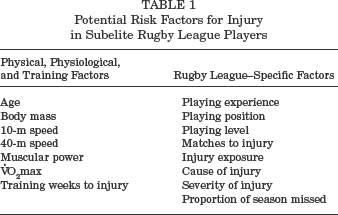
Statistical analysis was performed in SAS using the PROC GENMOD procedure (SAS Institute, Cary, NC). The statistical model was fitted in PROC GENMOD using generalized estimating equations 27 and incorporating repeated-measures analysis. An autoregressive correlation structure was assumed to measure temporal effects of the observations. As the dependent variable was dichotomous, both categorical and continuous variables were collapsed and grouped to ensure that approximately a third of observations fell within each level. A list of these categories can be seen in Table 1. Odds ratios (ORs) were calculated to determine which factors increased or decreased the risk of injury, with 1 of the levels chosen as the reference level. A value greater or less than 1 implied an increased or decreased risk of injury, respectively. Also, 95% confidence intervals (CIs) for the ORs were calculated. Where the confidence interval did not contain the null value (OR = 1.0), the OR was taken as being significant at the P <. 05 level.
Potential Risk Factors for Injury in Subelite Rugby League Players
Results
A total of 219 matches were played over the 4 seasons. The total exposure time was 3341 playing hours. Of the 153 players, 94 players (61.4%) recorded 1 or more injury in 1 or more seasons (185 injuries in total). When expressed relative to exposure hours, the incidence of injury was 55.4 (95% CI, 47.4–63.4) per 1000 playing hours. The most common site of injury was the thigh and calf (11.7 [95% CI, 8.0–15.3] per 1000; 21.1%), whereas injuries to the shoulder (10.2 [6.8–13.6] per 1000; 18.4%) and knee (8.4 [5.3–11.5] per 1000; 15.1%) were less common. Joint sprains (19.2 [14.5–23.8] per 1000; 34.6%) were the most common type of injury, whereas muscle strains (11.1 [7.5–14.7] per 1000; 20.0%) and fractures and dislocations (7.5 [4.6–10.4] per 1000; 13.5%) were less common. Injuries were most commonly sustained while being tackled (16.5 [12.1–20.9] per 1000; 29.7%) and while tackling (13.2 [9.3–17.1] per 1000; 23.8%) (Table 2). The most common specific injuries were lateral ankle sprains (6.9 [4.1–9.7] per 1000; 12.4%), acromioclavicular joint injuries (4.5 [2.2–6.8] per 1000; 8.1%), and knee medial ligament sprains (3.9 [1.8–6.0] per 1000; 7.0%) (Table 3).
Site, Nature, and Cause of Injuries Sustained Over 4 Competitive Playing Seasons a
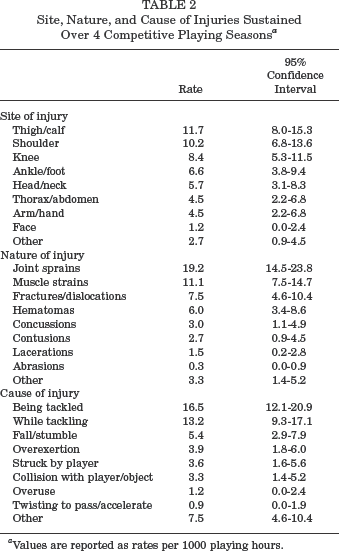
Values are reported as rates per 1000 playing hours.
Incidence of Common Specific Injuries a
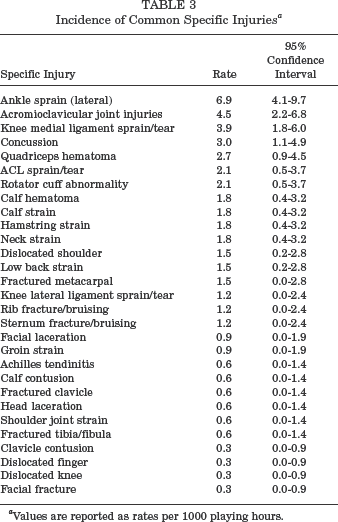
Values are reported as rates per 1000 playing hours.
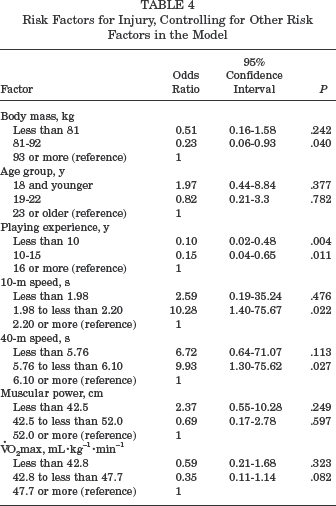
Variables included in the initial multivariate analysis for all injuries were body mass, age, playing experience, grade, position, 10- and 40-m speed, muscular power, and estimated
Risk Factors for Injury, Controlling for Other Risk Factors in the Model
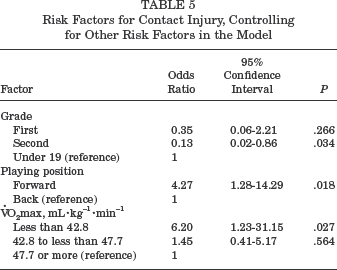
The risk factors for contact injuries are shown in Table 5. Variables included in the initial multivariate analysis were body mass, age, playing experience, grade, position, 10- and 40-m speed, muscular power, estimated
Risk Factors for Contact Injury, Controlling for Other Risk Factors in the Model
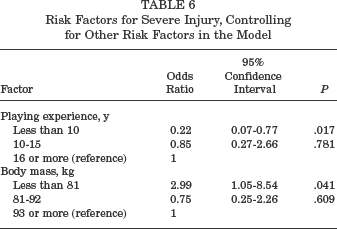
The risk factors for the severity of injury are shown in Table 6. Variables included in this analysis were body mass, age, playing experience, grade, position, 10- and 40-m speed, muscular power, estimated
Risk Factors for Severe Injury, Controlling for Other Risk Factors in the Model
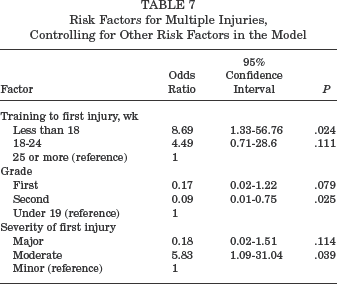
The risk factors for multiple injuries are shown in Table 7. Variables included in this analysis were body mass, age, playing experience, grade, position, 10- and 40-m speed, muscular power, estimated
Risk Factors for Multiple Injuries, Controlling for Other Risk Factors in the Model
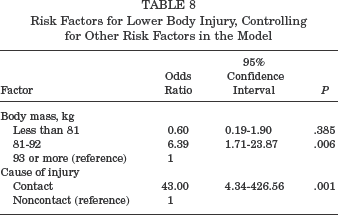
The risk factors for sustaining a lower body injury are shown in Table 8. Variables included in this analysis were body mass, age, playing experience, grade, position, 10-and 40-m speed, muscular power, estimated
Risk Factors for Lower Body Injury, Controlling for Other Risk Factors in the Model
Discussion
The present study is the first to investigate risk factors for injury in rugby league players. The results of this study demonstrated that subelite rugby league players with low speed and maximal aerobic power are at an increased risk of injury. In addition, players who completed less than 18 weeks of training before sustaining an initial injury were at greater risk of sustaining a subsequent injury. These findings provide some explanation for the high incidence of fatigue-related injuries in rugby league players. 8 In addition, these findings highlight the importance of speed and endurance training to enhance performance and reduce the incidence of injury in subelite rugby league players.
The finding of a higher risk of contact injuries in forwards is to be expected given that forwards spend a significant proportion of match play involved in tackling and physical collisions.
18
In addition, the finding of lower injury risk in second-grade players is consistent with previous injury studies that have shown that the incidence of injury is lower at lower playing levels.6,9 The major new finding of this study was that a low estimated
The finding that players who completed less training were at greater risk of sustaining a subsequent injury is in agreement with some 24 but not all 16 studies of collision sport athletes. Upton et al 24 reported that a lack of preseason training increased the risk of injury in schoolboy rugby union players. However, Lee et al 16 found a greater risk of injury in rugby union players who attended training more frequently. The higher injury risk in the rugby union players who attended training more frequently may be because of residual fatigue associated with heavy preseason training or an increased playing intensity accomplished through increased fitness levels. 16 Although the present study found that players who completed less training were at greater risk of sustaining a subsequent injury, increasing training loads and fitness levels may not reduce the incidence of injury. 12 Indeed, although improving player fitness may reduce the incidence of fatigue-related injuries, it is possible that a greater work capacity could increase playing intensity and, as a result, increase the incidence of injury in subelite rugby league players. 13
The present study found that players with low 10- and 40-m speed had an increased risk of injury. In addition, players with lower body mass had a greater risk of injury and injury severity. It has recently been shown that the speed of matches may influence injury rates in collision sports, with greater playing intensity and match speeds resulting in higher injury rates. 19 The finding of greater injury risk in slower, lighter players may reflect their reduced ability to generate and tolerate high-impact forces associated with tackles. 10 Certainly, a heavier player moving at high speed toward the defensive line would have a greater performance advantage and reduced injury risk than a slower, lighter player. In addition, the greater injury risk in players with lower speed may reflect a reduced ability of the players to position themselves correctly before effecting the tackle.
In the present study, players who sustained a moderately severe injury were at increased risk of sustaining a subsequent injury. These findings are in agreement with other studies of collision sports that have found a significant relationship between an initial injury event and subsequent injuries.3,26 Another interesting finding from the present study was the reduced risk of injury and injury severity in players with less than 10 to 15 years of playing experience. Playing experience 23 and previous injury 20 have been shown to be risk factors for subsequent sporting injury. It is likely that players with greater playing experience (more than 16 years of experience) had also sustained more injuries throughout their playing careers than inexperienced players (ie, less than 15 years of experience). The lower risk of injury in inexperienced players may be because of fewer previous injuries sustained while participating in rugby league.
In summary, the present study is the first to investigate risk factors for injury in rugby league players. The results of this study demonstrated that subelite rugby league players with low speed and maximal aerobic power are at an increased risk of injury. In addition, players who completed less than 18 weeks of training before sustaining an initial injury were at greater risk of sustaining a subsequent injury. These findings provide some explanation for the high incidence of fatigue-related injuries in rugby league players. 8 In addition, these findings highlight the importance of speed and endurance training to enhance performance and reduce the incidence of injury in subelite rugby league players.