





Abstract
Background: The treatment of trochlear cartilage lesions is challenging given the likely presence of other patellofemoral joint pathologies, the topography of the area, and the limited available treatment options. Only 1 other study has examined the effectiveness of autologous chondrocyte implantation for lesions of the patellofemoral joint.
Hypothesis: Patients treated with autologous chondrocyte implantation for moderate to large isolated lesions located on the trochlea will report improvement in the modified overall condition scale score of the Cincinnati Knee Rating System at a minimum 2-year follow-up.
Study Design: Case series; Level of evidence, 4.
Methods: Using modified scales of the Cincinnati Knee Rating System, 40 Cartilage Repair Registry patients rated their overall condition and symptoms at baseline and at a mean follow-up of 59 ± 18 months. Factors likely to affect outcomes also were analyzed.
Results: At baseline, patients were between ages 16 to 48 years, had a mean total defect size of 4.5 cm2, and reported an overall condition score of 3.1 points (poor). Many failed a prior marrow-stimulation procedure (48%). Other procedures performed before baseline included tibiofemoral osteotomy in 23% and lateral release or Fulkerson for patella maltracking in 13%. Forty-three percent were receiving workers' compensation at baseline. Patients reported statistically significant improvement in their mean overall condition (3.1 points preoperatively to 6.4 points postoperatively), pain (2.6 to 6.2 points), and swelling (3.9 to 6.3 points) scores. Eleven patients experienced 17 subsequent procedures, and no patients had a failed implantation.
Conclusion: Autologous chondrocyte implantation appears to improve function and reduce symptoms in young to middle-aged patients with symptomatic, full-thickness articular cartilage lesions of the trochlea.
Keywords
Trochlear lesions are generally caused by acute or repetitive trauma to the knee or mechanical problems of the patellofemoral joint. 6 Based on a study of 1000 knee arthroscopies in which the reported mean total defect area was 2.1 cm2, focal chondral or osteochondral lesions were characterized as the main lesion or largest lesion when more than 1 lesion was present in 1.1% of athroscopies. 13 In general, identifying the optimal cartilage repair treatment for active young to middle-aged patients with moderate to large, symptomatic, full-thickness lesions depends on a number of factors, including patient age, defect size and location, physical demands, the degree of patient disability, response to prior treatments, concomitant injuries, and patient expectations. 8 For trochlear lesions in particular, the management strategy is even more complex. Operating on trochlear lesions is technically challenging, and successful tissue repair in this area may be limited by high shear forces.20,21 In addition, trochlear lesions are often found in the presence of coexisting patellofemoral joint abnormalities, such as extensor mechanism malalignment. 7 The selection of an appropriate cartilage repair procedure for trochlear lesions may depend on whether these coexisting lesions mask, enhance, or have no effect on patient pain, other symptoms, or impairment.
The results from a number of studies suggest that autologous chondrocyte implantation (ACI) yields long-term improvement in function and symptoms and may be a viable and optimal treatment for young to middle-aged adult athletes or patients with high physical demands and a long, active life span.4,9,19,22,23 In addition, earlier studies have shown that ACI not only produces a hyaline-like repair tissue 3 but also results in improved efficacy,3,9 cost-effectiveness, 16 long-term outcomes,19,26-28 and return to sports.22,23
Information pertaining to ACI for full-thickness articular cartilage lesions of the patellofemoral joint is limited, especially information on the treatment of trochlear lesions. To date, only 1 study has examined the role of ACI in the patellofemoral joint. 20 The results, based on a case series of 9 patients who had isolated trochlear lesions implanted, showed a statistically significant mean improvement in the modified overall condition scale score of the Cincinnati Knee Rating System (Cincinnati Knee Score) from 4.56 to 6.22 points. The purpose of this multicenter study was to determine the efficacy and safety of ACI for symptomatic trochlear lesions at 2 or more years after surgery.
Methods
Patients included in this case series came from the Cartilage Repair Registry (Registry), a program funded by Genzyme Biosurgery and overseen by an independent board of 7 orthopaedic surgeons. The Registry was designed to prospectively track the symptoms and functional changes of patients who were treated with ACI (Carticel [autologous cultured chondrocytes], Genzyme Biosurgery, Cambridge, Mass) and other cartilage repair procedures. Details of the Registry methods have been described previously.4,9,18
Forty patients treated by 34 surgeons were identified based on the following criteria. All had to be treated with ACI for full-thickness, symptomatic articular cartilage lesions located only on the trochlea. Patients had to have a baseline overall condition score less than or equal to 5 (fair) and be at least 2 years past their implantation date. Patients with missing baseline overall condition scores or lesions implanted (staged or concurrently) in both knees were excluded from the study. All study patients read and signed informed consent forms compliant with updated privacy regulations of the Health Insurance Portability and Accountability Act.
Information on knee alignment, patella tracking, ligament stability, surgical history, cause of defect, defect size and location, concurrent procedures, workers’ compensation status, age, height, weight, and gender were collected at baseline. Patellofemoral and tibiofemoral alignment were determined by physical examination rather than radiographs or magnetic resonance imaging (MRI) scans. Surgeons assessed tibiofemoral alignment according to the anatomical axis. Before implantation, baseline scores were captured using modified scales from the Cincinnati Knee Score 25 that measured patients’ overall condition, pain, and swelling. The outcome scales used in this study have been described elsewhere 4 (Figure 1). After study patients were identified, research assistants and surgeons made extensive efforts to collect current follow-up assessments. Patients were paid $25 for their time and effort spent to complete follow-up assessments. Information on adverse events, treatment failures, and procedures after implantation were captured with questionnaires sent at 6-year follow-up or spontaneously reported by surgeons or patients up to 10 years after treatment; all safety information was entered into the manufacturer's safety surveillance database.
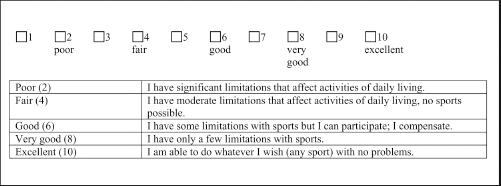
Modified overall condition scale of the Cincinnati Knee Rating System.
Statistical Methods
Statistical analyses were based on the number of patients who submitted follow-up assessments during follow-up data collection (completer's analysis). The primary end point of this study was the mean change in the overall condition score from baseline to follow-up. Additional end points included the mean change in the pain and swelling scale scores from baseline to follow-up. For each outcome parameter, the mean change from baseline was evaluated using 2-sided paired t tests at the .05 significance level; 95% confidence intervals (CI) also were generated.
The effects of baseline overall condition score, receiving workers’ compensation at baseline, having a patella tracking procedure concurrent with implantation, having any concurrent procedure with implantation, follow-up duration, and total defect size on the mean change in overall condition score were assessed using analysis of variance (ANOVA) at the .05 significance level.
The analysis plan included a predefined ACI treatment failure criteria as follows: Autologous chondrocyte implantation was considered a failed procedure if the patient required a subsequent operation that necessitated removal of the graft, confirmed loss of defect fill, or violated the subchondral bone (eg, abrasion chondroplasty, microfracture, drilling, unicompartmental knee replacement, total knee replacement, osteochondral plugs). The analysis plan stipulated that all patients who met the predefined treatment failure criteria were assigned a follow-up overall condition score of “2,” assumed to have all symptoms present, and were included in the analysis.
Surgical Methods
Autologous chondrocyte implantation is a 2-stage procedure that involves a cartilage harvest and subsequent implantation of autologous cultured chondrocytes (Carticel). These procedures have been described in other publications.3,21 All surgeons whose patients were included in this study were trained and certified by the manufacturer to perform the implantation procedure. As part of their training, surgeons were provided with FDA-approved supplemental training materials, including an instructional video, surgical manual, and postoperative rehabilitation protocols.
Preimplantation and Cartilage Harvest.
Surgeons performed preoperative assessments to determine patient eligibility for the implantation procedure and to identify concomitant abnormalities such as ligament instability, tibiofemoral malalignment, meniscal injury, and patella maltracking. Surgeons were encouraged to address coexisting joint abnormalities concurrently with ACI to maximize treatment effect.
The first step of the ACI procedure involved the harvest of the cartilage specimen (200-300 mg) from a nonweightbearing area of the distal femur. Chondrocyte cells acquired from harvested tissue were processed and cultured in an FDA-licensed facility according to strict operating procedures. Before the cells were shipped from the manufacturing facility, cell cultures were tested for sterility, endotoxin levels, cell viability, and population doubling time. The final product, which consisted of approximately 12 million cultured chondrocyte cells, was sent to the implantation facility on the day of implantation.
Implantation.
The implantation procedure involved preparing the defect bed, harvesting the periosteal patch, attaching the periosteal patch over the defect, applying fibrin glue to seal the periosteal flap and defect edges, ensuring a watertight seal, injecting cultured cells through the remaining open edge, and closing the open edge (Figures 2 and 3). Given the challenges associated with operating in this location, surgeons were advised to pay special attention to the preparation and harvest of the periosteal flap, especially for trochlear defects that extended to both sides of the sulcus.
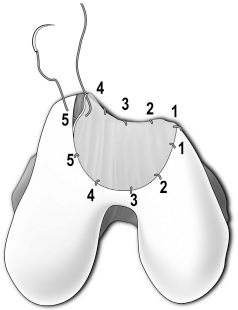
Illustration of the suture technique used to secure the periosteal patch.
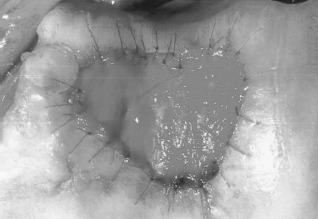
After suturing, the periosteal patch should restore trochlear congruity.
Surgeons generously oversized the template used to harvest the periosteal flap by several millimeters, and a modified suture fixation technique was used to ensure that the periosteal flap would follow the normal contours of the trochlea and result in normal articulation between the trochlea and patella. 21
Rehabilitation Guidelines.
Rehabilitation followed a standard protocol with variations based on a number of factors that included lesion size, the patient's previous functional status, and any concurrent procedures performed with ACI. 29
Immediately after surgery, ice, elevation, and compression were used as necessary to minimize pain, swelling, and scar tissue formation. Within 6 to 24 hours after surgery, patients used a continuous passive motion (CPM) machine. Depending on the size and location of the lesion, CPM settings initially ranged from 0° to 40° and were increased by 5° of flexion per day as tolerated. The CPM machine was used for 6 to 8 hours a day for 4 to 6 weeks. Passive range of motion (ROM) progressed as tolerated to reach the following goals: ROM between 0° to 90° by week 2 to 3; ROM between 0° to 105° by week 4; and ROM of 120° by week 6. Passive ROM and patellar mobilization were encouraged throughout the day to avoid loss of motion.
Patients began partial weightbearing immediately with crutches (approximately 25% of body weight) and wore a knee brace locked in full extension to avoid shear forces across the patellofemoral joint. Partial weightbearing progressed to 50% body weight by weeks 2 to 3, 75% body weight by week 4, and full weightbearing by week 8.
Early strengthening activities involved quadriceps sets and multiplane straight leg raises. Electrical stimulation was used to re-educate muscles and strengthen quadriceps. As the patient's weightbearing status increased, closed kinetic chain exercises such as weight shifting and minisquats (0°-30°) were incorporated. Bicycle riding with low resistance was encouraged beginning week 4 to 6. A full strengthening program that involved weight machines and closed kinetic chain exercises was incorporated by week 8 to 10. Open kinetic chain knee extension exercises were avoided to prevent excessive patellofemoral joint reaction forces.
Patients were allowed to engage in low-impact activities (walking program, swimming, golfing, skating, rollerblading, cross country skiing) at 5 to 6 months after implantation, high-impact activities (jogging, running, and aerobic classes) at 8 to 12 months after implantation, and full, unrestricted activities (tennis and basketball) at 12 to 18 months after implantation.
Results
Baseline
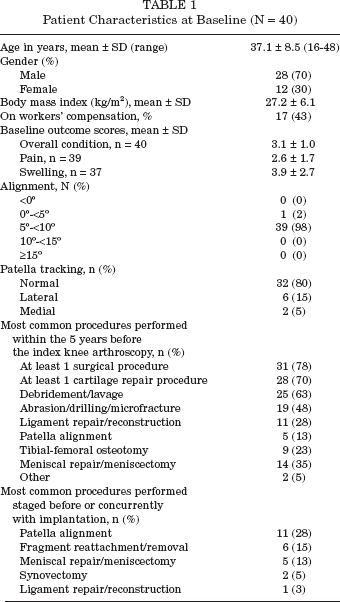
Baseline characteristics are listed in Tables 1 and 2. At baseline, patients were overweight (mean BMI = 27.2), 24 predominantly male (70%), with a mean age of 37 years (range, 16-48 y). All patients had tibial femoral alignment that fell between 5° to <10° except 1 patient whose alignment fell between 0° to <5°. At baseline, normal and lateral patella tracking was found in 80% and 15% of patients, respectively. In addition, 2 patients at baseline had medial patella tracking, a result due to the overcorrection of lateral tracking with a prior corrective procedure. There were no natural occurrences of medial patella tracking. Based on the information reported, trochlear lesions resulted from acute injury in 53% of patients, and 13% of patients were diagnosed with osteochondritis dissecans (OCD) lesions. The cause was not specified for the remainder of patients. Thirty-eight patients had single defects located on the trochlea, and 2 patients had multiple defects located on the trochlea.
Patient Characteristics at Baseline (N = 40)
Trochlea Defect Characteristics at Baseline (N = 40)
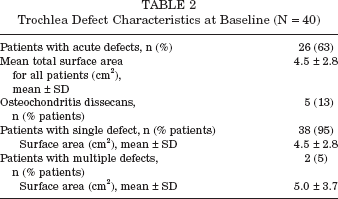
Within the 5 years before the cartilage harvest (before baseline), 48% of patients had failed a marrow-stimulation procedure (ie, microfracture, abrasion arthroplasty, or drilling), 23% had a tibiofemoral osteotomy, and 13% had a patella tracking procedure, that is, lateral retinacular releases or Fulkerson procedures. In addition, patients had large lesions (mean total defect size of 4.5 cm2; range, 1-14 cm2) and rated their mean baseline overall condition score 3.1 ± 1.0 points (poor). Almost half of all patients (43%) were receiving workers’ compensation at baseline. The most common procedures performed concurrently with implantation were patella tracking, that is, lateral retinacular releases or Fulkerson procedures, in 28% of patients, fragment reattachment or removal in 15% of patients, and meniscal repair or meniscectomy in 13% of patients.
Patient-Reported Outcomes
Research assistants collected follow-up assessments from all patients (100% response rate) in the cohort at a mean follow-up of 59 ± 18 months (range, 24-84). Patients, including 92.5% who improved, reported a mean improvement in their overall condition score from 3.1 ± 1.0 points at baseline to 6.4 ± 1.7 points at follow-up (P < .0001) (Figure 4). Pain and swelling scores also improved from 2.6 ± 1.7 to 6.2 ± 2.4 points and 3.9 ± 2.7 to 6.3 ± 2.7 points, respectively (both P < .0001) (Figure 4).
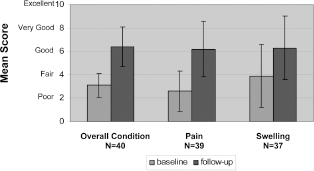
Improvement from baseline of the modified scales of the Cincinnati Knee Rating System. *For all scales, baseline and follow-up scores were significantly different at the .05 level (P < .0001).
Results from secondary analyses showed neither follow-up duration, defect size, workers’ compensation status, nor having any concurrent procedure with ACI affected the primary outcome (the mean change in overall condition score). More specifically, the magnitude of improvement was not significantly different between patients who had a concurrent procedure with ACI and those who did not (P = .404); the mean change in overall condition score was 3.5 ± 1.8 versus 3.0 ± 2.2, respectively. However, baseline overall condition scores did affect outcome (P = .0032); patients with baseline scores lower than 4 reported greater improvements from baseline than patients with a baseline score of 4 or higher (3.8 ± 1.6 vs 2.4 ± 2.2 points, respectively).
In addition, the mean change in score from baseline to follow-up was plotted, for all patients, by visit to highlight any outcome trends over time. Results from this scatter plot showed improvement in overall condition score decreased minimally during a 2- to 7-year follow-up period, suggesting sustained improvement with ACI (Figure 5).
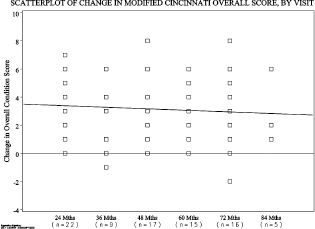
Scatter plot of change in modified overall condition score over time.
Subsequent Procedures
In total, 11 patients had 17 subsequent arthroscopic procedures. The most common reasons for or findings at these operations were adhesions in 4 cases, periosteal flap detachment in 4 cases, chondromalacia in 4 cases, loose bodies in 3 cases, torn meniscus in 3 cases, fibrotic tissue in 2 cases, and decreased range of motion in 2 cases. Chondromalacia observed in subsequent surgeries of 4 patients was assessed by the treating surgeon as related to ACI in 1 case, not related in 2 cases, and unspecified in 1 case. No patient had a failed ACI according to the study definition of treatment failure.
Discussion
This observational, multicenter case series was conducted to determine if treatment with ACI for symptomatic, full-thickness articular cartilage lesions in the trochlea would result in improved outcomes at a minimum of 2 years after implantation. The results from our study suggest that ACI, when applied in routine practice, yields improved function and reduced symptoms in young to middle-aged adult patients who have a history of failed cartilage repair procedures and moderate to large, symptomatic, full-thickness lesions isolated on the trochlea.
The effectiveness of ACI has been documented in a number of patient populations, including adolescents, athletes, and patients with OCD defects.4,9,18,19,26-28 In comparison with these studies, the present investigation differed with respect to severity of cartilage injury, length of follow-up, and lesion location. Despite these differences, our results show similar levels of improvement after treatment with ACI to those reported in past studies.2,4,9,14,18,20,28 At a mean follow-up of 59 months, patients treated with ACI reported a significant improvement in overall condition score of 3.3 points. No patient had an implantation procedure that failed. In addition, the results of this study were directionally similar, but of a greater magnitude of improvement, compared with those reported in the only other study that examined the effectiveness of ACI for treatment of lesions in the patellofemoral joint. 20 Although patients in the present series had lesions of similar size and comparable overall condition scores at baseline to those of Minas and Bryant, 20 the mean improvement in overall condition score reported here was 3.3 points versus 1.66 points for the Minas and Bryant patients. This difference might be due to characteristics other than lesion size and baseline overall condition scores.
In addition, we sought to compare the results of our present study with those of other cartilage repair techniques (eg, microfracture, mosaicplasty, and OATs) for the treatment of trochlear lesions. Direct comparisons are difficult to perform because study populations and end points were different across studies, or the information (eg, defect size, patient age, coexisting knee lesions) needed to assess comparability of patient populations was not published. No comparable studies of other treatments reported analyses that were limited to patients with only trochlear lesions; most studies reported results from an aggregate analysis of lesions in different locations. Despite these challenges, 1 study had sufficient information for some comparison of trochlear lesion results. In a recent article by Kreuz et al, 15 the effect of microfracture on lesions located in different knee compartments was reported for 70 patients with full-thickness (Outerbridge classification grade III-IV) cartilage lesions of the knee, including 16 patients with treated trochlear lesions. In comparison with patients of the Kruez study, patients in our study were similar in mean age (41.6 years, Kruez vs 37.1 years, Mandelbaum) and BMI (26.4 kg/m2, Kruez vs 27.2 kg/m2, Mandelbaum), but the reported mean lesion size was larger (2.31 cm2, Kruez vs 4.5 cm2, Mandelbaum) in our study. The results from the Kreuz study showed that patients with trochlear lesions reported significant mean improvement in the ICRS scale and modified Cincinnati Scale scores from baseline to 6 months and from 6 months to 18 months after treatment with microfracture. However, from 18 months to 36-month follow-up, these patients reported a deterioration in their initial improvement. 15 In our study patients, similar trends of improvement were seen, but deterioration in improvement was not observed at later follow-up time points. In contrast to the Kreuz data, our results showed that improvement in overall condition score decreased minimally during a 2- to 7-year follow-up period, suggesting durability of improvement with ACI (Figure 5). However, this finding should be interpreted with caution given the small sample of data included in the scatter plot and the effects of other variables, for example, age, that could not be controlled in this descriptive analysis.
We caution overinterpreting limited comparisons across these studies and recognize that the most robust direct treatment comparisons are derived from prospective comparative trials.2,9,14 We also recommend that appropriate treatment selection for an individual patient should be informed by consensus or expert guidelines, considering lesion-specific factors (eg, location, size, cause), patient-specific factors (eg, age, commitment to rehabilitation, physical demand),5,17 and published outcomes data most applicable to these factors and the patient's clinical presentation.
In addition to some comparison with other treatments, we had hoped to comment on the role of an unloading tibial tubercle osteotomy, for example, anteromedialization, performed concurrently with ACI, a widely debated treatment regimen that has been implemented in some practices. Lesions of the patellofemoral joint often occur with patella maltracking. According to Peterson, 28 Minas, 20 and Beck, 1 the effect of ACI on cartilage restoration of patellofemoral defects may be enhanced by performing a concurrent offloading tibial tubercle osteotomy. In the present study, patella tracking procedures were performed in 28% of patients to correct existing patella maltracking. Because only 3 patients in this study had a Fulkerson osteotomy, it was not possible to directly compare the outcomes of patients with an osteotomy with the outcomes of patients without an osteotomy. The role of offloading tibial tubercle osteotomy in conjunction with ACI cannot be determined without additional evidence from larger, controlled studies—although this practice has been adopted in some clinical algorithms.20,21
Strengths of this multicenter case series include an observational multicenter approach in which patients were selected based on predefined inclusion and exclusion criteria before study outcomes were known. In addition, analyses were determined a priori, and the follow-up response rate was 100%. Moreover, the results of this study likely reflect those obtained from clinical practice and represent a broader spectrum of the population of interest than results from randomized controlled trials or case series. 11
Our study also had limitations and sources of potential bias because a control group for comparison was not included. Therefore, it is possible that the improvement observed may have been due to a variable other than ACI. Although the effects of all variables were not tested, defect size, follow-up duration, and having workers’ compensation at baseline did not appear to affect the primary outcome. In addition, having any concurrent procedure, including patella realignment, meniscal repair, ligament repair/reconstruction, or synovectomy—whether performed staged before or concurrent with ACI—was not found to affect the improvement reported by patients at follow-up. This finding suggests that the observed trochlear lesions of our complex group of study patients were not incidental, likely to be a source of patient pain and other impairing symptoms, and responsive to ACI treatment.
Another limitation of the current study design is that patient compliance with rehabilitation, a factor known to positively influence treatment outcome, was not monitored. Although the effects of rehabilitation on treatment outcomes were not examined in this study, patient adherence to prescribed rehabilitation guidelines is critical to the successful healing of the graft.4,10,21,29 Surgeons should set patient expectations regarding return to physical activities and emphasize the importance of patient commitment to rehabilitation.
Significant barriers associated with collecting data in a long-term, multicenter, observational study prohibited our collecting objective data, that is, radiographs and MRIs. While the lack of objective data may have limited our findings, this absence likely had minimal effect on the direction of study results reported here. The quality of radiographs and MRIs varies, often leading to inconsistent interpretation of images (poor interrater reliability), and the data of radiographs and MRIs have poorly correlated with important dimensions of patient health. 12 The patient-reported scales used in this study highly correlated with clinician evaluations of improvement 4 and, therefore, were appropriate and sufficient to determine the impact of treatment on patient well-being.
Clinicians should interpret study results in light of study limitations. It is important to note that these results are not generalizable to all patients with trochlear lesions, given lesions in this area generally are found in the presence of lesions at other locations, perhaps indicating a different disease origin. These results also are not applicable to patients with incidental, nonsymptomatic trochlear chondral lesions that may be aptly treated with less invasive cartilage repair procedures. However, our results are consistent with and support results obtained from randomized controlled trials and other multicenter or long-term studies.2,4,9,18 Based on our study results, ACI appears to improve function and reduce symptoms in young to middle-aged patients with a history of failed cartilage-repair procedures and symptomatic, moderate-to-large, full-thickness articular cartilage lesions of the trochlea.