






Abstract
Shoulder dislocations have an incidence of 17 to 24 per 100 000 per year24,45 and are more than 90% directed anteriorly. 13 After an initial dislocation, the labral structures often tear from the bony glenoid to reinsert more inferiomedially. The capsular ligaments stretch, thus widening the joint, often resulting in recurrent dislocations.
Several risk factors for primary dislocation have been identified. Being adolescent or a young adult at the time of initial dislocation is clearly associated with a higher risk of subsequent instability, just as is occupational use of the arm at or above chest level, hyperlaxity, and participation in collision sports.15,40 Although nonoperative therapy, that is, shoulder immobilization and physical therapy, can lead to satisfactory results, 17 it is also reported to be associated with a recurrence rate as high as 57%, which is inversely related to the age of the initial dislocation.15,18
Surgical stabilization can be achieved using several techniques such as the open and arthroscopic Bankart procedure at which the labrum is reattached to the glenoid.2,3 The presence of recurrent instability after the open Bankart procedure varies from 3.5% to 23% after 4 to 6 years postoperatively39,42 and 10% to 22.6% after the modified Bankart procedure 11 to 29 years postoperatively.4,25,33
Open stabilization has long been considered the gold standard for surgical stabilization and is still reported in several reviews to be superior to arthroscopic stabilization.12,27,31 However, arthroscopic stabilization evolved and shows to have good results too. Arthroscopic advantages include less chance of loss of motion, especially external rotation that could limit the shoulder function, shorter surgery time, improved cosmetics, and less postoperative pain. 14 The most recent arthroscopic technique involves the use of suture anchors and decreases the failure rate when compared with the previous arthroscopic techniques of capsulorrhaphy, transglenoid sutures, and bioabsorbable tacks. 16
Most studies with this technique show recurrence rates around 10% up to 3.6 years postoperatively.6,9,16,44 With more extended follow-up, one study in rugby players shows a success rate of >90% 5.9 years postoperatively. 26 Recently, Castagna et al 10 showed a recurrence rate of 23% in 10.9 years after arthroscopic stabilization using suture anchors.
Predisposing factors identified for recurrent dislocation after arthroscopic stabilization include a young age, being male, and having an interval of more than 6 months between the first dislocation and time of surgery.22,36 Also, both humeral head and glenoidal defects are described as risk factors as well as the number of suture anchors that have been used.6,44
Increasing evidence is emerging that patients and doctors do not always agree on functional improvements after therapeutic interventions. 20 The patient’s subjective well-being is increasingly considered to be important, in addition to objective shoulder scores. This implies the start of using patient-based questionnaires more regularly. To investigate the outcome of a surgical intervention ideally, both system-specific (shoulder) and condition-specific (instability) instruments should be used.34,35
The purpose of the present study was to prospectively evaluate the long-term surgical outcomes after arthroscopic shoulder stabilization in patients with traumatic recurrent anterior shoulder instability using absorbable suture anchors with emphasis on both redislocations and subjective shoulder function.
Materials and Methods
Design
Institutional approval was obtained from our local ethics committee. Patients signed informed consent forms. We performed an observational prospective case series of 67 consecutive patients with 70 affected shoulders who underwent an arthroscopic stabilization using suture anchors from January 1999 to December 2001, with a mean follow-up of 9 years (range, 8-10 years). This technique was introduced in our hospital in 1997. All patients were operated on by one single senior surgeon.
These patients met the following inclusion criteria: (1) all patients were 18 years or older and had repeated involuntary anterior instability after an initial episode caused by a traumatic event, and patients with atraumatic or multidirectional instability were excluded; (2) arthroscopic repair was performed using absorbable suture anchors; and (3) a consistent postoperative treatment program was followed, which included 6 weeks of immobilization in a sling after which a period of active exercises was started. Sport activities were allowed 4 months postoperatively.
Preoperative evaluation consisted of a detailed history including their level of sports activity and physical workload, and physical examination included Rowe scores (version 1978; 0-25 = poor, 25-50 = fair, 50-75 = good, and 75-100 = excellent) to enable prospective evaluation. 39 We have a heterogeneous population including professional athletes, recreational athletes, and sedentary patients.
Surgical Procedure
Patients received an interscalene block before induction of general anesthesia to diminish postoperative pain. Patients were operated in the lateral decubitus position with traction in 2 directions. For the procedure, we used Rodtag (Smith & Nephew, Andover, Massachusetts) made of polyglycolide/polylactate, 3.7 mm in size with a PDS 2.0. The anchors were applied using a push-in technique and were single loaded.
Three portals were used: the standard posterior portal, the standard anterior portal just above the subscapularis tendon through which the anchors were placed, and one superior portal just anterolateral to the acromion. The first anchor was placed at the 5-o’clock position (right shoulder) or 7-o’clock position (left shoulder), which was sufficient to fix the advanced anteroinferior capsula/labrum complex anterosuperior.
With a suture passer through the anterior portal, a shuttle relay was passed through the labrum and advanced through the superior portal, where one of the strands of the anchor suture was brought as well. With the shuttle relay, the first strand was led through the labrum. The same was repeated with the second strand of the anchor suture. After having led both sutures through the labrum, they were tied, thus achieving a mattress configuration. Capsular plication was performed when the capsule was stretched out.
Postoperative Evaluation
Patients were contacted by telephone and asked for written follow-up using Web-based questionnaires. Our primary outcome is recurrent instability, defined as either a subluxation or a full dislocation. Our secondary outcome is the subjective improvement of shoulder function. The shoulder function was not objectified by physical or radiographic examination.
We conducted a subanalysis addressing the influence of several possible risk factors on redislocation. These risk factors include age, dominance, gender, preoperative shoulder function (Rowe score), the number of dislocations preoperatively, the time to surgery in months, and the number of suture anchors that were used. Also, possible influences of both preoperative overhead and contact sports are assessed, as well as the presence of bony defects on both sides of the shoulder joint.
Because both glenoidal bone loss as well as Hill-Sachs lesions have proven to significantly influence the rate of a redislocation after soft tissue shoulder stabilization, the extent of osseous defects was measured on magnetic resonance imaging (MRI) scans.7,37 Glenoid defects (compression fracture) were assessed using the Bigliani classification, ranging from an ununited glenoidal fragment attached to the separated labrum (type 1) to a malunited fragment detached from the labrum (type 2) to an anterior glenoidal erosion <25% (type 3A) or >25% (type 3B). 5 Defects on the humeral head (Hill-Sachs lesions) were calculated by taking the MRI slice with the largest observed defect and measuring the size of the defect in relation to the total joint circumference in the same slice, expressed as a percentage.
We used the Oxford Instability Score (OIS), 11 the Western Ontario Shoulder Instability Index (WOSI), 23 and the Dutch version of the Simple Shoulder Test (SST) 28 as validated patient-based questionnaires to evaluate the shoulder function at follow-up. We used the Short Form-36 (SF-36) to assess perceived general health status from our patients compared with the normal Dutch population. 1
Statistical Analysis
Analyses were performed using SPSS version 17.0 (Chicago, Illinois). Characteristics of our study population were described using the median and standard deviation (SD) when normally distributed or the interquartile range when nonnormally distributed. The number of redislocations was calculated as a percentage of the examined shoulders. To evaluate the influence of gender, dominance, number of suture anchors, preoperative sports participation, and degree of bone defect on the risk of redislocation (yes/no), we calculated relative risks with 95% confidence intervals. For the categorical and continuous variables of age, Rowe score, months to surgery, and number of preoperative dislocations, we used logistic regression analysis, with redislocation (yes/no) as the dependent variable, and calculated odds ratios with 95% confidence intervals. For the number of preoperative dislocations, we divided our patients into 3 groups: having experienced up to 2, up to 5, and more than 10 preoperative dislocations. The differences in OIS, WOSI, and SST between patients with and without redislocations were evaluated using the Mann-Whitney test. Scores on the SF-36 were compared with reference scores from the Dutch general population (version SF-36-1), adjusted for age and sex. 1 A value of P < .05 was considered statistically significant.
Results
Of 67 patients in total, 65 patients with 68 affected shoulders (97%) could be reached for follow-up to evaluate redislocation; 2 patients were lost to follow-up. One patient died 5 years postoperatively without ever having experienced a redislocation.
There were 43 men and 22 women; in 47%, their dominant side was involved. The mean age at time of surgery was 31 years (range, 19-56 years). One patient who reported 2 severe subluxations was included because of the presence of a labral lesion on his MRI arthrography. The median number of dislocations before surgery was 5 (range, 2-40). The median number of months between the first dislocation and surgery was 51 months (range, 8-479 months). Sixty-five percent of the shoulders were stabilized using 2 suture anchors and 35% using 3 or more suture anchors. Before stabilization, 17 patients (19 shoulders) participated in contact sports, 22 patients (23 shoulders) participated in overhead sports, and 8 patients (9 shoulders) participated in a combination of both.
Recurrent Instability
At follow-up, 8 to 10 years postoperatively, a total of 24 (35%) shoulders had experienced a redislocation. In 10 (15%) shoulders, redislocation took place within the first 2 years postoperatively, another 7 (10%) shoulders redislocated 2 to 5 years postoperatively, and another 7 (10%) experienced a redislocation after more than 5 years (Figure 1).
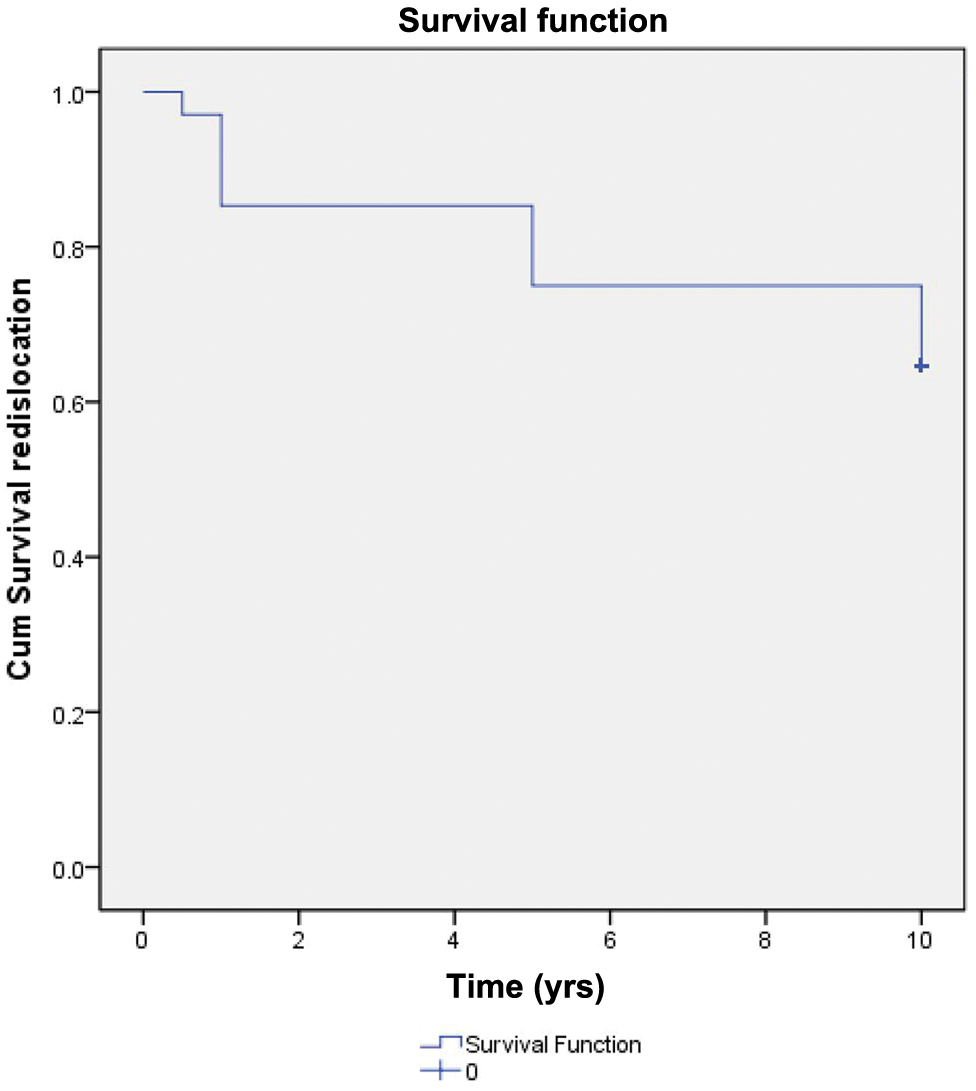
Kaplan-Meier curve of the redislocation rate over time.
Of all patients who experienced a redislocation, 18% (12 shoulders) experienced 1 to 2 recurrent dislocations at most, 7% (5 shoulders) experienced 3 to 4 recurrent dislocations, another 7% (5 shoulders) experienced 5 to 10, and 3% (2 shoulders) experienced more than 10 recurrent dislocations. Nine patients (13%) in whom primary stabilization failed underwent a new operation; others were treated nonoperatively or refused a reoperation.
Risk Factors
The results are shown in Table 1. Although not significant, shoulders stabilized with 3 or 4 anchors tended to have a less chance to redislocate than ones stabilized with 2 anchors (P = .06). No relationship was found between the number of suture anchors and the postoperative period in which a redislocation took place (P = .48).
Subanalysis for Possible Risk Factors for Redislocation a
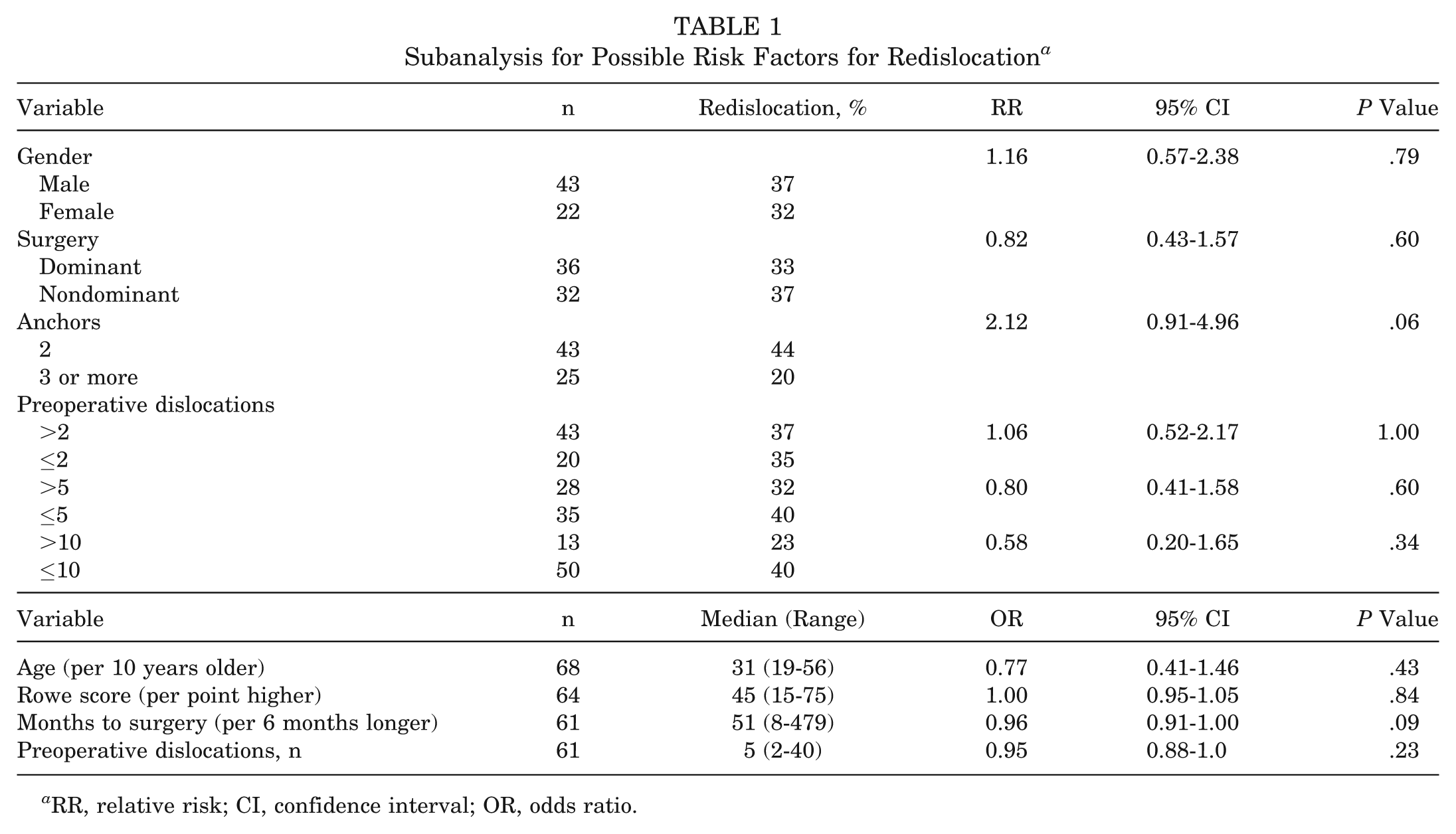
RR, relative risk; CI, confidence interval; OR, odds ratio.
No other possible risk factors could be confirmed; being operated on the dominant side was not associated with having an increased risk for experiencing a redislocation (P = .60), nor was being male (P = .79). Age (P = .43) and preoperative Rowe score (P = .84) were neither associated to have an increased risk, and also time span to surgery (P = .09) and the number of preoperative dislocations in general (P = .23) or up to 2, up to 5, or more than 10 were not associated with an increased risk of experiencing a redislocation (P = 1.00, P = .60, and P = .34, respectively).
Preoperative Sports Participation
In total, 40 patients (42 shoulders, 62%) participated in either contact sports or overhead sports or both preoperatively. Twenty-five patients (26 shoulders, 38%) either participated in other sports or no sport at all. Preoperative participation in contact sports alone or in both contact and overhead sports simultaneously did not increase the chance of experiencing a redislocation (P = .57 and P = .48, respectively). Participation in overhead sports alone, however, seemed to significantly decrease the chance of experiencing a redislocation (P = .03) (Table 2).
Subanalysis for Preoperative Sport Activities as Risk Factors for Redislocation a
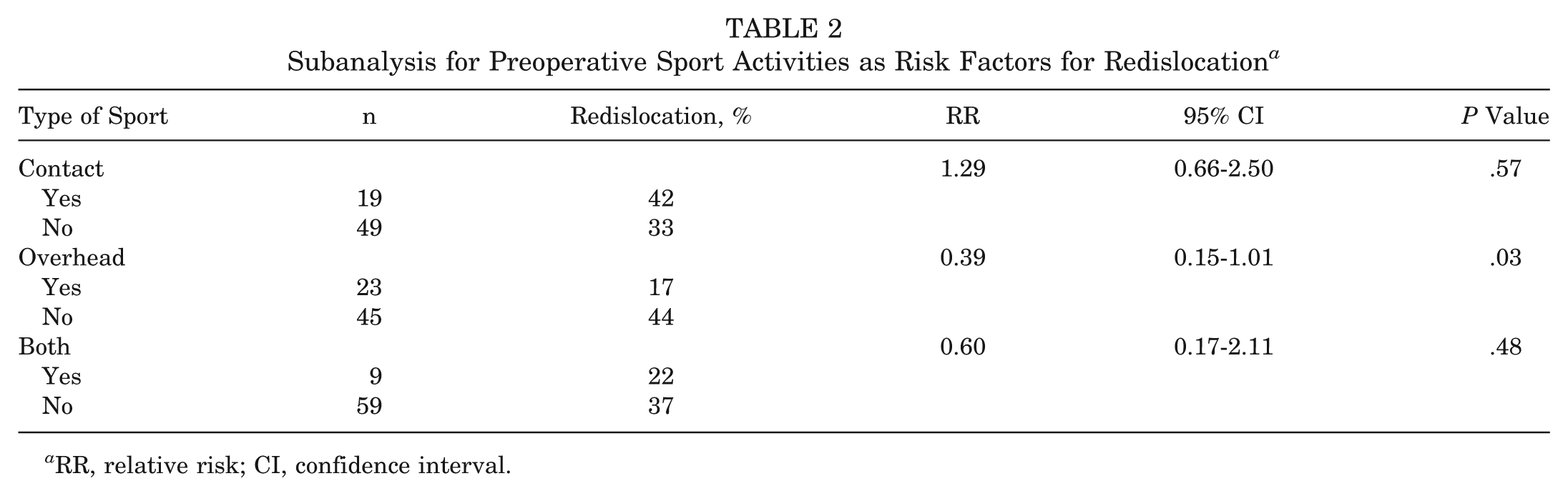
RR, relative risk; CI, confidence interval.
Bony Defects
To assess the effect of bony defects on redislocations, we conducted a subanalysis using 54 MRI scans in which we evaluated both the glenoid and humeral head (Hill-Sachs) (Table 3). In 15 shoulders (28%), the glenoid was intact; in 39 shoulders (72%), the glenoid had some degree of damage, varying from Bigliani type 2 (6 cases) to type 3A (33 cases). When compared with shoulders without a glenoid defect, neither type 2 nor type 3A nor both types combined increased the risk of redislocation (P = .63, P = 1.00, and P = .60, respectively).
Subanalysis for Bony Defects as Risk Factors for Redislocation a
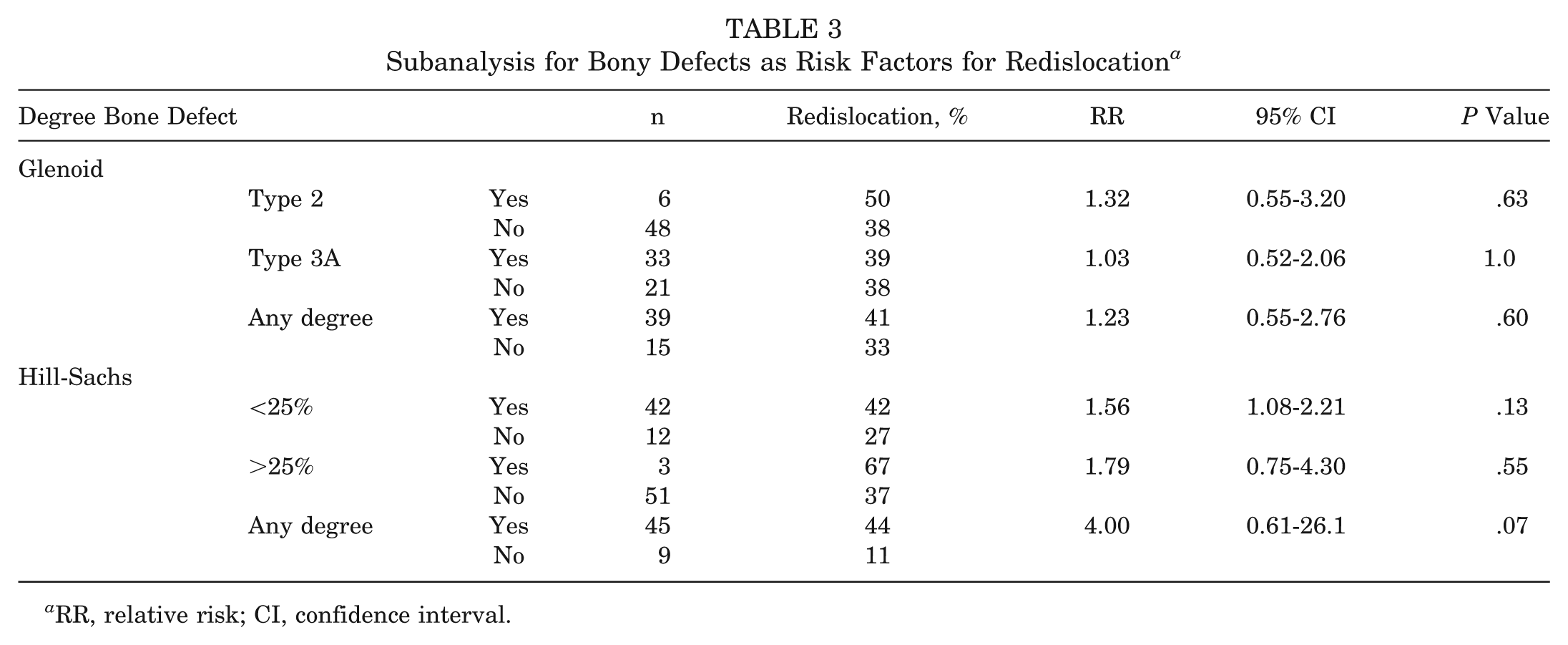
RR, relative risk; CI, confidence interval.
Addressing the humeral head, in 9 shoulders (17%), no Hill-Sachs lesion was identified; in 42 shoulders (78%), a Hill-Sachs lesion comprised less than 25% of the humeral head circumference, and in only 3 shoulders (6%), the Hill-Sachs lesion comprised more than 25%. Although not significant, there might be a relationship between the presence of any degree of Hill-Sachs lesion and the presentation of a redislocation (P = .07). The lesion’s size, however, was of no significant influence, with P = .13 for lesions <25% and P = .55 for lesions >25%.
Postoperative Shoulder Function
Our secondary outcome was the subjective shoulder function, evaluated with the above-mentioned questionnaires. This function was not objectified. Although 57 patients (59 shoulders, 84%) were willing to answer the questionnaires, the postoperative function was conducted only from those 48 patients (50 shoulders) without a reoperation during follow-up (71%). The characteristics of these scores are summarized in Table 4.
Subjective Shoulder Scores (Median and IQR) a
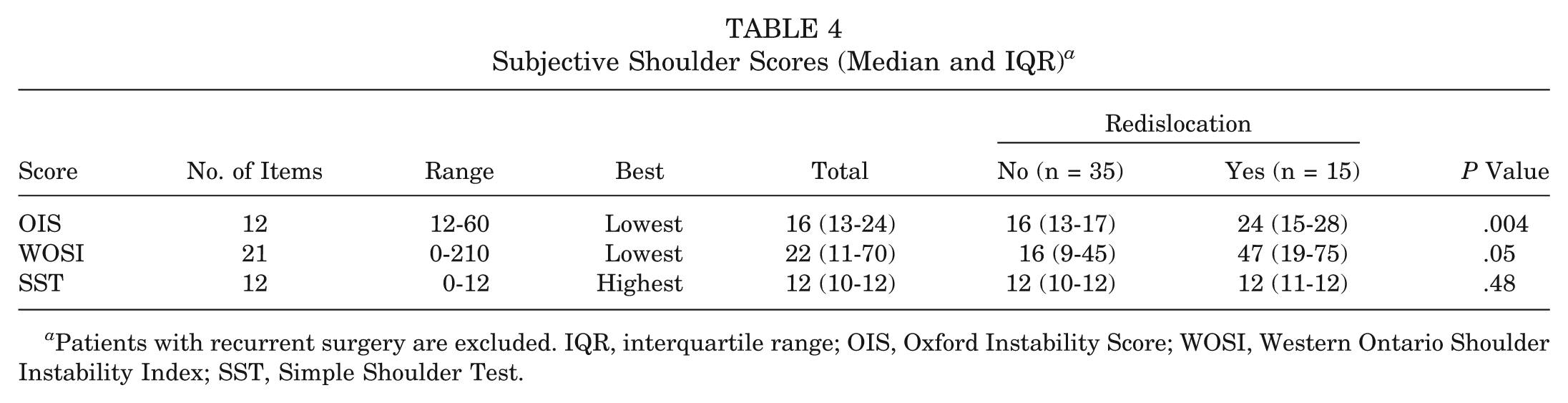
Patients with recurrent surgery are excluded. IQR, interquartile range; OIS, Oxford Instability Score; WOSI, Western Ontario Shoulder Instability Index; SST, Simple Shoulder Test.
The median scores for both the OIS and the WOSI were low (meaning good function), with 16 of 12 to 60 for the OIS and 22 of 0 to 210 for the WOSI. The scores of patients without a redislocation were significantly better compared with patients with a redislocation. The median SST score was high (meaning good function), with 12 of 0 to 12, and there was no difference between SST scores of patients with or without a redislocation (Table 4).
In the SF-36 score, when corrected for age (16-40 years), only 5 participants scored less in both the physical and mental component compared with the normal Dutch population. Because not all patients were athletes, the SF-36 score was not corrected for this entity, even though athletes might have a higher baseline SF-36 score. When corrected for sex, there were only 3 patients to score less than the norm (Figure 2).
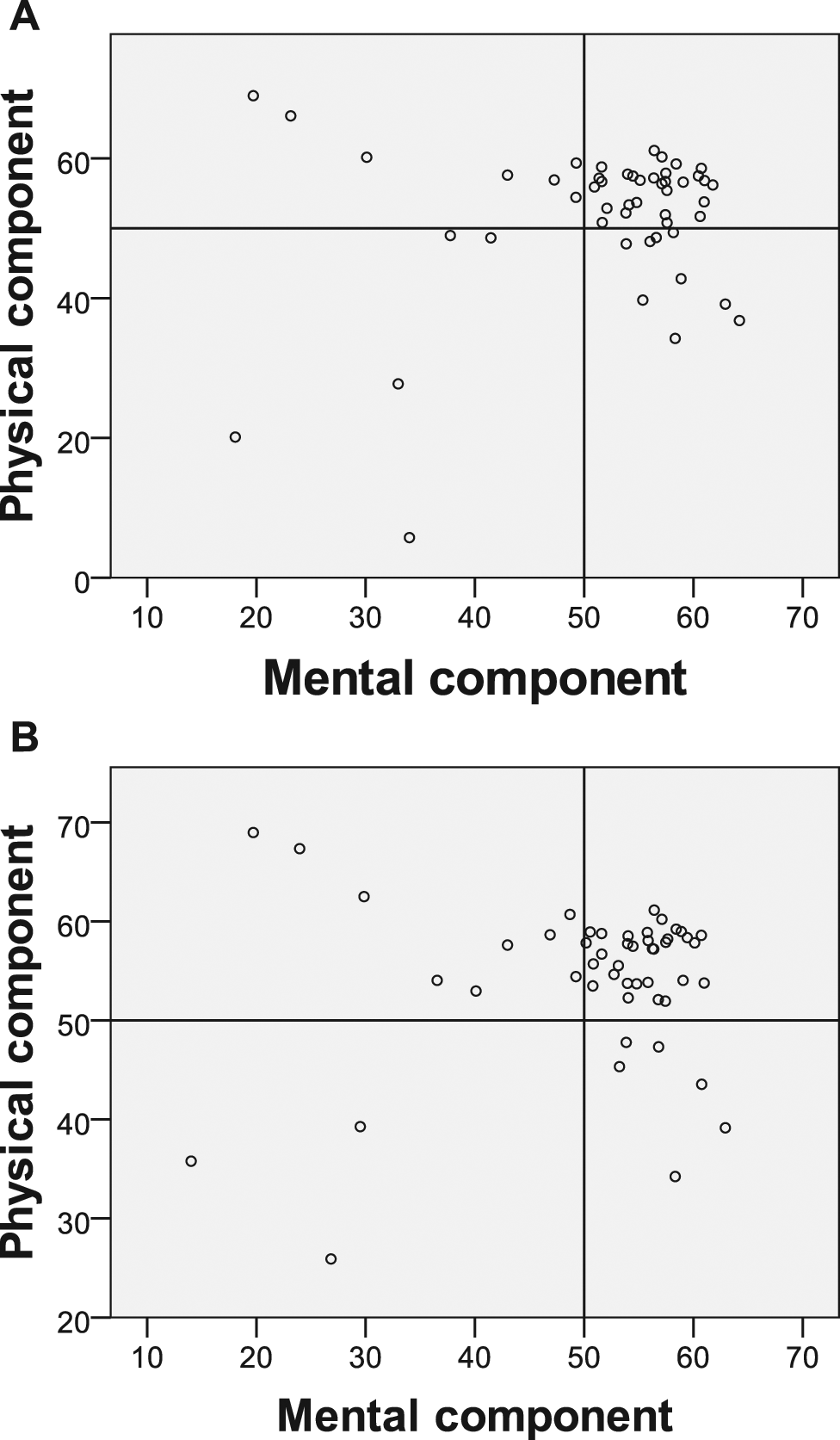
The SF-36 scores corrected for age (16-40 years) (A) and sex (B) compared with the normal Dutch population. The physical and mental scores above 50 correspond to better physical or mental function than the comparison group.
Complications
No infections or other complications occurred in this series.
Discussion
The optimal surgical technique to treat recurrent anterior glenohumeral instability remains a controversial topic, as good results have been shown by both open and arthroscopic stabilization. Although often described to show a lower recurrence rate, the open Bankart procedure can result in a limited range of motion.21,27
In our study on the long-term follow-up after arthroscopic stabilizations for traumatic onset of recurrent anterior shoulder instability, redislocation was defined as our primary outcome. Because the subjective questionnaires reflect the experience of the patient, we used strict criteria for redislocation, including both a subluxation and a full dislocation, to avoid possible confusion for the patient. Our results up to 2 years postoperatively resemble previous studies with a 15% failure rate.6,16,44 However, another 20% of the patients experienced their first redislocation after 2 years, leading to a total 35% of our patients having experienced at least one redislocation 8 to 10 years postoperatively. This is slightly more compared with long-term follow-up studies in open stabilization4,25,33 and one previous long-term follow-up study in arthroscopic stabilization, which only reached 71% for final follow-up. 10
No previously identified risk factors could be confirmed in our study. Contrary to previous studies, no significance was found for age as a risk factor.36,38,43 Because young age has been identified as a risk factor to increase the chance of a redislocation, the relatively high age of our population might positively influence our results. The interval between first dislocation and surgery did not increase the chance of a redislocation. Nor did the number of preoperative dislocations, up to 2, up to 5, or more than 10, influence the chance of having a redislocation. Dominance, gender, and preoperative shoulder function did not influence the chance of having a redislocation either.
As Boileau et al 6 previously described, we also did find, although not significantly, a relationship between the number of suture anchors that were used and the chance of a redislocation. This trend shows that patients stabilized with 3 or more suture anchors have less chance to experience a redislocation than patients stabilized with 2 suture anchors. The fact that 43 shoulders (63%) were stabilized using 2 suture anchors might partly explain the higher recurrence rate in our study compared with previous studies. We did not find any confounding factors between the different risk factors.
We also found, as previously described by Voos et al 44 and Boileau et al, 6 that the presence of a Hill-Sachs defect, although not significantly, increased the redislocation risk. We did not find a relationship between glenoid lesions and redislocations.
Preoperative participation in contact sports, as Ide et al 19 described before, did not influence the redislocation risk. We observed that preoperative participation in overhead sports, however, decreased this risk significantly, although no specific measures were taken in overhead athletes. This is contrary to the findings of Ide et al 19 and Pagnani et al, 32 who previously described no relationship, and to Sachs et al 40 and Calvo et al, 8 who described a significant increased redislocation risk in patients participating in overhead sport activities.
This finding might be because of higher awareness, better muscular control, and better proprioceptive abilities in patients participating in overhead sports compared with their peers who do not share their experiences. Another plausible explanation is that these patients might have diminished their sports intensity or did not return to their preinjury level of shoulder function compared with patients who were not engaged in overhead activity.
To investigate the subjective functional improvement of a surgical intervention ideally, both system (shoulder)–specific and condition (instability)–specific instruments should be used.34,35 The OIS, WOSI, and SST are designed to do so, including questions addressing sport, work, and daily activities. To objectify the results of our initial procedure, in this subanalysis, we only included patients without a reoperation during follow-up. Based on the good average scores, we conclude that our patients in general are satisfied with their shoulder function.
We furthermore found that only the instability-specific questionnaires (OIS and WOSI) distinguished significantly between patients with and without redislocation, whereas the more general shoulder score (SST) did not. In our opinion, only instability-specific questionnaires should therefore be used in long-term follow-up studies for instability management.
The SF-36 showed that the majority of the patients score above average on both the mental and physical component. With our heterogeneous patient population, we did not correct for the fact that athletes might have a higher baseline SF-36 score.
Because the OIS, WOSI, and SST have only recently been developed and had not yet been validated thoroughly at the time of surgery, we conducted the Rowe score before surgery. The Rowe score is a very commonly used scoring system largely based on the objective shoulder function.
An important advantage of using validated patient-based questionnaires is that patients can be included for final follow-up without visiting the hospital. Especially in this relatively young and highly mobile patient population, it is a very practical way to follow up on patients.
Although long-term follow-up studies on previous arthroscopic techniques are available,30,41 to our knowledge, only one previous study has been published on extended follow-up after arthroscopic stabilization using suture anchors in a community-based patient population. This study, however, included only 71% for their final follow-up. 10
One study with an extended follow-up included only male contact athletes who are likely to be in excellent condition and might not be as representative as our population. 26 Another previous study described the results after open stabilization with suture anchors using the OIS. Eleven years after their initial operation, they have a response rate of 64% and have a mean score of 21.7, with 12% experiencing further dislocations or ongoing symptoms of instability. 29
Strong points of this study are the 97% long-term follow-up and the presence of an independent observer using validated patient-based questionnaires. A weak point is the fact that 10 years ago, generally 2 to 3 anchors were used, while presently, a large consensus exists to use 3 or more anchors. Another weak point is the fact that, although the used subjective scores are highly valuable, patients were not physically or radiographically evaluated, and instability, shoulder range of motion, or strength is not objectified. The authors, however, argue that a stiff shoulder or an impaired shoulder function will translate in the outcome of the questionnaires. Instability-specific parameters like passive apprehension could therefore not be included in our results.
Conclusion
Eight to 10 years postoperatively, about one third of the patients undergoing this type of procedure reported a redislocation. More than half of these occurred for the first time more than 2 years after surgery.
We found that the number of anchors used, as well as the presence of a Hill-Sachs defect, tended to be predisposing factors for experiencing a redislocation. Other previously identified predisposing factors for redislocation could not be confirmed. Although all patients in general reported few functional problems, patients without a redislocation have a significantly better subjective shoulder function compared with their peers with a redislocation.
Footnotes
Acknowledgements
We acknowledge Mary Boekhorst from the Onze Lieve Vrouwe Gasthuis, Amsterdam, the Netherlands, for her contribution in coordinating our patient population.
The authors declared that they have no conflicts of interest in the authorship and publication of this contribution.