







Abstract
Background:
Concussions impair balance, visual acuity, and reaction time—all of which are required for high-level batting performance—but the effects of concussion on batting performance have not been reported. The authors examined this relationship between concussion and batting performance among Major League Baseball (MLB) players.
Hypothesis:
Batting performance among concussed MLB players will be worse upon return to play than batting performance among players missing time for noninjury reasons.
Study Design:
Cohort study; Level of evidence, 3.
Methods:
The authors identified MLB players who sustained a concussion between 2007 and 2013 through league disabled-list records and a Baseball Prospectus database. For a comparison group, they identified players who went on paternity or bereavement leave during the same period. Using repeated-measures generalized linear models, the authors compared 7 batting metrics between the 2 groups for the 2 weeks upon return, as well as 4 to 6 weeks after return, controlling for pre-leave batting metrics, number of days missed, and position.
Results:
The authors identified 66 concussions and 68 episodes of bereavement/paternity leave to include in the analysis. In the 2 weeks after return, batting average (.235 vs .266), on-base percentage (.294 vs .326), slugging percentage (.361 vs .423), and on-base plus slugging (.650 vs .749) were significantly lower among concussed players relative to the bereavement/paternity leave players (time × group interaction, P < .05). In weeks 4 to 6 after leave, these metrics were slightly lower in concussed players but not statistically significantly so.
Conclusion:
Although concussed players may be asymptomatic upon return to play, the residual effects of concussion on the skills required for batting may still be present. Further work is needed to clarify the mechanism through which batting performance after concussion is adversely affected and to identify better measures to use for return-to-play decisions.
After a concussion, cognition is impaired for weeks to months after the injury. Cognition often remains compromised even after somatic symptoms resolve.9,19 This is manifest in subjectively reported cognitive symptoms, such as slowed thinking or response speed, mental fogginess, and poor concentration.2,33 Additionally, neuropsychological testing of concussed individuals has shown deficits in attention,17,21,36 as well as reaction time and information-processing speed.17,21,49,54 Concussion also affects balance26,47 and ocular function, including visual-motor speed,9,14,17 eye movement, and tracking.8,11,24,25,27,28,31,56
Many of these impaired neurocognitive abilities are important components of effective hitting in baseball. Hand-eye coordination and visual acuity have been associated with improved batting performance.12,13,35,59 Additionally, faster reaction time and better attention correlate with better batting performance.23,32,46,50,51,53,58 Proper weight shift and balance are also essential for successful batting.20,57
Despite the known relationships between batting performance and these neurocognitive abilities impaired by concussion, as well as the complex neurologic mechanisms required to hit a baseball, the effects of concussion on hitting metrics have not been examined in the peer-reviewed literature. Concussions account for approximately 2.1% of all time-loss injuries in Major League Baseball (MLB); only strains and contusions are more common than concussions. 1 The contribution of concussions to all time-loss injuries in high school and collegiate baseball is similar to that in MLB, and the incidence is increasing at a rate of approximately 14% each year, up to the most recent estimate of approximately 0.07 concussions per 1000 athlete-exposures.22,29,37 However, the only published studies examining concussions in baseball have focused on descriptive epidemiology and injury biomechanics, not on the consequences of concussion on player performance.3,6,22,29,37
Understanding the effect of concussions on batting performance among baseball players can help to inform return-to-play decisions for these athletes. Our objective was to examine the relationship between concussion and batting performance in MLB players.
Methods
Study Design
A retrospective cohort study design was used to determine the relationship between concussion and batting performance. We identified MLB players who had a concussion and examined various batting metrics pre- and post-injury. We then compared this change in batting metrics to that of MLB players who missed playing time by going on paternity or bereavement leave.
Study Population
Major League Baseball players with concussions were identified through 2 methods: (1) a text search for “concussion” in the online (www.MLB.com) transactions pages 40 from 2007 through 2013 to identify all players who went on the disabled list (DL) for concussions and (2) a Baseball Prospectus database of all head injuries from 2007 through 2012. 15 The Baseball Prospectus database ascertained concussion information through player pages on baseball websites and confirmed with different Associated Press newspaper articles, reports, or media guides. Therefore, this included concussive events in which the player did not go on the DL.
A similar process was used to identify players who took bereavement or paternity leave, who were taken off the active roster through transactions during the time of leave. We performed a text search for “bereavement” and “paternity” on the MLB.com transactions pages from 2007 through 2013. For this group, we did not examine the Baseball Prospectus database. As it is unlikely that players would miss playing time for bereavement or paternity reasons without an official transaction, we did not use any further method to identify these players.
We included all concussions, bereavement leaves, or paternity leaves (in general, termed as “events”) occurring in players who had played in the major league regular season for at least 2 weeks before the event. Events were excluded if the player did not play for at least 2 weeks in the major league regular season before the event, if the player had a previous event of the same type in the same year, if the player had events of 2 different types in the same year, or if the player missed more than 35 days of major league play due to the event. Additionally, we excluded any events in which the player had <10 regular season major league plate appearances in the 2 weeks after return. Finally, we excluded all pitchers from analysis because they have limited number of at-bats in a 2-week period.
This study was approved as an exempt study by the university’s research subjects review board.
Hitting Metrics
We obtained all hitting metrics from the regular season game logs on baseball-reference.com. 4 The game logs provide information on the results of each plate appearance that a player has in an individual game, the number of innings played, and the position that the player played in the game, as well as some additional advanced metrics. From this information, we calculated metrics likely affected by concussion: batting average (AVG; hits per official at-bats), on-base percentage (OBP; [hits + walks + hit-by-pitch]/[at-bats + walks + hit-by-pitch + sacrifice fly-outs]), slugging percentage (SLG; [singles + (2 × doubles) + (3 × triples) + (4 × home runs)]/official at-bats), OBP plus slugging percentage (OPS), walk percentage (walks per plate appearances), strikeout percentage (strikeouts per at-bats), and home run percentage (home runs per at-bats).
We examined these batting metrics at 3 periods: pre-event (the 2 weeks before the player had a concussion or went on bereavement or paternity leave), post-leave (the 2 weeks after the return to the active roster from the event), and long-term post-leave (the period from 4 weeks after the day of return to 6 weeks after the day of return). We chose to examine this long-term post-time period as a way to observe any additional recovery that could occur.
Statistical Analysis
Descriptive characteristics regarding the sample were calculated as frequencies and percentages for categorical variables and means and standard deviations for continuous variables. Raw mean comparisons of batting metrics were made between concussed players and those on leave using independent-measures t tests. A series of general linear models (GLMs) were used to make these comparisons while controlling for previous batting (eg, pre-event OPS when examining post-leave OPS), position (catcher vs noncatcher), and number of days missed. These GLMs were then supplemented by repeated-measures GLMs examining change from pre-stats while employing the same covariates, with the exception of the pre-batting stats. These models allow for the examination of interindividual differences (comparisons across groups) and intraindividual change (differences over time). The repeated-measures aspect of the study also helps account for the potential for random interindividual differences in the post-leave time frames due to intraindividual variability in batting metrics during the modest time interval (2 weeks) examined. A P value <.05 was interpreted as statistically significant.
Results
A total of 187 events of concussion, bereavement leave, and paternity leave were identified among position players. We excluded 53 events owing to the player having >1 event in a year (n = 21), the player missing >35 days (n = 6), and events where pre- or post-leave batting metrics were not available because the player did not participate in any games during the period (eg, on the bench before leave or did not return to play after event; n = 26). Thus, we examined a final sample of 134 events (66 concussions and 68 paternity or bereavement leaves). Thirty-five (53%) concussions resulted in the player being placed on the DL. With regard to noninjury leave events, 45 (66%) were for bereavement leave, and 23 (34%) were for paternity leave. The demographic characteristics of the sample are presented in Table 1.
Demographic Characteristics of Concussion and Paternity/Bereavement Leave Events a
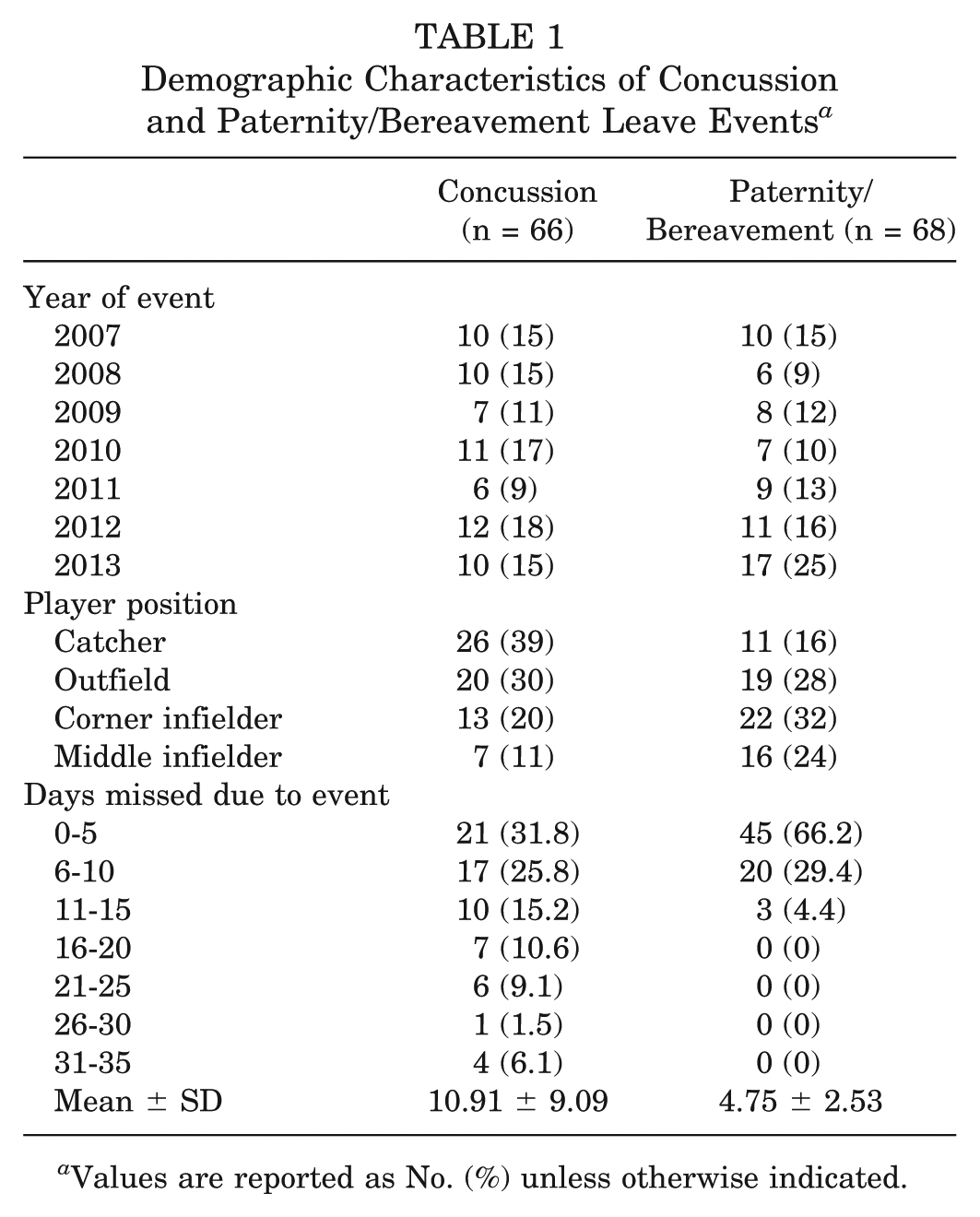
Values are reported as No. (%) unless otherwise indicated.
Unconditional comparisons of batting metrics at each time point are presented Table 2. There were no significant differences in unconditional batting metrics between the groups during the pre-event period. During the 2 weeks after the event, concussed players had significantly worse AVG, OBP, SLG, and OPS than players on bereavement/paternity leave. None of these differences were present during the long-term post-leave period.
Unconditional Batting Metrics a
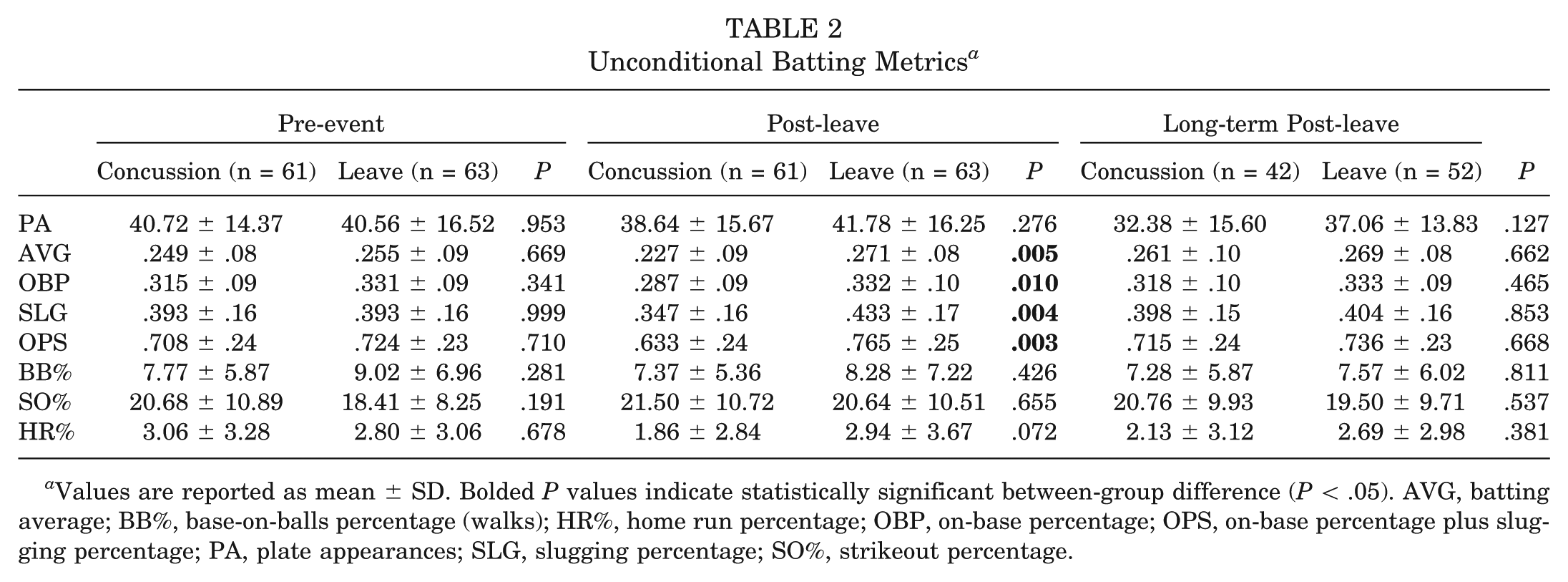
Values are reported as mean ± SD. Bolded P values indicate statistically significant between-group difference (P < .05). AVG, batting average; BB%, base-on-balls percentage (walks); HR%, home run percentage; OBP, on-base percentage; OPS, on-base percentage plus slugging percentage; PA, plate appearances; SLG, slugging percentage; SO%, strikeout percentage.
After controlling for pre-event batting performance, number of days missed, and player position, concussed subjects had significantly worse OPS (.652 vs .745) during the 2 weeks after return from the event than did players who went on paternity or bereavement leave, as shown in Table 3. Once again, none of these differences were present during the long-term post-leave period.
Estimated Marginal Means of Batting Metrics a
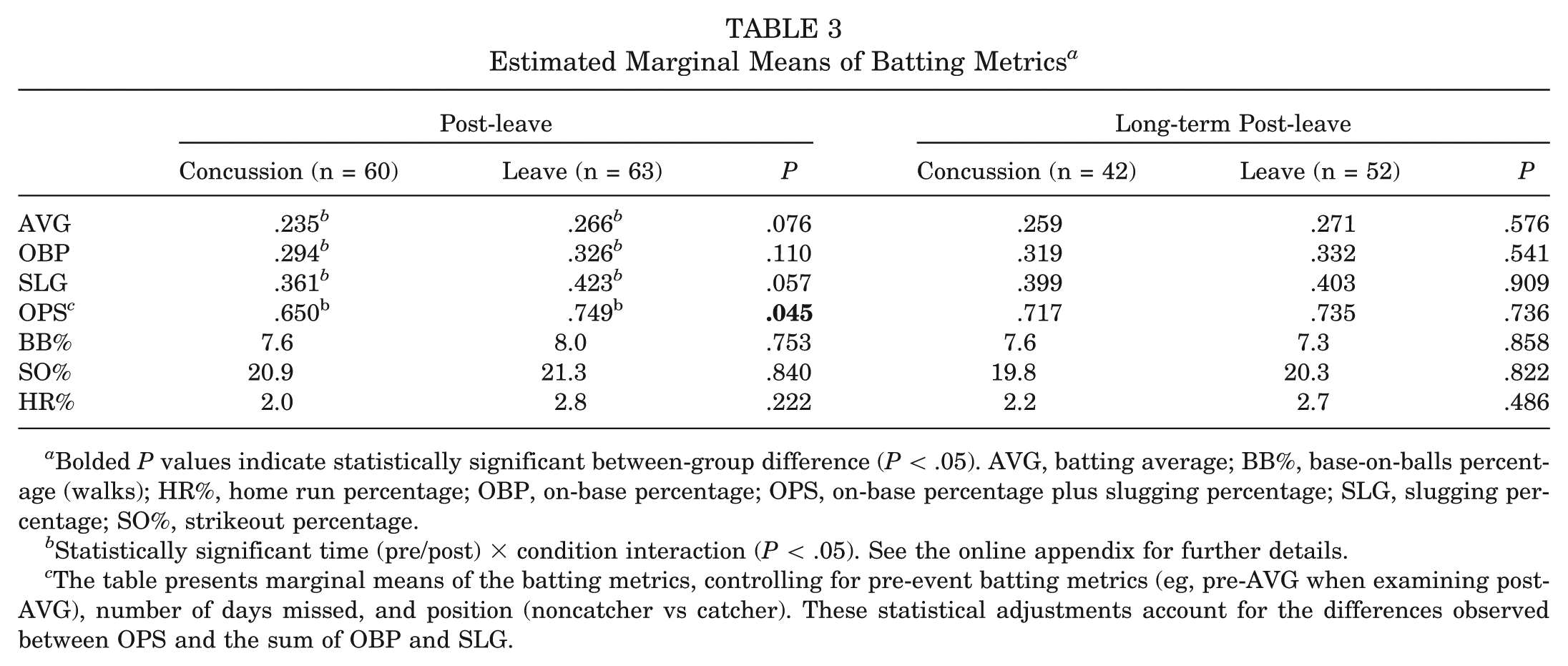
Bolded P values indicate statistically significant between-group difference (P < .05). AVG, batting average; BB%, base-on-balls percentage (walks); HR%, home run percentage; OBP, on-base percentage; OPS, on-base percentage plus slugging percentage; SLG, slugging percentage; SO%, strikeout percentage.
Statistically significant time (pre/post) × condition interaction (P < .05). See the online appendix for further details.
The table presents marginal means of the batting metrics, controlling for pre-event batting metrics (eg, pre-AVG when examining post-AVG), number of days missed, and position (noncatcher vs catcher). These statistical adjustments account for the differences observed between OPS and the sum of OBP and SLG.
Repeated-measures GLMs revealed a significant interaction (P < .05) between time and event (concussion vs bereavement/paternity leave) for OPS, as well as AVG (.235 vs .266), SLG (.362 vs .420), and OBP (.294 vs .326). These changes in batting metrics from pre-event to post-return are presented in the Appendix (available online at http://ajsm.sagepub.com/supplemental). Among concussed players, batting performance in nearly all metrics declined from the pre-event period to the post-leave period, whereas in bereavement/paternity leave players, batting performance actually improved for nearly all the metrics.
As shown in Table 1, the distribution of days missed was different between the concussed players and the players who went on paternity or bereavement leave. In addition to performing analyses that controlled for the number of days missed, we performed a sensitivity analysis restricted to just those players who missed ≤10 days. The results were similar to the analyses including all players. Repeated-measures GLMs revealed a significant interaction between time and event (concussion vs bereavement/paternity leave) for the post-leave period for AVG (.232 vs .266, P = .04), SLG (.366 vs .420, P = .04), and OPS (.667 vs .746, P = .04). OBP was also lower for the concussed group than the noninjury leave group (.301 vs .326), but the interaction was no longer statistically significant.
Discussion
This study is the first to investigate the relationship between concussion and batting metrics. In fact, this is only the second study to examine the effect of concussion on performance of sport-specific activities. 34 Our results show that concussed MLB players perform worse after returning from their injuries than players who miss playing time for noninjury reasons. This difference persists even after controlling for pre-injury performance, position, and number of days missed. Our findings suggest that concussed baseball players who are cleared to return to play through traditional approaches may not have fully returned to baseline status before their return. Although concussions account for only 2.1% of time-loss injuries in MLB players, the rate of diagnosed concussions in baseball is increasing, and these findings have implications for return-to-play decisions in general, across all sports.
According to the MLB policy on return to play established in 2011, for a player to return after a concussion, the club must certify that all symptoms have resolved at rest and exertion, that ImPACT results have returned to baseline, and that the team physician feels that it is safe to return to competition.5,39 Thus, in our sample, despite resolution of symptoms and return to baseline cognition (as determined via ImPACT score), players continued to exhibit impaired function manifested by decreased AVG, OBP, slugging percentage, and OPS. Our results suggest that these methods of determining recovery and readiness for return-to-play may not be sensitive enough to detect incomplete recovery from concussion in some neurocognitive domains.
In addition to the new return-to-play policy, MLB established the 7-day DL in 2011, which aimed “to allow concussions to clear, prevent players from returning prematurely and give clubs a full complement of players in one’s absence.” 39 Before the establishment of this 7-day DL, players were required to either go on the DL for 15 days or stay on the active roster without playing, which could increase pressure for the player to return before complete recovery.5,52 This 7-day period for the concussion DL is likely based on the commonly cited concussion recovery time of 7 to 10 days for 85% to 90% of athletes.7,42,43,48 However, a growing body of research suggests that time to recovery may actually be longer.30,38,41 Our findings that concussed players have impaired batting performance in the weeks after return to play suggest that, in this population, impairment in some neurocognitive domains is prolonged beyond the given 7 days.
Hitting a baseball may be uniquely sensitive to the effects of concussion. MLB players use a 2¼-inch-diameter bat to hit a 3-inch-diameter baseball thrown at speeds of >90 miles per hour from 60 feet 6 inches away. At these speeds, the ball reaches the batter approximately 400 milliseconds after it leaves the pitcher’s hand.
The ability to successfully perform these tasks thus depends on the proper functioning of multiple neural networks. These include ocular networks, which control smooth pursuit and saccadic eye movements12,44 and are involved in seeing the ball and making a prediction about its location, and attentional networks, which allow players to integrate additional perceptual information (eg, pitch count, pitch sequence, position of the pitcher’s arm during the pitch) to enhance the prediction of ball location, as well as to block out extraneous stimuli.23,50,53 Finally, the initiation and completion of a successful bat swing requires proper functioning of the motor circuits, vestibular and cerebellar networks involved in postural stability and balance, 10 circuits involved in visual reaction time, 13 and intact connections to the right inferior frontal gyrus, which provide inhibitory control over a swing once it has begun. 45
Several of these neural functions and networks are known to be disrupted by concussion (eye saccades, convergence, accommodation, attention, vestibular control of balance, reaction time); thus, it is no surprise that this complex perceptual-motor task is readily affected by this injury. The large number of brain structures and neural networks that must properly function in only 400 milliseconds may also explain why batting recovery back to baseline takes longer than recovery of any of the cognitive functions traditionally used to determine return to play. We do not have access to any neurocognitive test scores for the players included in this study, but future studies should look to associate measures of these cognitive functions with batting performance.
It is interesting to note that walk percentage and strikeout percentage—measures traditionally associated with “seeing the ball”—were not associated with concussion status. The concussed baseball players are putting the ball in play just as often as the nonconcussed, but once the ball is in play, the outcome is worse. Some evidence shows that a batter can control where the ball is going such that the outcome of a ball in play is better; thus, these outcomes are also reliant on reaction time and eye movement and tracking.16,18,55 One potential explanation for the worse batting performance after concussion is that the batter’s timing is off just enough to decrease the power of contact (reducing the number of extra-base hits) as well as the batter’s control over the timing of contact (reducing the number singles resulting from balls hit in gaps between opposing fielders). Future research should examine bat speed, ball angles off the bat, distribution of balls in play (fly ball vs line drive vs ground ball), and spray charts of batted ball placement to further test this hypothesis.
This study has many strengths, including being the first in baseball to examine athletic performance after concussion, the use of a nonconcussed comparison group in addition to a pre-post comparison, and appropriate control for confounders such as position and number of days missed. However, as with all studies, there are some limitations to our work. First, we relied on the MLB.com transaction site for the majority of our subject ascertainment. The quality of these data is unknown and may differ among DL, paternity leave, and bereavement leave. Additionally, we may have missed some cases at the end of the seasons, when there is no incentive to place players on leave due to a roster size increase on September 1, leaving no consequence for hurt players to sit on the bench. However, there is little reason to believe that the association between concussion status and batting performance would be different at the end of the season than earlier in the season. The concussions included in our study are not all confirmed with a medical diagnosis, and it is possible that some of the players included in our analysis did not truly have a concussion. Additionally, our study did not account for time that players who went on the DL spent on rehabilitation assignment in the minor leagues, which may be associated with performance upon return. There may be other unmeasured factors that are different between the 2 groups, such as mental state of the players, which could lead to residual confounding in our analyses.
The institution of the change in return-to-play guidelines and DL length in 2011 may change the characteristics of the concussed population; however, to mitigate this, we included concussions that caused players to go on the DL and concussions that did not. Additionally, we found that year of injury was not significantly associated with batting performance, and analyses examining the association in 2007-2010 compared with 2011-2013 showed the pattern of differences was consistent across the 2 periods (data not shown). Finally, although we controlled for differences between groups in the number of days missed, there may still be a residual effect from bereavement/paternity leave players missing fewer days than those of concussed players. That is, the association that we are observing may be due to rust rather than the concussion. We believe that this is unlikely, though, as a subgroup analysis restricted to events in which players missed ≤10 days showed results consistent with those reported.
To our knowledge, this is the first study in the literature to examine the association between concussion and batting metrics. Concussed MLB players have worse batting performance after returning from their injuries than do players who miss playing time for noninjury reasons. Although concussed players may be asymptomatic upon return to play, the residual effects of concussion on the complex perceptual-motor skills required for batting may still be present. Further work is needed to clarify the mechanism through which batting performance after concussion is adversely affected.
Footnotes
Acknowledgements
The authors acknowledge Corey Dawkins of Baseball Prospectus for contributing his database of concussed players. They also acknowledge Katie Evans, PhD, for her contributions to data management and analysis.
One or more of the authors has declared the following potential conflict of interest or source of funding: J.J.B. has declared 2 potential conflicts of interest: while not directly related to this study, he holds a patent titled “Method of Diagnosing Mild Traumatic Brain Injury,” PCT International Application Number PCT/US2012/069002, US Serial No. 14/365,550; he is also a consultant for Banyan Biomarkers and Roche Diagnostics for purposes not related to this study.
References
Supplementary Material
Please find the following supplemental material available below.
For Open Access articles published under a Creative Commons License, all supplemental material carries the same license as the article it is associated with.
For non-Open Access articles published, all supplemental material carries a non-exclusive license, and permission requests for re-use of supplemental material or any part of supplemental material shall be sent directly to the copyright owner as specified in the copyright notice associated with the article.
