







Abstract
Background:
Medial ulnar collateral ligament (UCL) reconstruction is a common procedure performed on professional pitchers in Major League Baseball (MLB). Although a great deal is known about primary reconstruction, much less is known about revision reconstruction.
Purpose/Hypothesis:
The purpose of this study was to evaluate statistical performance, return to play, and career longevity in MLB pitchers after revision UCL surgery, with the hypothesis that pitching performance and career longevity will decline after revision surgery.
Study Design:
Cohort study; Level of evidence, 3.
Methods:
A total of 33 MLB pitchers who underwent revision UCL reconstruction surgery (UCL-R group) were identified and compared with 33 age- and position-matched controls (CTL group). Return to play, total years played, and statistical performance were evaluated and compared with controls.
Results:
After revision surgery, 65.5% of UCL-R pitchers returned to the MLB level. On average, the UCL-R pitchers played 0.8 years less in the majors (P < .01) than did the control pitchers. The UCL-R pitchers who returned to the MLB level had a similar earned run average (UCL-R: 4.88, CTL: 4.76, P = .82) and walks/hits per innings pitched (UCL-R: 1.58, CTL: 1.44, P = .22) compared with the control pitchers. There were significant declines, however, in terms of innings pitched (UCL-R: 36.95, CTL: 75.00, P < .01), walks per 9 innings (UCL-R: 4.75, CTL: 3.49, P < .01), and wins (UCL-R: 1.88, CTL: 4.10, P < .01) as well as nonsignificant declines in wins above replacement (UCL-R: 0.25, CTL: 0.62, P = .06) and runs above replacement (UCL-R: 3.26, CTL: 6.91, P = .07).
Conclusion:
MLB pitchers who undergo UCL-R have a low rate of return to MLB play and have shortened careers after return. Pitchers who returned to the MLB level maintained performance in several statistics such as earned run average and walks/hits per innings pitched; however, pitchers returned with a significantly decreased workload.
Baseball pitching has the potential to place tremendous amounts of stress on the throwing elbow.3,6 The anterior band of the medial ulnar collateral ligament (UCL) acts as the primary stabilizer to valgus stress between 20° and 120° of flexion.13-15 Over time, repeated stress to the elbow can damage the UCL and ultimately lead to injury. Overhead throwing athletes, such as baseball pitchers, have an increased propensity for injury to the elbow.3,11,17 For high-level athletes such as major league pitchers, surgical reconstruction of the UCL, or Tommy John surgery, has shown to have a much higher return to sport compared with nonoperative management. 19 The UCL reconstruction has been shown to be a reliable procedure that allows overhead throwing athletes to not only return to play but also continue to play at a high level.1,2,5,7,10,12,16,18
Multiple previous studies have evaluated performance after primary UCL reconstruction, with conflicting data reported in terms of pitching performance statistics after primary reconstruction.5,8,12 Although a great deal is known about primary UCL reconstruction, very little is known about performance after revision UCL reconstruction surgery. To our knowledge, there have been only 2 previous studies evaluating revision UCL reconstruction.4,9 These studies are limited by sample size and lack of comparison with a control group. A study by Dines et al 4 evaluated 4 Major League Baseball (MLB) pitchers’ return to play after revision UCL reconstruction and did not evaluate any performance measures. A similar, larger study by Jones et al 9 evaluated pitching performance after revision reconstruction but lacked comparison to controls.
The purpose of this study was to identify a cohort of MLB pitchers who underwent revision UCL reconstruction and to evaluate pitching performance and return to play compared with age- and position-matched major league controls. Of further interest, we looked to evaluate how long pitchers were able to continue their career after undergoing a second UCL reconstruction. We hypothesized that pitching performance and career longevity would decline significantly after revision surgery compared with controls.
Methods
We conducted a retrospective, case-controlled study. This study was reviewed and approved by our institutional review board.
Revision UCL Reconstruction Pitchers
A cohort of 43 professional baseball players who had originally undergone primary UCL reconstruction and then subsequently required revision reconstruction between 1996 and 2012 were identified. Of these 43 players, 10 were excluded because they either were not pitchers (n = 3) or had played only minor league baseball (n = 7). A final cohort of 33 MLB pitchers, which excluded minor league pitchers, was identified (UCL reconstruction [UCL-R] group). The UCL-R players were identified using methods similar to those of previous studies5,7,12: via team websites, press releases indicating players had undergone UCL reconstruction, personal websites, and baseball statistical websites, including baseballreference.com. In finding the cohort, “Tommy John” surgery was considered an acceptable reference. To verify each pitcher’s year of surgery, we cross-referenced each player’s reported surgical date with a gap in pitching statistics.
For each UCL-R pitcher, the years of primary reconstructive surgery and revision surgery were collected. Statistics were obtained using 2 independent statistical sources (http://www.baseballreference.com and http://www.fangraphs.com) to maximize completeness and accuracy. Pitcher demographics included handedness, date of birth, age at surgery, and position (relief, closer, or starter). We collected each pitcher’s MLB and minor league years played.
To establish sufficient trends in performance, we collected pitching performance statistics for 3 years before revision surgery and 3 years after revision surgery. Only MLB statistics were evaluated. Statistics collected included innings pitched, earned run average (ERA), walks and hits per innings pitched (WHIP), wins, losses, win percentage, walks per 9 innings (BB/9), strikeouts per 9 innings (SO/9), strikeouts per walk (SO/BB), hits per 9 innings, home runs per 9 innings, wins above replacement (WAR), runs above replacement (RAR), runs against per 9 innings (includes unearned runs; RA/9), and runs against per 9 innings average (RA/9avg). The WAR, RAR, and RA/9avg statistics are better explained in Table 1.
Baseball Statistics Definitions a
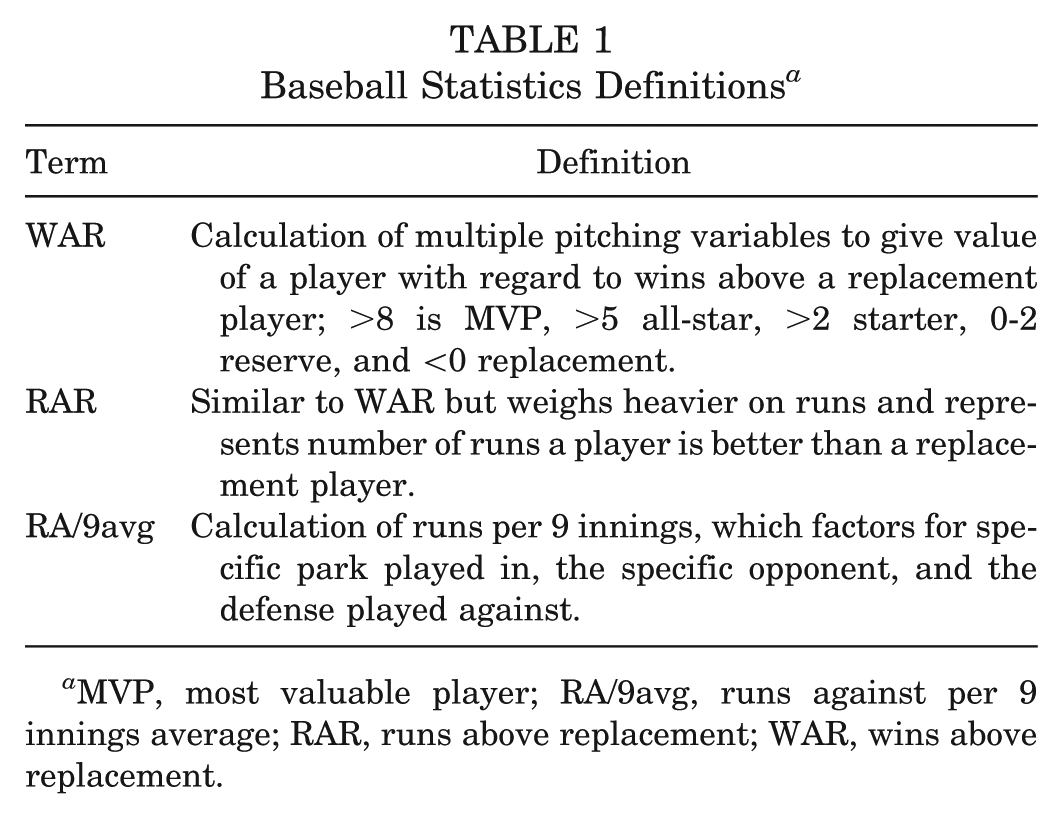
MVP, most valuable player; RA/9avg, runs against per 9 innings average; RAR, runs above replacement; WAR, wins above replacement.
Control Pitchers
An age- and position-matched group of MLB pitchers (no minor league pitchers) were identified in a blinded process. A total of 33 control pitchers were identified (CTR group). The CTR players were selected by first creating a database of MLB pitchers. Players were removed from the group of possible controls if they had a known history of revision UCL reconstruction. After excluding for pitchers with previous UCL reconstruction, the database of MLB pitchers was then deidentified. The CTR players were then selected based on the year of revision UCL reconstruction for the respective pitcher in the original cohort, designated as the index year. The CTR pitchers were selected based on age during the index year, qualified as ±1 year, and based on position (starting pitcher, closing pitcher, or relief pitcher). The final matched control was selected via a randomized selection of the remaining age- and position-matched group.
Data were collected for 3 years before and 3 years after the index year. The CTR group demographics and pitching performance statistics were the same as those collected in the UCL-R group.
Statistical Analysis
The aims of the analysis were to compare performance measures between the UCL-R and CTL groups and to compare these measures before and after surgery. Data are described using means, standard deviations, counts, and percentages. In the case of repeated-measures analyses (pre vs post, year-over-year comparisons), least squared means and standard errors were determined. The Tukey method was used to adjust the P value to control the type I error rate. Univariate generalized estimating equations were used where the performance measure was the dependent variable and group (UCL-R, CTL), time, and group × time interaction were the independent variables. Statistical significance was set at P < .05. All analyses were performed using SAS 9.4 (SAS Institute).
Results
Pitcher Demographics
A cohort of 43 professional baseball players who had originally undergone primary UCL reconstruction and then subsequently required revision UCL reconstruction was identified. Of these 43 players, 10 were excluded because they either were not pitchers (n = 3) or had played only minor league baseball (n = 7). A final cohort of 33 MLB pitchers, which excluded minor league pitchers, was identified. The mean (± SD) age at primary reconstruction surgery was 23.7 ± 4.5 years (range, 18-34 years), with 48.5% undergoing primary reconstruction before entering the major leagues. Mean age at the time of revision surgery was 28.5 ± 4.0 years (range, 21-35 years), and the mean age of the control pitchers was 28.2 ± 3.7 years (range, 22-36 years) (P = .18). The mean time between primary and revision surgery was 4.73 years (range, 1-13 years). Most pitchers (24/33; 72.7%) were right handed in both the UCL-R and CTL groups. At the time of revision surgery, most of the UCL-R pitchers were relief pitchers (24/33; 72.7%), with only 6 of 33 (18.2%) starting pitchers and 3 of 33 (9.1%) closing pitchers (Table 2). The UCL-R pitchers pitched a mean of 4.8 ± 3.9 years (range, 0-13 years) in the majors before undergoing revision surgery; the CTL pitchers pitched a mean of 4.1 ± 3.2 years (range: 0-14 years) (P = .07) before the index year.
Descriptive Statistics, UCL-R Pitchers and Controls a
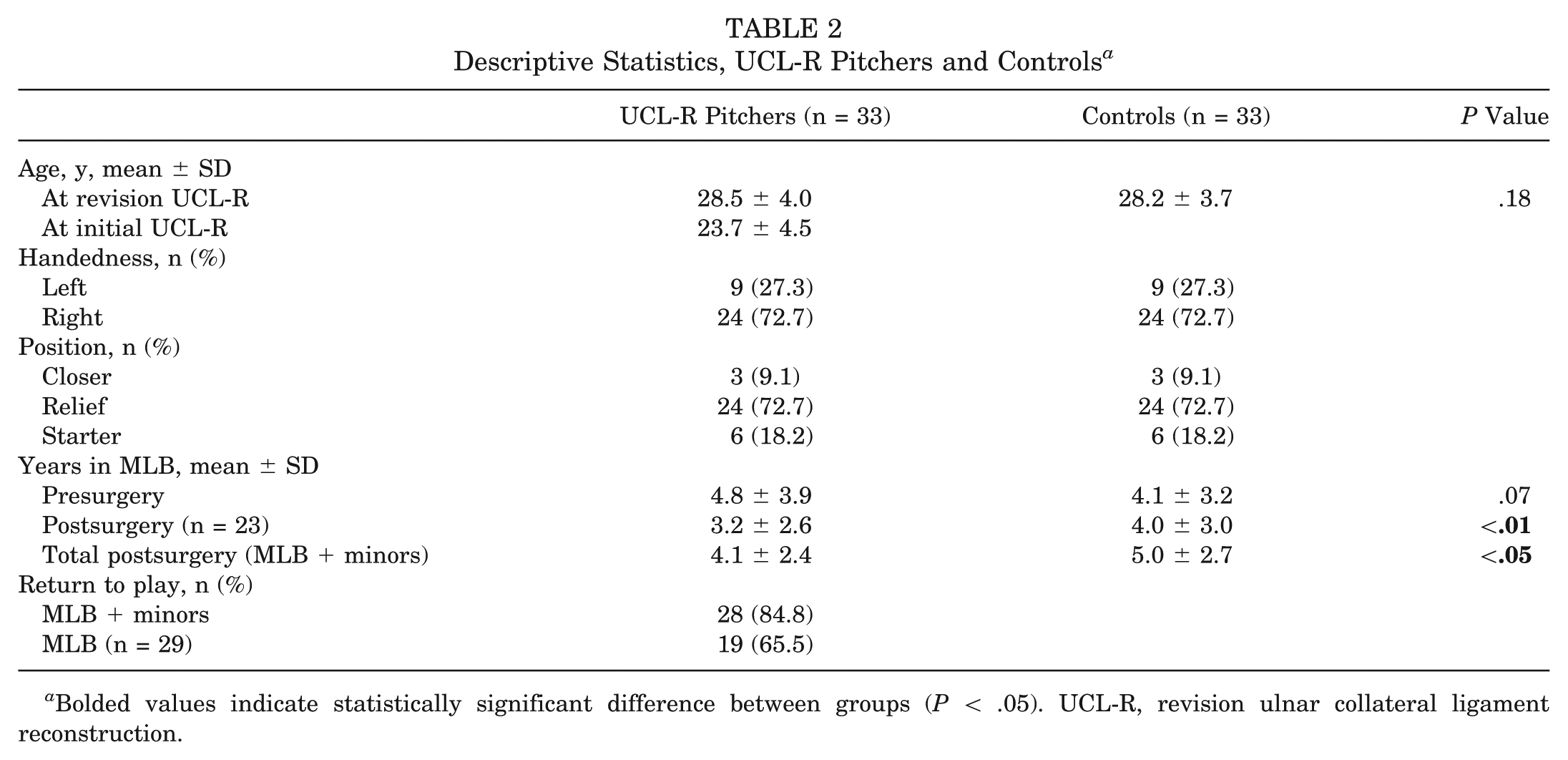
Bolded values indicate statistically significant difference between groups (P < .05). UCL-R, revision ulnar collateral ligament reconstruction.
Return to Play and Career Longevity
After revision surgery, 84.8% (28/33) of the UCL-R pitchers returned to pitching in either the major or minor leagues. However, only 65.5% (19/29) of the UCL-R pitchers returned to pitching at the MLB level (Table 2). The UCL-R pitchers who returned to MLB play pitched a mean of 3.2 ± 2.6 years (range, 1-11 years) in the majors after surgery and a mean of 4.1 ± 2.4 years (range, 1-11 years) in total (major and minor league performance) after surgery. This is compared with CTL pitchers, who pitched 4.0 ± 3.0 years (range, 0-12 years, P < .01) in the majors and 5.0 ± 2.7 years in total (range, 1-12 years, P < .05) after the index year.
Twelve percent (4/33) of the UCL-R pitchers had postrevision careers extending 7 years or more (including the minors), with the longest career at 11 years after surgery. However, the majority of UCL-R pitchers, 26 of 33 (78.8%), pitched 3 years or less in the majors, and 18 of 33 (54.5%) pitched 3 years or less in total, including minor league play.
Performance Statistics
UCL-R Pitchers (Presurgery) Versus Controls
No significant differences were detected between UCL-R and CTL pitchers when comparing presurgery performance statistics (Table 3). Specifically, no significant differences were detected in innings pitched (UCL-R: 66.73, CTL: 72.54, P = .63), ERA (UCL-R: 4.76, CTL: 4.79, P = .93), or WHIP (UCL-R: 1.45, CTL: 1.49, P = .51). The remaining statistical measures of pitching performance—specifically, WAR, RAR, BB/9, SO/9, SO/BB, H/9, HR/9, wins, losses, win percentage, RA/9, and RA/9avg—also failed to demonstrate any statistically significant differences between the UCL-R and CTL groups in the years before surgery.
Presurgery Performance Statistics for UCL-R Pitchers Versus Controls a
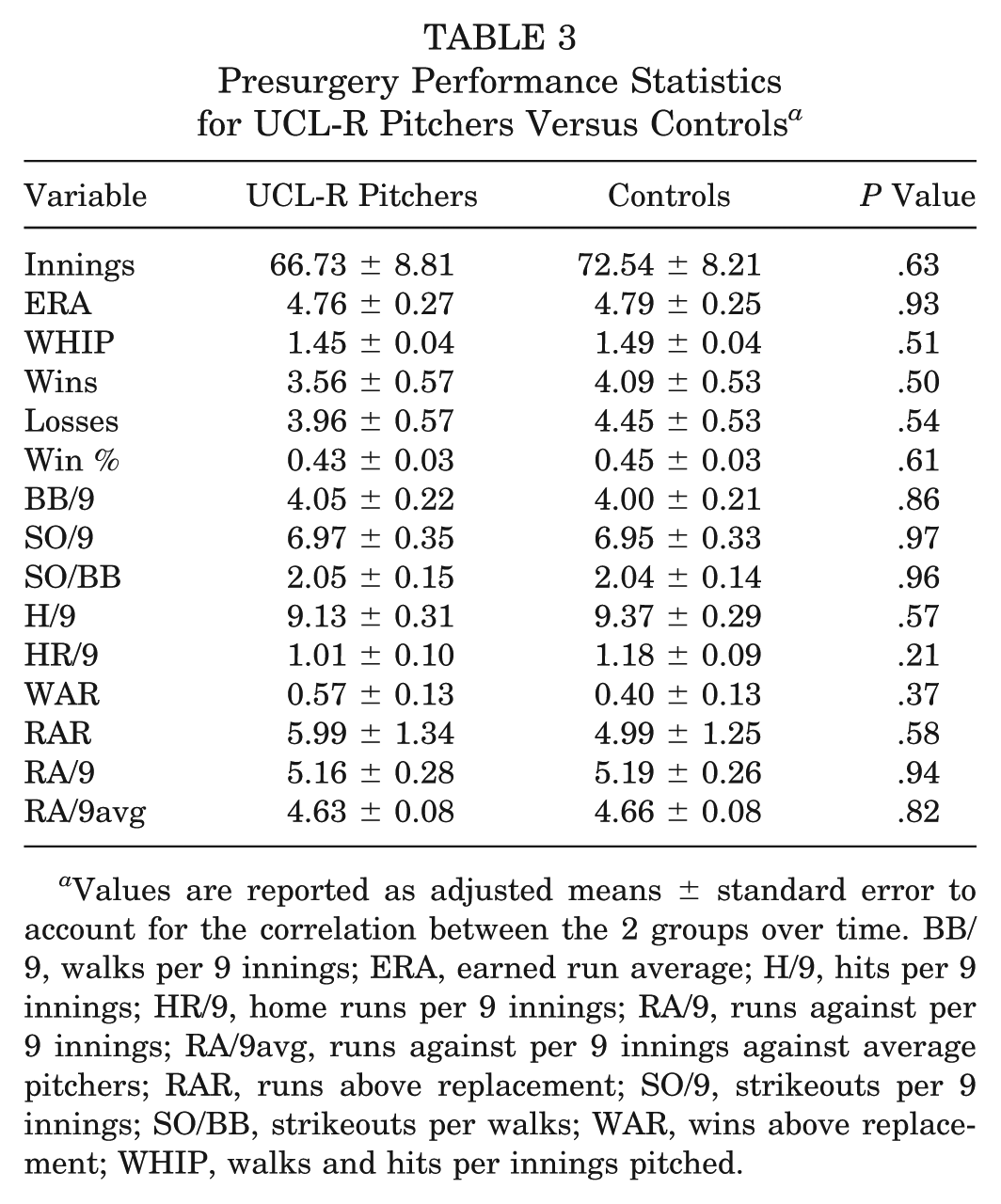
Values are reported as adjusted means ± standard error to account for the correlation between the 2 groups over time. BB/9, walks per 9 innings; ERA, earned run average; H/9, hits per 9 innings; HR/9, home runs per 9 innings; RA/9, runs against per 9 innings; RA/9avg, runs against per 9 innings against average pitchers; RAR, runs above replacement; SO/9, strikeouts per 9 innings; SO/BB, strikeouts per walks; WAR, wins above replacement; WHIP, walks and hits per innings pitched.
UCL-Revision: Pre- Versus Postsurgery
In comparing presurgery and postsurgery pitching performance, the UCL-R pitchers were found to have several declines in performance (Table 4). Innings pitched showed a significant decline, dropping from a mean of 67.18 innings to 39.10 innings (P < .01). The BB/9 innings also showed a significant decline from 4.02 to 4.79 (P < .05). Wins and losses both showed significant declines after surgery (3.61 vs 1.89, P < .01, and 4.00 vs. 2.27, P < .01, respectively), likely both attributed to a decrease in play, since the winning percentage was not found to change significantly (0.43 vs. 0.50, P = .24). WAR decreased from 0.58 to 0.19 (P = .06), and the RAR decreased from 6.09 to 2.60 (P = .08), which was not statistically significant. The RA/9avg was the only significant performance improvement, which improved from 4.64 to 4.45 (P < .05). No significant differences were detected in terms of ERA (pre: 4.74, post: 4.87, P = .81) or WHIP (pre: 1.45, post: 1.59, P = .13). Similarly, no significant performance differences were seen in WAR, RAR, SO/9, SO/BB, H/9, HR/9, or RA/9.
Comparison of Pitching Performance Statistics Before and After UCL Revision Surgery (for UCL-R Pitchers) and Index Year (for Controls) a
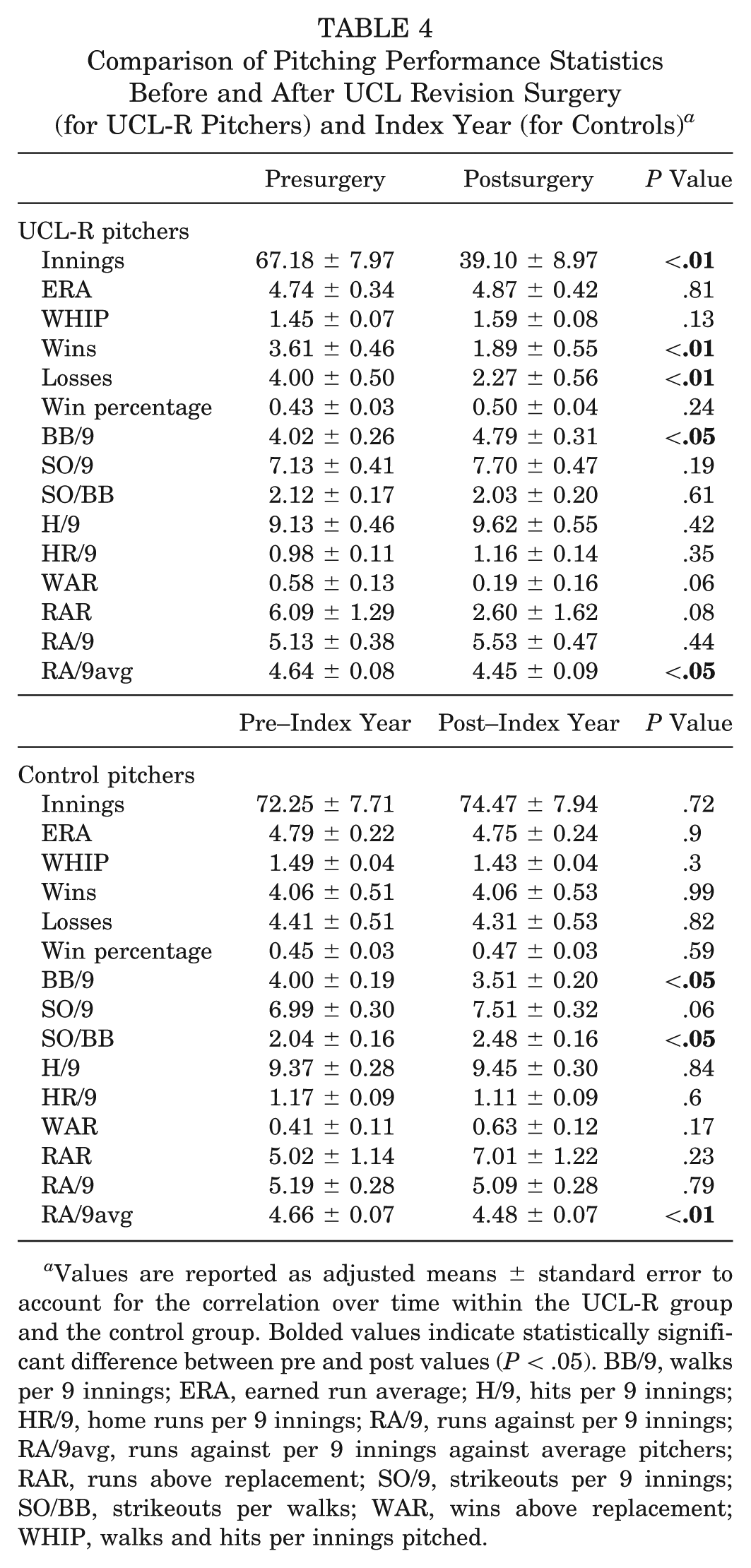
Values are reported as adjusted means ± standard error to account for the correlation over time within the UCL-R group and the control group. Bolded values indicate statistically significant difference between pre and post values (P < .05). BB/9, walks per 9 innings; ERA, earned run average; H/9, hits per 9 innings; HR/9, home runs per 9 innings; RA/9, runs against per 9 innings; RA/9avg, runs against per 9 innings against average pitchers; RAR, runs above replacement; SO/9, strikeouts per 9 innings; SO/BB, strikeouts per walks; WAR, wins above replacement; WHIP, walks and hits per innings pitched.
Control Pitchers: Pre– Versus Post–Index Year
In evaluating performance of the CTL pitchers before and after the index year, several changes were noted (Table 4). Significant improvements were seen in BB/9 (pre: 4.00, post: 3.51, P < .05), SO/BB (pre: 2.04, post: 2.48, P < .05), and RA/9avg (pre: 4.66, post: 4.48, P < .01). The SO/9 increased from 6.99 to 7.51, but this was not found to reach statistical significance (P = .06). There were no differences detected in innings pitched (pre: 72.25, post: 74.47, P = .72), ERA (pre: 4.79, post: 4.75, P = .90), or WHIP (pre: 1.49, post: 1.43, P = .30). Similarly, no significant performance differences were seen in WAR, RAR, wins, losses, win percentage, H/9, HR/9, and RA/9 (Table 4).
UCL-R Pitchers (Postsurgery) Versus Controls
Comparison of UCL-R pitchers with the CTL group after surgery showed several significant differences in statistics measuring pitching workload (Table 5). Pitchers in the CTL group pitched a mean of 75.00 innings after the index year, whereas the UCL-R pitchers pitched 36.95 innings (P < .01). The UCL-R pitchers also had a lower number of wins (UCL-R: 1.88, CTL: 4.10, P < .01) and losses (UCL-R: 2.29, CTL: 4.27, P < .01) than did the CTL pitchers. Win percentage, however, was similar at 0.49 in the UCL-R pitchers and 0.46 in the CTL pitchers (P = .70).
Comparison of Postsurgery Performance Statistics Between the UCL-R and Control Pitchers a
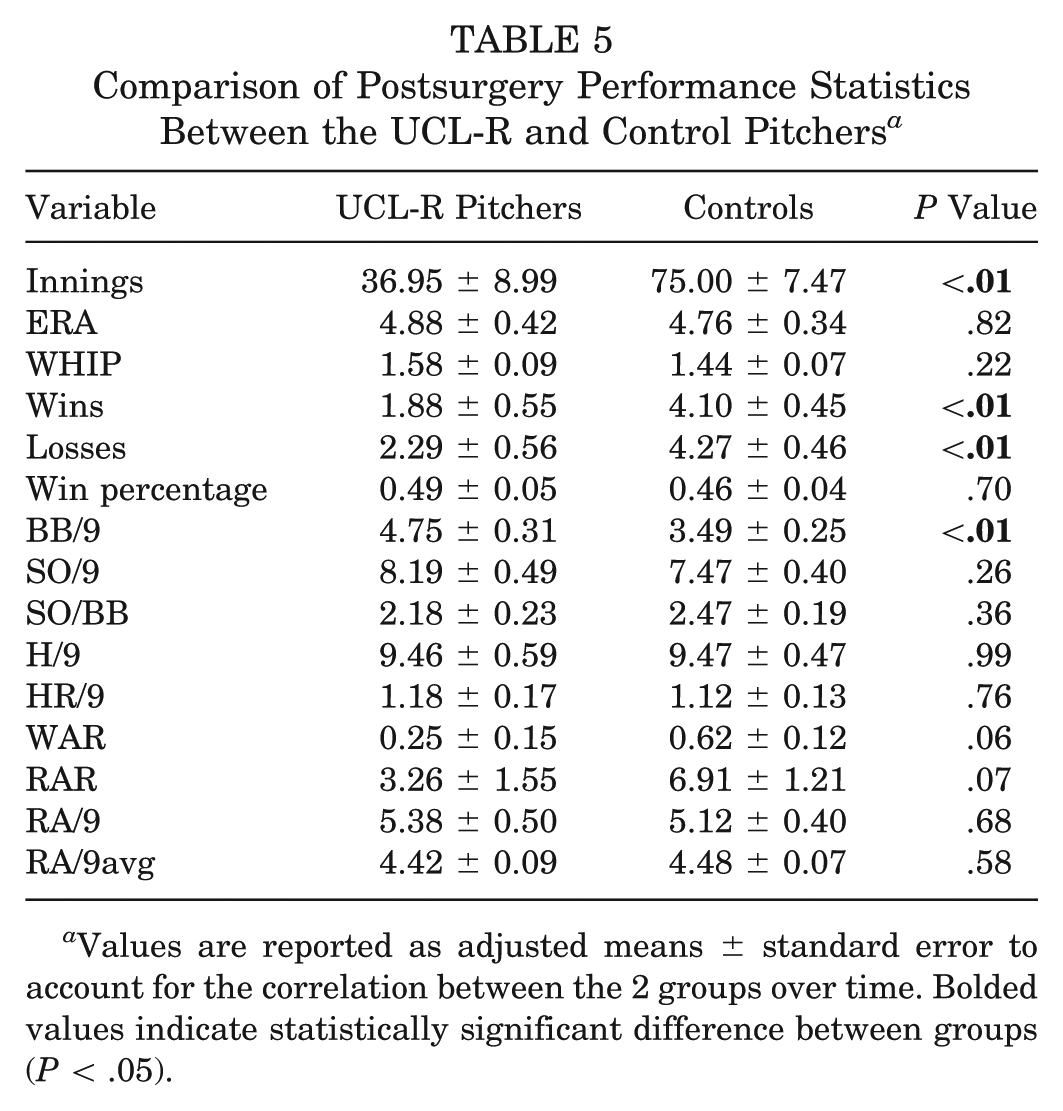
Values are reported as adjusted means ± standard error to account for the correlation between the 2 groups over time. Bolded values indicate statistically significant difference between groups (P < .05).
The UCL-R pitchers compared with CTL pitchers showed a decline in WAR and RAR but did not reach significance, at 0.25 versus 0.62 (P = .06) and 3.26 versus 6.91 (P = .07), respectively. There was also a significant increase in the number of BB/9 in UCL-R pitchers at 4.75 versus 3.49 in CTL pitchers (P < .01). The WHIP showed a nonsignificant increase in UCL-R pitchers at 1.58 versus 1.44 in CTL pitchers (P = .22). The ERA was also similar in both groups, with an ERA of 4.88 in UCL-R pitchers compared with 4.76 in CTL pitchers (P = .82). The RA/9avg also did not show any difference between UCL-R and CTL pitchers (4.42 vs. 4.48, P = .58). Other performance statistics, including H/9, HR/9, SO/9, SO/BB, and RA/9, showed no significant differences between the 2 groups after the index surgery year (Table 5).
Discussion
Primary UCL reconstruction, or Tommy John surgery, has historically been a reliable procedure to allow high-level pitchers to return to sport with pitching success.1,2,5,7,10,12,16,18 Much less is known, however, about return to sport and performance after revision UCL reconstruction. This study’s findings suggest that players who undergo revision UCL reconstruction have a limited return to MLB play, a shortened pitching career, and decreased pitching workload.
Two previous studies have evaluated MLB pitchers who have undergone revision UCL reconstruction. An evaluation of 4 MLB pitchers by Dines et al 4 found a 75% (3/4) return to MLB play. A slightly larger study by Jones and colleagues 9 reviewed 18 MLB pitchers, which found a return to MLB play of 78% (14/18) in revision pitchers. Our study is the largest cohort to date of MLB pitchers who have undergone revision reconstruction, and in contrast to these previous studies, we showed a rate of return to MLB play of only 65.5%. This limited return to play suggests that after revision reconstruction, one should expect a lower rate of return to the MLB level than previously reported.
The UCL-R pitchers who returned to the MLB after revision surgery also had significantly shorter careers compared with controls. The UCL-R pitchers pitched a mean of 3.2 years at the MLB level and 4.1 years, including major and minor league play. The UCL-R pitchers, however, ended their major league career as well as their overall career (majors and minors) almost 1 year earlier than matched CTL pitchers. Revision surgery did not preclude some pitchers from having extended careers, as a small subset of pitchers had careers 7 years or more, with the longest postrevision career spanning 11 years (majors and minors). This appears to be more of the exception than the rule, as the vast majority of pitchers (78.8%) lasted 3 years or less in the majors after revision surgery.
Of the UCL-R pitchers who returned to the MLB level after revision surgery, statistical performance was not statistically different than that of the CTL pitchers in certain categories, including ERA, WHIP, and RA/9avg. These data suggest that if UCL-R pitchers are able to return to the major league level, they may still be capable of performing at a sustained, competitive level. There was, however, a significant increase in walks after revision surgery compared with CTL pitchers, which would indicate a loss of control or accuracy. Other declines in performance included WAR and RAR, but this did not reach significance.
Although the performance of reconstructed pitchers appears to be maintained in some categories, statistical markers that represent pitching workload are greatly reduced. The UCL-R pitchers pitched approximately half as many innings, and the mean number of both wins and losses was significantly lower after surgery than that of the CTL group. Jones and colleagues 9 also noted a similar workload reduction in their cohort of revision pitchers. This decreased workload is likely attributable to multiple factors, including increased surveillance of pitch counts, demotion in pitching position to a lesser role, or a lack of arm endurance.
This study was the first to use an age- and position-matched control group for comparison performance statistics of professional baseball pitchers both before and after revision UCL reconstruction. This approach allowed for evaluation of performance changes due to revision surgery without confounding from expected statistical declines that occur over time. Limitations of this study include the fact that it is a retrospective observational study, which has inherent potential for confounding and bias. Potential areas of bias include the possibility of information bias from potential missing data as we used an Internet-based review method for evaluation of player statistics.
In conclusion, revision UCL reconstruction in major league pitchers allows a limited rate of return to MLB play. Although a second UCL injury may not be career ending, it appears to be career limiting, as the majority of pitchers play significantly fewer years. Those pitchers who do make it back to the major league level and continue to pitch are able to maintain some of their same statistical performance levels. There are, however, significant declines in performance markers that suggest a decreased workload and pitching productivity.
Footnotes
Acknowledgements
The authors thank Meredith Mahan and the Henry Ford Statistics Department for their help with the statistical evaluation for the study.
The authors declared that they have no conflicts of interest in the authorship and publication of this contribution.