






Abstract
Background:
There is a paucity of outcome data to guide the surgical treatment of acute grade III posterolateral corner (PLC) knee injuries.
Purpose:
To systematically review the literature to compare clinical outcomes of the treatment for acute grade III PLC injuries.
Study Design:
Systematic review; Level of evidence, 4.
Methods:
A systematic review of the literature including Cochrane, PubMed, Medline, and Embase was performed. The following search terms were used: posterolateral corner knee, posterolateral knee, posterolateral instability, multiligament knee, and knee dislocation. Inclusion criteria were outcome studies of surgically treated acute PLC injuries with a minimum 2-year follow-up, subjective outcomes, objective outcomes including varus stability, and subgroup data on PLC injuries. Two investigators independently reviewed all abstracts. Accepted definitions of varus stability on examination or stress radiographs and the need for revision surgery were used to categorically define success and failure.
Results:
Eight studies with a total of 134 patients were included. The mean patient age was reported in 7 studies (range, 21-31.5 years). The mean time to surgery was reported in 5 studies (range, 15-24.3 days); surgery was performed within 3 weeks in the other 3 studies. Four studies reported International Knee Documentation Committee scores (range, 78.1-91.3); 5 studies reported Lysholm scores (range, 87.5-90.3). Only 3 studies obtained bilateral varus stress radiographs. Based on an objective evaluation with varus stress examinations or radiographs, there was an overall success rate of 81% and failure rate of 19%. In 2 studies, the fibular collateral ligament and popliteus tendon were repaired and staged cruciate reconstruction performed in most patients; there were 17 failures of 45 patients (38%). In the remainder of the studies, patients were treated with local tissue transfer, hybrid repair for amenable structures or reconstruction for midsubstance tears, or reconstruction of all torn structures; the failure rate was 9%.
Conclusion:
The repair of acute grade III PLC injuries and staged treatment of combined cruciate injuries were associated with a substantially higher postoperative PLC failure rate. Further research is required to identify the reconstruction technique that provides optimal subjective and objective outcomes.
The posterolateral corner (PLC) of the knee has received increased attention in the literature over the past 2 decades. In a consecutive series of 187 patients with an acute knee injury and a complete ligament tear found on magnetic resonance imaging, the incidence of grade III PLC injuries was 16%. 23 Most PLC injuries are combined with anterior cruciate ligament (ACL) and/or posterior cruciate ligament (PCL) ruptures, whereas isolated injuries account for less than 30%.8,22 PLC injuries may also occur in conjunction with knee dislocations. The recognition and treatment of acute PLC injuries are important, especially in multiligament knee injuries, because untreated PLC injuries are associated with cruciate ligament graft failure.9,21,32
The quantitative anatomy, imaging findings, and biomechanics of the posterolateral knee have been further defined, and an evolution in the surgical treatment of acute PLC injuries has occurred concurrent with these advancements. Historically, isolated PLC injuries were often treated with primary repair and cast immobilization for 6 weeks,4,6 whereas multiligament injuries were often treated with prolonged immobilization alone. 31 With studies demonstrating a high failure rate with primary repair,25,30 a trend toward reconstruction has occurred.8,27 Early reconstruction techniques for PLC injuries utilized a single femoral tunnel and fibular sling 24 ; this evolved to 2 femoral tunnels with a fibular sling to attempt to add external rotation stability. 2 More recently, there has been a focus on complete reconstruction of the PLC.8,18,19
Because of the nature of acute PLC injuries, studies are often heterogeneous with respect to surgical timing, surgical technique, concomitant ligamentous injuries and associated surgical treatment, and outcome reporting. Several case series on the surgical treatment of acute PLC injuries have been published, although the outcomes of this severe injury have not yet been reported in a systematic review. Thus, the purpose of this study was to systematically review the literature on the surgical treatment of acute grade III PLC injuries.
Methods
Article Identification and Selection
This study was conducted in accordance with the 2009 Preferred Reporting Items for Systematic Review and Meta-Analysis (PRISMA) statement. 26 A systematic review of the literature on the surgical treatment of acute PLC injuries was performed using the Cochrane Database of Systematic Reviews, the Cochrane Central Register of Controlled Trials, PubMed (1980-2014), Medline (1980-2014), and Embase (1980-2014); the queries were performed in September 2014. The following search terms were utilized: posterolateral corner knee, posterolateral knee, posterolateral instability, multiligament knee, and knee dislocation. The literature search strategy included the following:
Search 1: posterolateral[All Fields] AND corner[All Fields] AND (“knee”[MeSH Terms] OR “knee”[All Fields] OR “knee joint”[MeSH Terms] OR (“knee”[All Fields] AND “joint”[All Fields]) OR “knee joint”[All Fields])
Search 2: posterolateral[All Fields] AND (“knee”[MeSH Terms] OR “knee”[All Fields] OR “knee joint”[MeSH Terms] OR (“knee”[All Fields] AND “joint”[All Fields]) OR “knee joint”[All Fields])
Search 3: posterolateral[All Fields] AND instability[All Fields]
Search 4: multiligament[All Fields] AND (“knee”[MeSH Terms] OR “knee”[All Fields] OR “knee joint”[MeSH Terms] OR (“knee”[All Fields] AND “joint”[All Fields]) OR “knee joint”[All Fields])
Search 5: “knee dislocation”[MeSH Terms] OR (“knee”[All Fields] AND “dislocation”[All Fields]) OR “knee dislocation”[All Fields]
This systematic review reports treatment outcomes for acute injuries; chronic injuries are reported in part 2. There was no consensus regarding the definition of “acute” PLC injuries, but a maximum of 3 to 6 weeks before treatment has been utilized in previous studies.3,8 For the purposes of this investigation, studies with a mean time to surgery of <4 weeks (and <6 weeks for all patients within a particular study) were eligible for inclusion.
Additional inclusion criteria were as follows: at least 2 grades of increased lateral joint opening on preoperative varus stress examinations in at least three-quarters of patients compared with the contralateral uninjured side, minimum 2-year follow-up, reporting of subjective outcome scores, and reporting of objective outcomes including varus stress examinations or varus stress radiographs. 17 Exclusion criteria were non–English language studies, biomechanical laboratory studies, fracture-dislocations, nonsurgical treatment, surgical treatment with external fixation, case reports, and reports on the management of multiligament injuries or knee dislocations if a separate cohort composed of combined PLC injuries was not identified. Two investigators independently reviewed the abstracts from all identified articles. Full-text articles were obtained for review if necessary to allow the application of inclusion and exclusion criteria. Additionally, all references from the included studies were reviewed and reconciled to verify that no relevant articles were missing from the systematic review.
Data Collection
Level of evidence was assigned according to the classification from Wright et al 33 and collected from the abstracts of the included studies. Patient demographics, duration of follow-up, surgical technique details, subjective outcomes, and objective outcomes including varus stress examinations and varus stress radiographs were extracted and recorded. For continuous variables (ie, age, surgical timing, follow-up, outcome scores), the mean and range were collected if reported. The Lysholm knee score and International Knee Documentation Committee (IKDC) subjective knee form score are the most commonly reported subjective outcome scores for these injuries and were collected in this systematic review; Tegner scores, if reported, were collected.
Based on a varus stress examination, success was defined as IKDC A or B, 13 AMA grade 0 or I, 1 or if investigators of the study reported the knee to be “stable” to varus stress when compared with the uninjured knee on a postoperative varus stress examination. Additionally, <4.0 mm of increased lateral gapping on varus stress radiographs was also considered a success for the purposes of this study. 17 Failure was defined as IKDC C or D, AMA grade II or III, ≥4.0 mm of increased lateral gapping on varus stress radiographs, 17 or if the knee was reported to be “unstable” to varus stress when compared with the uninjured knee. Further, the need for a reoperation because of varus instability was classified as a failure.
Data Analysis
Demographic data, surgical technique, and outcomes were collected. Postoperative varus examination or varus stress radiographic findings were analyzed categorically as success or failure. The incidence of “failure” was calculated for individual studies and subgroups. A narrative systematic review was chosen rather than a formal quantitative synthesis because of the potential for bias in observational studies and because there was substantial heterogeneity among included studies in terms of cohort characteristics and study methods.7,11
Bias
There can be inherent selection and performance bias in evidence level 3 and level 4 studies because of the lack of randomization and prospective comparative control groups, especially in populations characterized by heterogeneity in injuries. Selected studies were reviewed to ensure that authors minimized bias while recognizing the constraints present with such studies.
Results
A flow diagram outlining the process for the literature review and study selection is shown in Figure 1. After the removal of duplicates, nearly 4000 records remained. It is believed that this large number of search records was because of the generic anatomic terms (eg, posterolateral) and injury types (eg, dislocation) utilized to describe the injuries; a careful review of titles and abstracts allowed the exclusion of articles on unrelated conditions (eg, posterolateral spinal fusion, hip dislocation). After screening of the titles and abstracts, 78 full-text articles were identified for review. Twenty-one studies remained after the application of inclusion/exclusion criteria; 8 studies focused on acute PLC surgical treatment or had appropriate subgroup data. The 8 studies, with a total of 134 patients, included one evidence level 2, two level 3, and five level 4 studies. Demographic data (Table 1), surgical technique, and outcome data (Table 2) were collected.

Flow diagram outlining the process of study selection.
Demographic and Combined Injury Data for the Studies Reviewed a
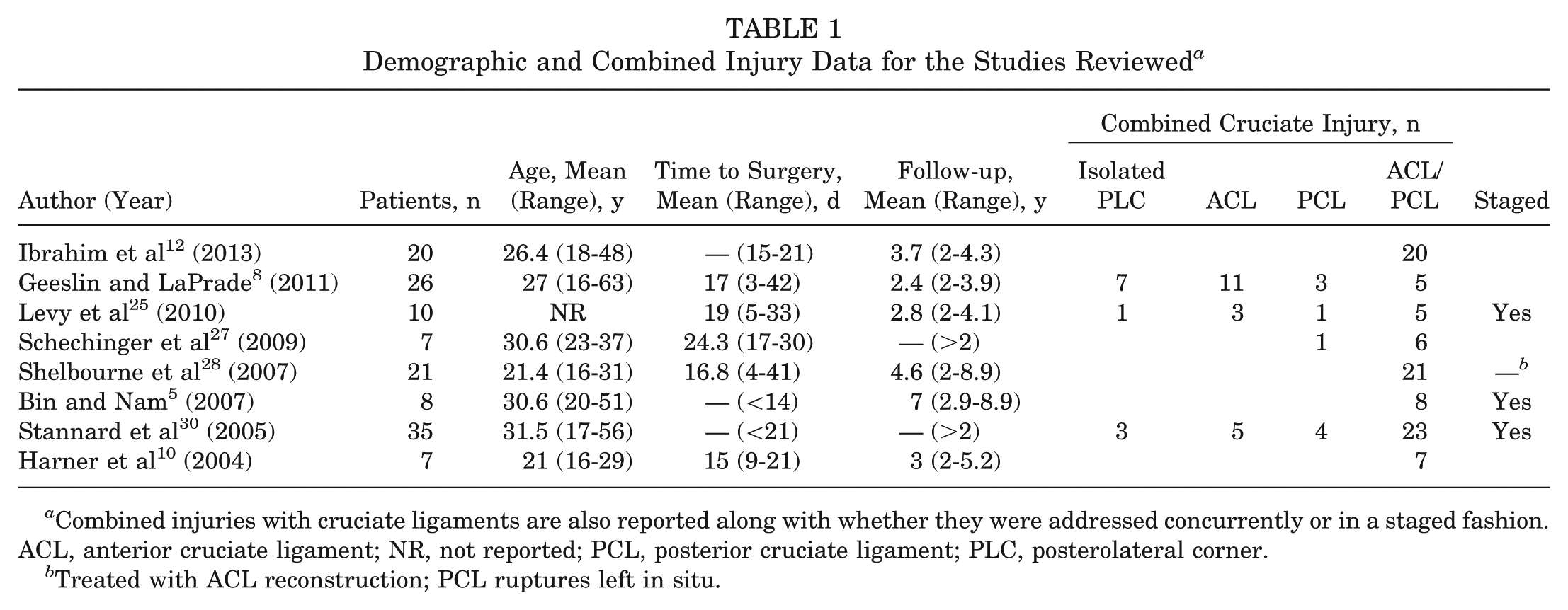
Combined injuries with cruciate ligaments are also reported along with whether they were addressed concurrently or in a staged fashion. ACL, anterior cruciate ligament; NR, not reported; PCL, posterior cruciate ligament; PLC, posterolateral corner.
Treated with ACL reconstruction; PCL ruptures left in situ.
Lysholm Score, IKDC Score, and Number of Successes and Failures for the Studies Reviewed a

Success and failure as defined on objective criteria. Examination, varus stress examination; IKDC, International Knee Documentation Committee.
Criteria for success vs failure were determined either by varus stress examination findings (examination), varus stress radiographs (radiograph), or the author’s classification of failure (reported).
Varus stress radiographic outcomes only reported for a subset of 14 patients.
Unable to separate scores for primary repair from revision of failures.
Surgical Techniques
The surgical technique for addressing PLC injuries varied between studies; a mixture of repair and reconstruction was performed. Several authors performed primary repair of bony avulsions of key structures, with reconstruction reserved for inadequate tissue quality.5,10,30 Reconstruction was performed in 2 studies using a fibular sling technique; Ibrahim et al 12 utilized a fibular sling with a single femoral fixation point (Figure 2), 24 whereas Schechinger et al 27 utilized a fibular sling with 2 femoral tunnels 2 and performed posterolateral capsule imbrication (Figure 3). Other authors performed repair of key posterolateral structures; Shelbourne et al 28 performed “en masse surgical repair” of the healing lateral structures to the tibia using a staple (with a possible separate repair of the biceps femoris tendon to the fibula), 29 whereas Levy et al 25 directly repaired fibular collateral ligament (FCL) and popliteus tendon injuries with suture anchors and performed posterolateral capsule reefing for persistent posterolateral rotatory instability. Geeslin and LaPrade 8 performed anatomic reconstruction of midsubstance FCL and popliteus tendon injuries (Figure 4), performed direct repair of lateral capsule avulsions with suture anchors (Figure 5), and repaired biceps femoris avulsions through bone tunnels (Figure 6); 4 patients underwent recess repair of popliteus tendon bony avulsions.
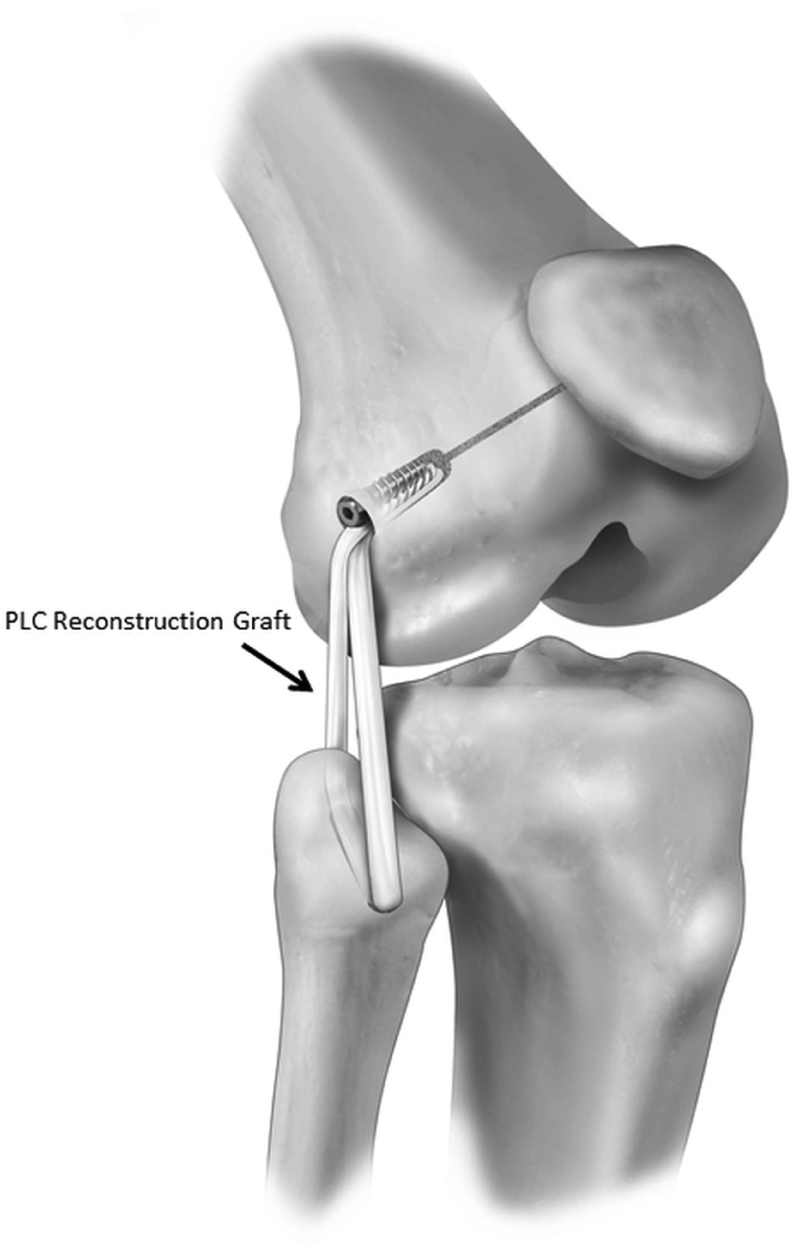
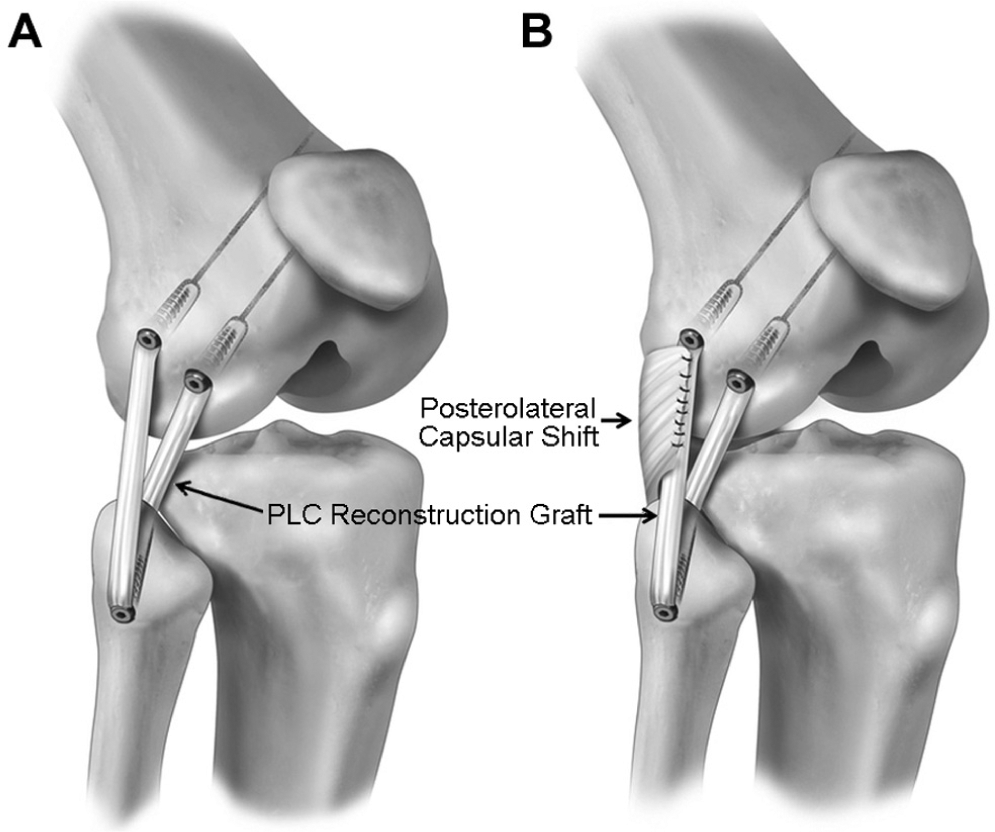
(A) Fibular sling technique with 2 femoral insertion points for the posterolateral corner (PLC) reconstruction graft intended to re-create the fibular collateral ligament and popliteofibular ligament function is shown as originally described 2 and (B) modified with a posterolateral capsule shift. 27

Illustrations of anatomic-based posterolateral corner reconstruction from the (A) lateral view and (B) posterior view are shown, addressing the fibular collateral ligament (FCL), popliteus tendon (PLT), and popliteofibular ligament (PFL). Reproduced with permission from LaPrade et al. 19

Illustration of lateral capsule repair with suture anchors is shown. Reproduced with permission from Geeslin and LaPrade. 8

(A) Illustration depicting a whipstitch placed into the distal end of the avulsed biceps femoris tendon before suture anchor repair. (B) Arcuate fracture repair is illustrated using fibular bone tunnels with a whipstitch in the distal aspect of the biceps femoris tendon. Reproduced with permission from Geeslin and LaPrade. 8
Overall, only 8% of injuries were isolated to the PLC of the knee. The majority of PLC injuries were combined with a rupture of one or both cruciate ligaments. Combined ACL injuries accounted for 14%, combined PCL injuries accounted for an additional 7%, and combined bicruciate injuries accounted for the remaining 71% of the 134 patients in this study. Cruciate injuries were concurrently reconstructed in 4 studies.8,10,12,27 Staged reconstruction of most cruciate injuries was performed in 3 studies.5,25,30 In 1 study, ACL reconstruction was performed and the PCL ruptures left in situ. 28
Outcomes
IKDC and Lysholm scores are reported in Table 2. Tegner scores were reported by 2 studies.5,12 Bin and Nam 5 reported a mean postoperative Tegner score of 3.9 (range, 3-5). Ibrahim et al 12 reported that all patients had a Tegner score between 4 and 7 postoperatively, although mean and individual scores were not reported. Only 3 of the 8 studies obtained varus stress radiographs for the quantitative evaluation of laxity,5,8,28 whereas the other studies utilized a physical examination to report laxity. Of the 3 studies that reported on postoperative varus stress radiographs, 2 reported quantitative measurements,8,28 whereas the third reported the categorical grade. 5 When varus stability was used as the primary outcome of interest for the studies in this systematic review, there was an overall success rate of 81% and failure rate of 19% based on an objective evaluation with varus stress examinations or radiographs (Table 2).
Two studies reported repairing all PLC structures with staged cruciate reconstruction in most patients25,30; there were 17 failures of 45 patients (38% failure rate). In the other 6 studies, patients were treated with either local tissue transfer/advancement, a hybrid technique of repair for amenable structures or reconstruction for midsubstance tears, or reconstruction of all torn structures; the reported failure rate was only 9%.
Bias
Attempts were made by the authors of the selected studies to minimize bias, including the use of a consecutive series, >80% follow-up if reported, and reporting of inclusion/exclusion criteria. Accepted subjective outcome scores were reported. Reporting of “objective” stability is certainly subject to selection and reporting bias when the surgeon performs the examination.
Discussion
The most important finding of this systematic review was that the repair of acute grade III PLC injuries with staged cruciate reconstruction was associated with a 38% failure rate, whereas a more robust reconstruction-focused approach for PLC injuries with concurrent reconstruction of cruciate injuries resulted in an overall mean 9% failure rate. However, despite the variability of surgical techniques in this systematic review, the mean subjective outcome scores for the studies were relatively tightly grouped; the highest and lowest Lysholm and IKDC scores differed by only approximately 3 points and 13 points, respectively.
Biomechanical studies have reported the interdependence of PLC structures and cruciate ligaments.9,14,20,21 This may result in greater force on the PLC repair or reconstruction site. Delayed treatment of cruciate ligament ruptures may have contributed to the high failure rate reported for the studies on PLC repair in this review.25,30 While the medial compartment is inherently stable because of the convex femoral condyle and concave tibial plateau, the lateral compartment is inherently unstable because of the opposing convex articular surfaces; this anatomic and biomechanical principle may have rendered PLC repair inadequate. 16
Several reconstruction techniques have been reported and were utilized in the studies in this systematic review; these can be broadly categorized as either biceps tendon transfer, 5 fibular-based sling,12,27 or anatomic-based reconstruction of the FCL, popliteus tendon, and popliteofibular ligament. 8 There was insufficient evidence in this systematic review to allow a quantitative comparison of these techniques. Further, the systematic review produced no comparative clinical series or evidence that would allow the selection of a particular reconstruction technique.
The literature pertaining to the surgical treatment of acute grade III PLC injuries is currently limited to mostly studies with evidence level 3 and 4. No studies in this review had a control group for the nonsurgical treatment of acute injuries. However, a historical control group reported poor outcomes for patients treated nonsurgically for acute grade III PLC injuries; nearly all patients had severe or gross instability, and the mean Lysholm score was 65. 15 Follow-up was short term, with a 2-year minimum in this systematic review and a mean of 3.4 years. While a higher incidence of failure was found for repair of acute PLC injuries and staged cruciate reconstruction, a longer follow-up is likely necessary to allow for the differentiation of outcomes based on a particular PLC reconstruction technique. Also, because of the wide variability in the reporting of objective postoperative outcomes, it is recommended that future clinical studies obtain bilateral comparison varus stress radiographs to allow for a quantitative clinical evaluation and objective reporting of results. Further, long-term research is required to identify the reconstruction technique that provides optimal subjective and objective outcomes.
The authors recognize that this systematic review itself has limitations. First, it is recognized that there was little uniformity in reporting subjective and objective outcomes for PLC injuries. Of the 8 studies that met inclusion criteria, in only 3 studies were varus stress radiographs obtained, and only 2 reported stress radiograph results for individual patients. The remainder reported physical examination data alone. Second, it is well recognized that most PLC injuries occur as combined injuries with concurrent cruciate ligament tears, so it is difficult to assign outcomes specific to PLC treatments. An additional limitation is that current subjective outcome measures may not have adequate sensitivity to appreciate clinically significant rotational or coronal plane instability. As with any systematic review, it is possible that relevant articles or patient subgroups were not identified with our search terms and literature review. Finally, the available level of evidence in the literature for outcomes after the surgical treatment of acute grade III PLC injuries limits any definitive conclusions regarding an optimal surgical technique.
Conclusion
Repair of acute grade III PLC injuries combined with staged cruciate ligament reconstruction was associated with a 38% failure rate, whereas a more robust, reconstruction-focused approach of the primary PLC structures and concurrent reconstruction of cruciate injuries resulted in a mean 9% failure rate.
Footnotes
Acknowledgements
The authors thank Grant Dornan, MSc, for his statistical consultation on the design and execution of this study.
One or more of the authors has declared the following potential conflict of interest or source of funding: R.F.L. receives royalties from Arthrex Inc and Smith & Nephew; is a paid consultant for Arthrex Inc, Ossur, and Smith & Nephew; and receives research support from Arthrex Inc, Smith & Nephew, Ossur, and Linvatec.
An online CME course associated with this article is available for 1 AMA PRA Category 1 Credit™ at  . In accordance with the standards of the Accreditation Council for Continuing Medical Education (ACCME), it is the policy of The American Orthopaedic Society for Sports Medicine that authors, editors, and planners disclose to the learners all financial relationships during the past 12 months with any commercial interest (A ‘commercial interest’ is any entity producing, marketing, re-selling, or distributing health care goods or services consumed by, or used on, patients). Any and all disclosures are provided in the online journal CME area which is provided to all participants before they actually take the CME activity. In accordance with AOSSM policy, authors, editors, and planners’ participation in this educational activity will be predicated upon timely submission and review of AOSSM disclosure. Noncompliance will result in an author/editor or planner to be stricken from participating in this CME activity.