







Abstract
Background:
The elbow is the second most commonly dislocated major joint in the general population. Previous studies that focused on emergency department populations indicate that such injuries occur most frequently among adolescent athletes.
Purpose:
To describe the epidemiological rates and patterns of sports-related elbow dislocations in high school athletes.
Study Design:
Descriptive epidemiology study.
Methods:
Sports-related injury data for the 2005-2006 through 2013-2014 academic years from a national convenience sample of high schools participating in the National High School Sports-Related Injury Surveillance Study (High School Reporting Information Online [RIO]) were analyzed.
Results:
Certified athletic trainers participating in High School RIO reported 115 of 1246 (9.2%) elbow injuries as elbow dislocations. A total of 30,415,179 athlete exposures (AEs) were reported during the study period, resulting in a dislocation rate of 0.38 per 100,000 AEs. The majority of the dislocations resulted from boys’ wrestling (46.1%) and football (37.4%). Elbow dislocation rates were higher in competition than in practice. Also, 91.3% of dislocations occurred in boys’ sports. Among both boys (60.4%) and girls (88.9%), the majority of injuries occurred during varsity sports activities. Contact with another person was the most common injury mechanism (46.9%), followed by contact with the playing surface (46.0%). Dislocations more commonly resulted in removal from play for more than 3 weeks (23.4% vs 6.9%, respectively) or medical disqualification (36.9% vs 7.0%, respectively) compared with other elbow injuries. Dislocations were also more likely to result in surgical treatment than other elbow injuries (13.6% vs 4.7%, respectively).
Conclusion:
In high school athletes, elbow dislocations result in longer removal from play and are more likely to require surgical treatment than nondislocation-associated elbow injuries. Rates and patterns of elbow dislocations vary by sport. In high-risk sports, focused sport-specific prevention strategies may help to decrease the rates and severity of elbow dislocation injuries.
Joint dislocations are common, accounting for 8% of all orthopaedic emergency room visits in the United States (US) each year. 34 After the shoulder, the elbow is the most commonly dislocated major joint in the general population.17,32,35 Although the majority of elbow dislocations demonstrate a predictable return to function, patients may develop residual pain and loss of terminal extension. In the setting of associated fractures and ligamentous injuries, chronic elbow instability may also develop2,6,10,11,15,23,29,30; however, serious complications, such as median nerve entrapment, compartment syndrome, and vascular injury, are uncommon.3,4,8,13,22,33
Sports participation among young people is steadily increasing, and it is estimated that 7 million US high school students are involved in competition sports.21,26 Younger athletes are becoming more at risk for sports-related injuries whether from overuse, fractures, concussions, sprains/strains, or dislocations. 27 Adirim and Cheng 1 reported that the elbow is the fifth most commonly injured body part in young athletes. Coupled with findings that elbow dislocations make up 10% to 25% of all elbow injuries, it is expected that elbow dislocations will become more prevalent in the adolescent athlete in the future. 17 A study several decades old suggested that there may be a higher incidence of elbow dislocations in adolescents compared with the general population. 18 Stoneback et al 32 reported more recent data, utilizing the National Electronic Injury Surveillance System (NEISS) database, which confirmed this propensity and showed that the highest incidence of elbow dislocations occurred in those aged 10 to 19 years, with sports activities being a common mechanism of injury.
To our knowledge, there has been limited literature on the epidemiology of elbow dislocations in high school athletes. Most prior studies did not use current data, were descriptive of the adult population, or focused on sport-specific fractures and overuse injuries.16,19,35 Our objective was to describe the epidemiology of elbow dislocations in high school athletes across several sports using data captured from the 2005-2006 through 2013-2014 academic years by a large national sports injury surveillance system. Furthermore, we aimed to evaluate differences by sex and sport, including the mechanism of injury, setting of injury, and time to return to play. We believe that the data gathered from this study will help identify athletes at risk for an elbow dislocation. Understanding sport-specific rates and patterns of injury is an important first step toward the long-term goal of the development of effective, targeted injury prevention strategies.
Methods
This descriptive epidemiology study was approved by the Nationwide Children’s Hospital Subjects Review Board (Columbus, Ohio, USA). The study retrospectively reviewed data collected from 2005-2006 through 2013-2014 by the National High School Sports-Related Injury Surveillance System (High School Reporting Information Online [RIO]), a multiyear, prospective surveillance system that recruits US high schools with National Athletic Trainers’ Association (NATA)–affiliated, board-certified athletic trainers (ATs) to report exposure and injury data for athletes participating in school-sanctioned high school sports. The methods of the High School RIO study have been previously reported.7,27 In brief, High School RIO used 2 concurrent surveillance cohorts during the study period. In the original study cohort, willing participants were categorized into 8 strata based on US census geographic region (Northwest, Midwest, South, and West) and school population (total enrollment ≤1000 or >1000). A total of 100 high schools were randomly selected from these 8 strata to report for each of the 9 sports included in the original High School RIO study (boys’ football, soccer, basketball, wrestling, and baseball and girls’ soccer, volleyball, basketball, and softball). If a school dropped out of the study, a replacement school was selected from the same stratum to maintain the nationally representative 100-school sample. Additional sports have been added to this surveillance system (see Table 1 for a complete list of sports, some of which have strong regionalism, such as boys’ ice hockey). Since 2007-2008, High School RIO has expanded to include a large national convenience sample of US schools reporting data on 18 to 20 sports annually (while the number varies annually, with some schools participating for several years, the average number of participating schools is approximately 200). Overall, during this study period, 810 unique high schools contributed data to High School RIO. ATs from participating schools logged in to an Internet-based data collection tool weekly to report athlete exposure (AE) and injury data.
Elbow Dislocation Injury Rates by Sport and Exposure Type a
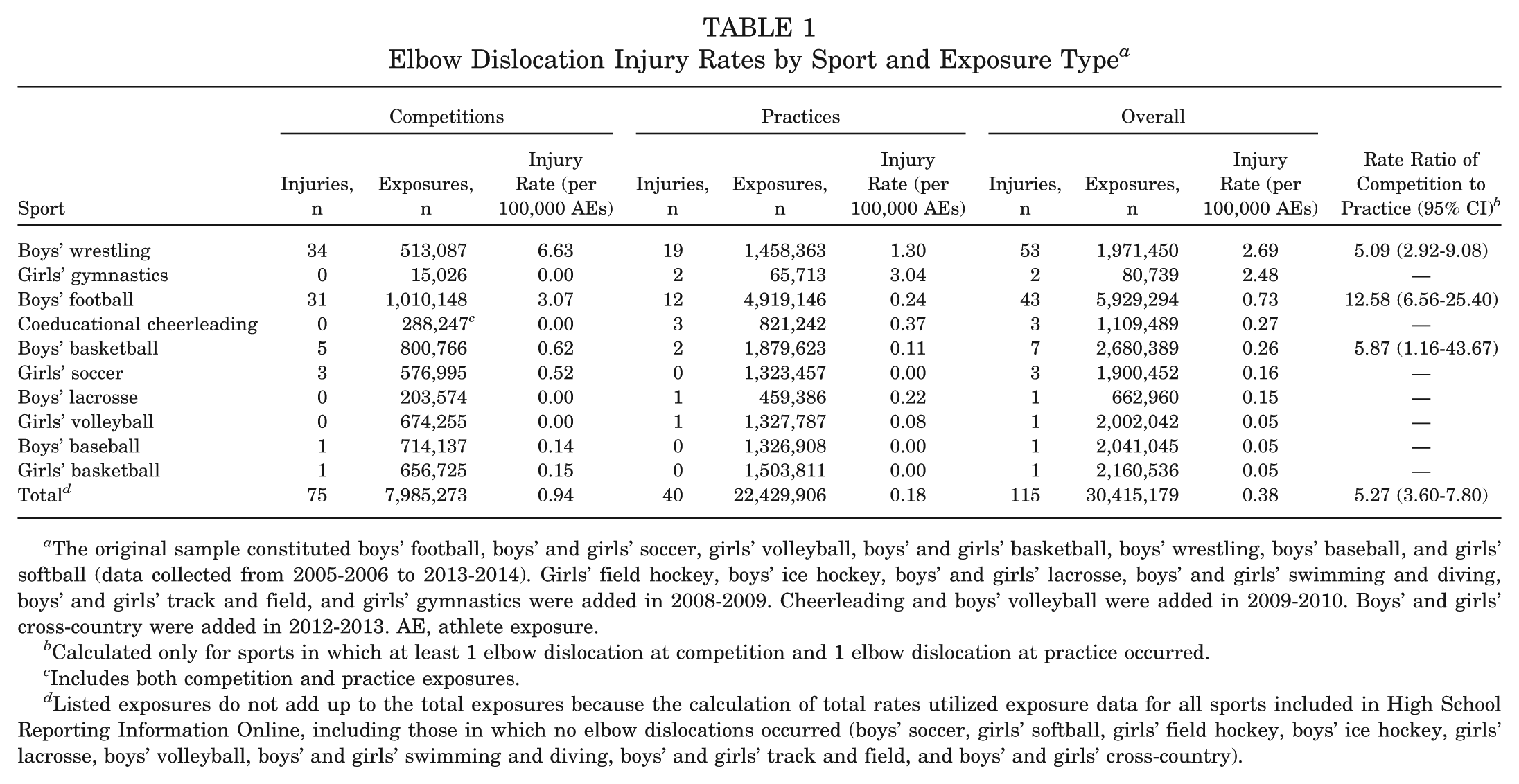
The original sample constituted boys’ football, boys’ and girls’ soccer, girls’ volleyball, boys’ and girls’ basketball, boys’ wrestling, boys’ baseball, and girls’ softball (data collected from 2005-2006 to 2013-2014). Girls’ field hockey, boys’ ice hockey, boys’ and girls’ lacrosse, boys’ and girls’ swimming and diving, boys’ and girls’ track and field, and girls’ gymnastics were added in 2008-2009. Cheerleading and boys’ volleyball were added in 2009-2010. Boys’ and girls’ cross-country were added in 2012-2013. AE, athlete exposure.
Calculated only for sports in which at least 1 elbow dislocation at competition and 1 elbow dislocation at practice occurred.
Includes both competition and practice exposures.
Listed exposures do not add up to the total exposures because the calculation of total rates utilized exposure data for all sports included in High School Reporting Information Online, including those in which no elbow dislocations occurred (boys’ soccer, girls’ softball, girls’ field hockey, boys’ ice hockey, girls’ lacrosse, boys’ volleyball, boys’ and girls’ swimming and diving, boys’ and girls’ track and field, and boys’ and girls’ cross-country).
In High School RIO, exposures are defined in terms of AEs. Each AE represents a single athlete participating in a single practice or competition. To meet the definition of an injury, an incident must meet the following 3 criteria: (1) occur as the result of an organized high school practice, competition, or performance; (2) require medical attention by an AT or physician; and (3) result in restriction of the athlete’s participation for at least 1 day beyond the date of injury or be a fracture, concussion, heat illness/injury, or dental injury (which are captured regardless of time loss). All elbow dislocations reported to High School RIO were analyzed in this study. Elbow dislocations reported to High School RIO were identified using the combination of “elbow” for the variable representing the injured body part and “dislocation” for the variable representing the primary type of injury; subluxations were not included. Because elbow dislocations are less common than other sports-related injuries, we examined all data captured by High School RIO from 2005-2006 through 2013-2014 from both the original and convenience samples for all 20 sports.
Statistical analyses were conducted using SAS software version 9.3 (SAS Institute) and OpenEpi version 3.02 (Emory University). Injury rates were calculated by dividing the number of injuries (numerator) by the number of AEs (denominator) by sport. Because of the rare nature of elbow dislocations, injury rates were calculated per 100,000 AEs. Sport-specific activities and mechanisms of injury were examined when at least 10 elbow dislocations occurred as a result of participation in that sport; sport-specific data were not examined for sports with fewer than 10 elbow dislocations. Rate ratios (RRs) with 95% CIs were calculated as follows:

χ2 tests were used to compare elbow dislocations to other elbow injuries with regard to injury severity, with statistical significance determined at α < .05.
Results
Overall Injury Patterns
A total of 810 high schools, representing the convenience sample, have reported data to High School RIO during the study period. From 2005-2006 through 2013-2014, ATs reported 1246 elbow injuries, of which 115 (9.2%) were dislocations. A total of 30,415,179 AEs were reported during the study period, resulting in an overall elbow dislocation rate of 0.38 per 100,000 AEs. One or more elbow dislocations occurred in only 10 of the sports captured in High School RIO (Table 1). The vast majority of these injuries resulted from participation in boys’ wrestling (46.1% of all elbow dislocations; rate, 2.69 per 100,000 AEs) and boys’ football (37.4% of all elbow dislocations; rate, 0.73 per 100,000 AEs). Despite a low number of elbow dislocations (n = 2), girls’ gymnastics had the second highest rate of injury (2.48 per 100,000 AEs). Elbow dislocation rates were higher in competition (0.94) than in practice (0.18) overall (RR, 5.27; 95% CI, 3.60-7.80), and this trend by type of athletic activity was seen in 6 of the 10 sports (Table 1). Of those sports with significantly higher elbow dislocation rates in competition, the largest differences between competition and practice occurred in boys’ football (RR, 12.58; 95% CI, 6.56-25.40). Of the 115 elbow dislocations reported by ATs, only 2.6% were attended to by an AT alone, with 56.5% by a general physician (ie, pediatrician, primary care physician) and 68.7% by an orthopaedic physician/sports medicine physician (note that categories are not mutually exclusive). Assessment methods used included radiography (96.5% of all elbow dislocations), magnetic resonance imaging (26.1%), and computed tomography (2.6%).
Comparison by Sex
Of the 115 elbow dislocations, 105 (91.3%) occurred in boys’ sports. The demographics of the injured athletes are reported in Table 2. Among both boys (60.4%) and girls (88.9%), the majority of injuries occurred in varsity activities as opposed to junior varsity, freshman, or combined activities. Overall, the rate of elbow dislocations was significantly higher in boys’ (0.57) than girls’ (0.08) sports (RR, 6.88; 95% CI, 3.73-13.90). Among sports comparable by sex (boys’ and girls’ soccer, basketball, lacrosse, baseball/softball, swimming and diving, track and field, and cross-country), there was no significant difference (RR, 1.85; 95% CI, 0.58-6.92).
Characteristics of Athletes With Elbow Dislocations by Sex
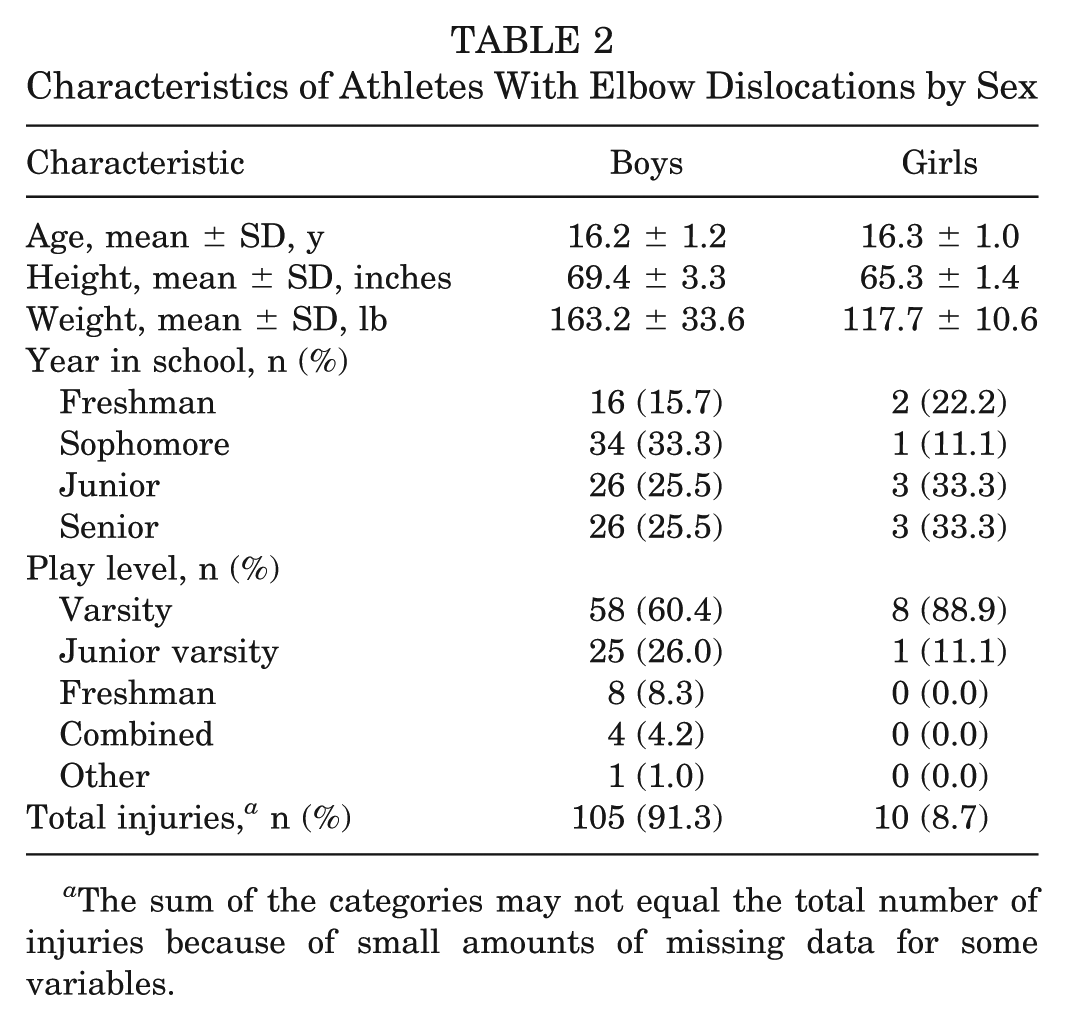
The sum of the categories may not equal the total number of injuries because of small amounts of missing data for some variables.
Injury Characteristics
The characteristics of the elbow dislocations are presented in Table 3, both overall and, more specifically, for boys’ football and wrestling. Interestingly, although right-handedness is the predominant human phenotype, 60.6% of the 104 dislocations where the body’s side was specified in the injury report occurred to the left elbow. The vast majority of elbow dislocations were new injuries (95.7%). Across all sports, contact with another person was the most common injury mechanism (46.9%), followed by contact with the playing surface (46.0%). However, these overall characteristics are driven by the characteristics of boys’ wrestling and football because these 2 sports accounted for nearly 85% of all elbow dislocations.
Characteristics of Elbow Dislocation Injuries a
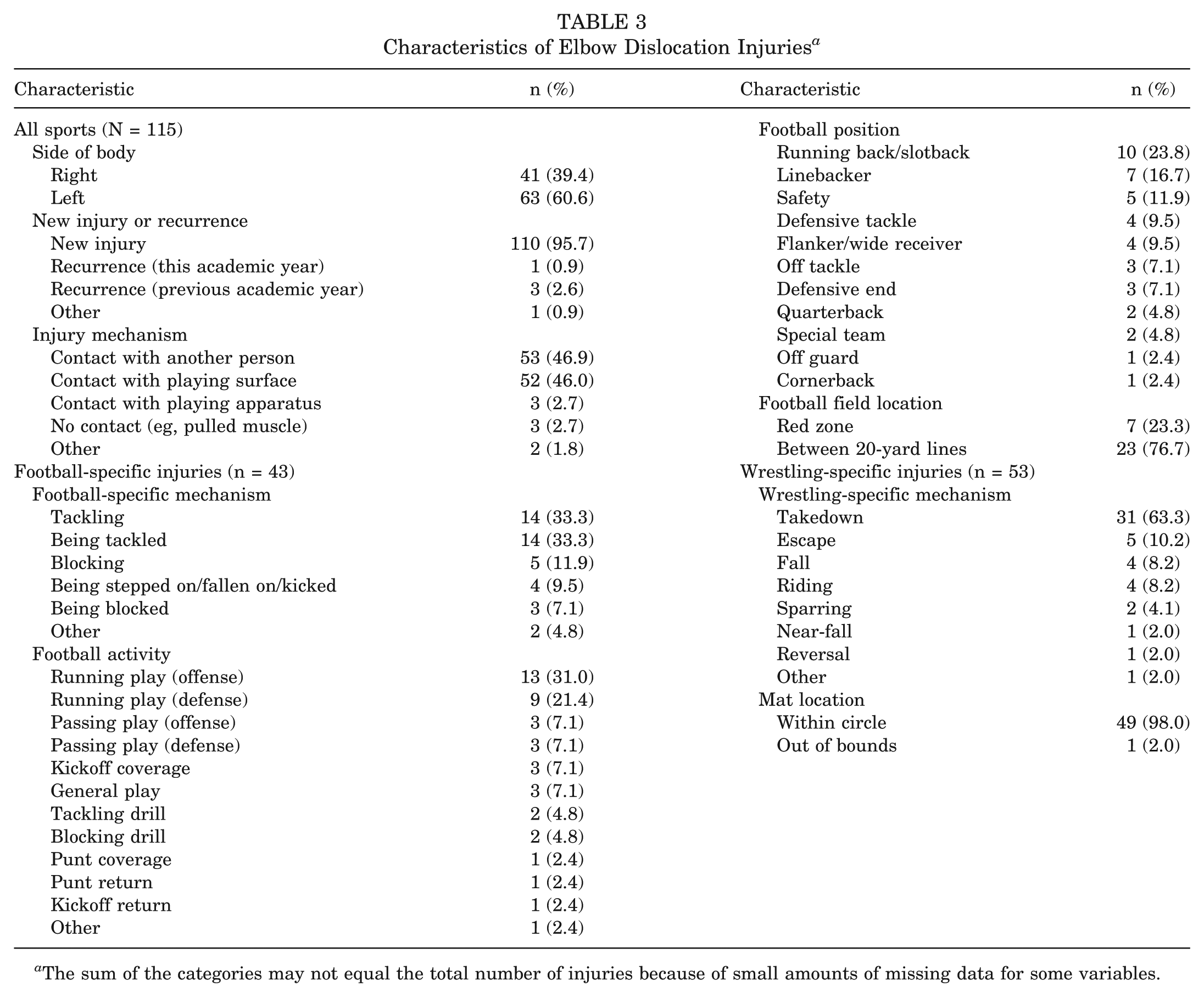
The sum of the categories may not equal the total number of injuries because of small amounts of missing data for some variables.
The most common general mechanisms of elbow dislocations in wrestling were contact with the playing surface (47.1%) and contact with another person (45.1%). Takedown (63.3%) was the most common sport-specific injury mechanism, followed by escape (10.2%). The most common general mechanisms for elbow dislocations in football were contact with another person (53.5%) and contact with the playing surface (44.2%). Tackling (33.3%) and being tackled (33.3%) were the most common sport-specific injury mechanisms. Interestingly, 83.3% of the elbow dislocations resulted from being tackled, and 66.7% resulting from tackling occurred to the left elbow. Over half (52.4%) of all elbow dislocations in football occurred on running plays. Running back/slotback was the position most frequently injured (23.8%).
Severity of Elbow Dislocations Compared With Other Elbow Injuries
Time loss from elbow dislocations compared with other types of elbow injuries are displayed in Figure 1. Elbow dislocations more frequently resulted in removal from play for more than 3 weeks (23.4% vs 6.9%, respectively) or medical disqualification (36.9% vs 7.0%, respectively; P < .0001) and more frequently resulted in surgical treatment (13.6% vs 4.7%, respectively; P = .001) compared with other elbow injuries. In wrestling, the sport with the highest rate of elbow dislocations, 46.0% of these injuries resulted in removal from play for more than 3 weeks (including injuries in which the season ended before the athlete could return to play), 42.0% in medical disqualification, and 13.7% in surgical treatment.
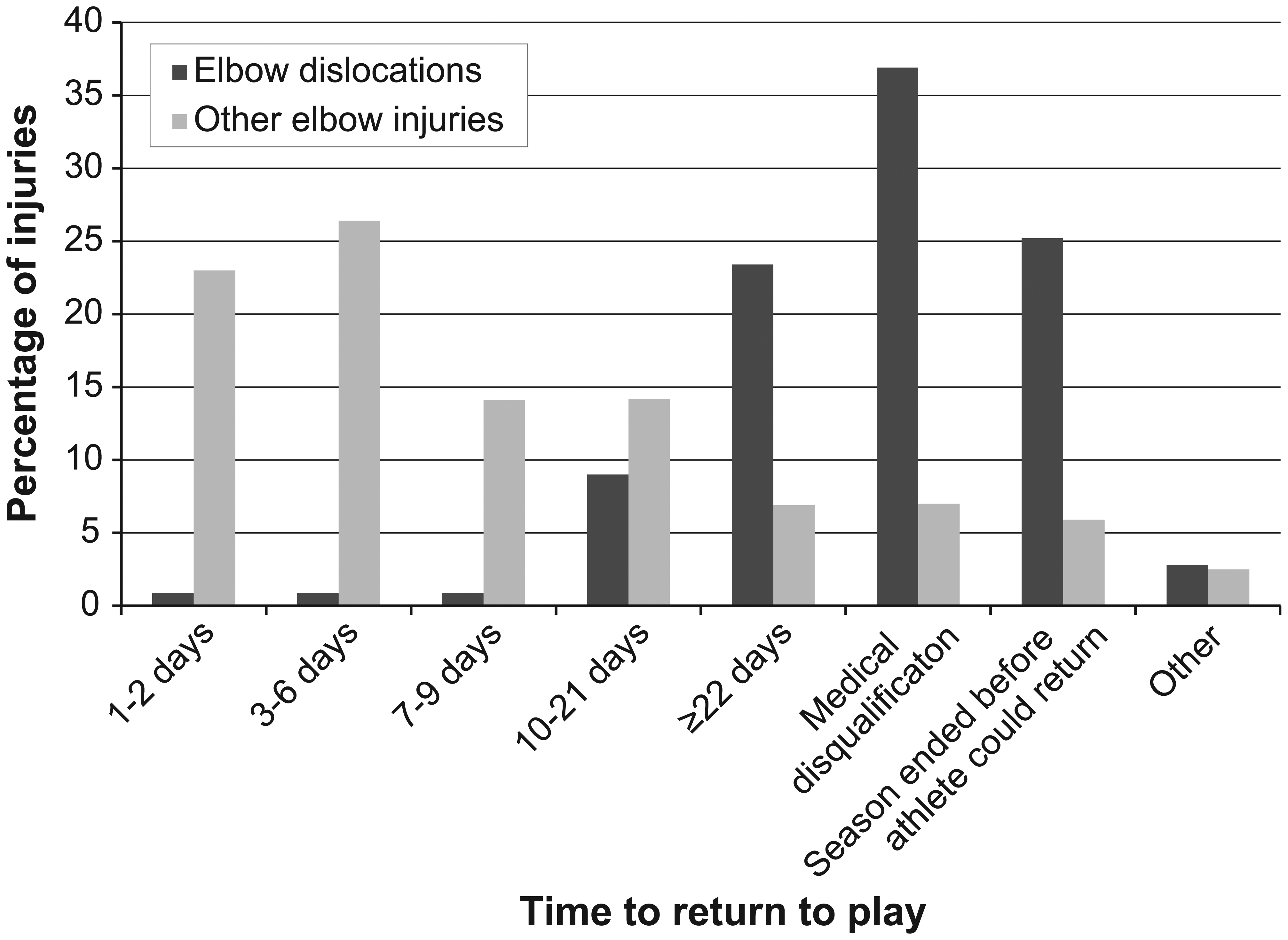
Comparison of time loss resulting from elbow dislocations and all other elbow injuries (National High School Sports-Related Injury Surveillance Study, United States, 2005-2006 to 2013-2014 school years).
Discussion
The overall rate of traumatic elbow dislocations in the general population is quite low both in the US and abroad. Stoneback et al 32 reported the incidence of elbow dislocations in the adult population at a rate of 5.21 elbow dislocations per 100,000 person-years in the US. Comparable rates are seen in the adult populations of other countries at 5.5 to 7.7 per 100,000 persons per year.14,35 Although previously reported data suggest that sport is the most likely activity during which elbow dislocations are sustained, our study is the first to describe the epidemiology of elbow dislocations in high school athletes, detailing the incidence by sex, sport, mechanism of injury, injury characteristics, and time to return to play.17,32 Elbow dislocations comprised 115 of 1246 (9.2%) elbow injuries in our sample. The incidence of elbow dislocations was calculated to be 0.38 per 100,000 AEs over the 8 academic years from 2005-2006 to 2013-2014.
Our study also found an extreme male predominance of elbow dislocations in high school athletes, with 105 of 115 dislocations (91.3%) occurring in boys. Previous reports show conflicting results concerning sex and elbow dislocation rates. Kuhn and Ross, 17 Yang et al, 35 Neviaser and Wickstrom, 24 and Rechel et al 26 have reported higher rates of dislocations in boys; however, Hindle et al 14 described equal rates in both sexes. Within the NEISS study group, adolescents aged 10 to 19 years had the greatest discrepancy in dislocation rates between boys and girls, with 8.91 per 100,000 person-years (53%) and 4.72 per 100,000 person-years (47%), respectively. 32 No other previous report, however, has shown such a large discrepancy between the rates of elbow dislocations between boys and girls.
The male predominance in our study is likely a result of selection bias because the majority of injuries occurred in football and wrestling, which are commonly male-dominated high school sports. It is, however, possible that adolescent boys are predisposed to more aggressive sports, behavior, and contact both during practice and competition. 30 Our data support such a theory because boys had higher injury rates than girls in the sport of basketball, which is a sport represented by both sexes in our data set. The difference was seen in both competition and in practice. Kocher et al 16 have described differences in upper extremity sports injuries between sexes in a pediatric population, noting that boys had 2 times as many upper extremity injuries as girls. The same study noted a propensity for attritional overuse injuries to be more likely in girls and traumatic injuries to be more common in boys. Our study shows a similar pattern but in an adolescent high school population and may be both a reflection not only of boys’ involvement in more aggressive sports but also more aggressive play.
Another interesting finding was the variation in the frequency of elbow dislocations by type of sport being played as well as age. The vast majority of elbow dislocations occurred in boys’ wrestling (53/115) and boys’ football (43/115). Similarly, the incidence in high school boys’ wrestling (2.69 per 100,000 AEs) was far greater than that of wrestling in all ages. 32 Our rates are comparable with the incidence rates of prior studies but are much higher than when compared with adult athletes.17,32 In 2008, a study of a 10-year period in the National Football League (NFL) reported the incidence of elbow dislocations to be 0.21 per 100,000 AEs, which itself represents an upward trend in the past decade. 5 The current study calculated an incidence of 0.73 per 100,000 AEs for elbow dislocations in boys’ football, which is more than 3 times higher than that in the NFL. While this finding may in part be explained by differences in the adolescent and adult bony and ligamentous architecture, by weaker muscular constraints, and by differences in falling mechanics ultimately gained at much higher levels of play (ie, collegiate and professional), the finding is likely multifactorial.1,3,9,16,31
In the adolescent athlete, increasing the level of play, from freshman to varsity, appears to increase the risk of elbow dislocations. Continued increases in the level of play, namely, at the professional NFL level, do not appear to increase the risk of elbow dislocations in a linear manner. 5 Furthermore, looking at age, the sophomore age constituted the highest percentage of elbow dislocations (35/115), followed by juniors (29/115) and seniors (29/115) and then the lowest in the freshman age group (18/115). When stratified by level of play, the data do not support the conclusion that younger age groups are more at risk. However, understanding the stratification of high school levels of play may rectify the discrepancy. Rarely do freshmen partake in higher level sports, namely, the varsity and junior varsity levels, the levels at which the most elbow dislocations take place (92/115). The youngest players on varsity and junior varsity squads are usually sophomores and juniors, the age groups that are the most likely to sustain a dislocation based on our data.
With respect to the mechanism of injury, elbow dislocations in football most commonly occurred during tackling (33.3%) and being tackled (33.3%). Carlisle et al 5 reported that tackling caused 24% of upper extremity injuries, with the elbow being the most commonly injured site, constituting 53% of all tackling injuries in the NFL. Running backs/slotbacks (23.8%) and linebackers (16.7%) were the most prone to elbow dislocations in the current study, while offensive and defensive linemen were more prone to upper extremity injuries in the NFL, accounting for 75% of NFL elbow injuries. This discrepancy may present a target for prevention in the adolescent athlete compared with the professional athlete by determining at-risk positions.
Player-on-player contact (46.9%) and contact with a playing surface (46.0%) accounted for the majority of elbow dislocations. Participants in boys’ wrestling and football spent a large amount of time in contact with each other and their playing surface. Specifically, almost half (46.1%) of the dislocations in the current study were in wrestling, with 63.3% of those occurring during takedown maneuvers. In comparison, Stoneback et al 32 found that wrestlers constitute a lower proportion of all sports-related elbow dislocations at 12%, and while it did stratify by sex and sport activity, the NEISS database did not provide information on the level of sport during which the injury took place. Similarly, Yard and Comstock 36 reported that the elbow was the fourth most commonly injured body part in high school wrestlers, with the percentage of elbow injuries in their population being higher than that of college wrestlers (10.1% vs 2.3%, respectively). They also found that the majority of dislocations occurred during takedown.
The discrepancy may be real or merely a function of High School RIO being a more sensitive metric for capturing these events. While it is always possible that High School RIO, like all large population-based surveillance systems, may undercapture some injuries, there is no reason to believe that participating ATs should be more or less likely to report elbow injuries than ankle or knee injuries or to report concussions. To date, there have been over 50 peer-reviewed publications reporting High School RIO data, and when comparisons to other data sources can be made, this data source has been demonstrated to be as or more complete than other sources.
Competitions also tend to have more elbow dislocation events than practice sessions, which is a finding supported by multiple other studies.19,26,28,36 Rechel et al 26 reported a similar rate of upper extremity injuries during practice and competition; however, elbow dislocations were not looked at separately. Similarly, a higher level of play (varsity vs junior varsity vs freshman), not necessarily age, also correlated with a higher risk of elbow dislocations in both boys and girls (Table 2). It is plausible to assume that during competition, athletes may play with a higher level of intensity, may play while being more fatigued, and may perform riskier maneuvers, and because practice does not allow for the usual amount of contact as competition, these conditions may make athletes more susceptible to more severe injuries, such as dislocations and fractures, during competition as opposed to practice. 28
Although the elbow is not the most commonly dislocated or injured joint during sports activities, elbow dislocations do result in significant morbidity and playing time lost. In the current study, 23.4% of elbow dislocations resulted in a playing time loss of more than 3 weeks (vs 6.9% of other elbow injuries). Upper extremity dislocations resulted in the greatest time loss on average (56 days) in the NFL compared with other upper extremity injuries (6 days). 5 This highlights the significant morbidity of elbow dislocations, as 49.4% of other sports-related injuries resulted in removal from play of less than 1 week. In addition, the current study showed that 36.9% of all elbow dislocations led to medical disqualification compared with 7.0% of other elbow injuries. This may be attributable to the fact that 13.6% of elbow dislocations required surgery. Moreover, it has been reported that nearly half of all sports injuries requiring surgery result in medical disqualification for the season. 26 Stiffness is the most common complication after an elbow dislocation, which can affect an athlete’s long-term quality of life and return to play.10,23 Many studies suggest that achieving early range of motion and minimizing immobilization to less than 1 week can reduce this complication.2,6,10,16,23,25
The results of this study will help with the development of focused strategies to reduce the incidence of sports-related elbow dislocations in young athletes. Specifically for boys’ wrestling and football, the routine incorporation of practice drills simulating situations with a high risk of dislocations, such as takedowns, tackling, and being tackled, may be beneficial. With proper coaching, athletes can practice appropriate techniques on practice mats and tackling dummies to avoid contact with the playing surface.19,27 Because certain positions have been shown to be at risk during high school football, drills and scenarios focused toward positions such as running backs/slotbacks could represent the first target for intervention, and although these drills may not be focused on scoring, they are nevertheless vital to the success of a team, given that elbow injuries remove a player for an extended period of time. In high school, where trades and new players are not possible options, limiting injuries is a vital technique for a successful season.
Furthermore, coaches may choose to reflect on team strategies in sports such as football. It may very well be that a coach utilizes running plays more often than passing plays. By limiting touches to a running back, the potential for injuries could be mitigated not only by decreasing total collisions but also by decreasing fatigue. Likewise, it is important to emphasize proper conditioning of stabilizing muscle groups, overall endurance, and adequate rest and hydration to reduce accidental injuries due to poor form and fatigue.11,12 Several reports have shown that elite, well-trained adolescent athletes have fewer injuries than the general population.10,30 Finally, while age, sex, and handedness are not modifiable factors, they do represent at-risk populations at which to focus the above-mentioned techniques. We believe that this information will not only benefit the athletes but may also be valuable to coaches, trainers, and parents, who have the direct ability to modify and improve at-risk scenarios.
Our study has a few limitations. The High School RIO surveillance system only collects information from high schools with NATA-affiliated ATs. Schools without such trainers are not included, which may make the observed results less generalizable to the national population. The ATs at the surveillance system schools, however, are certified, experienced, and well trained, which improves the accuracy of the data collected. Second, an AE was only defined as an athlete’s participation in a single practice or competition and not the duration of time spent in practices and competitions. This definition is consistent with several other injury surveillance models and provides an adequate method of calculating the injury risk.20,26-28,35,36 Additionally, like all large national surveillance systems, High School RIO may not capture all high school sports-related elbow injuries as only those that come to the AT’s attention can be reported. Finally, the number of sports surveyed expanded from 9 in 2005-2006 to 20 in 2012-2013, which led to a slight underreporting of the true incidence of elbow dislocations during the study period. However, several sports with the highest dislocation rates (boys’ wrestling and football) were recorded throughout the entire study time period, so we believe that the effect on our overall results was minimal. Despite these limitations, this study provides the best picture of the overall epidemiology of elbow dislocations among high school athletes to date, given the multiyear, large, national surveillance system from which data were drawn.
Conclusion
In high school athletes, elbow dislocations are less common than other elbow injuries but have significantly increased morbidity and long-term effects. The highest incidence of elbow dislocations occurred in boys’ wrestling and football, and there is a high incidence in girls’ gymnastics as well. Injury prevention strategies, such as focused simulations and training drills for at-risk populations and scenarios, should be developed to reduce the injury risk. Prospective studies with a larger number of high schools and sports are needed to identify young athletes at particular risk of elbow dislocations in the nation.
Footnotes
The authors declared that they have no conflicts of interest in the authorship and publication of this contribution.