







Abstract
Background:
Humeral retroversion physiologically decreases during growth. However, in throwing athletes, the external forces caused by repetitive throwing are thought to increase humeral retroversion on the dominant side compared with that on the nondominant side.
Purpose:
To investigate the correlation between humeral retroversion and length of baseball career before age 16 years.
Study Design:
Cross-sectional study; Level of evidence, 3.
Methods:
A total of 112 high school baseball players (32 pitchers and 80 position players) with a mean age of 15.6 years (range, 15-16 years) were enrolled in the study. All participants completed questionnaires regarding their player position and the age when they started baseball and were given physical examinations. Shoulder range of motion and humeral retroversion were assessed on the dominant and nondominant sides. Humeral retroversion (rotation angle of the proximal humerus relative to the distal humerus) was measured ultrasonographically.
Results:
Humeral retroversion was significantly greater on the dominant side than on the nondominant side in both pitchers (P < .0001) and position players (P = .0005). The side-to-side difference in humeral retroversion in pitchers (13.9° ± 11.2°) was significantly greater than that in position players (9.0° ± 11.1°, P = .0361). In pitchers, there was a significant negative correlation between humeral retroversion and the age at which the players had started baseball (P = .033, β = −2.494).
Conclusion:
These results suggest that humeral retroversion increases with decreasing age at commencement of a baseball career before age 16 years in pitchers.
Retroversion of the humerus is defined as a posteriorly rotated angle of the humeral head relative to the epicondylar axis of the elbow joint. It has often been measured by using radiography17,18,20 or computed tomography.4,19 Recently, ultrasonography has been used for medical evaluations of humeral retroversion in baseball players.15,22 In ultrasonographic evaluation, the angle between the bicipital groove and the epicondylar axis of the elbow joint can be measured instead of the angle between the humeral head and the epicondylar axis.15,22
Humeral retroversion decreases during growth but stabilizes at maturity. Edelson 5 showed that mean humeral retroversion in humans decreases by 48° between birth and skeletal maturity. However, external stress during growth affects the growth pattern of the humerus. 7 In throwing athletes, the external forces caused by repetitive throwing are thought to reduce this decrease in humeral retroversion during growth, consequently increasing humeral retroversion on the dominant side compared with the nondominant side.15,16,22 Therefore, the magnitude of the humeral retroversion angle may be affected by the age at which a child starts playing baseball and by the positions played. Our objective was to investigate the correlation between humeral retroversion and length of baseball career before age 16 years. Our hypothesis was that the humeral retroversion angle would be greater in adolescents who had started their baseball careers earlier.
Methods
A total of 112 male high school baseball players (32 pitchers and 80 position players) with a mean age of 15.6 years (range, 15-16 years) who had started throwing between 4 and 12 years of age volunteered to participate in this study. All players had been playing baseball year-round (active both on teams and in private, even in the off-season) since they had started. Twenty-eight of the 32 pitchers (87.5%) and 71 of the 80 position players (88.8%) were right arm dominant. Thirty-one of the 32 pitchers (96.9%) were pitchers in elementary and/or junior high school. Forty-two of the 80 position players (52.5%) had no experience pitching in elementary and/or junior high school. All players had never had any previous surgery in a shoulder or elbow joint. The goals and components of the study were explained to all participants and their parents. The participants and their parents reviewed and signed an informed consent form approved by the Osaka Medical College Institutional Review Board (protocol No. 1338).
All participants completed questionnaires regarding their current position and the age when they started baseball. They were also given physical examinations. Shoulder range of motion and humeral retroversion were assessed bilaterally by the same investigator. For the assessment, participants were placed in the supine position with the shoulder at 90° of abduction, the elbow at 90° of flexion, and the forearm in the neutral position. Specific variables of shoulder range of motion were (1) external rotation, (2) internal rotation, and (3) total arc of rotation. The examiner assessed passive shoulder range of motion in the horizontal plane by using a conventional technique recommended by the American Academy of Orthopaedic Surgeons. 2 Neutral rotation was defined as the position in which the long axis of the forearm was perpendicular to the trunk. The ends of range of external and internal rotation were defined as either the points of cessation of rotation or the point at which scapular movement was noted. The scapular movement was evaluated by both visual and tactile observation. The degree of rotation away from the horizontal plane (trunk) was measured with a digital inclinometer (Smart Tool; M-D Building Products; accuracy, 0.1°) placed on the palmar side of the forearm. The angles from neutral rotation to each endpoint were calculated. Our previous study has shown intraclass correlation coefficients (ICCs) of the range of motion measurements of 0.90 for intraobserver reliability and 0.81 for interobserver reliability. 15
Humeral retroversion angle of the proximal humerus relative to the distal humerus was measured ultrasonographically 15 (Figure 1). Participants were placed in the supine position with the shoulder at 90° of abduction, the elbow at 90° of flexion, and the forearm in the neutral position. A greater numerical value implied greater humeral retroversion (Figure 1). Our pilot study has shown that ICCs of the measurement of humeral retroversion were 0.92 for intraobserver reliability and 0.89 for interobserver reliability.
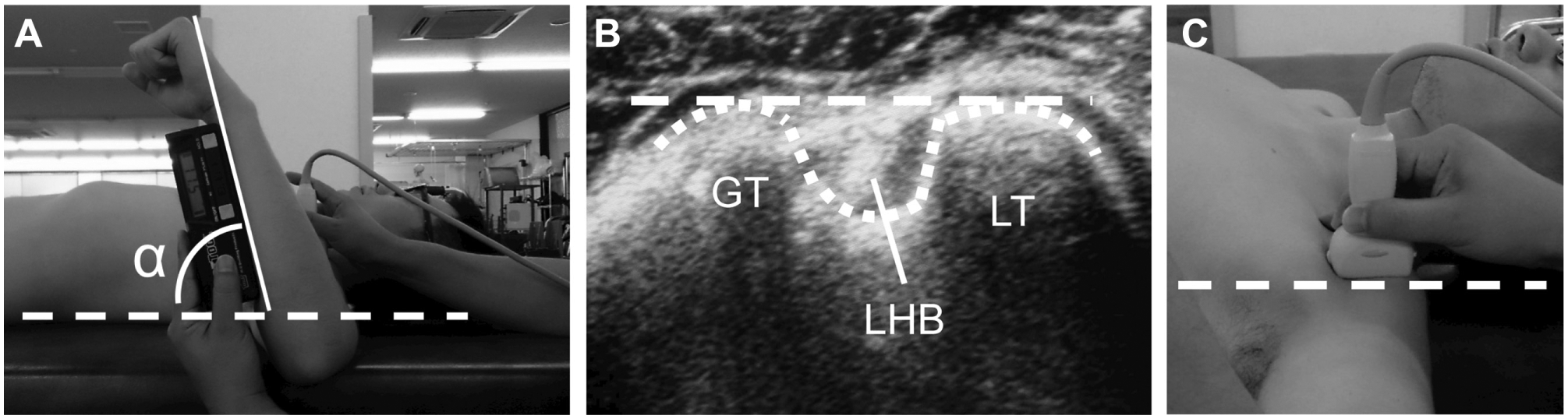
The rotation angle of the proximal humerus relative to the distal humerus (humeral retroversion angle) was measured by ultrasonography as previously described. 15 Participants were placed in the supine position with the shoulder at 90° of abduction, the elbow at 90° of flexion, and the forearm in the neutral position. Humeral retroversion was defined as (A) the angle between the long axis of the forearm and a line parallel to the trunk when (B) the line tangential to the greater tuberosity and lesser tuberosity (forming the bicipital groove) was parallel to the horizontal baseline on the ultrasound monitor, (C) while the ultrasound probe was held parallel to the floor. A greater numerical value implied greater humeral torsion at a posterior angle (ie, greater humeral retroversion). GT, greater tuberosity; LHB, long head of biceps tendon; LT, lesser tuberosity.
Statistical Analysis
All measurements were performed twice and the means calculated. Shoulder external rotation, internal rotation, total rotation, and humeral retroversion were compared bilaterally using a paired t test, as well as between pitchers and position players by using an unpaired t test with unequal variances. In both pitchers and position players, linear regression analysis was used to investigate relationships between degree of humeral retroversion and the age when the player had started baseball. P < .05 was considered to indicate statistical significance. All data analyses were performed with STATISTICA version 6.0 software (StatSoft, Inc).
Results
Humeral retroversion was significantly greater on the dominant side than on the nondominant side in both pitchers (P < .0001) and position players (P = .0005) (Table 1). The side-to-side difference in humeral retroversion in pitchers (13.9° ± 11.2°) was significantly greater than that in position players (9.0° ± 11.1°, P = .0361). Maximum external rotation was significantly greater and maximum internal rotation and total rotation were significantly less on the dominant shoulder than on the nondominant shoulder in both pitchers (P < .0001) and position players (P < .0001). There were no significant differences in maximum external rotation, maximum internal rotation, and total arc of rotation between pitchers and position players.
Humeral Retroversion and Shoulder Range of Motion in Pitchers and Position Players a
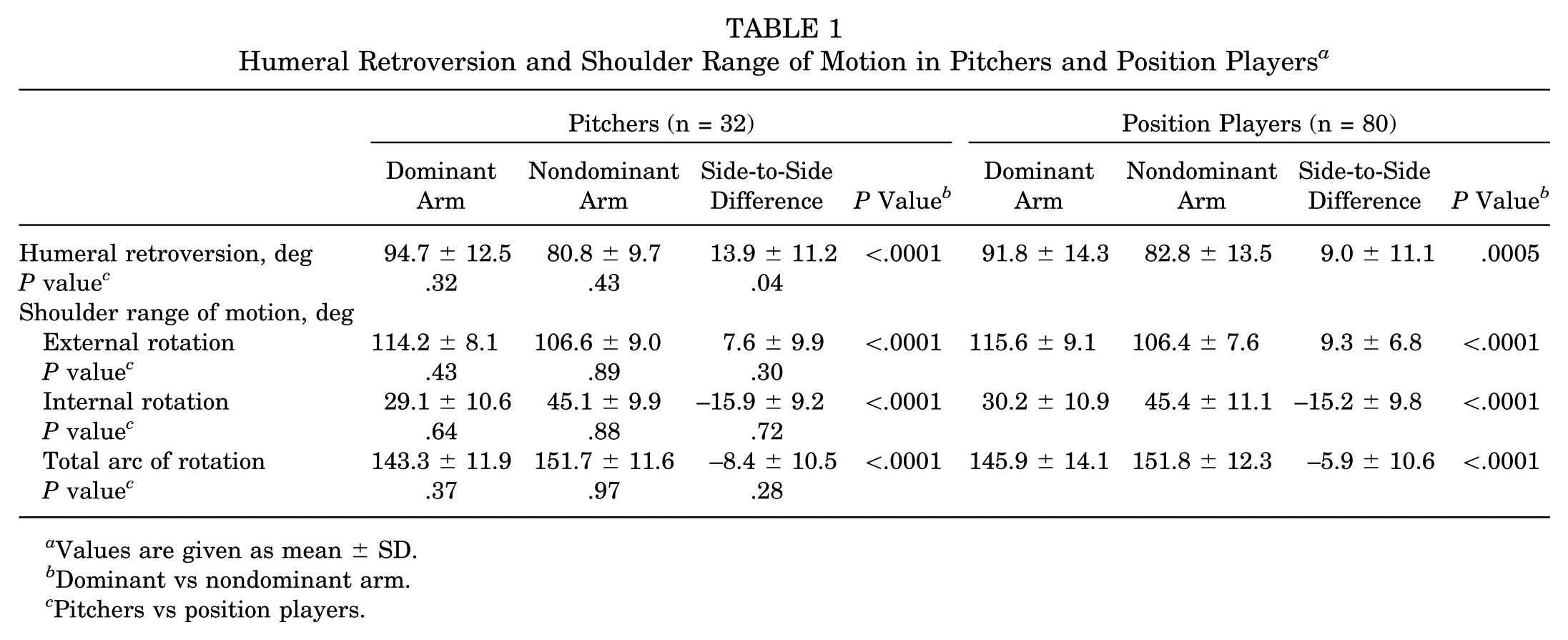
Values are given as mean ± SD.
Dominant vs nondominant arm.
Pitchers vs position players.
On the dominant side, in pitchers, humeral retroversion was greater when the players had started their baseball careers earlier, and there was a significant negative correlation between humeral retroversion and age when the players had started baseball (P = .033, β = −2.494) (Figure 2A). In contrast, humeral retroversion on the dominant side in position players was not significantly correlated with the age when the players had started baseball (P = .211) (Figure 2B). No significant correlation between humeral retroversion and age when the players had started baseball was found on the nondominant side in either pitchers (P = .203) or position players (P = .500) (Figure 2, C and D).
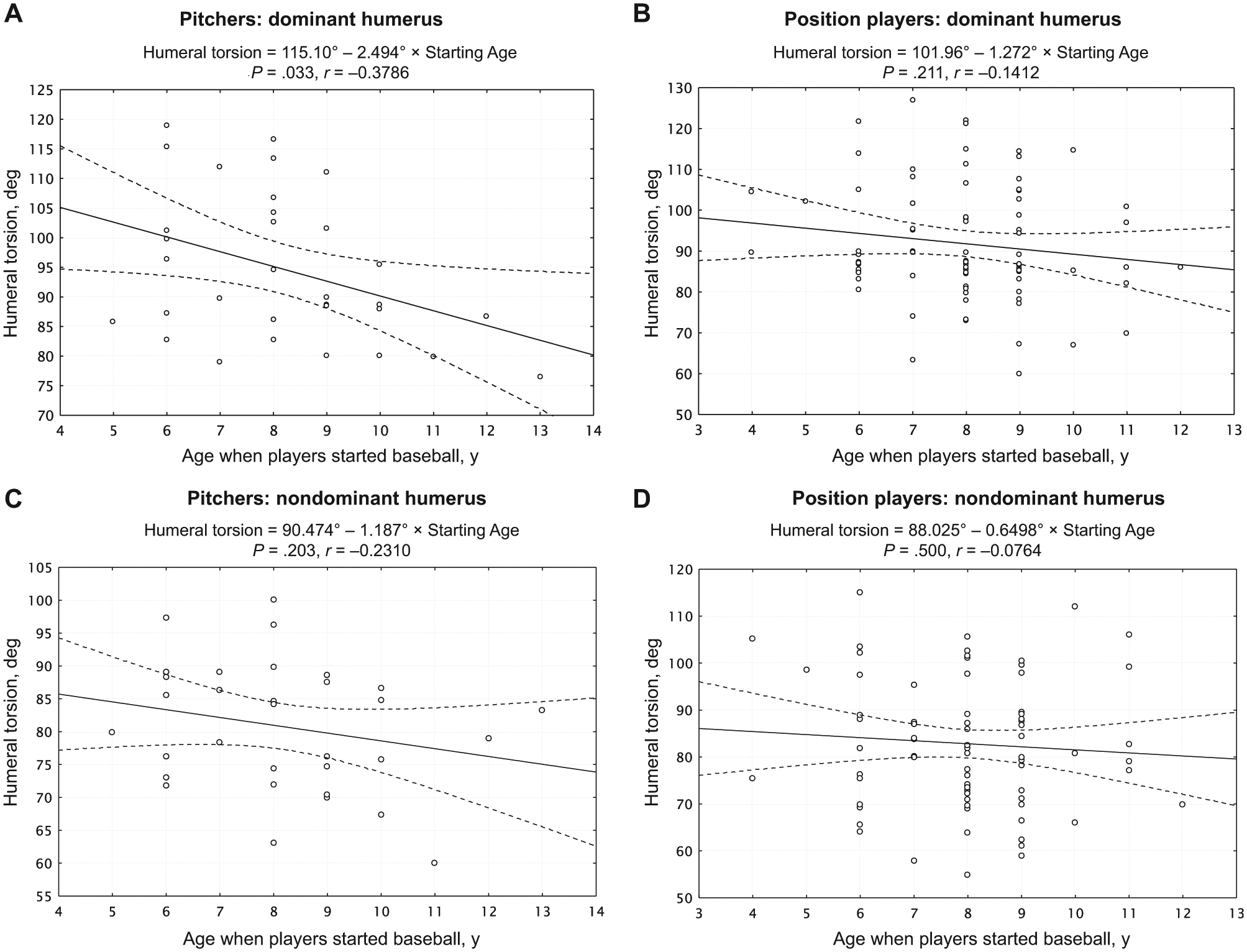
Linear model of humeral retroversion on the dominant side, by age when players started baseball. Area between broken lines indicates the 95% confidence band for the regression line (solid line). (A) Dominant humerus in pitchers; (B) dominant humerus in position players; (C) nondominant humerus in pitchers; (D) nondominant humerus in position players.
Discussion
Humeral retroversion physiologically decreases during growth.5,22 In throwing athletes, the external forces caused by repetitive throwing are thought to reduce this decrease in humeral retroversion during growth, leading to increased humeral retroversion on the dominant side compared with the nondominant side.15,16,22 However, the factors affecting humeral retroversion angle in the throwing arm have been unclear. Here, we showed that high school baseball pitchers had a significant negative correlation between humeral retroversion on the dominant side and the age when they had started baseball. When pitchers began pitching earlier in elementary school and junior high school, their humeral retroversion angles were increased. This result suggests that regular pitching before the age 16 years affects humeral retroversion.
In position players, humeral retroversion was not significantly correlated with age when the players started baseball. Moreover, the side-to-side difference in humeral retroversion in pitchers was significantly greater than that in position players. These results suggest that an increased pitch count, as well as playing baseball during elementary school and junior high school, may increase the humeral retroversion angle, because pitchers throw more frequently than do position players. 3
Although position players did not have a significant correlation between humeral retroversion on the dominant side and the age when they had started baseball, their humeral retroversion was still significantly greater on the dominant side than on the nondominant side. Therefore, regular throwing volume during elementary and junior high school, even in position players, was still capable of increasing humeral retroversion despite the lack of a significant age correlation. Increased humeral retroversion in throwing athletes is thought to increase external rotation and decrease internal rotation of the shoulder joint,4,15,20 suggesting that shoulder range of motion may be directly proportional to humeral retroversion. However, our results showed that shoulder range of motion did not differ between pitchers and position players, even though the side-to-side difference in humeral retroversion in pitchers was significantly greater than that in position players. These results suggest that capsular condition and muscle balance in pitchers may differ from those in position players, because shoulder range of motion is affected by changes in capsular condition or muscle balance.1,6,8-14,21
Our study had a few limitations. We did not investigate the participants’ player positions during elementary and junior high school, although most of the pitchers in high school baseball (96.9%) had also been pitchers in elementary and/or junior high school. In a future study, we intend to assess the effect of position during elementary and junior high school on humeral retroversion. Second, we studied only male baseball players. Recently, the numbers of female baseball players have been increasing, so there is now a need to investigate humeral retroversion in these female players. Third, our study did not include data on nonthrowing athletes. However, we considered this unnecessary because a previous study had already shown that there was no significant side-to-side difference in humeral retroversion in high school soccer players. 15
Conclusion
High school baseball pitchers had a significant negative correlation between humeral retroversion on the dominant side and the age at which they had started baseball. Moreover, the side-to-side difference in humeral retroversion in pitchers was significantly greater than that in position players. These results suggest that humeral retroversion increases with increasing length of baseball career before age 16 years in pitchers.
Footnotes
The authors declared that they have no conflicts of interest in the authorship and publication of this contribution.