






Abstract
Failla MJ, Logerstedt DS, Grindem H, et al. Does extended pre-operative rehabilitation influence outcomes 2 years after ACL reconstruction? A comparative effectiveness study between MOON and Delaware-Oslo ACL cohorts. Am J Sports Med. 2016;44(10):2608-2614. (Original DOI:
In the above article, a statistical software error was discovered during a separate analysis of the data by the authors. During the importation of data into the statistical software, text used as placeholders for null values were converted by the software to a value of 0 instead of being excluded from analysis. This error did not affect the overall outcome of the study, but did systematically affect the 2 year mean IKDC and KOOS values. Baseline data and return to sport data were unaffected by this error. Corrected means, statistical analysis, and figures are as follows.
The DOC cohort continued to have significantly higher IKDC scores at 2 years after ACLR (n = 149; 91 ± 11; n = 1736; 83 ± 14; P < .001) (Figure 3). The DOC cohort continued to have higher scores at 2 years on the pain (n = 111; 94 ± 9; n = 1744; 90 ± 11; P = .003), symptom (n = 111; 89 ± 12; n = 1746; 84 ± 14; P < .001), ADLs (n = 111; 98 ± 5; n = 1744; 95 ± 8; P = .001), and sports/recreation (n = 111; 85 ± 17; 82 ± 19; P = .036) subscales, and as reported in the original article, not in the quality of life (n = 111; 76 ± 20; n = 1744; 74 ± 21; P = .291) subscale of the KOOS (Figure 4). There continued to be no significant group by meniscal procedure (P = .793) or group by graft type (P = .066) interactions on 2 year IKDC scores.
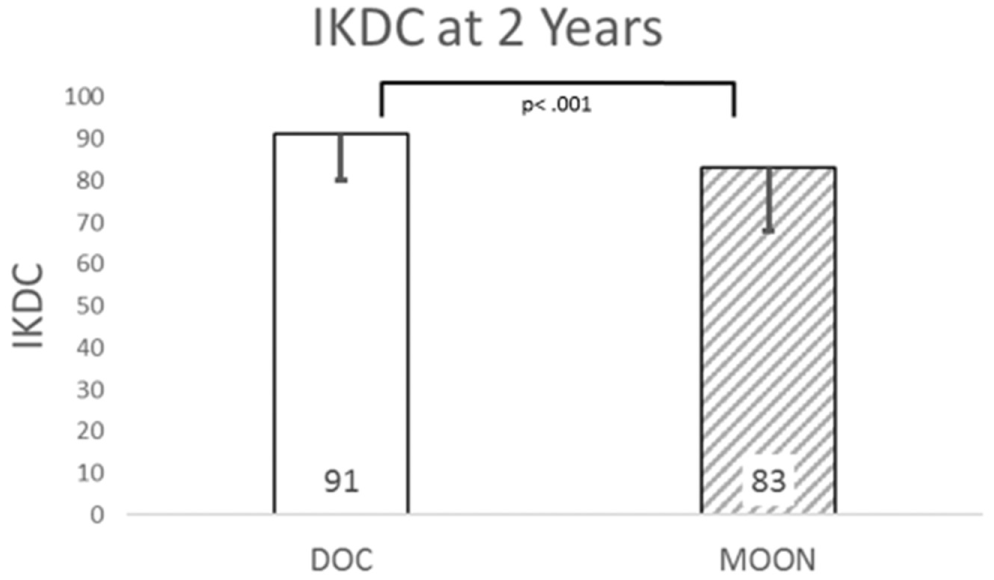
IKDC Scores 2 Years After ACLR Between Cohorts.
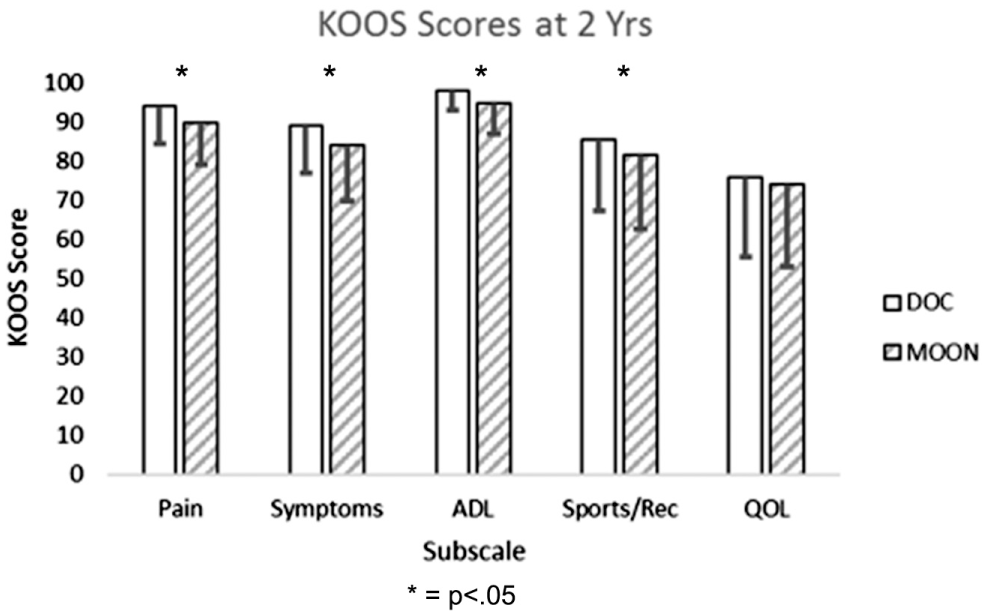
KOOS Scores 2 Years After ACLR Between Cohorts.