







Abstract
Background:
The incidence of upper extremity injury in baseball pitchers has increased over the past decade. This has resulted in a large body of research mainly focused on the kinematic and kinetic patterns of the elbow and shoulder to elucidate the cause of these injuries, with little attention on studying the associations of forearm rotation and upper arm joint moments.
Hypothesis:
There will be significant differences in forearm kinematics and kinetics when comparing the fastball pitch with the curveball pitch. There will be a positive association between forearm kinetics, specifically supination and pronation moments, and the elbow varus moment.
Study Design:
Descriptive laboratory study.
Methods:
A total of 78 pitchers were recruited for this study, and they underwent a pitching analysis using motion analysis techniques. A random-intercept, mixed-effects regression model was used to determine differences in forearm kinematics and kinetics when pitching a fastball compared with a curveball, as well as to determine if associations existed between forearm supination and pronation moments and the elbow varus moment.
Results:
There were a number of significant differences in forearm position when pitching a fastball compared with a curveball, with the curveball producing a more supinated forearm position. Significant associations were found between increasing forearm supination moments and an increase in elbow varus moment for both the fastball and the curveball (P = .002 and P < .001, respectively). For every 1-N·m increase in the supination moment, there was a 1-N·m and 1.1-N·m increase in the elbow varus moment for the fastball and curveball, respectively.
Conclusion:
The results demonstrated that the forearm position was not associated with the elbow varus moment. However, the supination moment was associated with the elbow varus moment.
Clinical Relevance:
On the basis of these findings, pitching coaches and trainers can understand the implications of proper lower arm pitching mechanics in the later portion of the pitch cycle as a potential risk of injury and, therefore, can develop coaching strategies to reduce incorrect positioning, especially when players are pitching the curveball.
The increased incidence of shoulder and elbow pain and injuries in baseball pitchers over the past 3 decades has prompted many researchers to investigate the biomechanics of pitching in hopes of elucidating a cause for these injuries.5,13,15,17 The result of these efforts has led to the belief that the problem is multifactorial and that the causes of this increasing injury rate include overuse, poor pitching mechanics, and the throwing of breaking-type pitches (ie, curveballs, sliders, and cutters).3,8,10,14 Conclusive evidence as to which of these is ultimately responsible for the increased incidence does not exist.
Much of the biomechanical research has focused on finding differences between the fastball and breaking pitches to address the idea that pitching breaking pitches can place an increased stress on the elbow, leading to an increased injury risk. A number of studies have provided evidence to refute this claim and have indicated that the fastball produces greater stresses on both the elbow and shoulder compared with breaking and off-speed pitches.8,18,21 Yet even with scientifically backed evidence, many pitchers and pitching coaches still believe that throwing the curveball is more detrimental than throwing the fastball. This controversy suggests that there is still more to learn about the pitching motion and how other joints may contribute to the development of stress on a pitching arm when throwing different pitch types.
A primary focus of the biomechanical research has been the evaluation of the shoulder and elbow joint kinematics and kinetics, given that these joints are the most commonly injured in baseball pitchers. However, there is a paucity of information about the other joints and segments associated with the pitching motion, notably the wrist and forearm, which account for 2.8% and 7.6% of reported injuries for pitchers, respectively. 15 A limited number of studies have detailed the kinematic and kinetic patterns of the wrist and forearm,2,6,19,20,22 but none have looked at how the kinematics and kinetics of the forearm affect the joint moments at the elbow. Understanding the implications that the motion of the forearm has on the elbow varus moment may provide new insights for injury mechanisms and developing new injury prevention strategies.
The purpose of this study was to describe the differences in forearm kinematics and kinetics between the fastball and curveball and to investigate associations between the forearm motion and moment profiles and the elbow varus moment in uninjured collegiate baseball pitchers. It was hypothesized that there will be significant differences in forearm kinematics and kinetics when comparing the fastball pitch with the curveball pitch. It was also hypothesized that there would be a positive association between forearm kinetics, specifically supination and pronation moments, and the elbow varus moment.
Methods
This study was approved by the Connecticut Children’s Medical Center’s Institutional Review Board, and all study participants signed consent before the start of the pitching analysis. Pitchers were recruited from NCAA Division I and Division III schools. To be a participant in this study, pitchers needed to be actively pitching for a collegiate team, be capable of pitching at full effort, be able to throw both fastball and curveball pitches, and have a minimum 2 years of experience pitching the curveball in a game setting. At the time of the analysis, all of the participants were pain- free and had not had a serious injury (ie, an injury causing them to miss at least 1 game or practice) to their pitching arm within the preceding 6 months. None of the participants had any history of surgery to their pitching arm.
Before starting the pitching data collection, anthropometric measures including height, weight, leg lengths, and joint widths were measured to appropriately scale the inertial properties of the biomechanical model. A total of 38 retro-reflective markers were then attached over specific bony landmarks to create a 16-segment model as previously described by Nissen et al. 17 An additional 2 markers were placed on the circumference of the ball to determine the instant of ball release and to aid in the calculations of ball velocity and joint kinetics. The markers for the forearm were placed over the medial and lateral epicondyles along the flexion/extension axis of the elbow and over the ulnar and radial styloid of the wrist, again along the flexion/extension axis of the wrist. These 4 markers, along with the associated joint centers, were used to create 2 coordinate systems that were used to describe the rotational motion of the forearm (Figure 1). The proximal coordinate system was centered at the elbow joint center. The z-axis for the proximal coordinate system was parallel to the vector created between the elbow joint center and shoulder joint center, the y-axis was constructed as the cross-product of the z-axis and the axis constructed between the elbow joint center and wrist joint center, and the x-axis was the cross of the z- and y-axes. The distal coordinate system was centered at the wrist joint center. The z-axis was defined as a parallel vector to the vector between the elbow joint center and wrist joint center, the y-axis was constructed by crossing the z-axis with the vector between the ulnar and radial styloid markers, and the x-axis was the cross of the z- and y-axes. Using these 2 coordinate systems, it was possible to determine the forearm’s rotational position (ie, supination or pronation) as the angle between the 2 coordinate systems. Pronation was considered to be a positive value (Figure 2). In this work, the term “forearm moment” refers to the rotational torque produced to resist a supination or pronation movement of the forearm. Positive values for forearm rotation indicated a pronated position, while a negative value indicated a supinated position. In this work, the terms “forearm position” and “forearm moment” were used as inclusive descriptors indicating either forearm supination or forearm pronation since forearm position varies from pitcher to pitcher at the same time point in the pitching cycle.
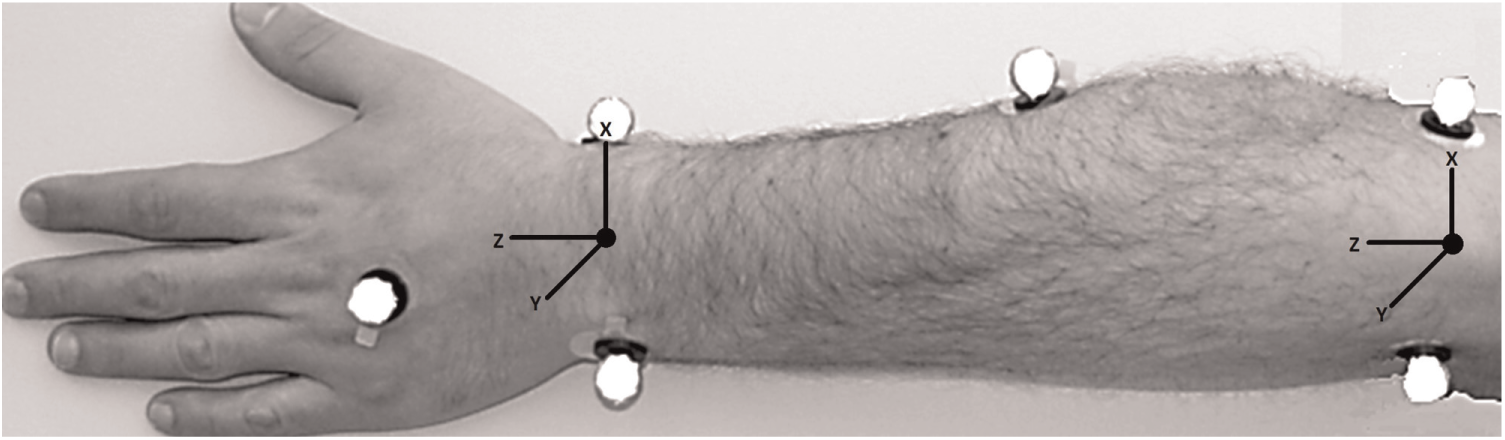
Illustration of the forearm marker positions and coordinate systems.
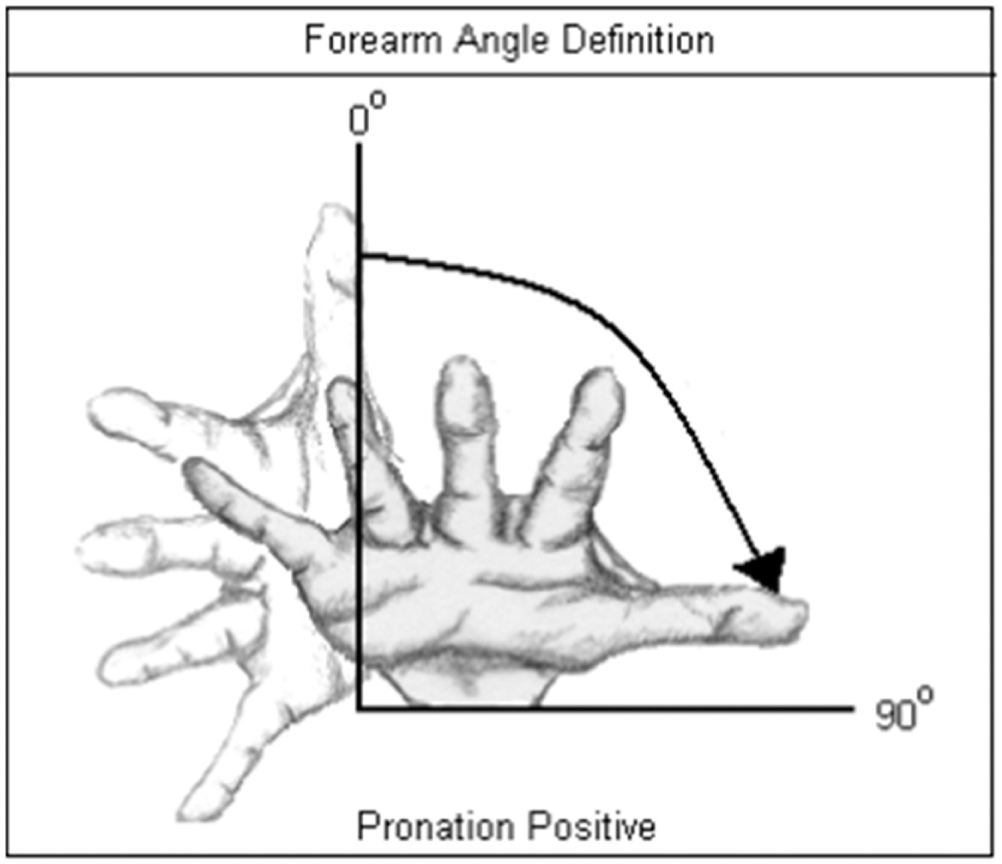
Forearm angle definition.
Once all markers were placed, the participants were allowed to warm up and stretch for as long as they required to be comfortable pitching in the laboratory environment. All participants pitched from a regulation 10-in indoor mound toward a target with a designated strike zone set 60 ft, 6 in, away. All of the participants involved in this study pitched either 3 or 4 pitch types (ie, fastball, curveball, slider, cutter, or change-up) depending on what they typically pitched in a game setting; however, the results of this study were limited to those obtained from the fastball and curveball only. Motion data were collected using a 12-camera Vicon 512 motion capture system (Vicon Motion Systems) at 250 Hz. The pitching motion was divided using 4 time points as described by Fleisig et al. 7 Initial data processing including trajectory reconstruction and marker labeling was performed in Vicon Workstation, and joint and segment angles were computed using Vicon Bodybuilder (Vicon Motion Systems) based on Euler’s equation of motion as previously described. 17 Joint and segment kinetics were computed using custom Matlab code (Mathworks) using standard inverse-dynamic techniques. 12 All kinetic data presented in this study were presented as internal moments.
The first 3 trials in which all marker data were present throughout the entirety of the pitching cycle were analyzed for each participant, regardless of whether the pitch resulted in a ball or strike, to make the results of this work more generalizable to a game setting. Descriptive statistics were computed for all parameters of interest, which include forearm position at foot contact, maximum external rotation of the glenohumeral joint, the instant of ball release, maximum internal rotation of the glenohumeral joint, mean forearm position, maximum forearm supination and pronation angles, forearm position at terminal elbow extension, maximum pronation and supination rotational velocities, maximum pronation and supination moments, maximum forearm moment at terminal elbow extension, and maximum elbow varus moment, for both the fastball and the curveball. Means and SDs of the variables were presented. A random-intercept mixed-effects regression model9,11 that also allowed for the calculation of type III effects was used to determine differences between the fastball and the curveball, as well as to determine if significant associations existed between the parameters of interest and the elbow varus moment. The random-intercept mixed-effects model was chosen for 2 reasons. First, the model properly accounts for repeated measures, making use of all of the data rather than using a single averaged trial for each pitcher. Second, it can be extended to test for type III effects, allowing for the understanding of significant differences between 2 groups. Statistical findings in which the P value was ≤.05 were considered to be significant. All statistical testing was performed using SAS software version 9.3 (SAS Institute Inc).
Results
A total of 78 collegiate-level pitchers participated in this study, with a mean age of 19.9 ± 1.3 years, a mean height of 184.2 ± 6.8 cm, and a mean weight of 86.3 ± 12.2 kg. There was a significant difference (P < .001) noted when comparing ball velocities between the fastball and the curveball (32.1 ± 2.5 m/s vs 29.0 ± 2.6 m/s, respectively).
There were a number of statistically significant differences found when comparing the forearm kinematics and kinetics between the fastball and the curveball (Table 1). The results indicated that, on average, when the curveball was thrown, pitchers kept their forearms in a greater degree of supination over the entire pitch cycle compared with when they threw the fastball. Interestingly, while there were significant differences noted in maximum pronation velocity, there was no difference noted in the maximum supination velocity (Table 1). It is also important to note that while there were significant differences in the supination and pronation moments between the fastball and the curveball, there was no significant difference between the forearm moment at terminal elbow extension (Table 1).
Differences in Kinematics and Kinetics of the Forearm Between the Fastball and the Curveball a
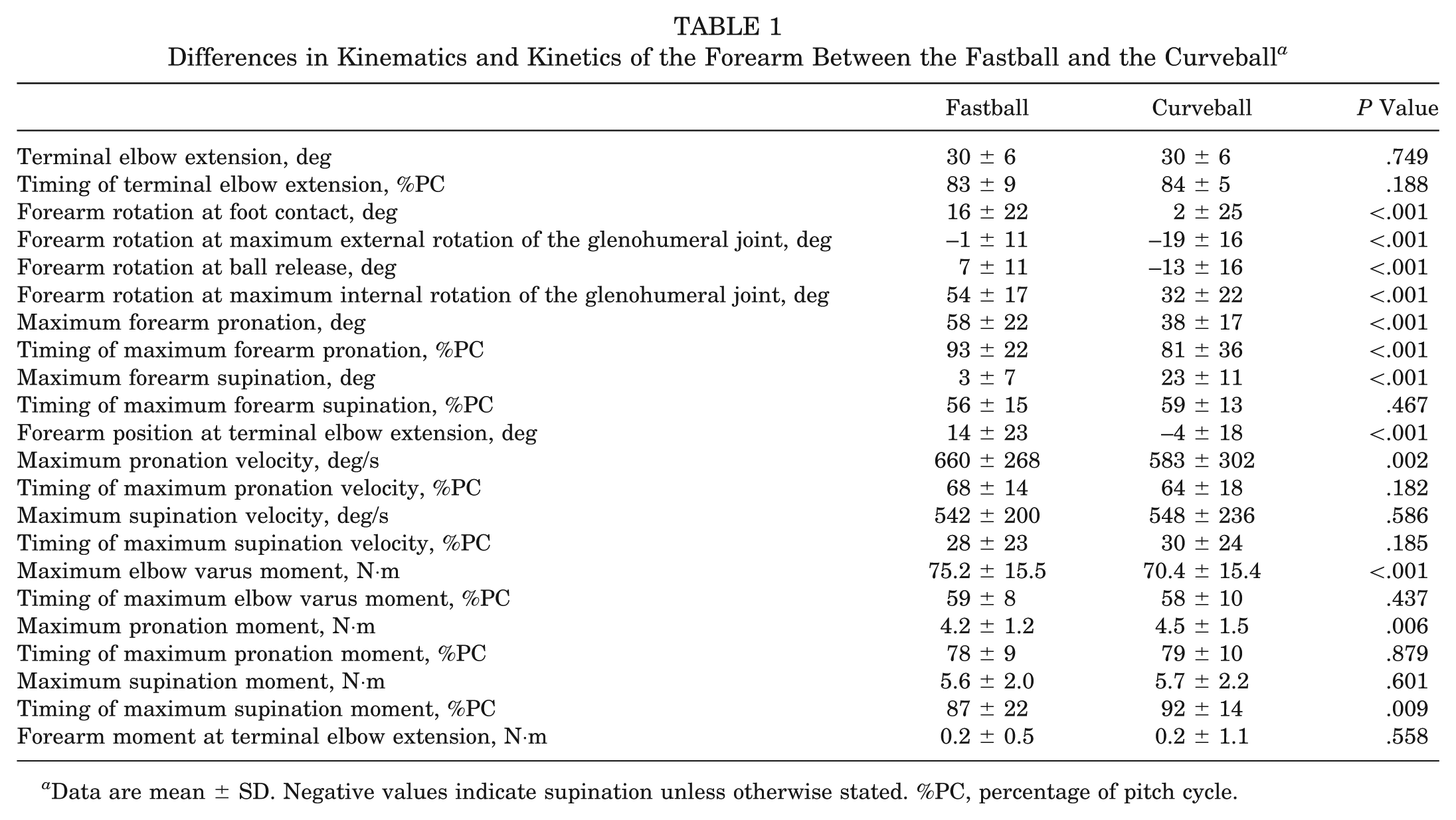
Data are mean ± SD. Negative values indicate supination unless otherwise stated. %PC, percentage of pitch cycle.
When analyzing the results of the regression analysis, there were statistically significant associations between the maximum elbow varus moment and the maximum supination moment (r 2 = 0.23), as well as the forearm rotation moment at terminal elbow extension (r 2 = 0.14). The maximum supination moment was found to be highly associated with the maximum elbow varus moment for both the fastball (r 2 = 0.23) and the curveball (r 2 = 0.30). A 1-N·m increase in the maximum supination moment was associated with a 1-N·m increase in the elbow varus moment for the fastball and a 1.1-N·m increase for the curveball (P = .002 and P < .001, respectively).
The forearm rotation moment at terminal elbow extension was also noted to be highly associated with the elbow varus moment (r 2 = 0.14). It was found that a 1-N·m increase in the forearm moment at terminal elbow extension decreased the elbow varus moment by 1.8 N·m for the fastball and 2.8 N·m for the curveball (P = .013 and P < .001, respectively). Depending on the individual participant, the forearm rotation moment at terminal elbow extension occurred as a supination moment, a pronation moment, or a neutral moment (defined as a moment between –0.1 and 0.1 N·m). The majority of participants (68%) had a pronation moment at terminal elbow extension, 23% had a neutral moment, and only 9% had a supination moment. Therefore, the results of the regression analysis indicated an association between the elbow varus moment and a pronation moment at terminal elbow extension.
Discussion
The results of this study indicated that when pitching the curveball, the participants held their forearms in a greater degree of supination throughout much of the pitching cycle in comparison with the fastball. This was consistent with previously published literature2,22 and makes intuitive sense, as many pitchers require the forearm to be in supination to successfully throw a curveball. The results of this work also indicated, as others have shown, 5 that the curveball produced a greater pronation moment compared with the fastball after ball release, in part due to the supinated position of the arm at ball release. Results also are consistent with previously published works indicating that the fastball has a greater maximum elbow varus moment compared with the elbow varus moment of the curveball.5,8,18,21 In addition, the regression analyses showed statistically significant associations with the supination moment and an increase in the elbow varus moment for both the fastball and the curveball. The results also showed a significant association between the pronation moment at terminal elbow extension and a decrease in the elbow varus moment for both the fastball and the curveball, although it is important to note that the decrease seen with the curveball was larger than that noted for the fastball.
The most compelling results were those found in the regression analyses. The results showed that the forearm’s instantaneous position and the rotational velocity of the forearm at the point of ball release were not associated with the elbow varus moment. This would indicate that the position of the forearm at ball release likely played no role in injury mechanisms for baseball pitchers and served only to help control the spin of the ball. This finding was previously concluded by Dun et al, 5 who stated that forearm rotational position had no effect on ulnar collateral ligament (UCL) strain and therefore was not a potential source of injury for baseball pitchers.
The regression analyses, however, indicate that an increase in the forearm supination moment was associated with an increase in the elbow varus moment for both the fastball and the curveball pitches. It is important to state that within-pitcher variations between trials were small; therefore, these results were based on consistent trends for each pitcher and not on a small number of pitchers who influenced the entire group data. In addition, the increase of 1 N·m in the elbow varus moment may seem insignificant. However, cadaveric studies have shown that the varus moment producing UCL failure is 34.29 ± 6.9 N·m 1 and that 54% of the total elbow varus load is transferred to the UCL. 16 Therefore, using the mean elbow varus moment found in this study for the fastball (75.2 N·m) and taking 54% of this value would suggest 40 N·m would be transferred to the UCL 16 ; thus, even a small increase in the elbow varus moment could have a significant effect on the potential injury risks.
When throwing either a fastball or a curveball, the more supinated the forearm was at the point of ball release, the more the pitcher would have to pronate the forearm to return to a neutral forearm position to field the ball. This is especially important with the curveball since the arm is in a greater degree of supination compared with that of the forearm. Since the arm’s natural tendency would be to rotate into further supination, the pitchers would need to fire their forearm pronators to resist the continued movement into supination. Although activation of a pitcher’s pronators would be protective of the medial elbow structures, including the UCL, 3 the added resistance created by the internal supination moment would introduce additional stresses on the medial side of the elbow and, therefore, does have a direct effect on and consequently increases the elbow varus moment. Therefore, forearm position and forearm rotational velocity alone do not increase the elbow varus moment. Rather, the combination of both causes an increase in the elbow varus moment. This demonstrates that the underlying soft tissues experience greater stresses during the deceleration phase of throwing a curveball as compared with a fastball. Supporting this idea is the work by DiGiovine et al, 4 who conducted an electromyogram-based study of baseball pitchers to understand the activation patterns and levels of the muscles during a pitch. Their results indicated that the distal arm muscles are very active during deceleration phases of the pitching cycle. More specifically, the pronator teres and supinator are most active during the deceleration phase of the pitch; interestingly, both the pronator and supinator have near-equal activity, reaching between 50% and 60% of the maximal voluntary contraction. 3 The data presented in the study of DiGiovine et al 4 were based on the fastball pitch only, which as previously mentioned places the forearm into a more neutral position during ball release and the deceleration phase; therefore, it is expected that the supinator and pronator teres would have near-equal activation as the forearm needs only to be held rotationally motionless. Given the position of the forearm during the curveball, it could be assumed that the pronator would need to fire to a greater extent to counteract the natural tendency for the arm to move into supination after the ball is released. This, as mentioned earlier, is intuitive as the internal supination moment after ball release is higher when throwing the curveball than the fastball. This is further supported by the data that show those pitchers who maintained a more pronated position at ball release and at terminal elbow extension had a negligible forearm moment (in most cases, a pronation moment) that actually caused a reduction in the elbow varus moment. Again, this points to the conclusion that more pronation at ball release later reduces the stresses on the underlying soft tissue.
This work points toward the potential injury prevention strategy of pitchers decreasing their forearm supination regardless of the pitch they are throwing. Although a fastball is not typically associated with a supinated position, fatigue or poor technique may lead to the potential for greater elbow varus moments. Therefore, coaches should pay close attention to their pitchers during instructional practices, as well as closely monitor their pitchers for technique changes due to fatigue. In addition, traditional 12-to-6 curveball mechanics teach a pitcher to throw a curveball with a near-neutral forearm position but with a large degree of ulnar deviation. This method allows pitchers to throw their curveball with less supination at ball release with reduced internal supination moment; therefore, pitchers could experience lower elbow varus moments. This is not the case for pitchers who throw a “slurve”-type curveball, in which a pitcher relies on supination instead of ulnar deviation to produce the desired ball spin. When throwing a slurve, a pitcher will have increased supination at the point of ball release and consequently a higher internal supination moment. It is therefore recommended that coaches stress curveball mechanics, pitching a 12- to 6-o’clock motion, rather than allowing pitchers to mimic the motion of a curveball by using a greater degree of forearm supination in an effort to reduce the stresses on the medial side of the elbow. A curveball thrown in this manner is ultimately safer than throwing a fastball, as shown in earlier studies.7,15,20
This study has several limitations. This is a laboratory study, and the effects of pitching with reflective markers, as well as the controlled conditions of the laboratory, may affect participant performance. However, this level of analysis is not viable in the field and is comparable with other motion-based studies currently in the literature.2,7,17,20,22 To simulate actual pitching conditions, we used a regulation mound and a full-length pitching space, and we allowed pitchers time to warm up and feel comfortable pitching in the laboratory environment. In addition, the results of this study were based on pitches that resulted in both balls and strikes. Although this may have increased the variations of the results, it is reflective of what a pitcher would experience in a game or practice setting.
Conclusion
The results indicated that while forearm position and the rotational velocities of the forearm’s rotation were not directly associated with the elbow varus moment, the kinetics of the forearm’s rotation were highly associated with the elbow varus moment. It was found that if a pitcher throws a pitch in a greater degree of supination, then the body must increase the resistance to this supination motion, which is associated with an increase in the elbow varus moment. Therefore, excessive supination and consequent rapid pronation after ball release may increase the risk of injury in college-aged pitchers.
Footnotes
The authors declared that they have no conflicts of interest in the authorship and publication of this contribution.
Presented as a poster at the 43rd annual meeting of the AOSSM, Toronto, Ontario, Canada, July 2017.