






Abstract
Background:
There is no consensus regarding the best treatment approach for skeletally immature children with anterior cruciate ligament (ACL) injuries. High-quality studies with long-term follow-up are lacking, and evidence to support decision making is limited.
Purpose:
To evaluate functional and patient-reported outcome, surgical history, and complications among young adults who sustained an ACL injury before the age of 13 years and were treated with active rehabilitation and the option of delayed ACL reconstruction if needed.
Study Design:
Case series; Level of evidence, 4.
Methods:
Forty-six children aged <13 years with a total intrasubstance ACL injury were included. None of these patients had additional injuries that warranted early surgery. At final follow-up at a mean 8 years after the time of injury, 44 patients remained in the study. The same test battery was conducted at baseline, 1 and 2 years, and final follow-up at approximately 18 years of age. The test battery included functional tests (hop tests and isokinetic muscle strength tests of quadriceps and hamstrings), patient-reported outcome measures (including the Knee injury and Osteoarthritis Outcome Score and the International Knee Documentation Committee Subjective Knee Form), and clinical examination. Medical records were reviewed to assess surgical history and complications.
Results:
At a mean 8 years of follow-up, 24 patients (55%) had undergone ACL reconstruction, and 16 (36%) had undergone meniscal surgery. Quadriceps muscle strength symmetry was >90% for 30 patients (68%). Mean leg symmetry indexes for hop and strength tests were consistently >90%, except for the single-hop test and hamstrings muscle strength for ACL-reconstructed knees. Mean ± SD International Knee Documentation Committee scores were 86.3 ± 13.7 for the ACL-reconstructed knees and 90.6 ± 11.8 for the nonreconstructed knees. At final follow-up, forty patients (91%) remained active in sports, but 29 (66%) restricted their activity level to nonpivoting sports.
Conclusion:
Active rehabilitation may have a role in treatment of children with ACL injury. Approximately 50% of children may cope well, even to adulthood, without a surgical intervention. The other half may develop instability that warrants ACL reconstruction, and one-third may require meniscal surgery.
Anterior cruciate ligament (ACL) injuries are increasing among our youngest athletes: the skeletally immature children. 13 Children are vulnerable, and their short- and long-term knee health and quality of life are in jeopardy. 49 As a result, management of pediatric ACL injuries is a much-debated topic. A consensus does not exist regarding the optimal treatment approach. The current evidence on management of pediatric ACL injuries is limited owing to bias and poor methodology.3,14,34 The International Olympic Committee consensus statement on pediatric ACL injuries was published in 2018. 3 This consensus statement addresses these controversies in management and provides a best practice guideline for clinicians. 3 For children with ACL injury and additional injuries (eg, bucket-handle meniscal tears), early ACL reconstruction and meniscal repair are recommended. For those without such additional injuries, a recommendation regarding a treatment approach could not be agreed on because of conflicting opinions. 3
A main goal in treatment decision making is to mitigate the risk for developing secondary knee injuries. 14 Many surgeons advocate early surgery to mechanically stabilize the injured knee and prevent secondary injuries to cartilage and menisci. 41 However, surgery in the growing knee is not without risk. These risks include growth disturbances,17,37 inadequate graft developement, 7 and, most important, more unpredictable results for children than adults.5,12 The rate of reinjury may be as high as 30%. 12 Therefore, some choose a primary nonsurgical approach pending growth and the option of delayed ACL reconstruction for those without additional injuries warranting early surgery.
Few prospective studies exist, and so far none has followed children with ACL injury to adulthood who were treated with active rehabilitation and the option of delayed ACL reconstruction. We aimed to investigate long-term outcomes among young adults who sustained an ACL injury in childhood (skeletally immature and <13 years old) and were treated with active rehabilitation and optional delayed ACL reconstruction. Our primary aim was to evaluate knee function and activity level with performance-based and patient-reported outcome measures (PROMs). The secondary aim was to describe knee surgery, complications, and secondary knee injuries.
Methods
Patients and Eligibility Criteria
This is a prospective follow-up study of 46 individuals in the Oslo Pediatric ACL Cohort. 33 Functional outcomes and magnetic resonance imaging (MRI) findings at 2 years were published in 2013.33,36
Consecutive patients were recruited from the Division of Orthopaedic Surgery, Oslo University Hospital, from March 2006 to October 2010. Out of 52 eligible patients, 46 were included, and 44 remained in the study at final follow-up, when reaching 18 years of age. Figure 1 illustrates the flow of study participants.
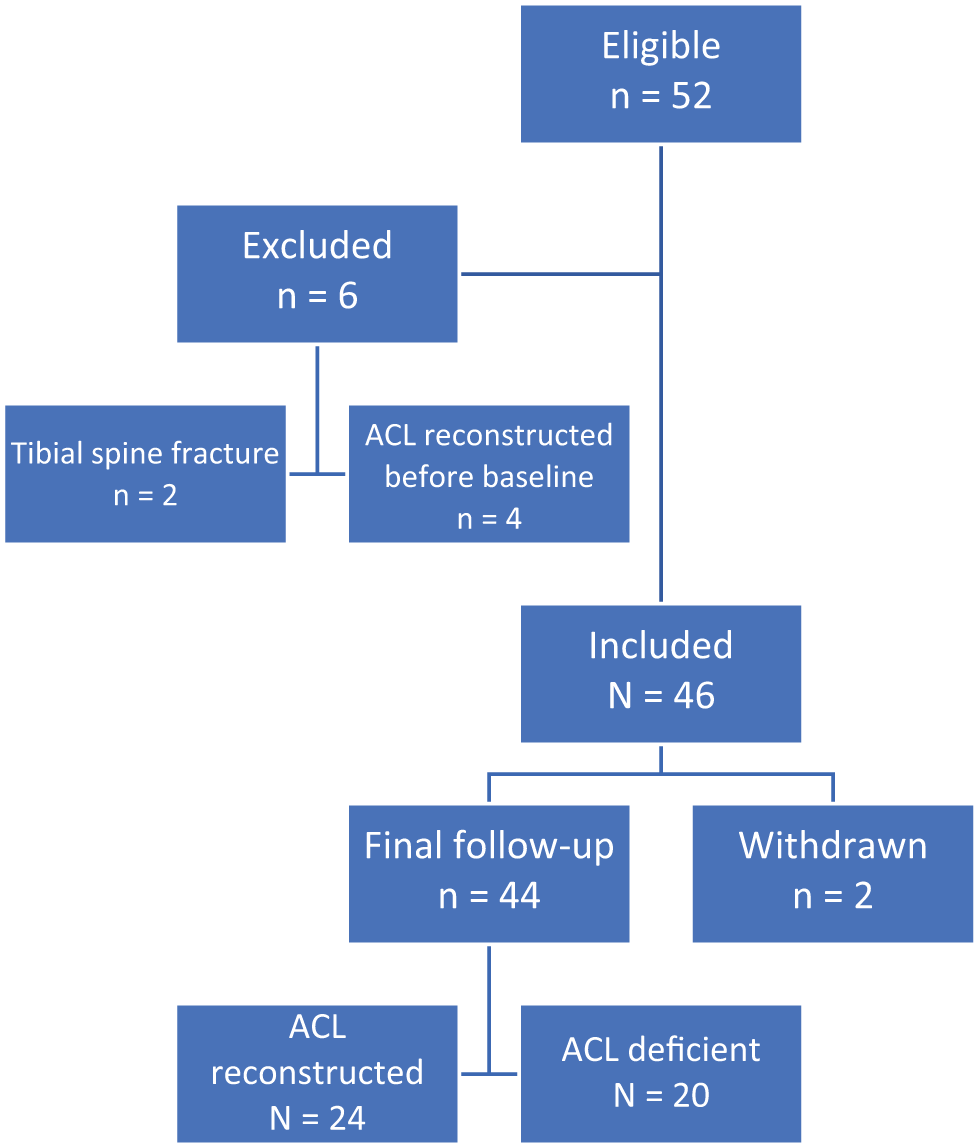
Flow diagram of study participants. ACL, anterior cruciate ligament.
The eligibility criterion was a confirmed traumatic complete intrasubstance ACL injury sustained before the age of 13 years and no concurrent ligament injury requiring surgery. Exclusion criteria were prior ACL reconstruction and having an ACL avulsion fracture in the index knee.
The diagnosis of an ACL injury was confirmed when all 3 of the following criteria were present: ACL injury verified by MRI, 31 a positive Lachman test, 27 and a side-to-side difference in anteroposterior translation >3 mm on an instrumented sagittal knee laxity measurement (manual maximum test, KT 1000 arthrometer; MedMetrics). 10 Diagnostic MRI confirmed open growth plates in all patients.
Treatment Algorithm
All children were treated with active rehabilitation and the option of having delayed ACL reconstruction if needed. 35 In Norway, this is the standard of care for skeletally immature patients with ACL injury who do not have additional injuries that warrant early surgery. This treatment protocol includes a structured rehabilitation program involving 3 phases supervised by a sports physical therapist and the use of a custom-fitted knee brace during pivoting sports and school-based physical education. Return to sport was allowed after passing functional criteria following completion of rehabilitation. 35 No activity modifications apart from using the knee brace during pivoting activities were advocated.
Delayed ACL reconstruction was considered if the rehabilitation program did not lead to adequate knee function and functional stability. 35 Indications for ACL reconstruction were multiple episodes of giving way, unacceptable reduction in activity level, or symptomatic meniscal injury. Patients who underwent ACL reconstruction followed the same postoperative rehabilitation program. The rehabilitation protocol is described in detail by Moksnes et al. 35
Follow-up
Patients were closely monitored throughout the study. Initially, they had weekly training sessions with the physical therapist and visits by request with the orthopaedic surgeon (L.E.). After the 2-year follow-up, patients had yearly visits at our orthopaedic clinic and appointments by request with the physical therapist (H.M.) and/or orthopaedic surgeon (G.R.E. or L.E.). All patients were invited to a final follow-up at approximately 18 years of age.
Outcome Measures
After completing the second phase of rehabilitation (after the initial injury), all children completed a baseline test battery, including performance-based tests, PROMs, and clinical examination. 35 The same test battery was performed after 1 and 2 years and at final follow-up. Patients who required ACL reconstruction underwent these tests preoperatively as well.
The performance-based tests were isokinetic concentric muscle strength measurements (knee extensors and flexors) and 4 single-legged hop tests 40 (single-hop test, triple-crossover test, triple-hop test, and 6-m timed hop test). Testing was led by senior sports physical therapists (H.G. and H.M.) and was performed without the knee brace after a 10-minute warm-up on a stationary bike. The uninjured leg was routinely tested first. A dynamometer (Biodex 6000; Medical Systems) at a test velocity of 60 deg/s was used to measure isokinetic quadriceps and hamstrings muscle strength. The participants performed 4 submaximum trial repetitions and had a 1-minute rest before 5 test repetitions were recorded at maximum efforts.
The following PROMs were included: the Knee injury and Osteoarthritis Outcome Score (KOOS), 43 the International Knee Documentation Committee (IKDC) Subjective Knee Form, 24 the Knee Outcome Survey–Activities of Daily Living Scale (KOS-ADLS), 26 and the visual analog scale (VAS) for knee function. IKDC, KOS-ADLS, and VAS give a total score from 0 to 100 (worst to best). The KOOS has 5 subscales: Pain, Symptoms, Activities of Daily Living (ADL), Sports and Recreation (Sports/Rec), and Quality of Life (QoL). A score from 0 to 100 (worst to best) is calculated for each subscale.
The children completed these PROMs with their parents at all follow-ups except the final one, when the patient completed them alone. Main preinjury sports activity at baseline and current sports activity were reported at all follow-ups. Activity level was categorized according to Hefti et al 21 and modified to Norwegian sports 20 (Table 1).
Classification of Activity Level According to Pivoting Sports Activity

The clinical examination consisted of Lachman 47 and Slocum 45 tests performed by the senior author (L.E.). The patients reported their surgical history, reinjuries, and episodes of the knee giving way. Medical records were obtained for the 44 patients at final follow-up to include data on ACL reconstructions, additional surgery, and complications.
The regional ethics committee approved the study (REC nb 684-06288 1.2006.78).
Data Management and Statistical Analysis
Muscle strength and hop performance were reported as limb symmetry index (LSI). The number of patients with LSI >90% were calculated. The methods for calculating LSI were as follows:
Muscle strength: peak torque of involved leg / peak torque of uninvolved leg × 100
Distance hop tests: distance of involved leg / distance of uninvolved leg × 100
Timed hop test: time of uninvolved leg / time of involved leg × 100
Predictive Analytics Software Statistics (v 24.0; SPSS Inc) was used for all statistical analyses.
The proportion of patients reaching Patient Acceptable Symptom State (PASS) thresholds 38 for the IKDC and KOOS was calculated. The defined PASS threshold for the IKDC is 75.9 and for the KOOS subscales: 88.9 for Pain, 57.1 for Symptoms, 100 for ADL, 75 for Sports/Rec, and 62.5 for QoL. 38
Changes in continuous variables (PROMs and LSI for muscle strength and hop tests) from 2 years to final follow-up were analyzed with a paired t test or Wilcoxon signed rank test depending on data distribution, which was explored by histograms (Predictive Analytics Software Statistics, v 24.0). Data with substantial outliers or nonnormal distribution were analyzed with the Wilcoxon signed rank test. The proportion of patients showing minimal important change (MIC) for the KOOS Sports/Rec and QoL 23 subscales was calculated. MIC is defined as improvement >12.1 for Sports/Rec and >18.3 for QoL. 22
Results
Patient Characteristics
Of 46 included patients, 44 (96%; 15 females, 29 males) attended the final follow-up at a mean ± SD age of 19 ± 1.6 years. The mean time from injury to final follow-up was 8.0 ± 1.7 years. All but 1 patient had closed growth plates at final follow-up.
Baseline
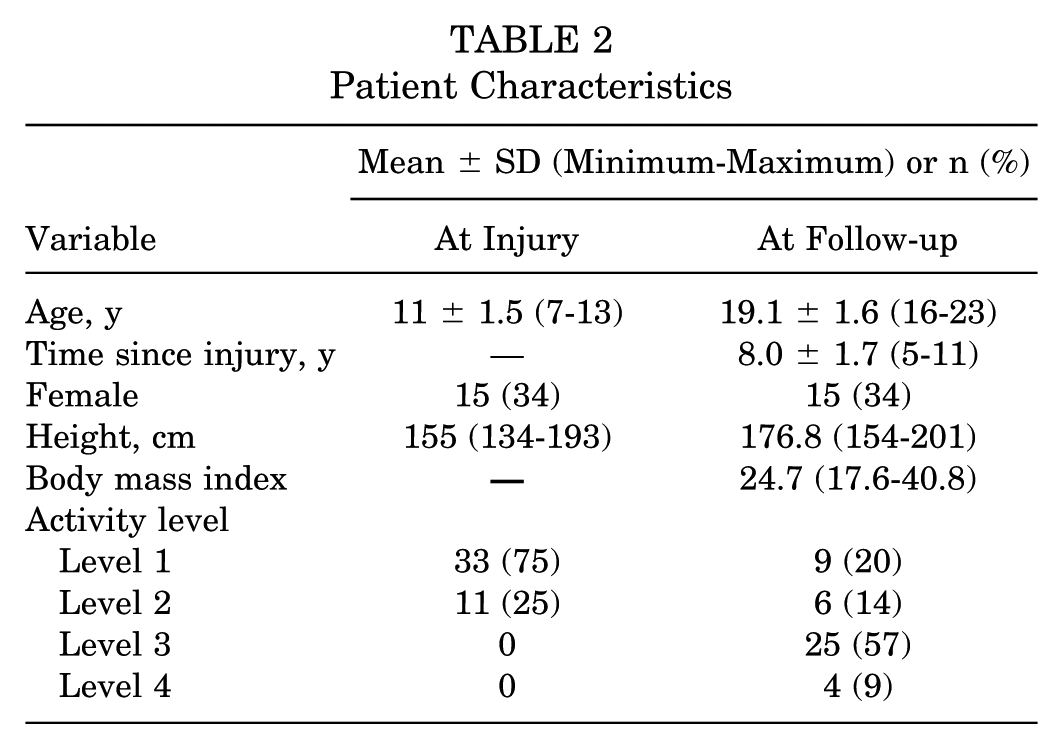
Mean age at injury was 11 ± 1.5 years. One patient had bilateral ACL injuries; 15, a right knee ACL injury; and 28, a left knee ACL injury. All patients participated in pivoting sports before injury. Patient characteristics are described in Table 2.
Patient Characteristics
Index ACL Reconstruction
At final follow-up, 24 of 44 (54.5%) patients had undergone ACL reconstruction. The reasons for ACL reconstruction were instability (n = 20), secondary injuries (n = 2; bucket-handle meniscal tears), and unacceptable activity limitation (n = 2). For all 24 ACL reconstructions, a transphyseal technique was used. Those undergoing surgery before the growth spurt (n = 3) had a pediatric transphyseal technique, including soft tissue graft (hamstrings in all cases) and post screw fixation in the tibia to avoid hardware or bone block crossing the epiphysis. The majority of patients were skeletally mature or close to skeletal maturity at the time of surgery. Those who were considered skeletally mature had appropriate interference screw fixations in the tibia and a screw or suspensory device in the femur depending on the graft (hamstring, n = 18; bone–patellar tendon–bone, n = 2; quadriceps, n = 1). In total, 12 surgeons were involved in ACL surgery. All but 1 ACL reconstruction was performed at the study center. Details regarding the index ACL reconstruction are described in Table 3.
Primary ACL Reconstruction Before Time of Follow-up a

ACL, anterior cruciate ligament; BPTB, bone–patellar tendon–bone.
Mean growth, 3.2 cm (range, 1-5 cm).
Growth: 8 cm, 8 cm, 13 cm, 19 cm, and 26 cm.
Post screw in tibia + EndoButton (Smith & Nephew) in femur.
BPTB: SoftSilk (Smith & Nephew) in tibia and femur. Hamstrings: RCI in tibia + EndoButton (Smith & Nephew) in femur. Quadriceps: SoftSilk (Smith & Nephew) in tibia + EndoButton (Smith & Nephew) in femur.
Thirty-six percent of patients (16 of 44) underwent meniscal surgery during the study period. Injury to a previously healthy meniscus was found in 9 of 16 patients (6 bucket-handle meniscal tears). Of these 16 patients with meniscal injuries that required surgery, 3 never had their ACL reconstructed and did not have further meniscal surgery. However, 2 patients who had meniscal repair initially without ACL reconstruction experienced failure and had later meniscal resection and ACL reconstruction. The remaining patients had ACL reconstruction.
For 6 of 16 patients, an initial incomplete or stable meniscal injury (observed on diagnostic MRI) progressed and required surgery. Of these tears, the majority progressed before ACL reconstruction (n = 5). One additional patient had an incomplete meniscal tear seen on diagnostic MRI, which was later confirmed as incomplete on diagnostic arthroscopy. For meniscal surgery and resurgery, see Appendix Table A1 (available in the online version of this article).
Complications
Surgical complications included postoperative infection (n = 1) and injury to the tibial nerve during post screw placement in the tibia (n = 1), which resulted in short foot syndrome. One patient with ACL reconstruction had a 4-cm leg-length discrepancy at final follow-up. This patient had a recognized leg-length discrepancy >2.5 cm before the ACL injury, and his condition was not believed to be the result of surgery.
One patient sustained a graft rupture <10 months after ACL reconstruction and subsequently underwent ACL revision surgery with a quadriceps tendon autograft. Another patient had graft insufficiency based on symptoms and clinical examination (Lachman 2+ without endpoint and Slocum pivoting 2+ at final follow-up). The graft was intact at the follow-up MRI. There were no contralateral knee injuries during the follow-up period. For complications and secondary surgery after the index ACL reconstruction, see Appendix Table A2.
Of the 24 ACL-reconstructed cases, 8 had additional surgery after the index ACL reconstruction. These secondary surgical interventions were due to surgical complications or reinjuries as mentioned earlier. Five patients had surgical treatment without ACL reconstruction, and 2 had meniscal surgery before ACL reconstruction. In total, 29 patients had knee surgery between injury and final follow-up. Appendix Table A3 describes surgery of nonreconstructed knees or before ACL reconstruction.
Activity Level
At final follow-up, the majority of patients (91%) remained physically active. The majority in both groups participated in level 3 sports (no pivoting). Strength training was the most commonly reported nonpivoting sport in both groups (nonreconstructed, n = 4; ACL reconstructed, n = 11). Eight of 24 patients in the ACL-reconstructed group and 7 of 20 in the nonreconstructed group still participated in level 1 or 2 sports. In both groups, soccer was the most commonly reported pivoting sport (nonreconstructed, n = 5; ACL reconstructed, n = 3). Two patients competed at a national level: cross-country (nonreconstructed, n = 1) and alpine skiing (n = 1, ACL reconstructed). Fifty-seven percent of patients (25 of 44) reported return to preinjury activity level. Nineteen patients never returned to preinjury activity level after injury, and for 13 of these, the self-reported reason for not returning was reduced knee function, fear of giving way, or fear of sustaining a new knee injury. Table 2 provides further details regarding activity level at baseline and follow-up, and Table 4 presents details regarding activity levels for the treatment groups.
Functional and Patient-Reported Outcome by Final Treatment a

Data are provided as mean ± SD (Minimum-Maximum) or n. IKDC, International Knee Documentation Committee; KOOS, Knee injury and Osteoarthritis Outcome Score; KOS-ADSL, Knee Outcome Survey–Activities of Daily Living; LSI, limb symmetry index; VAS, visual analog scale.
Muscle Strength
Of 44 patients, 30 (68%) had quadriceps muscle strength symmetry >90% (n = 16, not ACL reconstructed), and 25 (57%) had hamstrings muscle strength symmetry >90% (n = 14, not ACL reconstructed). In total, 22 of 44 patients (50%) had an LSI >90% for quadriceps and hamstring muscle strength (n = 13, not ACL reconstructed). Muscle strength measurements are presented in Table 4.
Hop Performance
In total, 17 of 42 patients (40%) had an LSI >90% for all hop tests (n = 10, not ACL reconstructed) (Table 4). Two patients out of 24 with ACL reconstruction were not able to perform the hop tests at follow-up, owing to either ACL surgery 6 months before testing (n = 1) or having sustained an ankle sprain a few weeks before testing (n = 1).
Patient-Reported Outcome Measures
For 36 of 44 patients (82%), IKDC scores were above the PASS threshold. 38 Six patients with ACL reconstruction and 2 without reported IKDC scores below PASS. 38 Out of 44 patients, the number of patients exceeding PASS thresholds for the KOOS 38 subscales were as follows: 39 (89%) for Pain, 43 (98%) for Symptoms, 32 (73%) for ADL, 38 (86%) for Sports/Rec, and 40 (91%) for QoL. Mean PROM scores are presented in Table 4. The individual KOOS scores are illustrated as a spaghetti plot (Figure 2) to show the variance between patients.

Spaghetti plot of individual KOOS scores. ADL, Activities of Daily Living; KOOS, Knee injury and Osteoarthritis Outcome Score; QoL, Quality of Life; Sports/Rec, Sports and Recreation.
Change From 2 Years to Final Follow-up
IKDC, KOS-ADLS, VAS, and KOOS QoL scores improved significantly from 2 years to final follow-up. LSI for muscle strength and hop tests did not change significantly, except for the single-legged hop test. For means of repeated measures, statistical tests, and P values, see Appendix Table A4. For the KOOS Sports/Rec, 8 of 44 (18%) patients improved more than the defined MIC of 12.1. For the KOOS QoL, 16 of 44 (36%) patients improved more than the defined MIC of 18.3.
Clinical Examination
Of 20 patients who did not undergo ACL reconstruction, all had a positive Lachman test 47 without endpoint, and 19 had pivoting on the Slocum test. 45 Sixteen patients of the 24 with ACL reconstruction had a side-to-side difference in clinical examination based on Lachman and Slocum tests (in anterior translation, n = 1; pivoting, n = 4; both, n = 11).
Discussion
This study examined long-term results of children with ACL injury who were treated with active rehabilitation and the option of later ACL reconstruction. Our results showed that 45% of the children coped well, even to adulthood, without ACL reconstruction. These findings show that copers do exist in the pediatric ACL-injured population. For the remaining 55% of the patients, delayed ACL reconstruction was warranted, mainly because of instability. Irrespective of final treatment, most patients reported high PROM scores and showed near symmetrical muscle strength and hop performance at final follow-up. Most patients remained physically active, although only 34% participated in pivoting sports at final follow-up.
The functional tests and PROMs used in this study are appropriate measuring tools for patients with ACL injury. Isokinetic dynamometry is reliable and valid, 8 and the 4 hop tests 40 are reliable and valid measures of hop performance. 42 IKDC is a valid, reliable, and responsive PROM.24,25 Furthermore, the KOOS 43 is an adequate score for evaluating adult patients with ACL injuries 44 and is commonly used in this population. Reference data are therefore available for large ACL cohorts, such as the Scandinavian ACL registries. 18 The PASS is a defined threshold for predicting knee satisfaction and is useful in interpreting IKDC and KOOS scores in research and clinical practice. 38
It is important to clarify that this is not a comparative study; our results describe the clinical treatment course after our treatment algorithm. Those who had instability problems or functional limitations or who sustained major new injuries were scheduled for surgery. The design of this study therefore prevents a fair comparison of outcomes after active rehabilitation alone versus active rehabilitation and delayed ACL reconstruction.
Our main finding—that some children with ACL injury may cope without ACL reconstruction—is not consistent with previously published literature, 41 which favors early ACL reconstruction over delayed or no ACL reconstruction to restore knee stability, prevent secondary injuries, and maintain activity levels. Several authors concluded that the risk of sustaining secondary meniscal injuries increases with delay of ACL reconstruction.2,30 The majority of these studies are retrospective or cross-sectional and include only ACL-reconstructed knees operated early or delayed. It is likely that the outcomes of these patients do not represent all children with ACL injury who are treated without ACL reconstruction. Selection bias is a major limitation in current literature, 3 which may explain why the patients in this prospective study show far better outcomes and fewer secondary injuries than previously described.
Despite a high follow-up rate and long follow-up time (96% at mean 8 years), the rate of secondary meniscal injuries (new and aggravated preexisting injuries combined) was still lower than previously reported. 46 New or aggravated preexisting meniscal injuries also occurred after patients underwent ACL reconstruction. In total, 9 of 44 patients had a new injury to a previously healthy meniscus (after active rehabilitation, n = 7; after ACL reconstruction, n = 2). In addition, 6 patients had a concomitant meniscal injury that progressed and required surgery. At final follow-up, no meniscal injuries were identified at clinical examination in the nonreconstructed cohort. Secondary meniscal injuries remain a concern in ACL-injured cases—after nonsurgical treatment and ACL reconstruction. This population should be followed closely to assess instability, need for meniscal repair, and ACL reconstruction or revision.
The relatively high number of surgical complications (4 of 24) and resurgery (8 of 24) is consistent with previous publications. DeFrancesco et al 11 reported that 1 in 6 patients with ACL reconstruction required additional surgery within the first 3 years. Interestingly, like us, they found that graft ruptures were the reason for fewer than half of these cases of resurgery. In a case series including 27 skeletally immature children treated with all-epiphyseal ACL reconstruction, Wall et al 48 found a high complication rate (48%) and resurgery rate (37%). The graft failure rate in our series (2 of 44) was similar to the rates reported in 2 studies by Kocher et al28,29 but substantially lower than those reported by Wall et al 48 and Dekker et al. 12 Dekker et al 12 reported an ACL reinjury rate of 32% (graft rupture or contralateral ACL injury) among 112 patients <18 years with ACL reconstruction. Time to return to sport was associated with a second ACL injury. 12 In the studies by Wall et al 48 and Dekker et al, 12 81% and 91% of patients respectively returned to sport. In our case series, the low graft failure rate may be explained by most patients’ restriction to nonpivoting sports, close follow-up, and older age at the time of surgery. By their final year of high school, 3 of 4 young athletes in Norway have quit organized sports. 6 This trend may influence activity levels and contribute to improved PROMs at final follow-up, which seems consistent with our finding that only 13 patients in our case series reported that they reduced their activity level because of their knee function.
The symmetrical functional performance and high PROM scores are consistent with previous high-quality studies. Interestingly, several studies of adults with medium- to long-term follow-up found no significant differences in PROMs,16,19,32 hop performance, 32 and muscle strength1,19 between ACL-reconstructed knees and those treated with active rehabilitation alone. However, the patients treated surgically in these studies may be biased toward a worse outcome as a result of failed nonsurgical treatment.
Kocher et al 28 reported a mean IKDC score of 96.7 ± 6 among 42 children in Tanner stages 1 and 2 at a mean 5.3 years after physeal-sparing ACL reconstruction, as compared with 89.5 ± 10.2 among 57 children in Tanner stage 3 at a mean 3.6 years after transphyseal ACL reconstruction. 29 These IKDC scores were higher than those reported for ACL-reconstructed knees in our case series, but for children in Tanner stage 3, the scores were similar to those reported for our nonreconstructed knees. In comparison, the ACL-reconstructed cases in our series underwent ACL reconstruction for instability, functional limitations, or secondary injuries and were thus likely to be biased toward a worse outcome. Furthermore, follow-up time is shorter in the aforementioned studies by Kocher et al,28,29 and patients who sustained a graft rupture were not included in the analysis (2 patients in each study).
Regardless of whether delayed ACL reconstruction was performed or not, the mean KOOS subscale scores reported in this case series were higher than those reported by adults with ACL reconstruction in the Norwegian Knee Ligament Registry 39 and, for the Pain and ADL subscales, similar to scores reported by uninjured adult controls. 9 The KOOS ADL subscale may not be a relevant outcome for this group, 23 as scores are generally high throughout the treatment course.
The PROM scores improved from 2 years to final follow-up. However, regarding the KOOS subscales, only QoL improved, indicating that aspects related to quality of life may be the main factor contributing to this improvement. Trends in activity level and common lifestyle change from childhood to adulthood may influence these changes in PROM scores.
Clinical examination verified a high degree of knee laxity in the nonreconstructed knees. The patients with ACL reconstruction also had increased knee laxity as compared with their uninjured knees. Several factors may contribute to the high proportion of side-to side-differences in clinical examination in this study: (1) the low age at surgery (mean, 15.3 years) versus most adult studies; (2) the properties of the hamstrings graft, which was predominantly used; (3) the possibly steeper angle of the femoral tunnel to avoid an oval injury zone to the femoral epiphysis (at expense of anatomic position); and (4) the possible stretching of the graft over time owing to the growth and inherent hyperlaxity in this population or the hyperlaxity changes in the injured knee as a response to the injury.
Strengths and Limitations
This is the first prospective study to follow children with ACL injuries to skeletal maturity and adulthood who were treated with active rehabilitation and optional delayed ACL reconstruction. The prospective design and inclusion of children treated nonsurgically strengthen the results of the study. The low number of patients lost to follow-up (n = 2) and the high proportion of inclusion among eligible patients with ACL injury (46 of 50) indicate that this is a representative sample of children with ACL injuries. Furthermore, all patients were skeletally immature and ≤12 years at the time of inclusion.
Some children had a delay in diagnosis. 33 Meniscal injuries observed at baseline may have occurred after the index ACL injury, and the number of new injuries to a healthy meniscus may be >9. However, these potentially new injuries would have occurred before the injury was diagnosed and treatment initiated. The PROMs used at the 2-year follow-up were not validated for children, and pediatric versions were not available at the time. 33 Also, MIC for deterioration is not defined 23 and therefore not described. The heterogeneity regarding surgical details in this cohort prevents generalization of the results to a specific surgical method, surgeon, or homogeneous population at the time of surgery (ie, age) but may be generalized to a surgical practice similar to ours. This is a descriptive study; therefore, we did not adjust for confounding factors in the design.
Because some patients develop instability with active rehabilitation alone, a key question is how to identify those who require ACL reconstruction. Given the limited sample size, we are not able to identify robust predictors for instability warranting delayed surgery. However, we may speculate that female sex may increase the risk (11 of 15 females had ACL reconstruction attributed to instability problems). Furthermore, all patients who continued competing at a high level in a pivoting sport (soccer, n = 1; alpine skiing, n = 2) had ACL reconstruction, but a patient competing at a high level in a nonpivoting sport (cross-country) did not undergo ACL reconstruction. The Pediatric ACL Monitoring Initiative 37 and the inclusion of patients in the Norwegian Knee Ligament Registry with nonsurgically treated ACL injury 15 will provide larger data sets on children with ACL injuries, which may help to identify such important prognostic factors in the future.
Clinical Relevance
Our suggestion that pediatric ACL copers do exist and that some remain copers to adulthood is a novel finding and a potential game changer for the management of ACL injuries among children. Our findings can be used to inform clinicians and support them in shared decision making. 4 This case series may be a useful reference for expected outcomes among children with ACL injuries after progressing through our treatment algorithm and can be used to inform patients and their caretakers. However, in this study, we closely followed the patients to be able to change our treatment approach if active rehabilitation did not provide adequate knee function. Some patients had instability problems or functional limitations, and some sustained new injuries to their menisci after active rehabilitation or ACL reconstruction. Therefore, irrespective of treatment approach, children with ACL injuries need to be followed closely by both the orthopaedic surgeon and the physical therapist until skeletal maturity. We need to identify those who may benefit from surgery and those who cope well without. Management of pediatric ACL injuries may be about balancing risks rather than reducing 1 particular risk.
Conclusion
Primary nonsurgical treatment with active rehabilitation may have a role in the treatment of children with ACL injury but without additional injuries that warrant surgery. Approximately 50% of these children may cope well and have healthy menisci, even to adulthood, without a surgical intervention. The other half may need delayed ACL reconstruction owing to instability, functional limitations, or secondary injuries. It is likely that at least 1 in 3 will need meniscal surgery before reaching adulthood. As the children in the current study reached adulthood, the majority had good function without much pain or symptoms in daily living and remained physically active regardless of final treatment, but 2 out of 3 restricted their level of activity to a nonpivoting sport.
Supplemental Material
DS_10.1177_0363546518810750 – Supplemental material for Coping With Anterior Cruciate Ligament Injury From Childhood to Maturation: A Prospective Case Series of 44 Patients With Mean 8 Years’ Follow-up
Supplemental material, DS_10.1177_0363546518810750 for Coping With Anterior Cruciate Ligament Injury From Childhood to Maturation: A Prospective Case Series of 44 Patients With Mean 8 Years’ Follow-up by Guri Ranum Ekås, Håvard Moksnes, Hege Grindem, May Arna Risberg and Lars Engebretsen in The American Journal of Sports Medicine
Footnotes
Acknowledgements
The authors acknowledge the Norwegian Sports Medicine Clinic (NIMI) for providing testing facilities. Thanks to Karin Rydevik and Kristin Bølstad at NIMI for their support and help with organizing testing. The authors also thank Anouk Urhausen and Julie Farseth Berg for their assistance during data collection.
One or more of the authors has declared the following potential conflict of interest or source of funding: L.E. has received fellowship grants and research grants from Arthrex and Smith & Nephew. G.R.E. has received a research grant for this project from Sophies Minde Ortopedi AS, a nonprofit company owned by Oslo University hospital; she also received a grant from the Norwegian Sports Medicine Society. AOSSM checks author disclosures against the Open Payments Database (OPD). AOSSM has not conducted an independent investigation on the OPD and disclaims any liability or responsibility relating thereto.
References
Supplementary Material
Please find the following supplemental material available below.
For Open Access articles published under a Creative Commons License, all supplemental material carries the same license as the article it is associated with.
For non-Open Access articles published, all supplemental material carries a non-exclusive license, and permission requests for re-use of supplemental material or any part of supplemental material shall be sent directly to the copyright owner as specified in the copyright notice associated with the article.
