






Abstract
Background:
An unsalvageable osteochondritis dissecans (OCD) fragment has been defined as one that cannot be saved. Unsalvageable OCD lesions have been treated with various techniques, including fragment excision, microfracture, osteochondral autograft transfer, fresh osteochondral allograft transplantation, and autologous chondrocyte implantation (ACI).
Hypothesis:
Patients who underwent ACI as treatment for unsalvageable OCD more than 10 years ago would maintain satisfactory patient-oriented outcome measures and have a low need for additional open surgery, especially arthroplasty.
Study Design:
Case series; Level of evidence, 4.
Methods:
All Swedish and Norwegian patients (59 patients with 67 OCD lesions) who underwent ACI for OCD under the direction of the senior author between 1990 and 2005 were identified through manual chart review. Features of the patient, OCD lesion, and surgery were extracted from the medical record and intraoperative photographs. Patients were sent questionnaires to assess the Knee injury and Osteoarthritis Outcome Score, Tegner-Wallgren activity score, and Lysholm score. In addition, patients were asked whether they had to undergo further surgery, including knee replacement, of the knee that underwent ACI. They were asked whether they would have the surgery again if in the same situation.
Results:
A total of 55 patients (93%) with 61 OCD lesions (91%) responded. The median follow-up duration was 19 years (range, 10-26 years) and the median age at follow-up was 43 years (range, 28-69 years). Subsequent arthroscopy was performed in the majority of cases, although many of these were scheduled “second looks” as part of a study. With respect to other subsequent surgery, 12 knees (20%) underwent any additional open surgery, but only 2 knees (3%) underwent arthroplasty. Eight knees (13%) underwent revision ACI. Most patients reached their preinjury activity level (62%) and would undergo ACI again if in the same situation (85%). If failure is defined as revision of the graft or conversion to arthroplasty, then survivorship after ACI for OCD in the current study would be 87% at 10 years, 85% at 15 years, and 82% at 20 years.
Conclusion:
ACI for OCD provides a durable treatment option. At a median follow-up of 19 years, there was a very low (~3%) conversion to total knee arthroplasty.
Keywords
Osteochondritis dissecans (OCD) was initially described as a spontaneous condition that brings about detached pieces of the articular surface without any other considerable damage to the joint. 9 Optimal treatment selection depends on several features from the history, physical examination, and imaging studies. The integrity of the progeny fragment is one of the most important of these features.
An unsalvageable OCD fragment has been defined as one that cannot be saved. 4 Features typically associated with an unsalvageable OCD fragment include the following: the fragment consists of cartilage only, the fragment consists of multiple pieces, and/or the fragment contains damaged or absent articular cartilage. 4 Of course, a missing fragment from previous surgical excision cannot be saved. Arthroscopic or open direct evaluation of the progeny fragment often provides the final refinement to classification as salvageable or unsalvageable.
Unsalvageable OCD lesions have been treated with various techniques, including fragment excision,1,17,20 microfracture, 8 osteochondral autograft transfer (OAT), 8 fresh osteochondral allograft (OCA) transplantation,7,10,11 and autologous chondrocyte implantation (ACI).6,12,14,15 The American Academy of Orthopaedic Surgeons clinical practice guideline on the diagnosis and treatment of OCD was unable to universally recommend for or against a specific cartilage repair technique in symptomatic patients with an unsalvageable OCD lesion. 5 After this formal process of systematic review considering the best available evidence (including rigorous literature search and data extraction), the final recommendation was inconclusive for both skeletally immature patients and skeletally mature patients. 5 Lesion location, size, and shape, as well as patient preference, may guide treatment selection. Specifically, many large unsalvageable OCD lesions can be treated with either fresh OCA transplantation or ACI with possible bone grafting. Any information about long-term outcomes and durability meaningfully informs this decision.
Consequently, we wanted to study patients who underwent ACI as treatment for unsalvageable OCD more than 10 years ago. Some of the patients in this report have been previously reported on with shorter follow-up.14,15 The purpose of this study was to assess patient-oriented outcome measures and need for further surgery, especially failures that led to arthroplasty. The hypothesis was that patients who underwent ACI as treatment for unsalvageable OCD more than 10 years ago would maintain satisfactory patient-oriented outcome measures and have a low need for additional open surgery, especially arthroplasty. In addition, we wanted to explore features of the patient, lesion, and surgical technique that may have influenced success or failure.
Methods
Patients
All Swedish and Norwegian patients (59 patients with 67 OCD lesions) who underwent ACI for OCD at the University of Gothenburg (Gothenburg, Sweden) facility under the direction of the senior author (L.P.) between 1990 and 2005 were identified through manual chart review, under institutional review board approval. Specifically, OCD cases were identified by manually searching the diagnoses listed in the printed operative reports for all cases of ACI that were performed for the time interval of the study. Features of the patient (including age, sex, and growth plate status) and of the OCD lesions (including size, location, and previous treatments) were extracted from the medical record. If the growth plate status was unclear from the text of the medical record, then actual radiograph images and magnetic resonance images were reviewed.
Surgical Procedure
The chondrocyte harvest, culture technique, and surgical procedure have been carefully detailed previously.3,14 Initial arthroscopic surgery was performed to permit examination of the defect and biopsy of healthy cartilage (300-500 mg) for subsequent cell culture and transplantation. 14 At the time of implantation, a medial or lateral parapatellar arthrotomy was performed to allow adequate exposure. 14 The chondral lesion was debrided to the best cartilage available so that a nerve-hook probe confirmed healthy surrounding cartilage that could not be undermined. 14 A periosteal flap (harvested from the proximal tibia) was secured to the surrounding cartilage with suture and fibrin glue, except in 1 place, allowing injection of cultured chondrocytes into the defect. 14 After this injection, a final suture and additional fibrin glue completed the periosteal flap closure. 14 Continuous passive motion was used for 48 hours after surgery, and weightbearing was protected for 10 to 12 weeks. 14
Specific features of each surgery (including bone grafting, superficial cover type, and concomitant procedures) were recorded from the operative report and intraoperative photographs. Superficial cover type during this time period included periosteum and a porcine-derived collagen bilayer membrane. In this study, every cover was periosteum. During this time period, if the bone loss was >8 mm in depth, then the ACI was combined with autogenous bone grafting as a single procedure. In these cases, cancellous bone graft was harvested from the ipsilateral distal femur, ipsilateral proximal tibia, or iliac crest. The bony defect was filled with this bone graft and impacted before securing with 1 periosteum cover. Subsequently, a second periosteum cover was secured, and the cultured chondrocytes were injected into the cartilage defect, as outlined above.
Clinical Evaluation and Statistical Analyses
Patients were sent questionnaires via mail of printed documents to assess the following patient-oriented outcome measures: Knee injury and Osteoarthritis Outcome Score (KOOS), 16 Tegner-Wallgren activity score,18,19 and Lysholm score. 18 In addition, patients were asked whether they had to undergo further surgery, including knee replacement, of the knee that underwent ACI. They were asked whether they would have the surgery again if in the same situation. No patient-related outcome measures were collected at baseline. For survivorship, failure was defined as revision of the graft or conversion to arthroplasty, which is identical to the definition used in similar studies of fresh OCAs.10,11
Calculations were performed using Stata Statistical Software (release 10; StataCorp). The Kruskal-Wallis (equality of populations, rank-based, nonparametric) test was used to determine if there were statistically significant differences (α = .05) between the outcome variables of 2 or more groups sorted by predictor variables. The Kaplan-Meier survival was estimated and graphed, using maintenance of the index ACI without revision or arthroplasty as the survival criterion.
Results
A total of 55 patients (93%) with 61 OCD lesions (91%) responded. The median follow-up was 19 years (range, 10-26 years). The characteristics of the patients who responded are reported in Table 1.
Characteristics of Evaluated Patients (N = 55) and Knees (N = 61) a
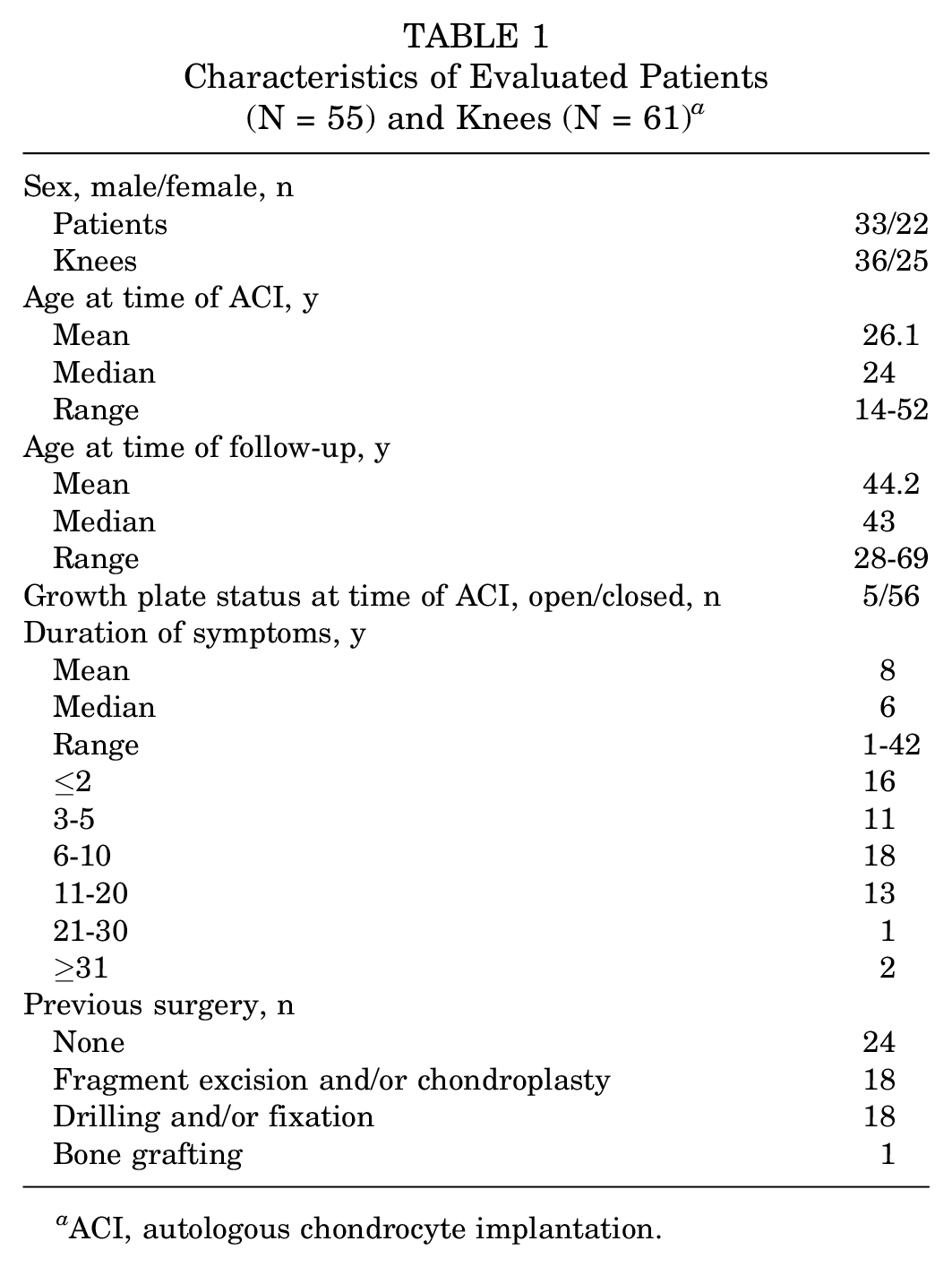
ACI, autologous chondrocyte implantation.
Most patients (61%) had already undergone surgery for the OCD lesion. The features of the OCD lesions are depicted in Table 2.
Features of OCD Lesions (N = 61) a

OCD, osteochondritis dissecans.
Most lesions involved the medial femoral condyle (70%) and were uncontained (59%). Specific details of the index ACI surgery are outline in Table 3.
Specific Details of Index ACI Surgery (N = 61 Lesions) a

Data are presented as No. ACI, autologous chondrocyte implantation; ACL, anterior cruciate ligament.
Bone grafting was not commonly (16% of cases) performed during the study period. Most procedures (70%) were performed in isolation without a concomitant procedure. The most common concomitant procedures were ACI of another region, proximal tibial osteotomy, and anterior cruciate ligament (ACL) reconstruction. Proximal tibia osteotomy (5 cases) was performed concomitantly with ACI of the medial femoral condyle. Tibial tubercleplasty (1 case) was performed concomitantly with ACI of the patella. All covers were periosteum during the study period.
For all 61 knees that underwent ACI for an OCD lesion, certain follow-up questions and subsequent surgeries are reported in Table 4. Subsequent arthroscopy was performed in the majority of cases, although many of these were scheduled “second looks” as part of a study. Common procedures performed during subsequent arthroscopy were resection of hypertrophic tissue, chondroplasty, and lysis of adhesions. A few cases included partial meniscectomy and removal of loose bodies. With respect to other subsequent surgery, 12 knees (20%) underwent any additional open surgery, but only 2 knees (3%) underwent arthroplasty. Eight knees (13%) underwent revision ACI.
Follow-up Questions and Subsequent Surgery (N = 61 Lesions) a

Data are presented as n. unless otherwise indicated. ACI, autologous chondrocyte implantation.
For the 8 knees that underwent revision ACI, this subsequent surgery occurred 1, 1, 1, 2, 2, 4, 6, and 10 years after the index ACI surgery. Six of these 8 OCD lesions had failed previous surgical treatment. None of these 8 cases that underwent revision ACI went on to have any further open surgery. For the 2 knees that underwent subsequent osteotomy, these procedures occurred 20 and 24 years after the index ACI surgery. Both of these patients who subsequently underwent osteotomy were in their third decade at the time of index ACI and had OCD lesions of the medial femoral condyle that had failed fixation with metallic pins. For the 2 knees that underwent total knee arthroplasty, these procedures occurred 12 and 18 years after the index ACI surgery, in the patients’ fifth and sixth decades, respectively. Both of these patients who ultimately underwent total knee arthroplasty were in their fourth decade at the time of index ACI. One had an OCD of the medial femoral condyle that had failed drilling and a valgus-producing tibial osteotomy. The other had an OCD lesion of the lateral femoral condyle that had failed fixation with a resorbable pin. The Kaplan-Meier survival estimate of index ACI without revision or arthroplasty is depicted in Figure 1.

Kaplan-Meier estimate of index autologous chondrocyte implantation (ACI) survival without revision or arthroplasty.
For the 59 knees that did not undergo total knee arthroplasty, patient-oriented outcome measures are reported in Table 5. If categorized by previous standards of the Lysholm score, then 12 knees were excellent (with a score of 95-100), 15 were good (84-94), 14 were fair (65-83), and 18 were poor (<65). The KOOS subscales with the greatest range and greatest variance in this study were the Sport and Recreation Function and the Quality of Life subscales. These measures, along with Tegner-Wallgren activity and Lysholm scores, were stratified by certain predictors in Table 6. None of these stratifications yielded a difference in outcome that was statistically significant.
Patient-Oriented Outcomes in Patients Who Did Not Undergo Total Knee Arthroplasty (n = 59) a

KOOS, Knee injury and Osteoarthritis Outcome Score.
Outcomes Stratified by Duration of Symptoms, Previous Surgery, and Concomitant Procedures (n = 59) a
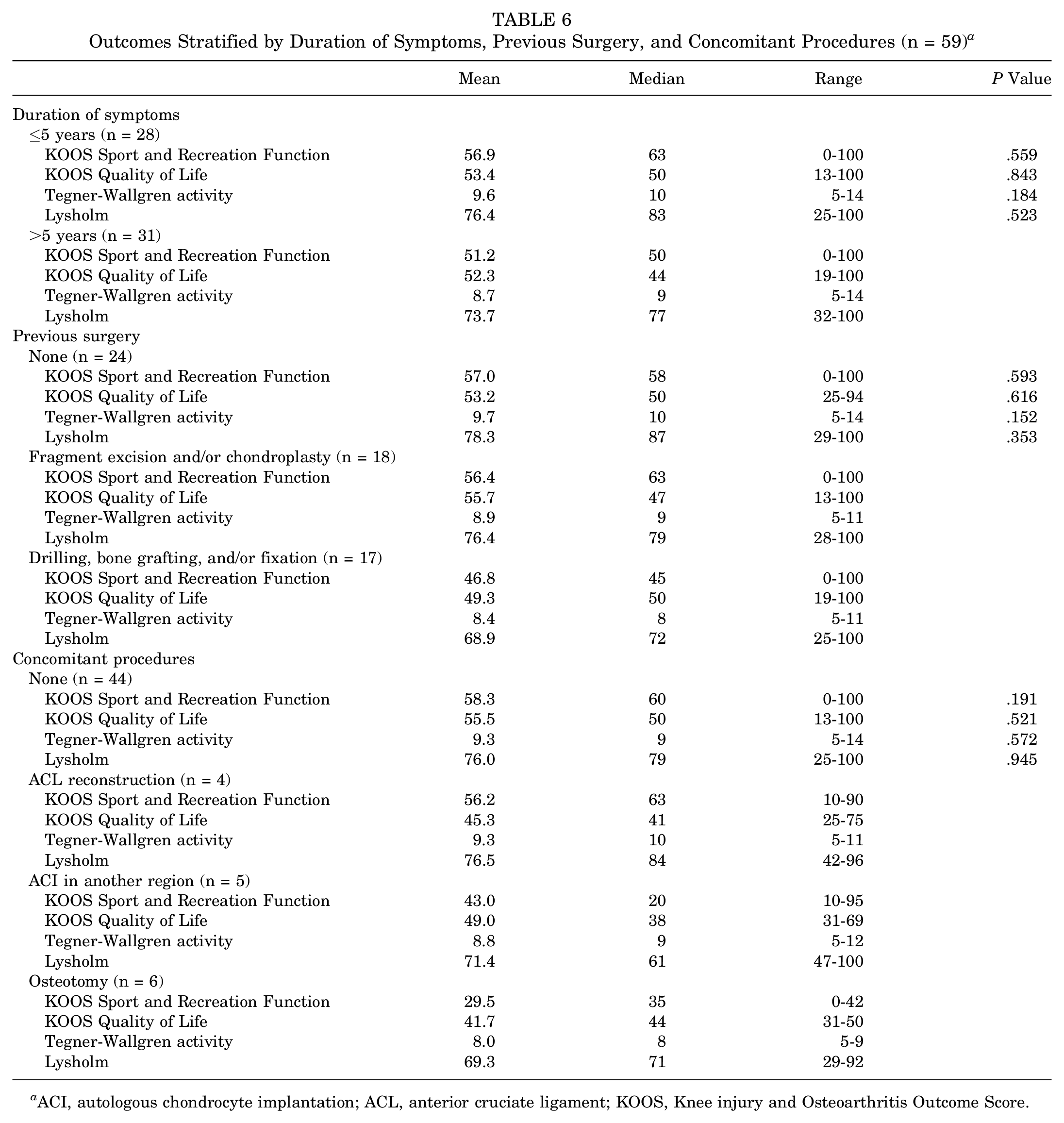
ACI, autologous chondrocyte implantation; ACL, anterior cruciate ligament; KOOS, Knee injury and Osteoarthritis Outcome Score.
Discussion
To our knowledge, this study provides the longest-term follow-up of ACI used to treat unsalvageable OCD. Most patients reached their preinjury activity level (62%) and would undergo ACI again if in the same situation (85%). Based on Lysholm score categories at final follow-up, about 20% were excellent knees, 25% good, 24% fair, and 31% poor. In the current study, 2 out of 61 knees (~3%) underwent total knee arthroplasty. That is, the survivorship of the native knee after ACI for OCD was ~97% at a median follow-up of 19 years. However, in addition to the 2 patients who underwent total knee arthroplasty, 8 out of 61 knees (~13%) underwent revision ACI and 2 knees (~3%) underwent osteotomy. Arthroscopy after ACI for OCD was also common, with 17 out of 61 knees (~28%) undergoing 2 or more arthroscopic procedures.
Comparison of filling the OCD fragment void with ACI to leaving the void empty is possible because treatment of OCD with fragment excision alone has been studied.1,17,20 Anderson and Pagnani 1 reported on 19 patients with 20 OCD lesions that were evaluated a mean of 9 years (range, 2-20 years) after fragment excision. When considered on the overall International Knee Documentation Committee scale, 2 knees were rated normal, 6 nearly normal, 4 abnormal, and 8 severely abnormal. 1 The authors concluded that the “long-term results are extremely poor.” 1 Similarly, Wright et al 20 studied 17 patients who were evaluated a mean of 9 years (range, 4-15 years) after fragment excision. Eleven of 17 patients (65%) had a fair or poor result. 20 These 2 studies1,20 had approximately half the mean duration of follow-up when compared with the current study of ACI for OCD. Sanders et al 17 reported on 134 patients who were evaluated a mean of 17 years after fragment excision, which is more comparable with the current study follow-up duration. In that setting, 20 patients (~15%) underwent knee arthroplasty (17 total knee arthroplasty, 3 unicompartmental knee arthroplasty). 17
Comparison of replacing the unsalvageable fragment with ACI to replacing the fragment in other ways is also possible, as microfracture, OAT, and fresh OCA transplantation have been studied. For small (<4 cm2 in area) unsalvageable OCD lesions, microfracture and OAT have been studied. 8 Gudas et al 8 reported on 47 patients (all children) who were evaluated a mean of 4 years (range, 3-6 years) after OAT (25 patients) or microfracture (22 patients). In the group treated with OAT, 21 of 25 patients (84%) achieved preinjury level, and no procedures were considered failures. 8 In the group treated with microfracture, 7 of 22 patients (32%) achieved preinjury level, and 9 of 22 (41%) patients had failed procedures which were revised to OAT in 7 cases and to ACI in 2 procedures. 8 Whereas Gudas et al followed patients for only 4 years, microfracture outcomes were already found to be unacceptable. OAT appears to be a reasonable option for these small OCD lesions, although there is only so much cartilage that can be borrowed from “less critical” parts of the knee. All 25 OCD lesions in the OAT group had an area of <4 cm2; 20 lesions (80%) had an area of <3 cm2. 8 Of note, only 12 OCD lesions (20%) in the current study on ACI for OCD had an area of <4 cm2; only 6 OCD lesions (10%) had an area of <3 cm2.
Fresh OCA transplantation allows the treatment of all sizes of unsalvageable OCD lesions, similar to ACI. Emmerson et al 7 reported on 65 OCD lesions that were evaluated a mean of 8 years (range, 2-22 years) after fresh OCA transplantation. Ten patients (15%) underwent reoperation, which included 5 OCA revisions and 3 arthroplasty procedures (2 total knee arthroplasty, 1 unicompartmental arthroplasty). 7 The authors reported that 7 knees (11%) were rated fair and 1 (2%) was rated poor. 7 Whereas this study 7 had a mean follow-up of 8 years, another study 10 reported on 129 knees (including 58 with OCD lesions) that were evaluated a median of 14 years (minimum, 2 years) after fresh OCA transplantation. These authors defined OCA failure as revision of the graft or conversion to unicompartmental or total knee arthroplasty. 10 Using this definition, the authors found that survivorship after fresh OCA transplantation was estimated to be 82% at 10 years, 74% at 15 years, and 66% at 20 years. 10 If judged by similar standards at the same intervals, then survivorship after ACI for OCD in the current study would be 87% at 10 years, 85% at 15 years, and 82% at 20 years.
The outcomes of ACI for OCD have previously been reported by 3 separate groups of authors. Cole et al 6 reported on 32 OCD lesions that were evaluated 4 years after ACI. 6 Treatment failure—defined as surgical retreatment that violated the subchondral bone (including knee arthroplasty), revision ACI, or failure to improve from baseline—occurred in 6 of 32 patients (19%). Ogura et al 12 reported on 29 knees that included 11 OCD lesions in adolescent patients who were evaluated a mean of 10 years (range, 2-19 years) after ACI. The 10-year survival rate was 89% in that study, 12 which is very close to the 87% in the current study. All patients in the study by Ogura et al indicated that if they could go back in time and make the decision again, they would choose to undergo ACI. Peterson et al14,15 first reported on 58 knees with OCD lesions that were evaluated a mean of 5 years (range, 2-10 years) after ACI and subsequently reported on 26 knees with OCD lesions that were evaluated a mean of 13 years (range, 10-20 years) after ACI. 15 Of note, some of the patients in the current study were also reported in those 2 studies. At a mean follow-up of 5 years for 58 knees, the mean Lysholm score was 92.4 and the mean Tegner-Wallgren score was 10.2. 14 At a mean follow-up of 13 years for 26 knees, the mean Lysholm score was 67.4 and the mean Tegner-Wallgren score was 8.6. 15 At the most recent follow-up (mean, 18 years; median, 19 years) for 59 knees in the current study, the mean Lysholm score was 75.4 and the mean Tegner-Wallgren score was 9.1. The Tegner activity level has been shown to be inversely correlated with age, even in normal knees. 2
When stratifying outcomes by duration of symptoms, previous surgery, and concomitant procedures, there were no statistically significant differences of patient-oriented outcome measures in the KOOS, Tegner-Wallgren activity score, or Lysholm score. However, both knees that underwent osteotomy after ACI and both knees that underwent total knee arthroplasty had failed previous surgery. Previous studies have found that younger age and smaller lesion size were associated with improved outcomes after ACI. 13
Some changes have been made since these cases were performed. With respect to the actual surgical technique of ACI, porcine-derived collagen membranes have replaced periosteum as the preferred covers of injected chondrocytes. More recently, the technique has evolved further to the implantation of membranes directly seeded with chondrocytes. With respect to concomitant surgical options, medial patellofemoral ligament reconstruction is more commonly performed now to address patellar instability and meniscal allograft transplantation is more commonly performed now to address meniscal deficiency. The ACI is combined with autogenous bone grafting as a single procedure slightly more often now, with a threshold of 6 mm of bone loss rather than of 8 mm.
Limitations
There were several limitations of the current study. Only 67 knees had undergone ACI for OCD more than 10 years before initiating the study. Even with 91% follow-up, only 61 knees were available for long-term follow-up evaluation. Even though this is the largest cohort of OCD lesions treated with ACI that has been reported, this number limited our power to detect predictors of success and failure. Further, there was considerable variation in duration of symptoms (from 1 to 42 years), previous surgery status, and defect location, which may influence outcomes. Other conditions, such as ACL rupture, have much less variation in these variables. There were no preoperative outcome scores. Finally, this study carefully documented the outcomes after only 1 treatment—ACI. Comparative, prospective studies would provide the most valuable information on outcomes after various treatments for unsalvageable OCD, including fragment excision alone, fresh OCA transplantation, and ACI.
Conclusion
ACI for OCD provides a durable treatment option. At a median follow-up of 19 years, there was a very low (~3%) conversion to total knee arthroplasty. However, in addition to these 2 patients who underwent total knee arthroplasty, 8 out of 61 knees (~13%) underwent revision ACI and 2 knees (~3%) underwent osteotomy. Most patients reached their preinjury activity level (62%) and would undergo ACI again if in the same situation (85%).
Footnotes
Submitted July 9, 2019; accepted January 2, 2020.
One or more of the authors has declared the following potential conflict of interest or source of funding: J.L.C. has received research support from Anika Therapeutics, Vericel, AlloSource, and Ossur and is a paid consultant for Vericel. K.G.S. has received research support from Vericel, AlloSource, and Ossur and education and hospitality payments from Arthrex. AOSSM checks author disclosures against the Open Payments Database (OPD). AOSSM has not conducted an independent investigation on the OPD and disclaims any liability or responsibility relating thereto.