






Abstract
Background:
The American Society for Surgery of the Hand advises patients that symptoms after wrist sprains resolve in 6 weeks and that recovery is usually excellent; however, there is scant supporting evidence for this reassurance.
Purpose:
To describe the epidemiology and report long-term outcomes of wrist sprains.
Study Design:
Descriptive epidemiology study.
Methods:
The US Department of Defense Military Health System Management Analysis and Reporting Tool was queried for wrist sprain International Classification of Diseases, Ninth Revision, codes between 2005 and 2008 among US Military Academy cadets. The electronic medical records were reviewed to obtain demographic information, mechanism of injury, and patient characteristics. A telephone survey was conducted to collect Single Assessment Numeric Evaluation (SANE) score, the shortened version of Disabilities of the Arm, Shoulder and Hand (QuickDASH) score, and ability to return to full military duty.
Results:
Of the 90 patients identified, 49 patients (50 wrists) met the final inclusion criteria. The mean patient age was 21 years, the majority were male (86%), and most sprains occurred during athletics (65%) and military activities (20%). Most patients (61%) had radiographs taken after index wrist sprain, and few (14%) underwent magnetic resonance imaging (MRI). After a mean follow-up of 10.4 years, most patients (78%) had no further wrist injury. The average SANE and QuickDASH scores were 88 and 7.5, respectively. Two patients (4%) ultimately were treated with surgical repair. Most patients (96%) were on an upper extremity profile, limiting military duty for a median of 14 days. All patients ultimately returned to full military duty.
Conclusion:
Patients with a wrist sprain diagnosis were followed for an average of 10 years. Although the majority (96%) of patients required a median of 14 days with limited upper extremity function, MRI is rarely indicated in the acute setting and most patients will never have another wrist injury and can expect excellent wrist recovery outcomes.
The 10th iteration of the International Classification of Diseases (ICD-10) has created 52 ways to classify an encounter for a wrist sprain, but the actual diagnosis of a wrist sprain is less tangible and precise. The International Wrist Investigators’ Workshop classified a wrist sprain as a partial wrist ligament tear, 4 although wrist sprains have been more tangibly described as any wrist injury with normal radiographs. 3 The American Society for Surgery of the Hand advises patients that wrist pain symptoms typically resolve in 6 weeks and that recovery is usually excellent 9 ; however, there is scant supporting evidence for this reassurance, and wrist sprains are often misdiagnosed by primary care and emergency providers. 5 On the contrary, a high percentage of patients with continued pain and dysfunction after immobilization have significant ligamentous pathology on diagnostic arthroscopy that may have benefited from early intervention. 1 It is difficult to predict which patients with wrist pain and normal radiographs will fail nonoperative management upon presentation after index wrist injury. Although magnetic resonance imaging (MRI) may offer a clearer diagnosis, performing an MRI scan on every patient with wrist pain and normal radiographs who presented to a Scandinavian emergency department changed surgical management in only 1% of patients. 3 The purpose of this study was to describe the epidemiology and report long-term outcomes of wrist sprains.
Methods
Approval from the institutional review board was obtained at the onset of the study. Patients eligible for inclusion were adult military cadets with a diagnosis of a wrist sprain by ICD-9 codes and confirmation of the diagnosis in the electronic medical records. Clinical eligibility was determined by the lack of pathology identified on wrist radiographs or absent wrist radiographs at presentation; however, pathology identified on MRI such as triangular fibrocartilage complex (TFCC) or ligamentous injury did not warrant exclusion. Patients ineligible for inclusion had additional surgical diagnoses or were unavailable for a telephone survey.
The US Department of Defense Military Health System Management Analysis and Reporting Tool (M2) maintains comprehensive records of all health care encounters paid for by the Military Health System (MHS). ICD-9 codes are documented for each patient encounter. The M2 database was queried for the following wrist sprains between 2005 and 2008 for US Military Academy (USMA) cadets:
Code 842.00: sprain of wrist, unspecified site
Code 842.02: sprain of the radiocarpal joint
Code 842.09: other sprain of the wrist
The electronic medical records were then reviewed to obtain demographic information, mechanism of injury, patient characteristics, and initial treatments. Patients with incomplete electronic medical record documentation were excluded from the study. Primary outcomes included the shortened version of Disabilities of the Arm, Shoulder and Hand (QuickDASH) score, Single Assessment Numeric Evaluation (SANE) score, ability to return to full duty, and length of profile. A higher QuickDASH score indicates greater disability, while a higher SANE score indicates greater proximity to preinjury baseline. A telephone survey conducted a minimum of 10 years after the index wrist sprain marked terminal follow-up 7 and was used to collect QuickDASH scores,2,6 SANE scores, 10 and ability to return to full military duty. Further surgery or failure of nonoperative management, defined as subjective persistent pain and dysfunction in the absence of surgery, was recorded. Outcome scores were averaged and reported. Outliers were defined according to Tukey range test. Relationships between sex and activity with outcomes were determined with 2-sample t tests assuming unequal variances.
Results
Of 90 patients (93 wrists) eligible for inclusion based on ICD-9 codes, 49 patients (50 wrists) were included in the study for a response rate of 54% (Figure 1). In total, 31 patients were not eligible for inclusion. Of these, 29 patients (30 wrists) were excluded for incomplete medical record documentation, 1 for a scaphoid fracture immediately before entering the USMA, and 1 for a subsequent upper extremity amputation from a blast injury while deployed. Of those who were eligible, 8 patients (9 wrists) were unable to be reached for a telephone interview and 2 declined to participate.

CONSORT (Consolidated Standards of Reporting Trials) flow diagram.
The mean patient age was 21 years, and the majority of patients were male (n = 42; 86%) (Table 1). Most sprains occurred during athletics (n = 32; 65%), notably in boxing (n = 7; 14%), martial arts (n = 5; 10%), and gymnastics (n = 4; 8.2%) (Table 1). Military activities accounted for 20% (n = 10) of wrist sprains, specifically in combative training (n = 5; 10%), military movement drills (n = 3; 6.1%), and an obstacle course (n = 2; 4%). In total, 50 initial treatments were noted in 38 patients, including splinting (n = 17; 34%), bracing (n = 14; 28%), physical therapy and/or nonoperative treatment (n = 10; 20%), taping (n = 4; 8%), and iontophoresis (n = 2; 4%). Fluidotherapy, pulsed ultrasound, and 3 weeks of casting were used in 1 patient each.
Patient Demographics and Injury Characteristics for Wrist Injuries a
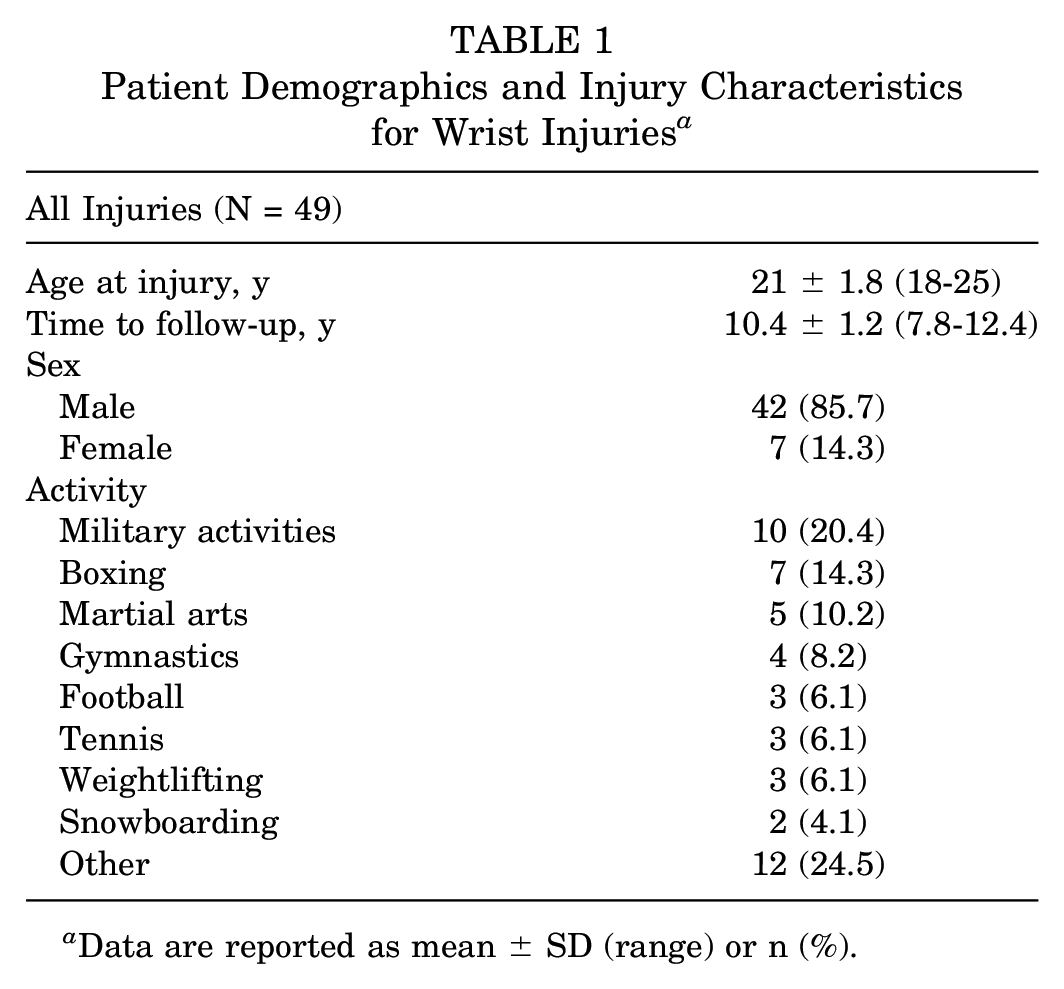
Data are reported as mean ± SD (range) or n (%).
Most patients had radiographs taken after index wrist sprain (n = 30; 61%), and a few underwent MRI (n = 7; 14%). Two patients (4%) underwent surgery for the index wrist sprains. One patient failed to improve after initial nonoperative measures, and MRI demonstrated a TFCC tear. The patient ultimately received an arthroscopic TFCC repair 476 days after his initial injury. A second patient also did not improve with nonoperative measures, and MRI demonstrated persistent edema around the extensor carpi ulnaris (ECU) tendon with subluxation on physical examination. This patient ultimately received ECU stabilization 146 days after his initial injury.
After a mean follow-up of 10.4 years, 80% of patients (n = 39) had no further wrist injury, 14% (n = 7) had 1 additional sprain, and 6% (n = 3) had >1 additional wrist injury (Table 2). The average SANE and QuickDASH scores were 88 and 7.5, respectively (Figures 2 and 3). Upper extremity profiles were given to 47 patients (96%), limiting military duty for a median of 14 days (Table 2, Figure 4). All ultimately returned to full military duty. Sex and injury mechanism were not correlated with profile length, SANE scores, and QuickDASH scores (Table 3).
Patient-Reported Outcomes for Wrist Injuries a
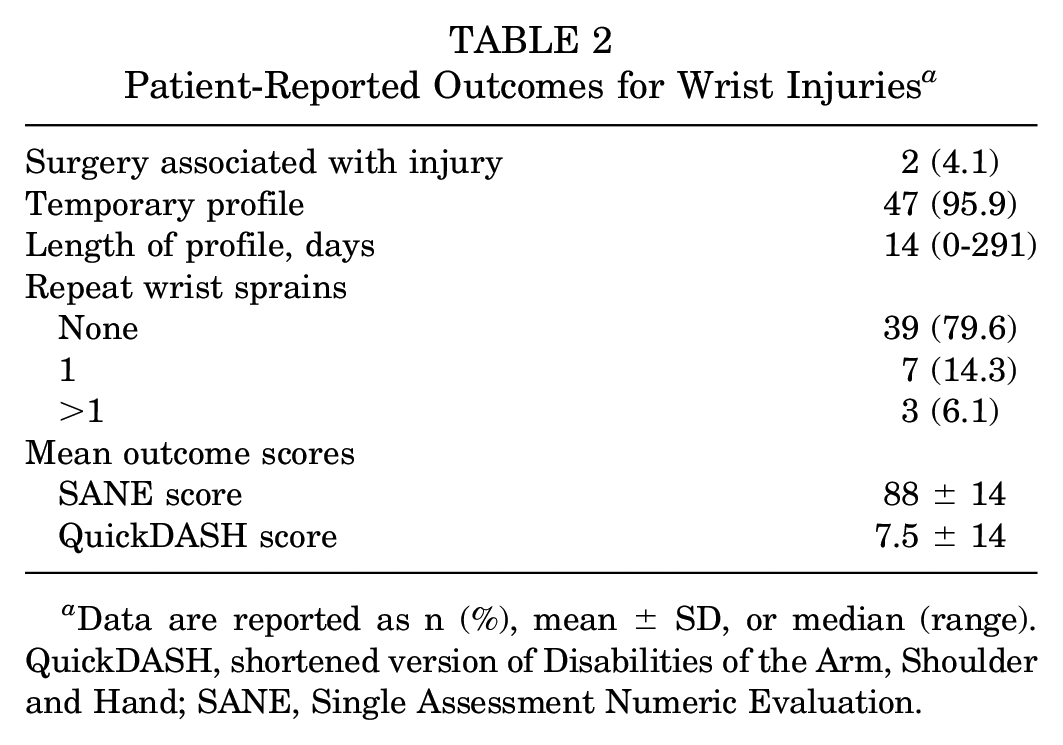
Data are reported as n (%), mean ± SD, or median (range). QuickDASH, shortened version of Disabilities of the Arm, Shoulder and Hand; SANE, Single Assessment Numeric Evaluation.

SANE scores by activity type. SANE, Single Assessment Numeric Evaluation. A higher score indicates greater proximity to preinjury baseline.

QuickDASH scores by activity type. QuickDASH, shortened version of Disabilities of the Arm, Shoulder and Hand. A higher score indicates greater disability.

Profile length by activity type.
Effect of Patient and Injury Characteristics on Patient-Reported Outcomes a
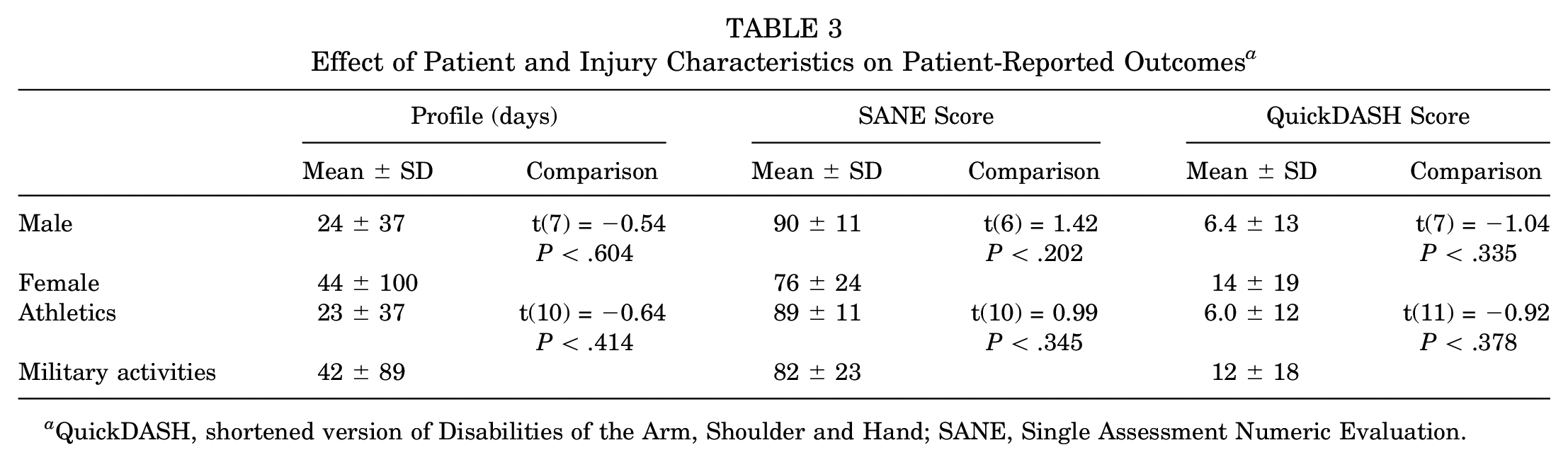
QuickDASH, shortened version of Disabilities of the Arm, Shoulder and Hand; SANE, Single Assessment Numeric Evaluation.
Discussion
In the present analysis, most patients who experienced wrist sprains never sustained another wrist injury and reported excellent outcomes; however, nearly all (96%) faced limited military duty and athletic activity for a median of 14 days. At the 10-year follow-up, patients reported low impairment and high function in their previously injured joints. This information can be used to counsel similarly active and motivated patients regarding short-term recovery expectations and physical responsibilities, and can provide long-term reassurance for recovery and return to activity, particularly military duty.
Athletic activities were a frequent cause of wrist sprains among USMA cadets, and this finding reflects both the high incidence of sports injury in this population and the role of sports injury in limiting the cadets’ ability to fulfill military duties. In general, 3% to 9% of sports injuries occur in the hand and wrist, with acute injuries often resulting from contact sports and chronic overuse injuries because of repeated loading. 8 Among USMA cadets, the rates of wrist sprains due to athletic activities is considerably higher than rates of wrist sprains from military activities (65% and 20%, respectively). For military training purposes, understanding which specific training activities increase injury risk offers insight into both safety interventions and training scheduling. Scheduling injury-prone military activities later in training courses would help maximize training time before injury and minimize inability to stand duty or participate in athletic events.
There was no statistically significant relationship between sex or activity type with functional or profile-related outcomes; however, it is notable that the most extreme outlier in profile length was linked to the obstacle course (291 days). Out of the 3 most extreme outliers in profile length specific to athletic activities, 1 was linked to horseback riding (177 days) and 2 were linked to tennis (143 and 109 days). Ultimately, however, the full return of patients to duty offers reassurance that cadets who could be reached and who had remained in the military 10 years after a wrist sprain did not suffer from significant morbidity or inability to return to duty because of their injuries. This study’s uniquely long follow-up time with the collection of QuickDASH scores, SANE scores, and military duty status 10 years after injury similarly reinforces the lack of long-term morbidity or inability to remain on active duty due to wrist sprains.
Acute wrist sprains are notably characterized by no radiographic findings, and the inclusion criteria in this study required a lack of pathology on wrist radiographs. In a prospective study examining the clinical diagnosis of wrist sprain, Bergh et al 3 found that 81% of 155 wrist sprains with negative radiographs had pathology on MRI, and 2 patients required arthroscopic repair of the TFCC. The authors subsequently recommended early MRI assessment within the first 2 weeks after index wrist injury for persistent pain, as wrist sprains may be more pathologic than what is initially appreciated. 3 In the present analysis, 2 patients (4%) required surgery when nonoperative measures failed. Both patients had persistent symptoms that were further delineated with an MRI scan, ultimately leading to surgical intervention. Subsequently, we recommend MRI only after nonoperative measures are unsuccessful for at least 3 weeks and the patient has been referred for evaluation by a hand surgeon.
Our study indicates that a substantial majority (80%) of patients with wrist sprains who were able to participate 10 years after injury ultimately reported excellent outcomes. Patients who experience pain, however, may benefit from a more aggressive initial treatment approach. A review of 43 patients with recalcitrant pain 6 weeks after wrist sprain diagnosis who underwent diagnostic arthroscopy revealed that 95% had pathology on intraoperative examination, and 39% would have benefited from acute surgical intervention. 1 The authors championed arthroscopy as the best method to directly visualize and evaluate intra-articular pathology and recommended its implementation after 3 to 4 weeks of recalcitrant symptoms after a wrist sprain; however, it is unclear how many wrist sprains were identified and improved with immobilization from this cohort. 1 Although both MRI and diagnostic arthroscopy have important roles for the persistently painful and dysfunctional wrist sprain, the high rate of recovery in our study indicates that these modalities may not be appropriate for blanket use for wrist sprains.
There are several limitations to this study. The use of telephone interviews for terminal follow-up, rather than clinical visits with imaging and physical examinations, can introduce recall bias or prevent physician identification of subtle instability and does not capture how patients with previous joint trauma may organically present for chronic degenerative changes many years after injury. However, telephone interviews enabled long-term follow-up despite the participants’ wide geographic distribution and were conducive to study reproducibility and standardization. Despite best efforts to contact all eligible participants with multiple phone calls, nearly one-sixth of patients had outdated contact information. Given the unique military population, this outdated contact information may introduce selection bias in patients separated from the military for a longer period, which could indicate a more significant degree of wrist pathology not explicitly mentioned in the medical records and subsequently underestimate wrist sprain morbidity. Not all patients included in this study had readily available documentation of their initial treatments, and future studies can help to elucidate the role of initial treatments in optimizing long-term outcomes.
Despite these limitations, this analysis presents epidemiological data and longitudinal outcomes after wrist sprains, identifying the natural history of wrist sprains and work time lost because of injury among a military academy cadet cohort. MRI is rarely indicated in the acute setting and a minority (4%) of patients required surgical intervention. While the majority of patients will experience several weeks of limited upper extremity function, most will never have another wrist injury and can expect excellent wrist function at long-term follow-up.
Footnotes
Submitted October 10, 2020; accepted January 25, 2021.
One or more of the authors has declared the following potential conflict of interest or source of funding: L.J.N. has received education support from Arthrex. J.C.D. has received hospitality payments from Stryker. AOSSM checks author disclosures against the Open Payments Database (OPD). AOSSM has not conducted an independent investigation on the OPD and disclaims any liability or responsibility relating thereto.
References
Supplementary Material
Please find the following supplemental material available below.
For Open Access articles published under a Creative Commons License, all supplemental material carries the same license as the article it is associated with.
For non-Open Access articles published, all supplemental material carries a non-exclusive license, and permission requests for re-use of supplemental material or any part of supplemental material shall be sent directly to the copyright owner as specified in the copyright notice associated with the article.
