






Abstract

(L-R) John Goldblatt, MD, Kenneth E. DeHaven, MD, Michael D. Maloney, MD, and Giancarlo Puddu, MD
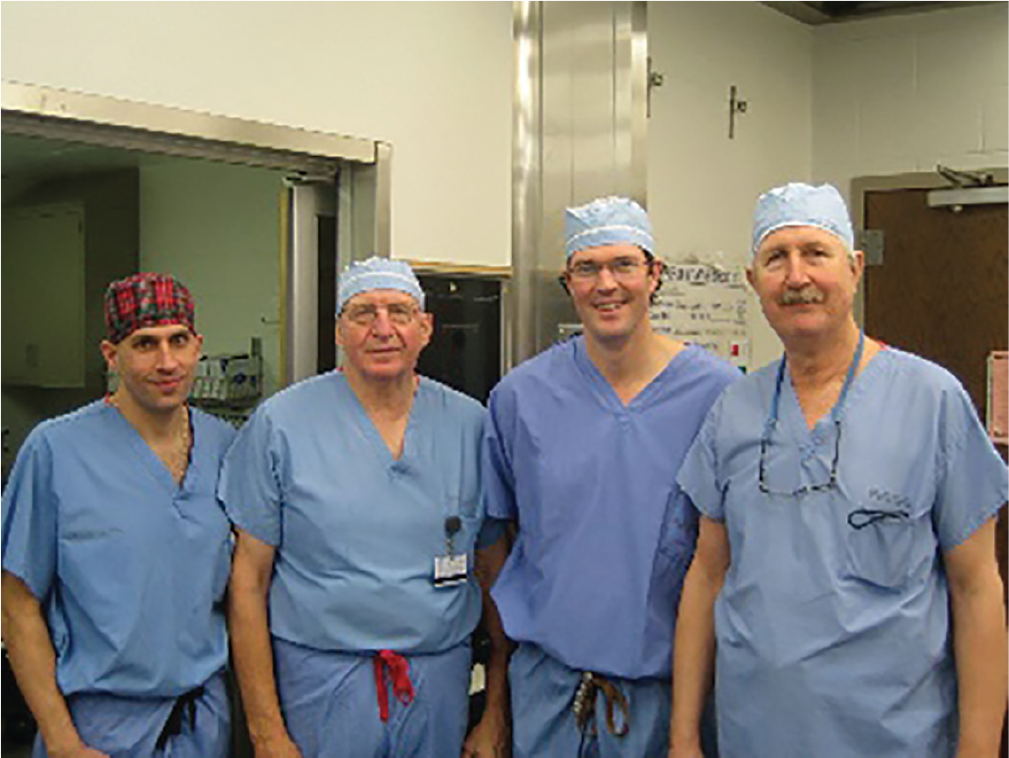
Kenneth E. DeHaven, MD, an orthopaedic surgeon renowned for revolutionizing the use of arthroscopy in the United States, died on June 20, 2021, in Westminster, Colorado. He was Professor of Orthopaedics at the University of Rochester until his retirement in 2012, when he was appointed Professor Emeritus. Dr DeHaven received his undergraduate degree from Dartmouth College in 1961, where he earned All-East and All-Ivy honors playing for the Dartmouth football team. He graduated cum laude from Dartmouth Medical School and earned his medical degree from Northwestern University Medical School in 1965. He completed his internship and residency training in surgery and orthopaedic surgery at the Cleveland Clinic Foundation. In 1975, Dr DeHaven was recruited to become the first Director of Athletic Medicine at the Orthopaedics Department of the University of Rochester.
Beginning in the early 1970s, Dr DeHaven, a lifelong athlete, began using minimally invasive, arthroscopic surgery to diagnose and repair knee injuries in athletes. His contributions saved the careers of countless high school, college, and professional athletes whose only prior treatment option involved open incision surgeries and subsequent months-long rehabilitation and recovery.
Dr DeHaven was a friend and colleague of Richard Burton, MD, Emeritus Wehle Professor and Chair in Orthopaedics, for 50 years. “He had the vision to see the potential of joint arthroscopy and the commitment and energy to make it a reality,” Burton said. “He was both a teacher and a learner in this respect—he traveled internationally as a pioneer to exchange ideas with others and rapidly became the ‘guru’ authority among his peers.” Dr Burton also noted Dr DeHaven’s contributions to the evolution of sports medicine as a clinical practice. In the early 1970s, the emerging specialty was gaining attention for its use by world-class professional athletes. DeHaven wanted to ensure that the highest level of care would be accessible to athletes—and former athletes—at the community level. He popularized the role of the team physician—interfacing with coaches, athletic trainers, and physical therapists—to ensure the best care was available for athletes at all levels.
It is not an overstatement to say that his contributions to sports medicine and arthroscopy are immeasurable. I, along with countless others, chose the University of Rochester for residency training and for the opportunity to learn from Dr DeHaven. In the 1980s people thought that the meniscus had no purpose—it was considered a vestigial tissue. When there was a knee injury, surgeons would make a big incision and take the entire meniscus out. With that approach, the progression to knee arthritis is a rapid one. Dr DeHaven advanced our understanding of knee anatomy, and his research established that the meniscus has a vital role in the health of the knee joint. His discoveries demonstrated that we could perform meniscus repair. His efforts to develop and refine arthroscopic surgical techniques have spared thousands of patients from needing a total knee joint replacement later in life.
As a clinician, a teacher, and a role model, he should be noted—along with his many contributions to orthopaedic medicine leadership—as one of the pioneers of sports medicine and arthroscopy. Despite being a giant in the field, he was such a humble and gracious man. He was always very patient, willing to spend the extra time explaining things to young athletes and their families. And for faculty and trainees, he was an impactful role model, a kind man, a genuine friend, and a mentor. His example of how he treated people around him is what I try to emulate.
My favorite recurring memory will always be that whenever and wherever I would travel to speak or meet with colleagues, one of the first questions I would get was, “How is Ken or Dr DeHaven?” He had an enormous positive impact on literally everyone he encountered and made everyone feel valued and inspired. His friendship and respect was a tremendous gift.
Dr DeHaven popularized many expressions in his teachings. He was fond of saying that the definition of a serious injury was any condition that interfered with golf. Also, acknowledging his modesty despite his accomplishments and expertise, he would state that there were still injuries he had not seen, but he was certain that they had seen him. Finally, and most consistent with his desire to always provide the highest level of care to all patients, he would emphasize that sports medicine surgeons made their reputation more on the patients they treated without surgery than those they performed surgery on.
For more than 3 decades, Dr DeHaven served as an orthopaedics faculty member involved in teaching, patient care, clinical research, training, and mentoring many residents and fellows. From 2004 to 2008, Dr DeHaven was the Senior Associate Dean for Clinical Affairs at the University of Rochester Medical Center (URMC) and the Director of the University of Rochester Faculty Practice Group. A surgical skills laboratory at the URMC bears his name in recognition of his groundbreaking contributions to arthroscopy and his dedication to training generations of orthopaedic residents and fellows. He also served as a team physician for countless high school, college, and professional teams.
A testament to his incredible commitment and leadership skills, Dr DeHaven is the only person to have served as the President of the American Orthopaedic Society for Sports Medicine (AOSSM), the Arthroscopy Association of North America, the International Society of the Knee (a parent society to the International Society of Arthroscopy, Knee Surgery and Orthopaedic Sports Medicine), and the American Academy of Orthopaedic Surgeons.
He authored or coauthored nearly 90 scientific papers throughout his career, contributed to 36 textbooks, provided 46 visiting professorships, and gave numerous other invited lectures nationally and internationally. Even though he had a prolific academic and orthopaedic leadership career, he most cherished the professional and personal relationships that developed from a shared passion for sports medicine. He was the epitome of a godfather, serving in that role for the AOSSM/European Society of Sports Traumatology, Knee Surgery and Arthroscopy Traveling Fellowship.
He received the Distinguished Alumnus of the Year Award from the Cleveland Clinic in 2010 and was frequently listed among the best doctors in America for sports medicine, knee surgery, and arthroscopy. He is a member of the AOSSM Hall of Fame.
He is survived by his wife, Jean, and daughter, Kathleen. The DeHavens are predeceased by their son, David. One of my greatest honors in life was being trained by Dr DeHaven, serving as his junior partner, and, most impactfully, having him as my friend.