







Abstract
Background:
Laboratory testing has shown that the Guardian Cap NXT, an aftermarket padded football helmet cover, reduces head acceleration in test dummies compared with a helmet alone. However, it is unknown whether use of the Guardian Cap NXT is associated with a reduction in concussions on the field.
Purpose:
To study the effect of Guardian Cap NXT use on the incidence of concussions in National Football League (NFL) preseason practices from 2018 to 2023.
Study Design:
Cohort study; Level of evidence, 3.
Methods:
Using data from the NFL Injury Surveillance System, concussion rates in preseason practices during the 2018 to 2023 preseasons (excluding the 2020 preseason) were compared before and after the NFL required players in certain positions (offensive linemen, defensive linemen, tight ends, and linebackers) to wear the Guardian Cap NXT during practices in 2022. Several secondary analyses, including 2 Poisson regression models, were conducted to evaluate the effects of preseason, player position, practice intensity (pads vs no pads), collision partner, helmet shell involvement, and Guardian Cap NXT requirement.
Results:
A total of 139 concussions occurred during the preseason Guardian Cap NXT requirement period in 2018, 2019, 2021, 2022, and 2023. After the Guardian Cap NXT requirement was implemented, the concussion rate in the group of affected positions decreased 54% (P = .001) in the univariate analysis and 62% (P = .004) in the regression model. For concussions involving the helmet shell (as opposed to the facemask) (n = 76), there was no significant association between Guardian Cap NXT use and the concussion rate (P = .122), indicating that the reduction in concussions could not be attributed solely to the energy-absorbing effects of the Guardian Cap NXT.
Conclusion:
Required use of the Guardian Cap NXT was associated with a 54% to 62% reduction in the overall incidence of NFL practice concussions. However, when only concussions involving a helmet shell impact were considered, there was no longer a significant relationship between Guardian Cap NXT use and the incidence of concussions.
Keywords
Aftermarket padded helmet covers have long been touted as a means of reducing the severity of head impacts and the incidence of concussions in football. In the late 1980s and into the 1990s, a small number of National Football League (NFL) players sought to increase their head protection by wearing the ProCap, which was a polyurethane pad that attached to the exterior of the helmet, similar to the SAFR helmet cover offered today. While early research into the effectiveness of the ProCap was inconclusive, 10 there are several mechanisms by which a padded helmet cover could potentially lower head acceleration and thereby reduce the risk of brain injuries. First, additional padding helps to spread out the impact pulse in time and space and lower the peak force applied to the helmet. Second, some padded helmet covers can slip on the helmet shell, which can potentially reduce angular acceleration. Third, helmet covers can reduce linear acceleration and angular acceleration simply by increasing the mass and moment of inertia of the helmet. On the other hand, adding a helmet cover makes the helmet profile larger, which could potentially lead to additional head impacts and higher tangential forces.
The Guardian Cap XT (Guardian Sports) was introduced in 2011 and has become a common football helmet add-on. The Guardian Cap XT consists of several rows of padding attached to a one-size-fits-all helmet cover. In the first laboratory study to explore its effectiveness, the Guardian Cap XT was attached to 3 different football helmet models, which were subjected to guided wire drop testing as prescribed by the National Operating Committee on Standards for Athletic Equipment (NOCSAE). 3 The Guardian Cap XT did not mitigate impact forces at most locations.
In 2017, Guardian Sports developed a new model designed for NFL athletes and collegiate linemen called the Guardian Cap NXT (the standard model is called the XT), which was initially only available to NFL players. The Guardian Cap NXT added a layer of vinyl nitrile padding intended to accommodate NFL speeds. The additional padding increased the mass of the Guardian Cap by 85% from 200 g (7 oz) for the regular XT model to 369 g (13 oz) for the NXT model. Guardian Sports has recently developed an NXT 1.8 model with improved attachment points and vinyl nitrile padding redesigned into the main structure of the cap. Extra-large sizes for the NXT and NXT 1.8 models have also been developed for larger helmets. In laboratory testing conducted by Bailey et al 1 using a linear impactor and helmeted dummies, the Guardian Cap NXT reduced the Head Acceleration Response Metric (HARM; a head injury metric that combines linear acceleration and angular acceleration 2 ) by an average of 9% relative to the helmet alone. Pilot testing with the Guardian Cap NXT on both the striking ram and the dummy suggests that adding a second Guardian Cap NXT roughly doubled the reduction in the HARM to about 20% to 25% relative to testing with only 1 Guardian Cap NXT present. Cecchi et al, 4 using a methodology similar to Bailey et al 1 but with different impact locations and test speeds, found that the XT model did not significantly lower peak linear head acceleration, but it did significantly reduce peak angular head acceleration, DAMAGE (Diffuse Axonal Multi-Axis General Evaluation), and HARM, especially at lower test speeds. Virginia Tech conducted pendulum testing using a NOCSAE headform and calculated that the theoretical concussion risk based on peak linear and angular head acceleration was reduced 15% by adding a Guardian Cap XT to the helmeted dummy and 22% by adding a Guardian Cap XT to both the pendulum and the helmeted dummy. 5 The Guardian Cap NXT reduced the concussion risk by 34% when added to the helmet and 64% when added to both the pendulum and the dummy’s helmet. The performance of the Guardian Cap varied greatly depending on the helmet model in the Virginia Tech testing.
Several recent field-based studies have reported that the XT model does not significantly reduce head acceleration as measured by mouthguard or helmet sensors.4,8,9 However, these studies included a relatively small number of players, captured no concussive impacts, and investigated the standard Guardian Cap XT version instead of the NXT version. Thus, the effect of the Guardian Cap NXT on the incidence of concussions has not been evaluated in a large on-field trial.
On the basis of promising laboratory testing results, the NFL in 2022 began requiring that all offensive linemen, defensive linemen, tight ends, and linebackers wear the Guardian Cap NXT in practices from the beginning of training camp until the second preseason game. In 2023, the NFL extended the requirement to cover all preseason practices and all contact practices in the regular season and postseason and to add running backs and fullbacks to the list of positions required to wear the Guardian Cap NXT. The purpose of the current study was to evaluate the effectiveness of the Guardian Cap NXT in preventing concussions in NFL practices by measuring the concussion rate before and after the 2022 requirement. This study benefited from the fact that the NFL requirement created a situation in which the concussion rate in Guardian Cap–required positions (offensive linemen, defensive linemen, tight ends, and linebackers) could be compared with historical controls (the same positions over the same portion of the preseason) in a large statistical study.
Methods
Data Source and Inclusion Criteria
The NFL Injury Surveillance System was queried for player concussions occurring in preseason practices from 2018 to 2023. Only concussions occurring during the portion of the preseason affected by the 2022 Guardian Cap NXT requirement (the beginning of training camp until the second preseason game, hereafter referred to as the preseason requirement period) each year were analyzed. The 2020 preseason was considered dramatically different from the other years because of COVID-19 restrictions that significantly altered the preseason schedule, including the removal of games, and was therefore excluded from the analysis. This left 3 preseasons before the Guardian Cap NXT requirement (2018, 2019, and 2021) and 2 preseasons after the requirement (2022 and 2023). Concussions during this period were categorized into a “Guardian Cap–required” (GC) group or “Not required” (non-GC) group based on the position of the concussed player. The GC group was composed of the positions required by the NFL to wear a Guardian Cap NXT beginning in 2022: offensive linemen, defensive linemen, tight ends, and linebackers. Running backs and fullbacks were excluded from the univariate analysis because their status changed in 2023. All other positions were placed in the non-GC group. The term “Guardian Cap” will be used in this study to refer to either the NXT or NXT 1.8 model, which were assumed to be equivalent from an impact protection standpoint. In 2023, Guardian Sports made a change to the NXT 1.8 model to improve the fit and attachment. This version had the same energy attenuation characteristics in laboratory testing as the previous model.
Assumptions About Guardian Cap Use
The GC and non-GC groups were defined based on whether the Guardian Cap was required as opposed to actually worn because some players wore a Guardian Cap even though it was not required of them, and Guardian Cap use in these players was not tracked. For example, a small number of players began wearing the Guardian Cap sporadically in the 2020 (<10 players) and 2021 (50-100 players) preseasons. Despite this fact, we have assumed for this analysis that no NFL players were wearing a Guardian Cap during practices before 2022. We are also aware that some players in nonrequired positions wore a Guardian Cap during practices in the 2022 (~50 players) and 2023 (~100 players) preseasons, but we have assumed that number to be zero in our analysis. Lastly, we have assumed that all players in the required positions wore a Guardian Cap during practices in 2022 and 2023, noting that they were fined if they did not. These assumptions were expected to result in a slight underestimation of the true effect of the Guardian Cap, given that a total of 6417 different players participated in at least 1 practice during the time period of the study. The assumptions were conservative in the sense that they biased the results slightly toward the null hypothesis that the Guardian Cap requirement had no effect on the concussion rate.
Data Analysis
The concussion rate was calculated by normalizing concussion counts to player practice exposure. A complete list of player practice participation for the 2018 to 2023 preseasons was created using player attendance records captured through the NFL Injury Surveillance System. For each group and time period of interest, the number of player practices was calculated by counting the number of players with full or limited participation in each practice. The primary outcome measure in this study was the change in the concussion rate among players in the GC group before and after the imposition of the requirement. For all univariate comparisons of the concussion rate, standard errors, 95% confidence intervals (CIs), and statistical significance were calculated using the chi-square test. Standard deviations are not presented for average yearly concussion counts because of the small sample sizes (n = 2 preseasons after the requirement).
Several secondary analyses were conducted to check the robustness of the primary analysis. The concussion rate in the GC group was compared before and after the requirement in several subgroups, such as by year, position, and practice type (padded vs unpadded). In addition, the concussion rate in the non-GC group was calculated before and after the requirement to see if there were other league-wide changes in the concussion rate that were not associated with Guardian Cap use.
Other secondary analyses looked at the distribution of injury sources and impact locations among concussed players. This information was obtained through a qualitative video review of the preseason concussions included in the analysis using the procedure outlined by Lessley et al. 6 Video of practice concussions was provided by the NFL clubs. The qualitative video review collected a large amount of information such as player activity, helmet impact location, and helmet impact source. The distribution of impact sources (helmet, body, or ground) was calculated and compared for various subgroups. In addition, the video review data were analyzed to determine how many helmet shells were involved in each concussion (0, 1, or 2). For example, a facemask-to-ground impact involves 0 shells, a helmet shell–to-shoulder impact involves 1 shell, and a helmet shell–to–helmet shell impact involves 2 shells. Shell involvement was defined as the majority of the impact area occurring on the helmet shell as opposed to the facemask. Cases in which helmet shell involvement was unknown (18/127), typically because of uncertainty about the exact timing of the concussive impact, were assumed to involve the helmet shell at the same rate as in known cases. Because the potential protective capability of the Guardian Cap is mostly limited to helmet shell impacts, we hypothesized that concussions in the GC group would involve proportionately fewer helmet shell impacts after the requirement.
Regression Modeling
Lastly, 2 Poisson regression models were used to compare the concussion rate between required and nonrequired players, while accounting for potential confounders. Special teams positions were excluded. Running backs and fullbacks were included. The first model looked at the overall concussion rate, controlling for preseason, player position, practice intensity (padded vs not padded), and whether the Guardian Cap requirement was in effect for the specific player practice session. The second model compared the rate of shell-involved concussions only. Because the number of events for this second model was considerably smaller (139 total concussions vs 76 known shell-involved concussions), we were forced to reduce the number of covariates to practice intensity (pads vs no pads), required position (yes or no), running back/fullback position (yes or no), and whether the Guardian Cap requirement was in effect at that time and for that position (yes or no). The running back/fullback position was included as a separate covariate because these positions were included in the Guardian Cap requirement starting in 2023, unlike the other positions that were included in the requirement starting in 2022. In 18% of the concussion cases (25/139), it was not possible, because of missing/obstructed video or unknown injury plays, to ascertain whether the concussion involved a shell impact. In these cases, multiple imputation was used for missing shell impact data, accounting for shell impact rates by position, whether the Guardian Cap requirement was in effect, and practice intensity; results were then aggregated using the Rubin rules. 7
Results
A total of 139 concussions occurring during the preseason requirement period (the beginning of training camp until the second preseason game) in 2018, 2019, 2021, 2022, and 2023 were included in this study. Of these concussions, 12 were excluded from the univariate analysis because they occurred to running backs or fullbacks, leaving 127 concussions (Table 1). There were 92 (72%) of these concussions that occurred to players in the GC group (offensive linemen, defensive linemen, tight ends, and linebackers). The concussion count in the GC group during the preseason requirement period decreased from an average of 23.3 concussions per year before the requirement to 11.0 concussions per year after the requirement, which was a 53% decrease and was statistically significant according to a 2-tailed t test (P = .035) (Figure 1). This result was unchanged after normalizing for practice exposure. Among running backs and fullbacks, only 1 concussion occurred in 2023; thus, the concussion rate dropped from 2.75 concussions per year before their inclusion in the Guardian Cap requirement to 1.00 concussions per year afterward. Although changes to the structure of NFL practices were made before the start of the 2021 preseason, our data showed that the total number of player practices was not affected much and remained similar across all preseasons of interest. The concussion rate in the GC group during the preseason requirement period decreased from 10.5 ± 1.3 concussions per 10,000 player practices before the requirement to 4.8 ± 1.0 concussions per 10,000 player practices after the requirement, which was a 54% decrease. This decrease in the concussion rate was highly significant according to the chi-square test (P = .001).
Concussion Count, Player Practice Exposure, and Concussion Rate in Univariate Analysis a
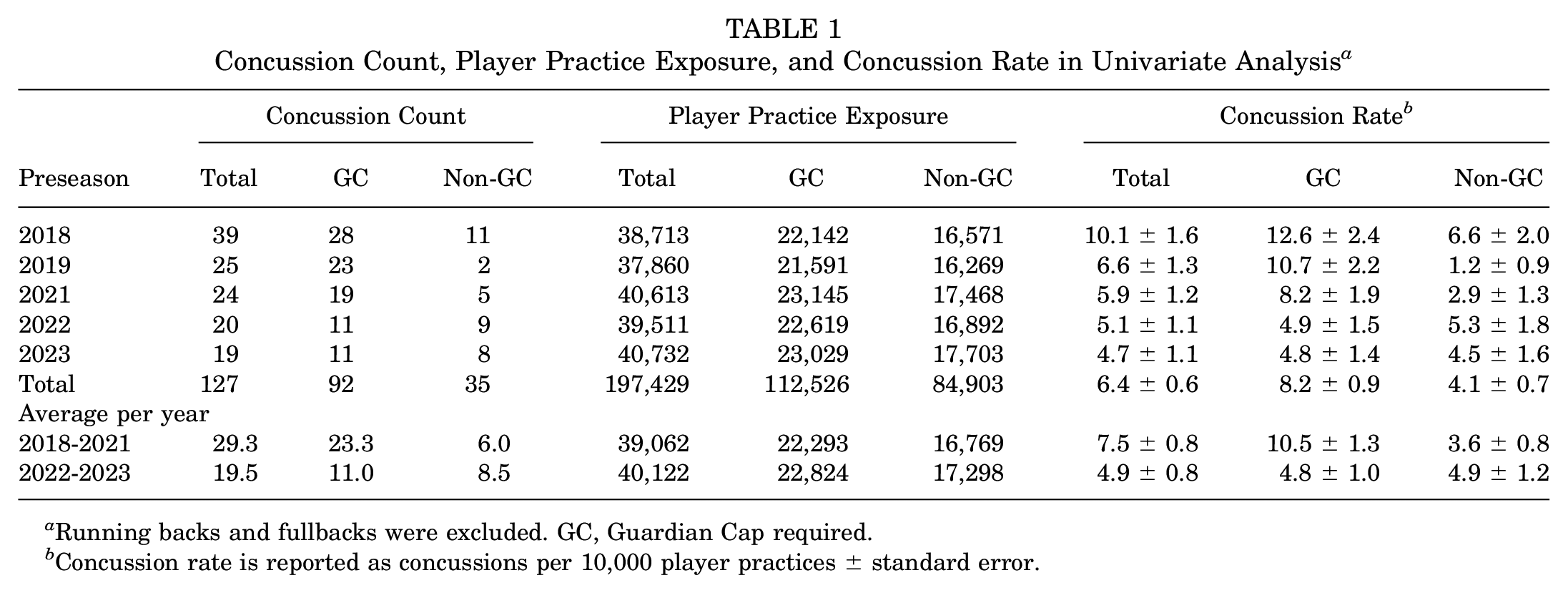
Running backs and fullbacks were excluded. GC, Guardian Cap required.
Concussion rate is reported as concussions per 10,000 player practices ± standard error.
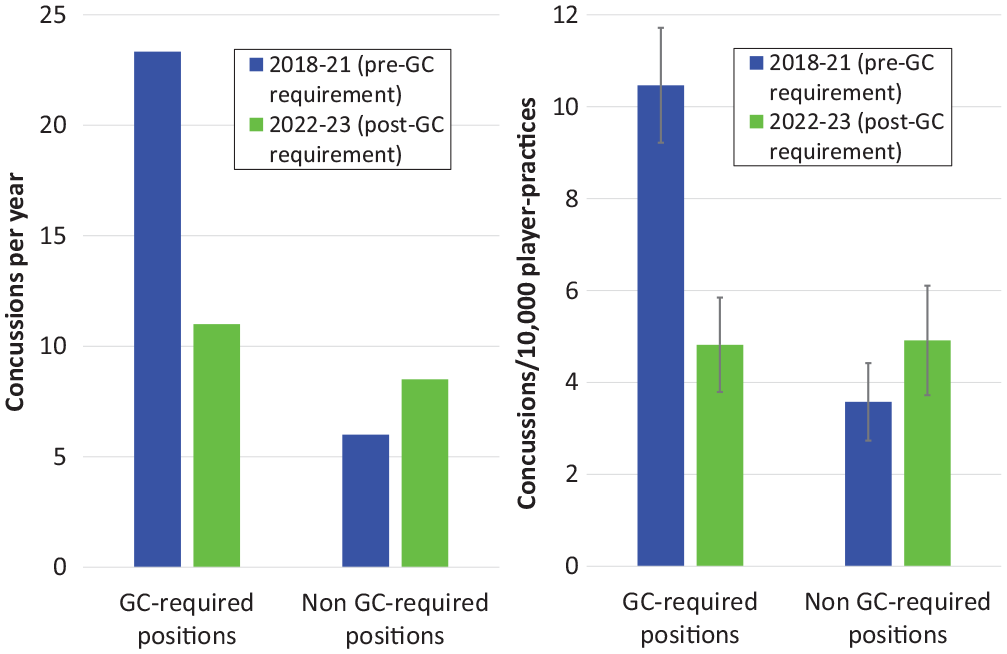
Concussion counts (left) and rates (right) during the preseason requirement period in the Guardian Cap–required (GC) and non-GC groups before and after the Guardian Cap requirement. Error bars represent ±1 standard error.
When the analysis was performed for the non-GC group, no significant relationship between the Guardian Cap requirement and the concussion rate was found. The concussion count increased from an average of 6.0 concussions per year before the requirement to 8.5 concussions per year after the requirement, which was not statistically significant (P = .52) (Figure 1). This result changed little after normalizing for practice exposure. The concussion rate in the non-GC group during the preseason requirement period increased from 3.6 ± 0.8 concussions per 10,000 player practices before the requirement to 4.9 ± 1.2 concussions per 10,000 player practices after the requirement, which was not significant according to the chi-square test (P = .35).
A considerable year-to-year variation in the concussion rate was observed, particularly in the non-GC group, which had a smaller sample size (Figure 2). A generally decreasing trend in the concussion rate among the required positions was observed both before and after the imposition of the requirement in 2022. Although statistically significant when aggregated into before and after the requirement, the yearly decreases in the concussion rate in the GC group over time were not statistically significant in consecutive year-to-year comparisons, nor was the concussion rate significantly correlated with preseason year before the requirement in the linear regression model (P > .05). The decrease in concussion counts in the GC group after the requirement was shared fairly equitably among the 4 required positions (Figure 3). The great majority (83%) of the concussions included in this study occurred in padded practices as opposed to unpadded practices, even though only 57% of the player practices were padded (Figure 4). In the univariate analysis, the odds of a concussion were 3.7 times higher (95% CI, 2.3-5.8; P < .001) in padded practices compared with unpadded practices.
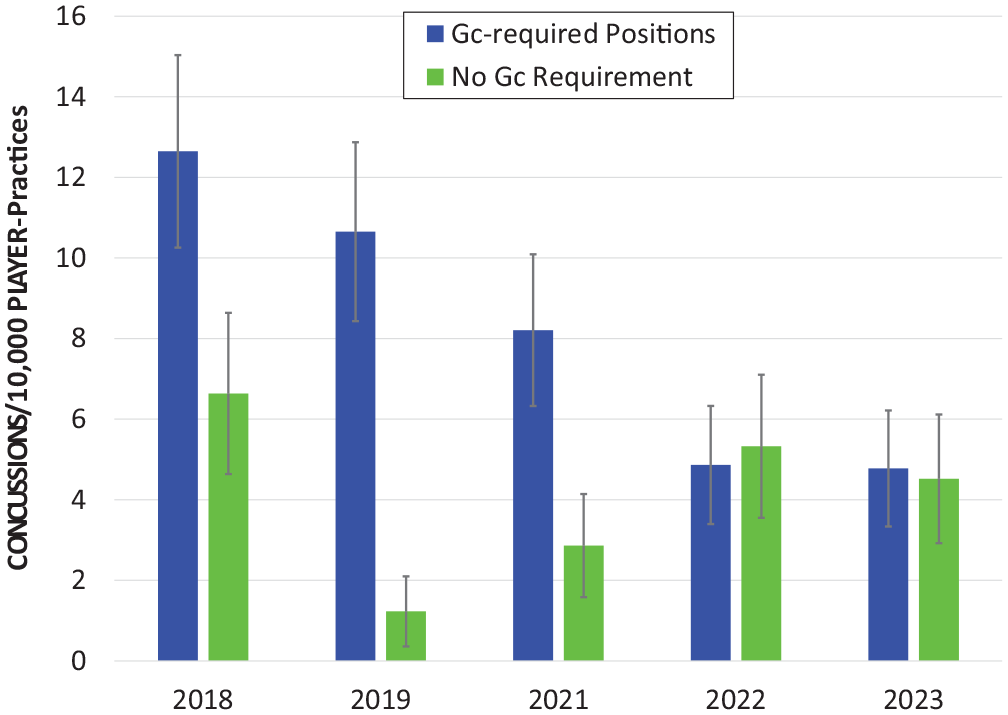
Concussion rate by year in the Guardian Cap–required (GC) and non-GC groups during the preseason requirement period. The Guardian Cap requirement began with the 2022 preseason. Error bars represent ±1 standard error.
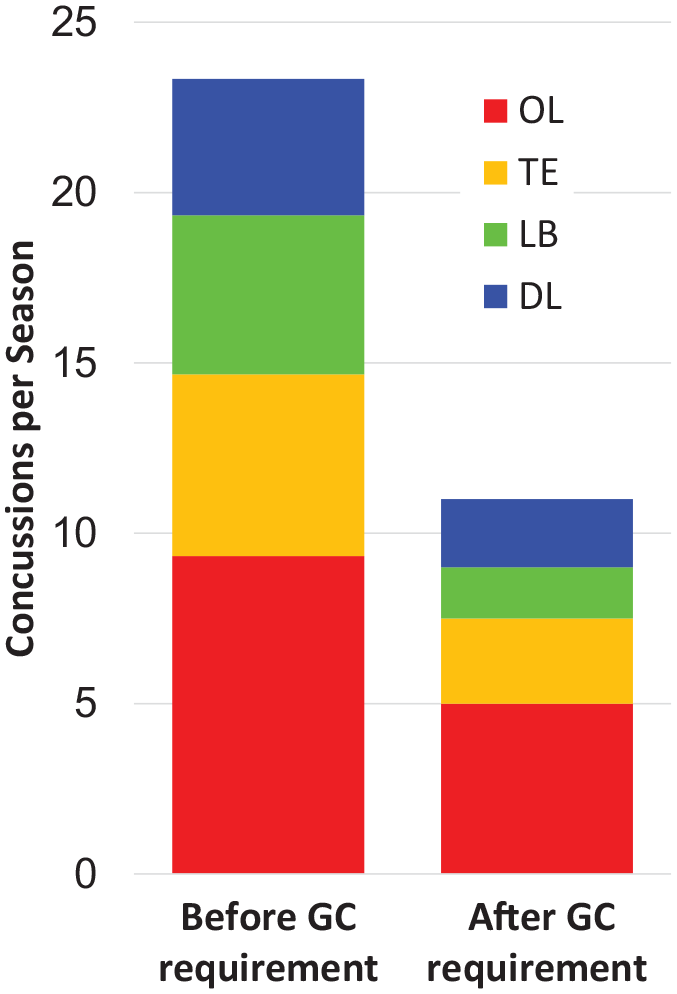
Concussion counts in the Guardian Cap–required (GC) group by player position.
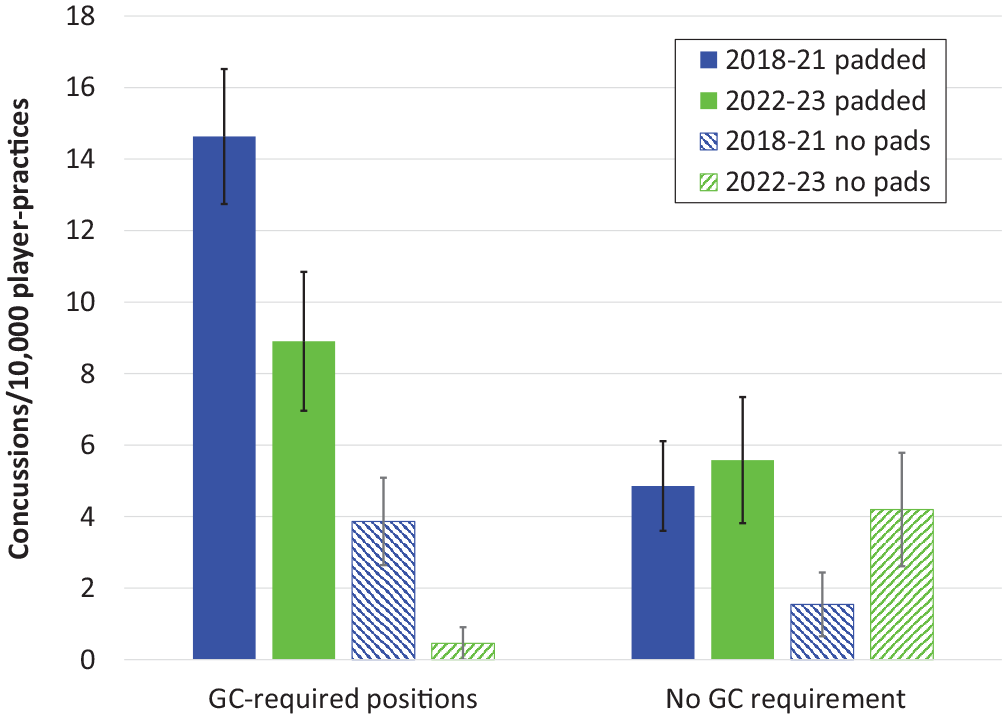
Concussion rates in the Guardian Cap–required (GC; left) and non-GC (right) groups during the preseason requirement period in padded (solid) and unpadded (hatched) practices. Error bars represent ±1 standard error.
Before the requirement, the injury source for concussed players in the GC group was primarily another player’s helmet or body. After the requirement, the number of concussions caused by another player’s helmet remained about the same, while the number of concussions caused by another player’s body decreased substantially (Figure 5). There were 18 concussions in the GC group in which the injury source was unclear, primarily because of difficulty in identifying the concussive event. This problem diminished with time as processes for identifying injury plays improved. Half of the unclear cases occurred in the 2018 preseason, and all of the unclear cases occurred before the Guardian Cap requirement.
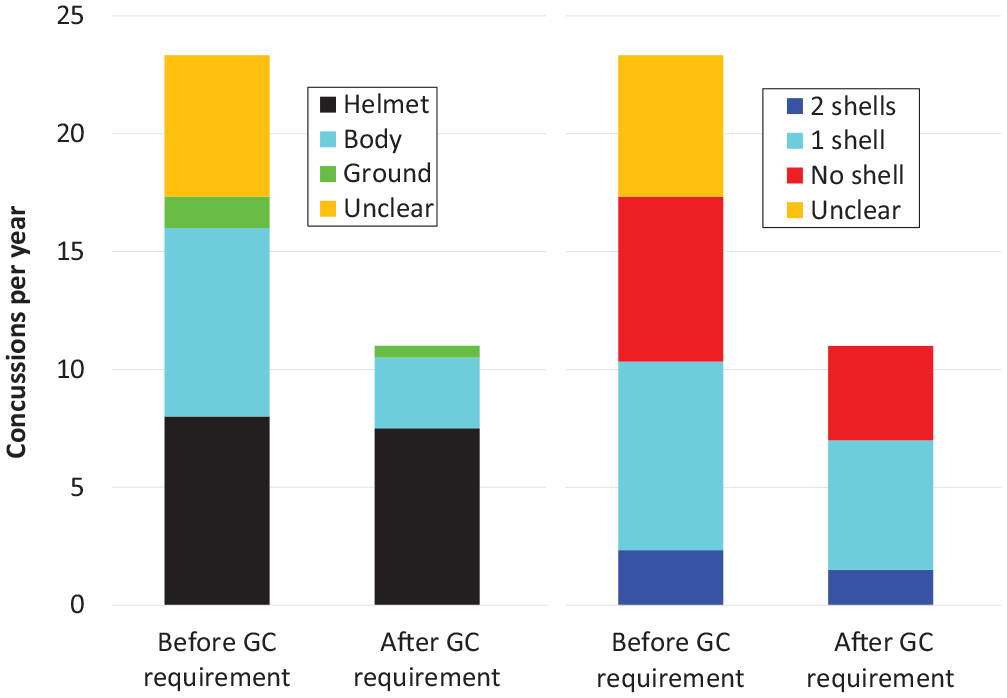
Injury source (left) and helmet shell involvement (right) for concussions in the Guardian Cap–required (GC) group before and after the Guardian Cap requirement.
When the injury source in the GC group was further broken down into helmet shell involvement, there was a 32% decrease (from 10.3 to 7.0 concussions per year) in known helmet shell–involved concussions after the requirement. There was also a 43% decrease (from 7.0 to 4.0 concussions per year) in concussions known not to involve the helmet shell after the requirement. However, this calculation omits several unclear cases during the pre-requirement period, which may have skewed the result. If the concussions with an unknown impact source are assumed to involve the helmet shell 61% of the time (the same as concussions with known sources), then concussions involving the helmet shell likely decreased 50% (from 14.0 to 7.0 concussions per year) after the requirement, and concussions not involving the helmet shell likely decreased 57% (from 9.4 to 4.0 concussions per year) after the requirement. The overall 53% decrease in the yearly preseason concussion count in the GC group after the requirement includes a large reduction in concussive impacts that should not necessarily be attributed to the Guardian Cap because no helmet shells were involved. If the rate of concussions involving no helmet shell had remained unchanged after the requirement, then the overall decrease in the yearly preseason concussion count in the GC group after the requirement would have been 30%, not 53%. There was no statistically significant association between the concussion rate and the GC requirement in the GC group when only helmet shell–involved concussions were considered (P = .20).
Compared with the GC group, very different trends in concussion scenarios were observed in the non-GC group. Concussion counts went up by 42% in the non-GC group after the requirement. This increase was driven almost entirely by an increase in concussions caused by the ground, which comprised nearly half of all concussions sustained by the non-GC group after the requirement (Figure 6). In the non-GC group, concussions with no helmet shell involvement decreased 25% (from 2.0 to 1.5 concussions per year) after the requirement, while the incidence of concussions involving at least 1 helmet shell increased 77% (from 3.7 to 6.5 concussions per year) after the requirement.
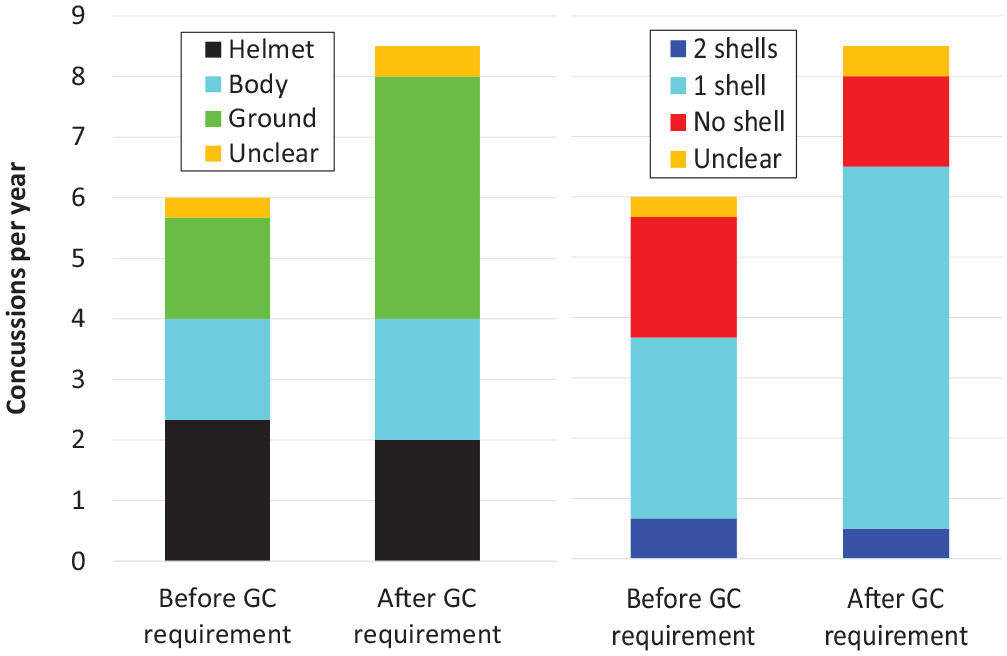
Injury source (left) and helmet shell involvement (right) for concussions in the non–Guardian Cap–required (non-GC) group before and after the Guardian Cap requirement.
According to the Poisson regression analysis, player position, preseason, practice intensity (pads vs no pads), and the Guardian Cap requirement all had independent and statistically significant effects on the overall incidence of concussions. For players under the Guardian Cap requirement, we estimated the overall risk of concussions per practice session to be 38% (95% CI, 20%-73%) of when the Guardian Cap requirement was not in effect, or 62% lower (P = .004) (Table 2). However, when we looked at only concussions involving shell impacts, the risk ratio of 51% (95% CI, 22%-120%) was not statistically significant (P = .122) (Table 3).
Results of Poisson Regression Analysis Considering All Concussions a
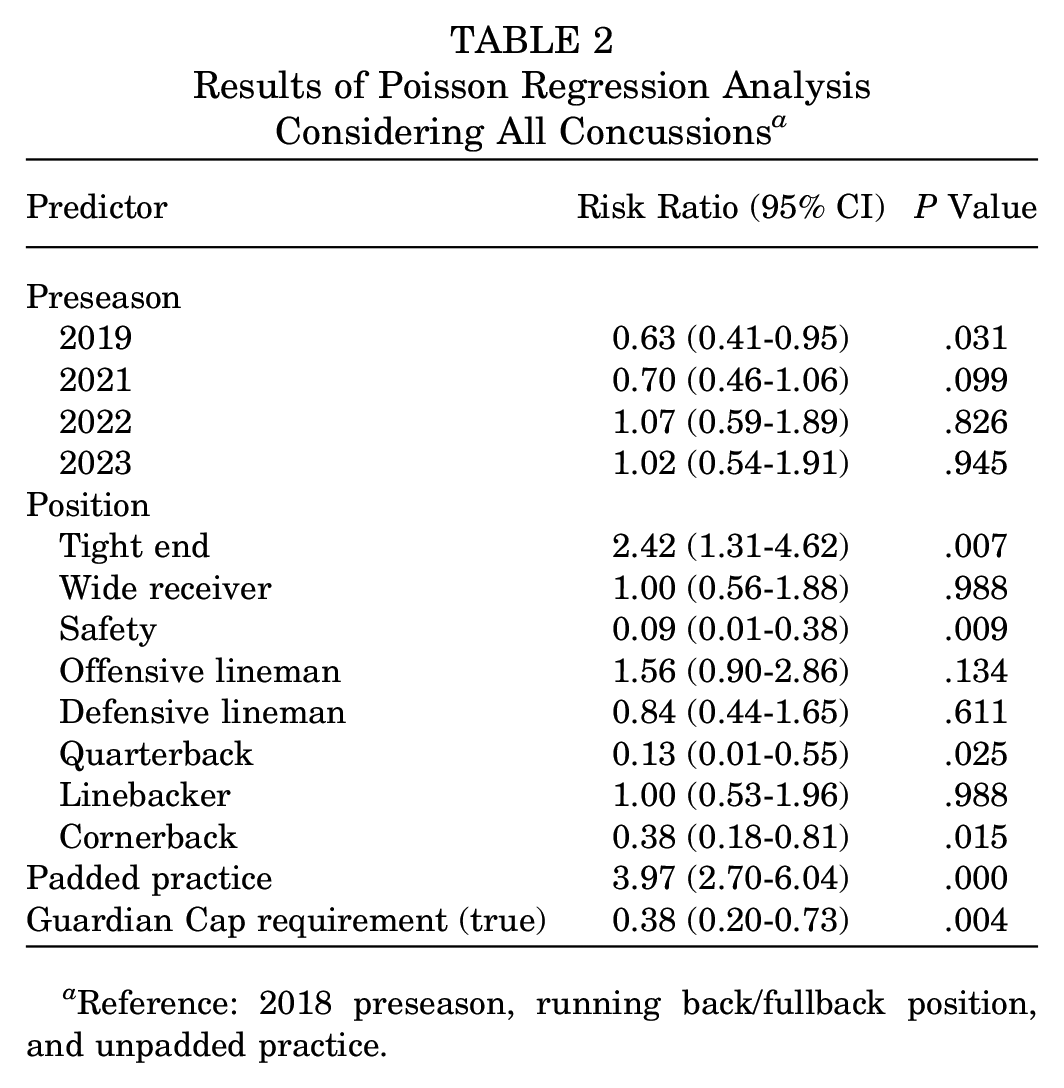
Reference: 2018 preseason, running back/fullback position, and unpadded practice.
Results of Poisson Regression Analysis Considering Helmet Shell Concussions Only a
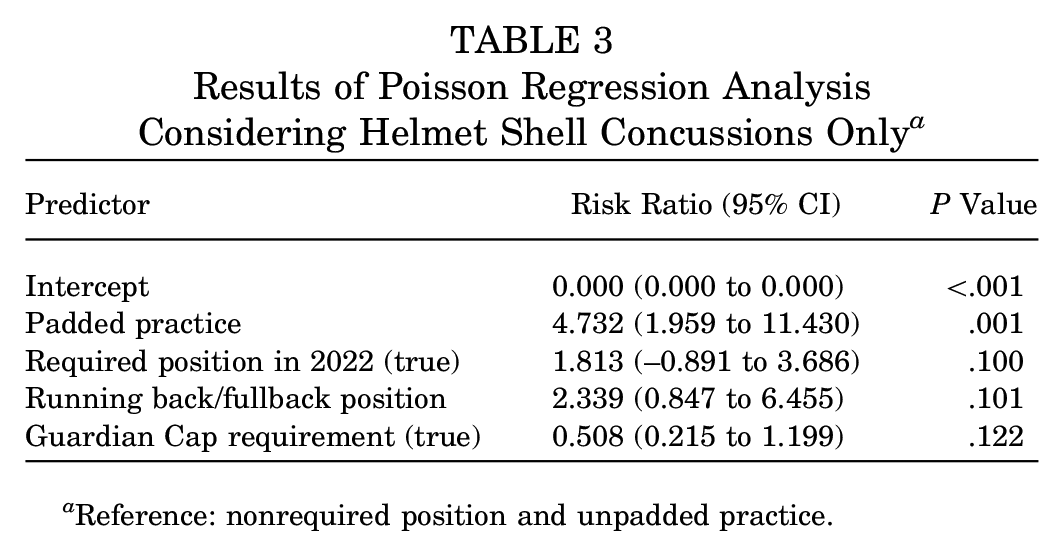
Reference: nonrequired position and unpadded practice.
Discussion
The primary finding in this study is that among players in positions subject to the NFL Guardian Cap requirement, preseason practice concussion counts decreased a statistically significant 53% after the imposition of the requirement (Figure 1). However, secondary analyses suggest that the Guardian Cap was not responsible for the entire reduction. A qualitative video review found that the 53% reduction in concussions was composed of 2 parts: a 30% reduction from concussive impacts involving at least 1 helmet shell and a 23% reduction from concussive impacts involving no helmet shell (Figure 6). From a physics standpoint, the primary benefit of the Guardian Cap comes from reducing head acceleration through compression of the padding. Of course, the padding is not compressed in impacts involving no helmet shell (ie, the facemask of the concussed player vs the ground, the facemask, or the body of another player). When the analysis was limited to concussions involving the helmet shell (ie, concussions in which the Guardian Cap padding would be compressed), there was no longer a statistically significant relationship between Guardian Cap use and the concussion rate (Table 3).
However, the Guardian Cap also increased the mass and moment of inertia of the helmet. Although adding size and mass to the helmet raises concerns about neck fatigue and strain, neck strain injuries were rare and did not increase after the Guardian Cap requirement. Increasing the mass and moment of inertia of the helmet can potentially reduce head acceleration independently of padding compression, although probably to a much smaller degree. Therefore, some portion of the reduction in concussions involving no helmet shell impacts could potentially be attributable to the added mass of the Guardian Cap, which was relatively heavy (369 g). For these reasons, we believe that the results of this study provide some evidence that use of the Guardian Cap may be beneficial in reducing the incidence of concussions in football, but the degree of benefit is uncertain.
In this study, normalizing concussion counts for player practice exposure produced results that were very similar to calculations using raw concussion counts, which suggests that concussion counts are a good proxy for concussion rates in this dataset. Most concussions occurred in padded practices, which was not surprising because unpadded practices were generally of lower intensity than padded practices. In subgroup analyses, large changes in the concussion rate were observed that appeared to be unrelated to the Guardian Cap requirement. For example, there was already a steady downward trend in concussion counts each year preceding the Guardian Cap requirement that appeared to continue and level off after the requirement was implemented (Figure 3). This trend was not statistically significant and did not correlate with changes in practice exposure over the duration of this study (Figure 2).
Another large change in concussion rate that did not appear to be related to the Guardian Cap requirement was the 42% increase in concussion counts in the non-GC group after the requirement (Figure 6), which led to the surprising finding of similar concussion rates in the GC and non-GC groups in 2022 and 2023 (Figure 2). The increase in concussions in the non-GC group was driven primarily by an increase in concussions caused by the ground, which cannot be explained by the Guardian Cap requirement. Furthermore, the requirement cannot explain why there was a decrease in concussions in the GC group but an increase in concussions in the non-GC group. Theoretically, the Guardian Cap should benefit not only the player who is wearing it but also a player who strikes it. This is based on Newton’s third law, which states that the impact force between 2 colliding objects is equal and opposite. Therefore, the presence of the Guardian Cap on players in the GC group, in addition to some players in the non-GC group, should have lowered the concussion rate in the non-GC group after the requirement was implemented, all other things being equal.
One possible explanation for an increased concussion rate is risk compensation. Players wearing the Guardian Cap may have increased the aggressiveness of their play to compensate for the heightened level of safety that they felt while wearing the Guardian Cap. However, for reasons explained above, any change in behavior in the GC group should influence concussion counts in the same direction for both the GC group and non-GC group (although perhaps not to the same degree). Risk compensation cannot explain why there was a large decrease in concussions in the GC group at the same time there was a large increase in concussions in the non-GC group. Given that many of the subgroup analyses results were not statistically significant and could not be explained by the factors included in this study, we conclude that large increases and decreases in concussion counts in a group of players may often be attributable to random or chaotic processes (stochastic noise). This is especially true for the non-GC group, which had small concussion counts (Figure 2).
The present study is the first to compare concussion rates in professional football players wearing and not wearing the Guardian Cap NXT. Previous work on the Guardian Cap has evaluated the XT model (instead of the NXT model) and has been limited to laboratory studies and field measurements of nonconcussive impacts with mouthguard and helmet sensors. The current study investigated real-world concussion rates in NFL preseason practices before and after the Guardian Cap requirement in 2022. The overall sample size of preseason player practices (n = 213,595) and concussions (n = 139) was relatively large. This study relied on detailed individual player participation data and qualitative video review data, which first became available for preseason practices in 2018.
Limitations of this study include small sample sizes in some subgroups, an incremental rollout of the Guardian Cap requirement, a lack of data regarding which players in nonrequired positions were wearing the Guardian Cap, and an inability to account for all the factors that affect the concussion risk, including possible changes in the style of play and the ways in which padded practices were conducted in response to the Guardian Cap requirement. Strengths of the study include a large sample of players, data on practice exposure, and a video review of all concussions to determine collision partners and helmet shell involvement. The findings from this study suggest that the Guardian Cap was associated with a 54% to 62% reduction in the incidence of NFL practice concussions. However, when only concussions involving a helmet shell impact were considered, there was no longer a significant relationship between Guardian Cap use and the incidence of concussions. The fact that we found large concurrent changes in concussion counts likely unrelated to the Guardian Cap highlights the need for caution in interpreting the results of this study, particularly subgroup analyses with smaller sample sizes. Concussion counts vary because of many factors, and the Guardian Cap is only one of those factors. Future studies with a larger sample size may clarify these issues.
Footnotes
Submitted July 30, 2024; accepted May 1, 2025.
One or more of the authors has declared the following potential conflict of interest or source of funding: The research presented in this article was made possible by a grant from Football Research Incorporated (FRI). FRI is a nonprofit corporation that receives funding from sources including the National Football League (NFL) and is dedicated to the research and development of novel methods to prevent, mitigate, and treat traumatic head injuries. The views expressed are solely those of the authors and do not represent those of FRI or any of its affiliates or funding sources. J.R.F., J.M.C., D.J.L., A.M.B., E.J.S., C.P.S., and J.R.C. are affiliated with or employed by Biomechanics Consulting & Research, which receives consulting fees from the NFL and FRI. K.B.A. and B.S.M. have received consulting fees from the NFL Players Association. T.M. is the medical director of the NFL Players Association. A.K.S. is the chief medical officer of the NFL. AOSSM checks author disclosures against the Open Payments Database (OPD). AOSSM has not conducted an independent investigation on the OPD and disclaims any liability or responsibility relating thereto.
