






Abstract
Background
Edible residues from Hindu offerings (lungsuran) may enter mixed waste streams despite retaining nutritional value. Although food rescue research has focused on household leftovers and supply-chain loss, less is known about how culturally governed norms and changing ritual economies shape post-ritual handling of edible offerings.
Objective
To examine how socio-religious norms, authority structures, and changing ritual economies shape lungsuran handling in urban Bali and identify culturally legitimate pathways for nutrition-sensitive recovery.
Methods
We conducted a qualitative study in Denpasar, Indonesia, from September to November 2025 using 20 in-depth interviews with key informants, 4 focus group discussions involving 40 participants, and structured observations across 8 household and temple ritual settings. Data were transcribed, coded, and analyzed thematically.
Results
Participants described lungsuran as edible and blessed, yet discard occurred in both household and temple settings, especially after large or frequent ceremonies. Post-ritual handling was shaped by four interrelated mechanisms: ritual-temporal suitability, authority and ownership, social permission and hierarchy, and marketization with devotional abundance. Reuse was more likely when decision rights were clear, social permission was explicit, and sorting occurred within an acceptable safety window. In pooled temple settings, ownership ambiguity, reluctance to be seen taking food, and reliance on purchased offerings increased discard. Across settings, time, labor, containers, storage, and transport affected recovery.
Conclusions
Lungsuran is not ordinary leftover food but a culturally governed edible flow. Nutrition-sensitive recovery is more likely when it aligns with ritual timing, clarifies authority, reduces social hesitation, and integrates food safety into community governance.
Sacred Food After Balinese Hindu Ceremonies: Why It Gets Wasted and How It Could Help Families
In Balinese Hindu ceremonies, people prepare offerings that often include fruit, cakes, rice-based foods, and other items. After prayers, some of this food becomes lungsuran—food that has been offered and is believed to carry blessings. Many people feel it is not right to throw away blessed food. Yet, in daily practice, much lungsuran is still left unused and ends up in the trash.
This study explored why this happens in an urban setting in Bali. We found that lungsuran is often not taken or used because it may remain exposed for a long time during ceremonies, so people later worry it is no longer clean or safe to eat. In temples and shared spaces, it is also not always clear who has the right to take the remaining food. Some people feel embarrassed to be seen taking food or worry others will judge them. Some families also leave offerings behind, especially when they buy ready-made offerings, because they feel their religious duty is complete once they have prayed, even if the food is still edible.
These findings suggest practical ways to reduce waste while respecting tradition: preparing amounts that match actual needs, sorting edible items soon after ceremonies, using simple safe-handling practice such as clean surfaces and covered containers, and clearly announcing who may take remaining food and when. Importantly, rules should be supported by religious and community leaders, and the process should avoid selling blessed food.
Highlight
This study shows how lungsuran becomes waste through four interacting mechanisms—ritual-temporal suitability, authority and ownership, social permission and hierarchy, and marketization/devotional abundance—operating under cross-cutting material constraints. It also identifies culturally legitimate and nutrition-sensitive recovery pathways in urban Bali.
Introduction
Food waste and malnutrition continue to coexist as a global double burden. Large quantities of edible food are discarded while many populations still face inadequate diets, food insecurity, and limited access to diverse, nutritious foods. This tension has increased interest in interventions that can simultaneously reduce edible loss and improve food access, particularly in rapidly urbanizing settings where food provisioning, social norms, and waste systems are changing.1–4
Within public health and nutrition, this concern has contributed to growing attention to nutrition-sensitive approaches. In this literature, the value of food recovery lies not only in preventing waste but also in whether recovered foods can support dietary diversity and short-term food access in ways that are socially acceptable, safe, and institutionally feasible. Yet most food-waste research still explains edible loss through household planning, purchasing, storage, and disposal behavior. This framing is useful, but it is less able to explain contexts in which food circulates through ritual, moral, and social systems before it becomes available for ordinary consumption.3–5
Insights from food anthropology, commensality studies, and scholarship on ritual food help address this gap. Food anthropology has long shown that food is not only a source of nutrients but also a carrier of identity, value, obligation, and social order. Commensality research similarly shows that eating together organizes belonging, hierarchy, inclusion, and exclusion, while South Asian scholarship on ritual meals demonstrates that ceremonial foods are embedded in symbolic and social systems that regulate procurement, offering, sharing, and consumption.6–10
These perspectives are highly relevant to Bali. In Balinese Hindu practice, offerings (banten) frequently contain edible items such as fruits, rice-based foods, snacks, and side dishes. After ritual use, some of these items become lungsuran, also referred to in some contexts as surudan or paridan. Although lungsuran is often understood as blessed and still edible, its post-ritual handling is not equivalent to that of ordinary leftover food. Its movement is shaped by culturally specific ideas about sacred transformation, appropriateness, etiquette, compatibility, and responsibility.11–15
In this article, we therefore conceptualize lungsuran as a culturally governed edible flow. Unlike leftovers, lungsuran has passed through ritual transformation and carries post-offering meanings that affect whether it is considered appropriate to eat or share. Unlike surplus, its fate is not determined by quantity alone, but by rules of timing, ownership, legitimacy, and social permission. Unlike redistribution, edible flow refers to the broader movement of edible material through socially regulated pathways before any redistribution can occur. The concept highlights how food can remain physically edible while becoming socially unavailable, morally sensitive, or institutionally unclaimed.7,8,10,16
The post-ritual handling of lungsuran is also shaped by broader social relations. Access is not neutral. It may be governed by religious authority, lineage boundaries, order of access, social hesitation, prestige concerns, and gendered divisions of labor between those who authorize disposal and those who sort and reclaim foods. Under such conditions, reluctance to take lungsuran should not be read simply as personal preference or lack of need; it may also reflect symbolic boundary-making, moral surveillance, and status performance within communal religious life.6,9,15,17
These dynamics are unfolding alongside urban and socioeconomic change. The increasing use of ready-made offerings, changing labor patterns, greater emphasis on practicality, and the expansion of larger or more elaborate ceremonies may all alter the post-ritual trajectory of edible offerings. When offerings are purchased rather than prepared within the household, felt ownership over what happens after the ceremony may weaken. At the same time, devotional abundance may increase the volume of edible residues beyond what households or temple communities can realistically reclaim, sort, or redistribute.12–15,17
This study examines how lungsuran is handled in urban Bali and identifies the mechanisms that shape whether it is re-consumed, shared, diverted, or discarded. We conceptualize its post-ritual trajectory as being filtered through four interrelated mechanisms: ritual-temporal suitability, authority and ownership, social permission and hierarchy, and marketization/devotional abundance. These mechanisms operate under cross-cutting material conditions, including labor, time, storage, containers, and transport. By analyzing lungsuran in this way, the article contributes not only to understanding ritual food handling in Bali, but also to broader debates on food waste, commensality, moral regulation, and nutrition-sensitive recovery in culturally governed food systems.3,4,18,19
Methods
Study Design and Reporting
A qualitative study using a mini-ethnographic approach was conducted to examine how post-offering edible residues (lungsuran) were handled within Balinese Hindu ritual settings. The study was designed to generate mechanism-focused explanations and identify actionable leverage points for nutrition-sensitive recovery in an urban context. Reporting was prepared in line with established qualitative reporting standards, including explicit documentation of sampling, data collection, analysis, and strategies to enhance trustworthiness. Supplemental materials provide key local terms, a contextual offering-food table with religious-symbolic notes, the interview guides, and a summary codebook to support transparency and auditability.
Study Setting and Cultural Context
The study took place in Denpasar City, Bali, Indonesia, an urban area characterized by frequent household and temple rituals and diverse socioeconomic profiles across neighborhoods. Data collection covered the four Denpasar subdistricts (Denpasar Barat, Denpasar Selatan, Denpasar Timur, and Denpasar Utara) and was operationalized through community engagement in selected banjar adat (customary neighborhood units).
In Balinese Hindu practice, offerings (banten/bebanten) commonly include edible items such as fruit, rice-based foods, side dishes, and snacks. After rituals, edible components may become lungsuran (also termed surudan/paridan), which may be consumed or shared. However, acceptability and redistribution can be shaped by local norms, such as perceived ritual compatibility, etiquette, and boundaries in communal settings. This study treated lungsuran as a culturally governed edible flow whose post-ritual trajectory is jointly shaped by meanings, norms, and practical constraints, including food safety, time, and storage.
Edible offering components in Balinese Hindu practice are also not symbolically neutral. Across commonly used offering forms such as pejati, sodaan/ajuman, and gebogan, fruits and other agricultural produce are often associated with gratitude and abundance, rice-based components with sustenance and steadfast devotional intent, and arranged cakes or snacks with completeness and ritual propriety. These associations help explain why post-offering foods retain moral and ritual significance after prayer and why lungsuran cannot be treated as equivalent to ordinary leftovers (see Supplementary Table S2).20–22
Sampling and Participants
In-Depth Interviews (Key Informants)
Key informants were selected using purposive sampling to represent roles with direct knowledge of ritual practice, customary governance, and community or institutional responsibilities relevant to post-ritual handling. Informant categories were predefined to capture multiple system levels and viewpoints, including: (1) religious authority such as Hindu religious leaders or pemuka agama; (2) customary leaders, including bendesa adat, kelian banjar, orprajuru; (3) community members involved in ritual preparation and post-ritual handling; (4) local government or service actors relevant to food systems and waste management; and (5) market or service actors, such as banten providers, where relevant.
Recruitment was conducted through customary or community gatekeepers and institutional contacts. Eligibility criteria included being 18 years or older, having current or recent involvement in ritual processes or community governance, and being willing to participate in an audio-recorded interview. Recruitment continued until thematic sufficiency was reached across key actor groups, indicated by the absence of substantively new mechanism categories in ongoing analysis.
Thematic sufficiency was assessed iteratively rather than as a purely numeric threshold. Recruitment and analysis proceeded in parallel, and data collection was stopped when additional interviews and focus group discussions (FGDs) no longer yielded substantively new mechanism categories across the main actor groups relevant to post-ritual handling. The aim was not exhaustive representation of every ritual variation, but analytic coverage of the decision pathways that shaped reuse, redistribution, or discard.
Focus Group Discussions
Four FGDs were conducted across the four Denpasar subdistricts, with a total of 40 participants and approximately 10 participants per group. Participants were recruited through coordination with kelian banjar to ensure representation of community members who were routinely involved in ceremonies, offering preparation, and post-ritual handling at household and community levels. Eligibility criteria included being aged 18 years or older, residing in or actively participating in the banjar's customary activities, and being willing to discuss experiences in a group setting. Efforts were made to include variation in age, gender, and perceived socioeconomic backgrounds to encourage heterogeneous discussion.
Data Collection Procedures
Fieldwork was conducted from September to November 2025 using three complementary methods: in-depth interviews, FGDs, and structured participant observation. Sessions were conducted in the participants’ preferred language used in daily communication, either Indonesian and/or Balinese as appropriate. All interviews and FGDs were audio-recorded with permission and supported by field notes.
In-Depth Interviews
Semi-structured interviews were conducted for 45 to 60 min per participant. Interview prompts explored: (1) meanings attributed to lungsuran and its perceived religious status; (2) perceived rules governing eligibility to accept, consume, or share lungsuran, including ritual compatibility boundaries and socially recognized classifications of offerings; (3) practical post-ritual handling pathways in households and communal settings; (4) perceived drivers of discard, including changes in the ritual economy, such as purchased offerings, “megah” ceremonies, and overproduction; (5) food-safety concerns, handling constraints, including time or heat exposure and storage, and decision points; and (6) feasible, culturally acceptable leverage points for redirection, including governance, roles, rules, and safeguards. Interviews concluded with a short “implementation probe” asking participants to propose what a realistic and legitimate pathway would look like in their setting.
Focus Group Discussions
Four FGDs were conducted for 60 to 90 min per session. A standardized facilitation protocol was used, including introduction and confidentiality agreement, ground rules on voluntary participation, respectful turn-taking, and non-attribution, guided discussion, and a closing reflection focused on solutions. Prompts addressed shared norms about taking or consuming lungsuran, perceived stigma and etiquette, variation in practices between household and temple or community contexts, the perceived effects of marketization and overproduction on discard, and community-acceptable governance options, including food-safety practices for redistribution. A facilitator led each FGD, and a note-taker documented key contextual details and non-verbal dynamics.
Structured Participant Observation
Structured participant observation was conducted in eight settings, comprising five household ceremonies and three neighborhood temples, from October to November 2025. Observation sessions followed a consistent checklist across three phases: pre-ritual preparation and staging of offerings or foods, ritual placement, circulation, access, and boundaries; and post-ritual sorting, consumption, sharing, storage, diversion, composting, or disposal. For each session, field logs documented: (1) setting type and ceremony context; (2) categories of edible items observed, such as fruits, rice-based items, snacks, side dishes; (3) actors involved in decision-making; (4) handling actions and sequences; (5) time-related constraints such as delays before sorting and time left at location; and (6) explicit or implicit rules shaping eligibility and redistribution. Where feasible, approximate volumes of residual foods were recorded using visual estimation supported by sample weighing when access and setting norms allowed, with methods and assumptions documented in observation logs to support auditability.
Approximate quantities of lungsuran were derived from structured visual estimation supported by direct sample weighing when access and ritual norms permitted. During selected observation sessions, containers or bundles of representative residual foods were weighed and then used as reference points to estimate comparable units within the same setting. Per-session estimates were logged in field notes and summed across the eight observation sites to generate the cumulative estimate reported in the Results. Because continuous weighing of all residual materials was not feasible, these quantities should be interpreted as indicative observational estimates rather than as precise weight measurements.
Data Management
Audio recordings were transcribed verbatim. Identifiers, includingnames, precise addresses, and unique contextual markers, were removed or masked during transcription. Each participant was assigned a coded identifier reflecting data source and setting, such as interview versus FGD and household versus temple or community setting. Field notes, observation logs, and analytic memos were stored in secure, password-protected folders with access restricted to the author.
Translation of Quotations
Selected quotations in Indonesian and/or Balinese were translated into English for manuscript reporting. Draft translations were generated using a generative AI tool used solely for translation support, and were then reviewed, corrected, and culturally calibrated to ensure semantic accuracy and contextual fidelity. Discrepancies were resolved by checking against the original-language versions, which were retained in the audit file. Generative AI was not used for coding, theme development, interpretation, or writing analytic claims. Only de-identified text, with names, locations, and other identifiers removed, was processed through the AI tool to protect confidentiality.
Data Analysis
Data were analyzed using reflexive thematic analysis following a systematic sequence: familiarization with transcripts and field notes; generation of initial codes; development of candidate themes; review and refinement of themes; definition and naming of themes; and production of an analytic narrative. Coding and theme development were supported by qualitative analysis software (NVivo 14; QSR International). Analysis combined semantic coding of explicit statements with interpretive coding to identify mechanisms linking norms, structures, and handling decisions. A food-systems and socio-ecological orientation guided theme organization across interacting levels, including individual perceptions and preferences, interpersonal etiquette and stigma, community or customary rules and authority, and institutional or service constraints shaping feasible pathways.
Coding and theme development were led by the sole author, consistent with a reflexive thematic analysis approach. Rather than seeking inter-coder agreement, the analysis emphasized iterative comparison across data sources, memo writing, theme refinement, and explicit documentation of analytic decisions in the audit trail. Member checking with selected key informants was used to test the clarity and cultural accuracy of sensitive interpretations, including those related to compatibility beliefs, etiquette, and legitimacy of redistribution.
Strategies to Enhance Trustworthiness
Credibility and dependability were strengthened through multiple procedures. Method triangulation was applied across interviews, FGDs, and observations to compare reported norms with observed practices and to examine variation by setting, including household versus temple or community settings. Member checking was conducted with selected informants to confirm interpretive accuracy of key themes and to ensure culturally appropriate phrasing for sensitive constructs, such as ritual compatibility boundaries, taboo classifications, and legitimacy of redistribution. An audit trail was maintained, including dated versions of guides, code definitions, theme maps, and analytic memos documenting decision rules and revisions. Reflexive memos were used to record evolving interpretations and to monitor potential researcher assumptions during analysis.
Supplemental materials include the interview guides, a contextual table of observed offering-food categories, and a summary codebook with definitions and illustrative examples to help readers assess how the empirical material supports the thematic claims reported in the manuscript.
Ethical Considerations
Ethical approval was obtained from the Health Research Ethics Committee (Komisi Etik Penelitian Kesehatan), Politeknik Kesehatan Kartini Bali (Approval No. 050/KEPK/DI/PKKB/2025). All participants provided informed consent prior to participation. Confidentiality protections and the right to withdraw at any time were emphasized. Access permissions and community entry were coordinated with relevant customary and community stakeholders to ensure respectful conduct in ritual settings.
Results
The qualitative dataset comprised 20 in-depth interviews with key stakeholders, four focus group discussions (40 participants), and 8 structured observations across household and temple settings. Key informants were aged 33 to 67 years (15 male, 5 female), while the FGDs captured predominantly female perspectives involved in domestic food preparation and post-ritual sorting. Observations totaled 37.5 h and produced an approximate cumulative estimate of 307 kg of lungsuran across sessions (range 8–95 kg per session). This figure should be interpreted as an indicative observational estimate rather than a precise weight audit. Participant profiles are summarized in Tables 1 and 2.
Characteristics of Key Informants by Role, Age, Sex, Education, and Years in Role.
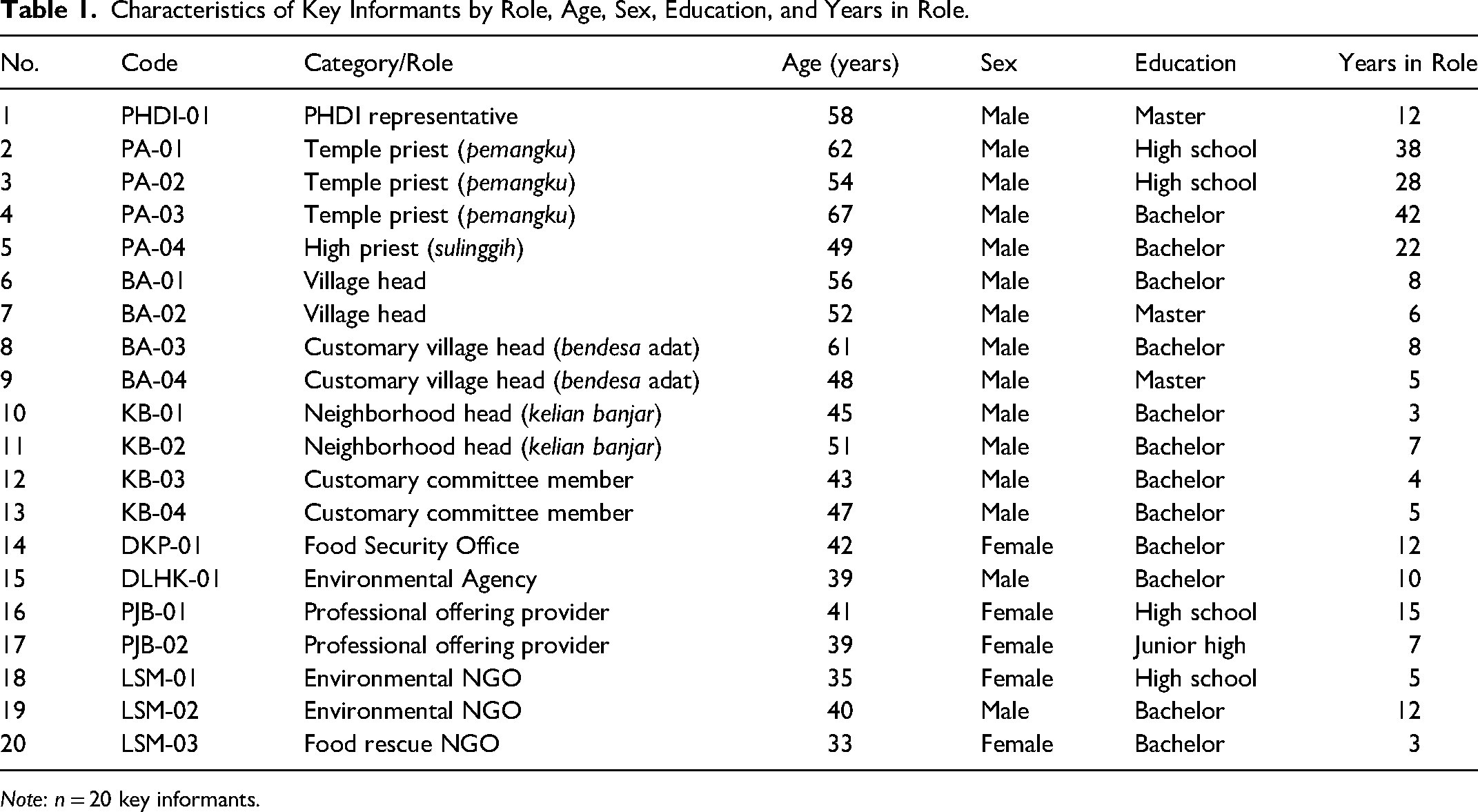
Note: n = 20 key informants.
Composition of Focus Group Discussions by Sub-District, Sex, and Mean Age.
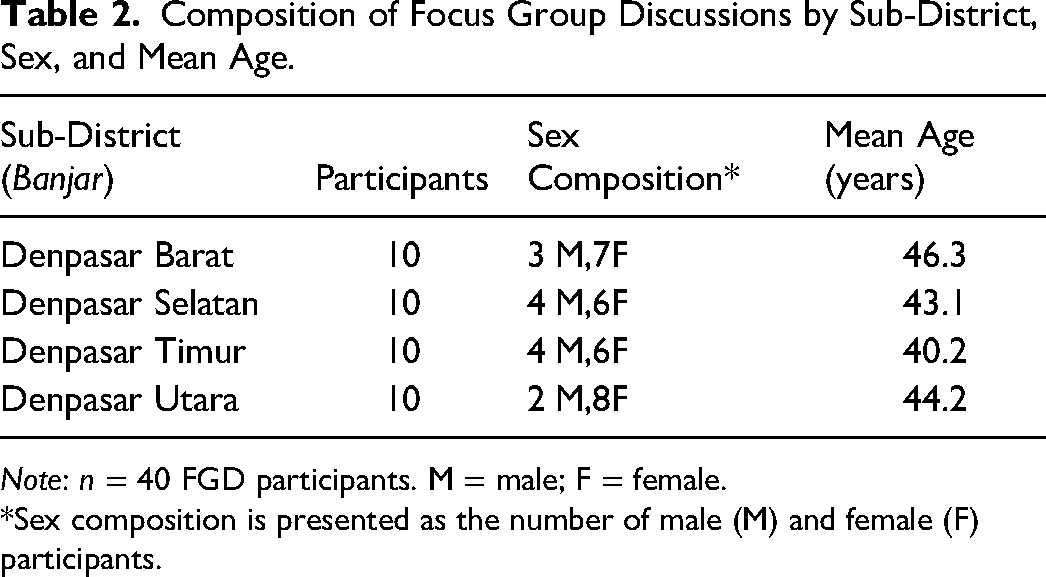
Note: n = 40 FGD participants. M = male; F = female.
*Sex composition is presented as the number of male (M) and female (F) participants.
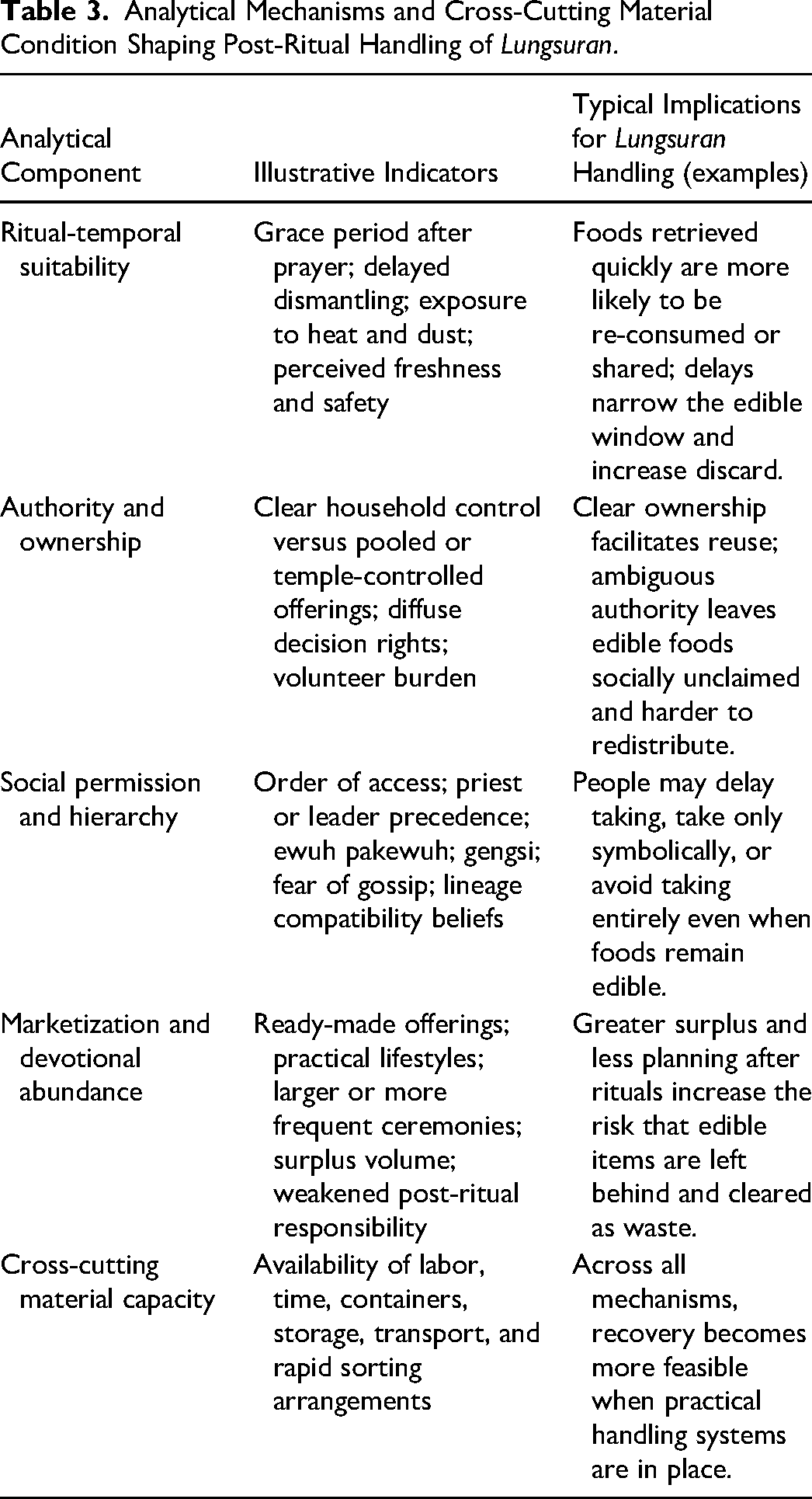
Across interviews, FGDs, and observations, lungsuran was consistently described as a culturally governed edible flow rather than as ordinary leftover food. Figure 1 summarizes the revised analytical model, and Table 3 consolidates the four mechanisms and the cross-cutting material condition that shaped post-ritual handling. Supplementary Table S7 provides the expanded codebook and illustrative examples supporting the development of these mechanisms. Four mechanisms shaped whether lungsuran moved toward re-consumption, sharing, diversion, or discard: (1) ritual-temporal suitability, (2) authority and ownership, (3) social permission and hierarchy, and (4) marketization and devotional abundance. In this model, re-consumption refers to edible lungsuran being eaten by the household or ritual participants soon after ritual completion, usually within the same setting or under direct household control. Sharing refers to edible lungsuran being transferred to others or taken away for later consumption, especially in communal or temple settings where permission, ownership, and timing must be socially clarified. Diversion refers to non-human food or material pathways such as feeding animals or composting, while discard refers to disposal into mixed waste. Table 4 presents the estimated allocation of lungsuran across the eight observation sites according to these post-ritual outcomes. Across all outcomes, material capacity—including time, labor, containers, storage, and transport—acted as a cross-cutting operational condition that widened or narrowed the possibility of recovery.
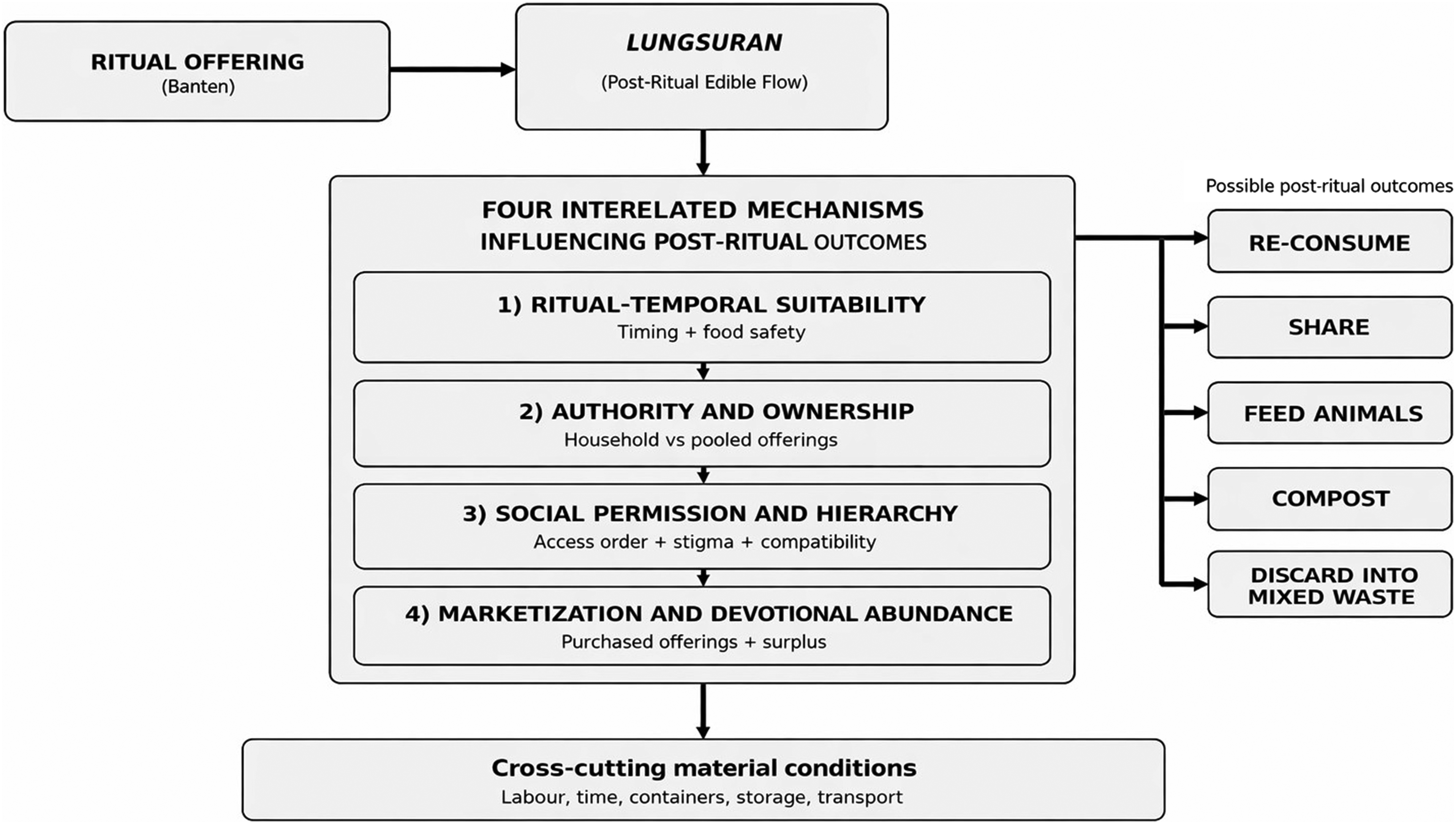
Synthesized pathway from ritual offering to post-ritual outcomes.
Analytical Mechanisms and Cross-Cutting Material Condition Shaping Post-Ritual Handling of Lungsuran.
Estimated Allocation of Lungsuran Across Observation Sites.
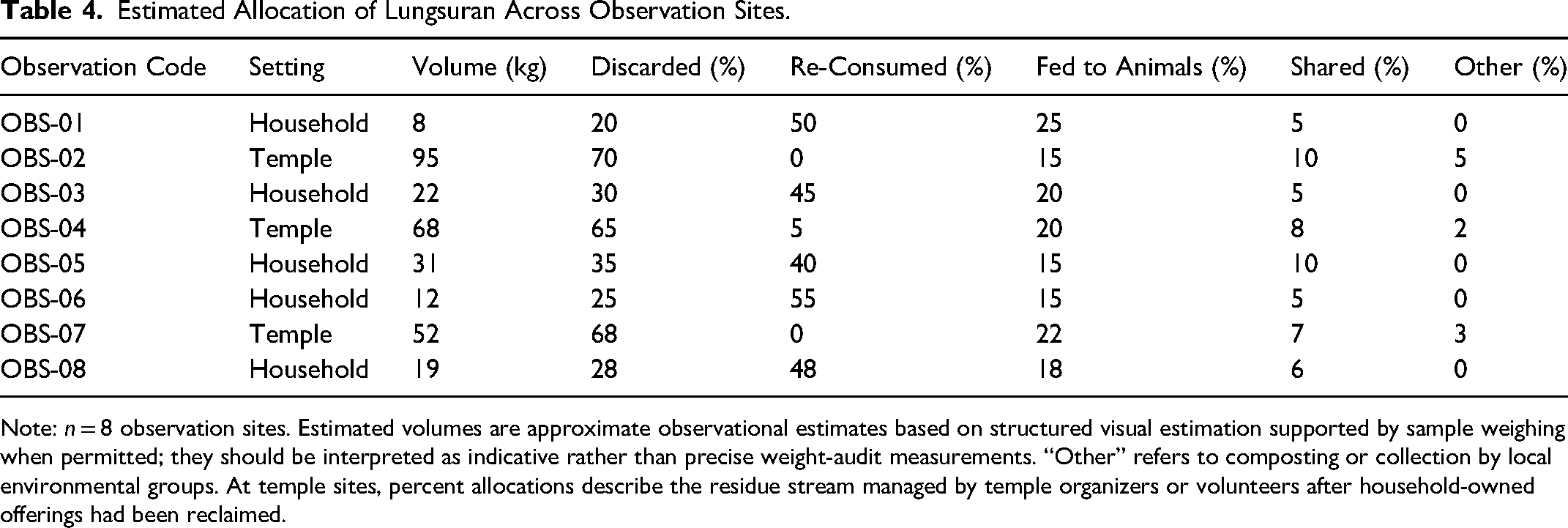
Note: n = 8 observation sites. Estimated volumes are approximate observational estimates based on structured visual estimation supported by sample weighing when permitted; they should be interpreted as indicative rather than precise weight-audit measurements. “Other” refers to composting or collection by local environmental groups. At temple sites, percent allocations describe the residue stream managed by temple organizers or volunteers after household-owned offerings had been reclaimed.
Ritual-Temporal Suitability
Participants consistently described lungsuran as food that remains blessed after offering, but whose practical edibility is time-sensitive. Offerings were not always dismantled immediately after prayer because they were expected to remain in place until the ritual sequence had fully concluded and the sari (essence) had been received. In practice, this created a narrow recovery window. The longer edible items remained exposed to heat, dust, insects, and repeated handling, the more likely they were to be reclassified as inappropriate or unsafe to consume. Lungsuran means the offering has ‘come down’ - it has been received. Its sacred status changes, but it does not become impure … lungsuran is a blessing, not garbage. (WM-PA03; temple priest)
This mechanism is important for the study's nutrition-sensitive framing. Commonly observed items such as fruits, rice-based foods, snacks, and side dishes could potentially contribute to short-term household food access or dietary variety, but only if they were retrieved and sorted within this limited temporal window. Once ritual timing and perceived food safety moved out of alignment, nutritional potential was effectively lost.
Authority and Ownership
Post-ritual trajectories differed sharply between households and temples. In households, decision rights were clear, and lungsuran more readily re-entered the domestic food cycle through immediate consumption, sharing with neighbors, animal feed, or composting. In temples, however, participants distinguished between household-owned offerings that were usually reclaimed after prayer and pooled or left-behind offerings that were socially treated as milik pura. In this second stream, responsibility was diffuse, decision rights were ambiguous, and volunteers often prioritized rapid site clearance over careful sorting. The most basic difference is who has the ‘right’ over lungsuran. At home it is clear: the household decides. But at the temple there is no single owner—it is communal. Without clear rules about who may take what, how much, and when, most of it ends up discarded because people are reluctant to take responsibility. (WM-KB03; customary committee member)
This distinction also had a gendered dimension. Institutional authorization in the study setting was concentrated among priests and customary leaders, who were predominantly male, whereas routine domestic preparation and post-ritual sorting were more often described by FGD participants as women's work. As a result, those who handled foods most directly did not always have the same authority to legitimize redistribution in communal settings.
Social Permission and Hierarchy
Beyond ownership, access to lungsuran in communal settings was regulated by unwritten social rules. Participants described order-of-access norms in which priests and customary leaders were expected to precede volunteers and the wider public. They also described ewuh pakewuh, meaning relational awkwardness or hesitation in acting, and gengsi, meaning prestige- or status-related reluctance to appear needy or greedy. These norms discouraged timely retrieval even when foods remained edible. Ewuh pakewuh is difficult to translate—it is a feeling of awkwardness or discomfort even when nothing explicitly forbids an action. You want to take lungsuran but feel uneasy with the host; you want to say ‘please do not throw this away’ but feel uneasy toward tired temple organizers. So, people become passive and let it become waste rather than face that social discomfort. (WM-BA01; customary village head)
Read analytically, these patterns point to more than etiquette alone. Hierarchy organized who could act first; gossip and social judgment functioned as informal sanctions; and compatibility beliefs around lineage or ritual leadership operated as symbolic boundaries around legitimate recipients. Several participants also differentiated between households that took lungsuran because it helped reduce food expenses and more affluent households that limited or avoided taking it to protect social standing. Redistribution, therefore, was not simply enabled or blocked by culture; it was stratified by authority, class signaling, and social visibility.
Marketization and Devotional Abundance
Participants linked increased discard to changes in the ritual economy. Ready-made offerings were widely described as practical and increasingly common, especially for large temple ceremonies. However, when offerings were bought rather than prepared within the household, participants felt that post-ritual responsibility was more easily displaced. Ceremonies were also described as becoming more frequent and, in some settings, more elaborate. This combination generated larger volumes of edible residue while weakening the sense that someone should reclaim, sort, and redistribute it. There are several factors behind the changes. First, the community's economy has improved, so people do not really need lungsuran for consumption. Second, lifestyles have shifted people have become more individualistic than before. Third, cleanliness and health standards have risen, so people are more selective about what they eat. Fourth, values have shifted: in the past, lungsuran was considered a blessing; now it is more often treated as leftover or even as waste. (WM-BA04; customary village head)
Importantly, participants usually framed abundance as devotional rather than merely performative. Offering more was described as a way to express gratitude and present one's best to the deity. Yet this devotional abundance had practical consequences. When the scale of offering exceeded what could be realistically reclaimed and safely handled, surplus edible food was more likely to be abandoned to a small group of tired volunteers and then discarded.
Culturally Legitimate Recovery Pathways
Despite these constraints, most participants expressed conditional support for the organized recovery of edible lungsuran. The strongest conditions were religious and customary legitimation, voluntariness, transparency, and explicit protection against commercialization. Participants suggested simple but actionable measures: right-sizing offerings before ceremonies, assigning designated sorting teams, using covered surfaces and containers, rapidly separating foods that remained edible, and publicly announcing who could take what and when. During a temple festival, I announced on the microphone: ‘Everyone may take lungsuran, no need to feel hesitant. Rather than becoming waste, it is better used.’ After that announcement, people were more willing to take it. Without legitimacy from respected figures, people remain reluctant. (WM-KB01; neighborhood head)
In ritual settings, nutrition-sensitive recovery depends less on food-rescue logic alone than on whether recovery is ritually appropriate, socially legitimate, and operationally manageable.
Discussion
This study shows that lungsuran is best understood not as ordinary leftover food, but as a culturally governed edible flow whose post-ritual fate is shaped by ritual timing, authority, hierarchy, and changing ritual economies. This interpretation extends conventional food-waste frameworks that explain edible loss mainly through household planning, purchasing, and disposal behavior. In the present case, foods became wasted not only because they were perishable, but because they moved through a morally regulated social field before they became available for ordinary consumption.23–26
The findings suggest that edible recovery in ritual settings cannot be explained adequately by quantity or perishability alone. What mattered was not simply whether food remained edible, but whether it could move through a socially legitimate pathway of retrieval, authorization, and use. In this sense, the study extends dominant food-waste framings by showing that post-ritual food loss is mediated by sacred timing, entitlement, and social hierarchy. The analytical value of the edible-flow concept therefore lies in shifting attention from food as a material remainder to food as an object whose recoverability is socially organized.7,9,10,23
The findings also deepen understanding of power and hierarchy in post-ritual food handling. Order-of-access norms, ewuh pakewuh, and gengsi did not merely reflect politeness or personal preference; they operated as informal mechanisms of social control. Hierarchy shaped who could act first, prestige shaped who could act without shame, and compatibility beliefs shaped who was considered an appropriate recipient. These dynamics also intersected with gendered divisions of ritual and post-ritual labor, particularly between those who authorized redistribution and those who handled foods directly. This division meant that those most directly involved in handling edible lungsuran did not always possess equal authority to legitimize redistribution decisions in communal settings. Together, these patterns suggest that redistribution in ritual settings may reproduce social distinctions unless legitimizing rules explicitly widen the circle of acceptable recipients.6,10,15,27–29
The study further shows that marketization changes not only how offerings are procured but also how moral responsibility is distributed after ritual use. Participants’ accounts of ready-made offerings are consistent with wider scholarship showing that convenience can reshape everyday moral obligations around food. In urban Bali, purchased offerings made ritual participation more practical, but also weakened felt ownership over post-ritual handling. Combined with devotional abundance, this increased the likelihood that edible materials were left to tired volunteers and cleared as waste rather than being actively sorted or redistributed.12,13,17
From a nutrition-sensitive perspective, the findings point to a modest but meaningful opportunity. The foods most often mentioned in interviews and observations, including fruits, rice-based items, snacks, and side dishes, are not nutritionally equivalent, and the present study did not include nutrient assays. Even so, these categories could support short-term household food access and aspects of dietary diversity if they are recovered early and handled safely. In this context, nutrition-sensitive recovery means creating socially legitimate and food-safe pathways through which culturally acceptable edible items can potentially contribute to food access without undermining ritual values.3,4,24–26
These findings also have relevance beyond Bali. Many religious and ceremonial food systems involve rules about offering, blessing, entitlement, and social distribution. Although the specific meanings differ across settings, a similar analytical problem recurs: foods may be nutritionally usable yet remain constrained by ritual timing, hierarchy, and symbolic boundaries. The Bali case therefore contributes to broader debates on food waste, ritual economy, commensality, and the governance of culturally sensitive redistribution.9,16,23
The applied implication is that successful interventions must work with, rather than against, the moral architecture of ritual food. The most plausible entry points identified here were pre-ritual right-sizing, rapid post-ritual sorting, basic covered storage and container systems, and public authorization from priests or customary leaders regarding who may take edible lungsuran and when. These are governance measures as much as technical ones. They reduce waste not by redefining lungsuran as ordinary surplus, but by making recovery ritually appropriate, socially legitimate, and operationally feasible.27–31
Several limitations should be noted. First, the qualitative design was intended to explain mechanisms rather than estimate prevalence, so the findings are analytically transferable rather than statistically generalizable. Second, the cumulative estimate of 307 kg across observation sessions should be interpreted as indicative because it was based on structured visual estimation supported by sample weighing when access permitted, not on continuous weighing of all materials. Third, coding was conducted by the sole author in line with reflexive thematic analysis; trustworthiness was strengthened through triangulation, audit trail, and member checking rather than through formal inter-coder reliability testing. Finally, the study inferred nutritional potential from food categories and handling pathways rather than from laboratory assessment of nutrient composition or microbiological safety.
Overall, the study suggests that edible recovery in ritual contexts becomes feasible when sacred meaning, social legitimacy, and practical handling conditions are brought into alignment. Where those elements remain disconnected, blessed foods can move rapidly from moral value to material discard.
Conclusion
Lungsuran is not simply leftover food, but a culturally governed edible flow whose post-ritual fate depends on the alignment of sacred meaning, social legitimacy, and practical feasibility. In urban Denpasar, edible losses occurred when a narrow recovery window was constrained by ritual sequencing, ambiguous authority over communal residue streams, social permission norms, and the growing marketization of offerings. Material capacity, especially labor, time, containers, storage, and transport, further shaped whether edible items were rapidly recovered or cleared as waste. Nutrition-sensitive recovery is therefore feasible only when interventions are designed around ritual-temporal suitability, transparent authorization, culturally legitimate redistribution rules, and basic food-safety practices. Future work should test pilot governance models, document nutrient composition of commonly recovered items, and evaluate whether such models can improve dignified food access without undermining ritual values.
Supplemental Material
sj-docx-1-fnb-10.1177_03795721261457483 - Supplemental material for From Offerings to Food: A Qualitative Study of Lungsuran Handling and Nutrition Potential in Urban Bali
Supplemental material, sj-docx-1-fnb-10.1177_03795721261457483 for From Offerings to Food: A Qualitative Study of Lungsuran Handling and Nutrition Potential in Urban Bali by I Desak Ketut Dewi Satiawati Kurnianingsih in Food and Nutrition Bulletin
Footnotes
Acknowledgments
The author thanks all participants for sharing their time and experiences and acknowledges the customary and community leaders in Denpasar who facilitated access and supported the conduct of fieldwork. The author also thanks colleagues who provided informal feedback on early drafts.
Author Contributions
As a single-author study, the author conceived the study, designed the methods, conducted data collection, managed and analyzed the data, and drafted and revised the manuscript.
Data Availability
De-identified qualitative data supporting the findings of this study are available from the corresponding author upon reasonable request, subject to the conditions of the ethics approval and appropriate confidentiality safeguards.
Declaration of Conflicting Interests
The author declared no potential conflicts of interest with respect to the research, authorship, and/or publication of this article.
Funding
The author received no financial support for the research, authorship, and/or publication of this article.
Use of Generative AI
As described in the Methods, a generative AI tool was used only to support translation of de-identified quotations and language editing (grammar and readability). The author reviewed and revised all outputs and takes full responsibility for the content. No generative AI tool was used for qualitative coding, theme development, or interpretation.
Supplemental Material
Supplemental material for this article is available online.

References
Supplementary Material
Please find the following supplemental material available below.
For Open Access articles published under a Creative Commons License, all supplemental material carries the same license as the article it is associated with.
For non-Open Access articles published, all supplemental material carries a non-exclusive license, and permission requests for re-use of supplemental material or any part of supplemental material shall be sent directly to the copyright owner as specified in the copyright notice associated with the article.
